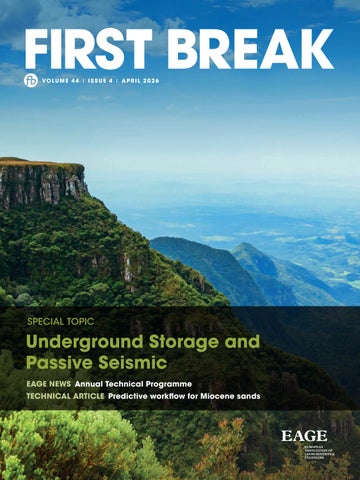
First Break April 2026 - Underground Storage and Passive Seismic

Page 1


SPECIAL TOPIC

Underground Storage and Passive Seismic

TECHNICAL

1,900+ Abstract Submissions 200+ Exhibitors

1,300+ Technical Presentations

12+ Strategic and Plenary Sessions

82 Topics Covered 4 Exhibition Theatres

Click here to check it out

FIRST BREAK ® An EAGE Publication www.firstbreak.org

ISSN 1365-2397 (online)

CHAIR EDITORIAL BOARD

Clément Kostov (cvkostov@icloud.com)

EDITOR

Damian Arnold (arnolddamian@googlemail.com)

MEMBERS, EDITORIAL BOARD

• Philippe Caprioli, SLB (caprioli0@slb.com) Satinder Chopra, SamiGeo (satinder.chopra@samigeo.com) Anthony Day, NORSAR (anthony.day@norsar.no)

• Kara English, University College Dublin (kara.english@ucd.ie)

• Hamidreza Hamdi, University of Calgary (hhamdi@ucalgary.ca)

• Fabio Marco Miotti, Baker Hughes (fabiomarco.miotti@bakerhughes.com)

• Roderick Perez Altamar, OMV (roderick.perezaltamar@omv.com)

• Susanne Rentsch-Smith, Shearwater (srentsch@shearwatergeo.com)

• Martin Riviere, Retired Geophysicist (martinriviere@btinternet.com) Angelika-Maria Wulff, Consultant (gp.awulff@gmail.com)

• Dong Zhang, Fugro (dongzhang1991@gmail.com)

EAGE EDITOR EMERITUS Andrew McBarnet (andrew@andrewmcbarnet.com)

PUBLICATIONS MANAGER

Hang Pham (publications@eage.org)

MEDIA PRODUCTION

Saskia Nota (firstbreakproduction@eage.org) Ivana Geurts (firstbreakproduction@eage.org)

ADVERTISING INQUIRIES corporaterelations@eage.org

EAGE EUROPE OFFICE

Kosterijland 48 3981 AJ Bunnik

The Netherlands

• +31 88 995 5055 eage@eage.org

• www.eage.org

EAGE MIDDLE EAST OFFICE

EAGE Middle East FZ-LLC

Dubai Knowledge Village PO Box 501711 Dubai, United Arab Emirates

• +971 4 369 3897

• middle_east@eage.org

• www.eage.org

EAGE ASIA PACIFIC OFFICE

EAGE Asia Pacific Sdn. Bhd. UOA Centre Office Suite 19-15-3A No. 19, Jalan Pinang 50450 Kuala Lumpur

Malaysia

• +60 3 272 201 40

• asiapacific@eage.org www.eage.org

EAGE LATIN AMERICA OFFICE

EAGE Americas SAS Av Cra 19 #114-65 - Office 205 Bogotá, Colombia

• +57 310 8610709 americas@eage.org

• www.eage.org

EAGE MEMBERS’ CHANGE OF ADDRESS

Update via your MyEAGE account, or contact the EAGE Membership Dept at membership@eage.org

COPYRIGHT & PHOTOCOPYING © 2026 EAGE

All rights reserved. First Break or any part thereof may not be reproduced, stored in a retrieval system, or transcribed in any form or by any means, electronically or mechanically, including photocopying and recording, without the prior written permission of the publisher.

PAPER

The publisher’s policy is to use acid-free permanent paper (TCF), to the draft standard ISO/DIS/9706, made from sustainable forests using chlorine-free pulp (Nordic-Swan standard).

Editorial Contents

3 EAGE News

15 Personal Record Interview — Fargana Exton

16 Crosstalk

19 Industry News

Technical Article

27 A predictive workflow for hidden Miocene sands: integrating rock physics, and machine learning for the Miocene prospect in the West Offshore Nile Delta, Egypt

Ramy Fahmy, Aia Dahroug, Manal El Kammar and Nadia Abd-Elfattah

Special Topic: Underground Storage and Passive Seismic

37 The Norwegian elephant awakens: The CCS reservoir for Northern Scandinavia

Kristian B. Brandsegg, Sougata Halder, Allan McKay, Bent Kjølhamar and Gunhild Myhr

45 Underground hydrogen storage

Stephen A. Sonnenberg

53 Price-flooring green hydrogen production and geological carbon sequestration

Ruud Weijermars and Simone Pilia

63 SADAR sparse network results from four years of microseismic monitoring

K.D. Hutchenson, D. Quigley, E.B. Grant, C. Yelton, J.Jennings and P.A. Nyffenegger

71 Engineered barrier materials for geological disposal facilities

Prof Brian G.D. Smart, Dr Carl F. Gyllenhammar and Dr Richard Stark

77 Screening mafic rocks at the basin scale for CO2 storage potential: Example from the Paraná Basin, Brazil

Craig Lang, Ashley Uren, Paul Helps, Joseph Jennings and Mark Reynald

86 Calendar

cover: The Paraná Basin, Brazil, where this month Landmark Halliburton discuss how mafic rocks are being screened for potential sequestering CO2.

37 The Norwegian elephant qwakens: The CCS reservoir for Northern Scandinavia.

European Association of Geoscientists & Engineers Board 2025-2026

Environment, Minerals & Infrastructure Circle

Andreas Aspmo Pfaffhuber Chair

Florina Tuluca Vice-Chair

Esther Bloem Immediate Past Chair

Micki Allen Liaison EEGS

Martin Brook Liaison Asia Pacific

Ruth Chigbo Liaison Young Professionals Community

Deyan Draganov Technical Programme Representative

Madeline Lee Liaison Women in Geoscience and Engineering Community

Gaud Pouliquen Liaison Industry and Critical Minerals Community

Eduardo Rodrigues Liaison First Break

Mark Vardy Editor-in-Chief Near Surface Geophysics

Oil & Gas Geoscience Circle

Johannes Wendebourg Chair

Timothy Tylor-Jones Vice-Chair

Yohaney Gomez Galarza Immediate Past Chair

Alireza Malehmir Editor-in-Chief Geophysical Prospecting

Adeline Parent Member

Jonathan Redfern Editor-in-Chief Petroleum Geoscience

Robert Tugume Member

Anke Wendt Member

Martin Widmaier Technical Programme Officer

Sustainable Energy Circle

Giovanni Sosio Chair

Benjamin Bellwald Vice-Chair

Carla Martín-Clavé Immediate Past Chair

Emer Caslin Liaison Technical Communities

Sebastian Geiger Editor-in-Chief Geoenergy

Maximilian Haas Publications Assistant

Dan Hemingway Technical Programme Representative

Carrie Holloway Liaison Young Professionals Community

Adeline Parent Liaison Education Committee

Longying Xiao Liaison Women in Geoscience and Engineering Community

Martin Widmaier Technical Programme Officer

SUBSCRIPTIONS

First Break is published monthly online. It is free to EAGE members. The membership fee of EAGE is € 90.00 a year including First Break, EarthDoc (EAGE’s geoscience database), Learning Geoscience (EAGE’s Education platform) and online access to a scientific journal.

Companies can subscribe to First Break via an institutional subscription. Every subscription includes online access to the full First Break archive for the requested number of online users.

Orders for current subscriptions and back issues should be sent to First Break B.V., Journal Subscriptions, Kosterijland 48, 3981 AJ Bunnik, The Netherlands. Tel: +31 (0)88 9955055, E-mail: corporaterelations@eage.org, www.firstbreak.org.

First Break is published by First Break B.V., The Netherlands. However, responsibility for the opinions given and the statements made rests with the authors.

Mike Branston Vice-President
Sanjeev Rajput President
Martin Widmaier Technical Programme Officer
Andreas Aspmo Pfaffhuber Chair Environment, Minerals & Infrastructure Circle
Maren Kleemeyer Education Officer
Johannes Wendebourg Chair Oil & Gas Geoscience Circle
Giovanni Sosio Chair Sustainable Energy Circle
Diego Rovetta Membership and Cooperation Officer
Eric Verschuur Publications Officer
Christian Henke Secretary-Treasurer

Comprehensive Technical Programme announced for Annual in Aberdeen

Following an excellent response to the Call for Abstracts, with more than 1900 submissions received, the Technical Programme has been finalised. It features over 1300 technical presentations spanning 82 topics. In addition, the Local Advisory Committee and EAGE Technical Communities have curated 26 dedicated sessions focused on areas such as energy transition, critical minerals, subsurface technologies, integrated geoscience and engineering, and applied industry case studies.

Martin Widmaier, Technical Programme Officer, said: ‘The Annual in Aberdeen will feature one of the most comprehensive and forward-looking technical programmes in recent years. It offers a unique opportunity to explore, learn from, and showcase the latest developments and applications in geoscience, technology, and related engineering disciplines.’

The programme is designed to serve a wide professional audience, from geophysicists and geologists to reservoir engineers, subsurface specialists, and energy transition professionals. Across four days, delegates can expect a dynamic mix of oral and poster sessions, strategic discussions, dedicated sessions and exhibition.

A major strength of the programme is its disciplinary breadth. Core tracks include geophysics, geology, petroleum and reservoir engineering, and integrated subsurface studies. These are complemented by strong coverage of energy transition topics, alongside dedicated strands focused on environment, minerals and infrastructure, as well as computer science and information management.

In geophysics, delegates will find a particularly rich programme covering seismic inversion, full waveform inversion, imaging theory, wavefield modelling, signal processing, seismic interpretation, rock physics, borehole seismic methods, distributed acoustic sensing, gravity inversion, electromagnetic methods, remote sensing, and near-surface characterisation. Artificial intelligence and machine learning are also prominent throughout the programme, with multiple sessions focused on their application in seismic imaging, velocity modelling, interpretation, characterisation, and processing.

The geology programme will span topics such as carbonates and evaporites, depositional systems, petroleum systems, structural geology, petrophysics and outcrop analogues. These sessions will provide valuable insight into both fundamental geological understanding and its practical application across exploration, development, and energy transition projects.

In petroleum and reservoir engineering, the programme will address dynamic reservoir characterisation and modelling, flow simulation, history matching, production optimisation, enhanced oil recovery, well performance and work-overs. These sessions will highlight how engineering workflows continue to evolve, especially through the growing use of digital tools and integrated analysis.

Integrated subsurface sessions will focus on field development and production, unconventional resources, exploration case studies, geomodelling, geomechanics, pore pressure and multidisciplinary studies. These sessions underline the importance of linking geoscience and engineering disciplines to support better decision-making across the full project lifecycle.

Energy transition will be a major part of the programme. Delegates can expect sessions on carbon capture and storage, geothermal energy, gas, hydrogen and underground energy storage, site operations and monitoring, screening and site characterisation, wind park site characterisation, and waste management and storage. These sessions will reflect the increasing role of

Latin America warms to geothermal 11 13 Winter camp in Saudi
Hannover is cool venue
Technical Programme committee at the selection meeting.

subsurface expertise in enabling lower-carbon energy systems and supporting the broader transition.

The programme also includes a growing focus on environment, minerals and infrastructure, with topics linked to low-carbon minerals, critical raw materials and infrastructure-related geoscience. In parallel, the computer science, standards and information management track will explore the digital and data-driven side of the industry, helping delegates understand how information, systems and standards support more efficient subsurface work.

A key feature of EAGE Annual 2026 will be its dedicated sessions, which add further depth and variety to the main programme. These sessions will cover themes such as space resources exploration, digital oil field and integrated modelling, critical minerals exploration, fluid flow mechanisms for energy transition resources, integrated geochemical and petroleum systems analysis, cost-effective monitoring for geological storage and geothermal projects, collaboration across CCS sectors, low-carbon minerals and mining, energy resilience, lessons from Ukraine, under-utilised data, risk-based decision-making, clear communication, production

management, geoenergy, mature basins, deep brines, marine geohazards, later life field management, and geothermal potential. Together, they will offer delegates dedicated discussion on some of the most relevant and fast-evolving topics in the field.

Strategic sessions will take place daily, providing a broader perspective on industry priorities, challenges, and opportunities.

Students will also have a place in the programme, with dedicated activities including a field trip on Monday morning. This helps to ensure the event supports both experienced professionals and the next generation of talent.

Overall, delegates can expect a programme that combines technical rigour with industry relevance, covering everything from conventional subsurface disciplines to the technologies and workflows shaping the future of energy. Whether attending for deep technical knowledge, cross-disciplinary learning, or strategic insight, participants can look forward to a conference programme with both scale and substance.

Visit eageannual.org/conference-schedule to check out the full programme.

Get ready for Annual Hackathon on AI

This year’s Hackathon at the Annual in Aberdeen, organised by the Technical Community on Artificial Intelligence, will test contestants’ ability to build and optimise a thriving city while powering the astronomical, escalating energy demands of advanced artificial intelligence. We asked the winners of the Hackathon in Toulouse last year – Xiaoxuan Zhu (University of Science and Technology of China) and Valentin Cassayre (EOST Université de Strasbourg) –about their experience of the competition on AI agents.

What motivated you to enter?

Curious about AI, yet not AI scientists, the Hackathon offered an opportunity to explore how data science and emerging technologies can be applied to Earth sciences, to challenge ourselves beyond the academic setting and to collaborate with others on real-world geoscience problems.

It was also a chance to learn from peers and mentors from diverse backgrounds, and to contribute a creative solution within a short, high-pressure timeframe, which was both exciting and rewarding.

What was the solution you devised?

Our core idea was that, even though AI agents have great potential, it is still not mature enough to replace human analysts in fields requiring certain expertise, for example seismic processing.

We developed the interactive quality control (IQC) assistant, a feedback-driven

system designed to streamline seismic data workflows. By leveraging the model context protocol (MCP) for seamless data access and processing, the system integrates large language models (LLMs) to intelligently select instructions and interpret complex geophysical plots.

The solution empowers geoscientists to load, inspect and analyse SEG-Y datasets while maintaining a persistent memory of user annotations and preferences to deliver increasingly optimised, feedback-driven QC workflows.

Was this a positive experience?

This hackathon provided a sandbox to bridge the gap between traditional seismic processing and agentic AI through handson experience with skilled AI scientists.

Implementing the MCP was a signifi cant technical milestone, as it allowed us to design a system where LLMs don’t just ‘chat’ about data but actively interact with

SEG-Y files. This deepened our understanding of how to build context-aware AI agents that can interpret complex geophysical plots and automate QC workflows. We also improved our ability to communicate effectively.

Would you encourage others to try the Hackathon?

It is an incredible learning experience, regardless of your level of expertise. It pushes you to think critically and creatively under time constraints, work in a collaborative environment, and address a real-world problem reaching a tangible solution in just a couple of days. The networking

DUG Elastic MP-FWI Imaging provides accurate models of of Vp, density, Vp/Vs, S-impedance and P-impedance ratio directly from raw field data. These quantities were derived without the need to generate angle stacks for an

inversion workflow.

The DUG Elastic MP-FWI Imaging derived quantities are geologically conformable and show a significant increase in resolution. We can readily identify the reservoir location and fluid effects — a beautiful example of a flat spot! info@dug.com | dug.com/fwi

Sustainable energy recovery on agenda for Annual

Eric Delamaide (IFP Technologies), member of the Technical Community on Enhancing Hydrocarbon Recovery for Sustainability looks forward to the Annual in Aberdeen in June and reflects on the participation of the community at Toulouse 2025.

The Community will participate again at the EAGE Annual 2026 in Aberdeen with a workshop on ‘Maximising subsurface recovery: From hydrocarbons to energy storage for a sustainable energy future’, which explores how integrated subsurface characterisation and engineering strategies enhance recovery and performance across hydrocarbons, EOR, geothermal, and energy storage. Focusing on efficiency, sustainability and innovation, it highlights advancements in geoscience, modelling,

and monitoring, featuring industry and academic case studies that support a low-carbon, resilient energy future.

Patricia Gusmao (Petrobras) presented a discussion focused on CO2 EOR in the Brazilian offshore pre-salt context, including an interesting section on CO2 sequestration. We learnt in particular that Petrobras had sequestered 53.8 million tons of CO2 by 2023 and were aiming to sequester 80 million tons by 2025.

Marcel Bourgeois from TotalEnergies presented a different perspective on the same topic. He made the case that gas EOR is not outdated and that it is very important for TotalEnergies as it concerns one quarter of their 2P reserves. His talk focused on some important technical aspects such as miscibility and why it is important to combine water and gas (WAG) for better results. He also discussed the merits of CO2-EOR vs CCUS.

Antoine Thomas, a consultant with eppok, presented a thought-provoking talk on waterflooding and polymer injection with a touch of psychology. He argued that the usual primary/secondary/tertiary approach was not the most efficient and exposed some of the flawed excuses used to delay EOR. He showed that polymer injection in particular should be used as soon as possible to accelerate recovery. In the context of a world where there is a clear need to reduce carbon emissions and at the same time a strong dependency on oil as the main energy source, EOR appears to be an indispensable and obvious tool to achieve these needs.

Join the community on LinkedIn

Watch out for dedicated sessions at NSG 2026 exhibition theatre

We are introducing for the first time an exhibition theatre at the Near Surface Geoscience Conference & Exhibition 2026 in Thessaloniki, Greece. It will provide the ideal interactive environment for our dedicated sessions of which two have been announced so far.

One of the dedicated sessions will focus on UXO and Object Detection, a field of growing significance as technology reshapes how unexploded ordnance and other buried objects are detected and managed. With advanced geophysical techniques and AI-driven tools, detection practices are becoming faster and more accurate. In these sessions, experts will share insights into the challenges of UXO

detection, presenting real-world examples and innovative approaches that improve operations and efficiency in the field.

There will also be a dedicated session focused on Infrastructure Planning and Monitoring, a critical field as infrastructure projects grow in scale, complexity and societal impact. Geophysical planning

and monitoring have become essential to ensure projects are delivered safely, efficiently and sustainably. This session will examine emerging workflows, monitoring techniques and practical solutions that optimise infrastructure management.

Stay tuned for more details on dedicated sessions and the exhibition theatre.

Deadline reminder for NSG 2026 call for abstracts

Don’t forget that the Call for Abstracts for NSG 2026 is currently open. Being part of the Technical Programme offers you the opportunity to share your expertise as part of the conference proceedings. At www.eagensg.org you will find a full list of topics, guidelines, the submission process and other relevant information. Abstracts need to be submitted by 15 April 2026, 23:59 CEST.

Antoine Thomas at the ‘Reassessing polymer flooding and the outdated ‘primary, secondary, tertiary’ model’ talk.

Hannover a model host for GET 2026

Hannover is a fitting host for the 7th EAGE Global Energy Transition Conference & Exhibition (GET). Long associated with Germany’s oil and gas sector, the city now sits at the meeting point of geoscience, energy systems, public policy and industrial change. That mix gives Hannover a clear relevance for a conference focused on how the energy sector is changing, and on the role of subsurface knowledge in that shift.

For delegates working in geoscience, applied geophysics and subsurface technologies, Hannover has particular weight. The city is home to Geozentrum Hannover,

a major geoscience hub that brings together the Federal Institute for Geosciences and Natural Resources, the State Office for Mining, Energy and Geology, and the Leibniz Institute for Applied Geophysics. That concentration of institutions gives the city a strong base in geoscientific research, regulation and applied expertise, closely aligned with many of the themes discussed at GET events.

Hannover also stands out for the way research and industry connect. The wider region brings together major energy players such as enercity and E.ON, university-led research and cross-sector networks that support collaboration in energy innovation. At Leibniz University Hannover, energy research is coordinated through the Leibniz Research Centre Energy 2050. It links around 30 institutes. Hannover is also part of ForWind, the joint wind energy research centre of the universities of Oldenburg, Hannover and Bremen.

That wider ecosystem matters because the energy transition is not being discussed in Hannover just in theory. It is visible in infrastructure, in research programmes and in practical city-level policy. Hannover and the surrounding region have adopted ambitious climate goals through their climate protection programme, aiming for a 95% reduction in greenhouse gas emissions and a 50% reduction in final energy demand by 2035, compared with 1990 levels, with climate neutrality targeted for the same year.

These goals are backed by practical measures. The region supports solar deployment through funding, advi-

sory programmes and a solar cadastre (registry), while the city also promotes energy-saving renovation and building efficiency. Hannover’s approach is not limited to adding new technologies, it also focuses on improving what is already there, especially in buildings, heating systems and local infrastructure.

The city is also part of major shifts in heat and low carbon energy supply. Enercity is advancing changes in Hannover’s district heating system, and one of the best-known examples is the geothermal project in Lahe, which is intended to supply a meaningful share of the city’s district heating demand. Alongside this, the region continues to expand solar energy, with Region Hannover reporting leading photovoltaic growth in Lower Saxony in 2024.

Hannover’s energy story also includes a record of innovation. The city is known as the site of the first operational wooden wind turbine tower in Hannover, a project that drew international attention as an example of alternative thinking in renewable energy engineering. It is also a regular meeting point for the sector through major trade fair activity, including EnergyDecentral in Hanover.

For our international audience, Hannover brings together the legacy of conventional energy, the technical depth of geoscience and the practical demands of the transition. That is exactly the context in which EAGE’s energy transition discussions are most useful, grounded in real systems, real constraints and real opportunities.

Learn more at eageget.org.

Mark AGMM in your agenda

Mark your calendar for the Annual General Meeting for Members (AGMM) taking place on Wednesday 10 June 2026 from 13:30 to 14:30 during our Annual Conference in Aberdeen, UK. This is your opportunity to meet the EAGE Board, learn about the activi-

ties of the past year and contribute to shaping the future of EAGE. We encourage members to attend and share their thoughts, ideas and feedback. Visit eage.org/about_eage/agmm for more details. We look forward to seeing you there!

Herrenhausen Gardens in Hannover.

We’ve added 18 new courses to our 2025 educational offering

EAGE continues to expand its portfolio of learning opportunities for geoscience and engineering professionals worldwide. In 2025 alone, 18 new courses were added, enriching a growing catalogue that spans multidisciplinary topics, skills and formats.

Some courses are delivered through Learning Geoscience, EAGE’s online education platform, which provides access to accessible expert-led training, complemented by self-paced and free learning resources that are available yearround.

One of the newest additions to the catalogue, for instance, is the Interactive Online Short Course on Exploitation and commercialisation potential of natural hydrogen held on 19-20 May 2026. Taught by a top instructor, Dr Arnout Everts, the online course brings an opportunity for geoscientists from all over the world to engage in a conversation about hydrogen taking a holistic approach.

Beyond online learning, in person courses are a key part of EAGE’s educational portfolio allowing participants to engage in direct discussions with instructors and peers and enabling hands-on exploration of complex topics.

EAGE’s new Masterclass on land seismic planned on 22-26 June in Pau, France, will bring participants close to field operations with a team of seasoned specialists, including nodal deployment, surveying and vibrator operation and testing.

Another new course on Structural geology must knows by Dr Pascal Richard scheduled in the Hague, Netherlands on 1-3 September 2026, combines fundamental knowledge on rock failure, faults and geological structures with a virtual reality field trip where participants can enter the simulations together under the guidance of the instructor.

Later this year, participants can dive into site investigation work for offshore wind farms, with a new course led by Jeroen Godtschalk and Barbara Cox SI fiction: Offshore wind development for geoscientists, from site investigations to wind farm design. The programme features a unique way of exploring new knowledge and skills through interactive decision making and project management exercises.

EAGE’s educational portfolio also includes in-house training where courses are tailored to companies’

EAGE Education Calendar

learning goals in an effort to make training practical and relevant to specific industry needs. The reasoning behind these courses lies in the importance of collaborating with companies and businesses that seek to improve teamwork and foster knowledge exchange by using company-related situations. Companies across different industries are welcome to access and engage with our portfolio.

Upcoming courses to note

Some of our new courses to watch out for are the interactive online short course on Introduction to offshore wind by Drs Barbara Cox and Jeroen Godtschalk on 12-13 May; the courses at the EAGE Annual Conference and Exhibition in Aberdeen; or Selecting suitable land seismic geometries by Drs Mostafa Naghizadeh and Andrea Crook at the Second EAGE Land Seismic Acquisition Workshop in Dubai, UAE on 16-18 November.

You can access the EAGE Short Course Catalogue on our website eage.org/education/short-course-catalogue and contact education@eage.org for questions.

12-13 MAY AN INTRODUCTION TO OFFSHORE WIND – BY JEROEN GODTSCHALK & BARBARA COX INTERACTIVE ONLINE SHORT COURSE 2 DAYS, 4 HRS EACH

19-20 MAY EXPLOITATION AND COMMERCIALIZATION POTENTIAL OF NATURAL HYDROGEN –BY ARNOUT JW EVERTS INTERACTIVE ONLINE SHORT COURSE 2 DAYS, 4 HRS EACH

7 JUN • INTRODUCTION TO MODERN MARINE SEISMIC SURVEYS: SCOPE, DESIGN AND IMPLEMENTATION – BY XANDER CAMPMAN

• LANGUAGE MODELS FOR GEOSCIENCE APPLICATIONS – BY THOMAS B. GRANT

8 JUN • CLASTIC SEQUENCE STRATIGRAPHY: CONCEPTS, METHODS AND WORKFLOWS –BY RENE JONK

• DATA VISUALIZATION PRINCIPLES FOR SCIENTISTS – BY STEVE HORNE

12 JUN • AI ACROSS RESERVOIR MODELLING WORKFLOW: A HANDS-ON INTRODUCTION –BY VASILY DEMYANOV & FARAH RABIE

• SEISMIC DATA PROCESSING FOR OFFSHORE WIND FARM DEVELOPMENT – BY SHAJI MATHEW

22-26 JUN EAGE MASTERCLASS LAND SEISMIC 2026 – BY CLAUDIO STROBBIA, ENRICO CERAGIOLI & CLAIRE GRIMSHAW

DURING EAGE ANNUAL 2026 ABERDEEN, UK

DURING EAGE ANNUAL 2026 ABERDEEN, UK

DURING EAGE ANNUAL 2026

ABERDEEN, UK

IN-PERSON COURSES PAU, PARIS

Every month we highlight some of the key upcoming conferences, workshops, etc. in the EAGE’s calendar of events. We cover separately our four flagship events – the EAGE Annual, Digitalization, Near Surface Geoscience (NSG), and Global Energy Transition (GET).

First EAGE/ALNAFT Workshop – Unlocking Hydrocarbon Potential of the West Mediterranean Offshore Frontier Basin of Algeria and Second EAGE/ALNAFT Workshop – Techniques of Recovery of Mature Fields and Tight Reservoirs 11–13 May 2026 – Algiers, Algeria

These workshops will discuss frontier exploration opportunities, reservoir optimisation and advanced recovery techniques. Through high-quality technical sessions, case studies and expert discussions, participants will gain valuable insights and engage in meaningful knowledge exchange. Join industry peers in Algiers for these focused, high-impact technical events. 50% discount on the registration fees for all African residents!

Early bird fee deadline: 5 April 2026

Regular fee deadline: 26 April 2026

Second International EAGE Land Seismic Acquisition Workshop 16-18 November 2026 – Dubai, UAE

The event offers a focused platform for sharing experience, innovation and practical insight across land seismic operations, with focused sessions on sampling, sensors, sources and field implementation. Contributors are invited to submit abstracts highlighting new technologies, case studies, lessons learned, and solutions to acquisition challenges in complex environments. With an emphasis on efficiency, data quality, safety, and operational excellence, the workshop encourages open technical exchange and discussion. This is a valuable opportunity to contribute to a high-quality programme and engage with peers shaping the future of land seismic acquisition.

Abstract deadline: 15 May 2026

EAGE Workshop on Exploration: Unlocking New Zealand’s Upstream Potential 1-2 September 2026 – Taranaki, New Zealand

New Zealand is entering a period of renewed momentum, shaped by maturing oil and gas assets, the reopening of offshore exploration, and increasing focus on geothermal energy, CCUS, and sustainable resource development. The workshop will bring together geoscientists, engineers, regulators, policymakers, and industry leaders to examine how exploration can be reimagined in a modern, low-carbon context. The workshop will showcase the geological potential of New Zealand’s onshore and offshore basins, highlight advances in subsurface imaging, digital technologies, and integrated workflows, and present real-world case studies spanning hydrocarbons, geothermal development and carbon storage.

Abstract deadline: 3 May 2026

First EAGE Conference on Basin and Petroleum Systems Modelling 17-19 November 2026 – Houston, USA

With this event, EAGE Basin & Petroleum Systems Analysis community recognises a clear gap in conferences and training opportunities dedicated to this discipline when professionals globally are applying these practices to both hydrocarbon provinces and emerging new energy ventures. The Call for Abstracts is open for topics such as Basin evolution and tectonics; Hydrocarbon systems analysis and modeling case studies; Advanced modelling techniques, workflows; AI in subsurface modelling; Basin modelling for energy transition; and Geochemical techniques to constrain maturity, migration and fluid properties.

Abstract deadline: 10 August 2026

WORKSHOP REPORT

Cooperation is key to seabed seismic evolution through innovation

The Third EAGE Seabed Seismic Workshop, held in Bahrain in November 2025, confirmed that seabed seismic has moved decisively. This report from workshop co-chair James Wallace (BGP Offshore).

Over three days, operators, contractors, technology providers and researchers met to exchange experience, challenge assumptions and assess how seabed seismic continues to evolve under increasing technical, economic and environmental constraints.

A key message emerged early: overall project performance is governed more by how surveys are designed and executed than by source or receiver technology. Many speakers emphasised that operational inefficiencies, rather than technology limitations, remain the dominant cost driver in ocean-bottom node projects.

The keynote presentations framed this theme clearly. One outlined a forward-looking vision that moves away from conventional, single-discipline acquisition towards multiphysics data. Advances in marine vibrators and autonomous operations illustrated a clear industry direction towards lower-impact, safer and more efficient seismic acquisition. The second keynote described a high-density OBN survey combined with DAS cable installed in existing wells. This resulted in a joint OBN and 3D DAS-VSP dataset, offering an alternative perspective on hybrid seismic acquisition.

Throughout the workshop, the importance of integration was repeatedly reinforced. Case studies demonstrated that even relatively modest improvements in planning can deliver meaningful efficiency gains, with direct benefits for cost, emissions and operational risk. Multi-purpose vessels capable of deploying both sources and receivers featured as a practical means of reducing vessel days and simplifying logistics. At the same time, closer interaction between acquisition, processing and imaging was shown to improve decision-making, maximising the quality of seabed seismic data.

One of the strongest technical themes running through the workshop was the growing recognition of near-field hydrophone

(NFH) data as a valuable seismic product. NFH recordings were shown to deliver high-resolution shallow imaging, support hazard identification, contribute to wavelet estimation and provide a valuable input to processing workflows. With ever-increasing pressures on seismic projects, several speakers stressed that fully leveraging all recorded data is of utmost importance.

Detailed discussions addressed clock drift, positioning errors and environmental effects, including currents, tides and water-column velocity variations. Millisecond-scale timing errors and centimetre-scale positioning inaccuracies accumulate through the workflow, with tangible consequences for imaging and full-waveform inversion (FWI). Continued research into accuracy, including clock technologies and environmental measurements, was highlighted as critical as the industry pushes towards higher resolution.

FWI featured throughout the programme, reflecting its transition to a routine component of seabed seismic workflows. Case studies illustrated improvements in velocity model accuracy, imaging in complex geological settings and the exploitation of sparse receiver designs.

Comparing this year’s discussions with those from earlier workshops highlighted both continuity and change. Themes such as sparse geometries, FWI and OBN technology have persisted, while NFH imaging, DAS, autonomous technologies and low-impact source technologies have moved to the forefront of our focus. There was also a clear shift towards longer-term thinking, with multi-year acquisition strategies and simplified contractual models increasingly viewed as enablers of efficiency, emissions reduction and sustained technical development.

Panel discussions played a central role in placing technical progress within a wider industry context. Sustainability, underwater noise, permitting and societal expectations were discussed alongside acquisition and imaging advances, reinforcing that future success will depend not only on better data, but on how seabed seismic aligns with broader environmental and regulatory frameworks.

The 2025 workshop reflects the next stage in the evolution of seabed seismic. Many topics that were once exploratory are now treated as established practice. At the same time, greater emphasis has been placed on areas shaping current practice. Together, these discussions highlight a marine seismic industry that is fully invested in seabed seismic, and increasingly focused on how best to manage, integrate and sustain it, both now and in the future.

In closing, a single word encapsulates the spirit of the meeting: cooperation. Continued success will depend on the willingness of the seabed seismic community to collaborate across disciplines, organisations and regions, and to collectively shape a resilient and innovative future for the technology.

Attendees discussed how seabed seismic technology needs cooperation.

Latin America workshop warms to geothermal energy discussion

Prof Rosa María Prol-Ledesma (National Autonomous University of Mexico) reports on the Third EAGE Workshop on Geothermal Energy in Latin America held last November in Liberia, Costa Rica.

A wide range of experts on geothermal energy from Latin America, North America and Europe focused the discussions on the potential of innovative geothermal technologies for both heat and electricity generation with special emphasis on Latin America developments and legislation.

The objective was to generate a space for analysis and discussion on aspects associated with lessons learnt, good practices, trends, promotion strategies and regulatory standards with reference to the commercial use of geothermal resources, both for electricity generation and their direct uses.

The Latin America region holds vast, largely untapped geothermal potential along the Pacific Ring of Fire, with Mexico, Costa Rica and El Salvador leading current development, though only a fraction of the estimated 55-70 GW potential (around 1.7 GW utilised) is online. Despite strong regional interest and initiatives from different organisations, like the Inter-American Development Bank, the increase in geothermal energy production has stalled in the last years in

the region but this workshop demonstrated that there are numerous efforts to increase the exploitation of geothermal resources not only in Latin America but also in Canada and Europe. Special attention was paid also to direct applications like providing heat for agricultural purposes (dehydration of crops, heat for greenhouses), cooling, and district heating in cooler areas.

Special talks on advances in regulatory modifications to promote geothermal energy production in several countries in Latin America forecast an important increase in private investment in geothermal projects. Some countries are enhancing legal frameworks to attract investment for both electricity and direct heating/cooling applications but there are still major legal issues to secure investment in major projects.

The importance of social and environmental issues was a major point. Several presentations and the field trip provided evidence of the relevance of including social and environmental concerns from the outset of a geothermal project especially in remote low-income communities. The environmental issues were evident during the field trip that showed the feasibility of protecting the conservation areas simultaneously with the development of the geothermal resources.

updates to specialised exploration methodologies and development of new areas. There was a review of the long-standing exploitation of geothermal energy in Costa Rica and Mexico and the general development of geothermal in Latin America. Additionally, the recent efforts to promote geothermal development in Canada were presented. New developments in direct use of geothermal heat for heating were addressed in the talk by colleagues from the University Centre in Svalbard.

An exhaustive review of a fundamental exploration methodology was presented by Yuri Abreu in his keynote talk about the role of geophysics in geothermal development. Progress in the application of nodal ambient noise tomography and resistivity models in exploration campaigns was evidence of the non-stop evolution of exploration methodologies to derisk the early stages of geothermal projects.

The novel applications for EGS exploitation were described in a special session on this topic that included an exhaustive review of the advancements in the last 50 years of EGS modelling and exploitation.

The keynote speakers presented a diverse range of subjects, from country

We are looking forward to the Fourth EAGE Workshop on Geothermal Energy in Latin America to continue the geothermal contribution to the energy transition in the region.

Geothermal workshop participants.

TECHNICAL COMMUNITIES

POWERING INNOVATION

TOGETHER

EAGE WELCOMES 2 NEW TECHNICAL COMMUNITIES

EAGE welcomes the new Technical Communities in Geomechanics and Radioactive Waste Storage. We keep strengthening collaboration to advance in innovation and shape the future of subsurface science together.

Geomechanics reflects beauty in a unique way where physics, chemistry, geology, and engineering meet to explain how the subsurface evolves and responds to human activity. In a short time, our EAGE Geomechanics Community has developed into a vibrant and active group led by a highly motivated team from industry and academia.

2 NEW COMMUNITIES WITH 700+ PARTICIPANTS ON LINKEDIN

EAGE HAS 16 TECHNICAL COMMUNITIES

UNLOCK OPPORTUNITIES FOR GROWTH

STUDENTS CAN APPLY FOR THEIR FIRST YEAR OF MEMBERSHIP FOR FREE (RE)ACTIVATE YOUR MEMBERSHIP TODAY!

Winter camp is highlight for students in Saudi

Memorable moment this year for the ‘King Fahd University of Petroleum and Mineral (KFUPM) Student Chapter was the ‘Winter Camp’. This was a joint desert gathering organised in collaboration with the Student Chapters of the International Association of Drilling Contractors (IADC), Society of Petrophysicists and Well Log Analysts (SPWLA), and American Rock Mechanics Association (ARMA). The event brought together students, faculty and researchers for a calm evening under the stars, strengthening community ties and encouraging informal exchanges in a unique setting outside the classroom.

at the local, regional and international levels, thereby enhancing their academic experience and career readiness.

members have joined from a wide range of countries spanning undergraduate, MSc and PhD students, bringing together participants from geosciences and engineering, as well as members from other departments. This diversity strengthens the Chapter’s dialogues and activities by combining different technical perspectives and career interests within one active community.

Faculty adviser, Dr Ammar El-Husseiny said: ‘I am delighted to witness the leadership, energy and passion of the active students. Through the Chapter, we aim to provide students with meaningful opportunities to engage with industry, develop professional skills and build connections with peers and professionals

Located in the Eastern Province of the Kingdom of Saudi Arabia, in close proximity to major energy operators and service companies, the Chapter uses this strategic setting to help bridge the gap between academic learning and the workflows, expectations and challenges encountered in the field.

A new Board was selected last August. Since then more than 15 new

The core activities focus on seminars, skills-based workshops and company visits. Technically, the Chapter maintains broad coverage across geology, petrophysics, geophysics, and petroleum engineering, while also aligning with the Kingdom’s Vision 2030 priorities by expanding engagement with carbon capture and storage (CCS) and wider energy-transition themes.

To learn more about the Chapter, contact the Chapter president Duha Shammar Dr Nabil Saraih (nabil.saraih@ kfupm.edu.sa).

University of Houston launches the first Student Chapter in US

The University of Houston is proud to announce the establishment of the first EAGE Student Chapter in the United States. This milestone reflects the growing global reach of EAGE and highlights Houston’s central role within the international energy and geoscience community.

The Chapter brings together MSc and PhD students from diverse backgrounds in geology and geophysics. It provides a platform for early-career scientists to exchange technical expertise, engage in inter-disciplinary collaboration and pursue professional development. Positioned in a Carnegie R1 research institution, the Chapter aims to serve as a bridge between academia and industry.

Members of the Chapter are actively involved in research spanning seismic imaging, machine learning applications,

structural geology and tectonics, subsurface fluid flow, basin analysis, and reservoir characterisation. By integrating geological and geophysical methodologies, the Chapter reflects the collaborative spirit required to address modern energy and environmental challenges.

The aim is to foster an inclusive and internationally connected network. Planned activities include technical talks from industry and academic leaders, hands-on workshops, webinars, and career development events designed to complement classroom education and provide practical exposure to real world geoscience applications.

By establishing this chapter, the University of Houston strengthens its engagement with the global EAGE community and offers students a gateway

to international collaboration, technical excellence and professional growth. To get involved or learn more, please contact Chapter president Ella Claxton (erclaxto@cougarnet.uh.edu) or Chapter advisor Jose Gorosabel (jmgorosa@central.uh.edu).

EAGE Student Chapter KFUPM.
First US Chapter students.

Telling the truth about shallow-water monochannel seismic data

A new EAGE publication reminds us that in offshore engineering and environmental studies, the most critical information often lies just a few metres beneath the seabed. Foundations for wind farms, pipeline routes, harbor structures and coastal protections all depend on understanding shallow sediments with accuracy and confidence. Yet too often, the rich information contained in high resolution seismic data is simplified, processed for appearance rather than meaning, and stripped of its true amplitude content.

That’s what Seafloor Characterization by Monochannel Seismic Surveys is all about. Written by Aldo Vesnaver, Luca Baradello and Fabio Meneghini, the book is both a practical manual and a methodological statement. It argues that monochannel systems such as Chirp and Boomer (sub-bottom profiling techniques used to map shallow underwater geology) deserve to be treated with the same rigour as larger multichannel surveys and that, when processed carefully, they can deliver far more than attractive images.

The motivation was concrete. While working on multichannel data from the Gulf of Trieste, Vesnaver learnt that a high-resolution Chirp survey in the same area had been processed using automatic gain control (AGC) alone. AGC enhances visibility but destroys true amplitude relationships, precisely the information needed to detect subtle lithological changes, shallow gas pockets or fluid escape features. The response was to develop a spherical divergence correction that accounts for

inelastic absorption in shallow sediments. Once applied, lateral variations in reflectivity became clear and plumes of fluids rising into the seawater could be identified with confidence.

From that starting point grew a complete workflow for extracting quantitative value from seismic systems that can be deployed from a small boat and operated from a standard PC. The book guides readers through the practical realities of Chirp and Boomer acquisition, explaining the trade-offs between bandwidth and resolution and showing how to recover amplitudes properly before applying advanced processing. Multiple reflections are not automatically discarded. Instead, they are analysed and, in the case of Boomer data with source receiver offset, even exploited.

One of the book’s strongest contributions lies in traveltime and amplitude inversion. By inverting reflection data, it becomes possible to estimate P wave velocity, layer thickness and acoustic impedance of shallow sediments. When amplitudes are incorporated into tomographic schemes, even density can be approximated. Absolute errors may not be negligible, but lateral variations, often the most critical parameter in marine geology and geotechnical design, prove stable and informative.

What truly sets this volume apart is its practical usability. The workflows are supported by ready-to-run code in MATLAB, Python and FORTRAN, each offering nearly identical functionality. The book also includes a SEGY file with real data, allowing readers to immediately

experiment with the code and explore the workflows hands on. They are rare and extremely useful. Students can follow a clear path from theory to implementation. Researchers can extend the algorithms. Professionals can immediately apply them to real projects.

Seafloor Characterization by Monochannel Seismic Surveys is more than a textbook. It is a working toolkit for anyone involved in offshore infrastructure or environmental monitoring, and a reminder that even the simplest systems, handled with care, can reveal the seabed’s most valuable secrets. For those working with shallow marine data, it is the kind of reference that earns a permanent place on the desk rather than on the shelf.

The book is available through EAGE EarthDoc, where interested readers can find further details and obtain a copy.

The EAGE Student Fund supports student activities that help students bridge the gap between university and professional environments. This is only possible with the support from the EAGE community. If you want to support the next generation of geoscientists and engineers, go to donate.eagestudentfund.org or simply scan the QR code.

Many thanks for your donation in advance!

Personal Record Interview

Starting in Azerbaijan, a career destined for the oil business

Her early fascination with ‘black gold’ has so far taken Fargana Exton from the oil fields of Balakhani, her birthplace in Azerbaijan, to working in the digital field in London, via a lengthy period in Australia. Recruited early as a geoscientist for SLB, she has managed career and family as well as mentoring and advocating for women.

Upbringing in Soviet occupation

I was born and raised in Balakhani, a small but historically significant district situated about 15 km from Baku. It is home to the legendary ‘Nodding donkeys’ scene from James Bond movie and is still pumping oil. My curiosity about the seemingly magical appearance of ‘black gold’ from the earth began early on and never faded. During my childhood, Azerbaijan was still part of the Soviet Union. After the USSR collapsed in 1992, many families, including mine, faced an abrupt disruption. Government jobs disappeared, and my parents, whose careers were in food and construction, had to adapt to new realities. Despite changes, I did well in school, and my parents encouraged me to pursue a career, ideally as a teacher, a path they considered secure and respectable.

University in Baku

I initially tried to follow their guidance, enrolling at university to study language and literature, but lasted only three months. My heart was drawn elsewhere –to the science behind oil, how it rose to the surface, and how much could be hidden below. Inspired in part by my uncles, both geoscientists, I redirected my studies to math and physics, subjects that felt both challenging and invigorating. This journey led me to Baku State University, where I delved into geophysics and seismology.

Recruited by SLB

During my final year, Schlumberger (aka SLB) recruiters visited my university, seeking dynamic field engineers – a per-

fect opportunity to connect my fascination with oil to practical experience and hopefully have a boundaryless career abroad. Teaching offered a safety net, and I even lectured part-time in geophysics, but the lure of fieldwork proved too strong. There was one catch: my fluency wasn’t English, as I studied French at school. Attending a two-month SLB training in Abu Dhabi, I learnt how much I’d have to adapt. It was there I met my future husband, whose Australian accent initially muddled my English even further (although I now occasionally speak with an Aussie twang after nearly two decades together).

First job in Azerbaijan

In 2008, my first role in SLB was as an onshore drilling rig, 200 km away from Baku. The global downturn in O&G in 2009 dashed my hopes of working offshore – a dream I still quietly nurture.

Move to Australia

Maintaining a long-distance relationship, with my then-boyfriend working in Egypt and later returning to Australia, was challenging. By 2010, I relocated to Perth, Western Australia to be with him and build a career as a borehole geophysicist. We married in a charming country ceremony, south of Perth. Australia felt like home: warm people, sunny days for eight months of the year. Even cricket, a sport I never expected to enjoy, became an unlikely passion of mine. Living there allowed me to thrive, both professionally and personally, and contribute to the vibrant Australian industry.

Present job/living in UK

After 13 years in Australia working in various capacities, I joined SLB’s London HQ to focus on digital and AI transformation. My husband moved on from SLB joining a UK engineering consultancy. Aside from fewer BBQs and pricier Ashes Test cricket tickets, everything felt familiar, and culturally enriching thanks to European travel opportunities on our doorstop. Our children flourished too.

Value of digital

Witnessing the digital revolution’s impact on industry reinforced my belief in technology as a tool for progress, when applied ethically. Automation and AI have transformed workflows. Sometimes, I wish technology had advanced sooner. I spent long hours manually interpreting seismic data, time better spent exploring innovative opportunities.

Volunteer work in industry

Today, I dedicate part of my time to mentorship. I have volunteered for the EAGE Young Professionals programme in the WEG community since 2019 and in SLB mentor through WISE (Women Inspiring Supportive Empowering). My next ambition is to present at the Women’s Global Leadership Conference.

Leisure time

Balancing life’s demands, I stay active with pilates and regular workouts, travel widely with the family, and relish adventures with my friends, be it hiking, exploring museums or unwinding in nature.

CROSSTALK

BUSINESS • PEOPLE • TECHNOLOGY

Oil in troubled waters

On 21 March Iranians began their 13-day celebration of Nowruz (New Day), a 3000-year-old festival that marks the spring equinox. The circumstances could hardly be more ill-starred for an occasion intended to mark new beginnings.

Unintended or not, the choice to go to war (a controversy beyond the scope of this column) has focused attention on the story of Iran’s massive energy resources, now under threat like never before. Its estimated 206 billion barrels are considered to be the third largest oil reserves in the world. Its gas reserves are also top-ranked, taking into account its South Pars field in the Persian Gulf connected to Qatar’s North Dome. The combined fields (total reserves of 1800 trillion cu ft of gas across 9700 km2) are independently produced, with roughly two-thirds being in the Qatar sector. While Iran’s South Pars production has been impaired by sanctions and abandoned by the international industry, oil majors and others have ploughed billions into making Qatar one of the top three LNG producers in the world, alongside the US and Australia. The vulnerability of these two fields in a military conflict has already been demonstrated.

Even more strategic is Kharg Island (8 km x 4 km), 25 km from the Iranian mainland, its very existence in the balance at the time of writing. One of the largest oil terminals in the world, its deep water available for docking very large crude carriers (VLCCs) has been responsible for at least 90% of Iran’s oil exports supplied by onshore and offshore pipelines, with a storage capacity of 34 million barrels.

production revenue, often associated with corruption and the development of autocratic regimes, of which Venezuela is another classic example.

Iran’s starting point for the finding of oil riches in the early 1900s was hardly auspicious. Long forgotten was its glorious past as one of the longest continuous civilisations, ruler of the geographically enormous Achaemenid Empire, under the legendary ‘king of kings’ Cyrus I (c. 559–530 BCE) and Darius I (522–486 BCE). By the 19th century Persia was a multi-ethnic, virtually bankrupt nation under the Qajar shahs, who basically enriched themselves at the expense of the population. A low point was the Great Famine of 1870-72: the death toll is disputed but likely to have caused a 20% decline in the population. (History would repeat itself with a catastrophic famine in 1917-1919 and again in 1942-43, these attributable to the country’s plight as a strategic territory in both the First and Second World Wars.)

‘Iran’s starting point for finding oil was hardly auspicious’

Energy vulnerability is nothing new for Iran. It experienced a major assault on its oil industry facilities in 1980 when the Abadan refinery was effectively destroyed during the early stages of the Iraq-Iran war.

Almost from its first oil discovery, Iran has been a model example of the turmoil that oil wealth can bring, often referred to as the resource curse or paradox of plenty. This is when the country’s economic growth becomes over-dependent on its oil

Persia’s fate in the 19th century was to be the pawn in the so-called Great Game between Russia and Great Britain. Historians note, however, that the country escaped actual colonisation. Russia sought to win access to warmer ports, expand its markets in Central Asia and contain British power in the region. Britain was mainly obsessed with protecting the trade routes to India, the Jewel in the Crown, for example, constantly worried about possible Russian intrusion via Afghanistan. Early on in the century Persia ceded significant territory in the Caucasus and Kazakhstan in the Russo-Persian wars. Later Britain would take advantage of the bankrupt government to win major economic concessions, even including the establishment of the Imperial Bank of Persia, allowing Britain major influence over the country’s finances and monetary policy.

The final humiliation for Persia in this period was the Anglo-Russian Agreement of 1907. It effectively ended the Great Game. Both countries were more concerned with containing the threat of emerging German imperialism. Without any say,

Persia was arbitrarily divided into three zones of protection — Russia in the north, Britain in the south, and a small neutral area sandwiched in between — all under the rule of a shah who was governing with a newly created parliament (in 1906) forced upon him following civilian unrest.

In 1908, a British geologist George Bernard Reynolds found the first oil at the Masjed Solyman in the southwest. It would initiate momentous changes in the country’s destiny and global geopolitics. Reynolds was working for a team of investors headed by British-born William Knox D’Arcy, who had made a fortune in Australia. The so-called D’Arcy Concession was signed on his behalf in 1901 with the ruler Mozaffar ad-Din Shah Qajar (weirdly, D’Arcy himself never visited the country). The heavily indebted Shah entered a 60-year exploration rights agreement in exchange for 16% of the oil company’s profits, the wisdom of which would haunt successive rulers.

In 1908, money had been running out for D’Arcy, his syndicate now working in collaboration with Bumah Oil. With no success, Reynolds had been ordered home by the investors when, in a final foray against orders, he struck oil. Things took off pretty quickly thereafter. The Anglo-Persian Oil Company (APOC) was founded in 1909 with Burmah providing the financing. By 1912, APOC was producing oil and shipping it to a newly built refinery on the island of Abadan, with a capacity of around 2500 barrels per day. Then the onset of the First World War changed everything.

benefits to Britain, fomenting resentment at the special treatment and perceived preferential lifestyle of foreign oil workers.

At the outbreak of the Second World War, so vital was the oil asset in Iran that Britain and Russia between them occupied the country. In 1941 they forced Khan to abdicate, said to be too close to Germany, and installed his more compliant son, Mohammad Reza Pahlavi. He would rule more or less uninterrupted until the 1979 revolution. The immediate postwar period witnessed the rise of Mohammad Mossadegh, an aristocratic populist from the pre-Shah Qajar elite, whose mantra was constitutional rule and the end of AIOC’s control over Iran’s oil. He was prime minister for a little over two years from April 1951, swept into office on a ‘nationalise oil’ platform. To the bemusement of many, he was famous for his theatrical oratory, often openly weeping, and for conducting diplomacy at home in his pyjamas affecting the impression of a dying man. Mossadegh did technically take over AIOC by passing legislation in Iran’s parliament. But a sweeping British blockade of the Abadan refinery and sanctioning of Iran’s oil and assets worldwide took its toll on the country’s economy and on Mossadegh’s support, deserted domestically by, among others, the religious establishment (the mullahs) which regarded him as too secular.

‘Ironically, Iranian oil production reached its peak in 1976’

Winston Churchill, then First Lord of the Admiralty, brought forward legislation in which the government would spend £2.2 million on acquiring a controlling interest in APOC and a 20-year contract guaranteeing the British Royal Navy a reliable flow of oil at significantly reduced price. This reflected Churchill’s determination to eliminate coal from warships and reduce dependence on American Standard Oil and Royal Dutch Shell. He famously boasted how ‘Fortune brought us a prize from fairyland beyond our wildest dreams. Mastery itself was the prize of the venture’. Production surged from a total annual production of 120,000 to 1 million tons by 1918 despite attempted disruption by Russian military and by Germany through Persian tribes. The Bolshevik revolution temporarily reduced Russian interest and holdings in Persia but by example lent weight to nationalist objections to the oil deal. A coup d’état in 1921 was engineered by an army officer, Reza Khan, who eventually became ruler in 1925 with a radical change programme.

Khan (later Reza Shah Pahlavi) instituted a rack of reforms to create a more modern Iran (as it became in 1935) but implemented with increasing authoritarian force. By 1940 Iran’s oil production was the fourth largest in the world but a lightning rod for unrest at home. A renegotiation of the oil agreement in 1933 created the Anglo-Iranian Oil Company (AIOC) but still extended substantial

Operation Ajax, a notorious coup orchestrated mainly by the US CIA (engineered in Tehran by a grandson of President Theodore Roosevelt) restored the Shah’s authority in 1953. He would go on to rule until 1979. To appease nationalist sentiment, in 1954, the Shah signed off on a consortium agreement with an international group in which BP (previously AIOC) was a 40% partner with five American companies (40%), Royal Dutch Shell (14%) and Total (6%). The group retained exclusive E&P and refinery rights. The big difference was that it was now a 50-50 profit share, providing revenue enabling the Shah to transform the country into a military and economic powerhouse, championing domestic reform, and emerging as a founding member of OPEC pushing for high oil prices. The dark side was repression of opposition by the SAVAK intelligence and national security operations, and the Shah’s notorious extravagance and unpopular courting of Western interests.

Ironically, it was in 1976 that Iranian oil production reached its peak of 6.67 million barrels per day. Under popular pressure, the Shah between 1973 and 1976 had forced international oil companies to cede operations, assets, and facilities to the National Iranian Oil Company. It was not enough to keep him in power. Despised by many sectors of Iran’s population, he and many followers fled the country, leaving Ayatollah Ruhollah Khomeini to return from exile in Paris to lead the Islamic Revolution and find managing oil as troublesome as ever. That story is still playing out. In the meantime, we may reflect on the words of 13th century Persian poet Rumi, ‘Raise your words, not voice. It is the rain that grows flowers, not thunder.’

Views expressed in Crosstalk are solely those of the author, who can be contacted at andrew@andrewmcbarnet.com.

Shearwater unveils ‘cheaper and greener‘ alternative to ocean bottom node surveys

Shearwater is developing Distributed Acoustic Monitoring as a ‘reliable, scalable tool’ for seismic subsurface monitoring.

Working with the Research Council of Norway (RCN) and Aker BP, the company has won research funding from the Norwegian government for a four-year project to turn existing fibre-optic cables into dense seismic arrays.

‘Today, oil and gas reservoir monitoring relies heavily on ocean bottom node (OBN) and towed-streamer surveys. These approaches are proven and highly capable, but not always the most practical fit for every objective. That’s where DAS becomes a potential enabler for a more cost-effective, practical monitoring,’ said Shearwater in a statement.

With the company posting a £15 million operating loss in its fourth quarter results, it is hoped that DAS could help to transform Shearwater’s fortunes in the longer term. ‘DAS has the potential to reduce time requirements and logistical complexity while lowering overall costs and environmental impact. Substantial sensing infrastructure is already in place, and we expect that more will be installed in the future,’ said Shearwater.

Shearwater will benchmark DAS against OBN, using data from Aker BP’s Edvard Grieg field. It will then adapt and scale Elementi Full Waveform Inversion (FWI) and Reverse Time Migration (RTM) imaging platforms for DAS. It will quantify uncertainty present in the subsurface models and images used for monitoring, with machine learning techniques and ensure scalability on GPU Infrastructure. Finally, it will design new monitoring strategies ‘tailored to the specific needs and advantages of surface- and well-based-DAS sensing platforms’.

‘We’re not setting out to replace OBN — at least not everywhere. But by combining DAS and OBN strategically, we aim to extend monitoring capabilities in ways that weren’t possible before,’ said Shearwater. Think lower cost, faster repeat surveys, uncertainty-quantified subsurface information from fewer data, and smarter decision-making.’

‘For projects with tight budgets — like many CCS and geothermal developments, DAS could be the only viable option. And for mature oil fields, it opens up the possibility of more frequent and flexible monitoring strategies,’ the company added.

‘We’re building tools that will plug directly into Shearwater’s Reveal platform including our state-of-the-art Elementi elastic full waveform inversion (FWI) and new machine learning frameworks – tested on real data and ready for realworld use. And with Aker BP’s field data and expertise baked in, we’re making sure this works where it counts,’ Shearwater added in its statement.

By 2029 Shearwater expects to validate the world’s first fully integrated DAS monitoring workflow that could reduce survey emissions by up to a third, while doubling the frequency of data collection, it claimed.

DAS could double frequency of data collection.

Viridien reports fourth quarter operating profit of $89 million and net profit of $52 million

Viridien has reported four quarter 2025 operating profit of $89 million on revenues of $277 million, compared to $49 million on revenues of $339 million in Q4 2024. Net profit of $52 million compared to $29 million in Q4 2024.

Full-year operating profit was $237 million on revenues of 1.165 billion compared with operating profit of $143 million on revenues of $1.12 billion in 2024. Full-year net profit was $71 million compared with $51 million in 2024.

Full-year Geoscience revenue of $444 million is up 10%, driven by all our three core basins and Earth Data revenue is up 6% to $406 million.

The company is expected to reduce net debt to $753 million.

Sophie Zurquiyah, chair and CEO of Viridien, said: ‘2025 was a pivotal year in advancing the asset-light strategy and financial transformation we initiated in 2018. Leveraging our proven competitive edge as an advanced technology and digital expert, we delivered very strong

operational performance and generated substantial cash, fully allocated to debt reduction. This performance reflects the strength of our business model, driven by highly skilled, excellence-focused teams and deep expertise in high-performance computing. In 2026, assuming a comparable business environment, we expect to generate a further $100 million in net cash flow, seasonality consistent with 2025. This will be dedicated to additional deleveraging, further strengthening the group’s financial structure.’

TGS launches 3D survey in Nigeria

TGS is shooting the Nigeria Laide multi-client 3D survey in partnership with SeaSeis Geophysical Limited.

The survey lies within the Outer Fold and Thrust Belt of the eastern Niger Delta and covers approximately 11,700 km2

The Laide multi-client 3D survey design is based on the GeoStreamer dual-sensor system, long offsets, wide tow, and a triple-source configuration, delivering modern broadband seismic data that supports full-integrity PSTM and Q-PSDM through advanced Elastic FWI-driven velocity model-building.

‘The implementation of this technology enables explorers to overcome the complex geological challenges of the deepwater eastern Niger Delta, including stacked toethrust structures, elongate anticlines (e.g. Bolia–Chota), inner fold-and-thrust-belt geometries, and shale diapirs/mud volcanoes,’ said TGS in a statement.

DUG and Searcher reprocess 3D offshore Malaysia data

DUG and Searcher Seismic have signed an agreement to reprocess multi-client 3D seismic data offshore East Sarawak.

The companies will reprocess more than 60 legacy 3D surveys covering an area of up to 45,000 km2 from original field data using its advanced FWI imaging technology and pre-stack imaging workflows to produce one seamless 3D seismic volume.

The reprocessed multi-client 3D dataset will be made available for licensing to

petroleum exploration and development companies, enabling them to undertake more extensive evaluations of the remaining hydrocarbon potential in and around existing fields and infrastructure.

The project is expected to commence in the first quarter of 2026 with final data available from early-2027. Interim results will be available to assist with early acreage evaluation.

Petrobras launches $30 million reservoir characterisation scheme offshore Brazil

Petrobras and partners in the Libra Consortium will invest $30 million in the Libra Rocks project to create geological models to be applied in Mero, Petrobras’ third largest field, located in the pre-salt layer of the Santos Basin, offshore Brazil.

Libra Rocks establishes a partnership between the consortium and the University of Brasília (UnB), the Federal University of Paraná (UFPR), and the Pontifical Catholic University of Rio Grande do Sul (PUC-RS).

‘Libra Rocks has the potential to reduce uncertainties in the production curve, increase efficiency in reservoir management, optimise the location of new wells, and improve knowledge about the timing of CO2 entry and oil loading in the reservoir,’ said Bruno Moczydlower, executive manager of Libra.

Among innovations, the use of artificial intelligence stands out for the development of algorithms capable of automating the processing of geological data. The technology will allow the construction of detailed models of the carbonate rocks in the Libra area.

The initiative aims to study the origin, composition, structure, and transformation of the rocks to understand characteristics

such as the distribution of pores (empty spaces) and permeability (the ability to allow the passage of fluids). Furthermore, it aims to increase knowledge about the geological evolution related to the opening of the South Atlantic, resulting from the separation between Brazil and Africa.

Another highlight is the ‘Digital Rock,’ which involves using ultra-high-resolution images to create 3D replicas of rock samples, expanding the ability to characterise oil reservoir rocks.

The reservoir of this field is among the most studied in Brazil due to its productive potential and technological challenges. Located at depths ranging from 5000 to 6000 m below sea level, and in water depths of 1800 to 2000 m, it stands out for its unique conditions, such as high salinity and high CO2 content, said Petrobras. Its formation is mainly composed of carbonate rocks originating approximately 125 to 113 million years ago. These rocks exhibit high porosity and good permeability, characteristics that favour the storage and flow of oil, it added.

‘These particularities reinforce the importance of deepening studies on the rock characteristics of the region to opti-

mise production,’ said Petrobras. ‘Furthermore, the results can generate geological knowledge with the potential to be applied in other fields of the pre-salt section of the Santos and Campos basins.’

Operations in the Mero unitised field are conducted by a consortium operated by Petrobras in partnership with Shell Brasil, TotalEnergies, CNPC, CNOOC, and Pré-Sal Petróleo SA (PPSA) as the contract manager and representative of the Brazilian government in the non-contracted area.

Shearwater reports operating loss of $15 million

Shearwater has reported a fourth quarter 2025 operating loss of $15 million on revenues of $169 million, compared with an operating loss of $24 million on revenues of $104 million in Q4 2024.

The company reported a Q4 2025 net loss of $37 million compared to a net loss of $39 million in Q4 2025.

Shearwater reported marine contract revenue of $98 million and multi-client revenue of $49 million in the fourth quarter, while software, processing and imaging revenue was $8 million. Shearwater’s fleet of 8.8 active vessels, including two OBN crews, was 67% ultilised. Its cost reduction and efficiency programme is on track to reduce headcount by some 20%. Cash flow from operations was $26 million compared to -0.2 million in Q4 2024. At quarter end the company reported a backlog of $316 million.

‘While marine acquisition activity remained low in the quarter, strong multi-client revenues drove a significant improvement in our results, underscoring the value-creation potential of our multi-client strategy,’ said Irene Waage Basili, CEO of Shearwater.

‘Recent client discussions increasingly emphasise reserve replacement, which is encouraging for the industry’s longterm fundamentals. Over time, rebuilding reserves to sustain production and energy security will require renewed investment in seismic acquisition and imaging, fully aligned with our strategic direction. To date, however, this shift has not translated into increased activity in our tendering pipeline. Against this backdrop, Shearwater has taken decisive measures to strengthen liquidity, simplify the organisation, and deliver material cost reduction to improve cash flow development.’

Floating production, storage, and offloading unit Guanabara operates in the Mero field, targeting the pre-salt layer of the Santos Basin.
Source: Petrobras.

Viridien has launched the 4300 km2 Charrua 3D multi-client survey in AREA-OFF 1 offshore Uruguay for client Sintanta.

Data acquisition will be conducted by the vessel BGP Prospector and Viridien will leverage its advanced seismic imaging technologies, such as time-lag full-waveform inversion (TLFWI), to deliver high-resolution subsurface images.

Acquisition fieldwork will take place over two seasons: February-April 2026 and November 2026-April 2027, with most acquisition relevant to the key prospects on AREA OFF-1 expected to be completed in the first season. Fast-track results from seismic data acquired in the first season are expected in Q4 2026, with full PSDM results from the first season expected in Q2 2027.

‘This project expands Viridien’s multi-client data footprint and demonstrates the company’s confidence in the long-

Geoex MCG launches Norwegian Sea reprocessing Viridien shoots 3D survey offshore Uruguay

Geoex MCG has launched Phase I of its Norwegian Sea reprocessing programme in collaboration with RockWave.

The RDI MC2D, acquired with an extended 16 s TWT record, images the full crustal thickness and the entire sedimentary column in the deep Vøring and Møre basins as well as in the North Sea.

The Regional Deep Imaging Project is supported by work conducted with the Geological of Norway (NGU) and the Norwegian University of Science and Technology (NTNU). Research by Peron Pindivic et al (2023) on the Norwegian Sea dataset (RDI19) underpins the consistent margin-domain framework applied across the area.

‘This reprocessing programme represents a technically innovative stepchange for the dataset, applying the latest advancements in broadband processing,

term potential of the southern Atlantic Margin in Latin America as basins offshore Uruguay share strong parallels with Namibia’s Orange Basin, where recent major light oil discoveries have confirmed a working Aptian petroleum system,’ said Viridien in a statement.

Robert Bose, chief executive officer of Sintana Energy, said: ‘We are excited to see activity on AREA OFF-1 beginning so soon after completion of our acquisition of Challenger Energy in December 2025. 3D seismic acquisition is a key next step in defining the potential of Uruguay’s offshore embedded within our transatlantic portfolio, and which is underpinned by a relationship with Chevron that spans the conjugate margins. We look forward to providing further updates on progress over the coming quarters.’

Sintana Energy holds a 40% non-operated interest in the AREA OFF-1 block, after the farm-out in 2025 of a 60% oper-

ating interest to an affiliate of Chevron, and is carried for the total anticipated cost of the 3D seismic acquisition program.

Seismic acquisition follows rejection by courts in Uruguay of interventions by activist groups, which Sintanta said demonstrated ‘the robustness of Uruguay’s environmental consultation and permitting process.’

Meanwhile, Viridien and BGP have entered into an agreement with the government of Guyana to launch a multi-client 3D seismic acquisition and imaging program across the shallow water acreage lots 2, 3 and 4, an area comprising approximately 25,000 km2

Data will be acquired by BGP and seismic imaging will be performed by Viridien, applying its proprietary advanced workflows, including shallow-water demultiple and time-lag full-waveform inversion (TLFWI).

noise suppression and velocity model-building,’ said Geoex.

Phase I of reprocessing focuses on delivering significant uplift to the Norwegian Sea portion of the survey through modern deghosting, designature, denoise and demultiple techniques, along with an enhanced velocity model for PSDM. These improvements will sharpen the imaging of Palaeozoic and Mesozoic stratigraphy and refine Top Basement definition, directly supporting improved charge modelling, reservoir prediction, and risk reduction during acreage evaluation, the company added. ‘MC2D provides the geological insight needed to understand source rock maturation and reservoir distribution across the Norwegian Sea.’

The fully reprocessed phase I dataset will be available in Q4 2026.

Regional Deep Imaging Project.
Source: Geoex MCG

US releases Alaska seismic datasets

The US Bureau of Ocean Energy Management’s Alaska Outer Continental Shelf Region has released five 3D seismic survey

datasets from the Beaufort Sea into the public domain with no restrictions on use or publication.

‘These datasets support informed decision-making by industry and government and also empower academic researchers and the public to better understand Alaska’s offshore resources,’ said Mick Bradway, acting director of BOEM’s Alaska Outer Continental Shelf Region.

The five datasets – B-02-99-AK, B-05-98-AK, B-04-97-AK, B-03-96-AK and B-01-95-AK – are available now at the National Archive of Marine Seismic Surveys. They encompass five geological and geophysical exploration permits, 10 original or reprocessed SEG-Y files, nine

survey areas and 232 square miles of Beaufort Sea lease areas.

The datasets were submitted to BOEM, which kept them confidential for a proprietary period, currently 25 years. After that period BOEM may release certain geophysical data and information to the public.

The National Archive of Marine Seismic Surveys is a collaborative initiative between BOEM and the US Geological Survey. It offers a public platform for accessing seismic data collected by or contributed to US Department of the Interior agencies.

BOEM said it is planning additional legacy seismic releases on a rolling basis.

BGP shoots 2D survey offshore Angola

BGP has completed a 2D seismic acquisition project at the operated KON-16 Block, within the Kwanza Basin, onshore Angola for client Corcel.

The 326-line km of high resolution 2D seismic data acquired over the KON16 block provides clear imaging of key pre-salt structures increasing confidence that the acquisition will lead to multiple derisked pre-salt and post-salt drilling opportunities within KON-16, said Corcel.

Seismic processing by DUG will follow with results expected throughout the year to support prospect maturation and drilling preparation.

‘The initial field data shows the positive impact of the high specifica-

tion acquisition parameters designed specifically to image the high-graded pre-salt prospects in KON-16, advancing prospect definition and supporting the company’s progression towards drilling the high-impact KON-16 exploration well,’ said Corcel in a statement.

The onshore Kwanza basin has 2589 line-km of 2D data acquired in 2010 and reprocessed in 2025. Over KON16 there are 143 line-km of 2D data.

Acquiring 326 line-km of new 2D data provides a 227% increase in seismic coverage inside KON-16, which will greatly increase the subsurface imaging, prospect definition, and decrease exploration risk, said Corcel.

Current modern 2D line spacing averages >14 km in the areas of interest, and while this is sufficient to identify prospectivity, especially when integrated with the eFTG (high-resolution gravity gradiometry) data acquired in 2024, a closer 2D line spacing of 2.5 km was achieved, which is beneficial when moving on to drilling, said Corcel.

The seismic campaign was designed to cover specific prospects high-graded by the Corcel team and to build on the work done in 2025, integrating the legacy 1970s 2D data, the 2010 2D seismic data (which was recently reprocessed), and the 2024 eFTG data.

Raw data is ‘excellent’, said BGP.

TGS redeploys vessel after cold stack

TGS vessel Ramford Vanguard has been reintroduced for a new acquisition campaign for the upcoming European summer season, following its winter-stack period.

The campaign is scheduled to begin in mid-March with an oil and gas site survey, before continuing with two offshore wind

contracts. The current plan extends acquisition activities well into the third quarter.

Kristian Johansen, CEO of TGS, said: ‘We see opportunities for more work in the market, and if we are successful the campaign may be extended further toward the end of Q3. Our Ultra High Resolu-

tion 3D streamer solution has a proven track record within the offshore wind site characterisation market. We are now taking another step and will do our first oil and gas site survey, thereby broadening our product offering and leveraging our technology to optimise asset utilisation.’

Westwood forecasts up to 19 high-impact wells this year

Africa and South America will remain the dominant regions for high impact drilling with 19 and 15 wells respectively in 2026, according to Westwood.

It forecasts around 65 high impact wells to complete in 2026, in line with 2025, but current projections suggest that the slowdown in high-impact exploration drilling will continue as explorers continue to exercise capital discipline.

In Africa, four wells are expected in the Orange Basin in Namibia and Chevron plans to drill Gemsbock, the first well in the frontier Walvis Basin since 2018. Four wells are due to complete in the Tano-Ivorian Basin with three by Murphy, including the unsuccessful Civette well completing in January 2026, Caracal currently drilling and Bubale expected to spud later in the first quarter. Key frontier basin tests this year include Eni’s Matsola well in the offshore Sirte Basin, TPAO’s Curad-1 offshore Somalia, Shell Velox’s well in the Herodotus, and Azule’s Piambo well in the Namibe.

In South America, the Suriname-Guyana Basin and the Santos and Campos basins in Brazil will continue to host the majority of the high-impact drilling from the region. Petronas is expected to lead the high-impact drilling in Suriname with at least two wells. Shell recently completed drilling at its unsuccessful Araku Deep well targeting a frontier Lower Cretaceous clastic play on the Demerara Plateau. In the Santos Basin, BP’s Tupinamba will target a large pre-salt prospect next door to its giant Bumerangue discovery, made in 2025. Elsewhere across South America, key frontier wells could be drilled in deepwater Uruguay and offshore Peru. The frontier deepwater of Brazil’s Equatorial Margin is expected to be a focus area for Petrobras, with Morpho currently drilling in the Foz do Amazonas. Further southeast in the Potiguar Basin, Petrobras will drill the Mãe de Ouro well, a follow up to the 2024 Anhanga discovery.

In Asia Pacific, 10-12 high impact wells are expected in 2026. Key frontier deepwater carbonate tests are expected offshore Papua New Guinea at Mailu and in deepwater Malaysia at Jampuk and Langka. Petronas may spud its first frontier well at Akbar-1 in the Bobara PSC, eastern Indonesia. Eni continues its exploration programme in the Kutei Basin, Indonesia, where it is currently drilling a large Miocene fan prospect at Geliga. In India, ONGC and Oil India will finish their Andaman and Kerala-Konkan fron-

tier campaigns in early 2026, with the next high-impact campaign likely to be Vedanta’s (Cairn India) deepwater Krishna-Godavari drilling in KG-DWHP-2017/1. In Australia, Santos is expected to make the long-awaited return to exploration in the Roebuck Basin targeting potential Triassic plays at Curie and Ara from late 2026.

High-impact wells are expected in Uzbekistan, Kazakhstan, Kuwait and Turkey. Offshore Kuwait, KOC’s Riquah-3 follows on from the largest discovery of 2024 (Al Nokhetha). The well is targeting a deeper Jurassic play in the sparsely explored offshore. In Russia, the Kontrovichskoye well was recently being announced in the Yamal Peninsula.

In Europe, six high impact wells are expected in 2026. Equinor’s Vikingskipet well in the Barents Sea completed in mid-February as a dry hole. Other planned high-impact wells in Norway include Var Energi’s Lakris and Aker BP’s Alpehulme. In the Bulgarian Western Black Sea, OMV Petrom will drill the Krum well, which is a key test of the emerging Upper Miocene and Pliocene turbidite play after the Vinekh failure earlier in 2026. Across the border in Romania OMV Petrom also plans to drill the Anaconda prospect ~37km south of the Domino gas field.

In North America five high-impact wells are expected. bp’s Conifer-1 targeting a large prospect in the US Gulf and 2026 will mark its return to the Paleogene. BP also plans to drill a high-impact ILX prospect on the NW flank of the Kaskida discovery, and Shell, Chevron and TotalEnergies are all expected to drill high-impact wells in the US Gulf.

Geoex MCG and DUG reprocesses data offshore Caribbean

Geoex MCG and DUG have reprocessed more than 18,0000 km of seismic data in the Caribbean.

The Greater Caribbean Basin Synthesis is a multi-phase exploration project mapping the Orinocco Delta, Perla and

Dragon fields spanning Trinidad and Tobago, Barbados, St Vincent, Grenada, Nicaragua and Mexico.

The first set of data – comprising three newly reprocessed datasets – forms parts of a larger campaign offering access to

approximately 40,000 km of 2D seismic and 4500 km² of 3D seismic data.

‘Our ongoing reprocessing work is focused on illuminating offshore gas accumulations and identifying key prospects of interest,’ said Geoex.

High Impact Wells in 2026: Westwood has identified 15 key wells to watch
Source: Westwood Wildcat

Geoex MCG releases Venezuala seismic data

Geoex MCG has released multi-client seismic data offshore Venezuela.

Three large offshore areas, covering more than 18,000 km, have been reprocessed in 2025 by DUG Technology, dramatically enhancing imaging quality and revealing new prospectivity across the basin, said Geoex.

The company also manages approximately 40,000 km of vintage 2D and 4500 km2 of vintage 3D data volumes, which form part of a multi-phase exploration program.

‘The first data has been made available from Venezuela and processed pursuant to an OFAC specific licence issued to the company. Our announcement aligns with the recent US measures easing restrictions on energy sector services to Venezuala. These developments provide clearer guidance for international companies seeking to license seismic data in accordance with US regulatory requirements,’ said Geoex in a statement.

‘Venezuela is entering a phase of unique commercial opportunity, and

Geoex MCG is already on the ground with the seismic insight explorers will need for early evaluation,’ said Robert Sorley, president Geoex MCG. ‘Underpinned by our access to the vintage offshore Venezuelan seismic library, the development of the US licensing framework, and partnership with DUG Technology to reprocess to whole offshore, we’re proud to offer this exclusive regional seismic coverage to the exploration industry.’

Venezuela has long been known for major oil and gas accumulations, from Lake Maracaibo to the Columbus Basin, but modern seismic coverage has historically been limited, said Geoex.

‘The regional coverage provides companies with a broad view of basin trends, supporting early stage opportunity ranking and portfolio planning by assessing underexplored frontier zones adjacent to existing producing areas; mapping self-similar structural trends and DHIs with confidence; and reducing early-stage subsurface risk and accelerate prospect maturation,’ said Geoex in a statement.

US predicts 100 more years of oil and gas exploration

The US has declared 66 billion barrels of oil and 218 trillion ft3 of natural gas remain undiscovered in the Outer Continental Shelf giving the potential for 100 or more years of energy production from the shelf.

The US Bureau of Ocean Energy Management (BOEM) has released the 2026 National Assessment of Undiscovered Oil and Gas Resources, an estimate of the undiscovered, technically and economically recoverable oil and natural gas resources outside of known oil and gas fields on the US Outer Continental Shelf.

‘The Outer Continental Shelf holds tremendous resource potential,’ said BOEM acting director Matt Giacona. ‘This report provides the foundation for decisions that will ensure affordable

energy and robust energy security for generations of Americans.’

The findings are derived from analysing each geologic play across the Outer Continental Shelf and assigning a probability for the existence of undiscovered oil and gas resources for individual plays, said BOEM. Play results are then aggregated up to regional results and ultimately, a total Outer Continental Shelf estimate.

Meanwhile, the US Bureau of Ocean Energy’s Lease Sale Big Beautiful Gulf 2, or BBG2, has generated $47 million in high bids. The sale included 25 blocks covering approximately 141,000 acres in federal waters of the Gulf of America. Thirteen companies submitted 38 bids totalling $70 million.

ENERGY TRANSITION BRIEFS

Saipem and Capsol Technologies have entered into a cooperation agreement to develop projects of mutual interest in the Hot Potassium Carbonate (HPC) segment.

TGS has signed a brokerage agreement with a ‘major global renewables developer’ to offer its offshore wind measurement datasets from a northern European country available to the broader market. The two-year high-resolution datasets, captured using LiDAR and met-mast technologies, provide inputs that help to de-risk early-stage yield assessments and support more accurate turbine design specifications.

The UK maintained the top spot in Europe’s offshore wind market in 2025, installing 1.3GW of offshore capacity, the second largest globally after China, according to BloombergNEF’s Global Wind Turbine Market Shares 2025. The UK is also attracting new supply-chain investment, with Chinese turbine maker Mingyang announcing plans to invest up to £1.5 billion in a Scottish wind turbine factory with Octopus Energy.

Getech has signed an agreement with Swedish geothermal technology company Jordkraft Energy AB. The companies will explore opportunities including: geothermal site screening and feasibility studies; collaboration on commercial tenders; and joint funding applications.

Fugro has won a contract from Oriel Windfarm Ltd to deliver a detailed geotechnical site investigation that will inform the design and installation of foundations for 25 offshore wind turbines. Located off the coast of County Louth, the 375 MW project is planned to be among Ireland’s first commercial-scale offshore wind farms and is being jointly developed by JERA Nex bp and the Irish semi-state utility ESB.

Low Carbon has reached financial close on its first battery energy storage system (BESS) project in Poland. The 8 MW Przeworsk project, located near Rzeszow in southeastern Poland, is expected to be operational early next year.

BRIEFS

The US Bureau of Ocean Management is preparing an environmental impact statement for proposed oil and gas lease sales in the Northern, Central and Southern California Planning Areas of the Outer Continental Shelf. The programmatic environmental impact statement will support the first Central and Southern California lease sales currently scheduled for 2027.

Equinor and Wellesley Petroleum have established a joint exploration project aimed at increasing high-pressure, high-temperature (HPHT) exploration activity on the Norwegian Continental Shelf and contributing to long-term production from existing infrastructure. The project will drill up to 15 exploration wells in 2027–2030. Wellesley will target operating up to 3–5 HPHT wells per year.

Aramco has reported fourth quarter net income of $25 billion and full-year net income of $105 billion. Cash flow from operating activities was $41 billion and $136.2 billion for the full year. Capital investment was $52.2 billion in 2025. In 2026 capital investment guidance is $50-55 billion. The company announced a share buyback program of up to $3 billion over 18 months.

Australia’s Northern Territory Government has launched an onshore petroleum acreage release in the Beetaloo Sub-basin. Applications are now open across 50 full and part blocks in acreage release EPNT26-1. The acreage is 4000 km2 and is located near the Amadeus Gas Pipeline and the Stuart Highway within the highly prospective Beetaloo Sub-basin, one of Australia’s most significant onshore shale gas plays.

Eni has reported fourth quarter net income €1.2 billion ($1.4 billion), up 35% year-on-year. Cash flow from operations of €3 billion ($3.5 billion) is up 4% year-on-year. In 2025 the company delivered six big projects in Angola, Indonesia, Norway and Congo. Full year production of 1.73 million boe/d ‘exceeded expectations’.

Viridien teams up with NVIDIA to enhance seismic imaging

Viridien is collaborating with NVIDIA to transform seismic imaging workflows by leveraging NVIDIA HPC platforms and Viridien’s expertise in subsurface imaging technologies.

The collaboration will optimise Viridien’s seismic imaging algorithms on NVIDIA accelerated computing platforms, including the integration of advanced techniques such as tensor cores and mixed-precision computing.

John Josephakis, VP of HPC and supercomputing, NVIDIA, said: ‘By combining NVIDIA accelerated computing platforms and AI with Viridien’s expertise in seismic imaging and HPC, together we are enabling subsurface teams to deliver sharper, more reliable images faster and more cost-effectively. Better imaging reduces uncertainty, improves prospect screening and well placement decisions, and ultimately lowers the cost of exploration by cutting dry hole risk and minimising the time and compute required to reach decision-grade results.’ Viridien said the agreement would accelerate HPC for seismic imaging.

Meanwhile, Viridien has launched a new regional multi-client data initiative for the offshore basins of India.

The initiative will start with the Phase 1 Mahanadi Basin reimaging and merging of approx. 9000 km2 of 3D seismic data over the offshore East Coast Mahanadi Basin.

The aim of the Phase 1 Mahanadi Basin reimaging project is to provide higher-quality imaging over proven petroleum system areas, as well as deeper-water areas where exploration of new thermogenic plays has been challenging owing to low-quality imaging of legacy data. Viridien will apply imaging technologies, such as time-lag full-waveform inversion (TLFWI) and least-squares PSDM (LSQPDSM), to address these challenges and produce seamless, merged 3D datasets.

Dechun Lin, head of earth data at Viridien, said: ‘The innovative imaging technology and regional expertise provided by Viridien, combined with phased project expansion throughout the Mahanadi Basin, will drive new exploration and investment opportunities for emerging plays, and support both ongoing and future bid rounds.’

Fast-track results will be ready by June 2026, with final data available by the end of 2026.

Viridien said it its subsurface imaging powered by HPC reduces exploration risk and informs better drilling decisions. Example from the Laconia Phase I 12Hz E-TLFWI dataset in the US Gulf (image courtesy of Viridien Earth Data).

A predictive workflow for hidden Miocene sands: integrating rock physics, and machine learning for the Miocene prospect in the West Offshore Nile Delta, Egypt

Abstract

Egypt prioritises Miocene hydrocarbon exploitation in the eastern Mediterranean West Offshore Nile Delta (WOND) licence. This study integrates Amplitude Versus Offset (AVO) analysis with machine learning to improve prospect identification and reduce exploration risk. Deterministic geophysical interpretation and data-driven modelling using Gradient Boosted Decision Trees (GBDT) and neural networks identify seismic abnormalities and predict subsurface facies.

AVO analysis interprets amplitude and polarity shifts to find direct hydrocarbon indicators (DHIs) and classify anomalies into AVO Classes II, IIp, and III. Additionally, machine learning can discover subtle gas-charged sands by collecting complicated, non-linear connections between seismic properties and well log data. Rock physics study, including 85% gas substitution scenarios, proves the workflow’s robustness.

The findings identify gas sands with AVO Class II responses and good porosity and low acoustic impedance contrasts. These traits appear as soft amplitude anomalies in near-angle stacks and increasing amplitude brightness in far-angle stacks. Gas sand probability volumes using machine learning match seismic amplitude readings, boosting interpretive confidence. Application to WOND Miocene and Pliocene case studies confirms the workflow’s ability to define prospective reservoirs and reduce uncertainty.

This combined AVO and machine learning system strengthens subsurface characterisation in geologically complicated environments, aiding offshore basin exploration and development decisions.

Introduction

The WOND licence is situated 100 km offshore from Alexandria city in the Mediterranean Sea, covering an area of approximately 1800 km2 enclosed in a rectangle 70 km (inline, NE-SW), and 20 km crossline (Figure 1).

The geological deposits within the WOND licence consist of sandstones and mudstones arranged in fining-upward composite patterns, indicative of a channelised depositional system. The geological deposits are made up of significant net volume sands (Cross et al., 2009).

The WOND licence has certain important geological features, such as the Rosetta fault, which runs from the northeast to the southwest, the Nile Delta Offshore Anticline (NDOA), which runs from the east-northeast to the west-northwest, and fault blocks that have rotated northeastward along the licence boundary (Ahmed et al., 2001). The Upper Pliocene channels’ depositional geometries, on the other hand, are not influenced by these significant structures. The thickness and sedimentation patterns across them stay the same (Samuel et al., 2003).

1 Rashpetco Company | 2 Cairo University

There are around 20 exploration and appraisal wells and more than 80 development wells in the study area. These fields exhibit bright amplitudes in far-angle stacks, (Othman et al., 2021). The production zones extend to a depth of only 3 km true vertical depth below mudline (TVD BML) and include the Upper Pliocene (Figure 2).

Seven failure cases were also observed in the region. One exploration well tested for AVO class IIp gas sand within the Pliocene level but encountered brine sand. A precisely focused Messinian non-clastic formation revealed an absence of sand. The remaining wells, drilled in the Miocene section based on geological models, encountered water sand (Monir and Shenkar, 2016).

This paper builds on insights gained from two earlier studies conducted in the West Nile Delta. The first study applied artificial neural networks (ANN) to identify low-amplitude, impedance decrease (soft kick) gas prospects within the Upper Messinian section, demonstrating the effectiveness of artificial neural networks (ANN) in detecting subtle seismic anomalies (Abd-Elfattah et al., 2025). The second study extended this

* Corresponding author, E-mail: ramyfahmy@gstd.sci.cu.edu.eg; RamyFahmy85@yahoo.com DOI: 10.3997/1365-2397.fb2026022

Figure 1 (a) Satellite map (Google Earth) showing the location of the West Offshore Nile Delta licence. The bottom-left inset, bordered in black, provides a regional context of Egypt, where the black rectangle highlights the specific study area shown in the main map. END-2 represents one of the wells utilised in this study. (b) Detailed map of the study area. The green rectangle delineates the specific licence boundaries. The solid brown line indicates the location of the seismic profile shown in Figure 2.

approach to the deeper Miocene interval, targeting similarly elusive low-amplitude responses (Fahmy et al., 2025). Building upon these foundations, the current research focuses specifically on the concept of ‘invisible sand’ gas-charged reservoirs with impedance values nearly identical to the surrounding lithology, making them challenging to detect using conventional interpretation techniques. To address this, the study employs an advanced machine learning algorithm that integrates seismic attributes, rock physics modeling, and well data to enhance the classification and de-risking of these subtle targets. This workflow aims to

improve hidden prospects identification and reduce exploration uncertainty in complex deepwater settings.

Methodology

Building on our previously published and well-received study on predicting Miocene AVO Class II responses through rock physics modelling (Fahmy et al., 2025), this research advances that work by applying the established rock physics template and workflow to identify deep AVO Class IIp prospects. In this study, the analysis was extended beyond well-based interpretation to a 3D seismic cube, incorporating machine learning to classify and map AVO Class IIp anomalies at a larger scale. The methodology integrates well log interpretation, rock physics modelling, stochastic analysis, and seismic attribute evaluation to de-risk Miocene prospects. Well logs from both Miocene and Pliocene intervals were classified into six lithology and fluid facies based on clay volume and water saturation cut-offs, and fluid substitution modelling (with 85% gas saturation) (Cross et al., 2009), was applied to evaluate impedance responses. P-impedance trends revealed that Pliocene gas sands typically exhibit lower impedance than the background, while Miocene gas sands often show similar or higher impedance, complicating seismic identification. AVO Class II impedance decreases (soft kicks) were identified as key DHIs, with their occurrence strongly influenced by porosity and cap rock type, favouring sandy shale over shale. A Monte Carlo stochastic simulation workflow (Metropolis et al., 1953; Dubrule, 2003; Pyrcz and Deutsch, 2014) was used to model intercept and gradient variations for different lithology and cap rock scenarios. This approach, integrated with geostatistical modelling frameworks, confirmed a higher probability of AVO Class II detection in sandy shale-capped reservoirs. Seismic analysis demonstrated that the brightest amplitudes correspond primarily to AVO Class I impedance increase (hard kicks), which may represent either gas or water sands, while AVO Class IIp signatures

Figure 2 A regional section indicating the Pre-Tertiary to Pliocene units. The vertical axis represents the True Vertical Depth subsea (TVDss) in metres. The horizontal axis indicates the total distance of the profile, extending 80 km from west to east. The primary producing zone is the Pliocene.
Figure 3 Synthetic gather analysis for END-2 well shows AVO classes IIp for gas sand and water sand for Abu-Madi Miocene, after El-Ata et al., 2023.

often appear transparent. Additional interpretation showed that calcareous sands and shales exhibit high impedance, reducing the likelihood of impedance decrease (soft kick) responses, and that unsuccessful wells were commonly associated with low-porosity or calcareous sands. The full workflow was presented in the previous study, and in the current work several Miocene prospects exhibiting AVO Class IIp behaviour were identified.

The research region lacks gas sand classified as AVO class IIp anomaly; a nearby example was cited as gas sand for AVO class IIp from the Abu-Madi Miocene (El-Ata et al., 2023). An example of water sand as AVO class IIp is demonstrated by the polarity reversal between the near-angle stack (0-10Θ) and far-angle stack (30-40Θ) events, while water sand as AVO class I exhibits consistent polarity. An example of AVO class IIp as both water sand and gas sand demonstrates that AVO class IIp gas sand is closer to the background impedance, resulting in a polarity flip at a lower-angle stack compared to brine sand, which shows AVO class IIp a polarity flip at a higher-angle stack (Figure 3).

A mathematical approach capable of autonomously resolving problems that usually require human assistance is termed a machine learning technique (Haykin, 1999). Petrophysical parameters of the reservoir can be predicted by integrating seismic attributes that are physically related to the reservoir characteristics (Haykin, 1999; Hampson and Russell, 2004; Helset et al., 2004; Lehocki and Avseth, 2021). After a correlation between seismic properties and target classes was established, the identified seismic facies categories (including gas sand, water sand, and shale) were extrapolated throughout the seismic volume. Following the confirmation of multiple gas sand occurrences, machine learning techniques were applied to distinguish the seismic characteristics of gas sand from those of other lithologies, such as water sand and shale (Gui et al., 2024; Zou et al., 2023).

The amplitude variations between the Pliocene and Miocene strata show that all bright impedance decrease (soft kick) formations are characterised by gas sand with gas saturation exceeding 25%, whereas the Miocene section, which constitutes most of the prospect’s amplitude, is classified as impedance increase (hard kick) and includes both gas sand and water sand (Figure 4). Numerous machine learning algorithms are employed to accurately identify gas sands in both Pliocene section while failing to do so effectively in Miocene section (Abd-Elfattah and Fahmy, 2017). The Gradient Boosted Decision Tree algorithm effectively classifies the output for both the Pliocene and the Miocene, despite some noise and overlap. The Gradient Boosted Decision Trees algorithm requires considerable time and resources, complicating the evaluation of how input data contributes to the training model’s classification of output through numerous iterations. A novel concept emerges: integrate both algorithms to leverage their advantages. The supervised classification multi-layer perceptron of the neural network selects the four seismic attributes with the highest weights, which are then utilised as input for the Gradient Boosted Decision Trees algorithm. The outcome exhibits exceptional output precision with minimal noise and overlap.

The workflow is carried out in four basic steps (Abd-Elfattah and Fahmy, 2017):

1. Target feature mapping. The record length of the seismic data employed is more than 9 km and a sampling interval of 5 m. Seismic polarity conventions designate positive amplitudes for impedance decrease (soft kicks) and negative amplitudes for impedance increase (hard kicks), unless specified differently. The near-angle stack has angles from (0 to 10), and the far-angle stack has angles from (30 to 40). Target features — including confirmed occurrences of gas sand (encompassing AVO Classes II and III), water sand, and shale — were identified to serve as reference points for integration with input seismic data. The gas sand pickset consisted of multiple seismic locations indicating the presence of gas sand, and pick-sets were also established for all identified water sand and shale intervals. An example of gas sand with AVO class II and AVO class III is represented by red picks, water sand by blue picks, and shale by green picks (Figure 5).

2. Selection of seismic attributes. In the second phase of the methodology, the most relevant seismic attributes were identified

Figure 4 Random seismic sections show examples of the Pliocene section and Miocene section with horizontal length of 15 km. The Miocene exhibits hard-kick amplitudes with less definitive fluid discrimination.
Figure 5 A random cross-section with total horizontal section 24 km displays instances of gas-sand with low-seismic-amplitude AVO Class II picks (red), water sand picks (blue), and shale background picks (green). The Simian field is a shallow submarine slope channel from the Pliocene period, while Swan-E is a recently discovered deep Miocene field in WOND.

and extracted from the data cubes. During the neural network training process, weights were automatically assigned to each attribute, indicating their relative importance in differentiating gas sand, water sand, and shale. These attributes are the square of the intercept, the variance of the angle-stack, the square of the gradient and the natural logarithm of the energy attribute computed from the full stack.

3. Model training. In the third phase, the Gradient Boosted Decision Tree (GBDT) algorithm was trained. This supervised machine learning model was configured with 100 estimators, a maximum depth of 5, and a learning rate of 1. The selected seismic attribute data and the corresponding pick-sets for gas sand, water sand, and shale were used as inputs, enabling the model to learn the distinct attribute patterns associated with each target feature. The training process produced a probability volume designed to predict the presence of AVO Class II and AVO Class IIp gas sands.

4. Model application This step generated output probability cubes representing the likelihood of AVO Class II and AVO Class IIp gas sands The resulting probability volumes provide a detailed spatial representation of the areas most likely to contain subtle gas sand anomalies.

Results

The novelty of this research lies in the successful extraction of the AVO Class II/IIp signature. The AVO class is used for the gas sand, which utilises geological de-risking as an additional confirmation for the DHI supports, while another AVO class is used for the water leg located within the fairway of the same prospect. For that, the gas sand that has AVO class IIp and the water leg with AVO class I are considered DHI support in the Miocene. Furthermore, the gas sand and water

DHI Support in Miocene Formations within the Same Fairway

Formation

Type AVO Characteristic of Gas Sand AVO Characteristic of Water Sand Comparison of AVO Characteristics

Miocene Sand AVO class II AVO class IIp Gas Sand is Class II, Water Sand is Class IIp.

AVO class II AVO class I Gas Sand is Class II, Water Sand is Class I.

AVO class IIp (Flip polarity angle ϴ flip smaller than water sand)

AVO class IIp (Flip polarity angle ϴflip bigger than gas sand) Both are Class IIp, but Gas Sand ϴflip is smaller than Water Sand ϴflip

Table 1 Illustration of the various instances of gas sand and water sand within the same fairway, which can be regarded as DHI support in the Miocene formations.

sand that have AVO class IIp and the different flip angles for the polarity are considered DHI support in Miocene levels (Figure 3) (Table 1)).

This study introduced an example for AVO class IIp as water sand within the off structure of gas sand AVO class II DHI support that matches with the fluid substitution study. The stratigraphy of the section is characterised by five sand intervals, which are separated by four shale intervals. Within this structure, gas sand is present in levels L1 and L2. A gross pay of 74 m true vertical depth (TVD) was measured from a gross thickness of 330 m TVD. Porosity values for these intervals were found to be as high as 27%, with a gas saturation of approximately 71% (Figure 6).

Figure 6 AVO Class II is represented by the (a) near-angle, (b) and far-angle stack seismic sections with the total horizontal length 14 km. The soft kick, or impedance decrease, is observed to brighten on the far-angle stack for a Miocene well discovery. For the B Well (Swan-E) Messinian discovery, segments of log-while-drilling (LWD) for Gamma Ray and Resistivity are shown in (c). A gross pay of 74 m TVD (the sum of thicknesses of the L1 and L2 intervals annotated on figure (c) was found from a gross thickness of 330 m TVD.

Prospect I is an example of two AVO classes within the fairway for the same prospect. Located in the western area of the WOND structure, it demonstrates distinct RMS amplitude characteristics. The near-angle stack shows higher amplitude at the water leg off-structure, while the far-angle stack exhibits dimmer amplitudes at the water leg and bright amplitudes over the structure. The seismic sections reveal that the faulted structure appears as a faint impedance decrease (soft kick) on the near-angle stack and brighter on the far-angle stack. The AVO class II gas sand, combined with AVO class IIp for the off-structure, is considered DHI support, indicating that the AVO class IIp may be related to water sand (El-Ata et al., 2023; El-Bahiry et al., 2017; Fattah et al., 2022) (Figure 7).

An example of an AVO Class IIp, which functions as a direct hydrocarbon indicator (DHI), is provided by Prospect 2, a feature that is situated on the western side of an anticline and is faulted by a reverse fault. RMS anomalies are evident on both sides of the faults based on near-angle stack seismic data. Seismic sections reveal a clear impedance increase (hard kick) flipping to an impedance decrease (soft kick) at both sides of the left fault on the far-angle stack, indicating reverse polarity AVO class IIp. On the far side of the near-angle stack, an impedance increase (hard kick) is observed, which becomes dimmer on the far-angle stack without flipping, consistent with AVO class I water sand. The presence of an AVO class IIp anomaly alongside AVO class I beneath the same prospect and cap rock suggests that AVO class IIp relates to gas sand, while AVO class I corresponds to brine sand (Figure 8).

Figure 7 (a) A depth map at the upper Miocene level. Root-Mean-Square (RMS) amplitude maps extracted from the (b) near-angle, and (c) far-angle stacks with the total horizontal length 20 km. The corresponding near-angle and far-angle seismic stack segments are displayed in (d) and (e), respectively. AVO classes consistent with rock physics delineate potential reservoir fluid variations.

Prospect 3, located on the western side of an anticline and faulted by a reverse fault, provides another example of AVO class IIp as a direct hydrocarbon indicator (DHI). RMS anomalies were observed on both sides of the fault using near-angle stack seismic data (Figure 9). Seismic sections reveal a clear impedance increase (hard kick) flipping to an impedance decrease (soft kick) on both sides of the fault on the far-angle stack, indicating reverse polarity AVO class IIp. On the other far side of the near-angle stack, an impedance increase (hard kick) is observed that becomes dimmer on the far-angle stack without flipping, consistent with AVO class I water sand. The presence of an AVO class IIp anomaly alongside AVO class I below the same prospect and cap rock suggests that AVO class IIp is related to gas sand, while AVO class I corresponds to brine sand (Figure 9).

Prospects 4, 5, and 6, situated on the western side of an anticline and faulted by multiple reverse faults, provide additional examples of AVO class IIp as an impedance decrease (soft kick) direct hydrocarbon indicator (DHI). RMS anomalies were observed on both sides of the faults based on near-angle stack seismic data (Figure 10). Seismic sections reveal a clear impedance increase (hard kick) on the near-angle stack flipping to an impedance decrease (soft kick) on the left side of the left fault on the far-angle stack, indicating reverse polarity AVO class IIp. On the other side of the near-angle stack, an impedance increase (hard kick) becomes dimmer on the far-angle stack without flipping, consistent with AVO class I water sand. The presence of an AVO class IIp anomaly alongside AVO class I below the same

prospect and cap rock suggests that AVO class IIp is related to gas sand, while AVO class I corresponds to brine sand.

The final gas sand probability cube accurately mapped regions of high gas saturation, even in areas where low seismic amplitude anomalies were previously indistinct. This comprehensive approach improved the classification of gas sands and highlighted subtle anomalies, providing valuable insights for de-risking prospects in challenging subsurface environments.

The machine learning results reveal the gas sand probability volume represented in red and the water sand probability volume in blue, effectively delineating the subsurface distributions (Figure 11).

The forward modelling incorporated a fluid substitution scenario with 85% gas saturation and was applied to all five wells, revealing consistent seismic responses that matched the AVO-derived predictions. AVO synthetic modelling for other wells, where water sand is replaced by 85% gas, as the gas saturation in area (Cross et al., 2009), shows that gas sand exhibits lower amplitude than water sand at near angles, leading to a closer flip

angle compared to water sand at far angles. Additionally, gas sand shows lower amplitude at near angles, transitioning from soft impedance in gas sand to hard impedance in water sand, as observed in D-well cleaner sand (Figure 12).

These models accurately delineated gas sand and water sand distributions, which matched the outcomes of the forward modelling with fluid substitution. Comparative cross-plots of P-impedance versus porosity, derived from both forward modelling and machine learning outputs, revealed identical patterns for gas sand across all wells. This characteristic flip was consistently identified in both forward modelling and machine learning, providing a strong DHI confirmation for gas sand presence.

When applied to the seismic dataset, the probability cubes created using machine learning produced spatial distributions of gas sand identical to the anomalies predicted through AVO analysis. The RMS amplitude anomalies, derived from near- and far-angle stacks, aligned exactly with the regions forecasted by both approaches, confirming the workflows (Figure 13).

Figure 9 (a) A depth map at the upper Miocene level. Root-Mean-Square (RMS) amplitude maps extracted from the (b) near-angle stacks with the total horizontal length 12 km. The corresponding near-angle and far-angle seismic stack segments are displayed in (c) and (d), respectively. AVO classes consistent with rock physics delineate potential reservoir fluid variations.
Figure 8 (a) A depth map at the upper Miocene level. Root-Mean-Square (RMS) amplitude maps extracted from the (b) near-angle stacks with the total horizontal length 21 km. The corresponding near-angle and far-angle seismic stack segments are displayed in (c) and (d), respectively. AVO classes consistent with rock physics delineate potential reservoir fluid variations.

10 (a) A depth map at the upper Miocene level. Root-Mean-Square (RMS) amplitude maps extracted from the (b) near-angle stacks with the total horizontal length of 12 km. The corresponding near-angle and far-angle seismic stack segments are displayed in (c) and (d), respectively. AVO classes consistent with rock physics delineate potential reservoir fluid variations.

Overall, the validation highlights the complementarity and effectiveness of integrating AVO analysis and machine learning techniques. Their ability to yield identical results ensures a high degree of confidence in identifying gas sands, mitigating exploration risks, and enhancing the evaluation of subsurface prospects. This robust workflow offers a powerful tool for de-risking and exploring complex geological settings.

The probability volumes of gas sand and water sand were analysed along arbitrary lines through prospect 2 (Figure 8), and

Figure 13 A random seismic cross-section with total horizontal section 24 km shows the anomalies from the probability represented by distinct colours: red for gas sand, blue for water sand, and green for the shale background. This cross-section traverses the Simian, Swan-E Pliocene, and Swan-E Messinian fields (output result).

prospects 4, 5, and 6 (Figure 10), providing a comprehensive depiction of the subsurface distribution (Figure 14).

The integration of AVO analysis with Gradient Boosted Decision Trees (GBDT) and neural networks successfully resolved Class IIp anomalies within the WOND licence that are typically obscured in conventional seismic workflows. By combining deterministic rock physics with data-driven classification, the

Figure
Figure 11: A 3D probability volume for Miocene gas sand (red) and water sand (blue) at multiple levels.
Figure 12 is a forward AVO synthetic model for a) A-well gas sand, b) E-well, and c) D-well, illustrating lower near-angle amplitudes and earlier AVO flip angles in gas sands compared to water sands.

14 shows gas sand and water sand probability volumes as arbitrary lines through a) prospect 2, and b) prospects 4, 5, and 6 with total horizontal section 12 km.

model effectively discriminated gas sands from brine sands and shale, even in Messinian intervals characterised by low amplitudes and overlapping impedance values. Forward modelling and fluid substitution (85% gas saturation) provided a physical calibration for these machine learning outputs, confirming that the integrated workflow maintains a high degree of sensitivity to direct hydrocarbon indicators (DHI).

However, the technical performance of this workflow is constrained by seismic signal-to-noise ratios and the availability of high-quality well logs for training. Because the machine learning models were optimised for the specific Miocene petrophysical properties of the Nile Delta, the feature weights particularly those involving GBDT would require recalibration if applied to different geological basins. Additionally, while the limited number of discovery wells in this offshore setting provided sufficient validation for the current licence, the scalability of the method relies on maintaining computational efficiency as dataset sizes increase.

Conclusion

This study demonstrates the successful integration of Amplitude Versus Offset (AVO) analysis and machine learning techniques to enhance the identification and de-risking of hydrocarbon prospects within the West Offshore Nile Delta (WOND) licence. By combining deterministic geological insights with advanced data-driven methodologies, the workflow effectively identifies subtle AVO Class IIp anomalies, which are critical for delineating gas sands in the Miocene section. The use of Gradient Boosted Decision Trees (GBDT) and neural networks significantly improved classification accuracy, enabling the detection of gas

sands even in scenarios with low seismic amplitudes and challenging impedance contrasts.

Validation through forward modelling and fluid substitution confirmed the reliability of the integrated approach, aligning predicted gas sand distributions with observed seismic amplitude anomalies. The case studies presented highlight the practical applicability of the workflow, demonstrating its effectiveness in mitigating exploration risks and improving decision-making in complex geological settings. While the methodology is computationally intensive and dependent on data quality, its success underscores the potential of integrating physics-based and machine learning techniques in hydrocarbon exploration.

This robust and innovative workflow not only addresses existing challenges in subsurface evaluation but also offers a pathway for advancing hydrocarbon prospecting in offshore environments. Future work should focus on addressing the limitations identified, such as improving scalability and testing the methodology across diverse geological contexts, to further enhance its adaptability and reliability for broader applications in the energy sector.

Data availability

The datasets generated and/or analysed during the current study are available from the corresponding author upon reasonable request.

References

Abd-Elfattah, N. and Fahmy, R.M. [2017] Reducing the risk of hydrocarbon exploration and lithology characterisation: Using a neural network approach in the West Delta Deep Marine Concession Area, offshore Nile Delta, Egypt. First Break, 35(7), 41-49. https://doi. org/10.3997/1365-2397.2017016

Abd-Elfattah, N., Dahroug, A., El Kammar, M. and Fahmy, R. [2025]. Machine learning and AVO class II workflow for hydrocarbon prospectivity in the Messinian offshore Nile Delta Egypt. Scientific Reports, 15(1), 3566. https://doi.org/10.1038/s41598-025-86765-7

Ahmed, A., Ahmed, E.B., Marc, G., Hans-Jürg, M., Marcus, S. and Hala, Z. [2001]. Tectonic evolution of the eastern Mediterranean Basin and its significance for the hydrocarbon prospectivity of the Nile Delta deepwater area. GeoArabia, 6(3), 363-384.

https://doi.org/10.2113/geoarabia0603363

Cross, N., Cunningham, A., Cook, R.J., Taha, A., Esmaiel, E. and El Swidan, N. [2009]. Three-dimensional seismic geomorphology of a deep-water slope-channel system: The Sequoia Field, Offshore West Nile Delta, Egypt. AAPG Bulletin, 93(8), 1063-1086. https://doi. org/10.1306/05040908101

Dubrule, O. [2003]. Geostatistics for seismic data integration in earth models. Society of Exploration Geophysicists and European Association of Geoscientists and Engineers.

El-Ata, A.S.A., El-Gendy, N.H., El-Nikhely, A.H., Raslan, S.M., El-Oribi, M.S. and Barakat, M.K. [2023]. Seismic characteristics and AVO response for non-uniform Miocene reservoirs in offshore eastern Mediterranean region, Egypt. Scientific Reports, 13(1), 8897. https:// doi.org/10.1038/s41598-023-35718-z

El-Bahiry, M., El-Amir, A. and Abdelhay, M. [2017]. Reservoir characterization using fluid substitution and inversion methods, offshore West

Figure

Nile Delta, Egypt. Egyptian Journal of Petroleum, 26(2), 351-361. https://doi.org/10.1016/j.ejpe.2016.05.005

Fahmy, R., El Kammar, M., Dahroug, A. and Abd-Elfattah, N. [2025]. AVO class II advanced prospectively workflow for deep miocene in west delta deep marine, offshore Nile Delta, Egypt. Journal of African Earth Sciences, 227, 105634. https://doi.org/10.1016/j. jafrearsci.2025.105634

Fattah, N.A., Ibrahim, I.M. and Elkammar, M. [2022]. Seismic reservoir characterisation and pressure depletion of the Abu Madi Formation in the NW Khilala field, onshore Nile Delta, Egypt. Contributions to Geophysics and Geodesy, 52(2), 209-237. https://doi.org/10.31577/ congeo.2022.52.2.3

Gui, J., Gao, J., Li, S., Liu, B. and Chen, Q. [2024]. A deep learning framework for petrophysical properties prediction in gas reservoirs. IEEE Geoscience and Remote Sensing Letters, 7508405. https://doi. org/10.1109/LGRS.2024.3464755

Hampson, D. and Russell, B. [2004]. STRATA and Emerge training workshop documentation.

Haykin, S. [1994]. Neural networks: a comprehensive foundation. Prentice hall PTR. https://dl.acm.org/doi/abs/10.5555/541500

Helset, H.M., Matthews, J.C., Avseth, P. and van Wijngaarden, A.J. [2004]. Combined diagenetic and rock physics modeling for improved control on seismic depth trends. 66th EAGE Conference and Exhibition, Abstract. https://doi.org/10.3997/2214-4609-pdb.3.F041

Lehocki, I. and Avseth, P. [2021]. From cradle to grave: how burial history controls the rock-physics properties of quartzose sandstones. Geo-

physical Prospecting, 69(3), 629-649. https://doi.org/10.1111/13652478.13039

Metropolis, N., Rosenbluth, A.W., Rosenbluth, M.N., Teller, A.H. and Teller, E. [1953]. Equation of state calculations by fast computing machines. The Journal of Chemical Physics, 21(6), 1087-1092. http://dx.doi.org/10.1063/1.1699114.

Monir, M. and Shenkar, O. [2016]. Pre-Messinian petroleum systems and trap style in the offshore Western of Nile Delta; an integrated geological and geophysical approach. Paper presented at the SPE/AAPG Africa Energy and Technology Conference. https://doi.org/10.2118/ AFRC-2552889-MS

Othman, A.A.A., Metwally, F., Fathy, M. and Said, W. [2021]. Reservoir delineation employing spectral decomposition and pre-stack inversion techniques, Offshore Nile Delta, Egypt. Journal of Geology and Geophysics, 10, 490.

Pyrcz, M. J. and Deutsch, C.V. [2014]. Geostatistical reservoir modeling. 2nd Edition, Oxford University Press, New York, p. 448. ISBN: 978-0199731442.

Samuel, A., Kneller, B., Raslan, S., Sharp, A. and Parsons, C. [2003]. Prolific deep-marine slope channels of the Nile Delta, Egypt. AAPG Bulletin, 87(4), 541-560. https://doi.org/10.1306/1105021094

Zou, C., Zhao, L., Hong, F., Wang, Y., Chen, Y. and Geng, J. [2023]. A comparison of machine learning methods to predict porosity in carbonate reservoirs from seismic-derived elastic properties. Geophysics , 88(2), B101–B120. https://doi.org/10.1190/geo20210342.1

Special Topic

UNDERGROUND STORAGE AND PASSIVE SEISMIC

Submit an article

Large-scale exploration of shale oil and gas has driven innovation in passive seismic characterisation of unconventional reservoirs. Such techniques are proving to be extremely useful in assessing the suitability of former oil and gas fields for underground storage of CO2. A range of techniques for assessing CO2 storage reservoirs are under development, such as geomechanical modelling, geophysical workflows and seismic analysis in combination with work on injection rates and rock characterisation.

Kristian B. Brandsegg et al illustrate how the repurposing of high-quality seismic data and state-of-the-art geophysical workflows can significantly lower entry barriers for CCS projects.

Stephen A. Sonnenberg presents an overview of the fast-developing underground hydrogen storage sector.

Ruud Weijermars et al question Europe’s reliance on price-floor guarantees to fasttrack green hydrogen production and geological carbon sequestration, expressing concern about climate interventions that provide a false sense of climate solutions being underway and may smother still much needed innovation.

K.D. Hutchenson et al present SADAR sparse network monitoring results and performance after four years of extended operational testing and evaluation.

Prof. Brian G.D. Smart et al explore he potential role of quick clay as a compliment to bentonite and cement in engineered shaft and well barriers for geological disposal facilities (GDFs).

Craig Lang et al discuss how storage in mafic rocks is growing in importance due to the potentially faster rate of sequestering CO2 securely in mineral form and use the Paraná Basin as a case study for how to screen these rocks at the basin scale.

First Break Special Topics are covered by a mix of original articles dealing with case studies and the latest technology. Contributions to a Special Topic in First Break can be sent directly to the editorial office (firstbreak@eage.org). Submissions will be considered for publication by the editor.

It is also possible to submit a Technical Article to First Break. Technical Articles are subject to a peer review process and should be submitted via EAGE’s ScholarOne website: http://mc.manuscriptcentral.com/fb

You can find on www.firstbreak.org/guidelines the First Break author guidelines.

Special Topic overview

January Land Seismic

February Digitalization / Machine Learning

March Reservoir Monitoring

April Underground Storage and Passive Seismic

May Global Exploration

Further Special Topics may be added over the course of the year.

The Norwegian elephant awakens: The CCS reservoir for Northern Scandinavia

Kristian B. Brandsegg1*, Sougata Halder1, Allan McKay1, Bent Kjølhamar1 and Gunhild Myhr1 illustrate how the repurposing of high-quality seismic data and state-of-the-art geophysical workflows can significantly lower entry barriers for CCS projects.

Abstract

The rapid scale-up of carbon capture and storage (CCS) on the Norwegian Continental Shelf requires robust, cost-effective subsurface screening, characterisation, and long-term monitoring solutions. Advances in marine seismic acquisition and processing play a central role in reducing geoscience uncertainty and accelerating storage site maturation. This article highlights recent technological achievements in CCS enablement, demonstrated by the Elephant CCS project in the Norwegian Sea, a large-scale multi-client dataset repurposed for carbon storage applications.

The Elephant project leverages modern 3D broadband seismic data processed using both pre-stack depth migration and high-fidelity velocity model building. A key innovation of the dataset used to mature the Elephant CCS site is its ability to resolve depositional architectures and stratigraphic heterogeneity relevant to horizontal permeability distribution and plume migration behaviour. Broadband processing and geomorphological interpretation provide new insights into reservoir continuity and seal effectiveness, critical for derisking site selection and informing dynamic modelling. Furthermore, the project demonstrates how multi-client seismic libraries can form a scalable foundation for future 4D seismic monitoring, establishing a baseline for time-lapse surveillance of CO2 injection.

Together, these advances illustrate how the repurposing of high-quality seismic data and state-of-the-art geophysical workflows can significantly lower entry barriers for CCS projects. The Elephant CCS project exemplifies the utilisation of high-quality seismic data combined with analytical tools and workflows for delivering fit-for-purpose subsurface intelligence to support Norway’s ambition for gigaton-scale CO2 storage and the broader energy transition.

Introduction

Northwest Europe is a global leader in cross-border CCS developments (Global CCS Institute, 2025). Early projects have largely been national-centric, with Norway drawing on nearly 30 years of operational experience from Sleipner and Snøhvit CCS projects (Ringrose, 2020). Major initiatives also include Teesside-Humber, Acorn and HyNet (UK), Greensand (Denmark), and Aramis and Porthos (Netherlands). Large hubs are now maturing within

1 TGS

* Corresponding author, E-mail: Kristian.Brandsegg@tgs.com

DOI: 10.3997/1365-2397.fb2026023

these regions, e.g. Northern Lights in Norway are designed to store both local and long-distance transported CO2. The increase in cost-efficient storage sites is expected to drive competitive pricing and market maturity.

Given the history of hydrocarbon exploration and production, the majority of active sedimentary basins have sufficient data that can be repurposed for subsurface evaluation for developing a CO2 storage concept. However, to progress efficiently from initial screening to CO2 storage site maturation, projects rely on high-quality seismic data for reservoir characterisation, injection planning and leakage monitoring. Often, legacy seismic data is generally sufficient for early-stage storage concept building; the key challenge lies in ensuring long-term reservoir integrity, optimised injection, and effective monitoring over decades. With access to modern, high-quality 3D seismic data, the evaluation process can be accelerated cost-effectively. As CCS costs currently exceed EU CO2 prices, the cost efficiency of the CCS project, especially within 4D monitoring programs, is critical. Integration of geological, geophysical and petrophysical information from subsurface well and seismic data can provide valuable insights into storage suitability for both depleted hydrocarbon and saline reservoirs, onshore and offshore (Halder et al., 2022; Halder et al., 2024).

Subsurface evaluation for carbon storage builds on decades of oil and gas industry experience, including time-lapse seismic monitoring, but also introduces new challenges such as identifying migration-assisted storage and evaluating underexplored, data-lean areas. Advances in seismic acquisition and processing from mature basin exploration have directly enabled the growth of CCS projects through cost-effective monitoring, measurement and verification (MMV) strategies (IOGP, 2025).

Developing new CCS concepts from modern high-quality seismic data in the Norwegian Sea

The Elephant CCS project represents a frontier application of high-quality seismic data to large-scale CO2 storage assessment in the Norwegian Sea at approximately 65°N (Figure 1). Based on an extensive (>10,000 km²) broadband GeoStreamer 3D seismic dataset, the project targets Lower to Middle Jurassic saline aquifers in a region with proven favourable reservoir properties,

limited hydrocarbon prospectivity, and sparse well control. Strategically important to the development of CCS infrastructure in northern Scandinavia, this site integrates multiple trapping mechanisms, including solubility, residual (capillary) and local structural and stratigraphic trapping, indicating gigaton-scale storage potential. Advanced seismic attribute analysis enables robust aquifer characterisation in an area with limited well data and provides critical constraints for geological and dynamic models. These results form the basis for a detailed, cost-effective monitoring, measurement, and verification (MMV) plan, supporting long-term storage integrity and regulatory confidence in developing this site further.

Geological setting

The Elephant carbon storage complex is located on the Trøndelag Platform in the Norwegian Sea, adjacent to the structurally complex Halten and Dønna terraces (Bunkholt et al., 2021). While most available well control is derived from these hydrocarbon provinces in the west, the platform exhibits a distinct structural style, having experienced less intense deformation than the rotated fault blocks that dominate the terrace areas following Late Triassic–Jurassic multiphase extension (Figure 2). The Trøndelag Platform is separated from the terraces by the Revfallet–Bremstein–Vingleia fault complex, which became a major structural boundary during the Late Jurassic-Early Cretaceous (Figure 3). Prior to this, sedimentation across the platform and terrace regions was regionally linked, allowing depositional interpretations at the Elephant site to be informed by offset well data within a broader basin context (Martinius et al., 2011). The simplified stratigraphic column (Figure 4) outlines the regionally

Figure 2 Wells utilised for the regional rock physics models are shown here with the two-way time (TWT) of the Base Cretaceous Unconformity (BCU) horizon. The red line is the indicative outline of the Elephant storage site.

Figure 3 GeoStreamer seismic section from PGS19MO2NWS from the Sør High across the Elephant structure on the Trøndelag Platform.

Figure 1 The mid-Norway carbon storage site is named after the seismic survey outline (grey polygon) mimicking an elephant. Red polygon indicates the main storage site.

extensive Upper Jurassic seals of the Melke and Spekk formations overlying multiple Lower to Upper Jurassic aquifer units that form the primary CO2 storage intervals.

In the absence of good well control, high-quality seismic data helps to reduce uncertainties around the distribution of aquifers and seals against each other and their properties through utilising pre-stack seismic attributes, facies inversion, rock physics from offset wells and through extracting architectural elements of the sedimentary environment from seismic geomorphology.

The high quality and resolution of the 3D seismic data enable detailed mapping of the seal and overburden above the top Garn Formation, the uppermost storage unit at the Elephant site. Overburden architectures such as clinoforms, onlaps, and toe-sets are clearly imaged, allowing assessment of potential integrity risks and CO2 migration pathways in the underlying Ile Formation aquifer (Figure 5). Faults are well resolved and can be confidently mapped to evaluate their impact on seal and overburden integrity. Seismic imaging expressed by spectral decomposition of the top Ile Formation also reveals strandplain geometries within the underlying Ile Formation, supported by reliable ties to cored offset wells (Figure 6).

Following the definition of the regional storage framework, detailed mapping of the Top Garn/Base Melke horizon highlights subtle rugose structuration that would not be resolved with lower-quality data, underscoring the value of broadband seismic data early in site evaluation. On the tectonically quiescent Trøndelag Platform, the extensional fault-derived syn-rift Garn Formation comprises laterally extensive fluvial to shallow-marine sandstones. This extensive continuity supports a migration-assisted storage concept at scale, informed by well-based analogues from the Halten Terrace expressed by the horizon-based flow modelling (Figure 5).

Consistent 3D static model

The 3D seismic data enables clear discrimination between the shale-dominated Melke and Not Formations and the sand-prone Garn Formation. Conventional horizon-based interpretation proved challenging for the Garn Formation due to pronounced lateral variations in sand content, prompting the application of a probabilistic facies inversion to more robustly delineate highsand aquifer elements. The facies inversion highlights significant lateral heterogeneity within the Garn Formation, in contrast to the more laterally continuous sandstone character observed in the underlying Ile Formation (Figure 7). Integration of seismic attributes with offset well data and rock physics-based calibration allows a data-driven characterisation of depositional elements and reservoir properties, offsetting the limited local well control. The resulting facies probability volumes provide a consistent framework for defining aquifer distribution and connectivity within the 3D static model (Figure 8).

These results fundamentally improved the conceptual understanding of reservoir architecture at the Elephant site. Isopach mapping of the Garn Formation, constrained by seismic-derived impedance and facies probabilities, reveals a predominantly north-south-orientated depositional system, differing from earlier basin-scale interpretations. In contrast, the Ile Formation forms a regionally extensive, low-impedance sandstone package with clear strandplain and prograding geometries, supported by strong seismic expression and calibration from cored offset wells (Figure 9). The ability to resolve sandstone distribution and potential connectivity between the Garn and Ile formations is critical for assessing storage capacity, injectivity, and CO2 migration pathways (Figure 10). By directly conditioning the

Figure 5 Using the top aquifer (Top Ile Formation) interpretation, we can use horizon-based flow modelling to determine the likely open aquifer ‘fairway’ to outline areas for further investigation. The dotted line is the indicative outline of the Elephant storage site.

Figure 6 Chair diagram showing a combined spectral decomposition display from the Ile Formation aquifer, highlighting the spectacular strand plain geomorphology that can be extracted from the Elephant seismic dataset. Understanding depositional fabrics enables informed decisions on the orientation of horizontal permeability distributions, among other parameters, which are vital for understanding CO2 behaviour in the subsurface.

Figure 4 Simplified stratigraphy showing the distribution of aquifers and sealing lithologies based on Dalland et al. (1988).

Figure 7 Seismic facies inversion showing the probability of sandstones (white/red is high probability, blue/green is low probability), highlighting the distribution of the Garn and Ile formations.

Figure 8 This Garn Formation impedance map from the high-quality GeoStreamer data guides the development of facies maps across the area of interest and highlights key geological features in the depositional element map of the aquifers that can be directly used in later steps, including reservoir modelling.

Figure 10 Total porosity transformation (filtered total porosity (PhiT) displayed on the well track – green/ blue – low PhiT, orange/red – high PhiT). Notice the impressive match between the well porosity log in well 6508/5-1 and the porosity volume.

Figure 9 Prograding strand plain deposits showing across the Ile Formation in section flattened at the base and in plan view defined by spectral decomposition above.

Table 1 Reservoir parameters used in the static model construction related to the seismic facies observations in the Upper Jurassic sequence and anchored to nearby wells (KH – Horizontal permeability, Swi – initial water saturation, maxKrg –maximum relative permeability of gas, Sgt – Specific total gravity).

3D static model with seismic-derived facies and architecture, the workflow reduces uncertainty in aquifer extent and connectivity, providing a robust foundation for subsequent dynamic simulation and storage performance assessment.

Dynamic 3D model

Building on the 3D seismic-driven static model and interpreted connectivity between the Garn and Ile formations (Figures 11 and 12), a full-field 3D dynamic reservoir model was construct-

ed to evaluate the Elephant site as a migration-assisted CO2 storage system. The simulation model comprises ~2 million active cells (number of cells = 252 x 118 x 88; cell dimensions ΔX = ΔY = 250 m; average ΔZ ≈ 7.1 m) and represents a storage complex of ~5,000 km² areal extent and ~750 m thickness. Static grids and properties (Table 1) were generated from the seismic-conditioned geological model (Figure 13), while dynamic simulations employed a black-oil formulation to represent CO2–brine displacement, assuming pure CO2 (<4% impurities) and modest salinity (~50,000 ppm). Reference conditions include a depth of ~1300 m true vertical depth subsea (TVDSS), initial pressure of ~2030 psi, temperature of ~57 °C, and a geothermal gradient of ~30 °C/km, with active diffusion in both liquid and vapour phases. As a stress test, injection scenarios with five wells operating at 10 Mt/yr for five years were simulated to assess plume migration, pressure evolution, and trapping efficiency. Results indicate that CO2 migrates up-structure with dissolution, residual trapping, and local closures contributing to containment, while pressure increase remains modest even at gigaton-scale injection. Vertical migration from the Ile Formation into the overlying Garn Formation is limited, and any CO2 reaching

Figure 11 Conceptual sketch illustrating the potential injection strategy, where CO2 is injected into the underlying Ile Formation and allowed to migrate up-dip, where some of it will potentially migrate into the overlying Garn Formation, the shallowest accessible sandstones within the Jurassic aquifer sequence. After injection has ceased and pressuredrive have stopped, the CO2 is likely to move due to buoyancy.

Figure 12 Regional schematic section through the proposed Elephant open aquifer storage site illustrating the prospective aquifer packages and the overlying shaly Spekk Formation regional seal for carbon storage within Jurassic sandstones. The notion is to inject CO2 down dip and allow migration to allow CO2 to trap residually and in dissolution.

Figure 13 Lateral extent of the Upper Jurassic sequence expressed by porosity.

the Garn Formation is predicted to become immobilised within approximately 2000 years post-injection, suggesting a low risk of long-term CO2 migration beyond the defined storage complex (Figure 14).

Monitoring, Measurement and Verification (MMV) plan considerations

A crucial part of the development plan for a CO2 storage site is the formulation of the MMV plan (Brandsegg et al., 2026). The MMV plan needs to be both indicative and evolutionary whilst remaining cost-effective in operation, i.e., needs to show the most likely approach based on current knowledge and technology status, but be flexible and adaptable as the site’s operations progress. A risk-based approach is recommended (IOGP 2022) whilst ensuring the regulatory and societal requirements are met to enable verification of containment of the CO2 and conformance of the storage site to expected behaviour. Precise geological characterisation for defining CO2 plume movement and risk assessment for CO2 leakage is critical for developing MMV plans for carbon storage projects. Here, we consider one core element of the MMV plan for the Elephant site: subsurface time-lapse monitoring using seismic data. As outlined previously, accurate subsurface modelling based on a robust baseline 3D seismic survey prior to the beginning of the injection operation is critical for assessing and maintaining the long-term storage site integrity.

Key mechanisms for the Elephant site are migration-assisted storage and reliance on multiple trapping mechanisms that are both complicated and have differing lengths and timescales. In addition, whilst the risk of leakage from legacy wells is close to zero, the consequent lack of well control – and associated knowledge gained from hydrocarbon production – means that some subsurface elements are under constrained, e.g., depth control of the gently sloping aquifer and connectivity of key units such as the Ile and Garn formations. Being able to monitor the spatio-temporal evolution of the CO2 plume in a cost-effective fashion is crucial and forms part of the core MMV plan, e.g., to verify containment of the injected CO2 in the storage unit and derive estimates of plume migration speed (e.g., Acuna et al., 2024) as a key indicator of conformance with dynamic model predictions.

Figure 14 The initial dynamic modelling results (total 250 Mt injection from 5 injector wells over 5 years) show that the Elephant CO2 storage prospect should not see dangerous pressure increase from the injection of 1 Gt. The CO2 injected in the Ile Fm. appears to have little prospect of flowing upward into the overlying Garn Fm. Whatever CO2 does reach the Garn Formation would appear to stop migrating around 2000 years after injection. The risk of CO2 migrating from the Elephant aquifer site appears very low.

Klüver and Day (2025) outlined an integrated seismic survey design approach that exploits a well-sampled 3D baseline survey to optimise the geometric repeatability – a key criterion in seismic time-lapse monitoring – of differing seismic methods to enable an evolutionary approach to mapping the CO2 plume extent in 3D. In addition, David et al. (2024) outlined that hybrid surveys comprising short streamers and sparse self-recovering Ocean Bottom Nodes could be used together with advanced imaging such as Full Waveform Inversion (FWI) to provide a cost-effective and operationally flexible approach to seismic monitoring. It would appear to be feasible to employ these kinds of survey design, acquisition and imaging approaches to optimise the core MMV plan for the Elephant site, with initial monitoring efforts being focused on injection wells and larger-scale surveys reserved for future monitoring efforts as the plume extent grows. In addition, the core MMV approach should be complemented with early warning systems and/or triggers, with suitable contingency planning. Being able to capture and interrogate data from multiple sources (e.g., injection wells in near real time), integrate new technologies (e.g., Hunnestad et al., 2026) and assimilate into models of storage site performance will be crucial.

The Elephant carbon storage site is a vital part of CO2 logistics

in Mid- and Northern Norway

SINTEF led a recent study on CO2 logistics in Northern Norway, completed in January 2026, and this study includes the techno-economic analysis for the region (Skagestad et al. 2026). It demonstrates that long transport distances, dispersed emission sources, and limited existing pipeline infrastructure favour ship-based CO2 transport combined with coastal hub solutions as the most robust and scalable early phase CCS pathway for the region. The study highlighted a hub-and-spoke logistics concept, with liquefaction, intermediate storage, and ship transport enabling phased capacity build-up and reduced upfront investment risk, while remaining compatible with future pipeline development as volumes increase. Within the evaluated logistics scenarios considered in the study, the Elephant carbon storage site was identified as a particularly attractive candidate with its extensive seismic coverage, large capacity, and flexible injection concepts. Its location, scale, and compatibility with both direct offshore injection and shore-based terminal solutions align well with the recommended logistics framework. The Elephant storage

site is a preferred storage destination for Northern Norway CCS value chains as they mature and integrate into a Northern Scandinavia CO2 transport and storage network.

Conclusion

Early integration of regional subsurface evaluations into CCS projects allows operators to align regulatory, commercial, and operational priorities while safeguarding both storage integrity and compliance with the predicted model. High-quality seismic coverage of the entire storage complex is essential for accurate subsurface characterisation and modelling for early derisking injection operation and storage containment. The key aspects for Elephant carbon storage site are:

Elephant site positioning: The Elephant carbon storage site in Mid-Norway is strategically located and supported by extensive regional 3D seismic data, providing the subsurface confidence required for large-scale storage while remaining adaptable to evolving CCS infrastructure concepts.

Strategic site selection: Effective CO2 storage site selection must avoid conflicts with existing and future oil and gas developments, preserving hydrocarbon value, infrastructure integrity, and long-term field management while enabling early alignment of CCS with regional subsurface planning.

Infrastructure flexibility: The site offers multiple development pathways, including integration with fixed onshore facilities (e.g. pipeline to the Kråkøya terminal) and floating direct-injection solutions, ensuring future-proof deployment without constraining transport or injection strategies from Northern Scandinavia and beyond.

Integrated MMV framework: A cost-effective and robust MMV strategy is best achieved through a complementary suite of geophysical technologies, including ultra-high resolution 3D seismic, advanced streamer acquisition, ocean bottom nodes, and DAS/VSP, supporting long-term storage assurance and the successful development of the Elephant carbon storage site.

Coexistence with other marine uses: As offshore wind and other marine activities increasingly overlap with CCS prospects, high-quality seismic coverage is essential to ensure safe spatial planning, accurate subsurface characterisation, and long-term operational compatibility.

Acknowledgement

TGS is thanked for permitting the sharing of work conducted on the Elephant carbon storage site using PGS19MO2NWS seismic data. Appreciation is also extended to Bill Powell for his valuable expertise and contributions.

References

Acuna, C., Vinchon, M., Furre, A., Torsnes, I. and Thomson, N. [2024]. Northern Lights CCS Monitoring: A Plan in Continious Evolution. 85th EAGE Annual Conference and Exhibition, Workshop Programme

Brandsegg, K.B., Halder, S., McKay, A. and Myhr, G. [2026]. A proper MVV Plan Ensures Confidence and Value in Permanent Carbon Storage. AAPG Explorer, 47(3).

Bunkholt, H., Oftedal, B., Hansen, J., Løseth, H. and Kløvjan, O. [2021]. Trøndelag Platform and Halten–Dønna Terraces Composite Tectono-Sedimentary Element, Norwegian Rifted Margin, Norwegian Sea. Geological Society, London, Memoirs, 57, M57-2017. 10.1144/ M57-2017-13.

Dalland, A., Worsley, D. and Ofstad, K. [1988]. A Lithostratigraphic Scheme for the Mesozoic and Cenozoic Succession Offshore Midand Northern Norway. NPD Bulletin, 4

Global CCS Institute. [2025]. Global status of CCS 2025. https://www. globalccsinstitute.com/resources/global-status-report/

Halder, S., Gonzalez, K., Fick, A., Ly, V., Lasscock, B., Sylvester, Z. and Snaw, C. [2024]. Accelerated Regional Stratigraphic Framwork Building for Subsurface CO2 Storage Assessment. First Break, 42(10), 95-101

Halder, S., Keay, J., Xie, J., Fockler, M. Mayer, M. and Hargreaves, P. [2022]. Synergy between Industry Intelligence and Technologyical Innovation to Address our Climate Goal. First Break, 40(10), 59-63.

Hunnestad, K., Rørstadbotnen, R., Ringrose, P., Landro, M., Avdal, J., Netland, T.C., Beugelsdijk, M., Arntsen, B., Carraux, G. and Elster, A. [2026]. Demonstration of Seismic Monitoring of CO2 Storage using a 3D Acoustic Laboratory. 10.2139/ssrn.6113527.

IOGP. [2022]. Recommended Practices for Measurement, Monitoring, and Verification Plans associated with Geologic Storage of Carbon Dioxide. Report 652.

Klüver, T. and Day, A. [2025]. Optimized Seismic Acquisition Geometries for CO2 Injection Monitoring. 86th EAGE Annual Conference and Exhibition, Abstract

Martinius, A., Ringrose, P., Brostrøm, C., Elfenbein, C., Naess, A. and Ringås, J. E. [2011]. Reservoir Challenges of Heterolithic Tidal Sandstone Reservoirs in the Halten Terrace, Mid-Norway. Petroleum Geoscience, 11, 3-16.

Ringrose, P. [2020]. Future of CCS — What Happens Next? 10.1007/9783-030-33113-9_4.

Skagestad, R., Bøe, S.E., Johnsen, K., Aas, K., Mathisen, A., Ringstad, C., Vollsæter, G. and Berstad, E. [2026]. CO2 Logistics in Northern Norway: Final public report. SINTEF project report 624123, SINTEF AS.

Don’t miss the opportunity to showcase your work at the Second EAGE/AAPG Geothermal Energy in the Middle East Workshop. Abstract submissions close on 22 May 2026, so submit now and be part of shaping the region’s geothermal future.

Underground hydrogen storage

Stephen A. Sonnenberg1* presents an overview of the fast-developing underground hydrogen storage sector.

Introduction

Hydrogen is the lightest, most abundant element in the universe. Hydrogen exists as diatomic molecules (H2), meaning each molecule consists of two hydrogen atoms. The element is long recognised for its energy potential. Hydrogen can be oxidised and transformed into electricity through hydrogen fuel cells and stored in large quantities as pressurised gas. Hydrogen is manufactured in a variety of ways but for a large part (greater than 90%) from hydrocarbons (mainly methane) by steam reforming. It is also manufactured from water hydrolysis. Hydrolysis is approximately four times more expensive than steam reforming. Hydrogen is a versatile and clean-burning fuel.

Nearly all the hydrogen consumed in the United States is used by industry for refining petroleum, treating metals, producing fertilisers, and processing food. Petroleum refineries use hydrogen to lower sulphur contents of fuels. The National Aeronautics and Space Administration (NASA) has used liquid hydrogen since the 1950s as a rocket fuel. NASA also uses hydrogen fuel cells to power electrical systems on spacecraft. A relatively new use is hydrogen fuel cells in cars.

Types of hydrogen fall into informal colour categories. White hydrogen is natural or geologic hydrogen. Green hydrogen is created by electrolysis. Green hydrogen is emission-free and uses renewable energy (e.g., wind energy or solar energy) to power electrolyses to turn water into hydrogen and oxygen. Blue hydrogen results from natural gas being steam reformed or coal carbonisation or gasification and CO2 generated in the process

is captured and sequestered. Black hydrogen is steam reformed from natural gas (or coal) and the CO2 is not captured. Hydrogen could replace natural gas as the fuel for power plants and other industrial processes.

Natural hydrogen systems

Naturally occurring hydrogen is known as white hydrogen. Earth produces hydrogen naturally and continuously through a variety of processes. Natural hydrogen in the earth can be produced by radiolysis of water, serpentinisation (water and certain iron-rich rocks), thermal decay of organic matter and degassing of the Earth’s core and mantle and magmas (Figure 1).

Water is a common fluid inclusion trapped in subsurface minerals, making it an abundant liquid in the upper crust. The crust contains radioactive elements uranium, potassium, and thorium which decay over time. The radioactive elements emit radiation in the form of α, β, and γ particles which are capable of breaking the chemical bonds of water molecules in these inclusions. When exposed to radiation, water breaks down into hydrogen, oxygen, peroxides, hydrogen radicals, and hydroxyls.

The radiolysis of water can be simply written as:

H2O + ionising radiation → H2 + OH•

Radiolysis may have been a source of Earth’s atmospheric oxygen. In early stages of Earth’s history, radioactivity is thought to have been two orders of magnitude higher than present.

1 Colorado School of Mines

* Corresponding author, E-mail: stephen ssonnenb@mines.edu DOI: 10.3997/1365-2397.fb2026024

Figure 1 Earth produces hydrogen continuously through radiolysis of water, serpentinisation, decay of organic matter, deep-seated mantle and magma degassing.

Serpentinisation is a process in which ultramafic rocks are hydrolysed and transformed at low temperatures (150oC to 400oC), resulting in hydrogen gas. Serpentinisation involves the hydrolysis and transformation of primary ferromagnesium minerals (olivine and pyroxenes) to produce hydrogen-rich fluids and secondary minerals. Optimal temperature for maximum hydrogeneration is 200oC to 315oC.

Serpentinisation reaction can be written as:

6[(Mg1.5Fe0.5)SiO4] + 7H2O) → 3[Mg3Si2O5(OH)4] + Fe3O4 + H2

Olivine + water → serpentine + magnetite + hydrogen gas

Organic-rich shales transform to oil and gas with time and temperature. This involves sufficient burial depths for thermal transformations. Decay of organic matter via oxygen results in hydrogen and CO2 (2CH2 O + O2 = 2H2 + 2CO2).

Mantle-derived hydrogen may be of primordial origin in the Earth. Hydrogen accounts for 92% of the elements in the universe. Thus, it is conceivable that primordial hydrogen is present in the core and mantle. Volcanic gases contain a small portion of hydrogen. Hydrogen gases are also noted on mid-ocean spreading systems.

Naturally occurring hydrogen has been found in shallow continental wells (e.g., Mali while drilling for water), in oil and gas exploration (e.g., Kansas wells), in basement rock mines (e.g., Kola Peninsula in Russia), in seepages described in mid-oceanic ridge systems, onshore ophiolitic contexts, and other sedimentary basin settings. Hydrogen has been reported in volcanoes, kimberlite pipes, uranium-rich and/or iron-rich igneous and metamorphic terranes, Precambrian shields, faulted rift zones, subduction-zone arcs, coal basins, wet soils, geysers and hot springs, as well as oil and gas fields. The vast majority of hydrogen generated naturally involves mafic (magnesium-iron rich) and ultramafic rocks (e.g., ophiolites).

White hydrogen deposits have been found in the United States, Eastern Europe, Russia, Australia, Oman, France, and Mali. Some have been discovered by accident and others through exploration using surface features referred to as fairy circles (shallow elliptical depressions that can leak hydrogen).

The hydrogen system (similar to the petroleum system) has the following elements and processes.

Source – radiolysis of water, serpentinisation (water and certain iron-rich rocks), deep-seated mantle, magma degassing, thermal decay of organic matter.

Maturation – time and temperature (depth).

Migration – diffusion and advection (motion of carrier water).

Accumulation – buoyancy driven system.

Reservoir – porous and permeable beds.

Trap – structural or combination.

Seal – (top and lateral seals) – evaporites, shales.

Overburden – relatively undisturbed overburden (tectonically quiet to prevent hydrogen escape via fracture systems).

Manufactured hydrogen

Manufactured or synthetic hydrogen can be created by steam reforming of natural gas or coals and by electrolysis.

Steam reforming (SMR) is a primary reaction that occurs when methane reacts with high-temperature steam in the presence of a catalyst to produce hydrogen and carbon monoxide. Carbon monoxide can react with steam in a reaction known as water-gas shift which results in additional hydrogen and carbon dioxide. Coal gasification is a thermal process in which coal reacts with oxygen and steam at high temperatures that convert coal into hydrogen, carbon monoxide, carbon dioxide, methane, and water vapour. The gas created is known as syngas. The process involves partial oxidation and not combustion of the coal.

Steam-methane reforming reaction

CH4 + H2O (+ heat) → CO + 3H2

Water-gas shift reaction

CO + H20 → CO2 + H2 (+ small amount of heat)

Hydrogen is also commonly produced from electrolysis. Water electrolysis is the decomposition of water into its basic components, hydrogen and oxygen, through the passing of an electric current. Decomposition of water using a renewable energy source (e.g., wind energy) is called green hydrogen. An electrolyser consists of two electrodes called cathodes and anodes. The cathode is a negatively charged electrode, and the anode is positively charged. Cathodes and anodes are separated by a membrane called an electrolyte and surrounded by water. Electricity plus water yields hydrogen and oxygen.

Electricity + 2H2O → 2H2 + O2

Two types of electrolysers are commonly used: alkaline electrolysis (potassium hydroxide electrolyte) and proton exchange membrane (PEM; solid membrane electrolyte).

Uses of hydrogen

Hydrogen has a wide range of uses across several industries including fuel cells, oil refining, ammonia production, metal treatment, transportation, aerospace applications, chemical production, and emerging technologies. Some of the uses include: Power plants – operators of power plants are exploring using hydrogen for replacement of natural gas or as a supplement. Fuel cell power plants generate electricity for backup or supplemental power. The US has about 210 operating fuel cell electric power generators at 151 facilities.

Fuel cells – Fuel cells generate electricity through chemical reactions (Figure 2). The energy can power vehicles, drones, and stationary power plants. Fuel cells for vehicles may be two to three times more efficient than an internal combustion engine. High cost of fuel cells and limited hydrogen fueling stations have limited the number of hydrogen-fueled vehicles.

Oil refining – hydrogen used in refining petroleum products by removing sulphur. Processes like hydrocracking and desulphurisation are involved.

Ammonia production – hydrogen is combined with nitrogen to produce ammonia. Ammonia is a key ingredient in fertilisers.

Metal treatment – hydrogen used to reduce metal oxides. This produces cleaner enhanced metals.

Vehicles – hydrogen fuel cells are potentially used in automobiles, buses, trains, etc.

Aerospace – hydrogen used as rocket fuel; hydrogen fuel cells used for electricity.

Hydrogen peroxide – disinfectant and bleaching agent used in healthcare and cleaning products.

Heating and electricity generation – hydrogen or hydrogen-rich blends with natural gas can be burnt potentially for heating and electricity generation. Several power plants in the US have announced plans to operate hydrogen-natural gas fuel mixture in combustion turbines.

Town gas – produced primarily from coal but also oil. This gas refers to a gaseous mixture, used as a fuel. Composition of town gas: hydrogen (30-50%), methane (20-30%), carbon dioxide (3%), carbon monoxide (7-17%), nitrogen (8%). Town gas is used for lighting, cooking, industrial applications, and the food sector.

Underground Hydrogen Storage (UHS)

Hydrogen is stored as a gas or liquid. Liquid storage requires cooling hydrogen below -423oF. Liquid hydrogen can be stored in cryogenic tanks for fuel cell vehicles or directly as fuel in truck, rail, marine and rocket engines. Gas storage in large volumes can occur in natural geological formations (Figures 3 and 4; Table 1).

Parameters like porosity, permeability, lithology, caprock thickness, temperature, depth, and salinity should be evaluated prior to site selection (Borghini et al., 2025). Subsurface storage options are listed below:

Salt caverns

Salt domes are structural domes formed when salt intrudes into overlying rocks (diapirism). Salt domes are homogeneous bodies of salt. Salt caverns are formed through solution mining of rock salt. Cylindrical artificial pits are built through the injection of water. The salt surrounding the caverns is impermeable and virtually leakproof. An avenue for gas leakage is leaky wells or induced cracks (created by high gas pressures. Caverns can also be created in bedded salts. Bedded salts are thinner than domes and usually consist of alternating layers of halite (salt) and non-soluble beds such as shale, anhydrite, and dolomite. Salt caverns generally have a low risk of microbial activity. Thermal and mechanical stability are constraints in areas. Hydrogen storage (about 95% pure) is limited to four projects around the world (three in the US and one in the UK; Figure 4). Cushion gas is estimated to be 20-30%.

Saline aquifers

Saline aquifers are present in all sedimentary basins. The saline aquifers consist of porous and permeable beds, and roof rocks providing a good seal, not cracked. The water in the beds is generally saline but can be fresh. These types of reservoirs are present all over the world. Underground natural gas storage is common in aquifers. Criteria to be met for aquifer storage include having high porosity and permeability and caprocks and lateral seals with extremely low permeability. Potential problems with saline aquifer storage include mineral reactions with hydrogen, biochemical reactions, and fault leaks. There is no record of pure hydrogen storage in aquifers to date (Sambo et al., 2022). Town gas projects have been reported in Germany (Ketzin), Czech

Figure 2 Hydrogen fuel cell basics.

Republic (Lobodice), and France (Beynes)(Figure 4). Cushion gas is estimated to be up to 80%.

Depleted oil and gas fields

Depleted oil and gas fields are an attractive hydrogen storage site because of proven seals and reservoirs. These fields are

good candidates for storage because of well-defined structure and stratigraphy. Depleted gas fields may be better targets for storage than depleted oil fields. Depleted oil fields are not very often converted to underground gas storage facilities. Residual oil in depleted oil fields increases the risk of chemical reactions (e.g., hydrogen may turn into methane). Depleted gas fields have readily available formation information and proven seals. The depleted fields often have bottom water. Solubility/miscibility of hydrogen with water or oil contributes to hydrogen loss. Depleted gas field examples for hydrogen storage are listed in Figure 4. Cushion gas in depleted fields is estimated to be 50-60%.

Converted natural gas storage fields

Natural gas storage fields are proven areas of subsurface storage. These storage fields were created in depleted oil and gas fields. Underground hydrogen storage does not significantly differ from natural gas storage (Tarkowski, 2019). The fields have proven reservoirs and seals. These fields can be converted to hydrogen storage if hydrogen replaces natural gas as the future energy source.

Examples of operating salt cavern sites

Examples of hydrogen storage in salt caverns are reviewed by Sambo et al. (2022) and Tarkoski et al. (2019). Evaluating and ranking criteria for underground storage is reviewed by Borghini et al. (2025). The Gulf Coast area of the US contains numerous salt domes and three are used for active hydrogen storage (Spindletop Dome, Clemens Dome, Moss Bluff Dome). Teeside salt caverns are located in Yorkshire, UK and are examples of bedded salt deposits and storage. Each of these examples will be briefly discussed.

Spindletop dome is located in the southern portion of Beaumont, Texas (Figure 5). The Spindletop oil field was discovered in 1901 and is credited with starting the modern petroleum industry. The salt dome is derived from the Louann Salt layer of Jurassic age. The caprock area and flank areas have produced over 125 million barrels of oil (Eby and Halbouty, 1937). Oil was produced from Miocene and Oligocene sandstones.

Table 1 Worldwide operating Underground Hydrogen Storage sites. (modified from Zivar et al.,
Figure 3 Underground Hydrogen Storage: saline aquifers, salt caverns, depleted oil and gas fields, and conversion of natural gas storage fields.
Figure 4 Types of underground injection sites around the world. Modified from Sambo et al. (2022).

The salt cavern at Spindletop is at mean depths of 1500 m. The salt cavern created at Spindletop has a mean diameter of 70 m and a geometric volume of 906,000 m3. Spindletop is the world’s largest hydrogen storage facility. Pressure range in the storage field is 68 to 202 bars. Stored gas (%H2) is 95%.

Hydrogen storage began in 2017.

Clemens salt dome, southwest of Houston, Texas, is a former sulphur production plant. It is now an active gas storage site, operated by ConocoPhillips. Storage began in 1983; the salt cavern has a storage capacity of 580,000 m3

Diameter of the cavern is 49 m; height of the cavern is 300 m. Reference depth is 930 m. Pressure in the field ranges from 70 to 135 bars during operation. Stored gas (%H2) is 95%.

Moss Bluff Salt Dome has stored 95% hydrogen gas since 2007. The field is located 5 miles southeast of the town of

6 Structure map top Banco Verde, crosssection, reservoir characteristics, and well log, Diadem field, Argentina. Modified from Rodriquez and Santistevan (2001), Sambo et al., (2022).

Moss Bluff. The dome was discovered in 1926 and sulphur was discovered in 1944. The storage field is located in the northeast part of Houston. Depth to the salt is 820-1400 m. Capacity of the cavern is 566,000 m3. The mean diameter of the cavern is 60 m, height is 580 m. Working gas capacity is 43.7 X 10⁶ m3; cushion gas is 27.0 X 10⁶ m3. Pressure ranges for 55 to 152 bars during operation.

The Teesside salt storage facility is located in Yorkshire, UK and has been in operation since 1972. Three salt caverns store hydrogen (95% H2), lying at depths of approximately 380 m in upper Permian-bedded salt deposits. Each cavern has a volume of approximately 70,000 m3; total storage volume is 210,000 m3. The stored hydrogen is used in a refinery nearby to produce methanol and ammonia. The caverns operate at pressures of 45 bars. Working gas volume is 8.9 X 10⁶ m3 of hydrogen gas.

Figure 5 Spindletop salt dome, Texas.
Figure

Example of storage in depleted oil and gas reservoirs

Diadema field is located in Argentina was launched in 2001 and became the country’s first-ever underground gas storage project (Figure 6). The field is located in the northern part of the San Jorge Basin. The field is compartmentalised by faulting. Diadema has two reservoirs that can store natural gas and hydrogen. The Banco Verde reservoir and glauconitic reservoir are major units for natural gas and hydrogen storage, respectively. Hydrogen is produced by a windfarm and electrolysers. Chemical, microbial, and changing mechanical properties are potential challenges.

The Underground Sun Storage project is located in the Molasse basin of Austria. This storage project was opened in 2023. Hydrogen is stored on a scaled and commercial basis in depleted underground gas reservoirs. Solar energy is used to generate electricity that is used in water electrolysis to create hydrogen for seasonal storage in former gas reservoirs. Natural gas was found in thick sandstone layers in the lower Miocene strata of the Burdigal and Haller series, Molasse basin. The seal is a clay layer. Reservoir salinity is 14 to 18,000 ppm. The original gas reservoir depleted and the field was converted to natural gas storage. The relatively new project is turning storage into mixed and pure hydrogen storage.

Examples of storage in a saline aquifer

Beynes underground storage site is located in the Paris basin, the largest sedimentary basin in France. Town gas containing 50% hydrogen is stored in a saline aquifer. Reservoir depth is 466 m, porosity 25%, permeability 700mD to 3000 mD, caprock thickness is 100 m. Natural gas and town gas with 50% hydrogen is stored. Capacity is 3.3 X 10⁸ m3. Bacterial activity and changes in gas composition have been reported (Borghini et al., 2025). Lobodice is a well-known hydrogen storage site located in the Czech Republic. Town gas (50% H2 and 25% CH4) was injected, starting in May 1965 in an aquifer at an average depth of 400 to 500 m, reservoir average thickness 12 m and average porosity of 24% and temperature of 20oC and salinity of 0.25 M NaCl. Caprock consisted of 300 m if Tertiary Baden sediment (Borghini et al., 2025). Town gas was stored but displayed an alteration in composition. The hydrogen volume decreased while the methane

7

Figure 8 Location map and structural cross-section Ketzin storage site. Ketzin is located in Germany, 35 km west of Berlin. On the right is a cross-section of the storage site. Ketzin has been used for Town gas storage and CO2 storage. Target zone for Town gas storage is Jurassic sandstones. The target zone for CO2 storage was in the upper part of the Stuttgart Formation. CO2 was injected into a saline aquifer in the Ketzin site from 2008 to 2013. The CO2 storage pilot terminated in 2017.

volume increased. Town gas composition showed changes in H2 (from 54% to 37%), CO2 (from 9.0% to 3.3%), CH4 (from 22% to 40%), and N2 (from 2.5% to 8.6%). The cause of alteration is attributed to micro-organisms (Sambo et al., 2022). Town gas was removed in 1990, and the underground gas storage site was converted to natural gas.

Ketzin underground storage site is located in Germany, 40 km west of Berlin in the Northeast German Basin. In the 1960s, Town gas (62% H2) and natural gas (imported from Siberia) were stored in Jurassic-age Sinemurian/Hettangian sandstone aquifer at depths of 250 to 400 m. The cap rock is Tertiary Rupelian clay (80-90m-thick). Between 1964 and 1985, gas losses were reported. Injection of Town gas resulted in gas loss and changes in gas composition. The main cause of the gas loss was chemical and microbiological processes in the reservoir. Underground corrosion and changes in permeability were also reported (Sambo et al., 2022). The site was also a pilot site for CO2 storage (20082013) in a saline aquifer at depths of 630-950 m. This geologic anticlinal is currently used for hydrogen (62%) and natural gas storage (Sambo et al., 2022).

Key challenges to subsurface storage

Underground hydrogen storage in porous formations or caverns is important for balancing inter-seasonal demand scenarios and for achieving near zero-carbon for future energy. Underground hydrogen storage remains largely untested (Heinimann et al., 2021).

Four basic challenges that need to be addressed before underground hydrogen storage begins include: potential for microbial activities (e.g., H2 consumption, biotic gas production), potential mineral reactions (e.g., dissolution and precipitation) with hydrogen, hydrology (e.g., multi-phase flow leading to migration of fines, mixing and diffusion, unstable displacements) and geomechanical changes (buoyancy pressure buildup, mechanical strength) with injection-withdrawal cycles (Sambo et al., 2022; Zhang et al., 2024).

Site selection is a challenge similar to site selection for natural gas and CO2 storage. The selected site should be close to a source of hydrogen or have minimal transport costs involved. The site should be near to where the hydrogen will be used for industrial

Figure
Underground natural gas storage in France. Modified from Sambo et al. (2022).

or energy purposes. Borghini et al. (2025) developed a hydrogen storage suitability index to rank and evaluate storage sites.

Site selection in salt caverns for hydrogen storage involves finding areas with salt domes (e.g., Gulf Coast, US) or bedded salt (e.g., Teesside, UK). Locations are limited around the world. Caverns must be created through a leaching method to create a large, stable, and airtight space for large-scale storage. Salt caverns are currently used for natural gas, crude oil, hydrogen, and compressed air. Main criteria for site selection include salt thickness, and caprock thickness. Salts are assumed to have low porosities (2.5% porosity or less), the salt cavern porosity is 100%, and salt cavern permeability 1 X 10⁹ mD. Most storage currently is in salt domes. Bedded storage has concerns about cavern stability, cavern size, permeability of the interbeds, and relative solubility of the interbeds.

Site selection for aquifer or depleted reservoir storage requires reservoir characterisation (Borghini et al., 2025). Reservoirs should have porosities greater than 20%, permeabilities greater than 500 mD, temperatures above 40oC (to reduce microbial rates), salinities exceeding 100 g/L (to reduce microbial rates), and depths greater than 800 m (to prevent contamination of potable water supplies). Borghini et al. (2025) also calculate a reservoir quality index based on porosity and permeability.

Summary

Salt caverns, aquifers, and depleted hydrocarbon reservoirs offer storage promise for hydrogen. These storage sites offer the capacity to store hydrogen safely and economically. Hydrogen is one of the fuels of the future to meet energy and industrial demands (Heinemann et al., 2021). The global hydrogen economy will depend on subsurface hydrogen storage. Hydrogen is beneficial for supply of clean energy throughout the world.

Underground hydrogen storage is similar to underground natural gas storage. More than 400 natural gas storage fields are in operation around the world. Natural gas is held in inventory under pressure in three types of facilities: depleted hydrocarbon reservoirs, aquifers, and salt cavern formations.

Key issues with underground hydrogen storage include the following: microbial, hydrogeological, geomechanical, and geochemical changes to injected gas and the reservoir.

References

Borghini, L., Corradetti, A., Del Ben, A., Franceschi, M. and Bonini, L. [2025]. Underground hydrogen storage suitability index: A geologic tool for evaluating and ranking storage sites. International Journal of Hydrogen Energy, 149, 13 p. https://doi.org/10.1016/j. ijhydene.2025.150110

Eby, B. and Halbouty, M. [1937]. Spindletop oil field, Jefferson County, Texas. AAPG bulletin, 21, p. 475-490.

Heinemann, N., Alcalde, J., Miocic, J., Hangx, S., Kallmeyer. J., Ostertag-Henning, C., Hassanpouryouzband, A., Thaysen, E., Strobel, G., Schmidt-Hattenberger, C., Edlmann, K., Wilkinson, M., Bentham, M., Haszeldine, R.S., Carbonell, R. and Rudloff, A. [2021]. Enabling large-scale hydrogen storage in porous media – the scientific challenges. Energy Environment Science, 14, 853-864. https://doi. org/10.1039/d0ee03536j.

Rodriguez, J. and Santistevan, P. [2001]. Diadema project – Underground gas storage in a depleted field, in Patagonia, Argentina. SPE 69522, 6 p.

Sambo, C., Dudun, A., Samuel, S., Esenenjor, P., Muhammed, N. and Haq, B. [2022]. A review on worldwide underground hydrogen storage and potential fields. International Journal of Hydrogen Energy, 47, p. 22840-22880. https://doi.org/10.1016/j.ijhydene.2022.05.126

Tarkowski, R. [2019]. Underground hydrogen storage: Characteristics and prospects. Renewable and Sustainable Energy Reviews, 105, p. 86-94. https://doi.org/10.1016/j.rser.2019.01.051

Zhang, J., Zhang, L. and Hu, S. [2024]. Underground hydrogen storage in depleted gas fields: Progresss, challenges, and outlook. Journal of energy storage, 102, 113842, 15 p. https://doi.org/10.1016/j. est.2024.113842

Zivar, D., Kumar, S. and Foroozesh, J. [2021]. Underground hydrogen storage: A comprehensive review. International Journal of Hydrogen Energy, 46, p. 23436-23462.

Price-flooring green hydrogen production and geological carbon sequestration

Ruud Weijermars¹* and Simone Pilia1 question Europe’s reliance on price-floor guarantees to fast-track green hydrogen production and geological carbon sequestration, expressing concern about climate interventions that provide a false sense of climate solutions being underway and may smother much-needed innovation.

Abstract

Full-scale green hydrogen production (GHP) and geological carbon sequestration (GCS) implementation projects are currently receiving massive public funding. Simultaneously, a ballooning volume of publications has evolved, routinely overstating the technological readiness of these climate mitigation remedies. We combine a Scopus-based bibliographic analysis of publication trends with a brief techno-economic appraisal, stressing the importance of separating research momentum from demonstrated deployment readiness. While the research momentum is undeniably real, as is the climate crisis, our assessment concludes that the economic viability of GHP remains a distant hope. Separately, the technical readiness of GCS in depleted oil and gas fields and saline aquifers of the North Sea also remains largely unproven. We assert that the serious techno-economic challenges associated with both GHP and GCS cannot demonstrably be assumed solvable anytime soon. In truth, no commercial party would presently participate in any of these speculative and excessively costly GHP and GCS ventures without public funds comprehensively price-flooring these initiatives. Predictably, with technical and economic foundations falling short, many of the projects will falter quietly, without delivering the promised benefits.

Introduction

This article investigates whether premature project scale-up and limited performance oversight can lead to multi-billion-dollar losses borne by taxpayers. The claim made, we are aware, will not resonate well with prevailing research lobbies; bandwagon supporters insist that green hydrogen production (GHP) and geological carbon sequestration (GCS) are mature technologies and will soon be affordable. We claim counter-wise: (1) green hydrogen cannot be produced commercially in the foreseeable future (Curcio, 2025), and likewise, (2) carbon sequestration in geological reservoirs faces insurmountable cost escalation due to still unresolved operational challenges (Afgawu and Weijermars, 2025).

In spite of these concerns, numerous full-scale GHP and GCS projects have meanwhile been allocated billions of EU capital funding largely backstopped by the European governments, with all the risks sitting with the public underwriters. We are

1 King Fahd University of Petroleum & Minerals (KFUPM)

* Corresponding author, E-mail: Ruud.Weijermars@kfupm.edu.sa

DOI: 10.3997/1365-2397.fb2026025

concerned that research bandwagons have fostered a premature public expectation that largely unproven technologies, GHP and GCS, are already — or soon will provide — technically and economically viable solutions to the climate crisis.

Research bandwagons

A useful approach for interpreting how attention and expectations can rise, and eventually correct, in technology-focused fields, is the Gartner hype cycle. It provides a concise representation of how technologies move from an initial trigger to a peak, then fall into a trough of disillusionment, before finally yielding (at best) more modest, workable applications (e.g., Borup et al., 2006). A contemporary example is generative AI: Gartner (2024) suggests it has moved beyond the peak, and attention has shifted from broad excitement to applications requisitioning demonstrable return on investment.

We posit that research bandwagons describe closely related dynamics within the research system itself. They are

Figure 1 Annual publication counts (bars; left axis) and cumulative total (dashed curve; right axis) for Scopus-indexed research articles matching our CO2 and H2 keyword sets. We consider only research articles published by institutions located in the European continent. Search terms used were: (1) Hydrogen production and value chain: hydrogen/H2; green/blue/gray/natural hydrogen; electrolysis; production/generation; storage; transport; cost/economics; carriers (ammonia/ methanol), and (2) Carbon sequestration & CCS/CCUS: CCS/CCUS/GCS; carbon capture/storage/ sequestration; CO2 capture/storage; DAC/CDR; mineralisation/ carbonation; cost/abatement/credits.

expectation-driven surges in scientific activity, typically observable as rapid increases in publication output, and (often) in funding and institutional attention. In this sense, research bandwagons resemble bibliometric analogues of the Gartner hype-cycle: both track expectations and attention, but may remain detached from actual operational performance in practice. As with hype cycles, corrections tend to follow when practical obstacles emerge and early promises become harder to sustain (Borup et al., 2006; Van Lente et al., 2013).

Figure 1 summarises the publication output-rate in the CO2-H2 research domain from authors based in Europe, using Scopus records. The bars show the annual number of publications captured by our query (left axis), while the curves report the cumulative total (right axis). One observes three distinct regimes. First, from the early 1990s to the mid-2000s, annual output remains low and nearly flat, consistent with a niche topic with limited community uptake. Second, a clear take-off occurs in the late-2000s and early-2010s, where yearly counts increase rapidly and the cumulative curve begins to bend upward, indicating a transition from niche activity to sustained growth. Third, from roughly the late-2010s onward, and especially in the early-to-mid 2020s, growth acceleration occurs, which is assumed to be a reflection of significant increases in allocation of research funding.

Interpreted through the Gartner-style hype cycle, the recent steepening of CO2 and H2 focused research output curves is consistent with a system that has moved well beyond the initial trigger phase and into a high-expectations / high-mobilisation phase. If this acceleration reflects an inflated expectations peak (in the sense of attention outpacing validated readiness), the hype-cycle logic suggests that the next few years could show deceleration, a plateau or even a decline in yearly publications, as constraints, disappointments, or slower-than-expected deployment become more salient and will dampen the justification and willingness for sustained funding.

While the rapid build-up of scientific attention drives momentum (Figure 1) — and possibly innovation — it also calls for caution: research enthusiasm should separate expected value from premature claims about technological readiness levels (TRL).

Urgency of climate change remedies

Our criticism of TRL claims in proposed climate change remedies should not be confused with climate change denial. The climate crisis is supported by extensive observational records and a mature modelling ecosystem (Figure 2a). The Coupled Model Intercomparison Project (CMIP) is the principal modelling framework under the World Climate Research Programme (WCRP) for systematically comparing climate models (Taylor et al., 2012; Eyring et al., 2016; Wang et al., 2024), leading to improvements in both the accuracy of climate-change projections and of scientific understanding of climate change. The assessment reports by the Intergovernmental Panel on Climate Change (IPCC) have been supported by detailed and robust forward climate-change scenario models — CMIP6 provided crucial data for the IPCC’s most recent and comprehensive Sixth Assessment Report (IPCC, 2021).

By coordinating climate experiments among modelling centres worldwide and running identical experiments across different

climate models, researchers can assess their strengths, weaknesses, and uncertainties; such comparisons enhance model reliability and help to refine the critical factors included in forward climate modelling projections (Hausfather and Peters, 2022; Varney et al., 2023). But just as research bandwagons show overconfidence in TRL practicality of their chosen solution, so have climate modellers struggled to avoid polarisation among modelling factions (Figure 2b). A consensus is yet to be reached; climate-change deniers continue to selectively cite apparent contradictions in climate models; a team of five handpicked climate-change critics recently was given a main platform by the US Energy Information Agency (Christy et al., 2025), and rebutted by 85 leading climate experts (Dessler and Kopp, 2025).

‘Doing-nothing’ scenario

Long-term monitoring of atmospheric greenhouse gases underpins forward projections of climate impacts and mitigation pathways, synthesised in major assessments (e.g., IPCC). The converging evidence from observations and model projections helps to explain why mainstream policymakers are still willing to underwrite large-scale interventions. Henceforth, having a long-term reference-curve for the expected cumulative growth of anthropogenic CO2-emissions is useful, because then we can off-set possible emission-mitigation measures, scaled at a desired future reduction, relative to the ‘business-as-usual’ or ‘Doing-Nothing’ scenario. Unlike the detailed models referenced earlier, an alternative approach simply uses, as a starting point, the historic trend (1850-2022) of the cumulative increase in the atmospheric CO2-emissions, , from anthropogenic sources (Figure 3a, blue curve). This historic data was tightly matched by a poly-nominal regression-curve (Weijermars, 2025):

(1)

with being the reference regression curve expressed in billion tons (equivalent to Gigatons). At the beginning of year 1850, the cumulative anthropogenic excess CO2-emissions amounted only to 18.781 GtCO2, which is the last term in Equation (1),

Figure 2 (a) Expansion of climate modelling research domains over time. Courtesy: National Center for Atmospheric Research. (b) Polarized human factions affecting climate research. Courtesy: Knowable Magazine.

Incremental growth of emissions according to the reference scenario

(1)

(2)

Cumulative value of curbed-emission curve billion tons Equation (3)

Year when the curbing measure was adopted time 2022

Years lapsed since the onset of curbing measures

Curbing factor

and for t=0 the polynomial formula will give that value. Next, the historic escalation of CO2-emissions captured in Equation (1), was assumed to be a reliable reference for business-as-usual forward projection, accurately averaging out and reflecting our past inability to meaningfully curb emission-levels (Figure 3a, red curve). The expected incremental annual growth (or decline), , in excess (or deficit) emissions was computed from the cumulative values of Equation (1) and in subsequent years, using:

(2)

The curbing scenarios of Figure 3b were plotted, using the polynomial-reference of Equation (1) and curbing the incremental growth-rate of Equation (2) as follows:

(3)

The parameters featuring in Equation (3) are explained in Table 1. The curbing factor needs to be aggressive to redeem the escalation of global greenhouse gas (GHG) emissions. For example, a curbing factor of ζ = 5% (0.05) would lead to carbon net zero by year 2070. However, this is unlikely to succeed in reality, because it would require 40 Gt/y x 0.05=2 Gt/y being shaved off the excess emission curve and then in each subsequent year the mitigation (per Equation (3) with factor n ζ) needs to compound to 4 Gt/y in year 2, 6 Gt/y in year 3, and then n x 2 Gt/y in year n Arguments given in this paper send a chilling message: we neither have the financial means nor the technological capacity to redeem the immense volume of anthropogenic GHG-emissions escalating faster each year.

time 0-178 years (i.e. year 2022-2200)

Dimensionless 0.0025, 0.005, 0.0075, 0.01, 0.025, 0.05

Toxicity of carbon dioxide

Carbon dioxide is a potential asphyxiant at sufficiently high concentration. The American Conference of Governmental Industrial Hygienists (ACGIH) classifies ~40,000 ppm as immediately dangerous to life and health (USDA, 2020). When the concentration reaches 5000 ppm, ACGIH recommends limiting to an 8-hour maximum time of exposure. Symptoms of mild CO2-exposure are headaches and drowsiness.

When might atmospheric CO2 approach levels associated with adverse effects? The red curve in Figure 3a shows a forward projection of the current escalation trend – this is the ‘Doing-Nothing’ curve. The cumulative GHG emission, which reached 1800 Gt in 2024, will have 10-folded, to 18,000 Gt, by year 2163. This 10-fold increase of the CO2-excess in the atmosphere (Figure 3b) corresponds to an atmospheric CO2-concentration increase to about 2000 ppm, using the methodology of Trenberth and Smith (2005). We would not be just exposed for only 8 hours, but permanently. And in addition, the climate crisis will affect our welfare by disruptive impact of (1) extreme weather (NOAA, 2025), (2) sea-level rise (Sweet et al., 2022), and (3) global warming (Cheng et al., 2022), causing massive economic losses (Kotz et al., 2024).

Key issues remaining to be solved are: (1) What is the best countermeasure to invest in? and: (2) Have we embarked on the right solution path to begin with? We query these issues in the remainder of this article.

Techno-economic readiness of clean hydrogen production

Concern: Research bandwagons may have manufactured an overoptimistic perception of technological readiness, which

Figure 3 (a) Cumulative excess emissions of CO2 from anthropogenic sources as measured (blue) and forward expansion (red curve), based on the polynomial curve given in Equation (1). (b) Forward scenarios for cumulative excess emissions of CO2 from anthropogenic sources, with historic data curve till 2022 (blue, as measured) extended forward beyond 2150 (red curve). This is the assumed ‘business-asusual’ or ‘doing nothing’ reference curve. Also shown are the emission-curbing curves according to the curbing model of Eqs. (1)-(3), with various curbing factors applied, ζ =0.0025, 0.005, 0.0075, 0.01, 0.025, and 0.05. The latter 5% curbing rate closely corresponds to the IEA Net Zero Scenario (IEA, 2021).

Table 1 Key parameters used in computing the emission-curbing scenarios.

now is used to justify the public funding of industrial-scale green-hydrogen projects. Policy momentum is amplified under pressure of well-founded climate urgency, easily leading to the premature embrace of research bandwagon advocating certain solutions. Although European price-flooring policies may seem a calculated strategy to some, it could equally well be labelled as doom-driven spending sprees. We claim that the current funding levels for hydrogen-related industrial projects are not grounded in demonstrated techno-economic readiness.

The EU Hydrogen Bank has awarded subsidies for renewable hydrogen production in two auction rounds (Table 2). Of the selected 21 projects totalling ~€1.7 billion of approved subsidies, only €0.97 billion has been inked so far, supporting ~3 million

Figure 4 (a) ‘Grey hydrogen’ is currently needed in fertiliser production, and is massively produced from burning fossil fuels (natural gas); the hydrogen production cost is factored into fertiliser prices and has not come down by any recent innovation. ‘Brown hydrogen’ originates from coal gasification. (b) ‘Blue hydrogen’ is from a production process that also uses natural gas feedstock but ‘whitewashes’ this fossil fuel combustion through permanent storage of the CO2 generated, rather than releasing it into the atmosphere. (c) ‘Green hydrogen’ does not use methane feedstock but splits water into hydrogen via electrolysis — this is energy-intensive and only delivers truly ‘green hydrogen’ if the electrical power input is from renewmable energy resources (solar panels, windmills, or hydropower). AI images.

tons of hydrogen production over 10 years. Bid prices reflect the subsidy level developers consider necessary to bridge the gap between expected revenues and production costs. Importantly, a significant portion of companies withdrew, even after being awarded the requested support, suggesting persistent uncertainty about project economics and execution. Another disconcerting aspect of the auction is that the subsidy has not enough actual takers. This probably explains why the EU Hydrogen Bank started to award fertiliser producers claiming to offset the use of brown hydrogen by a cleaner form of hydrogen generation, but little detail has been provided on the technology shift, which may explain the delay in firming up with the selected parties (e.g., IGNIS, Table 2).

Reality check of techno-economic appraisals: Commercial extraction of white hydrogen, directly from geological reservoirs, is still non-existent at present — no cost-effective extraction method exists; it’s been under development for several decades but remains idling without significant technology breakthroughs. That is why blue and green hydrogen (Figure 4a-c) are resorted to as possible clean fuel alternatives. However, these also are merely speculative solutions, because none are currently economic and reaching the economic threshold remains far off by a wide margin – actually the cost/revenue gap is much larger than suggested by the bid prices in Table 2; concise arguments are given below.

Fuel price competitiveness is best assessed on an energy-equivalent basis using calorific values. On a lower heating value (LHV) basis, methane has a calorific value of approximately 50 MJ/kg, while hydrogen has a calorific value of about 120 MJ/kg, implying that hydrogen contains roughly 2.4 times more energy per unit mass. Accordingly, combustion of 1 kg of hydrogen is energetically equivalent to combustion of approximately 2.4 kg of methane. At standard conditions, 1 kg of methane corresponds to roughly 50 standard cubic feet (scf); thus, 2.4 kg corresponds to about 120 scf (0.12 Mcf). With long-term US Henry Hub natural gas prices in the range of 2-4 $/MMBtu, the energy-equivalent cost of hydrogen would need to be priced below roughly 0.23-0.45 $/kg to be competitive with natural gas on a pure combustion fuel-cost equivalent basis.

Unfortunately, the cost of green hydrogen, which strictly refers to H2 produced by electrolysis using electricity from renewables, is nowhere near 0.23–0.45 $/kg; instead the price estimations range between 1.5-3 $/kg (Curcio, 2025), depending on assumed electricity prices. Moreover, if the value chain is extended by producing green hydrogen abroad (e.g., in Egypt, as in projects considered for funding by the EU), additional transport and logistics costs must be included. Conversion to ammonia is a way of transporting ‘hydrogen fuel’ without cooling being too costly: ammonia already liquefies at -33 C (room pressure), whereas pure H2 would require cooling to -253 C (room pressure). The ammonia can be co-burnt as fuel, but re-obtaining the ‘sexy’ green hydrogen at the destination port, ammonia would need to be cracked for reconversion to H2, adding significant cost. The shipping cost of remotely produced green hydrogen ranges between 1.5-3.00 $/kg (Curcio, 2025), which raises the total cost of remotely produced green hydrogen with the added expense of transportation to 3-6 $/kg. Actually, a green hydrogen price of 5 $/kg is a rather common estimation; a far cry from the 0.23–0.45 $/kg needed to be competitively priced.

Separately, methanol is liquid at room temperature and pressure, and is sometimes touted as being an ideal carrier substance for H2; but this is a fallacy: when reconverting the methanol to hydrogen it releases CO2, making the whole deal both murky and costly. Table 3 summarises the transportation trade-offs.

Although we tend to think of synthetic hydrogen as a source of clean energy, about 75% of global hydrogen production is routinely generated as part of the world’s regular feedstock for ammonia production, a key process step towards synthetic fertiliser production. The ammonia produced for that purpose is not competing with fuel prices (and neither under scrutiny of GHG emission — as fossil and alternative fuels are). The ammonia substrate used in synthetic fertiliser production, generated via grey hydrogen in a steam methane reform (SMR) process, costs 0.80-1.50 $/kg (Curcio, 2025); and it is released into the atmosphere as anthropogenic CO2, and therefore will contribute to toxification of the atmosphere.

The production of synthetic fertiliser using grey hydrogen for producing ammonia feedstock is cost-effective and even outcompetes natural fertiliser extraction from dwindling resources. The proposed alternative of blue hydrogen production in lieu of green and white hydrogen being unavailable, assumes using SMR in combination with CO2 sequestration to offset the burden on GHG emissions; its estimated cost is 0.90-1.80 $/kg (Curcio, 2025). However, successful carbon capture at an affordable price is still a speculative proposition at present (see later).

In summary, we have not seen any new technology breakthrough development that would bring down the cost of green hydrogen production, despite the increasingly larger volume of research; electrolysis is the required process, and the cost is constrained by electrical power usage. More hydrogen produced with less electrical energy would bring down the cost, but that seems tantamount to proposing a permissible violation of thermodynamical laws — we do not envisage that happening any time soon.

Additionally, ample evidence of high hydrogen generation cost from the sophisticated hydrogen production cost templates by NREL (Penev et al., 2018) underscore the disconnect: projected cost reductions and learning curves for affordable green hydrogen production have yet to materialise in practice, indicating that meaningful technology maturation remains a long way off.

Economic exposure of government commitments in hydrogen projects: The Netherlands shut down the Groningen gas field in 2024, ending its long-standing strategy of serving as a major natural-gas hub for Europe. Its updated strategy pivots toward becoming a northern European hydrogen hub, with Rotterdam developing import terminals and storage capacity and domestic H2 pipeline networks expanding. These investments implicitly assume that the cost of green hydrogen will fall substantially. But the green hydrogen price is — in our assessment — unlikely to come down anytime soon, if ever.

Table 3 Different chemical compounds and phase states for enabling transportation

This Dutch hydrogen roundabout cannot be conceivably fed with clean green hydrogen, because it is excessively costly to produce even with massive EU subsidies allocated for the short term. Instead, we foresee a rapid shift to the burning of grey hydrogen, produced with substantial GHG emission and still very costly as compared to natural gas, with no net gain for the environment.

Visionary energy policies or collective foolishness? We say the latter is the more likely to be true, and the final outcome may well be that we have been betting on the wrong horse while trying to win a race we do not seem to know how to win.

Technological readiness of GCS

Claim: Even though CCS and geological CO2 storage have been studied for decades (see Figure 1), many experts (including surveys like IPCC assessments) classify it at a relatively low TRL for large-scale, climate-relevant deployment. Illustrative points include:

Major infrastructure elements (capture, transport, injection, long-term monitoring) are not yet integrated and industrialised at

ANRAVCCUS Cement CCUS value chain (capture + transport + storage) Bulgaria

Beccs Stockholm Bioenergy CCS (BECCS) Sweden

CalCC CO2 capture in lime production + CCS France

Coda Terminal CO2 mineral storage hub Iceland

EVEREST Carbon capture for large lime plant Germany

GeZero Full CCS chain in cement manufacturing Germany

GO4ZERO Carbon negative clinker CCS Belgium

IFESTOS Zerocarbon cement and concrete production Greece

IRIS CCU (CO2to methanol/low carbon products) Greece

Kairos@C Industrial CO2 capture + storage Belgium

K6 Program Carbon capture & utilisation in cement France

KOdeCO net zero Cement CCUS Croatia

TarraCO2Storage Offshore CO2 storage Spain

StarFish Offshore CO2 storage innovation Norway

Danube Removals Onshore CO2 removals + storage Hungary

ACCSION / ACCSIONtype Onshore CO2 capture & storage at cement Denmark

Table 4 EU-funded industrial carbon management projects.

the scale needed for gigatonnes per year of CO2 removal. Current projects are few and small relative to global emissions.

Many components (especially long-term storage verification and monitoring systems) lack robust, standardised, cost-effective performance data across diverse geological settings.

Existing CCS/GCS efforts represent commercialisation efforts that are highly contingent on market/regulatory support, but rather than being technically mature, even the decades-old Gorgon GCS project still struggles to overcome technology failures (Weijermars, 2024a; Afagwu and Weijermars, 2025).

The portfolio of EU Innovation Fund has €2.6 billion in funding committed across 16 CCS/industrial carbon management projects (Table 4). Additional funding was provided to Integrated GCS projects (Table 5).

Reality check – techno-economic appraisal: GCS projects are business ventures vulnerable to market volatility and policy shifts. Using a relatively low benchmark storage cost of 100 $/ton CO2, to remove 40 Gt/y, even if it were technically feasible, we would have to incur $4 trillion annually. For reference, the world 2022 GDP was $100 trillion, which means 4% of world GDP would be needed to remove and store the annually emitted anthropogenic CO2 excess from the atmosphere. If we scaled down to 8 Gt/y, as was suggested by IEA’s 2050 net zero scenario (IEA, 2021) — and all other measures capture the remaining 32 Gt/y emissions — the total cost would still be in the same ballpark.

Without a traditional model of economic profit in place, there is no likelihood of ever finding broad political and societal support for public spending at such an unprecedented scale. Examples of recurrent technical setbacks in carbon capture projects were given in a prior FB article (Weijermars, 2024b). No economically affordable and technically proven carbon capture project solutions exist at the present day; companies claiming otherwise can be easily refuted when rigorously audited. The AI-generated cartoon of Figure 5 succinctly explains our concern.

Economic exposure of government commitments in GCS projects: The Dutch government has given nearly a blanket agreement to participants in the Porthos GCS project. However, cost escalations and project delays are already compounding. This is no surprise, because the operator role was assigned to a government entity without operational experience and

STARFISH Norwegian North Sea (Havstjerne reservoir) Innovation Fund ~225

Kairos@C Belgium → North Sea storage Innovation Fund ~357

Greensand Future (Denmark) Danish North Sea Innovation Fund ~41

Greensand Swedish link Sweden → Danish North Sea Innovation Fund ~54

Northern Lights (Phase 2 expansion) Offshore Norwegian North Sea Connecting Europe Facility (CEF) CEF grant (tens of millions)

Aramis CCS

Dutch North Sea CEF Energy ~124

Porthos Dutch North Sea / Rotterdam CEF Energy ~102

Table 5 EU-funded North Sea offshore CCS projects.

Shared offshore CO2 storage infrastructure; open-access for multiple industrial emitters.

Integrated CCS value chain: CO2 capture, transport, liquefaction, offshore storage.

Offshore CO2 storage in Nini reservoir, Denmark; first large-scale storage in EU.

Linking Swedish CO2 capture to Danish Greensand offshore storage.

Expansion of transport and storage hub, supporting Europe-wide CO2 storage access.

Offshore pipeline and platform connecting multiple emitters to storage.

Rotterdam CO2 sources linked to offshore storage via pipeline infrastructure.

5 Net-zero-emission projects have attracted strong support in Europe, but may lack the technological readiness level required for successful

was entirely generated by AI, based on authors’ prompts.

without the contractor-handling leverage that large oil companies have, and often need to overcome challenges in new projects. Although Sleipner and In-Saleh continue to be cited as successful sequestration projects, the injection volumes were smaller than initially anticipated (Hauber, 2023). And the first large-scale multi-well injection Gorgon GCS project has still not succeeded to overcome premature pressure escalation in the injection wells (Weijermars, 2024a) leading to massive cost escalation and no reported solution as of yet.

Discussion: Is the energy system turning into a Ponzi scheme?

We affirm that GHG emissions have a devastating societal impact, and European dependency on fossil-fuel imports is also well documented. These issues put pressure on governments to act and take responsibility for remediation policies and actions. The European Union is advised by sophisticated climate models and energy system models (Capros et al., 2019). However, these models are desktop studies, invariably jarred by optimistic scenario projections. Noble thoughts and concerns about escalation of the climate crisis prompt for action (Brosch, 2021). Based on the chosen scenarios, deemed most suitable by research-informed politicians to solve the societal dilemmas, massive funding is allocated for (1) utopic green and blue hydrogen-based energy supply systems, and (2) practically untested carbon-curbing solutions.

Meanwhile, research bandwagons may have fostered misplaced confidence among policymakers — but not among commercial investors, who largely remain on the sidelines when asked to commit capital to green hydrogen production and GCS

technologies. Price-floor guarantees attempt to bridge this gap by insulating investors from market risk, yet in doing so they entrench technological pathways that may never be expected to achieve cost-competitiveness and the promised climate benefits remain elusive.

At the base of this disjunctive reality is a disconcerting trend in modern science and engineering literature towards overstating TRLs relative to operational reality. Such overpromising of project solutions that remain untested and distant, and in many cases economically unattainable, is wasteful. Inflated TRL claims spill over into policymaking, where large public funds are mobilised for ostensibly ‘noble’ projects structured as public–private partnerships, but ultimately underwritten by government price-floor guarantees that transfer risk to taxpayers.

In reality, insurmountable cost-escalations, due to unresolved operational challenges, continue to beset some of the world’s largest carbon storage projects (Hauber, 2023). Separately, green hydrogen production, at the forefront of the much-needed green energy transition, remains extremely costly. Unfortunately, no quick remedies are in sight and alternative solutions are wanting. We flag the dangers of prioritising nearly all funding to research restricted to hydrogen production and geological carbon sequestration, as well to the full-scale implementation of publicly subsidised ‘larger-than-life’ demonstration projects. The global inequity in efforts to mitigate emissions and the vulnerability of the European emission trading system (ETS) have been pointed out elsewhere (FB, Weijermars, 2025). And if the price-making at the ETS carbon market falters, price-guarantees for geological CO2-storage projects by governments mean taxpayers will bear the brunt.

Figure
upscaling. This cartoon

Conclusions

This article questions Europe’s growing reliance on price-floor guarantees to accelerate green hydrogen production (GHP) and geological carbon sequestration (GCS). While the climate crisis demands urgent action, urgency must not be mistaken for technological readiness. Our assessment concludes that both GHP and GCS are being prematurely upscaled despite unresolved technical challenges and a lack of economic viability.

Bibliometric evidence indicates strong research bandwagon dynamics, where rapid growth in publications and funding has fostered inflated expectations of technological readiness. However, research momentum does not equate to operational readiness. For green hydrogen, production costs remain far above competitive thresholds, even under optimistic assumptions, and are further exacerbated by storage and transport requirements.

Geological carbon sequestration faces similar limitations. Large-scale, reliable CO2 storage has not been demonstrated at climate-relevant scales, and persistent operational challenges continue to drive cost escalation, with the Gorgon GCS project being a prime example (Afagwu and Weijermars, 2025). Even at conservative cost estimates, the implied financial burden of gigaton-scale sequestration would be politically and economically unsustainable. In conclusion, without demonstrable breakthroughs in cost reduction and operational performance, large-scale deployment of green hydrogen production and geological carbon sequestration risks wasting public resources and creates a false sense of progress. Effective climate policies should be grounded in proven techno-economic readiness, rather than in expectation-driven optimism. And the focused bets on a limited set of projects stifles funding for alternatives that could be more technically sound and economically viable.

Author Bios

Dr Simone Pilia applies seismology and geodynamic simulation to investigate the structure and dynamics of the lithosphere and mantle. He also has a strong interest in scientometrics and research-policy analysis. He has held academic positions at the University of Cambridge and the University of Milano-Bicocca, and since 2023 has served as an assistant professor at the College of Petroleum Engineering and Geosciences, King Fahd University of Petroleum and Minerals (KFUPM).

Dr Ruud Weijermars applies a multidisciplinary approach to petroleum engineering by integrating geomechanics, reservoir engineering, and energy strategy. His work bridges technical expertise and strategic decision-making, benefiting both industry and academia. He has held academic positions at Texas A&M University and the Bureau of Economic Geology at the University of Texas at Austin, and since 2021 serves as a professor at the College of Petroleum Engineering and Geosciences, King Fahd University of Petroleum and Minerals (KFUPM). He is also the founding editor of Energy Strategy Reviews, a Q1 Elsevier journal.

References

Afagwu, C. and Weijermars, R. [2025]. Sensitivity Analysis of CO2-Migration Paths in Geological Carbon-Dioxide Sequestration: Case Study of the Gorgon GCS Project. SSRN, http://dx.doi.org/10.2139/ ssrn.4985775.

Borup, M., Brown, N., Konrad, K. and Van Lente, H. [2006]. The sociology of expectations in science and technology. Technology analysis & strategic management , 18(3-4), 285-298. https://doi.org/10.1080/09537320600777002

Brosch, T. [2021]. Affect and emotions as drivers of climate change perception and action: a review. Current Opinion in Behavioral Sciences, 42, 15-21. https://doi.org/10.1016/j.cobeha.2021.02.001.

Capros, P., Zazias, G., Evangelopoulou, S., Kannavou, M., Fotiou, T., Siskos, P., De Vita, A. and Sakellaris, K. [2019]. Energy-system modelling of the EU strategy towards climate-neutrality. Energy Policy, 134, 110960. https://doi.org/10.1016/j.enpol.2019.110960

Cheng, W., Dan, L., Deng, X. et al. [2022]. Global monthly gridded atmospheric carbon dioxide concentrations under the historical and future scenarios. Scientific Data, 9, article number: 83. https://doi. org/10.1038/s41597-022-01196-7

Christy, J., Curry, J., Koonin, S., McKitrick, R. and Spencer, R. [2025]. A Critical Review of Impacts of Greenhouse Gas Emissions on the U.S. Climate. Washington DC: Department of Energy. https://www. energy.gov/sites/default/files/2025-07/DOE_Critical_Review_of_ Impacts_of_GHG_Emissions_on_the_US_Climate_July_2025.pdf

Curcio, E. [2025]. Techno-economic analysis of hydrogen production: Costs, policies, and scalability in the transition to net-zero. International Journal of Hydrogen Energy, 128, 473-487. https://doi.org/10.1016/j.ijhydene.2025.04.013

Dessler, A. and Kopp, A.E. [2025]. Climate Experts’ Review of the DOE Climate Working Group Report. ESS Open Archive. https://doi. org/10.22541/essoar.175745244.41950365/v1

Eyring, V., Bony, S., Meehl, G.A., Senior, C.A., Stevens, B., Stouffer, R.J. and Taylor, K.E. [2016]. Overview of the Coupled Model Intercomparison Project Phase 6 (CMIP6) experimental design and organization. Geoscientific Model Development, 9(5), 1937-1958. https://doi.org/10.5194/gmd-9-1937-2016

Gartner. [2024]. Hype Cycle for Emerging Technologies press release. https://www.gartner.com/en/newsroom/press-releases/2024-08-21-g artner-2024-hype-cycle-for-emerging-technologies-highlights-developer-productivity-total-experience-ai-and-security.

Hauber, G. [2023]. Norway’s Sleipner and Snøhvit CCS: Industry models or cautionary tales. Institute for Energy Economics and Financial Analysis. https://ieefa.org/resources/norways-sleipner-and-snohvitccs-industry-models-or-cautionary-tales

Hausfather, Z. and Peters, G. P. [2022]. Evaluating the accuracy of past climate model projections. Scientific Reports, 12, 16264. https://doi.org/10.1038/s41598-022-16264-6

IEA. [2021]. Net Zero by 2050 A Roadmap for the Global Energy Sector Net Zero by 2050. https://www.iea.org/reports/net-zero-by-2050 IPCC. [2021]. Climate Change. 2021. The Physical Science Basis. Sixth Assessment Report (AR6). https://www.ipcc.ch/report/ar6/wg1/ Kotz, M., Levermann, A. and Wenz, L. [2024]. The economic commitment of climate change. Nature. https://www.nature.com/articles/ s41586-024-07219-0

NOAA. [2025]. Site accessed 16 February 2025. https://gml.noaa.gov/ about/aboutgml.html

Penev, M., Saur, G., Hunter, C. and Zuboy, J. [2018]. H2A Hydrogen Production Model: Version 3.2018 User Guide. NREL. www.hydrogen. energy.gov/h2a_production.html

Sweet et al. [2022]. Global and Regional Sea Level Rise Scenarios for the United States: Updated Mean Projections and Extreme Water Level

Probabilities Along U.S. Coastlines. NOAA, Silver Spring, MD, 111 pp. https://oceanservice.noaa.gov/hazards/sealevelrise/noaa-nostechrpt01-global-regional-SLR-scenarios-US.pdf

Taylor, K.E., Stouffer, R.J. and Meehl, G. A. [2012]. An overview of CMIP5 and the experiment design. Bulletin of the American Meteorological Society, 93(4), 485-498. https://doi.org/10.1175/ BAMS-D-11-00094.1

Trenberth, K.E. and L. Smith [2005]. The mass of the atmosphere: A constraint on global analyses. J. Clim., 18, 864–875. https://doi. org/10.1175/JCLI-3299.1

USDA. [2020]. Carbon Dioxide Health Hazard Information Sheet. https://www.fsis.usda.gov/sites/default/files/media_file/2020-08/ Carbon-Dioxide.pdf

Van Lente, H., Spitters, C. and Peine, A. [2013]. Comparing technological hype cycles: Towards a theory. Technological forecasting and social change, 80(8), 1615-1628. https://doi.org/10.1016/j. techfore.2012.12.004

Varney, R.M., Wieder, W.R., Schädel, C. et al. [2023]. Simulated responses of soil carbon to climate change in CMIP6 Earth system

models. Biogeosciences, 20, 3767-3791. https://doi.org/10.5194/ bg-20-3767-2023

Wang, Y., Zhang, Y., Li, J. and Sun, W. [2024]. Contributions of greenhouse gases and solar activity to global climate change from CMIP6 model simulations. Climate Dynamics. https://arxiv.org/ abs/2406.05468

Weijermars, R. [2024a]. Concurrent Challenges in Practical Operations and Modeling of Geological Carbon-dioxide Sequestration: Review of the Gorgon Project and FluidFlower Benchmark Study. Energy Strategy Reviews, 56, 101586. https://doi.org/10.1016/j. esr.2024.101586

Weijermars, R. [2024b]. CO2 Storage capacity classification and compliance. First Break, 42(11), 85-93. https://doi.org/10.3997/1365-2397. fb2024100

Weijermars, R. [2025]. Utility of the Geological Carbon Sequestration (GCS) Business: Potential Perils and Scenarios till 2150 and Beyond. First Break, 43(4), 57-65. https://doi.org/10.3997/13652397.fb2025030

Sixth EAGE Workshop on Naturally Fractured Rocks

Abstract submission is open for the Sixth EAGE Workshop on Naturally Fractured Rocks, taking place 25–27 October 2026 in Al Khobar, Saudi Arabia.

Share your latest research , case studies, and practical insights on fractured reservoirs with an international audience of experts . Contribute to the technical discussions shaping best practices and innovation in naturally fractured rock characterization and development.

Abstract Submission Deadline: 30 April 2026

Submit your Abstract!

25–27 OCTOBER 2026 • AL KHOBAR, SAUDI ARABIA

SADAR sparse network results from four years of microseismic monitoring

K.D. Hutchenson1*, D. Quigley1, E.B. Grant1, C. Yelton1, J.Jennings1 and P.A. Nyffenegger1 present SADAR sparse network monitoring results and performance after four years of extended operational testing and evaluation.

Introduction

Passive microseismic monitoring systems have an operational role in a number of economic geophysical applications including, for example, mining, geothermal systems, enhanced oil recovery, unconventional resource production, and geologic carbon storage (GCS). This report summarises results for the SADAR microseismic monitoring sparse network testing and evaluation effort begun in November 2021, associated with the Carbon Management Canada (CMC) Newell County Field Research Station (FRS) carbon capture and storage (CCS) facility in Alberta, Canada. The CMC FRS is a proving ground for evaluating measurement, monitoring, and verification (MMV) technologies for GCS (Lawton et al., 2019; Macquet et al., 2019, 2022). As shown in Figure 1, the site hosts several seismic monitoring technologies including a network of three-component geophones, a downhole geophone array, several DAS runs, and the SADAR sparse network consisting of four SADAR Arrays. The CO2 injection rates at the FRS are low, approximately 20 tons/year or less, injected into the Basal Belly River Sandstone (BBRS, z~300 m), simulate migration from a deep reservoir. (Nyffenegger et al., 2025)

This article focuses on SADAR sparse network monitoring results and performance after 4 years of extended operational

testing and evaluation. Reported initially in Nyffenegger et al., (2022), the four SADAR compact volumetric phased arrays were deployed configured as a sparse local network for microseismic monitoring of the FRS injection well. Figure 1 shows the arrays located at distances of 70 m (A3), 200 m (A1 and A4), and 300 m (A2) from the injection well. Previous publications, Zhang et al. (2023), Nyffenegger et al. (2022, 2023), and Hutchenson et al. (2025b), discuss the array configurations, installation, and initial performance aspect.

The strategic layout of the SADAR arrays furnishes a pioneering operational demonstration for sparse-network seismic imaging within the FRS framework. By leveraging multiple vibroseis campaigns, the system has successfully demonstrated the ability to provide high-resolution subsurface imaging using innovative techniques.

Furthermore, four years of continuous field operation have validated the SADAR architecture, confirming its reliability, superior performance, and long-term viability in sparse-network environments for both microseismic and imaging functions. The totality of the results indicates the system performs both passive microseismic monitoring functions and active source seismic survey functions required for verifying containment and conformance for GCS monitoring.

1 Geospace

* Corresponding author, E-mail: khutchenson@geospace.com

DOI: 10.3997/1365-2397.fb2026026

Figure 1 The location of the Carbon Management Canada Newell County Field Research Station in Alberta, Canada, southeast of Calgary. The injection well is the red dot in the centre, the sparse network of four SADAR arrays are the red stars. Other seismic monitoring technologies are also shown (see legend).

Methods and passive monitoring results

The SADAR sparse network has been recording events for the entire period since November 2021 with a reliability near 99%.

A semi-automated process consisting of a processing pipeline followed by analyst refinement generates a microseismic bulletin on a monthly basis. The passive monitoring pipeline is primarily an automated data reduction software that develops microseismic measurements and information combining the SADAR array data and information across the network. Currently, all processing happens in the Geospace processing centre using continuously recorded data. Initial event detection and location estimates are performed using a grid-search method similar to the source-scanning algorithm defined by Kao and Shan (2004), except including beamformed time series from the four SADAR phased arrays as described in Zhang et al. (2023). Final locations use the methods developed after Geiger (1910), which essentially linearises the relationship between arrival times and hypocentral parameters via a velocity model. The solution is iterated until traveltime residuals reach a minimum that defines the location solution. Location uncertainty estimates follow Flinn (1965), Jordan and Sverdrup (1981), and Bratt and Bache (1988), enabling use of a priori information about data uncertainties (pick errors) to compute confidence/coverage uncertainty ellipsoids (Zhang et al., 2023).

Estimates of event moment magnitude (Mw) follow Shearer (2019) using the displacement spectrum corrected for propagation loss effects and fitted to the Brune (1970, 1971) model. The spectra of the beamformed data are fitted between 30 Hz and 90 Hz matching the band containing the bulk of the signal energy. The magnitude is determined for individual arrays and then averaged to obtain the network magnitude.

The total bulletin population, across all depths and of all qualities, is 14,073 events. The ‘best’ events shown in Figure 2 are located using all four arrays (number of defining arrays ndef=4) where greater SNR allows accurate arrival time estimates across the network. Including events deeper than 15 m minimises events associated with surface activities (injection well, observations wells, and refrigeration units, involving pumps, motors and other sources of noise). Out of 1583 events located deeper than 15 m, 741 events meet all quality criteria. The clustering near the middle part of Figure 2 surrounds the injection well, observations wells, and industrial infrastructure.

Figure 2 (left) Map view of the study area showing the locations of the best events and SADAR array locations. (right) East-West vertical slice projection of located events. Events are colour-coded by time (bottom color bar) and sized by magnitude (legend in right figure).

Figure 3 shows the displacement spectra and magnitude fit for each array for an example event. Individual Mw estimates for each array are shown in the lower left of each plot. The displacement spectra of the signal and noise, the Brune model best fit, and the network average Mw is shown. For the FRS monitored volume, a very low stress drop of 1 kPa is required to fit these spectra. The network average Mw for this event is -1.62.

Figure 4 illustrates the magnitude frequency distribution for all locatable events (ndef ≥ 3) following the Gutenberg-Richter b-value approach (Shearer, 2019; Eaton, 2018; Grechka and Heigl, 2017). Note the largest magnitude is around -0.5 Mw. Below about -2.0 Mw, the distribution suggests events may not be uniformly detected. However, the non-standard histogram distribution may simply be a spatial distribution effect combined with the network geometry. The b-value for this catalog is 2.39, significantly above the generally accepted value of b~1 for catalogs dominated by tectonic events (Frohlich and Davis, 1993; Shearer, 2019), indicating the distribution is more heavily weighted by lower magnitude events. Nevertheless, the area around Newell County is largely

Figure 3 The displacement spectra for arrays A1 through A4 and the Mw fit. The beam signal spectra is shown in solid blue, beam noise spectra is shown in dotted blue, the individual array Mw model (black dotted line), and the network average Mw model (red dashed line).

aseismic, and there is no indication of what magnitude distribution should be expected under these circumstances acknowledging the relatively small perturbation of the CO2 injection.

Examining the received signal power level on each array as a function of distance (Figure 5) provides a different view of the

Figure 4 Magnitude (Mw) frequency distribution (blue dots), and cumulative magnitude frequency distribution (N≥M) (orange squares) for events located within the network. The small blue triangles indicate the data used to determine the Gutenberg-Richter relationship (dotted line).

minimum magnitude detection limits, used in conjunction with Figure 4 for estimating of the magnitude of completeness (Mc) after Eaton (2018). The detection range limits and therefore completeness estimates vary with the event-array distance due to the frequency-dependent attenuation of the signals. Figure 5 is constructed using 545 events having ndef=4 with depths greater than 25 m, and within 275 m of the injection well. One point is plotted for each array for each event, for a total of 2180 points, and the modelled received signal level curves as a function of magnitude (solid lines) are also plotted, including estimated propagation loss. Also, noise estimates appear on the plot for single channel noise average level (red dashed line), and then both the beam minimum (green dashed) and maximum noise suppression (green dash-dot) from measured array gains. Figure 5 combined with Figure 4 support the Mc estimate should be around -2.5 Mw within the monitored volume.

SADAR Array and sparse network performance

The sparse network of SADAR arrays at the FRS proving ground offers the opportunity to model the performance of the arrays and network and validate the performance models using monitoring results. Figure 6 illustrates the location performance model prediction built for the SADAR sparse network (Grant et al., 2025)

Figure 5 Range versus received signal power for located events with depth greater than 25 m, within 275 m of the injection well, and with arrival times clearly seen on all arrays.

Figure 6 Performance prediction model minimum magnitude locatable event, compared to minimum magnitude observed events. (left top) Spatial view of the network performance model at a depth of 150 m. (bottom left) Vertical slice of the network performance model oriented in an east-west direction. (top right) Spatial results for minimum magnitude+531e located events at a depth slice of 150 m. (bottom right) Vertical east-west cross-section for minimum magnitude located events.

compared to the observed bulletin spatially binned and processed to indicate the minimum magnitude of the event per voxel. The model, constructed after Nyffenegger et al. (2023, 2025a) and Grant et al.

Figure 7 Relative location of the planar array and volumetric array boreholes at A3. The red circles represent the surface planar array; the blue ‘x’s are the vertical borehole sensors for A3. The horizontal aperture of the planar array is 18 m along each edge defined by the four corner sensors.

(2025), combines the predicted array performance for improving detection, and the network performance for providing locations based on detection on four arrays. The model validation spatial view (top-right) and vertical east-west slice (bottom-right) using the bulletin results are in general agreement with the model. There are many gaps in the data, but seismic activity is at a low level.

During the autumn of 2024, a planar phased array consisting of 51 three-component sensors was installed at the surface over array A3 for measuring the noise and gain differences between the surface and shallow borehole geophones. Array A3 is a wide-aperture compact volumetric phased array design of 51 vertical sensors deployed between 9 and 13 m depth in 17 boreholes. Figure 7 shows the relationship of the surface sensors and A3 boreholes (Hutchenson et al., 2025b).

Example spectra at local time midnight and noon are shown in Figure 8. Figure 8a displays the spectra of the A3 reference relative to the centre surface sensor. The A3 reference sensor is the middle platter of three and the centre sensor of the platter, at a depth of 11 m. The corresponding surface sensor is directly above the A3 reference sensor; spectra for all three components are shown. The A3 reference sensor power drops to the system noise level at ~100 Hz until just after the 800 Hz anti-aliasing filter.

In comparison, Figure 8b displays the array beam formed for the surface and A3 arrays respectively. Note the spectral noise level differences. In Figure 8c, the spectral noise levels show the diurnal difference compared to Figure 8a. This is local noon and the compound is very active. The surface sensor noise shows a dramatic increase. Noise power levels from 10 Hz and higher have increased, but the A3 reference sensor noise power has not significantly changed. Finally, in Figure 8d, the beam spectra for the surface array shows a diminishing of the noise, but the noise power is still high relative to the midnight beam. The A2 beam noise level again shows no significant diurnal difference.

System reliability

Over the extended duration operational evaluation at the FRS, the SADAR system has maintained ~99% availability. The system has been engineered for durability, from geophone components through digitiser electronics and the data acquisition server.

Figure 8 Spectral noise levels estimated using Welch’s method for single elements and beams from the surface phased array compared to the A3 volumetric phased array at local midnight (left) and noon times (right) for A3 single reference sensor relative to the centre surface sensor ((a) and (c)), and A3 beam compared with the surface array beam ((b) and (d)).

Nevertheless, the geophone sensors are permanently emplaced and not accessible. To address the possibility of sensor attrition over the lifetime of a monitoring project, a sensitivity study was undertaken using the process reported in Hutchenson et al. (2025a):

• Data with a known controlled impulse source were identified and processed by an analyst.

• Array elements (sensors) were randomly excluded from the array configuration: starting with one random sensor, followed by a 2nd, and a 3rd etc. until 35 sensors are excluded from the array configuration.

• The process is then repeated with a different permutation of sensors. Each final permutation of sensors comprises one ‘trial’.

• Ten trials were conducted.

The frequency-wavenumber (FK) response of the full array was considered as a standard to compare against. The deviation was calculated as the difference in features measured from the FK response between the compromised array and the full array solutions. Measured features comprise:

• Maximum FK Azimuth (30-90Hz Band)

• Maximum FK Dip (or depression angle)

• FK F-Stat

The average deviation (y-axis) was computed and plotted against the number of excluded sensors (x-axis). The mean and variance were calculated for each of the parameters across the 10 trials. The averaged values were then compared with the FK from the full array.

Two events were selected as examples for the study to test against two arrays. A1 (standard design, 54 sensors) and A3 (wide aperture design, 51 sensors) were tested using a -1.52 Mw event. Path distances were approximately the same; both events were 131 m from their respective arrays. Only results from A3 are used to illustrate the results shown in Figure 9.

Results indicate the extracted features are robust to sensor attrition to about 30% of sensors. Extracted features begin to show major deviations after 15-20 sensors are excluded.

These results demonstrate performance of the volumetric arrays are stable and robust under conditions of sensor attrition without replacement. The loss of a few sensors has minimal impact on the performance of the array.

Methods and active source survey imaging results

Controlled seismic sources for deep imaging surveys have much greater source levels than microseismic events and can image the geologic structure to much greater depths than the current BBRS reservoir at the FRS but are limited by acquisition geometries. Since installation of the SADAR network in November 2021, 2-3 repeated active source monitor surveys have been conducted per year at the FRS site using a single lightweight Envirovibe source, primarily focused on imaging the shallow BBRS reservoir (~300 m depth) (Quigley et al., 2025a, 2025b; Nyffenegger et al., 2025a, 2025b).

Two nearly orthogonal monitor survey shot lines are shown (Figure 10), together with the corresponding subsurface line midpoints with the four SADAR arrays. The midpoint lines for each of the array centres are shown in white between the source lines and SADAR arrays.

Shot records are extracted from continuously recorded passive data based on known shot times. The processing sequence to produce seismic cross-sections (Quigley et al., 2025a, 2025b) includes:

1. Cross-correlate shot segments from continuous recorded data with source sweep.

2. Sum shots from common shot stations for a given survey.

Figure 9 Results of the reliability study for Array A3. The graphs show the difference and variation with respect to simulated increasing sensor attrition for azimuth, dip, and velocity features measured from the FK response.
Figure 10 Vibroseis active monitor shot lines, Line 13 (blue) and Line 15 (red), are shown on the grounds of the FRS. The white lines show the subsurface midpoint locations between the shot lines and each of the SADAR array centres (yellow stars A1 through A4).

3. Beamform arrays (500m target depth, Medicine Hat Formation).

4. Sort into common receiver gathers.

5. Apply Normal Moveout (NMO) correction.

6. Cross-equalisation data scaling (Rickett and Lumley, 2001).

The result is an ‘optimum offset’ receiver gather seismic cross-section (Hunter and Pullan, 1989). Due to the sparse receiver array locations, one should view the midpoint cross-sections as SADAR array-centric common receiver gathers to image the optimum offset range of clean reflections. Although the sensors distributed over the array aperture produce a conventional narrow 3D swath of coverage, this collapses into a 2D cross-section at the beamforming step with a single beamformed output per shot point per array. A conventional delay-and-sum beamforming method is used for this demonstration to illustrate the minimum improvement that can be expected from assembling images from the SADAR-phased arrays using beams designed for maximising the SNR of the specular reflections.

The targeted depth points chosen (z~500m, Medicine Hat Fm) yield a beam width sufficient for imaging both the Basal Belly River Sandstone reservoir (BBRS, z~300m) and Manville (z~1.2 km) units within the optimum offset window outside of the surface wave noise cone (Figure 11).

Figure 12 and Figure 13 show the subsurface cross-sections for the common receiver gathers of Lines 13 and 15 observed at each of the SADAR arrays. Both the BBRS at 300 m depth and deeper units are well resolved, including the Mannville Group. The Basal Cambrian at approximately 2000 m (Burwash et al., 2024), is also improved although to a lesser extent; beamforming focused on the specular reflections from Basal Cambrian should improve resolving the basal stratigraphy.

Depending on the array-source offset along the respective vibe lines, some arrays show the reflectors better than others. With a larger offset, the noise cone shifts, allowing better viewing of the depth reflectors in an optimum offset survey.

The robustness of the SADAR arrays relative to sensor attrition for active source reflection surveys follows the demonstration for the passive microseismic functionality. In short, randomly chosen sensors are progressively excluded from the analysis and treated as dead traces, and images generated to gauge

Figure 11 Array 3 subsurface line common receiver gathers from the October 2024 survey, Line 13 comparing a single surface sensor located above the centre hole of the array (left), the centre-hole, middlelayer reference sensor (centre), and the targeted beam profile (right).

loss of effectiveness (Quigley et al., 2025b). Figure 14 example shows a supergather swath (Sheriff, 2002) of Line 13 as recorded by A3. Thirty (30) sensors, greater than 50% of the array, have been randomly excluded prior to beamforming. The left image shows the single-sensors image with the 30 excluded sensors as dead traces. The resulting beamformed image without data from the 30 excluded sensors is shown on the right.

Discussion

Four SADAR volumetric phased arrays were permanently installed in shallow boreholes as a sparse network at the CMC FRS in the autumn of 2021. The total installation time for the sparse network took about seven days from start to when the network became operational. The network has been in continuous operation for over four years for extended duration test and evaluation. The sparse network has been proven as a reliable and robust solution for passive microseismic monitoring and as an effective receiver for active-source optimum offset imaging of the geologic structure. During this extended evaluation period, several noteworthy results were obtained.

The phased array signal processing enables significant SNR improvements over single stations. Beamforming maximises the SNR of the received signals by reducing the noise, resulting in identifying phase arrivals with lower uncertainties. Lower onset uncertainty reduces the location uncertainty ellipse axes. Comparisons between surface geophones and SADAR sensors, both single sensors and beamformed signals, illustrate the dramatic SNR differences the permanently installed sensors achieve in a noisy environment.

The results show microseismic events down to Mw = -3 are located, but the magnitude of completion is between -2 Mw and -2.5 Mw and is a function of distance from the arrays. However, with the increased SNR, many events are detected and located in the industrial compound at shallow depths. Without ground truth, it is impossible to classify and remove many of these shallow events as due to surface activities. Therefore, shallow events (depth < 15m) are not used in routine analysis.

Furthermore, the SADAR arrays have proven their capability for imaging the subsurface using active sources. Repeated seismic survey lines are shot on the order of every 3-6 months. The SADAR arrays provide a low-noise receiver with a fixed

location, allowing optimum offset images to be easily generated and compared, and eliminating sensor deployment costs.

The four years of passive deployment have provided a unique opportunity to demonstrate reliability of the systems. The system has been operating at near 99%, offline only for minor system maintenance or widespread power outages. Reliability studies illustrate the loss of a few sensors will not degrade either microseismic monitoring or active survey imaging system functions.

Figure 12 Subsurface line common receiver gather cross-sections for the combinations of monitor survey line 13 with the 4 SADAR arrays.

Figure 13 Subsurface line common receiver gather cross-sections for the combinations of monitor survey line 15 with the 4 SADAR arrays.

In addition, a near real-time processing system to detect, determine accurate phase picks and pick error, located and plot events have been demonstrated in the field using hammer strikes within the compound. Additional 3C sensors have been added to each array in a single borehole, placing sensors at each of the platter levels of the array. Additional repeated active surveys for proving out time-lapse analysis continue on schedule. This development work is continuing.

However, considering the entirety of the results to date, we assert the joint passive microseismic monitoring and active source imaging capability of the SADAR sparse network should be considered as validated beyond the integrated system operational demonstration. Moreover, this approach has value for other seismic monitoring applications in the commercial energy resources sector. The integrated seismic monitoring capabilities will provide facility engineers with improved information for understanding the physical state of geologic assets applicable to mining, geothermal, SAG-D and EOR production, gas storage, and waste sequestration projects. The multi-functional capabilities of the SADAR monitoring infrastructure will provide technical risk reduction by identifying geologic anomalies before operations are threatened.

Acknowledgements

Geospace Technologies acknowledges Carbon Management Canada for access to the Newell County Field Research Station

Figure 14 Receiver gather images for Line 13 from July 2022 with 30 randomly excluded individual sensors, shown with dead traces visible (left), and (right) targeted beamformed image. The left-hand image follows a supergather swath approach.

and operational data. The Field Research Station is funded by the Joint Industry Project. The authors also acknowledge financial support from Emission Reduction Alberta (ERA) through the Advanced Multi-Physics Sparse Monitoring (AMPS) project and the Government of Alberta through the Technology Innovation Emissions Reduction (TIER) Fund.

References

Bratt, S.R. and Bache, T.C. [1988]. Locating events with a sparse network of regional arrays. Bull. Seism. Soc. Am., 78(2), 780-798, https://doi.org/10.1785/BSSA0780020780.

Brune, J. [1970]. Tectonic stress and the spectra of seismic shear waves from earthquakes. Journal of Geophysical Research, 75, 4997-5009. Brune, J. [1971]. Correction. Journal of Geophysical Research, 76, 5002.

Burwash, R.A., McGregor, C.R. and Wilson, J. [2024]. Chapter 5 - PreCambrian basement beneath the western Canada sedimentary basin. In Geological Atlas of the Western Canada Sedimentary Basin, G.D. Mossop and I. Shetsen (comps), Calgary, Canadian Society of Petroleum Geologists and Alberta Research Council.

Eaton, D.W. [2018]. Passive seismic monitoring of induced seismicity: Fundamental principles and application to energy technologies. Cambridge University Press, 88-90. https://doi.org/10.1017/9781316535547.

Flinn, E.A. [1965]. Signal analysis using rectilinearity and direction of particle motion. Proceedings of the IEEE, 53(12), 1874-1876. https://doi.org/10.1109/PROC.1965.4462.

Frohlich, C. and Davis, S.D. [1993]. Teleseismic b-values; or much ado about 1.0. Journal of Geophysical Research, 98, 631-644.

Geiger, L. [1910]. Herdbestimmung bei erdbeben ans den ankunftzeiten: Nachrichten von der Gesellschaft der Wissenschaften zu Göttingen. Mathematisch-Physikalische Klasse, 4, 331-349.

Grant, E.B., Nyffenegger, P.A. and Hutchenson, K.D. [2025]. Predicting and evaluating the performance of sparse permanent array networks for microseismic monitoring. Presented at GeoConvention, 5-7 May 2025, Calgary, CA. https://geoconvention.com/wp-content/uploads/ abstracts/2025/114858-predicting-and-evaluating-the-performanc

Grechka, V. and Heigl, W.M [2017]. Microseismic monitoring. SEG Geophysical Reference Series, 22, 128-129.

Hunter, J.A. and Pullan, S.E. [1989]. The optimum offset shallow seismic reflection technique. Proceedings of the Application of Geophysics to Engineering and Environmental Problems, EEGS, 143-174.

Hutchenson, K.D., Quigley, D., Yelton, C., Grant, E.B. and Nyffenegger, P.A. [2025a]. Capabilities of microseismic monitoring using robust permanent SADAR arrays. Presented at SEG IMAGE, 25-28 August 2025, Houston, TX.

Hutchenson, K.D., Jennings, J., Grant, E.B., Quigley, D., Yelton, C. and Nyffenegger, P.A. [2025b]. Persistent microseismic monitoring using robust permanent SADAR arrays. Presented at SEG CCUS, 3-5 March 2025, Houston, TX.

Jordan, T.H. and Sverdrup, K.A. [1981]. Teleseismic location techniques and their application to earthquake clusters in the South-Central Pacific. Bull. Seism. Soc. Am., 71(4), 1105–1130. https://doi.org/10.1785/BSSA0710041105.

Kao, H. and Shan, S.-J. [2004]. The source-scanning algorithm: Mapping the distribution of seismic sources in time and space. Geophys. J. International, 157(2), 589-594. https://doi.org/10.1111/j.1365246X.2004.02276.x.

Lawton, D.C., Dongas, J., Osadetz, K., Saeedfar, A. and Macquet, M. [2019]. Development and analysis of a geostatic model for shallow CO2 injection at the Field Research Station, Southern Alberta, Canada. In Davis, T., Landrø, M. and Wilson, M. eds., Geophysics and Geosequestration, Cambridge University Press, 280-296, https://doi.org/10.1017/9781316480724.017.

Macquet, M., Lawton, D., Osadetz, K., Maidment, G., Bertram, M., Hall, K. and Kolkman-Quinn, B. [2022]. Overview of Carbon Management Canada’s pilot-scale CO2 injection site for developing and testing monitoring technologies for carbon capture and storage, and methane detection. Recorder, 47(1).

Macquet, M. and Lawton, D.C. [2019]. Exploring continuous seismic data for monitoring CO2 injection at the CaMI Field Research Station, Alberta, Canada. 89th SEG Annual International Meeting, Expanded Abstracts, 4913-4917, https://doi.org/10.1190/segam2019-3216737.1.

Nyffenegger, P.A., Grant, E.B., Zhang, J., Jennings, J. Quigley, D., Hutchenson, K.D., Tinker, M.A., Macquet, M. and Lawton, D.C. [2023a]. Estimates of performance model factors for passive microseismic SADAR phased arrays at the Newell County Facility. GeoConvention 2023. https://www.geospace.com/wp-content/uploads/20230400_ NyffeneggerEtAl_PerformanceOutlookForTheSADARArrayNetworkAtTheNewellCountyFacility.pdf

Nyffenegger, P.A., Lawton, D.C., Macquet, M., Quigley, D., Kolkman-Quinn, B. and Hutchenson, K.D. [2025a]. Advances in coupled passive and active seismic monitoring for large-scale geologic carbon storage projects. In Wilson, M., Davis, T. and Landrø, M. eds., Geophysics and the Energy Transition, Elsevier Press, 333-354.

Nyffenegger, P.A., Hutchenson, K.D., Quigley, D., Yelton, C. and Dahl, M. [2025b]. Integrated passive and active source sparse seismic monitoring for geologic carbon storage projects. Presented at SEG IMAGE, 25-28 August 2025, Houston, TX.

Nyffenegger, P.A, Zhang, J., Grant, E.B., Quigley, D., Hutchenson, K.D., Tinker, M.A., Lawton, D.C. and Macquet, M. [2023]. Performance and outlook for the SADAR array network at the Newell County facility. First Break, 41(4), 56-62.

Nyffenegger, P., Tinker, M.A., Zhang, J., Grant, E.B., Hutchenson, K.D. and Lawton, D.C. [2022]. Compact phased arrays for microseismic monitoring. First Break, 40(4), 69-74.

Quigley, D., Hutchenson, K.D., Nyffenegger, P.A. and Dahl, M. [2025a]. Active source imaging from Newell County geologic carbon storage facility using a sparse network of SADAR arrays. Presented at GeoConvention, 5-7 May 2025, Calgary, CA.

Quigley, D., Nyffenegger, P.A., Hutchenson, K.D. and Yelton, C. [2025b]. Active source sparse imaging using permanent SADAR arrays. Presented at SEG CCUS, 3-5 March 2025, Houston, TX.

Rickett, J.E. and Lumley, D.E. [2001]. Cross-equalization data processing for time-lapse seismic reservoir monitoring: A case study from the Gulf of Mexico. Geophysics, 66(4), 1015-1025.

Shearer, P. [2019]. Introduction to Seismology. Cambridge University Press, 282-285.

Sheriff, R.E. [2002]. Supergather. Encyclopedic Dictionary of Applied Geophysics (4th edition), 340.

Zhang, J., Hutchenson, K.D., Nyffenegger, P.A., Grant, E.B., Jennings, J., Tinker, M.A., Macquet, M. and Lawton, D.C. [2023]. Performance comparison of compact phased arrays and traditional seismic networks for microseismic monitoring at a CO2 sequestration test site. The Leading Edge, 42(5), 332-342.

Engineered barrier materials for geological disposal facilities

Prof Brian G.D. Smart1*, Dr Carl F. Gyllenhammar 2 and Dr Richard Stark3 explore the potential role of quick clay as a compliment to bentonite and cement in engineered shaft and well barriers for geological disposal facilities (GDFs).

Abstract

Geological disposal facilities (GDFs) rely on engineered barrier systems to isolate radioactive waste from the biosphere over a timescale extending to one million years. Bentonite and cement have become popular barrier materials while the authors suggest that quick clay could also be a suitable material.

Quick clay, a marine clay, is characterised by its extreme thixotropic behaviour and plastic deformation properties. There is a possibility of using quick clay to create barriers for GDF boreholes and shafts that will produce less CO2 and accommodate likely fatigue-creating cyclical loading caused by incessant twice-daily earth tides acting during the one million year GDF design life.

Potential advantages of applying quick clay as a deformable barrier material are considered within the framework of an engineered barrier system with performance requirements for shafts and wells, designed with a view to meeting the GDF challenges – extreme longevity and minimal CO2 production. Particular attention is paid to the cyclical loading applied to the barrier by earth tides, invoking the resistance of barrier materials to loading twice per day by earth tides, which could cause failure of rigid materials such as cement in a fatigue mode.

Introduction

Confined deep geological disposal via geological disposal facilities (GDFs) is widely recognised among supporters of the generation technology as the preferred long-term management strategy for high-level radioactive waste and spent nuclear fuel. The confinement is enabled using a multi-barrier concept combining engineered barrier systems with natural geological barriers to prevent radionuclide migration into the biosphere over geological timescales.

Engineered barrier systems applied in the GDF may typically be constructed from cement and bentonite clay. The cement provides rigid structural containment and relatively low permeability barriers in stacking containers and plugs boreholes and shafts. Bentonite provides a low-permeability void filling capability that swells when wetted, filling voids and generating compressive stresses as well as providing significant radionuclide sorption. It

is used to seal shafts and boreholes and to fill the voids between containers stacked in chambers.

In launching the National Nuclear Laboratory (NNL) Gamechangers Challenge to find alternative materials for the encapsulation of nuclear waste in a net zero world, (NNL 2022) stated that ‘Ordinary Portland Cement (OPC), pulverised flue ash (PFA) and blast furnace slag (GBFS, also known as GGBS) are used extensively for the encapsulation of a wide variety of low and intermediate level radioactive waste. However lower alkalinity alternatives are being explored to reduce corrosion of encapsulated metals; these alternatives also offer environmental benefits due to their lower carbon footprint. Additionally, alternatives to PFA and GBFS (key components of the cement mix) are being sought as security of supply becomes an issue. PFA, for example, is a by-product from coal-fired power stations and UK production ceased in early 2021, whilst GBFS is a waste material from steel production, and is similarly under threat due to the reduction in steel production overall in the UK as well as changes to methods of production.

‘Cement-based systems require considerable energy including heat, releasing CO2 into the atmosphere in the process. In light of the UK Net Zero 2030 targets, there is a requirement to seek game-changing encapsulation solutions that reduce emissions.’

‘Accordingly, the more sustainable solutions presenting a lower environmental impact may include (but are not limited to)

• Novel materials and alternatives to Portland cement-based systems

• Materials or strategies already in use within other sectors that could be adapted for use in the nuclear sector

• Replacement of cement for encapsulation and/or replacement to current waste containers and/or removing the requirement for a waste container at all.’

Cement-based materials are used extensively for the encapsulation of a wide variety of low and intermediate level radioactive wastes. However lower alkalinity alternatives are being explored to reduce corrosion of encapsulated metals. These alternatives also offer environmental benefits due to their lower carbon footprint. Additionally, alternatives are being sought to ensure

1 Cama Geoscience AS

* Corresponding author, E-mail: brian.smart@camageo.no DOI: 10.3997/1365-2397.fb2026027

Finland Posiva – ONKALO repository (Olkiluoto)

Sweden SKB – Forsmark repository

France ANDRA – Cigéo (Bure)

Switzerland Nagra repository concept

Canada NWMO Adaptive Phased Management repository

Crystalline granite Copper canister with cast-iron insert, compacted bentonite buffer, bentonite backfill

Crystalline granite Copper–steel canister, MX-80 bentonite buffer, bentonite backfill

Callovo-Oxfordian claystone

Carbon-steel waste canisters, compacted clay / bentonite seals, cementitious plugs

Opalinus clay Steel canisters, high-density bentonite buffer, bentonite backfill

Crystalline rock or sedimentary rock

Copper-coated steel container, bentonite buffer, bentonite–sand backfill

security of supply. Barrier materials favoured internationally are shown in Table 1.

Engagement in the NNL encapsulation challenge introduced the authors to the practices of the nuclear industry and ultimately respond to a suggestion that Quick Clay might find application in engineered barriers, and hence this paper which introduces quick Quick Clay, a natural but novel clay with extreme thixotropy that might replace cement as a barrier for sealing the wells and shafts that access the GDF. Not only would this reduce the carbon footprint of the cement used in these barriers by more than 50% but also enhance their performance by replacing brittle cement that could deteriorate in a fatigue mode, Antrim, J.D. (1967), due to ‘the perpetual twice per day’ cyclical loading and unloading caused by earth tides.

Quick clay: Geological origin and material properties: Rankka et al, [2004]

Quick clay is a naturally occurring clay found in locations in the northern hemisphere that were previously subjected to glaciation. When the ice cover developed during the last Ice Age melted 10,000 years ago, an enormous amount of clay material was left in the emergent shallow seas and on adjacent land. During the following uplift of these areas in Canada, North America, Norway and Sweden, the clay deposits were covered by soil. Over the millennia, fresh water seeped through the soil and the underlying clay deposits, leaching out the NaCl salt that naturally keeps the clay mineral platelets together. When the salt concentration dropped below 1 %, the result was a highly thixotropic clay liable to create landslides or rather Quick Clay slides (or as known in Canada, Leda Clay slides). The composition of these ultra-thixotropic sensitive clays is surprisingly similar; a mix of mainly clay minerals such as kaolinite and illite with little swelling smectite clays such as bentonite or vermiculite. There are significant deposits of quick clay in Norway, Sweden, Finland, Canada, USA (Alaska) and Russia. Locations are often revealed by the occurrence of sudden landslides. The structure of quick clay derives from flocculated clay particles deposited in saline seawater. When freshwater leaches the loosely bound salt ions in the pore water that hold this structure together, the clay becomes metastable and can collapse when disturbed. Country

Copper canister isolates waste; bentonite provides swelling seal and low permeability

Buffer protects canister and limits groundwater flow

Clay seals limit water flow and radionuclide transport

Swelling clay provides mechanical support and hydraulic barrier

Multi-barrier system designed to contain radionuclides for >106 years

The headline properties of quick clay include:

• Thixotropic behaviour with high sensitivity – high enough to be triggered by earth tremors and along with its retained plasticity means that borehole and shaft barriers will not behave in a brittle manner and fracture

• If the load increase is sufficient, the quick clay will liquify and flow into any voids created

• Permeability typically reported in the range of 1x10⁻⁶ to 1x10⁻⁴ Darcy for Norwegian Quick Clay

• Very low swelling capacity compared with bentonite clays

• Chemically stable in the proposed application – has existed since formation by glacial action about 10,000 years ago

• A density of 1700 to 1900 Kg/m3

• Has the added benefit of being easily removed if re-entry to the GDF was required

These properties suggest that quick clay could function in a GDF as a deformable sealing barrier in shafts and wells, depending on ever-present gravity for loading and quick clay’s propensity to flow when shocked or loaded to retain its plugging/sealing function. Quick clay has the added advantage over cement and set bentonite in that that it can be more easily removed using water jets if re-entry is required.

The replacement of cement with quick clay has the additional environmental benefit of providing a substantial reduction in product CO2 emissions – from 0.95T CO2 per tonne of cement to between 0.002 and 0.006TCO2 per tonne of quick clay, i.e. a 37% reduction at worst. IPCC [2006], International Energy Agency 2023, Global Cement and Concrete Association [2020].

The challenge of sealing boreholes and shafts ‘in perpetuity’

Natural geomechanical phenomena threatening well integrity

Earth tides and their relevance to Geological Disposal Facilities (GDF)

Because of the careful selection will be paid to the location of the GDF, it is unlikely that a significant earthquake would take the rock mass containing the GDF through one large cycle or ‘kick’ of compaction and rebound with associated discontinuity creation and activation, there are natural cyclical processes acting

Table 1 Examples of engineered barrier materials used.

continually that ultimately may have the same physical but reduced magnitude effect – the earth tides that occur globally every day.

Earth tides (solid Earth tides) Melchior, P. [1983]. are elastic deformations of the Earth’s crust caused mainly by the gravitational attraction of the Moon and the Sun. These forces act on the entire planet, producing periodic strain throughout the crust and mantle. Agnew, D. C. [2007]. Baker, T. F. [1984]. Because the deformation is global and elastic, tidal effects propagate through the full thickness of the crust and can be measured in deep boreholes and at shallow depths from underground laboratories which are potential GDF sites. (Tables 2, 3 and 4)

Although being of much smaller individual magnitudes of impact, these are natural cyclical driven processes created by earth tides that ‘nudge’ the rock mass towards and through failure – e.g. by overcoming the ‘stick’ and inducing ‘slip’ seismicity on faults that will continue ‘in perpetuity’ and therefore need to be factored into GDF design. Additionally, the effect on brittle cement barriers will need to be managed. Their failure process can be seen as being the combination of squeeze on the rigid

barrier developing at a creep rate combined with twice-daily earth tide forces of relatively low magnitude but consistently daily frequency inducing fatigue failure.

Evidence of these gravity-driven low magnitude but repetitive phenomena include observations of cyclical variations at research sites chosen as potential GDF’s hydrocarbon reservoir pore pressure linked to ocean (sea) tides – pressure differences observed of several psi are reported and moon (earth) tides, Stroup, D.F. et al (2007). In their paper Pulse of the seafloor: Tidal triggering of microearthquakes at 9 500 N East Pacific Rise, Stroup, D.F.et al (2007) conclude ‘Unequivocal evidence of tidal triggering is observed for microearthquakes (−0.4 to 2.0 ML) recorded between October 2003 to April 2004 near 9°50′N on the East Pacific Rise (EPR). Although semidiurnal tidal stress changes are small (<2 kPa), seismicity exhibits a significant (>99.9%) nonrandom temporal distribution, with events occurring preferentially near times of peak extension. Due to the proximity of this site to an ocean tidal node, where changes in sea surface height are minimal, periodic stress changes are dominated by the solid Earth tide.

The cyclical or low magnitude cyclical effects add to the dynamically active nature of the rock masses hosting the GDFs and the long-term potential impacts on the activation of faults, fractures, weak bedding planes, barrier materials and certainly fatigue-prone brittle materials must be considered as they will operate ‘in perpetuity’.

deep borehole geophysical instruments

>10 km Elastic deformation continues throughout the crust and into the upper mantle

Table 2 Depth of influence of earth tides.

crustal strain amplitude 10^-8 – 10^-9

tidal periods ≈12 hours (semidiurnal) and ≈24 hours (diurnal)

Table 3 Typical magnitudes of solid earth tides.

Relevance of Earth tides for geological disposal facilities

Earth tides are relevant to the hydrogeology and geomechanics of deep underground facilities. Earth tidal strains can produce cyclic variations in pore pressure, fracture aperture and groundwater flow. These signals are frequently used to characterise permeability, hydraulic connectivity, and mechanical properties of host rock formations. In the context of GDFs (typically 500-1000 m deep), tidal responses measured in boreholes and underground laboratories provide valuable information for repository performance assessment. But more importantly the degree of perpetually cyclical ground disturbance is evident. If GDF barriers are coupled to the rocks they will feel the same degree of disturbance, causing, it is proposed, fatigue-driven failure especially given the geological time scales. (Table 5)

Clay Tidal signals used to analyse hydraulic properties of clay formations

Bure Underground Research Laboratory (France)

- Oxfordian Claystone Tidal pore - pressure variations observed in monitoring boreholes Canadian Underground Research Laboratory (Manitoba) Granite

Yucca Mountain Site Studies (USA) Volcanic tuff

4 Observed Earth tide effects in deep underground research laboratories.

Strain and hydraulic responses measured in deep crystalline rock

Tidal responses used to estimate fracture permeability and hydraulic diffusivity

Äspö Hard Rock Laboratory (Sweden)
Groundwater pressure oscillations and tidal strain observed in deep boreholes Mont Terri Underground Laboratory (Switzerland)
Table

Examples of GDF - relevant research into Earth iides

Study Key Finding

Bredehoeft, J. D. [1967]. Earth tides produce measurable oscillations in groundwater wells

Hsieh et al. (1987) Tidal response of wells used to determine hydraulic properties

Burbey (2010) Tidal loading affects groundwater flow in fractured rocks

Davis et al. (1989) Crustal strain measurements confirm deep penetration of tidal deformation

Conclusions

Earth tides are relevant to the hydrogeology and geomechanics of deep underground facilities. Tidal strains can produce cyclic variations in pore pressure, fracture aperture and groundwater flow. These signals are frequently used to characterise permeability, hydraulic connectivity, and mechanical properties of host rock formations. In the context of GDFs (typically 500-1000-m deep), tidal responses measured in boreholes and underground laboratories provide valuable information for repository performance assessment. More importantly, the degree of perpetually cyclical ground disturbance is evident. If GDF barriers are coupled to the rocks they will feel the same

Hydraulic isolation k often targeted ≤ ~10^-12 m/s (programme-specific); diffusion dominates

Self-sealing Swelling or plastic closure; seal EDZ/cracks

Mechanical stability Withstand rock stress, creep, glacial loads; avoid brittle pathways

Thermal stability Stable under repository heat (often 100120°C design bounds)

Chemical stability Stable under groundwater chemistry; interactions with canister/cement must be bounded

Relevance to GDF

Used to estimate aquifer transmissivity and storage

Method widely used in repository hydrogeology

Important for characterising deep fractured host rocks

Relevant for understanding rock deformation at repository depth

degree of disturbance, causing, it is proposed, fatigue driven failure especially given the geological time scales.

GDF site will be subjected to minute but continuous earth tides which will tend to nudge rigid the ground of the GDF and barrier materials into failure given the exceptionally long performance time required of the GDF. While bentonite remains the reference material for buffer applications, quick clay demonstrates mechanical properties that may be advantageous for sealing fractures or deformable backfill applications. However, the lack of swelling capacity and limited long-term performance data represent significant uncertainties.

Permeability stated as 0.1–10 μD (no k in m/s; no density-controlled k curve reported).

Thixotropic/plastic behaviour described and stated; swelling pressure limited to the pressure generated by the height of clay column

Geomechanical compliance (plastic deformation) is a core claim and stated

Thermal limits / mineral alteration behaviour not stated

Chemically stable/inert and non-toxic stated; saline solutions may stiffen while preserving plasticity.

Radionuclide sorption Sorption/ion exchange provides retardation Radionuclide sorption stated.

Chemical stability Stable under groundwater chemistry; interactions with canister/cement must be bounded

Gas management Allow gas migration without fracturing/ permeability increase

Erosion resistance Resist piping/erosion under groundwater flow

Constructability & QA/QC Emplacement methods, QA acceptance criteria (e.g., density), large volumes

Long-term durability 10^4–10^6 year performance including THMC coupling

Table 6 Compliance matrix: Quick clay vs nuclear GDF barrier requirements.

Chemically stable/inert and non-toxic stated; saline solutions will stiffen while preserving plasticity.

Gas transport behaviour not stated

Erosion/piping resistance stated

Pumpable/placeable behaviour stated

Long-duration (geological timescale) stability ‘testing’ evidenced from the geological age of quick clay

Partially indicated; not demonstrated vs nuclear target

Potential mechanism, but not demonstrated

Demonstrated

Not demonstrated

Indicated; needs nuclearspecific chemistry testing

Evidenced in the literature

Indicated; needs GDFspecific water chemistry testing

Not demonstrated

Not demonstrated

Demonstrated

Demonstrated exceptionally well

Table 5 GDF-Relevant Research.

Qualification of any alternative clay material would require extensive laboratory and in-situ testing to demonstrate hydraulic performance, chemical stability and long-term mechanical behaviour under repository conditions.

Bentonite and cement remain the most mature engineered barrier material for geological disposal facilities, and they are designed to be rigid and in firm contact with the void they have been designed to seal. Quick clay possesses unusual rheological properties, and, given the irresistible force that will be generated on brittle plugs, it may warrant further investigation as a deformable sealing material, whereby a seal is maintained.

Recommendations

It is recommended that quick clay is tested according to the current GDF mechanical compliance criteria, i.e Table 6 withstands rock stress, creep, glacial loads; and avoids brittle pathways, but with the proviso that fatigue properties are also measured from quick clay, cement and solidified bentonite. The requirement to be able to avoid brittle pathways is paramount. If stage 1 is successful, the rest of the compliance criteria should be addressed.

Note The matrix in Table 6 assesses whether quick clay can be shown to meet typical nuclear GDF-engineered barrier requirements. Where a required parameter is not reported in the paper, compliance is recorded as ‘Not demonstrated (not stated)’. This is not a rejection — only an evidence status statement.

References

Agnew, D.C. [2007]. Earth Tides. In G. Schubert (Ed.), Treatise on Geophysics, 3 Geodesy. Elsevier. Available at https://doi.org/10.1016/ b978-044452748-6.00056-0

Antrim, J.D. [1967]. The Mechanism of Fatigue in Cement Paste and Plain Concrete. PhD Thesis, University of Illinois at Urbana–Champaign, USA. Available at https://onlinepubs.trb.org/Onlinepubs/ hrr/1967/210/210-004.pdf

Baker, T.F. [1984]. United States Geological Survey (USGS). Earth Tides Overview. Available at https://www.usgs.gov/programs/earthquake-hazards/earth-tides

Bredehoeft, J.D. [1967]. Tidal Deformation of the Solid Earth. Science Progress. Response of well–aquifer systems to Earth tides. Journal of Geophysical Research. Available at https://doi.org/10.1029/ JZ072i012p03075

Burbey, T.J. [2010]. Fracture characterization using Earth tide analysis. Available at https://doi.org/10.1111/j.1745-6584.2009.00674.x

Davis, J.L., Bock, Y., Martin, S., Okubo, S., Prescott, W.H. and Svarc, J.L. [1989]. Application of the Global Positioning System to crustal deformation measurement. Journal of Geophysical Research: Solid Earth, 94(B10), 13635–13651. Available at https://doi.org/10.1029/ JB094iB10p13635

Global Cement and Concrete Association. [2020]. Net Zero Roadmap. Available at https://gccassociation.org/concretefuture/

Hsieh, P.A., Bredehoeft, J.D. and Farr, J.M. [1987]. Determination of aquifer transmissivity from Earth tide analysis. Water Resources Research. Available at: https://doi.org/10.1029/WR023i010p01824 International Energy Agency. [2023]. Tracking Cement. Available at https://www.iea.org/reports/cement

IPCC. [2006]. Guidelines for National Greenhouse Gas Inventories Industrial Processes. Available at https://www.ipcc-nggip.iges.or.jp/ public/2006gl/

Melchior, P. [1983]. The Tides of the Planet Earth. Pergamon Press. National Nuclear Laboratory (NNL). [2022]. Gamechangers Challenge – Alternative materials for the encapsulation of nuclear waste in net zero world. Available at https://www.gamechangers.technology/challenge/Alternative_materials_for_encapsulation_of_nuclear_waste_in_a_net_zero_world

Rankka, K., Andersson-Sköld, Y., Hultén, C., Larsson, R., Leroux, V. and Dahlin, T. [2004]. Quick Clay in Sweden. Swedish Geotechnical Institute, Report, 65. Available at https://www.researchgate.net/ publication/265232950_Quick_clay_in_Sweden

Stroup, D.F., Bohnenstiehl, D.R., Tolstoy, M., Waldhauser, F. and Weekly, R.T. [2007]. Pulse of the seafloor: Tidal triggering of microearthquakes at 9°50′N East Pacific Rise. Geophysical Research Letters, 34, L15301. Available at https://doi.org/10.1029/2007GL030088

Zhang, Z., Zhongtoa, Y., Sutao, Y., Yang, L., Lvchao, Y., Xueyu, P., Kaihe, L. and Jinsheng, S. [2024] The Influence of Cyclic Loading on the Mechanical Properties of Well Cement. Energies. Available at https://www.mdpi.com/1996-1073/17/15/3856

To serve the interests of our members and the wider multidisciplinary geoscience and engineering community, EAGE publishes a range of books and scientific journals in-house. Our extensive, professional marketing network is used to ensure publications get the attention they deserve.

EAGE is continually seeking submissions for both book publishing and articles for our journals. A dedicated and qualified publishing team is available to support your publication at EAGE.

Screening mafic rocks at the basin scale for CO2 storage potential: Example from the Paraná Basin, Brazil

Craig Lang1*, Ashley Uren1, Paul Helps1, Joseph Jennings1 and Mark Reynald1 discuss how storage in mafic rocks is growing in importance due to the potentially faster rate of sequestering CO2 securely in mineral form and use the Paraná Basin as a case study for how to screen these rocks at the basin scale.

Abstract

This study evaluates, at basin scale, the CO2 storage potential of the Early Cretaceous Serra Geral basalts in the Paraná Basin, Brazil. We couple common chance mapping with storage resource estimation to map the Total Storage Resource (TSR) and refine to a Prospective Storage Resource (PSR) by incorporating supercritical CO2 conditions, freshwater constraints, and pressure limitations. Porosity is derived from density and inverted sonic logs and cross-checked against empirical velocity-porosity relationships. Geochemistry is used to frame mineralisation potential and informs efficiency factors. Results indicate extensive plausible-likely fairways for storage, with basin-wide TSR and PSR values comparable in order of magnitude to other flood basalt provinces. These screening outputs provide a practical framework for focusing site-scale appraisal.

Introduction

As the world wrestles with the challenge of decarbonisation, carbon capture and storage (CCS) technologies offer a means to geologically sequester large volumes of CO2. Estimates suggest that CCS can support ~15% of total cumulative emission reductions through to 2050 (e.g., IEA’s Sustainable Development

Scenario, 2020) and crucially, mitigate hard-to-abate emissions such as those related to industrial and energy systems. Various subsurface CCS options exist, with sedimentary saline aquifers, enhanced oil recovery and depleted fields having been the major focus to date (discussed previously by Gravestock et al. 2022, Jennings and Saunders 2022 and Smith et al. 2023a, b). Storage in mafic-ultramafic rocks is increasingly attractive due to rapid and permanent CO2 mineralisation, potentially lowering containment risk and long-term monitoring exposure, whilst also providing additional storage options in locations (e.g. Figure 1) that could be different to sedimentary related options. The potential of this process has been piloted by CarbFix in Iceland (2200 tpa; Snæbjörnsdóttir et al., 2017; CarbFix, 2014; 2024) and at Wallula in Washington State, United States (1000 t injected; McGrail et al. 2016).

Screening of mafic-ultramafic intervals across the globe is advantageous because a range of factors contribute to success, including rock chemistry and its reactivity with CO2, porosity, permeability, reservoir temperature/pressure, etc. Screening of potential storage locations across the globe was previously discussed by Helps et al. (2024) (e.g. Figure 1), whereas here we screen a basin for where greater storage potential exists within it.

1 Landmark, Halliburton

* Corresponding author, E-mail: craig.lang@halliburton.com DOI: 10.3997/1365-2397.fb2026028

Figure 1 Combined global subsurface predictions (based on tectonic setting) and surface lithology datasets highlighting areas where ultramafic and mafic rocks are likely to occur. Darker colours denote greater dataset overlap and thus, increased likelihood. The surface lithology (red) provides validation of subsurface predictions and delineates the mapped aerial extent of exposed ultramafic/ mafic rocks, modified after Helps et al. (2024).

Our screening methodology first uses a common chance mapping (CCM) workflow to indicate the likelihood of storage success, before various methods are used to determine basin-scale storage resource variability. We classify storage resources following the Storage Resource Management System (SPE, 2025), that although not specifically for mafic rocks distinguishes a high-side Total Storage Resource (TSR) from a more practicable Prospective Storage Resource (PSR) refined by key subsurface constraints.

The basin-scale assessment is performed on the Paraná Basin in southwest Brazil (Figure 2), with a focus on the Serra Geral Group. The Serra Geral Group are Early Cretaceous flood basalts of the Paraná-Etendeka Large Igneous Province associated with the Tristan da Cunha plume and the subsequent opening of the South Atlantic Ocean (Karner and Gamboa, 2007; Krob et al. 2020; Rossetti et al. 2025).

Total Storage Resource (TSR)

Geological and subsurface data were collected and used to build CCMs. This considers the presence and thickness of target intervals, combining these to identify general areas that may have

Figure 2 Regional map showing the Paraná Basin within South America. Well locations and emitter sites are indicated; emitter symbols are scaled according to measured emissions (from the Neftex® Emitter Dataset).

opportunities for storage that prevents bias to regions. We consider that the presence of structural elements in the basin could be seen as a potential risk, though whether the individual elements would act as barriers or conduits to the mineralising fluid means that we didn’t fully discount those areas affected. By utilising the entirety of this theoretical area of opportunity we have calculated what can be termed a TSR, though since this would effectively be a near maximum we have aimed to reduce in a reasonable manner by bringing in additional factors.

Data preparation

Presence and thickness mapping

Seismic and well data (ANP, 2021) were interpreted in two-way time and depth converted using time-depth pairs to map out the variability of depth, thickness, and other properties across the basin. These depth surfaces were constrained and validated against outcrop belts older than the basalts (Figure 3A), with surface geology (e.g. Neftex® surface geology map; Horn et al., 2022) and Neftex Gross Depositional Environment maps utilised for the relevant time interval.

Figure 3 A. Example depth-surface utilised in this study, with constraining data shown, B. Representative well log suite (ANP, 2021), illustrating the log responses that identify higher-porosity zones of interest: lower density, higher neutron porosity, slower sonic, and lower resistivity.

Methods used and a summary of generated porosity from well logs. A. Velocity-density cross plot for the Serra Geral, derived from wells containing both sonic and density logs. A best-fit power-law trend is used to quality-control density logs and create synthetic density logs where required. Low density outliers reflect washouts. B. Porosity-depth relationship derived from density logs; source log type indicated. C. Porosity-depth relationship derived from the empirical velocity-porosity method of Navarro et al. (2020).

Well log assessments

Porosity was estimated via two methods and averaged:

1. Wireline-derived porosity from density logs, with synthetic density from inverted sonic logs utilised where a density log was not available using a power-law relationship for the conversion (Figure 4A) (Gardner et al. 1974). Outliers deviating from the trend were corrected to mitigate cave in/wash out impact. Mid-case porosity (Figure 4B) was calculated using a grain density of 2.9 g/cc and water density of 1.05 g/cc.

2. Empirical velocity-porosity relationships from Navarro et al. (2020) were applied to inverted sonic logs (Figure 4C).

Basalt geochemistry

Geochemistry of the basalts is one of the primary success factors for carbon storage, as identified and discussed in Helps et al. (2024) and others (e.g. Keleman et al. 2019; McGrail et al. 2006). The potential for basalt (and other rock) storage is based on providing the necessary cations in aqueous solution to form minerals with CO2. Whole rock basalt data was compiled and normalised to anhydrous compositions and iron was standardised by converting

all to total ferric iron (Fe2O3t), allowing for Fe present as FeO and Fe2O3 to be expressed consistently (e.g. Le Bas & Streckeisen, 1991). Serra Geral compositions vary from basaltic andesite to subalkali basalt, with both evolved and primitive end members (Figure 5), which is consistent with Rossetti et al. (2025) and Alves & Riccomini (2025). MgO, CaO and FeO are key contributors to carbonate mineralisation, however, reactive availability depends on mineral hosts, alteration state and temperature. For instance, as little as 8% of the FeO from magnetite could be utilised, whereas for minerals like Wollastonite up to 90% of the CaO may be made available (e.g. Kelemen et al. 2019; Kumari et al. 2024). Tests on the Serra Geral suggest high CaO reactivity rates, but MgO rates appear to be less efficient (Ferreira et al., 2024). It is beyond this screening study stage to consider this in more detail, though the potential efficient use of these elements within mineralisation reactions will be part of the storage resource assessment.

Seral Geral basalt CO2 storage screen

An initial evaluation of theoretical CO2 storage potential was undertaken by identifying key elements of the Serra Geral

Figure 4
Figure 5 Whole rock geochemistry summary of the Serra Geral Basalts (Derived from Gard et al. (2019) and Alves and Riccomini (2025)), A. Total Alkali-Silica classification, B. Frequency histograms of MgO, CaO and FeO composition with p90-p50-p10 percentiles and average indicated for each.

Figure 6 A. Combined CCM (carrying lowest chance forward), representing the volcanicfacies presence map used in subsequent screening. This was generated using the surface geology for volcanic units in the Paraná Basin, volcanic facies depicted on the relevant Neftex Gross Depositional Environment (GDE) maps and the Minimum Non-Preservation Layer, identifying where surface rocks pre-date the Serra Geral. B. Thickness CCM of the volcanic interval. C. Relevant structural data (Horn et al., 2022) buffered to indicate potential risk on the containment capability of faults. Some may be more permeable and allow for communication and others could be fully sealing. D. Final CCM with the lowest chance propagated through to generate an updated storage-likelihood map.

A.

thickness (from

below the 100

Porosity map generated from using the average of both methods used in Figure B-C; using a porosity-depth gradient and well-calibrated grid adjustments (well locations in black). C. Total pore volume map derived from thickness (A) and porosity (B) inputs. D. Total Storage Resource (TSR) distribution map generated using a stoichiometric mineralisation approach, incorporating geochemical data (Figure5), pore volume and an applied efficiency factor.

interval and integrating them using a Common Chance Mapping (CCM) workflow (Figure 6). Individual CCMs were generated for volcanic facies presence, thickness and containment risk from structures. These factors do not all directly control the TSR, but together they frame the basin-scale likelihood of mineralisation-based storage. Each component is ranked using a five-tier chance scale: Proven Absent, Unlikely, Plausible, Possible and Likely.

For TSR estimation, the fairway was defined by combining the volcanic facies presence and thickness CCMs (Figure 6). A 100 m thickness cutoff was applied as a minimum interval from surface to act as a partial seal for storage (Alves and Riccomini, 2025) as there is a need for the interval to act as both storage target and seal.

TSR estimates for the plausible-likely areas (Figure 6) are indicated in Figure 7. Inputs include thickness (Figure 3A), and an altered porosity depth trend (Figure 7B). TSR is calculated using a stoichiometric mineralisation method (e.g., Crafoord et al. 2025; Katre et al. 2025), that uses the MgO, CaO and FeO compositions of the basalts (Figure 5B). Pore volume (Figure 7C) is used as a proxy for the rock fraction that is sufficiently proximal to water to enable dissolution of these cations and availability for subsequent mineralisation.

As this stoichiometric estimate generates a near-maximum theoretical capacity, many studies consider an efficiency factor reduction with the result (reviewed in CarbStrat, 2025). Here, results were reduced using a stochastic p90-p50-p10 efficiency factor, following an approach similar to Goodman et al. (2011)

Figure 7
Serra Geral
Figure 3A)
m top interval cut. B.

and IEAGHG, (2009) for sedimentary saline aquifers. The efficiency factor incorporates:

• Net proportion of flow tops/bases that will provide the bulk of storage. These ranges derive from multiple well logs (e.g. Figure 3B), and comparison to analogous studies (e.g., Rossetti et al. 2025).

• Accessible porosity accounting for connectivity and the potential impact of swelling clays (Aradóttir et al. 2014; Nooraiepour et al. 2026).

• Porosity uncertainty, with ±40% around the mean trend utilised (Figure 7C).

• Water displacement limits, acknowledging that not all pore water can be displaced (e.g., Goodman et al. 2011)

• Mineralisation efficiency considering the utilisation of mineral phases and expected reaction rates (e.g. Kelemen et al. 2019; Kumari et al. 2024), that also considers potential rates as suggested by the intervals geothermal gradient.

The resulting efficiency factors (p90: 0.44%; p50: 1.16%; p10: 2.41%) align with published estimated ranges e.g., 40.65 kg/m3 CO2 stored estimate (e.g. ~1.4% total volume efficiency) (McGrail

et al. 2006), and 18.8–48.7 kg/m3 CO2 fixed (~0.6–1.7 % total volume efficiency) (Snæbjörnsdóttir et al. 2014).

Prospective Storage Resource (PSR)

The TSR chance map (Figure 6) and volumetric estimates (Figure 7D) represent what is theoretically possible in the Serra Geral basalts in the absence of operational or regulatory constraints. As expected, these values are high-side indications because they don’t account for injectivity, supercritical conditions, groundwater protection, pressure limits or proximity to emitters. To derive a more practicable Prospective Storage Resource (PSR), several additional screening criteria are applied.

Supercritical storage

Supercritical CO2 injection is preferable because it results in higher CO2 density, increasing storage efficiency, reduces buoyancy forces, and limits pressure build up. The CarbFix project (e.g. Aradóttir et al. 2014) demonstrates that dissolved-phase injection into basalts can permit mineralisation in relatively shallow, partially sealed intervals (e.g., 400-800 m). Although, this approach

Figure  8 A. Hydrostatic pressure map. B. Temperature map generated using Neftex geothermal gradient model (data-driven and machine-learning informed). C. Resulting CO2 density map derived from pressure-temperature conditions illustrates where supercritical CO2 can be achieved (typically > 600 – 700 kg/m3).
Figure 9 A. Electrical conductivity measurements from groundwater wells (Monteiro et al. 2014) plotted against depth, illustrating variable trends and limited data coverage near the inferred transition zone. B. Salinity estimates from produced water samples collected from well tests in hydrocarbon exploration wells (ANP, 2021); data has usually been derived using onsite indicator methods.

Figure 10 Final Prospective Common Chance Map (CCM) generation with emitter apron overlay in transparent grey. The apron illustrates where higher chance areas occur relative to practical proximity to emitter sources (Neftex dataset, supplemented with the additional input of locations from MapBiomas Brasil (2025) for Brazil). The combined CCM is generated using the CCM from Figure 6, a temperature CCM, derived from the geothermal map (Figure 8), supercritical CO2 CCM, produced from combined temperature and pressure conditions (Figure 8) and hydrogeology CCM based on depths to the freshwater-saline transition.

Figure 11 Inputs for prospective storage resource estimates and distribution maps. A. Serra Geral basalt thickness below the hydrogeology and supercritical cut off (Figure 8 and Figure 9). B. Mid-interval depth map for the remaining basalt section after applying cuts-offs. C. Estimated proportion flow tops/bases, based on averages from multiple well logs (sonic, density (original and synthetic), deep and shallow resistivity, neutron) D. Average porosity map for net intervals (from C) generated using a porosity-depth gradient and locally adjusted to match well-specific porosity (black dots). E. Net pore-volume estimate for flow top/base intervals (areas without sufficient net data not included). F. Updated storage resource distribution map generated using the stochiometric approach and efficiency factors (as in Figure 7D). G. Storage resource distribution map for supercritical CO2 storage only, using CO2 density calculated using the mid-interval depth (B) and efficiency factors adapted from Peck et al. (2014). H. Pressurelimited supercritical storage resource distribution map using a pressure window defined by hydrostatic and fracture gradients, and typical compressibility for water and basaltic rock.

requires a significant amount of water (25:1 Water:CO2) which is likely impractical for many large-scale injection projects. Water-alternating-gas (WAG) methods (e.g. Nelson et al. 2025) may reduce water demand, though large-volume projects will still preferentially require supercritical conditions, whether injecting pure CO2 or using WAG cycles.

Depth-based screens commonly apply a 750-800 m threshold (e.g. McGrail et al. 2006; Gorain et al. 2025), that is reasonable in average geothermal gradients (i.e. 30°C/km) but will lead to misclassification in areas with anomalously high or low gradients. Instead, the change in CO2 density is here modelled with derived pressure and temperature maps partly using relationships from Ouyang (2011) (Figure 8). This approach indicates that ~30% of the original fairway (Figure 6) does not achieve supercritical conditions under present geothermal regimes and is therefore excluded from the fairway (Figure 8C).

Fresh water aquifers

Fresh water aquifers are a critical subsurface resource and are generally unsuitable for CO2 storage in regions with significant population densities or widespread agricultural activity. Consequently, the depth at which freshwater transitions to more saline groundwater represents an important constraint that limits the portion of the basaltic interval appropriate for injection.

For the Paraná Basin, two datasets were analysed to determine this transition (Figure 9). The datasets lack measurements at depths where salinity is expected to increase and is likely to be influenced by drilling-mud contamination and/or the influence of the Guarani aquifer (Gonçalves et al. 2020) that underlies the basalts, both of which introduce uncertainty. In terms of the available data a minimum freshwater-saline transition at approximately 750 m is suggested for the basalts, though local geological and hydrology variability may impact that.

Updated Serra Geral basalt CO2 screen

The updated assessment of the Serra Geral basalts is shown in Figure 10, where the updated combined Common Chance Map (CCM) incorporates constraints from the TSR screening (Figure 6), Neftex geothermal gradient, hydrostatic pressure and CO2 density maps (Figure 8), which inform the supercritical CO2 map and freshwater depth limits (Figure 9). This map represents a more realistic storage resource distribution for the basin, with an overlay of emitter proximity (Figure 10) that suggests areas that are operationally more accessible.

Within these refined areas storage resource estimates were calculated using several methods. The primary inputs (Figure 11A-E) are constrained by the updated depth considerations: (i) removal of the upper 750 m to avoid freshwater aquifers (Figure 8) and (ii) exclusion of zones too shallow for supercritical storage (Figure 9). Only flow tops/bases were utilised as effective storage intervals (Figure 11C), and porosity was averaged exclusively from those intervals (Figure 11D).

The first method applies the stoichiometric method with the efficiency factor discussed previously (Figure 11F). In this refined calculation the proportion of flow tops/bases were taken directly from nearby wells, that replace earlier approximations

and so updated efficiency factors (p90: 2.58%; p50: 4.56%; p10: 7.40%) have been derived that excludes that.

The second and third methods quantify supercritical CO2 storage. Efficiency factors for saline aquifers are commonly based on Goodman et al. (2011), but these are not specifically appropriate for storage into basalts. Given textural similarities, limestone/dolomite factors are used here as analogues, though it is acknowledged to not be fully representative, as for instance, basalts are generally more strongly water-wet (e.g. Hosseini et al. 2022). The factors from Peck et al. (2014) are incorporated (p90: 1.65%; p50: 4.17%; p10: 8.01%), as the net value from Figure 11C were used as a direct input into the calculation. Resulting open-system supercritical storage assessments – where pressure can dissipate away from the injection site – are shown in Figure 11G.

In many instances, pressure tends to be the primary limiting factor. A further estimate accounts for pressure-controlled supercritical storage (Figure 11H). This method uses typical compressibility for water and basalt, along with the change of pressure window with depth calculated from using a hydrostatic gradient with a fracture gradient that is typical of stiff crystalline rocks (e.g. Montgomery and Smith, 1991; Saif et al. 2024). This estimation assumes no lateral pressure dissipation, making it a conservative estimate.

Summary

This study outlines a basin-scale methodology for screening basaltic intervals for CO2 storage, applied to the Serra Geral basalts in the Paraná Basin, Brazil. By integrating common chance mapping with multiple storage resource assessments, we identify both the theoretical Total Storage Resource (TSR), as well as locations and intervals that are more operationally realistic with a Prospective Storage Resource (PSR) estimate.

A substantial portion of the Paraná Basin exhibits plausible-likely potential for CO2 storage (Figure 6, Figure 10), with TSR and PSR estimates that we’ve calculated broadly comparable to other large igneous provinces – for example the Deccan traps, India (~58-328 Gt mid. Bakshi et al. 2023; Gorain et al. 2025) and the Columbia River Basalts (~179 Gt mid. McGrail et al. 2006). These basin-wide chance maps and estimates should be regarded as indicative, as practical storage feasibility ultimately depends on local parameters. These include, the presence of effective sealing intervals, the porosity-permeability characteristics of individual flow top/bases, mineralogical controls on mineralisation rates and efficiencies, and pressure-management constraints to state just a few. Such local-scale considerations will refine the storage fairway and narrow volumetric estimates to the intervals that are more suitable for injection. Nevertheless, basin-scale assessments of this type provide an invaluable planning resource – helping to identify the most prospective regions for CO2 storage and guiding where additional detailed appraisal should be prioritised.

References

Alves, J.P.G.R. and Riccomini, C. [2025]. The potential for carbon dioxide storage in basaltic rocks of southern Brazil: An approach based on favorability analysis. eartharxiv.org, October, 1-14.

ANP - Agència Nacional do Petróleo, Gás Natural e Biocombustiveis. [2021]. Free access to public onshore Brazil technical data – Paraná basin, Government of Brazil. https://reate.cprm.gov.br/arquivos/ index.php/s/z0XoautAuswCSbf, accessed November 2024.

Aradóttir, E.S.P., Gunnarsson, I., Diderikssen, K., Gislason, S.R., Sigfusson, B., Grandia, F., Oelkers, E. and Snæbjörnsdóttir, S.Ó. [2014]. CarbFix final report – Oct 2011 – Sept 2014. CarbFix Project no. 281348, 53 pp.

Carbfix. [2024]. Carbfix – How it Works. https://www.carbfix.com/ how-it-works

CarbStrat SRL. [2025]. Expanding CO2 storage: The role of CO2 mineralizing rocks such as basalts and peridotites. October 2025, 162 pp. Crafoord, E., Wanhainen, C. and Bark, G. [2025]. Permanent storage of carbon dioxide in mafic rock formations: exploring Sweden’s potential. Front. Clim., 7, 1685187.

Ferreira, A., Santos, R.V., de Almeida, T.S. et al. [2024]. Unraveling the rapid CO2 mineralization experiment using the Paraná flood basalts of South America. Nature Scientific Reports, Sci. Rep. no. 14, 8116.

Gard, M., Hasterok, D. and Halpin, J.A. [2019]. Global whole-rock geochemical database compilation. Earth System Science Data, 11(4), 1553-1566.

Gardner, G.H.F., Gardner, L.W. and Gregory, A.R. [1974]. Formation velocity and density -- the diagnostic basics for stratigraphic traps. Geophysics, 39, 770-780.

Gonçalves, R.D., Teramoto, E.H. and Chang, H.K. [2020]. Regional Groundwater Modeling of the Guarani Aquifer System. Water, 12(9), 2323.

Goodman, A., Hakala, A., Bromhal, G. et al. [2011]. U.S. DOE methodology for the development of geologic storage potential for carbon dioxide at the national and regional scale. International Journal of Greenhouse Gas Control, 5, 952965.

Gorain, S., Kumar, A., Saha, D. and Sen, P. [2025]. Assessment of carbon dioxide storage potential in Deccan basalts using geophysical methods. Discover Geoscience, 3, 166.

Gravestock, C., Jennings J. and Simmons, M. [2022]. Estimating saline aquifer CO2 storage resource in data lean regions. Subsurface Insights, 8 pp.

Helps, P., Lang, C. and Dadwal, E. [2024]. Mapping the Potential for Carbon Storage in Mafic and Ultramafic Rocks. First Break, 42(10), 67-74.

Horn, B.L.D., Oliveira, A.A., Simões, M.S., Besser, M. L. and de Araújo, L. L. [2022]. Mapa geológico da Bacia do Paraná. Porto Alegre: SGB-CPRM, Escala 1:1.000.000, online resource: https:// rigeo.sgb.gov.br/items/90259164-248f-4c39-9198-8e720a45d86b, accessed September 2025.

Hosseini, M., Ali, M., Fahimpour, J., Keshavarz, A. and Iglauer S. [2022]. Basalt-H2-brine wettability at geo-storage conditions: Implication for hydrogen storage in basaltic formations. Journal of Energy Storage, 52(Part A), 104745.

IEA GHG (International Energy Agency Greenhouse Gas R&D Programme). [2009]. Development of Storage Coefficients for CO2 Storage in Deep Saline Formations; 2009/13, 61 pp.

IEA. [2020]. Energy Technology Perspectives 2020: Special report on carbon capture, utilisation and storage, 174 pp. https://iea. blob.core. windows.net/assets/181b48b4-323f-454d-96fb-0bb1889d96a9/ CCUS_in_clean_energy_transitions.pdf, accessed November 2024.

Jennings, J. and Saunders, C. [2022]. Accelerate Carbon Capture and Storage Site Screening. Subsurface Insights, 5 pp.

Karner, G.D. and Gamboa, L.A.P. [2007]. Timing and origin of the South Atlantic pre-salt sag basins and their capping evaporites, In: Schreiber, B. C., Lugli, S. & Bąbel M. (eds) Evaporites Through Space and Time. Geological Society of London – Special Publications, 285, 15-35.

Katre, S., Ochonma, P., Mamidala, A., Sahu. S., Nair, A.M., Ravi, K. and Gadikota, G. [2025]. Organic ligands and CO2 unlock the potential for energy relevant metals recovery and carbon mineralization from mafic rocks. Nature Scientific Reports, 15, 10882.

Kelemen, P., Benson, S.M., Pilorgé, H., Psarras, P. and Wilcox, J. [2019]. An Overview of the Status and Challenges of CO2 Storage in Minerals and Geological Formations. Frontiers in Climate, 1(9), 20 pp.

Krob, F., Glasmacher, U., Bunge, H-P., Friedrich, A. and Hackspacher, P. [2020]. Application of stratigraphic frameworks and thermochronological data on the Mesozoic SW Gondwana intraplate environment to retrieve the Paraná-Etendeka plume movement. Gondwana Research, 84, 81-110.

Kumari, P., Yahmadi, R., Mumtaz, F., Vega, L.F., Ceriani, A., Tribuzio, R., Dumée, L.F. and Decarlis, A. [2024]. CO2 capture via subsurface mineralization geological settings and engineering perspectives towards long-term storage and decarbonization in the Middle East. Carbon Capture Science & Technology, 13, 100293.

Le Bas, M.J. and Streckeisen, A.L. [1991]. The IUGS systematics of igneous rocks. Journal of the Geological Society, 148, 825-833.

MapBiomas Brasil. [2025]. Infrastructure Data, online resource: https:// brasil.mapbiomas.org/en/dados-de-infraestrutura/, accessed September 2025.

McGrail, B.P., Schaef, H.T., Ho, A.M., Chien, Y.-J., Dooley, J. J. and Davidson, C.L. [2006]. Potential for carbon dioxide sequestration in flood basalts. J. Geophys. Res., 111, B12201.

McGrail, B.P., Schaef, H.T., Spane, F.A., Cliff, J.B., Qafoku, O., Horner, J.A., Thompson, C.J., Owen, A.T. and Sullivan, C.E. [2016]. Field Validation of Supercritical CO2 Reactivity with Basalts. Environmental Science & Technology Letters. American Chemical Society (ACS), 4(1), 6-10.

Monteiro, A.B., Cardoso, A.d.C., Franzini, A.S. et al. [2014]. Hydrogeological map of Brazil, 1 mapa, color. Escala 1:5.000.000, CPRM. ArcGIS downloadable resource: https://rigeo.sgb.gov.br/handle/ doc/24909, accessed September 2025.

Montgomery, C. and Smith, M.B. [1991]. Chapter 4: Rock stresses In Dandekar, A, Y., (ed.) Hydraulic Fracturing, first edition. CRC Press Taylor & Francis Group, 109-140.

Navarro, J., Teramoto, E.H., Engelbrecht, B.Z. and Kiang, C.H. [2020]. Assessing hydrofacies and hydraulic properties of basaltic aquifers derived from geophysical logging. Braz. J. Geol., 50, e20200013. Nelson, C.J., Goldberg, D.S. and White, M.D. [2025]. Water-alternating-gas injections for optimized mineral carbon storage in basalt. International Journal of Greenhouse Gas Control, 141, 104283. Nooraiepour, M., Masoudi, M. and Hellevang, H. [2026]. Carbon mineralization in CO2-seawater-basalt systems: Reactive transport dynamics and vesicular pore architecture controls, Preprint 2601.00710, https://arxiv.org/abs/2601.00710.

Ouyang, L.B. [2011]. New Correlations for Predicting the Density and Viscosity of Supercritical Carbon Dioxide Under Conditions

Expected in Carbon Capture and Sequestration Operations. The Open Petroleum Engineering Journal, 5(1), 13-21.

Peck, W.A., Glazewski, K.A., Klenner, R.C.L., Gorecki, C.D., Steadman, E.N. and Harju, J.A. [2014]. A Workflow to Determine CO2 Storage Potential in Deep Saline Formations. Energy Procedia, 63, 52315238.

Rossetti, L.M.M., Millett, J.M., Rossetti, M.M.M., Marins, G.M., Simões, M.S., Manton, B., Carmo, I.d.O. and de Lima, E.F. [2025].

Subsurface Geology of the Paraná-Etendeka Large Igneous Province: Implications to Province Stratigraphy and CO2 Storage. Basin Research, 37, e70038.

Saif, M., Kiran, R., Rajak, V.K. and Verma, R.K. [2024]. Investigation of an Indian Site with Mafic Rock for Carbon Sequestration. ACS Omega, 9(28), 30270-30280.

Smith, J., Jennings, J. and Butt, T. [2023a]. Identify CO2 Storage Potential with On-Demand Screening. Exploration Insights Magazine, 9 pp. Smith, J., Uren, A., Jennings, J., Butt, T. and Lang, C. [2023b]. Adapting Hydrocarbon Workflows to Enable Efficient and Rapid Screening for CO2 Storage Potential. First Break, 41(10), 53-58.

Snæbjörnsdóttir, S.Ó., Oelkers, E.H., Mesfin, K. et al. [2017]. The chemistry and saturation states of subsurface fluids during the in situ mineralisation of CO2 and H2S at the CarbFix site in SW-Iceland. International Journal of Greenhouse Gas Control, 58, 87-102.

Snæbjörnsdóttir, S.Ó., Wiese, F., Fridriksson, T., Ármansson, H., Einarsson, G.M. and Gislason, S.R. [2014]. CO2 storage potential of basaltic rocks in Iceland and the oceanic ridges. Energy Procedia, 63, 4585-4600.

SPE. [2025]. CO2 Storage Resources Management System, Society of Petroleum Engineers (SPE). ISBN: 978-1-959025-93-1.

Fourth EAGE Workshop

Share your knowledge by submitting in one of

• EOR Processes (Chemical/Gas/Thermal/ Hybrid/Experimental)

• Advanced Modeling of EOR: Simulation & Data Analytics

• Optimization of Field Management for EOR

• EOR Case Studies & Economics

• EOR and the Energy Transition

• AI modeling applications for EOR (case studies)

• EOR in unconventionals

CALENDAR OF EVENTS

July 2026

27-31 Jul 9 th EAGE Conference on Conjugate Margins www.eage.org

28-29 Jul APGCE 2026 Curtain Raiser: EAGE Workshop on Exploration and Opportunities in the Paleogene Play www.eage.org

September 2026

1-2 Sep EAGE Exploration Workshop: Unlocking New Zealand’s Upstream Potential www.eage.org

7-9 Sep Fifth EAGE Marine Acquisition Workshop www.eage.org

8-11 Sep ECMOR 2026 www.ecmor.org

15-16 Sep 5 th EAGE Conference on Carbon Capture, Utilisation and Storage www.eage.org

18-20 Sep Fifth AAPG/EAGE Hydrocarbon Seals of the Middle East Workshop www.eage.org

20-24 Sep Near Surface Geoscience Conference and Exhibition (NSG) 2026

• 32 nd European Meeting of Environmental and Engineering Geophysics

• 7 th Conference on Mineral Exploration and Mining

• 3 rd Conference on Hydrogeophysics

• 2 nd Conference on Geohazards Assessment and Risk Mitigation www.eagensg.org Thessaloniki Greece

21-25 Sep World CCUS Conference 2026 www.wccus.org

23-24 Sep EAGE/SBGf Workshop on Seismic Processing www.eage.org

27-30 Sep The 16th SEGJ International Symposium www.sites.google.com/segj.org/is-16th

29-30 Sep EAGE Symposium on Subsurface Intelligence: Harnessing AI/ML to Maximise Asset Value www.eage.org Kuala Lumpur Malaysia

October 2026

5-8 Oct International Conference of Young Professionals – GEOTERRACE 2026 www.eage.org

6-7 Oct EAGE Symposium on From Data to Decisions: Agentic AI and Advanced Data Exploitation for Vietnam’s Upstream and Subsurface Value www.eage.org

6-8 Oct Fourth EAGE Conference on Seismic Inversion www.seismicinversion.org

7-8 Oct Fourth EAGE Workshop on EOR www.eage.org

STAY TUNED AND STAY ENGAGED

CALENDAR OF EVENTS

Valdivia

Turn static files into dynamic content formats.

Create a flipbook