ISSUE 1 Thursday 8 October 2026
DAILY NEWS
INNOVATE DISCOVER EDUCATE
The official newspaper of the 40th EACTS Annual Meeting 2026 Techno-College: Back to the Beginning A look back on the formation of EACTS’ renowned training forum with Founder Hugo Vanermen
4
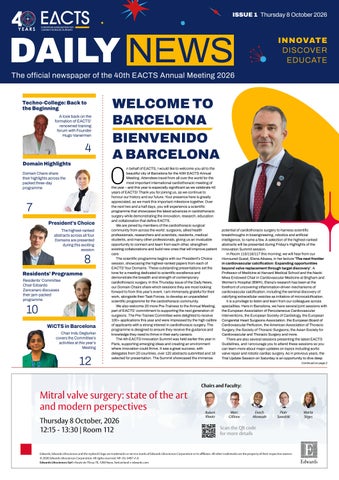
WELCOME TO BARCELONA BIENVENIDO A BARCELONA
O
Domain Highlights Domain Chairs share their highlights across the packed three-day programme
7 President’s Choice The highest-ranked abstracts across all four Domains are presented during this exciting session
8
Residents’ Programme Residents’ Committee Chair Edoardo Zancanaro discusses their jam-packed programme
10
WiCTS in Barcelona
Chair Indu Deglurkar covers the Committee’s activities at this year’s Meeting
12
n behalf of EACTS, I would like to welcome you all to the beautiful city of Barcelona for the 40th EACTS Annual Meeting. Attendees travel from all over the world for the most important international cardiothoracic meeting of the year – and this year is especially significant as we celebrate 40 years of EACTS! Thank you for joining us, as we continue to honour our history and our future. Your presence here is greatly appreciated, as we mark this important milestone together. Over the next two and a half days, you will experience a scientific programme that showcases the latest advances in cardiothoracic surgery while demonstrating the innovation, research, education and collaboration that define EACTS. We are joined by members of the cardiothoracic surgical community from across the world: surgeons, allied health professionals, researchers and scientists, residents, medical students, and many other professionals, giving us an invaluable opportunity to connect and learn from each other, strengthen existing collaborations and build new ones that will improve patient care. The scientific programme begins with our President's Choice session, showcasing the highest-ranked papers from each of EACTS' four Domains. These outstanding presentations set the tone for a meeting dedicated to scientific excellence and demonstrate the breadth and strength of contemporary cardiothoracic surgery. In this Thursday issue of the Daily News, our Domain Chairs share which sessions they are most looking forward to from this year’s event. I am immensely grateful for their work, alongside their Task Forces, to develop an unparalleled scientific programme for the cardiothoracic community. We also welcome 20 more Pre-Trainees to the Annual Meeting, part of EACTS’ commitment to supporting the next generation of surgeons. The Pre-Trainee Committee were delighted to receive 100+ applications this year and were impressed by the high calibre of applicants with a strong interest in cardiothoracic surgery. The programme is designed to ensure they receive the guidance and knowledge they need to thrive in their early careers. The 4th EACTS Innovation Summit was held earlier this year in Paris, supporting emerging ideas and creating an environment where innovation could thrive. It was a great success, with delegates from 20 countries, over 120 abstracts submitted and 18 selected for presentation. The Summit showcased the immense
potential of cardiothoracic surgery to harness scientific breakthroughs in bioengineering, robotics and artificial intelligence, to name a few. A selection of the highest-ranked abstracts will be presented during Friday's Highlights of the Innovation Summit session. In Room 115/116/117 this morning, we will hear from our Honoured Guest, Elena Aikawa, in her lecture 'The next frontier in cardiovascular calcification: Expanding opportunities beyond valve replacement through target discovery'. A Professor of Medicine at Harvard Medical School and the Naoki Miwa Endowed Chair in Cardiovascular Medicine at Brigham and Women’s Hospital (BWH), Elena’s research has been at the forefront of uncovering inflammation-driven mechanisms of cardiovascular calcification, including the seminal discovery of calcifying extracellular vesicles as initiators of microcalcification. It is a privilege to listen and learn from our colleagues across specialities. Here in Barcelona, we have several joint sessions with the European Association of Percutaneous Cardiovascular Interventions, the European Society of Cardiology, the European Congenital Heart Surgeons Association, the European Board of Cardiovascular Perfusion, the American Association of Thoracic Surgery, the Society of Thoracic Surgeons, the Asian Society for Cardiovascular and Thoracic Surgery and more. There are also several sessions presenting the latest EACTS Guidelines, and I encourage you to attend these sessions so you can learn more about major updates on topics including aortic valve repair and robotic cardiac surgery. As in previous years, the Trial Update Session on Saturday is an opportunity to dive deep Continued on page 2
Chairs and Faculty:
Mitral valve surgery: state of the art and modern perspectives Thursday 8 October, 2026 12:15 - 13:30 | Room 112
Robert Klautz
Marc Gillinov
Enoch Akowuah
Piotr Suwalski
Marta Sitges
Scan the QR code for more details
Edwards, Edwards Lifesciences and the stylized E logo are trademarks or service marks of Edwards Lifesciences Corporation or its affiliates. All other trademarks are the property of their respective owners. © 2026 Edwards Lifesciences Corporation. All rights reserved. NP--EU-3497 v1.0 Edwards Lifesciences Sàrl • Route de l’Etraz 70, 1260 Nyon, Switzerland • edwards.com
Issue 1 Thursday 8 October 1
IN THIS ISSUE Learning Labs
Take advantage of the invaluable opportunity to train with some of the world’s best cardiothoracic surgeons at the EACTS Learning Lab. Our hands-on workshops are designed to advance your technical abilities and include wetlabs, drylabs, simulation and practical sessions.
18
Scientific Programme
20
EACTS Academy Courses
23
Continued from page 1
into the latest data from current trials such as the ART Trial (legacy of Professor David Taggart). Thank you, once again, for travelling to Barcelona. Our Annual Meeting remains the highlight of the EACTS calendar. It is an opportunity to forge fresh connections, renew old friendships, exchange ideas and draw inspiration from the latest advances in
our field. As we celebrate 40 years of EACTS, I hope you will also join us at our 40th Anniversary Gala Dinner on Friday evening, where we can reflect on everything our Association has achieved together and look ahead to the future. I wish you an enjoyable and productive meeting and thank you for helping us continue our shared mission of improving outcomes for patients.
Techno-College
Showcasing the techniques and technologies of the future Techno-College opened the EACTS Annual Meeting yesterday with a full day dedicated to the technologies, devices and innovative surgical techniques shaping the future of cardiothoracic surgery. Techno-College welcomes international delegates of all experience levels and includes two concurrent streams – cardiac and thoracic.
Acquired Cardiac Disease Domain
Exhibition floor plan and Exhibitor list
Thoracic Disease Domain
B
26
rand-new for 2026, Techno-College participants took part in hands on training to develop their skills and knowledge of chest wall trauma; intrathoracic rib fixation and Cryo Nerve Block Therapy. Speaking on the workshops, Thoracic Disease Domain Chair Korkut Bostanci said,
EACTS TV
Watch live and recorded content from this year's Annual Meeting on EACTS TV, featuring compelling panel debates, highlights and interviews with the world’s leading cardiothoracic surgeons.
"The chest wall sessions focused on innovation. In chest trauma, surgeons are used to fixing ribs from the outside; at Techno-College, we had a new workshop looking at how to fix broken ribs from the inside. It was interesting to look at these different approaches and to see how new techniques can offer alternative solutions to some of the common challenges we face in thoracic surgery."
28
Satellite Symposia
Join experts as they discuss the latest clinical data, current and future approaches to patient care and much more in a wide range of satellite sessions hosted by industry.
29
T
he cardiac stream of Techno-College showcased first-in-human experiences, emerging solutions and state-of-the-art live 3D surgery. Led by world-leading experts, the programme explored key concepts as well as more complex surgical techniques, ideal for both early career surgeons and advanced specialists. Joerg Kempfert, New Technology Task Force Chair said,
DOWNLOAD THE EACTS APP HERE
“To my knowledge, Techno-College is the largest live case format that we have on the planet. Seeing how our community is moving from minimally invasive surgery to 3D and now towards robotics is the most exciting. That evolution is really reflected in what we’re presenting at Techno-College. We are not only showing what we’re doing today, but also looking at what is going to become part of clinical practice tomorrow.”
A SNAPSHOT OF THURSDAY'S SESSIONS
Thoracic Young Investigator Award abstract session
08:30 - 09:30 Room 115/116/117
13:45 - 14:45 Room 133-134
President's Choice
EACTS - MMCTS video session: When complexity meets minimally invasive surgery
10:00 - 11:00 Room 118-119 WiCTS – When complexity meets precision: Extreme cases, strategic & skilled leadership 10:00 - 11:00 Room 115/116/117 Treatment decisions in multivessel disease 11:15 - 12:00 Room 115/116/117 Honoured Guest: Elena Aikawa
2 EACTS DAILY NEWS
13:45 - 14:45 Room 111
15:15-16:15 Room 118-119 Residents cardiothoracic debate 16:30 - 17:30 Room 131-132 The robotic frontier: International practice, validated simulation & anatomy‑based complexity 16:30 - 17:30 Room 114 Late breaking clinical science 1
FULL-PAGE ADVERT
Techno-College
TECHNO-COLLEGE INNOVATION AWARD
TECHNO-COLLEGE BACK TO THE BEGINNING Techno-College Founder Hugo Vanermen took us back to the formation of EACTS’ renowned training forum, reflecting on the importance of pushing the limits of conventional surgery for progress and innovation. With its unique format of live surgery and ‘live-in-a-box’ cases, the programme was the first of its kind to demonstrate emerging procedures and technologies before they become part of everyday clinical practice.
I
n the late nineties, lesser invasive cardiac procedures were pioneered at centres such as Aalst, Chieti, Dallas, Greenville, Leipzig and Rosario with very satisfactory results. Increasingly, the need to have a forum for new inventions from the industry, procedures in their infancy, patents, wetlabs and live surgery had been recognised but not acted upon by the large cardiothoracic societies. In the US, Hani Shennib, a cardiac surgeon in Montreal had created a conference, which gave presentations in these areas. In Europe, I set up a similar format in 1998 called ‘The Key to Advanced Techniques in Cardiac Surgery’, which was the very first live teleconference on these endeavours. The session took place immediately before the EACTS Annual Meeting in Brussels attracting some 250 surgeons and an invited international faculty.
Techno-College Innovation Award Winner 2025 Photochemical Tissue Passivation: How Light Can Save the Saphenous Vein Graft
Hugo Vanermen Techno-College Founder Past President Torkel Aberg said: “The EACTS Council of the day was delighted with this development. Rules were shaped and a small organisation was erected. In Vienna 2003, the first, now named Techno-College, was arranged and has been an integral part of the EACTS Annual Meeting ever since. Vanermen’s was probably the largest gift ever to be given to the Association." Growing in participant numbers, TechnoCollege could be further expanded with a thoracic stream, the Techno-College Innovation Award was introduced, and further features were added, including wetlabs and training facilities. The evolution and the ever-increasing number of attendees speaks for itself, and today’s Techno-College will have a ‘packed room’ once again.
Isaac George Columbia University, USA
Randy Chitwood, Glen Barnhart, Hugo Vanermen, Clark Hargrove, Fred Mohr and José-Luis Pomar
After three years, I was very proud to hand over to New Technology Task Force Chair Volkmar Falk as I knew he was going to continue the endeavour very successfully. Today, true to its original mission of improving patient outcomes,Techno-College continues to look to the future of cardiothoracic surgery,
connecting the EACTS community with the very latest science and innovation in our field. Visit the History Wall in the Registration area to uncover more about Techno-College's past, present and future!
We caught up with 2025 Techno-College Innovation Award recipient Isaac Goerge (New York Presbyterian Hospital-Columbia University Irving Medical Centre, New York, USA) for an update on his groundbreaking innovation.
T
he award was very important to me personally, as it was a great honour to be selected by surgeons among surgeons for surgical innovation. It represents validation of concepts as well as the general field of CABG
research, with encouragement that my surgical colleagues will join into this clinical endeavour when we are ready. It also introduces the concepts to the surgical community early, which may allow for greater review and input for iterations. Ultimately, the product will be used in the OR, so optimising its use, workflow and specifications will need close, detailed input from surgeons. Durvena is an early-stage company developing an innovative treatment to reduce neointimal hyperplasia in saphenous vein grafts (SVG). By utilising a commonly used photosensitive dye and green light, the DurVena therapy aims to strengthen the adventitia of the SVG prior to implantation, rendering it less likely to lose structural integrity
10 years later. From one heart to over 500,000 lives touched.
Freedom from structural valve deterioration (SVD)
97.8%
Freedom from reoperation due to SVD
94.3%
Freedom from valve-related mortality
98.6%
Freedom from NSVD
Thank you for your trust.
Discover the full COMMENCE 10-year data
These 10-year data from the COMMENCE trial suggest this tissue technology has the potential to change the way we think about durability in biological valves, including in younger patients said Professor Michael A. Borger, Medical Director of the University Clinic for Cardiac Surgery at the Heart Center Leipzig.
Edwards, Edwards Lifesciences, the stylized E logo, COMMENCE and RESILIA are trademarks or service marks of Edwards Lifesciences Corporation. All other trademarks are property of their respective owners. © 2026 Edwards Lifesciences Corporation. All rights reserved. PP--EU-12803 v1.0 Edwards Lifesciences Sàrl • edwards.com Route de l’Etraz 70, 1260 Nyon, Switzerland
4 EACTS DAILY NEWS
WINNER
Pierre Mordant 'A novel dual-lumen femoral artery cannula to prevent lower limb ischemia during peripheral CPB/ECMO'
FINALISTS
Kee Soon Chong 'Sutureless Aortic Ring Connector for Aortic Arch Surgery' Hillary Pierce 'Femoral Arterial Cannula with Distal Balloon'
At EACTS 2026 Scan the QR Code to Learn More
A decade of durability data reflects more than a milestone. It represents a shared commitment to improving patient outcomes. The COMMENCE aortic trial 10-year results reinforce the trust placed in RESILIA tissue and Edwards’ commitment to rigorous science, long-term evidence, and continuous innovation. Together with surgeons around the world, we have helped impact more than half a million lives and continue to shape the future of valve therapy. The data demonstrated favorable safety outcomes and sustained hemodynamic performance at 10 years, in a young patient population (mean age 65,1 years).
97.9%
Techno-College Innovation Award 2026
Redefining
The 40th EACTS Annual Meeting
QUARTERPAGE ADVERT
following the CABG procedures to treat coronary artery occlusion(s). The long-term benefit of therapy is to reduce SVG neointimal hyperplasia and improve patency compared to untreated SVG. To date, 15 patients have been treated as part of a First in Human feasibility study: a single graft is randomised to treatment versus an internal control of an untreated SVG. Thirty-day clinical and CT angiography followup showed no major safety signals, no mortality, and no signification patency issues. Six-month imaging follow-up consists of CT angiography and coronary angiography with IVUS, which is ongoing. Sample CT angiography from one patient is shown in the accompanying image. Modifications are underway to improve temperature control of the treatment chamber. Additional patients as part of the feasibility study are planned, with future plans for an IDE trial in the United States. The EACTS Annual Meeting is a wonderful venue for inventors and venture capital funding, the leadership is very much engaged and receptive to innovation, and EACTS continues to lead the way forward in new technology.
Entering a new era of cardiac surgery with da Vinci 5 technology Da Vinci 5 technology supports cardiac surgical teams in delivering minimally invasive procedures with precision.
QUARTERPAGE ADVERT JOIN OUR LUNCH SYMPOSIUM
Evolving Strategies in Aortic Arch Repair OCTOBER 8TH
Da Vinci 5 Surgical System The da Vinci 5 Surgical System is a class IIb medical device. Refer to complete mandatory statements available on the booth.
12:15 PM - 1:30 PM, ROOM 113
Intuitive’s Privacy Notice is available at www.intuitive.com/privacy. © 2026 Intuitive Surgical Operations, Inc. All rights reserved. Product and brand names/logos, including Intuitive, Da Vinci, and Ion, are trademarks or registered trademarks of Intuitive Surgical or their respective owner.
MAT13067 v2 EU 09/2026
Issue 1 Thursday 8 October 5
Acquired Cardiac Disease Domain
Highlights from the Acquired Cardiac Disease Domain
JOIN OUR LUNCH SYMPOSIUM THURSDAY, OCTOBER 8TH
That balance between innovation and foundations runs throughout the programme. As surgical techniques continue to evolve and new technologies offer additional options for patients, cardiac surgeons are increasingly required to understand not only what is new, but also when and how these approaches should be applied in everyday practice.
12:15 PM - 1:30 PM, ROOM 113
Evolving Strategies in Aortic Arch Repair
Gloria Färber
Acquired Cardiac Disease Domain Chair
T
Moderator
Moderator
Martin Czerny (Freiburg, Germany)
Tomas Holubec (Nürnberg, Germany)
his year’s Acquired Cardiac Disease programme brings together some of the most important themes shaping cardiac surgery today. For Gloria Färber, Chair of the Acquired Cardiac Disease Domain, that breadth is one of the programme’s greatest strengths.
The Evolution of Aortic Arch Therapies – Today and Tomorrow.
The Nexus Platform – Endovascular Arch Repair: From Concept to Clinical Evidence.
Neo EDE™ – One Step Ahead in FET Repair.
E-vita® Open Neo – Proximal Flexibility. Distal Flow.
Martin Czerny (Freiburg, Germany)
Andrea Colli (Pisa, Italy)
FULL-PAGE ADVERT
Andreas Martens (Oldenburg, Germany)
Petar Risteski (Zurich, Switzerland)
AMDS – Rethink the Repair in Acute Type A Dissection. ™
®
Stuart Grant (Manchester, United Kingdom)
The programme this year is very interesting and full of rapidly evolving technologies and innovations. We will have sessions on robotic surgery and minimally invasive surgery, but we will also talk about the important procedures that are the fundamental basis of the speciality. It really is a programme for all surgeons.
A closer look at mitral valve disease One highlight of the programme is its focus on mitral valve disease, with sessions exploring secondary mitral regurgitation and the growing range of techniques and technologies available to treat it. The educational value of these sessions is especially important. The session 'Atrial secondary MR and TR: Predict, rethink, intervene?' today will look at the challenges of secondary mitral and tricuspid regurgitation, asking how surgeons and heart teams can better predict disease progression, reconsider treatment strategies and determine the right moment to intervene. The hands-on sessions and Learning Labs provide delegates with the opportunity to develop and refine their technical skills in a dedicated training environment. We have a very good training centre for mitral valve surgery, so you should not miss this.The programme gives surgeons the opportunity to hear about new approaches, and to understand how they can be translated into clinical practice.
Tackling complex decision-making Some of the more challenging decisions faced by cardiac surgeons will be addressed. In 'Treatment decisions in multivessel disease', delegates will consider the complexities of choosing the optimal revascularisation strategy. Another session today, 'Intraoperative guidance of septal myectomy and mitral valve management for HOCM', will focus on the role of intraoperative guidance in managing patients with hypertrophic obstructive cardiomyopathy, bringing together surgical technique, imaging and real-time decision-making. In 'How to weather the storm? Challenging redo operations following aortic valve procedures', we see patients increasingly present for repeat interventions following previous surgical or transcatheter procedures. The ability to manage difficult reoperations is becoming an ever more important part of the cardiac surgeon’s skill set. 'Transcatheter devices: Explanting the unexplantable' addresses the increasingly relevant challenge of removing implanted transcatheter devices when surgical intervention becomes necessary.
evolving approaches to valve disease sit alongside the core procedures, judgement and technical skills that surgeons rely on every day. This combination is what makes the programme relevant to such a broad audience of surgeons. Whether delegates are interested in the latest technologies, looking to improve their approach to complex valve disease, or simply wanting to strengthen their practical surgical skills, there is something for everyone.
A programme built for every cardiac surgeon Across the Acquired Cardiac Disease programme, the message is clear: innovation does not replace the fundamentals of cardiac surgery; it builds upon them. Robotic and minimally invasive surgery, new devices and
Acquired Cardiac Learning Labs happening today! 11:15 - 13:15 Endoscopic Dry Lab Training - Basic, Mitral & Aortic 13:45 - 15:45 Endoscopic Dry Lab Training - Basic, Mitral & Aortic 16:15 - 18:15 Learning Lab - Left-handed surgeons 16:15 - 18:15
Endoscopic Dry Lab Training - Basic, Mitral & Aortic
THANK YOU TO OUR TECHNO-COLLEGE SPONSORS GOLD
World Leader in Aortic Arch Solutions Off-the-Shelf
Custom-Made
SILVER Friday 9th October
BRONZE
AMDS™ Hybrid Prosthesis
E-vita® Open Neo Hybrid Stent Graft System
Neo EDE™ Hybrid Arch Device
Exhibition Hall, Booth #4
Join us as we gather to celebrate the 15th year of commercialisation for Thoraflex Hybrid with special presentations from Prof. Malakh Shrestha and one of our earliest patient success stories, Mr Hartmut Stielow.
Nexus Tre™
Aortic Arch Stent Graft System
Notice: The manufacturer, Endospan Ltd., assumes full responsibility for all regulatory compliance and certifications associated with this product. JOTEC GmbH functions solely as a distributor/reseller and is not responsible for the regulatory content of the marketing materials. Caution: Nexus Tre™ Aortic Arch Stent Graft System is a custom-made device. Custom-made devices are specifically made in accordance with a written prescription of any person authorised by national law by virtue of that person’s professional qualifications; which gives (1) specific design characteristics provided under that person’s responsibility and (2) is intended for the sole use of a particular patient exclusively to meet their individual conditions and needs. Custom-made devices are not available in the US and availability is subject to local regulatory approval. Neo EDE™ is a custom-made device for a particularly identified patient manufactured by JOTEC GmbH. All products and indications are not available/approved in all markets. Refer to the device’s Instructions for Use for indications, contraindications, warnings, precautions, and possible complications. Nexus® is a registered trademark of Endospan Ltd. all other trademarks are owned by Artivion, Inc. or its subsidiaries JOTEC GmbH and Ascyrus Medical GmbH are wholly owned subsidiaries of Artivion, Inc. © 2025 Artivion, Inc. All rights reserved. Ascyrus Medical GmbH, Grosse Gallusstrasse 16-18, 60312 Frankfurt, Germany, is the manufacturer of AMDS™
16:15
GENERAL
VGS
JOTEC GmbH, Lotzenäcker 23, 72379 Hechingen, Germany, is the manufacturer of E-vita Open Neo, Neo EDE ®
™
Endospan Ltd, Maskit St. 4 Herzlia Business Park, Herzlia, Israel 46733, is the manufacturer of Nexus Tre™
MLENG1926.001 (2025-12)
Issue 1 Thursday 8 October 7
Acquired Cardiac Disease Domain
Congenital Disease Domain
President’s Choice 08:30 - 09:30
PLENARY
President’s Choice
ROOM 115/116/117
08:30 - 09:30
Surgical and Transcatheter Aortic Valve Replacement Outcome in a Lowto-Intermediate Risk population: Do DEDICATE-RCT outcomes generalize to all trial-eligible patients? SAVR-trial (n=557) and TAVR-trial (n=654) cohorts, using propensity-score matching and formal transportability methods.
Kevin Veen
R
Erasmus University Medical Center, The Netherlands
andomised trials are the engine of guideline change, but their populations are, by design, selected. The DEDICATE trial (Randomised, Multicentre, EventDriven Trial of TAVI versus SAVR in Patients with Symptomatic Severe Aortic-Valve Stenosis) showed non-inferiority of TAVR compared to SAVR, and is referenced in the 2025 ESC/EACTS valvular heart disease guidelines. Yet, mortality in the trial's SAVR arm looked unexpectedly high compared with everyday practice. In our study, drawing on the nationwide Netherlands Heart Registration (NHR), we asked whether the trial's conclusions translate to real-world patients, investigating it through three linked questions: representativeness, reproducibility and transportability. We applied DEDICATE's inclusion and exclusion criteria and study period (May 2017– September 2022) to the NHR, yielding 3,389 trial-eligible SAVR-registry patients. We compared these with DEDICATE's own
Representativeness: is DEDICATE typical of the low-risk population? Probably not entirely. Trial-eligible registry patients were younger, had a lower EuroSCORE II and carried fewer comorbidities than the DEDICATE participants who met the same criteria. Crude one-year mortality in DEDICATE's SAVR arm was 6.4%, against 3.1% in the trial-eligible SAVR-registry. As such, the DEDICATE cohort appears to be a selected subset of the low- to intermediate-risk population, rather than the full spectrum of patients seen in routine care. Reproducibility: do the trial's relative effects reappear after matching? Here the answer splits by endpoint. After we matched SAVR-trial patients to comparable registry patients, the registry cohort continued to do better. SAVR-trial patients experienced significantly more composite events (HR 1.63, 95% CI 1.02–2.62) and strokes (HR 2.96, 95% CI 1.37–6.37), with comparable mortality (HR 1.15, 95% CI 0.65–2.02). In other words, for the primary composite endpoint and for stroke, we could not reproduce the trial's relative effects; the registry SAVR patients fared better than their trial counterparts, pointing to potential residual confounding, differences in peri- and post-operative management, or differences in how events were adjudicated (rigorous VARC-2 in the trial versus ICD-10 coding in the registry) Mortality was the exception. When we matched TAVR-trial patients to registry SAVR patients,
we reproduced a survival advantage for TAVR (HR 0.46, 95% CI 0.24–0.87) that closely mirrored DEDICATE's own as-treated estimate (HR 0.45). For this single endpoint, the relative effect held. Transportability: does the benefit shrink in the real world? Because the mortality effect was reproducible, we could take the final step by applying formal transportability analyses; reweighting the trial to resemble the registry population and redoing the within-trial comparison. While relative benefit survived, the absolute benefit shrank. The one-year absolute risk reduction fell from 3.8% in the trial (95% CI 1.4–6.1) to 2.1% when transported to the registry (95% CI 0.1–4.2). Practically, the number needed to treat with TAVR to prevent one death nearly doubled, from 26 to 48. In roughly 95% of resampling runs, the transported benefit was smaller than the trial's.
Why it matters The effects of DEDICATE should be handled with care outside the trial. Relative effects for stroke and the composite endpoint did not travel to the Dutch setting, and even the robust mortality signal delivered a diminished absolute payoff once anchored to a real-world population. We argue for formally integrating high-quality national registries such as the NHR and the EACTS Adult Cardiac Database alongside RCTs, so that guideline recommendations reflect effects that are both internally valid and clinically relevant to the patients actually in front of us. References Daeter, E., Roefs, M.M., Post, R.A.J., Ten Berg, J., Tonino, P.A.L., Van Veghel, D., Klautz, R., Takkenberg, J.J.M. and Veen, K.M.
T
In my opinion, this is one of the best programmes for congenital over the last few years. I must acknowledge the importance of education in all the work EACTS does, and the importance of European and international collaboration in progressing the speciality. The Congenital Heart Disease programme is structured around focus sessions that bring together world-renowned international experts who will share their knowledge and the latest advancements in the field with delegates. This year’s programme will feature four joint sessions with leading international societies: STS, ECHSA, AEPC and EACTAIC. The EACTS–STS Joint Session is dedicated to the management of the aortic root in patients with congenital heart disease, including current surgical techniques, outcomes, and complications related to the Ross procedure and aortic valve repair. The EACTS–ECHSA Joint Session today will address current 8 EACTS DAILY NEWS
Direct Coronary Reimplantation for Anomalous Aortic Origin of the Right Coronary Artery: A 20-Year Single-Centre Experience Our two-decade experience shows that comprehensive anatomical repair, addressing the ostial deformity, intramural course, and abnormal take-off angle, can be standardised as a reproducible surgical technique with excellent outcomes. Most importantly, it can allow young athletes to return safely to unrestricted sport and achieve their full potential.
and (4) its incompletely understood pathophysiology is composite, comprising both fixed and dynamic components (Figure 1). These observations raise two important questions. First, in a condition that ranks among the leading causes of SCD and may first present as a fatal event, is conservative management always appropriate for an asymptomatic patient? Second, when a complex lesion has two physiological components and several distinct anatomical targets (Figure 1), can a technique addressing only one target be considered a complete correction?
asymptomatic patients, remains controversial. Although unroofing is the most widely adopted operation, our programme has favoured direct coronary reimplantation as a comprehensive anatomical repair. This longitudinal experience was designed to clarify the role, reproducibility, and outcomes of this strategy in a still-debated condition. We reviewed our institutional nomalous aortic origin of a experience with direct coronary coronary artery (AAOCA) is a reimplantation for AAORCA. congenital coronary anomaly Between 2006 and 2024, 80 with a reported prevalence of patients underwent surgery; 44 0.2%–1.3%. Although many (55%) were younger than 18 years. patients are asymptomatic and Most patients were symptomatic diagnosed incidentally, AAOCA (78%): 58% had exertional chest pain may be associated with angina, or syncope, 10% had survived an myocardial infarction (MI), and aborted SCD event, 12% had a sudden cardiac death (SCD). Left previous MI, 12% reported AAOCA (AAOLCA) carries a higher palpitations, and 11% had dyspnea. risk of malignant ventricular 22% were asymptomatic. arrhythmias and SCD, whereas In every patient, the anomalous right AAOCA (AAORCA) is more vessel arose from the left sinus and common and generally has a more followed an inter-arterial course; an benign natural history. intramural component was present in Management nevertheless remains 80%. Preoperative assessment controversial, with no consensus included echocardiography in and CT Lucrezia Puglisi on surgical indications. Coronary angiography in 89%. There was no Louis Pradel Hospital, France unroofing is currently the most operative mortality, need for ECMO, or widely adopted surgical technique. low cardiac output syndrome. With this background, several points In this study, we explored these Morbidity was low: arrhythmia deserve emphasis: (1) the true unresolved issues through a occurred in 1.2%, bleeding or prevalence remains unknown, retrospective analysis of nearly pericardial effusion in 6.2%, and one although recognition is increasing with 20-years of institutional experience patient required early surgical the widespread use of dedicated with surgical repair of AAORCA. reintervention. Late outcomes were high-resolution cardiac imaging; (2) Because the anatomical and clinical similarly favourable, with no deaths AAOCA is the second leading cause features of AAOLCA are better defined and no documented recurrent of SCD among young people; (3) in and surgical indications are more coronary stenosis. Notably, autopsy series, its contribution to SCD widely accepted, we focused on postoperative echocardiography is ninefold greater among young AAORCA, for which optimal showed no aortic valve incompetence, athletes than among non-athletes; management, particularly in early or late, consistent with the nature
Figure 1: A) The three anatomical targets; B) Two obstractive mechanism; C) Anatomical targets addressed by each surgical technique
of the repair, since direct reimplantation leaves the aortic valve untouched. Three coronary reinterventions occurred in the overall cohort (two catheter-based and one surgical). This study is limited by its retrospective, single-center design. Systematic functional testing was not uniformly available throughout the study period. Prospective multicentre studies incorporating standardised assessment and ischemic riskstratification are the next important step. Direct reimplantation is technically demanding and should be concentrated in high-volume centres with specific expertise because of its steeper learning curve. Within these limitations, our nearly 20-year experience demonstrates that comprehensive anatomical correction can be performed with no operative mortality, low morbidity, preserved aortic valve function, and favourable late outcomes, while supporting a
Don't miss the European Board of Cardiothoracic Surgery focus session!
Highlights from the Congenital Disease Domain challenges in congenital mitral valve surgery and provide insights into emerging technologies. The EACTS–AEPC Joint Session today focuses on the surgical management of the adult Fontan patient, late failure of the total cavopulmonary connection, and pulmonary hypertension. Finally, the EACTS–EACTAIC Joint Session tomorrow offers an update on the perioperative management of congenital heart disease, with a focus on brain protection, cardiopulmonary bypass strategies, fast-track extubation, and regional anaesthesia. This year, we received 299 abstracts for evaluation – the highest number ever submitted to the Meeting for this Domain. Based on the highest-ranked abstract submissions, three focused sessions will be held. The focus session on the Ross Procedure and Aortic Valve Repair offers an update on current operative techniques, outcomes, and complications in patients undergoing Ross procedures and aortic valve repair. The ‘Focus on adult patients with congenital heart disease’ will address contemporary challenges and surgical strategies in the treatment of adults with congenital heart disease. The session on Heart Transplantation and Mechanical Circulatory Support explores the latest advances and clinical insights in mechanical support and heart
ROOM 115/116/117
A
Congenital Disease Domain
he Congenital Disease Domain programme highlights EACTS’ important work and joint ventures with other societies and specialities in the field. We spoke with Vladimiro Vida, Chair of the Congenital Heart Disease Domain, who outlines some of the key sessions.
PLENARY
13:45 - 14:45 transplantation for patients with congenital heart disease. On Saturday, a dedicated session for ‘Basic science and innovation for congenital heart disease’ will highlight cutting-edge developments in congenital heart disease, including bioengineered materials, xenotransplantation, artificial intelligence, and the treatment of lymphatic disorders. The Domain will also host a Learning Lab on Friday, dedicated to the surgical correction of d-transposition of the great arteries (d-TGA) through an arterial switch operation. Participants will have the unique opportunity to perform the procedure on a 3D-printed model, under the supervision of experienced international surgeons. The Learning Lab will feature 12 surgical stations, each accommodating two trainees and supervised by an expert surgeon, providing an exceptional hands-on learning experience in a highly interactive setting. The programme will conclude with the highly recommended 'Special session dedicated to J.V. Comas on transposition of the great arteries', dedicated to the memory of a great Spanish surgeon who brought a lot to our community and our hearts – the late Juan V. Comas. It will focus on one of his main subjects: transposition of the great arteries. We are delighted to have this session as we celebrate
Vladimiro Vida
Congenital Heart Disease Domain Chair 40 years of EACTS, honouring the past, the passion of our members, and the friendships we make within the Association. It will open with an invited lecture from our Vice-President Lorenzo Galletti who had the chance to work together with Juan Comas, followed by a global expert panel discussion addressing current concepts and future perspectives in the field.
9 October | 15:00-17:00 Congenital Learning Lab Arterial switch operation: Hands-on surgical simulation on 3D models
ROOM 118-119
Today, the European Board of Cardiothoracic Surgery (EBCTS) will take centre stage with a practical, insight packed hour designed for trainees, early-career specialists and established surgeons alike. This session is unmissable for those attendees in educational or training roles. EBCTS sets and delivers high-stakes examinations that promote common standards of knowledge, clinical judgement and practice across Europe and beyond. It awards two main qualifications: Membership (MEBCTS / Level 1) and Fellowship (FEBCTS / Level 2). The Membership examination is a rigorous four-hour, 180-question multiple-choice paper taken at secure test centres. It assesses the standard expected at the end of national training and preparing for independent specialist practice. The Fellowship is an in-person structured oral (viva) examination for surgeons which can be taken at any time after the Membership examination has been passed. Candidates can sit modules in adult cardiac surgery, congenital cardiac surgery, or both. Thoracic surgery examinations are now delivered through the Unified European Board of Thoracic Surgery (UEBTS) in partnership with ESTS and UEMS. There is also a dedicated Cardiovascular Surgery Critical Care pathway. All exams are quality assured using modern assessment science: high order standard-set questions, scientifically derived pass marks, and structured formats that test real-world decision-making rather than factual recall. What the session will deliver: Update on Exams – Stephen Clark, Chairman of EBCTS, will give the latest news on formats, eligibility, pass marks, schedules and recognition.
The Science of Examinations – Yvonne Hurst, educational advisor and assessment expert to EBCTS, will explain how high-stakes surgical exams are designed, validated and marked so that they are fair, reliable and defensible. Mock Exam: Part 1– Eduard Quintana, Francesco Onorati and Bernhard Winkler will demonstrate Membership-style questions, showing the style and depth candidates face. You will have a chance to see if you can get the questions correct! We will explain how the right answer is arrived at. Mock Exam: Part 2 – Espeed Khoshbin, Neil Cartwright and Denis Berdajs will run a live-style Fellowship oral scenario, illustrating the conversational yet searching nature of the structured vivas so that you can see what the examination is really like without sitting it yourself! Marking – Stephen Clark will close by outlining how the Fellowship candidates performance is assessed and how the results are determined from what you just saw. This Annual Meeting session is a rare chance to see the examination process from the inside - how questions are written and standard-set, what “good” answers look like, and how the Board balances fairness with the need to protect patients through robust standards. For those preparing to sit MEBCTS or FEBCTS, the mock questions and marking discussion will be invaluable. For trainers and programme directors, it offers clarity on what the Board expects. For everyone else, it is a window into how European cardiothoracic surgery continues to raise and harmonise professional standards.
return to unrestricted physical activity.
Live translation available This year, we’re pleased to offer live audio translation in over 60 languages in the Plenary room (115-117) via Wordly.
Live Translation 1. Scan the QR code using your personal device
https://attend.wordly.ai/join/XWJN-2581
2. Select your preferred language 3. Click attend If you wish to listen to the audio translation, please use your headphones and ensure that your device is unmuted.
Sign up Stay up-to-date with the latest EACTS news and insights.
Issue 1 Thursday 8 October 9
Thoracic Disease Domain
Residents' Committee
Residents' Programme
W
e sat down with EACTS Residents' Committee Chair, Edoardo Zancanaro (San Raffaele Hospital, Milan, Italy and Brigham and Women’s Hospital/Harvard Medical School, Boston, USA) to find out about this year's Residents' Programme in Barcelona. He shares his highlights from the programme, the sessions not to miss, and explains why the EACTS Annual Meeting continues to be one of the best places for trainees to learn, develop skills and connect. The Residents' Programme returns with a refreshed schedule that blends returning favourites with brand-new formats, with an emphasis on discussion and participation. Escape the Coffin We have so many interesting things happening. 'Escape the Coffin' has been revisited with a new format. We didn't want to change it completely, but we have some surprises. No spoilers… come and join us! For anyone attending for the first time, ‘Escape the Coffin’, our hugely popular interactive session, follows an escape room format. Two challenging real-life cases will be revealed on the day - one cardiac and one thoracic - and presented to the audience, who help make key clinical decisions along the way. The audience will work together to determine and vote for the outcome of the scenario and (hypothetical) patient presented in the case. Simply put - if you get the answers wrong, the patient’s condition deteriorates. If you get them right, the patient achieves the best possible outcome. Let’s join together and save the patient!
academics, hospital managers, industry professionals, medical students and clinicians will all connect throughout the Meeting. The Residents' Luncheon returns with dedicated tables covering a range of areas including transplants, minimally invasive surgery, pulmonary and congenital. Trainees have the opportunity to sit down with leading experts in an informal setting. Attendees are encouraged to register early at the information desk on site for the luncheon, as it is always oversubscribed. First-come-first-served! The EACTS Annual Meeting is unmatched the best opportunity that you have to meet chiefs of different hospitals, fellows, students, researchers, and the EACTS Residents’ Committee to explore research, different opportunities, collaborations and future fellowships. Several sessions will return and debut in Barcelona, including a new resident team competition built around real-world cases. An informal Residents’ Open Mic event is also taking place tomorrow, where anybody can ask questions of residents from across Europe and the USA at the EACTS Booth in the Exhibition Hall. We will see debate-style discussions of ‘nightmare cases’ return, where experienced surgeons will guide residents through difficult clinical decisions, in cases where things go wrong. Beyond the Residents' Programme, I also recommend visiting the hands-on sessions, including ‘Touch the Valves’, which allows delegates to handle the latest transcatheter valve and learn about insertion directly from experts.
Residents in Barcelona Networking also remains a major focus of the programme, and the EACTS Annual Meeting as a whole. Consultants, surgeons, trainees and fellows, theatre teams, perfusionists and allied health professionals, researchers and
Residents’ Committee Activities Outside of the Annual Meeting, the Residents’ Committee has a packed schedule of activities aimed at strengthening collaboration, education and networking opportunities for residents globally. This includes the National Trainee
Summit, bringing together national European representatives to discuss common projects and explore ways to further unify and strengthen. The Case Corner webinar series gives residents the opportunity to present their cases to an expert panel and benefit from discussion and feedback. In addition, several exciting new projects are currently in development, with more details to be revealed soon. The Committee is also expanding its collaborations with other societies and international groups, including EAPCI Young, the Endoscopic Cardiac Surgeon Club, TSA in the USA and GTSRA, among others, creating opportunities for residents to build an international professional network.
40 years of EACTS This year marks the 40th EACTS Annual Meeting; a milestone that carries great significance. It is so special. I have seen how much work has gone into the entire EACTS organisation over the years, and how much preparation goes into the Annual Meeting. It is a celebration of all our work. On behalf of the Committee, I extend a huge thank you to the Council, EACTS Presidents, the Programme Committee, the Secretary General, staff at the Windsor office, and everyone involved across different Domains and Committees – without this team effort, we would not be able to push the boundaries forward. I feel a responsibility to keep this treasure we have alive and protect it, because it's really the only association like it in
Highlights from the Thoracic Disease Domain
Edoardo Zancanaro Residents’ Committee Chair
Europe. We need it, and together we're stronger. Looking ahead, I hope EACTS will continue working towards greater collaboration across Europe, including the EACTS Core Curriculum that helps harmonise training, residencies and opportunities between countries. Differences in qualification recognition across countries stifles movement, and the curriculum aims to set a high standard of guidelines that can be used across the continent. It is a big goal for the future. For trainees and residents considering membership, EACTS is one of the best associations to support you. From publications, Academy courses, the Annual Meeting and educational resources to networking, fellowships and opportunities to present research, EACTS is there throughout every stage of a resident's career - and a community, a family, that continues long after the Meeting ends. If you look at the podium, a lot of young residents have been given the space to speak on their work. I have been selected as one of the 40 Under 40 by EACTS and was reflecting on the first time I presented a paper at an Annual Meeting. There was no judgement, only support. It was the best moment of my life at that time. EACTS has given me what I have at home – an international house, where I’m growing every day. I have made the dearest friends and connections, not just for work, but as a human being and a doctor.
W
ith an even stronger emphasis on thoracic surgery, more dedicated sessions, practical learning opportunities and more opportunities for young surgeons than ever before, the Thoracic Disease Domain programme is not to be missed. From hands-on Learning Labs and complex case discussions to the latest developments in robotics, lung cancer treatment, lung volume reduction and artificial intelligence, the programme reflects the pace of change across the specialty. We spoke to Domain Chair Korkut Bostanci about some of the highlights he is looking forward to this year.
We are pleased to have more thoracicfocused sessions than ever before in this year’s programme. The Domain also presents a rich Learning Lab schedule for young thoracic surgeons. The regular thoracic Learning Lab will have four sections, covering ‘Bronchoscopic lung volume reduction', 'Thoracoscopic surgery on simulators and air leak management', 'Rib fixation and
08:30 - 09:30
Why become a member of EACTS? As part of our global community, you’ll gain access to world-class resources, expert-led training and a network of professionals driving innovation in cardiothoracic surgery. Apply now to become a member of EACTS and enjoy access to all the below membership benefits. Connect
Network with peers at the EACTS Annual Meeting – the leading global event in cardiothoracic surgery Access exclusive member-only rates for events COMING SOON: EACTS mentorship programme
13:45 - 14:45 Room 112 Pros and cons of alternative approaches to aortic arch disease – When sternotomy is just not good enough (ASCVTS@EACTS) 15:15 - 16:15 Room 115/116/117 EACTS / ESC: Patient preference vs patient benefit: Who decides and how to treat complex chronic coronary syndromes and severe aortic stenosis?
PLENARY
Finn Dittberner
Odense University Hospital, Denmark
P
ostoperative air leakage remains the most common complication following lung resections and continues to be a major challenge in thoracic surgery. Although most air leaks resolve spontaneously, they frequently delay chest drain removal, prolong hospital stay, increase healthcare costs and affect patient recovery negatively.
Because Enhanced Recovery After Surgery (ERAS) pathways increasingly focus on early discharge it has become an important clinical priority to identify effective strategies to shorten postoperative air leakage. Autologous blood pleurodesis is a simple and inexpensive technique that has been used for decades to treat persistent air leakage and spontaneous pneumothorax. Despite its widespread availability and ease of application robust evidence supporting its use after modern minimally invasive lung surgery is scarce. To date, only one small, randomised trial evaluated autologous blood pleurodesis for postoperative air leakage but this trial was performed two decades ago in patients undergoing thoracotomy. Our presentation describes the findings from a multicentre (two high volume university hospitals) randomised controlled trial which
eacts.org
investigated whether early administration of autologous blood on the first postoperative day would influence chest drainage time in patients with air leakage following Video Assisted Thoracoscopic Surgery (VATS lobectomy or wedge resection). We included patients with air leakage greater than 40 mL/min during cough and mobilisation on the first postoperative day measured by a standard electronic chest drainage device. Patients were randomised in a 1:1 ratio to receive standard chest drain management with or without autologous blood pleurodesis in addition to standard care. Randomisation was stratified according to extent of resection (lobectomy or wedge) as well as site of resection (upper or lower lobes) to ensure balanced treatment groups. Air leakage was continuously monitored using digital drainage systems and chest drain removal followed
predefined objective criteria. This is the only contemporary randomised trial to evaluate early autologous blood pleurodesis after VATS in patients with postoperative air leakage after lung resection. Our study addresses an important clinical problem and provides new evidence in thoracic surgery. The findings have a potential to influence daily management of postoperative air leakage and may contribute to future recommendations for enhanced recovery following lung resections.
15:15 - 16:15 Room 113 EACTS – ECHSA session: The evolving landscape of congenital MV surgery 15:15 - 16:15 Room 133-134 EACTS - EBCP: Under pressure: When blood meets mechanics
EACTS 40th Anniversary Evening The EACTS 40th Anniversary celebrations will continue at this year's Gala Dinner, where delegates will come together to celebrate four decades of achievement and the people who have shaped the Association's remarkable journey.
Advance
Visit the Membership Team on the EACTS Booth in the Exhibition Hall to find out more or apply online here >>
9 October | 16:15 - 18:15 Learning Lab - Left-handed surgeons
ROOM 115/116/117
Free access to the European Journal of Cardio-Thoracic Surgery (EJCTS) Reduced rates to contribute to the Interdisciplinary Cardiovascular and Thoracic Surgery journal (ICVTS) Free access to EACTS educational webinars Preferential rates for EACTS Academy training Apply for exclusive fellowships and bursaries
Full active members pay just €300 a year.
9 October | 08:30 - 10:30 Learning Lab - Thoracic surgery mega learning lab; 4 stations, 4 new skills
Thoracic Disease Domain
Learn
Join task forces and committees shaping surgical standards and practice Be part of initiatives supporting women, early-career clinicians and Allied Health Professionals Free access to the Adult Cardiac Database Apply for Outreach Grants Apply for Innovation Grants Vote at the General Assembly and help shape EACTS’ future.
surgeons in mind. There is plenty for thoracic surgeons at every stage of their careers to engage with, and we look forward to seeing you at our sessions.
Autologous blood pleurodesis for postoperative air leakage following video-assisted thoracoscopic surgery – a randomised controlled trial
THURSDAY 8 OCTOBER
BECOME A MEMBER OF EACTS TODAY!
consensus document, 'Lung volume reduction for emphysema'. In the 2026 'EACTS expert consensus documents' session on Friday, we will be talking about this document, presenting some challenging cases alongside it, and will explore how the recommendations can be applied in clinical practice. As a rapidly developing area, we will of course have sessions dedicated to AI in thoracic surgery. On Saturday we will be speaking about the fundamentals, ethics and application of artificial intelligence in thoracic surgery – and how it can be used for the prevention of complications. We have two sessions dedicated to lung cancer; the 'Current challenges and future aspects of lung cancer treatment' session, and a second oncological session, 'Sublobar Resection for Early-Stage NSCLC: Translating Landmark Trials into Standard Surgical Care', both on Friday. The programme takes a broad look at where thoracic surgery is now and where it is heading, while keeping practical education and the development of the next generation of
President’s Choice
JOINT SESSIONS
10:00 - 11:00 Room 113 EACTS - AEPC joint session on Fontan failure
Cryoanalgesia', and 'Airway stenting'. As a left-handed surgeon myself, I will be an instructor in the new joint Learning Lab we are co-hosting with the cardiac stream, a wetlab teaching the basic principles tips and tricks for left-handed surgeons. In addition to e-Posters and abstracts like the Thoracic Young Investigator Award session, we have plenty of compelling focus sessions that will no doubt be very attractive to our young surgeons in particular. On Friday, 'Robotic surgery – From segments to transplant' will be a very interesting session, covering almost everything being done by a robot in thoracic surgery, from segmentectomies to robotic lung transplantation. We will also discuss robotics in the 'Thoracic outlet syndrome' session today. The attractive 'MDT meeting: Complex thoracic cases' session today features an excellent panel of residents covering three challenging cases presented from Vienna, Dublin and Paris. It will be a great opportunity to explore how different teams approach complex problems and to encourage discussion between trainees and experienced surgeons. Recently, we have prepared an expert
EACTSNews Hub
Read the latest news from EACTS on our regularly updated website News Hub. Visit the eacts.org homepage for the latest features, or find us under the ‘Our Community’ tab.
Tickets: To collect your invitation and choose your table, visit to the Socials Desk in the Exhibition Hall by 17:00 latest today!
Venue: Museu Nacional d'Art de Catalunya Dress code: Smart casual
Issue 1 Thursday 8 October 11
WiCTS
10:00 - 11:00
Room 118-119
EACTS QUIP
Harmonising training and standards for robotic-assisted cardiac surgery across Europe and beyond
When Complexity Meets Precision - Strategic & Skilled Leadership
Part of the EACTS Adult Cardiac Database, discover the world’s first robotic-assisted cardiac surgery data collection
T
he Women in Cardio Thoracic Surgery Committee (WiCTS) is delighted to welcome delegates to this year's scientific session, 'When Complexity Meets Precision: Extreme Cases, Strategic & Skilled Leadership'. Bringing together internationally recognised experts in cardiac and thoracic surgery, this programme will explore how innovation, technical excellence and strategic leadership enable surgeons to safely tackle demanding clinical challenges. From robotic coronary revascularisation and complex congenital valve reconstruction to advanced thoracic procedures and highly challenging surgery for large ventricular tumours, our speakers will demonstrate that surgical success extends well beyond technical expertise. It requires meticulous preparation, multidisciplinary
LATE BREAKING 16:30 - 17:30
ABSTRACT
Sam Nashef
Royal Papworth Hospital, UK
Jason Ali
Royal Papworth Hospital, UK
collaboration and the ability to lead high-performing teams through uncertainty. The session concludes with a forward-looking discussion on the future of WiCTS within EACTS and our shared vision for the next generation of cardiothoracic surgeons. This Annual Meeting also marks an exciting milestone for the WiCTS Committee as we warmly welcome our new Committee Members. Their expertise, enthusiasm and diverse perspectives will strengthen our ongoing work and help shape future initiatives in education, mentorship, leadership and professional development. Since its foundation, the WiCTS Committee has an established identity and is an active and influential part of EACTS, championing the role of women in cardiothoracic surgery while fostering an equitable, diverse and inclusive culture across our Association. Through scientific
Maroua Eid
Miia Lehtinen
Monica Mittal
University Hospital of Angers, France
Helsinki University Hospital, Finland
St Bartholomew's Hospital, UK
sessions, educational programmes, mentoring initiatives, networking opportunities and international collaborations, WiCTS supports surgeons at every stage of their careers. By creating opportunities for connection, collaboration and career development, the Committee continues to strengthen our specialty and inspire the next generation. Among its flagship initiatives, the WiCTS Travelling Leadership Fellowship has been particularly impactful since its introduction. The Fellowship provides women in cardiothoracic surgery with the opportunity to visit leading centres, gain exposure to different clinical and leadership environments, establish lasting professional collaborations and return to their institutions with new perspectives. As the Chair of WiCTS, I think the contribution of the Committee members has been invaluable. I would like to share with great pride
that all three members of the Committee who are under the age of 40, Maroua Eid, Miia Lehtinen and Monica Mittal, have been recognised by EACTS for their exemplary contribution as awardees of the EACTS 40 Under 40. Within WiCTS, there has been a strong tendency to groom and mentor budding leaders in the specialty at all levels. WiCTS has provided great opportunities to Committee Members to participate, moderate sessions and exercise their leadership skills. They will undoubtedly be our future leaders. We look forward to welcoming you to what promises to be an inspiring session that celebrates surgical excellence, innovation, collaboration and leadership - while reaffirming WiCTS' commitment to advancing our profession and improving patient care through diversity, opportunity and excellence.
Get set for the day and meet colleagues over a coffee. WiCTS Networking Session 15:15-16:15 | Room 118/119 A chance for surgeons to interact, share ideas and insights, unlock partnership opportunities and impart career advice to surgeons in training. Followed by the opportunity to further conversations over a coffee in the Banquet Hall, Level 2 from 16:15-17:15.
EuroSCORE 3: A Recalibrated, Rebuilt Risk Model for Contemporary Cardiac Surgery ROOM 114 More than two decades since the original EuroSCORE first gave cardiac surgeons a common language for risk, the tool remains part of daily practice worldwide, used in Heart Team discussions, patient consent conversations, quality benchmarking, and research. But practice has moved on since EuroSCORE II was built on data collected around 2010, and outcomes have continued to improve. Our late-breaking presentation asks a simple question with real clinical consequences: is EuroSCORE II still telling surgeons the truth about risk, and if not, what should replace it? Drawing on 143,652 operations from 107 centres across 16 countries between 2022 and 2025, the largest contemporary EuroSCORE dataset assembled to date, we first tested EuroSCORE II against current outcomes. The model still discriminates well between higherand lower-risk patients, but it now overestimates mortality by around 26%. In practical terms, a patient told they face a 10% risk of death may, in reality, be facing closer to 7 to 8%. The first, and perhaps most immediately
HONOURED GUEST LECTURE TODAY
useful, finding is how simply this can be fixed. Recalibrating only the model's intercept, without touching any of its risk factors, restored accurate calibration instantly, with no loss of discrimination. For centres not ready to adopt a new model, this is a change that can be made today. We then went further, rebuilding the model from the ground up as EuroSCORE 3. It incorporates more detailed procedural categories, body mass index, and renal function as a continuous variable, capturing operative complexity that EuroSCORE II's broader categories could miss. The result is a further, modest gain in discrimination (AUROC improving from 0.836 to 0.857) alongside excellent calibration, confirmed not only internally but in an entirely separate validation cohort of almost 13,000 further patients. Alongside EuroSCORE 3, we built a machine-learning model, an elastic net regression, using exactly the same variables. Despite the current enthusiasm for AI-driven risk prediction, it performed identically to our conventional statistical model. For a field increasingly asked to weigh algorithmic
Robotic cardiac surgery minimum standards for programme implementation, training and quality assurance - Expert Consensus Document Wouter Oosterlinck
References Nashef, S.A.M., Roques, F., Sharples, L.D. et al. (2012) ‘EuroSCORE II’, European Journal of Cardio-Thoracic Surgery, 41(4), pp. 734–744.
This enables the entire specialty to work towards the common goal of safe, high-quality robotic-assisted cardiac surgery. Importantly, the training pathway is not based on assumptions or opinions. It is directly linked to agreed standards and will continue to evolve as new data is collected and analysed across the EACTS community.
11:15 - 12:00 Plenary Room 115/116/117
This year’s Honoured Guest Lecture will be delivered by Elena Aikawa, an internationally recognised leader in cardiovascular biology and translational research. Elena is a Professor of Medicine at Harvard Medical School and the Naoki Miwa Endowed Chair in Cardiovascular Medicine at Brigham and Women’s Hospital (BWH). She has received numerous honours, including the American Heart Association (AHA) Special Recognition Award
T
complexity against interpretability, this is a reassuring result: a transparent, coefficientbased score that any surgeon can calculate by hand remains just as accurate as its black-box counterpart, at least with the data available to us. For delegates, the take-home messages are practical. Centres still relying on EuroSCORE II should be aware it now overstates risk, particularly above 10 to 15%, and should consider recalibrating locally in the interim. EuroSCORE 3 is intended to be made available via the EuroSCORE website, subject to final regulatory approval, and, like its predecessors, has been built with future recalibration in mind, because if this project has shown anything, it is that a risk model is never really finished. We look forward to discussing these findings, and what they mean for risk prediction in cardiac surgery, at the meeting.
The next frontier in cardiovascular calcification: Expanding opportunities beyond valve replacement through target discovery
12 EACTS DAILY NEWS
WiCTS Networking Coffee Break 09:30-10:00 | Room 118/119
existing registries, and a systematic review of the literature. The approach allowed us to identify a first set of candidate variables. Those went back to the expert panel, through Johannes Bonatti Paola Quattroni Edgar Daeter Wouter Oosterlinck focus group discussion and University of Pittsburgh, USA QUIP Director QUIP Committee Chair UZ Leuven, Belgium formal voting, and the final standard was agreed: one he EACTS Adult Cardiac Database Redesigned two years ago, the ACD already hundred and thirty-two variables across two (ACD) now provides the surgical collates standardised high-quality data of hundred and nineteen fields. community across Europe and cardiac procedures, including 100,000 records Speaking on the new addition to the ACD, worldwide with a dedicated platform for from 25 hospitals and allows users to search for EACTS Quality Improvement Director Paola collecting and analysing data on roboticand compare data across many different Quattroni said, “To our knowledge, this is one of assisted cardiac surgery. This week, variables and fields. The inclusion of roboticthe first databases collecting such detailed data delegates have the chance to find out how assisted cardiac surgery adds extra granularity about robotically-assisted cardiac procedures. the ACD is revolutionising training, and allows for benchmarking and better Given the importance of understanding standards and data collection for cardiac decision making. innovation and new techniques in cardiac surgery. surgeries and the need for regulators to base An expert and community-led initiative their decisions on evidence, use of this Expanding the EACTS Adult To build this database, the EACTS Robotics database will be crucial.” Cardiac Database Data Working Group was established to explore The ACD benchmarking tool provides our Robotic-assisted cardiac surgery is how robotic cardiac surgery data could be community with important insights on how to increasingly being adopted across Europe, standardised internationally. A recent survey continually improve outcomes for patients. By from mitral valve repair to robotic-assisted conducted confirmed case volumes have risen collecting and incorporating data on roboticcoronary artery bypass grafting and more. steadily since 2020 with training and cost as the assisted cardiac procedures, the ACD also acts Hospitals are reporting reduced hospital stays, main barriers. as a source of evidence informing medical lower blood loss, fewer infections and faster In collaboration with experts from robotic device regulation. recovery, leading to better outcomes for cardiac centres, the first EACTS Robotic Quality Improvement Programme Chair patients. That’s why EACTS has developed a Cardiac Database Data Dictionary has been Edgar Daeter explains that “Changes to world-first robotic-assisted cardiac surgery developed and published openly, in a public medical device regulation are built on exactly database. The database will inform research repository, ensuring any centre or registry the kind of information collected by the EACTS and medical device regulation and assess the anywhere can adopt it. We used an iterative ACD. Evidence only exists if surgeons and efficacy of robotic-assisted procedures. saturation approach, combining three sources: clinicians collect the data and collect it in the expert consensus, benchmarking against best and most efficient way we can.”
in Vascular Biology. In her lecture, 'The next frontier in cardiovascular calcification: Expanding opportunities beyond valve replacement through target discovery', Elena will explore how advances in multi-omics, systems biology, advanced imaging and computational drug discovery are opening new possibilities to intervene before irreversible valve damage occurs.
The new Robotic cardiac surgery minimum standards for programme implementation, training and quality assurance Expert Consensus Document provides a clear blueprint for robotic cardiac surgery training pathways.
allowing us to monitor outcomes, measure quality and continuously refine training standards, creating a feedback loop between training, quality improvement and patient outcomes.
The approach is also highly supportive and adaptable. If a team requires additional guidance, we can provide For the first time, we have a structured tailored support based on their specific framework that can be used to train needs. Training follows a progressive teams safely and effectively, with pathway, beginning with less complex clearly defined goals. It also cases before advancing to more recognises that not everyone may be challenging procedures such as immediately ready for robotic training multivessel or redo operations. Our and outlines how surgeons and teams goal is to achieve the highest can develop the necessary skills and standards of quality from the very experience to prepare for a programme beginning and to monitor performance in the future. throughout the process.
Centres implementing robotic-assisted cardiac surgery will be required to collect and share procedural data,
Read the document
2026 EACTS expert consensus documents Friday 9 October 13:45 - 14:45 Room 115/116/117
ROBOTICS SESSIONS THURSDAY 8 OCTOBER 13:45 - 14:45 Room 131-132 Robotic cardiac surgery in clinical practice: Expanding applications and evidence 16:30-17:30 Room 131-132 The robotic frontier: International practice, validated simulation & anatomy‑based complexity Development of a new pan-European database for robotically-assisted cardiac surgery data FRIDAY 9 OCTOBER 15:15 - 16:15 Room 131-132 European perspectives on training in robotic cardiac surgery: Learning from expert practice
Making an international impact Johannes Bonatti The robotic extension of the EACTS Adult Cardiac Database is also a big opportunity for quality improvement at robotic heart surgery centres in the USA. The Database is open for international participation and risk adjusted assessment of outcomes and benchmarking across the globe is possible. This is why our team at the University of Pittsburgh Medical Center has joined the initiative. EACTS as a scientific society is the best home for quality improvement projects in innovative and high-tech cardiothoracic surgery globally. The Database welcomes data from any new robotic technology and can provide regulatory authorities with high-quality evidence that shows the value of roboticassisted procedures in heart surgery.
Participate in the initiative The EACTS Adult Cardiac Database is the first pan-European multi-centre database collecting detailed information about robotic-assisted cardiac surgery, playing a crucial role in improving patient outcomes. If you or your hospital is interested in being involved, please get in touch.
Find out more and submit your data
Veen, K., Quattroni, P., Ahmed, M., Ingram, D. and Adult Cardiac Database Robotics Data Working Group (2026) EACTS Robotics Cardiac Database Data Dictionary. Version 1. Zenodo. Available at: https://doi.org/10.5281/zenodo.19237812
Issue 1 Thursday 8 October 13
Thoracic Disease Domain
Thoracic Disease Domain
Thoracic Young Investigator Award Session
Sustained improvement in quality of life after surgery for thoracic outlet syndrome: 10-year results 13:45 - 14:45
T
ABSTRACT
13:45 - 14:45
ROOM 111
horacic outlet syndrome (TOS) is a complex condition caused by compression of the brachial plexus and/or subclavian vessels. It predominantly affects young and active patients and may result in chronic pain, functional impairment, occupational disability, and a substantial deterioration in quality of life. Although surgical decompression is widely performed after failure of conservative treatment, particularly in carefully selected patients, its long-term impact on functional outcomes and quality of life remains poorly documented.
We conducted a prospective observational study including all adult patients who underwent surgical treatment for TOS at Angers University Hospital between January and December 2016. Diagnosis was based on clinical assessment combined with systematic complementary investigations, including dynamic Doppler ultrasound, electromyography and dynamic upper-limb
Myriam Ammi
University Hospital of Angers, France
arteriography. Surgery was proposed after failure of physiotherapy and consisted of standardized transaxillary first-rib resection using the Roos approach, associated with scalenectomy and neurolysis. Pectoralis minor tenotomy was performed when additional compression was identified. Quality of life and upper-limb function were prospectively assessed using two validated patient-reported outcome measures: the Disability of the Arm, Shoulder and Hand (DASH) questionnaire and the 12-item Short Form Health Survey (SF-12), including its physical (PCS) and mental (MCS) components. Assessments were performed
preoperatively and at 6 weeks, 3, 6 and 12 months after surgery, with an additional long-term evaluation. Overall, 53 surgical procedures were performed in 49 patients, with a mean age of 40.1 ± 10.0 years; 66% were women. Neurogenic TOS represented the majority of cases (73.6%). Mean long-term follow-up reached 112.3 ± 4.1 months, providing almost 10 years of postoperative assessment. Upper-limb disability improved substantially after surgery. The mean DASH score decreased from 46 ± 20.1 preoperatively to 21 ± 20 at long-term follow-up, with statistically significant improvement from 3 months onwards. The physical component of the SF-12 increased from 35.2 ± 6.6 to 45 ± 9.9 at long-term follow-up. Mental quality of life also significantly improved after surgery. No significant predictive factor for poor postoperative outcome was identified among the clinical variables evaluated. These findings demonstrate that surgical decompression for TOS provides not only early
functional improvement but also sustained benefits in upper-limb function and quality of life nearly 10 years after surgery. Despite the predominance of neurogenic TOS, for which surgical indications remain debated, the durability of these patient-reported outcomes supports surgery as an effective long-term treatment in appropriately selected patients after failure of conservative management.
B
ABSTRACT
who are at increased risk of requiring invasive mechanical ventilation (IMV). The key challenge is timing. Existing trauma scores are frequently focused on prognosis, whereas early ventilatory triage requires a more immediate clinical signal. A practical score could help clinicians decide who requires closer observation, early critical-care involvement and timely escalation, while supporting appropriate management of patients who initially remain stable.
To address this clinical gap, the VENT-Score was developed from four readily available admission variables. The study analysed 302 adults with blunt chest trauma from a prospective cohort; 42 patients (13.9%) required invasive mechanical Figure 1 : VENT-Score separation and performance in blunt ventilation during their clinical care. The chest trauma. At ≥6 points: sensitivity 85.7%, specificity 94.6%, four variables were selected and PPV 72.0%, NPV 97.6%; apparent AUC 0.971. converted into an additive score ranging from 0 to 14 points: neurological status, assessed using the Glasgow Coma Scale; This clinical need motivated the present oxygenation, measured by the PaO₂/FiO₂ ratio; study and led to the development of the pulmonary contusion severity, graded VENT-Score (Ventilation Early Needs Triage), according to the established
Noha Fouda Mansoura University, Egypt Rather, it offers an objective signal to complement both, potentially improving early triage and resource allocation after blunt chest trauma. The results are encouraging, but they represent apparent performance in the analysed cohort. External validation in independent trauma populations will be essential before widespread implementation. If confirmed, the VENT-Score could provide trauma teams with a practical way to recognise impending ventilatory needs at the moment when preparation and early escalation may have the greatest impact.
a simple bedside tool designed to identify, at admission, patients with blunt chest trauma
EACTS President Rafa Sádaba's Friday highlights
O
n Friday, I would particularly highlight two exciting sessions focused on some of the major trials in cardiac surgery: 'Promoting big trials' and 'Big trials across the Atlantic: CTSN'. These sessions will also provide an excellent opportunity to foster collaboration with our North American colleagues and explore how we can design and develop high-quality trials in cardiac and thoracic surgery.
14 EACTS DAILY NEWS
There will also be an interesting session on the current and future treatment of lung cancer at 8:30, as well as the always popular 'Escape the Coffin' session at 13:45. Finally, the 2026 EACTS expert consensus documents session at 13:45 will review the main documents produced by EACTS and allied societies over the past year, providing a valuable opportunity to stay up to date with the latest relevant evidence and recommendations.
Chiara Catelli University of Siena,
P
Pape criteria; and obesity, defined as a body mass index (BMI) ≥30 kg/m². The VENT-Score showed clear separation between the two clinical groups. The mean score was 8.62 ± 3.22 among patients who required IMV, compared with 2.33 ± 1.70 among those who did not (p < 0.001). The apparent area under the receiver operating characteristic curve was 0.971. A threshold of 6 points provided a clinically informative signal. At this cutoff, 36 of 42 patients requiring IMV were identified, while 246 of 260 patients who did not require IMV were correctly classified. Sensitivity was 85.7%, specificity 94.6%, positive predictive value 72.0%, and negative predictive value 97.6% (Figure 1). The score also highlighted a group with a substantial burden of critical illness. Patients scoring at least 6 had mortality of 68.0%, compared with 1.6% among those below the threshold (p < 0.001); 96.0% required intensive care admission. These findings further suggest that patients with higher VENT-Scores may warrant early escalation and closer monitoring from the outset. The clinical message is straightforward: early ventilatory risk can be assessed using information already available at the bedside. The VENT-Score is not intended to replace clinical judgement or repeated reassessment.
ROOM 111
ure pulmonary ground-glass opacities (pGGOs) represent a distinct subset of lung adenocarcinomas, characterized by indolent behaviour, excellent prognosis and an exceptionally low risk of lymphnode involvement [1,2]. Although systematic hilar and mediastinal lymphnode assessment remains a cornerstone of lung cancer surgery, whether it provides meaningful benefit in patients with radiologically pure GGOs remains uncertain [2].
ROOM 111
lunt chest trauma may evolve rapidly A patient who appears stable on arrival may later develop respiratory failure as pulmonary contusion progresses and oxygenation deteriorates. The challenge for the trauma team is not only to recognise patients at risk of requiring invasive mechanical ventilation, but to anticipate this need early—before emergency intubation becomes unavoidable.
ABSTRACT
Italy
Beyond Prognosis: The VENT-Score for Early Prediction of Invasive Mechanical Ventilation in Blunt Chest Trauma
13:45 - 14:45
Lymphadenectomy Does Not Independently Influence Outcomes in Resected Pulmonary Pure Ground-Glass Opacities: A Propensity-Matched Secondary Analysis of the GORDON Study
I will deliver my Presidential Address on Friday too, at 11:15. You are all more than welcome to join, and I hope to see many familiar and new faces there.
Pure pulmonary ground-glass opacities (pGGOs) represent a distinct subset of lung adenocarcinomas, characterized by indolent behaviour, excellent prognosis and an exceptionally low risk of lymph-node involvement [1,2]. Although systematic hilar and mediastinal lymph-node assessment remains a cornerstone of lung cancer surgery, whether it provides meaningful benefit in patients with radiologically pure GGOs remains uncertain [2]. This secondary analysis of the multicentre GORDON study investigated whether lymphadenectomy independently affects perioperative and oncological outcomes in
patients undergoing curative resection of pGGOs. The study included 490 patients, of whom 435 underwent lymphadenectomy and 55 were treated without intentional nodal dissection. Because the two strategies were associated with , markedly different surgical patterns—particularly a higher frequency of lobectomy in the lymphadenectomy group and wedge resection in the No-Lymph group— propensity-score matching and multivariable modelling were used to disentangle the effect of nodal management from that of the pulmonary resection itself. The unadjusted results initially suggested a substantial advantage for omission of lymphadenectomy: mean operating time was approximately 45 minutes shorter in the No-Lymph group. However, this difference almost completely disappeared after accounting for the extent of pulmonary resection. Following propensity-score matching, mean operating times were 107.0 and 111.4 minutes in the No-Lymph and matched Lymph groups, respectively, with no significant difference. Multivariable analysis confirmed that lymphadenectomy strategy was not independently associated with operating time, postoperative length of stay or chest-tube duration. In contrast, the extent of pulmonary resection emerged as a major determinant of surgical burden. Compared with lobectomy, wedge resection was associated with an approximately 72-minute shorter operating time, together with reductions of almost 3 days in postoperative hospital stay and more than 2 days in chest-tube duration. These findings are consistent with the increasing role of parenchyma-sparing surgery in selected GGO-dominant lung cancers [3] and suggest
that simply omitting lymphadenectomy from an otherwise equivalent operation may provide limited perioperative benefit. Rather, the greatest reduction in surgical burden may be achieved when selective omission of lymphadenectomy forms part of a broader parenchyma-sparing strategy. The updated oncological analysis was also reassuring, although necessarily exploratory because of the low number of events. During approximately 1,950 person-years of follow-up, 14 recurrences were observed, all in patients who had undergone lymphadenectomy, whereas no recurrence occurred among the 55 No-Lymph patients. Cumulative recurrence incidence remained low, and no statistically significant differences in recurrence or overall survival were identified between strategies. Importantly, these findings should not be interpreted as evidence of oncological superiority of lymphadenectomy omission; rather, they provide no signal of an oncological penalty associated with its omission in carefully selected pGGO patients. This interpretation is consistent with previous studies reporting a very low risk of nodal involvement and excellent long-term outcomes in pure or GGO-dominant lesions [1–3]. The key message of this presentation is therefore that the apparent perioperative burden associated with lymphadenectomy in pGGO surgery is largely driven by the extent of pulmonary resection rather than by nodal dissection itself. In lesions with an extremely low probability of nodal involvement [1,2], reconsidering the need for systematic lymphadenectomy may facilitate appropriately selected wedge resections and a more biologically tailored, parenchyma-sparing surgical strategy [3].
References 1.
Catelli, C., Guerrini, S., D'Alessandro, M. et al. (2026) ‘Lymph node involvement and radiologic predictors of invasiveness in pure ground-glass adenocarcinomas: the GORDON study’, The Annals of Thoracic Surgery, 121(6), pp. 1318– 1327. doi:10.1016/j.athoracsur.2025.10.030.
2.
Xu, S., He, Z., Li, X., He, J., Ni, H., Ren, D., Ren, F., Li, T., Chen, G., Chen, L. and Chen, J. (2023) ‘Lymph node metastases in surgically resected solitary ground-glass opacities: a two-center retrospective cohort study and pooled literature analysis’, Annals of Surgical Oncology, 30(6), pp. 3760–3768. doi:10.1245/s10434-023-13235-7.
3.
Yoshino, I., Moriya, Y., Suzuki, K. et al. (2023) ‘Long-term outcome of patients with peripheral ground-glass opacity-dominant lung cancer after sublobar resections’, The Journal of Thoracic and Cardiovascular Surgery, 166(4), pp. 1222–1231. e1. doi:10.1016/j.jtcvs.2023.01.019.
FOCUS SESSION 13:45 - 14:45
ROOM 112
Aortic arch surgery using a modified clamshell approach
Kay-Hyun Park
Seoul National University Bundang Hospital, Seongnam, Korea
Exemplary case A 31-year-old male with Marfan syndrome presented with an arch and thoracoabdominal aneurysm, concomitantly with severe mitral valve regurgitation causing New York Heart Association (NYHA) Functional Class
IV dyspnea. Let alone a history of three previous operations via median sternotomy, the need to simultaneously address both the mitral valve and the rapidly expanding proximal thoracic aneurysm made either a standard sternotomy or a left thoracotomy inadequate for this complex procedure. Our approach, termed the hemiclamshell incision differs from the classic clamshell approach used for bilateral pulmonary resection, lung transplantation, and single-stage replacement of extensive thoracic aorta (Kouchoukos NT, et al. JTCVS 2018;155:1926-35). The patient was placed in the supine position with the left side elevated by 30 degrees. A left thoracotomy was made at the 4th intercostal space and obliquely extended to the right 3rd intercostal space. The incision
extended from the right mid-clavicular line to the left anterior axillary line. With a good exposure, mitral valve replacement and the arch-todescending thoracic aortic replacement down to the T8 level took 7 hours. The patient recovered uneventfully. Indications of hemiclamshell approach During the 12-year period since 2014, the hemiclamshell incision was used in 27 patients undergoing aortic replacement of various extents, all of which involved the aortic arch. Each patient had multiple indications for selecting the hemiclamshell incision, as listed in the Table. Several specific issues warrant brief discussion. (1) Unless the target lesion is accompanied by infection or fistula
formation, the frozen elephant trunk technique allows for ‘exclusion’ of extended arch aneurysms by a median sternotomy alone. However, our team’s policy for fit patients with a life expectancy exceeding 10 years has been conventional replacement, due to concerns regarding long-term problems associated with leaving a large aneurysm sac. (2) For surgeons who prefer conventional replacement over FET exclusion of extended aneurysms, a lateral thoracotomy can provide adequate exposure for the majority of cases. Nonetheless, the right-ward extension of a left thoracotomy offers superior exposure, enabling a safer and more expeditious procedure in specific scenarios, including concomitant cardiac valve or aortic root procedures, and isolated cerebral perfusion for a shaggy arch. (3) We found that the hemiclamshell approach provided satisfactory exposure for rare anatomical variations, such as aneurysm of
right-sided arch – where the incision was a mirror image of the one shown in the figure – and a large aneurysm of a high left subclavian artery. 4) For a few patients who could not receive allogenic blood transfusion due to religious beliefs or rare blood types (e.g., Rh-negative, which accounts for only 0.1% of the Korean population), avoiding a longitudinal sternotomy enabled transfusion-free surgery, even in small Asian patients. Early outcomes There was no 30-day mortality among the 27 patients; however, five inhospital deaths occurred. Uncontrolled infection subsequent to pre-existing mediastinitis, aortoesophageal fistula, and necrotizing pneumonitis accounted for four of these deaths. One patient died of a ruptured mycotic cerebral aneurysm that complicated postoperative endocarditis. We think that the absence of 30-day mortality or stroke, combined with relatively low incidence (11%) of long-term tracheostomy, substantiates the benefit of the hemiclamshell approach. The hemiclamshell incision, a trans-sternal extension of left thoracotomy, is a valuable option for complex aortic arch surgery when multiple challenging features are concomitantly present.
Issue 1 Thursday 8 October 15
Aortic Disease Domain LATE BREAKING
Highlights from the Aortic Disease Domain
Florian Schoenhoff
F
Aortic Disease Domain Chair
irmly focused on the future, the Aortic Disease Domain programme brings together new guidance, evolving surgical approaches and some of the most challenging questions facing the aortic speciality today. At the heart of the programme are four upcoming position papers. 'Highlights from the 2026 EACTS expert consensus document for the treatment of iatrogenic dissection' will be presented on Friday, and is of great interest to the Domain, dedicated to a topic that hasn’t been discussed in the most recent guidelines. 'Highlights from the 2026 EACTS expert consensus document for management of the left subclavian artery during open and endovascular aortic arch repair' will also be presented on Friday, exclusively covering one of
the most important topics for all surgeons that work in the speciality. 'EACTS/EACTAIC expert consensus document for perioperative management of Type A dissection' will be presented on Saturday, covering one of the most common emergencies in cardiac surgery. 'Highlights from the 2026 EACTS expert consensus document for endovascular repair in HTAD' on Saturday is perhaps the most important, with the broadest implications. Guidance has been lacking thus far in endovascular repair and hereditary aortic disease. We were able to convene an expert panel, working together with the European Society of Vascular Surgery, and look forward to presenting this document. Alongside these new recommendations, the programme will explore advances in diagnostic tools and the rapidly expanding field of genetic testing developments that are changing how clinicians understand, monitor and treat patients with aortic disease. Hereditary aortic disease and the growing role of genetics The increasing understanding of the genetic basis of aortic disease is opening new possibilities for diagnosis and risk assessment. As genetic testing becomes more widely available, clinicians gain better insights into patients at increased risk of aortic complications
Evolocumab in Patients with Prior Coronary Artery Bypass Grafting and No Prior Myocardial Infarction: Results from the VESALIUS-CV Study and hereditary conditions that can influence treatment decisions. The programme also looks at improving diagnostic tools more broadly, recognising that better information at the point of diagnosis can be critical to determining the right treatment strategy and timing. Exploring unconventional approaches We look forward to the 'Pros and Cons of alternative approaches to aortic arch disease – when sternotomy is just not good enough (ASCVTS@EACTS)' today. Surgeons will be challenged to think beyond conventional operative strategies and weigh the advantages and limitations of different approaches, for example, our colleagues in Asia have developed alternative access approaches for the aortic arch. That theme of managing the unexpected continues with 'Ooops, I did it again!’ – how to manage iatrogenic dissection' tomorrow. The ECD Document will also be presented during the session: 'Highlights from the 2026 EACTS expert consensus document for the treatment of iatrogenic dissection'. The programme also looks beyond the initial operation to consider the long-term journey of patients following aortic dissection. 'Lifetimemanagement of the organ aorta after index Type A repair – Guidelines and gut feeling
(STS@EACTS)' will see excellent speakers address an important question: how should patients be managed over the course of their lifetime after an initial Type A repair? This captures an important tension in clinical practice. Guidelines provide an essential framework, but long-term management can also require individual clinical judgement as patients evolve and their aortic anatomy changes over time. Tomorrow's session, 'Managing the left subclavian artery in aortic arch repair – The most important technical question in aortic arch surgery?' provides an opportunity to examine the different considerations involved. The next chapter of aortic care The programme does not view aortic disease as a problem that can be solved in the operating theatre alone. 'Post-operative management of Type A dissection – The importance of multidisciplinary teams in the treatment of acute dissection' on Saturday highlights the crucial role of collaboration in caring for these complex patients. The emphasis on new guidance, better diagnostic tools and genetics reflects where the field is heading. As our understanding of aortic disease continues to expand, the challenge is to turn that knowledge into better decisions for individual patients - from the first diagnosis through to lifelong management.
Aortic Disease Domain
16:30 - 17:30
ROOM 114
Subodh Verma
University of Toronto, Canada
P
rofessor Subodh Verma (cardiac surgeon, University of Toronto) presented an important new analysis from VESALIUS-CV examining the effects of evolocumab in patients with a history of coronary artery bypass grafting (CABG). The findings have direct relevance to cardiac surgeons because they reinforce a central principle of long-term CABG care: successful revascularization is not the end of treatment. Secondary prevention remains essential to preserving the long-term benefit achieved with surgery. VESALIUS-CV was an international, double-blind, placebo-controlled trial that randomized 12,257 patients with
atherosclerosis or high-risk diabetes, but no previous myocardial infarction or stroke, to evolocumab or placebo on top of background lipid-lowering therapy. Over a median 4.6 years, evolocumab reduced 3-point major adverse cardiovascular events (3-P MACE: coronary heart disease death, myocardial infarction, or ischemic stroke) by 25% and 4-point MACE (3-P MACE plus ischemia-driven arterial revascularization) by 19% in the overall population. In the lipid substudy, evolocumab lowered LDL-C by approximately 55%, achieving a median LDL-C of approximately 45 mg/dL (1.2 mmol/L). The analysis presented at late breaking session at EACTS focused on 1,432 participants with previous CABG but no prior myocardial infarction or stroke. This was a high-risk population despite substantial background lipid-lowering therapy: 88% were receiving a statin, 71% a high-intensity statin, and 25% ezetimibe. Median baseline LDL-C was 3.0 mmol/L. In the lipid substudy, evolocumab achieved a median LDL-C of 1.0 mmol/L, compared with 2.5 mmol/L with placebo. The clinical findings were striking. Evolocumab was associated with a 25% relative reduction in 3-P MACE (HR 0.75; 95% CI 0.53–1.06) and a 28% reduction in 4-P MACE (HR 0.72; 95% CI 0.57–0.92). Five-year 4-P MACE rates were 18.4% with evolocumab
versus 24.6% with placebo. Coronary-focused events were also substantially reduced, including myocardial infarction (HR 0.45), ischemia-driven revascularization (HR 0.68), and urgent coronary revascularization (HR 0.58). The treatment effect was consistent across key clinical subgroups, with no evidence of heterogeneity according to age, sex, diabetes status, or baseline statin use. These results matter because CABG treats the consequences of atherosclerosis; it does not eliminate the underlying disease. Native coronary disease continues to progress and bypass graft disease can develop. The 2026 American Heart Association Scientific Statement on secondary prevention after CABG emphasizes aggressive lifelong prevention and considers an LDL-C of <55 mg/ dL (<1.4 mmol/L) an ideal target following CABG, with non-statin therapy required when statins alone are insufficient. The VESALIUS-CV CABG analysis takes that concept further. In patients already receiving substantial lipid-lowering therapy, evolocumab achieved LDL-C levels around 1.0 mmol/L alongside important reductions in MACE and recurrent coronary events. These data support very intensive LDL-C lowering after CABG and suggest that, in appropriately selected patients, an LDL-C around 1.0 mmol/L may represent a clinically meaningful goal
when it can be safely achieved. As Professor Verma stated: Cardiac surgeons must make secondaryprevention pharmacotherapy part of our everyday vernacular. The operation is only one part of a patient’s lifelong treatment. Intensive LDL-C lowering must be a critical part of protecting that patient’s cardiovascular future.” For cardiac surgeons, the message is simple: the bypass operation may begin the next chapter of treatment, but secondary prevention determines much of what happens in the years that follow. References Bohula EA, Marston NA, Bhatia AK, et al. Evolocumab in Patients without a Previous Myocardial Infarction or Stroke. N Engl J Med. 2026;394:117–127. New England Journal of Medicine Ruel M, Sandner S, Ponnambalam M, et al. Secondary Prevention After Coronary Artery Bypass Graft Surgery: 2026 Update: A Scientific Statement From the American Heart Association. Circulation. 2026;153:e1408–e1426.
President’s Choice 08:30 - 09:30
PLENARY
ROOM 115/116/117
Early results of a new branched hybrid arch prosthesis for the frozen elephant trunk procedure: The Euro-EDE Multicenter Registry Early multicenter European experience with a next-generation hybrid branched frozen elephant trunk prosthesis to manage the left subclavian artery-The Euro-EDE
Laura Besola
University of Pisa, Italy
Elective and emergent aortic arch surgery has deeply changed and improved over the last four decades, with a plummeting of perioperative mortality and better long-term outcomes. The introduction of the frozen elephant trunk (FET) technique has made the procedure more surgeon-friendly, leading more surgeons to embrace complex arch surgery. However, while FET has been a gamechanger for arch surgery, in specific anatomies and during reinterventions, safe management of the left subclavian artery (LSA) may still be challenging because of its deep position in the mediastinum. To address this issue, several strategies have been proposed (1-4). Although they ease or avoid direct LSA anastomosis, these techniques are still time-consuming and require extensive LSA dissection. Recently, the Neo-EDE (Artivion, Kennesaw, GA, USA) has come on the market. It consists of a customizable FET device with the unique feature of housing a stented side branch for the LSA originating from the main aortic stent. The LSA stent is available in 11-mm and 15-mm diameters and is 40 mm long. The major benefit of this device is avoiding LSA graft suturing, thereby streamlining the FET procedure. The deployment of the stented branch is performed on a guidewire, advanced retrograde, under direct vision from the LSA ostium, or antegrade from the radial-axillary artery (5). 16 EACTS DAILY NEWS
We therefore created a physician-initiated International European Registry to assess early results of aortic arch surgery with the Neo-EDE and to learn from experience in the field the optimal way to use this innovative device. The Registry includes 17 European Centers where 35 patients underwent first-time or redo aortic arch surgery using the Neo-EDE. Because the study population was small and follow-up was limited, we focused on inhospital mortality, neurological events, and early device-related complications, particularly issues arising from the LSA stent, such as injuries or type II endoleak. Most cases were elective, but about one-third were treated emergently for acute aortic disease. Interestingly, in 20% of cases, the LSA presented an intimal dissection. Overall, CPB, cross-clamp, and circulatory arrest times were generally shorter than those reported in the literature (6,7), also considering the rate of redo surgery, concomitant root procedures, and the choice of most centers for moderate hypothermia. For the LSA, stent true sizing was the preferred choice in 54%, oversizing in 43%, and undersizing in 3%. In this last group, external banding was used to reduce the risk of endoleak. Oversizing was mostly dictated by the treatment of chronic dissections, involving the LSA, which required higher radial force for complete expansion. Only two LSA-related adverse events were observed. One type II endoleak required a postoperative correction with a vascular plug, and one LSA dissection required extraanatomical bypass. Mortality was 6%, which is low considering the inclusion of emergent surgeries. Three patients developed a neurologic event, two with permanent disability and one fatal, but no cases of paraplegia were observed. Two patients needed unplanned adjunctive non-
LSA vascular procedures, and three underwent in-hospital staged TEVAR. As anticipated, the follow-up was short, with a median of 53 days during which we had no new deaths, neurologic events, or LSA procedures. In total, five patients underwent staged thoracic or abdominal procedures over the follow-up. This initial experience supports using hybrid LSA-FET devices to ease LSA management. Careful evaluation of the preoperative CT scan to select the right LSA stent size is paramount to avoid possible neurological events, LSA damage, and type II endoleak. We are thrilled by this international cooperation, and we look forward to continuing to collect data on more patients and extend follow-up to confirm and support our initial observations and make hybrid LSA-FET even more surgeon-friendly and patient-safe.
Surgery, 104(6), pp. e463–e465. 4.
Shrestha, M. (2025) ‘Rapidlink™: a new technology to simplify the supra-aortic vessel anastomoses in total aortic arch surgery’, Annals of Cardiothoracic Surgery, 14(5), pp. 330–334.
5.
Giorgi, F., Besola, L., Levantino, M. and Colli, A. (2026) ‘A new branched hybrid arch prosthesis for the frozen elephant trunk procedure’, JTCVS Techniques, 36, 102261. doi:10.1016/j. xjtc.2026.102261.
6.
Mousavizadeh, M., Daliri, M., Aljadayel, H.A., Mohammed, I., Rezaei, Y., Bashir, M. and Hosseini, S. (2021) ‘Hypothermic circulatory arrest time affects neurological outcomes of frozen elephant trunk for acute type A aortic dissection: a systematic review and meta-analysis’, Journal of Cardiac Surgery, 36(9), pp. 3337–3351. doi:10.1111/jocs.15700.
7.
Besola, L., Biasci, L., Mangifesta, C., Giorgi, F., Ruggiero, D., Ravenni, G., Celiento, M., Levantino, M., Mazzola, M. and Colli, A. (2025) ‘Warming up
References
the frozen elephant trunk for aortic arch pathology’,
1.
Tokuda, Y., Yamada, M., Uemura, T. et al. (2026)
Annals of Cardiothoracic Surgery, 14(5), pp.
‘Left subclavian artery revascularization in aortic
369–376. doi:10.21037/acs-2025-evet-0147.
arch replacement: comparative patency of in situ reconstruction and extra-anatomic bypass’, European Journal of Cardio-Thoracic Surgery, 68(3), ezag098. 2.
Okamura, H., Kitada, Y., Miyagawa, A., Arakawa, M. and Adachi, H. (2021) ‘Clinical outcomes of a fenestrated frozen elephant trunk technique for acute type A aortic dissection’, European Journal of Cardio-Thoracic Surgery, 59(4), pp. 765–772.
3.
Pichlmaier, M., Luehr, M., Rutkowski,
FOCUS SESSION 15:15 - 16:15
ROOM 113
Surgical treatment of the mitral valve in ALCAPA
A
nomalous origin of the left coronary artery from the pulmonary artery, or ALCAPA, is a rare congenital coronary anomaly associated with myocardial ischaemia, left ventricular dysfunction and varying degrees of mitral regurgitation. Although restoration of a dual-coronary circulation is the cornerstone of surgical treatment, the optimal management of the mitral valve remains controversial. Mitral regurgitation in ALCAPA is predominantly an ischaemic and functional lesion. Its mechanisms are multifactorial and include papillary muscle ischaemia, infarction or fibrosis, left ventricular dilatation and spherical remodelling, mitral annular dilatation, leaflet tethering and impaired coaptation. Structural abnormalities of the valve, including posterior leaflet restriction, cleft or pseudocleft, prolapse and chordal lesions, may coexist and may reduce the likelihood of spontaneous improvement after coronary revascularisation. Importantly, not all patients with ALCAPA develop significant mitral regurgitation. Differences in coronary dominance and collateral circulation may influence the extent and distribution of myocardial and papillary muscle ischaemia. In patients with a dominant right coronary artery, better perfusion of the inferior left ventricular wall and posteromedial papillary muscle may help preserve mitral valve competence. However, the development of mitral regurgitation remains the result of a complex interaction between coronary anatomy,
Gianluca Brancaccio Hospital Bambino Ges, Italy
myocardial injury, ventricular remodelling and intrinsic valve morphology. The available literature shows that mitral regurgitation frequently improves or remains stable after restoration of a dual-coronary circulation. In the largest published meta-analysis, including 3,851 patients, overall mortality was 5.9%, with no significant difference between patients who underwent concomitant mitral valve surgery and those treated with coronary repair alone. Preoperative mitral regurgitation severity did not consistently influence early mortality, and subsequent reoperation on the mitral valve was relatively uncommon. These findings support a mechanism-based rather than severity-based approach. In infants, our preferred strategy is coronary revascularisation alone, irrespective of the initial degree of mitral regurgitation, because ventricular recovery and reverse mitral remodelling are frequently possible. In patients presenting later,
particularly after two years of age, concomitant mitral valve repair is considered when regurgitation is at least moderate. In adult-type ALCAPA, moderate or severe mitral regurgitation generally warrants concomitant mitral valve surgery. When mitral intervention is required, the surgical technique should address the dominant mechanism. Functional or ischaemic regurgitation may be treated with conservative annuloplasty, while papillary muscle or subvalvular dysfunction may require papillary muscle repositioning or chordal procedures. Structural leaflet abnormalities may be addressed through cleft closure, leaflet plasty, chordal repair or posterior leaflet augmentation in selected restrictive lesions. The key message is that severity alone is not sufficient to guide treatment. Surgical decisionmaking should integrate patient age, valve anatomy, ventricular geometry, papillary muscle
involvement and the likelihood of reverse remodelling. The aim is to repair what is unlikely to recover after revascularisation, while preserving leaflet mobility, growth potential and avoiding iatrogenic mitral stenosis in the growing child. References Brancaccio, G. et al. (2025) ‘A meta-analysis of mitral surgery in patients undergoing surgery for anomalous left coronary artery: when to perform repair?’, Pediatric Cardiology, 46, pp. 2531–2541. Isomatsu, Y. et al. (2001) ‘Surgical intervention for mitral insufficiency in patients with anomalous origin of the left coronary artery from the pulmonary artery’, The Journal of Thoracic and Cardiovascular Surgery, 121, pp. 792–797. Naimo, P.S. et al. (2016) ‘Long-term outcomes of anomalous left coronary artery from the pulmonary artery repair’, The Annals of Thoracic Surgery, 101, pp. 1842–1848.
S., Fabry, T., Guenther, S., Hagl, C. and Peterss, S. (2017) ‘Aortic arch hybrid repair: stent-bridging of the supra-aortic vessel anastomoses (SAVSTEB)’, The Annals of Thoracic
Coming in tomorrow’s issue of the Daily News: Clinical Practice Guidelines & New Expert Consensus Documents! Issue 1 Thursday 8 October 17
Thoracic Disease Domain
Learning Labs FOCUS SESSION
LEARNING LABS Hands-on guidance from the experts
10:00 - 11:00
ROOM 111
Robotic first rib resection for TOS: How I do it?
M
Bryan Burt
Take advantage of the invaluable opportunity to train with some of the world’s best cardiothoracic surgeons at the EACTS Learning Lab. These specialist hands-on workshops are designed to advance your technical abilities and include wetlabs, drylabs, simulation and practical sessions. You will gain practical experience using the latest devices, practice on simulators and interact with expert faculty and industry proctors. EACTS Learning Lab sessions are available to EACTS members for just an additional €75 each (€100 for non-members). Spaces are limited and offered on a first-come, first served basis. Don't miss out – book today to guarantee your opportunity.
UCLA, USA
y presentation at the Annual Meeting will primarily focus on the technical aspects of roboticassisted thoracoscopic first rib resection (FRR) for patients with thoracic outlet syndrome (TOS). The presentation will also include indications for FRR and algorithms for the diagnosis of and management of neurogenic and venous TOS.
I will review the technical aspects of robotic-assisted thoracoscopic FRR in detail in my presentation. with a series of high-quality videos that detail each step of the operation from start to finish. The videos will allow the operative technique to be followed sequentially, providing a clear demonstration of the procedure rather than simply describing the individual components of the operation.
The benefits of this robotic approach compared to traditional open approaches will be evident and include outstanding exposure of the first rib and ability to conduct the operation without retraction of the neurovascular structures that serve the arm, including the brachial plexus and subclavian artery. This is expected to decrease the morbidity of FRR compared with open approaches, and this is indeed what I have found in the analyses of my own data.
References Burt, B.M., Palivela, N., Karimian, A. and Goodman, M.B. (2020) ‘Transthoracic robotic first rib resection: twelve steps’, JTCVS Techniques, 1, pp. 104–109. doi:10.1016/j. xjtc.2020.01.005. Burt, B.M., Palivela, N., Cekmecelioglu, D., Paily, P., Najafi, B., Lee, H.S. and Montero, M. (2021) ‘Safety of robotic first rib resection for thoracic outlet syndrome’, The Journal of Thoracic and Cardiovascular Surgery, 162(4), pp. 1297–1305.e1. doi:10.1016/j. jtcvs.2020.08.107.
EACTS LEARNING LAB SCHEDULE Thursday 8 October
Location
Thoracic surgery mega learning lab; 5 stations, 5 new skills
EACTS Learning Lab 1
Endoscopic Dry Lab Training – Basic, Mitral & Aortic
EACTS Learning Lab 2
Learning Lab - AV Repair – Valve sparing aortic root surgery: The reimplantation technique
EACTS Learning Lab 1
Endoscopic Dry Lab Training – Basic, Mitral & Aortic
EACTS Learning Lab 2
Learning Lab - AV Repair - Annuloplasty with remodelling valve sparing root replacement and isolated aortic valve repair
EACTS Learning Lab 1
Endoscopic Dry Lab Training - Basic, Mitral & Aortic
EACTS Learning Lab 2
Learning Lab – Left-handed surgeons
EACTS Learning Lab 1
Endoscopic Dry Lab Training – Basic, Mitral & Aortic
EACTS Learning Lab 2
08:30 – 10:30
11:15 – 13:15
13:45 – 15:45
16:15 – 18:15
Friday 9 October
Location
Learning Lab - Coronary
EACTS Learning Lab 1
Endoscopic Dry Lab Training - Basic, Mitral & Aortic
EACTS Learning Lab 2
Learning Lab – Mitral Valve
EACTS Learning Lab 1
Endoscopic Dry Lab Training – Basic, Mitral & Aortic
EACTS Learning Lab 2
Congenital Learning Lab: Arterial switch operation: Hands-on surgical simulation on 3D models
EACTS Learning Lab 1
Endoscopic Dry Lab Training – Basic, Mitral & Aortic
EACTS Learning Lab 2
09:00 – 11:00
12:15 – 14:15
15:00 – 17:00
Saturday 10 October
Location
09:00 – 10:00
EACTS Learning Lab 1
09:00 – 11:00
18 EACTS DAILY NEWS
Learning Lab – Touch the valves Endoscopic Dry Lab Training – Basic, Mitral & Aortic
EACTS Learning Lab 2
EUROMACS The European Registry for Patients with Mechanical Circulatory Support (EUROMACS) offers the tools to collect clinical procedural updates and scientific data for patients in advanced stages of heart failure who have undergone durable mechanical circulatory support (MCS) procedures. Joining the EUROMACS Database provides access to data from over 60 international hospitals, supports quality improvement through a a standardised data dictionary, and offers a unique platform for international collaboration and research. “Being a part of EUROMACS gave me a chance not only to contribute as a clinician, but also to help the shape of scientific direction of this really important European platform. For me, the biggest value of EUROMACS is that is brings people, experience and data together and it allows us to identify the questions that really matter, to build strong collaborations between centres, and turn the registry into research projects with real clinical impact. The impact is not only scientific, but also very practical as it helps us to improve the care we provide to the patients with advanced heart failure and mechanical circulatory support.”
GORE SYMPOSIUM AT EACTS 2026 Peter Ivak
Institute for Clinical and Experimental Medicine (IKEM), Prague
OCTOBER 8, 2026 12:15-1:30 pm ROOM 127
EUROMACS Task Force Member
EUROMACS version two has recently been upgraded, in a major step forward for the research. The data dictionary upgrade will transform data collection and allow us to collect data in a more detailed, structured and standardised way. It means research can be more precise, comparisons between centres will be stronger, and collaboration across multiple centres will improve patient care in mechanical circulatory support. “I see it not just as a technical improvement, but as something that can directly increase the scientific value of the registry and support progress in the care of our patients.” The “EUROMACS and the evolving landscape of mechanical circulatory support” will take place today, Thursday 8 October at 15:15.
For more information and to register your interest, visit our website at eacts.org/quality-improvement.
QUARTERRETHINKING AORTIC ARCH REPAIR: PAGE ADVERT Evidence, strategy and future perspectives Faculty: Prof. Robin H. Heijmen, The Netherlands Dr. G. Chad Hughes, U.S.
Explore: ▪ Lifetime management of arch disease ▪ Open and endovascular treatment strategies ▪ ARISE II/III clinical updates ▪ Case-based discussion
Join the discussion shaping the future of aortic arch repair. W. L. Gore & Associates, Inc. goremedical.com
Flagstaff, AZ 86004
800 437 8181
928 779 2771
Refer to Instructions for Use at eifu.goremedical.com for a complete description of all applicable indications, warnings, precautions and contraindications for the markets where this product is available. Products listed may not be available in all markets. © 2026 Gore Medical GmbH. All rights reserved. All trademarks referenced are trademarks of either a member of the Gore group of affiliated companies or their respective owners. “Together, improving life” mark and design are trademarks of a Gore company. 26AR2098-EN01 SEPTEMBER 2026
Issue 1 Thursday 8 October 19
SCIENTIFIC PROGRAMME Acquired Cardiac Disease Domain
Aortic Disease Domain
Thoracic Disease Domain
General Interest
Congenital Disease Domain
THURSDAY 8 OCTOBER Room 115/116/117
Room 111
Room 112
Room 113
Room 114
Room 118-119
Room 120-121
Room 131-132
Room 133-134
Room 211
Room 212
10:00 – 11:00
10:00 – 11:00
10:00 – 11:00
10:00 – 11:00
FRIDAY 9 OCTOBER Room 115/116/117
Room 111
Room 112
Room 113
Room 114
Room 118-119
Room 120-121
Room 131-132
Room 133-134
Room 211
08:30 – 09:30
08:30 – 09:30
08:30 – 09:30
08:30 – 09:30
08:30 – 09:30
08:30 – 09:30
08:30 – 09:30
08:30 – 09:30
08:30 – 09:30
08:30 – 09:30
Precision is teachable: Endoscopic and robotic mitral repair
Current challenges and future aspects of lung cancer treatment
Hereditary Thoracic Aortic Disease (HTAD) - Closing the knowledge gap between genes and sutures
Focus on Ross operation and aortic repair
New techniques and outcomes of aortic valve interventions
Precision recovery in cardiac surgery: Long‑term ERAS insights, remote risk modification & intelligent medication management
Optimising sternal outcomes: Comparative fixation methods, novel infection therapies, and AI‑enhanced rehabilitation
EACTS rising researchers session 1
Thoracic Abstract Session
Innovative solutions and risk stratification in advanced heart failure
08:30 – 09:30 President’s Choice, Room 115/116/117 08:30 – 10:00 Moderated e-Posters, e-Poster Browsing Station, e-Poster Theatres 1, 2, 3 and 4 10:00 – 11:00 Treatment decisions in multivessel disease
10:00 – 11:00 Thoracic outlet syndrome
10:00 – 11:00
10:00 – 11:00
10:00 – 11:00
10:00 – 11:00
10:00 – 11:00
Surgical evidence in focus: Major studies in cardiac surgery
EACTS - AEPC joint session on Fontan failure
Atrial secondary MR and TR: Predict, rethink, intervene?
WiCTS - When complexity meets precision: Extreme cases, strategic & skilled leadership
Surgical strategies to optimise patients outcomes with atrial fibrillation
Transplantation
Next level heart failure surgery
Arch wars
Endocarditis in transition: From changing epidemiology to complex surgical solutions
09:30 – 10:00 Moderated e-Posters, e-Poster Theatres 1, 2, 3 and 4 10:00 – 11:00
10:00 – 11:00
10:00 – 11:00
10:00 – 11:00
10:00 – 11:00
10:00 – 11:00
10:00 – 11:00
10:00 – 11:00
10:00 – 11:00
10:00 – 11:00
10:00 – 11:00
Starting a MICS-CABG program: What you need to know
Unanswered questions in pleural disease management - Joint EACTS-ERS session
“Ooops, I did it again!” - How to manage iatrogenic dissection
EACTS – EACTAIC joint session: Challenges in monitoring and transfusion management in neonatal cardiac surgery
Pushing the limits in aortic valve and root surgery: Hostile anatomy, complications, and salvage
How I teach mechanical circulatory support and transplant strategies in advanced heart failure
EACTS - EBCP: From the hype to practice: Making AI work in cardiac surgery
Residents session - Nightmares
Thoracic Abstract Session
Promoting big trials
AV valve surgery in challenging clinical scenarios
11:15 – 12:00 Honoured Guest - Elena Aikawa, Room 115/116/117 "The next frontier in cardiovascular calcification: Expanding opportunities beyond valve replacement through target discovery" 12:00 – 13:45 Lunch, Exhibition Hall, Satellite Symposia, Moderated e-Posters, e-Poster Theatres 1 and 3 13:45 – 14:45
13:45 – 14:45
How to weather the storm? Challenging redo operations following aortic valve procedures
Thoracic Young Investigator Award abstract session
15:15 – 16:15
15:15 – 16:15
15:15 – 16:15
15:15 – 16:15
EACTS / ESC: Patient preference vs patient benefit: Who decides and how to treat complex chronic coronary syndromes and severe aortic stenosis?
Surgical management of non-thymic mediastinal masses
cute type A aortic A dissection - Advances in the ultimate aortic catastrophe
EACTS – ECHSA session: The evolving landscape of congenital MV surgery
13:45 – 14:45
13:45 – 14:45
13:45 – 14:45
The radial artery Pros and cons of session alternative approaches to aortic arch disease – when sternotomy is just not good enough (ASCVTS@EACTS)
AV surgery (R) evolution
11:15 – 12:00 Presidential Address - Rafael Sádaba, Room 115/116/117
13:45 – 14:45
13:45 – 14:45
13:45 – 14:45
13:45 – 14:45
13:45 – 14:45
13:45 – 14:45
European Board of Cardiothoracic surgery
Transcatheter devices: Explanting the unexplantable
Robotic cardiac surgery in clinical practice: Expanding applications and evidence
EACTS - MMCTS video session: When complexity meets minimally invasive surgery
"Do what you can, with what you have, where you are"
Congenital rapid response 1
Intraoperative guidance of septal myectomy and mitral valve management for HOCM
12:00 – 13:45 Lunch, Exhibition Hall, Satellite Symposia, e-Poster Browsing
15:15 – 16:15
15:15 – 16:15
15:15 – 16:15
15:15 – 16:15
15:15 – 16:15
Beyond the headline result: How trial design, endpoints, and statistics shape clinical practice
EUROMACS and the evolving landscape of mechanical circulatory support
EACTS - EBCP: Under pressure: When blood meets mechanics
High-speed CABG
Mitral and tricuspid valve endocarditis: Challenging scenarios
16:30 – 17:30
16:30 – 17:30
13:45 – 14:45
13:45 – 14:45
13:45 – 14:45
13:45 – 14:45
2026 EACTS expert consensus documents
EACTS - ERAS: Complications in cardiac surgery we don’t like to talk about: Building zero-harm pathways
Lifetime-management of the organ aorta after index Type A repair – Guidelines and gut feeling (STS@ EACTS)
Focus on heart transplant and mechanical support
14:45 – 15:15 Break, Moderated e-Posters, e-Poster Theatres 1, 2, 3 and 4 15:15 – 16:15 Results of aortic valve surgery in specific patient populations
15:15 – 16:15 Residents cardio-thoracic debate
16:30 – 17:30
16:30 – 17:30
Coronary surgery: Decision-making at the crossroads of clinical judgment and evidence
MDT meeting: Complex thoracic cases
Distal aortic repair - The inevitable long-game towards endovascular treatment
16:30 – 17:30 Congenital miscellaneous session
16:30 – 17:30 Late breaking clinical science 1
16:30 – 17:30
16:30 – 17:30
Contemporary concepts and future directions in durable mechanical circulatory support
Transcatheter valve therapies under the lens: Real-world outcomes across the heart
The robotic frontier: International practice, validated simulation & anatomy‑based complexity
Mini-access multi-procedure
Thoracic rapid response 1
16:30 – 17:30 Endocarditis session
THURSDAY 8 OCTOBER 08:30-09:00
09:30-10:00
12:30-13:00
14:45-15:15
15:15 – 16:15
15:15 – 16:15
15:15 – 16:15
15:15 – 16:15
15:15 – 16:15
Pushing the boundaries of CABG
Sublobar resection for early-stage NSCLC: Translating landmark trials into standard surgical care
Managing the left subclavian artery in aortic arch repair – The most important technical question in aortic arch surgery?
EACTS – STS joint session: Management of the aortic root in patients with CHD
Optimising outcomes in patients with poor ejection fraction
16:30 – 17:30
16:30 – 17:30
16:30 – 17:30
16:30 – 17:30
One appendage – Three strategies: Evidence versus enthusiasm
Robotic surgery – From segments to transplant
2026 Clinical practice guidelines
Focus on adult patients with congenital heart disease
Time
Topic
13:45 – 14:45 Francis Fontan Fellowship
13:45 – 14:45
13:45 – 14:45
Escape the coffin
Thoracic rapid response on lung transplantation
15:15 – 16:15 WiCTS session
15:15 – 16:15
15:15 – 16:15
Reinventing valve therapy: The next wave of innovation
European perspectives on training in robotic cardiac surgery: Learning from expert practice
15:15 – 16:15
15:15 – 16:15 EACTS/AATS foundation award session
15:15 – 16:15
Contemporary approaches for aortic valve intervention
Big trials across the Atlantic: CTSN
16:30 – 17:30 Complex aortic root procedures: How I teach
16:30 – 17:30 Late breaking clinical science 3
16:30 – 17:30
16:30 – 17:30
16:30 – 17:30
16:30 – 17:30
16:30 – 17:30
The future of cardiac repair: From immunomodulation to regeneration
Highlights of the Innovation Summit
Tips and Tricks in minimally invasive and robotic surgery
Aortic surgery innovations - What's hot... and not!
Endoscopic aortic valve surgery: A new paradigm in the lifetime management of aortic valve disease
e-Poster browsing station
Acquired Cardiac – Aortic Valve
e-Poster Theatre 1
Aortic Domain 1
e-Poster Theatre 2
Congenital Domain 1
e-Poster Theatre 3
Thoracic Domain 1
e-Poster Theatre 4
Acquired Cardiac – translational science and research
e-Poster Theatre 1
Acquired Cardiac – Transcatheter
e-Poster Theatre 3
Acquired Cardiac – Heart failure
e-Poster Theatre 1
Aortic Domain 2
e-Poster Theatre 2
Congenital Domain 2
e-Poster Theatre 3
SATURDAY 10 OCTOBER
Thoracic Domain 2
e-Poster Theatre 4
Time
09:30-10:00
14:45-15:15
Room 111
Room 112
Room 113
Room 114
Room 120-121
Room 131-132
Room 211
Room 212
08:30 – 09 :30
08:30 – 09 :30
08:30 – 09 :30
08:30 – 09 :30
08:30 – 09 :30
08:30 – 09 :30
08:30 – 09 :30
08:30 – 09 :30
08:30 – 09 :30
Aortic valve repair without root aneurysm – Video session
When surgeon and machines collaborate - AI tools every surgeon should know
Nightmares of thoracic surgery
Location
e-Posters
Acquired Cardiac - Endocarditis
e-Poster Theatre 1
Aortic Domain 3
e-Poster Theatre 2
Post-operative management of Type A dissection – The importance of multidisciplinary teams in the treatment of acute dissection
Congenital Domain 3
e-Poster Theatre 3
Thoracic Domain 3
e-Poster Theatre 4
Coronary Moderated e-Poster
e-Poster Theatre 1
Aortic Domain 4
e-Poster Theatre 2
Congenital Domain 4
e-Poster Theatre 3
11:15 – 12:45
Thoracic Domain 4
e-Poster Theatre 4
Trial update session
Topic
Improving CABG outcomes in the OR
10:00 – 11:00 Remodel, resect, or replace? – How best to treat the severely emphysematous lung
10:00 – 11:00
10:00 – 11:00
Endovascular repair in Heritable Thoracic Aortic Disease – Do as much nothing as possible or pushing the limits?
Basic Science and innovation for congenital heart disease
11:15 – 12:15 Airway sparing surgery
Artificial Intelligence in thoracic surgery
e-Poster Theatre 1
Aortic Domain 5
e-Poster Theatre 2
Congenital Domain 5
e-Poster Theatre 3
Thoracic Domain 5
e-Poster Theatre 4
Congenital rapid response 2
Back to the future
10:00 – 11:00
10:00 – 11:00
10:00 – 11:00
10:00 – 11:00
ranscatheter therapies T in clinical action: Real‑world cases that sharpen decision‑making
Nursing and allied health professionals in cardiothoracic surgery
Contemporary challenges and innovations in minimally invasive valve and atrial fibrillation surgery
The changing landscape of heart transplantation
10:00 – 11:00 Commandos / VSD
11:15 – 12:15
11:15 – 11:45
Special session dedicated to J.V. Comas on transposition of the great arteries
Abstract session – Nursing and allied health professionals
12:45 – 13:30 Closing Plenary, Room 115/116/117
Location
Acquired Cardiac – Mitral Valve
EACTS Rising researchers session 2
09:30 – 10:00 Moderated e-Posters, e-Posters Theatres 1, 2, 3 and 4 10:00 – 11:00
12:00 – 12:45
09:30-10:00
20 EACTS DAILY NEWS
13:45 – 14:45 CSIA @ EACTS: Stakeholders and sustainability in global cardiac surgery
Room 115/116/117
Beyond repair: Mastering mitral valve replacement
FRIDAY 9 OCTOBER Location
VIEW THE MODERATED e-POSTERS
13:45 – 14:45 Composite endpoints in the contemporaries trial: Are we measuring what matters?
SATURDAY 10 OCTOBER
Enjoy even more science at the 40th EACTS Annual Meeting
Topic
13:45 – 14:45
16:15 – 16:30 Break, Exhibition Hall, e-Poster Browsing
16:30 – 17:30
e-POSTERS Time
13:45 – 14:45
Late breaking EACTS - EACTAIC clinical science 2 joint session: Haemostasis and fast-track recovery: From bleeding control to early extubation pathways
14:45 – 15:15 Break, Exhibition Hall, Moderated e-Posters, e-Poster Theatres 1, 2, 3 and 4
16:15 – 16:30 Break, Exhibition Hall, e-Poster Browsing 16:30 – 17:30
Room 212
Keynote Lecture – Toni Nadal: Anyone can be trained EACTS Awards Ceremony Farewell Drinks Reception from 13:30, Entrance Hall
For detailed programme and break times please refer to the EACTS App.
Issue 1 Thursday 8 October 21
EACTS ACADEMY Surgical Management of Congenital Aortic Valve Disease and Aortopathies
T
he Surgical Management of Congenital Aortic Valve Disease and Aortopathies course takes place in the historic city of Rome on 4-5 November 2026, bringing together Lorenzo Galletti Course Directors Lorenzo Course Director Galletti, Vladimiro Vida and Emre Belli, and experienced surgeons to examine one of the most demanding areas of congenital cardiac surgery. Over two days, the Level 3 course will address the full surgical spectrum of congenital aortic valve disease and aortopathies; from the critically ill neonate to the young adult with congenital heart disease. For Course Director Lorenzo Galletti, the central challenge is not just knowing which procedures are available but understanding when and how to use them. “Managing the aortic valve in children requires careful decision-making,” he explains. “As surgeons, we must identify the right treatment for each individual patient while also being prepared to manage complex issues, difficult cases and potential complications. The decisions made early in a patient’s life have long-term consequences. There is no single definitive, lifelong solution for children with aortic valve disease, so it is critical to establish the right pathway. This is a judgment that requires not just knowledge, but also the skills, competence and ability to make the right decisions.” A programme built around decision-making The course is structured around clinical decisionmaking and long-term evidence, with an emphasis on the challenges that arise in real-world practice. The highly interactive format will include decision labs with live audience polling, failure-analysis cases
presented by faculty, head-to-head debates and a closing crossfire, where areas of expert disagreement will be deliberately brought to the forefront. Key topics include: • Indications and techniques for repair of aortic stenosis and aortic regurgitation across different ages • The appropriate use of the Ross procedure at different stages of a patient’s life, including a live-in-a-box case • The recognition and management of complications, and • Special situations and difficult conversations with young adults with congenital heart disease, including aortic valve endocarditis in children and failed Ross procedures. Decision labs The decision labs will put participants at the centre of the clinical decision-making process. Cases will explore challenging scenarios, including the management of a newborn with aortic valve disease unsuitable for repair while preserving biventricular circulation, as well as patients with aortic valve stenosis, and a case of poor aortic valve regurgitation. Who should attend? This Level 3 course is designed for experienced paediatric cardiac surgeons looking to advance their decision-making in the management of aortic valve disease across all paediatric age groups. It is ideal for cardiac surgeons treating younger adults with congenital heart disease, who require specialised long-term management. Participants can expect challenging case discussions, a high level of interaction and live-in-abox procedures, with opportunities to test their clinical judgement alongside experienced international faculty.
10th EACTS Mechanical Circulatory Support Summit 19-21 November 2026 Amsterdam, The Netherlands Now in its tenth year, the EACTS Mechanical Circulatory Support (MCS) Summit is Europe’s largest gathering for the MCS community. Join us in Amsterdam to get to grips with the evolving landscape of the field, exchange perspectives with peers and experts, and build connections with colleagues from around the world.
Join us in Rome on 4–5 November and explore the decisions that shape the lifelong management of congenital aortic valve disease. Register today at eact.org
Reducing the global burden of structural heart disease with the EACTS Outreach Programme EACTS members play a crucial role in creating longterm advancements in global surgical care. The EACTS Outreach Programme improves the outcomes for heart patients in underserved regions by advancing education initiatives. The programme distributes grants with generous funding from the Edwards Lifesciences Foundation and the Every Heartbeat Matters (EHM) initiative to qualified surgeons involved in humanitarian work that focus on the detection, treatment and recovery of underserved populations, with the goal of reducing the global burden of structural heart disease. Speaking on the programme, 2026 recipient Ermanno Bellanti, said: “The grant helps low-income or resourcelimited hospitals develop the capacity to treat patients with heart disease locally. The central aim is not simply to operate on patients during a visiting mission by an external team, but to create the conditions for local teams to become progressively autonomous.” The EACTS Outreach Committee, Chaired by Carlos Mestres, awards industry or charity sponsored grants to EACTS members. By leveraging industry and charity contacts, EACTS aims to shift the focus from short-term missions to sustainable programmes that improve longterm patient outcomes in underserved regions.
Every Heartbeat Matters Grant applications will open to EACTS members on 16 November 2026. Thank you to the Edwards Lifesciences Foundation for their generous support. 22 EACTS DAILY NEWS
Issue 1 Thursday 8 October 23
Acquired Cardiac Disease Domain
Sponsored Advertorial
ABSTRACT SESSION
Re-Repair vs Replacement After Failed Mitral Valve Repair for Degenerative Mitral Regurgitation: Insights From an International Multicenter Registry 13:45 - 14:45
ROOM 114
outcomes of the two strategies using data from REDO-MR, an international multicenter registry we built specifically to address this gap. We analyzed 371 patients from six European and US centers who underwent either re-repair (n=75, 20%) or valve replacement (n=296, 80%) between September 2002 and December 2025. The choice of surgical strategy was left to the operating surgeon and was based on valve morphology, leaflet quality and Guido Ascione the patient's overall clinical profile. Cardiovascular Research Foundation, USA Inverse probability of treatment weighting (IPTW) was performed to adjust for baseline between-group Mitral valve repair (MVr) is the differences. Kaplan-Meier and gold-standard treatment for degenerative mitral regurgitation (MR), Fine-and-Gray competing-risks methods were employed to assess as, when performed in a timely survival, recurrent MR, and manner, it restores normal life .1,2 reintervention over a median follow-up expectancy of 3.6 years, extending to more than Despite excellent long-term two decades in some patients. durability, particularly at centers of Compared to the valve replacement excellence3, repair failure may still cohort, re-repair patients were younger occur because of technical issues, progression of the underlying disease, (55 vs 65 years), had fewer comorbidities (STS score 0.8% vs or infective endocarditis. As repair 1.9%), and more frequently presented rates have steadily increased over the with early failure of index repair (42% past decades, the number of patients vs 13%, all p<0.01). presenting with failed repair is Re-repair was associated with lower expected to rise accordingly.4 When postoperative morbidity, but in-hospital repair fails, both mitral re-repair and mortality was similar between groups valve replacement are viable options. Re-repair has been associated with (1.4% vs 1.0%, p=0.999). Residual postoperative MR was more frequent superior survival in selected series5–7, after re-repair (MR >1+: 11% vs 1%, but remains technically demanding, with its feasibility largely dependent on p<0.01). At 13 years, IPTW-adjusted valve anatomy, timing, and mechanism survival numerically favored re-repair of index repair failure. Conversely valve (96% vs 85%), though the difference did not reach statistical significance replacement, although technically (p=0.277; Figure 1). Conversely, the more straightforward, carries the 13-year cumulative incidence of long-term complications associated recurrent MR>2+ was 17.1% after with prostheses, including structural valve degeneration, thromboembolism, re-repair versus 4.7% after replacement (p=0.033), and mitral and endocarditis. Evidence to guide treatment selection in this context has reintervention occurred in 4.8% versus 2.4% of the cases (p=0.008), with the so far come almost entirely from two strategies' outcome curves single-center series. Our aim was beginning to diverge as early as five therefore to compare real-world
References 1.
Praz, F., Borger, M.A., Lanz, J., MarinCuartas, M., Abreu, A., Adamo, M. et al. (2025) ‘2025 ESC/EACTS Guidelines for the management of valvular heart disease: developed by the task force for the management of valvular heart disease of the European Society of Cardiology (ESC) and the European Association for Cardio-Thoracic Surgery (EACTS)’, European Heart Journal, 2025, ehaf194.
2.
Watt, T.M.F., Brescia, A.A., Murray, S.L., Burn, D.A., Wisniewski, A., Romano, M.A. et al. (2020) ‘Degenerative mitral valve repair restores life expectancy’, The Annals of Thoracic Surgery, 109, pp. 794–801.
3.
Del Forno, B., Ascione, G., Carino, D., D’Ovidio, M., Lapenna, E., Verzini, A. et al. (2025) ‘Long-term outcomes of contemporary surgical repair for degenerative mitral regurgitation’, Journal of the American College of Cardiology, 85, pp. 835–847.
4.
Badhwar, V., Chikwe, J., Gillinov, A.M., Vemulapalli, S., O’Gara, P.T., Mehaffey, J.H. et al. (2023) ‘Risk of surgical mitral valve
years after surgery (Figure 1). On multivariable analysis, procedure type independently predicted both recurrent MR and reintervention during followup. Our findings confirm that, in real-world practice, re-repair remains infrequently performed after failed MVr, accounting for roughly one in five cases (20%) in our cohort—closely in line with recent Society of Thoracic Surgeons database figures.7 Younger age, early failure of the index repair, and the absence of restricted posterior leaflet motion were the strongest factors associated with the selection of re-repair over valve replacement in our analysis, offering surgeons practical criteria to guide decision-making at the time of reoperation. While re-repair may carry a numerically lower mortality risk than replacement, this potential benefit should be balanced against a
repair for primary mitral regurgitation’,
meaningfully higher risk of recurrent regurgitation and further intervention. Careful, individualised patient selection therefore remains essential when choosing between these treatment strategies, and referral to experienced mitral centers should be considered whenever feasible. Prospective data are needed to determine whether re-repair confers a true survival advantage over replacement beyond that attributable to patient selection.
Journal of the American College of Cardiology, 81, pp. 636–648. 5.
Moore, R.A., Wierup, P., Tappuni, S., Houghtaling, P.L., Burns, D.J.P., Chemtob, R. et al. (2024) ‘Reoperation after early and late failure of mitral valve repair for degenerative disease’, The Journal of Thoracic and Cardiovascular Surgery, 167, pp. 1251–1262.e8.
6.
Zhong, Z., Xu, H., Song, W. and Liu, S.
develop their skills and knowledge in the essentials of cardiothoracic surgery. Department of Cardiac and Vascular Surgery Director at the University Hospital Mainz, Hendrik Treede, looks forward to hosting the courses in 2027.
mitral valve repair: a systematic review and meta-analysis’, Frontiers in Cardiovascular Medicine, 9, 868980.
Figure legend. 13-year IPTWadjusted survival (top) and 13-year cumulative incidence function (CIF) of recurrent MR >2+ (bottom), according to treatment strategy (re-repair vs replacement). CIF: cumulative incidence function; IPTW: inverse probability of treatment weighting; MR: mitral regurgitation.
University Hospital Mainz, Germany
Next year, we look forward to meeting you at the University Hospital Mainz for our highly popular EACTS Academy Fundamentals courses! The EACTS Fundamentals courses are the perfect opportunity for trainee surgeons to
24 EACTS DAILY NEWS
"Mainz brings together everything a hands-on surgical course needs under one roof. Our Rudolf Frey Lernklinik facility was purpose-built as a simulation centre for exactly this kind of teaching – it has the lecture space, the audiovisual infrastructure and the wetlab and simulator capacity to run parallel theoretical and practical sessions without compromise. "Delegates get purpose-built teaching facilities, dedicated wetlab stations,
procedure-specific simulators, and staff on hand throughout the course to support the Course Directors and Faculty. The rotation between lectures and hands-on stations means people are never just watching – they're doing, or about to do. And being embedded in a working university hospital means the teaching stays connected to real clinical practice, not just the course syllabus." Apply now for EACTS Academy Scholarships We're delighted to offer EACTS trainee members the chance to attend our Fundamentals courses for FREE! Each Scholarship includes registration to a specific Fundamentals course and a €450
Dr Joseph Bavaria, Chairman of the Department of Cardiovascular Surgery at Jefferson Health in Philadelphia and President of the Heart and Vascular Institute, describes the concept, technical features and patient selection for an open Zone 2 hybrid arch technique with sequential, delayed branched arch TEVAR completion.
(2022) ‘Re-repair vs. replacement for failed
7.
Ibrahim, M.E., Toubat, O., Sperry, A.E., Bonnell, L., Elenbaas, C., Anzai, I. et al. (2026) ‘Outcomes of re-repair vs replacement after failed primary mitral regurgitation repair: the Society of Thoracic Surgeons Adult Cardiac Surgery Database analysis’, The Annals of Thoracic Surgery, 121, pp. 571–579.
Learn the fundamentals at the University Hospital Mainz in 2027
Hendrik Treede
Is Frozen Elephant Trunk Always the Right Approach? A Staged Approach to Arch Repair: Open Zone 2 Surgery and Branched TEVAR
contribution towards travel and accommodation costs, enabling awardees to benefit fully from the scientific programme, educational activities and international professional network.
Find out more
Could you please describe the open Zone 2 hybrid arch technique with sequential (delayed) branched arch TEVAR completion? The concept is essentially to use a Zone 2 arch graft, which is an open graft, with the distal anastomosis just before the subclavian artery. You then have a premade, created landing zone of Dacron between the subclavian and carotid arteries. You perform a standard operation, with anastomoses to the left common carotid and innominate artery. This is known as the Zone 2 arch. Once the open procedure is finished, we then wait (sometimes between 30 and 90 days) and come back and perform a GORE® TAG® Thoracic Branch Endoprosthesis (TBE) that lands into Zone 2. But now that Zone 2 is Dacron and has been completely created as a landing zone, the procedure is very straightforward. We usually take the TBE graft down to the mid-thoracic aorta and then, in this sequential phase, extend it to approximately 5 cm above the coeliac artery. Could you outline the technical features of the grafts and TBE devices you commonly use in these procedures? We generally put in a 28-, 30- or even 32-mm Dacron aorta, which would allow a big TBE, even up to a 34- or 37-mm TBE graft. That is important because with a graft that size, we can use the 12-mm portal, which provides excellent inflow into the subclavian artery.
What are the advantages of this technique? The operation is simpler than a Zone 3 arch or a frozen elephant trunk (FET). We don't have to go into Zone 3. If you look at a standard FET series, there are a significant number of tracheostomies and pulmonary issues related to the nerves that are right there. With this approach, we stay anterior to those important nerves. It is also easier because we are not as deep into the chest as we are with a Zone 3 arch or FET. And, it's easier because it's not as deep into the chest as a Zone 3 arch or a FET. The other issue is that it avoids having to deal directly with the left subclavian artery. The left subclavian is quite difficult and adds a lot of time to an arch procedure. Sometimes it must be done extra-anatomically, which means going into another cavity. This basically takes the pain away from dealing with the subclavian artery and leaves it for the TBE graft, which was specifically designed to deal with the subclavian artery. It is like the perfect marriage. In our series, the paraplegia risk is zero. Who are the ideal patient candidates for this approach? Acute Type A dissection is a total aortic catastrophe. We basically see three types of presentation. The first is the older patient who comes in with an acute Type A dissection. In those patients, what we're really trying to do is make sure they don't die.
The second is a patient with an acute Type A dissection who has very severe distal malperfusion, which needs to be treated immediately, or a patient with an arch that is essentially blown up. In other words, this is a non-A, non-B type of dissection where the primary tear is in the arch, and the arch is in very bad shape. Those two indications probably represent around 20–25% of all acute Type A dissections, and those are the patients who actually need a FET. But that means we also have about 60% of patients who are relatively stable although “stable” is the wrong word for a Type A dissection. They are younger, relatively stable, and generally less than 65 or 70 years of age. In those patients, who represent the majority, we would do a Zone 2 arch as the index procedure. Then, within 90 days, we allow the patient to recover from the operation and perform the TBE graft. It is important that we do this within 90 days after the Type A dissection occurs. The reason is that we want to be able to move the membrane and have that position between the membrane and the opposite aortic wall. What we find is that when we do the Zone 2 arch in acute Type A dissection, 40% of those patients don't need anything further. So, we ultimately only put in the Zone 2 TBE in about 60% of that group. The second indication is chronic dissection. In this case, we are talking about residual dissection after a DeBakey Type I dissection. For example, patients may be one, two, three or four years after their initial operation, which is usually just a straightforward ascending graft. They then develop a degenerating aneurysmal
arch and descending aorta, and sometimes even a thoraco-abdominal aorta. In those cases, we perform a redo operation from the front, do a Zone 2 arch, create the landing zone and create the entire technical platform to accept a TEVAR solution. In this case, it is a TBE graft because it is a Zone 2 arch. Believe it or not, this is the most common indication for this approach in our practice and the number one indication among all the cases our group has performed. The third indication is an aneurysm. These are usually atherosclerotic aneurysms. In these cases, we can be concerned about the incidence of paraplegia with an FET. If we think there is a problem, we will stage the procedure with a Zone 2 arch. So, this gives you a complete thoracic solution for acute dissection, chronic dissection and even aneurysm.
Issue 1 Thursday 8 October 25
EXHIBITION FLOOR PLAN
EXHIBITION OPENING TIMES: Thursday 8 October Welcome Reception Friday 9 October Saturday 10 October
Exhibition
09:00 - 18:30 17:00 - 18:30 09:00 - 17:00 09:00 - 12:00
T
his year's Exhibition marks a special milestone as EACTS celebrates 40 years of advancing cardiothoracic surgery. Over four decades,
look forward to building new relationships as we embark on the next chapter of
the Annual Meeting has grown into a truly global event, bringing
collaboration, innovation and progress together.
together delegates from more than 100 countries and showcasing the
09
11
12
168 22
23
latest innovations from industry partners across the world.
167
64
147
148
150
07
25
06
26
27
137
63
138
EACTS LEARNING LABS
139
136 28
135
127
62
128
129
117
31
57
58
60
JenaValve Technology
155
ABBOTT
63
Johnson & Johnson MedTech | Heart Recovery
62
ADCORPUS
165
Johnson & Johnson MedTech Surgery
157
Advanced Medical Solutions
116
KLS Martin Group
35
Advanced Medtech Solutions
88
LivaNova
79
ADVITOS
92
LSI Solutions
139
Andocor
59
Medela AG
117
Ansabere Surgical
152
Medistim ASA
80
Arthrex GmbH
115
Medtronic
56
Artivion, Inc.
76
MedXpert
42
AtriCure
3
Meril Life Sciences
150
Avenns Medical
108
METRUM CRYOFLEX
107
Baxter International
27
Miconvey Technologies
161
Beijing Bohaikangyuan Medical Devices
45
MicroPort® Surgical
148
BioCer Entwicklungs-GmbH
127
NEOS Surgery
25
NEXT
84
Nordson MEDICAL
159
BIOMED® SURGICAL
87
Novlead Biotech
172
Biotest GmbH & Co. KGaA
44
OpInstruments GmbH
55
BrioHealth Technologies
6
OSTEOBIONIX
154
Cardia Innovation AB
135
Osypka GmbH
102
Cardio Medical GmbH
199
PRRI Cardiothoracic
37
Cardio Surgical Ltd
133
Qualiteam - Products to Advance Recovery
32
CARL.
54
Redax
100
CARMAT
147
ROCOR MEDICAL
82
Chalice Medical
128
Santec Atramat
60
Changzhou Ankang Medical Instruments Co., Ltd.(CAK)
98
Scanlan International, Inc.
47
108
CORCYM
30
SCTS - Society for Cardiothoracic Surgery
166
CTSNet
39
SERAG-WIESSNER GmbH & Co. KG
118
107
DELACROIX-CHEVALIER
137
Shanghai XINCHANG Memory Alloy Technology
160
Dendrite Clinical Systems
24
Simurghy
77
Designs for Vision
46
Sinapi Biomedical
57
DIMEDA Instrumente GmbH
11
SmartCanula
37
Dr. Franz Koehler Chemie GmbH
54
SpectroCor
34
Geister Medizintechnik GmbH
51
SS Innovations
60
EACTS - The European Association For Cardio-Thoracic Surgery
1
STS - The Society Of Thoracic Surgeons
167
Edwards Lifesciences
61
Sunoptic Technologies
26
enableCV
41
SURGIMED
58
ESTS
162
Teleflex
130
Eurosets
5
4
105
Terumo Aortic
Exstent Limited FEHLING INSTRUMENTS GmbH
38
Terumo Cardiovascular
4
FIAB
89
TI MEDICAL PRIVATE LIMITED
64
Fresenius Medical Care Germany GmbH
138
TJ WELCOME MEDICAL EQPT.
103
Fuji Systems
33
Transonic Europe BV
136
Geister Medical
78
USB Medical
91
Genesee BioMedical, Inc.
90
Vivostat
129
Getinge
31
Waston Medical
8
Grena Ltd
22
WEGO GROUP
7
Haemonetics
9
Wexler Surgical
36
HEMONART
43
Wisepress
173
HMT Medizintechnik GmbH
12
XENOSYS
81
HXCORMED
170
XVIVO
106
International Society for Minimally Invasive Cardiothoracic Surgery (ISMICS)
169
Zimmer Biomet
94
INTUITIVE
28
VENTURA MEDICAL TECHNOLOGIES
153
152
116
153
160
154
161
162
116
78
115
32
100
33
79
102
98
99
34 35
56
CATERING POINT
94 80
92
88
106 105
36 37 90 55
38
54
81
89
88
82
87
155
83 157
42
43
44
45
46
E- POSTER AREA 3
163 165
103
41
166
47 E- POSTER AREA 1
169 170 171 172
E- POSTER AREA 4
26 EACTS DAILY NEWS
E- POSTER AREA 2
173
Stand Number
2
TV STUDIO
59
Exhibitor Company Name
Abacus Medicine Pharmaceuticals
61
03
Stand Number
163
159
77
39
colleagues and enjoy a friendly challenge between sessions.
Jafron Biomedical
30
01
journey. Their longstanding partnership has played a vital role in the success
168
130
04
EACTS
perfect space to take a break from the busy programme, connect with
AATS – American Association for Thoracic Surgery
133
76
02
appreciation to the many companies that have supported EACTS throughout its
Exhibitor Company Name
ENTRANCE
ENTRANCE
offer a dedicated networking area, complete with a foosball table, providing the
and evolution of the Association over the past four decades.
08
05
The Exhibition floor is as vibrant and dynamic as ever, creating countless opportunities for learning, networking and discovery. We are also pleased to
As we celebrate this landmark anniversary, we extend our sincere
24
We are equally delighted to welcome new exhibitors joining us this year and
NETWORKING AREA
Issue 1 Thursday 8 October 27
EACTS TV
Join experts as they discuss the latest clinical data, current and future approaches to patient care and much more in a wide range of satellite sessions hosted by industry.
Your guide to what's on
TUNE IN
DOWNLOAD THE EACTS APP HERE
SATELLITE SYMPOSIA
Watch live and recorded content from this year's Annual Meeting on EACTS TV. Educational and entertaining, EACTS TV features compelling panel debates, Annual Meeting highlights and interviews with the world’s leading cardiothoracic surgeons.
These sponsored programmes do not form part of the official Annual Meeting scientific programme.
Thursday 8 OCTOBER
THURSDAY 8 OCTOBER
FRIDAY 9 OCTOBER
FRIDAY 9 OCTOBER
Time
Session Title
Panelists
Time
Session Title
Panelists
09:45–10:00
Your daily briefing: Thursday
Edoardo Zancanaro Monica Casiraghi Vladimiro Vida
09:30–09:45
Your daily briefing: Friday
Michael Borger Julia Dumfarth Polina Danchenko
Techno-College: The recap
Joerg Kempfert Korkut Bostanci Jolanda Kluin
10:00–10:15
Shaping the future of research - designing trials with and for patients
Cristina Ruizsegria Claire Tiffany Rebecca Maier
Industry insights
Christian Mazzi Darla Hutton Geoff Stevens
EACTS 40 under 40
Advancing Surgical AF: Optimizing Ablation & LAA Exclusion
Is robotics the future?
Alicja Zientara Fabrizio Rosati Meindert Palmen Joseph Zacharias Antonios Pitsis
Nabil Hussein Beatrice Bacchi Laura Rings Erik Vinck
CT Surgery Resident Showdown!
Hosted by: Richard Milton Juan Grau
Mitigating Cardiac Adhesions & Patient Blood Management
Then vs Now: 40 Years of Heart Surgery
Can Gollmann-Tepeköylü Miia Lehtinen Ernst Wolner Jose Luis Pomar Rafael Sádaba
10:30–10:45
11:15-12:15
14:00–14:15
14:30–14:45
15:00–15:15
15:30–15:45
16:15–17:00
17:15–17:30
The lastest in Innovation
Friedhelm Beyersdorf Mark Hazekamp William Cohn
National Trainee Summit: A step into European certification
Edoardo Zancanaro Polina Danchenko Soi Avgeridou
FFF Heart Transplantation and Mechanical Assist Devices Fellowship
Peter Licht Alina Gallo Rafael Ayala
When complexity meets precision: Skilled & strategic leadership
Indu Deglurkar Franca Melfi Hassina Baraki Julie Cleuziou Anna Lena Emrich
The experience exchange
Ruggero De Paulis Francesca Gatta
10:30–10:45
12:30–13:15
15:15–16:00
16:15–16:45
17:00–17:15 17:30–17:45
Latin Heart Rounds live at 40th EACTS Annual Meeting
What to expect - Aortic Forum 2027 The experience exchange
Jorge Casanova Rui Almeida Lorena Montes Victor Bautista-Hernandez Florian Schoenhoff Martin Czerny Anthony Estrera Volkmar Falk Edoardo Zancanaro
SATURDAY 10 OCTOBER 09:30–09:45
Your daily briefing: Saturday
Florian Schoenhoff Korkut Bostanci Emily Pan
10:30–10:45
Annual Meeting highlights & looking forward to 2027
Patrick Myers Lorenzo Galletti
Better Data, Better Outcomes: How Quality Improvement Is Changing Cardiac Surgery
Paola Quattroni Edgar Daeter Duncan Ingram
10.00-10.15
Thursday 8 OCTOBER
EACTS Booth
There’s more to discover at the EACTS Booth this year! Explore our new and improved schedule of activities, meet EACTS Committees, connect with fellow members and find out what’s happening across the Association. With plenty of opportunities to engage, connect and get involved, make the booth a must-visit. Check the schedule and come along - we look forward to seeing you there!
28 EACTS DAILY NEWS
Time
Session
09:30
MedXpert - Versatility Is Key in Chest Wall Reconstruction: The STRATOS System Speaker: Dr Georgios Sotiropoulos, Athens Naval Hospital, Greece
09:45
MedXpert - Advantages of chest wall reconstruction with the MedXpert system STRATOS. Superiority in complex oncology surgery Speaker: Dr Kostas Kostopanagiotou, ‘Attikon’ University Hospital, Greece
13:15
Adult Cardiac Database Demo Drop In
14:45
Learn more about the EACTS Academy
17:00
EACTS 40 Under 40 Meet & Greet
Time
Logo
Abstract
Time
Logo
Abstract
Room
Room 130
Room 113
Trialogue on Cardioplexol® A New Low-Volume, Cardiac SurgeonAdministered Cardioplegic Solution in Clinical Practice From randomized Phase 3 evidence to 15 years of clinical experience
Room 111
The First Valve Matters Most: Redefining Surgical Valve Choice in the Era of Lifetime Management
Room 111
Room 129
The Robotic Revolution: Redefining coronary and Valve surgery in the Modern World
Room 133+134
Room 112
The Rise of Physiologic Heart Replacement Therapy in advanced heart failure
Room 131+132
Rethinking Aortic Arch Repair: Evidence, Strategy and Future Perspectives
Room 127
MEMO: Two decades of Memory in Motion. The future of valve repair begins here
Room 113
The future of durable LVAD therapy: Full support – less burden
Room 131+132
Beyond 10 Years: Redefining Durability and Decision-Making in Aortic Valve Surgery
Room 112
Robotic cardiac surgery in Europe: The return, the readiness, the future
Room 212
Rethinking antiplatelet therapy in cardiac surgery. Precision PlateletMapping® testing in cardiac surgical pathways
Room 127
Modern Valve Surgery: Advancing Technology, Empowering Teams, Improving Outcomes
Room 114
Protected Cardiac Surgery: Avoid Acting Under Pressure
Room 118+119
Medtronic Symposium
Room 118+119
Y-incision aortic annular enlargement & optimising surgical site infection prevention after sternotomy
Room 212
Intrathoracic Rib Fixation: A Turning Point in Chest Wall Surgery
Room 128
Innovative and multidisciplinary solutions: Optimize outcomes in minimally invasive cardiac surgery
Room 114
A Safe and Wearable thoracic drainage: ideal to promote early patient mobilization
Room 128
5 Years of Thoraflex™ Hybrid: Innovation That Continues to Shape Aortic Surgery
Room 129
Advanced Heart Failure in 2026: The Expanding Role of LVAD Therapy
Room 120+121
Evolving Strategies in Aortic Arch Repair
Mitral Valve Surgery: State of the Art and Modern Perspectives
12:15–13:30
Room
12:15–13:30
Issue 1 Thursday 8 October 29
EXPLORE Barcelona combines grand architecture with relaxed beach life, centuries of history with cutting-edge design, and famous landmarks with vibrant neighbourhoods that are best discovered by simply wandering. No trip is complete without seeing the iconic Sagrada Família. After 144 years of challenges to complete its construction, Antoni Gaudí's extraordinary basilica is complete. A cross weighing about 100 tonnes atop the Tower of Jesus Christ is now in place, making the Spanish modernist church the tallest in the world at 172.5 meters and marking the culmination of one of architecture’s longestrunning construction projects. Its intricate façades, towering spires and breathtaking interior are an essential visit. Gaudí's influence can be found throughout
Barcelona. Park Güell offers sweeping views across the city alongside colourful mosaics and imaginative architecture, while Casa Batlló and La Pedrera showcase his distinctive style along the elegant Passeig de Gràcia. Even if you don't venture inside, these buildings are worth seeing from the street. For a different side of Barcelona, visit the Picasso Museum, or lose yourself in the winding streets of the Gothic Quarter. Hidden squares, Roman walls, independent cafés and small boutiques sit alongside churches and lively plazas. Food is an essential part of any
visit. A short walk away is La Boqueria market, where you can enjoy fresh fruit, seafood paella, cured meats and traditional Catalan specialities. Don’t leave without sharing tapas, enjoying freshly caught seafood by the waterfront, or trying pa amb tomàquet. October is a great time to visit the city. The summer crowds have eased, daytime temperatures are pleasant, and evenings are ideal for outdoor dining. It is also mushroom season in Catalonia, with many restaurants featuring seasonal wild mushrooms in traditional autumn dishes.
If you have time for one final excursion, head to Montjuïc and ride the cable car. Overlooking the harbour, this hill is home to beautiful gardens, museums and panoramic viewpoints that offer stunning views. As the sun begins to set, it's a wonderful place to appreciate the city's unique skyline. Whether you have an afternoon to spare or a few extra days, take the opportunity to discover why Barcelona remains one of Europe's most captivating cities.
CELEBRATING 40 YEARS OF EACTS Forty years ago, a small group of visionary surgeons came together with an ambitious idea: to create a European society that would advance cardiothoracic surgery through collaboration, education and scientific excellence. Since then, EACTS has grown into global community for professionals working across cardiothoracic surgery. As EACTS celebrates its milestone 40th anniversary, we look back at the people, places and moments that laid the foundations for the Association we know today.
A vision takes shape
President, Turina as Secretary General, Borst as Editor and Ingolf Vogt-Moykopf as Treasurer. After several consultations with leading
Before EACTS, European cardiothoracic surgery was developing rapidly, but the specialty lacked a single forum through which surgeons from across Europe could share scientific knowledge, debate new techniques and establish common standards. The organisation of cardiac and thoracic surgery varied considerably between countries, while training and professional recognition were far from uniform.
Dive deeper into our story at the EACTS History Wall!
The idea of a dedicated all-European organisation had been discussed as early as 1969 within the European Cardiac Surgeons’ Club, where several future EACTS Founding Fathers were already active. Yet the obstacles – organisational, political and financial – seemed formidable. Encouraged by other members, Francis Fontan took the lead in founding the European Association for Cardio-Thoracic Surgery (EACTS) in 1985.
Francis Fontan, Hans Borst, Maurizio Cotrufo, Louis
Francis Fontan, the head of cardiac surgery in Bordeaux and an internationally recognised pioneer in congenital heart surgery, became the driving force behind the initiative. His vision was for an ambitious, scientifically rigorous, single-language European association, modelled in part on the American Association for Thoracic Surgery. He believed that Europe needed not only a major annual meeting, but also a journal with high scientific standards and a fair, efficient publication process. He also wanted cardiac and thoracic surgery to remain connected as surgery of the chest.
At the founding meetings, the group established many of the principles that would shape EACTS for decades to come. English was chosen as the Association’s official language, an unusual decision for a European medical organisation at the time. The group agreed on the need for a strong Constitution, carefully defined membership criteria, an annual scientific meeting and a new European journal.
On 1 March 1986, Francis Fontan presented his proposal for a new Association to a group of dedicated surgeons. Hans Huysmans, who had seen the limitations of existing European organisations through his involvement with the European Society of Cardiovascular Surgery, became a particularly strong
30 EACTS DAILY NEWS
that rigorous and impartial scientific selection was essential if EACTS was to establish credibility. Over four decades, EACTS has embraced innovation and research, integrating the latest technologies into its educational programmes and advancing the field alongside its global network of professional societies and collaborators.
Couraud, Hans Huysmans, Keyvan Moghissi, Ramiro
KONECT RESILIA aortic valved conduit
Rivera, Bjarne K H Semb, Marko Turina, Ingolf VogtMoykopf, David Wheatley, Ernst Wolner
supporter of the new venture despite the financial and professional risks involved. EACTS was officially registered in Paris on 17 May 1986.
Our Founding Fathers
Key responsibilities were divided among the Founders. Francis Fontan undertook to register the Association; Keyvan Moghissi worked on the Constitution; Marko Turina established the Association’s bank account and became Secretary General; Maurizio Cotrufo developed the emblem; and Hans Borst took responsibility for establishing the new journal. A temporary Executive Council was created, with Fontan as President, Moghissi as Vice-
European surgeons, the first meeting was organised in Vienna in 1987, attended by 450 delegates. Abstracts for the first Annual Meeting were to be judged anonymously, without revealing the authors or their institutions, reflecting the Founders’ belief
The first and only pre-assembled, ready-to-implant† biological aortic valved conduit, built specifically for bio-Bentall procedures.
EACTS 40th Anniversary Evening The EACTS 40th Anniversary celebrations will continue at this year's Gala Dinner, where delegates will come together to celebrate four decades of achievement and the people who have shaped the Association's remarkable journey. Tickets: To collect your invitation and choose your table, visit to the Socials Desk in the Exhibition Hall by no later than 17:00 today!
Venue: Museu Nacional d'Art de Catalunya
Dress code: Smart casual
Scan the QR code to learn more *As compared to self-assembled valved conduits. † Consult Instructions for Use for device preparation. Medical device for professional use. For a listing of indications, contraindications, precautions, warnings, and potential adverse events, please refer to the Instructions for Use (consult eifu.edwards.com where applicable). Edwards, Edwards Lifesciences, the stylized E logo, DualFit, KONECT, KONECT RESILIA and RESILIA are trademarks or service marks of Edwards Lifesciences Corporation or its affiliates. All other trademarks are the property of their respective owners. © 2026 Edwards Lifesciences Corporation. All rights reserved. PP--EU-12804 v1.0 Edwards Lifesciences Sàrl • Route de l’Etraz 70, 1260 Nyon, Switzerland • edwards.com
The 39th EACTS Annual Meeting
Social Media Ambassadors
AtriClip Mini Our Social Media Ambassadors for the 39th EACTS Annual will keep you informed of all the latest news from Copenhagen during and after #EACTS2025
®
Next-Generation LAA Exclusion. 60% Smaller Profile.* Now Available in Europe MEET US AT BOOTH #3
AtriClip FLEX-Mini® Device
FULL-PAGE ADVERT
Closed-ended surgical LAA exclusion device for open surgery.
* Less volume than the next smallest LAAE surgical device
AtriClip PRO-Mini® Device Optimized for minimally invasive procedures.