ISSUE 3 Saturday 10 October 2026
DAILY NEWS
INNOVATE DISCOVER EDUCATE
The official newspaper of the 40th EACTS Annual Meeting 2026
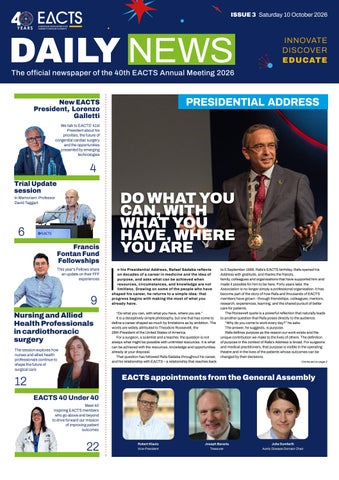
PRESIDENTIAL ADDRESS
New EACTS President, Lorenzo Galletti We talk to EACTS' 41st President about his priorities, the future of congenital cardiac surgery and the opportunities presented by emerging technologies
4 Trial Update session In Memoriam: Professor David Taggart
6 Francis Fontan Fund Fellowships This year's Fellows share an update on their FFF experiences
9 Nursing and Allied Health Professionals in cardiothoracic surgery The session explores how nurses and allied health professionals continue to shape the future of surgical care
I
DO WHAT YOU CAN, WITH WHAT YOU HAVE, WHERE YOU ARE
n his Presidential Address, Rafael Sádaba reflects on decades of a career in medicine and the idea of purpose, and asks what can be achieved when resources, circumstances, and knowledge are not limitless. Drawing on some of the people who have shaped his career, he returns to a simple idea: that progress begins with making the most of what you already have. “Do what you can, with what you have, where you are.” It is a deceptively simple philosophy, but one that has come to define a career shaped as much by limitations as by ambition. The words are widely attributed to Theodore Roosevelt, the 26th President of the United States of America. For a surgeon, a scientist and a teacher, the question is not always what might be possible with unlimited resources. It is what can be achieved with the resources, knowledge and opportunities already at your disposal. That question has followed Rafa Sádaba throughout his career, and his relationship with EACTS – a relationship that reaches back
to 5 September 1999, Rafa’s EACTS birthday. Rafa opened his Address with gratitude, and thanks the friends, family, colleagues and organisations that have supported him and made it possible for him to be here. Forty years later, the Association is no longer simply a professional organisation. It has become part of the story of how Rafa and thousands of EACTS members have grown - through friendships, colleagues, mentors, research, experiences, learning, and the shared pursuit of better care for patients. The Roosevelt quote is a powerful reflection that naturally leads to another question that Rafa poses directly to the audience. “Why do you come to work every day?” he asks. The answer, he suggests, is purpose. Rafa defines purpose as the reason our work exists and the unique contribution we make to the lives of others. The definition of purpose in the context of Rafa’s Address is broad. For surgeons and medical practitioners, that purpose is visible in the operating theatre and in the lives of the patients whose outcomes can be changed by their decisions. Continued on page 2
EACTS appointments from the General Assembly
12
EACTS 40 Under 40 Meet 40 inspiring EACTS members who go above and beyond to drive forward our mission of improving patient outcomes
22
Robert Klautz Vice-President
Joseph Bavaria Treasurer
Julia Dumfarth Aortic Disease Domain Chair
Issue 3 Saturday 10 October 1
IN THIS ISSUE NEW! Pulse by EACTS
EACTS TV
Exhibition map and exhibitors list
Scientific programme
New EACTS members
Continued from page 1
10 14 16 17 18
41st EACTS Annual Meeting
24
For the scientist in the lab, and those who work in research, the purpose is to generate impactful knowledge that informs practice, drives technological innovation, and enhances patient outcomes. "For those not in the field, the same applies. Why do you get up every morning? What can you do, and what are you contributing to others?" From there, Rafa moves in another direction: what happens when purpose meets constraint? Limitations are part of every career and every institution. Some are external, such as money, time, equipment or geography. Others are internal, such as selfdoubt or the assumptions we make about what is possible. There will always be limitations, but they do not have to define the outcome or what we strive to achieve. The danger comes when we accept them too readily, because in doing so we risk narrowing the possibilities and squandering our potential. To fulfil our purpose, we must not justify our limitations. Instead, we should do what we can, with what we have, where we are. Aiming high, even if you may not reach your final objective, is always worth it, and that is what Rafa tries to do. One of Rafa’s most powerful examples is Dr Norberto González de Vega, an 88-year-old Spanish surgeon who spent time training at the Leeds General Infirmary, the very same hospital where Rafa would train many years later. Dr González de Vega's work offers a striking example of what can happen when an idea is pursued with fierce determination despite severe limitations. Although his technique became widely used in cardiac surgery and is still recognised for its simplicity and efficacy, the man who designed it has not received the same level of international recognition as others. Dr González de Vega's story is not one solely of technical achievement, but a reminder that influence does not always belong to the person with the largest institution, the greatest resources or the highest profile. Inspired by those who achieved so much with few resources, Rafa explained his own experience at his centre in Spain: "Our hospital is at a mid-level in terms of volume, but with teamwork, and proper preparation and
communication, our team has developed a complete programme with excellent results." At a scientific level, the original team of two, which started with very limited resources, has grown into a successful team of more than 20 physicians and scientists with their own laboratory research programme. ‘Where you are’ is not a limitation, but a starting point. ‘What you have’ is not a list of everything you lack, but an inventory of what can be used. ‘What you can’ is ultimately a question of responsibility. This year marks the milestone 40-year anniversary of EACTS, and Rafa pays tribute to the grandfathers who had minimal resources, plenty of limitations, and did what they could. Their generation worked without many of the technologies, resources and accumulated knowledge that surgeons today may take for granted. They had fewer tools and answers, yet they built the foundations on which others could later stand. A video was then presented of Rafa and colleagues discussing what purpose means to them. It brought the theme out of the abstract and into the voices of people doing the work every day, showing that purpose is not a single, fixed idea but something shaped by patients, teams, mentors, challenges and responsibility. In that discussion, purpose becomes collective as well as personal: a reminder that medicine advances through shared commitment. Rafa’s message is not one of foolproof achievements, but of a way of working with purpose and making progress without waiting for perfect conditions. Limitations exist, but they don’t have to be the end of the story. One person can’t change everything, but maybe you can meaningfully change one thing.
LIFETIME ACHIEVEMENT AWARD Dr Norberto González de Vega pioneered the “De Vega annuloplasty,” a simple and durable tricuspid valve repair technique that has been used worldwide for more than 50 years and remains widely taught and performed today. Developed in 1972 at the Fundación Jiménez Díaz in Madrid, his technique has been cited in hundreds of scientific publications and
major cardiology textbooks. His wider career includes pioneering cardiac surgery in Spain, international collaboration with leading centres, decades of high-volume operative practice, and sustained recognition from Spanish cardiovascular societies. The EACTS 40th anniversary provides an opportunity to recognise Dr de Vega’s enduring contribution to cardiac surgery and the global legacy of his work.
DOWNLOAD THE EACTS APP HERE
Being honoured with an award like this in the winter of my life is something wonderful - a tribute to all the mentors I was fortunate enough to learn from over the years, an unforgettable gift for my family to whom I owe so much, and a source of pride for my patients and all the colleagues-surgeons, cardiologists, anaesthesiologists, perfusionists, and nurses - who have accompanied me on a journey that, while not always easy, has been truly wonderful.
A SNAPSHOT OF SATURDAY'S SESSIONS 10:00 - 11:00 Room 115/116/117 Improving CABG outcomes in the OR
Live Translation 1. Scan the QR code using your personal device
https://attend.wordly.ai/join/XWJN-2581
2. Select your preferred language 3. Click attend If you wish to listen to the audio translation, please use your headphones and ensure that your device is unmuted.
2 EACTS DAILY NEWS
11:15 - 12:45 Room 113 Special session dedicated to J.V. Comas on transposition of the great arteries 11:15 - 12:45 Room 131-132 Nursing and Allied Health Professionals in cardiac surgery
11:15 - 12:45 Room 115/116/117 Trial Update Session – In Memoriam: Professor David Taggart 12:45 - 13:30 Room 115/116/117 Keynote Lecture with Toni Nadal
Lorenzo Galletti on becoming EACTS' 41st President
It is a privilege to be part of such an important scientific community.
Can you take us back to when you first became involved with the Association in 1999? What did EACTS mean to you then? I became an active member of EACTS in 1999 – the same year as our immediate past-President Rafael Sádaba - and over the years I became increasingly involved in the Association. Since 2003, I was regularly involved in presentations at the Annual Meetings. From 2013 to 2017, I was a board member of the Congenital Disease Domain and then Chairman from 2018 to 2021. This was my first involvement in the EACTS Council. I have also served on the Guidelines Committee and in Education Committee within the congenital field, and last year I returned to the EACTS Council as Vice-President. Over the past few decades, being part of such a large, international scientific community has been so special. EACTS is one of the largest cardiothoracic associations and, in my view, the most global society in our field. As a young doctor, having access to some of the most prominent people in the speciality and being able to discuss things with them is extremely important and stands to me today. EACTS has been important for my professional development. Throughout my residency, fellowships and career, I have had mentors within and outside the Association who were willing to give me advice. Being part of the EACTS community means having people around you who are prepared to share their experience and expertise – including what you should and shouldn’t do in surgical practice. As EACTS celebrates its 40th anniversary, what does becoming President mean to you? It is a great honour and a great privilege. I have been a member of many different societies across Europe and the USA, but to serve as President of the European association for our field is particularly important to me. EACTS is an incredibly global organisation. We have members and presenters from Europe, Asia, the United States, South America and many other parts of the world, and we continue to develop our relationships in Africa. The breadth of representation makes it a very special community, and it is an honour to serve as President at such an important moment in the Association’s history, as we celebrate 40 years. What are your biggest priorities for your Presidency? I think every President should leave some work behind and contribute something to the future of the Association. One of my strongest commitments is to education, and I would like to continue to work toward better skills, better surgery and, ultimately, better outcomes for everyone involved: professionals, patients and their families, as well as industry and the wider healthcare community. 4 EACTS DAILY NEWS
I would like to increase the level of educational activity in congenital cardiac surgery, with more practical and live courses, using clinical scenarios and simulation of procedures. Simulation is becoming increasingly important in training, because the traditional concept of simply developing through a long learning curve is no longer acceptable. We need to provide high-quality education regardless of where someone is in their career. Another important priority is the development of a database for paediatric and congenital cardiac surgery. We need better ways of evaluating risk and benchmarking procedures. The registries we have today do not always capture the differences between centres, and it is very difficult to compare outcomes without standardised evaluation. We have already started working on this, with members of the EACTS Quality Improvement Programme and Congenital Disease Domain, and a taskforce is in development. I want to continue EACTS's contribution to globalisation. We should strengthen our educational and scientific collaborations with national, international and supranational societies. My own experience of different languages and cultures (I spent a lot of time in Madrid, speaking Spanish) has helped me to build relationships, particularly in Latin America. You have been active in several major cardiothoracic societies, including AATS and STS. What have you learned from working across different organisations, and how can EACTS strengthen collaboration with other societies to advance cardiothoracic surgery? We already have a very strong relationship with the STS and have joint activities in Latin America (the EACTS/STS/LACES Latin America Cardiovascular Surgery Conference) and our inaugural conference in South Africa that just took place. We are also developing our collaboration in India (e.g. our joint meeting in Kolkata). The American societies have a different structure from EACTS. The STS, for example, is a very large society, but its membership is predominantly American, and people largely speak the same language. EACTS is highly diverse, linguistically and culturally. We represent around 50 countries, and that diversity influences the way we work. There is a lot we can learn from each other. The STS can give us efficiency, while EACTS can bring a more diverse and perhaps more artistic perspective in the way we run things. Those differences are strengths, and the collaboration benefits both organisations. You have spent most of your career in congenital heart surgery. What is it about the speciality that inspires you? I had to leave my country very early in my career to pursue this speciality. At the beginning of my studies, I wasn't even sure I wanted to become a surgeon. I thought surgery could be quite mechanical and perhaps less intellectual. When I discovered cardiac surgery, I realised it was probably the most medical of the surgical specialities, and congenital even more so. You need an enormous understanding of physiology, and you follow patients from newborn life through childhood and into young adulthood. That was fascinating to me. The interaction with children and their families is of course difficult, but it is also one of the things that pushed me towards this field.
What is the biggest threat to the future of congenital cardiac surgery today? And, conversely, what is the biggest opportunity for EACTS? One of the biggest opportunities is the new population of patients who have survived congenital procedures and are now reaching adolescence and adulthood. This creates new challenges, but also opportunities to strengthen collaboration with other areas of cardiac medicine and surgery. For example, congenital cardiac surgery has historically been less focused on valve disease, so the growing adult congenital population gives us an opportunity to collaborate more closely with colleagues working in valve surgery and other adult cardiac specialties. Innovation is another major opportunity. Organ preservation and organ regeneration are areas that we want to explore, and we have created the EACTS Innovation Summit to look at these types of developments. What opportunities do AI, robotics and other emerging technologies offer the next generation of surgeons? They present fantastic opportunities, but we need to be careful about how we use them. AI has enormous potential to support and help us, particularly in clinical decision-making, but it requires strong integration of data, which we are constantly working towards. AI will also play an important role in training and could help us assess surgical skills and provide objective feedback on performance. I see them as tools that can complement traditional training and help us understand how someone is progressing through a procedure. I would like to explore creating a stable platform for daily discussion and knowledge sharing, rather than relying solely on annual meetings. I still work with friends on particularly difficult cases, sharing information and experience to help make good decisions. Creating a platform where that kind of exchange
could happen more routinely would be valuable. We often hear the term ‘patient-centred care’. What does that mean in practical terms for a cardiothoracic surgeon? Putting the patient at the centre of our practice is something we do automatically, something I have always done. There can sometimes be a tension between Guidelines, how healthcare systems are organised and what is truly patient-centred. Ultimately, putting the patient first should be inherent to medical practice. What should EACTS be doing to attract talented young medical professionals into cardiothoracic surgery?
Meet Vice-President Robert Klautz Robert J.M. Klautz completed his medical training at the University of Leiden Medical School. After medical school, he spent two years as a research fellow at the Cardiovascular Research Institute of UC San Francisco from 1991–1993 after which he defended his PhD-thesis in Leiden on Cardiac Mechanics, specifically on single ventricle physiology.
Cardiothoracic surgery is sometimes viewed as a less attractive speciality. The training is long, and in congenital you may need at least 10 years before you are a fully trained, independent surgeon. It’s difficult to compete with specialties that offer a shorter training pathway or earlier independence. If it is difficult to attract young professionals into the speciality, then we need to make sure that those who do choose it become part of the EACTS community as early as possible. EACTS is attractive because of its global community and its educational opportunities. We need to involve the next generation in EACTS activities from the beginning of their careers, give them opportunities to participate and make sure they have a voice. We are already doing this, but I think we can do even more. What have you learned from the EACTS Presidents who came before you that you want to carry forward as we enter the Association's fifth decade? This is a very important question. I have maintained close contact with many of the previous Presidents, and some have become very good friends. I have learned something from each of them. One of the strongest messages I took from Franca Melfi's Presidential Address was the importance of being free from pressure and independent in your thinking, pursuing innovation and continuing to question yourself throughout your professional life. But independence does not mean working alone. You need to create a team environment so that everyone in the ward is connected. A team is something you create, but also something you maintain. And you always need to continue improving and innovating. Finally, how do you like to spend time and relax outside of work? Golf, when I have the time. Golf has brought some lessons into my professional life too. You must be humble – you won’t become a good golfer without that humility. When you are standing on the tee, you think strategically: what can I do that gives me the best chance of putting the ball in the hole? It teaches you to think about the situation in front of you and make the best decision you can – the same goes for surgery.
Robert Klautz did his surgical training at Erasmus Medical Center in Rotterdam. In 2002, he returned to Leiden as a staff surgeon at the Department of Cardiothoracic Surgery, where he became chair of the department and professor in 2008. Since 2019 he also works at the department of cardiothoracic surgery of Amsterdam University Medical Center, initially as chief of the department and later as professor.
His main clinical and research interests are in mitral and aortic valve reconstruction, alternative surgical strategies in heart failure treatment, and ischemia reperfusion injury. He has been the residency training director in Leiden and chair of the training committee of the Dutch Association of CardioThoracic Surgery. He serves as a member of the National Medical Disciplinary Board and has been member of several supervisory boards in the health care environment. He is an active member of the EACTS, STS, AATS and has recently served on the Joint Guideline Committee for Heart Valve Disease of the ESC and EACTS-
It is with great honour and pride that I accept the nomination for the role of Vice-President of the Council of EACTS. During my tenure on Council I hope to improve the mutual recognition of cardiothoracic certification in the European countries and in accordance with this the training of cardiothoracic surgeons. This would allow for better integration and exchange of knowledge of cardiothoracic surgery across
Europe and ultimately improve the outcome of the patients we treat. I realise this is a long term goal that will need many years to achieve but I hope to contribute and accelerate this process in the next few years.
Aortic Disease Domain
Aortic Disease Domain Chair Florian Schoenhoff hands over to Julia Dumfarth Julia is the perfect person to take over this position. She is especially suited as she has a broad experience in open cardiac surgery, as well as vascular and endovascular surgery. Julia is one of the few cardiac surgeons that continue to perform open thoraco-abdominal surgery. She is not only very well connected within our speciality, but also has a great standing with our colleagues in vascular surgery, cardiology and genetics.
Julia has been instrumental in bringing together multidisciplinary aortic teams, incorporating genetics in daily decision-making in- and outside of the operating room. I have no doubt that we will see a number of innovative and exciting projects being launched during her tenure as Aortic Disease Domain Chair.
Florian Schoenhoff
Julia Dumfarth
Past Aortic Disease Domain Chair
Aortic Disease Domain Chair
QUIP A NOTE FROM TREASURER JOSEPH BAVARIA To the EACTS community, It is a great honour to be nominated by the leadership, and elected by the membership, as the Treasurer of our European Association for CardioThoracic Surgery (EACTS). I am very excited and optimistic about the future of EACTS and
its ability to provide impact, value, and relevance to its members, constituents, stakeholders, and ultimately our patients, through better surgery. EACTS is a very sophisticated organisation with operations in various and numerous domains. We are now a much broader, larger, more impactful, and deeper Association than in the past and operate across the full spectrum of
EACTS Adult Cardiac Database The leading European database of adult cardiac surgery The EACTS Adult Cardiac Database (ACD) is a collaborative registry and benchmarking tool of cardiac surgical data for centres on an international scale, supporting the development of evidence-based guidelines to improve pre- and post-operative care, and advancing quality research. Based on real world data, the database enables the identification of best practice and promotes the importance of integrating quality improvement initiatives into daily clinical practices. The database is rapidly becoming an important resource for EACTS members looking to understand how their centre’s practice compares with those of an international peer group. Building a shared picture of cardiac surgery outcomes The ACD was established to gather high-quality clinical data from participating centres and turn it into useful insights for cardiac surgeons and their teams. By contributing data, centres can
Edgar Daeter
QUIP Committee Chair
Paola Quattroni QUIP Director
benchmark their outcomes against an international peer group and gain a clearer understanding of how their results compare across a wide range of surgical procedures. This creates an opportunity to move from data collection to action: using insights from the database to identify opportunities for quality improvement and, ultimately, support better outcomes for patients. The value of the ACD also grows as more centres participate. A broader dataset creates a stronger basis for international comparison and helps build a shared understanding of trends and outcomes in adult cardiac surgery. A major milestone for the ACD The ACD has surpassed a major milestone: 100,000 highly curated datasets from cardiac surgery procedures recorded from 14 countries, including: Belgium, Bulgaria, Estonia, Germany, Ireland, Italy, The Netherlands, Spain,
cardiothoracic surgery. EACTS offerings, in a broad sense, have literally doubled in the past 5 years. The Treasurer’s responsibility is to manage our assets so that EACTS is financially healthy and prosperous and is therefore able to provide the myriad services required to drive forward our specialty. This is the mission. I will dedicate my time and energy to Sweden, United Kingdom, Vietnam and others. In total, 51 hospitals have now signed up to the ACD, and the dataset continues to grow, along with the value it offers participating centres. This expanding international participation is an important part of the ACD’s strength. It enables centres to look beyond their localised institutional data and place their outcomes within a wider international context. Benchmarking is most valuable when it leads to meaningful questions and action. The ACD is designed to support this process by making complex clinical data more accessible and clear to interpret. By exploring trends and differences across procedures, teams can identify areas that might warrant closer examination and use the resulting insights to inform best practice. Robotic Database Extension The Adult Cardiac Database has officially expanded to now collect robotic surgery data in the Robotic Database Extension. This is a pioneer initiative bringing together data that until now was not available. Expert consensus has led to development of a new standard to be adopted globally. We welcome centres to join the initiative and submit data.
serve the membership and leadership of EACTS as we continue to expand our increasingly global Association to new and greater heights. It has been an honour to serve as the EACTS Treasurer for the past 3 years and I look forward to serving for one more term.
We believe the EACTS ACD will be the leading European database collecting cardiac data from around the world. More than a repository of data, the database is a powerful instrument for benchmarking and research. The EACTS ACD holds huge potential to identify areas of improvement in clinical practice, drive innovation and ultimately improve patient outcomes. Edgar Daeter, QUIP Committee Chair to join and submit data and benefit from using the EACTS ACD’s interactive tools to analyse cardiac surgical data and continually improve patient outcomes. EACTS members can set up an account and access the ACD via: www.eacts.org/quality-improvement/ adult-cardiac-database/
Contribute to the growing database Centres and national registries are encouraged Issue 3 Saturday 10 October 5
Trial Update Session — In Memoriam: Professor David Taggart 11:15 - 12:45
Room 115/116/117
FOCUS SESSION
EW N
12:00 – 12:45
AI for prediction and prevention of surgical complications
Mentorship Programme A brand-new initiative, the EACTS Mentorship Programme captures the experience and knowledge of our community, connecting professionals working across the full spectrum of cardiothoracic care. The Trial Update session returns this year with a programme focused on some of the latest developments and ongoing debates in cardiovascular medicine. Ahead of the session, we spoke to Secretary General Patrick about what is on the agenda and the importance of bringing colleagues together to examine new evidence and its implications for clinical practice. "This year’s Trial Update session will have particular significance as we remember Professor David Taggart, whose memorable intervention on EXCEL helped define this forum’s commitment to open, critical debate.
David reminded us that advancing patient care requires the courage to question how evidence is interpreted and presented. This morning, we will honour that legacy by examining new findings, challenging assumptions and debating some of the most pressing questions in our specialty, such as long-term results of NOBLE, the 5th universal definitions of myocardial infarction, emerging long-term results of the TAVI and SAVR trials showing long-term issues with TAVI, and finishing with a tribute by John Puskas to David Taggart and his legacy.
We’re looking for mentors! Help empower other cardiothoracic professionals to grow, succeed, and achieve their full potential. Share your expertise, support the next generation, and help drive our mission of advancing skills, surgery, and patient outcomes. Give back to the EACTS community and make a lasting impact.
Become an EACTS Mentor Register your interest today!
"I hope colleagues will join us to remember David and continue the rigorous, candid discussion he championed."
ROOM 111
Anna Minasyan
University Hospital of A Coruña, Spain
A
rtificial intelligence is increasingly being used to predict surgical complications, but understanding its potential requires looking beyond published performance metrics and into how these models actually work.
10:00 - 11:00
ROOM 113
Next-generation patch integrating autologous tissue ingrowth and structural extensibility endogenous tissue ingrowth. In the highpressure circulatory system, non-synchronous degradation creates micro-mechanical "blank zones"—spots where the polymer has degraded before host tissue has matured—leading to localized tearing, patch aneurysms, or catastrophic perforation. Shintaro Nemoto
Osaka Medical and Pharmaceutical University, Japan
F Why become a member of EACTS? As part of our global community, you’ll gain access to world-class resources, expert-led training and a network of professionals driving innovation in cardiothoracic surgery. Apply now to become a member of EACTS and enjoy access to all the below membership benefits. Connect
Network with peers at the EACTS Annual Meeting – the leading global event in cardiothoracic surgery Access exclusive member-only rates for events COMING SOON: EACTS mentorship programme
Learn
Free access to the European Journal of Cardio-Thoracic Surgery (EJCTS) Reduced rates to contribute to the Interdisciplinary Cardiovascular and Thoracic Surgery journal (ICVTS) Free access to EACTS educational webinars Preferential rates for EACTS Academy training Apply for exclusive fellowships and bursaries
Advance
Join task forces and committees shaping surgical standards and practice Be part of initiatives supporting women, early-career clinicians and Allied Health Professionals Free access to the Adult Cardiac Database Apply for Outreach Grants Apply for Innovation Grants Vote at the General Assembly and help shape EACTS’ future.
Full active members pay just €300 a year. Visit the Membership Team on the EACTS Booth in the Exhibition Hall to find out more or apply online here >>
eacts.org 6 EACTS DAILY NEWS
guarantee good AI models: clinical data must be accurate, representative, appropriately labeled and correctly preprocessed, while models must be designed to avoid problems such as overfitting. From there, I will move to the clinical question: can these mathematical models help us anticipate and prevent surgical complications? Surgical care generates heterogeneous and high-dimensional information, and machinelearning approaches can identify complex and nonlinear relationships between variables that may be difficult to capture with conventional approaches. Using examples from intra- and perioperative care, I will explore how AI can support risk
FOCUS SESSION
www.eacts.org
BECOME A MEMBER OF EACTS TODAY!
In this presentation, I will first take the audience “behind the scenes” of artificial intelligence. The central idea is simple: AI is not magic; it is mathematics. Using practical examples, I will explain how clinical variables become inputs to a machine-learning model, how datasets are prepared and divided for training and testing, and how algorithms learn patterns that can subsequently be used to make predictions. The discussion will include concepts such as neural networks, weights and biases, activation functions, loss functions, and gradient descent, presented from a clinician’s perspective rather than a computer scientist’s perspective. Data quality will be an important part of this discussion. Large datasets alone do not
prediction before surgery, recognize evolving risk during the procedure, and identify patients likely to deteriorate postoperatively. The emphasis will not only be on discrimination or AUC, but on what happens after a prediction is generated. The most clinically useful AI model is not simply the one that predicts complications accurately. Prediction becomes valuable when it gives clinicians enough time and information to change management and prevent that complication.
or decades, pediatric cardiac surgeons have pursued the ideal biomaterial for cardiovascular reconstruction—one capable of in situ tissue regeneration that adapts seamlessly to a child’s somatic growth without material deterioration. While conventional approaches have faced critical bottlenecks, a regulatory-approved hybrid technology now offers a pragmatic, engineering-driven solution to these longstanding bio-mechanical dilemmas, backed by outstanding clinical outcomes. The Pitfalls of Conventional Scaffold Technologies First-generation decellularized xeno-extracellular matrix (ECM) scaffolds initially showed promise. However, mid-to-long-term clinical data revealed a high propensity for chronic inflammation, accelerated calcification, and tissue thickening, frequently causing progressive stenosis or valvular dysfunction that required complex reoperations. To address these limitations, secondgeneration tissue scaffolds shifted toward 100% biodegradable synthetic polymers fabricated via electrospinning. While eliminating antigenic risks, they introduce a fragile mechanical dilemma: the degradation rate must perfectly synchronize with
THANK YOU!
The Hybrid Strategy: Over 300 Pediatric Cases and Proven Efficacy Enter a next-generation surgical patch developed by a Japanese academia-industry consortium led by Osaka Medical and Pharmaceutical University. Rather than chasing the ideological ideal of 100% biodegradation, the developers adopted a physics-driven hybrid strategy. The new patch features a highly sophisticated warp-knitted fabric combining biodegradable poly-L-lactic acid (PLLA) and non-biodegradable polyethylene terephthalate (PET) yarns, completely sealed with a cross-linked gelatin membrane. Initially, the PLLA/PET framework handles the full hemodynamic load with optimal flexibility. Over six months, as the gelatin resorbs, host cells infiltrate the matrix, transforming the patch into a living, endothelialized autologous tissue. Crucially, once the PLLA disappears, the remaining permanent PET skeleton transitions into a unique sliding loop configuration. This allows the fabric, along with matured autologous tissue, to physically expand in response to the mechanical tension of the child’s growing blood vessels or balloon-catheter expansion. Moving beyond experimental models, this prestigious, award-winning innovation— recognized by multiple high-profile accolades from the Japanese government and major chemical industry associations—has achieved remarkable clinical success. It has received Japan regulatory approval and has already been successfully utilized in over 300 pediatric cases
Structure of the Hybrid knit inducing autologous tissue ingrowth
across Japan (Synfolium®, Teijin Medical Technologies Co., Ltd., Osaka, Japan). While this presentation focuses primarily on the basic science and innovation underlying the patch’s structural design and geometric textile engineering, its clinical translation has yielded overwhelmingly superior performance.
advanced engineering with proven clinical longevity. References 1.
Nemoto, S., Konishi, H., Shimada, R., Suzuki, T., Katsumata, T., Yamada, H., Sakurai, J., Sakamoto, Y., Kohno, K., Onishi, A. and Ito, M. (2018) ‘In situ tissue regeneration using a warp-knitted fabric in the canine aorta and inferior vena cava’, European Journal of Cardio-Thoracic Surgery, 54(2), pp. 318-327. doi:10.1093/ejcts/ezy045. 2. Nemoto, S., Konishi, H., Suzuki, T., Shimada, R., Katsumata, T., Osawa, S. and Yamaguchi, A. (2021) ‘Long-term viability and extensibility of an in situ regenerated canine aortic wall using hybrid warp-knitted fabric’, Interactive Cardiovascular and Thoracic Surgery, 33(2), pp. 165-172. doi:10.1093/icvts/ivab064. 3. Kasahara, S., Yoshimura, Y., Ichikawa, H., Hirata, Y., Murayama, H., Nakano, T., Miura, M. and Nemoto, S. (2024) ‘Early clinical results for a new self-organizing hybrid fabric in congenital cardiac surgery’,
Representative intraoperative photo of the patch implanted in
Annals of Thoracic Surgery Short Reports, 2(4), pp.
right ventricular outflow (from Ref [3])
Concurrently at this EACTS Annual Meeting, long-term clinical data demonstrating its exceptional 5-year efficacy and safety will be presented in a dedicated clinical session. By successfully preventing both the tissue degeneration of xeno-ECMs and the mechanical instability of 100% biodegradable polymers, the new hybrid patch delivers a true paradigm shift in in situ tissue restoration, beautifully bridging
804-809. doi:10.1016/j.atssr.2024.04.020. 4.
Arabkhani, B., Nemoto, S., De Kerchove, L., Perier, P., Wilbring, M., Sarikouch, S., Bertelli, F., Hjortnaes, J., Heinisch, P.P., Casselman, F., Beyersdorf, F., Hazekamp, M. and De Paulis, R. (2026) ‘The EACTS Innovation Committee’s perspective on the “Heart Valve of the Future”’, European Journal of Cardio-Thoracic Surgery, 68(6), ezag185. doi:10.1093/ejcts/ezag185./ezy045.
With grateful thanks to the members of the Executive Programme Committee who have worked tirelessly to shape this year’s EACTS Annual Meeting. Korkut Bostanci Gloria Färber Edoardo Zancanaro Milan Milojevic Patrick Myers
Rafael Sádaba Florian Schoenhoff Vladimiro Vida Alicja Zientara
Working alongside the Events Team:
Sharon Pidgeon Amanda Cameron Katie Bingham
Jenise Chisholm Marina Gueli
Issue 3 Saturday 10 October 7
CONNECTING THE CARDIOVASCULAR COMMUNITY Cardiovascular News is the leading source of news and information for specialists in cardiovascular care.
81
3 Top trials
10 Legacy
Practice-changing trials from a packed conference schedule
EUGENE BRAUNW The father of modern ALD cardiology remembere d
FULL-PAGE ADVERT
- NEWS - COMMENT - INDUSTRY UPDATES
12 Profile
www.cardiovascularn
BERNARDO CORTE SE Founder of DCB Academ discusses coronary adv y ances
0.81
NEW FORMAT
■ MAY 2026 | Issue
Beyond the wire
Latest-generation physiology technologies show promise for guiding PCI
Full story on page 14
FIND OUT MORE AT BIBAPUBLISHING.COM/SUB/CN-SUB.HTML
ews.com
FRANCIS FONTAN FUND FELLOWSHIPS Thoracic & Minimally Invasive Surgery Fellowship Victor Manuel Sanchez Sotelo Instituto Mexicano del Seguro Social, Mexico
A
s a board-certified cardiothoracic surgeon from Mexico, my primary motivation for applying for the EACTS FFF Thoracic and Minimally Invasive Surgery Fellowship was to deepen my expertise in advanced minimally invasive techniques and surgical innovation. I pursued training at a world-leading center for thoracic surgery so that I could acquire the necessary skills and translate these practices directly to the Mexican population. Shanghai Chest Hospital offered the ideal environment for this pursuit. From my first day in Shanghai, the scale and efficiency of the clinical operations were extraordinary. Shanghai Chest Hospital performs approximately 120 thoracic procedures daily, with our surgical team routinely completing over 17 cases per day. This ultra-high volume provided the perfect setting to observe and participate in complex procedures across the full spectrum of thoracic oncology—including lung, mediastinal, tracheal, chest wall, and esophageal conditions. Beyond standard anatomical resections, I gained extensive exposure to complex Uniportal VATS (UVATS) and Robotic-Assisted Thoracic Surgery (RATS), including sleeve resections, carinal reconstructions, and intricate subsegmentectomies. A key highlight of my fellowship was the direct integration of surgical technology and translational research into daily clinical practice. Complementing our operating room activity, the hospital’s surgical simulation and education center provided a platform to refine technical skills and master complex maneuvers in Uniportal VATS and robotic surgery. In the clinical setting, I took responsibility for pre-operative 3D CT reconstructions and surgical margin planning, as well as intraoperative Augmented Reality (AR) nodule
localization. Being actively involved in our team’s clinical research such as comparing AR-guided localization against traditional CT-guided or developing workflow for nodule identification using all these tools. These methods provided firsthand insight into how technology enhances surgical precision. Furthermore, I participated in collaborative meetings with software engineers working on AI-driven surgical tools and had the privilege of engaging with the patient-derived organoid laboratory, exploring advanced translational platforms for personalized oncology. The academic environment was equally enriching. I engaged in daily multidisciplinary case discussions focused on complex thoracic oncology. During my stay, I presented as a speaker at the "Shanghai Chest Symposium on Thoracic Surgery" and shared case report discussions at the "Thoracic Horizons – China/USA Thoracic Surgery Academic Forum." Academic exchange extended beyond our hospital through joint journal clubs at Shanghai East Hospital alongside Dr. Wentao Fang and his team. Throughout the fellowship, my mentor, Dr. Cheng Xinghua, provided strong guidance, encouraging my attendance at the World Congress on Lung Cancer (WCLC) in Seoul, Korea, and supporting my attainment of formal certifications in Uniportal VATS and robotic surgery.
Weill Cornell Medicine, USA
F
irst and foremost, my sincere thanks go to the Francis Fontan Fund and EACTS for giving me the opportunity to undertake the Pragmatic Clinical Trials Fellowship at Weill Cornell Medicine in New York. As a fifth-year cardiac surgery resident at Inselspital Bern, I came to the fellowship with a clear goal: to become a more independent clinical researcher and acquire the methodological skills needed to develop and lead clinical research projects myself. Now, only two months into the two-year fellowship, I have already had the opportunity to approach research from an entirely new perspective. An integral part of this training is the MSc in Clinical Epidemiology and Health Services Research at Weill Cornell, which provides the fellowship’s theoretical foundation. Beginning with an intensive summer program, the MSc covers epidemiology, study and trial design, statistics and coding, literature searches, and scientific writing in small classes. The summer course lives up to the word “intensive” homework included - and provides an excellent foundation for our projects. Regular feedback sessions allow us to apply what we learn directly to ongoing research. The MSc and fellowship interlock remarkably well.
I am deeply grateful to the European Association for CardioThoracic Surgery (EACTS) and the Francis Fontan Fund for making this transformative experience possible. My most sincere gratitude goes to my mentor, Dr. Cheng Xinghua, whose outstanding leadership and surgical mastery have been a true source of inspiration to me. I am also profoundly thankful to his entire surgical team, who welcomed me with open arms and treated me like a brother throughout my stay. Finally, my heartfelt gratitude goes to my wife, whose unwavering support and companionship made this international journey achievable.
This fellowship has significantly expanded my technical repertoire, decision-making skills, and perspective on modern thoracic surgical oncology. The combination of ultra-high surgical volume, technological innovation, and academic rigor has equipped me with
Pragmatic Clinical Trials Fellowship in partnership with Weill Cornell Medicine Kai Münker
invaluable expertise that I am eager to apply directly to my practice in Mexico, elevating surgical standards for our patient population.
Before coming to New York, my research experience included a basic science doctoral thesis, predominantly retrospective clinical studies, and the development of a local prospective pilot trial. However, my research had often depended on others for methodological and statistical components. I wanted to change that. My goal was to learn how to develop meaningful research questions, design studies and clinical trials, perform statistical analyses, and bring a project from an initial idea to publication. Put less formally, I wanted to become “the guy to ask” when it comes to research. Working across the research process has substantially deepened my understanding of concepts I had previously only begun to grasp. In particular, systematic reviews and meta-analyses have gone from concepts I was familiar with to methods I now understand on a much more fundamental level. Just as importantly, the epidemiology training has changed how I read the literature. Learning to critically assess not only results, but also methodology and applicability provides a different perspective on published evidence and, in
turn, helps generate better research questions. The practical side of the fellowship takes place within Professor Mario Gaudino’s group at Weill Cornell. Professor Gaudino is one of the most academically accomplished cardiac surgeons in the field, and the opportunity to learn from him and his team was a major reason I came to New York. My daily work combines developing my own projects with contributing to larger clinical trials. Another major strength is the opportunity to contribute to a broad range of research projects, with the prospect of publishing extensively throughout the fellowship. Whenever questions arise, there is expertise within the team to draw upon - in methodology, statistics, or the practicalities of clinical research. One of the most striking lessons during these first two months has been seeing the apparatus required to make large pragmatic trials work. Successful trials depend on a well-oiled research
infrastructure and substantial persistence. Fortunately, this trait is present in most cardiac surgeons in my experience. Mentorship is essential to this process. Professor Gaudino has the ability to explain both the bigger picture and the details behind methodological decisions, while demonstrating exceptional rigour in his own work. Members of the wider team contribute their individual expertise. One of the most rewarding experiences is developing my own projects, discussing them with experts, and knowing that the resulting study will be stronger because of that process. Over the coming two years, I hope the fellowship will also provide the foundation for lasting international collaborations. When I return to Europe, I want to lead clinical research projects, contribute to pragmatic clinical trials, and support younger colleagues with their own research. Cardiac surgery is changing rapidly. Advances in interventional cardiology, robotics and minimally invasive surgery, and artificial intelligence will continue to challenge established practice. We need high-quality evidence to determine which innovations actually improve patient care, and pragmatic clinical trials offer an important way of answering these questions in real-world practice. For cardiac surgeons with similar academic aspirations, I can strongly recommend the Francis Fontan Fund Pragmatic Clinical Trials Fellowship.
Issue 3 Saturday 10 October 9
FOCUS SESSION
Rendezvous approach for posterior mediastinal dumbbell tumors
Hussein Elkhayat
Chest Wall and Thoracic Trauma Task Force Chair
P
osterior mediastinal dumbbell tumours present an unusual surgical problem. Extending from the chest towards or into the spinal canal, they sit at the interface of thoracic and spinal surgery. Rather than approaching these tumours in separate stages, our teams developed a “rendezvous” strategy to address both components during the same operation. At the 2026 EACTS Annual Meeting, we presented six years of experience with this
technique in 29 patients. The thoracic component was approached by VATS or thoracotomy, while the spinal team used a separate posterior approach for intraspinal tumour disconnection and resection, with vertebral fixation when required. Both components were addressed during a single anaesthetic. Mean operative time was 3.3 hours and mean hospital stay 5.2 days, with no new neurological deficits observed on the first postoperative day.
became more standardized as the workflow between the thoracic and spinal teams developed. Our experience suggests that the rendezvous approach is not simply a technical modification, but a multidisciplinary strategy for tailoring complex surgery to the anatomy of the individual tumour.
The main finding from our series is that this combined thoracic–spinal strategy allowed these complex tumours to be managed within a single operative setting, with acceptable perioperative outcomes and surgical exposure tailored to the individual tumour rather than a fixed approach. We also observed an important learning effect. After approximately 10 cases, operative performance became more consistent. Rather than simply becoming faster, the procedure
Introducing Pulse by EACTS
Pulse brings EACTS media content together in one engaging, easy-tonavigate platform, making it simpler than ever for members to discover and enjoy our content on demand. I encourage every member to explore Pulse and make full use of this exciting new member benefit throughout the year.
Patrick Myers Secretary General
EACTSNews Hub
Read the latest news from EACTS on our regularly updated website News Hub.
Visit the eacts.org homepage for the latest features, or find us
under the ‘Our Community’ tab. 10 EACTS DAILY NEWS
Supporting Partner Issue 3 Saturday 10 October 11
Nursing and Allied Health Professionals in cardiothoracic surgery 10:00-11:00
ROOM 131-132
Cristina Ruiz Segria James Cook University Hospital, Edinburgh
As EACTS marks four decades of advancing cardiothoracic surgery, this year's Nursing and Allied Health Professionals (AHP) programme reflects on the evolution of nursing and allied health roles alongside the speciality itself. With multidisciplinary working, technological innovation and patient-centred care becoming increasingly important, the sessions will explore how these professions continue to shape the future of surgical care. The EACTS 40th anniversary celebration is a chance to understand how our roles and scope
of practice have evolved and how we are a crucial part of EACTS. Our Committee is growing, and it's important that we're part of those celebrations. The significant changes and rapid advances in robotics and minimally invasive surgeries have transformed how operations are performed - and how crucial it is now to have key members of medical teams working together to improve patient outcomes with safe, high-quality care. Multidisciplinary working has never been more important. Teams are the way forward in surgery, with new technologies, we need to work as one. Patients want to recover fast, go home early and live their lives, so they need a team that can ensure the surgery, preparation and aftercare is a success. Today, the Nurses and Allied Health Professionals session will take a look at the evolution and challenges of advanced roles in the field of cardiothoracic surgery and how they have changed in the last 40 years around the world. The session will have Committee Members Melanie Freas and Professor Blibleraj, and feature nurse Laura Saksa from the Cleveland Clinic, USA, examining the importance of striving for patients after any corrective surgery of the sternum to recover well and fast, and go home from day one. The programme will also highlight the growing importance of patient education, helping patients and their families better understand the surgical journey while supporting improved recovery and empowering them to play an active role in their care.
The abstract session is a chance for allied healthcare professionals to connect with peers. It will showcase new projects from across the AHP community and include a real patient perspective on participating in clinical research. We know our research is important, but we also want to hear patients’ perspectives. They are part of the change. Collaboration extends beyond the lecture theatre, and this year's programme will also introduce its first dedicated Nurses and Allied Health Professionals breakfast. Taking place before the scientific sessions begin, the event will provide an informal opportunity for delegates to meet colleagues over coffee. Just turn up, on a first come, first serve basis. The Committee's commitment to education continues throughout the year with dedicated projects and webinars, alongside the EACTS Nursing and Allied Health Professionals Fellowship, now in its second year. The Fellowship gives Nurses and Allied Health Professionals the opportunity to visit another centre, experience different ways of working, learn from colleagues in another country and bring new knowledge and ideas back to their own institutions. Applications will open on 1st March 2027 for Fellowships taking place in 2028. As the Committee continues to grow, I hope delegates from every part of the cardiothoracic community will use the opportunity to take part and engage with the
This fellowship broadened my international perspective, fostered global nursing collaboration, and empowered me to contribute meaningfully to the development of nursing research and the professional profile of cardiac surgery nursing in Austria. Karin Hinterbuchner, Past Fellow
programme and celebrate the progress of our profession and contribute to shaping its future. Everybody is welcome at the EACTS Annual Meeting. It's an international conference with innovative people who want to contribute to shaping the future of cardiothoracic care.
We want to learn what's happening around the globe, collaborate, educate each other and be inspired by the amazing things people are working on.
CVCC Level 1 & 2 Examination – Updated Regulations! Easier than ever to apply, view our updated regulations. The Critical Care Certification is for surgeons who are recognised as leaders of multidisciplinary, high performing teams. The Membership of the European Board of Cardiothoracic Surgery (MEBCTS) is for surgeons at the end of national training who are ready to work independently.
FEBCTS Level 2 Examination
ROOM 212
Donation After Circulatory Death and Its Impact on the Future of Heart Transplantation How DCD Managed to Change Heart Transplantation in Switzerland major milestone. But this was never simply about introducing a machine. It required a completely new clinical pathway involving intensive care teams, donation coordinators, anesthesiologists, perfusionists, transplant surgeons, cardiac surgeons and transplant cardiologists. Close cooperation between the Swiss transplant centers in Zurich, Bern and Lausanne was David Reineke University Hospital of essential. Bern, Switzerland The impact is reflected in the numbers. Before the DCD era, Switzerland performed approximately 30–40 heart transplants annually across three centers, with long waiting lists. eart transplantation has always faced one fundamental limitation: there are not Today, transplant activity and access to donor organs have reached levels that would have enough donor hearts for the patients who need them. For decades, transplantation seemed almost unimaginable for such a small country. In fact, between 2022 and 2024, the relied predominantly on donation after brain death (DBD), leaving many potential donors— probability of receiving a transplant increased and many potentially transplantable hearts— significantly, with a reported hazard ratio of 1.84 (1). outside the donor pool. The introduction of donation after circulatory death (DCD), DCD was a key driver, but not the only one. together with normothermic regional Switzerland has witnessed several almost perfusion and ex-vivo heart perfusion, has simultaneous developments: the transition fundamentally changed this paradigm. In toward an opt-out model of organ donation, Switzerland, these developments have gone increasing public awareness, DCD hand in hand with a series of innovations that implementation, rapid procurement, ex-vivo together have brought heart transplantation perfusion with the Organ Care System (OCS), to what we might call “Heart Transplantation broader acceptance of extended donor criteria, 2.0.” and international cooperation enabling longdistance DBD procurement. Together, these DCD itself is not new to Switzerland. It was developments have expanded both the donor introduced as early as 1985 but discontinued pool and the geographical reach of because of legal uncertainties. After the transplantation. Hearts that previously would regulatory framework was clarified, DCD was have been declined because of donor age, gradually reintroduced. logistics, ischemic time or complex donorThe real breakthrough for heart recipient constellations can now increasingly be transplantation, however, came with technologies considered. capable of recovering, preserving, resuscitating Ex-vivo perfusion has also fundamentally and assessing a heart after circulatory arrest. changed the philosophy of organ preservation. The introduction of ex-vivo heart perfusion in Instead of simply storing an organ on ice, the Switzerland in 2022 and the first Swiss DCD heart can be maintained in a warm, beating heart transplantation in March 2023 marked a state, allowing its function and metabolic
Critical Care Examination Applications opening 15th October!
MEBCTS Level 1 Examination
FOCUS SESSION 10:00 – 11:00
EUROPEAN BOARD OF CARDIOTHORACIC SURGERY
The Fellowship of the European Board of Cardiothoracic Surgery (FEBCTS) is for surgeons who are already practicing independently.
It has been an immense honour and privilege to serve as Chairman of EBCTS for the last 6 years and on the Board for 8 years. I am deeply grateful to the many colleagues, examiners and candidates whose professionalism and commitment have enabled us to modernise our examinations, deliver them successfully (even throughout the COVID pandemic), establish the Unified European Board of Thoracic Surgery, and introduce the world’s first critical-care examination specifically for cardiac surgeons. Now as an Emeritus Examiner, I will remain involved in quality-assurance work and in exploring how artificial intelligence can be leveraged in examinationrelated tasks. I am enormously proud of all that we have achieved together and delighted to see the Board flourishing, with record candidate numbers and a very exciting future ahead. Stephen Clark on stepping down as EBCTS Chair
Visit our website ebcts.org for more information
H
12 EACTS DAILY NEWS
recovery to be assessed. Preservation has become active organ assessment and, in the future, potentially organ rehabilitation. Our own clinical practice is evolving further. Following the implementation and consolidation of DCD and ex-vivo perfusion, we have optimized procurement and transplantation according to emerging evidence. With beatingheart implantation after ex-vivo perfusion (2), a second cardioplegic arrest can be avoided, potentially reducing ischemic injury and the need for postoperative mechanical support. More recently, based on promising preliminary data (3), we have explored an even more radical concept: avoiding cardioplegia altogether during procurement and transferring the heart directly to the perfusion system. Despite prolonged warm ischemia, the heart frequently resumes beating immediately, often without defibrillation or pacing, and demonstrates expected lactate profiles.
These observations raise an intriguing question: have we overestimated the protective role of cardioplegia in the setting of ex-vivo perfusion? They also suggest that warm ischemia may affect the heart differently inside and outside the donor body. Switzerland has shown what is possible when legislation, public engagement, technology, national collaboration and clinical innovation move together. DCD was the catalyst. The result is a new landscape of transplantation with one clear objective: to make more hearts available to more patients, and to give them the chance of a longer and better life. Figure 1. Source Swiss transplant
REGISTRATION IS OPEN!
References Source: Swiss transplant doi:10.1001/jamanetworkopen.2024.1828 doi:10.1016/j.xjtc.2025.03.013
Issue 3 Saturday 10 October 13
SCIENTIFIC PROGRAMME
FOCUS SESSION
Prognostic determinants in atrial secondary MR and TR: moving beyond the valve Acquired Cardiac Disease Domain
Aortic Disease Domain
Thoracic Disease Domain
General Interest
Congenital Disease Domain
SATURDAY 10 OCTOBER
Victoria Delgado
Room 115/116/117
Room 111
Room 112
Room 113
Room 114
Room 120-121
Room 131-132
Room 211
Room 212
08:30 – 09 :30
08:30 – 09 :30
08:30 – 09 :30
08:30 – 09 :30
08:30 – 09 :30
08:30 – 09 :30
08:30 – 09 :30
08:30 – 09 :30
08:30 – 09 :30
Aortic valve repair without root aneurysm – Video session
When surgeon and machines collaborate - AI tools every surgeon should know
Beyond repair: Mastering mitral valve replacement
Nightmares of thoracic surgery
Post-operative management of Type A dissection – The importance of multidisciplinary teams in the treatment of acute dissection
EACTS Rising researchers session 2
Congenital rapid response 2
Back to the future
09:30 – 10:00 Moderated e-Posters, e-Posters Theatres 1, 2, 3 and 4 10:00 – 11:00 Improving CABG outcomes in the OR
10:00 – 11:00 Remodel, resect, or replace? – How best to treat the severely emphysematous lung
10:00 – 11:00
Endovascular repair in Heritable Thoracic Aortic Disease – Do as much nothing as possible or pushing the limits?
Basic Science and innovation for congenital heart disease
11:15 – 12:15
11:15 – 12:45 Trial update session
10:00 – 11:00
Airway sparing surgery 12:00 – 12:45 Artificial Intelligence in thoracic surgery
10:00 – 11:00
10:00 – 11:00
10:00 – 11:00
10:00 – 11:00
ranscatheter therapies T in clinical action: Real‑world cases that sharpen decision‑making
Nursing and allied health professionals in cardiothoracic surgery
Contemporary challenges and innovations in minimally invasive valve and atrial fibrillation surgery
The changing landscape of heart transplantation
10:00 – 11:00 Commandos / VSD
11:15 – 12:15
11:15 – 11:45
Special session dedicated to J.V. Comas on transposition of the great arteries
Abstract session – Nursing and allied health professionals
12:45 – 13:30 Closing Plenary, Room 115/116/117 EACTS Awards Ceremony Farewell Drinks Reception from 13:30, Entrance Hall
For detailed programme and break times please refer to the EACTS App.
Learning Labs
Your guide to what's on
TUNE IN
Watch live and recorded content from this year's Annual Meeting on EACTS TV. Educational and entertaining, EACTS TV features compelling panel debates, Annual Meeting highlights and interviews with the world’s leading cardiothoracic surgeons.
EACTS LEARNING LAB SCHEDULE Saturday 10 October
Location
Time
Session
Panelists
09:00 – 10:00
Learning Lab – Touch the valves
EACTS Learning Lab 1
09:30–09:45
Your daily briefing: Saturday
Florian Schoenhoff Korkut Bostanci Emily Pan
09:00 – 11:00
Endoscopic Dry Lab Training - Basic, Mitral & Aortic
EACTS Learning Lab 2
10:30–10:45
Annual Meeting highlights & looking forward to 2027
Patrick Myers Lorenzo Galletti
10.00-10:15
Better Data, Better Outcomes: How Quality Improvement Is Changing Cardiac Surgery
Paola Quattroni Edgar Daeter Duncan Ingram
Enjoy even more science at the 40th EACTS Annual Meeting
SATURDAY 10 OCTOBER Time
09:30-10:00
References 1.
2.
3.
4.
5.
Saito Y, et al. Atrial functional mitral regurgitation: prevalence, characteristics and outcomes from the National Echo Database of Australia. Open Heart. 2023;10:e002330. Kagiyama N, et al. Outcomes and predictors of cardiac events in medically treated patients with atrial functional mitral regurgitation. Echocardiography. 2020;37:1131–1138. Atrial Functional Mitral Regurgitation: The Natural History of Atrial Functional Mitral Regurgitation. J Am Coll Cardiol. 2024;83. Fava AM, et al. Atrial Functional Tricuspid Regurgitation: Contemporary Characteristics, Outcomes, and Novel Risk Score. JACC Advances. 2025;4:101623. 2025 ESC/EACTS Guidelines for the management of valvular heart disease. Eur Heart J. 2025;46:4635–4736.
Contemporary outcomes of tricuspid valve surgery: a nationwide multi-centre analysis of primary and reoperative surgery
LEARNING LABS
e-POSTERS
right atrial remodelling, RV–pulmonary artery coupling and evidence of systemic congestion. These observations have practical implications. The 2025 ESC/EACTS Guidelines explicitly distinguish atrial from ventricular secondary MR and emphasise identification and treatment of underlying AF and HFpEF. For suitable patients with severe atrial SMR, surgery has gained a stronger role, while transcatheter edge-to-edge repair may be considered in selected high-risk patients.⁵ For TR, the guidelines similarly emphasise early assessment, including RV function and pulmonary pressures, reflecting growing recognition that intervention may become more hazardous once advanced right-heart failure and end-organ dysfunction are established.⁵ The key question, therefore, is not simply “How severe is the MR or TR?” but rather “What is the biological stage of the atrial valve disease?”. Atrial size and function, rhythm status, ventricular performance, pulmonary pressures, right-heart reserve, congestion and comorbidities may all provide prognostic information that complements conventional measures of regurgitation. As our understanding evolves, prediction may ultimately allow intervention to move from a response to advanced valve disease towards prevention of irreversible cardiac remodelling. The challenge for the coming years will be to define robust, validated markers that identify the window in which treating the valve - and the atrial disease driving it - can meaningfully change outcomes.
RAPID RESPONSE
Jules Olsthoorn
Isala Heart Centre, The Netherlands
SATURDAY 10 OCTOBER
DOWNLOAD THE EACTS APP HERE
trial secondary mitral regurgitation (ASMR) and atrial functional tricuspid regurgitation (AFTR) are increasingly recognised as distinct phenotypes of secondary valve disease. Their common denominator is atrial remodelling: enlargement of the left or right atrium and subsequent annular dilatation can produce significant regurgitation, often in the setting of atrial fibrillation (AF) and heart failure with preserved ejection fraction (HFpEF). Yet the prognostic significance of these lesions cannot be understood by looking at valve severity alone.
This is particularly relevant to the session “Atrial secondary MR and TR: Predict, rethink, intervene?”. The challenge is to identify which patients are likely to progress, which are already developing adverse cardiac consequences, and when intervention might alter the disease trajectory. For ASMR, the evidence suggests that the atrium is only part of the story. Large observational cohorts have demonstrated that patients with atrial functional MR are typically
Keynote Lecture – Toni Nadal: Everything can be trained
EACTS TV
A
Leiden University Medical Center, The Netherlands
older and have a high prevalence of AF. In the National Echocardiographic Database of Australia, AFMR accounted for approximately 40% of moderate or severe functional MR. Although outcomes were more favourable than in ventricular functional MR after adjustment, mortality remained substantial, with age, pulmonary hypertension, AF and reduced LV ejection fraction among important determinants of outcome.¹ Other studies reinforce the importance of the patient's overall phenotype. In medically treated patients with atrial functional MR, severe MR, symptoms, LV dilatation and comorbidity burden were independently associated with adverse cardiac events.² Conversely, recent work examining the natural history of AFMR found that progression of MR itself was relatively uncommon and was not independently associated with mortality. Instead, age, concentric LV remodelling, impaired diastolic function and elevated pulmonary pressures were more closely associated with mortality.³ This challenges a purely valve-centred approach and highlights the importance of understanding the atrial, ventricular and haemodynamic substrate. AFTR presents a similar paradigm, but with the additional importance of right-heart reserve. In a contemporary cohort of 370 patients with significant AFTR, right-heart failure, increased right atrial volume, reduced TAPSE/RVSP ratio, low serum albumin and greater TR effective regurgitant orifice area were independently associated with one-year mortality.⁴ These findings suggest that prognostic assessment should encompass not only TR severity but also
Topic
Location
Acquired Cardiac – Mitral Valve
e-Poster Theatre 1
Aortic Domain 5
e-Poster Theatre 2
Congenital Domain 5
e-Poster Theatre 3
Thoracic Domain 5
e-Poster Theatre 4
T
he tricuspid valve has long been the "forgotten valve" and its reputation has shaped practice: historical series reported in-hospital mortality of up to 10% for isolated surgery and as high as 37% for reoperations [1–3]. The result has been under-treatment and late referral, even though more-than-moderate tricuspid regurgitation affects around 4% of people over 75 and independently predicts mortality and right heart failure when untreated [4,5]. s. This presentation asks whether those figures still describe contemporary practice. Using the Netherlands Heart Registration (NHR), the nationwide quality registry covering all 15 Dutch cardiothoracic centres, we analysed two cohorts: 599 patients undergoing primary tricuspid valve surgery (2007–2021) and 345 undergoing tricuspid surgery as a reoperation after previous cardiac surgery (2007–2023). Concomitant aortic, aortic-valve and mitral procedures were excluded, so the tricuspid valve was the primary target in every case. In primary tricuspid valve surgery, repair was performed in 82% of patients. Thirty-day mortality was 4.0% overall and 2.8% once two high-risk subgroups, active endocarditis (8.5%) and
concomitant CABG (20.9%), were set aside. Respectively, 120-day mortality was 7.8% and 6.3%. Five-year survival was 72.0% overall and 74.8% in patients without endocarditis or CABG. Complications were infrequent, with new-onset arrhythmia the most common (21.7%). The reoperative cohort was a higher-risk population: median EuroSCORE II was 5.6% and 8.1% of patients were in critical preoperative condition. Even so, 30-day mortality was 4.3%, 120-day mortality 8.1% and five-year survival 67.8%, with repair still achievable in 64% of cases. These figures sit close to those of primary surgery and compare favourably with the 14.6% early mortality of one of the few contemporary reoperative series [3]. To our knowledge, this is the first nationwide analysis to report five-year survival after reoperative tricuspid surgery. Mortality showed no downward trend over time in either cohort; annual rates fluctuated between 0–10% for primary surgery and 0–16.7% for reoperations. The likely explanation is volume: nationwide, only 30–40 primary and 15–20 reoperative procedures are performed each year, roughly one to three cases per centre. This raises a legitimate question about centralisation. Second, the favourable outcomes almost certainly reflect careful patient selection and increasingly, diversion of the highest-risk patients to transcatheter therapies, which rose from a single NHR case in 2016 to more than 50 in 2021. Key findings Contemporary tricuspid valve surgery, primary or reoperative, is not the high-mortality procedure the historical literature describes: early mortality is around 4%, and under 3% in selected primary cases. Previous cardiac surgery alone should not be a reason to
withhold tricuspid intervention; reoperative outcomes approach those of primary surgery. Low per-centre volumes and no temporal improvement in mortality argue for centralising this surgery. These nationwide figures are a real-world surgical benchmark against which transcatheter tricuspid therapies should be judged.
References • Scotti, A., Sturla, M., Granada, J.F. et al. (2022) ‘Outcomes of isolated tricuspid valve replacement: a systematic review and meta-analysis of 5,316 patients from 35 studies’, EuroIntervention, 18, pp. 840–851. • Staab, M.E., Nishimura, R.A. and Dearani, J.A. (1999) ‘Isolated tricuspid valve surgery for severe tricuspid regurgitation following prior left heart valve surgery: analysis of outcome in 34 patients’, Journal of Heart Valve Disease, 8, pp. 567–574. • Pfannmüller, B., Moz, M., Misfeld, M. et al. (2013) ‘Isolated tricuspid valve surgery in patients with previous cardiac surgery’, Journal of Thoracic and Cardiovascular Surgery, 146, pp. 841–847. • Topilsky, Y., Maltais, S., Medina Inojosa, J. et al. (2019) ‘Burden of tricuspid regurgitation in patients diagnosed in the community setting’, JACC: Cardiovascular Imaging, 12, pp. 433–442. • Topilsky, Y., Nkomo, V.T., Vatury, O. et al. (2014) ‘Clinical outcome of isolated tricuspid regurgitation’, JACC: Cardiovascular Imaging, 7, pp. 1185–1194. • Dreyfus, J., Audureau, E., Bohbot, Y. et al. (2022) ‘TRI-SCORE: a new risk score for in-hospital mortality prediction after isolated tricuspid valve surgery’, European Heart Journal, 43, pp. 654–66
VIEW THE MODERATED e-POSTERS 14 EACTS DAILY NEWS
Issue 3 Saturday 10 October 15
EXHIBITION FLOOR PLAN
EXHIBITION OPENING TIMES: Thursday 8 October Welcome Reception Friday 9 October Saturday 10 October
09:00 - 18:30 17:00 - 18:30 09:00 - 17:00 09:00 - 12:00
T
his year's exhibition marks a special milestone as EACTS celebrates
We are equally delighted to welcome new exhibitors joining us this year and
40 years of advancing cardiothoracic surgery. Over four decades,
look forward to building new relationships as we embark on the next chapter of
the Annual Meeting has grown into a truly global event, bringing
collaboration, innovation and progress together.
together delegates from more than 100 countries and showcasing the
09
11
12
168 22
23
latest innovations from industry partners across the world.
167
64
147
148
150
07
25
06
26
27
137
63
138
EACTS LEARNING LABS
139
28
62
136
135
127
128
129
130
117
152
116
04
159
153
160
154
161
162
30 116
77
61
03
31
57
58
60
TV STUDIO 78
59
115
32
100
33
79
102
98
99
108
34 35
107
56
CATERING POINT
94 80
92
88
106 105
36
EACTS
37
01
55
38
54
90
89
88
81
82
87
155
83 157
41
42
43
44
45
46
E- POSTER AREA 3
163 165
103
39
166
47 E- POSTER AREA 1
169 170 171 172
E- POSTER AREA 4
16 EACTS DAILY NEWS
perfect space to take a break from the busy programme, connect with
journey. Their longstanding partnership has played a vital role in the success
colleagues and enjoy a friendly challenge between sessions.
E- POSTER AREA 2
173
NETWORKING AREA
Stand Number
Exhibitor Company Name
Stand Number
168
Jafron Biomedical
163
Abacus Medicine Pharmaceuticals
2
JenaValve Technology
155
ABBOTT
63
Johnson & Johnson MedTech | Heart Recovery
62
ADCORPUS
165
Johnson & Johnson MedTech Surgery
157
Advanced Medical Solutions
116
KLS Martin Group
35
Advanced Medtech Solutions
88
LivaNova
79
ADVITOS
92
LSI Solutions
139
Andocor
59
Medela AG
117
Ansabere Surgical
152
Medistim ASA
80
Arthrex GmbH
115
Medtronic
56
Artivion, Inc.
76
MedXpert
42
AtriCure
3
Meril Life Sciences
150
Avenns Medical
108
METRUM CRYOFLEX
107
Baxter International
27
Miconvey Technologies
161
Beijing Bohaikangyuan Medical Devices
45
MicroPort® Surgical
148
BioCer Entwicklungs-GmbH
127
NEOS Surgery
25
NEXT
84
Nordson MEDICAL
159
BIOMED® SURGICAL
87
Novlead Biotech
172
Biotest GmbH & Co. KGaA
44
OpInstruments GmbH
55
BrioHealth Technologies
6
OSTEOBIONIX
154
Cardia Innovation AB
135
Osypka GmbH
102
Cardio Medical GmbH
199
PRRI Cardiothoracic
37
Cardio Surgical Ltd
133
Qualiteam - Products to Advance Recovery
32
CARL.
54
Redax
100
CARMAT
147
ROCOR MEDICAL
82
Chalice Medical
128
Santec Atramat
60
Changzhou Ankang Medical Instruments Co., Ltd.(CAK)
98
Scanlan International, Inc.
47
CORCYM
30
SCTS - Society for Cardiothoracic Surgery
166
CTSNet
39
SERAG-WIESSNER GmbH & Co. KG
118
DELACROIX-CHEVALIER
137
Shanghai XINCHANG Memory Alloy Technology
160
Dendrite Clinical Systems
24
Simurghy
77
Designs for Vision
46
Sinapi Biomedical
57
DIMEDA Instrumente GmbH
11
SmartCanula
37
Dr. Franz Koehler Chemie GmbH
54
SpectroCor
34
Geister Medizintechnik GmbH
51
SS Innovations
60
EACTS - The European Association For Cardio-Thoracic Surgery
1
STS - The Society Of Thoracic Surgeons
167
Edwards Lifesciences
61
Sunoptic Technologies
26
enableCV
41
SURGIMED
58
ESTS
162
Teleflex
130
Eurosets
5
4
Exstent Limited
105
Terumo Aortic
FEHLING INSTRUMENTS GmbH
38
Terumo Cardiovascular
4
FIAB
89
TI MEDICAL PRIVATE LIMITED
64
Fresenius Medical Care Germany GmbH
138
TJ WELCOME MEDICAL EQPT.
103
Fuji Systems
33
Transonic Europe BV
136
Geister Medical
78
USB Medical
91
Genesee BioMedical, Inc.
90
Vivostat
129
Getinge
31
Waston Medical
8
Grena Ltd
22
WEGO GROUP
7
Haemonetics
9
Wexler Surgical
36
HEMONART
43
Wisepress
173
HMT Medizintechnik GmbH
12
XENOSYS
81
HXCORMED
170
XVIVO
106
International Society for Minimally Invasive Cardiothoracic Surgery (ISMICS)
169
Zimmer Biomet
94
INTUITIVE
28
VENTURA MEDICAL TECHNOLOGIES
153
AATS – American Association for Thoracic Surgery
133
76
02
appreciation to the many companies that have supported EACTS throughout its
Exhibitor Company Name
ENTRANCE
ENTRANCE
offer a dedicated networking area, complete with a foosball table, providing the
and evolution of the Association over the past four decades.
08
05
opportunities for learning, networking and discovery. We are also pleased to
As we celebrate this landmark anniversary, we extend our sincere
24
The exhibition floor is as vibrant and dynamic as ever, creating countless
Issue 3 Saturday 10 October 17
Welcome to all our new EACTS Members!
New Members Name
Country
Name
Country
Name
Country
Name
Country
Name
Country
Name
Country
Name
New Members Country
Name
Country
Name
Country
Abdul Baseer Wardak
AFGHANISTAN
Yoshihisa Shimada
CAMBODIA
Tarek El Feky
EGYPT
Terezia Andrasi
GERMANY
Klein Dantis
INDIA
Daniele Calzaferri
IRELAND
Yu Kawahara
JAPAN
Guy Custers
NETHERLANDS
Karolina Rucińska
POLAND
Lindita Çoku
ALBANIA
Charles Mve Mvondo
CAMEROON
Maged Shady
EGYPT
Julia Bendel
GERMANY
Shamanth Kashyap
INDIA
Patrick Higgins
IRELAND
Satoshi Otake
JAPAN
Dolores Koorndijk
NETHERLANDS
Pawel Zelechowski
POLAND
Albi Fagu
ALBANIA
William Santoire
CANADA
Ali Warda
EGYPT
Osama Gargum
GERMANY
Varun Muthu
INDIA
Vivekananda Siddiah
IRELAND
Khalid Abuelsamen
JORDAN
Maaike Van Huis
NETHERLANDS
Joanna Sliwka
POLAND
Indri Bibaja
ALBANIA
Ateeque Siddique
CANADA
Abdallah Nosair
EGYPT
Ilia Bazhanov
GERMANY
Akshaya Singh
INDIA
Jubran Al Balushi
IRELAND
Lijalem Garba
KENYA
Massimo Mariani
NETHERLANDS
Nuno Costa
PORTUGAL
Zina Otmani
ALGERIA
Lucrece Petnga
CANADA
Mohaned Radwan
EGYPT
Kursat Kirkgoz
GERMANY
Rishi Tiwari
INDIA
Steve Okwu
IRELAND
Tamba Martin Mattia
KENYA
Herman Tolboom
NETHERLANDS
Francisca Montenegro
PORTUGAL
Astrid Antonella Ramos
ARGENTINA
Regan Duffy
CANADA
Rana Elbayar
EGYPT
Godswill Oko
GERMANY
INDIA
Cathal Rafferty
IRELAND
Gilbert Oburu
KENYA
Sailay Siddiqi
NETHERLANDS
Tiago Nolasco
PORTUGAL
Guillermo Gutierrez
ARGENTINA
Jennifer Mcdonald
CANADA
Hossam Fouda
EGYPT
Regina Schleicher
GERMANY
Chandan Kumar Ray Mohapatra
Ronan J Ryan
IRELAND
Blend Bejiqi
KOSOVO
Aishat Olowoyeye
NIGERIA
Ana Margarida Rocha
PORTUGAL
Katherine Lopez
ARGENTINA
Linrui Guo
CANADA
Noha Fouda
EGYPT
Ahmed Jaafar Sadeq
GERMANY
Wen Zhou Wang
IRELAND
Tadas Abartis
LITHUANIA
Sarah Fatukasi
NIGERIA
Luis Moura
PORTUGAL
Hatem Elkady
AUSTRALIA
John Moore
CANADA
Sameh Sersar
EGYPT
Cynthia Aucella
GERMANY
Joseph Dilworth
IRELAND
Dominykas Budrys
LITHUANIA
Kenneth Christian
NIGERIA
Cátia Silva
PORTUGAL
Jason Varzaly
AUSTRALIA
Rashmi Nedadur
CANADA
Mahmoud Soliman
EGYPT
Christina Lohrenz
GERMANY
Joseph Murphy
IRELAND
Radvile Kadyte
LITHUANIA
Ayse Suslu
NORWAY
Mariana Campos
PORTUGAL
Jai Raman
AUSTRALIA
Felix Ma
CANADA
Mohamed Zahran
EGYPT
Henriette Most
GERMANY
Machaela Miskell
IRELAND
LUXEMBOURG
Sama Alhabsi
OMAN
Dina Alwaheidi
QATAR
Asen Ivanov
AUSTRALIA
Navneet Kang
CANADA
Ahmed Elkafoury
EGYPT
Hauke Winter
GERMANY
ISRAEL
Tahir Raza
PAKISTAN
Corneliu Vlas
ROMANIA
Michelle Ng
AUSTRALIA
Oscar Blanco Herrera
CANADA
Rania Mostafa
EGYPT
Olger Kraja
GERMANY
Mohammed Waheed Sultan
Yael Ag-Rejuan
Eugen Raul Mihaita Doroftei
INDIA
Gil Bolotin
ISRAEL
PAKISTAN
Scutaru Georgiana
ROMANIA
Jessica Tong
AUSTRALIA
Renee Fournier
CANADA
Karim Elmesery
EGYPT
Juelide Elmali
GERMANY
Saraansh Bansal
INDIA
Francesca Zanin
ITALY
Muhammad Raza Sarfraz
Bianca Gheorghiu
ROMANIA
Eduard Limonjiani
AUSTRALIA
Subodh Verma
CANADA
Khalid Abd Elgawad
EGYPT
Konstancja Porzycka
GERMANY
Mohammed Motiwala
INDIA
Adriano Papagni
ITALY
Dan Mihalcescu
ROMANIA
Shenghao Jiang
AUSTRALIA
Michael Zarathuscook
CANADA
Ahmed Fadaly
EGYPT
Zakaria Msallati
GERMANY
Mahendranath Prasad
INDIA
ITALY
Adrian Popa
ROMANIA
Vincent Le
AUSTRALIA
Hina Inam
CANADA
Mikko Uimonen
FINLAND
Carina Ciobotaru
GERMANY
Mohit Rana
INDIA
Antonio Davide Conserva
Ilie Zotea
ROMANIA
Anthony Tegg
AUSTRALIA
Ricky Muller Moran
CANADA
Fahad Almutairi
FRANCE
Andres Lezama Armenta
GERMANY
G N Lone
INDIA
Alexandra Bordianu
ROMANIA
Zeynep Gulben Kuk Ozalp
AUSTRALIA
Hanmei Li
CHINA
Jean Dubrez
FRANCE
Matthias Raschpichler
GERMANY
Riju Nair
INDIA
Nikita Chibisov
RUSSIA
Li Xiao Qiang
CHINA
Louis Labrousse
FRANCE
Emir Prashovikj
GERMANY
Mohammed Wahaj Ali
INDIA
Sofia Glukhova
RUSSIA
Leifu Shen
CHINA
Nicolas Dostrevy
FRANCE
Ahati Aren
GERMANY
Vinaypraveen Ayyala
INDIA
Daniil Murylev
RUSSIA
Hua Lu
CHINA
Valeria Stati
FRANCE
Ivana Mitrovic
GERMANY
Harish Badami
INDIA
Muslem Almusawi
SAUDI ARABIA
Weidong Li
CHINA
Emeline Plubel
FRANCE
Ahmad Ali
GERMANY
Manjunath Bale
INDIA
Saif Alshaikhmubarak
SAUDI ARABIA
Hongfei Xu
CHINA
Sandrine Dackam
FRANCE
Yelyzaveta Sitnikova
GERMANY
Ramesh Babu Bommaji
INDIA
Toga Ahmed
SAUDI ARABIA
Chengxin Zhang
CHINA
Marie Anne Barbier
FRANCE
Lorenz Veggetti
GERMANY
Sudheer Gandrakota
INDIA
Osman Al-Radi
SAUDI ARABIA
Chenyang Dai
CHINA
Beltran Levy Praschker
FRANCE
Kostiantyn Kozakov
GERMANY
Satya Sridhar Kale
INDIA
Norah Albugami
SAUDI ARABIA
Jian Ding
CHINA
Guillaume Guimbretiere
FRANCE
Josephina Haunschild
GERMANY
INDIA
Suha Althibait
SAUDI ARABIA
Zhi Liu
CHINA
Maiolino Elena
FRANCE
Benjamin Bierbach
GERMANY
Nareshkumar Kalludi Lakshminarasappa
Alwaleed Althobaiti
SAUDI ARABIA
Yu Feng
CHINA
Pietro Messi
FRANCE
Yassine Bennani
GERMANY
SAUDI ARABIA
Rong Zhou
CHINA
Yean Sophea
FRANCE
Mihnea Ghinescu
GERMANY
Venkata Sreedatta Sarraju
Hatem Elmontaser
INDIA
Hani Mufti
SAUDI ARABIA
COLOMBIA
Aurelien Vallee
FRANCE
Christian Liewald
GERMANY
Rhazane Nalluri
INDIA
Ivana Đurošev
SERBIA
COLOMBIA
Jacques Tomasi
FRANCE
Fabian Hundertmark
GERMANY
Levaka Reddy
INDIA
Aludaat Chadi
FRANCE
Lusine Baziiants
GERMANY
Mohammad Hafiz
INDIA
Michel Kindo
FRANCE
Isabel Baldizon Ibarra
GERMANY
Maulik Sharma
INDIA
Saade Saade
FRANCE
Penelope Adinku
GHANA
Lalitaditya Malik
Irakli Khelaia
GEORGIA
GHANA
Dina Markhulia
GEORGIA
Kenneth Kekeli Kuetsidzo
Nana Sichinava
GEORGIA
Loukia Alexopoulou Prounia
GREECE
Ajay Moza
GERMANY
Dimitris Altis
Stefan Erler
GERMANY
Helena Kirr
Sakic Adel
AUSTRIA
Jakob Hirsch
AUSTRIA
Jessica Gottsberger
AUSTRIA
Wolfgang Dietl
AUSTRIA
Martina Hoeftberger
AUSTRIA
Albert Hannover
AUSTRIA
Sarah Linnemeier Jose Ramon Matilla Jennifer Stabernak Laurenz Wolner Josef Helm
AUSTRIA AUSTRIA AUSTRIA AUSTRIA AUSTRIA
Kamal Agarzayev
AZERBAIJAN
Alvaro Martinez Santacruz
Zarifa Badalova
AZERBAIJAN
Carmen Pabon
Rajeebshankar Karmakar
BANGLADESH
Golam Mursalin
BANGLADESH
M Asmaul Nur
BANGLADESH
Md Masud Ur Rashid
BANGLADESH
Kazi Rimo
BANGLADESH
Marina Bushkevich
BELARUS
Ward Seurs
BELGIUM
Haddani Othmane
BELGIUM
Lukman Boutasmit
BELGIUM
Elisa Cornet
BELGIUM
Nicholas Rennie
BELGIUM
Gilles Soenens
BELGIUM
Sophie Bonni
BELGIUM
Oksana Manoryk
BELGIUM
Michaela Orlitova
BELGIUM
Tom Verbelen
BELGIUM
Danae Halleux
BELGIUM
Laurie Stiennon
BELGIUM
Manuel Pirotte
BELGIUM
Milana Klymenko
BOSNIA AND HERZEGOVINA
Heitor Gonzaga
BRAZIL
Gabriela Ruiz
BRAZIL
Jose Renato Torrano Jr
BRAZIL
Marcio Lacerda
BRAZIL
Patricia Viana
BRAZIL
Everton Abegg
BRAZIL
Guilherme Krawczun
BRAZIL
Caroline Lopes Machado
Jaime Arroyo
COLOMBIA
Carlos Chaves Flores
COSTA RICA
Kai Unfried Ana Varela Moreno Christophe Meneas
COSTA RICA COSTA RICA COTE D'IVOIRE
Sinisa Bogovic
CROATIA
Igor Lekšan
CROATIA
Zlatko Marovic
CROATIA
Mislav Planinc
CROATIA
Gloria Sestan
CROATIA
Nikola Slišković
CROATIA
INDIA
Mohammed Idhrees
INDIA
Ezhilan Subramanian
INDIA
Soumyajit Das
INDIA
Venkata Ketana
INDIA
Cristina Arangino
ITALY
Paolo De Orchi
ITALY
Paolo Albino Ferrari Simone Spano
ITALY ITALY
ITALY
Amin Ullah
PAKISTAN
Andrea Nenna
ITALY
Valeria Berti
ITALY
Antonella Dalonzo Anna Rita Manca Rosa Alba Mozzillo
ITALY ITALY ITALY
ITALY
Satyajit Samal
INDIA
Luigi Pellegrino
Mohit Rakhecha
INDIA
Pranav Vempati
GREECE
Michail Argyriou
GERMANY
Tatiana Farb
EGYPT
Jui Hsiang Chen
TAIWAN
Hofiz Yuldoshev
TAJIKISTAN
Godwin Sharau
TANZANIA
Thiti Chanmayka
THAILAND
Chanapong Kittayarak
THAILAND
Parinya Leelayana
THAILAND
Boonlawat Homvises
THAILAND
Wichayane Chotivanich
THAILAND
Peerapat Kongmalai
THAILAND
Termsiri Aittiwarapoj
THAILAND
Pathara Densiridecha
THAILAND
Piyawat Lertsomboon
THAILAND
Punnarerk Thongcharoen
THAILAND
Kasisak Luangpatomaram
THAILAND
GREECE
Vijayant Devenraj
INDIA
Massimo Salardino
ITALY
Sohail Saqib
PAKISTAN
Ilija Bjeljac
SERBIA
GERMANY
John Kokotsakis
GREECE
Saurav Gupta
INDIA
Stefano Pelenghi
ITALY
Prerna Rani
PAKISTAN
Xue Wei Chan
SINGAPORE
Sulejman Abdusalamov
GERMANY
Vasileios Kollias
GREECE
Iresh Shetty
INDIA
Giuseppe Imperatore
ITALY
Mudassar Hussain
PAKISTAN
Md Sazzad
SINGAPORE
Melik Atmaca
GERMANY
Efthymia Liaretidou
GREECE
Sabita Jiwnani
INDIA
Simone Tombelli
ITALY
Moath Hattab
PALESTINE
Kok Hooi Yap
SINGAPORE
Hasan Alkhatib
PALESTINE
Maros Kostial
SLOVAKIA
Hamad Madi
PALESTINE
Richard Kovac
SLOVAKIA
PALESTINE
Anton Tisoncik
SLOVAKIA
Laura Vidmar
SLOVENIA
Maja Bocek
SLOVENIA
Tomislav Klokocovnik
SLOVENIA
Abdijalil Ali
SOMALIA
Andrea Tonelli
SOUTH AFRICA
Tummarat Ruangpratyakul
THAILAND
Jacques Van Wyk
SOUTH AFRICA
Teera Simapattanapong
THAILAND
Kopano Mmalane
SOUTH AFRICA
Penprang Suwannapong
THAILAND
Delroy Musiyarira
SOUTH AFRICA
Phiphat Lochingchairit
THAILAND
Chang-Ha Lee
SOUTH KOREA
Pongpon Munsittikul
THAILAND
Hyo Yeong Ahn
SOUTH KOREA
Nasser Khaoula
TUNISIA
Myeongsu Kim
SOUTH KOREA
Hacı Ucak
TURKEY
Inha Kim
SOUTH KOREA
Ilknur Aydar
TURKEY
Yujin Kwak
SOUTH KOREA
Endri Balla
TURKEY
Ha Lee
SOUTH KOREA
Ozun Bayramlik
TURKEY
Samina Park
SOUTH KOREA
Elif Bicer
TURKEY
Victor X Mosquera Rodriguez
SPAIN
Mehmet Cakici
TURKEY
Gulfem Cakmak
TURKEY
ITALY
Omar Sadek
TAIWAN
Kyriakos Bellos
Sara Saltarocchi
EGYPT
TAIWAN
Chen-Yen Chien
SERBIA
INDIA
Beshoy Moris
Taiwei Chen
Jana Milojevic
Vivek Jaswal
BULGARIA
TAIWAN
PAKISTAN
GREECE
Svetoslav Stoyanov
SWITZERLAND
Shao Jung Li
Atif Nawaz
Ioannis Apergis
EGYPT
Lea Steiner
ITALY
GERMANY
Mostafa Abdelhafeez
SWITZERLAND
Marco Moscarelli
Karen Hornung
BULGARIA
SWITZERLAND
Sylvia Spiesshofer
INDIA
ITALY
Arulkumar Keirthanan
SWITZERLAND
Samuel Khatchatourov
Vinitha Nair
Silvia Romiti
EGYPT
Cem Kapkin
GREECE
INDIA
Hazem Ahmed
SWITZERLAND
SERBIA
Vaibhav Mishra
BRAZIL
SWITZERLAND
Freya Jenkins
Aleksandar Kamenov
GREECE
Jessica Silverio
Dragan Odavic
PAKISTAN
Emmanouil Matalliotakis
EGYPT
SWITZERLAND
Syeda Rabia Mahmood
GERMANY
Omar Galal
SWITZERLAND
Simon Hoerstrup
ITALY
Emmanuel Walter
BRAZIL
Nicola Dotto
Khalil Fattouch
ITALY
Ellton Cavalcanti Dos Santos
SWITZERLAND
INDIA
Alessandro Ricci
ECUADOR
SWITZERLAND
Amine Benouhiba
Kumar Saurabh Gaur
INDIA
Monica Gilbert
SWITZERLAND
Sébastien Colombier
SERBIA
Vishesh Sharma
BRAZIL
Thorsten Krueger
Aleksandar Milutinovic
GREECE
Stephanie Senna
SWITZERLAND
PAKISTAN
Chrysanthi Manali
ECUADOR
SWITZERLAND
Stephanie Mckeown
Rizwan Ullah
GERMANY
Guillermo Solorzano
Aristotelis Panos
ITALY
Lisa Harling
BRAZIL
SWITZERLAND
Fares Shamshoum
ITALY
Kaua Oliveira Da Silva
SWITZERLAND
Thanh-Long Nguyen
INDIA
Martina Mortillaro
Gilmer Romero
Kai Münker
SERBIA
INDIA
BRAZIL
SWITZERLAND
Aleksandar Milosavljevic
Nitin Prakash Kochar
Alessandro Mariani
SWITZERLAND
Robin Willixhofer
PAKISTAN
GREECE
DOMINICAN REPUBLIC
SWITZERLAND
Peter Matt
Jamil Rehman
Theodoros Milas
DENMARK
Elena Kraemer
MEXICO
GERMANY
Finn Dittberner
SWITZERLAND
Juan Camilo Valencia Gaviria
Vanessa Zwaans
BRAZIL
SWITZERLAND
Can Keskinaslan
ITALY
ITALY
Guilherme Kriger
Dominik Flury
Andrea Dellamore
Riccardo Magni
DENMARK
SWITZERLAND
SERBIA
INDIA
Hanna Dagnegaard
SWITZERLAND
Driton Bajrami
Miroslav Milicic
Pranav Mali
DENMARK
SWITZERLAND
Leon Mitoulas
PAKISTAN
GREECE
Mustafa Ahmad
Yujin Haller
Aizaz Khattak
Eirini Tsilivakou
BRAZIL
SWEDEN
MEXICO
GERMANY
Andressa Da Silva Elicker
SWEDEN
Zineb Chaabi
Victor Sanchez Sotelo
Anna Stegmann
DENMARK
Angiza Shahim
ITALY
ITALY
Joakim Grant Fredriksen
SWEDEN
SERBIA
Roberta Iacobelli
BRAZIL
SERBIA
SWEDEN
Ibrahim Nauf
Vladimir Milicevic
INDIA
Pedro Cosac
Nemanja Karamarkovic
Mohammed Fakhro
PAKISTAN
Fredrick Clifford Selvam
DENMARK
PAKISTAN
SWEDEN
Afnan Fayaz
GREECE
Sana Buttar
Zain Abedin
SPAIN
Marten Larsson
MEXICO
Antonios Samothrakis
BRAZIL
SERBIA
SPAIN
Diana Batin
Lorena Nayeli Ramos
GERMANY
Maira Fernandes
Maja Ercegovac
Jose Villaescusa
SERBIA
Carla L Schuering
DENMARK
PAKISTAN
SPAIN
Aleksandar Mikic
ITALY
Hussein Nasser Awada
Muhammad Haseeb Mumtaz
Marta Domingo Rivas
PAKISTAN
Gianluca Brancaccio
BRAZIL
Gloria Ortiz Betance
SPAIN
Niaz Ali
INDIA
Paulo Amorim
MEXICO
PAKISTAN
Jose Manuel Martínez Comendador
MEXICO
Nakul Babu
DENMARK
PAKISTAN
Samreen Malik
Country
Luis Arturo Ramirez Valdivia
GREECE
Benjamin Kelly
Syed Bukhari
MEXICO
Georgios Pilichos
BRAZIL
PAKISTAN
Jesus Infante
GERMANY
Rodrigo Tchaick
Amna Abbas
MEXICO
ITALY
Emilija Miskinyte
DENMARK
Rene Soberanis Gervacio
Giovanni Leuzzi
Mariafrancesca Fiorentino
PAKISTAN
MEXICO
MEXICO
INDIA
Shakir Ullah
Laura Rodriguez
Annet Cazares Perez
ITALY
PAKISTAN
MEXICO
ITALY
Cristina Viola
Hosh Muhammad
Emmanuel Enrique Armenia
Carlo Ferronato
ITALY
Evald Christiansen
Sunsiarey Henry
MEXICO
Ermanno Bellanti
BRAZIL
PAKISTAN
Omar Victorica
INDIA
Felipe Spadini
Waqar Malak
ITALY
Arohi Jain
DENMARK
PAKISTAN
Mauro Del Giglio
GREECE
Kamran Hosseinzadeh
Waqar Khan
PAKISTAN
Vasileios Patris
BRAZIL
MALAYSIA
PAKISTAN
Nazish Sikander
GERMANY
Pedro Rondinelli
Ahmad Mahir Shamsuddin
Sara Hussain
MAURITIUS
Yaroslav Ivanov
CZECH REPUBLIC
MALAYSIA
PAKISTAN
Mohammad Sohawon
Arshi Jain
David Vician
Ng Ern
Ikram Hassan
ITALY
ITALY
BRAZIL
MALAYSIA
Valentina Aloi
Riccardo Bei
Vaclav Maly
Saravana Karupiah
MARTINIQUE
Sara Bravin
INDIA
CZECH REPUBLIC
MALAYSIA
PAKISTAN
Amjad Shaikh
Towa Miyata
Nur Shahkizza Mohd Jefry
PAKISTAN
GREECE
CZECH REPUBLIC
PAKISTAN
Somia Razzaq
Alkinoos Nikolis
Mirabubakr Mirkomilov
PAKISTAN
Mahwish Bhutta
Diyan Muhammad
GERMANY
Anton Maksymenko
Athar Khan
MARTINIQUE
Zipan Fan
CZECH REPUBLIC
MALAYSIA
Sunsiarey Henry
CZECH REPUBLIC
Dushan Kolesar
Rashid Radzif
ITALY
ITALY
CZECH REPUBLIC
PAKISTAN
Marilena Drago
Penelope Semple
CZECH REPUBLIC
Syeda Ruqaiya
PAKISTAN
INDIA
Ales Klvacek
MADAGASCAR
Misauq Mazcuri
Bijoy Kutty
CZECH REPUBLIC
Ravaoavy Hariniaina
MALTA
GREECE
Jan Coufal
MACEDONIA
Nathan Zammit
Fotios Mitropoulos
CZECH REPUBLIC
Marko Minovski
LUXEMBOURG
ITALY
GERMANY
Jan Burkert
Sergiu Cebotari
Pierpaolo Fortunato
Miyoung Cho
CZECH REPUBLIC
18 EACTS DAILY NEWS
Vijit Cherian
CUBA
CZECH REPUBLIC
BRAZIL
INDIA
Massiel De La Rosa Castillo
Lea Wittlinger
Monica Louise Lima
Sameer Ummer
Name
Sonja Meissner
GERMANY
Ioanna Galanopoulou
GREECE
Pramoda Hari
INDIA
Mattia Vinciguerra
ITALY
Luca Paolo Weltert
ITALY
Martina Ziantoni
ITALY
Said Baris
MOLDOVA
Mara Djurovic
MONTENEGRO
Fatima Zahra Ammor
MOROCCO
Soukaina Benbakh
MOROCCO
Badreddine Belayachi
MOROCCO
Yassin Elmourabit
MOROCCO
Salma El Manir
MOROCCO
Meryeme Grine
MOROCCO
Hatim Yousfi
MOROCCO
K Khaing Saw Lwin
MYANMAR
Mohammad Eid Mohtasib
Niraj Bhattarai
NEPAL
Luis Aguirre Tipismana
PERU
Deepak Magar
NEPAL
Jose Conde
PERU
Sagar Khatiwada
NEPAL
Luz Rosadio
PERU
Manish Acharya
NEPAL
Harod Silva Tejada
PERU
Krishnaprasad Bashyal
NEPAL
Brigitte Tarazona
PERU
Bikash Shah
NEPAL
Alex Valdivia
PERU
Mike Gartside
NETHERLANDS
Sergio Zavala
PERU
Jojanneke KraaijeveldVan Den Beukel
NETHERLANDS
Luis Zavaleta
PERU
Neil Christian Villamucho
PHILIPPINES
Nicko Olermo
PHILIPPINES
John Kevin Kim Dela Cruz
PHILIPPINES
Fabienne Plaßmeier
GERMANY
Nikolaos Antonopoulos
GREECE
Ashiq Nihmathullah
Jana Sattelmair
GERMANY
Omiros Chalvatzoulis
GREECE
Hemachandren Munuswamy
INDIA
Tanushree Kar
INDIA
Ashish Khanijo
INDIA
Furkan Sayyad
INDIA
Pranay Mehsare
INDIA
Shahir Vardhan Reddy Kasi Reddy
Yusuke Ando
JAPAN
Merel Jans
NETHERLANDS
INDIA
Masato Furui
JAPAN
Fay Claybrook
NETHERLANDS
INDIA
Yusuke Nakata
JAPAN
Alaa Maali Natacha Jalu
GERMANY GERMANY
Tien Chen Tu Peng
GUATEMALA
Michael Hsin
HONG KONG
Marianne Thoenes
GERMANY
Yiu Tung Matthew Wong
HONG KONG
Hussam Imadi
GERMANY
Christy Wong
HONG KONG
Saha Harant Ilias Arfanis
GERMANY GERMANY
Mohammad Mehdi Dehghani Firoozabadi
GERMANY
Elham Mansour Safaeyan
GERMANY
Carl Philipp Bittorf
GERMANY
Mohamed Haj Khalaf
GERMANY
Presheet Pathare
GERMANY
Mahmod Ammar
GERMANY
Joyjit Singh
GERMANY
Imre Barabás
HUNGARY
Viktória Bognár
HUNGARY
Levente Bogyo
HUNGARY
Nicolas Alexander Toranosuke Kato
HUNGARY
Heajung Ryu
HUNGARY
Hanna Tihanyi
HUNGARY
Wan Chin Hsieh
Nagesh Basavaraj Nikunjkumar Shekhada Vipin Nair
INDIA
INDIA INDIA
John Neeraj Wesley
INDIA
HUNGARY
Divva Azhalisita Amelinda
INDONESIA
Miklos Bitay
HUNGARY
Gassani Amalia
INDONESIA
Tómas Kristjánsson
ICELAND
Reynold Siburian
INDONESIA
Rajan Modi
INDIA
Esmail Asdaghpour
IRAN
Pranjal Banthia
INDIA
Alireza Ghavidel
IRAN
Vishal Gupta
INDIA
Mehrdad Salehi
IRAN
Elina Oesterhaus
GERMANY
Maria Elisa Saavedra Meza
GERMANY
Mariana Shumliakivska
GERMANY
Kunal Jain
INDIA
Shkar Raouf Haji Saeed
IRAQ
Laurin Micek
GERMANY
Anil Jain
INDIA
Fahmi Kakamad
IRAQ
Julius Borger
GERMANY
Kush Bhatt
INDIA
Arian Mahmoud
IRAQ
Aline Rentschler
GERMANY
Vikas V
INDIA
Kornelija Bajoraityte
IRELAND
Kim Stoecker
GERMANY
A Mughilan
INDIA
Illann Wall
IRELAND
Svetla Chilikova
GERMANY
Bharathi Bhat
INDIA
Lorraine Browne
IRELAND
Mariateresa Femia Maria Serena Menzione
ITALY ITALY
Priscilla The
NETHERLANDS
Tijn Heeringa
NETHERLANDS
Olga Papazisi
NETHERLANDS
Piergiorgio Bruno
ITALY
Pascal Govers
NETHERLANDS
Gabriella Bonioli
ITALY
Arash Dodge
NETHERLANDS
Masayuki Shimizu Noritoshi Minematsu
JAPAN JAPAN
Kenta Higashi
JAPAN
Kazuhiro Ueda
JAPAN
Motonori Ishido
JAPAN
Kazuma Handa
JAPAN
Ryu Kanzaki
JAPAN
Yusuke Motoji
JAPAN
Takanobu Kimura
JAPAN
Yoshiki Watanabe
JAPAN
Ryoma Oda
JAPAN
Hideyuki Kato
JAPAN
Daiki Saito
JAPAN
Jun Hayashi
JAPAN
Ridha Alnuwaysir
NETHERLANDS
Elyan Ruiz Solano
NETHERLANDS
Andre Van Der Mee Mendes
NETHERLANDS
Christian Vroegh
NETHERLANDS
Mounir Bourass
NETHERLANDS
Ferdinand Bruning
NETHERLANDS
Vincent Sier
NETHERLANDS
Bart Velders
NETHERLANDS
George Ayoub
NETHERLANDS
Kinsing Ko
NETHERLANDS
Elise Cevaal Poortvliet
NETHERLANDS
Marie Jose De Hartog
NETHERLANDS
Lydia Allemekinders
NETHERLANDS
Sepideh Banar
NETHERLANDS
Laurent Coopmans
NETHERLANDS
Christine Carmelle Esplana
PHILIPPINES
Mikolaj Chmielnicki
POLAND
Andrzej Gnilka
POLAND
Mateusz Janeczek
POLAND
Michal Kuten
POLAND
SPAIN
Julia Ogrodowczyk Vel Ogrodowicz
Jhonny Javier Montesino Villafranca
Kerem Demir
TURKEY
POLAND
Ana Solbes Molto
SPAIN
Okay Karaca
TURKEY TURKEY
Pawel Slozowski
POLAND
Carla Gotsens Asenjo
SPAIN
Arif Karslioglu
Roch Pakuła
POLAND
Rosa Peiro Osuna
SPAIN
Umit Kervan
TURKEY
Dorota Wozniak
POLAND
Remedios Ríos
SPAIN
Ufuk Keskin
TURKEY
Oktawiusz Mirecki
POLAND
Gökhan Kocaman
TURKEY
POLAND
Narda Waleza Ajhuacho Renteria
SPAIN
Wojciech Wiese
Alvaro Alvarez Tomas
SPAIN
Muhammet Sefa Saglam
TURKEY
Nicolas Moreno Mata
SPAIN
Isil Tasoz Ozdas
TURKEY
Maria Solis
SPAIN
Umutcan Ulusoy
TURKEY
Jean Carlo Olivo Soto
SPAIN
Levent Yazicioglu
TURKEY
Carlos Porras
SPAIN
Yigit Yilmaz
TURKEY
Lorena Rubio
SPAIN
Okan Yurdakok
TURKEY
Ali Yener
TURKEY
Hilal Dogangun
TURKEY
Lucas Moskal
POLAND
Michal Graczyk
POLAND
Katarzyna Żanowska
POLAND
Seweryn Grudniewicz
POLAND
Michal Pawlikow
POLAND
Tomasz Semań
POLAND
Eryk Trela
POLAND
Lina Bengherbia
POLAND
Issue 3 Saturday 10 October 19
New Members Name
Country
Name
Country
Name
Country
Marta Domingo Rivas
SPAIN
Secil Ozturk Kucuker
TURKEY
Samir Mirzoiev
UKRAINE
Jose Villaescusa
SPAIN
Osman Akpinar
TURKEY
Pavlo Radzikhovskyi
UKRAINE
Diana Batin
SPAIN
Ayse Ali Hasan
TURKEY
Daniel Rusnak
UKRAINE
Marten Larsson
SWEDEN
Kemal Kararslan
TURKEY
Sabi Sandu
UKRAINE
Mohammed Fakhro
SWEDEN
Senanur Duymaz
TURKEY
Mykhailo Semenets
UKRAINE
Ibrahim Nauf
SWEDEN
Meril Ahmet
TURKEY
Matviyan Shymon
UKRAINE
Angiza Shahim
SWEDEN
Feyza Alkilic
TURKEY
Rodion Skvarskyi
UKRAINE
Zineb Chaabi Yujin Haller
SWEDEN SWITZERLAND
Zinar Apaydin Mariam Arafa
TURKEY TURKEY
Andrii Stepaniuk Mykhailo Todurov
UKRAINE
SWITZERLAND
Aslanbek Arziev
TURKEY
Kyrylo Tsyhalko
UKRAINE
Driton Bajrami
SWITZERLAND
Mohamad Kenan Atasi
TURKEY
Dariia Vinnichenko
UKRAINE
Dominik Flury
SWITZERLAND
Osman Murat Bastopcu
TURKEY
Denis Voropaiev
UKRAINE
Can Keskinaslan
SWITZERLAND
Busra Bastopcu
TURKEY
Andrii Sydiuk
UKRAINE
Elena Kraemer
SWITZERLAND
Selin Can
TURKEY
Rostyslav Tsinyk
UKRAINE
Peter Matt
SWITZERLAND
Funda Cansun
TURKEY
Yurii Behei
UKRAINE
Robin Willixhofer
SWITZERLAND
Bedirhan Cevik
TURKEY
Rasim Budahov
UKRAINE
Kai Münker
SWITZERLAND
Deniz Cevirme
TURKEY
Maxym Khudas
UKRAINE
Thanh-Long Nguyen
SWITZERLAND
Serkan Deser
TURKEY
Denys Skorokhod
UKRAINE
Aristotelis Panos
SWITZERLAND
Emre Dogan
TURKEY
Yurii Tarasenko
UKRAINE
Stephanie Mckeown
SWITZERLAND
TURKEY
Ahmed Ghobara
Thorsten Krueger
SWITZERLAND
Emine Aleyna Eroglu Polat
UNITED KINGDOM
Sébastien Colombier
SWITZERLAND
Yagmur Esenoglu
TURKEY
Setemi Olufemi
UNITED KINGDOM
Amine Benouhiba
SWITZERLAND
Tirth Shah
Nicola Dotto
SWITZERLAND
UNITED KINGDOM
Simon Hoerstrup
SWITZERLAND
Ching Chi Chu
UNITED KINGDOM
Dragan Odavic
SWITZERLAND
Freya Jenkins
SWITZERLAND
Ambreen Abid
UNITED KINGDOM
Cem Kapkin
SWITZERLAND
Samuel Khatchatourov
SWITZERLAND
Sylvia Spiesshofer
SWITZERLAND
Lea Steiner
SWITZERLAND
Shao Jung Li
TAIWAN
Taiwei Chen
TAIWAN
Chen-Yen Chien
TAIWAN
Jui Hsiang Chen
TAIWAN
Hofiz Yuldoshev
TAJIKISTAN
Godwin Sharau
TANZANIA
Thiti Chanmayka
THAILAND
Chanapong Kittayarak
THAILAND
Parinya Leelayana
THAILAND
Boonlawat Homvises
THAILAND
Wichayane Chotivanich
THAILAND
Peerapat Kongmalai
THAILAND
Termsiri Aittiwarapoj
THAILAND
Pathara Densiridecha
THAILAND
Piyawat Lertsomboon
THAILAND
Punnarerk Thongcharoen
THAILAND
Kasisak Luangpatomaram
THAILAND
Tummarat Ruangpratyakul
THAILAND
Teera Simapattanapong
THAILAND
Penprang Suwannapong
THAILAND
Phiphat Lochingchairit
THAILAND
Pongpon Munsittikul
THAILAND
Nasser Khaoula
TUNISIA
Hacı Ucak
TURKEY
Ilknur Aydar
TURKEY
Endri Balla
TURKEY TURKEY
Elif Bicer
TURKEY
Mehmet Cakici
TURKEY
Gulfem Cakmak
TURKEY
Kerem Demir
TURKEY
Okay Karaca
TURKEY
Arif Karslioglu
TURKEY
Umit Kervan
TURKEY
Ufuk Keskin
TURKEY
Gökhan Kocaman
TURKEY
Muhammet Sefa Saglam
TURKEY
Isil Tasoz Ozdas
TURKEY
Umutcan Ulusoy
TURKEY
Levent Yazicioglu
TURKEY
Yigit Yilmaz
TURKEY
Okan Yurdakok
TURKEY
Ali Yener
TURKEY
Hilal Dogangun
TURKEY
Aysen Yaprak Kapkin
TURKEY
20 EACTS DAILY NEWS
Deniz Gunay
TURKEY
Gokhan Ipek
TURKEY
Berna Karatas Nur Simge Kokles
TURKEY TURKEY
Suha Kucukaksu
TURKEY
Tunc Lacin
TURKEY
Eyup Murat Okten
TURKEY
Suat Nail Omeroglu
TURKEY
Mehmet Onalan
TURKEY
Yunus Ozsaray
TURKEY
Fatma Ozturk
TURKEY
Mehmet Rum
TURKEY
Mahmut Sasani
TURKEY
Mehmet Sengor
TURKEY
Muhammed Serbetci
TURKEY
Ilhan Sesiguzel
TURKEY
Kudret Tekin
TURKEY
Altug Tuncer
TURKEY
Mehmet Turan
TURKEY
Melike Ulker
TURKEY
Hassan Bakali
TURKEY
Yüksel Beşir
TURKEY
Deniz Bozdogan
TURKEY
Chris Bond
UNITED KINGDOM
Ananya Mathur
UNITED KINGDOM
Ivan Yim
UNITED KINGDOM
Krupal Reddy
UNITED KINGDOM
Michael Kay
UNITED KINGDOM
Umberto Benedetto
UNITED KINGDOM
Stamatina Koskolou
UNITED KINGDOM
Zaheer Tahir
UNITED KINGDOM
Mustafa Rady
UNITED KINGDOM
Vincenzo De Franco
UNITED KINGDOM
Shakil Farid
UNITED KINGDOM
Joshua Samuel
UNITED KINGDOM
Samuel Kemp
UNITED KINGDOM
Luis A. HernandezArenas
UNITED KINGDOM
Hind Elhassan
UNITED KINGDOM
Sena Cavus
TURKEY
Sahin Iscan
TURKEY
Musa Manneh
TURKEY
Mete Gursoy
TURKEY
Ceren Yildiz
TURKEY
Mikel Kamami
UNITED KINGDOM
Dilsad Amanvermez Senarslan
TURKEY
Shahid Mehmood
UNITED KINGDOM
Ahmet As
TURKEY
Salih Salihi
TURKEY
Vivin Chrysostor Albert Santhappa
UNITED KINGDOM
Ahmet Kuyucu
TURKEY
Lea Billich
UNITED KINGDOM
Guvanch Charyyev
TURKMENISTAN
Volodymyr Kiritsev
UKRAINE
Ilya Zhushman
UKRAINE
Taras Gudzenko
UKRAINE
Denys Strilchuk
UKRAINE
Rostyslav Zvarychuk
UKRAINE
Tetiana Velyhoria
UKRAINE
Kostiantyn Babych
UKRAINE
Vasil Beleiovych
UKRAINE
Andrii Bulakh
UKRAINE
Khrystyna Chekh
UKRAINE
Kostiantyn Daviskiba
UKRAINE
Diana Dudok
UKRAINE
Sviatoslav Flinta
UKRAINE
Diana Ilchuk
UKRAINE
Yevhenii Kashperskyi
UKRAINE
Ivan Kravchenko
UKRAINE
Oleksandr Kupchynskyi
UKRAINE
Volodymyr Kupchynskyi
UKRAINE
Anhelina Lymar
UKRAINE
Ivan Makohonchuk
UKRAINE
Vladyslav Marchenko
UKRAINE
Andreas Gialeli
UNITED KINGDOM
Mark Kerr
UNITED KINGDOM
Sarah Kelly
UNITED KINGDOM
James Veitch
UNITED KINGDOM
Nizar Asadi
UNITED KINGDOM
Richard Thomson
UNITED KINGDOM
Jose Alvarez Gallesio
UNITED KINGDOM
Muneeb Khalid
UNITED KINGDOM
Hiwa Najmalddin
UNITED KINGDOM
Kosha Patel
UNITED KINGDOM
Garima Bhag
UNITED KINGDOM
Hamad Ahmad
UNITED KINGDOM
Sanjay Chaubey
UNITED KINGDOM
Ishaan Chauhan
UNITED KINGDOM
Mona Dave
UNITED KINGDOM
Name
Country
Archie Egrilmezer
UNITED KINGDOM
Samson Egbulonu
Yuvraj Juttla
UNITED KINGDOM
Rhia Marie Casinillo
UNITED KINGDOM
Umar Masoro
UNITED KINGDOM
Luciano Delbono
UNITED STATES
Elizabeth Norton
UNITED STATES
John Puskas
UNITED STATES
Alex Wang
UNITED STATES
Jordan Bloom
UNITED STATES
Melina Heine
UNITED STATES
David Deboer
UNITED STATES
Sarah Nisivaco
UNITED STATES
Bushray Almiqlash
UNITED STATES
Cristiano Spadaccio
UNITED STATES
Nika Samadzadeh Tabrizi
UNITED STATES
Shinya Unai
UNITED STATES
Peter Kneuertz
UNITED STATES
Sashelin Naidoo
UNITED STATES
Ahmet Bilgili
UNITED STATES
Amjad Syed
UNITED STATES
Nicolas Anzellini
UNITED STATES
Jaymie Claire Henry
UNITED STATES
Felix Tsai
UNITED STATES
Ali Mashadi
UNITED STATES
Chawannuch Ruaengsri
UNITED STATES
Andrea Orellana
UNITED STATES
Amit Bhargava
UNITED STATES
Makoto Mori
UNITED STATES
Brandon Ferrell
UNITED STATES
Ali Hage
UNITED STATES
Jennifer Wilson
UNITED STATES
Calvin Macdonald
UNITED STATES
Elan Burton
UNITED STATES
Bryant Fisher
UNITED STATES
Adriana Hette
UNITED STATES
Defne Gunes Ergi
UNITED STATES
Ariana Goodman
UNITED STATES
Veronica Liang
UNITED STATES
Angela De La Fuente
UNITED STATES
Dawn Jaroszewski
UNITED STATES
Annabella Hochschild
UNITED STATES
Fadi Hage
UNITED STATES
Ramiro Arismendi
URUGUAY
Carolina Sosa Vota
URUGUAY
Olim Khamdamov
UZBEKISTAN
Doniyor Kuchkarov
UZBEKISTAN
Alina Mistirian
UNITED KINGDOM
Younis Peach
UNITED KINGDOM
Jade Qu
UNITED KINGDOM
Sam Raaj
UNITED KINGDOM
Evgeny Raevsky
UNITED KINGDOM
Shruti Rajendra
UNITED KINGDOM
Akhash Rathinam
UNITED KINGDOM
Daniella Ricchiuti
UNITED KINGDOM
Vaishnavi Sabarigirivasan
UNITED KINGDOM
Wafaa S M Shehada
UNITED KINGDOM
Sophia Sood
UNITED KINGDOM
Sanjeevan Sriskandarajah
UNITED KINGDOM
Mirthica Suganthan
UNITED KINGDOM
Selina Tsai
UNITED KINGDOM
Haron Watak
UNITED KINGDOM
Henrietta Wilson
UNITED KINGDOM
Hussain Zaidi
UNITED KINGDOM
Bekzod Isomitdinov
UNITED KINGDOM
Aamir Amin
UNITED KINGDOM
Ahmed Elmezayen
UNITED KINGDOM
Bertram Harrington
UNITED KINGDOM
Mubashar Nadeem
UNITED KINGDOM
Ashwin Phadke
UNITED KINGDOM
Radhe Shantha Kumar
UNITED KINGDOM
Enoch Akowuah
UNITED KINGDOM
Muhammed Hebala
UNITED KINGDOM
Asif Shah
UNITED KINGDOM
Vamsidhar Dronavalli
UNITED KINGDOM
Shakulov Murodulloyevich
UZBEKISTAN
Amr Rushwan
UNITED KINGDOM
Alisher Akbarzoda
UZBEKISTAN
Alisher Akbarzoda
UZBEKISTAN
Khusan Khalikulov
UZBEKISTAN
Nikita Konovalov
UZBEKISTAN
Khondamir Mirzaev
UZBEKISTAN
Murodjon Muhammedov
UZBEKISTAN
Maksud Muradov
UZBEKISTAN
Aziza Tavakkalova
UZBEKISTAN
Farrukh Vohidov
UZBEKISTAN
An Nguyen
VIETNAM
Ayan Arya
UNITED KINGDOM
Stefania Cavaliere
UNITED KINGDOM
Oscar Lu
UNITED KINGDOM
Yasser Khalaf
UNITED KINGDOM
Nikolaos Kostoulas
UNITED KINGDOM
Pablo Gomes Da Silva De Rosenzweig
UNITED KINGDOM
Yin Tung Shanessa Chan
UNITED KINGDOM
Qizong Hayden Huang
UNITED KINGDOM
Aron Abraham
UNITED KINGDOM
Laith Ali
UNITED KINGDOM
Hazem Aljasem
UNITED KINGDOM
Jason Kho
UNITED KINGDOM
Laura Viola
UNITED KINGDOM
Georgios Kechagioglou
UNITED KINGDOM
Shahzad Raja
UNITED KINGDOM
Poorva Zope
UNITED KINGDOM
Nicole Asemota
UNITED KINGDOM
Swapnil Sahoo
UNITED KINGDOM
Anshini Thakur
UNITED KINGDOM
Sign up Stay up-to-date with the latest EACTS news and insights.
2026
Ozun Bayramlik
TURKEY
Country
UNITED KINGDOM
UKRAINE
Leon Mitoulas
Selinsu Gulesce
Name
Issue 3 Saturday 10 October 21
Recognising 40 outstanding
members under the age of 40!
As we celebrate 40 years of EACTS, we have recognised 40 inspiring EACTS members under the age of 40, who demonstrate a commitment to cardiothoracic surgery and our mission to improve patient outcomes. Following a highly competitive selection process, we’re delighted to share the official members of the EACTS 40 Under 40 initiative. These individuals represent the next generation of leaders whose contributions are advancing patient care, driving scientific innovation and inspiring colleagues across the global cardiothoracic community.
Cardiothoracic surgery is a specialty that demands dedication, resilience, curiosity, and collaboration. To be recognised by EACTS among such an inspiring group of early-career surgeons and researchers is both humbling and motivating. It strengthens my commitment to advancing patient care, contributing to research and innovation, and supporting the future of our specialty. Leila Louise Benhassen
Being included among such an outstanding group of colleagues is both a privilege and a responsibility. I’m sincerely grateful to the mentors, collaborators, colleagues, and patients who have been part of this journey. Every achievement in academic surgery is built on teamwork, shared knowledge, and the pursuit of better outcomes for our patients. Tulio Caldonazo
22 EACTS DAILY NEWS
Issue 3 Saturday 10 October 23
BREAKING BARRIERS BUILDING THE FUTURE
FULL-PAGE ADVERT
Innovate
Discover
Educate