ISSUE 2 Thoracic Friday 10Disease October 2025 Domain
DAILY NEWS
INNOVATE DISCOVER EDUCATE
The official newspaper of the 39th EACTS Annual Meeting 2025
EACTS Lifetime Achievement Award
Yesterday, Professor Marko Turina received an EACTS Lifetime Achievement Award. We spoke with him about his decision to pursue surgery and reflections on the specialty's future.
4
An interview with the President
Professor Volkmar Falk discusses his career, influences, the challenges facing cardiothoracic surgery and his love of music.
6
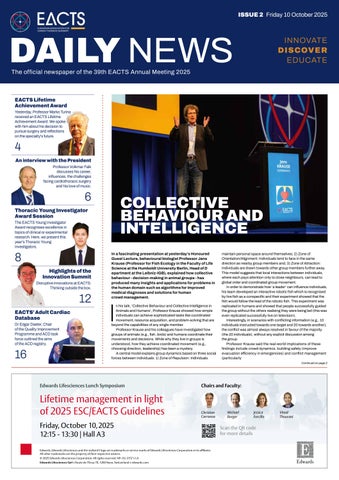
COLLECTIVE BEHAVIOUR AND INTELLIGENCE
Thoracic Young Investigator Award Session The EACTS Young Investigator Award recognises excellence in topics of clinical or experimental research. Here, we present this year's Thoracic Young Investigators.
8
Highlights of the Innovation Summit
Disruptive innovations at EACTS: Thinking outside the box.
12
EACTS’ Adult Cardiac Database Dr Edgar Daeter, Chair of the Quality Improvement Programme and ACD task force outlined the aims of the ACD registry.
16
In a fascinating presentation at yesterday’s Honoured Guest Lecture, behavioural biologist Professor Jens Krause (Professor for Fish Ecology in the Faculty of Life Science at the Humboldt University Berlin, Head of D epartment at the Leibniz-IGB), explained how collective behaviour - decision-making in animal groups - has produced many insights and applications for problems in the human domain such as algorithms for improved medical diagnoses and solutions for human crowd management.
I
n his talk, ‘Collective Behaviour and Collective Intelligence in Animals and Humans’, Professor Krause showed how simple individuals can achieve sophisticated tasks like coordinated movement, resource acquisition, and problem-solving that are beyond the capabilities of any single member. Professor Krause and his colleagues have investigated how groups of animals (e.g., fish, birds) and humans coordinate their movements and decisions. While why they live in groups is understood, how they achieve coordinated movement (e.g., choosing direction, leadership) has been a mystery. A central model explains group dynamics based on three social forces between individuals: 1) Zone of Repulsion: Individuals
maintain personal space around themselves; 2) Zone of Orientation/Alignment: Individuals tend to face in the same direction as nearby group members and; 3) Zone of Attraction: Individuals are drawn towards other group members further away. This model suggests that local interactions between individuals, where each pays attention only to close neighbours, can lead to global order and coordinated group movement. In order to demonstrate how ‘a leader’ can influence individuals, his team developed an interactive robotic fish which is recognised by live fish as a conspecific and their experiment showed that the fish would follow the lead of the robotic fish. This experiment was replicated in humans and showed that people successfully guided the group without the others realising they were being led (this was even replicated successfully live on television). Interestingly, in scenarios with conflicting information (e.g., 10 individuals instructed towards one target and 20 towards another), the conflict was almost always resolved in favour of the majority (the 20 individuals), without any explicit discussion among the group. Professor Krause said the real-world implications of these findings include crowd dynamics, building safety (improve evacuation efficiency in emergencies) and conflict management (particularly Continued on page 2
Edwards Lifesciences Lunch Symposium
Lifetime management in light of 2025 ESC/EACTS Guidelines
Chairs and Faculty:
Christian Carranza
Friday, October 10, 2025 12:15 - 13:30 | Hall A3 Edwards, Edwards Lifesciences and the stylized E logo are trademarks or service marks of Edwards Lifesciences Corporation or its affiliates. All other trademarks are the property of their respective owners. © 2025 Edwards Lifesciences Corporation. All rights reserved. NP--EU-3157 v1.0 Edwards Lifesciences Sàrl • Route de l’Etraz 70, 1260 Nyon, Switzerland • edwards.com
Michael Borger
Jessica Forcillo
Scan the QR code for more details
Vinod Thourani