





















JAMES VANVAKAS





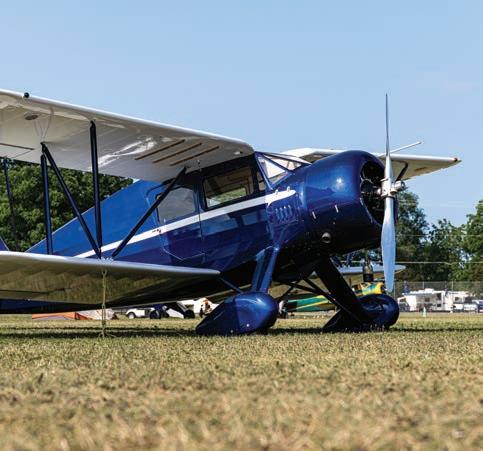
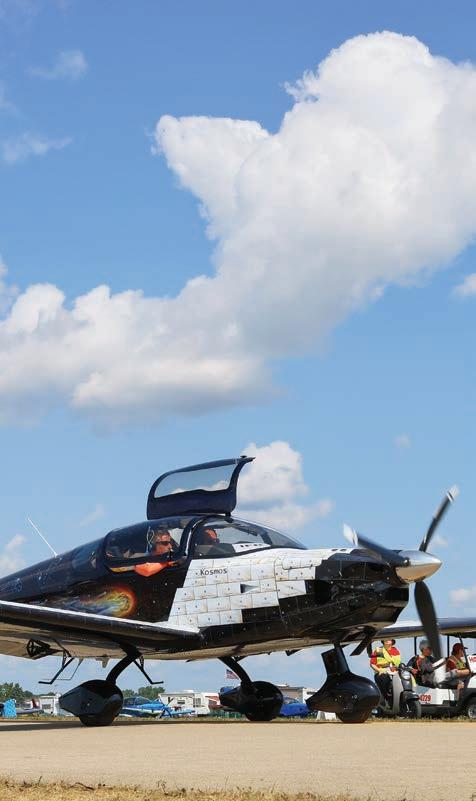
HUNDREDS OF GORGEOUS, striking airplanes arrive at EAA AirVenture Oshkosh each and every year in hopes of winning a Lindy Award. Few aircraft, in comparison to how many arrive, come away with any sort of award. Fewer still come away with a Lindy.
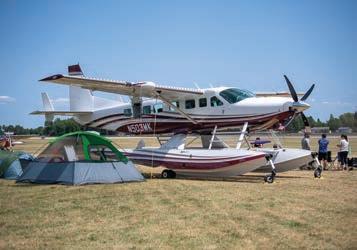
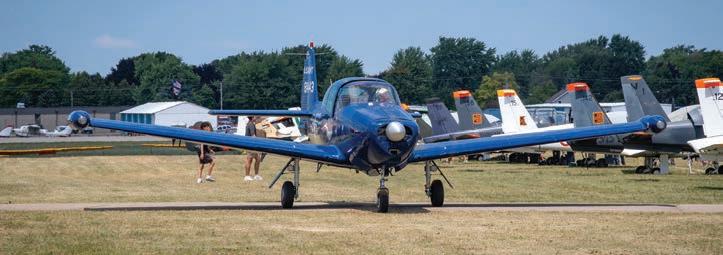
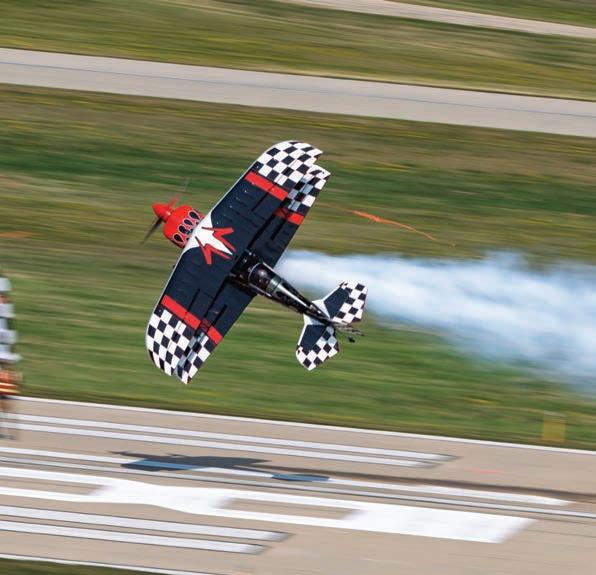
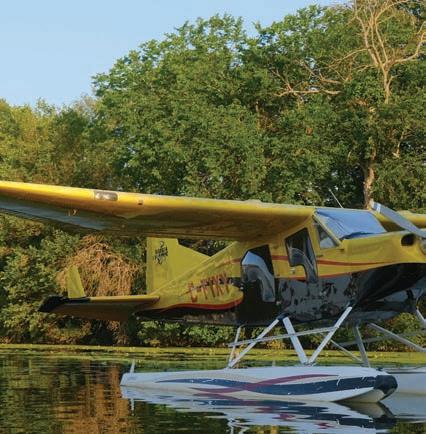
Awards are given out across six categories: Homebuilts, Warbirds, Vintage, Rotorcraft, Ultralights and Lightplanes, and Seaplanes. Entrants can be considered for only one category in a given year, and are
not eligible for the same or any lower-tier awards if they have won in the past.
Looks are considered in award judging, but the quality of craftsmanship inherent in the aircraft is a crucial factor as well. Careful construction and/or restoration, as well as tireless maintenance, is essential in winning a Lindy.
With all of that said, congratulations to all the 2026 award winners!
Weathers Norwood, Minnesota
PUBLISHER: Jack J. Pelton, EAA CEO & Chairman of the Board
VICE PRESIDENT OF PUBLICATIONS, MEMBERSHIP SERVICES, RETAIL, SAFETY AND SECURITY, AND EDITOR IN
CHIEF: Jim Busha
MANAGING EDITOR: Hal Bryan
SENIOR EDITOR: Sam Oleson
EDITORIAL STAFF: Robbie Culver, Emme Hornung, Jim Roberts, Angela Satterlee, Barbara A. Schmitz
SENIOR COPY EDITOR: Colleen Walsh
COPY EDITOR: Jennifer Knaack
PRINT PRODUCTION TEAM LEAD/GRAPHIC DESIGNER: Marie Rayome-Gill
GRAPHIC DESIGNERS: Amber Fabian, Brandon Wheeler
SOCIAL MEDIA MANAGER: Holly Chilsen
SOCIAL MEDIA COORDINATOR: Michael Sullivan
SOCIAL MEDIA INTERN: Madeline Wooten
SENIOR SALES AND ADVERTISING EXECUTIVE: Sue Anderson
Antique (Through August 1945)
Customized Aircraft Runner-Up
World War II Era Runner-Up
Bronze Age Outstanding Closed-Cockpit Monoplane
Bronze Age Runner-Up
Silver Age Outstanding Open-Cockpit Biplane
Silver Age Runner-Up
World War II Military Trainer/Liaison Aircraft Champion
Transport Category Champion
Customized Aircraft Champion
World War II Era Champion
Bronze Age Champion
Silver Age Champion
Antique Reserve Grand Champion
Antique Grand Champion
Classic (September 1945-1955)
Outstanding Beech
Outstanding Ercoupe
Outstanding Luscombe
Outstanding Navion
Outstanding Piper
Outstanding Stinson
Outstanding Swift
Outstanding Limited Production
Preservation
Custom Class A (0-85 hp)
Custom Class B (86-150 hp)
Custom Class C (151-235 hp)
Custom Class D (236+ hp)
Best Customized Runner-Up
Class I (0-85 hp)
Class II (86-150 hp)
Class III (151-235 hp)
Class IV (236+ hp)
Champion Customized Classic
Reserve Grand Champion
Grand Champion
Contemporary (1956-1970)
Outstanding Beech Single-Engine
Outstanding Beech Multi-Engine
Outstanding Cessna 150
Outstanding Cessna 170/172/175/177
Outstanding Cessna 180/182/185/210
Outstanding Mooney
Outstanding Piper PA-24 Comanche
Outstanding Piper PA-28/PA-32 Cherokee
Outstanding Limited Production
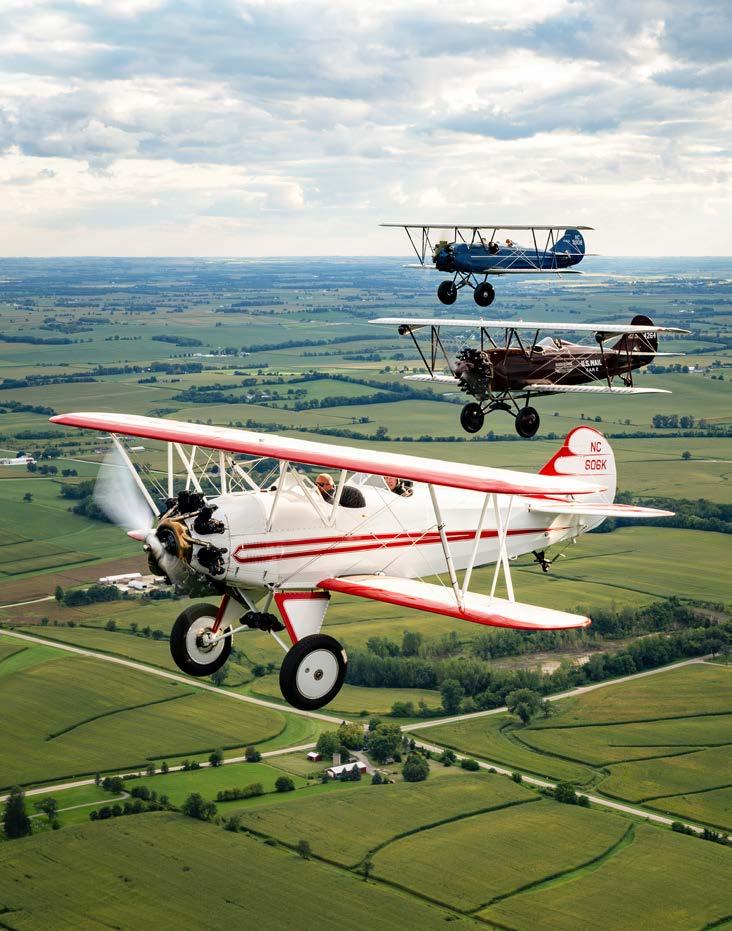
Nick Rezich Green Bay, Wisconsin Travel Air D-4-D N606K
Randolph Shields Benton, Kansas Stinson V77 Reliant N58285
Rusty Gavagan Chandler, Arizona Stinson Model 12 N36747
Joseph Raimo New York, New York Taylorcraft BL-65 N24367
Luigi Ricci Moretti Swarthmore, Pennsylavnia Fleet Model 7B N174RS
Cecil Bradford Huntersville, North Carolina Stinson SR6B N15117
Michael Porter East Liverpool, Ohio Boeing B75N1 StearmanN56383
Grant Schwartz Fenton, Michigan Douglas DC-3 N8704
Ronald Wagner Excelsior, Minnesota Howard DGA-15P N68431
Trey Hayden Rhome, Texas Beechcraft D17 N67738
Warren Caldwell Oklahoma City, Oklahoma Ryan SCW-145 N46207
Walter Bowe Sonoma, California Cirigliano SC-1 N775W
John Machamer Gettysburg, Pennsylvania Pitcairn PA-7S N97WA
Walter Bowe Sonoma, California Pasped Skylark N14919
Bill Ellington Houston, Texas Beech B35 N8926A
Joseph Mapes Stevens Point, Wisconsin Ercoupe 415 N99092
Jason Ridgeway West Chicago, Illinois Luscombe T-8F N1822B
Eric Rice Troy, Ohio Navion Ryan N4562K
Mike Childress Akron, Ohio Piper PA-12 N4364M
Justin Kehler Skiatook, Oklahoma Stinson 108 N97605
Fabian Schouten Canyon Country, California Globe GC-1 Swift N3232K
Jim Wells Lansing, New York Aeronca 15AC Sedan N944EW
Valerie Slocum Poplar Grove, Illinois Cessna 195 N2158C
Nathan Hauser Newark, Delaware Piper PA-15 N4420H
John Wigmore Salem, Oregon Dart GC-70 N31696
Shawn Johnson Stamping Ground, Kentucky Cessna 170 N3417D
Nathaniel Perlman Kirkland, Washington Cessna 195 N195BT
Kent Bosch Montevideo, Minnesota Ryan Navion N4210K
Dana Weigle Dublin, Ohio Taylorcraft BC-12 N5253M
Shawn Honaker Sellersburg, Indiana Aeronca 7AC ChampionN83175
Bruce Kaufman Elm Grove, Wisconsin Universal Globe GC-1BN3389K
Hans Steiner Exeter, California Beechcraft C-45 N9370Z
Wayne Roberts Grenada, Mississippi Cessna 195 N195CG
Walter Bowe Sonoma, California
Grumman Bearcat NX818F
Tom Reneau Midland, Texas Cessna 140 N1949A
Erik Utter
David B. Fields
Tony Belli
Joel Dopson
Burien, Washington
Midland, Texas
Huron, Ohio
Beechcraft S35 Bonanza N5894S
Beechcraft D18 N777XJ
Cessna 150 N8153S
Ooltewah, Tennessee Cessna 172 N5122A
Jason Peterson Calgary, Alberta Cessna 180 CFIQC
Doug Ewart
Martin Hench
Kansas City, Missouri
La Verne, California
Mooney M20C N6212U
Piper PA-24 Comanche N7220P
Dale Wheeler Valencia, California Piper PA-28 Cherokee N5453W
Thomas Myers Wills Point, Texas
200D N2980T
Most Unique Anthony Urbano Gilbert, South Carolina Piper PA-24 Cherokee N2024P
Preservation Award
Class I Single Engine (0-160 hp)
Class II Single Engine (161-230 hp)
Class III Single Engine (231+ hp)
Dean Richardson Memorial Award
Outstanding Customized
Reserve Grand Champion Customized
Reserve Grand Champion
Grand Champion Customized
Chris Demopoulos Dyer, Indiana Cessna 172H N3832R
Michael Bergeson Cottage Grove, Minnesota
Piper PA-18 Super Cub N8831B
Christopher Cormier Riverview, New Brunswick Piper PA-18 Super Cub CFLQE
Keith Steiner Granbury, Texas
Piper PA-24 Comanche N9321P
Christoper Belli Oregon, Ohio Cessna 172 N8762U
James Kapantais Carrollton, Texas Beech 35-B33 Debonair N61JK
Mark Erickson Brandon, South Dakota
Piper PA-18 Super Cub N14319
Paul Neuman Campbellsburg, Kentucky Cessna 150 N8231F
William Cunningham Tulsa, Oklahoma
Beech E33C Bonanza N775JW












Loving your time at AirVenture® ?
Join EAA®, and take a piece of Oshkosh home with you! An EAA membership will give you year-round access to all things aviation.
Enjoy member benefits such as:
•Monthly issues of EAA Sport Aviation® magazine
•Discounts while you’re here at AirVenture ®
•Free access to nearly 400 museums and science & technology centers, including the EAA Aviation Museum™








































www.icomamerica.com/aviation insidesales@icomamerica.com







Preservation Awards
Preservation Award Peter Bales Janesville, WisconsinHughes OH-6A Loach N67PB
Preservation Award Mike Anderson Muskogee, OklahomaHiller UH-12B N5025J
Preservation Award Courtney St. PierreClinton, North CarolinaNorth American T-28B TrojanN662WW
Preservation Award Jeff Kaney Naples, Florida Aérospatiale SA 341 GazelleN341KJ
Preservation Award John Carlton Lenoir, North CarolinaCessna L-19A Birddog N143F
Preservation Award Scoop Heavey Barrington, Illinois MiG-17F N717MG
Judges’ Choice
L-5E Jan Johnson Manteca, CaliforniaStinson L-5E AmbulanceN31853
T-28 Chris Birrell Ottumwa, Iowa North American T-28F N397DM
Patrol Bomber SAC Holdings Phoenix, Arizona Consolidated PB4Y-2 PrivateerN2871G
Basic Trainer Lincage Flight LLCHolly Springs, North CarolinaVultee BT-13 N56319
Liaison Logan Steet Winnesboro, South CarolinaPiper L-4 Grasshopper N3280N
Primary Trainer Eric Whyte Anchorage, Alaskade Havilland DHC-1 ChipmunkN22777
Best
A-26 Silver Vincent Quadrani Vincent QuadraniKingsford, MichiganDouglas A-26B Invader N99420
Primary Trainer Silver Brent Courtney Brent Courtney Magnolia, Texas Boeing PT-17 Stearman N1028C P-51 Silver Fagen Fighter Restoration; Sebastian DomineCarmel Valley, CaliforniaNorth American P-51D N354WR Granite Falls, Minnesota
B-25 Silver Warbird Shop; Madras, Oregon Hugo Mathys Grenchen, SwitzerlandNorth American B-25D N8897Z Fighter Silver Henry & Jay Schroeder, Craig DavidsonHenry SchroederDanville, Illinois Curtis P-40K Warhawk NX9733 Observation Silver Andrew Badenhorst Andrew BadenhorstDerby, Kansas Aermacchi AM3-CM N955ZA L-Bird Silver AirCorps Aviation; Bemidji, MinnesotaJames Harker Forest Lake,
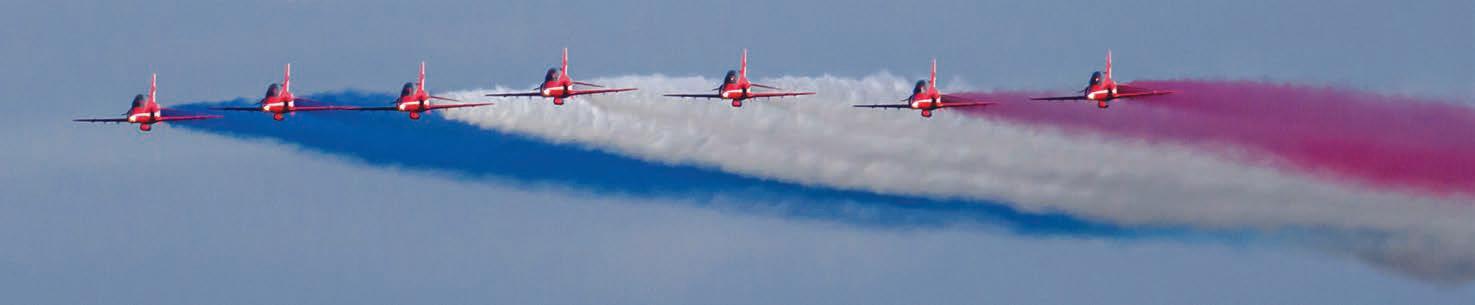
ATTENDEES, VOLUNTEERS, AND PILOTS should be aware that the Red Arrows’ performances require a larger aerobatic box, necessitating a slight move of the crowd line to the west during the afternoon air show. Only essential, authorized air show personnel are permitted inside the box during the Red Arrows’ performance.
The Red Arrows crowd line will run the entire length of the flightline from Ultralights through Warbirds, in line with the existing speaker poles, about 120 feet west of the regular crowd burn line. This line will be clearly marked.
For
Visitors will have access to the regular crowd line area until noon on Sunday. At this time, visitors must move back to behind the Red Arrows crowd line.
AirVenture guests will not be allowed to leave chairs, blankets, coolers, or other items past the Red Arrows crowd line at any time on those days. On Sunday, Wittman Road will be closed to all vehicular tra c, providing additional space for air show viewing.
After noon on Sunday, pilots or crew of aircraft parked between the two crowd lines will be allowed in the area for a short time with a security escort to perform urgent, essential tasks. Everyone will need to be out of this area by 3:15 p.m. on Sunday.
Full access will be restored after the conclusion of the air show on Sunday. Look for extensive signage on the grounds further explaining the areas and times covered by these necessary rules and guidelines.






BY BARBARA A. SCHMITZ AIRVENTURE TODAY STAFF
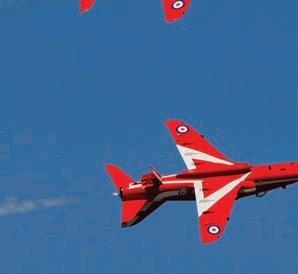
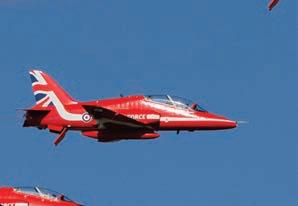
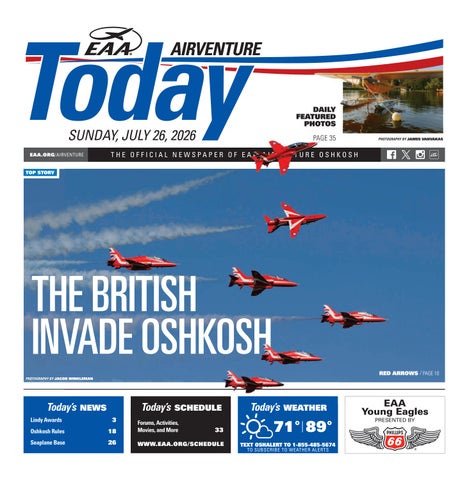
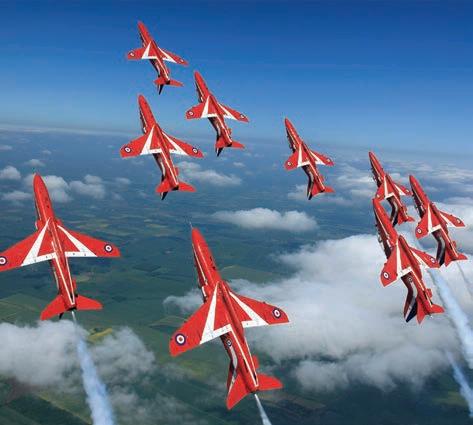
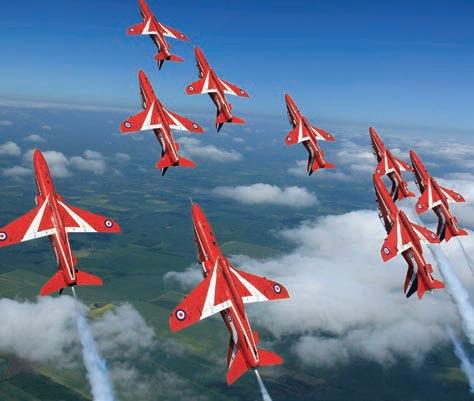
ONE THING IS CLEAR after talking to the Royal Air Force’s (RAF) Red Arrows team. They are as excited to be in Oshkosh as they are to be performing in the daily air show.
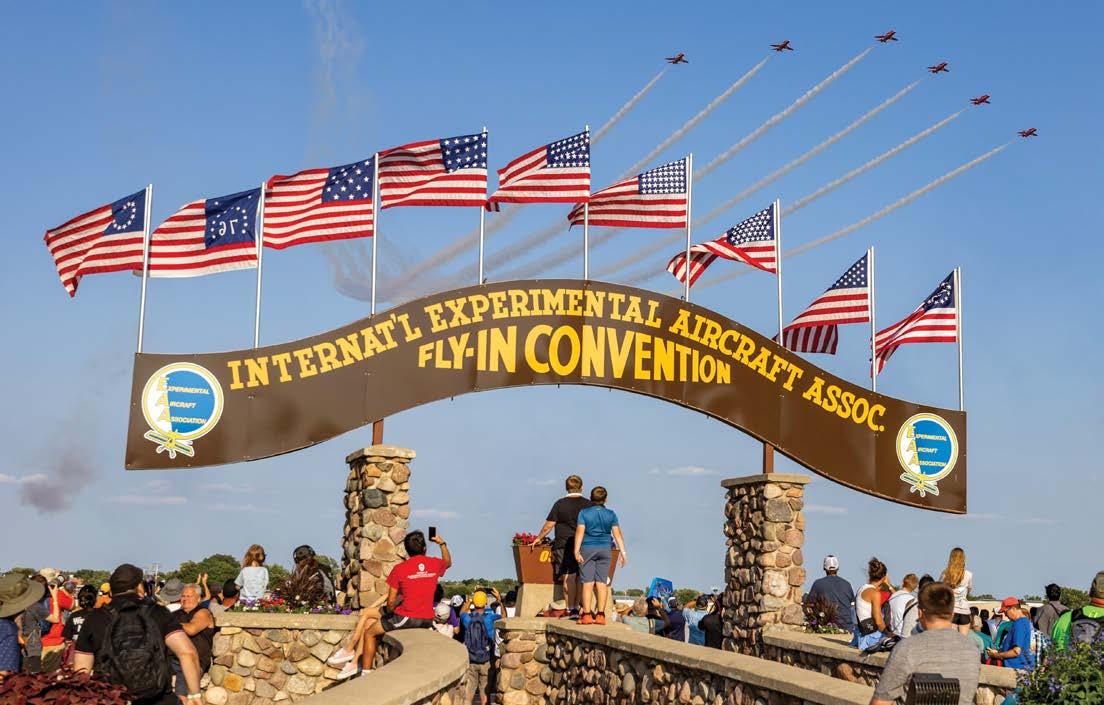
EAA AirVenture Oshkosh is the fifth and last stop of the Red Arrows tour throughout the United States to help the nation celebrate its 250th anniversary. On Sunday after the show, they’ll start the three- or four-day trip back to their home in the United Kingdom, said Mark McKinstry, squadron leader and media and communications o cer.
None of the team members had been to EAA AirVenture Oshkosh before, but the Oshkosh air show is well known in the European aviation community, said Stuart Roberts, squadron leader, supervisor, and commentator for their shows.


“We’re very fortunate,” he said. “We perform at iconic locations, but to be at such a ubiquitous aviation event that we’ve heard amazing things about over the years is such an honor. We’re excited to be at Oshkosh for our very first time.”
Sasha Nash, wing commander, agreed. “Oshkosh is an amazing place for anyone interested in aviation. It’s on a scale I couldn’t even imagine, and I want to explore as much as I can.”
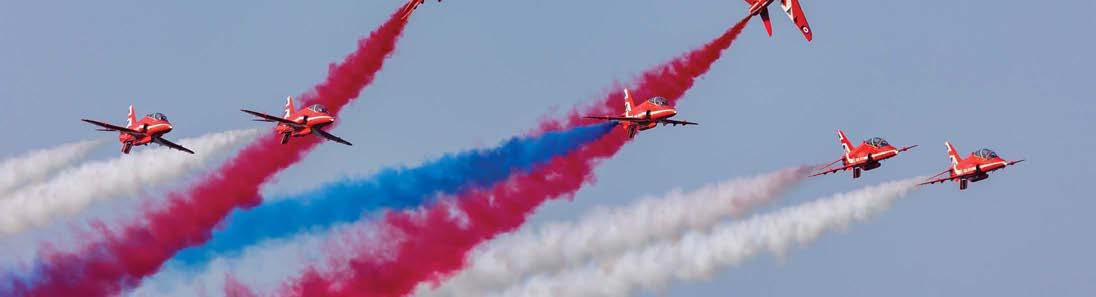
The team is flying seven ships for the EAA show, down from the nine they fly
for major events, such as their Fourth of July performance. The reason is the age of their airplanes, as they have been flying the British-built Hawk T1 since 1980.
“We are looking to sustain the jets until 2030,” Roberts said. So since some of the jets are approaching 40 years old, they are trying to fly them less often until a replacement airplane is chosen. The competition for that will be opening shortly, Roberts said.
Statistically, it is quite difficult to become a Red Arrows pilot, Roberts said.
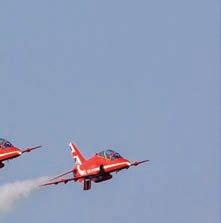
To be considered, you need to be serving as an RAF pilot, have at least 1,500 fastjet flying hours, and be considered an exceptional pilot just to make the short list of about six pilots. Those six then go through a weeklong selection, which includes a formal interview, peer assessment, and a flying test. Generally, there are two open slots each year.
Training starts in September, with shows redesigned and with new pilots. “We build in small building blocks, with two, three, or four planes together, and opposing solos going through training down to 100 feet,” Roberts said.
Closer to the season’s start, they spend five weeks training in Greece. All their maneuvers are done visually, but they use a pitch overlay, which helps to ensure optimal performance and safety during complex aerobatic maneuvers.
Nash, who commands all of the 150 people on the RAF Aerobatic Team, including air and ground crews, said the team prides itself on teamwork, precision, and excellence in the air. “We aim to demonstrate a unique airborne demonstration where we bring the red, white, and blue from the U.K. all the way over to the U.S.”
Roberts said Oshkosh provides a unique airspace, but it’s the people he’s been most impressed with so far. “People have been so friendly and aviation focused. Chances are that everyone you talk to is a pilot or involved in aviation.”
Nash said all Red Arrows members have had the opportunity to sign autographs, pose for selfies, and chat with EAA members and visitors. You can visit the Red Arrows tent in Boeing Plaza.




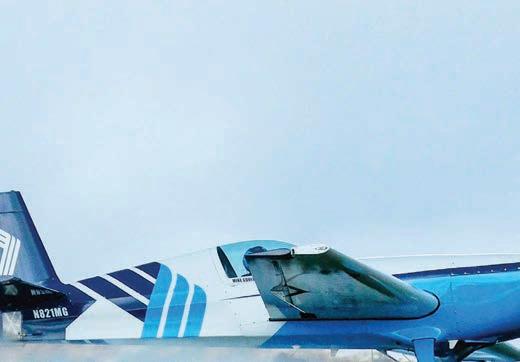

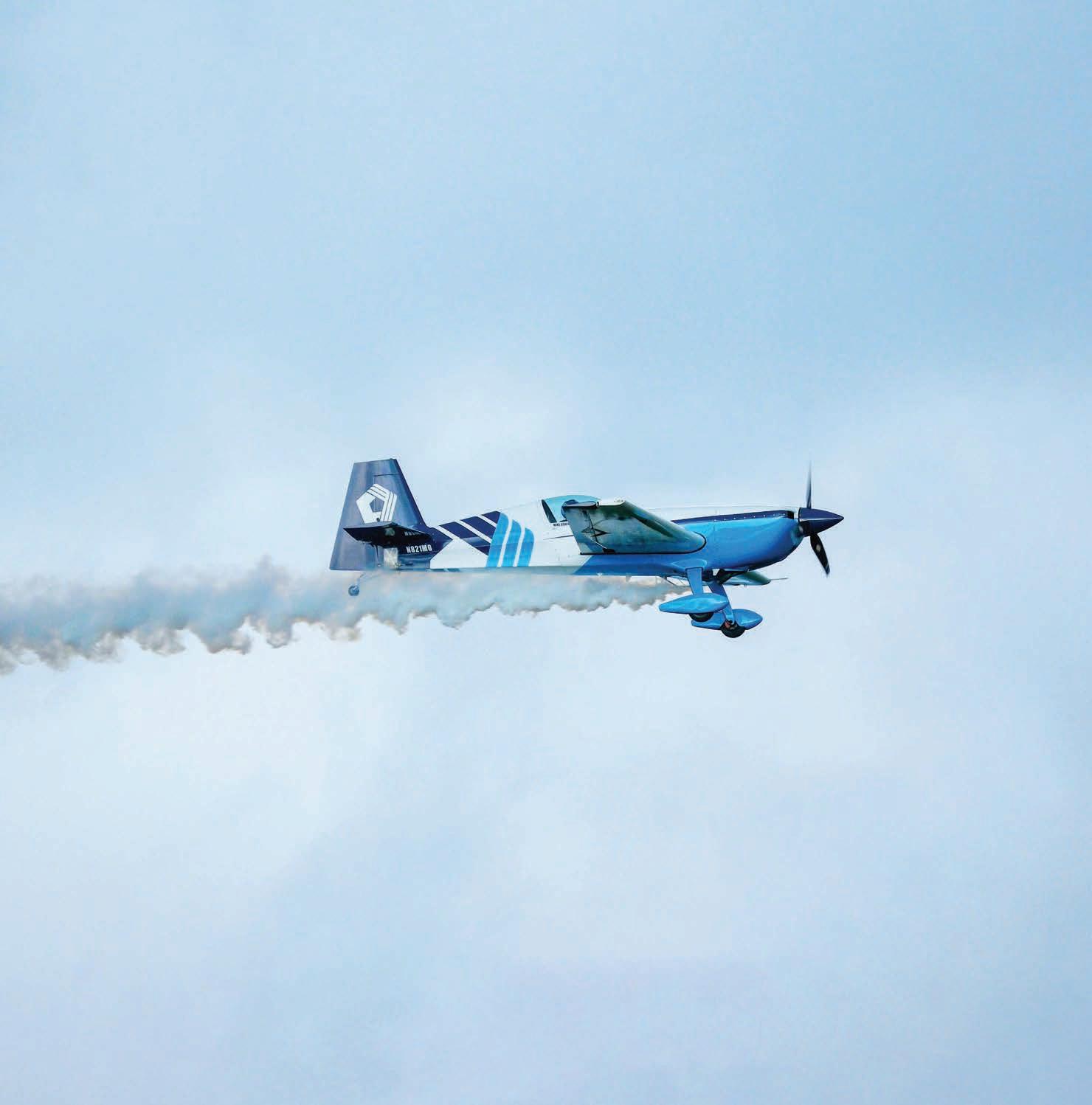
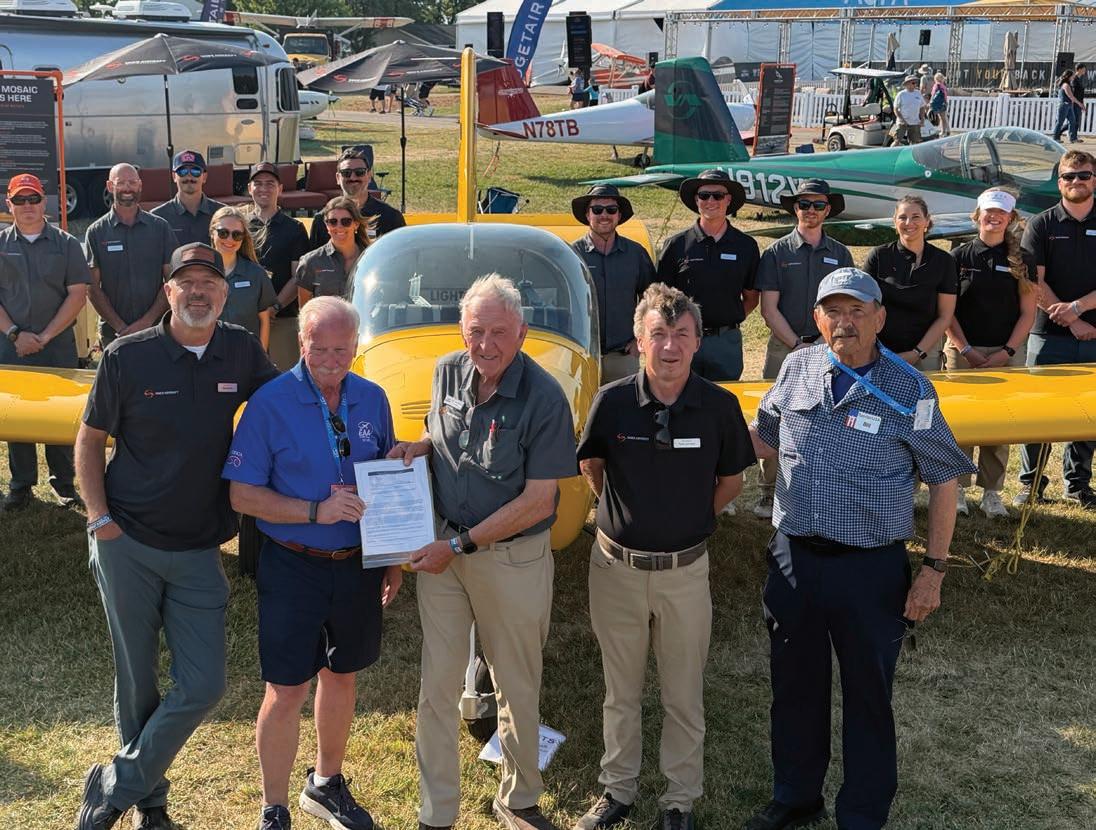
THE MOSAIC AIRCRAFT certification rules introduced a year ago at EAA AirVenture Oshkosh are beginning to bear fruit, as the delivery of a Van’s RV-12 at this year’s EAA fly-in convention marks the opening of a new Sport Pilot 2.0 era for recreational aviation.
“When Transportation Secretary Sean Du y unveiled the MOSAIC rules at Oshkosh in 2025, it heralded tremendous possibilities for light aircraft, flight training, and pilot certification,” said Jack J. Pelton, EAA CEO and chairman of the board. “With the FAA’s publishing on July 24 of amended rules for the design, manufacture, airworthiness certification, operation, maintenance, and alteration of light-sport category aircraft, this year’s AirVenture was the perfect place to bring that language into reality.”
The RV-12 delivered to Tom Snow, EAA Lifetime 161308, of Signal Mountain, Tennessee, is the first of the model to be built at the Van’s Aircraft facility in Oregon in compliance with the MOSAIC rules. It creates new possibilities for updating flight training fleets and aircraft that are also legal to fly in instrument conditions. It was developed under ASTM International consensus standards that enabled new 14 CFR Part 22 light-sport aircraft category certifications.
EAA led the e ort for MOSAIC rule development over a 10-year period, seeing it as the next step in the evolution of aircraft certification for recreational aircraft. Built on the success of the 2004 sport pilot/light-sport aircraft rule, MOSAIC uses ASTM International consensus
standards to enlarge the light-sport aircraft category and give pilots more options to fly sport-pilot eligible aircraft.
“There is so much potential under these just-published standards,” Jack said. “One phrase that comes immediately to mind is ‘increased access’ — to new aircraft designs, to updated flight
training fleets, and to more opportunities for pilots who choose to fly under sport pilot regulations. That is what EAA envisioned with its decade-long leadership in MOSAIC, as part of our organization’s mission to increase participation in aviation.”
MOSAIC enlarges the light-sport aircraft category, as it leaves untouched
the foundation of all light-sport aircraft delivered since the 2004 introduction of the category.
More information regarding MOSAIC is available at EAA.org/ MOSAIC.
OSHKOSH MOMENTS

BY ANGELA SATTERLEE AIRVENTURE TODAY STAFF
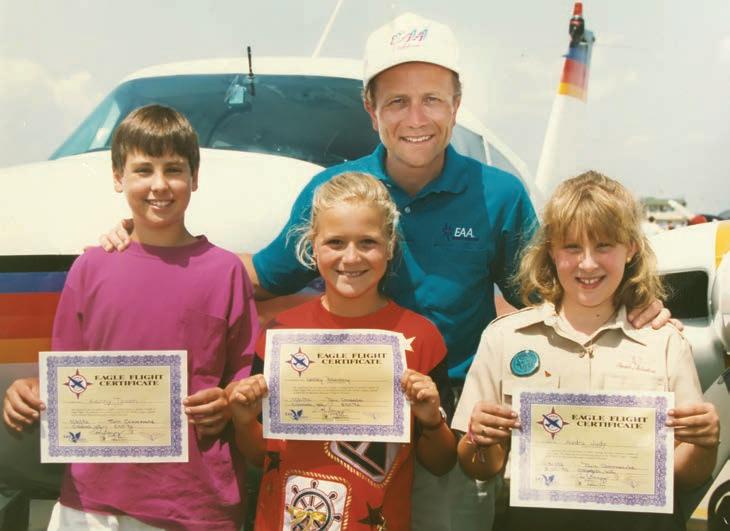
LESLEY POBEREZNY hasspent her entire life surrounded by aviation. As the daughter of Young Eagles founder Tom Poberezny and granddaughter of EAA founder Paul Poberezny, flying has always been part of her story. In 1992, she became part of EAA history when she took the first official Young Eagles flight.
Her family’s aviation legacy stretches back generations. Paul Poberezny founded the Experimental Aircraft Association in 1953, growing it into one of the world’s largest aviation organizations and creating what would become EAA AirVenture Oshkosh. His son, Tom, carried that legacy forward as EAA president, helping expand EAA, which included the introduction of the light-sport aircraft category, and creating the Young Eagles program to inspire the next generation of aviators.
Today, that program has provided more than 2.5 million free flights to young people around the world.
“[Aviation] was in my blood already due to my grandfather and my dad,” Lesley said. “And just growing up around AirVenture, but also growing up around air shows in general.”
Her father also flew with the Eagles Aerobatic Team for 25 years, making air shows a way of life for the family.
“Growing up as a kid, I remember packing up on a Thursday night and leaving for another air show on Friday morning and then returning on Sunday night and then doing it all again the next weekend. Show after show after show.”
Lesley’s first airplane ride came long before her historic Young Eagles flight. At just 3 days old, she flew with her family to Nashville, Tennessee, beginning a lifetime around airplanes.
Then, on July 31, 1992, she became the first o cial Young Eagle. Flying aboard her father’s Piper Twin Comanche alongside her cousin Audra and another young passenger,
Kenny Toson, the group soared over AirVenture, launching what would become one of EAA’s most influential youth programs.
“It just meant a lot to be with family and make new friends that have now turned into family,” she said.
Looking back more than three decades later, Lesley is proud by how far the program has come.
“It’s just amazing how the program is still going … and that we’re still helping those youth to get that aviation bug so in the future they are our pilots,” she said.
“Young Eagles is a big deal … because anybody can do it. Just get those kids up there and let them see their world in a di erent perspective and hopefully they get that [aviation] bug.”
Although she never became a pilot herself, Lesley built her own career in aviation through marketing and continues to spend every AirVenture on the grounds, celebrating the community her family helped build.
“We are a family organization,” she said.
This year’s AirVenture is especially meaningful. Saturday marks four years since Tom Poberezny’s passing, and Lesley said seeing people continue to honor both her father and grandfather reminds her that their impact lives on.
“For me personally, it’s returning and seeing friends that I haven’t seen in a year. And it’s like time has not stopped,” she said. “Even though we live in separate states, just coming together and sitting around the campfires at night and talking, we can catch up like nothing’s passed.
“It’s great to see that my grandfather and my dad are still, even though they have passed, that aviation’s still alive,” she said.
As millions of young people continue to climb into an airplane for their first Young Eagles flight, Lesley sees the same mission her father envisioned in 1992 continuing to soar.
“It’s great to see it still going strong and growing with just leaps and bounds of people arriving,” she said.

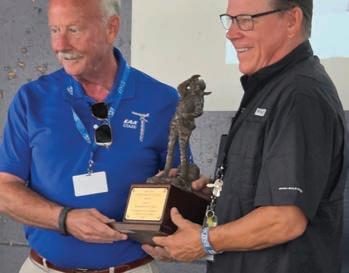
EAA CEO and Chairman of the Board Jack J. Pelton presented retiring U.S. Rep. Sam Graves (R-Missouri) with the prestigious Freedom of Flight Award. The presentation was made during a congressional town hall on Saturday morning at Forum Stage 4.
“We’re going to present to Sam Graves, congressman, committee chair, an advocate, a pilot, a farmer, and a member with our highest award in recognition for his significant contributions to general aviation,” Jack said. “As a general aviation pilot and member, Sam knows firsthand the benefits and value of our community and our airports. Our continued freedom to fly will serve as his legacy from the decades he has spent in Congress.”
Chairman Graves expressed his appreciation upon receiving the award, adding, “I am going to continue to advocate for general aviation in Washington, D.C.”
Since 2001, Graves has represented general aviation and his home district, the Missouri 6th, in the U.S. House of Representatives, most recently as chairman of the House Committee on Transportation and Infrastructure. He was instrumental in securing $12.5 billion last year for a long-needed air tra c control modernization and, in 2024, passing a $105 billion FAA reauthorization bill.
The awards presentation was followed by a town hall discussion and Q&A session. Also on stage were Jim Viola,



president and CEO of General Aviation Manufacturers Association; Jim Coon, senior vice president of government advocacy at the Aircraft Owners and Pilots Association; Christy Greco Johnson, senior vice president of govern ment affairs at the National Business Aviation Association; and Teresa Marr, senior director of legislative a airs at Vertical Aviation International.


EAA’s Freedom of Flight Award has been presented since 1986 and recog nizes contributions to aviation that closely mirror the integrity, entrepre neurship, and innovativeness of EAA members. Past recipients include Neil Armstrong, Cli Robertson, Burt Rutan, and Scott Crossfield.
















BY ANGELA SATTERLEE AIRVENTURE TODAY STAFF
ONE OF THE MOST EMOTIONAL TRADITIONS at EAA AirVenture Oshkosh took place Friday, July 24, as 100 Vietnam War veterans traveled from Wittman Regional Airport to Washington, D.C., and back, on the annual Yellow Ribbon Honor Flight.
The veterans visited the Vietnam Veterans Memorial and other national monuments dedicated to those who served before returning to Oshkosh, where thousands gathered in Boeing Plaza to welcome them home with signs, cheers, applause, American flags, and a water cannon salute.
Now in its 12th year at AirVenture, the Honor Flight is organized by Missions of Honor (formally known as Old Glory Honor Flight). The nonprofit has coordinated Honor Flights since 2009, giving veterans the opportunity to visit the memorials built in their honor at no cost. American Airlines once again donated the aircraft, flown by an all-volunteer crew of pilots and flight attendants.
For many Vietnam veterans, the trip is more than a visit to Washington; it’s about the homecoming they never received.
U.S. Army Vietnam War veteran Rick Royston knows that feeling firsthand.


AirVenture 2026
Monday
10:00am Engine Leaning Made Simple
TUESDAY

8:00am Ring Gap and Cylinder Life 10:00am Compression Testing
WEDNESDAY 10:00am Engine at TBO Options
THURSDAY 10:00am Proactive Approach to Aircraft Engine Maintenance
FRIDAY
SATURDAY
10:00am Choosing the Right Aviation Mechanic


“It’s very emotional,” Rick said. “It brings back some good and bad memories.”
Although he has already experienced an Honor Flight himself, Rick returned to wel come home the next group of veterans.

“I enjoy welcoming them home,” he said. “They’re brothers and sisters,” he said.
For one woman waiting for her husband to return, the annual Honor Flight means finally seeing Vietnam veterans receive the appreciation they long deserved.
“It makes me proud,” she said. “And it makes me feel like finally the American public is honoring the Vietnam veterans.”
She said one of her husband’s favorite parts of the trip is witnessing the changing of the guard at Arlington National Cemetery.
The Honor Flight is about more than visiting monuments. It is about recognizing the
10:00am Oil Changes as a Diagnostic of Engine Health





sacrifices of those who served and reminding them that their service mattered.
“It shows that the country is honoring him as a serviceman … and that our country does respect the military, so [he] feels like what he did was worth it,” she said.
For the veterans stepping o the airplane Friday evening, the crowd waiting in Boeing Plaza o ered something many never received decades ago, a heartfelt welcome home.

Hosted by Bill Ross, A&P I/A 2023 GAA National Aviation Technician of the Year Award Winner! STOP BY for a free copy of Engine Management 101


*Each seminar qualifies for 1 hour of IA Renewal Crdit & FAA Wings Credit



























BY JESSICA SCHAEFER
EAA RAY AVIATION SCHOLAR CLAIRE
JENKINSON has a passion for vintage aircraft — one that matched another young pilot whose legacy she honored this year as she flew into AirVenture 2026.
Joey Ermel. The first recipient serves rural communities in Alaska; the second supports aviation mentoring for specialneeds and low-income youths.













Joey Ermel was a true AirVenture kid, having attended every year since birth, volunteering at the Blue Barn, and flying in with his grandfather in their Breezy N3AZ in 2014. He was the inaugural EAA Chapter 15 Ray Aviation scholar, earning his private pilot certificate in July 2019 out of Lewis University Airport in Romeoville, Illinois. He made history as the first Ray Scholar to fly Young Eagles.
After Joey’s death by motorcycle accident in 2021, his mother Aymee Zimmerman formed the Joey Ermel “Do Your Impeccable Best” Tailwheel Endorsement Scholarship through EAA.
The scholarship looks to encourage and support the spirit of volunteerism and passion for sharing aviation that defined
This year’s scholar, Claire Jenkinson, 19, earned her private pilot certificate as a Ray Aviation scholar from EAA Vintage Chapter 16 in Gardner, Kansas.
This year she flew her vintage 1946 Aeronca Champ 7AC to AirVenture for the first time with the help of her safety pilot and CFI. Claire owns a one-third share of the Champ, which the group restored and recently updated with an 85-hp electric starter.
Claire has been working to help share the history of aviation with others and hopes to begin restoration soon on a piece of local history, a 1941 Aeronca Chief.
Aymee says Claire is the perfect candidate for the third year of the Ermel scholarship, as she embodies the spirit of aviation volunteerism and doing, as Joey always did, their “Impeccable Best.”
Mike Suess celebrates 50 years of service
BY EMME HORNUNG









WHEN VISITORS, VOLUNTEERS, OR STAFFERS CELEBRATE a milestone year of attendance, we usually gloss over the inconvenient truth that the milestone does not include the forsaken year of 2020 when there was no AirVenture. But for Mike Suess, EAA Lifetime 97039, who is celebrating his 50th Oshkosh this year, he can actually say he was on the convention grounds in 2020.
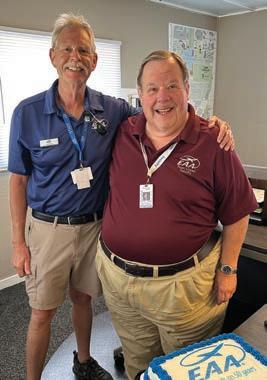
Mike joined the team in Oshkosh in 1976 before EAA’s headquarters had even moved here from Hales Corners. His best friend, Larry Last, was the assistant to Vern Lichtenberg, the grounds facilities manager at the time. He started coming to help out on just Fridays, but once he was out of school, he came four days a week.
Some years later, Mike joined the Oshkosh Auxiliary Police, which managed convention security. He was part of that team for 43 years until EAA decided to form their own security team. Mike was tasked with setting up the security dispatch group, which today is based in Camp Scholler.
With about 270 portable radios and 400 security sta during AirVenture, the dispatch group works in three shifts each day, receiving and routing calls all over the grounds to provide quick and reliable service to ensure the safest experience possible.
“Every year is kind of unique,” Mike said. “2020, believe it or not, that was the year of no AirVenture, but I was still here. There was a handful of us that were patrolling around the grounds.”
To celebrate his 50th anniversary this year, he welcomed back Vern, now in his late 80s, and Larry to take a special tour of the grounds before convention started, and his team even surprised him with a celebratory cake.
Making sure a convention of this size is safe and enjoyable is no small feat, but with a great team, it makes it worth it for Mike.
“It was actually one of Paul’s favorite sayings, ‘You come for the airplanes, but you come back for the people,’ and that pretty much sums it up,” he said. “I’ll keep doing this as long as I’m able.”






















































BY HAL BRYAN AIRVENTURE TODAY STAFF
WE ALL KNOW PAUL’S TIMELESS QUOTE about our annual convention, how you come for the airplanes and come back for the people, and it’s as true now as it’s ever been. The idea that once you’ve been here once the people become the draw is a big part of what shapes our culture. And that culture lives by and flourishes because of what are known simply as the Oshkosh Rules:
Treat everyone with kindness. Be respectful around all aircraft. If you see any trash, pick it up. Thank the volunteers.
And, of course, once the NOTICE (previously known as a NOTAM) goes into e ect, we say “Oshkosh rules apply.” That’s a whole di erent set of rules, granted, but they shape the culture as well with talk of colored dots and wings rocked.
Over the years (more than I care to count), I’ve found myself quietly developing some personal rules of my own to add to the list.
There’s an old military truism that says “no battle plan survives first contact with the enemy.” My version of that is “no plan survives opening Monday.” And that’s okay. If plan A fizzles and evaporates, Plan B is all but guaranteed to be a pleasant surprise.
Like anyone who’s been here more than once, I have an army of dear friends that I usually only see once a year. Sometimes we try to make plans to get together, but that rarely seems to work (see the previous rule). Somehow, though, we invariably bump into each other through some set of circumstances that should be a coincidence, but it
happens so consistently that it seems more like a law of physics.
Out in the non-AirVenture real world, we all have friends with di erent common interests, but when you slip through the looking glass into AirVenture, a common interest in aviation is a given. One of my favorite moments this year was an impromptu dinner with several dear friends, most of whom didn’t know each other, whose ages ranged from 65 all the way down to 26. Fueled by wildly disparate backgrounds and experiences doused in a shared love of aviation, the conversation crackled and sparked in a way that found me thinking of it less as burgers at Pete’s and more as a golden age salon.
If you spot an airplane you want to look at, someone you want to talk to, or a part you want to purchase, do it. Time speeds up in this part of Wisconsin in late July, and “I’ll come back later” is almost always followed by “… and be disappointed.”
Some of the most memorable and enlightening conversations I’ve ever had started with a compliment — “What a beautiful airplane!” — or a question — “Is this a ’46 or a ’47?”
When you stop to eat, if there’s an empty spot at your table and someone asks to join you, say yes. Whoever’s asking, they’ve already passed through some initial friendship checkpoints — they love something about aviation, and they’re







really happy to be here. Listen to their story, and share yours in return.
This is a hard and fast rule that my team lives by as sta members. When operating any kind of vehicle anywhere on the grounds, just assume that the person who has the right of way is everybody but you. That flavor of humility is not only our obligation as hosts, but it brings a certain peace of mind that always feels better than a dash of road rage.
This one is self-explanatory. Those of us who have access to on-site transportation only enjoy that privilege out of necessity, and our mandate is to opt for walking whenever possible. So, if we are on wheels and we see someone who might need a ride, even if it means going a mile out of the way, we offer the ride. This always leads to good conversations, often
leads to new friendships, and sometimes even leads to new stories for the newspaper or one of our magazines.
Oshkosh rules, whether they are the original and sacred four, or ones that you’ve developed yourself along the way, are what transform 1,400 acres of Wisconsin into everyone’s beloved hometown for one week each year. And we keep coming back because for all of us, well — Oshkosh rules!





















































































































BY JESSICA SCHAEFER
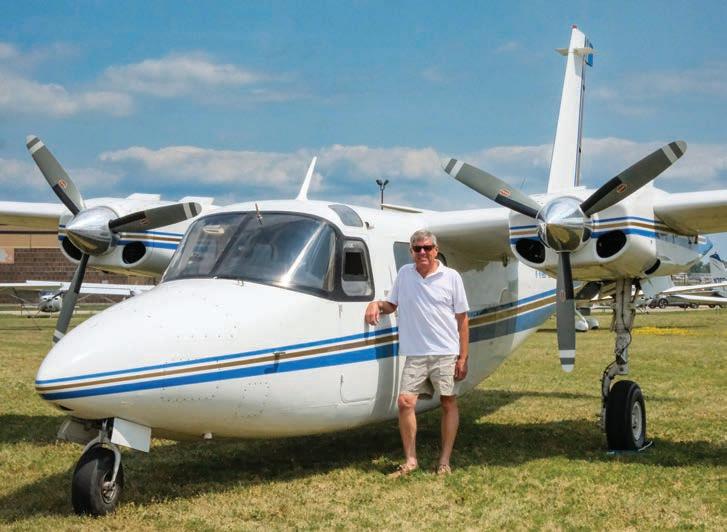
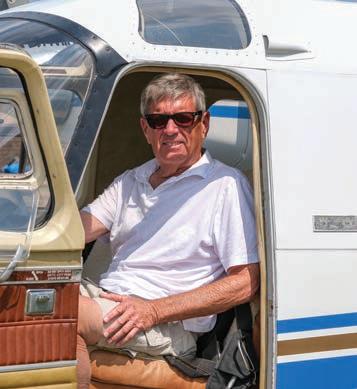
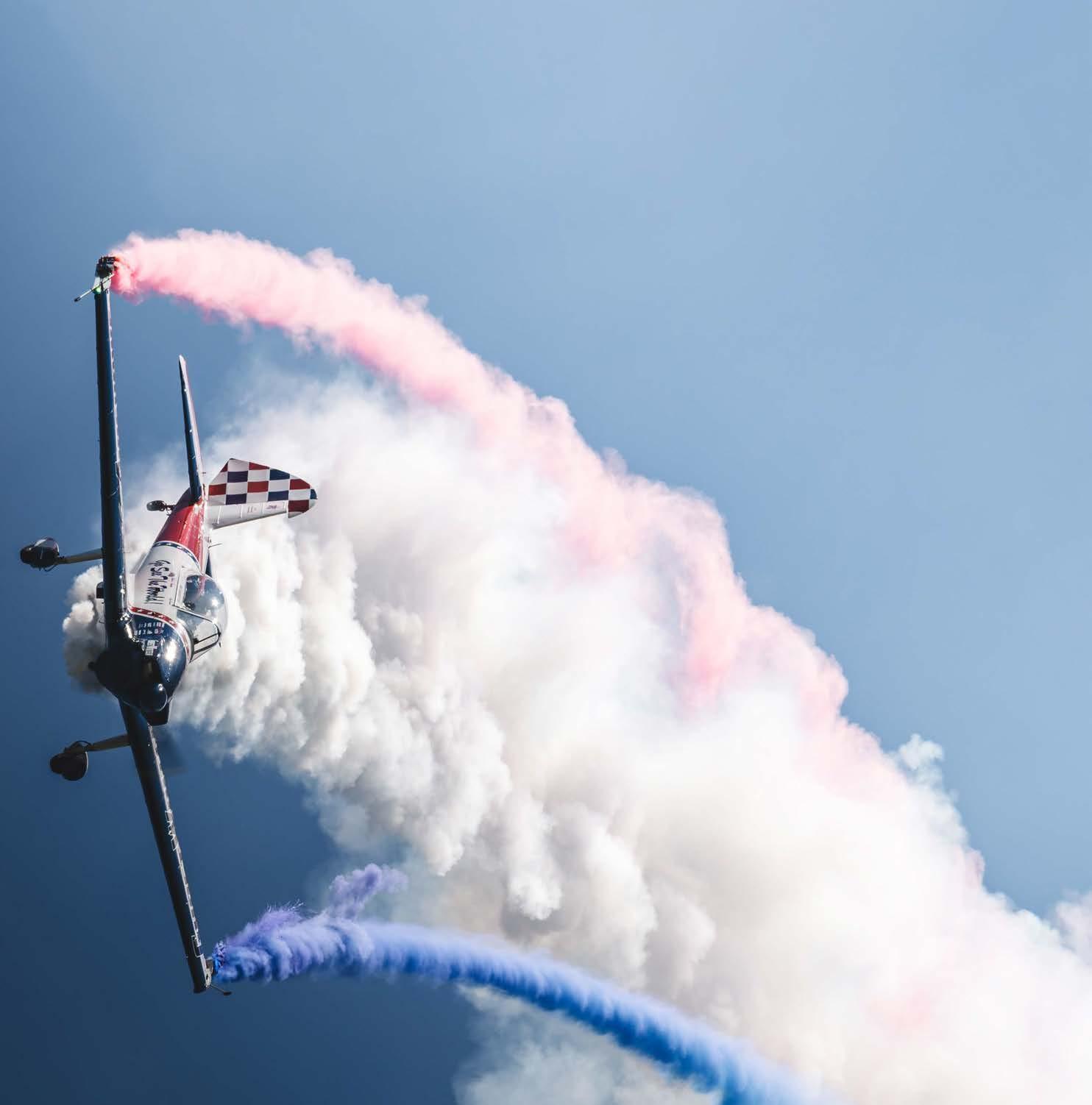
FOR MANY AIRVENTURE VISITORS, watching David Martin fly the Aero Commander this year was a chance to see something few pilots would ever attempt: portions of Bob Hoover’s legendary routine, complete with the engine-out rolls that made Bob one of aviation’s most admired performers.

It wasn’t the full act (Bob’s complete demonstration remains one of the most extraordinary displays of precision ever flown), but it was enough to remind longtime aviation enthusiasts why Bob became an icon, while introducing a new generation to the pilot many consider the greatest stick-and-rudder aviator who ever lived.
For David, flying even a small part of that routine represents the culmination of a lifelong dream.
He first came to Oshkosh in 1979 as a 19-year-old. Growing up surrounded by some of aerobatics’ most accomplished pilots, he spent his early years soaking up knowledge anywhere he could find it, listening to experienced aviators and spending evenings enjoying AirVenture grounds with friends and mentors who were already aviation legends. His fascination with aviation had started even earlier after seeing the Spirit of St. Louis tour in 1977. He joined EAA that year, making next year his 50th year as an EAA member.
“I always wanted an Aero Commander,” he said. While he says he’s not done flying, he considers this performance a capstone in his own journey.
Bob Hoover’s acts in the Shrike Commander became legendary, not
simply because of the breathtaking and graceful engine-out aerobatics, but because they showcased an unmatched understanding of energy management and control. David describes Bob without hesitation as “the greatest stick-and-rudder pilot ever,” adding that after flying the Commander himself, he is even more impressed by what Bob accomplished.
This particular Aero Commander carries its own connection to that history. The airplane was a commercial aircraft like most, bought by Bruce Byerly of Byerly Aviation, whose company sponsored Bob for many years. David had been searching for a Commander when he stumbled across the airplane in an online owners group. It wasn’t even for sale. He called anyway, explained what he hoped to do, and Bruce agreed.
The routine may look graceful from the ground, but David said it demands constant attention from the cockpit. Unlike most aerobatic performances, where the pilot can focus almost entirely on the sequence of maneuvers, the Commander requires constant monitoring. Every engine restart, each part of the hydraulic system, every indication matters. If an engine doesn’t restart, you have to already be in position to land. On the ground, you wait for confirmation the brakes and hydraulics are working before committing to a turn.
During one practice flight, David waited anxiously for the landing gear indication light to illuminate. The gear was down, but until that confirmation appeared, there was uncertainty. “You have to pay attention to the plane,” he said.
Bob himself admitted that even after countless performances, the routine still made him nervous. David understands exactly why.
Respect for both the airplane and the routine is part of what fellow performers appreciate. After seeing David fly the demonstration, aerobatic legend Sean D. Tucker o ered simple praise that carried enormous weight: “Hoover would
have been proud,” Sean told him. “You did a good job.”
David hopes the routine resonates whether spectators remember watching Bob in person or are discovering him for the first time. This year, a young visitor told him he watches Bob Hoover videos before bed each night. David was delighted with this, finding it unexpectedly fabulous to hear from a young visitor.
To him, Bob’s story transcends generations. A World War II fighter pilot, prisoner of war, accomplished test pilot, and one of aviation’s most celebrated air show performers, Bob’s influence reaches far beyond those fortunate enough to have seen him fly.
And David hopes that inspiration continues with today’s young pilots. “If you’re flying a 172 and you’re watching this thinking, I’d like to fly something else, why not?” he said. “It’s not that hard to fly something else. If you want to fly something, go ask.”
Looking back, David wishes he had been less intimidated as a young pilot and taken advantage of more opportunities, even with Bob himself.
“Find someone and ask,” he said. “Don’t be too shy. Pilots are very supportive people.”
In many ways, that may be the greatest tribute to Bob Hoover — not simply preserving one of aviation’s most famous performances, but inspiring the next generation to chase opportunities they never imagined possible.








BY ROBBIE CULVER AIRVENTURE TODAY STAFF
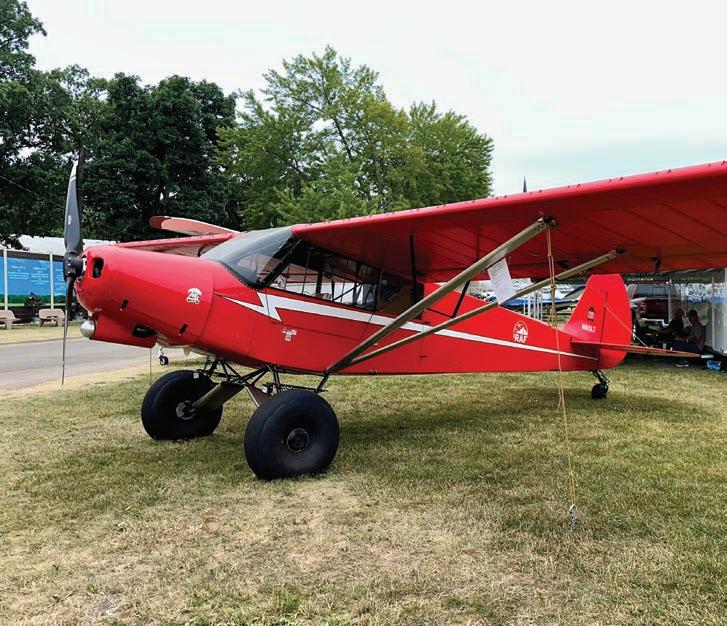
JAVRON AVIATION inBrainerd, Minnesota, offers experimental Super Cub kits using original Piper PA-18 specs and dimensions. At EAA AirVenture Oshkosh 2026, the company had a four-place Super Cub kit on display. Javron’s Jay DeRosier said, “We basically took the architecture from a stock Super Cub, meaning the wing location, strut location, engine, door opening, locations, all that, and transferred it to this airframe. Doug Keller designed the airframe for us.
“It’s a clean sheet of paper design,” he added. “The upper longerons come from the rear wing fitting and go down to the tail. So there’s no light Piper channel structure up above to give the fuselage shape. The fuselage is all wide open inside; it is a great big box. The front seats are on Cessna-type seat tracks. So they move back and forth. They can be taken out really easily.
“The airframe will actually go to 2,500 pounds, but my wing was tested
to 2,200 pounds with a margin, so we go to 2,300 on floats or on the four-place.”
Jay added, “My Super Cub kits are made right o Piper drawings, so all my parts interchange with the stock Super Cub. So they are a pure copy of a Super Cub. Some of the other ones take liberty in their design and change things, but the four-place is a Super Cub. All the wing incidence angle, tail incidence angle, all those critical things are the same as a Super Cub. It’s just wider — it’s 44 inches wide inside, and it’s 19 inches longer than a stock Cub, which helps increase the envelope of the CG.”
The aircraft has a 2,300-pound gross weight and is around 1,200 pounds empty, leaving a 1,100-pound useful load. It is available as an experimental amateur-built kit, and there is a builder-assist program available at the company’s location in Brainerd.
Contact Jay DeRosier at 218-8299320 or visit JavronAviation.com.






•Multiple Companies
•Face-to-Face
•AirVenture® July 20-26
•No appointment required


BY RAUL CISNEROS
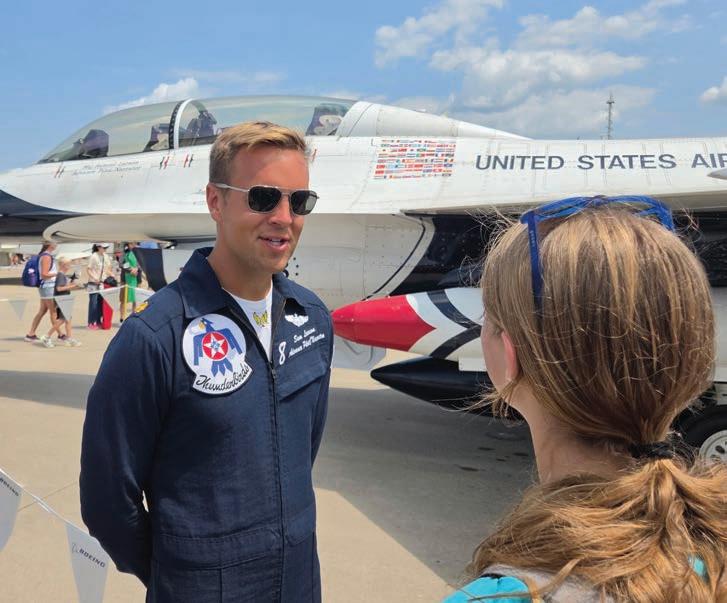
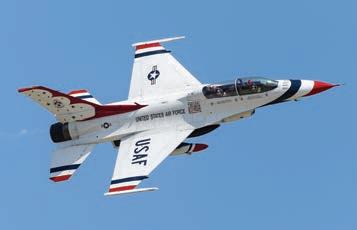
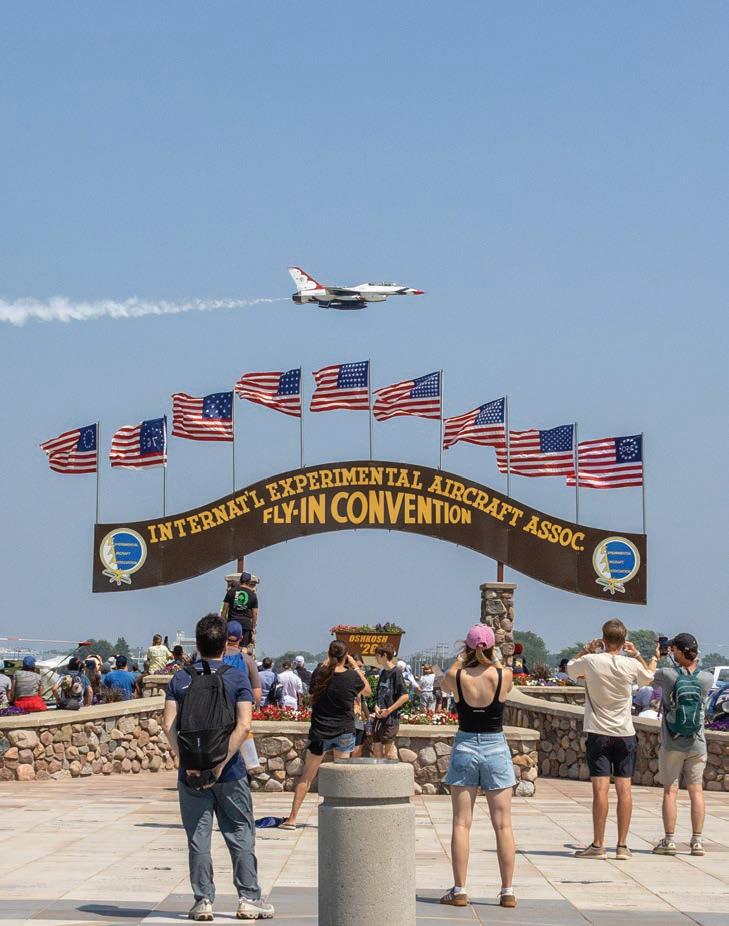
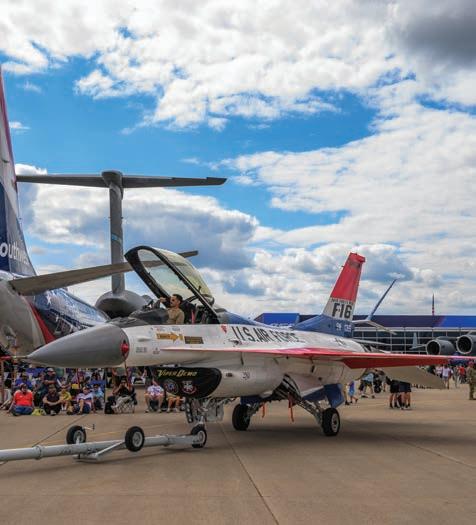
U.S. AIR FORCE MAJ. SAM “RAZZ” LARSON said he first came to AirVenture when he was about 10-11 years old. “I remember distinctly the first time my dad drove me up here,” he said. “I knew about Oshkosh, but just the scale of it, overwhelming … .” He kept coming back year after year. This time around, he’s at AirVenture representing the USAF’s demonstration team as Thunderbird 8, conducting outreach. Joining him is his crew chief, Staff Sgt. Sovann Din. Becoming a Thunderbird pilot is a multistep and rigorous process. “You have to be an instructor pilot in a fighter platform, is the min-qual,” he said. “And then also 750 to 1,000 hours minimum to apply, in addition to being an
instructor pilot. You apply to the team, you go out on a trip with the team to a show site, and then they down-select semifinalist to finalist. If you’re selected as a finalist, you go out to Nellis Air Force Base, and you actually do a flying tryout in the (F-16) D model.” Applicants are also interviewed by the wing leadership at Nellis and the demonstration team.
RaZZ was selected as a Thunderbird pilot in June 2025. Afterward, he went to Holloman Air Force Base to get checked out in the F-16. Last November he became Thunderbird 8, his current role, where his job is to inspect sites ahead of shows and conduct narration. This November he will transition to
“On the other side of all that discomfort and adversity, usually that’s where your dreams lie.”
— RaZZ Larson
Thunderbird 3, where he will fly one of the six actual demonstration jets.
A Davenport, Iowa, native, RaZZ is a 2015 graduate of the U.S. Air Force Academy in Colorado where he was on the parachute team, making more than 700 jumps. In 2015, right after graduating from the academy he came to AirVenture and saw an F-22 demonstration. “That was hugely impactful on my life of, ‘Okay, I want to go fly F-22s,’” he said. “That’s my dream.” He came back in 2018 and set his goal to fly an F-22 at Oshkosh. In 2023 he got to do that, including doing an aerial photo shoot featured in EAA Sport Aviation the following year.
While standing next to his F-16, RaZZ has taken the time to talk to a steady stream of attendees, sign his autograph, and take pictures. Asked what advice he can o er to young people, he said, “You have to take a risk at some point in your life and step outside of your comfort zone. And sometimes that’s the most di cult step in their journey, but we encourage everyone to take that step, bet on yourself and be
willing to get outside of your comfort zone because on the other side of all that discomfort and adversity, usually that’s where your dreams lie.”
RaZZ also o ered his perspective about another part of life: failure. “I’ve been telling folks, ‘Don’t be afraid to fail,’” he said. “Failing is an inherent part of flying. Air Force flying is designed to make you fail multiple times. It’s part of life. It really is. And to learn how to fail forward, to pick yourself back up and move on to the next day and apply the lessons learned … .”
As for AirVenture, RaZZ expressed his gratitude to EAA for its hospitality.
“To the fans here, to the volunteers, probably most importantly, thank you for what they do year-round to make this happen,” he said. “We get to come here for a week and enjoy the spectacle, but we know that people pour their blood, sweat, and tears into this to make it happen, and specifically this week, we were welcomed with open arms everywhere we went.”

BY BARBARA A. SCHMITZ AIRVENTURE TODAY STAFF
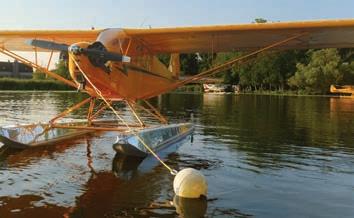
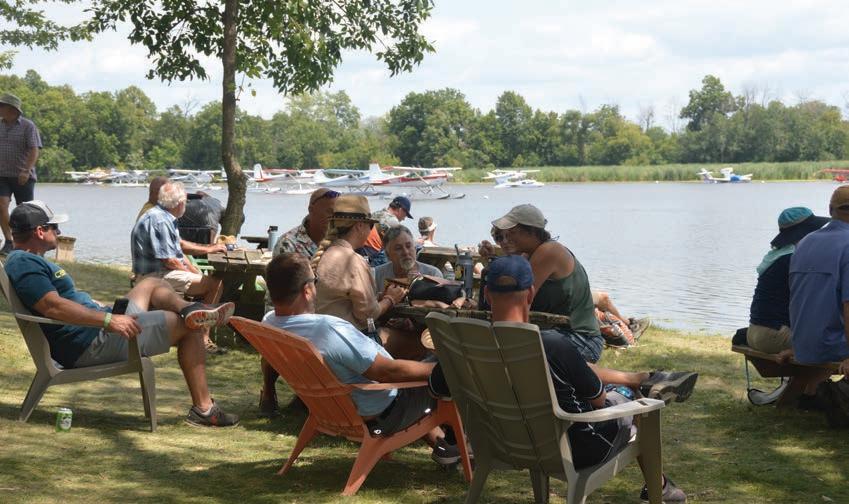
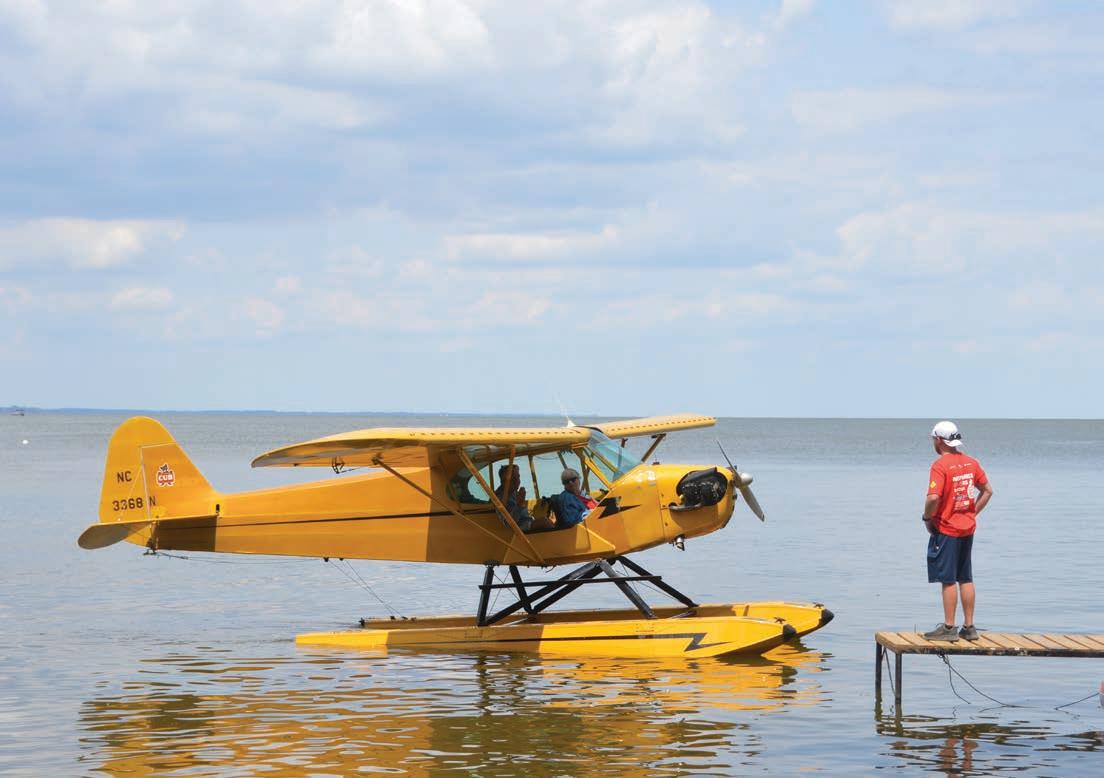
EAA’S SEAPLANE BASE is less than 5 miles away from the EAA AirVenture Oshkosh grounds, but visiting there is like going to an exotic, faraway land.
A woodland trail, complete with flowers and lights, takes you from the bus drop-o to the actual base. And once there, you’ll quickly realize its charm: gentle breezes, trees providing shade, and people gathered around picnic tables and chairs, chatting and looking out at the bay of Lake Winnebago where seaplanes are moored and pontoon boats takes visitors for short tours. Nearby, kids splash in the water, people snooze under a tree, and at night, they sit around a campfire.
Lyndsey Anderson, the Seaplane Base volunteer coordinator, said it takes hundreds of volunteers to get this area of EAA AirVenture Oshkosh ready for the fly-in convention. Because it’s located on private land, they are limited when they can come in and get the grounds ready. Work generally starts on Memorial Day weekend when 60-70 volunteers start the bigger projects, such as laying and leveling the ground for a new first aid building or doing dock rehab. But that’s when they also start their beautification e orts, planting pots and beds with flowers.
Throughout the summer, volunteer Patti Bryant comes over daily to water
and care for the plants, ensuring they’re ready for this week. “We have 22 whiskey barrels with at least 10 plants in them, plus some in smaller pots,” she said. Her family lives in the back of the bay, so she often takes a rowboat or canoe over and spends one to two hours watering daily. “It feels like a utopia every day I’m here.”
Patti said she’s been doing the flowers for 11 years, but she and her entire family have been volunteering there for more than 20 years. They got started after she and her children drove by the Seaplane Base and noticed the sign that they were looking for volunteers. They’re also a multigeneration family who volunteers, with her father also helping out.
The remainder of the volunteers start trickling in days before the convention begins to prepare for its opening and to keep things going smoothly. Lyndsey said 220 volunteers are helping this year, doing everything from working the camping area and picking up garbage to running the o ce, giving pontoon rides, moving airplanes with tugboats, and sta ng the docks. “It’s quite an undertaking,” Lyndsey said. They have 11 co-chairs to help coordinate the work because their scope is so large, she said.
Visitors to the Seaplane Base appreciate the area so it’s not unusual for many to be repeat visitors.
“This is my second time here,” said Jared Anway, EAA 1659114, of Nashville, Tennessee. “I came to see the seaplanes as last time I didn’t get to actually see planes take o . But this time I’ve already seen two takeo s and two landings.”
He’s also a big fan of the shade. “It’s pretty chill here.”
Visitor Chris Bergevin, of Boise, Idaho, agrees. This is his 20th visit to AirVenture and the Seaplane Base, and he laughed as he said the burritos bring
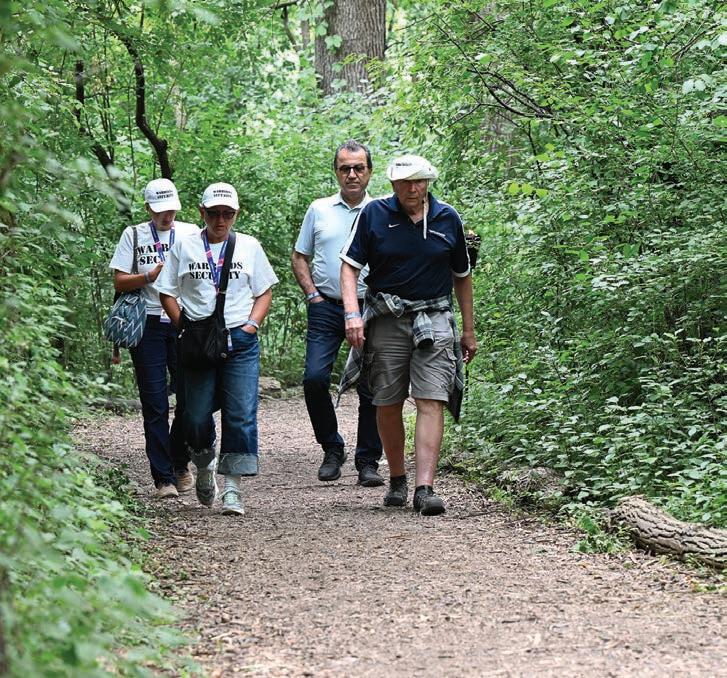
him back. But seriously, “it’s the awesome airplanes, the cooler temperatures, and the beautiful setting.”
This year, the area was also the place for the “summer of love,” Lyndsey said. Two volunteers were married preconvention in Oshkosh, and with some help from the volunteers, an EAA attendee proposed to his girlfriend on the big yellow chair by the lake on Tuesday. Then her husband-to-be, Andrew Elert, had a bachelor party with the “boat boys” osite, and she had a bridal shower the following day, with volunteers stopping by to visit and congratulate her. Their wedding will be held November 7.
“Our volunteers are just like family,” Lyndsey said. And many of the volunteers are multigeneration volunteers, as well. Even the Vette family, who owns the land, has multigenerations involved, with Susan Vette Mosley overseeing the o ce operations, she said.
Lyndsey has advice for those who haven’t been to the Seaplane Base before. “Come on Monday just as the show opens; it’s usually really slow because it always takes a few days before people discover us.”

Aircraft Specialties Services, Inc.
Rinehart Fine Arts and Historic Collectibles
Adept Propulsion Technologies
AeroCreeper
Air Line Pilots Association, Int’l
ALSIM
AeroConversions, LLC
Alpha Systems Engineering & Mfg, LLC.
Design, Analysis and Research Corporation
General Aviation
Modifications Inc
Astronics/PECO Inc
BLR Aerospace LLC
Bridger Manufacturing
David UHL Studios, Inc.
Progressive Air Group
Sonex Aviation, LLC
1331 Custom Decor & Goods
9er Systems
Aero Endeavors
AeroPlex Labs
AIAA
AIG Aerospace Insurance Services, Inc.
Air Rhoades LLC
Aircraft Consoles, LLC
Airhart Aeronautics Inc
AirLogbooks
Amazon Prime Air
Americans for Safe Aerospace
AOPA Electric Aviation Division
Apex Realty Advisors, LLC
Art Cave Company
Atmos Avionics
Avalon Precision Castings
AvBrief.com
Aviate Pilot Apparel
Aviation Bar Cart
Aviation Detailing Association
Aviation Safety Solutions
Avion Research Corporation
AvTech Exams
BEC Defense
Belt Bonanza
Big Sky Dynamics
Blackstar Flight Simulation
Bliss Mobil USA
C R Stuff
California Baptist University
Castleberry Instruments & Avionics
CheckPrep
Christen Industries, Inc.
Circuit Board Medics
CityDogTech.com
Coastal Range Equipment
CoolFly (Zhejiang) Aircraft
Technology Co. Ltd
Cru Social Inc
Custom Aircraft Builders
Custom Engraving Ltd
Dassault Systemes
Dean’s Parts & Collectibles
Delta Strut
Double Line Marketing LLC
DTA
EcoTrikes LLC
Elevation Off Grid
Enhanced Radar
Epic Flight Academy
Everdry Waterproofing
EyeLights
Fairmont State University
Fargo MC Services
Fellowship of Christian Airline
Personnel (FCAP)
Fit-Ear
Fivestar Leather GmbH
Fly ORKA, Inc.
Fox Cities Flix
Fox City Psychic
Freefly Systems Inc.
Friday Dog Cartooning
Friends of British Aviation Heritage
Fuzzbutt Boutique
GeoSpatios Inc
Gold Seal Online Ground School
Good Boy Vodka
H6 Aviation Service
Hangar 8
HISC
Honor Flight Network
House of Rags (The)
IFR6
Innovative Aerosystems
Jack Walters & Sons Corp
James Aircraft
Jediwoods
Jump Aero
Keyed Dynamics Inc.
Kinzie Foods
KO Construction
LamVec Technology Ltd
Legit Avionics
Level Up Aviation
Light Shadow Color
Liquified RV Toilet Treatment
M4 Ranch Group
MACHINE AGE LAMPS
Mankiewicz Coatings LLC
M-B Companies
Merlin Labs
Midwest Flying Machines LLC
Minky Girl LLC
Morningside University
Mountain Air Realty
MR-VFR
MX Ledger LLC
My Brother’s Keeper Aviation Academy
NFuture
Northwest Aviation Medicine
OnTraxx
Open Road Harley-Davidson
Ozarks Relaxed Living
Pants for Birds LLC
Paradox Aviation
Paralyzed Veterans of AmericaWI Chapter
Patriot Aircraft
Patriotic Shop, Inc.
Petal & Prop Designs
Pilot Circle
Pilot Reach
Pilotbase
PilotDuty
Piper Flyer Association
Plane Crazy Life & Roger Reaves
Pray Aviation, Inc.
Precision
Predator Powered Parachutes
ProAm Steel
Professional Asian Pilots
Association Inc (PAPA)
Red Bull Flying Bulls
RED RDD, LLC
ResNexus
Richard I Bong Veterans
Historical Center
Rise Vertcal
River Valley Remodelers
Roamcraft Co.
Robinson Helicopter Company
Rogue Labs
ROKit Oxygen
Runway 31
SEAL Aviation
SeatCraft LLC
See The Bravo
Shenzhen Smart Drone UAV Co., Ltd
Simplistic Sensations Rock Shop/Boutique
Society of Women in Engineering - Wisconsin Chapter
Solid Ground Aviation
Solidstrip
STOL Creek Aviation LLC
T-Bird Sport Flight Aircraft
Ten Works
Texas State University
Thorp Aircraft
Thunderbird Aviation, LLC
Titan Aerobatic Team
Turtleback Trailers
United Companies Air Center
Universal Windows Direct
Veterans Airlift Command
Vetterman Exhaust Inc
Victory Jukebox
Virtual Ground School
ViscoTec America
V-Space
Wacko Products
You Can Fly PPG
Zhejiang Taxus Aircraft Parts
Technology Co
BY HAL BRYAN
EVERY YEAR, MORE than 10,000 aircraft fly to Wisconsin for AirVenture. Of those, nearly 3,000 are showplanes — vintage aircraft, warbirds, homebuilts, aerobatic airplanes, etc. — that are displayed around the grounds. But some visitors may notice other airplanes parked here and there that didn’t fly in at all, because they’re part of the EAA Aviation Museum collection. Because our museum exhibits rotate, many of these aircraft are only viewable by the public during AirVenture, spending the rest of the year in long-term storage on the convention grounds. Here’s a guide
to some of these airplanes that you’ll see as you wander the neighborhoods of AirVenture.
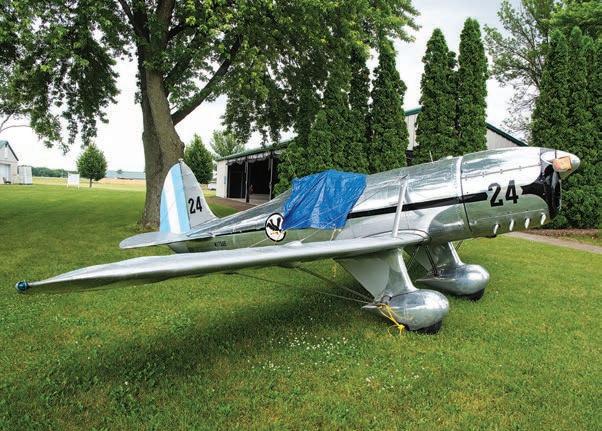
Aircraft: 1938 Ryan STA/STM Super Sport
The Ryan Aeronautical Company introduced the ST, or Sport Trainer, in 1934, followed soon thereafter by the STA Super Sport, which was equipped with a 125 hp Menasco C-4 engine. The Guatemalan air force bought six of the airplanes in 1938, designated STM and including larger cockpit cutouts and two wing-mounted Lewis machine guns. The museum’s example was built from parts of those STMs after World War II, and it was later restored in Guatemalan air force colors and donated to EAA in 2003.




EAA® AirVenture® Oshkosh™ could not happen without the outstanding support of our volunteers.
Help us in thanking them today!

Supported by
BY HAL BRYAN
IN THE LATE 1800S, not all that long after the United States celebrated its first 100 years, scientists, engineers, inventors, tinkerers, and adventurers around the world spent time and other resources trying to solve what was then widely known as “the flying machine problem.” While some of the most impactful innovations in history, from antibiotics to the internet, weren’t necessarily widely anticipated, the idea of controlled, powered, manned flight was, for some, almost impatiently expected.
Yes, there were plenty of skeptics, notably an editor at the New York Times who wrote in October 1903 that “… the flying machine which will really fly might be evolved by the combined and continuous e orts of mathematicians and mechanicians in from one to ten
million years.” By that time, though, people had been successfully flying gliders for more than 50 years, and rubber-powered model airplanes had been around since 1870. So, instead of a surprising innovation, the Wrights’ success, coming just two months after the Times’ pessimistic prediction, was seen (eventually, once word got around and people were convinced that it had happened) as a solution to a known problem. What nobody could have anticipated, however, was the impact of airplanes on civilization, nor the incredible rate of innovation that would take place. This year at EAA AirVenture Oshkosh 2026, we’re highlighting the first two dozen years of that innovation. Each day, we’ll highlight one of the aircraft on display as we celebrate the “Pioneers of Flight.”
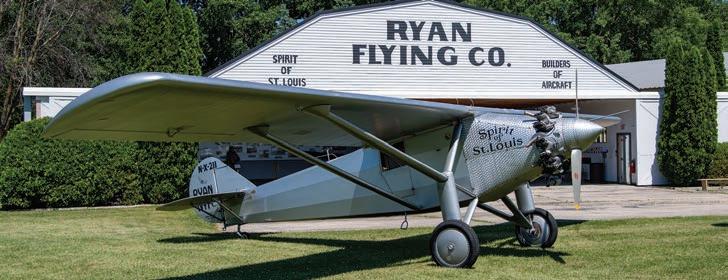
One of the most famous aircraft in history, the one-o Ryan NYP named Spirit of St. Louis was purpose-built for an audacious goal — to make the first nonstop flight between New York and Paris. The airplane was built, of course, for legendary aviator Charles Lindbergh, who completed the grueling 33-1/2hour flight in May 1927, less than a month after the aircraft’s first flight. Developed from the Ryan M-2 mailplane, the NYP carried Lindbergh to world-changing success and transformed the idea of flying from a novelty to a societal necessity. The original, of course,
LENGTH: 27 feet, 7 inches
WINGSPAN: 46 feet
HEIGHT: 9 feet, 10 inches
MAX SPEED: 133 mph
ENGINE (ORIGINAL): 223-hp Wright J-5C
Whirlwind nine-cylinder radial
hangs in a place of honor at the Smithsonian Institution’s National Air and Space Museum in Washington, D.C. Over the years, EAA has built two flyable replicas, the first for the 50th anniversary of Lindbergh’s flight in 1977 (this example hangs in the EAA Aviation Museum) and a second, which first flew in 1990, that is maintained in flying condition.

BY
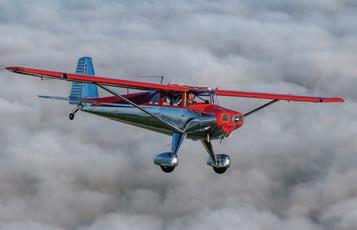
AS WORLD WAR II came to an end, people of the free world looked ahead to an era that held the promise of unprecedented peace and prosperity. Rough estimates indicate that, at the start of the war in September 1939, there were approximately 30,000 pilots, both civilian and military, in the United States. By war’s end in August 1945, the estimated number had ballooned to more than half a million. It seemed patently obvious that the previous generation’s “chicken in every pot” would be supplanted in 1946
by “an airplane in every garage.” Manufacturers went to work, introducing new aircraft and updating (and more actively marketing) existing designs. Sadly, this was the boom that wasn’t. A lot of wartime pilots moved on from flying, and, while commercial air travel grew steadily, general and recreational aviation didn’t attain the hoped-for ubiquity.
Still, 1946 was a remarkable year for GA, and that optimism, however impractical, gave us so many classic aircraft that remain beloved today. You’ll note that, unlike most aircraft anniversaries, this one isn’t exactly hard and fast. We’re not strictly celebrating first flights or
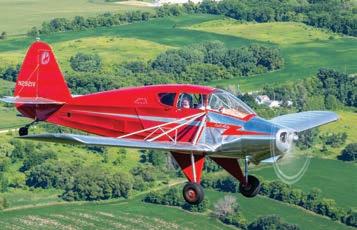
FIRST FLIGHT: 1940
LENGTH: 23 feet, 5 inches
WINGSPAN: 35 feet, 10 inches
SEATS: 2
CRUISE SPEED: ~100 mph
introductions; rather, we’re looking back at the airplanes that were in production and on the market in that first full year of postwar peace. As you wander the Vintage neighborhood on the AirVenture grounds, you’ll likely see lovingly restored examples of a variety of types being
An EAA ® Lifetime membership shows your commitment to aviation as a way of life, and it signals that you stand with EAA’s mission to grow participation in aviation by promoting The Spirit of Aviation ® !
As a thank you for your commitment to EAA, you will receive a $100 discount on your Lifetime membership during AirVenture ® 2026. Visit EAA.org/Lifetime to learn more or upgrade your membership today!
FIRST FLIGHT: 1937
LENGTH: 20 feet
WINGSPAN: 34 feet, 7 inches
SEATS: 2
CRUISE SPEED: ~105 mph
celebrated as part of the Class of ’46. When you do, try to imagine what it was like 80 years ago, with the horrors of war well and truly behind us, a world in love with aviation, and nothing but blue skies ahead. That’s the context to have in mind as we celebrate the Class of ’46.
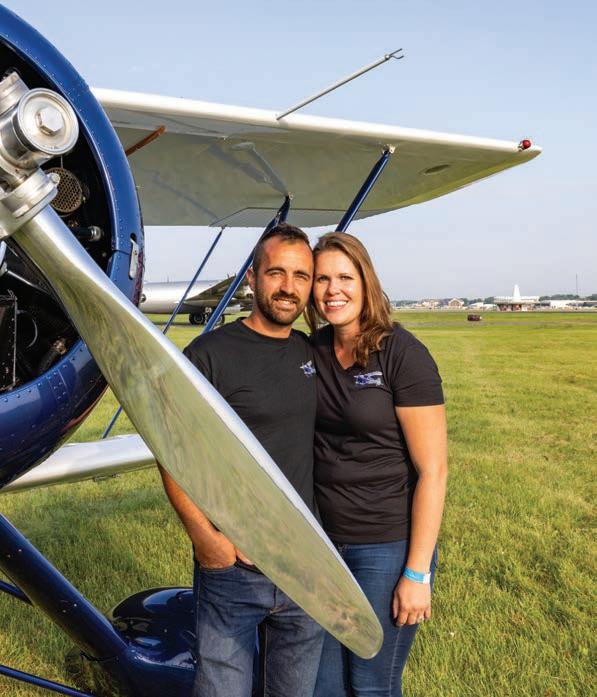
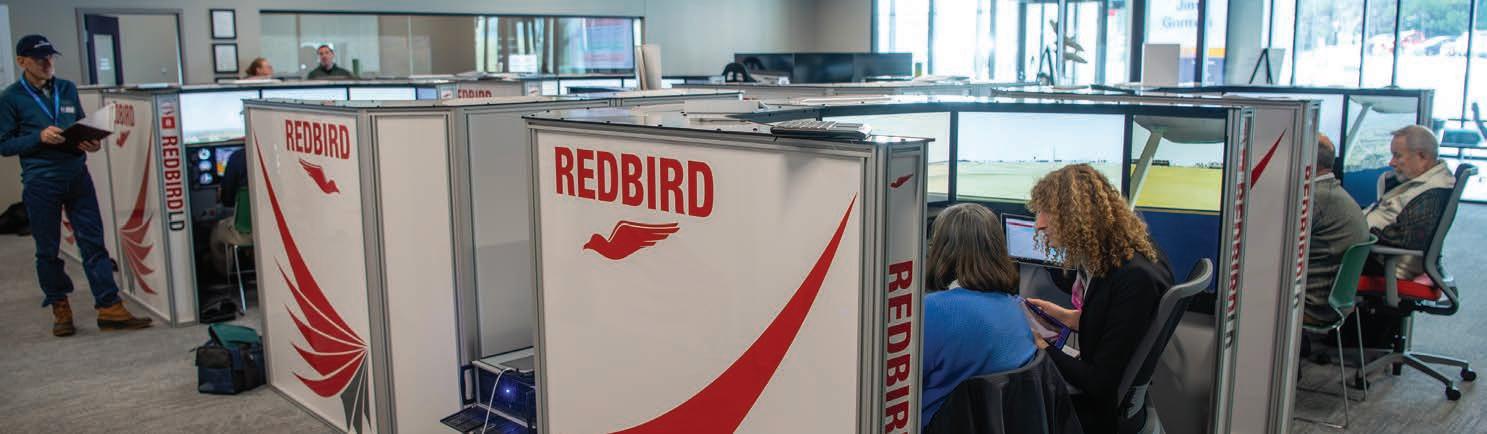
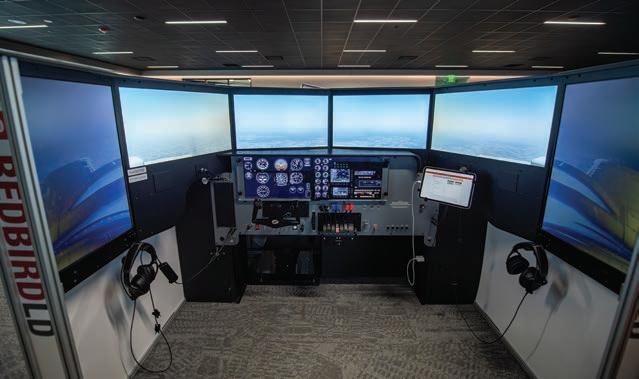
THE EAA® PILOT PROFICIENCY CENTER
is a skill-building and training facility for those with a desire to increase their knowledge and hone their abilities.
Redbird LD Advanced Aviation Training
Devices are available for solo flight training or with an EAA instructor pilot throughout the year.





























Free youth admission ages 18 and under is supported in part by



SUNDAY, JULY 26, 2026
ACROSS
1. AutoGyro makes the side-by-side Cavalon and the tandem _______.
4. AirEV’s eVTOL, the ______ (two words) comes in personal and cargo versions.
5. Kit helicopter made by Vertical Aviation.
8. Rotorcraft pioneers Sikorsky and Bensen.
9. Frank ________ designed a popular helicopter that has been in production since 1979.
DOWN
2. They make helicopter kits like the 400 and 500.
3. This Swedish single-seat eVTOL aircraft takes its name from George, Jane, Judy, and Elroy.
6. Based in Italy, they make gyroplanes like the M24 and M26.
7. Pivotal’s eVTOL ultralight.
SATURDAY, JULY 25, 2026 ANSWERS
ACROSS
1. Cornell 5. Schmued 8. Lightnin 9. Skyraider
BlackFly
Magni
Jetson
Dakota
Liberator
Wildcat
Starfighter
Invader
Raven
Loach
Supermarine
Airacobra 7. Pinto 10. Valiant
SUNDAY, JULY 26, 2026 ANSWERS



How well do you know EAA history?
Try your hand at these trivia questions and find out.
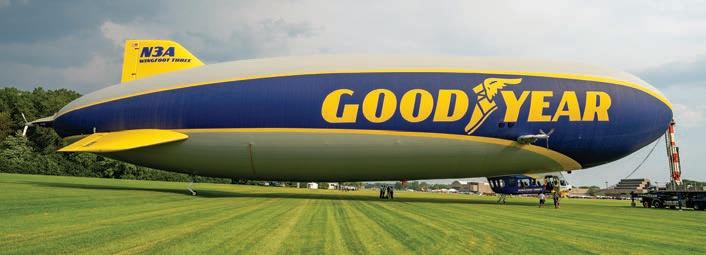
Q: The world-famous Goodyear Blimp has made numerous appearances at EAA AirVenture Oshkosh over the years, including this summer. What was the name of the first commercial Goodyear Blimp, built in 1925?
SATURDAY, JULY 25, ANSWERS
Piper (7,780)
SUNDAY, JULY 26, ANSWERS

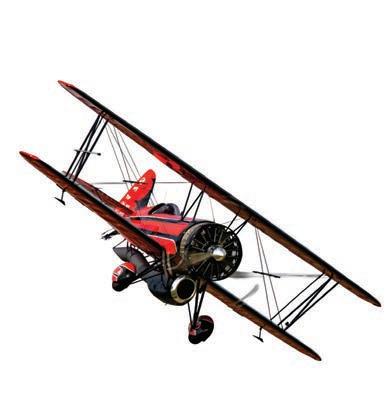
See Jarrod fly the incredible Jet Waco in today’s air show!
“Thunderstruck gets you fired up. The rest has a funny way of making the chaotic sound logical.”
Thunderstruck — AC/DC
The Wanderer — Dion
Dreams — Van Halen
Watching Airplanes — Gary Allan
Thriller — Michael Jackson
SUNDAY, JULY 26, 2026






















FROM FIRST ARRIVAL to final takeo and everything in between, we want to see AirVenture through your eyes. Check out today’s featured social shots of the day! Share your highlights on social media using #OSH26
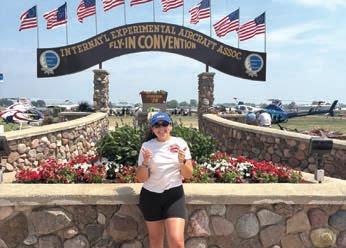
@abby.ventures
It’s a bird, it’s a plane! OSH ‘26
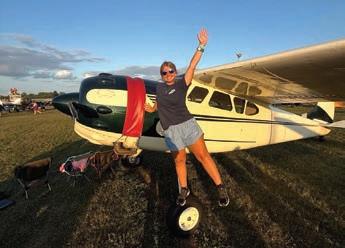
@mary_in_the_Airy
Highly recommend getting your pilots license during OSH week so you can always celebrate here! 4 years since my first pilot certificate and I can’t wait for many more #osh2026
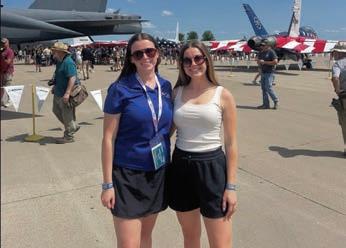
@meteorologistlauren
I ran into a local celebrity at EAA Airventure!! This is NBC 26 Today’s @jordanbrennanwx !!! So sweet to meet her in person
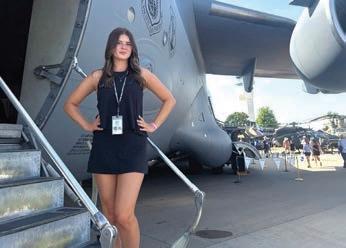
@flywithskyeee first time at osh
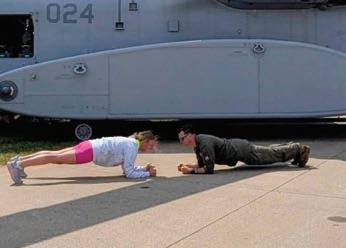
@heathermonthie
Got the Marine to plank with me this morning

GOLD
DeltaHawk Engines
Embry-Riddle Aeronautical University
Honda Aircraft Company
Lightspeed Aviation
Lycoming
Mars Wrigley
PenFed
Phillips 66
Piper Aircraft, Inc.
Redbird Flight
Victor Sierra
Aircraft Owners and Pilots Association (AOPA)
Aircraft Specialties Services
Aspen Avionics, an AIRO Group Company
Cirrus
Dynon
Epic Aircraft
Goodyear Tire & Rubber Company
Icom America
Junkers Aircraft
Oshkosh AeroTech
PowerLift Hangar Doors
Riesterer & Schnell
RTX
Wipaire
BRONZE
AeroShell
Ballweg Implement Co, Inc
Blackhawk
Bose Aviation
Continental Aerospace Technologies
Covington Aircraft
CubCrafters
Delta Air Lines
Diamond Aircraft
Elixir Aircraft
GE Aerospace
Green Bay Austin Straubel Int.
Airport
Gulf Coast Avionics / Pacific Coast Avionics
Hangar 22 Coffee
Jani-King
Jeppesen ForeFlight
JP Instruments
magniX
NATCA
Pepsi
Piedmont Airlines
Pilatus Aircraft USA Ltd.
Poly Fiber, Inc
Robinson Helicopter Company
Rotax iService and Training
Centres
SiriusXM Aviation
Southwest Airlines
Superior Air Parts, Inc.
SureFly Electronic Ignition
Tecnam
True Blue Power
uAvionix
United Airlines
Van’s Aircraft
VOLARE HANGARS
Whelen Aerospace Technologies
Williams International
Wing Aviation
Women in Aviation International (WAI)
Zenith Aircraft
4imprint
Airbus
ASA (Aviation Supplies & Academics)
Avfuel
B & C Specialty Products Inc.
Barnstormer
Bristell Aircraft
CiES Incorporated
DATC
General Aviation Manufacturers Association (GAMA)
Gridiron Air
Horizon Hobby
Lincoln Electric
PlaneWX
SOFTIE PARACHUTES by ParaPhernalia, Inc.
Starr Aviation
Teledyne Aerospace Electronics, Gill Aircraft Batteries
UND Aerospace
Arena Americas
Banyan Group Ventures
Chicago Executive Airport
David Clark Company

Endeavor Air
EnerSys®
Flight Outfitters
Flite Test
GES
Global Aerospace
Gulfstream Aerospace
Honda Power Equipment
JSfirm.com
MATCO ALS
Metro Sales Inc.
Mountain Air Realty
Ninety-Nines, Inc (The)
Old School Model Works
Pilotsmith
PS Engineering Inc
SCHEELS
Scheme Designers, Inc
Sherwin-Williams Aerospace
Small Town EV
Target Oshkosh
The Yalanis Private Wealth
Management Group of Wells
Fargo Advisors
Walkabout Hats
WILCO
Zipline