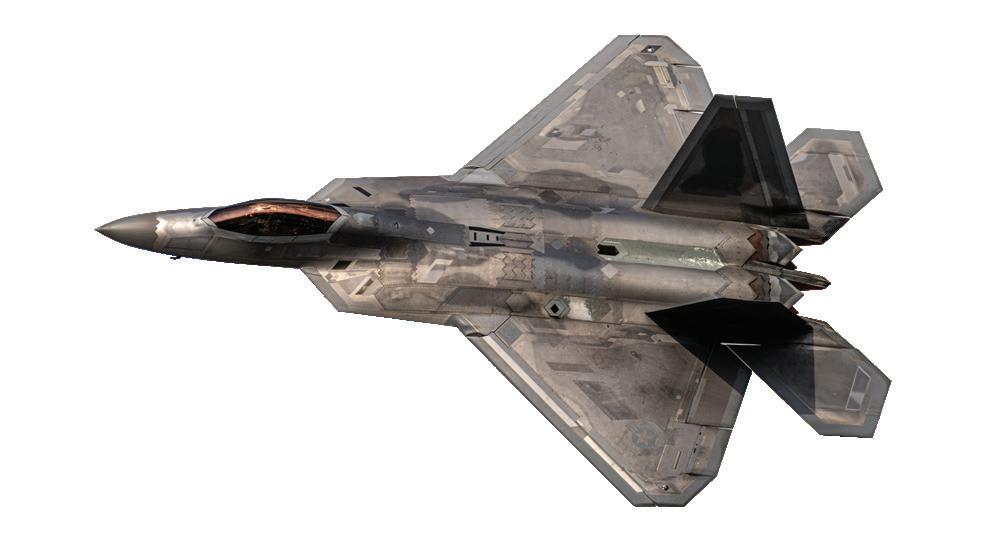

PHOTOGRAPHY BY CHRISTOPHER LOHFF
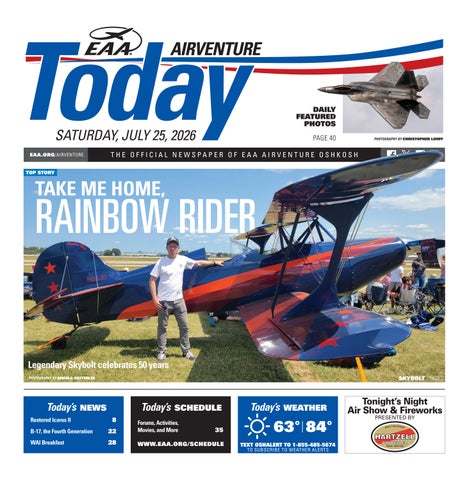







BY ANGELA SATTERLEE AIRVENTURE TODAY STAFF
SOME AIRPLANES BECOME FAMOUS because of speed or records. Others become legendary because of the people whose lives they touch.
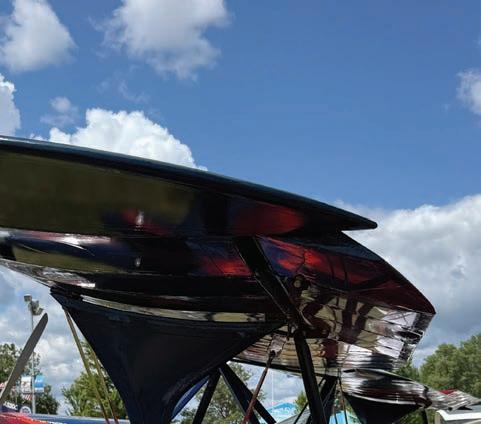
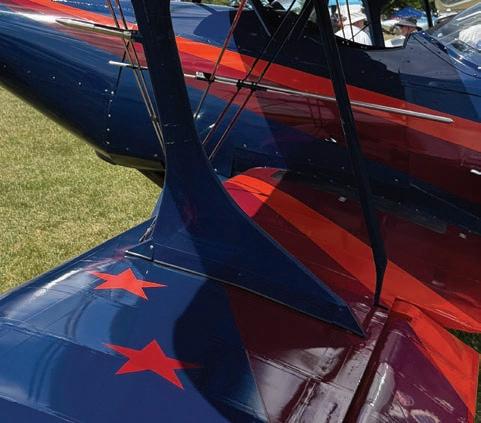
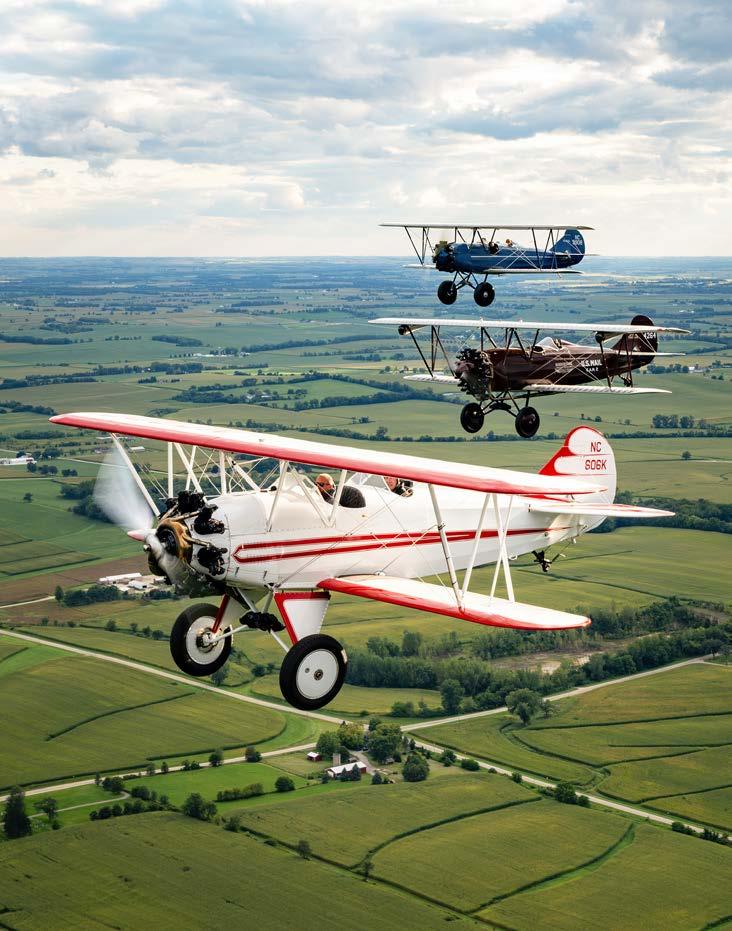
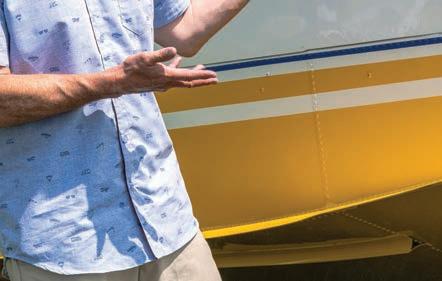
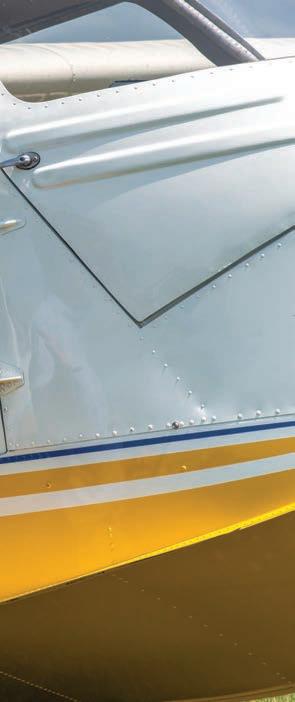
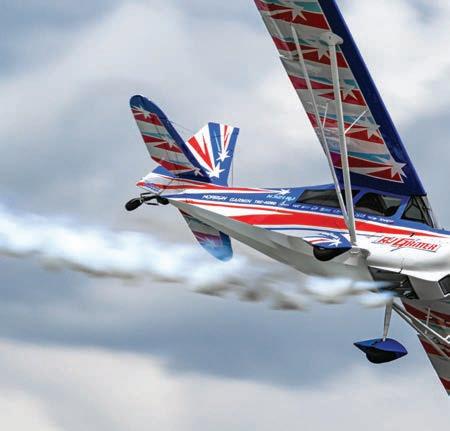
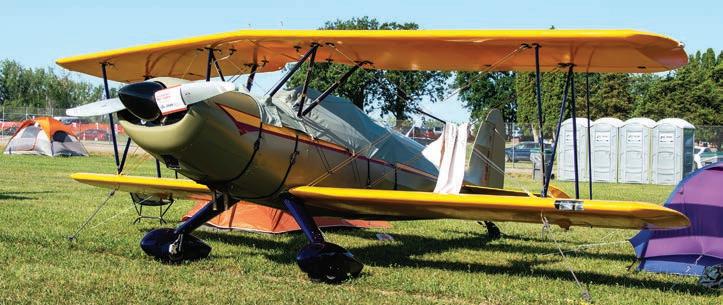
The 1976 Steen Skybolt, N56JD, better known as Rainbow Rider, is celebrating its 50th anniversary this year after making the trip back to EAA AirVenture Oshkosh, where its remarkable story continues.
Built by Mike Huffman and Mallie Norton in Tulsa, Oklahoma, the Skybolt first flew on July 12, 1976. A few years later, Hu man met entertainer and aviation enthusiast John Denver, who had been looking for a Skybolt of his own. Denver purchased the airplane in 1979, and is believed to be the one who christened it Rainbow Rider.
He flew the colorful biplane for several years, featuring it in his television special The Higher We Fly and the EAA film Wings on Dreams, making the aircraft recognizable to aviation enthusiasts around the world.
After Denver sold the airplane to a friend of Huffman’s in Tulsa, Rainbow Rider passed through several owners and was eventually damaged. Dick and Barb Keil of Naples, Florida, later acquired the aircraft and spent years painstakingly restoring it to flying condition. They installed new lower wings and longer landing gear while carefully preserving the original paint scheme designed during John Denver’s ownership.
When Dick died, Barb wanted to make sure the airplane would go to someone who understood its history and significance. That person was Chuck “Charlie” Dignan Jr.
Charlie, a Colorado-based pilot with more than 20 years of experience
in flight instruction, air ambulance, airline and business aviation, first came across Rainbow Rider while casually browsing Barnstormers.com for a recreational airplane and was instantly drawn to it.
“They spent years restoring it piece by piece to the original paint job,” Charlie said. “It would’ve been much easier to start over, but they brought it back to the same condition and the same vibe as John Denver intended.”
Because Charlie shared Denver’s Colorado roots and deeply appreciated the airplane’s history, Barb believed he was the right person to continue its legacy. After purchasing the aircraft, Charlie flew it home to Colorado.
“It kind of put up a fight when I first showed up,” Charlie said. “They had restored it, but it hadn’t been flying. Once I started flying that first 10 hours, it had some little bugs to work out for sure ... but crossing that Colorado border, everything gelled.”
This week, Charlie brought Rainbow Rider back to Oshkosh, arriving Wednesday to celebrate the airplane’s 50th anniversary with the EAA community.
“It’s a huge responsibility for one, but it’s also a great honor,” Charlie said.
The airplane’s story is also reaching a new audience through a documentary currently in production. Charlie’s longtime friend, filmmaker Michael Bud, is directing Rainbow Rider, which follows the aircraft’s incredible history and the people whose lives have been shaped by it.
Fifty years after its first flight, Rainbow Rider continues to inspire aviation enthusiasts, proving that some airplanes become much more than machines


PUBLISHER: Jack J. Pelton, EAA CEO & Chairman of the Board
VICE PRESIDENT OF PUBLICATIONS, MEMBERSHIP SERVICES, RETAIL, SAFETY AND SECURITY, AND EDITOR IN CHIEF: Jim Busha
MANAGING EDITOR: Hal Bryan
SENIOR EDITOR: Sam Oleson
EDITORIAL STAFF: Robbie Culver, Emme Hornung, Jim Roberts, Angela Satterlee, Barbara A. Schmitz
SENIOR COPY EDITOR: Colleen Walsh
COPY EDITOR: Jennifer Knaack
PRODUCTION TEAM LEAD/GRAPHIC DESIGNER: Marie Rayome-Gill
GRAPHIC DESIGNERS: Amber Fabian, Brandon Wheeler
SOCIAL MEDIA MANAGER: Holly Chilsen
SOCIAL MEDIA COORDINATOR: Michael Sullivan
SOCIAL MEDIA INTERN: Madeline Wooten
SENIOR SALES AND ADVERTISING EXECUTIVE: Sue Anderson


BY SAM OLESON AIRVENTURE TODAY STAFF
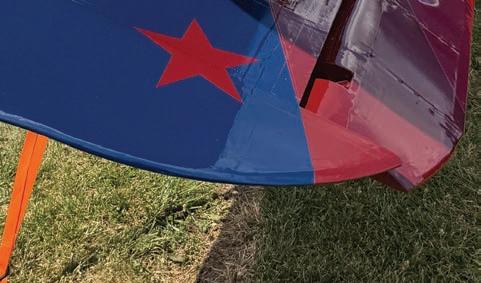
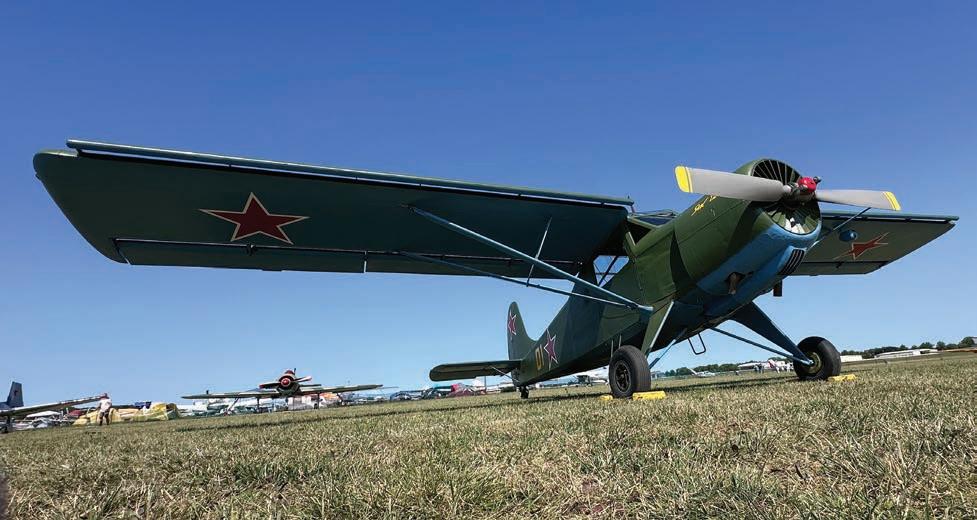
IF YOU HAPPENED TO BE WALKING among the rows of L-birds, trainers, and assorted Eastern Bloc aircraft in the Warbirds area at AirVenture 2026 the past few days, there was likely one airplane that elicited a “What is THAT?” reaction from even the more knowledgeable military aviation buffs: an ultrarare Soviet Yak-12M. Introduced shortly after World War
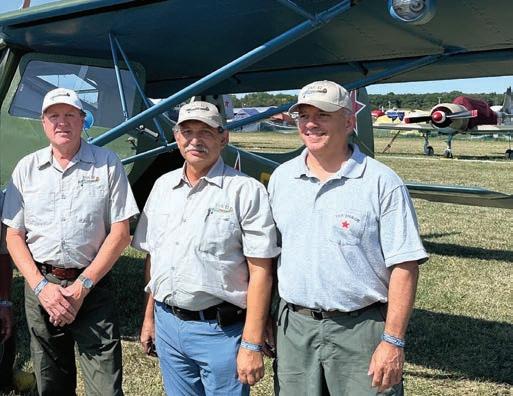
Oshkosh on Wednesday is owned and operated by the nonprofit organization Antique and Classic Aircraft International in Long Island, New York, and is believed to be the only flying example in the U.S. Built in 1955, the airplane originally served in Poland and is powered by an Ivchenko AI-14R, a 260hp, nine-cylinder radial engine, and is fitted in an air ambulance configuration.

“It’s the second-to-last model that they made in Russia,” said Craig Sampson, who led the restoration on the airplane for Antique and Classic Aircraft International. “It was designed in the middle of World War II as a replacement for the Po-2 biplane.
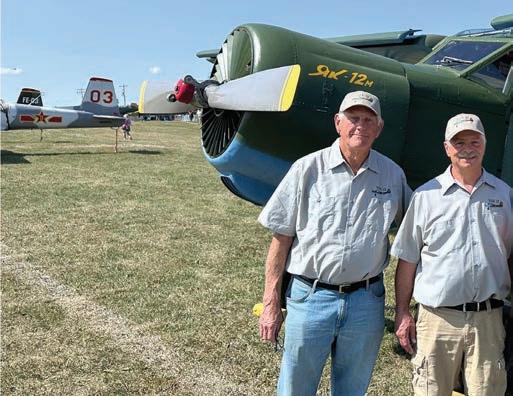
The aircraft is mainly for observation operations, Russian front lines, similar to the Birddog. So troop evacuation, and aerial spotting of artillery, and things like that. So it used to be the job of the Po-2, and the Yak-12 was designed then to take over. This one is a 1955 variant and served in Russia and Craig, EAA 640840, said not much is known about the airplane’s history prior to it arriving in the U.S., with it


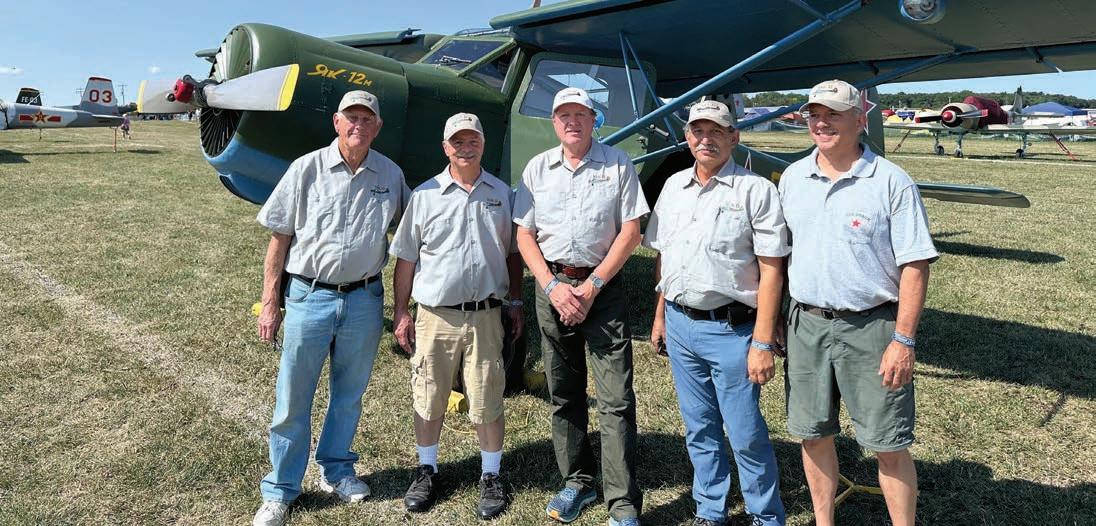














eventually making its way to Long Island in 2015 after it changed hands a couple times.

The airplane’s first postrestoration flight took place in November 2025, with Craig performing the testflying regimen.







































“This particular plane, we don’t know its original history,” he said. “It did spend time in Poland, towing gliders at the end of its life. It was then somehow bought by somebody to import it to the United States. It was impounded in the Port of Houston by customs. For what reason? We don’t know. It ended up on the chopping block and at a customs auction. A gentleman here in the States decided it’d be a great idea [to purchase it]. He bought it at auction, probably for a pretty cheap price, and decided he wanted to restore it to flying condition. He saw how big the project was and gave up on it. … We have a small not-for-profit organization we set up to take the airplane as a donation. So we did, it was donated to us, and we decided we’d give it a shot to restore it to flying condition. That was 11 years ago.”
Craig and his team put together a group of volunteers and set to work restoring the airplane, though it certainly was not a straightforward process when it came to documentation.
“First flew in November of last year, right before winter set in. So we got our first couple of flights in, then put it away in a hangar to wait out the whole New York winter, and then started flying it again in March,” Craig said. “So it’s been flying now since March, building time on it. I did all the test flying. It’s the only one flying in the country. There were no pilots that had any experience, so the insurance company said, ‘Well, you’re it.’ And they allowed me to fly it and learn how. I flew a Yak, the only one in England, for about an hour a couple of years ago. And that was my only experience. But I do have a lot of experience in tailwheel aircraft and a lot of small aircraft flying.”
With a cruise speed of around 100 mph, the Yak-12 is definitely a low-and-slow flyer. Between the earlyweek wildfire smoke and some poor weather on the way to Oshkosh, Craig and a small team of Antique and Classic Aircraft International volunteers arrived a bit later than expected but were happy to showcase this rare Russian treasure at AirVenture.

“It was just a steel tube frame and a container with boxed parts,” he said. “Half of it couldn’t be recognized. And no manuals. So we sourced the manuals. We managed to find the original Russian manuals written in Russian Cyrillic. So we had to use Google Translate and a couple of Russian volunteers that could speak it. So it was a bit of a chore, but we got it done. We were very lucky that most of the parts came with the project. We just rummaged through all the boxes, and most of them were there. So as far as the airframe parts were concerned, most of it was there.”
“It’s always a big adventure to come to EAA, no matter what,” he said. “If you can bring something different, it’s exciting to do that, and let the general public get to see that it’s here. And we need all the support we can get to keep flying. All the interest that we can generate in it, it just helps us out as a not-for-profit organization.”








To learn more or donate to Antique and Classic Aircraft International, visit AntiqueAircraft.org. Be on the lookout for a full-length feature story on the Yak12M in a future EAA publication.


















www.icomamerica.com/aviation insidesales@icomamerica.com


• Base: IC-A120B
Perfect base station for home or airport communications. The IC-A20 mobile version available for vehicle use..
• Panel Mount: IC-A220 + IC-A220 TSO Version

Innovation at it’s best, OLED screen and easy intalation (TSO version availble).



Visit the Icom Booth #2026-2028 July 20 – July 26, 2026















BY EMME HORNUNG AIRVENTURE TODAY STAFF
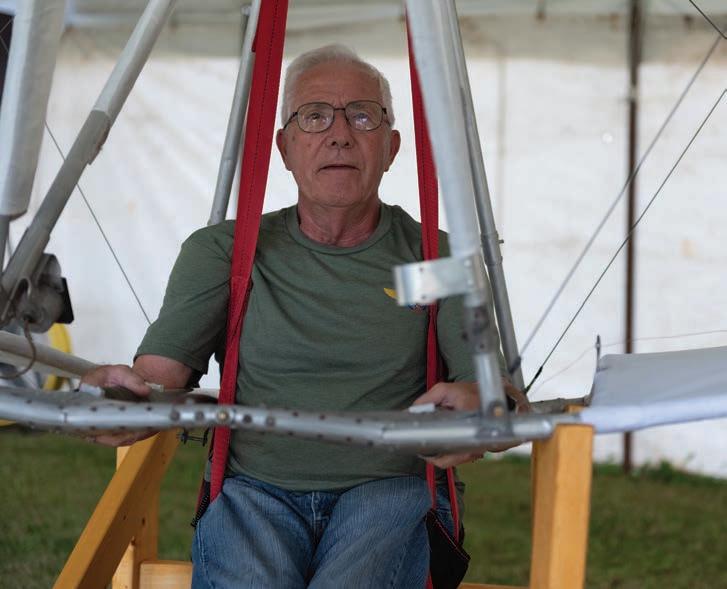
FIFTY YEARS AGO, the powered ultralight movement took o at EAA Oshkosh 1976 when John Moody demonstrated a takeoff and landing in his powered hang glider, the Icarus II. Often called the “father of modern ultralight aviation,” Moody built the Icarus II hang glider in the mid-1970s. The local flat terrain was not ideal for the sport, however, so he mounted a two-cycle, 12.5-hp McCulloch engine and a propeller to the back. This allowed him to take o from ground level and climb for about 30 minutes, before shutting o the engine to soar.
His first flight in the powered Icarus II was in March 1975, but it was not until EAA’s 1976 convention that he demonstrated it in front of the Oshkosh crowds, and thus a movement was born. The sport of powered ultralights rose in popularity, and in 1982, the FAA created FAR Part 103. This new ruling was a milestone in aviation freedoms, as it ruled ultralight vehicles did not require registration nor pilot certification to fly them.
To celebrate the 50th anniversary of his flight during AirVenture 2026, Moody decided to donate the Icarus II to EAA. With help from members of the Michigan Ultralight Association (MULA), the aircraft was trailered from Moody’s home in Florida to Michigan for a thorough and thoughtful restoration. MULA members spent months cleaning, repairing, and recovering Icarus II, which you can read all about in August’s EAA Sport Aviation Ultralight World.
After making its final trip to Oshkosh, the Icarus has been on display all week in the Ultralights area. Moody and MULA members were in attendance to celebrate the anniversary and a job well done on the restoration, as well as the 40th anniversary of their club. When the week wraps up, the Icarus will make its way to the EAA Aviation Museum to be put on display, honoring Moody’s contributions to the sport, and preserving its history and craftsmanship for future generations.







Enter for a chance to win one of two e-bikes. NO PURCHASE NECESSARY TO ENTER OR WIN. Void where prohibited by law. The PenFed Ultimate Ride Giveaway is open to legal residents of any of the 48 Contiguous United States, DC, and permanent legal residents of those jurisdictions currently residing on an overseas US military installation, age 18+. Limit one entry per person/email. (2) prizes: each an E-bike selected by Sponsor, ARV $1,499. Prizes may differ from shown. Begins 7/6/26 at 12:00:01 AM ET, ends 10/1/26 at 11:59:59 PM ET. Winning names will be drawn on or about 10/8/26. Winners need not be present. Odds of winning depend on number of valid entries received. See Official Rules at Giveway.PenFed.org/Ebike for complete details and entry without scanning QR Code. Sponsor: Pentagon Federal Credit Union. Certain images in this advertisement were created using artificial intelligence and do not represent real people, places, or events. © 2026 Pentagon Federal Credit Union.






ATTENDEES, VOLUNTEERS, AND PILOTS should be aware that the Red Arrows’ performances require a larger aerobatic box, necessitating a slight move of the crowd line to the west during the afternoon air shows on those days. Only essential, authorized air show personnel are permitted inside the box during the Red Arrows’ performance.
The Red Arrows crowd line will run the entire length of the flightline from Ultralights through Warbirds, in line with the existing speaker poles, about 120 feet west of the regular crowd burn line. This line will be clearly marked.
For Air Show Spectators
Visitors will have access to the regular crowd line area until 1:15 p.m. on Saturday and until noon on Sunday. At those times, visitors must move back to behind the Red Arrows crowd line. AirVenture guests will not be allowed to leave chairs, blankets, coolers, or
other items past the Red Arrows crowd line at any time on those days. Saturday and Sunday, Wittman Road will be closed to all vehicular tra c, providing additional space for air show viewing.
For Pilots and Crew of Aircraft Parked on the Flightline
After 1:15 p.m. on Saturday and noon on Sunday, pilots or crew of aircraft parked between the two crowd lines will be allowed in the area for a short time with a security escort to perform urgent, essential tasks. Everyone will need to be out of this area by 4:45 p.m. on Saturday and 3:15 p.m. on Sunday.
Full access will be restored after the conclusion of the air show on Saturday and Sunday. Look for extensive signage on the grounds further explaining the areas and times covered by these necessary rules and guidelines.






BY EMME HORNUNG AIRVENTURE TODAY STAFF
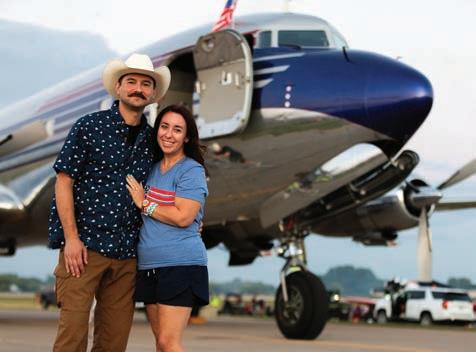
LOVE IS IN THE AIR this year just as much as the fumes of 100LL. During the Wednesday night air show, the Flying Bulls carried a little something extra on board with them — an engagement ring — that they delivered to Ryan Bauer just before he proposed to his nowfiancee Kelli Couch.
Both employees of a major airline, Ryan, a 39-year Oshkosh attendee, met Kelli in 2022 while they both were attending AirVenture. They lost touch but soon reconnected after finding each other on a dating app, and they have been together ever since.
When planning the AirVenture proposal, Ryan initially just asked they be able to take pictures in front of the DC-6 without any ropes behind them, but Steph
Stricklen, U.S. PR liaison for the Flying Bulls, saw an opportunity to take things a bit further.
“They took the ball and ran with it and created that whole experience for us, and I am super, super grateful,” Ryan said. “Wednesday night was just way beyond anything I could imagine.”
“The sta really helped Ryan keep it a surprise … . They were thrilled to do that for their first ever appearance here,” Kelli added. “It wasn’t until the pilot took the ring out of his pocket and handed it to Ryan, then I was like, ‘Oh,’ and even then I still was a little bit in shock.”
Kelli, indeed, said “Yes.” Congratulations to the happy couple!


AirVenture 2026
Monday
10:00am Engine Leaning Made Simple
TUESDAY

8:00am Ring Gap and Cylinder Life
10:00am Compression Testing
WEDNESDAY
10:00am Engine at TBO Options
THURSDAY
10:00am Proactive Approach to Aircraft Engine
Maintenance
FRIDAY
10:00am Oil Changes as a Diagnostic of Engine Health
SATURDAY
10:00am Choosing the Right Aviation Mechanic

STOP BY for a free copy of Engine Management 101


Hosted by Bill Ross, A&P I/A 2023 GAA National Aviation Technician of the Year Award Winner!


*Each seminar qualifies for 1 hour of IA Renewal Crdit & FAA Wings Credit

BY RAUL CISNEROS
FAA
DEPUTY ADMINISTRATOR Chris
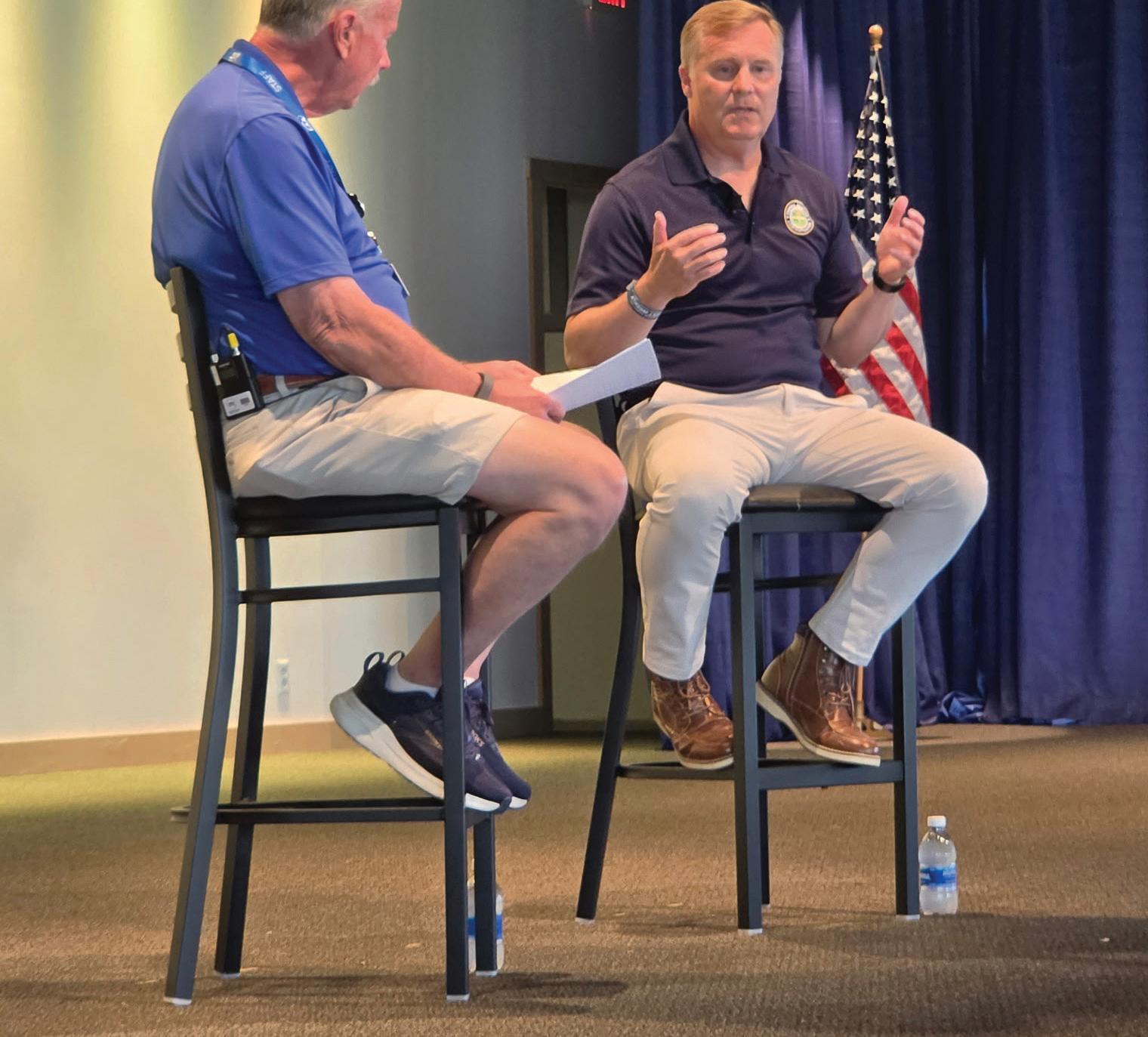
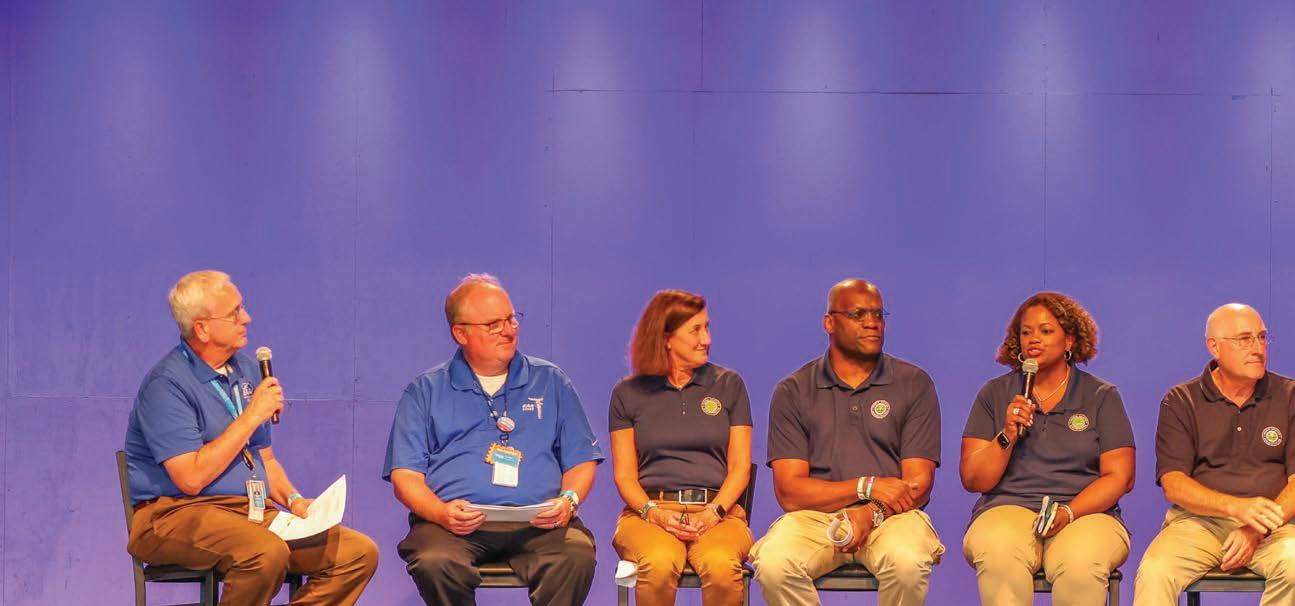
Rocheleau discussed numerous topics during the Meet the FAA Administrator forum at the Theater in the Woods on Thursday morning. Joining him on the stage for a discussion was EAA CEO and Chairman of the Board Jack J. Pelton. Rocheleau also took questions from the audience.
In his opening remarks, Rocheleau talked about Flight Plan 2026, which focuses on three key areas: safety, people, and innovation/modernization. About safety and following the tragic crash at
Reagan National Airport in January 2025, Rocheleau said, “One of the things we really doubled down on was what was missed? What could we have done better?” He said that an FAA team has worked with the National Transportation Safety Board to look into opportunities there to make the system safer overall. Rocheleau also said the agency is using artificial intelligence and machine learning to figure out how the FAA is using data to make the system safer.
As it relates to people, Rocheleau acknowledged that the FAA has struggled
to bring sta on board. However, he did report good news. “Last year we exceeded our goal of over 2,200 controllers and bringing them into the system,” he said. He also added that they are on track for this year at about 90 percent of hitting their goal and expect to exceed it again. Regarding modernization, Rocheleau talked about building out a new air tra c control system. “One of the things that that we certainly had to tackle early on last year was some of the outages of the equipment we had within the system,” he said. “We got $12.5 billion to build out a
new infrastructure.” In addition to modernizing the airspace, Rocheleau said there is also a focus on modernizing the agency and making it more responsive to stakeholders and industry.
To underscore the FAA’s responsiveness to stakeholders, Rocheleau said that after the forum they would be announcing mobile clearance delivery. This new technology was developed in collaboration with Jeppesen ForeFlight. It will connect pilots with air traffic
FAA ADMINISTRATOR / PAGE 13


controllers directly via the ForeFlight mobile app to manage their IFR flight plans without the need for radio and/or phone calls.
During the question-and-answer portion of the forum with Jack Pelton, Rocheleau was asked about the notice of proposed rulemaking on drones and autonomous vehicles operating beyond visual line of sight and the concern of EAA members about sharing the airspace in a safe manner. Rocheleau said the FAA “didn’t want to rush to a decision and have to go back and fix it later on … .” He added that it was going to be necessary to understand the concerns of the drone delivery industry and the general aviation community.
Pelton also asked Rocheleau about the goal to remove leaded fuel in aviation by 2030 (2032 in Alaska). Rocheleau described the timing as “aggressive,” adding, “… in the coming weeks we’re going to issue a new
roadmap to kind of reset …,” he said. “I can tell you with confidence we’re not going to set an arbitrary date that says, ‘well, this is what it says,’ without making sure that whatever we’re going to put in those aircraft is safe.”
Rocheleau also took time to answer a number of questions from the audience, including on digitization, the VOR network, interagency collaboration, and the prospects of air traffic controllers receiving a 2.8 percent pay raise.
Rocheleau has a long and distinguished record of service to the nation. He’s previously served at the FAA in numerous roles and was one of the first leaders of the Transportation Security Administration. Rocheleau served in the U.S. Air Force and retired from the USAF Reserve in 2010 as a lieutenant colonel. Before joining the agency in 2025, he was the chief operating officer for the National Business Aviation Association. Rocheleau said he has been coming to AirVenture for more than 10 years.


BY ANGELA SATTERLEE AIRVENTURE TODAY STAFF
WHAT IF AN airplane could become the first step toward freedom?
For survivors of human tra cking, transportation is often one of the biggest barriers to escaping dangerous situations. That’s where the Freedom Aviation Network (FAN) steps in. The nonprofit organization connects volunteer pilots with advocates and survivors, providing safe, rapid, and compassionate air transportation to help people reach safety, reunite with family, attend court appointments, and begin rebuilding their lives.
Founded in 2022 by Stephanie Lamar and Jared Miller and based in Nashville, Tennessee, FAN has quickly built a nationwide network of volunteer pilots and supporters.
Representing the organization at EAA AirVenture Oshkosh this year are volunteers Paula Swift and Debbie Owen, who will speak Saturday from 10 a.m. to 11:15 a.m. at the WomenVenture Center. This marks FAN’s third
year at AirVenture, where they hope to recruit volunteer pilots while raising awareness about both human trafficking and the many ways people can support the organization.
“There are so many avenues for volunteering,” Debbie explained. “A lot of people think they can only come in as one thing, but there are di erent levels of volunteering. Our mission is recruiting pilots to help with transports, but we’re also looking for advocates who travel with our VIPs and people who simply want to help spread the word.”
In order to become a volunteer pilot, all that is needed is a private pilot certificate with 250 hours of total flight time and access to an aircraft.
Transportation is often the greatest obstacle for survivors trying to leave tra cking situations. Cars and buses can be followed or tracked by tra ckers, while
aircraft allow survivors to be moved hundreds of miles away quickly and safely.
“They tend to go back on average six or seven times before they leave completely,” Debbie said. “Getting them as far away as quickly as possible helps reduce that return rate.”
FAN refers to the survivors they transport as “VIPs,” short for “very important package.” The name reminds pilots that every mission is critical while also protecting each survivor’s identity.
Volunteer pilots focus solely on flying the aircraft while trained advocates provide trauma-informed care throughout the journey. That support is especially important because some survivors were tra cked by air and may struggle with getting back into an aircraft.
SURVIVORS / PAGE 15



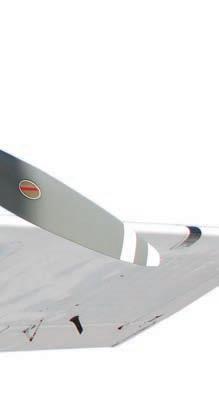








FAN’s support doesn’t end after one flight. The organization continues working with survivors for up to two years, providing transportation to court hearings, family reunifications, counseling, and other services that help them stay on the path toward a new life.
For Debbie, the mission is deeply personal, making every volunteer hour worthwhile.
“We’re doing this for the one person that we can bring to safety, for the one that we can end up helping get back on track and live a good life,” Debbie said. “We can’t save them all, but we can save the one, which I think is really important.”
Human trafficking is often thought of as something that happens somewhere else, but Debbie said that’s far from reality.
“Human trafficking is out there. And I think being aware is part of the battle,” Debbie said. “More awareness brings more hope.”
In addition to volunteer pilots, FAN relies on advocates, event volunteers, and supporters who assemble care packages for survivors. Every role contributes to helping someone take the next step toward safety.
FAN wouldn’t be able to help as many VIPs as they have without the support from their main






sponsors Signature Aviation, Air Care Alliance, R3 Aviation Services, Institute for Survivor Care, and Blue Lightning Initiative.

Visitors can learn more about Freedom Aviation Network and hear directly from a survivor who has flown with FAN during Saturday’s presentation at the WomenVenture Center.









































































































OSHKOSH MOMENTS

BY BARBARA A. SCHMITZ AIRVENTURE TODAY STAFF
ANDREA VENTURINI, OF Florence, Italy, had always wanted to be a pilot. But he never thought it was possible without money and proper introductions.
But during a vacation in Scotland, a friend took him to the field where his father flew gliders in the 1960s.
“I bought three launches for 85 pounds. Even though the weather wasn’t the best, it allowed me to be in command of the glider for three flights. It made me realize that flying is the most beautiful thing anyone can do.”
He was hooked. Before returning to Italy, he signed up for classes and got his glider license at age 50. But after a while, he decided he wanted to fly in a motored plane. “A glider is too much like a sailing boat; it’s too dependent on the weather,” he explained.
So while visiting family in Connecticut, he earned his private pilot certificate in about 2018.
But when he was back in Italy, a U.S. private certificate didn’t do him much good. So he then earned his private license from the EASA, the equivalent of the FAA in Europe. More certifications, ratings, and endorsements followed: taildragger, tow pilot, aerobatic gliding, and almost seaplane. He came up short on getting his seaplane license due to COVID when he couldn’t go back to take the test.
He earned his U.K. license, and to prove his English proficiency, back in Italy he took and easily passed the Test of English Aviation (TEA) so he could fly internationally. And he continued to fly. Just some of his flights include:
• Flying solo from Boston to Manhattan with only 40 hours logged as a private pilot.
• Coast2Coast2Coast, or flying across the lower half of the United States and back again. A video he posted on Instagram flying over Meteor Crater, Arizona, got him 14 million viewers.
• Flying across the Atlantic Ocean in the Risen airplane from east to west, without refueling, and stopping at EAA AirVenture Oshkosh in 2024. The journey took 11 hours and used 43 gallons of fuel.
• Flew from Tuscany, Italy, to Saudi Arabia in an ultralight in December 2025.
Venturini also became the Italian two-seat glider champion in 2021 with Alberto Sironi, a title they still
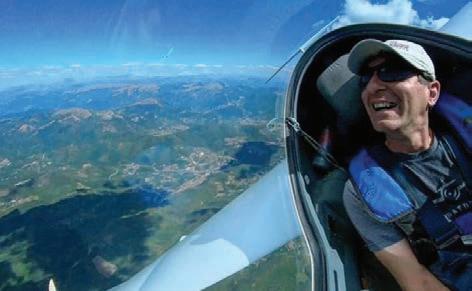
hold today. That championship led him to becoming team captain of the Italian gliding team in 2023.
Today, he’s personally logged about 1,000 hours and is ready for his next adventure, which he said he will continue to share with high school students, encouraging them to pursue aviation and their dreams. That adventure will include a volcano project, and he’s looking for partners to make it happen.
“Sharing the passion is important to me,” he said. “Aviation is the main way to bring people together. There are opportunities out there, but you need to pursue them. I want to make sure my experience will benefit the next generation. But my ultimate dream is to use aviation as a tool to bring a message of peace around the world.”


BY ROBBIE CULVER AIRVENTURE TODAY STAFF
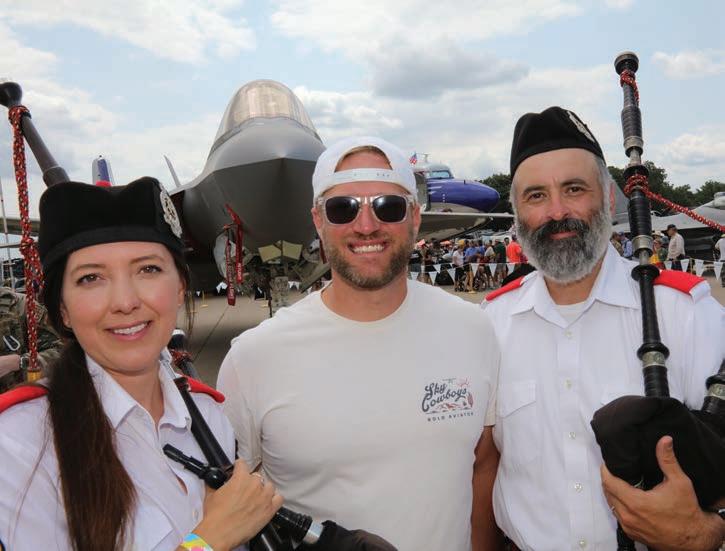
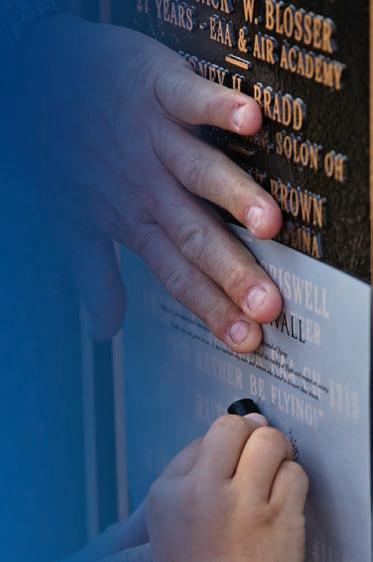
FOR EAA MEMBERS Louis Graham, EAA 782591, and Molly Sommer, EAA 1640006, part of the magic of Oshkosh is having the opportunity to play the bagpipes at di erent events around the show. Louis said, “It all started a few years ago when I joined the Chicago Highlanders. I met Molly, and she said her husband was interested in getting started flying and asked if he could reach out. We invited him out to Oshkosh, and I told her that I’d always had the dream of playing pipes at sunset in camp on the hill, and so she suggested that we bring our pipes to camp.
“We did it one night, and before we knew it, there were a bunch of golf carts at the bottom of the hill, and we ended up
getting a bunch of gigs. So this year we’re walking around playing those gigs. On Sunday, we do the Memorial Wall chapel ceremony.” Louis has been coming to Oshkosh for 37 years!
“Professionally, I fly a Falcon 2000 LXS and a Falcon 900 LX, and have a Skybolt over at IAC that we purchased to learn how to fly Skybolts. Because we’re building a Skybolt, and we’re hoping, fingers crossed, to have it done for next Oshkosh!”
Molly said, “I joined a bagpipe band, met Louis about three years ago, and my husband was interested in aviation, and then my dad was also a pilot, and my grandpa was a pilot as well. And [Louis]
invited us to come to Oshkosh … and I said, ‘Let’s do it.’ My husband and I came up and just fell in love with being here.”
Molly’s grandfather flew a B-24 in World War II, and her husband, Justin, EAA 1579280, is working on his instrument rating. Aviation runs in the family.
Molly added, “I think this playing up here has hit di erently than some of the other places I played, just seeing the response of people, especially like people
in the military. People come with stories. Sometimes it’s hard to see someone react to what you’re playing, and it’s super touching and super humbling … to be able to play something for someone and it means so much to them.”
Keep your ears tuned for the sounds of bagpipes in the evening from a hill in Camp Scholler, and on Sunday morning at the memorial ceremony for those who have flown west.
BY ROBBIE CULVER AIRVENTURE TODAY STAFF
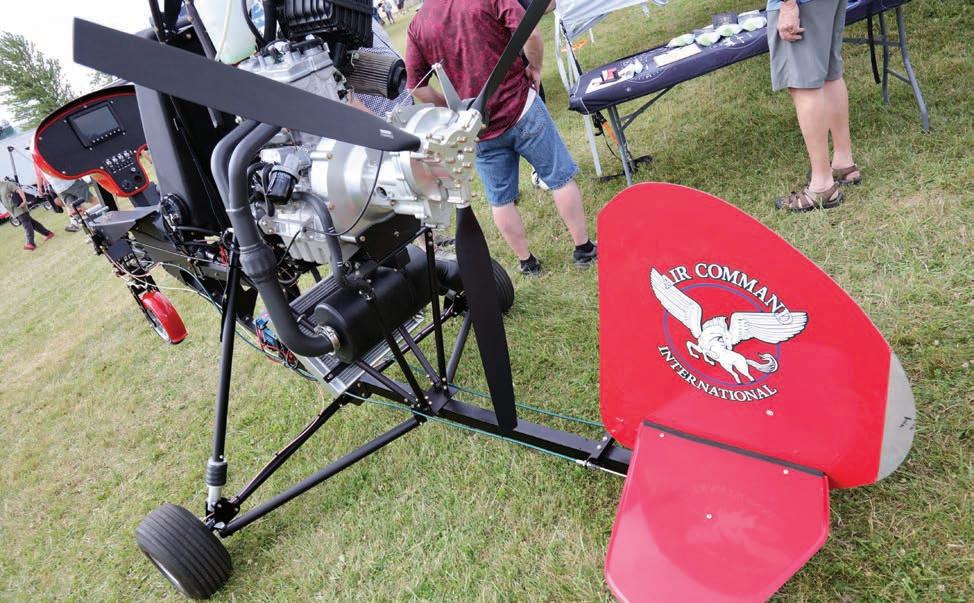
GYROCOPTERS ARE A misunderstood segment of light aviation. Joe Covelli, owner of Air Command International LLC, describes gyros as a “fun flying experience. It’s like flying a mini sports car in the sky … 100 percent of the time, fun flying. If you’d like to have wind in your face, this is a great experience.”
Air Command has been around a long time, and is preparing a revised version of a gyrocopter as well as a new engine. Joe said, “We’ve shown it here at Air Venture … the last few years, which has been great. We’ve answered a lot of questions about it. There’s a ton of interest because there’s the need for a reliable, safe, a ordable engine in our market space.”
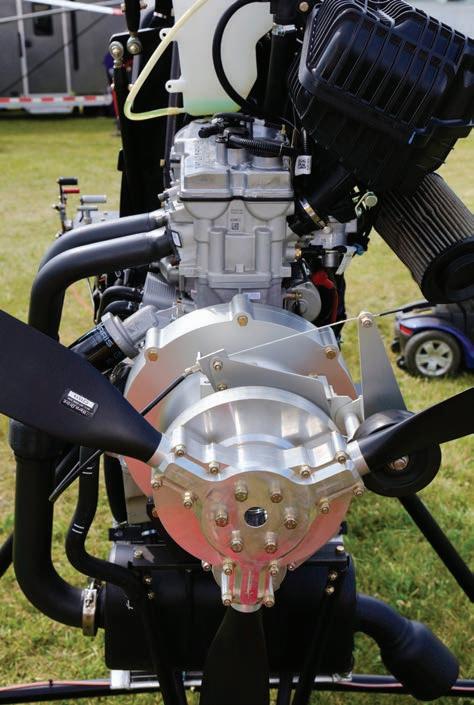
The new engine is based on a Polaris ATV engine. “We feel this will fill that space, that void that’s out there right now. It’s a 100-hp engine at 8000 rpm. We’ve had this engine in testing and then this project for seven years now. And so we’re ready to start flying this in September and building time and proving out what we’ve done behind the scenes with all the data collection, the numbers, running the numbers, that type of thing.”
The gyroplane itself is experimental and is sport pilot-eligible.
“Gyro Air Command has been around since 1984. So the gyro is really based o of the experiences of those 40 years and just a really solid, good flying product. The intent, the last several years, has been to refresh the look of the gyroplane, so we can update the look, but we can also add safety enhancements, new features, other options.
“For example, we have adjustable rudder pedals. This is a great scenario, being a single-seat airplane. The intent with that is to have the instructor step in, take the flight for the first day, tune, trim the aircraft, bring it down, and have the student then get into the aircraft, and with the adjustable rudder pedals, that adjustment can be made in about two minutes, no tools required.”
Keith Lemire, senior design engineer, said, “A few years ago when we were looking at this and looking at adding a higher horsepower engine, we decided to take a look at the mast and sti en that up.

“One of the other safety enhancements we did was to reinforce the lower link on the joystick. We discovered quite by accident that the bolt in the back was torn out by just a literal accident that Joe had. [He] hit a lowhanging branch with the mast when he had it on the trailer, and it tore the threads out.”
Keith said the engine “conversion has been an ongoing thing for several years, and I would say, at this point, it’s safe to say we perfected it… It’s not gonna get any better than this. The engine tends to have a little less inertia, so we’ve done some things with that. Less relative to the [Rotax] 582, I should say it that way. So we’ve done some steps to take care of those issues, things that can ruin your gearbox and ruin your day really fast. So it’s about managing engine vibration, basically, internal vibration to the engine.”
Joe added, “We’re still in prototype development. We’re at the end of the process, but we want to prove out what we’ve known and make sure it performs before we make any other commitments as to production.”
Air Command is located near the ultralight runway in Booth 928.





















BY KAYLA KOHLER, JEPPESEN FOREFLIGHT
JEPPESEN FOREFLIGHT ON THURSDAY ANNOUNCED a landmark collaboration with the FAA to develop Mobile Clearance, a groundbreaking new technology that will connect pilots with air traffic controllers directly via the ForeFlight Mobile app to manage their IFR flight plans without the need for radio or phone calls, streamlining pilot-controller communication and reducing workload on both sides.
This new capability will be demonstrated at the Jeppesen ForeFlight Booth (443-445) during EAA AirVenture Oshkosh 2026. Pilots departing from Appleton International Airport (ATW) throughout the show will also have the opportunity to use the feature to receive their departure clearances.
A New Paradigm in Pilot-Controller Communication Currently live at a growing number of airports in Texas, with expansions into other states planned for the near future,
the Mobile Clearance system will introduce a suite of digital capabilities intended to replace certain legacy voice-based procedures at a number of towered U.S. airports. Key features include:
• Streamlined IFR Departure Clearances: Pilots can request and receive their IFR departure clearances digitally through ForeFlight, eliminating the need to manually transcribe and read back long clearances. The system supports amended and revised clearances issued by ATC directly to the pilot’s iPad or iPhone, with prominent notifications within ForeFlight ensuring pilots can quickly respond to accept or reject each clearance.
• Mobile Flight Plan Closure (Coming Soon): A separate capability planned for rollout soon will allow pilots to close their IFR flight plans within ForeFlight upon arrival at
nontowered fields, addressing safety concerns where pilots may risk premature in-air cancellations of their IFR flight plans to avoid busy ATC phone lines after landing.
Innovation Through Collaboration
This groundbreaking technology is the result of a hand-inhand partnership between Jeppesen ForeFlight and the FAA.
“We are proud to assist the FAA in using innovative technology to address the challenges facing today’s air traffic control system,” said Travis Root, senior vice president of Flight Deck Products. “By unclogging communication lines and easing pilot and controller workload, we’re building a safer and more e cient future for aviation together. Throughout this development process, the FAA has been exceptionally engaged partners, working closely with us to conceptualize, implement, and refine the system to meet the demands of a modern airspace.”
Jeppesen ForeFlight also extends its gratitude to United Flight Systems, a flight school based at David Wayne Hooks Memorial Airport (KDWH) in Houston, Texas, which graciously provided essential support to the program by allowing sta to test and validate the system in real-world conditions.




















































BY JIM ROBERTS AIRVENTURE TODAY STAFF
IMAGINE YOU’RE A YOUNG B-17 RADIO OPERATOR far from your Pennsylvania home, setting off on your first mission over Germany. Just two days before Christmas 1944, the bomber labors into the skies from your base in Italy, and your pilot turns northbound toward the Alps and hostile skies.
You’re serving in the 816th Bomb Squadron, 483rd Bomb Group (Heavy), part of an aerial armada destined to bring Nazi Germany to its knees. Of course that day is somewhere o in the uncertain future, and statistically your future may be very short. According to the 483rd Bomb Group Association, of the original 646 personnel sent to Italy in 1944, 39.8 percent were either killed in action or became prisoners of war.
After what seems an eternity of breathing through a crude oxygen mask in subzero temperatures, your formation nears the target. Without warning, a wall of antiaircraft fire
surrounds your ship, mortally wounding the Flying Fortress. With the aircraft limping toward home and losing altitude, you send an SOS prior to ditching in the Adriatic Sea. Your cry for help is answered by friendly forces, and you will be one of the lucky ones to see the war’s end.
That’s the story I hear from 23-year-old Nolan Merulli as he recounts his greatgrandfather’s service in World War II. Nolan, a commercial pilot and CFI from Monaca, Pennsylvania, made the pilgrimage to EAA AirVenture Oshkosh to immerse himself in aviation and connect with his great-grandfather through a flight in the Commemorative Air Force’s B-17, Sentimental Journey.

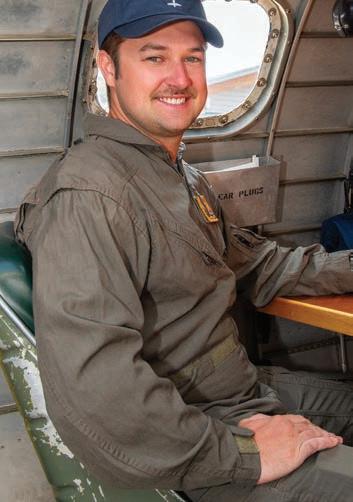
Nolan related, “My dad got me into flying. He was never a pilot himself, but he really loved aviation. We were at air shows watching all the planes, and he’d always tell me about his grandfather, Walter Cochran, my great-grandfather, and I’ve loved the B-17 my whole life.” Nolan continued, “My dad was an important person to me. I lost him in 2020 at 46 years old. So it’s tough, but he meant a lot to me for getting me into aviation.”
The flight was a gift from Nolan’s grandmother, Suzanne Merulli, the daughter of that B-17 radio operator. On a phone call she said, “I knew this would be a delight for him. And my dad was a wonderful person, and I know he’d be thrilled to death for Nolan.”
And what did Nolan think while seated for takeo at the radio operator’s station? “It was just amazing, absolutely surreal. I literally was crying as we’re taking off at the sound of those engines.” Did he feel like his great-grandfather was along on the flight? “Absolutely. My dad as well. I know he’s up there with me, and it was just an amazing experience.”
9 AM - 9:45 AM
PLANES, TRAINS, AND A
PROP STRIKE (WINGS CREDIT)
PHILIP MANDEL, FAASTEAM
10 AM - 10:45 AM
SAFE AND SECURE USE OF TABLETS AND CAMERAS IN AND AROUND AIRCRAFT
NIC MARTINEZ, MYGOFLIGHT | FLIGHT FLIX
11 AM - 11:45 AM ON SECOND THOUGHT
JOLIE LUCAS, CASCADE COUNSELING, INC., LCSW
12 PM - 12:45 PM
NEXT-GEN COCKPITS & SAFER SKIES: LEVERAGING NEW TECH FOR GA SAFETY FRANK KUNNUMPURATH, HOLY MICRO! LLC
1 PM - 1:45 PM THE ARMLESS PILOT’S IMPOSSIBLE AIRPLANE
JESSICA COX, RIGHTFOOTED FOUNDATION
MEET & GREETS

1 PM - 1:45 PM
KYLE FOWLER | Kyle Fowler Aerosports
2 PM - 2:45 PM
JESSICA COX | @rightfooted



BY BOYS & GIRLS CLUB OF OSHKOSH
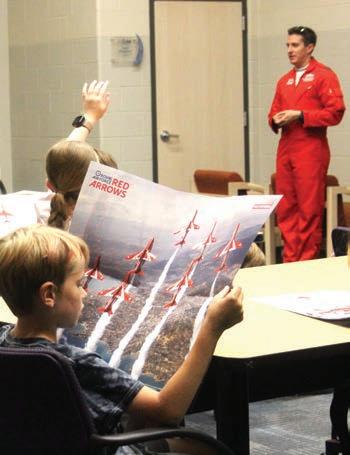
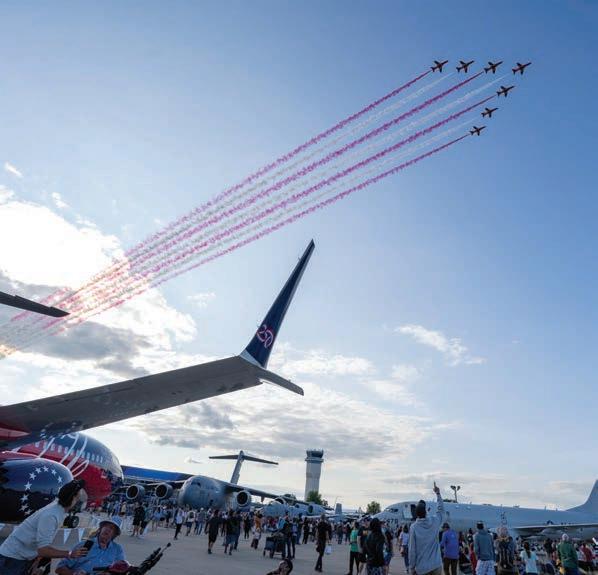
FOR A GROUP OF KIDS in the Quest program at the Boys & Girls Club of Oshkosh, Thursday started like any other summer day. But soon they were peppering members of the elite Royal Air Force’s Red Arrows with questions about supersonic flight, the colored smoke that the aerobatic team’s jets stream during air shows, and whether it’s scary to fly in tight formation at hundreds of miles an hour.
The visit came during the Red Arrows’ historic first appearance at EAA AirVenture Oshkosh 2026, where the nine-jet aerobatic team is flying afternoon air shows July 24-26 as part of an extended U.S. tour. Between their arrival and air shows, members of the team carved out time to stop by the club for a
conversation with kids who had plenty on their minds.
“How do you create smoke that comes out of the planes?” one club member asked, prompting an explanation of how the jets’ exhaust produces the team’s signature red, white, and blue trails. “Can you go faster than the speed of sound?” asked another. One club member wanted to know what the pilots did before they became pilots, curious whether flying jets was always the plan. And, inevitably, someone asked the question every kid wants to ask a fighter pilot: “Is it scary?”
“Not scary. Just fun,” said “Red 5” Flight Lt. Dustin Wales, drawing laughs. Wales was joined by Squadron Leader Doug Smith during the morning visit to the club.
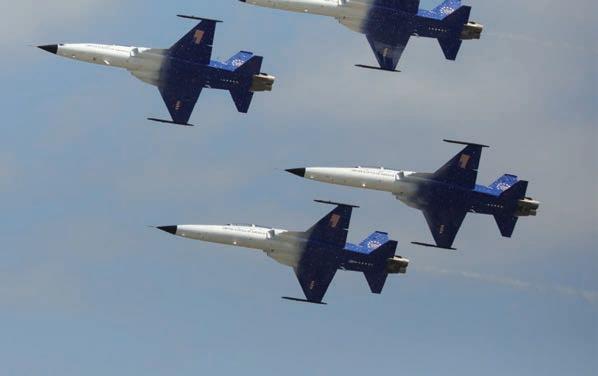
The Red Arrows, formally known as the Royal Air Force Aerobatic Team, have been dazzling crowds since 1965 and are now in their 62nd season. The team has flown nearly 5,000 displays across 57 countries, using the British-built Hawk T1 jet to execute tight formations and precision aerobatics that have made them one of the most recognizable military display teams in the world.
Beyond their air show performances, the Red Arrows serve as ambassadors for the United Kingdom at home and abroad and play a role in recruiting for the Royal Air Force, promoting the best of British military aviation. Their stop at AirVenture 2026 marks the first time the team has performed at the show.































BY BAILEY NOEL
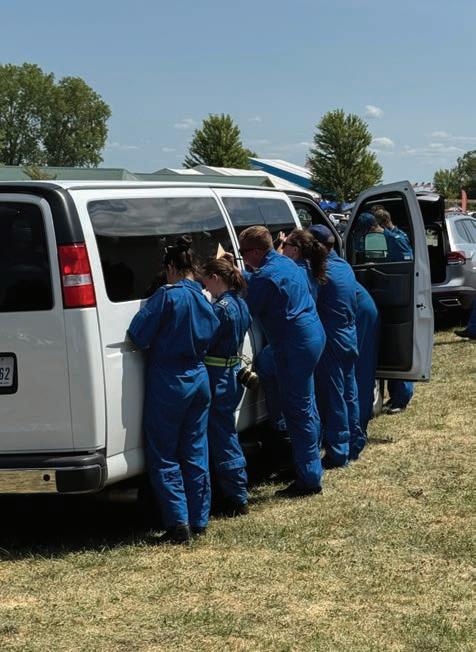
IN THEIR FIRST EVER VISIT TO EAA AIRVENTURE OSHKOSH, members of the Royal Air Force’s Red Arrows Demonstration Team support staff, known as the Circus, took part in a beloved Oshkosh tradition: writing postcards to their loved ones at home.
The free postcard program, started by local tourism agency Discover Oshkosh in 2021, invites AirVenture attendees to fill out a postcard to send to friends or loved ones for free at its concierge booth located at the base of the tower on the corner of Knapp Street and Waukau Avenue. Last year, the program sent out 2,500 postcards to all 50 states and 30 countries, according to Discover Oshkosh Marketing Coordinator Anna Murphy.
Members of the Circus were spotted Thursday afternoon in their vibrant royal blue flight suits writing to their family and friends.
Circus 9, Cpl. Damon Wilson, shared that he wrote a postcard to his wife and 4-year-old son. “I said, ‘Greetings from the largest air show in the world’ and that I miss them a lot. ‘I’m loving my time here, but I’ll be home soon,’” he said.
Air Specialist (Class 1) Lucinda McDermont wrote a postcard home to her grandfather. “I told him I miss him, I can’t wait to be home, I’m absolutely loving it. I told him I’m all the way in Wisconsin,” she shared, “and then a little family joke that ‘I can’t wait to see his gate,’ which is always fun because he always talks about his gate. We’re all the way from Wales, so it’s a long, long way from home.”
While the team performs at AirVenture during the Friday, Saturday, and Sunday air shows, these postcards will travel roughly 4,000 miles back to the team’s families across the United Kingdom, continuing to spread the reach of AirVenture globally.




offer hot coffee, doughnuts, fresh
salads, sandwiches, and much more.
One Market has everything you need to make your stay more enjoyable.

AROUND THE GROUNDS


















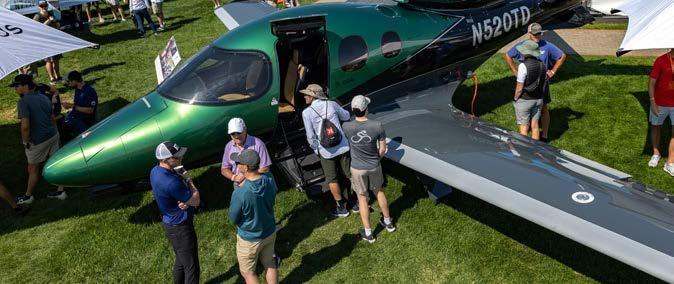
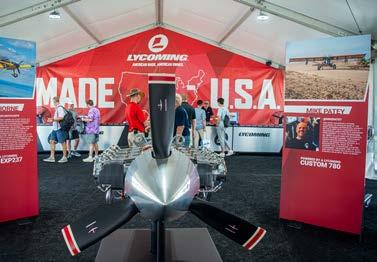
With more than 900 exhibitors on-site at EAA® AirVenture ® Oshkosh™ 2026, aviation innovation and inspiration is everywhere you turn. From cutting-edge technology to must-have gear, expert services to future opportunities — EAA exhibits support the industry and the lifestyle.

Whether you’re here for business, passion, or a little of both, you’ll find exactly what you need… and plenty you didn’t know you were looking for.
Make time to explore these exhibit destinations:


• Ultralight and Rotorcraft Display Area
•Fly Market Exhibit Area
•Main Aircraft Display Areas


•Aircraft Spruce & Specialty Exhibit Hangar A

•Aspen Avionics Exhibit Hangar B
•Elixir Aircraft Exhibit Hangar C
•DeltaHawk Engines Exhibit Hangar D






» International Federal Pavilion
•Aviation Gateway Park presented by Piper Aircraft Inc.
» EAA Vertical Lift Center in partnership with Robinson Helicopter Co. and Vertical Aviation International (VAI)
•EAA Seaplane Base presented by Wipaire
• EAA WomenVenture Center


And more around every corner!











» EAA Education and Career Center presented by Piedmont Airlines

















BY ANGELA SATTERLEE AIRVENTURE TODAY STAFF
WOMEN IN AVIATION INTERNATIONAL (WAI) celebrated the 30th annual Connect Breakfast Wednesday morning at the Paul H. Poberezny Conference Center, continuing a long-standing WomenVenture Day tradition of connecting young women with role models who have built successful careers in aviation and aerospace.
WAI welcomed NASA Deputy Chief Flight Director Emily Nelson as this
year’s keynote speaker.
Emily, who helped lead NASA’s Artemis II mission, shared the story of her own career to encourage young women to believe there is a place for them in the aviation industry. She said her interest in solving problems led her to study mechanical engineering, which eventually opened the door to a career at NASA.
After moving to Houston, Emily joined NASA through the United Space Alliance as an International Space Station thermal operations and resources flight controller. She became NASA’s 70th flight director in 2007,
only the 10th woman to hold the position, and now serves as deputy chief flight director at NASA’s Johnson Space Center in Houston, Texas.
Rather than hiding the setbacks she endured to get to where she is today, Emily said she believes they should be shared to help others realize that failure is part of the journey.
“I would tell you that I did not get certified the first time I went to go and certify as a flight controller,” she said. “I didn’t make it the first time I applied to become a flight director.”
Emily encourages young women to keep pushing forward even when things don’t go


as planned, reminding them that every challenge is an opportunity to learn and grow. And that no one can succeed alone.
“The best part of my job is there’s no standard day,” she said. “I get to do something di erent just about every day… And one of the best aspects of human spaceflight in particular is that everything we do, we do as a team.”
As the Connect Breakfast celebrated three decades of inspiring women in aviation, Emily’s message is clear: Setbacks don’t define a career. It takes perseverance, teamwork, and a willingness to keep learning.






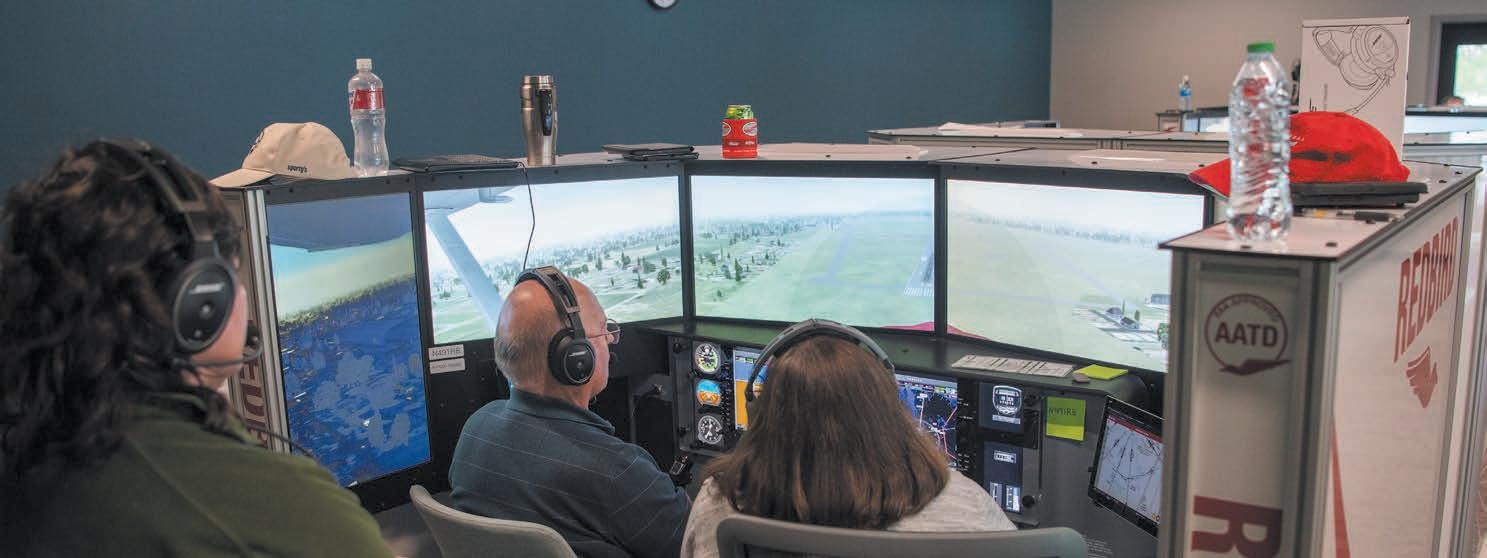
We’ve built a training catalog which includes:
Test your stick-and-rudder skills, judgment, and situational awareness. Requires 30 PIC hours in the last 12 months.*
Build your own experience one-on-one with an EAA instructor. You set the goals; we’ll help you crush them. Requires a student pilot certificate or higher.*
Sharpen your decision-making in the system. Requires IFR currency or within the six-month grace period.*
Check out the full schedule of EAA® Pilot Proficiency Center events here! * Registration required
EAA® AirVenture® Oshkosh™ could not happen without the outstanding support of our volunteers.
Help us in thanking them today!

Supported by
BY HAL BRYAN
IN THE LATE 1800S, not all that long after the United States celebrated its first 100 years, scientists, engineers, inventors, tinkerers, and adventurers around the world spent time and other resources trying to solve what was then widely known as “the flying machine problem.” While some of the most impactful innovations in history, from antibiotics to the internet, weren’t necessarily widely anticipated, the idea of controlled, powered, manned flight was, for some, almost impatiently expected. Yes, there were plenty of skeptics, notably including an editor at the New York Times who wrote in October 1903 that “… the flying machine which will really fly might be evolved by the combined and continuous e orts of mathematicians and mechanicians in from one to ten million
years.” By that time, though, people had been successfully flying gliders for more than 50 years, and rubber-powered model airplanes had been around since 1870. So, instead of a surprising innovation, the Wrights’ success, coming just two months after the Times’ pessimistic prediction, was seen (eventually, once word got around and people were convinced that it had happened) as a solution to a known problem. What nobody could have anticipated, however, was the impact of airplanes on civilization, nor the incredible rate of innovation that would take place. This year at EAA AirVenture Oshkosh 2026, we’re highlighting the first two dozen years of that innovation. Each day, we’ll highlight one of the aircraft on display as we celebrate the “Pioneers of Flight.”
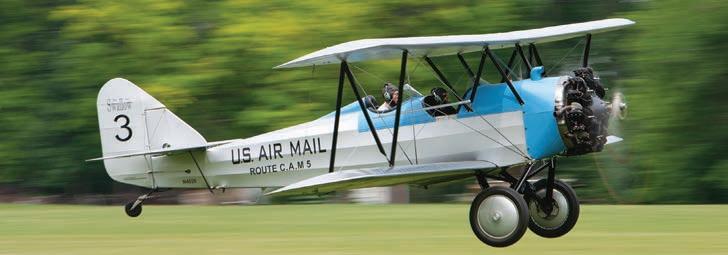
The E.M. Laird Aviation Co. was originally founded in 1920 by legendary air race designer Emil “Matty” Laird and was renamed the Swallow Airplane Manufacturing Co. after his departure. The new o cers of the Swallow Aircraft company included future household names Lloyd Stearman and Walter Beech. The company developed a series of multipurpose aircraft, including the Super Swallow, which was a mainstay of early airmail e orts. EAA’s example, built in 1927, is serial No. 899 and is painted to represent an airmail airplane flown by Varney Air Lines,
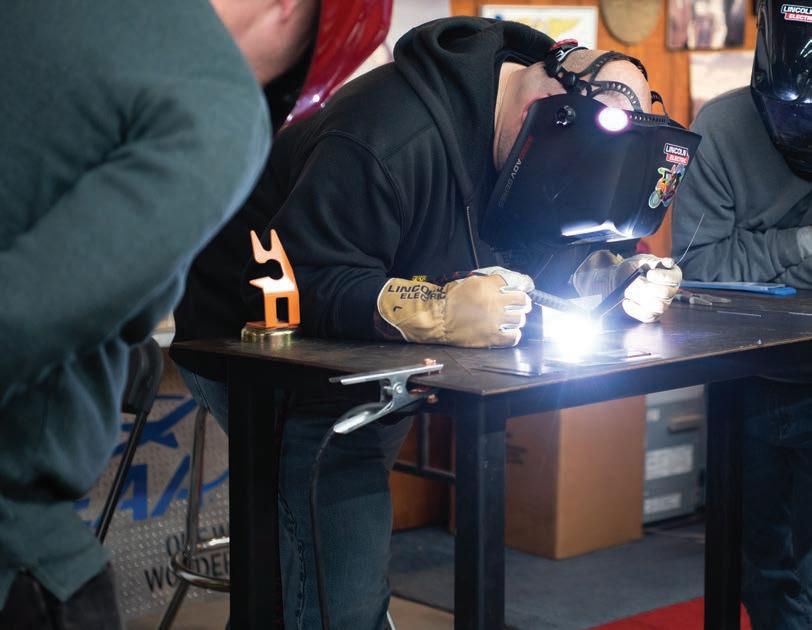
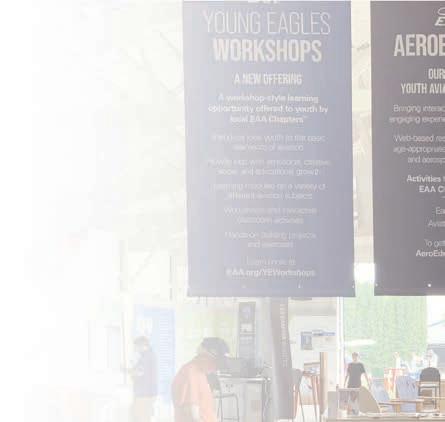
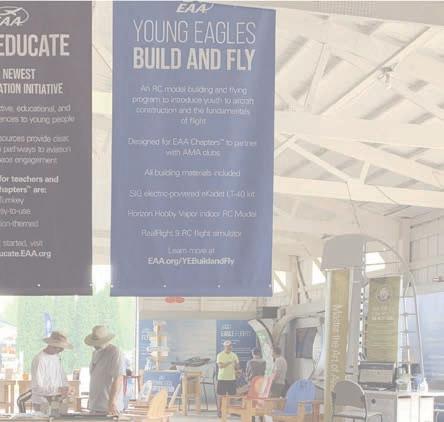
Homebuilding is the heart of EAA, and you can learn virtually every skill and gain the confidence you need to build an airplane while at EAA ® AirVenture ® Oshkosh™ Patterned after the highly successful EAA SportAir ® Workshops.
Presenting Sponsor Supporting Sponsors
LENGTH: 23 feet, 10 inches
WINGSPAN: 32 feet, 8 inches
HEIGHT: 8 feet, 11 inches
MAX SPEED: 100 mph
one of the companies that made up United Airlines when it was founded in 1931. The aircraft was donated to EAA in 1976 by John H. McGeary Jr. and remained in storage for many years, before being restored to flying condition with a 220-hp Continental radial engine from 2001 to 2004.


The very best from the aviation world come together for one week to share their knowledge with you, including hundreds of innovators, authors, experts, and legends.


EAA WEARHOUSE
9-10 a.m. Buck Wyndham, Hogs in the Sand: A Gulf War A-10 Pilot’s Combat Journal
9-10 a.m. John Berkstresser, Learning to Fly Essential Elements: Connecting the Dots
10-11 a.m. Michelle “MACE” Curran, Book 1: The Flipside; Book 2: Upside Down Dreams; Book 3: What’s Your Callsign
11 a.m.-12 p.m. Capt. Laura Savino, Jet Boss: A Female Pilot on Taking Risks and Flying High
12-1 p.m. John Teichert, Book 1: Boom; Book 2: In God I Trust
1-2 p.m. Jennifer Pitt, The Barnstormer and the Lady: Aviation Legends Walter and Olive Ann Beech
2-3 p.m. Ken Katz, The Supersonic BONE: A Development and Operational History of the B-1 Bomber
3-4 p.m. Rob Zettel, American MiG Pilot: Inside the Top-Secret USAF Red Eagles MiG Squadron
4-5 p.m. Fred Robinson, The Renaissance Aviator
5-6 p.m. Bill Ross, Superior Air Parts: Engine Management 101







AROUND THE GROUNDS
BY HAL BRYAN
EVERY YEAR, MORE than 10,000 aircraft fly to Wisconsin for AirVenture. Of those, nearly 3,000 are showplanes — vintage aircraft, warbirds, homebuilts, aerobatic airplanes, etc. — that are displayed around the grounds. But some visitors may notice other airplanes parked here and there that didn’t fly in at all, because they’re part of the EAA Aviation Museum collection. Because our museum exhibits rotate, many of these aircraft are only viewable by the public during AirVenture, spending the rest of the year in long-term storage on the convention grounds. Here’s a guide to


some of these airplanes that you’ll see as you wander the neighborhoods of AirVenture.
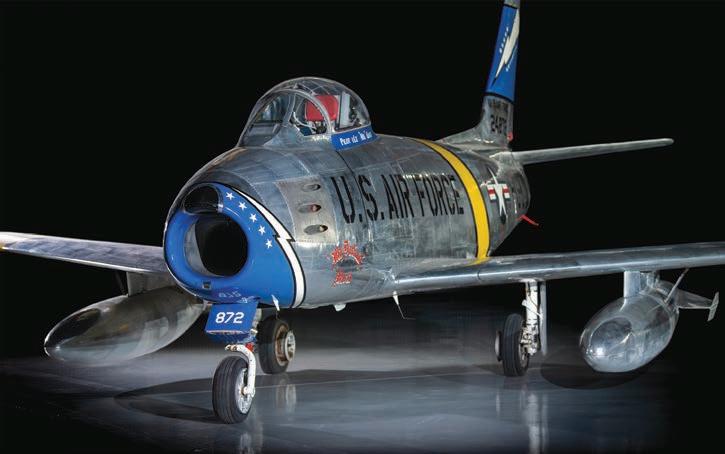
This Canadian-built example of the venerable F-86 is one of two in our collection, the other one being the lighted “gate guard” that sits in front of EAA headquarters on Poberezny Road. This Sabre is painted to represent the one flown by famed Apollo flight director Gene Kranz during his deployment to Korea in the mid-1950s.





























BY HAL BRYAN AIRVENTURE TODAY STAFF
AS WORLD WAR II came to an end, people of the free world looked ahead to an era that held the promise of unprecedented peace and prosperity. Rough estimates indicate that, at the start of the war in September 1939, there were roughly 30,000 pilots, both civilian and military, in the United States. By war’s end in August 1945, the estimated number had ballooned to more than half a million. It seemed patently obvious that the previous generation’s “chicken in every pot” would be supplanted in 1946 by “an
airplane in every garage.” Manufacturers went to work, introducing new aircraft and updating (and more actively marketing) existing designs. Sadly, this was the boom that wasn’t. A lot of wartime pilots moved on from flying, and, while commercial air travel grew steadily, general and recreational aviation didn’t attain the hoped-for ubiquity.
Still, 1946 was a remarkable year for GA, and that optimism, however impractical, gave us so many classic aircraft that remain beloved today. You’ll note that, unlike most aircraft anniversaries, this one isn’t exactly hard and fast. We’re not strictly celebrating first flights or introductions; rather, we’re looking back at

Loving your time at AirVenture® ?
Join EAA®, and take a piece of Oshkosh home with you! An EAA membership will give you year-round access to all things aviation.
Enjoy member benefits such as:
•Monthly issues of EAA Sport Aviation® magazine
•Discounts while you’re here at AirVenture ®
•Free access to nearly 400 museums and science & technology centers, including the EAA Aviation Museum™

FIRST FLIGHT: 1932
LENGTH: 23 feet, 10 inches
WINGSPAN: 36 feet, 4 inches
SEATS: 4
CRUISE SPEED: ~118 mph

FIRST FLIGHT: 1945
LENGTH: 21 feet, 10 inches
WINGSPAN: 36 feet
SEATS: 2
CRUISE SPEED: ~95 mph
the airplanes that were in production and on the market in that first full year of postwar peace. As you wander the Vintage neighborhood on the AirVenture grounds, you’ll likely see lovingly restored examples of a variety of types being celebrated as part of the Class of ’46. When
you do, try to imagine what it was like 80 years ago, with the horrors of war well and truly behind us, a world in love with aviation, and nothing but blue skies ahead. That’s the context to have in mind as we celebrate the Class of ’46.

















































8:00




































SATURDAY, JULY 25, 2026
ACROSS
1. Fairchild’s trainer, after it got a canopy and moved to Canada.
5. Chief designer of North American’s thoroughbred, Edgar _______.
8. The Flying Bull’s P-38 was once Lefty Gardner’s White _______’.
9. Its nickname was “Spad” and its mission was “Sandy.”
11. In the U.S. it was the Skytrain; to the British it was the ______.
12. Consolidated’s mighty bomber.
13. Grumman’s fighter, though most survivors were built by a car company.
14. Lockheed’s “missile with a man in it.”
15. Medium bomber that served the U.S. in three wars.
2. The Army’s name for Hiller’s most popular helo.
3. Officially the Cayuse, but best known as the _____.
4. The company that built R.J. Mitchell’s masterpiece.
6. Bell’s first production single-engine fighter.
7. A horse, a car, a bean, and a jet trainer.
10. Vultee’s basic trainer.
FRIDAY, JULY 24, 2026 ANSWERS DOWN
ACROSS 2. Grumman 6. Ercoupe 8. Standard 9. Johnson 10. Swift 11. Funk 12. Navion
Free youth admission ages 18 and under is supported in part by
Try your hand at these trivia questions and find out. The answers, along with a new question, will be in tomorrow’s paper.
Q: This year in the Vintage area, we’re celebrating the Class of ‘46 — the 80th anniversary of the general aviation boom immediately following World War II. Of the more than 30,000 aircraft built and sold that year, which GA manufacturer is believed to have sold the most?
FRIDAY, JULY 24, ANSWERS
de Havilland DH.82 Tiger Moth
Watch the sky for Nathan’s skywriting, and see him light up the night with pyrotechnics in this evening’s air show!
“Music has been an incredible influence on my life. Watching how music could drive emotion, and be incredibly entertaining, if I wasn’t an air show performer, I’d have probably made a career in music. This playlist spans across multiple genres, each having a different effect on my (and your) outlook, emotions, and optimism.”
Rhapsody in Blue — George Gershwin Don’t Worry Baby — The Beach Boys One Big Holiday — My Morning Jacket Honeysuckle Blue — Drivin N Cryin Echoes — Pink Floyd
SATURDAY, JULY 25, 2026
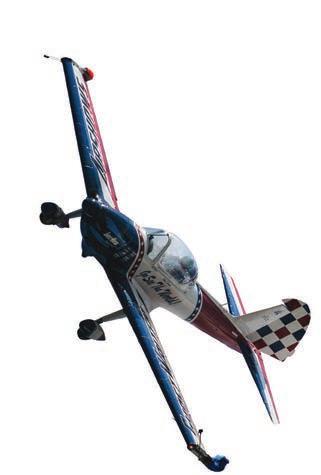

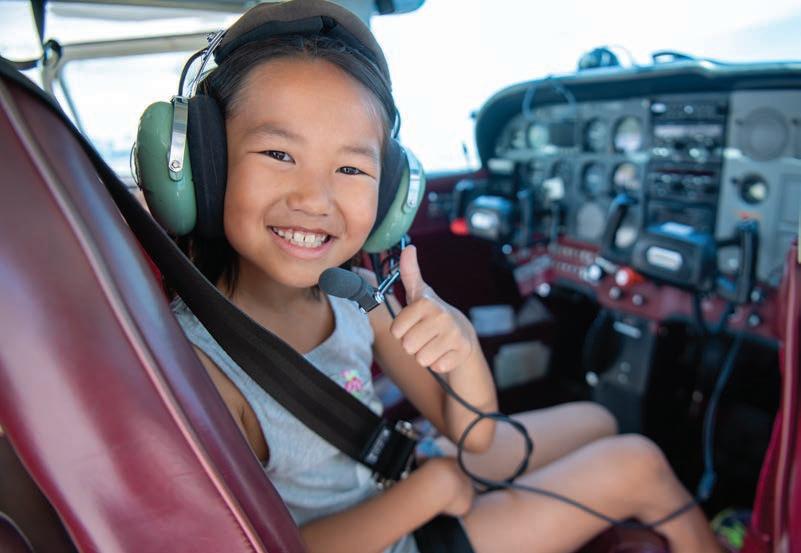

FROM FIRST ARRIVAL to final takeo and everything in between, we want to see AirVenture through your eyes. Check out today’s featured social shots of the day! Share your highlights on social media using #OSH26 to possibly be featured in a future issue of AirVenture Today!

@elise.montgomery #OSH26
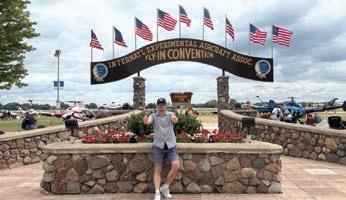
@paulohernandez_ch
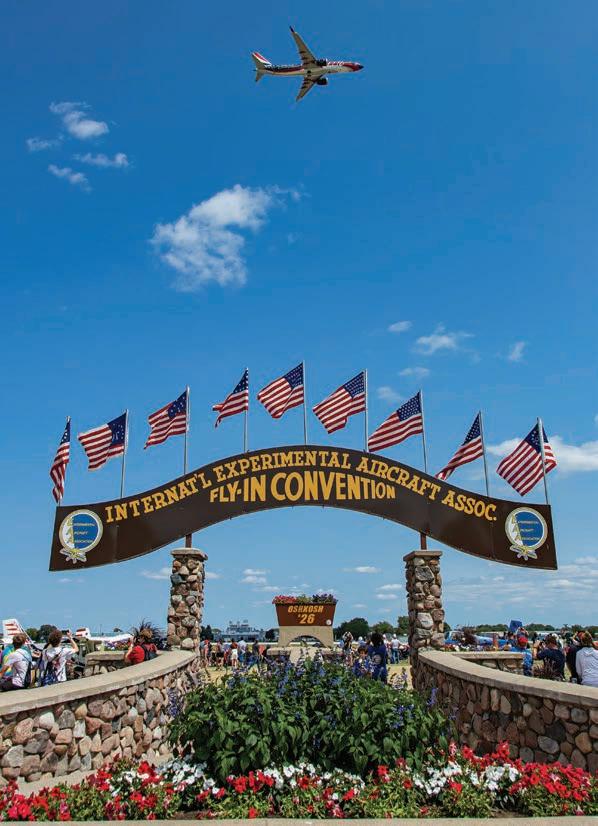
For years, I dreamed of visiting EAA AirVenture Oshkosh—and today, I finally experienced the world’s greatest aviation celebration.
From standing beneath the iconic flags at the entrance, to watching the incredible F-22 Raptor, breathtaking formation flights, my favorite helicopter, the CH-47 Chinook, and sharing every moment with great friends… this day is something I’ll remember for the rest of my life.
Aviation isn’t just about airplanes— it’s about passion, friendship, history, and the people who inspire us to keep looking toward the sky.
Thank you, Oshkosh, for making this dream a reality.
Blue skies and tailwinds!
#EAAAirVenture #AirVenture #Oshkosh #OSH26 #EAA Aviation AvGeek AviationPhotography
PilotLife Flying GeneralAviation Warbirds F22Raptor CH47Chinook DreamsComeTrue BucketList FlyWithFriends BlueSkies Wisconsin AviationLovers

@courtrenderman
a little stop by the Brown Arch to see the block in memory of Grandpa. His favorite place filled with his favorite people & somehow he taught our family how to love it all just as much! #eaa #family #maingatenorthadmissions #eaavolunteer #volunteer

@Krissystryker
Fun to see our beautiful plane at Osh Kosh ! It flew in Veterans and their families #oshkosh

@cherrycityspitfire
Oshkosh, it’s been too long. Let’s not permit so much time to pass between our next rendezvous, oui?
LET’S GO, FRIENDS!
#cherrycityspitfire #oshkosh #airventure2026 #pinup @eaa
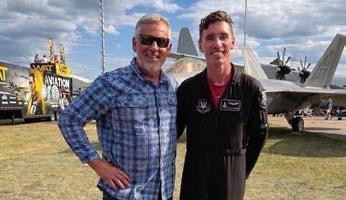
@Johnyork
Got to chat with Laz today at OSH. He does such a great Demo in the F-22 Raptor!!! #oshkosh #f22raptordemoteam #f22 #usairforce

GOLD
DeltaHawk Engines
Embry-Riddle Aeronautical University
Honda Aircraft Company
Lightspeed Aviation
Lycoming
Mars Wrigley
PenFed
Phillips 66
Piper Aircraft, Inc.
Redbird Flight
Victor Sierra
Aircraft Owners and Pilots Association (AOPA)
Aircraft Specialties Services
Aspen Avionics, an AIRO Group Company
Cirrus
Dynon
Epic Aircraft
Goodyear Tire & Rubber Company
Icom America
Junkers Aircraft
Oshkosh AeroTech
PowerLift Hangar Doors
Riesterer & Schnell
RTX
Wipaire
BRONZE
AeroShell
Ballweg Implement Co, Inc
Blackhawk
Bose Aviation
Continental Aerospace Technologies
Covington Aircraft
CubCrafters
Delta Air Lines
Diamond Aircraft
Elixir Aircraft
GE Aerospace
Green Bay Austin Straubel Int.
Airport
Gulf Coast Avionics / Pacific Coast Avionics
Hangar 22 Coffee
Jani-King
Jeppesen ForeFlight
JP Instruments
magniX
NATCA
Pepsi
Piedmont Airlines
Pilatus Aircraft USA Ltd.
Poly Fiber, Inc
Robinson Helicopter Company
Rotax iService and Training
Centres
SiriusXM Aviation
Southwest Airlines
Superior Air Parts, Inc.
SureFly Electronic Ignition
Tecnam
True Blue Power
uAvionix
United Airlines
Van’s Aircraft
VOLARE HANGARS
Whelen Aerospace Technologies
Williams International
Wing Aviation
Women in Aviation International (WAI)
Zenith Aircraft
4imprint
Airbus
ASA (Aviation Supplies & Academics)
Avfuel
B & C Specialty Products Inc.
Barnstormer
Bristell Aircraft
CiES Incorporated
DATC
General Aviation Manufacturers Association (GAMA)
Gridiron Air
Horizon Hobby
Lincoln Electric
PlaneWX
SOFTIE PARACHUTES by ParaPhernalia, Inc.
Starr Aviation
Teledyne Aerospace Electronics, Gill Aircraft Batteries
UND Aerospace
Arena Americas
Banyan Group Ventures
Chicago Executive Airport
David Clark Company

Endeavor Air
EnerSys®
Flight Outfitters
Flite Test
GES
Global Aerospace
Gulfstream Aerospace
Honda Power Equipment
JSfirm.com
MATCO ALS
Metro Sales Inc.
Mountain Air Realty
Ninety-Nines, Inc (The)
Old School Model Works
Pilotsmith
PS Engineering Inc
SCHEELS
Scheme Designers, Inc
Sherwin-Williams Aerospace
Small Town EV
Target Oshkosh
The Yalanis Private Wealth
Management Group of Wells
Fargo Advisors
Walkabout Hats
WILCO
Zipline