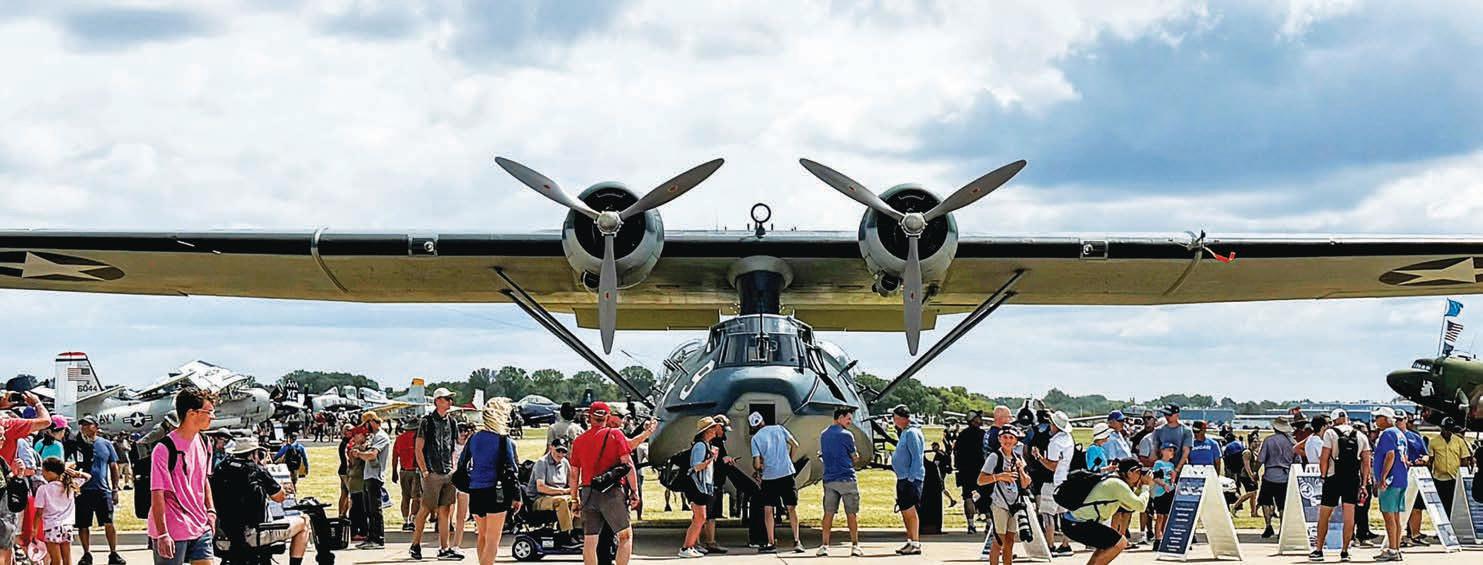
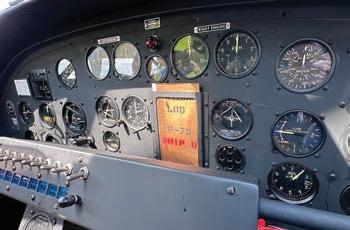
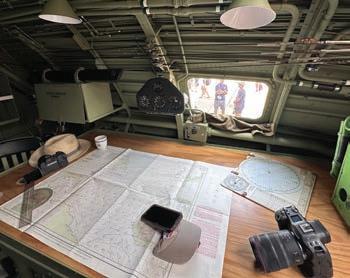
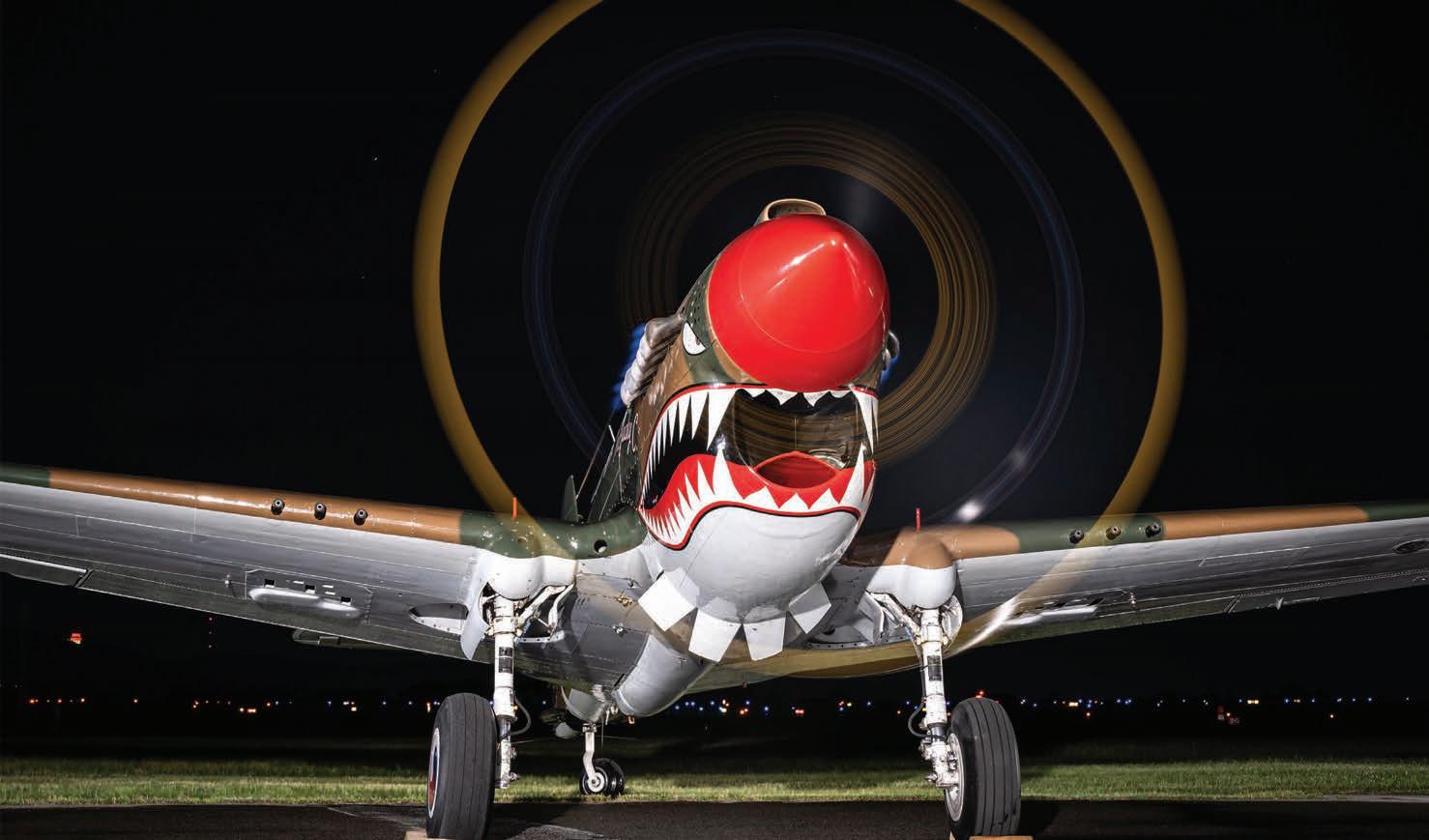
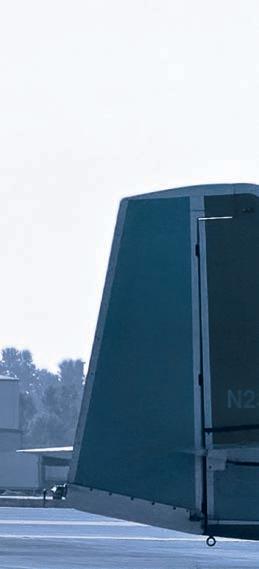
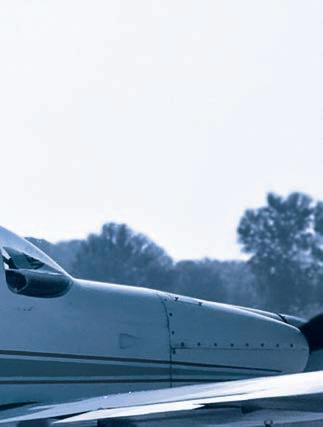
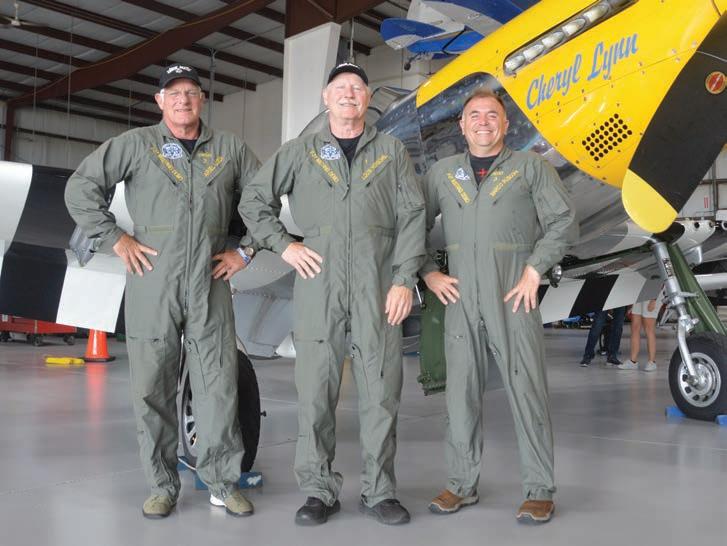
EIGHTY-FOUR YEARS AGO, above the freezing waters of the North Atlantic, the crew of Consolidated PBY5A Catalina BuNo 2459 was annoyed. Perhaps angry. Definitely motivated. For the past several months, the
airplane and its crew had been operating from Fleet Air Base Reykjavík, Iceland, with Patrol Squadron 73 (VP-73), hunting for German U-boats during the all-important Battle of the Atlantic. After months of disappointing results, with no U-boats sunk, VP-73’s Iceland commanding officer, Capt. Daniel V. Gallery, decided he needed to create some incentive. So, until a
U-boat victory was recorded, the officers’ club would be closed. Keep in mind, this wasn’t the Iceland of 2026. It was no tourist destination. The club was one of the few places that Navy officers could have a good time on the isolated island. Apparently that was all the motivation the crew of 2459 needed.
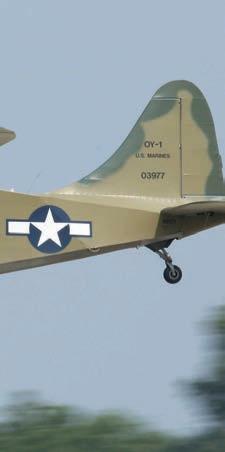
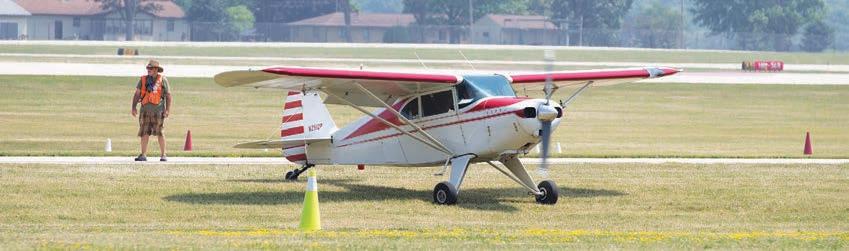
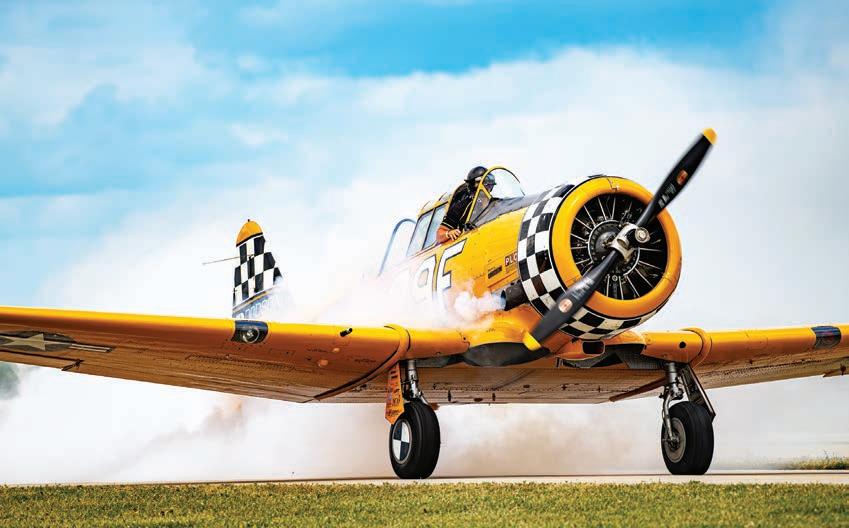
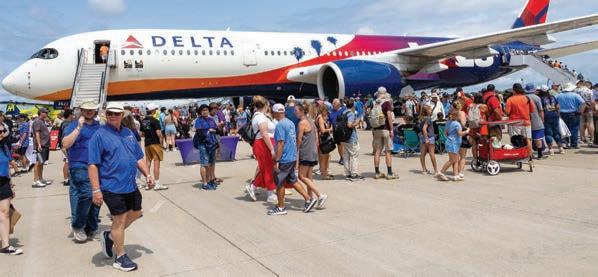
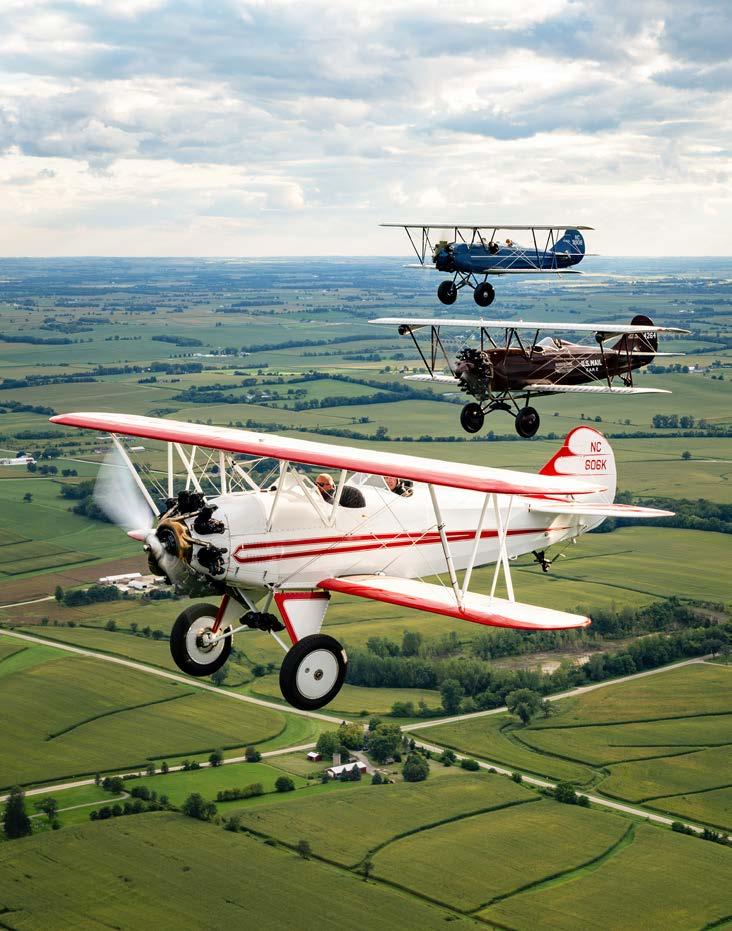
PHOTOGRAPHY BY CAMERON KRAUSE
PHOTOGRAPHY BY JIM ROBERTS
TOP STORY BY SAM OLESON AIRVENTURE TODAY STAFF
The Clean Standard
Trusted by Schools to Protect the Next Generation
Schools are high-traffic environments where germs spread fast and cleanliness directly impacts student health and attendance. Jani-King partners with K–12 schools, universities, and charter schools to deliver consistent, thorough cleaning programs that target high-touch surfaces, restrooms, cafeterias, gymnasiums, and classrooms.
PAGE 1 / SUB HUNTER
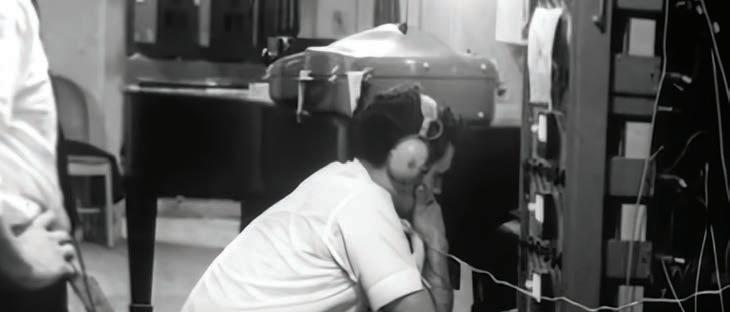
On August 20, 1942, Lt. Robert B. Hopgood and his crew, flying 2459, attacked and sunk U-464, a large “Milchkuh” supply submarine, south of Iceland. After the attack, Hopgood sent a simple, now-famous, four-word message back to base: “Sank sub, open club!”
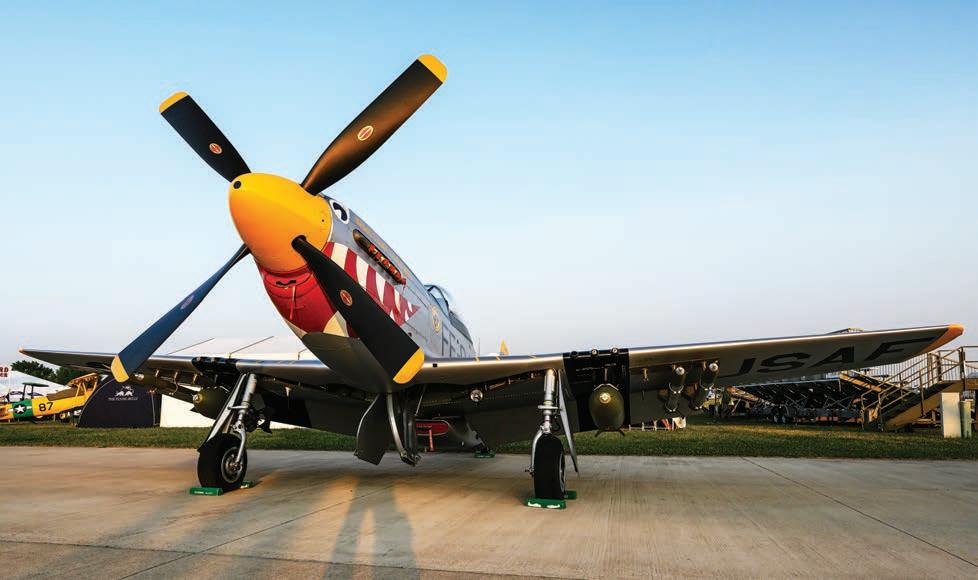
Catalina 2459 was the subject of a Tuesday presentation at Warbirds in Review during EAA AirVenture Oshkosh and is undoubtedly one of the highlights of this year’s event. Believed to be the oldest surviving PBY, Catalina 2459 is owned by the American Heritage Museum, located in Stow, Massachusetts.
During its 19-month deployment to Iceland, 2459 flew 195 combat missions and more than 1,675 combat hours. Its crews made 13 U-boat sightings, attacked 10 submarines, and sank three of them: U-464, U-582, and U-194. Another U-boat, U-528, was badly damaged and later destroyed. Following its service in the North Atlantic, 2459 returned home and served at a number of Navy stations, including Anacostia, Gainesville, Pensacola, and Coast Guard Air Station Elizabeth City.
The aircraft entered civil service in 1946 and was eventually converted into a water bomber, fighting forest fires in
“The airplane represents very accurately a beginning of the war opening day show for an airplane like this.” — Joe Scheil
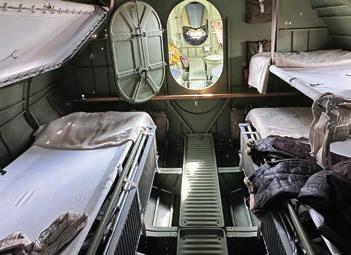
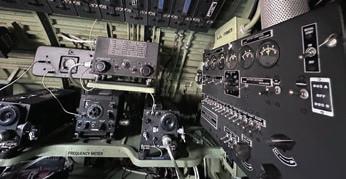
Canada. After its retirement as a water bomber in the 1980s, 2459 was rescued by a Dutch group and repainted in Royal Netherlands Navy markings in 1995. In 2019, 2459 was purchased by donors for the American Heritage Museum. The aircraft was ferried across the North Atlantic and brought to American Aero Services in New Smyrna Beach, Florida, for restoration to its 1942 configuration. Civilian passenger fittings were removed, and turrets, crew stations, radar, radio areas, and wartime details were rebuilt or re-created. Just a few weeks ago, on July 6, Catalina 2459 flew once again.
Rob Collings, president of the American Heritage Museum, and Joe Scheil, a pilot and historian of PBYs and 2459 in particular, chatted in length about the historical significance of the airplane and the care and detail that went into its seven-year restoration. As the longest continuous battle of World War II, the Battle of the Atlantic and the importance of PBYs was a particular emphasis during Tuesday’s presentation.
“So I think the video [that preceded Tuesday’s presentation] did an amazing job stressing how important the battle for the Atlantic was that someone like Winston Churchill said, ‘I never lost a night of sleep over the battle for Britain, but I did over the battle for the Atlantic.’
When you think of how wars are won, it’s logistics, production, oil,” Rob said. “If those supply chains got cut off by the U-boats, England would fall. The Soviet
Union would fall. And the Soviets took out 8 million Germans that we would have to deal with. If we didn’t have all of our bases in England, there would be no 8th Air Force. There would be no D-Day. All of these events would have ceased from happening. So the [U-boat] wolf pack were out there hunting the sheep as they were coming across. This is the sheep dog that protected them.”
Rob’s journey with PBYs began about 40 years ago in Oshkosh when he had the chance to poke around one owned by legendary warbird pilot Connie Edwards. Around two decades ago, he started searching for one to acquire and met Joe, who helped him find and acquire 2459. After Rob and Joe ferried the airplane across the Atlantic, the process of converting it back to its 1942 configuration began, which meant shedding its civilian type certificate.
“We knew the type certificate we would lose,” Joe explained. “This would become an experimental airplane instead of standard category, but we corrected the rudder back to what we call an unbalanced, no counterweight. We put the bomb nose in, the turrets. All civilian equipment was removed. We found the military equipment to put back in. That was probably seven years on eBay by a host of people that are all friends and helpers of the American Heritage Museum. A lot of guys in the stands here devote their time and money to find little parts.
“The specifics of the airplane were, we wanted to, as close as we could get, get the aircraft to August 20, 1942. We had a specific place in time that we wanted to present to audiences. And so we couldn’t go on eBay and buy a 1945 radio or a 1948 radio. It had to be prior to
January or February of ’42 in build date. And we did pretty well, but the airplane represents very accurately a beginning of the war opening day show for an airplane like this,” Joe said.
You can get a closer look at Catalina 2459 on Boeing Plaza during the latter half of AirVenture 2026, and be on the lookout for a full-length feature story on the airplane in a future EAA publication.
PUBLISHER: Jack J. Pelton, EAA CEO & Chairman of the Board
VICE PRESIDENT OF PUBLICATIONS, MEMBERSHIP
SERVICES, RETAIL, SAFETY AND SECURITY, AND EDITOR IN
CHIEF: Jim Busha
MANAGING EDITOR: Hal Bryan
SENIOR EDITOR: Sam Oleson
EDITORIAL STAFF: Robbie Culver, Emme Hornung, Jim Roberts, Angela Satterlee, Barbara A. Schmitz
SENIOR COPY EDITOR: Colleen Walsh
COPY EDITOR: Jennifer Knaack
PRINT PRODUCTION TEAM LEAD/GRAPHIC DESIGNER: Marie Rayome-Gill
GRAPHIC DESIGNERS: Amber Fabian, Brandon Wheeler
SOCIAL MEDIA MANAGER: Holly Chilsen
SOCIAL MEDIA COORDINATOR: Michael Sullivan
SOCIAL MEDIA INTERN: Madeline Wooten
SENIOR SALES AND ADVERTISING EXECUTIVE: Sue Anderson
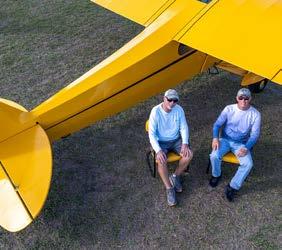
PHOTOGRAPHY BY SAM OLESON
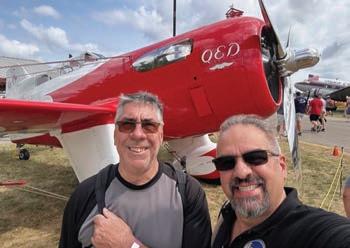
PHOTOGRAPHY BY SAM OLESON
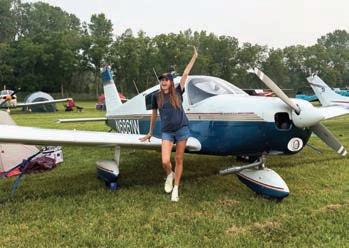
PHOTOGRAPHY BY SAM OLESON
PHOTOGRAPHY BY SAM OLESON
AUGUST RASPET AWARD WINNER 2026
BY ANGELA SATTERLEE AIRVENTURE TODAY STAFF
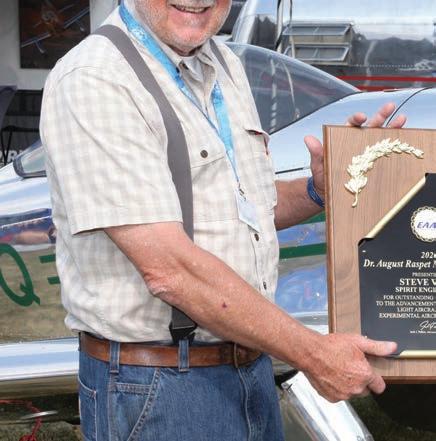
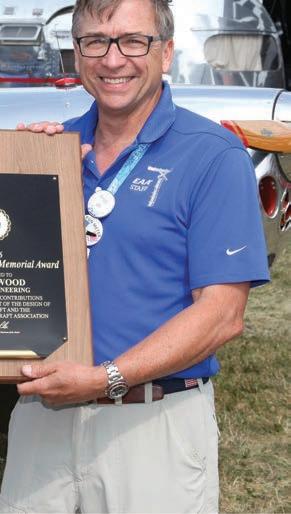
Since 1960, the Dr. August Raspet Memorial Award has recognized individuals who have made outstanding contributions to the advancement of light aircraft design. Named for the late Dr. August “Gus” Raspet, the award is one of aviation’s most prestigious honors.
This year, that distinguished list welcomes Steve Wood, EAA 70439, president of Spirit Engineering. Steve was nominated by the EAA Homebuilt Aircraft Council for his work designing the Spirit SE-1, a light single-place airplane that made its debut at EAA AirVenture Oshkosh 2025.
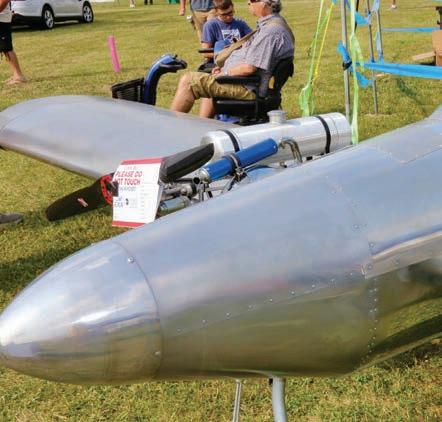
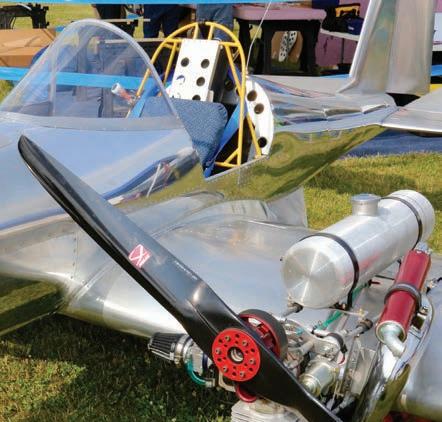
He designed the airframe, but when he couldn’t find an engine that met his vision, he made one himself. The result is an all-metal aircraft with folding wings, responsive handling, and a price point aimed at making aircraft ownership more attainable, which has been Steve’s overarching mission for decades.
“I get the most satisfaction and the most enjoyment out of saying that any person can fly right now because I gave them a way to fly,” Steve said. “They could not afford to fly. Now they can a ord to fly. That’s immensely satisfying to me.”
His passion for aviation began long before Spirit Engineering. As a thirdgeneration aviator, he grew up surrounded by airplanes. His grandfather flew during World War I, while his father and uncles were military pilots. Which is a passion he’s passed down to his own children and grandchildren,
who are with him at AirVenture this year, making his family five generations of aerophiles.
“I can’t remember not being around airplanes,” he said.
Steve knew from the very beginning that he was going to pursue a career in aviation.
“If you’d have asked me when I was 6 years old what I was going to be when I grew up, I would have said aeronautical engineer ... it never changed,” he said. “I thought every kid knew what he wanted to do when he grew up. I found out later that’s not true ... But it was for me.”
An EAA scholarship helped him earn his aeronautical engineering degree, launching a career that included time at Cessna before he started his own company. In 1983, his Sky Pup design earned an engineering innovation award, one of many designs focused on making flying more accessible, before founding Spirit Engineering in 2010.
“I’ve always had di erent designs sort of rolling around inside of me,” Steve explained. “Most of them have something to do with low-cost aviation because I want my grandkids to enjoy aviation the way I have.”
That is reflected in the SE-1. Weighing just 440 pounds empty, the aircraft cruises at just over 100 mph, climbs at 750 feet per minute, and can take o in about 500 feet. Spirit Engineering also designed the inverted V-twin engine that powers the airplane, giving Wood complete control over the design from the
ground up. Still, he believes a ordability is the aircraft’s greatest achievement.
“1.5-million-dollar airplanes aren’t the future of aviation,” he said.
While Steve said he never expected to receive the Raspet Award, he considers the recognition especially meaningful because of those who have come before him.
“You don’t do this to get awards, but the fact that someone recognizes maybe
the hard work, the blood, sweat, and tears that goes into designing and developing a unique airplane is honorable.”
Steve is humbled that the Raspet Award puts him in such good company.
“If you look at the list, it’s a pretty auspicious list to be on,” he said. “It’s like a who’s who of airplane design. And so it’s an honor to be a recipient and to be included in that.”
PHOTOGRAPHY BY PHOTOS BY SWEENY
OSHKOSH MOMENTS
KEEPING THE FLIGHTLINE IN LINE
Meet Volunteer of the Year Award recipient Sandy
Strebel
BY EMME HORNUNG AIRVENTURE TODAY STAFF
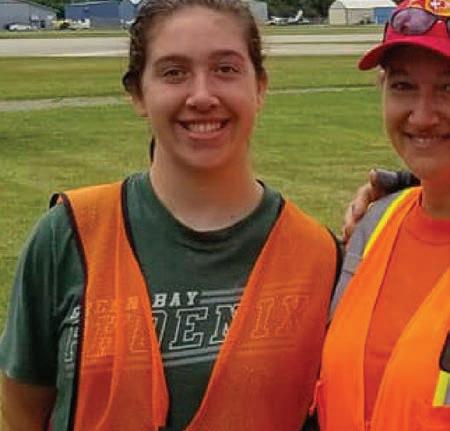
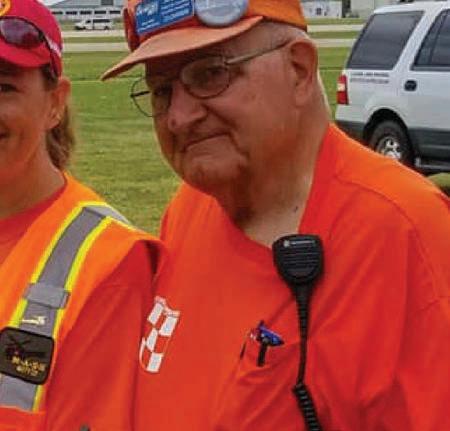
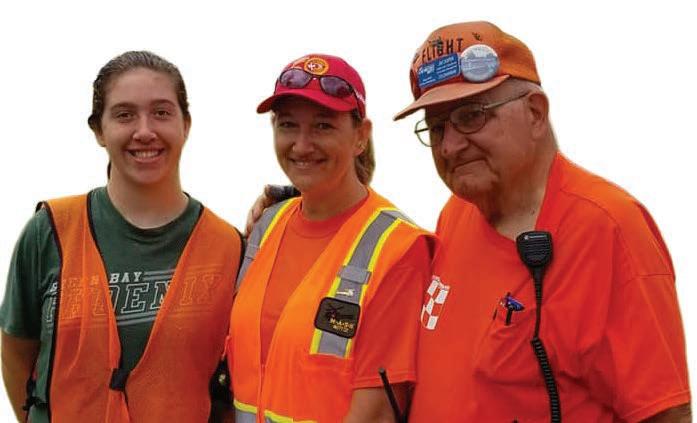
THE FISK ARRIVAL conga line is only the first half of the dance that is flying into Wittman Regional Airport during AirVenture — the dance doesn’t truly end until the engines shut off. Before pilots get to pitch a tent under their wing, the Flightline Operations team orchestrates ground movements to get the thousands of flying-in pilots to their campsites safely and efficiently. Part of the team is Sandy Strebel, EAA Lifetime 883319, who has been recognized as one of EAA’s 2026 Volunteers of the Year.
Growing up in Oshkosh, aviation has always been a part of Sandy’s life. “Before I volunteered, I’d be playing in my backyard, and I would watch warbirds fly in formation over our house because we’re about 2 miles away from the runway,” she said.
Aside from living in EAA’s backyard, volunteering for EAA is a whole family a air. Sandy’s family have been dedicated volunteers since the 1970s when EAA first moved to Oshkosh. Her father, Jim Casper, was the chairman of Flightline Ops for many years, and today the reins are held by her sister, Carol Carona.
Sandy started volunteering at just 13 years old with Operation Thirst on the flightline, but it wasn’t long before she started helping with parking operations. “My dad taught me how to park airplanes,” she said. When she was 16, six of her cousins joined the e orts in Oshkosh, and they quickly proved themselves. “We were called the cousins on the radio, and we were our own parking crew, and we would get plopped all over the field wherever they might need us,” she said. “So, that was sort of the beginning of how it started.”
Nearly 40 years later, Sandy now manages parking and camping operations in the North 40, which includes more than 1,000 parking and camping spaces in this one area alone, though Sandy and her team of volunteers almost make it look easy — almost.
“On top of working really long hours, the heat is really di cult. There’s a lot of pressure on us. You have to make sure that you can lean on each other and trust each other, and instinctively make decisions in order for us to fade into the background so people don’t notice us,” she said. “It’s like a referee of a football game. The less you think about the referees, the better job they’re actually doing. So, we don’t want to a ect the big show, but we also need to make sure that everything’s going to be safe and e cient.”
In her leadership role, Sandy has been taking
her team runs into and how they’re handled, what works and what doesn’t work, and di erent trends in order to make operations better every year, making for a priceless resource for the entire Flightline Ops team.
“I am incredibly humbled to be recognized for the work that I’ve done, mostly because I do the work not thinking about what I’m going to get back from it. I do the work because it’s important,” she said.
Thank you, Sandy, for everything you do for EAA and for a safe and enjoyable AirVenture experience!
Both of Sandy’s children joined the volunteer team when they turned 16. Pictured here is her daughter, Tessa, Sandy, and her father, Jim Casper, in 2019. PHOTOGRAPHY COURTESY OF SANDY STREBEL
WARBIRDS
A Piece of Marge Finally Home After 82 Years in the Jungle
BY BARBARA A. SCHMITZ AIRVENTURE TODAY STAFF
ABOUT 82 YEARS after crashing into the jungles of Papua New Guinea, a piece of Marge is coming home. And just for this week, you can see it on the EAA AirVenture Oshkosh grounds.
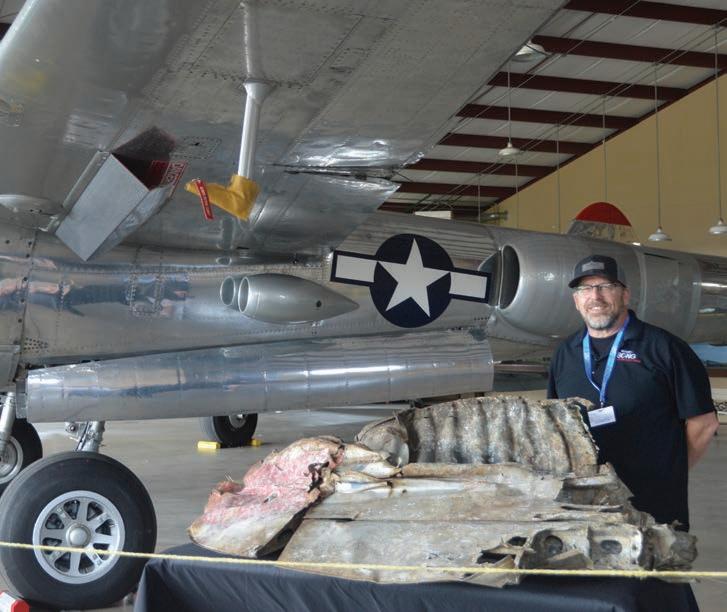
John Gidley, executive director of the Richard I. Bong Veterans Historical Center in Superior, Wisconsin, said a significant portion of the P-38 Lightning’s right wing with identifiable marks, including the last three serial numbers of the airplane, arrived in Wisconsin about a week ago. The marks indicate without doubt that this was the plane of Maj. Richard Bong, a Wisconsin native and ace who downed 40 enemy airplanes in the Pacific theater. Bong was ordered home for his own safety as America’s top pilot, and he quickly married his sweetheart, Marge. About six months later, Bong, then 24, was killed test-flying a Lockheed P-80 fighter in California. It was said that he bailed out too late after steering the aircraft away from civilian homes.
Pilot Tom Malone was flying Marge in 1944 when the twin-engine fighter malfunctioned and crashed into a ravine in the jungle. He was able to bail, but Marge was lost.
John said he didn’t see the piece of the wing himself until Monday morning. During AirVenture, it is located in the Pitcairn Hangar on Pioneer Airport, just beyond the KidVenture activities.
The work to bring closure about the airplane’s location began about three years ago. “In about 2023, our curator Briana Fiandt said she wondered
whatever happened to Marge ,” John recalled. “We were doing an oral history on veterans when one of the veterans said the Wisconsin International Guard goes to the Madang Province all the time. She always wondered if the plane was still there since there was no record of anyone going out to find it when it went down.”
They called the e ort to locate the plane “Mission Marge,” John said, and partnered with Pacific Wrecks and its director Justin Taylan in 2024 to help find it. Within 10 days, they found it, then surveyed it and did a documentary about their find. You can find the documentary on YouTube.
Then things kind of snowballed, John said, and soon they were facilitating a sister city connection between Poplar, Wisconsin, where Bong was born, and Madang. It was during their second visit there to secure the site that the government agreed to permanently loan them a piece of the airplane.
“Our intention was to establish a community where it could be kept safe,” John said. The remaining parts of the airplane will stay where they landed. “Our hope is that the villagers in the area will make sure no one removes anything from the site. We plan to keep our relationship going as long as we can.”
Once AirVenture ends, the wing will be making a stop in Poplar and then heading to the Bong museum in Superior, where they will create a new exhibit. John said they plan to hold a big event in September when they open it to the public.
On Saturday, Justin, Briana, and others will tell the recovery story at Theater in the Woods. It begins at 6:30 p.m. Richard Bong’s family members will also be present.
EAA Museum Director Chris Henry said he worked with the Bong museum for years to get the wing at AirVenture. Because it is an artifact that needs to be preserved, it is in Pitcairn Hangar because they can better protect the piece
from humidity, rain, and UV rays. It is under the wing of EAA’s P-38.
“When we unboxed the wing, it was surreal,” Chris said. “In these times of warfare, you will never see an ace fighter pilot again that exceeds 40 victories. Richard Bong was always one of my heroes, and I’m happy that we can have an artifact of his here, even if it is for a short period of time.”
John Gidley, executive director of the Richard I. Bong Veterans Historical Center in Superior, Wisconsin, and a piece of the P-38 Lightning’s right wing. The airplane crashed in New Guinea 82 years ago and once was flown by Wisconsin ace Richard I. Bong. PHOTOGRAPHY BY BARBARA A. SCHMITZ
VISIT US ON CELEBRATION WAY TO SAVE ON DATABASEUPDATES
SAVE UP TO $150 ON SELECT DATABASE SUBSCRIPTIONS
We’re offering special airshow discounts on avionics database update subscriptions — available directly from our exhibit space at EAA® AirVenture® 2026. Additional savings are available for new customers switching to Garmin databases. The pros at our database desk will answer your questions, offer advice and suggest the most cost-effective options for your Garmin avionics or flight portables. Look for us on Celebration Way.
See our full schedule of daily seminars, meet-and-greet events and more.
HUMMEL AIRCRAFT SHOWCASES NEW MULTICRUISER, BUILDS ULTRACRUISER DURING AIRVENTURE
Celebrates 25 years of Ultracruiser
BY ROBBIE CULVER AIRVENTURE TODAY STAFF
MATT HIGGINS AND his wife, Laurie, own ers of Hummel Aircraft, are focused on fun, a ordable flying. Their line of ultralight and light-sport aircraft are all aimed at the fun flying market. To be Part 103 compliant, aircraft must weigh less than 254 pounds, cannot exceed 5 gallons of fuel, can carry only a single occupant, and cannot exceed 55 knots calibrated airspeed at full power in level flight. The stall speed cannot exceed 24 knots calibrated airspeed. The Ultracruiser Classic falls under Part 103, as does the new Multicruiser.
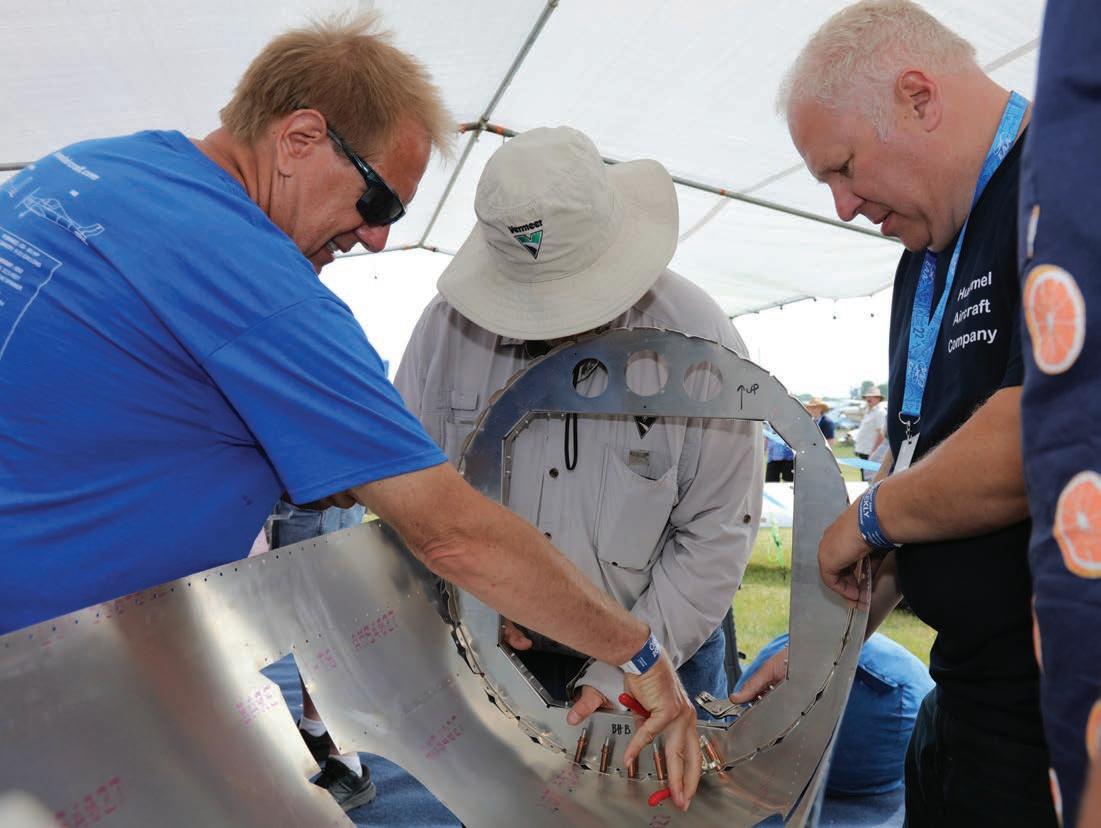
“We are showing our newest Part 103 design, multiengine airplane called the Multicruiser,” Matt said. “And we’re also showing our Ultracruiser design. It’s been around for 25 years. During AirVenture Oshkosh 2026, a group of volunteers is building an Ultracruiser at the Hummel booth to kind of demonstrate how easy it is to build one of our kits.”
Building a kit during AirVenture is not a new idea, but it remains an interesting challenge. The goal is to start with boxes of parts on Monday, and by the end of the show, the good fairies of aviation wave their magic wands and an airplane appears.
“We started Monday morning, with just parts from our kit, and we are going to finish this airplane hopefully this week with all volunteer builders. I mean, I’m helping, but these are all just people that signed up on our website to come and learn about it. So we’re hoping that kind of sheds some light on the fact that these
are pretty easy to build and they’re fun,” Matt said.
“We’re building about five hours a day here for six days. We’ve got five or six volunteers, so we should be somewhere near 200 hours by the end of the week, we hope. We should have an airplane sitting here. It won’t have the engine then, obviously. But the airframe will be sitting here ready to go.”
The Ultracruiser is o ered as a kit or plansbuilt ultralight, while the Hummel H5 is a light-sport aircraft that is kit or plansbuilt and is not Part 103 compliant.
“All of our kit parts [are designed] … in such a way that if you go to Cleco the thing together and it doesn’t fit, then you’ve done something wrong. All the
HUMMEL AIRCRAFT / PAGE 12
“All of our kit parts [are designed] … in such a way that if you go to Cleco the thing together and it doesn’t fit, then you’ve done something wrong. All the parts are drilled [and] formed; they come to you ready to go.”
—
Matt Higgins
PHOTOGRAPHY BY ROBBIE CULVER
Visit the Icom Booth #2026-2028 July 20–26, 2026
From takeoff to touchdown, Icom radios deliver dependable communication for pilots and ground crews. Choose the right solution for every stage of flight:
• Handheld: IC-A25 and IC-A16 series – Reliable backup comms
• Base Station: IC-A120B – Ideal for home or airport use, with mobile configuration available
parts are drilled [and] formed; they come to you ready to go,” he said.
There’s still the usual deburring and cleaning up parts.
“The metal is pretty light on this airplane, so deburring is more of a delicate event than maybe on a RANS or a Van’s or something,” Matt said. “Because our skins are thin. We have a really good online video series that I walk through every single step on YouTube. Every step [is] in the builder’s manual, there’s a video that goes with it.”
A ordable and aviation are not always found in the same sentence. Hummel focuses on both.
“You can build an entire airplane, including the engine prop, instruments, and everything for around $30,000, which is amazing,” Matt said. “And it’s all metal. There’s no composites, there’s no wood,
there’s no fabric, no fabric. … And there’s no welding in our kits. There’s no solid riveting in our kits. We do all that for you.”
The Ultracruiser has been a popular aircraft for 25 years.
“It’s real easy to meet ultralight weight with our Ultracruiser as long as the customer follows the plans and stays very minimal with instruments and fancy stu ,” he said. “We’ve got enough left over for a real thin seat cushion. That’s about it. That fits the mission. And the mission is fun. Fun and a ordability.”
The company is also introducing the new Multicruiser to the market. Also built as a kit, the Multicruiser has two counterrotating engines that produce about 23 hp each.
“They are counterrotating,” Matt said. “I was able to work with the engine manufacturer, believe it or not, and they produced one for us, counterrotating. So that tells me they must see a market.”
The company plans to offer the Multicruiser as a kit and as a ready-to-fly ultralight.
“Even though I proved I can build it to Part 103 standards, we’re gonna really recommend that everybody either has appropriate training or they build it as an experimental amateur-built,” he said. “So at least they have to have a sport pilot [certificate]. And the new MOSAIC allows multiengines, right? So that’s kind of where we’re thinking this is really going to end up.”
MOSAIC did open up a door for Hummel.
“It’s based on the Ultracruiser, so it’s based on a design that’s 25 years old. There’s some obvious changes to it if you’re an Ultracruiser connoisseur. You can tell the tail’s bigger, the rudder’s bigger, there’s some structural di erences inside the aircraft, the wingspan’s a little bit bigger. The front of the airplane, obviously, looks a lot di erent. But it shares about 90 percent of the same components. For customers that have built an Ultracruiser in the past, [this] should feel the same to them,” Matt said.
You can find Hummel Aircraft near the ultralight runway at Booth 945 or online at HummelAircraft.com.
PAGE 10 / HUMMEL AIRCRAFT
PHOTOGRAPHY BY ROBBIE CULVER
PHOTOGRAPHY BY ROBBIE CULVER
The FJ33®/FJ44® family of engines won’t let you down. Williams International’s Total Assurance Program (TAP BlueTM) covers all engine maintenance for a fixed cost per flight hour, and offers the option to implement carbon offsets. Simple, predictable, and affordable – TAP Blue.
WARBIRDS
Warbirds Unveil Bud Anderson Statue
BY BARBARA A. SCHMITZ AIRVENTURE TODAY STAFF
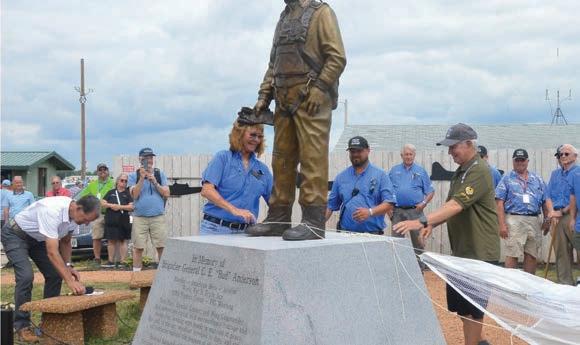
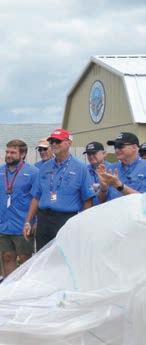
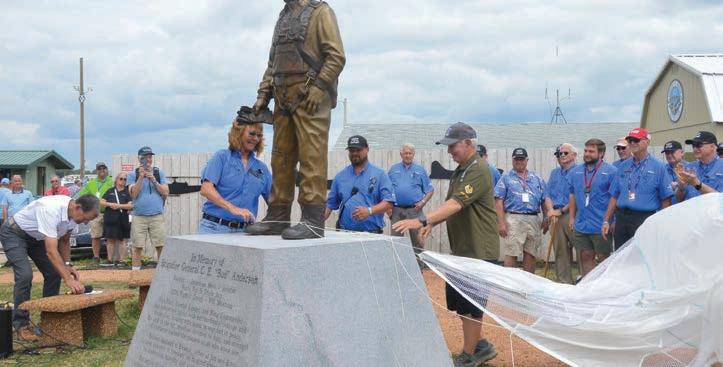
A LIFE-SIZE BRONZE statue of retired Brig. Gen. C.E. “Bud” Anderson was unveiled Tuesday in the Warbirds area at EAA AirVenture Oshkosh. The work of sculptor Douglas Van Howd, the statue of Bud in his flying uniform is in the garden and next to the museum that honors the World War II triple ace that was dedicated the year before.
Bud died in May 2024 at the age of 102. He had been a frequent speaker at Warbirds in Review for decades.
Warbirds of America Board Director Connie Bowlin thanked the donors and board members for their support and said that Bud “was a very good friend for a very long time” and had “sacrificed so much for all of us” during the war.
In addition, she thanked Kyle Guyette and Scott Guyette for creating a video of Bud’s life, accomplishments, and his funeral, including his burial at Arlington National Cemetery.
Connie also thanked Bud’s son, Jim, who has donated some of his father’s artifacts to the museum, including his WWII foot locker.
“Should I give Dad’s short talk or his long one?” Jim said as he started his remarks during the ceremony. “His short one would be ‘thank you,’ and his long one
would be ‘thank you very much.’ But I think I’ll speak longer than that.”
Jim said he and his sister, as well as their children and grandchildren, are thankful for the donors who made this museum and garden a fitting tribute to Bud.
Jim said his father came to nearly every AirVenture to present at Warbirds in Review. “He enjoyed being here and loved the people. … I know he influenced a lot of people to get started in aviation.”
statue, he saluted his father.
Theresa Eaman sang “I’ll Be Seeing You” as Bud’s statue was unveiled, since Bud requested she sing it every time he was here.
The Warbirds of America Museum will be open daily during AirVenture in the Warbirds area. It is located at the west end of the Warbirds merchandise building.
“He enjoyed being here and loved the people.”
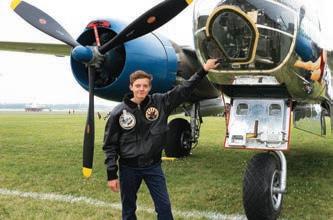
WITH THE BOMBARDIER STATION HE REBUILT FOR THE A-26 HELL’S BELLE
with the
before his
the then 8-year-old found it fuel for a longtime
in
as they
in
included
LOGAN JACOBSON
When Logan Jacobson picked up a used copy of
Fly
Fight: Memoirs of
Triple Ace about the story of World War II fighter pilot Bud Anderson,
interest
aviation. Which
meetups
general
death
2024
lived only 30 miles apart in California. Today Logan has been on the restoration team of Hell’s Belle, a WWII A-26 bomber in the Warbirds area. Logan said it once was an EAA asset that made its way to California and is now under the ownership of Taigh Ramey. During the two years Jacobson has worked on the airplane, he has worked on the gunner’s platform in the fuselage and the bombardier’s station in the nose. The airplane’s appearance at AirVenture marks the first time it has been out of California in several years.
Connie Bowlin and Jim Anderson work to untangle the last of the cover over the life-size bronze statue of retired Brig. Gen. C.E. “Bud” Anderson Tuesday. PHOTOGRAPHY BY BARBARA A. SCHMITZ
PHOTOGRAPHY BY PHIL WESTON
Meet Mike Goulian
North America’s most decorated aerial demonstration pilot.
July 23 at 11 AM Visit PenFed booth #382.
First 50 people receive a free tumbler.
See you there!
Throughout his 30-year career as a pilot and certified flight instructor, Mike Goulian has devoted himself to excellence in the air, and in business.
UK Pilot Flies a 1977 Piper PA-28 Turbo Arrow III Across Atlantic to Oshkosh
Arrives with Cherokees to Oshkosh mass arrival
BY ROBBIE CULVER AIRVENTURE TODAY STAFF
JON HUNT FLEW his 1977 Piper PA-28 Turbo Arrow III across the Atlantic from the United Kingdom from May 23 to June 1, then continued on to AirVenture with the Cherokees to Oshkosh mass arrival on Monday, July 20. Jon is a former BBC Television reporter who has turned to aviation content creation as The Flying Reporter — he has a YouTube channel — and is making his first trip to Oshkosh.
A Piper PA-28. Across the Atlantic. What an adventure!
“It had been a dream of mine, I think, and it is for many pilots, from the U.K., I suspect, to cross the Atlantic, go to Oshkosh. So I’d been thinking about it for some time. One of my followers suggested I come in with the Cherokees to Oshkosh mass arrival, and I kind of go, yeah, that’ll never happen. You know, it’s kind of one of those things that you know is going to take a lot of work, a lot of planning, and life gets in the way.
“But I don’t know what made me suddenly decide to do it. I just decided I was
going to do it. You know, I’m 53 now, and you’re not getting any younger and, you know, everyone has these dreams to do things, but they never do them, do they?
Always put them o . My mum was getting sick as well, and it was kind of a moment in life where I thought, I’d given up my job at the BBC, you know, my son was a bit older so didn’t need as much support from me, and I could maybe just go and do something for me.”
Flying a single-engine piston aircraft across the North Atlantic Ocean is no small thing. It required a lot of preparation, planning, training, and equipment to do it safely.
Jon said, “I knew I had to get the instrument rating to safely do it, and I think legally do it as well. It’s very hard to get the instrument rating in the U.K., much harder than the U.S. As far as commitment and time, the process. The whole thing is I had to pass seven exams that are similar to ATP [airline transport pilot] level exams. I pretty much
studied half of the ATP syllabus. That’s what the U.K. requires at this time. [They are] looking at changing it, thankfully, but that’s what we had. That took six months of self-study and then … individually taking these exams. I didn’t pass them all first time. And then, you know, I got the rating.”
Preparing to fly a 49-year-old aircraft on the trip required some work as well. “I had to save up money to upgrade the aircraft, get the avionics into a fit state because it was all pretty old. I mean, I was flying it IFR. We can fly IFR on a much more basic instrument rating in the U.K. We have terrible weather over there, don’t you know? And so there’s this rating we can get. So I’ve been flying IFR for a while, shooting approaches, but I didn’t have the full privileges. I couldn’t use it outside the U.K., for one thing. So, yeah, upgraded the aircraft, that cost a lot of money, so that took two years to save up for.”
Jon is also raising money for a charity as part of his adventure. Aerobility is described as “changing lives through the magic of flight.” Jon said, “They are set up to enable disabled people to experience the magic of flight. What we all know as pilots is that flying provides us with a huge escape and wonderful therapy. When you’re flying, you’re detached from the world and all your troubles on the ground. And for disabled people, they experience that in flight, you know, on a magnitude of 10 or more, right? Because for them, they’re very often locked into their world. They might be locked into a wheelchair. They’re constrained on the ground. But when they’re up there in the cockpit, they’re as free as you and me. They’re as free as a bird.” You can donate online at aerobility.com.
PHOTOGRAPHY COURTESY OF JON HUNT
PHOTOGRAPHY COURTESY OF JON HUNT
On to the adventure of an Atlantic crossing! “May 23, I set course from Southern England. I went to Scotland, (then) to Vágar, in the Faroe Islands. Reykjavík in Iceland, Kulusuk in East Greenland, Kangerlussuaq on the west of Greenland. Iqaluit in Northern Canada; Kuujjuaq for a fuel stop, where you buy fuel by the barrel — [it is] 1,000 Canadian dollars for the barrel. And if you don’t use it all, you can’t have them store it. They take it away and they probably use it in their snowmobiles for all I know. So that’s pretty gutting because I only used about half a barrel. It was a very conservative fuel stop, but I was playing this really conservatively.
“And then from there, it was Goose Bay [and then] Bangor, Maine. And then I’d been touring, you know, a little bit in the east and Midwest of the United States and had a bit of a holiday in Florida. Now here in Oshkosh.”
But Jon didn’t just fly into Oshkosh; he joined the Cherokees to Oshkosh mass arrival. Jon said, “They do it really well. They really, really make you a safe formation pilot. They make you come to two weekends of mandatory training. They show you their method, they show you
their procedures, and you become a real professional unit by the end of the training.
“That was great fun. And I didn’t think we’d make it here. We didn’t get in [Sunday]. The weather where we were in
40 Years of Flight Tech
The past four decades transformed how pilots communicate, navigate and stay safe in the air. Now, those who lived that evolution share their stories.
Panel: Thursday, July 23 at 1:30 p.m.
Dan Gauger
Chris Henry
central Wisconsin was terrible. We wanted 5 miles [visibility] for this ideally. You know, we had some VFR-only pilots on board and you know, 5 miles, 3 miles really is terrible. Anyway, it was 3 miles visibility this morning, but we did it, and it was hard work, really hard work, some low cloud ceilings as well. But we got in, and it was such a great feeling to come in here. I was whooping in the cockpit as we were downwind. For a Brit to get to bring his aircraft all the way from the United Kingdom to Oshkosh and make it here in formation with a great family of Cherokee pilots. They are superb, all camping together.”
Welcome to Oshkosh, Jon!
“It was such a great feeling to come in here. I was whooping in the cockpit as we were downwind.”
— Jon Hunt
PAGE 16 / UK TO OSHKOSH
PHOTOGRAPHY COURTESY OF JON HUNT
‘Disability Doesn’t Mean Inability’
BY BARBARA A. SCHMITZ AIRVENTURE TODAY STAFF
WHEN JESSICA COX was born without arms, there were few role models she could look to for inspiration.
“I grew up without a cellphone and without social media,” she recalled. “I didn’t have a community with others who had similar disabilities. I always wondered if someone else like me was out there. I felt so alone.”
In her late teens, she read a news story about a woman with disabilities, and she reached out to her. That woman became her mentor and changed her life.
Now a worldwide motivational speaker who has presented in 29 countries, she spreads her message through the Rightfooted Foundation, a 501(c)(3) nonprofit dedicated to serving the armless community, especially children born without arms. It also provides a free custom dressing hook to children born without arms.
work a job. “It’s simple things like that that give them dignity,” she said.
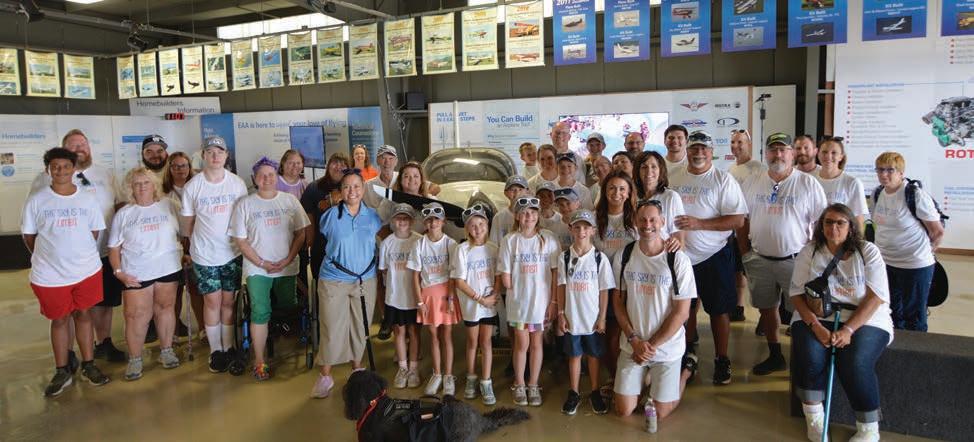
If there’s one thing that the children from Limbitless Wisconsin who attended her presentation on Tuesday remember, Jessica hopes it’s this: Disability doesn’t mean inability.
“They need to find a way to find their passions,” she says. “I hope this is a moment that will stay with them forever since the whole world is telling them they can’t, just because they were born without an arm or they lost a leg.”
Now Jessica is trying to do the same and help others, particularly children who have lost a limb.
Jessica became the world’s first armless pilot in 2008 when she earned her sport pilot certificate; she also has a black belt in tae kwon do.
She was back in Oshkosh on Tuesday, speaking to a group about her journey and the importance of being fearless and adaptable, as well as advocating for disabilities. The timing coincides with the anniversary of the Americans with Disabilities Act, signed on July 26, 1990.
Too often, people with disabilities are forgotten and aren’t given opportunities to get an education or
But just as important as it is that children hear her message, it’s vital that their parents hear it, too. She explained how she buckles her 1946 Ercoupe 415-C’s four-point harness
JESSICA COX / PAGE 19
Children and their families from Limbitless Wisconsin, which brings limb loss and limb different (LL/LD) individuals, families, and friends together, circle Jessica Cox, the world’s first armless pilot after her Tuesday presentation. PHOTOGRAPHY BY BARBARA A. SCHMITZ
using only her feet, and answered questions about the challenges that come with having no arms.
In short, she told and showed how she can do just about anything those with arms can do.
“If a parent is telling their child that they can’t do something, that child will think they can’t,” Jessica said. It’s normal to want to help your child, but that can mean the child doesn’t learn how to do everyday tasks such as getting dressed or eating.
“I hope this is a moment that will stay with them forever since the whole world is telling them they can’t, just because they were born without an arm or they lost a leg.”
— Jessica Cox
“Independence doesn’t come easy to people with disabilities, but it’s something they yearn for so much,” she said. “Too many times, society disables children, and we want to make sure people can get over the stigma that exists, rather unconscious or not.”
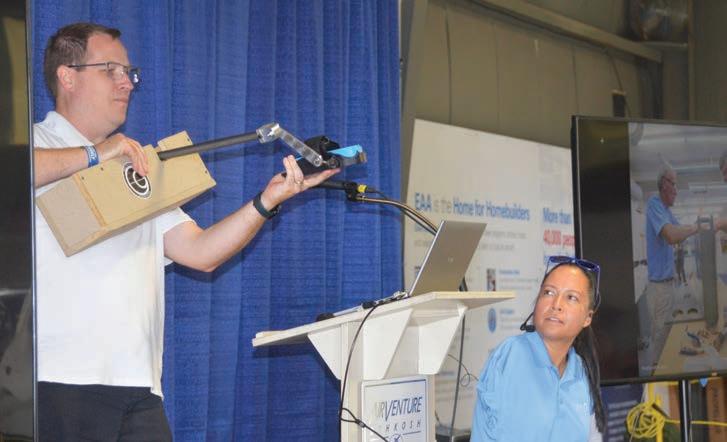
While Jessica still flies her Ercoupe to promote the mission of the foundation, she looks forward to having a new airplane to further her work. The Impossible Airplane is a four-seat purpose-built RV-10 created for her to fly using only her feet. (The right seat is standard, however.) It is being built, in part, by EAA Chapter 898 and should be completed and fly on November 14, said Patrick Chamberlain, inclusive engineering director for Rightfooted and Jessica’s husband.
A fundraising party will be held the same day at Falcon Field in Mesa, Arizona.
For more information, visit ImpossibleAirplane.com.
Construction started in 2022, and EAA members have been working on the airplane weekly. Patrick said most people won’t notice the modifications, such as the throttle
quadrant, since they use universal design and a combination of standard pieces. They hope to start using the new airplane to fly children and their parents in 2027, and Jessica hopes to fly it over the closing ceremonies of the Paralympics in Los Angeles in 2028.
“We’ll use it for Young Eagles events, and we’re excited about the opportunity to go visit families using this airplane,” Patrick said. “To spend time in their home environment and let them see how Jessica can do everything will help those kids become independent.” PAGE 18 / JESSICA COX
Patrick Chamberlain demonstrates how the flying foot will work in the new Impossible Airplane. Jessica Cox will just slip her foot into the “shoe” and be able to control the yoke. PHOTOGRAPHY BY BARBARA A. SCHMITZ
SOMETHING TO SMILE ABOUT
BY JIM ROBERTS
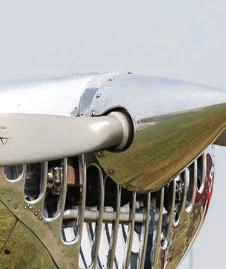
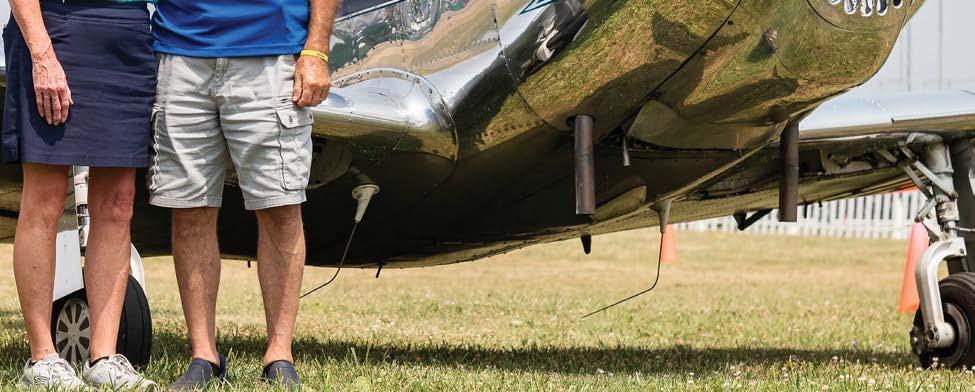
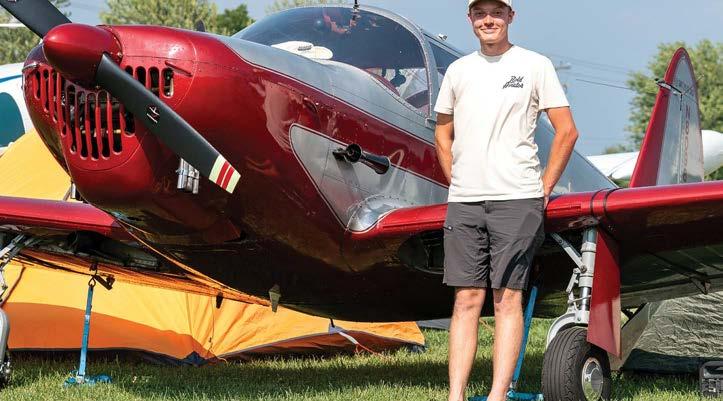
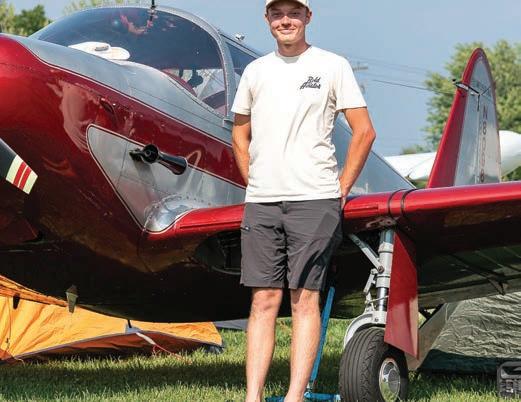
IF YOU SPY a sporty little plane with a Cheshire-cat grin at EAA AirVenture Oshkosh, chances are it’s the “smiley face” grill of a Globe Swift. This hallmark of the aircraft, along with sleek lines and leading edge wing slots, seems to say, “Hey friend, let’s go have some fun.” And as they celebrate the 80th birthday of their beloved little bird, that’s exactly what Swift caretakers are doing.
The sporty craft was born in 1946 when Globe Aircraft Corp. rolled out the GC-1A Swift. Shortly after, Globe replaced the 85-hp GC-1A with the 125-hp GC-1B, and orders poured in. To keep up with demand, Globe issued a production subcontract to TEMCO (the Texas Engineering and Manufacturing Company). Later beset with dwindling demand and financial challenges, Globe went bankrupt in 1947; TEMCO bought the assets and continued production until August 1951. Ultimately 911 Swifts came o the Globe line, and 586 were built by TEMCO, for a total of 1,497 aircraft.
Today, “Swifters” (the self-proclaimed moniker for Swift owners) are supported by the Swift Museum Foundation (SMF), which owns the type certificate and provides parts and expertise to keep the airplanes flying. SMF members number over 600, representing nearly 450 aircraft worldwide, including aircraft in Europe, South America, Canada, South Africa, and even Russia.
It’s said that “Swifts are like snowflakes; no two are alike.” Some have been modified to include higher-horsepower engines, control sticks to replace the original wheels, and a sliding bubble canopy. Many cherish the originality of a stock Swift, and some owners, like my wife and I, have
found a “sweet spot” between originality and high-performance; our bird is mostly original while concealing a 210-hp Continental behind a modified nose. Swifts of all varieties can be found at AirVenture this week, and I’d like to introduce some of my friends and their airplanes.
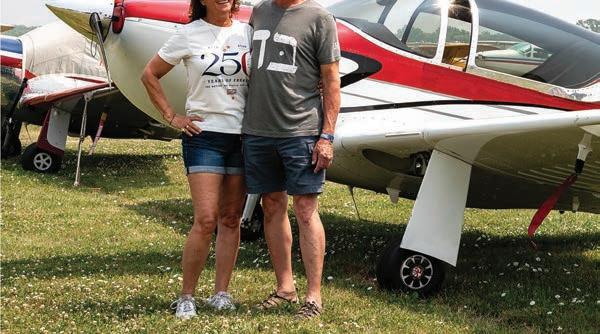
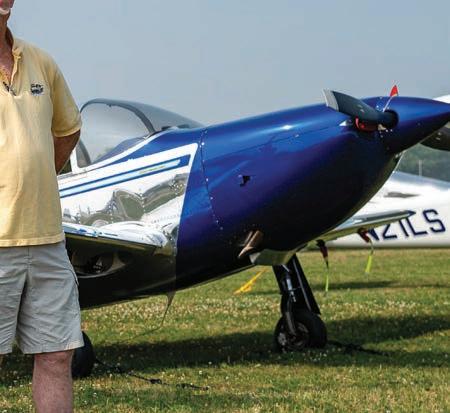
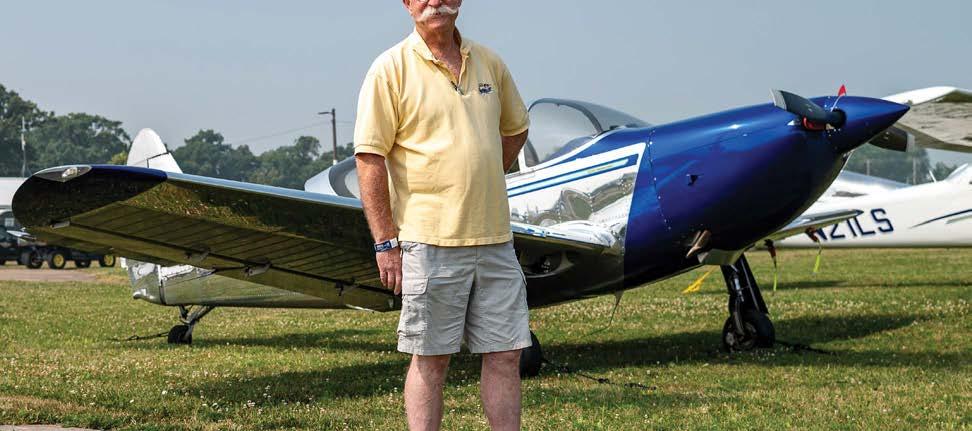
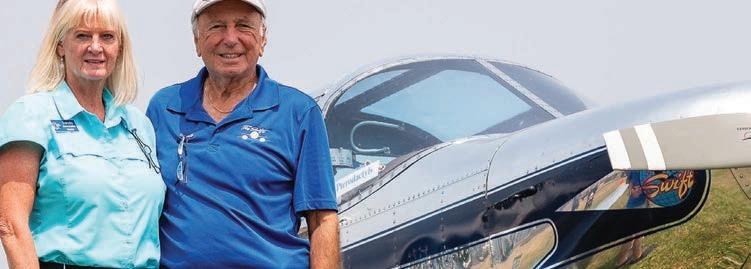
Paul and Sandy Mercandetti’s 1946 GC-1B is parked with “The Class of ’46” across from the Vintage Aircraft Association Red Barn. Paul acquired the Swift in 2000 as a project and recalled, “We took a basic airframe and found a wing from one airplane, a wing from another, tail feathers from another. Found an engine in a box, pulled it out, mounted it up, and used it to set all the ba ing and cowling, and built an instrument panel.” The restoration included a 210-hp Continental that Paul artfully fit behind the original “smiley face.” Paul and Sandy enjoy formation flying in their Swift, and they’re both check pilots with the Swift Formation Committee.
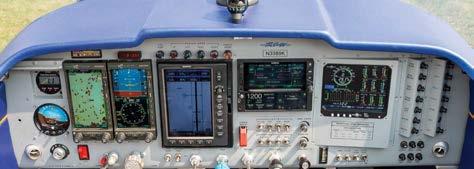
Dr. Bruce Kaufman is a retired pediatric neurosurgeon, so the gent’s got some smarts; his immaculately polished 210-hp “Super Swift” reflects that. Sporting dual control sticks, a sliding bubble canopy, 210-hp Continental engine, and a 21st-century glass panel, the plane is a real traveler. Bruce said, “This year’s project is trying to hit all 48 states and I’ve got 31 down.”
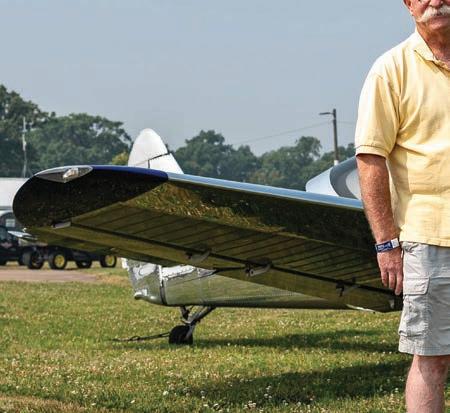
Like Bruce, Terry and Wade Gillaspie love traveling with their Swift, having flown the plane nationwide, even to Alaska. Wade gets impressive speed out of the 145-hp engine, typically cruising at 150 mph. He explained, “I think the aerodynamics have a lot to do with it. I’ve spent a whole lot of time working on engine baffling and cowling and fit, SMILE / PAGE 22
AIRVENTURE TODAY STAFF
Terry and Wade Gillaspie with their traveling Swift. PHOTOGRAPHY BY JIM ROBERTS
Bruce Kaufman put a 21st-century panel in a mid-20th-century airplane. PHOTOGRAPHY BY JIM ROBERTS
Dr. Bruce Kaufman and his “Super Swift.” PHOTOGRAPHY BY JIM ROBERTS
with official event apparel
All purchases support EAA programs and promote The Spirit of Aviation® Available at official EAA® merchandise locations
PAGE 20/ SMILE
trying to get all the cooling air drag o of it.” The couple have become lifelong friends with other Swifters, and Terry remarked, “It’s a true blessing to be with all these people, and they fill my heart. We have more young guys and girls coming into the program, and we’re excited about that.”
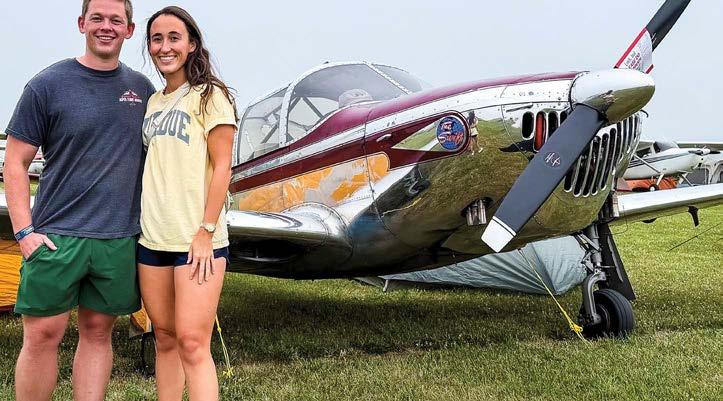
Twenty-four year-old Evan Pearce is one of those young folks. He first spotted his Swift in Columbus, Indiana, while getting maintenance done on his Cessna 120. Evan recalled, “I saw the Swift and I said, ‘I have to own that airplane.’” After selling the Cessna and pooling his resources in 2022, the Swift was his. Evan said, “It’s been an incredible airplane. It’s vintage … The ramp appeal’s all there … It’s a 110-knot airplane … it’s economical. And if I want to go out and have fun, I can do light aerobatics. So it doesn’t do any one thing perfectly, but it does a little bit of all of them.”
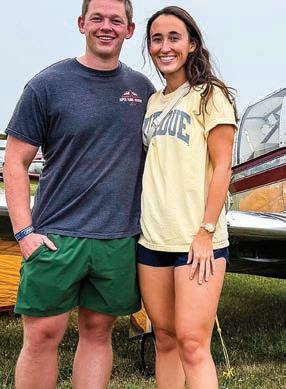
Evan and his favorite co-pilot, Paige Bishop, met in college and now fly for the airlines. When asked how she likes the Swift, Paige enthused, “Oh my gosh, it’s just so responsive and so much fun to just go out and fly, even on long trips. We’ve taken it to the Bahamas.” She added, “I don’t think there’s anybody that could take better care of that Swift. He polishes it every year. I helped last year, doing
Silent AUCTION
We appreciate your support!
Thanks to everyone who has participated! Good luck.
SMILE / PAGE 23 Sandy and Paul Mercandetti with the 1946 GC-1B Swift that Paul restored. PHOTOGRAPHY BY JIM ROBERTS
everything under the airplane.” To which I replied, “Evan, she’s a keeper!”
Jack Albright is all smiles when talking about the Swift he bought in 2022. He said, “I’m on the constant search for all the possible upgrades I can get. I’ve done the gear doors, the diamond-treaded vintage tires. Just
did a whole engine rebuild, and I want to put skylights in the top. Got some new radios; anything that’s available, it’s got to go on. And it’s cool, and it’s a ordable to buy and operate. I’ve been in and out of 1,200-foot grass strips with it, and I can bring all sorts of stu . I mean, it does everything.”
AirVenture 2026
Monday
10:00am Engine Leaning Made Simple
TUESDAY
8:00am Ring Gap and Cylinder Life
10:00am Compression Testing
WEDNESDAY
10:00am Engine at TBO Options
THURSDAY
10:00am Proactive Approach to Aircraft Engine
Maintenance
FRIDAY
Jack represents the new generation of Swifters, and he’s part of a young group uno cially known as “The Whippersnappers.” They include Evan Pearce, Ray Brown, Daniel Probst, and Drew Stewart. I tell Jack they’re the future of the Swift and he says, “We’re trying our best.” Now that’s something to smile about.
10:00am Oil Changes as a Diagnostic of Engine Health
SATURDAY
263
10:00am Choosing the Right Aviation Mechanic
STOP BY for a free copy of Engine Management 101
Hosted by Bill Ross, A&P I/A 2023 GAA National Aviation Technician of the Year Award Winner!
*Each seminar qualifies for 1 hour of IA Renewal Crdit & FAA Wings Credit
*A&Ps - join us on Tuesday at 8am for Tech Tuesday
The Swift is a favorite of Evan Pearce and co-pilot Paige Bishop. PHOTOGRAPHY BY JIM ROBERTS
Jack Albright’s grin is almost as wide as his Swift’s. PHOTOGRAPHY BY JIM ROBERTS
EAA® AirVenture® Oshkosh™ could not happen without the outstanding support of our volunteers.
Help us in thanking them today!
Supported by
Singing the Stars and Stripes
BY ANGELA SATTERLEE AIRVENTURE TODAY STAFF
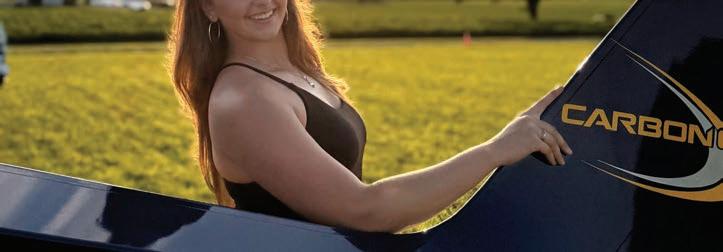
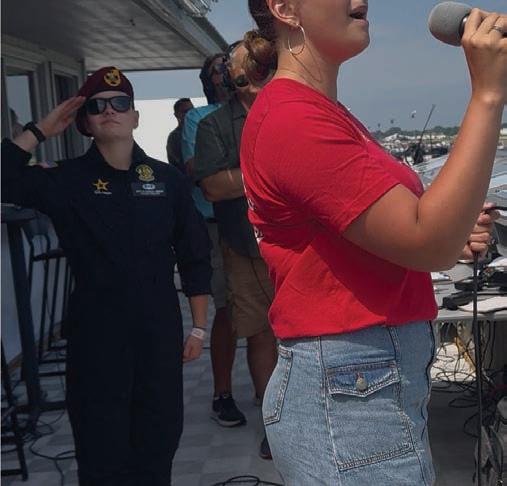
WHEN THE FINAL air show of EAA AirVenture Oshkosh begins Sunday, Oshkosh native Lily Krueger, EAA 1335593, will once again step onto the stage to sing the national anthem, a moment that brings together the two passions that have shaped her life: aviation and music.
This year’s performance marks Lily’s second time singing the anthem at the opening of an AirVenture air show, although she first took the stage at just 10 years old singing the anthem for forums and other events. The first opportunity to sing came from a connection with her vocal coach and EAA Aviation Museum Director Chris Henry.
“My first year I sang up here, I was only 10. And so it was very nerve-racking to be at such a big event,” she said. “And Chris Henry was just so comforting, and he truly made me feel so special out here with everybody else who’s way bigger than I am.”
AirVenture has always been a huge part of Lily’s life as she’s attended every year since she was 9 months old. And her connection to aviation goes back even further.
“I’ve never missed a year. And I hope to never miss a year,” she said. “Aviation has always been a part of me, who I am. And it’s been a part of my mom.”
That passion began with her grandfather, who completed nearly all of his pilot training before a medical exam revealed a hole in his heart, preventing him from earning his pilot certificate. Although he never became a pilot, he remained
active in aviation through radio-controlled aircraft, building and flying model airplanes and sharing that love with Lily and her mother.
JULY 30–AUGUST 2
WHEN THE AIR SHOW ENDS, THE RACING BEGINS.
PHOTOGRAPHY COURTESY OF ANN KRUEGER
“He really instilled that in my mom, and she has therefore instilled it in me,” she said.
Lily started taking Young Eagles flights when she was 8 years old and began flight training at 13. She passed her private pilot checkride on February 7, 2026, and was named a Ray Aviation scholar, which she plans to use as a stepping stone toward additional ratings.
“I have always just kind of had the dream of doing aerobatics,” Lily said. “So performing at air shows … is the end goal. I’d love to do one here someday.”
While aviation has always been part of her life, music has been right alongside it. Lily has performed in school musicals, sung at her church, appeared at sporting events across Wisconsin, and her personal favorite, performed the national anthem at numerous veterans events.
“The anthem is one of my favorite things to sing. It was a song made for those who have served our country, and it’s such an honor to be able to sing such a meaningful song,” she explained.
Her mother, Ann Krueger, EAA 1335591, said the two passions have always gone hand in hand.
“She loves singing as much as she loves flying,” Ann said.
Despite years of performing, Lily said she still gets nervous before every
anthem because each audience and venue brings something di erent.
“There’s a di erent dynamic to every single performance,” she said. “Even if it’s at the same place, there’s always something di erent.
“I think there’s a good part about being nervous,” Lily explained. “I think if you’re a little bit nervous, it keeps you aware of what you’re doing, and it keeps you in the moment.”
To settle those nerves, she sticks to a routine before every performance.
“I drink a lot of tea prior to my anthems, and … I do a prayer before my anthems. I am very in touch with my faith. It’s something I really pride myself on. And so I pray before every single anthem that I do. It’s just a moment between me and God that I believe is very sacred, and I believe helps me to get through all my anthems and do as well as I do,” Lily said.
For Ann, watching her daughter combine both of the things she loves on aviation’s biggest stage is something she never takes for granted.
“[Performing at AirVenture] has just really encompassed all of everything she really loves. So it’s a proud parent moment for sure to see that,” Ann said.
As Lily opens the final air show of AirVenture 2026, she’ll do so not only as a longtime performer, but also as a newly certificated pilot whose aviation journey is just getting started.
PHOTOGRAPHY COURTESY OF ANN KRUEGER
WARBIRDS
JACK ACES
BY BARBARA A. SCHMITZ AIRVENTURE TODAY STAFF
THE THREE-SHIP JACK Aces Formation Aerobatic Team made its EAA AirVenture Oshkosh debut this week, and said they were humbled to fly their precision formation aerobatics show that highlights the history of the P-51 Mustang.
“We grew up as kids idolizing this airplane and to be able to fly them here is very humbling,” said pilot Marco Rusconi, of Canada. Lead pilot Louis Horschel, of the U.S., agreed. “This is an iconic airplane, one of the most famous airplanes in our history. The people who designed this plane, those who flew it into combat, had a mission of saving the world.”
Horschel said the war in Europe was not going well when the Mustang came out, and it was a huge turning point in the war.
“What we really try to do in our show is to honor the airplane and its history as best we can,” Marco said. And in 2026, the 250th birthday of the U.S., flying P-51s makes their performance even more relevant, he said.
Ariel Luedi, of Switzerland, the third member of the team, said this is his first time in Oshkosh. “Even in Europe, all pilots speak of Oshkosh and the event. To perform here is surreal. It puts some pressure on me, as I want to perform well in front of all these people. I am very honored because I know everyone wants to fly at Oshkosh.”
Ariel also performs aerobatics as a three-ship team called SUBITO in the PC-7 Pilatus in Switzerland, and all three do solo shows as well.
With the team having three pilots from three different countries, it creates an interesting international dynamic. Ariel said it was fate that they ended up together.
In 2017, Marco was a P-51 instructor at Stallion 51 in Florida, and Louis and Ariel were beginning Mustang training with him. They’ve been flying together ever since and share a passion for the airplane.
“A six-hour di erence in time zones makes it interesting when we get together,” Louis said. And Ariel flies over
from Europe about eight times a year for shows or training.
“I come here, rest one day, practice the flight, and then we’re ready for the show,” Ariel said.
Marco said the three get together in the winter months for an intense two- or threeweek training camp. “We fly one or two flights a day, every day. We have a commitment to not only make the show safe, but also account for its intricacies and complexities … due to the fluid environment we operate in.”
On the planning side, their process is similar to what professional athletes go through, they said. They mentally prepare before each flight, and after the flight watch their show on video to pick out where they can improve. “It doesn’t matter about how we felt about the flight,” Marco said. “It’s what the crowd sees.”
A short documentary on the team was released Wednesday. You can view it on any of their social media accounts.
The Jack Aces team in front one of their Mustangs. From left is Ariel Luedi, Louis Horschel, and Marco Rusconi. PHOTOGRAPHY BY BARBARA A. SCHMTITZ
EAA’S TYPE CLUB COALITION MEET AT AIRVENTURE
BY ROBBIE CULVER, TCC CHAIR
TYPE CLUBS ARE often the best resource for information and documentation, and they add socialization among owners, sometimes even hosting annual fly-ins. Whether the aircraft that owns you is certificated or experimental, sharing information and best practices with like-minded owners or builders is always helpful.
EAA’s Type Club Coalition is a group of aircraft type clubs with the stated mission to leverage the knowledge and resources of the coalition to better prepare general aviation pilots for flight risks associated with known accident “hot spots.” The TCC’s vision is a future with unprecedented, low general aviation fatal accident rates. These e orts have produced tangible results, as reflected in the reduction in the accident rate.
Each year, the TCC meets annually in the EAA Founders’ Wing. This year, Tom Turner of the American
Bonanza Society discussed a yearlong initiative focused on retractable landing gear incidents. There is a new website, available as a resource to all interested parties, at PutYourGearDown.com.
According to the website, “Gear-up and gear-collapse mishaps are the single biggest threat to the longevity of the Beechcraft fleet. This campaign equips pilots, owners, and mechanics with the training, tools, and habits to prevent them — every flight, every approach, every time.”
The issue a ects more than just Bonanzas, though.
Consistently, about 40 percent of reported mishaps are gear related, and in most cases the cost of recovery or repair means that the aircraft is totaled. In these incidents, 40 percent forgot to put the gear down, 55 percent were some sort of gear collapse, and about 5 percent had
enough detail in the preliminary report to say some mechanical failure was involved.
The issue is severe enough that retractable gear is a major reason for age-related insurance cuto for more seasoned pilots. The website has resources for pilots, CFIs, and mechanics.
Ric Peri of the Aircraft Electronics Association discussed pending changes to AC 43.13. The AC is out of date, over 1,000 pages long, and in need of an update. Ric is asking type clubs and their members to get involved.
Tom Charpentier, EAA’s government relations director, reviewed a pending EAA initiative involving legacy fleet support, parts availability, and a discussion of how to define the problem so it can be addressed.
Matt Speare of the Lancair Owners and Builders Organization (LOBO) reviewed the Light-Sport Repairman — Inspection (Airplane) course that LOBO has been o ering, the process of how it was approved by the FAA, and the ongoing challenges of meeting demand for the course.
Matt said, “The process is outlined in 14 CFR § 65.107 and expanded upon in Advisory Circular 65-32B, Certification of Repairmen (Light-Sport). To become an authorized provider, an organization must develop a comprehensive 16-hour curriculum that satisfies the knowledge requirements established by the FAA for the inspection rating.
“The curriculum must include lesson plans, learning objectives, instructional materials, student handouts, a written examination, grading standards, and procedures for maintaining student records.
“The course must also identify qualified instructors with the technical knowledge and instructional experience necessary to teach the material. In addition to the curriculum, the provider must demonstrate that it has appropriate classroom facilities, instructional equipment, and administrative procedures to deliver the course e ectively.
“An application package is submitted to the FAA containing the course syllabus, instructor qualifications, PAGE 28 / TYPE CLUB
The TCC’s vision is a future with unprecedented, low general aviation fatal accident rates. These efforts have produced tangible results, as reflected in the reduction in the accident rate.
testing procedures, sample completion certificate, quality assurance process, and other supporting documentation required by AC 65-32B.
“The FAA conducts a detailed review to ensure the course meets all regulatory and instructional standards before issuing a course acceptance number.”
As TCC chair, I organize the meeting and the agenda, and this year I brought up a real-world scenario from this past May. A fatal accident that I witnessed — without
getting into details — was a brutal reminder of the importance of transition training, and the requirement for preparation for a first flight. It brought home the need for the ongoing mission of the TCC and the initiatives we focus on.
The TCC encourages all type clubs to join in our ongoing e ort to improve safety and share best practices. Check out EAA.org/eaa/aviation-interests/ type-club-coalition for more information.
Annual Meeting Highlights EAA Successes
BY BARBARA A. SCHMITZ AIRVENTURE TODAY STAFF
THE 2025 EAA AirVenture Oshkosh fly-in convention set a new attendance record at 704,000 visitors. But despite the smoke that caused delays and poor visibility for much of the weekend, it appears the 2026 event will be close to last year’s numbers.
“It’s nothing but remarkable,” EAA CEO Jack J. Pelton said at Wednesday’s annual meeting, after comparing gate admission, parking, and other numbers to the year before.
EAA is continuing to improve its grounds with the groundbreaking of the youth Discovery Park occurring earlier in the week.
“KidVenture started humbly as a hands-on activity for kids 12 and under,” Jack said. “Now we are seeing 20,000 kids coming through there on a weekly basis.”
Jack said it was time to enhance KidVenture and incorporate all activities in one spot on the convention grounds and give a permanent home to KidVenture. The center’s ribbon cutting will be held at the 2027 convention.
In addition, on Wednesday the 2.5 millionth Young Eagle flew.
“Tom [Poberezny] set a challenge to fly 1 million youth when EAA started the Young Eagles program, and a lot of people didn’t believe
“We have 6,000 volunteers at AirVenture alone and thousands more year-round. You can’t put a price tag on any of that, and I can’t thank them enough.”
— Jack J. Pelton
it could occur,” Jack said. “But we’re not going to take the foot o the pedal and get to 3 million next.”
EAA challenged Young Eagles pilots to fly 25 Young Eagles in one year to reach this year’s milestone, and Jack said 280 pilots accomplished that, noting the program is a cornerstone for all EAA’s programs to get youths involved in aviation.
Advocacy is also a priority for EAA this year with several challenges. One of those is ASTM standards for light-sport aircraft, with Van’s new RV-12 that was designed to the ASTM standards becoming a major breakthrough, Jack said. “Now that this is done, it will be a game changer.”
Other issues that EAA will focus on is getting lead out of aviation fuel, ensuring that ADS-B, which was designed for safety, is not used for generating revenue for airports, and integrating unmanned aircraft into the airspace. “There must be a level playing field for how that airspace is used,” Jack said.
EAA will also work to reduce the barriers for maintaining older aircraft, he said.
In the next year, Jack said EAA will also have more of an online presence to communicate to members year-round, keeping people informed on what the organization is doing.
Jack also shared:
• EAA is getting closer to getting its B-17 back in the air after collaborating with others to get a set of spars purchased at a significantly reduced cost.
• Webinar attendance is strong, with over 35,000 attendees in the last year.
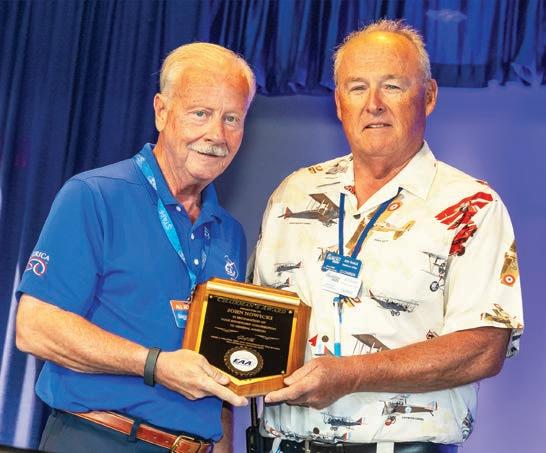
EAA CEO Jack J. Pelton presents the Chairman’s Award to John Nowicki at Wednesday’s annual meeting. The award is given to an EAA member whose passion, skill, and vision have carried EAA programs forward. John has been volunteering for EAA for 46 years, including at his home chapter, Chapter 101, is a Young Eagles pilot, and leads the volunteer advisory committee, helping to streamline and enhance the EAA volunteering experience. “I don’t take this honor lightly,” John said. “This award is shared with my family, friends, and fellow EAA members. Without their support, I would not have been able to do this for the last 46 years.”
• 89,000 visitors visited the EAA AirVenture Museum in the last fiscal year. EAA will be updating its kids area to ensure all items are again functioning. It has also initiated selfguided interactive tours.
• EAA has 889 chapters across the country.
• With the help of the Ray Foundation, EAA is helping more young people learn to fly. And when you get young people engaged with a chapter and mentors in that chapter, even more young people will succeed.
“All of our success is because of our volunteers,” Jack said. “Without them, none of this would happen. We have 6,000 volunteers at AirVenture alone and thousands more year-round. You can’t put a price tag on any of that, and I can’t thank them enough.”
PHOTOGRAPHY BY ANDREW ZABACK
NOTICE TO AIRVENTURE ATTENDEES: STARTING TOMORROW
Red Arrows Crowd Line — Friday, Saturday, and Sunday, July 24-26
ATTENDEES, VOLUNTEERS, AND PILOTS should be aware that the Red Arrows’ performances require a larger aerobatic box, necessitating a slight move of the crowd line to the west during the afternoon air shows on those days. Only essential, authorized air show personnel are permitted inside the box during the Red Arrows’ performance.
The Red Arrows crowd line will run the entire length of the flightline from Ultralights through Warbirds, in line with the existing speaker poles, about 120 feet west of the regular crowd burn line. This line will be clearly marked.
For Air Show Spectators
Visitors will have access to the regular crowd line area until 1:15 p.m. on Friday and Saturday and until noon on Sunday. At those times, visitors must move back to behind the Red Arrows crowd line. AirVenture guests will not be allowed to leave chairs, blankets, coolers, or other items past the Red Arrows crowd line at any time on those days. Friday through Sunday, Wittman Road will be closed to all vehicular tra c, providing additional space for air show viewing.
For Pilots and Crew of Aircraft Parked on the Flightline
After 1:15 p.m. on Friday and Saturday and noon on Sunday, pilots or crew of aircraft parked between the two crowd lines will be allowed in the area for a short time with a security escort to perform urgent, essential tasks. Everyone will need to be out of this area by 4:45 p.m. on Friday and Saturday and 3:15 p.m. on Sunday.
Full access will be restored after the conclusion of the air show on Friday, Saturday, and Sunday. Look for extensive signage on the grounds further explaining the areas and times covered by these necessary rules and guidelines.
CASSIA’S COLORFUL CREATIONS
A familiar face at AirVenture
BY ANGELA SATTERLEE AIRVENTURE TODAY STAFF
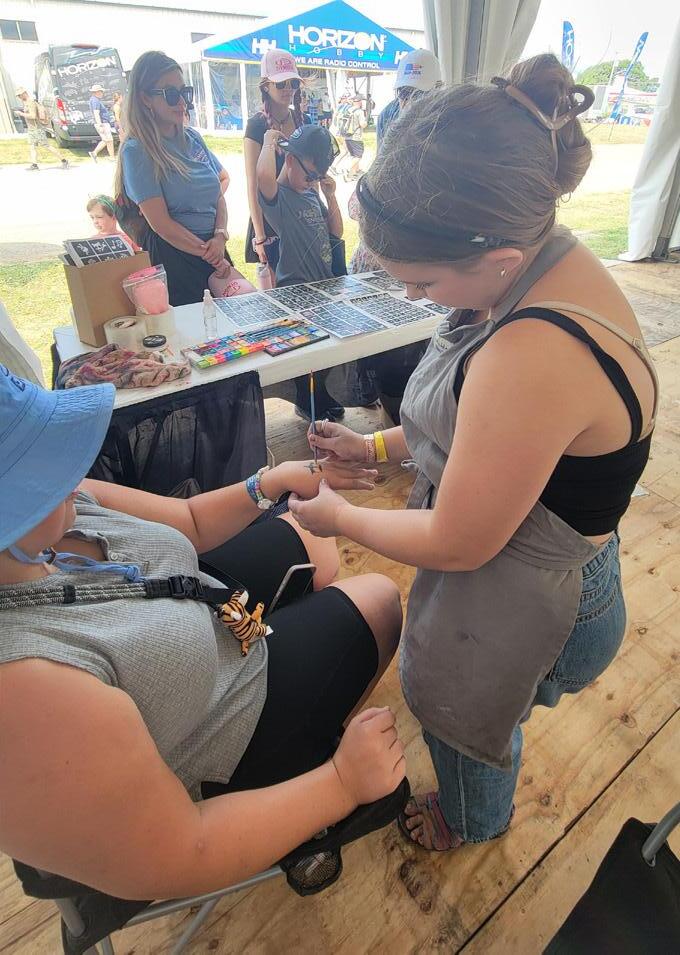
AT JUST 9 YEARS OLD, Cassia Conroy asked if she could set up her art supplies in her family’s UPS exhibitor tent at EAA AirVenture Oshkosh and give anyone who came by a free face painting. This was not only a way to grow her artistic talents but to also experience AirVenture in a way she could relate to.
Her brother Alexander has always been interested in airplanes and loves photographing them. He found his passion and Cassia was looking for hers.
“My brother’s here, and he’s a photographer and a pilot so that’s the main
reason we’re here. I needed a hobby, so that’s when I started doing face paint at events.”
What began as a way to practice her artistic skills has grown into one of her favorite AirVenture traditions.
“This is what she looks forward to,” said her uncle, James Highley. “And she’s made so many friends. … She’s a rock star!”
Cassia first discovered face painting during the COVID-19 pandemic, practicing designs on herself while looking for a creative outlet. Before long, she was painting faces for school marching bands and local Girl Scout groups, building the confidence to bring her talents to AirVenture.
Now 13 years old, Cassia is attending AirVenture for the fourth time as a face painter. Over the years she has become a familiar face at her family’s tent, with people often waiting in lines wrapped around the tent for her artwork. She now brings her supplies with her to other air shows her family attends.
She’s a friendly example that you don’t need to be a pilot or aircraft enthusiast to enjoy our annual convention. Because while her family’s connection to aviation brought her to AirVenture, Cassia has found her own way to be part of the event.
PHOTOGRAPHY BY ANGELA SATTERLEE
First Generation Pilots Announces Launch
BY AUGUSTAS SENUTA, VICE CHAIR
FIRST GENERATION PILOTS (FGP), a newly established 501(c)(3) nonprofit organization dedicated to supporting aspiring pilots who are the first in their families to pursue aviation careers, officially announced its launch during a University of North Dakota event. Through mentorship, networking opportunities, scholarships, and career development initiatives, the organization aims to make the path to becoming a pilot more accessible to the next generation of aviators.
Aviation can be di cult to navigate without guidance from someone who’s done it before. Challenges include high financial barriers, a lack of mentorship, and limited professional networks, all of which are essential for success in the industry.
Originally founded as a student organization in 2024, the UND First Generation Pilots grew to become one of the largest student organizations on campus, totaling over 300 active members and establishing a
five-year, $10,000 scholarship program in just two years. It is now o cially recognized as the first chapter of the FGP nonprofit.
First Generation Pilots was founded by Lucas de Jager, Augustas Senuta, EAA 1226736, Logan Laier, and Tyler Svrusis, who plan to establish a scholarship program, develop a nationwide mentorship network, and expand its reach through collegiate chapters across the country.
“Many students entering aviation who do not have connections in their family lack a clear roadmap for navigating the profession,” said Lucas, founder and chair of First Generation Pilots. “FGP was created to help bridge that gap and ensure those pilots receive access to the guidance, community, and opportunities needed to succeed.”
FGP is currently seeking mentors, industry partners, and donors interested in expanding opportunities for
aspiring pilots and first-generation aviators. The organization is also seeking students interested in launching FGP chapters at collegiate aviation programs across the country.
The founders of the First Generation Pilots nonprofit, from left to right, Logan Laier, Tyler Svrusis, Augustas Senuta, and Lucas de Jager. PHOTOGRAPHY COURTESY OF AUGUSTAS SENUTA
PHOTOGRAPHY BY CAMERON KRAUSE
PHOTOGRAPHY BY ALDEN FRAUTSCHY
PHOTOGRAPHY BY PHIL HIGH
PHOTOGRAPHY BY DAVE WITTY
VISIT US AT BOOTH 463
MEET & GREETS
10 AM - 10:45 AM
MIKE GOULIAN | Goulian Aerosports
1 PM - 1:45 PM
JOHN AND MARTHA KING | King Schools
PROGRAM PAVILION THURSDAY SCHEDULE
8:30 AM - 11:45 AM
RUSTY PILOTS (WINGS CREDIT)
BRIAN SCHIFF
12 PM - 12:45 PM
MISSED IT BY THAT MUCH (WINGS CREDIT)
ROB GESKE, AOPA AIR SAFETY INSTITUTE
1 PM - 1:45 PM
MENTAL HEALTH AND YOUR MEDICAL: WHAT PILOTS NEED TO KNOW
DR. SUSAN NORTHRUP, FAA FEDERAL AIR SURGEON; ANITA FETZER, AOPA SENIOR MEDICAL CERTIFICATION SPECIALIST; FERNANDO CAMPOAMOR, AOPA GENERAL COUNSEL; DR. RACHAEL FERRARO, AME
2 PM - 2:45 PM
LIFE, LEARNING & LAUGHS
– LESSONS FROM A PILOT & MECHANIC
BRIAN SCHIFF & JEFF SIMON, COCKPIT2COWL
3 PM - 3:45 PM
THE BASICS OF BASICMED
ANITA FETZER, AOPA SENIOR MEDICAL CERTIFICATION SPECIALIST; PATRICK BROOKE, AOPA LSP ATTORNEY
4 PM - 4:45 PM
MAXIMUM FUN, MINIMUM COST: THE WONDERFUL WORLD OF FLYING CLUBS
HIS DANCE IS UNFORGETTABLE, his smile is contagious, and his love of people shines like a beacon!
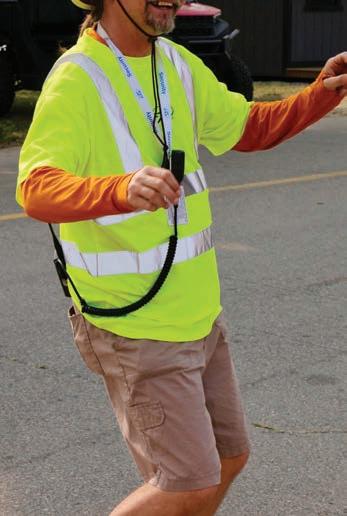
As you enter the AirVenture grounds near the Bus Park, it is hard to miss Karl Kessler, the dancing security guard at the corner of Waukau and Forest Home. Karl, a resident of Oshkosh, is well known for his energetic smile, outgoing personality, and warm greeting to everyone who passes. In fact, as Karl was being interviewed for this article, he was saying “hello” or “good morning” (or both) to anyone and everyone who passed. Constantly.
“I get to see everybody, and I get to say, ‘Hey,’ greet them. I think I’m one of the first faces of EAA people see. And for me [Karl pauses to say ‘Good morning, y’all’ to folks entering the show], it is so amazing [‘Good morning!’] to see all these di erent people. A lot of times, me out here dancing, it brings a smile into their faces. [‘Good morning!’] Watching people smile is just a beautiful thing. It makes me happy. This is my seventh year.”
As for how he got involved with AirVenture?
Karl said, “I needed a part-time job for the summer. I teach elementary music here in Oshkosh. I just started and fell in love with it. [Another ‘Good morning!’ to attendees walking by.] Are you having fun yet? No? Ah. I hope things get better.”
When I asked Karl if this is his everyday personality just shining through, he replied “This is ADHD at its finest. Yeah, this is me!”
But it’s a beautiful thing, Karl.
“Good morning! Y’all heading in? Gate 31!” It’s the nonstop patter, dancing, and his smile that greet you. I asked Karl what he likes best about what he does at AirVenture. “Meeting people. And then when you have the jets going by behind you, it’s like, oh my gosh, yeah. Between meeting the people and hearing the loud jets.
“I live five houses down from the airport. And we’re like, why not be a part of it and get in and see it and experience it? I have grown with my knowledge of airplanes from doing this,” he said.
When Karl talks to first-time visitors, he shares some sage advice after standing at this corner for seven years. “Don’t feel bad if you don’t get to see everything!”
So as you walk in, when you see the man in the yellow shirt, dancing and waving, it’s probably Karl — be sure to stop, say hello, and share a smile.
PHOTOGRAPHY BY ROBBIE CULVER
Back to Basics
‘Pioneers of Flight’ at EAA AirVenture Oshkosh 2026
BY HAL BRYAN
IN THE LATE 1800S, not all that long after the United States celebrated its first 100 years, scientists, engineers, inventors, tinkerers, and adventurers around the world spent time and other resources trying to solve what was then widely known as “the flying machine problem.” While some of the most impactful innovations in history, from antibiotics to the internet, weren’t necessarily widely anticipated, the idea of controlled, powered, manned flight was, for some, almost impatiently expected.
Yes, there were plenty of skeptics, notably including an editor at the New York Times who wrote in October 1903 that “… the flying machine which will really fly might be evolved by the combined and continuous e orts of mathematicians and mechanicians
in from one to ten million years.” By that time, though, people had been successfully flying gliders for more than 50 years, and rubberpowered model airplanes had been around since 1870. So, instead of a surprising innovation, the Wrights’ success, coming just two months after the Times’ pessimistic prediction, was seen (eventually, once word got around and people were convinced that it had happened) as a solution to a known problem. What nobody could have anticipated, however, was the impact of airplanes on civilization, nor the incredible rate of innovation that would take place. This year at EAA AirVenture Oshkosh 2026, we’re highlighting the first two dozen years of that innovation. Each day, we’ll highlight one of the aircraft on display as we celebrate the “Pioneers of Flight.”
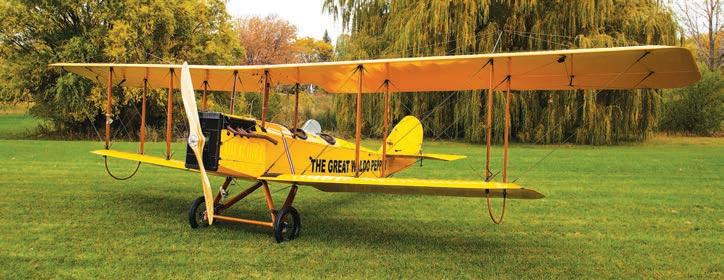
Standard J-1
A contemporary of, and quite often mistaken for, the Curtiss Jenny, the Standard J-1 was also built as a trainer and used by both the Army and the Navy, as well as by civilian flight schools. In addition, a variant called the Standard JR-1B was built specifically as a mail carrier for the U.S. Postal Service. After WWI, surplus Standards were modified in a number of ways to carry passengers, and at least one was converted for use as an aerial applicator. As with the Jenny, Standards found their way into the hands of barnstormers both in real life and on the silver screen — certainly the most
famous J-1 was the one seen in The Great Waldo Pepper with the titular character’s name painted on the side. That’s the paint scheme EAA chose when restoring its original example to flying condition in 2013.
FREE YOUTH ADMISSION
youth admission ages 18 and under is supported in part by
Training for Every Pilot
We’ve built a training catalog which includes:
VFR Command Challenge
Test your stick-and-rudder skills, judgment, and situational awareness. Requires 30 PIC hours in the last 12 months.*
Personal Proficiency Challenge
Build your own experience one-on-one with an EAA instructor. You set the goals; we’ll help you crush them. Requires a student pilot certificate or higher.*
IFR Command Challenge
Sharpen your decision-making in the system. Requires IFR currency or within the six-month grace period.*
Check out the full schedule of EAA® Pilot Proficiency Center events here! * Registration required
Meet Your Favorite Authors!
Boeing Plaza
10-11 a.m. Chris Henry and Hal Bryan, The Final Mission: Personal Stories of the Lives Touched by EAA’s B-17 Aluminum Overcast EAA Wearhouse
9-10 a.m. Pam Ward, Miss Blue! The Pilot Maker
10-11 a.m. Chester Hull, Life on the Flight Deck
11 a.m.-12 p.m. Wally Soplata, The B-25 in the Backyard
12-1 p.m. Steve Church, Fighter Combat World War Two
1-2 p.m. John Berkstresser, Learning to Fly Essential Elements: Connecting the Dots
2-3 p.m. Fred Robinson, The Renaissance Aviator
3-4 p.m. John Fredrickson, Book 1: Doolittle Raid Doctor; Book 2: Boeing Metamorphosis
4-5 p.m. Rob Zettel, American MiG Pilot: Inside the Top-Secret USAF Red Eagles MiG Squadron
5-6 p.m. Ken Katz, The Supersonic Bone: A Development and Operational History of the B-1 Bomber
WomenVenture Center
9-10 a.m. Mary Shipko, Book 1: AVIATRIX: First Woman Pilot for Hughes Airwest; Book 2: The Firsts: Women Pilots and How They Changed the Airlines; Book 3: Daring Mary: Aviation Pioneer
10-11 a.m. Erin Miller, Book 1: Final Flight, Final Fight; Book 2: What Grandma Did
11 a.m.-12 p.m. Jennifer Pitt, The Barnstormer and the Lady: Aviation Legends Walter and Olive Ann Beech
12-1 p.m. Judie Ohm, Turret Tales
1-2 p.m. Capt. Laura Savino, Jet Boss: A Female Pilot on Taking Risks and Flying High
2-3 p.m. Eileen Bjorkman, The Fly Girls Revolt: The Story of the Women Who Kicked Open the Door to Fly in Combat
3-4 p.m. Michelle “MACE” Curran, Book 1: The Flipside; Book 2: Upside Down Dreams; Book 3: What’s Your Callsign
4-5 p.m. Sheila M. Young, I See an Airplane Up in the Sky
EMERGENCY WEATHER SAFETY
What About These Other Airplanes?
A spotter’s guide to the EAA Aviation Museum aircraft around the grounds
BY HAL BRYAN
EVERY YEAR, MORE than 10,000 aircraft fly to Wisconsin for AirVenture. Of those, nearly 3,000 are showplanes — vintage aircraft, warbirds, homebuilts, aerobatic airplanes, etc. — that are displayed around the grounds. But some visitors may notice other airplanes parked here and there that didn’t fly in at all, because they’re part of the EAA Aviation Museum collection. Because our museum exhibits rotate, many of these aircraft are only viewable by the public during AirVenture, spending the rest of the year in long-term storage on the convention grounds. Here’s a guide to some of these
airplanes that you’ll see as you wander the neighborhoods of AirVenture.
Aircraft: 1926 Ford Flivver Replica
In the mid-1920s, Henry Ford wanted to build an “everyman’s airplane,” the flying counterpart to the Model T. This replica was built in 1991 by members of EAA Chapter 159 of Saginaw, Michigan, with help from the original designer, Otto Koppen, to airworthy standards, but was never flown. The only other Flivver, the sole remaining prototype, is on display at the Henry Ford Museum in Dearborn, Michigan. AROUND
Celebrating the Class of ’46
A spotter’s guide for AirVenture Oshkosh 2026
BY HAL BRYAN AIRVENTURE
AS WORLD WAR II came to an end, people of the free world looked ahead to an era that held the promise of unprecedented peace and prosperity. Rough estimates indicate that, at the start of the war in September 1939, there were roughly 30,000 pilots, both civilian and military, in the United States. By war’s end in August 1945, the estimated number had ballooned to more than half a million. It seemed patently obvious that the previous generation’s “chicken in every pot” would be supplanted in 1946 by “an
airplane in every garage.” Manufacturers went to work, introducing new aircraft and updating (and more actively marketing) existing designs. Sadly, this was the boom that wasn’t. A lot of wartime pilots moved on from flying, and, while commercial air travel grew steadily, general and recreational aviation didn’t attain the hoped-for ubiquity.
Still, 1946 was a remarkable year for GA, and that optimism, however impractical, gave us so many classic aircraft that remain beloved today. You’ll note that, unlike most aircraft anniversaries, this one isn’t exactly hard and fast. We’re not strictly celebrating first flights or introductions; rather, we’re looking back at
PIPER J-3 CUB
FIRST FLIGHT: 1938
LENGTH: 22 feet, 5 inches
WINGSPAN: 35 feet, 3 inches
SEATS: 2
CRUISE SPEED: ~75 mph
the airplanes that were in production and on the market in that first full year of postwar peace. As you wander the Vintage neighborhood on the AirVenture grounds, you’ll likely see lovingly restored examples of a variety of types being celebrated as part of the Class of ’46. When
PIPER PA-12 SUPER CRUISER
FIRST FLIGHT: 1945
LENGTH: 22 feet, 10 inches
WINGSPAN: 35 feet, 5 inches
SEATS: 3
CRUISE SPEED: ~105 mph
you do, try to imagine what it was like 80 years ago, with the horrors of war well and truly behind us, a world in love with aviation, and nothing but blue skies ahead. That’s the context to have in mind as we celebrate the Class of ’46.
BLUE BARN
> Attend a forum about growing your chapter, engaging youth, and more
> Represent your chapter by placing your pin on the chapter map
> Become a Young Eagles or Eagle Flights volunteer
> Learn about chapter resources and best practices
> Connect with chapter leaders and EAA’s Chapters staff
PHOTOGRAPHY BY ANDREW ZABACK
PHOTOGRAPHY BY JIM KOEPNICK
TODAY STAFF
Today’s SCHEDULE
A Membership Worth a Lifetime.
8:30
THURSDAY, JULY 23, 2026
AROUND THE GROUNDS
PHOTOGRAPHY BY DANIEL RUTH
PHOTOGRAPHY BY DANIEL RUTH
PHOTOGRAPHY BY GRANT BURG
PHOTOGRAPHY BY GRANT BURG
PHOTOGRAPHY BY ALEX MILLER
PHOTOGRAPHY BY BAILEY NOEL
PHOTOGRAPHY BY TOM CROCKETT
PHOTOGRAPHY BY DANIEL RUTH
PHOTOGRAPHY BY DAVE WITTY
EAA® EXHIBITS
The Ultimate Aviation Marketplace
With more than 900 exhibitors on-site at EAA® AirVenture ® Oshkosh™ 2026, aviation innovation and inspiration is everywhere you turn. From cutting-edge technology to must-have gear, expert services to future opportunities — EAA exhibits support the industry and the lifestyle.
Whether you’re here for business, passion, or a little of both, you’ll find exactly what you need… and plenty you didn’t know you were looking for.
Make time to explore these exhibit destinations:
• Ultralight and Rotorcraft Display Area
•Fly Market Exhibit Area
•Main Aircraft Display Areas
•Aircraft Spruce & Specialty Exhibit Hangar A
•Aspen Avionics Exhibit Hangar B
•Elixir Aircraft Exhibit Hangar C
•DeltaHawk Engines Exhibit Hangar D
» International Federal Pavilion
•Aviation Gateway Park presented by Piper Aircraft Inc.
» EAA Vertical Lift Center in partnership with Robinson Helicopter Co. and Vertical Aviation International (VAI)
•EAA Seaplane Base presented by Wipaire
• EAA WomenVenture Center
And more around every corner!
» EAA Education and Career Center presented by Piedmont Airlines
Today’s CROSSWORD
THURSDAY, JULY 23, 2026
ACROSS
ULTRALIGHTS
3. The Sorrell brothers’ ultralight biplane.
5. A plansbuilt ultralight whose name assures you it isn’t costly.
6. Based in Cincinnati, ___ Hawk Aviation makes a variety of ultralights.
7. Titan offers the _______ as both an ultralight and a two-seat sport aircraft.
9. Concept makes the Carbon _______ trike.
11. Moody’s Oshkosh mount in 1976, the ______ II.
12. Evolution’s ultralight trike.
13. Team offers the Mini-___, the Hi-___, the Aero___, and the Super___, among other aircraft designs.
DOWN
1. Earthstar’s _______ Gull can be built as a true ultralight.
2. Airdrome Aeroplanes’ 3/4-scale replica of this German fighter can be built as an ultralight.
4. Valley Engineering’s back-to-basics ultralight, the _____________ Flyer.
8. Part 103 says your ultralight can’t carry more than ____ gallons of gas.
10. The Quicksilver MX Sport and single-seat Sprint are powered by the _____ 447.
WEDNESDAY, JULY 22, 2026 ANSWERS
ACROSS
2. Pitot Static
3. Freedom
6. Adverse Yaw 7. Steam Gauges
Lateral
Spacelines
Coordinated
Phantom
Red Arrows
Isaacman
Spirit
Bye
EAA AIRVENTURE FORUMS
Learn from Experts
The very best from the aviation world come together for one week to share their knowledge with you, including hundreds of innovators, authors, experts, and legends.
EAA ® WORKSHOPS
Go Hands-On
Homebuilding is the heart of EAA, and you can learn virtually every skill and gain the confidence you need to build an airplane while at EAA ® AirVenture ® Oshkosh™
Patterned after the highly successful EAA SportAir ® Workshops.
Presenting Sponsor Supporting Sponsors
How well do you know EAA history?
Try your hand at these trivia questions and find out. The answers, along with a new question, will be in tomorrow’s paper.
Q: Celebrating its 100th anniversary this year, the Ford Tri-Motor is well-known for its role in the rise of commercial air travel during the late 1920s into the 1930s before being supplanted by Boeing and Douglas designs. However, in 1942, a well-past-its-prime Tri-Motor was used for evacuations during what World War II battle?
WEDNESDAY, JULY 22, ANSWERS
Folland Gnat
Catch Jeff’s incredible aerobatic precision and flair in today’s air show!
“For me, music and flying go hand in hand. Before a flight, music helps me settle into the right frame of mind — focused, confident, and ready to perform. These are some of the songs I find myself coming back to before practice, competition, and air shows, and they never fail to get me excited to climb into the cockpit.”
Invincible — Skillet Seven Nation Army — The White Stripes Higher — Creed New Divide — Linkin Park
EAA® VERTICAL LIFT CENTER
THURSDAY, JULY 23, 2026
Wall MEMORIAL
e EAA® Memorial Wall gives families a quiet place to remember and honor those who have gone before us.
AEROSPACE
We Understand the Lineage of Grassroots Aviation
OSHKOSH MOMENTS
@Hudpilot
Always nice to go anywhere with Claude (not to be confused with Claude AI)
@Flyingwithlauren
I made it to OSH! Flew the Fisk in MVFR! Oh and we got in on the first try.
@rvanvels
#osh26 in the books and we are out until 27, great event as usual! We will fly there next year!
@Sarahmedemler
If I can take these yahoos solo to EAA, you can definitely take your kiddos too.
@Reverendtoddseely My home through Friday.
@andy_Litak Mission accomplished.
Our Florida-to-Oshkosh journey is officially complete, and our Tecnam has safely arrived! A huge thank you to @tecnam_aircraft for an incredible airplane, @lycomingengines for an engine that performed flawlessly every mile of the journey, and to the entire Team family for making this adventure possible. It was an unforgettable trip, and we’re proud to be part of such an amazing team. Now it’s time for Oshkosh! Follow us over the next few days—we’ve got some seriously cool aviation content coming your way. If you’re at AirVenture, stop by the Lycoming booth and check out the airplane we ferried all the way from Florida. See you in Oshkosh!
Embry-Riddle Aeronautical University leads the way in safety training
Now more than ever, skilled professionals are needed to recognize and protect against a wide range of disruptive workplace threats that include aircraft accidents, cyberattacks and occupational injuries.
Embry-Riddle’s programs in security, intelligence and safety, led by our accomplished faculty, help develop the analytical and technical understanding needed to succeed as safety professionals in aviation, aerospace and beyond.
Besides providing hands-on experience, our programs also help build a network of connections through industry partnerships, internships and co-ops.
Ready to secure your next move? Find out how Embry-Riddle prepares you to protect people, systems and communities. erau.edu/oshkosh EXPLORE