The content or opinions expressed, implied, or included in or with any recommended resources are solely those of the authors and not those of the publishers of the Dynamic Steward. The publishers do, however, advocate these resources on the basis of their rich contributions to the area of stewardship ministry, and assume that readers will apply their own critical evaluations as they make use of them.
The Dynamic Steward is published quarterly by the Stewardship Ministries of the General Conference of Seventh-day Adventists.®
Assistant Editor: Johnetta B. Flomo FlomoJ@gc.adventist.org
Editorial Assistant: Megan Mason
Layout & design: info@180.social
Contact us: 12501 Old Columbia Pike Silver Spring, MD 20904 USA Tel: +1 301-680-6157
gcstewardship@gc.adventist.org
Aniel Barbe, Editor 2
Managing a Timely Commodity
Impact of Time on Adventism, Stewardship, Wisdom, and Mission
Juan R. Prestol-Puesan, PhD 4
Catherine Boldeau 7
In the Interest of Time
Clayton Maurede 9
Recovery of a Lost Sanctuary
Numbering Our Days in a World That Sells Them
Beatriz Ferreira
From Hurry to Order
Jimmy Botha
Our Time to Prepare and Work
Angelique Van Wyk
Effect of Time Management on Mental Well-Being
Juliet Huoma Obulor Fidimaye
Are You Busy, Or Just Driven?
Alex Mareniuc
www.facebook.com/GCStewardshipMinistries www.issuu.com/Dynamicsteward Listen to this Magazine
Managing a Timely Commodity
Aniel Barbe, Editor
The Stewardship Ministries Department, aligned with the GC’s I Will Go strategic document, has adopted “Communion with God” as one of its foundational priorities. An extract of the Stewardship Ministries’ mission statement reads: “The Stewardship Ministries Department exists in response to and to facilitate the proclamation of the three angels’ messages of Revelation 14:6–12.” As worship is at the core of the three angels’ messages, adopting communion with God as a priority is a necessary initiative in life management.
Communion with God usually brings to mind activities such as unhurried devotional time, family worship, and returning to the altar. However, apostle Paul provides a more comprehensive and relational perspective of worship: “Therefore, I urge you, brothers and sisters, in view of God’s mercy, to offer your bodies as a living sacrifice, holy and pleasing to God—this is your true and proper worship” (Romans 12:1). Worship surpasses worship activities; it involves our entire being and all that we have. The way I manage my material resources, treat my body, and use my time is indeed worship. Communion with God may start with morning prayers and Sabbath services, but it goes beyond and becomes the lifestyle, the life, of the believer.
“
The way I manage my material resources, treat my body, and use my time is indeed worship.
“
Along with space, time is the basic dimension of human life (Acts 17:26). Worship, though in spirit and in truth, still happens within time. Quality worship requires ample time. Often, our appeals for deeper communion fail to materialize, not because
we are not convincing enough or because our church members have a rebellious spirit, but because they face the obstacle of finding time. Stronger appeals to communion with God can even yield greater frustration, deeper guilt, and growing resistance unless we provide our members with the tools to manage time effectively. Ellen White closely aligns with this approach to education: “I may talk and talk . . . about doing this, that, and the other; but if I go no further, I have not helped him really in carrying out these ideas. I must teach him how to do this” (General Conference Bulletin, March 4, 1895, p. 459). It is insufficient to repeat and shout the importance of communion with God to ensure real transformation. We must also share the practical know-how needed to create the time and space for that communion to take place.
In this issue of the Dynamic Steward, we want to spend less time talking about the need for communion, though critical to grow as a steward, and more on telling how to find adequate time to practice it. We want to equip members on how to steward time faithfully by prioritizing faithful Sabbath observance, daily personal and family worship, and committing to balanced, productive, and purposeful living.
Most of the articles in this issue come from a team of stewardship educators from the British Union Conference, led by Cathy Boldeau. Recently, they developed the Redeem the Time workshop, which is available to you, church leaders, at: https://redeemtimenow.org/ All thanks to them for using their gift of time and other gifts for the common good of God’s church.
Enjoy and share the timely commodity!
Impact of Time on Adventism, Stewardship, Wisdom, and Mission
Juan R. Prestol-Puesan, PhD
Time is defined as “the measured or measurable period during which an action, process, or condition exists or continues.” It is “a nonspatial continuum that is measured in terms of events which succeed one another from past through present to future.”1 Time is, therefore, critical to human life.
Man has experienced a fascination with time throughout the ages. Ancient civilizations such as the Sumerians, Chinese, Assyrians, Babylonians, Egyptians, Greeks, and Romans laid a foundation for our modern view and understanding of time. The Babylonians, through their timekeeping devices, traced and measured time, developing the use of a sexagesimal (base-60) system that has applications even today as we measure time in seconds, minutes, and hours.2 Philosophers, poets, scientists, and industrialists, among others, have had their say in how humans view and relate to time.
In this article, we look at time in the context of the Scriptures and consider time and its impact on Adventism, stewardship, wisdom, and mission.
ATime and Adventism
dventism was brought into existence within the confines of the time parameters of prophetic time. Prophetic time and eschatology, together with the historicist interpretation of bible prophecy, are prominent in guiding Adventist beliefs and practices (see Revelation 10:8–11; 14:6, 7).
In the Scriptures, we find that God chooses to operate within the confines of time, as in the prophecy of Jeremiah 29:10–14. Verse 10 reads: “When seventy years are completed for Babylon.” We also see God exercising patience, “delaying” His actions, but in the end, not being late.3
The prophetic foundation of the Adventist faith is firmly anchored on the years and events of 457 bc, ad 31, ad 34, and ad 1844, which are time parameters found in the books of Daniel and Revelation.3 The year-day method and the 70 weeks (490 years between 457 bc–ad 34 that are decreed)4 are essential to the understanding of the prophecy of Daniel 9:24 and tie the concept of time to Adventism, and by connecting it, also links Adventists to a strong sense of urgency. The prophetic messages of Daniel and Revelation frame the Adventist hope in a time context and place Adventists as stewards of time and as pilgrims and resident aliens on this earth.
Time And Stewardship
Man is a steward of time, accountable to the Lord of time. In that regard, Ellen White wrote, “Of no talent He has given will He require a more strict account than of our time.”5 We are clearly reminded of our accountability each week with the observance of the Sabbath (see Exodus 20:8–11; Isaiah 58:13, 14; Mark 2:27, 28). Humans have a limited existence on this earth, and a good use of time provides divine approval. Being useful to other humans requires selflessness, affection, warmth, and love. A life without altruistic and loving motives becomes an exercise in selfishness that renders no usefulness, no sense of accomplishment, no satisfaction, and no happiness.
The reality is that God owns time, and we are accountable to Him for our use of it.
“ “
In the parable of Luke 12:16–21, Jesus addresses this issue. This is the parable of a man who deceives himself into believing that material things are his, and even time is also his: “And I’ll say to myself, ‘You have plenty of grain laid up for many years. Take life easy; eat, drink, and be merry.’ But God said to him, ‘You fool! This very night your life will be demanded from you. Then who will get what you have prepared for yourself?’ This is how it will be with whoever stores up things for themselves but is not rich toward God” (verses 19–21).6 In this parable, Jesus placed time as equivalent to life itself (verse 20). The warning to the rich man could be summarized as “Your time is up,” or “This is the end of your life.” As a steward of life in its many aspects, the rich man was accountable to the Lord of time.
The counsel of Psalm 90:12 is very valid: “Teach us to number our days carefully so that we may develop wisdom in our hearts” (CSB). Solomon speaks about time in terms of making good use of time throughout our lives (see Ecclesiastes 3:8). The reality is that God owns time, and we are accountable to Him for our use of it.
Time and mission are gifts bestowed on us that impact many of our priorities and habits. “ “
Time And Wisdom
Wisdom is defined as the “ability to discern inner qualities and relationships; good sense.”7 The counsel of Psalm 90:12 is to “number our days carefully.” Butt how are humans to adequately plan if they do not know when their days will end? Would it not be fair if God provided us with information about the length of our days in advance? To this question, Ellen White provided an insightful answer when she wrote, “The times and the seasons God has put in His own power. And why has not God given us this knowledge?—Because we would not make a right use of it if He did. A condition of things would result from this knowledge among our people that would greatly retard the work of God in preparing a people to stand in the great day that is to come.”8
In his book Four Thousand Weeks: Time Management for Mortals, Oliver Burkeman wrote that the average human lifespan is 4,000 weeks, which represents an average of 28,000 days we could plan on.4 9 Of course, given the consequences of sin on humans, the ravages of inherited health issues, and the impact of accidental events, the length of life could even be significantly shorter, depending on the circumstances.
The wisdom found in Psalm 90:10 resonates well as it reads, “Our lives last seventy years or, if we are strong, eighty years. Even the best of them are struggle and sorrow; indeed, they pass quickly and we fly away” (CSB).
The expression of James 4:14 reads, “Yet you do not know what tomorrow will bring—what your life will be! For you are like vapor that appears for a little while, then vanishes” (CSB). This leads us to believe that once death reaches us and our stewardship of life concludes, the memory of our days evaporates. The counsel of Psalm 90:12 is wise: “Teach us to number our days carefully so that we may develop wisdom in our hearts” (CSB). Given the uncertainty of human life, the best course of action is to collect the lessons learned through events already experienced and weigh up the divine evidence from the Owner of time and Lord of our lives.
Leadership is a gift from God for which we are accountable. It is ours to use for a while, and it returns to Him. Critical to leaders is the timing of decisionmaking affecting family, career, academic achievements, electoral processes, and retirement considerations. Wisdom to Christians and to wise Adventist leaders involves knowing when to decide, what is the best decision, and how to implement it, seeking timely counsel and prayerfully considering the consequences.10
Time And Mission
Instead of being viewed as a theme in Scripture, mission, as seen by the followers of Jesus Christ, is the raison d’être, the reason for being. Just as man does not own time, he does not own mission either. Only God does. Man is a steward of the share of time given by God for him to live. Time and mission are gifts bestowed on us that impact many of our priorities and habits. Mission is owned by God and is ours to participate in.
Mission, in whatever form or fashion, involves individual choices, because being a good steward is being involved in mission, and being involved in mission is a selfless response to the God who owns mission. “Occupy till I come,” Jesus said (Luke 19:13, KJV), and this is indeed a call to live purposefully, to live inside a spiritual engagement, not in idleness, but spreading God’s influence and living a life of service.
Jesus’ advice, “Occupy till I come,” does not shift the ownership or the control of the timing to us of when mission will close. The closure of mission is in His sovereign hands. Why is this important? Because service should bring peace and faith to our souls.
Mission requires a personal choice and a commitment that begins with believing and leads to total engagement. Total engagement, in the words of Paul, is “Christ in you, the hope of glory” (Colossians 1:27) by being “crucified with
Christ,” by welcoming “Christ [who now] lives in me” (Galatians 2:20) as I serve as an instrument to help others come to know the Christ who saved me. As Ellen G. White affirms, “Like the stars in the vast circuit of their appointed path, God’s purposes know no haste and no delay.”11 She also affirmed, “The program of coming events is in the hands of our Maker. The Majesty of heaven has the destiny of nations, as well as the concerns of His church, in His own charge.”12
Conclusion
The story is told of a high-powered meeting between the devil and his closest associates to listen to new ideas to make his work more effective. After listening to their ideas, one idea was offered by a less-than-important fallen angel, who suggested, “Let’s tell the people that the Bible contains the truth, that Jesus is their savior, but we then tell them they don’t need to rush, because they have time, plenty of time.”
The devil liked it.
Allow me to conclude this message with a quotation from an Adventist scholar that summarizes my feelings and concerns as a human and as an Adventist living and serving today. He wrote:
The Seventh-day Adventist Church has only one genuine problem—time. Time just goes on and on and on as the years of preaching the sooncoming
Savior continue to expand past 170. Many of us expected the Second Advent to arrive in our youth, and now we are old. Time. Ongoing time is Adventism’s only problem. All other issues flow out of that single problem, including the denomination’s theological, administrative, and financial tensions.14
Explore, discern, choose, realign, and execute your priorities, and make the best use of your time following the counsel of Romans 13:11: “Besides this, since you know the time, it is already the hour for you to wake up from sleep, because now our salvation is nearer than when we first believed.”15
Juan R. Prestol-Puesán, PhD, is a distinguished financial leader, former Treasurer and Chief Financial Officer of the General Conference of Seventh-day Adventists, and currently serves as special assistant to the General Conference Treasurer. With decades of dedicated service to the global Adventist Church, he is widely respected for his leadership in stewardship, finance, and organizational development.
1 “Time,” Merriam-Webster, accessed April 14, 2026, https://www.merriam-webster.com/ dictionary/time.
2 Emily Otranto, “A Brief History of Timekeeping,” last modified June 22, 2023, https:// rauantiques.com/blogs/canvases-carats-and-curiosities/a-brief-history-of-timekeeping.
3 See also Ellen G. White, Desire of Ages (Pacific Press Pub. Assn., 1898), 32: “Like the stars in the vast circuit of their appointed path, God’s purposes know no haste and no delay.”
4 The reader is encouraged to review the Seventh-day Adventist teachings found in Selected Studies on Prophetic Interpretation by William H. Shea, and the following volumes edited by Frank B. Holbrook: Symposium on Daniel, 70 Weeks, Leviticus, Nature of Prophecy, and Doctrine of the Sanctuary – A Historical Survey. Other works on the Adventist prophetic interpretation on Daniel and Revelation are available to the reader.
5 The Hebrew word ḥāṯaḵ means “decreed” or “to cut, cut off, or determine.”
6 Ellen G. White, Christ’s Object Lessons (Review and Herald Pub. Assn., 1900), 342.
7 See also White, Christ’s Object Lessons, 261, for a comment on this passage and the failure
of this man to choose the God of eternity.
8 “Wisdom,” Merriam-Webster, accessed April 14, 2026, https://www.merriam-webster. com/dictionary/ wisdom.
9 Ellen White, Selected Messages (Review and Herald Pub. Assn., 1958), Book 1, 189.
10 Four thousand weeks x 7 days = 28,000 days; or approximately 76 years.
11 See Juan R. Prestol, “Finishing Well,” Ministry Magazine April 2010, https://www. ministrymagazine.org/archive/2010/04/finishing-well.
12 White, Desire of Ages, 32
13 Ellen G. White, Thoughts From the Mount of Blessings (Pacific Press Pub. Assn., 1896), 120
14 George R. Knight, End-Time Events and The Last Generation (Pacific Press Pub. Assn., 2018), 121.
15 The Hebrew word for time in this verse is kairos (kαіpoϛ), which refers to opportune, appointed, specific, meaningful time for action. The word hour in this verse can be translated as hora (ὥρα hṓra), a hour or a specific time of day.
In the Interest of Time
Catherine Boldeau
14 July, 2021, 1:16 p.m.
Time stopped.
This was the moment that my mother took her last breath, the one that changed me.
Mother
As a child, I recall my mother’s Protestant work ethic that hummed in the background of our three-story house. It was a quiet engine that demanded early mornings, hours in piano practice, reading, homework, and often learning by heart the coming Sabbath’s mission story.
My mother worked tirelessly outside the home. As a senior nurse in a large hospital, she worked the night shift for many years. And she worked on our birthdays, all the holiday seasons, and every Saturday night after sunset. My mother taught me about chronos—the brutal, linear march of time. She spent so much of her life trying to outrun the ticking clock, always preparing for tomorrow, that she often forgot to inhabit the hours she was living in.
Before we move further, let me just say that this is an observation born of hindsight, not a critique. As I get older, I simply understand more about the invisible clocks she was fighting against, many of which I must battle. Living with my mother taught me the value of timekeeping, the necessity of deadlines, and the ability to create a plan and follow through. And the finances that she amassed not only supported her family and provided an inheritance for her grandchildren, but also funded the mission of the church in a myriad of ways.
BGrandmother
ut my grandmother embodied kairos—the opportune or “right” moment. She possessed an uncanny, quiet wisdom, never rushing to fill a silence or force an outcome, but always arriving exactly when she was needed. My grandmother was a woman who lived as though God was sitting next to her.
I can still hear her quietly humming “Jesus, Keep Me Near the Cross.” Her entire approach to life seemed to echo a passage from The Desire of Ages, grounded in a thoughtful, daily contemplation of her faith:
It would be well for us to spend a thoughtful hour each day in contemplation of the life of Christ. We should take it point by point, and let the imagination grasp each scene, especially the closing ones. As we thus dwell upon His great sacrifice for us, our confidence in Him will be more constant, our love will be quickened, and we shall be more deeply imbued with His spirit. If we would be saved at last, we must learn the lesson of penitence and humiliation at the foot of the cross (Ellen G. White, p. 83).
The Sabbath was my grandmother’s sanctuary in time, and her reverence for it began long before the day arrived. Friday afternoons were dedicated to readying ourselves for its arrival—we would polish our shoes while she meticulously ironed our clothes. She was so determined to honor that sacred threshold that, an entire hour before the Sabbath even began, she would have us sit in quiet anticipation, waiting to welcome it in.
Time
While a child, I learned the value of chronos and kairos from my mother and grandmother. But as an adult, I became fully aware of the biblical mandate for Christian time management. It was more than about strict organization, less procrastination, and self-productivity; it was about the rule of God in your space.
The patriarch, Moses, reflecting on the 4,000 weeks of a human life, stated: “Teach us to number our days, that we may gain a heart of wisdom” (Psalm 90:12). Here, we are introduced to a broader understanding of time. The finite nature of life is exposed, while the reader discovers the omniscience of the God who existed “before the mountains were born or you brought forth the whole world, from everlasting to everlasting you are God” (Psalm 90:2).
We learn that God exists beyond the boundaries of the moments, minutes, hours, days, months, and years. The concept of God existing outside of human time is a profound theme throughout the Bible. The apostle Peter states, “But do not forget this one thing, dear friends: With the Lord a day is like a thousand years, a thousand years are like a day” (2 Peter 3:8).
This verse directly addresses the difference between human and divine time. It implies that God is not bound by the ticking of the clock. Vast stretches of history and a single fleeting moment are equally present to Him.
Chronos and Kairos
Chronos is sequential, measurable time. When the biblical authors wanted to express a duration of time, a delay, or the passing of days and years, they used the phrase chronos, such as in Acts 14:3, “So Paul and Barnabas spent considerable time there, speaking boldly for the Lord.”
Kairos, on the other hand, is not simply time; it is the appointed or opportune moment. In Ephesians 5:16, Paul urges Christians in Ephesus to “[redeem] the time, because the days are evil” (NKJV). Seize the God-given opportunities that are available for personal and spiritual growth, for outreach and mission, and for being an ambassador for Christ.
Now Is the Time
Centuries have passed, and the coming of Jesus is at hand. Paul, writing to the Christians in Rome, uses kairos to remind us that “understanding the present time: The hour has already come for you to wake up from your slumber, because our salvation is nearer now than when we first believed” (Romans 13:11).
As Christians living on the edge of eternity, we need to “be sober, be vigilant; because your adversary the
devil, as a roaring lion, walketh about, seeking whom he may devour” (1 Peter 5:8, KJV). And for this reason, we need to be highly mindful of how we use our time. Ellen White, speaking about the practical use of time in these last days, says, “We have no time to waste, no time to devote to selfish pleasure, no time for the indulgence of sin. . . . Time squandered can never be recovered. We cannot call back even one moment. The only way in which we can redeem our time is by making the most of that which remains, by being co-workers with God in His great plan of redemption” (Christ’s Object Lessons, p.342).
Redeem the Time
While addressing the issue of time management at these end times, as stewards, we need to gain a biblical understanding that time is a finite gift from God, avoid the spiritual trap of busyness, and anchor the soul by prioritising daily personal worship and safeguarding the Sabbath, the sanctuary in time.
To address these matters, the Redeem the Time initiative was commissioned by the General Conference. Based on six modules, it is a facilitated course that teaches us how to use our time more wisely in kingdom pursuits.
AConclusion
s I reflect on my early life, I can truly say that God blessed me with two caregivers who taught me how to value time through order and organization and find opportune moments for His glory. As you manage your time, view it in the light of the coming of the Lord Jesus Christ and ensure that all your activities are grounded in the Bible and focused on the mission.
Catherine Anthony Boldeau is a qualified educator and experienced communication specialist. She holds an MA in Creative Writing (Teaching), an MBA (Augment) in Entrepreneurship, is a member of the Institute of Leadership, and is passionate about how personal, missional, and organizational culture contribute to biblical stewardship. She currently serves as the Stewardship Director of the British Union Conference. She is the project lead for the Redeem the Time initiative.
“The only way in which we can redeem our time is by making the most of that which remains, by being co-workers with God in His great plan of redemption.”
Ellen White “ “
Recovery of a Lost Sanctuary
Clayton Maurede
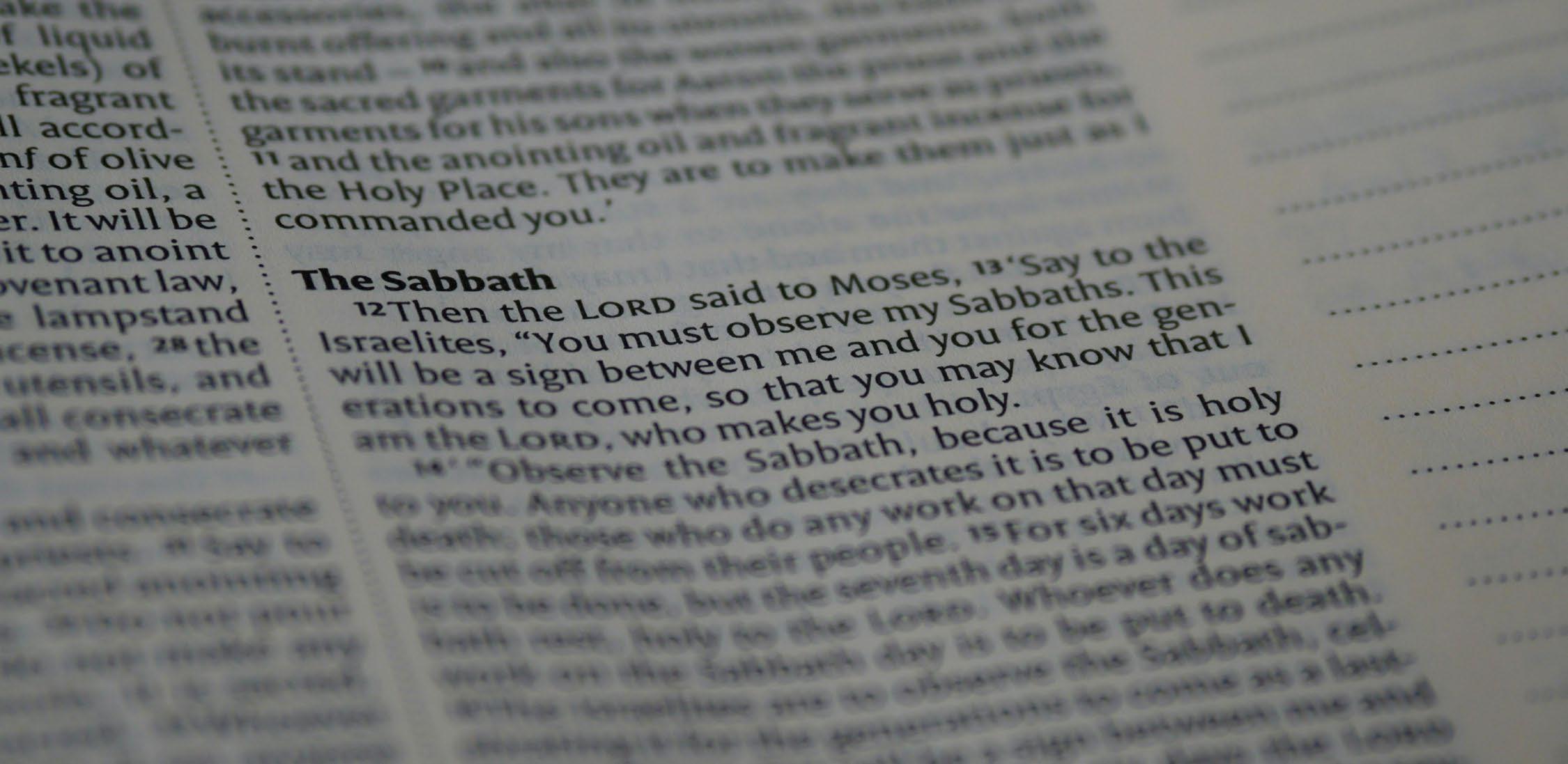
In a culture obsessed with productivity, the Sabbath often appears as an ancient restriction, an interruption to momentum rather than a gift. Yet Scripture presents the Sabbath not as a boundary imposed upon time, but as a sanctuary placed within time. In the Exodus narrative, holiness is often encountered through structure (Exodus 25:8, 9). The tabernacle in the wilderness and later the Jerusalem temple were not arbitrary religious constructions but carefully patterned sanctuaries—microcosms of divine order. Every curtain, vessel, and ritual embodied a theological element: God dwells among His people, but His presence needs to be approached on His terms. The Old Testament sanctuary functioned as a sacred space within profane geography. It localized transcendence. Israel could point to a place and say: Here, heaven touches earth. The Holy Place mediated access; the Most Holy Place guarded mystery. Time, ritual, priesthood, and sacrifice converged into a spatial theology of encounter.
Yet, intriguingly, Scripture places the Sabbath before the sanctuary. Genesis presents a sanctified day long before a sanctified structure. This ordering is theologically significant. Before Israel ever built a tabernacle, humanity received a sanctuary not made with hands—the Sabbath. Genesis 1–2 contains some striking parallels with sanctuary theology. God orders chaos into cosmos, culminating not in humanity but in divine rest. Just as the ancient temple dedications concluded with the deity “taking up residence,” Genesis ends with God resting on the seventh day. Rest, therefore, is not divine inactivity but divine enthronement. If creation is a cosmic sanctuary, then the Sabbath is its sanctum—the temporal equivalent of the Most Holy Place. This inversion is profound. Whereas the tabernacle sacralizes space within time, the Sabbath sacralizes time within space. The wilderness sanctuary embodied graded holiness: outer court (common access), Holy Place (mediated access), and Most Holy Place (restricted presence). The Sabbath mirrors this logic but transposes it into time. Not all time is equal; six days are given for common labor, but the seventh is set apart. Just as Israel moved spatially toward the divine presence, the weekly cycle moves temporally toward the sacred encounter. The Sabbath became a palace in time—portable, indestructible, immune to exile. Even when the temple fell, the Sabbath stood.
Sabbath as God’s Gift of Time Stewardship
The Sabbath begins not in Sinai but in Creation (Genesis 2:1–3). Before Israel’s establishment, humanity received a rhythm. This is crucial: The Sabbath is not about prohibition but about participation in God’s own temporal pattern. In a world where worth is measured by output, Sabbath announces that value is grounded in divine grace, not human achievement. Sigve Tonstad deepens this insight by framing the Sabbath as a sign of divine sovereignty over time itself. The Sabbath reminds humanity that time is not self-generated capital but a divine trust. Thus, observing Sabbath is the ultimate act of time management, not squeezing
more into life, but surrendering time back to its creator. Modern productivity teaches mastery over time; Sabbath teaches mastery under God. True time management is not control but consecration. The Sabbath recalibrates our temporal imagination from ownership to stewardship.
The Preparation Day Principle: Guarding the Edges of Time
If Sabbath is a sacred time, preparation becomes sacred work. The biblical notion of the “Preparation Day” (Mark 15:42) reveals that Sabbath holiness is protected not only by what happens on the day itself, but by how its edges are guarded. Jewish tradition has long understood this principle. The Sabbath begins not at rest but in readiness. Ellen White also writes concerning the guarding of the edges, and she admonishes that all work be done on Friday in preparation before the commencement of the Sabbath. Guarding the edges requires intentional boundaries. Without guarding the margins, the center collapses. Here are some strategies that could aid in the preparation of the Sabbath. I have classified them into four categories: rhythmic, liturgical, digital, and emotional
- Rhythmic Decluttering: Finish all essential tasks before sunset. Ensure all major, important, and expected requirements are fulfilled in good time during the week, not crammed on Friday, as this will clog Friday, leading to unnecessary pressure on the day. In addition, avoid carrying unresolved stress into sacred time. Resolve all stresses in all possible ways before sunset.
- Liturgical Preparation: Prepare meals ahead of time to avoid last-minute meal preparation, as these tend to put pressure on the day of preparation. Lay out clothes and organize spaces in good time. Also, use music or prayer to signal transition into the Sabbath.
- Digital Sabbath Boundaries: We now live in a digital age when most of our lives are spent in constant use of digital devices and spaces. Create a technological sunset that mirrors the solar one by setting auto-replies or setting device limits for the Sabbath.
- Emotional Closure: Practice forgiveness before Sabbath begins. Cultivate an attitude of gratitude where you end the week with a reflection of the things you are grateful for rather than unfinished tension.
Holiness often lives in transitions. Guard the edges of time, and you will guard the heart of the Sabbath.
From Restriction to Delight
Isaiah 58:13 calls believers to “call the Sabbath a delight.” In Hebrew, the term suggests deep joy, not grim obligation. The prophetic vision reframes Sabbath not as withdrawal from life but as immersion into truer life. The Sabbath is thus both memory and prophecy: remembering creation while rehearsing redemption. There are some ways of making Sabbath a delight, such as cultivating presence through unrushed meals shared with those you do not usually fellowship with, intentional conversations, and lingering prayer. Secondly, re-enchant creation through nature walks, silence as spiritual practice, and observing beauty without utility. Thirdly, practice communal joy by creating a space in the community for shared meals, testimonies of gratitude, and intergenerational fellowship. Lastly, practice sacred reading by not only using Scripture for studying but also for savouring, particularly poetry, psalms, or reflective theology.
At its deepest level, Sabbath is ontological before it is ethical. It addresses who we are before what we do. Modernity has conditioned us into functional identities; we are what we produce. Sabbath dismantles this illusion. In Exodus, Israel rests not because work is finished but because they are free. Sabbath is the liturgy of liberation. On Sabbath, we stop performing and start belonging. The Sabbath is about being, not having. The Sabbath invites us into a sacramental mode of existence where presence outweighs productivity. God did not rest because He was tired, but because creation was complete. Likewise, Sabbath calls us to rest not because life is finished, but because grace is sufficient.
The Sabbath invites us into a sacramental mode of existence where presence outweighs productivity. “ “
Safeguarding the Sabbath in a Restless Age
To safeguard the Sabbath today requires both resistance and imagination. Resistance against the cultural idol of busyness. Imagination to rediscover sacred rhythms within modern life. Some practical ways can be utilized to safeguard the Sabbath, such as establishing weekly rituals. Once these are established, they become easier to follow. Teaching children anticipation, not obligation, is also another way of safeguarding the Sabbath. In addition, framing Sabbath as relational rather than regulatory also helps. Lastly, viewing rest as worship, not withdrawal. The Sabbath must be protected not as law but as life. When neglected, souls fragment. When embraced, time itself becomes sacramental.
Clayton Maurede is a passionate preacher and theologian who holds a BA in Theology and an MA in Systematic Theology. Currently serving as an Intern Minister in the SEC, he is committed to proclaiming biblically grounded, theologically rich, and practically transformative messages. He has worked extensively in pastoral ministry in Zimbabwe and established a digital district online named Team Zunde together with his colleagues which made a huge impact locally and internationally during the Covid pandemic. Clayton’s work focuses on deepening believers’ understanding of Scripture while equipping them to live faithfully, think critically, and steward their calling with purpose. Currently he is actively engaged in pastoral ministry, preaching, teaching, and spiritual formation. In this role, he seeks to cultivate communities rooted in Scripture, shaped by grace, and attentive to God’s activity in everyday life. His ministry is characterised by a pastoral sensitivity that balances theological depth with practical application, particularly in areas such as Systematics, doctrine, and spiritual formation.
At the heart of Clayton’s calling is a vision to raise a generation of believers who live faithful lives guided by a solid biblical truth.
Numbering Our Days in a World That Sells Them
Beatriz Ferreira
We live in a world that quietly trains us to measure our worth in productivity. From a young age, we are taught that time is money, that success is accumulation, and that rest is a reward earned only after exhaustion. Somewhere along the way, “time is money” stopped being a saying and became a belief that quietly governs how we think, how we work, and even how we value ourselves. If an hour does not produce something measurable, we call it wasted; if a season does not increase our income or status, we question its worth. Our environment (social media, corporate culture, even casual conversations) constantly reinforces the same message: do more, earn more, achieve more. We no longer ask what truly matters; we ask what pays more. This dynamic reflects what Han (2015) describes as the “achievement society,” in which individuals internalize the demand for performance until they become both exploiter and exploited.
In the book of Ecclesiastes, Solomon declared that the endless pursuit of gain is “vanity and vexation of spirit” (Ecclesiastes 1:14, KJV). After building, acquiring, and experiencing more than most could imagine, he found that abundance did not equal fulfillment. Bartholomew (2009) notes that Ecclesiastes functions as a sustained critique of a life oriented around achievement and accumulation, calling readers back to the fear of God as the only stable foundation for meaning. His reflections challenge the modern assumption that busyness equals purpose.
Perhaps the danger of our time is not simply that we are busy, but that we have confused what is urgent with what is eternal, risking what matters most: family, friendship, and fellowship with God. The real crisis of time management is not that we lack hours, but that we have misunderstood their value.
Time as Currency
We live in an age that treats time like a luxury asset. It is budgeted, optimized, tracked by apps, and broken into productive units, and we speak of “spending time,” “saving time,” and “wasting time” as if every minute must justify its existence. The unspoken rule is clear: If time does not generate
income, advancement, or measurable results, it is being misused. Yet in elevating time to this almost sacred status, we paradoxically fail to offer it for what is truly sacred: family dinners become optional, friendships are reduced to quick messages, and moments of prayer or reflection are squeezed between obligations. We say time is our most valuable possession, but we routinely withhold it from the relationships and spiritual practices that give life meaning.
Solomon observed a similar tension long before the rise of productivity culture. In Ecclesiastes, he describes the endless cycle of labor and striving that leaves the soul restless rather than fulfilled: “There was no end to all his toil, yet his eyes were not content with his wealth” (Ecclesiastes 4:8). Bartholomew (2009) argues that this passage exposes the vanity of labor disconnected from God, a restlessness that grows the more one accumulates. Solomon did not condemn work; he condemned work that had lost its anchor in something greater than itself. As Keller and Alsdorf (2012) argue, the Christian vision of work is not about self-advancement but about serving God and neighbor; a purpose that transforms how we allocate our most precious resource: time.
Our Environment Shapes Our Priorities
The environment we inhabit quietly shapes our understanding of what truly matters. When surrounded by individuals who emphasize ambition and material success, we begin to measure our worth by achievements or possessions. In contrast, being part of a community that values kindness, connection, and balance shifts our focus toward relationships and emotional wellbeing.
Physical spaces also shape our perceptions. Towering buildings, crowded streets, and fast-paced cities encourage productivity and competition, subtly convincing us that time is scarce and success is urgent. Meanwhile, open landscapes and natural settings invite reflection and presence, reminding us of simplicity and the importance of slowing down. Research supports this intuition: Kaplan and Kaplan (1989) developed Attention Restoration Theory, demonstrating that natural environments replenish cognitive resources depleted by modern urban life. In these moments, we often realize that fulfillment does not come solely from external achievements, but from inner peace, meaningful relationships, a reminder that we are loved by God, and a sense of belonging within the larger world.
Biblical Principles for Intentional Living
Learning to manage our time wisely requires intention, discipline, and a clear sense of purpose, and the Bible offers timeless principles to guide us. Psalm 90:12 teaches, “Teach us to number our days, that we may gain a heart of wisdom,” reminding us that time is limited and should be used thoughtfully. Likewise, Ephesians 5:15, 16 urges believers to “be very careful, then, how you live—not as unwise but as wise, making the most of every opportunity.” The life of Jesus Christ provides a perfect model of intentional living. Despite constant demands, He prioritized prayer and demonstrated the importance of setting aside time for spiritual renewal, as seen in Luke 5:16: “But Jesus often withdrew to lonely places and prayed.” He balanced service, rest, and purpose, showing that effective time management is not about constant activity, but about aligning our daily actions with God’s will and investing in what has eternal value. Keller and Alsdorf (2012) describe this as “vocational stewardship”—the understanding that how we use our time is itself an act of worship and faithfulness.
Conclusion
In the end, the question is not whether we will spend our time, but how and on what. Every day offers the same twenty-four hours to the ambitious executive, the exhausted parent, the distracted student, and the quiet soul seeking meaning. Yet what distinguishes a life of depth from a life of mere motion is not the quantity of activity, but the clarity of priority. Han (2015) warns that the achievement society ultimately produces exhaustion rather than fulfillment—a burnout that no amount of productivity can cure. If we continue to measure our worth by output alone, we will find ourselves running faster while feeling emptier.
The tragedy is not hard work itself, but the silent agreement we make to let work define us.
Perhaps reclaiming our time begins with reclaiming our perspective. Time is not currency to be traded for validation; it is a gift from God for relationships, growth, service, and worship. When we pause long enough to question the assumptions our culture hands us, we begin to see that the most meaningful moments rarely appear productive on paper. Conversations around a dinner table, unhurried walks, prayers whispered in quiet rooms: these do not increase our status, yet they enlarge our souls.
If busyness has blurred our vision, intentional living can restore it. We cannot add more hours to our days, but we can anchor them in what is eternal. The true worth of a life will not be measured by the applause we received or the achievements we accumulated, but by the love we gave, the presence we offered, and the faithfulness with which we walked with God, because it is before Him that our story will find its eternal meaning.
Beatriz D. Ferreira is a member of the UNASP church, São Paulo, Brazil. She works at the Museum of Biblical Archaeology (MAB), where she contributes to research and cultural initiatives, and also served as a missionary in Vejle, Denmark. As a researcher and writer, she explores architecture, history, and biblical archaeology, producing work grounded in academic depth and critical inquiry, while also engaging as a religious writer focused on faith and spiritual reflection.
We say time is our most valuable possession, but we routinely withhold it from the relationships and spiritual practices that give life meaning. “ “
1 Bartholomew, Craig G. Ecclesiastes. Baker Academic, 2009.
2 Han, Byung-Chul. The Burnout Society. Stanford University Press, 2015.
3 Kaplan, Rachel, and Stephan Kaplan. The Experience of Nature: A Psychological Perspective.
Cambridge University Press, 1989.
4 Keller, Timothy, and Katherine Leary Alsdorf. Every Good Endeavor: Connecting Your Work to God’s Work. Dutton, 2012.
From Hurry to Order
Jimmy Botha
In many parts of the world today, people speak about being busy almost as a badge of honor. Schedules are full, inboxes overflow, and the pressure to respond to constant demands has become normal. Leaders, pastors, and church members often move from one commitment to the next with little space to pause or reflect.
Yet beneath this culture of busyness lies a quiet exhaustion. Many people sense that life is full but not always meaningful, productive but not always purposeful. The deeper challenge is that our time is often shaped by urgency rather than intention.
Scripture highlights this tension. In Ephesians 5:15, 16, Paul urges believers, “Be very careful, then, how you live—not as unwise but as wise, making the most of every opportunity.” In other translations, the phrase is rendered “redeeming the time.” The biblical invitation is not to rush through life faster, but to live with wisdom and attentiveness.
The Redeem the Time initiative was developed to help individuals rediscover this biblical approach to time stewardship. Rather than treating time as something to conquer or optimize, the program invites participants to see time as a gift entrusted by God, something to be received with gratitude and arranged with care.
One of the most important movements in this journey is the transition from intention to practice. Many people desire a life that prioritizes worship, relationships, meaningful work, and rest. Yet good intentions alone rarely shape daily rhythms. Living those intentions requires structure. Practical tools help translate spiritual values into lived patterns of life.
FWhy Order Matters?
or some, the word “order” sounds rigid or mechanical. Yet biblical order is not about control or perfection. It creates space for what matters most. Modern life often moves at a relentless pace. The urgent crowds out the important, and noise replaces attentiveness. Christian writer John Mark Comer argues that hurry is not simply a scheduling problem but a spiritual condition that erodes love, joy, and attentiveness. When life becomes hurried, relationships suffer, prayer becomes rushed, and meaningful service loses its depth.
Order offers a different path. By intentionally arranging our time, we protect space for worship, relationships, and thoughtful work. Order allows love to breathe. In this sense, planning and structure become acts of stewardship. They acknowledge that time is limited, meaningful, and entrusted to us by God.
The psalmist captured this truth in a simple prayer: “Teach us to number our days, that we may gain a heart of wisdom” (Psalm 90:12). Awareness of time’s limits invites wisdom rather than anxiety.
The Power of Planning
One of the most transformative shifts people experience in learning about time stewardship is the movement from reactive living to proactive living. Without planning, the loudest voices and most urgent requests tend to shape the day. Interruptions, unexpected tasks, and external expectations quietly determine priorities. Over time, this creates a life that feels constantly rushed yet strangely unfulfilled.
Planning interrupts that pattern. From a spiritual perspective, planning is not an attempt to control the future. Instead, it is an act of trust. It recognizes that time matters and that thoughtful preparation helps align daily life with deeper values.
Alan Fadling, in A Non-Anxious Life, observes that anxiety often grows when everything feels equally urgent. Planning gently restores proportion. When individuals decide in advance what truly matters, they become less vulnerable to the pressures of the moment.
In practice, this may involve a simple pause before the week begins, reviewing responsibilities, identifying priorities, and prayerfully considering how to use time faithfully. The goal is not to create a perfect schedule but to enter the week with intention rather than drift.
One of the most transformative shifts people experience in learning about time stewardship is the movement from reactive living to proactive living. “ “
The Weekly Review
One of the most powerful disciplines in time stewardship is the practice of a weekly review. Many people move from one week to the next without pausing to reflect. Tasks accumulate, responsibilities blur together, and spiritual priorities gradually disappear beneath daily pressures. The weekly review provides a moment of intentional pause. Often practiced on Sunday evening or at the beginning of a new week, this reflection invites individuals to look backward with gratitude and forward with realism. It encourages participants to acknowledge both their opportunities and their limits.
This discipline is less about efficiency than awareness. When people understand what lies ahead and what truly matters, they experience greater calm and focus.
Three simple questions can guide this practice:
- What am I thankful for from the past week?
- What truly matters in the week ahead?
- What must be scheduled to protect my time?
These questions help individuals enter the week with purpose rather than pressure.
Moving from Lists to Calendars
Another practical tool that supports intentional living is time blocking, sometimes called time boxing. Most people rely heavily on to-do lists. While lists help identify tasks, they do not necessarily ensure those tasks will be completed. Lists communicate intention, but calendars reveal commitment. Time blocking moves tasks from abstract intention into concrete space. Instead of merely writing down a responsibility, individuals assign it a specific time on the calendar. By giving important activities a defined place in the day, people protect work that might otherwise be postponed or crowded out.
This approach also reduces decision fatigue. Rather than constantly asking, “What should I do next?” individuals follow a rhythm that has already been thoughtfully planned. Healthy structure, however, must remain flexible. Plans exist to serve people, not the other way around. Compassionate flexibility ensures that planning supports human dignity rather than becoming another source of pressure.
Simplifying Task Management
Participants are also introduced to simple task-management systems designed to prevent feeling overwhelmed. The goal is clarity, not complexity. Many people feel stressed because their minds are trying to hold dozens of unfinished responsibilities at once. David Allen notes in Getting Things Done that the human mind functions best when it is freed from the burden of remembering everything simultaneously.
Simple systems, such as identifying the three most important tasks for the day, can dramatically reduce this mental burden. When priorities are clear, focus becomes easier, and energy can be directed toward meaningful work. Recognizing that not all tasks carry equal weight also restores perspective. When everything appears equally urgent, decision-making becomes exhausting. Often, the simplest systems prove the most sustainable.
Managing Energy, Not Just Time
Another insight many participants find liberating is the recognition that time stewardship involves managing energy as well as hours. Not every hour of the day is equally productive. Each person experiences natural rhythms of alertness and fatigue. Some people do their best thinking early in the morning, while others are more creative later in the day.
Wise planning pays attention to these rhythms. Demanding work can be scheduled during highenergy periods, while routine tasks or relational activities can take place during lower-energy moments. This approach honors the body and mind as part of God’s good creation and helps individuals avoid depletion while sustaining long-term, faithful service.
Designing an Ideal Week
Apractical exercise often used in time stewardship workshops invites participants to sketch what might be called an “ideal week.” Using a blank weekly calendar, individuals begin by blocking out
nonnegotiable commitments such as sleep, work hours, and commuting. Next, they add spiritual anchors such as prayer, worship, and Sabbath observance. Only then do they begin filling in additional responsibilities.
The goal of this exercise is not perfection. Instead, it offers clarity. Many people discover that life feels less chaotic when their most important commitments are visibly protected within the week. Participants are encouraged to approach this process with realism and self-compassion. The aim is not to design a flawless life but to create a sustainable rhythm.
Order as a Companion to Generosity
Ultimately, the practices of planning, reflection, prioritization, and energy awareness serve something deeper than efficiency. They create space for generosity. When time is received with gratitude and arranged with care, individuals discover greater capacity for worship, deeper attentiveness in relationships, and renewed energy for service.
In this way, order becomes the quiet companion of generosity. A life constantly driven by urgency rarely has space for grace. But a
life shaped by intentional rhythms creates room for the very things the gospel invites us to prioritize: communion with God, care for others, and faithful service in the world.
Redeeming our time, therefore, is not about becoming more efficient. It is about becoming more attentive. And in that attentiveness, time itself becomes a gift— gratefully received and abundantly shared.
Pastor Jimmy Botha serves as President of the Scottish Mission of Seventh-day Adventists, where he provides leadership to the churches, pastors, departments, and mission initiatives across Scotland.
Originally from South Africa, he has served in pastoral and administrative ministry in the United Kingdom for many years, with a strong interest in mission, leadership development, discipleship, and the spiritual well-being of pastors and members.
Pastor Botha holds Master’s degrees in Theology and Leadership and is currently pursuing a Doctor of Ministry degree with Andrews University, focusing on leadership, emotional resilience, and pastoral wellbeing. His ministry is shaped by a desire to see local churches thrive as communities of grace, generosity, and active discipleship.
In the Scottish Mission, he has helped articulate the strategic vision, “Gratefully Received, Abundantly Shared,” encouraging members to receive God’s gifts with gratitude and share them generously in mission and service. He is passionate about helping the church grow in faithfulness, compassion, and practical witness in its local communities.
1 Allen, David. Getting Things Done: The Art of Stress-Free Productivity. Piatkus, 2019.
2 Comer, John Mark. The Ruthless Elimination of Hurry: How to Stay Emotionally Healthy and Spiritually Alive in the Chaos of the Modern World. Waterbrook Press, 2019.
3 Fadling, Alan. A Non-Anxious Life: Experiencing the Peace of God’s Presence. IVP, 2024.
Dynamic Steward • Stewardship Ministries
Jimmy Botha
Hurry to Order
Our Time to Prepare and Work
Angelique Van Wyk
Never in earth’s history has time so solemnly held the value it does now as we get closer to the Second Coming (Revelation 22:12). The supply of this precious resource of time is graciously given to be used now for our character preparation (Matthew 22:11–14) and to spread the gospel (Revelation 14:6, 7), which involves a time for decision as minds weigh the message of truth. The time for grace will then be over as God puts an end to the current order of the dominions of darkness that have so long caused suffering for the saints (Daniel 2:35, 44), and He establishes His eternal kingdom.
This should not make us think negatively about the world ending. In fact, it means we will soon be able to meet the Lord face-to-face. The urgency of our time is not to scare us into survival or to instill panic. Instead, it should rouse the church from its lukewarm state and spur us on in the work, in sobriety and watchfulness, knowing that limited time is available and the moments are precious, while the world around us is heeding to deception before encountering sudden disaster. We are to invest our deepest concerted efforts as we approach the deadline. We are not to be caught off guard for the greatest event of our age. Every heartbeat is a moment for personal preparation and mission. We can exercise stewardship over the remaining time to fill our hearts with God’s Word and to help others do the same. A moment that passes by is irretrievable, and so are the opportunities presented in these moments to make them count before Christ returns. The effects of what we decide to do with these moments are exerted into eternity.
OTime for Character Preparation
ur characters are shaped by what we believe, and seeing that God weighs the heart, a critical ongoing eschatological preparatory work is to ensure that we bear His image, not the world’s. Some Christians live as though God will automatically fix their character flaws upon their arrival in heaven. This is not so. In Maranatha, Ellen White mentions “the finishing touch of immortality”1 that the living and resurrected saints receive upon Jesus’ return. There is no mention of being given a heavenly character; it comes by waging war with self (Galatians 6:6, 7). Thus, the finishing touch of immortality is the one thing missing when God looks upon the saved. Therefore, He imparts this gift to complete the work of transformation (1 Corinthians 15:53). Immortality is given to the heart that is set right with God.
In addition, if it were enough to merely intellectually know the truth in these end times, the believer’s heart would not capitulate when called to the test. Instead, the heart must be sanctified by the truth (John 17:17) and love the truth so that Satan’s delusions will not have power over it (2 Thessalonians 2:10–12). Our best way to serve the knowledge of truth is by applying its principles to every situation in daily life. In Our High Calling, Ellen White says that we need this quiet time of reflection and introspection with God to solidify our faith:
A mere ascent to truth is not enough. Daily we must live the truth. We must shut ourselves in with God, surrendering all to Him. To listen to the great and grand truths of the Word is not enough. We must ask ourselves the question, Does Christ dwell in my heart by faith? He alone can show us our necessity and reveal the dignity and glory of the truth. At the altar of self-sacrifice—the appointed place of meeting between God and the soul—we receive from the hand of God the celestial torch which searches the heart, revealing its great need of an abiding Christ (emphasis added).2
Spending time alone with God is not a trivial task, because as Christ dwells in the heart, He does not retain the sins therein found. Sadly, our characters are deformed. As the quote above states, it is clear that alone time with God forms the intersection of confession and surrendering of sins that prevail in the heart; it is where we transcribe the truths upon the heart, making them personal, and establish a faith that is firmly rooted in God. We need to expose ourselves to truth outside the group context to personally delve into God’s Word and pray sincerely. It is like conducting a business transaction between Christ and the believer, except we sell off bad products to gain one of priceless value: a sanctified soul that bears a cultivated Christlike character. If we miss the time, we keep the bad products in stock, and growth stagnates. When we show up, the character is cultivated, and if the lesson is taken to heart, we achieve growth in our investment and progress in our work of sanctification. This is a progressive task and not something we can accomplish in a day’s work—something to bear in mind as we prepare to be ready for Christ’s return.
Time to Obey the Great Commission (Matthew 28:18–20)
The wonderful effect of spending time alone with God daily is that it ripples in waves that create movements in evangelism, moving through the family and church, flowing to the unreached. William Miller had a coarse character, but was transformed as he spent time with God. As he ardently studied Scripture, the Lord enlightened his understanding with a view to time and prophecy. Ellen White explains:
The advent movement of 1840-44 was a glorious manifestation of the power of God; the first angel’s message was carried to every missionary station in the world, and in some countries
there was the greatest religious interest which has been witnessed in any land since the Reformation of the sixteenth century; but these are to be exceeded by the mighty movement under the last warning of the third angel.3
William Miller and the Advent movement are connected to the Bible’s end-time prophecy (Daniel 8:14). Miller thought the 2,300-year prophecy would be fulfilled in 1844. However, when Christ did not return, it was discovered that this date was actually the beginning of the investigative judgment in the heavenly sanctuary. We now look forward to the event of Christ’s return, not repeating the mistake of the historical misinterpretation to set a date for it, but ideally working toward it faithfully to offset its delay.
One of the most transformative shifts people experience in learning about time stewardship is the movement from reactive living to proactive living.
A reiteration exists in Revelation 10 that prophecies that convey to us specific dates have ended, but declares that the work will be done:
The message of Revelation 14, proclaiming that the hour of God’s judgement is come, is given in the time of the end; and the angel of Revelation 10 is represented as having one foot on the sea and one foot on the land, showing that the message will be carried to distant lands, the ocean will be crossed, and the islands of the sea will hear the proclamation of the last message of warning[;] . . . “that there should be time no longer” (Revelation 10:5, 6).4
As sobering as the thought is that prophecy linked to earthly timelines has ended, the time is now to be faithful and use every opportunity for the work of witnessing to our families, neighbors, colleagues, and all we meet. Spreading the gospel is the power of our time that will lead us on into time eternal.
Angelique van Wyk is a member of the Atlasville Church in Johannesburg, South Africa. She has previously served as an English Missionary Teacher in Seoul, South Korea. As a writer, she has written several articles to help encourage and nurture spiritual growth.
1 Ellen White, Maranatha (Review and Herald Pub. Assn., 1976), 221.
2 Ellen White, Our High Calling (Review and Herald Pub. Assn.,1961), 21.
3 White, Maranatha, 20.
4 White, Maranatha, 18.
Effect of Time Management on Mental Well-Being
Juliet Huoma Obulor Fidimaye
Time is one of the first gifts God gave humanity. It was presented as an ordered system designed to teach balance, productivity, and restorative living. At Creation, time was intentionally divided into day and night so that human beings would learn productive engagement during the day and restorative rest at night (Genesis 1:5).
This division establishes a rhythm of responsibility and recovery, now commonly understood as the circadian rhythm. Are human mental and physical well-being deeply connected to how time is used? Does a life without structure become out of sync with itself? Could the misuse of time at earlier stages of life produce consequences later in the form of regret, dissatisfaction, anxiety, and depression?
Time Management as a Foundation for Mental Health
According to the World Health Organization, “Mental health is a state of wellbeing in which an individual realizes his or her own abilities, can cope with the normal stresses of life, can work productively, and is able to make a contribution to his or her community.”1 Mental health, therefore, is not merely the absence of illness but the full capacity for individuals to function effectively within their environment. Psychological stability depends heavily on structured living patterns, including rest, productivity, and purpose.
Ellen White also connects mental health to a structured living pattern: “Every faculty with which the Creator has endowed us should be cultivated to the highest degree of perfection, that we may be able to do the greatest amount of good of which we are capable. Hence that time is spent to good account which is used in the establishment and preservation of physical and mental health. We cannot afford to dwarf or cripple any function of body or mind. As surely as we do this, we must suffer the consequences” (Christian Temperance and Bible Hygiene, p. 41).2
In this light, time “spent to good account” impacts mental health, which, in turn, influences one’s capacity for service and usefulness.
For spiritual leaders, this carries a clear implication. Ministry initiatives should not be limited to teaching doctrine; they should also involve guiding individuals toward a disciplined lifestyle that sustains both spiritual vitality and mental resilience. When leaders encourage structured living—such as regular devotional life, balanced work and rest, and purposeful daily planning—they help members, especially young people, become more stable, focused, and spiritually responsive.
HBenefits of Orderly Living
ealth, more specifically mental health, is preserved and strengthened through disciplined and orderly living. A large-scale metaanalysis found that disruptions in daily routines, such as irregular sleep, eating, and activity patterns, are significantly associated with increased anxiety, depression, and psychological distress (Liu et al., 2024).3 Similarly, individuals who maintain consistent routines experience better emotional stability and overall mental well-being.4 These findings reinforce the idea that mental health is not accidental but often the result of consistent and wellmanaged lifestyle choices.
Tomczyk, Altweck, and Schmidt (2021) found that poor time allocation negatively affects emotional well-being, concentration, life satisfaction, and overall mental health.5 In other words, one can assume that even when individuals are busy, the wrong type of busyness produces distress rather than fulfillment. This may be one of the major contributing factors behind the growing prevalence of mental health challenges today.
Spiritual leaders who help their congregations build structured, purposeful lives rooted in orderly living are not just promoting wellness; they are creating conditions for spiritual flourishing. Arguably, time is not only money, but is also families, congregations, and individuals; it is life, temporal or eternal. Families, congregations, and individuals who are taught to value time and structure are better positioned to grow spiritually, serve effectively, and remain mentally resilient.
Effect
Juliet Huoma Obulor Fidimaye
Enduring Effect of Purposeful Living
It is common, especially among the younger generation, to prioritize instant gratification over purposeful living because consequences seem distant. Activities such as excessive gaming, addictive entertainment consumption, pornography, gambling, and compulsive social media use consume hours that should be invested in intellectual, spiritual, and emotional development.
In contrast, the Scriptures state, “Remember your Creator in the days of your youth, before the days of trouble come and the years approach when you will say, ‘I find no pleasure in them’” (Ecclesiastes 12:1, NIV). The “evil days” represent later life stages marked by deep reflection. When age has taken its full course, the person who once lived carelessly and indulged in purposeless habits may find that looking back becomes a source of regret rather than joy and satisfaction.
Human beings were designed for meaningful activity. From Creation, purposeful work was part of mental stability: “The Lord God took the man and put him in the Garden of Eden to work it and take care of it” (Genesis 2:15). Productive engagement strengthens cognition, emotional stability, and self-worth. Idleness, however, weakens discipline and creates vulnerability to addictive behaviors. Young people should be encouraged early to engage in fruitful labor and in activities that will strengthen their character and practical skills.
The prayer of the psalmist deserves attention: “Teach us to number our days, that we may gain a heart of wisdom” (Psalm 90:12). Numbering our days means living with the awareness of life’s limitations. Without such awareness in youth, old age becomes a season of emotional mourning.
Similarly, Ranjita and McKean (2000) explain that poor scheduling creates chronic stress. Poor time management contributes to enduring anxiety, feelings of overwhelmingness, and loss of priority control.6 This reveals an important paradox about time: wasting time eventually produces the feeling of having no time.
Research in developmental psychology shows life satisfaction in older adulthood strongly correlates with perceived purpose and productivity during early life (Kim, Park, & Peterson, 2022).7 Individuals who invested in growth, relationships, and meaningful pursuits reported higher happiness and lower depressive symptoms than those who focused mainly on pleasure-oriented activities.
Finally, Scripture declares, “Do not be deceived: God cannot be mocked. A man reaps what he sows” (Galatians 6:7). The use of time is like planting a seed, and emotional outcomes are the harvest. Productive use of time includes learning and intellectual growth, skill development, spiritual devotion, physical activity, meaningful relationships, rest, and sleep. Healthy time management builds mental stability and lifelong satisfaction. Balanced and purposeful living reduces anxiety, increases confidence, and protects against age-related regret.
Conclusion
Time is not merely a schedule; it is a moral and psychological resource. God’s division of day and night established a structure meant to train humanity in balance. Both Scripture and research reveal that when time is misused, it often creates stress, decreases well-being, and leads to future emotional distress.
Balanced and pursposeful living reduces anxiety, increases confidence, and protects against age-related regret.
1 “Mental Health.” World Health Organization. Accessed April 23, 2026. https://www.who.int/ data/gho/data/themes/theme-details/GHO/mental-health.
2 White, Ellen G. Christian Temperance and Bible Hygiene. Good Health Publishing Co., 1890.
3 Liu, H., Tao, T. J., Chan, S.K.Y. et al. “Daily Routine Disruptions and Psychiatric Symptoms amid COVID-19: A Systematic Review and Meta-Analysis of Data from 0.9 Million Individuals in 32 Countries.” BMC Medicine 22, no. 49 (2024). https://doi.org/10.1186/s12916-024-03253-x.
4 “How a Daily Routine Can Boost Your Mental Health.” UCLA Health. March 11, 2026. https:// www.uclahealth.org/news/article/how-daily-routine-can-boost-your-mental-health.
“ “
Therefore, teaching youth proper time stewardship is not only a spiritual responsibility but also a mental health intervention. A well-used youth produces a peaceful old age; a wasted youth often produces depression. The greatest protection against later-life sorrow is purposeful living today.
Juliet Huoma Obulor Fidimaye is a Religious Studies graduate pursuing a Master’s in Education (Guidance and Counseling).
Psychological Wellbeing? A Cross-Sectional Analysis of Time-Use Patterns in the General Population and Their Associations with Wellbeing and Life Satisfaction.” BMC Public Health 21, no. 1858 (2021). https://doi.org/10.1186/s12889-021-11712-w.
6 Misra, R., & McKean, M. (2000). College Students’ Academic Stress and Its Relation to Their Anxiety, Time Management, and Leisure Satisfaction. “American Journal of Health Studies”, 16, 41-51.
7 Kim, E. S., Park, N., & Peterson, C. “Purpose in Life and Reduced Risk of Depression in Older Adults.” Journal of Positive Psychology, 17, no 3 (2022): 345–356.
5 Tomczyk, S., Altweck, L. & Schmidt, S. “How Is the Way We Spend Our Time Related to
Juliet Huoma Obulor Fidimaye
Dynamic Steward • Stewardship Ministries
Are You Busy, Or Just Driven?
The difference between urgent and important may be the most practical spiritual question of our time.
Alex Mareniuc
Think back to yesterday. Not the headline moments, just the details of how the day actually unfolded. How much of it did you choose? How much of it chose you?
For most people, if they’re honest, the answer is uncomfortable. The day began with a plan. Then a message arrived that needed a quick response. Then, there was a request that felt time-sensitive. Then, a situation that couldn’t wait. And somewhere between the morning and the evening, the day that was supposed to be theirs was quietly taken from them, not by anything dramatic, but by a steady stream of things that felt urgent.
This is what it means to live under the tyranny of the urgent. And for many church leaders, parents, workers, and members, it has simply become the texture of ordinary life, so much so that even children now feel a compulsion to respond to every notification the moment it arrives, as though a message left unanswered for more than a few minutes is somehow a social emergency.
But here is the question worth sitting with: Was everything that felt urgent actually urgent, or has urgency itself become a feeling we have stopped questioning?
RThe Illusion at the Heart of Busyness
esearchers found something striking when they studied how people choose between tasks. When a task was given an artificial deadline, even a deadline that made no practical difference to the outcome, people consistently chose it over a more important task with a longer time window. Not because it was better or more valuable, but simply because it felt more pressing.1 They called this the “mere urgency effect.” The feeling of urgency, independent of actual importance, was enough to redirect attention and override judgment.
We are, in other words, easier to distract and redirect than we think. And the world around us knows it. Notifications are designed to feel urgent. Inboxes are structured to reward immediate responses. Even the rhythms of church life can create a culture where the loudest need always wins.
The apostle Paul wrote to the Ephesians: “See then that you walk circumspectly, not as fools but as wise, redeeming the time, because the days are evil” (Ephesians 5:15, 16, NKJV). The emphasis is not on speed. It is on wisdom. Not the volume of activity, but the intentional direction of a life. Redeeming time is not about doing more but about refusing to let urgency make your decisions for you.
Three Ways We Choose the Urgent
Most of us assume that urgency is something that happens to us. But often, if we look more carefully, we have made an unconscious agreement with it. There are at least three common patterns.
1. The Achiever Pattern. Urgency feels productive. When the inbox is full, and the calendar is packed, there is a quiet sense of significance—moving from task to task, crossing things off, responding quickly. It all generates momentum. The problem is that this kind of productivity is often an illusion. We complete many things, but advance only a few of the things that truly matter. Ellen White saw this clearly: “You need to watch, lest the busy activities of life lead you to neglect prayer when you most need the strength prayer would give. Godliness is in danger of being crowded out of the soul through overdevotion to business.”2 The danger, she warns, is not work itself. It is work that slowly crowds out the soul.
2. The Avoider Pattern. For some, urgency is less about achievement and more about escape. When life feels too overwhelming to face, whether because of a difficult relationship, a fear that has never been named, or a question that is too uncomfortable to sit with, then staying in constant motion is one way to avoid it. The busier you are, the more justified the avoidance feels. After all, you don’t have time to deal with it right now. There is too much to do. The urgent becomes a refuge from the important.
3. The People Pleaser Pattern. This is perhaps the most common in ministry contexts. Every request that arrives from another person immediately becomes the most pressing item on the agenda. The word “no” feels dangerous, disrespectful, unhelpful, and un-Christian. And so every other person’s urgency becomes your own. Paul asked the Galatians a direct question: “For do I now persuade men, or God? Or do I seek to please men? For if I still pleased men, I would not be a bondservant of Christ” (Galatians 1:10, NKJV). The inability to say no is not just a practical problem; it is a spiritual one. When we give everyone else the authority to direct our time, we have quietly handed over something that was never theirs to manage.
Urgent Versus Important—Knowing the Difference
The path forward begins with a distinction that sounds simple but takes real discipline to apply: the difference between what is urgent and what is important.
Urgent tasks demand immediate attention. They press. They feel timesensitive. Important tasks, by contrast, are the ones that build what matters, such as relationships, health, spiritual depth, or long-term work that only grows slowly. The problem is that important tasks rarely shout. They wait. And because they wait, they are the first things displaced when the urgent arrives.
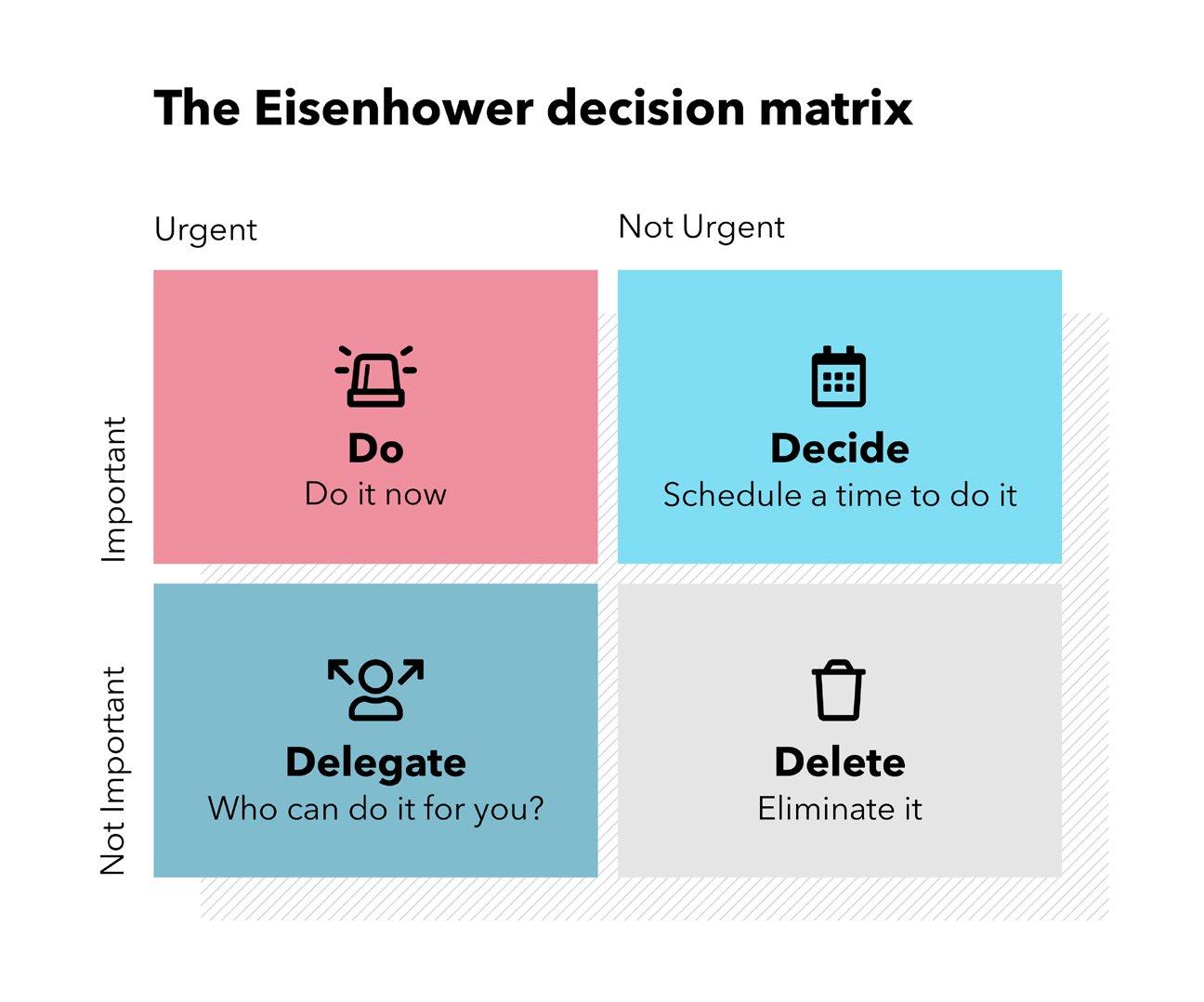
A practical tool that helps many people think through this is the Eisenhower Matrix. The matrix is a simple framework that asks two questions about every task: 1. Is it urgent? and 2. Is it important? The answers place each task into one of four categories, helping us see clearly which demands deserve our immediate energy and which ones, however loud they feel, can wait, be delegated, or be set aside altogether. More than a productivity technique, it is a framework for discernment. Because that is ultimately what this is all about: discernment, the willingness to stop before responding, to ask whether this particular demand deserves this particular moment, and to protect the things that genuinely matter from being crowded out by things that merely feel pressing.
The Eisenhower Decision Matrix
“
The goal is not a cleared schedule or a quieter life. It is a life in which urgency is a servant, not a master, where we are responding to genuine needs rather than being driven by noise, obligation, or the fear of disappointing people.
“
Jesus Himself modeled this. He walked away from crowds. He withdrew to quiet places. He said no to some requests in order to say yes to what the Father had given Him to do. He was not hurried. He was purposeful.
Living Free
The goal is not a cleared schedule or a quieter life. It is a life in which urgency is a servant, not a master, where we are responding to genuine needs rather than being driven by noise, obligation, or the fear of disappointing people.
Ellen White wrote: “Life is too solemn to be absorbed in temporal and earthly matters, in a treadmill of care and anxiety for the things that are but an atom in comparison with the things of eternal interest. Yet God has called us to serve Him in the temporal affairs of life. Diligence in this work is as much a part of true religion as is devotion.”3 When the things of eternity take their proper place, urgency finds its proper proportion.
There will always be things that feel urgent. The question is who or what gets to decide what is truly important. Reclaiming that authority, one day at a time, is what it means to live free from the tyranny of the urgent.
Pastor Alexandru Mareniuc is Director of Stewardship for the South England Conference of Seventhday Adventists in the British Union Conference.
In this role, he provides leadership in developing and implementing stewardship strategies that equip churches, pastors, and members to live out biblical principles of discipleship, faithfulness, and mission.
With over 15 years of pastoral ministry experience, he brings both local church insight and conference-level perspective to ministry. His background in theology, leadership, and business administration shapes his interests in stewardship theology, generosity, organisational development, leadership training, and digital resource design. He is particularly passionate about helping churches translate biblical principles into practical habits that strengthen mission, trust, and spiritual growth.
Pastor Mareniuc works closely with church leaders and congregations to deepen spiritual commitment, build trust, and foster a culture of mission-focused living. His ministry emphasises holistic stewardship, recognising that every aspect of life is entrusted by God and should be purposefully invested in His mission. Through training, teaching, and strategic support, he helps individuals and congregations grow in commitment, clarity, and direction.
2
1 Meng Zhu, Yang Yang, and Christopher K. Hsee, “The Mere Urgency Effect,” Journal of Consumer Research 45, no. 3 (2018): 673–690,
Assn., 1900), 343.
Ellen White, Testimonies for the Church (Review and Herald Pub. Assn., 1889),
3 Ellen White, Christ’s Object Lessons (Review and Herald Pub.