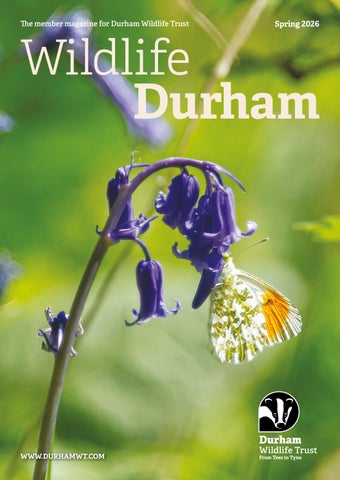
Cover image: Orange-tip butterfly on bluebells at Low Barns Nature Reserve by Enid Hoseason.
Spring Issue
ollowing a very wet winter we’re all probably hoping for some drier weather this spring and into summer (but hopefully not as dry as 2025). For a nation that likes to talk about the weather, the increasing frequency of weather extremes that we are experiencing at least gives us a new weather-related topic to discuss. On the Durham Wildlife Trust front, the weather – or more correctly the climate – is also creating a lot of discussion.
In this issue, you’ll find news on tree planting schemes, education and engagement, and even roof repairs – all of which are being disrupted by the extremes of weather. Tree planting has to take account of the species selected and how resistant they are to drought; education sessions get disrupted when there’s no water in the pond for pond dipping; and the roof repairs take longer than planned because it won’t stop raining!
At the Trust level, the main thing we can do is adapt to the changing conditions and make sure there’s as much space for nature as possible. That gives species and habitats the best chance to adapt and thrive. The Trust is doing that by bringing more land into management for wildlife and creating more spaces for nature, as you’ll see from the articles on Billingside Meadows and Swift City.
My suggestion for this spring is to enjoy the natural world, whether it’s the wildlife on your doorstep, or perhaps the fantastic magnesian limestone sites the Trust manages. With your continued support, nature across our region can not only adapt and survive but thrive.
Jim Cokill Director of Durham Wildlife Trust
MMore woodland created at
Milkwellburn Wood
ore than 3,000 new trees have been planted during the winter as part of an ambitious woodland creation project at Milkwellburn Wood near Chopwell, Gateshead. The 5.45-hectare expansion has been delivered in partnership with the North East Community Forest, marking a significant investment in local biodiversity, climate resilience and community access to nature.
Barbara Hooper, Head of Nature Recovery at Durham Wildlife Trust, said: “We are delighted that this wonderful woodland is going to be extended. It is such an important asset and this new section will connect Milkwellburn Wood directly with Durham Wildlife Trust’s adjacent reserve at Chopwell Meadows. We are really looking forward to working with local residents to encourage more opportunities to get involved in creating an even better space for people and nature.”
Get more of the magazine digitally
The Trust’s bumper digital edition of Wildlife Durham is delivered straight to inboxes at the same time as the printed copy. It features additional pages of content, including news and wildlife articles from across the Wildlife Trusts movement. If you are not already on the email database, please contact us: membership@durhamwt.co.uk
Scan to share the digital magazine with your friends and family.
New
to the team
The Trust has welcomed some new additions to its team over recent months. Lyze Bell and Wai Tung Kan joined as Conservation Trainees in late 2025, becoming the 99th and 100th trainees to have benefitted from the scheme. During their ten-month placements, Lyze and Wai will gain the skills and knowledge needed for a career in conservation. We wish them the best of luck in their new roles.
Over the coming weeks, we will be joined by several new team members to support our ambitious plans to bring nature into the heart of Sunderland (see page 6 for more details). Pip Jackson and Cathy Sharp will take on the role of Connecting Through Nature Officers, working together to improve health and wellbeing by connecting communities with local greenspaces in Sunderland. Dorinda Kealoha will be our City of Nature Sunderland Officer, helping the Trust connect with disadvantaged and marginalised communities, and working alongside project partners to organise nature-based activities that help improve wellbeing and the environment.
Wai Tung Kan and Lyze Bell
Educating and engaging through the seasons
Durham Wildlife Trust hosts a range of engagement events aimed at offering people across the region access to wildlife.
Muddy Wellies sessions, funded by Active Sunderland, continue to help nurture and develop our younger visitors in the fabulous natural setting of Rainton Meadows. In addition, over the winter we have extended our educational offer to cover KS3 and 4 learning outcomes. For more details, visit: www.durhamwt.com/adventure-schools
The Alzheimer’s Research UK-funded Wild About Brain Health sessions have also been a huge success, giving those attending a better understanding of how using and enjoying the outdoors can help combat the effects of dementia.
A major project for 2026 is Seasons of Connection, supported by Sunderland City Council Neighbourhood Fund. This mix of experiential and creative activities is designed to help people reconnect with nature and each other, improving wellbeing and confidence. The sessions feature a range of events including pond surveys, guided bird-walks, mini-beast surveys, and rock pooling at the coast. The first of these was a sell-out, so don’t delay booking onto these, or any of our other engagement sessions, at: www.durhamwt.com/events
Roof repairs at Low Barns
Essential maintenance to the roof of Low Barns Visitor Centre took place during February. The work has been completed to ensure that the old farm buildings that host the café, gift shop, meeting room and general facilities, are fit for purpose into the future.
Stronger Shores takes root
Stronger Shores is a DEFRA-funded project looking at innovative ways to combat coastal erosion and flooding, using nature-based solutions. The Stronger Shores team at Durham Wildlife Trust is exploring how kelp and seagrass can help protect our coastline, whilst also leading on project-wide engagement with the public. All three trial sites for seagrass restoration have now been planted with test areas, which will be monitored over the coming months. This work will help determine whether seagrass re-establishment is a viable technique for future, larger-scale coastal erosion reduction schemes.
Our engagement officer for the project has been running a series of online talks over the winter, so if you would like to find out more about kelp, cetaceans, seagrass, oysters and marine community organising, you can catch up on our YouTube channel. You can also head to our events page to explore exciting Stronger Shores events which will be advertised from March onwards.
FIND
OUT MORE
Search for Durham Wildlife Trust on YouTube and visit the Stronger Shores Talk Series playlist.
Pond dipping.
Photo: Mandy Walker
Blair Watson and Dr Martina Bristow planting seagrass in first trial at River Don.
Land management advice
Durham Wildlife Trust is launching a new, free, land advice service, supporting farmers and land managers to explore how they can maximise the nature benefits they deliver on their land.
Stephen Thompson, the Trust’s Land Advice Manager, can provide local, independent advice for farms, smallholdings, estates, woodlands or community green spaces.
Professional services include: information on farm and land management to benefit wildlife; information on ecological surveys and monitoring wildlife and habitats; mapping environmental features and wildlife connectivity; information on Biodiversity Net Gain and other green finance, plus links to a range of projects and organisations for further advice and funding.
For more details visit: www.durhamwt.com/land-management-advice
Save the date City Nature Challenge
The City Nature Challenge (CNC) is a global competition that is taking place from Friday, 24th April until Monday, 27th April. Using the iNaturalist app, regions compete to log the most records and the most species!
Environmental Records Information Centre (ERIC) North East is running the CNC across the whole of the North East. To participate, you can join some of the free Durham Wildlife Trust events that will be taking place, and log your own sightings across the weekend.
Visit www.durhamwt.com/city-nature-challenge for more information.
Celebrating an incredible volunteer community
Durham Wildlife Trust was proud to host its annual Christmas Volunteer Celebration Event last December, celebrating the extraordinary dedication, support and commitment of our volunteer community. From helping with conservation work on nature reserves and projects, to running gift shops and assisting with office administration, volunteers are at the heart of everything we do.
The evening recognised the incredible contributions of our volunteers, who together gave an outstanding 28,324 hours of their time to the Trust in 2025. We presented badges to mark hours of volunteer time given, and years of service awards, alongside some special awards including Young Volunteer of the Year, Coastal Champion, and the prestigious Golden Shovel Award!
Thank you to all our volunteers for your time and passion to support local wildlife. If you would like to take action for nature, why not join us in 2026. You can learn more about our volunteering opportunities at www.durhamwt.com/volunteer
Thompson
WILDER SUNDERLAND
Sunderland is a special place, made up of five areas, each with their own character and identity. To deliver for nature and people across Sunderland, Durham Wildlife Trust has been on a mission to make ourselves known in as many of those areas as possible, and be a trusted partner which can enable people in Sunderland to take action for nature in a way that works for them.
By Emily Routledge Head of Development and Communications
ifty-six years ago, the Trust began working in the Coalfield area of Sunderland, with the organisation’s founding volunteers acquiring Joe’s Pond from the Coal Board. By doing this, they laid the foundations for the later development of Rainton Meadows as Sunderland’s largest nature reserve.
Before 2020, our work was usually developed and delivered based on thinking from within the Trust – we chose what to do and where. Great work was done, but nature is still in decline and people are less connected to the natural world than ever before, so another way of working was needed. Over the last five years, we’ve been gradually rolling out a different approach – listening more to the people in the communities where we work, and focusing on working at a more local level; no longer just providing places for nature for people to travel to and visit, but also trying to put nature on the doorstep and make nature part of the community.
Headquartered in Sunderland, with large projects like Links with Nature and Nextdoor Nature already being delivered across Sunderland, it seemed like the perfect time, and place, for Durham Wildlife Trust to really focus on the local model.
Links with Nature has strengthened our partnership with Sunderland City Council and inspired the local authority, supported by the Trust, to apply to the Nature Towns and Cities funding programme with a project called Connecting Through Nature. This project takes the learning and ways of working from Links with Nature (based in the Coalfield area of Sunderland) and applies it to all five areas of Sunderland. Connecting Through Nature will bring organisations across the city together to better connect residents with local green spaces. Led by Sunderland Council, Durham Wildlife Trust will have two officer posts supporting events, volunteering, and skills building.
The Trust’s Nextdoor Nature work in Sunderland has helped communities by providing advice, tools, and an extra pair of hands to help care for local greenspaces. This has created new relationships – often with people the Trust hasn’t worked with before – and has enabled the Trust to work outside of our own nature reserves and deliver nature’s recovery across a wider area.
Rainton Meadows Nature Reserve by Kate English
One relationship Nextdoor Nature helped develop is with the International Community Organisation of Sunderland (ICOS). This relationship has highlighted that people want to help nature and the environment, but don’t feel they know how they can do that. In response, the Trust and ICOS worked together to develop a project proposal that was submitted to the National Lottery Community Fund (Reaching Communities). That project, City of Nature, has secured funding to deliver a programme of workshops, activities, and educational events in some of the most deprived areas of Sunderland, working with communities that don’t usually get involved in traditional nature and environmental projects.
City of Nature will deliver seasonally-themed events over three years, with participants co-creating the activities and project staff shaping the programme so that it delivers where the need is greatest. By doing that, as many people as possible will become more aware of, and connected to, the environment, and realise the benefits that nature can bring to them.
The various initiatives and projects operating across Sunderland have been designed to complement each other, and the collective effort will deliver a Wilder Sunderland. At the heart of each programme is people, and the ambition is that this concerted effort in Sunderland will connect people with nature in a meaningful way that will last long after any individual project ends. Many more people will be happier and healthier, with nature thriving on their doorsteps.
For information about all of the Sunderland programmes, visit www.durhamwt.com/wilder-sunderland
S Springtimespectacle What to see and where to go
pring brings a major change across our nature reserves, with longer days and (hopefully) more sun heating the ground. Plants begin to emerge from their winter slumber, providing a flourish of colour. We will see our overwintering birds moving back to their breeding grounds, and the return of the birds which breed here over the summer.
I’m not sure Aristotle got it right when he said: “One swallow does not make a summer”. To me, the first swallow I see, normally a few weeks into April, signifies the arrival of spring as they return from their winter stay in Africa. You can see swallows at many of our reserves, but the open spaces and waterbodies at Rainton Meadows are good places to watch swallows catching insects on the wing.
Early April is a great time to visit some of our wetland sites, such as Low Barns, Lamesley Pastures, and Shibdon Pond, to see if any of the rarer passage wading birds, such as green sandpiper, have dropped in. They use these sites as a pit stop on their journey to Scandinavia. Many of our wading birds, such as curlew, also move from their lowland wintering areas to upland habitats, such as Cuthbert’s Moor in the North Pennines. Keep an eye out for an exclusive Supporters Walk, taking place in August. Details will be listed on our website (www.durhamwt.com /events ). These visits are kept infrequent to limit disturbance to birds.
By Andy Wadds Reserves Manager
Bluebells at Baal Hill Wood Nature Reserve with Bishop’s Oak in the background.
Photo: Kate English
Azure damsefly with large red damselfly
Photo: Joe Finlay
Later on in April and throughout May is an excellent time to visit some of our ancient woodlands. Woodland specialist flowers emerge earlier than those in the grasslands, taking advantage of the sunlight streaming through the trees before the leaves fully emerge and close the canopy. A walk through Baal Hill Wood or Edmondsley Wood will be rewarded with excellent displays of bluebells, particularly around areas of coppiced woodland which allow pockets of light to break through the canopy and provide further variation of woodland structure. If you are interested in other ancient woodland indicator species, a walk along the Hawthorn Dene nature trail will let you tick a few off your list, with species such as dog’s mercury, wild garlic, and wood anemone being present throughout. Ancient woodland species are known to be incredibly slow to establish, with species such as wood anemone taking around 100 years to spread just six feet, which signifies the importance of protecting them and minimising disturbance, as much as possible, by sticking to paths.
If you prefer grasslands to woodlands, a visit to Cross Lane in Gateshead will reward you with a magnificent display of cowslips across the fields – the brilliant flashes of yellow are one of the few sources of joy whilst sitting in stationary traffic next to the Metrocentre!
It would be remiss not to mention the fantastic invertebrates that inhabit our sites. One of the first sightings you are likely to see in the year is the large red damselfly. This is one of the easiest damselflies to identify in the North East of England. If it is red and tucks its wing behind its body, it is almost guaranteed to be a large red damselfly! Malton Nature Reserve and Rainton Meadows are two fantastic sites to see them emerging in April and May. Rainton Meadows is classed as a priority site by the British Dragonfly Society and contained 16 of the 20 species recorded in the North East in 2024. Though I’ve mentioned Rainton and Malton for large red damselflies, almost any clean, slow-moving or stationary water-features on our nature reserves can support dragonflies and damselflies.
As we move into May, keep an eye out for the dingy skipper butterfly. This small, unassuming butterfly, often mistaken for a moth, is a priority species in the UK. Locally distributed, one of the easiest places to spot them is by the Events Field at Low Barns – keep an eye out for their low, darting flight or look for them basking in the sun on bare ground.
Finally, as the end of spring nears, our fantastic meadows begin to show their true colours. Make sure you visit any one of our wonderful reserves on the Durham magnesian limestone escarpment. These include Bishop Middleham Quarry, a Site of Special Scientific Interest (SSSI), Raisby Hill Grassland (SSSI), and many others within Durham Wildlife Trust’s patch. To find out more, read some of our blogs on the website: www.durhamwt.com/blog/tag/ magnesian-limestone
Shibdon Pond Nature Reserve
Cuthbert’s Moor Nature Reserve by Ruby Merriman
SCAN ME
Dingy skipper by Ian
Hoseason
Ponies, ponds and possibility at
Billingside Meadows is a mosaic of habitats which combine a restored former opencast coal mine and a Local Wildlife Site. With views of the Derwent Valley, on a clear day keen Durham Wildlife Trust enthusiasts may be able to spot Chopwell Meadows and Milkwellburn Wood to the north. The site was acquired following the closure of the Bradley surface coal mine and is to be managed for nature conservation in a similar fashion to Rainton Meadows, which was created in 1996 following the closure of the Rye Hill surface mine.
The 23 hectare Billingside Meadows site comprises a mixture of habitats, with open neutral grassland to the south, supporting meadow pipits Anthus pratensis , skylark Alauda arvensi s, and lapwing Vanellis Vanellus . Along the eastern edge, there is a mosaic of scrub interspersed throughout acidic and neutral grasslands containing species such as devil’s bit scabious Succisa pratensis , tormentil Potentilla erecta , and lady’s mantle Alchemilla mollis . Gorse, hawthorn and holly provide shelter and food for a range of songbirds that use the site. To the north, four ponds provide habitat for invertebrates.
The site will primarily be managed using conservation grazing by our very own Exmoor ponies. These well-loved creatures have preference for grasses and their grazing will prevent grasses from dominating the sward. Used in the correct densities, ponies are fantastic at creating a varied structure as they establish latrine areas in which they don’t forage, allowing a wider range of invertebrates to make use of the site. In addition to the ponies, we will also be managing the scrub on a rotation to create different stages of growth similar to the grazing. This promotes a varied scrub structure with both new and old growth alike, allowing more species to use the area.
By Andy Wadds Reserves Manager
As we implement these methods, we will be carefully observing the changes, ensuring we are getting the best results possible. As time goes on, this may develop into changes in the management of the site, such as completing hay cuts on specific areas and introducing different grazing animals, such as cattle and sheep, to achieve the best outcomes for nature.
Find out more about Billingside Meadows: www.durhamwt.com/nature-reserves/ billingside-meadows
Exmoor ponies on Billingside Meadows Nature Reserve
Photo: Andy Wadds
Photo: Andrew Wadds
Help us to protect our region’s magical meadows
Magnesian limestone grasslands are unique to Britain. Two-thirds of this rare habitat is found right here in northeast England. In fact, it is so rare and important that of the 300 hectares (the equivalent of 300 football pitches) found between the Tees and the Tyne, 207 hectares are designated as Sites of Special Scientific Interest.
These special grasslands have declined drastically over the last 100 years and, today, continue to face threats from building development, industrial activity and agricultural practices, as well as neglect.
This decline has pushed species dependant on this habitat onto smaller areas of land that are more fragmented. Animals like the northern brown argus butterfly and cistus forester moth depend on plants found on magnesian limestone grassland. Locally, they are now found on just a handful of sites.
Magnesian limestone grasslands are home to some of our rarest plant species, too. Floristically rich, just one square metre can support 40 different flowering species, creating a haven for invertebrates and other wildlife.
Durham Wildlife Trust has been fighting to conserve and restore magnesian limestone grasslands for more than 50 years. Today, the Trust cares for almost one-sixth of this rare grassland nationally and one-quarter within our region.
What makes our magnesian limestone grasslands so special?
Magnesian limestone was created as far back as 260 million years ago, during a period when the Zechstein Sea covered a large part of the UK. The sediments deposited on that sea floor millions of years ago, now shape the landscape of east Durham, Sunderland and South Tyneside.
As a charity, we are in a fortunate position to protect these grasslands and restore habitats for the rare species which depend on them.
By donating to our Magical Meadows appeal this spring, you can help to save homes for rare invertebrates such as the northern brown argus butterfly.
Earth Raise 2026 Your donations, doubled
This spring, we are taking part in the Earth Raise initiative – a seven-day online match funding campaign dedicated to helping charities to tackle environmental issues . This means that every donation given to our plea to save magnesian limestone grasslands will be doubled.
Please donate to our Earth Raise appeal between the 22nd and 29th April to restore our rare magnesian limestone grasslands.
Even a small amount can make a huge difference the species which rely on these habitats.
Find out more and donate: www.durhamwt.com/ magical-meadows-pledge
Northern brown argus by John Bridges Birds-eye primrose by Philip Precey
Town Kelloe Bank Nature Reserve
Building a future for swifts
By Mary-Anne Rielly Conservation Volunteer Coordinator
In just a few weeks, our skies will once again be dotted with the joyous ‘screaming’ of swifts as they return from their over-wintering spots in sub-Saharan Africa. But whilst their aerial displays about the rooftops will be most welcome, for a lot of us, their apparent drop in numbers, compared to ten or 20 years ago, will be hard to ignore. UK swift populations have declined by nearly 70% over the past three decades, largely due to a loss of suitable nesting sites and continuing declines in their insect prey.
Last July, Durham Wildlife Trust appealed to supporters to turn the tide for our feathered friends through our then-new project, Durham Swift City. Initially focused on installing swift boxes in church towers, the project aims to tackle local swift declines by providing safe, permanent and well-connected nesting sites across the county and beyond. Just two months after launch, our initial donation target of £10,000 was reached, thanks to the generosity of supporters and funders. This enabled the purchase of essential training and materials, allowing project volunteers, Mike and Madeleine, to make a start.
So far, Durham Swift City has overseen the installation of 46 swift boxes across six churches: St Brandon’s in Brancepeth, St Paul’s in Ryhope, St Mary’s in Easington Village, St Laurence in Pittington, St Cuthbert’s in Durham, and St Paul’s in Spennymoor. With several more churches eager to get involved, this growing network of nesting sites is set to expand further across the county in 2026.
“Have you heard that we’ve opened an Air B ‘n’ B at St Paul’s Church, Ryhope? Literally, an Air B ‘n’ B! Though it’s not for humans. Instead, it’s for the population of swifts that we hope will be reintroduced into the area. We were visited by the team from Durham Wildlife Trust who outlined the vision. Our belfry had been selected to host ten swift boxes which were effortlessly installed. Now we await the coming of the birds in future breeding seasons. So, it’ll be swifts in the belfry, rather than bats!”
The Reverend David Chadwick, St Paul’s Church
While it may be a few years before swifts nest in these newly-installed boxes, Durham Swift City is already laying the foundations for change. Through swift action now, we are helping to ensure that the sounds of swifts remain a defining feature of our summer skies for years to come.
Installation of swift boxes at St Paul’s
Events
Please book our events online at www.durhamwt.com/events or call 0191 584 3112.
The events listed below are for supporters and guests and free to attend unless otherwise stated.
Dawn Chorus Walk at Elemore Park
Saturday, 25th April, 6am – 8am Elemore Park, Easington Lane, Hetton-le-Hole, Houghton-le-Spring, DH5 0QS
As part of City Nature Challenge 2026: North East England, join the Links with Nature project and Ornithologist, Michael Turner, as we learn about our feathered friends at Elemore Park.
Discover how to identify birds using sound ID as we take an early-morning walk through the park and explore a range of local habitats. Booking is required for this event.
Join the Trust’s Director and Head of Development and Communications for an introduction to the Trust and to the nature reserve.
One of our region’s most important wildlife sites, this wetland reserve, bordered by the River Wear, also contains mixed woodlands and species-rich grasslands. Uncover the fascinating history of Low Barns and gain an insight into the Trust’s future plans.
Although pitched as an introductory event, all supporters are welcome to attend.
Supporters’ Woodland Walk
Saturday, 16th May, 10:30am – 12pm
Edmonsley Wood Nature Reserve, DH7 6FG
Join Northern Reserves Officer, Michael Andrews, on a springtime walk around Edmondsley Woods. Learn about the Trust’s management of the site, along with information on the many different species which call this beautiful reserve home. Booking is essential. Limited spaces are available.
An ode to lovebirds across the British Isles and their rituals of courtship
Jenny Shelton, Senior Media Officer at The Wildlife Trusts, shares her life-long passion and fully-fledged fascination for birds.
JANE AUSTEN, one of our great English writers and an authority on matters of the heart, once observed that, in courtship, ‘the man has the advantage of choice, woman only the power of refusal’.
The same can be said of the bird kingdom. In spring, birds – from mighty ospreys to garden robins –turn their sights to the business of breeding. Much like in Jane Austen’s time, the rules of romance are strictly observed. A female might find herself courted in a number of ways: a serenade, a dance, or the giving of a gift, like the kingfisher’s delicate presentation of a fish. Then, once the male has declared his intentions, it’s up to her to accept or refuse.
I once watched a male osprey return to a nest in southern England, where these birds had once vanished from the landscape. He had flown ahead of his mate from West Africa to claim their territory and awaited her arrival. When she appeared, he wooed her with gifts of sticks and shiny fish until she seemed satisfied with his devotion.
Courting birds often use visual cues, with more glamorous males coming out on top. The extravagance of the peacock’s tail, which offers little protection from predators, was evidence to Darwin that it must therefore be appealing to the female. Many birds can also see on the ultraviolet spectrum, which makes some colours glow vividly – like the blue of a blue tit’s crown (the brighter the better).
Along with gift-giving and looking gorgeous, another route to a female’s heart is through performance – be it an impressive vocal range or elaborate dance.
I was creeping through a thicket one day in early spring when a sound of such richness exploded from the thorny branches. The nightingale’s song is unmistakable: a heart-piercing performance of different sounds, hitting notes both high and low in a combination of complex phrases. It’s easy to appreciate how a bird with such vocal abilities must be in tip-top breeding condition. Sadly, nightingale numbers have plummeted by 90% in the UK in the last 50 years.
My final focus brings us back to the ballroom, where all the best romances play out from Persuasion to Grease Now’s the time to watch for the alluring dance of the great-crested grebe. What begins with tentative head-shaking and bill-dipping builds to the pair’s wonderful weed dance.
But there’s one bird that outperforms them all with an aerial ballet that few get to witness: the hen harrier. On a windswept hill somewhere, right now, a silvery male will be twisting and turning through the air, its wings opening and folding, its body rolling as it climbs and dives, chattering in an urgent attempt to charm a female hidden in the heather. If he wins her heart, he wins the chance to pass on his genes.
So, while Austen may have lamented a lack of female agency, had she looked to her garden finches or the singing starling, she might have been encouraged to find that female choice, in fact, holds the power to perpetuate life itself.
Loch of the Lowes
Scottish Wildlife Trust
Visit Loch of the Lowes in autumn to watch the breathtaking osprey, a stunning fish-eating bird of prey, soaring and fishing above tranquil waters. Don’t forget your binoculars!
Location:
Dunkeld, PH8 0HH
Fingringhoe
Wick
Essex
Wildlife Trust
Experience the magical nightingale chorus on a guided walk at Fingringhoe Wick in spring, where up to 40 males fill the evening air with their unforgettable, melodic song.
Location: Fingringhoe, CO5 7DN
Tring
Reservoirs
Hertfordshire
Wildlife Trust
Tring reservoirs are known as one of the best birdwatching spots in the south of England. Witness the passion of the greatcrested grebe courtship dance here in spring.
Location: Tring, HP23 4PA
Spring cleaning for nature
Get equipped
1 2 3
Welcome spring pickers! You’ll need heavy-duty gloves, appropriate footwear, a litter picker (to protect hands and backs) and two bags: one for general waste and one for recycling. Check with your local council or library for free litter pickers and bags.
Look out for wildlife
Pick the right spot
Although you might notice rubbish on roadsides or in waterways, it’s important to stay safe and avoid these areas. Keep to well-lit areas with accessible paths. Think carefully about your litter pick and plan your route beforehand.
A team effort
Safety first
Bottles, bags, food wrappers, toys and clothing are common finds. But some things are best to avoid, including sharp metal and glass. Report hazardous materials, like needles and syringes, to your local council instead.
4 5 6
Enjoy spotting wildlife and taking action for nature at the same time. Joyful birdsong, erupting golden daffodils and brimstone butterflies on the wing are just some of spring’s delights.
Spring cleaning
Invite family and friends, join an organised litter pick, beach clean or set up a spring pickers challenge in your local community. If you’re going solo, make sure you let someone know where you’re going.
Find out how you can get involved with your local Wildlife Trust and help take care of a wild patch near you at wtru.st/litter-pick-or-beach-clean
A clean sweep
When you have finished litter picking, give yourself a pat on the back with those well-washed hands. Welcome spring with hundreds or even thousands of fewer pieces of litter!
STEP BY STEP
WHAT DOES REGENERATIVE gardening mean?
My pillars are maintaining healthy soil, caring for wildlife and growing organically, using renewable and reusable resources (including ethically sourced plants and seeds and growing peat-free) and using water responsibly. I also make sure my garden benefits people outside of my household. That could look like sharing tools or knowledge by joining a community garden, seed swaps or giving away gluts.
How do you create both beautiful and ecological gardens?
I find beauty in signs of care— whether in the organised chaos of vegetables muddled in with companion flowers, a wild
garden meadow, or the skeletons of herbaceous perennials left standing through winter as habitat… telltale traces of a compassionate, sensible gardener at work. To me, beauty is an emergent property of a harmonious garden.
What can people do to support biodiversity and soil health?
Turning waste into a resource. Create habitats with compost heaps, log and leaf piles (life thrives on decay), and invite water in. Industrial chemical agriculture is one of the most devastating forces driving wildlife destruction, so above all, support ecological (or organic) food production—buy it, grow it, vote for it.
What do you mean when you say, “we are nature”?
We humans are simply another species on Earth, reliant on healthy ecosystems to thrive. Recognising our interdependence inspires me to live kindly—toward myself and all of nature. Not seeing ourselves as separate reshapes our cultural story, encouraging care. Gardening brings us into the present, empowering and reminding us we can care, create and heal.
What has gardening taught you?
Tolerance, hope, resilience and trust. Caring for a living space teaches acceptance of life and death—an idea I loved exploring in my book A Wilder Way.
From fashion model to regenerative gardener, Poppy Okotcha talks about all things wild
Home on the wing
"To hear the iconic R2-D2 calls of lapwing sealed it all for me; to know they'd found somewhere to call home and raise their family in the landscape, a little blue-green paradise for these wonderful birds."
Charlotte Pestell
Eleanor Johnston, Climate Change Manager at The Wildlife Trusts, introduces a new era of nature conservation, defined by extremes
F NATURE RESILIENT BY
ROM RECORD-BREAKING heatwaves to devastating floods, the impacts of climate change are no longer distant threats but everyday realities reshaping our landscapes and our lives.
Across the UK, The Wildlife Trusts are already helping nature adapt. We’re working on a national scale to build resilience, restore habitats and show the huge benefits of putting nature at the heart of climate adaptation, not just for wildlife, but for people too.
Take the Pevensey Levels in Sussex: a vast, low-lying area of grassland that has become increasingly dry due to climate change and water extraction. Sussex Wildlife Trust is revitalising this important wetland to hold more water again, helping to bring back the wading birds and waterfowl that would have once been in abundance.
When the Project Officer, Charlotte Pestell, visited the site in May last
year during an exceptionally dry spring she “knew things had gone well when it was still a complete necessity to wear wellies”. She described the “delight to walk onto the reserve, splashing along and marvelling at the big skies reflected in the new pools.”
At The Wildlife Trusts we regularly review progress and consider what we must do differently to prepare for the extreme and unpredictable weather that has become the norm. Our latest progress report, Resilient Nature, celebrates climate adaptation work and collaborations across the UK.
For many years, our work has been guided by the Lawton Principles –creating more, bigger, better and joined up natural habitats. Now, we are building on these principles through more flexibility, more diversity and the ability to bounce back. We’re applying this to a wide range of habitats, helping wildlife and people adapt to the changing climate.
If you build it
"It’s May 2024, we’re digging a pond in the back garden. But the work is called off when heavy rain turns the soil to mud. A frog appears, enjoying the now rain-filled hole—a glimpse of what is to come. By autumn, our previously waterlogged lawn drains more easily, and the new pond and shrubs welcome the heavy downpours.
"During the spring drought and summer heatwaves, the pond becomes a vital refuge for wildlife, and a cool and shady spot for me. Goldfinches flit through the splashes as a blackbird bathes in the shallows. Tadpoles wriggle, then transform into tiny frogs—living proof that small changes can make a big difference.
"Creating these nature-friendly spaces can help us as well as wildlife. Plants soak up water, reduce flooding and cool the air. Replacing concrete, artificial turf and paving with planted borders and lawns can significantly lower flood risk and prevent overheating in our homes."
Coastal
Sometimes, adapting to climate change means accepting that nature will have to change too. In 2013, a powerful tidal surge flooded Suffolk Wildlife Trust’s Hazel Wood Marshes Nature Reserve with saltwater. This meant that freshwater habitats and species were lost, but now the reserve has been transformed. New saltmarsh is developing and with it new flora and fauna is flourishing.
Peatlands
Across The Wildlife Trusts we’re restoring peatlands—when healthy, they absorb rainfall and release it slowly, helping to reduce flooding downstream. This work also supports rare wildlife too, including the whitefaced darter dragonfly. Thanks to Cumbria Wildlife Trust‘s extensive restoration of peatbogs at Drumburgh Moss, this dragonfly is on the rise.
New saltmarsh
At Hazel Wood Marshes
Nature Reserve long-legged spoonbills are now spotted in winter, sweeping their spoon-shaped bills through the shallows in search of food. Redshank, lapwing and avocet nest here too, while salt-tolerant marsh plants like samphire are popping up in the mud.
Woodlands and wetlands
Derbyshire Wildlife Trust’s Derwent Living Forest project is creating wooded habitats and wetlands to connect the National Forest with the soon-to-be established Northern Forest. This living corridor will allow species to move more freely, adapt and survive as climate conditions shift.
Bringing adaptation home
Climate adaptation isn’t just about vast landscapes—it can begin in towns and our own gardens too. Every patch of green space can help wildlife move between a mosaic of habitats, provide water, food, shelter and shade, and make our homes more resilient to extreme weather.
Let’s advocate for adaptation
Our weather is swinging between extremes—but we all have the power to help nature adapt. Whether it’s by supporting your local Wildlife Trust, creating a pond, or simply letting your garden grow a little wilder, every action counts.
Let’s challenge the idea of tidy, manicured gardens and instead embrace spaces full of life—messy,
Pine fresh
The Derwent Living Forest hopes to welcome the return of animals such as pine martens—nocturnal acrobatic climbers that rely on woodlands for foraging and safety. Ponds and wetlands will slow the flow of water and reduce flood risk, while also storing water to ease the impacts of drought.
Face off
The white-faced darter has declined due to peatbog loss caused by climate change and human activities. Cumbria Wildlife Trust is helping this small dragonfly spread to new areas, alongside the British Dragonfly Society, RSPB and Natural England, creating the right conditions for this striking insect to thrive.
diverse and resilient. These are the places that will withstand drought, heavy rain and heatwaves, while providing sanctuary for beetles, butterflies, birds and us too.
But beyond our own gardens, we must call for climate adaptation on a national scale—with nature at its heart. As extreme weather events become more frequent, it’s vital that our governments plan ahead to prioritise resilience. You can make a difference by writing to your MP, AS or MSP: share your experiences, highlight local climate challenges and urge them to support action that helps both nature and communities thrive.
When we give nature the space and time to adapt — whether in a vast forest, sprawling peatland, a saltmarsh or a small garden pond — nature has extraordinary resilience, can restore balance and protect us in return.
Climate-friendly gardening tips
With an estimated 24 million gardens in the UK, our gardens are a vast living landscape and can help us adapt to climate change.
Dig ponds
Stores water in storms and provides refuge during drought.
FIELD GUIDE
How I start spring mornings
Wilder Connections Officer at Derbyshire Wildlife Trust, Mark Newton , encourages us to rise with the lark.
AS A SELF-CONFESSED and proud bird nerd, spring has to be my favourite season. Here’s my field guide to getting the most out of your dawn chorus experience.
First, I’d check the weather and choose a dry, still day, preferably the kind that comes with those high pressure electric blue skies. Birdsong carries further in the cool, still air, so you’ll hear more voices joining the chorus.
I love the early morning , so I’m up like a lark to tune in. Settle down around 5am, as most songbirds begin before sunrise. The European robin, song thrush and common blackbird are
Dawn Chorus Day on 3rd May at wtru.st/dawnchorus-day
Thorax Broad blue or pale stripes on the top.
Thorax No black spur on the side.
Black mark Males have a mushroom-shaped marking below the base of the wings.
Common blue damselfly Enallagma cyathigerum
When April to October
Where Most waterbodies. Visits open water more than other blue damselflies.
Females Blue/dull green and black. Have a spine beneath segment eight (near the end of the body).
COMMON BLUE AZURE
Azure damselfly
Coenagrion puella
When April to September
Where Prefers smaller, sheltered ponds and streams. Stays near the edges of larger lakes.
Females Green (occasionally blue) and black. No spine beneath segment eight of the abdomen.
Two
of our most common damselflies,easilyconfused ataglance.Sohowdoyou spotthedifference?
Thorax Narrow blue or pale stripes on the top of the thorax.
Thorax Black spur on the side of the thorax.
Black mark Males have a U-shaped marking, detached from the black ring below.
Reaching Rothbury
Sir David Attenborough, now in his hundredth year, has stepped forward at a critical time to champion the Rothbury Estate Fundraising Appeal, with just one year left to raise the £30 million needed to complete the purchase. Over £10 million has already been raised from individual donations ranging from £5 to £5 million.
This vast upland of over 3,800 hectares, the size of central London, is the largest area of land to be put on sale in England in decades.
Sir David Attenborough says: “time is running out to save the historic Rothbury Estate. This huge, heart-shaped expanse of moorland, rivers, forest and upland in Northumberland needs your help. People know and love the Simonside Hills that rise here. They walk the ridges and listen for the calls of the curlew. They watch for red squirrels and admire the views as they scramble among the crags. They walk along its remote paths and marvel at the astonishing rock carvings left by our distant ancestors, who once lived here.
“The Wildlife Trusts have launched an appeal to buy this very special place. They will work with local farmers to care for the area and breathe new life into its precious wildlife habitats".
The size of the Rothbury Estate gives it great potential to contribute to nature restoration targets in the UK. Restoring its habitats for wildlife such as curlew, pine marten, beaver and golden eagle will have real significance for a greater area beyond its boundaries because the Estate lies at the heart of a 40-mile nature corridor, stretching from the north-east coast of England to the central Scottish border.
The Wildlife Trusts, in partnership with Northumberland Wildlife Trust, have ambitious plans to integrate nature recovery with farming, recreation, education and tourism on the Estate.
Discover the ways to support our purchase of the Rothbury Estate at wtru.st/rothbury-appeal
Thanks! Our fantastic supporters have helped us to raise over £10 million already to save this special site.
A focus on farming
A new Wildlife Trusts report reveals the UK pig and poultry sector’s vast pollution impact, with intensive farms creating waste equivalent to 4,160 Olympic-sized swimming pools and driving pesticide-heavy grain production that harms rivers, wildlife and countryside. wtru.st/ppreport
Space for Everyone
A Space for Everyone, a new guide for land managers funded by People’s Postcode Lottery, gives practical tips on making nature reserves, walking trails, lakes and rivers more accessible, inclusive and welcoming for all visitors. wtru.st/everyone
Q&A
Ruth Williams, Head of Marine Conservation at The Wildlife Trusts, gives us the deep dive into the 2025 Marine Review.
Marine Views
WHAT DID YOU discover in this year’s Marine Review?
We had a great year for puffins on Skomer in Wales and Muck in Northern Ireland! But also had to deal with a couple of serious incidents, including a bio-bead spill in Sussex and oil tanker collision in the North Sea. Our Wildlife Trust staff and volunteers were brilliant at providing a rapid response.
16,000 trees planted by Radnorshire Wildlife Trust and The Woodland Trust across the Wye catchment this winter.
19
, we had an incredible swell of pressure on to ensure these seabed protections are implemented swiftly and
In the UK our muddy seabeds store 240 million tonnes of carbon. But bottom
pine martens reintroduced to Exmoor by Devon Wildlife Trust—the species’ first return in over a century.
4
ways your support is making a difference
Red-billed choughs soar again in Kent skies after
—check out the Cornwall Good Seafood Guide for info. Get
200 years thanks to Kent Wildlife Trust and partners.
industry, and supporting your local Wildlife Trust, we
5,000
homes invited by Ulster Wildlife and fragrance company FieldDay to join the wildlife gardening campaign.
SHARE YOUR SIGHTINGS
By recording the wildlife you see across our patch, you can help us build the big picture, identifying species at risk or those on the move. Don’t worry if you aren’t confident on identification, submissions are reviewed by experts.
Visit irecord.org.uk
Create an account for yourself
Search for ‘Durham Wildlife Trust ’ under ‘all activities ’.