Durham Academy Upper School 2026–2027 Curriculum Guide
2026–2027 UPPER SCHOOL
Students:
This booklet will help you, your families and your advisor plan your course of study for the 2026–2027 school year. You will find an explanation of graduation requirements, a complete list of course offerings with descriptions and prerequisites, and a course selection form to record your preferences.
Starting in 2024–2025, we labeled our most challenging courses Advanced (ADV). These courses — composing an internally designed, academically rigorous curriculum that emphasizes choice and real-world relevance — equal or exceed APs in their rigor. ADV courses emphasize depth over breadth; student inquiry; relevant applications of knowledge and skills; and more authentic demonstrations of learning.
As you look forward to next year’s courses, please consider the following:
• Be sure that the courses you select satisfy Durham Academy’s graduation requirements (page 8). Many seniors recommend that younger students sketch out a plan for each remaining year at the Upper School.
• Remember that Durham Academy’s requirements represent a minimum level of expectation. Fueled by intellectual curiosity and propelled by college aspirations, you will likely exceed the school’s requirements by the time of your graduation. At the same time, we encourage you to be realistic about your abilities, honest about your academic preferences and pragmatic about your time. Consult with older students, your parents and your advisor as you seek to strike the right balance in your course load.
• Please sign up only for courses you plan to complete. Although there is an Add-Drop Period at the beginning of each semester, your registration now will be used to determine the number of sections needed and the positioning of courses in the master schedule. Depending on the needs of each department, under-enrolled courses may not be offered.
When you, your parents and your advisor have agreed on a complete course of study for next year, each party should sign the schedule form and return it. Forms for rising 10th through 12th graders should be returned to advisors by March 5, 2026. Forms for rising ninth graders should be given to their eighth grade advisor by March 5, 2026.
I hope you are looking forward to the new set of challenges that await you next year. If you have questions at any point in the registration process, please talk to your advisor, Assistant Upper School Director for Academic Affairs Rob Policelli, or me.
Upper School Director
Durham Academy Mission
The purpose of a Durham Academy education is to prepare each student to live a moral, happy and productive life. The development of intellect is central to such a life. Thus, intellectual endeavor and growth are the primary work of the school. The acquisition of knowledge; the development of skills, critical judgment and intellectual curiosity; and increased understanding are the goals of the school’s academic program.
Recognizing that intellectual growth cannot by itself lead to a rich and responsible life, Durham Academy is committed to helping each student achieve personal growth in an atmosphere that is both supportive and challenging.
Durham Academy provides students with opportunities to develop physically, learn the habits that lead to sound mental and physical health and experience the lessons and satisfactions of competitive athletics; to gain appreciation for the visual and performing arts, discover creativity within themselves and encourage growth of their own imaginations; to develop habits that lead to moral behavior, responsible action and the growth of character; and to gain an awareness of present and future obligations to fellow students, community, country and world.
Durham Academy believes that enhancing the spirit of community among faculty, students and parents is essential to the achievement of its goals. The faculty approaches each student as an individual, and the school encourages close personal relationships fostered in an atmosphere of trust, respect for the individual differences and appreciation for the racial, cultural and religious diversity of our society.
Upper School Curricular Philosophy
At Durham Academy Upper School, we consider personal development as important as academic achievement. Students engage with complex ideas and diverse perspectives across a robust curriculum designed to reveal and deepen their intellectual passions.
Core courses provide students with the foundational knowledge and analytical skills they need to be confident, critical, independent thinkers. In their four years at the Upper School, each student charts a unique academic journey in which they both follow their interests and discover new ones. Because our most challenging coursework is not limited by the AP program, students ask genuine, relevant questions and then pursue those questions with depth, rigor, scholarship and creativity. With students at the center of their learning, that learning becomes meaningful and enduring — and serves as a launchpad for success in college and beyond.
Upper School faculty are committed to guiding students as they explore the balance between authority and independence, responsibility and freedom. Students test their potential for growth and leadership in such diverse areas as athletics, the arts and service to school and community. Through all these endeavors, we encourage students to recognize the value of pursuing challenges and defending principles.
Course Selection Process
Returning students meet with advisors in February and March to review course selections for the coming year. Effective planning includes outlining the four-year program and specifying course preferences for the upcoming year. Students are encouraged to discuss their course selections with both their parents and advisor. The registrar and college counselors carefully review each student’s program.
New students receive registration information directly from the registrar, who meets with them to determine appropriate course selections.
While the registrar makes every effort to schedule students into appropriately selected courses, it’s important to note that no master schedule can accommodate all potential requests. Consequently, some course combinations may be prohibited by the master schedule. Student schedules become official and will be available to students and parents by Aug. 1, 2026. Please be aware that changes in course sections to accommodate a student’s teacher preference are generally not permitted. The one exception to this policy is if a student has had a particular teacher for a previous course and prefers not to repeat the match; in such cases, we accommodate the preference whenever the schedule allows it.
Add/Drop Policy
Students wishing to add or drop a course should discuss the change with their faculty advisor and, if approved, complete an add/drop request via email with the registrar.
Approval to ADD a course must be given by the faculty advisor, the course instructor(s), the parent(s) of the student and the Upper School registrar in the first five days of the school year for full-year courses, or in the first five days of the semester for semester courses.
Approval to DROP a course must be given by the faculty advisor, the parent(s) of the student and the Upper School registrar in the first 10 days of the school year for full-year courses, or in the first 10 days of the semester for semester courses.
Semester and/or full-year courses dropped after the 10day drop period must have the approval of the Academic Committee and the Upper School director. Courses dropped after the 10-day drop period receive a “WD” (withdrawal) recorded on the transcript. In general, no credit is awarded for any course dropped before its completion.
Course Numbers
Upper School courses are classified by a numerical system that clarifies levels within departments:
100–399
General education, indicating course sequence within a department. Honors courses are indicated with an “H”
400
Courses that meet the expectations of introductory college courses
450
Advanced (ADV) courses
500
Advanced (ADV) courses that build on ADV courses
Advanced Curriculum
All courses at Durham Academy are college preparatory. Our most intellectually rigorous courses are labeled Advanced (ADV). These courses build on the skills and knowledge of core courses and represent the top level of work in their department. ADV courses require students to practice a significant amount of independent problem-solving, time management and creative thinking. ADV courses focus on deep explorations of complex topics. They encourage students to ask open-ended questions and provide the means to develop original and sophisticated responses to those questions. These courses provide students with ample opportunities to take ownership of their learning and to demonstrate their learning in ways consistent with professional work in the discipline.
While Durham Academy will continue to offer AP examinations, ADV courses do not address or deliberately prepare students for those exams.
Course Overload Policy
Students may take no more than four Honors/ADV courses per semester.* All Upper Schoolers are limited to a maximum of six courses total per semester. Exception: A seventh course may be added if it is on this list. A waiver to these restrictions will be considered for students who provide a rationale to the Academic Committee. Students must complete the Course Overload Waiver — including the required signatures — and submit to the Upper School registrar by March 5, 2026.
*Certain 400-level courses also count toward an overload: Differential Calculus, Integral Calculus, and Statistics and Data Science.
Pathway Scholars
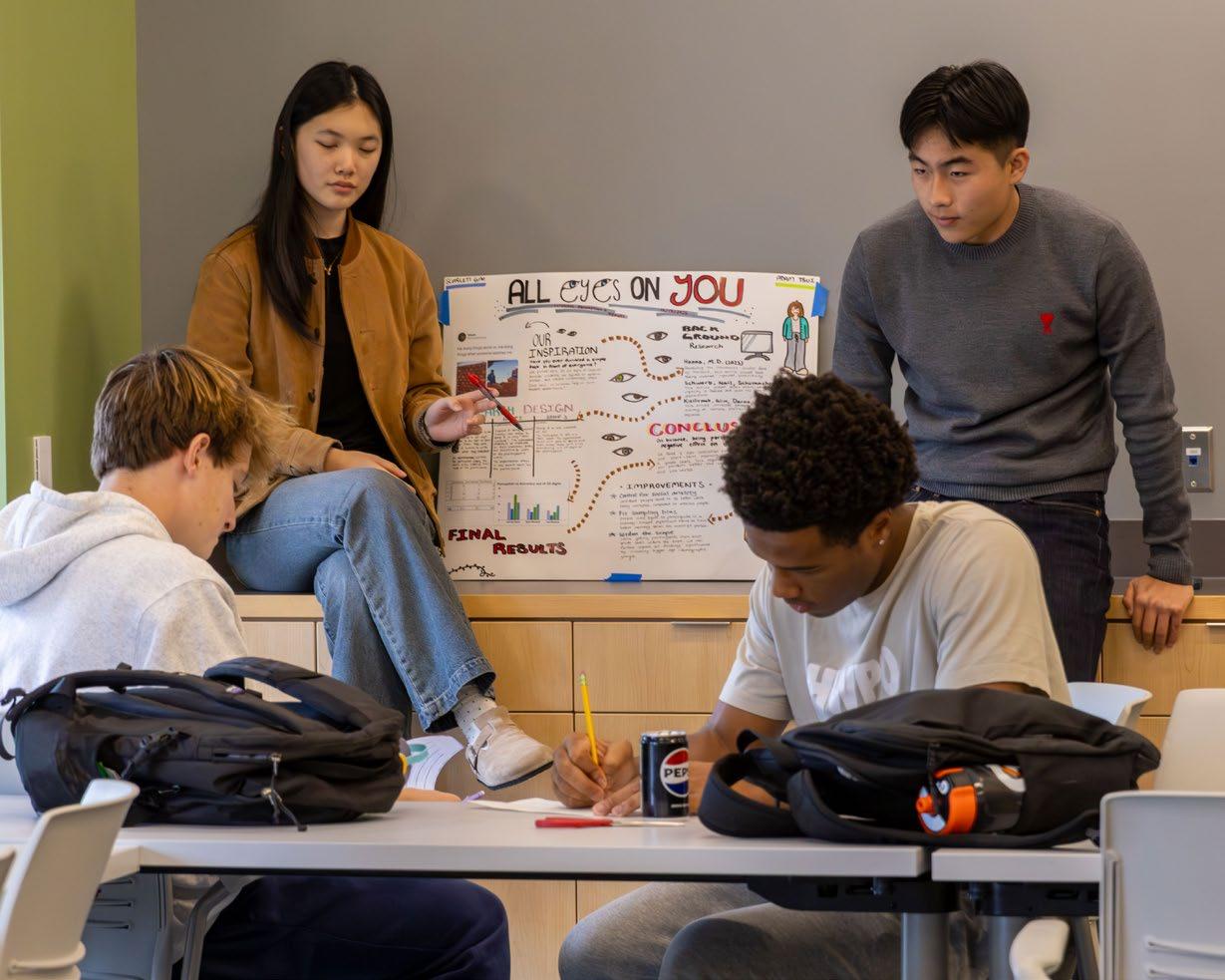
The Pathway Scholars program empowers Durham Academy students to pursue individualized genuine interests with purpose and passion. Scholars may choose one of the predefined Pathway focus areas — Entrepreneurship, Global Citizenship and Sustainability — or design their own Pathway. Scholars commit to a unique and powerful learning experience grounded in research, problem-solving, creative thinking, scholarship and real-world application. This interdisciplinary opportunity transcends the boundaries of traditional subject areas.
Scholars will imagine, design and implement communitybased research projects. Students may apply for funding to support their projects through the DA Community Engagement Microgrant fund. They will enroll in two semester courses: ADV Community-Based Research and then ADV Pathway Scholars The culminating event is the Research Symposium at which scholars demonstrate their learning to the wider community by presenting their project. Pathway Scholars receive distinctions on their transcripts.
ENTREPRENEURSHIP PATHWAY
Entrepreneurship is a mindset. Entrepreneurs and innovators are helping to solve some of the world’s biggest problems. Students who choose the Entrepreneurship Pathway will imagine, design and implement projects that apply to real-world problems in engineering, art, business and more.
GLOBAL CITIZENSHIP PATHWAY
Desmond Tutu — Nobel Peace Prize winner, antiapartheid activist and former archbishop of Cape Town — describes the African concept of ubuntu “Ubuntu is the essence of being human. It speaks of how my humanity is caught up and bound up inextricably with yours.” Students who select the Global Citizenship Pathway will imagine, design and implement projects that address our interconnectedness as human beings. Projects could involve local action to address a global issue.
SUSTAINABILITY PATHWAY
To be environmentally sustainable is to function in a way that does not jeopardize the well-being of future generations. Students who choose the Sustainability Pathway will imagine, design and implement projects that address the climate crisis locally or globally.
STUDENT-DESIGNED PATHWAY
The Pathway Scholars program empowers Durham Academy students to take ownership of their learning. While there are existing structures in place for the Global Citizenship, Sustainability and Entrepreneurship Pathways, any student who is interested in a topic that does not easily fit into one of these categories may work with Pathway Scholars faculty to design their own pathway.
EXAMPLES OF STUDENT-DESIGNED PATHWAY PROJECTS:
• A Biophilic City: Enhancing Urban Life Through Sustainability: How can we enhance sustainability efforts by fostering connections between humans and nature? This student set a goal of registering Durham as a Biophilic City — a global initiative that aims to improve residents’ well-being while addressing urban growth challenges. After partnering with a local bird alliance leader to draft a resolution, creating supporting documents and advocating for the initiative’s passage, this student was successful — earning unanimous City Council approval.
• Bringing Journey League to Durham Academy: The purpose of this initiative was twofold: to provide a safe, inclusive space for individuals with special needs to enjoy basketball and to integrate this program as an enduring part of the Durham Academy community. Through thoughtful planning and collaboration, the project laid the groundwork for a sustainable program that enriches the lives of its participants and fosters meaningful connections between athletes, their families and DA student volunteer coaches.
Interested students must complete the application process:
• Provide a written (or video-recorded) explanation of your demonstrated interest and action within your Pathway: Entrepreneurship, Global Citizenship, Sustainability, or Student-Designed.
• Complete an in-person interview with the Pathway Scholars Review Committee.
• Provide a reference who can speak to your work or interest within your Pathway.
Pathway Scholars Application
Pathway course descriptions can be found in Interdisciplinary Studies (page 36).
DIPLOMA REQUIREMENTS
Durham Academy Diploma Requirements
Twenty (20) credits are required for graduation. One credit is awarded for a full-year course; one half-credit is awarded for a one-semester course. The minimum course load is five courses each semester. Students are not allowed to drop a full-year course at the end of the first semester. Physical education courses are not counted toward the minimum load or toward the 20-credit requirement; nor is a course that is being repeated. Students must pass the equivalent of eight semester courses (four full-year courses) in their senior year.
Computer Science 0.5 Credit
Students are required to earn a one-semester computer science credit. Ninth grade students who successfully complete the Technology Education portion of Grade 9 Life Skills are exempt. Students who first enroll in DA in grades 10–12 may waive the requirement by completing a technology portfolio, or they can earn the credit by enrolling in one of DA’s computer science courses. See the Computer Science section for additional information.
English 4 Credits
Four years of English are required. English 9 and English 10 are the assigned courses in grades 9 and 10, respectively. Juniors must take either English 11: American Literature or ADV English 11: American Literature and Rhetoric. Seniors select two semester-length English 12 seminar courses from an array of offerings.
Fine Arts 1 Credit
All students are required to take one full-year course in any fine or performing arts discipline.
History 3 Credits
Three years are required. In grade 9, all students take Making of the Modern World. In grade 10, all students take U.S. History. Students must complete another two semesters of history at any point in their sophomore, junior or senior years.
Mathematics 1–4 Credits
Students are required to complete Algebra 1, Geometry, Algebra 2 and at least one year of mathematics beyond Algebra 2 in a course for which Algebra 2 is the prerequisite. Courses taken in middle school count toward the mathematics requirement but not toward the 20-credit graduation requirement.
Physical Education
All students must complete one approved physical education activity per year in grades 9 through 12. Details can be found in the Physical Education section.
Science 3 Credits
Students are required to take three years of laboratorybased science in sequence — Physics (grade 9), Chemistry (grade 10) and Biology (grade 11).
World Languages 2–3 Credits
Students are required to complete three consecutive years of the same language or two consecutive years of the same language if they begin at the Intermediate Low level or higher.
Additional Coursework 1.5(+) Credits
Additional requirements may be fulfilled by selecting courses from the above departments or Interdisciplinary Studies.
Note: The minimum course load is five courses in each semester. Physical education courses are not counted toward the minimum load or toward the 20-credit requirement; nor is a course that is being repeated or audited.
NOTES:
Credit*
DIPLOMA REQUIREMENTS WORKSHEET
STUDENT NAME
Credits
Credits
Electives 1.5(+) Credits *Students who successfully complete the Grade 9 Life Skills course are exempt from this requirement.
COMPUTER SCIENCE
Diploma Requirements: 0.5 Credit*
Ninth grade students enroll in the full-year Life Skills course that includes physical education, technology, sustainability, and Self and Community. In the technology unit, taught during the fall semester, students gain exposure to various digital tools and platforms used at DA, including cloud technology, collaborative tools, multimedia presentation software, and student information systems (currently Veracross).
Students also explore emerging ethical and social issues, such as information privacy, big data, and artificial intelligence. The technology seminar portion of Life Skills provides students with the skills to stay engaged and competitive in a digital classroom environment. The class is structured as a portfolio exercise and concludes with a test. Successful completion exempts students from the required graduation course credit and allows them to earn administrative privileges on their DA-issued laptop.
Note: Students new to DA in grades 10, 11 or 12 who do not have a computer science credit must demonstrate technology proficiency equivalent to that of ninth graders who complete the Grade 9 Life Skills technology seminar. Students unable to demonstrate proficiency must complete a computer science course to fulfill the 0.5-credit graduation requirement.
ABOUT ADVANCED (ADV) COURSES IN COMPUTER SCIENCE
Durham Academy offers three Advanced computer science courses for students who have completed CS 100- to 300-level courses and Precalculus. The sequence includes CS 450 ADV Computer Science (Java), CS 500 ADV Data Structures (C++), and CS 500 ADV Machine Learning and AI (Python), building progressively in complexity and depth. Each course challenges students to think critically and creatively while developing problem-solving skills. The CS 500 Machine Learning and AI course is studentled and student-driven, serving as the capstone of the computer science program. Students who complete all three ADV courses are well-prepared for computer science or engineering degrees in college.
*Students who successfully complete the Grade 9 Life Skills course (see Interdisciplinary Studies on page 37) are exempt from this requirement.
Transfer Goals Computer Science
Students will be able to independently use their learning to:
• Foster an inclusive computing culture.
• Collaborate around computing.
• Recognize and define computational problems.
• Develop and use abstractions.
• Create computational artifacts.
• Test and refine computational artifacts.
• Communicate about computing.
CS 100 • Introduction to Programming
Grades: 9, 10, 11, 12
Fall, Spring
PREREQ: Algebra I
Introduction to Programming is perfectly suited both for students who are curious about computer programming and for students who are confident in their plan to pursue additional computer science classes at DA or in college. For curious students, the course serves as an introductory exposure to computer programming and computer science using Python. For students who plan to continue their studies in the DA Computer Science Department, the course can help prepare them for CS 450 ADV Computer Science (students can also take CS 300 Game Design to be even better prepared for CS 450).The curriculum places heavy emphasis on the basic fundamentals of programming, such as data types, expressions, operators, selection structures, loops, methods and lists. The textbook and most course tools are freely available online. Therefore, it is essential that students have access to the Internet at home to complete assignments. Students should be comfortable with self-directed learning and problem-solving. While Algebra I provides a necessary foundation, success in this class depends more on logical thinking and problem-solving than on advanced mathematical ability. The course requires substantial work both in and outside of class to complete the curriculum and all projects on time.
CS 100 • Robotics 1
Grades: 9, 10, 11, 12
Fall
In Robotics 1, students explore theoretical and practical engineering and programming skills while preparing for interscholastic competition. Students study computer programming and principles of mechanical engineering, design artificial intelligence behaviors, and build basic robots.
CS 200 • Robotics 2
Grades: 9, 10, 11, 12
Spring
PREREQ: Robotics 1, Intro to Programming or permission by instructor
In Robotics 2, students build on concepts covered in Robotics 1 and apply knowledge about electrical materials, electric circuits, electromagnetism, computer science and mechanics. This course deepens students’ application of skills and knowledge from physics, math and computer science courses while developing an understanding of the interdisciplinary nature of engineering and technology, as well as possible STEM career paths. Through collaborative group projects, students develop creativity and problem-solving skills to create more complex solutions to socially relevant problems.
CS 300 • Game Design
Grades: 9, 10, 11, 12
Spring
PREREQ: Algebra I, Geometry (may be concurrent), and Introduction to Programming, or permission of instructor
In Game Design, students design and code games using Python and the Pygame library, exploring 2D design, object-oriented programming, sprite animation, user interactivity and game interfaces. Students solve problems and create content while developing the design and technical skills necessary to build their own games. Students utilize online texts and tutorials plus direct instruction to learn and master new topics. Geometry is an essential foundation for success, as geometric proofs develop algorithmic thinking similar to computer science problem-solving, and game design requires application of 2-D and 3-D geometric concepts. The course uses primarily artifact-based assessment and culminates in a final project. At the end of the course, students will work with their instructor to plan their continued computer science journey at DA.
CS 450 • ADV Computer Science
Grades: 10, 11, 12
Full-Year
PREREQ: Precalculus with no prior coding classes, or Algebra II and one of the following: CS 100 Introduction to Programming, CS 100 and CS 200 Robotics 1 and 2, or CS 300 Game Design This full-year course is a broadly focused exploration of Java programming that mirrors a 100-level college computer science course. The first third covers procedural programming, emphasizing Java’s foundations derived from C and C++. The second third focuses on object-oriented design, inheritance and polymorphism, highlighting Java’s distinct features from its predecessor languages. The final third concludes with algorithm design and efficiency, encompassing recursion, searching, pattern recognition, and sorting. Students gain proficiency in Java programming, class design, information encapsulation, and experience with string, array, and list methods and their associated functionality. Assessments include e-text homework, lab and project coding assignments, quizzes, tests, and occasional CTF (capture-the-flag) team problem-solving exercises. Students also learn GitHub usage and collaborative project posting. Student success requires dedication, maturity, independent follow-through and collaborative skills.
CS 500 • ADV Data Structures
Grades: 10, 11, 12
Spring
PREREQ: CS 450 and Precalculus
This semester-long course is a focused exploration of advanced data structures in C++, spanning array lists, vectors, linked lists, stacks, queues, binary trees, heaps, dictionaries and lookup tables. The course provides students with theoretical concepts involving advanced data structures and the C++ language that empowers them to build user-defined structures instead of relying on library-driven solutions. Students navigate concepts like hashing and mapping, exploring algorithms that balance memory space and speed efficiency based on specific problem-solving needs. Assessments include e-text homework, lab and project coding assignments, progress check quizzes, and occasional CTF (Capture The Flag) team exercises. The course emphasizes version control through GitHub and builds on material from CS 450, assuming students possess prior understanding of object-oriented design, inheritance and polymorphism.
CS 500 • ADV Machine Learning and AI
Grades: 10, 11, 12
Fall
PREREQ: CS 450 and Calculus. Recommended: CS 500 ADV Data Structures and a Data Sciences mathematics course
This semester-long course delves into machine learning, automation algorithms, artificial intelligence (AI), and predictive analytics using Python’s data analysis and visualization libraries. Student-driven, it challenges students to grasp advanced coding, mathematical and logical concepts. Assessment revolves around four major projects: three crafted by the teacher and one chosen by the student. As the capstone computer science course at Durham Academy, it requires independent work, self-teaching and the implementation of unique, non-traditional project designs. Students present their projects in class, defending the choices they made — of data sources, Python modules, and mathematical reasoning — to achieve desired outcomes. Peers and the teacher assess student work collaboratively.
APPLYING ACADEMICS OUTSIDE OF THE CLASSROOM
ROBOTICS
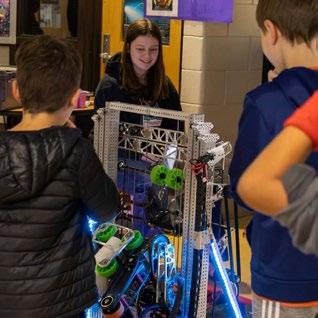
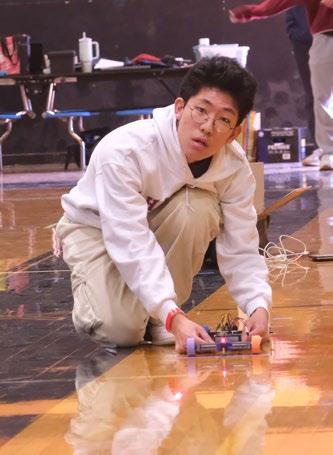
Durham Academy Upper School students compete in the FIRST Robotics Competition (FRC) program. FIRST’s values of gracious professionalism, “coopertition” (cooperation and competition) and good sportsmanship align directly with Durham Academy’s core values for helping each student achieve personal growth in a supportive and challenging environment. Students design, build and program a specialized human-sized robot each year within the span of an intense six-week build period. Teams then compete in local, state and international competitions.
Participating in robotics at DA provides students with opportunities to develop skills in teamwork, project management, marketing and branding, business plan development, community outreach, software development, fabrication and computer-aided design. Students work closely with their peers to achieve shared goals and often form long-lasting friendships.
UPPER SCHOOL ROBOTICS: DARC SIDE
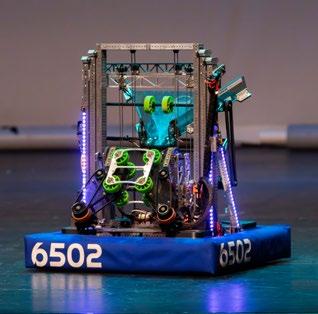
Durham Academy’s FRC Team, 6502 DARC SIDE (Durham Academy Robotics Club, Students in Design and Engineering), operates as an extracurricular club available to all Upper School students. Since its establishment in 2016, DARC SIDE has achieved remarkable success, including earning awards in the North Carolina State Championships each year and competing in the World Championships. The team takes pride in striving to be inclusive, diverse and fair to all students who wish to participate. Encouraging students who may identify with traditionally underrepresented groups in engineering is a particular focus.
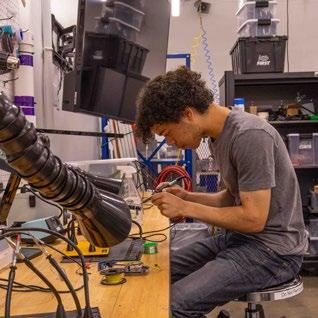
DARC SIDE meets in the Upper School fabrication lab, which provides students with access to an industrial-grade machine shop equipped with a CNC machine for crafting designs from aluminum, wood, plastics and various materials. Additionally, the lab features a 100W CO2 laser for precision cutting and engraving on wood, plastics and metals, alongside 3D printers and an array of shop tools such as lathes, drill presses, power saws and hand tools.
Learn more about DARC SIDE
ENGLISH
Diploma Requirements: 4 Credits
The Durham Academy English Department seeks to help students develop the skills and habits of lifelong readers, scholars, and global citizens:
• close attention to the language, structures, and meanings of texts
• understanding the people and systems that produce texts and the various purposes texts serve
• curiosity, creativity, and the will to pursue both
• collaboration and active listening
• ethical and empathetic engagement across differences
• the use of writing and speech as means to explore and express ideas and reflect on the developing self.
All of our courses are organized around this mission and philosophy.
ABOUT ADVANCED (ADV) COURSES IN ENGLISH
Advanced courses in the English Department invite students to engage with literature as critics, authors, and public intellectuals.
Students apply advanced foundational skills — close and active reading, independent interpretation, critical thinking, and writing across a range of modes — to analysis of texts and the cultural contexts, critical approaches, and broader conversations that surround them.
Students learn to think with texts in a variety of ways:
• examining how meaning is constructed
• exploring big questions that excite their curiosity
• conducting independent research
• trying on different critical lenses
• positioning their ideas in scholarly discourse
• discovering ways of understanding real-world issues and their own lived experience.
Students in Advanced (ADV) English courses should expect higher standards for foundational skills, engagement, curiosity, and self-sufficiency.
Transfer Goals English
Students will be able to independently use their learning to:
• Read regularly, for information and enjoyment, and know themselves as readers.
• Explore words and images to gain both a greater understanding of themselves and empathy for other experiences and perspectives.
• Use speaking and listening skills to effectively communicate ideas, in both face-to-face conversation and oral presentations, to suit various audiences and goals.
• Read all kinds of texts and images with confidence and the skills to think critically about context, content, and message.
• Communicate ideas effectively in writing to reach a variety of audiences and fulfill a variety of purposes.
• Pose thoughtful, open-ended questions, and search for and develop reasonable, evidencebased conclusions.
ENG
100 • English 9: Innocence & Experience
Grade: 9
Full-Year
In English 9, students acquire and apply the skills and habits necessary for a literate life. The course focuses on the thematic topic of Innocence and Experience, including how individuals and cultures signal childhood and adulthood, the role of knowing the self in maturing, and navigating difference and conflict as we come of age. Reading assignments include a diverse range of authors, cultures, and genres and help students build foundational comprehension and interpretive skills, including developing an annotation style that supports the individual learner. Writing assignments — which include personal response and analytical modes — emphasize developing supportable interpretations from well-selected textual examples and expressing those interpretations clearly. Grammar instruction highlights understanding functional components of the English language to enhance clarity in writing and reading comprehension.
ENG 200 • English 10: Truth & Justice
Grade: 10
Full-Year
English 10 builds on the essential literacy skills of English 9, moving students into analysis of how texts create their meanings and effects. The course focuses on the thematic topic of Truth and Justice, prompting students to explore ways of knowing, structures of power, and mechanisms of justice. Reading assignments include a diverse range of authors, cultures, and genres, and help students develop active and critical reading skills through close engagement with language, structure, and theme. Mastering the analytical essay is a focus of the course, with students moving from theme papers that address big textual questions to close readings that focus on how language operates within a work of literature. Class discussion encourages students to try out interpretations and develop understandings collaboratively. Students continue to hone their annotation skills, grammar, mechanics, and vocabulary.
ENG 300 • English 11: American Literature
Grade: 11
Full-Year
In English 11, students explore essential questions that continue to define American culture: What does it mean to be an American? What is the relationship between individual and community? Who has voice and power in our country, and how can the disenfranchised speak truth to power? By studying major works of American fiction, poetry, and nonfiction, students continue to hone and expand their literacy skills, deepening their
understanding of language, form, and theme. Daily class discussions prompt students to exchange ideas and perspectives with their peers, engaging in collaborative learning. Writing assignments challenge students to compose in a range of modes, including comparative analysis, personal narrative, and the Common App college essay. Students develop their research, synthesis, and argumentation skills through a full-year passion project that invites them to dive deeply into a topic of their choice. Students in English 11 will get more in-class reading review and writing instruction than students taking ADV English 11.
ENG 450 • ADV English 11:
American Literature & Rhetoric
Grade: 11
Full-Year
PREREQ: Department approval required Students in ADV English 11: American Literature & Rhetoric will do everything detailed in the English 11 description and undertake an additional focus on rhetoric, the art of using language effectively to persuade and influence others. Through rhetorical analysis, students learn to consider how a text’s context informs the choices an author makes. ADV English 11 students will read more nonfiction and examine how American writers and speakers have used artful language to construct and critique the image and values to which America aspires. Students will jump right into interpretive work in class each day, independently navigating more fundamental skills such as reading comprehension and essay drafting. Students can expect more challenging assessments, a heavier cognitive workload, and higher standards for reading and writing skills than in English 11
English Lab
Grades: 9, 10, 11, 12
Full-Year, Fall, Spring
PREREQ: Students must be enrolled in a grade-earning English class (like English 9, etc.) and have the recommendation of their previous or current English teacher. This course will provide additional support to students taking English 9, English 10, English 11, or English 12 through extra instruction on and coaching of reading and writing skills. Students in the class will benefit from oneon-one support that meets them where they are and helps them continue to advance the literacy and writing skills that will allow them to succeed in all of their classes — and beyond. The course is pass/fail and does not have its own coursework or homework. Rather than add to a student’s workload, it is designed to support them in navigating their reading and writing assignments with greater confidence, independence, and success.
SENIOR ENGLISH SEMINARS
Seniors must take one English 12 seminar each semester to satisfy their English requirement. Offerings include both English 12 and ADV English 12. In ADV English 12 courses, students can expect a heavier cognitive workload, more challenging material and assessments, and higher standards for reading, writing, and seminar skills. We encourage students to follow their interest and curiosity when selecting senior seminars; junior-year teachers will make a recommendation for additional guidance. Seniors will select their top three seminar choices per semester, and enrollment will be subject to schedules and available space. Juniors can sign up for nonADV senior English 12 seminars in addition to English 11 or ADV English 11, but enrollment will be subject to available space and the English Department’s approval.
FALL SEMESTER COURSES
ENG 400 • English 12: Banned Books
Grade: 12*
Fall
This course explores the relationships between dominant and subcultures by investigating books that have been restricted or banned by different groups. In America, there is a growing movement to pull books considered “indecent” or “offensive” from classrooms and from school and county libraries. In this course, we seek to understand the growing disagreement about which books are “good” for young people. Part of this requires asking the question, “What are books good for, anyway?” We will consider which ideas are considered most dangerous or least desirable and how art serves as a resistant voice against groupthink (itself an idea derived from a frequently-banned book). After reading several books that have been widely challenged in our country, students will have daily discussions and write both analyses and personal-response papers that develop their own thoughts about the power and potential of ideas, including who should have access to them — or not. The texts in this course all contain sensitive and controversial material and require mature readers.
ENG 400 • English 12: Hip Hop and Poetry
Grade: 12*
Fall
This course explores the artistry of Hip Hop as a poetic and cultural force that speaks truth to power, builds identity, and reshapes language. By reading and listening to a range of poems and rap lyrics, students will investigate how artists across genres use sound, storytelling, and symbolism to resist
*departmental approval required for 11th grade students
dominant narratives and imagine new possibilities for self-expression. While poetry has long been a part of the literary canon, Hip Hop is often dismissed as counterculture. This course challenges that divide, asking not only who gets to be a poet, but what counts as poetry in the first place. Students will examine how both poets and MCs craft language to protest injustice, celebrate community, and explore complex identities. Throughout the semester, students will engage in daily discussion, comparative analysis, personal responses, and creative projects, including lyric annotations, poetic imitations, and performances. This course honors Hip Hop as a deeply literary tradition, one that invites us to listen closely, speak truthfully, and think critically about voice, power, and art.
ENG 400 • English 12: Sci-Fi and Dystopian Fiction Grade:
12*
Fall
At literature’s core are some big questions, including: “What does it mean to be human?” “How do I matter to the world around me?” and “Are people inherently good or evil?” Sci-fi and dystopian fiction attempt to answer these and other questions by imagining other worlds, alternate timelines, and what our future may hold. In this course, we will read short stories, poetry, and novels and watch sci-fi and dystopian TV shows and movies. Students will analyze the elements specific to the sci-fi and dystopian genres and will think about, write about, and discuss how they connect to humanity, society, and themselves as individuals.
ENG 450 • ADV English 12: Contemporary Global Issues in Fiction Grade: 12
Fall
PREREQ: Teacher recommendation advised
The five novels in this course resist being categorized within a single nation’s borders. They also share a preoccupation with whether it is possible to find a shared humanity — i.e., to create some form of justice — that transcends the boundaries of geography and identity both within and among modern nationstates. We will examine how these novels treat the notion of “otherness,” whether they suggest the possibility of organizing a global citizenry through mechanisms other than individual nations, and how the intersection of literary and political theory can help us illuminate the tools of fiction writing, as well as the insights fiction offers into the human condition. We shall seek to discover an alternative to these very labels (national borders) we use to define our sense of where we are, as well as our sense of who we are. Students will write
essays that synthesize literary analysis, realworld problem-solving, and personal reflection. All essay assignments invite students to pursue individually determined research questions. In the words of one student, the course aims to “push students to deconstruct their personal beliefs” in order to, as another student writes, “re-evaluate [their] own place in the world.” Every assignment, every discussion, every reading is devised in service of these aims.
ENG 450 • ADV English 12: Fantasy of the Middle Ages in Literature and Film Grade: 12
Fall
PREREQ: Teacher recommendation advised This course introduces students to art and literature from and about the Middle Ages. The semester’s work begins with medieval literature (in translation!), asking students to identify and articulate literary tropes in stories about King Arthur and Camelot. From there, students will consider the medievalist fantasies of nineteenth-century literary and visual arts. Finally, the course will cover 20th and 21st century reimaginings of the Middle Ages, especially considering gender, race, and magic in literature, video games, plays, and movies. Secondary sources including The Black Middle Ages, The Public Medievalist, and Whose Middle Ages? Teachable Moments for an Ill-Used Past will provide historical overviews and theoretical lenses on our work. Students will have one test at the beginning of the year and a final exam; between these two, they will submit short papers through which they develop formal analyses, comparative frameworks, and research methods according to collegiate standards. Students will be evaluated on how critically they articulate the ways myths about the past have shaped our present, and how they might be used to imagine a better future for us all.
ENG 450 • ADV English 12: Literary Theories
Grade: 12
Fall
PREREQ: Teacher recommendation advised Literature has been an important mode of human understanding and expression for thousands of years. You have been required to study it every year of your education, which has emphasized the primacy of reading with skill. But what is literature for? Who decides what books are “good” or worthy of study, and how do they make those determinations? These questions are the basis of literary theory — the scholarly consideration of the art of literature, its purposes, and its impacts. In this class, you will join in that scholarly consideration and weigh these questions and the various answers to them
for yourself. To do this, we read both pieces of literary theory — nonfiction treatises on the nature and forms of literature — and literary works including poetry and novels. Students in this course can expect a high level of complex reading, frequent writing assignments, and high expectations for class discussion engagement.
ENG 450 • ADV English 12: Shakespeare Grade:
12
Fall
PREREQ: Teacher recommendation advised This is not a course about a solitary genius who lived and wrote 400 years ago in England, but rather a living, breathing body of literature that is in current production, adaptation, and public discourse all over the world. What is it about this remarkable literature that allows it to bend to the questions, concerns, mindsets, and sensibilities of each new audience it encounters? Students will explore this question and learn how to think with Shakespeare alongside the diverse scholars, public intellectuals, creatives, artistic directors, actors, writers, readers, and theatergoers around the globe engaged in this project. That is to say, we will use this body of literature as a tool for examining our society past and present, the human condition in all its messy glory, and the remarkable facility of language and imagination to construct and deconstruct our world. But Shakespeare’s plays are not all serious business. Students will also learn to delight and participate in the poetry and playfulness of these texts. Students can expect collegiate standards for reading, thinking, discussion, and writing skills, as well as a wide range of assignments, including literary analysis and explication, critical engagement with scholarship in the field, independent research, formal seminar discussion, scene analysis and scene play, sonnet recitations, and creative writing.
SPRING SEMESTER COURSES
ENG 400 • English 12: Escapist Literature
Grade: 12*
Spring
Humans are resilient, and over time we have come up with thousands of ways to respond to stressful circumstances. One prominent way humanity responds to hardship, stress, and boredom is through mental escape: by daydreaming or watching TV, by drawing or going on a walk, by playing games or writing stories — and, of course, by reading. In this course, students will choose their own books to read throughout the semester based on their personal definitions of escapism. They will practice pacing their reading independently, and they will regularly reflect on and analyze these books in small group discussions and in
*departmental approval required for 11th grade students
one-on-one conversations with the instructor. In addition, the class will explore a variety of short texts, from several genres and in several formats. Students will treat genre fiction seriously, delving into its history of stigmatization and examining the ways different genres have evolved, in part by preparing a detailed presentation on a subgenre. Students will also discuss books across age levels, taking a trip to the Lower School to connect with favorite stories from childhood. The connecting thread? Everything students will experience fits within the category of escapist literature. Ultimately, all class discussions tie back to two essential questions: 1) What does it mean to escape? 2) What constitutes literary value?
ENG 400 • English 12: Ghost Stories
Grade: 12*
Spring
There’s nothing better for a good scare than a ghost story, but entertainment value alone does not explain the persistence of ghost stories across time and cultures. In this course, we will explore the cultural work that ghost stories do. In myth, folklore, literature, and film, we will see how ghost stories are sites for contending with human psychology, history, memory, trauma, and injustice. In the first unit, Haunted Houses, students will collaboratively discover, classify, and decode tropes of the Gothic genre and consider its popularity as a response to the Age of Reason and alongside the rise of Spiritualism. In the second unit, Haunted Landscapes, students will explore the notion that the present is always haunted by the past, researching the historical, cultural, and regional contexts behind specific stories, sites, and legends, including local haunts. In the final unit, Haunted Futures, students will consider how emerging issues and technologies — the climate crisis and AI — might shape our cultural relationship with ghosts. Students can expect regular reading assignments that include short stories, novels, folktales, nonfiction essays, and historical narratives, as well as the occasional podcast and film. Classwork and assessments will include group and independent work, presentations, literary analysis, interdisciplinary research, and opportunity for storytelling and creative writing.
ENG 400 • English 12: Outlaw Ocean Grade: 12*
Spring
Outlaw Ocean surveys stories of human interactions with the ocean from the earliest records of the North Sea to contemporary journalism in the South China Sea. We will listen to podcasts, read fiction and nonfiction, and learn about international maritime laws. We will discuss race, power and gender-bending aboard boats that sail beyond the reach
of any nation’s jurisdiction. We will consider how the sea around us is changing, and contemplate real-world solutions. This course is designed especially for students who have not yet found their voices in the English classroom, and it will be interdisciplinary from start to finish. Documentaries, podcasts and authorbased websites will support all kinds of learners, interests, and abilities.
ENG 400 • English 12: Sports Journalism Grade:
12*
Spring
This seminar explores sports journalism as a literary, cultural, and historical phenomenon, investigating how writers have shaped public perception of athletes, games, and social issues. Students will study the golden age of sports writing, analyzing masterful prose from figures such as Red Smith, Grantland Rice, and A.J. Liebling, and examining how their perspectives and biases informed their storytelling. The course then examines coverage of socially and politically significant athletes, including Jackie Robinson, Muhammad Ali, and Billie Jean King, to explore the intersections of race, gender, activism, and media influence. Finally, students analyze modern sports media and digital journalism, exploring how social media, multimedia platforms, and contemporary reporting have transformed narrative authority, ethics, and public discourse. Students will develop critical reading skills, media literacy, and applied writing skills through analytical essays, reflection papers, and a culminating portfolio of original sports journalism that demonstrates both craft and cultural insight.
ENG 450 • ADV English 12: American Novels, American Problems Grade:
12
Spring
PREREQ: Teacher recommendation advised In this ADV-level semester-long course, students will examine literature that engages with issues such as climate change, public health, economic inequality, and social and racial injustice. Through close reading, analytical writing, independent projects, and seminar-style discussions, students will investigate how contemporary texts both reflect and shape cultural conversations and social change. In addition to studying modern novels, students will read, analyze, and evaluate works of literary scholarship to deepen their understanding of critical debates surrounding texts. This is a discussion-driven course: students will be expected to arrive each day prepared with insightful, textbased questions and to contribute meaningfully and consistently to a rigorous, inquiry-focused classroom community.
ENG 450 • ADV English 12: Race and Identity in America
Grade:
12
Spring
PREREQ: Teacher recommendation advised This course will examine the power of race as a social construct — not rooted in biological reality — that has affected American life as much as any other human force or entity. Looking at race in fiction, essays, poetry, film and through the lens of literary theory, we will explore the impact of race on us individually, collectively, and nationally, seeking to understand America’s persistent racial injustice through the context of its egalitarian ideals. That is to say, the course seeks, in the words of author Heather McGhee, “to tally the hidden costs of racism to us all.” All essay assignments invite students to synthesize literary analysis, realworld problem-solving, and personal reflection as they pursue individually determined research questions. The course culminates in a memoir project that asks students to consider the impact of race hierarchy on American culture and how they understand their own identities — articulating the nature of their historical, cultural, racial, psychological, economic, political, ethnic, spiritual, and biological pasts so that they may inherit themselves
ENG 450 • ADV English 12: Women’s Literature Grade: 12
Spring
PREREQ: Teacher recommendation advised ADV English 12: Women’s Literature applies several theoretical lenses (e.g., feminist theory, queer theory, formalism, old historicism, Marxism) to the study of literature written by and about people who identify as women. Essential questions of the course include: Are the themes that interest or occupy women different from those that appear in books by and about people who identify as men? What do some of the language’s most talented writers have to say about their lives and experiences, and why have some of them perennially been left off reading lists in English classes? Students in the class read nonfiction, poetry, short stories, and novels by cis- and trans women, considering their sociological, historical, and aesthetic contexts. Much of the learning and reading is processed through in-class discussions that require full and engaged participation from every student. Frequent short writing assignments will help students see connections between the texts we study and between those texts and their own lives. A culminating research project will allow students to identify, explain, and respond to connections between the literature we study and our sociopolitical moment.
*departmental approval required for 11th grade students
SPEECH & DEBATE
Speech and Debate is about so much more than winning arguments. Participation in DA’s program is a journey into understanding current events, global politics, argumentation, research skills, and the ability to think on one’s feet and speak with confidence. Since its founding in 2005, Durham Academy Speech & Debate Team has grown into one of the nation’s premier programs by supporting students of all experience levels as they discover their unique voice.
The speech and debate program is now organized two connected experiences designed to enhance accessibility while sustaining the highest levels of competitive excellence:
THE SPEECH & DEBATE TEAM
The Speech & Debate Team, open to any Upper School student, provides broad access to speech and debate education, local tournaments, and selected national opportunities. Students learn the foundations of argumentation, research, presentation, and leadership while preparing for major annual competitions such as the TFL State Championship, NCFL Grand Nationals, and the NSDA National Tournament.
THE NATIONAL SPEECH & DEBATE TEAM
The National Speech & Debate Team, a selective and highly competitive division, supports students who wish to pursue advanced skill development and national-circuit competition. Students apply for seasonal participation blocks and, once admitted, train more intensively, attend targeted coaching sessions, and compete at round robins, national invitationals, and elite championships — including the Tournament of Champions.
Participants of both teams develop transferable skills: critical thinking, research fluency, organization, oral communication, listening, analytical clarity, and leadership. With roughly 90 students participating each year, the DA Speech & Debate program represents a diverse and vibrant community united by curiosity and advocacy. Students may join the Speech & Debate Team during our fall onboarding period, and National Team applications open each June and remain open throughout the year. All students participate in regular practices, local tournaments, and school-hosted events — including the Cavalier Invitational each January.
Durham Academy’s program has earned national recognition for excellence, including the Eleanor E. Wright Award for Debate and the Daniel S. Masterson, Jr. Award for Forensics, placing the school among the top teams at NCFL Nationals. DA is consistently listed among the top 100 chapters of the National Speech & Debate Association and holds one of the longest streaks of top-20 finishes at the NSDA National Tournament, earning the School of Outstanding Distinction Award in 2020, 2023, and 2024.
Our team provides students with access to competitions across the Triangle and, for those pursuing national-level competition, opportunities at universities such as Harvard, Princeton, Emory, University of Florida, and beyond.
Above all, speech and debate at Durham Academy is a community. Students build lasting friendships, discover confidence and purpose, and engage with ideas that shape their understanding of the world. Whether a student is exploring public speaking for the first time or competing on the national circuit, we believe every learner can find their voice — and use it to lead a moral, happy, and productive life.
Learn more about Speech and Debate
FINE ARTS
Diploma Requirements: 1 Credit
We believe that the learning and practice of art encourages the growth of the whole student and deepens the understanding of the human experience. Research shows that making art (in visual or performing arts) transforms our brains and our bodies*; we see this benefit especially in those making art each year. Fine Arts courses are studio classes, where students develop their skills by actively engaging in their chosen discipline, working independently and collaboratively. Through this process, students conceive and express their artistic ideas through experimentation and risk-taking across one or more disciplines, both inside the classroom and through extracurricular offerings.
*Johns Hopkins University and the American Academy of Arts & Sciences
Transfer Goals Fine Arts
Students will be able to independently use their learning to:
• Actively engage in the arts.
• Solve problems independently and collaboratively.
• Experiment and take risks to conceive, develop and express artistic ideas.
• Communicate ideas about and respond authentically to art in an informed manner.
• Connect artistic ideas and works with societal, cultural and/or historical contexts to deepen understanding of the human experience.
DANCE
FA 200 • Novice Dance
Grades: 9, 10, 11, 12
Full-Year
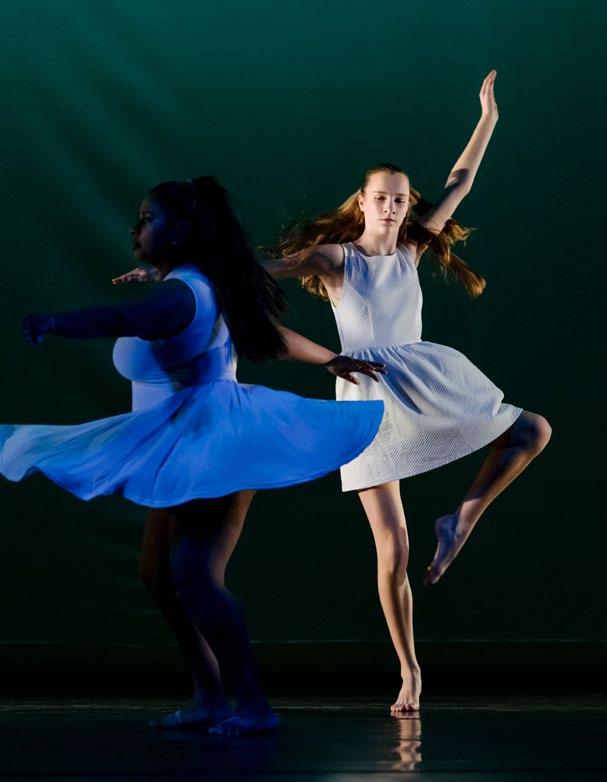
This full-year course will develop the beginning dancer in terms of knowledge of dance history, vocabulary, technique, choreography and performance skills. Students will explore aspects of movement, improvisation and choreography on an individual and group basis. Proper dance class and performance etiquette will be discussed and practiced daily. This course will introduce various dance styles including Ballet, Jazz, Modern, Broadway, Hip-Hop, Tap and Contemporary, and will evoke the creative voice of each student through movement exploration and choreographic small projects. Students enrolled in Novice Dance are required to perform in the winter and spring dance concerts. Dancers with at least one year of dance experience are encouraged to participate in a dance placement class in the spring.
FA 300 • Intermediate Dance
Grades: 9, 10, 11, 12
Full-Year
PREREQ: Dance placement class and instructor’s permission
This full-year, multi-level course will focus strongly on technical development and choreography. This course will highlight various dance styles including Ballet, Jazz, Modern, Broadway, Hip-Hop, Tap and Contemporary. This course will also develop the dancer’s versatility and ability to adapt to multiple dance styles and introduce dancers to guest teachers and choreographers. Students will complete independent and group choreographic projects to be presented in class or performed. Students are required to perform in both the winter and spring dance concerts. Dancers interested in taking Intermediate Dance are required to participate in a dance placement class in the spring. At least two years of dance experience are required for this course.
FA 350 • Dance Composition, Choreography & Community
Grades: 10, 11, 12
Full-Year
PREREQ: Dance placement class and instructor’s permission
This full-year course will challenge the upper-level dancer in terms of technique, choreographic principles and performance skills. This course will develop the dancer’s choreographic voice through project-based learning and performance. It will reinforce versatility and adaptability to multiple dance styles. Dancers enrolled are expected to
perform at a high level of technical precision and participate in self-reflection and critique frequently. Dancers will engage with the broader community, share lesson plans with Preschool and Lower School students and perform throughout the year at schoolwide events. Students are required to perform in winter and spring dance concerts at the Upper School. This course requires at least four years of dance training, whether at Durham Academy or within a studio community. Dancers interested in taking Dance Composition, Choreography and Community are required to participate in a dance placement class in the spring.
MUSIC
FA 200 • Vocal
Ensemble
Grades: 9, 10, 11, 12
Full-Year, Fall or Spring
The Upper School Vocal Ensemble studies music and musicianship through the rehearsal and performance of many different styles of music, both a cappella and accompanied. In addition to performance, in-depth exploration into other aspects of music and musicianship (e.g., arranging, songwriting/composition and recording) occurs throughout the year. Vocal Ensemble is open to all students interested in singing, regardless of prior experience. Participation in the Lower School Halloween Parade, winter and spring concerts, Upper School Commencement and potential other performances throughout the year are required components of the course. PLEASE NOTE: It is possible (and even recommended!) for students to participate in Vocal Ensemble for multiple years while at the Upper School. This course must be taken as a one-year continuous course (fall semester first, directly followed by spring semester) to fulfill the one-year Fine Arts graduation requirement. It can be taken one semester at a time, for elective credit, only after the student has completed their one-year Fine Arts requirement.
FA 300 • Fundamentals of
Music Theory
Grades: 10, 11, 12
Fall
Do you find yourself listening to music and wondering why it works the way it does? Or why that one moment in that particular song always makes you feel so emotional? Or are you a budding songwriter looking to craft the perfect ear candy? In Fundamentals of Music Theory, you will work toward a deeper understanding of the various building blocks of music and how those fundamentals work together to create the musical experiences that move us. This class is an excellent fit for any interested student looking to improve
their reading of music notation and understanding of how much of the music we listen to on a daily basis works, or for a student who has been in an ensemble and wishes to take their understanding of music to the next level. It is also a great fit for students interested in buffing up their skills before taking Songwriting & Composition in the spring. This course must be taken consecutively with Songwriting & Composition to fulfill the one-year Fine Arts graduation requirement.
FA 300 • Instrumental Ensemble
Grades: 9, 10, 11, 12
Full-Year, Fall or Spring
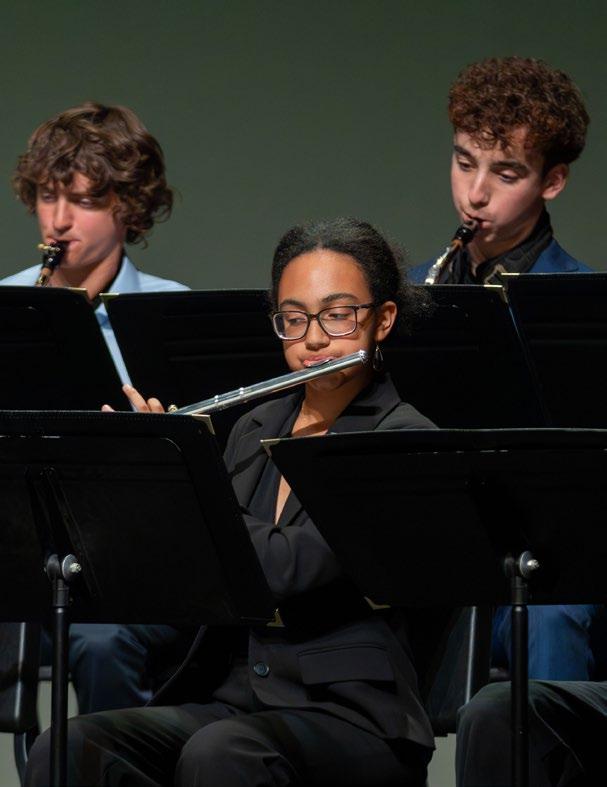
The Upper School Instrumental Ensemble studies music and musicianship through the rehearsal and performance of many different styles of music, in both the full ensemble and in smaller combinations. In addition to performance, in-depth exploration of other aspects of music and musicianship (e.g., arranging, songwriting/composition and recording) occurs throughout the year. Instrumental Ensemble is open to all instrumentalists (woodwinds, brass, bowed strings, plucked strings, keyboard and percussion), but each student must already have intermediate proficiency in their instrument of choice. The class is aligned to be a natural next step for students coming from Durham Academy’s Middle School instrumental program. Participation in the Lower School Halloween Parade, winter and spring concerts, Upper School Commencement and potential other performances throughout the year are required components of the course. PLEASE NOTE: It is possible (and even recommended!) for students to participate in Instrumental Ensemble for multiple years while at the Upper School. This course must be taken as a one-year continuous course (fall semester first, directly followed by spring semester) to fulfill the one-year Fine Arts graduation requirement. It can be taken one semester at a time, for elective credit, only after the student has completed their one-year Fine Arts requirement.
FA 350 • Songwriting & Composition
Grades: 10, 11, 12
Spring
PREREQ: Fundamentals of Music Theory or diagnostic test
Are you a budding singer-songwriter? Do you enjoy beat-making on your laptop? Are you midway through composing your opera or symphony? In Songwriting and Composition, you can bring your ideas to life! This class is for any student who is interested in or currently composing music. No matter the genre or medium, there are compositional ideas and practices that will help hone your ideas. Explorations will include:
music technology, studio and recording techniques, techniques for writing compelling melodies and harmonies, notational systems and software, and lyric writing. Students in the class are encouraged to pursue other topics related to their compositional work as they arise. Musical ideas will be honed and refined through coaching from Mr. Meyer and feedback from peers. This course must be taken consecutively with Fundamentals of Music Theory to fulfill the one-year Fine Arts graduation requirement.
FA 400 • Auditioned Music Ensemble: In The Pocket Grades: 10, 11, 12
Full-Year
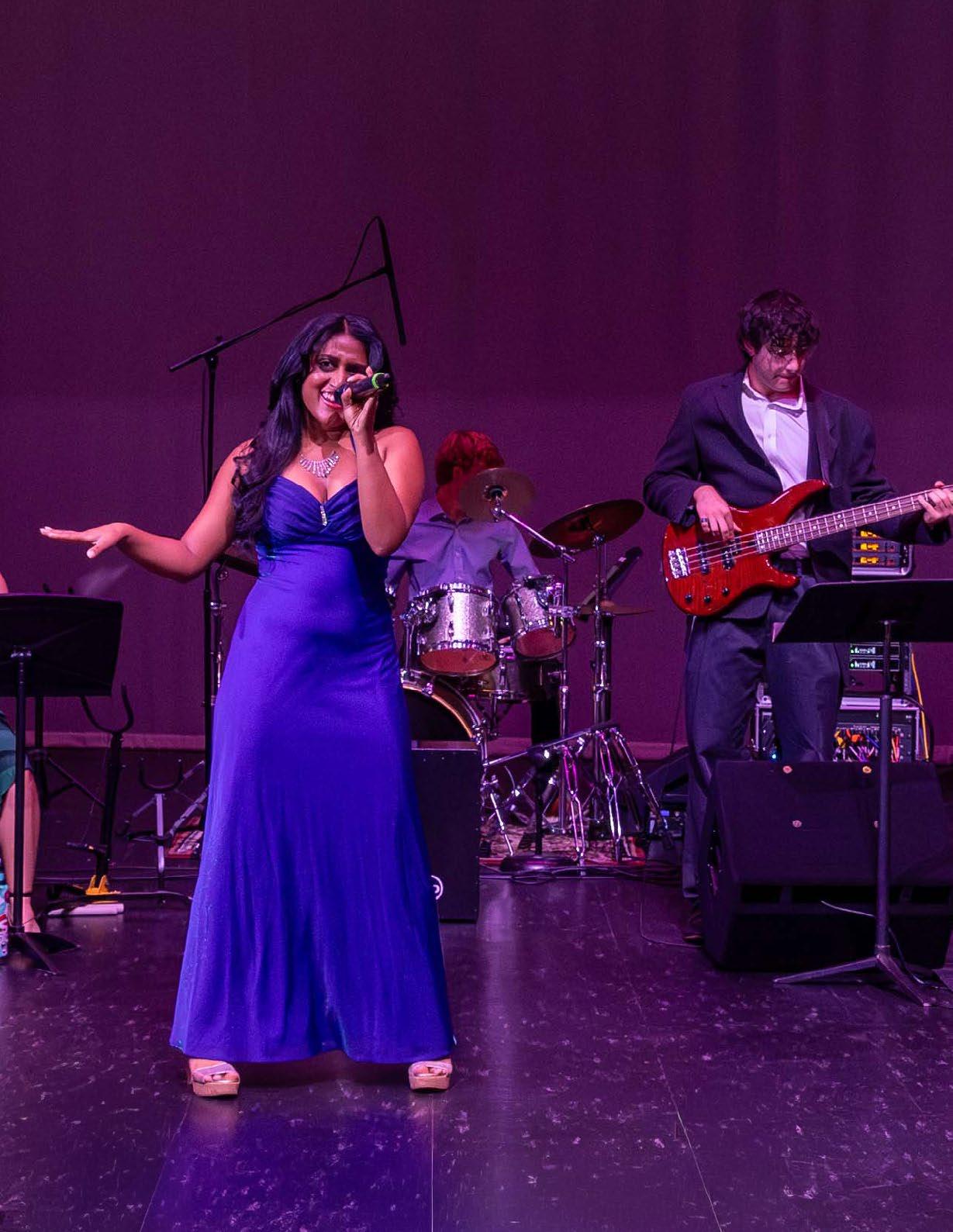
PREREQ: Audition and instructor’s permission In The Pocket is an auditioned music ensemble focused on performing all genres of commercial/popular music of the 20th and 21st centuries. The ensemble is a collaborative effort between students and adult members. During the school year, the ensemble performs at various school functions as well as events not directly associated with Durham Academy. Auditions are open to rising 11th and 12th graders; rising 10th graders must receive permission to audition from Mr. Meyer and Mr. Hoyt. Auditions are held in the spring each year for the following school year. In order to keep the group to a manageable size, auditions are typically restricted to replacing senior members who are graduating. Students who audition but are not accepted into In The Pocket are a good fit for Instrumental Ensemble or Vocal Ensemble, even if they’ve taken one of those classes previously.
THEATRE
FA 200 • Acting Studio Grades: 9, 10, 11, 12
Full-Year
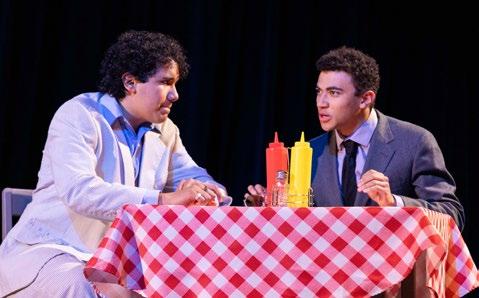
Want to improve your skills as an actor on stage or in front of a camera? Want to feel more confident speaking in public, making oral presentations in class, or interviewing for college or a job? Want to use your imagination and have fun? Well, you should take Acting Studio, where you will develop fundamental acting skills through a series of games, exercises, improvisations, monologues and scenes. Beyond acting, this course teaches skills necessary and relevant to quality living: problem-solving, building discipline, staying present, communicating effectively and collaborating with others. Students learn to become more aware of their surroundings, reduce their self-consciousness, trust their instincts and take risks by embracing the spirit of playing and
rejecting the need to be “perfect.” There is no outside performance requirement for this class. Instead, students focus on the rehearsal process and share their work — individually and in groups — with their classmates throughout the year.
FA 200 • Dramatic Writing for the Stage and Screen
Grades: 9, 10, 11, 12
Spring
Are you interested in the stories and characters you watch on television, in movies or on stage? Do you think about writing creatively but don’t give yourself time to sit down and write? Well, this course might be for you. The goal is to introduce students to the fundamental elements of dramatic writing — namely plot, character and dialogue — and provide them with tools they can use to create their own plays or screenplays. By analyzing how films and plays are typically structured and engaging in assorted developmental writing exercises, students will gain a practical understanding of screenwriting and playwriting. Students will then apply these techniques to develop their own script during the second half of the semester. Students will be given time during class to write, but they are also expected to continue their writing outside of class meetings as well. This course is an elective and DOES NOT count toward the Fine Arts graduation requirement.
FA 200 • Technical Theatre: Design & Production I
Grades: 9, 10, 11, 12
Full-Year
This course will explore the fundamentals of technical theatre with an emphasis on safety protocols, equipment and design concepts. Students will demonstrate their learning through different facets of the class: department productions, class projects, design concepts, and class discussions. Students will learn about and explore all aspects of technical theatre — from the world of design to scenic construction — by supporting a wide variety of live events at Durham Academy.
FA 300 • Scene Study
Grades: 10, 11, 12
Full-Year or Fall
PREREQ: Acting Studio
In this class, students will continue to develop their acting skills by applying and extending what they learned in Acting Studio to both on-stage and on-camera scenes. This is a project-based class in which students collaborate with peers to dig deeply into the rehearsal process: analyzing scripts,
exploring imaginary circumstances and discovering what actions their characters take, as they personalize and commit fully to their work in each rehearsal. By engaging in an ongoing critique process, students will learn to integrate feedback regularly into their rehearsals and develop the ability to share observations and offer suggestions to their peers. Students will work on a wide assortment of scenes and creative projects and, depending on the class makeup, may have the option of sharing their work with an audience outside of the class. Students are encouraged to take this class multiple times so they can explore different roles and challenges each time they take the course.
FA 300 • Technical Theatre: Design & Production II
Grades: 10, 11, 12
Full-Year
PREREQ: Technical Theatre Design & Production I
This course will expand on the knowledge gained in Design & Production I. Students will strengthen their skills by exploring more advanced techniques in scenic construction, advanced lighting design, 3D drafting techniques, and beyond. Students will demonstrate their learning through different facets of the class: DA Performing Arts Department productions, class projects, design concepts, and class discussions. Students will have opportunities to further their skills in stagecraft by working on Upper School productions in all areas (lighting, sounds, scenery, props, costumes, projections, and more). This is an opportunity to create art on stage with the use of advanced equipment within the world of theatre.
VISUAL ART
FA
200 • Digital Art & Design I
Grades: 9, 10, 11, 12
Full-Year
This full-year course teaches the foundational principles, techniques, creative practices and digital workflow of using the computer to make art. Students will learn the process of developing original concepts by using a digital sketchbook for written reflection, researching art movements and artists for context and inspiration, sketching compositions and planning their workflow. A wide range of projects that explore digital photography, collage, typography and graphic design will be produced using Adobe Photoshop, Lightroom and Illustrator. We will spend time during each project learning to understand and effectively use color, value, light, composition, line, texture, shape, space and balance to create compelling images. Throughout the course,
students will discuss their work and provide each other with feedback during group critiques. Student projects will be exhibited on campus at various times throughout the year.
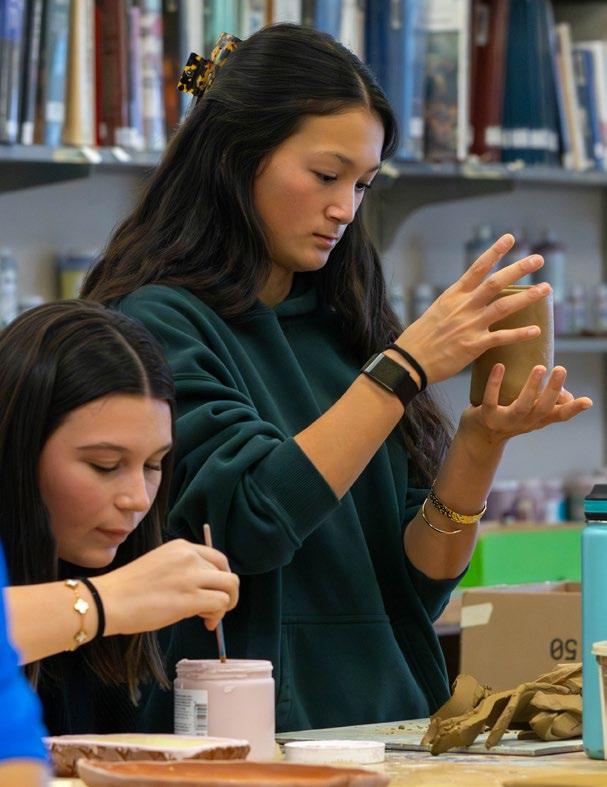
FA 200 • Explorations in Ceramics and Sculpture
Grades: 9, 10, 11, 12
Full-Year, Fall or Spring
Do you like to make “stuff?” This course focuses on a blend of experimentation and skill-building with clay and other three-dimensional materials. In the fall semester, we’ll begin with traditional and nontraditional methods of working in clay. From glazed and fired sculptures to pottery to mud houses and mold-making, learn why clay is one of the oldest and most versatile materials in human history. In the spring semester, we’ll expand our investigations into sculptural materials that may include paper, wood, wire, string, found objects and anything we can get our hands on. An open mind, love of working with your hands, desire to create objects, installations and structures, care for a safe studio environment and flexibility are all that’s required. In-class critiques, art vocabulary and a field trip will be built into the curriculum. This course must be taken as a one-year continuous course to fulfill the one-year Fine Arts graduation requirement. It can be taken one semester at a time or out of order for elective credit only.
FA 200 • Introduction to Two-Dimensional Visual Art
Grades: 9, 10, 11, 12
Full-Year, Fall or Spring
Do you like to draw and paint? Then this course is for you. No art experience is required, but experience can be very helpful. The fall semester focuses on exercises in basic drawing and composition with an emphasis on observation, expression and drawing from still life setups in pencil, charcoal and ink. Students complete a lengthier drawing project near semester’s end. The second semester begins with an introduction to a standard artist’s palette and color-mixing, followed by hands-on exercises for painting in acrylic on paper and canvas in different techniques, sizes and styles. During the third quarter, students develop their own paintings in response to thematic prompts. In-class critiques, art vocabulary and a field trip will be built into the curriculum. This course must be taken as a one-year continuous course to fulfill the one-year Fine Arts graduation requirement. It can be taken one semester at a time or out of order for elective credit only.
FA 200 • Photography I
Grades: 9, 10, 11, 12
Full-Year
This full-year project-based course is focused on learning the basic technical processes of both digital and film photography as well as the fundamental creative principles that govern artmaking. Working exclusively in a camera’s manual mode, students will learn to manipulate settings to produce an accurately exposed image with a creative point of view. Skills like reeling and developing film, printing test strips, contact sheets and prints in the darkroom, uploading RAW images from the camera to the computer, converting files to digital negatives, organizing files, and learning to navigate and use Adobe Photoshop and Lightroom will lay the foundation for our exploration. While these workflows can be complex and highly technical, they are the keys to the creative kingdom. Additionally, students will discuss their work, provide feedback to classmates during group critiques, and assess works by professional photographers in an effort to understand and bring together the process and the product of photography. Students who are great at — or excited to practice — exploring multi-step skill building; are interested in stretching their ability to think critically and abstractly; and want to explore what it means to “see” and “look” beyond the snapshot should take this course.
FA 200 • Video Production I
Grades: 9, 10, 11, 12
Fall
This course will offer students a hands-on overview of the vocabulary, camera gear and editing workflows associated with video storytelling. The goal of the course is to introduce students to the building blocks of audio and video production in order to produce videos that will inform, entertain or inspire an audience. Students will work in pairs or small groups to become proficient camera operators and will practice interview techniques that center their narrators as documentary subjects. All editing will be done in Adobe Premiere Pro, with ample time devoted to proper media management and archiving. This course must be taken consecutively with Video Production II to fulfill the one-year Fine Arts graduation requirement.
FA
250 • Video Production II
Grades: 9, 10, 11, 12
Spring
PREREQ: Video Production I
In this class, students will build on the technical and storytelling skills they learned in Video Production I. Students will act as video producers, determining what stories
they want to tell and what form is best suited to telling them. They will script, storyboard and direct scenes and short-form videos, and learn to apply titles, music, effects and color correction to make their videos more dynamic. Final projects will be determined by students in consultation with the instructor. This course must be taken consecutively with Video Production I to fulfill the one-year Fine Arts graduation requirement.
FA 300 • Digital
Art & Design II
Grades: 10, 11, 12
Full-Year, Fall or Spring
PREREQ: Digital Art & Design I or Video Production I and II with instructor’s permission or Photography I with instructor’s permission
In this full-year or semester course, students will continue to use Adobe programs, learning advanced techniques in the execution of more complex projects. Emphasis will be placed on exploration and the development of a personal visual style. Projects will give students the opportunity to explore design, illustration, visual storytelling, and abstract and surreal imagery. Throughout the year, students will be challenged to learn different ways of producing objects from their digital work, including bookmaking, laser cutting, 3D printing, printmaking and photographic processes. All students will be expected to present, reflect and think critically about their own work — as well as works by professional artists — in order to increase visual fluency and build new ideas. Student projects will be exhibited on campus at various times throughout the year.
FA 300 • Intermediate Art
Grades: 10, 11, 12
Full-Year, Fall or Spring
PREREQ: Intro to Two-Dimensional Visual Art, Explorations in Ceramics and Sculpture or instructor’s permission
This course is for students who know they enjoy art and are serious about developing their skills and visual ability. Only students with discipline and a strong desire to learn more sophisticated techniques should take this course. The content ranges from skill-building assignments in traditional graphite, charcoal, acrylic and oils to broader conceptual and experimental projects and methods. Work from observation and individual styles are emphasized. In-class critiques, art vocabulary and a field trip will be built into the curriculum. In addition to developing visual concepts, the course gives students the chance to continue on to Studio Praxis for Experienced Art Students (with permission of the instructor). Depending on quality, some works from the class may be used in portfolios for future applications to summer art programs, colleges and art schools.
FA 300 • Photography II
Grades: 10, 11, 12
Full-Year, Fall or Spring
PREREQ: Photography I or Video Production I and II with instructor’s permission or Digital Art & Design I with instructor’s permission
In this full-year or semester course students will examine and explore the art of visual storytelling through digital, analog and alternative photographic processes. Emphasis will be placed on experimentation and curiosity in an effort to discover and tell stories that are personally significant and visually impactful. Students will be challenged to develop more advanced technical skills, increasing their knowledge of Adobe programs, exploring studio lighting, and deepening their understanding of in-camera manipulation, film and darkroom techniques. Projects may include shortand long-form photo essays, hand-bound artist books, studio portraits and still lifes, alternative printing techniques, and working with light to create abstract imagery. In-class critique of the work, as well as visits to local galleries and museums, will help us increase visual fluency and learn to build new ideas. Student projects will be exhibited on campus at various times throughout the year.
FA 300 • Video Production: Animation
Grades: 10, 11, 12
Fall
PREREQ: Video Production I & II or Photography I with instructor’s permission or Digital Art & Design I with instructor’s permission
In this course, students will explore the fundamentals of animation and motion graphics through hands-on projects using Adobe Animate and After Effects. Building on concepts from graphic design and filmmaking, they will develop the technical skills required to bring text and static images to life. Projects may include typographic videos, stop-motion, whiteboard animations, flipbooks and introductory 3D motion design. Assessments will measure student understanding of animation principles and technical proficiency in industry-standard software. Students will be expected to make deliberate, artful choices about composition and narrative in order to empower themselves as creative thinkers and visual storytellers.
FA 300 • Video Production: Documentary Storytelling Grades: 10, 11, 12
Spring
PREREQ: Video Production I & II or Photography I with instructor’s permission or Digital Art & Design I with instructor’s permission This course is designed to allow students to engage in a guided, semester-long
video storytelling practice. Each offering of Documentary Storytelling will feature a cross-disciplinary partnership with another Upper School course, in which students will produce videos that highlight student learning and collaboration. Students will be expected to make regular progress toward filming and editing goals, while always respecting the boundaries of the students and faculty who have allowed them into the classroom. The initial iteration will highlight the work of the Peer Educators: Self and Community course from the joint perspectives of the Peer Educators and students enrolled in the Grade 9 Life Skills course. Please note: Future installments of this course may feature other participating classes, depending on access and schedule availability.
FA 350 • Portfolio for Photography and Digital Art
Grades: 11, 12
Full-Year, Fall or Spring
PREREQ: Digital Art & Design II or Photography II Portfolio for Photography and Digital Art is for students who want to deepen their knowledge of photographic and digital art tools while continuing to develop their creative voice and unique visual style. In this upper-level course, students will drive their own learning, constructing the content of their portfolio around an idea that holds personal interest or significance. Digital photography, Adobe Photoshop, Illustrator and Lightroom will continue to be our foundational tools, with the opportunity to explore InDesign, After Effects, Procreate, Procreate Dream, digital scanners, film photography, laser cutting, and alternative printing processes. An emphasis will be placed on connecting to the larger world of art through research and visits to local galleries and museums. Ultimately, students will produce a cohesive body of visual work, which may take the form of a hand-bound book of artwork, a portfolio box with printed imagery, a web-based portfolio or a physical exhibition.
FA 350 • Studio Praxis for Experienced Art Students
Grades: 10, 11, 12
Full-Year, Fall or Spring
PREREQ: Intermediate Art or instructor’s permission
Are you driven to make art? Are you possibly interested in applying to art programs? This course follows Intermediate Art and is for students who have the skill, independence and problem-solving ability to conceive of and produce work in response to conceptual prompts and ideas. Only students with discipline, self-motivation and a strong desire to
learn more sophisticated techniques should take this course. In addition to developing individual artistic direction, the course gives committed students the chance to continue working in the art studio through senior year. In-class critiques, art vocabulary and a field trip will be built into the curriculum. At the end of each semester, students will be required to compile a portfolio of their art. Depending on quality, these works can also be used in art school or college applications. The instructor will be available throughout the year to assist and guide individual students in how to arrange their portfolios for such applications. This course also can be taken one semester at a time or out of order for elective credit.
APPLYING ACADEMICS OUTSIDE OF THE CLASSROOM
PERFORMING ARTS
Students have several opportunities to extend their learning on- and off-stage in performing arts. Each year, the Upper School produces two professional-quality theatre productions — the Fall Play (October) and the Winter Musical (February). Recent productions include Mean Girls, Bright Star, All in the Timing and The Curious Incident of the Dog in the Night-Time. Students collaborate with DA Fine Arts faculty members and guest professional designers and directors to build these extraordinary productions. Over the years, students have reflected on the supportive environment fostered within the collaborative performing arts community and the profound impact participating in the program has made on their lives.
Although students are not required to enroll in an Upper School Fine Arts class to participate in the extracurricular activities, students grow the most by participating in both Fine Arts classes and the extracurricular program. For more information about the performing arts program, contact Fine Arts Academic Leader James Bohanek.
THEATRE OPPORTUNITIES INCLUDE:
CAST: Auditions are held in August (Fall Play) and November (Winter Musical) each year. Rehearsals take place weekday afternoons.
TECH CREW: Students work in teams on sets, lights, costumes, projections, sound and running crew. Students also support culminating performances of Fine Arts classes and community programming presentations across the Upper School.
PRODUCTION TEAM: Students hone their leadership skills as stage managers, assistant directors, assistant technical directors and tech crew captains.
PIT BAND: Student instrumentalists support the Winter Musical by playing in the pit band.
ADDITIONAL OPPORTUNITIES IN MUSIC INCLUDE:
XIV HOURS: DA’s auditioned a cappella group has been performing at DA and beyond for more than a decade, garnering accolades and awards along the way. Auditions are held in the fall for each academic year.
PEP BAND: Members of this instrumental ensemble rehearse once per week during lunch. Pep Band provides music and spirit for school events like pep rallies and Friday night CavDome basketball games.
HISTORY
Diploma Requirements: 3 Credits
We believe that learning to think historically prepares students to thrive in a complex, unpredictable world. Because we teach history as an interpretive process, not merely a recitation of facts, students learn to value questions that lack definitive answers and to see dialogue and diverse perspectives as paths to deep understanding. Students cultivate empathy as they strive to understand the perspectives of people from a wide range of times, places and cultures. Our students learn how to evaluate the credibility and significance of diverse sources, to question power dynamics and to embrace difference with a sense of vulnerability, humility and self-awareness. Through all of this, we challenge our students to see the dynamics of their world as contingent, giving them the confidence to effect positive change.
Students must fulfill a three-year history requirement that includes Making of the Modern World in Grade 9, U.S. History in Grade 10, and two semester electives that students can take at any point in grades 10, 11 or 12. Electives give students the opportunity to build on their foundational knowledge in global and U.S. histories while pursuing topics that interest them.
History electives are open to all students in grades 10, 11 and 12. Starting with the Class of 2028, students interested in taking an Advanced (ADV) history course must first complete the U.S. History (History 200) sequence and one 300-level history course.
ABOUT ADVANCED (ADV) COURSES IN HISTORY
In Advanced history courses, students question established interpretations, generate authentic questions, pursue those questions through research and articulate original conclusions.
Students commit to being an active collaborator in class and an independent learner outside of it. In these courses, students seek deep understandings of particular regions, historical periods, movements, societies or themes. These courses require students to recognize their own preconceptions, appreciate a multiplicity of modern and historical perspectives, and question dominant narratives.
Readings in Advanced history courses are particularly challenging in their complexity. They will often include lengthy primary sources and sophisticated works of modern scholarship. Students are expected to synthesize details and understand authors’ arguments on their own.
They should come to class ready to dive into critical analysis. Students in Advanced history courses are expected to write nuanced arguments that engage with complex themes and embrace ambiguity. Emphasis will be placed on developing original analysis, employing compelling evidence and making creative connections between sources.
Advanced history courses require in-depth research in which students pursue their own open-ended questions. Students should be prepared to commit to sustained inquiry in which they engage with diverse perspectives and sources and ultimately articulate original conclusions. Some research may involve working in local archives, conducting oral interviews or developing relationships with community partners. Students will be expected to share their findings with an audience.
Students will be able to independently use their learning to:
• Question personal values and recognize the values of others in order to navigate a complex world.
• Critically analyze contemporary and historical narratives.
• Question power dynamics to thoughtfully engage in society.
• Apply concepts and analyze systems of economics to engage purposefully in a global economy.
• Interpret how geography shapes perspective, policy and power.
CORE COURSES
HIST 100 • Making of the Modern World
Grade: 9
Full-Year
What are the defining political, economic, social, environmental and technological features of the modern world? What aspects of the world that we live in were inevitable and what might have been different? This course introduces students to modern world history from about 1800 to the present. It provides students with a global perspective on key historical themes with a particular focus on the consequences of imperialism and nationalism. Students will learn how to analyze diverse primary and secondary sources, generate authentic research questions, gather evidence and craft arguments that clearly reflect their thinking. They will sharpen these skills through tests, papers, class discussions, simulations and a final paper in which they examine the historical origins of a modern global issue.
HIST 200 • U.S. History to 1865
Grades: 10 Fall
The course deals with major themes and events in American history since colonial times that have helped shape the American character. Students will investigate the political and social foundation of the United States from European colonization to the present. The relationship of geographical diversity, settlement patterns and economic prosperity to political developments over time will be studied. Contributions of diverse racial, ethnic and religious groups to the development of American culture will be emphasized. Using a standard text and supplemental documents and readings, students will be introduced to the following main topics: the Revolutionary War and the Constitution, the early national period, sectional strife, the Civil War and Reconstruction.
HIST 200 • U.S. History Since 1865
Grades: 10
Spring
This course focuses on pivotal moments in American history from the end of the Civil War to the present. It engages with a diverse range of historical voices. In doing so, students gain a deep understanding of the ideals, tensions, debates and contradictions that have defined American history. Students cultivate a habit of looking at present-day issues in the context of history, scrutinizing all viewpoints and rooting their claims in factual evidence. Using a standard text and supplemental documents and readings, students will be introduced to the following main topics: Reconstruction, industrialization, Progressivism, World War I,
the conservative 1920s, the Great Depression and the New Deal, World War II, the Cold War, domestic politics in the 1960s and 1970s, and globalization. The course culminates in a research paper in which students develop their own interpretations on a theme or development in U.S. history.
ELECTIVE COURSES
FALL SEMESTER ELECTIVES
HIST 300 • The Ancient Mediterranean Grades: 10, 11, 12
Fall
In this course, students will explore the civilizations of the ancient Mediterranean, including Greece, Rome, Egypt, Phoenicia, Persia, and Carthage. Students will develop critical thinking and research skills as they explore the interconnectedness of these societies through trade, conflict, and cultural exchange. Students will learn how to assess ancient sources and develop arguments based on ancient texts and archaeology, while evaluating prevailing arguments from leading historians. Major assessments include short comparative essays, source evaluations, and presentations that challenge students to synthesize evidence from a variety of sources. By the end of the course, students will gain a deeper understanding of how historians reconstruct the ancient world and of the complexity and diversity of the ancient Mediterranean.
HIST 300 • Art Crimes Grades: 10, 11, 12
Fall
This course considers global art history from the Middle Ages to the present with a focus on the relationship between art, crime and appropriation. We will ask ourselves if the definition of art can include objects that are appropriated wholesale from another creator, culture or technique. We investigate the effects of global imperialism on art by looking at objects stolen from conquered societies, the repurposing of art from different cultures and the issues involved with repatriation, or returning stolen art to the societies that originally produced them. We explore the concepts and ethics of the Western-style museum and of privately owned artworks. We also explore the deliberate counterfeiting of objects, whether for religious reasons or to gain social power or wealth. In these ways, we examine how art is valued culturally, socially and monetarily. Regular homework includes personal and analytical reactions, creative texts or visual art (per student preference) and historical readings, documentary film and artist interviews. For their culminating assignment,
students teach an interactive lesson on an artwork (and its related crime) and write a journalistic text on the same topic (e.g., articles or a podcast in a true crime style).
HIST 300 • Classical Political Thought
Grades: 10, 11, 12
Fall
Why do so many democracies become corrupt? How do tyrants fall? When, if ever, are assassinations justified? Is social equality possible? Is it better for a ruler to be loved or feared? When should traditions be preserved, and when should they be abandoned? This course explores the historical circumstances — including, war, economic disasters, social unrest, conspiracies, empire-building and religious conflict — that led people to explore these and other questions about the nature of politics and power. We will study classic texts of Western political philosophy while emphasizing the political, social and cultural contexts in which they were produced. We will especially consider ancient Greece and Rome, the Middle Ages, the Renaissance, religious wars and absolutism. Students will sharpen their analytical skills in discussion and in writing. Assessments will include document analyses, seminars and argument-driven essays.
HIST 300 • Introduction to Philosophy
Grades: 10, 11, 12
Fall
Philosophy aims to shed light on some of life’s most essential but challenging questions. For instance, what makes an action moral, a belief justified, a painting beautiful or a law just? And how, if at all, can we resolve fundamental disagreements about such questions between people and between cultures? In this course, we will examine and wrestle with the responses offered to some of these questions by both historical and contemporary philosophers. We will work to gain an understanding of the range of topics philosophers deal with and the tools and methods they bring to bear. Students will develop skills in close reading, recognizing and evaluating the logical structures of arguments, and sharing their own perspectives through persuasive and well-reasoned writing. Students should anticipate an emphasis on seminar-style discussions and short but carefully crafted writing assignments.
HIST 300 • Migration and Movement
Grades: 10, 11, 12
Fall
What factors drive people to leave their homes and migrate to new regions? How has globalization influenced migration trends in the 21st century? How do governments
and international organizations manage or respond to large-scale migration? What role do environmental challenges play in current and future migration trends? What are some misconceptions about migrants and migration? In this interdisciplinary course — which draws upon the fields of human geography, history, sociology and political science — we will examine human population patterns, migration trends and demographic challenges associated with the movement of people in this interconnected world in which we live. Students will develop an understanding of how geopolitics relate to population studies and ultimately gain insight into the complex issues associated with global migration in the modern world. Assessments in this class will take many forms, including research, simulations, data analysis, tests, quizzes and presentations. The final project will be based on student interest.
HIST 300 • U.S. Government and Politics
Grades: 10, 11, 12
Fall
Want to become an informed citizen? Well, this is the course for you! Over the course of the semester, we will study the institutions and foundational values that have framed how we interact with our federal government. Additionally, we will explore American political culture and what makes for an effective politician. An emphasis will be placed on understanding the system of checks and balances among the legislative, executive and judicial branches and how this “delicate balance” has played out in the modern day. We will examine materials ranging from the Federalist Papers and U.S. Constitution to U.S. Supreme Court opinions and recent news articles. Our class activities will be discussion-based, and assessments will include essays, video documentaries, quizzes, Harkness discussions and role-play scenarios. As to later course selection, U.S. Government and Politics would provide an excellent foundation for the ADV Constitutional Law course.
HIST 450 • ADV Historical Approaches to Women and Gender
Grades: 11, 12
Fall
PREREQ: Starting with the Class of 2028, completion of both History 200 courses and one 300-level History course
ADV Historical Approaches to Women and Gender is offered every other year. It will be offered again in 2027–2028. Traditional approaches to history have often relied on events and texts that prioritize the lives and accomplishments of men. How can we change our approaches to history, the evidence that we use and the questions that we ask to uncover the stories of women and
people of marginalized genders? What can we learn about how race and class intersect with gender at different times and in different parts of the world? Where can we turn when our documents and texts don’t tell us the whole story? In this course, students will learn how to interpret a variety of types of evidence, including funerary monuments, archaeological sites and finds, letters, documents and art to understand the hidden histories of women and to illuminate the gender diversity of the past. After building competence in these skills, students will put them to use, crafting and executing a research project driven by their intellectual interests.
HIST 450 • ADV History of Durham
Grades: 11, 12
Fall
PREREQ: Starting with the Class of 2028, completion of both History 200 courses and one 300-level History course
In many ways, Durham represents both the adaptability of the American South and a model of urban reinvention. And yet, Durham’s success is complicated. This course examines Durham’s history as a case study in social transformation, asking questions that resist easy answers: What has been gained and what has been lost through developments such as the rise and fall of the tobacco industry, the construction and dismantling of Jim Crow, urbanization, and urban renewal? What has been the relationship between economic development and race relations over time? And to what extent are Durham’s historical development and social dynamics — especially around race — exceptional when compared to patterns elsewhere? Students will work with complex primary sources and scholarly essays, participate in and lead seminar discussions, hear from guest speakers, and take off-campus trips introducing them to a wide range of topics in Durham County’s past. Through short reflection essays and mini-research projects, students will build toward a substantial, independent research project of their choosing in the second quarter. The goal: Go beyond what has already been written and create new knowledge about the past. The research process and the effective oral presentation of findings will be valued as highly as the final product, which may take the form of a paper, documentary, or website.
HIST 450 • ADV
Korea, Vietnam, Cambodia: The Cold War and Its Legacy in East and Southeast Asia
Grades: 11, 12
Fall
PREREQ: Starting with the Class of 2028, completion of both History 200 courses and one 300-level History course While the Cold War was an intense political rivalry between the United States and the
Soviet Union, its effects on the entire world were profound. This course looks closely at conflicts in Korea, Vietnam, and Cambodia that deeply affected international politics as well as the lives of millions of ordinary people after World War II. We will consider how the modern trajectories of these three states developed and diverged from the devastating wars in which they were engulfed and also how they continue to shape geopolitics in the 21st century. Emphasis will be on the critical study of primary and secondary sources, including monographs and memoirs. Major assessments will include presentations and analytical essays. Drawing on scholars and resources from local universities as well as immigrants and industries in the Triangle, students will undertake a formal research project — based on their interests — that explores a topic related to a specific legacy of the Cold War in Asia. Some may choose to conduct fieldwork in the local area, while others may raise questions of historical interest related to new developments in scholarly research associated with East and Southeast Asia. Whatever route they take, students will develop a thoughtful, complex and original research project.
HIST 450 • ADV Modern Middle East
Grades: 11, 12 Fall
PREREQ: Starting with the Class of 2028, completion of both History 200 courses and one 300-level History course
The Middle East is a region that is often described as turbulent, complicated and exotic in popular U.S. imagination. In ADV Modern Middle East, we will explore the history of the region to show the way that historical forces that students have explored in their foundational history courses — industrialization, imperialism and nationalism — have affected and shaped its diverse societies. Working against frameworks that exceptionalize the region, we will begin with the long 19th century and the building blocks of modern social and political organization that gave rise to nation-states and contemporary global religions to show the centrality of the Middle East to the new world order that emerged in the 20th century. Using a variety of multimedia primary sources, we will continue to hone students’ abilities to decipher the meaning and value of historical sources, as well as practice using our interpretations of primary sources to develop nuanced and contestable interpretations of the contemporary Middle East. Major assessments will include document-based, in-class essays and an annotated bibliography and will culminate in a creative argumentative essay and presentation based on a topic of student interest connected to
course themes. In this class, we will focus on the historical and social development that have shaped the region; our debates will focus on historical and scholarly interpretations, not political or moral debates about current events and conflicts.
HIST 450 • ADV Moral Philosophy
Grades: 11, 12
Fall
PREREQ: Starting with the Class of 2028, completion of both History 200 courses and one 300-level History course
Imagine yourself as the conductor of a runaway trolley. On the track ahead, you notice five workers. You also notice a side track that only has one worker. Do you divert the trolley to the side track? Why? Now imagine a similar scenario where you are standing next to a large man on a bridge overlooking the tracks. Again, you notice the trolley headed toward the five workers. Do you push the man off the bridge onto the track to stop the trolley? Why not? What do your decisions say about you as a person? This course draws from multiple writers and texts to answer questions about what sort of person one should be and how to determine the right course of action in a particular situation. We will read essays and short stories that seek to identify principles for decision making and ethical behavior in a personal, civil and moral context. Students will apply ethical principles in a series of panel discussions and write essays on self-selected topics. Emphasis will be placed on classroom debate, position/opinion statements and argumentative/persuasive essay composition. The purpose of this course is to practice rational thinking and incorporate intuition in analyzing ethical behavior.
HIST 450 • ADV Nations and Nationalism
Grades: 11, 12
Fall
PREREQ: Starting with the Class of 2028, completion of both History 200 courses and one 300-level History course
Almost everyone on the planet lives in a nation, yet that form of social organization is a relatively recent and never-inevitable development in human history. What are the historical origins of nations? What are the benefits and limitations of living in a nation? Why are so many people willing to kill and die for their nations? To what extent is nationalism to blame for the most destructive wars in modern history? What role does nationalism play in our globalized world? In this course, students will analyze theories of nationalism and historical case studies such as Napoleonic France, Nazi Germany and postwar East Asia. Readings will include primary sources and sophisticated works of
modern scholarship. Most class meetings will revolve around seminar discussions in which students evaluate and critique the previous night’s readings. Students will occasionally lead class discussions. Assessments include essays and presentations. The course will conclude with each student using the theories of nationalism that we have studied and developed to research an example of contemporary nationalism, compose a paper and present their own conclusions.
HIST 450 • ADV Religion and Revolution in the Americas
Grades: 11, 12
Fall
PREREQ: Starting with the Class of 2028, completion of both History 200 courses and one 300-level History course
Karl Marx famously said that religion was the “opiate of the masses,” an insight that has been borne out by many famous examples of religion as a force for political quietude and conservatism. In this course, we will explore case studies in the Americas in which religious communities, texts and institutions were used to agitate for social change and upending of the status quo. Beginning with a unit on the academic study of religion, we will explore the relationships between “religion” and “society” and how historians and social scientists have argued that religion is a force for conservation rather than disruption of social order. From there, we will study the rise of Liberation Theology in South America and the centrality of religion to the Civil Rights and Black radical tradition in North America, exploring the complicated relationship between religion, society and movements agitating for political and social change. The major assessments for this class will include two in-class essays, a presentation on a particular liberation struggle in South America influenced by Liberation Theology and a final “unessay” assessment in which students will select their own medium (board game, poetry, podcast, multimedia presentation, artwork, etc.) for responding to Marx’s assertion that religion is the opiate of the masses.
HIST 450 • ADV U.S. Black History
Grades: 11, 12
Fall
PREREQ: Starting with the Class of 2028, completion of both History 200 courses and one 300-level History course
Much of the lived experience of African Americans remains undocumented, making it more difficult for all scholars of the African American experience to study. Since the
1970s, historians have focused on developing an African American historiography that centers African American thought, action and community. This course will explore how Black history became a separate field in American history. What inspired early scholars to focus on African Americans and the issues that mattered most to them? What drives today’s scholars to keep exploring new questions? To answer these questions, students will investigate traditional primary sources and unconventional historical materials such as folktales, music, photography and other material objects. Because the course prioritizes deep exploration of sophisticated themes such as African Culture in America, the Fight for Citizenship in American Democracy and Black Progress historically and contemporarily, students will also work with sources from preeminent African American historians and scholars including John Hope Franklin, Barbara Krauthamer, Carter G. Woodson, Darlene Clark Hine, Henry Louis Gates and others. Students interested in enrolling in the course should expect formative assessments, graded discussions and presentations. Throughout the semester, students will be gathering material to write an extensive research-based essay for inclusion in a course-specific publication modeled after Carter G. Woodson’s Journal of African American History.
SPRING SEMESTER ELECTIVES
HIST 300 • Crimes and Punishments
Grades: 10, 11, 12 Spring
This course focuses on the current state of criminal justice in the United States. We will begin with a detailed analysis of the complex state of mass incarceration in the U.S., noting its exceptional dimensions when compared with criminal justice systems in other countries. We will delve into the long history of punishment, analyzing influential texts that shaped the American experience and use these to understand the roots of the current system, including its connections with slavery. An investigation of case studies will provide a practical understanding of how the legal system works — from the police station to the courtroom and the prison system. Class readings and activities will highlight specific aspects, like solitary confinement and plea bargaining. Local resources — judges, reform advocates, courts — will supplement our in-class studies. Assessments are varied and will include discussions, debates, tests, simulations, essays and a final project based on student interest.
HIST 300 • Diaspora Kitchen
Grades: 10, 11, 12
Spring
Diaspora Kitchen is offered every other year. It will be offered again in 2027–2028.
This course will introduce students to some of the diaspora communities in the Triangle, in North Carolina and in the U.S. A good portion of the class focuses on exploring the circumstances that brought these families to the Durham-Chapel Hill area (history, politics, safety, social mobility, etc.). We will learn more about their native and now-hybrid culture using food and the history of food as a conduit. What are their unique migration and immigration stories? How does food reveal and illuminate culture and history?
To what extent does food connect them to their communities in the U.S. and tie them to their homelands? After exploring and reading about the concept of “diaspora,” the class becomes a “lab” — a kinetic, hands-on learning experience. We will be in the kitchen cooking; there will be visits to community centers; we will have guests. The semester culminates with a major collaborative project. In the past, the class has created a pop-up concept restaurant and, more recently, a food truck competition.
HIST 300 • Encounters with the Middle East Grades: 10, 11, 12
Spring
This course invites students to examine the “encounter points” through which they (as people living in the West) have come to know — or believe they know — the Middle East and North Africa. Students will reflect on their own first impressions and inherited narratives and consider how these moments of exposure have shaped perceptions of the region, its people, cultures, and histories. Moving beyond these initial frames, the course engages in a wide range of cultural sources — film, music, literature, food, and contemporary voices — to reveal the region’s complexity, diversity, and vibrancy. Students are expected to approach the course with curiosity, openness, and a willingness to reflect and participate. Throughout the course, students will collaborate on presentations and conclude with a mini-research paper. The ultimate goal is not only to challenge existing assumptions, but to encourage students to cultivate new, authentic encounter points and continue expanding them beyond the classroom.
HIST 300 • Introduction to Anthropology
Grades: 10, 11, 12
Spring
What does it mean to be human? Where did humans come from? How are they related to the rest of the natural world? What does the diversity of expressions of human culture
tell us about what it means to be human? In Introduction to Anthropology, we will explore these questions through the four fields of anthropology, studying the evolutionary history of homo sapiens, the material culture left behind of prehistoric humanity, as well as what language and culture tell us about the varieties of ways to be human today. Assessments will include two “diving into the debate” short research papers in which students explore a contemporary debate, as well as two original ethnographic research projects in which students will use the tools and methods of anthropology to explore the linguistic and cultural life of Durham Academy students.
HIST 300 • Modern Global Issues
Grades: 10, 11, 12
Spring
How do scarcities of water, oil and food drive conflicts in Africa, Asia and the Middle East? In what ways are emerging technologies like drones, artificial intelligence and augmented reality reshaping daily life in the 21st century? How can education address challenges such as child marriage and gender-based violence? And how do governments navigate the balance between national security and human rights when tackling terrorism and cyber threats? This semester-long elective explores these and other critical global issues, providing students with a deeper understanding of contemporary events. Through discussion, research and analysis, students will develop informed, well-reasoned perspectives on the challenges shaping our interconnected world. The class is designed to be interactive and engaging, featuring a variety of activities such as simulations, research projects and multimedia creations. By fostering critical thinking and thoughtful dialogue, this course empowers students to become active, globally aware citizens.
HIST 300 • Modern Political Thought
Grades: 10, 11, 12
Spring
How and why do ways of thinking change? Can violence ever be justified when trying to make society more equitable? What are the historical origins of conservatism, liberalism, communism, nationalism, fascism and other ideologies? How did the destruction wrought by the 20th-century world wars change how people thought about politics and history? What do democracy, communism and dictatorships mean in our rapidly changing world? This course will analyze the political, social and economic contexts in which modern political ideas emerged. Students will sharpen their analytical skills in discussion and in writing. Assessments will include document analyses, seminars and argument-driven essays.
HIST 450 • ADV American Popular Culture Grades:
Spring
11, 12
PREREQ: Starting with the Class of 2028, completion of both History 200 courses and one 300-level History course
This Advanced seminar examines how popular culture has both reflected and shaped American life from the 19th century to the present. Through film, television, music, sports, fashion, advertising, and digital media, students explore how mass culture has expressed and contested ideas about race, gender, class, and national identity. Major themes include the tension between “high” and “low” culture, the search for authenticity in a commercial age, the relationship between technology and cultural change, and the question of whether popular culture drives social transformation or merely mirrors it. Students will read and analyze complex primary sources and scholarly essays that offer competing interpretations of cultural history. Seminar discussion, analytical writing, independent research, and oral presentations will form the core of the course, challenging students to connect cultural artifacts to their historical contexts and to develop original interpretations. By semester’s end, students will better understand how popular culture serves as both a mirror and a motor of American society.
HIST 450 • ADV Ancient Technologies
Grades: 11, 12
Spring
PREREQ: Starting with the Class of 2028, completion of both History 200 courses and one 300-level History course
This course will introduce students to the technological innovations of the ancient world. By examining developments in areas like medicine, engineering, agriculture and food production, students will explore ancient approaches to innovation, problem-solving and societal advancement. How do historians uncover technologies of the past, and how can we use these discoveries to fuel new innovations? In addition to exploring ancient solutions to timeless problems, we will also examine the idea of innovation and the societal factors that fuel and guide technological advancement. We will place innovations in their historical and geographical context to better understand how the technologies of different ancient societies converged and diverged. Throughout the course, students will participate in experiential and practical learning and will finish the course with an interest-driven project and presentation.
HIST 450 • ADV Art History:
Aesthetics
and Theory
Grades: 11, 12
Spring
PREREQ: Starting with the Class of 2028, completion of both History 200 courses and one 300-level History course
This course focuses on global art history — primarily from 1800 to the present — through the lens of philosophy and aesthetic theory. Aesthetic theory poses the fundamental question: Does the value of an artwork come from the form of the object itself, from the appreciation of the viewer, from the object’s function or from other sources? The course emphasizes art and visual analysis, with a focus on theoretical frameworks, concepts and readings. Students will begin with broad concepts of beauty and artistic value (i.e., aesthetics). We will consider good and bad taste and how these are culturally defined. All units will address the lenses of gender, race and sexuality, particularly around women and people of color as subjects of art and as artists. This course will moreover allow us to imagine the future of art as works are increasingly created and viewed digitally. Student projects and papers will be applications of theory to artworks of their choosing or the beginnings of theories of their own based on a body of works. For example, students may complete an in-depth book/article review with citations of artworks; an imagined exhibit that demonstrates a concept; or a proposal for an artwork that demonstrates or undermines a theoretical concept. We will visit the North Carolina Museum of Art (NCMA) in Raleigh, in addition to one other field trip.
HIST 450 • ADV Constitutional Law
Grades: 11, 12 Spring
PREREQ: Starting with the Class of 2028, completion of both History 200 courses and one 300-level History course
The United States Constitution has been described as the most democratic document ever. Yet we are still struggling with profound questions some 230 years after it was originally ratified. How powerful should the federal government be? What is more important: freedom or security? Should there be limits to free speech? What constitutes illegal discrimination? When should the police be allowed to search your home? Can the United States engage in war without officially declaring it? This class will grapple with these questions and more by examining the Constitution and how the Supreme Court has interpreted it. Students will analyze Supreme Court opinions, study relevant historical context and wrestle with modern legal, philosophical and political scholarship. Classes will often revolve around
seminar discussions. Throughout the semester, students will be assessed through essays, tests, graded discussions, presentations and research assignments. Toward the end of the semester, each student will select a particular constitutional issue to explore in the modern context. For this project, students may analyze case law and legislative history; interview city, state or federal officials; or shadow lawyers, judges, police officers and local policy advocates. The end product will be a comprehensive advocacy letter, the presentation of a policy proposal to a panel of professionals or the production of a documentary.
HIST 450 • ADV Enchanted: Modern Religion
Grades: 11, 12
Spring
PREREQ: Starting with the Class of 2028, completion of both History 200 courses and one 300-level History course
Sociologist Max Weber described the process of modernization as “the disenchantment of the world,” leading to a world governed by rational logic, programmable machines and a natural order transparent to human understanding — but, most importantly, with a negligible place for religion with all its mysteries and contingencies. In this course, we will explore the many ways in which the modern world continues to be enchanted by gods and magic globally. We will explore the emergence of the European notion of “religion” in the early modern period in the context of European exploration and imperialism, as well as the impact of this terminology on systems of thought and politics that did not align with its assumptions — such as Hinduism, Confucianism and Buddhism. From there, we will explore the centrality of religious institutions, ideas and language in the modern world, focusing particularly on the rise of political Islam in the Middle East, Indigenous religions in Africa and the Americas, and the explosion of charismatic and evangelical communities throughout the global south. Assessments will include graded discussions, analytical essays, an annotated bibliography and a final culminating research project organized around a creative argument built on student interest.
HIST 450 • ADV Philosophy: Knowledge, Doubt and Inquiry
Grades: 11, 12
Spring
PREREQ: Starting with the Class of 2028, completion of both History 200 courses and one 300-level History course
When asked to explain his reputation for wisdom, the Greek philosopher Socrates replied that any wisdom he possessed lay only in this: While others believed (incorrectly)
that they knew a great deal, he alone recognized just how little he actually knew. In this course, we will follow in the footsteps of Socrates by scrutinizing our own knowledge and its limits. Through deep dives into classic and contemporary works of philosophy, we will explore such questions as: What is knowledge, and how can we attain it? What makes knowledge a goal worth pursuing in the first place? How much can we know about the world around us, about the future or about the inner lives of other people? How should we proceed when we have deep and persistent disagreements with others who are — to all appearances — just as intelligent and well-informed as we are? This course will emphasize challenging reading assignments and seminar-style discussions, with students expected to take an active role in leading class discussion. Through a series of short papers, students will hone their skills at evaluating and responding to philosophical arguments and will contribute their own perspectives to live philosophical debates.
HIST 450 • ADV Revolutions
Grades: 11, 12
Spring
PREREQ: Starting with the Class of 2028, completion of both History 200 courses and one 300-level History course
What are revolutions and what drives them? Are all revolutions essentially about tensions between economic classes? When are they about trying to create a better world, and when are they simply excuses for violence? Are they just about one group trying to gain power over others? Why are some revolutions successful while others falter? To what extent have revolutions created the structures and paradigms of our world? Students will grapple with these and other questions and then analyze historical revolutions, which might include the Haitian, French and Russian revolutions. In addition to works of historical and political scholarship, we will also use a variety of other sources — including art and film — to understand the nature of revolutions. Classes will often revolve around seminar discussions, and students should be prepared to evaluate primary sources and sophisticated works of modern scholarship. Each student will also explore a revolution beyond the ones that we discuss as a class. Using the theories of revolution that we have studied and developed, each student will choose a more recent revolution from any part of the world (including ones that are ongoing), conduct in-depth research, compose a paper and present their own conclusions.
LEADERSHIP OPPORTUNITIES
We argue that there’s no such thing as a “natural-born leader.” Rather, the qualities of a strong leader are learned over time, given the opportunity. At Durham Academy, there’s a place for all kinds of leaders: from the thoughtful, soft-spoken sort, to those overflowing with charisma.
STUDENT GOVERNMENT
At the Upper School, Student Government consists of a student body president and seven committees, each with a chair and a number of committee members (listed below). In addition, there is a class president and four class representatives per grade level. Each of these is an elected position.
• Social Events Committee
• Student Academic Committee
• Student Life Advisory Board
• Student Organization and Leadership Development Committee
• Student Spirit Committee
• Sustainability Committee
• RAISE (Raising Awareness of Inclusion and Social Equity)
OTHER LEADERSHIP OPPORTUNITIES
There are myriad other opportunities for students to build leadership muscle. Here are just a few:
• The Peer Educators team consists of twelve seniors who are selected to coteach Self and Community, a component of the Life Skills class for ninth graders. The rigorous selection process includes an application, interview, and teaching demonstration. Peer Educators must sign a contract agreeing to serve as role models for their younger Upper School peers — both on and off campus — throughout the school year.
• The Student Ambassador Leadership Council (SALC) is a group of Upper School students who work with Durham Academy’s Enrollment Management team to welcome prospective students and families to campus and who train fellow DA student ambassadors to offer tours.
• The Student-Athlete Leadership Team (SALT) is a group of student-athletes who are nominated and selected by coaches, athletics administration and Upper School deans for a yearlong study of leadership skills within a team environment.
INTERDISCIPLINARY STUDIES
Diploma Requirements: Not required
Can be used toward Additional Coursework requirements of 1.5 (+) credit
Interdisciplinary Studies courses prepare students to become expert researchers, entrepreneurs, leaders and teachers. Students develop skills for understanding the world and solving problems by applying tools from multiple academic disciplines. This experience prepares them for the many pursuits outside academia that do not fall into disciplinary categories.
Many of these courses are experiential and project-based, empowering students to put their knowledge into action in meaningful ways — from leading seminars on sustainability topics and crafting personal mission statements, to helping real businesses solve problems and developing deep, one-to-one tutoring relationships with local elementary students.
INT 100 • Grade 9 Life Skills
Grade: 9
Full-Year
Grade 9 Life Skills is not a diploma requirement, but all ninth-grade students will automatically be enrolled in the Grade 9 Life Skills course, which consists of four components: a Technology and Sustainability rotation; a Self and Community module; the Health, Wellness and First Aid seminar; and an optional component dedicated to physical activity.
Self and Community: The goal of Self and Community is to help ninth graders consider and discuss topics that will help them navigate their high school experience. Topics include: values, identity, decision-making, stress awareness and management, resilience, body image, social media, substance use, healthy relationships, sexual health, mental health and wellness. The course is taught by 12th grade Peer Educator mentors who work closely with the Upper School counselor, deans of students and additional faculty mentors to develop and execute research-based lesson plans.
Technology Seminar (first semester): Students will gain an exposure to the many digital tools used by teachers, administrators, coaches and staff at DA, including but not limited to cloud technology, collaborative document sharing, digital multimedia presentation and collaborative presentation tools, school and student information systems (currently Veracross) and others. The course also focuses on the ever-emerging ethical and social issues that are increasingly becoming an inherent part of students’ lives, specifically information privacy and protection, big data, and artificial intelligence. The course aspires to provide students with the skills to remain engaged and competitive in emerging models of a digital classroom. The course is structured as a portfolio exercise and concludes with a test. Successful completion of technology seminar exempts students from the required technology course half-credit for graduation and allows students to earn administrative privileges on their DA-issued laptop.
Living Sustainably (second semester): This class prepares students for active membership in a community that is working to reduce its carbon footprint and become more sustainable. The class explores the grounds, buildings and practices of Durham Academy as an institution and leads the Upper School’s Earth Day observance. Individually, students learn to recognize the choices that contribute to their own carbon footprint and expand their repertoire of ways to reduce it.
Health & Wellness Seminar: This course focuses on the physical, social, emotional, spiritual and psychological well-being of our students to best prepare for life in the Upper School and beyond. It is important for students to learn how to balance their academics, athletics and social commitments using appropriate tools to manage their mental health, nutrition and physical fitness. The content learned in this course — which includes topics in sexual health education — will often coincide with the Peer Education/ Self and Community course curriculum for practical application of the material. The content covered in this course will come from factual and anecdotal information.
Physical Activity: The optional physical education component of this course provides students with an understanding of fitness as it relates to physical well-being. Emphasis is placed on refining motor skills and developing healthy habits. Students will participate in individual fitness testing programs and learn the skills, strategies and rules necessary to participate in and enjoy a variety of leisure and physical activities in order to maintain lifelong health and well-being.
INT 200 • Community Engagement and Philanthropy
Grades: 10, 11, 12 Spring
This course will explore philanthropic philosophies and their evolution, evaluate models for addressing community needs such as voluntary, non-profit, for-profit, joint public/ private and analyze the reasoning behind various organizational approaches. Readings and activities for this course could include case studies, guest speakers, current event articles and hands-on volunteering in the community. Students will develop practical skills in grant writing, understanding funding cycles and evaluating the effectiveness, motivations and ethics behind charitable efforts. They will examine the roles of individual charitable actions, as well as corporate foundations — focusing on decision-making, accountability and strategic impact. Students will produce reflective writing as well as analytical position papers based upon their research, class readings and activities. A central component of the course involves students serving as grant evaluators for the DA Community Engagement Fund. In this role, they will request and review grant proposals from DA community members (students and faculty/staff), communicate with potential grantees, evaluate submissions and make funding decisions. This hands-on experience prepares students to thoughtfully engage in philanthropy and community impact.
INT 200 • Developing Effective Leadership
Grades: 9, 10, 11, 12
Fall or Spring
Developing Effective Leadership is designed to equip future leaders with a fundamental understanding of what leadership is and how an individual can develop the necessary skills to become an effective leader as a key component of both individual and community growth. A core component of this course is identifying the difference between leadership and management by learning the importance of understanding others, by building empathy through relationships, and by gaining a better understanding of different leadership styles. Throughout the semester, we will introduce students to leadership by focusing on what it means to be a good leader and leveraging connections through the greater Durham community as we incorporate a guest speaker series. Emphasis will be placed on preparing students to deal with the diverse realities of our society by identifying their own strengths and areas of growth, and how to best work with others. Throughout the course, students will engage with course material through written reflections and discussions based on assigned readings and guest speaker presentations, and a culminating Pecha Kucha project, which is a dynamic, fast-paced storytelling format that challenges students to communicate their ideas with clarity and creativity.
INT 200 • The Mission-Driven Life
Grades: 10, 11, 12
Fall
This course explores competing theories and necessary interdependence of morality, happiness and productivity. It challenges students to reconsider, refine and recommit to the virtues and values that matter most to them. The ideas of Confucius, Plato, Aristotle, Gandhi, Martin Luther King Jr., Pauli Murray, Carol Gilligan and David Brooks will frame our study of morality. Research from positive psychology will inform our discussions of happiness. Ben Franklin, Carol Dweck, Adam Grant, Eduardo Briceño and Stephen Covey (The Seven Habits of Highly Effective People) will help us identify new paths to productivity. At least 10 guest speakers — representing a range of professions and personalities — will share their experience and wisdom during the semester. Conversations, debates and classroom activities will be enriched by frequent, brief written personal reflections on the readings, TED Talks and guest speakers we encounter. Three major assignments will help build public speaking skills, strengthen our class community and expand perspectives on how to live a life of purpose. In the
first assignment (“Genius Time”), each student researches, writes and delivers a speech on a topic of authentic personal interest. In the second, each student interviews and then describes the essence of a mission-driven role model. The third speech (and final exam for the course) is a Personal Mission Statement — describing the sources and effects of the “compass” they wish to use to chart their path in life.
INT 200 • Problem-Solving for Real Businesses
Grades: 9, 10, 11, 12
Fall or Spring
Students work in teams to identify and solve real problems presented to them by a real local or global business. This is a great opportunity for résumé-building, networking and gaining important life skills. The businesses we meet with are legitimate networking contacts, and making a good impression can potentially lead to further collaborations such as internships, shadowing or professional advice. During each of the three problem-solving cycles, students will meet with a business partner, help to identify the root of an issue they are experiencing, collaborate in a small team to develop solutions and pitch ideas to their business partners and community members. Regardless of the problem, students will learn tools and strategies to help effectively engage in real work that has real consequences and the potential to make a meaningful impact.
INT 200 • Yearbook: Digital Media and Publishing
Grades: 10, 11, 12
Fall, Spring or Full-Year
In this course, students use a variety of software to create The Evergreen, Durham Academy’s yearbook. This student-centered publication aims to tell the story of the school year through photography and text. To meet this end, the course focuses on the basics of journalism, page design, photography and publishing. Students will be involved in all aspects of the publishing process, including gathering content, maintaining deadline schedules, editing and working collaboratively to produce a high-quality yearbook inclusive of the entire student body. Assessments will include student’s proficiency with the programs, quality of copy, digital imaging and overall layout design. Class size is limited.
INT 300 • Economics
Grades: 11, 12
Spring
In a course designed to prepare students for success in college economics courses, Economics introduces students to essential micro- and macroeconomics concepts with
concise readings and video lessons. Using a variety of activities as well as films, position papers, debates, guest speakers, collaborative projects and discussion, students learn about opportunity cost, comparative advantage, supply and demand, unemployment and inflation, and the four market structures: perfect competition, monopolistic competition, oligopoly and monopoly. Students also explore interest rate determination, taxation, fiscal policy, fractional reserve banking, monetary policy and macroeconomic stabilization tactics employed by legislators and the Federal Reserve. To conclude, students complete a final project and presentation focused on application of terms learned through the semester to an area of historical significance or pop culture. This course couples well with the fall semester elective Mathematics of Finance
INT 300 • Independent Study
Grades: 10, 11, 12
Fall or Spring
PREREQ: Completion of the Independent Study Application process; for Fall 2026 independent studies, initiate a conversation with Mr. Thomas Phu in February and submit your proposal by April 23, 2026. For Spring 2027 independent studies, initiate a conversation with Mr. Phu in September 2026 and submit your proposal by mid-November.
“What do you want to learn?” When the answer falls outside of Durham Academy’s curriculum, an independent study opportunity provides support for student exploration. The student-designed course is comparable to standard courses in rigor, daily attention and volume of time invested (5–7 hours/week). It culminates in a project or performance that is shared with the community in a form appropriate to the topic. Though students in this program work independently, they are supported by teachers and peers. They meet regularly (at least biweekly) with a teacher in a relevant academic field to select resources and check their understanding of content. They also work with the independent study coordinator to develop a weekly timetable, strategize, reflect and hold themselves accountable. The application process includes an initial statement of interest, a meeting with the independent study coordinator and a formal proposal. The Academic Committee evaluates all proposals and notifies students of its decisions by May 15, 2026, or Dec. 15, 2026.
Additional notes:
• Student initiative is central to independent study. Therefore, the student is expected to take responsibility for scheduling meetings, showing progress, designing the culminating activity, etc.
• Independent study lasts one semester. A student may apply for a one-semester extension through the regular proposal process.
• Independent study earns credit toward graduation and appears on the student’s transcript. Withdrawal after four weeks will result in a “WD” notation on the transcript.
• Independent study may not duplicate an existing course or substitute for a required course.
INT 400 • Peer Educators: Self & Community
Grade: 12
Full-Year
PREREQ: Application, interview, and teaching demonstration (Grade 11 students are emailed the application for Peer Educators: Self & Community)
Seniors who are selected to serve as Peer Educators will be trained to teach the Self and Community section of the Grade 9 Life Skills course. The goal of Self and Community is to help ninth graders consider and discuss topics that are often encountered during a student’s high school years, such as values, identity, decision-making, healthy relationships, body image, social media, substance use, and mental health and wellness. Peer Educators meet regularly with their faculty mentors to master the content and prepare lesson plans with a focus on developing their pedagogical and leadership skills. Additionally, Peer Educators serve as role models and mentors both within the classroom and the larger DA community.
INT 400 • Teaching Literacy Skills (Literacy Tutoring with Children’s Literacy Project)
Grade: 12
Full-Year
PREREQ: Application (Grade 11 students are emailed the application for Teaching Literacy Skills)
This course is a collaboration among Durham Academy Upper School, the Augustine Literacy Project - Triangle (ALPT), and Durham Public Schools. It combines three focus areas: a rigorous, systematic, multi-sensory, phonetic teaching approach to address language-related learning difficulties; a full-year, one-to-one tutoring relationship with a child at a local Durham elementary school; and outreach into the Durham community to address the needs of children who struggle with reading, writing and spelling. DA seniors will be taught how to tutor second graders using the Orton-Gillingham approach and the five essential components of research-based reading instruction: phonemic awareness, phonics, vocabulary, fluency and comprehension. Tutors will develop an ongoing relationship during the academic year with their assigned child. (To qualify
for tutoring, students must be eligible for free or reduced-price lunch and score below grade level in literacy skills.) DA tutors will be expected to teach approximately two lessons per week at a local elementary school. In the remaining class periods at DA, students will construct lesson plans, reflect on their tutorial experiences and discuss articles addressing child development, literacy, poverty and related topics. Note: Students signing up for this course will represent Durham Academy to the larger Durham community through this direct and sustained tutoring/mentoring program. Students are encouraged to consult with Crawford Leavoy concerning course availability and logistics. An application is required. Please note the class meets during “G” period to allow time for tutors to teach a 45-minute lesson and to drive to and from local elementary schools.
INT 450 • ADV Community-Based Research
Grades: 10, 11, 12
Fall or Spring
PREREQ: Successful application to Pathway Scholars
This course will provide students with the requisite foundation in research skills and community engagement. Students will learn the principles of service learning and design thinking as they deepen their critical consciousness about our local and global communities and partner with community leaders and organizations. Students will consider questions such as: How does one ethically engage with a community? How do geography, race, class, power and privilege influence our conception of community and engagement? Students will then research, plan and prepare for their unique community engagement project. This may include researching and identifying community organizations engaged in work related to a scholar’s research focus, interviewing community members and experts in the field, building and iterating prototypes, and more. Readings and activities for this course could include case studies, guest speakers and student-facilitated interviews based around the three Pathways: Entrepreneurship, Global Citizenship and Sustainability. Students will produce reflective writing as well as analytical position papers based upon their research and engagement experiences. The culminating assignment will be a DA Community Engagement Fund grant proposal submitted for a community-based research project that students will implement in the ADV Pathway Scholars course.
INT 450 • ADV Psychology
Grade: 12
Full-Year
Psychology is a young and ever-evolving science. This course will cover a variety of psychology’s fundamental concepts and
theories while also considering how our understanding changes with emerging data and recognition of individual differences; cultural, biological and social influences; and our perceptual biases. Students will be challenged to synthesize broad-ranging material from neurobiology to emotion, sensation to substance use and psychological disorders to social influence. When possible, we will hear from experts in the field to gain a better understanding of what psychology looks like in professional settings. There will be opportunities to evaluate, design and conduct research and to apply psychological principles to personal growth and community-building. Students must be curious about themselves and the world around them, be willing to collaborate, offer and receive feedback and respectfully engage in classroom discussions and activities with an open and critical mind.
INT 450 • ADV Research
Grades: 11, 12 (Grade 10 with application)
Fall or Spring
ADV Research is a fast-paced course that explores the complexities of real-world topics and issues by analyzing divergent perspectives. The goal is to provide students with the tools to evaluate information accurately and make compelling, evidence-based arguments. Topics are driven by student choice and personal interest, as well as the culminating projects. The course involves reading and understanding source material in the form of texts and other media, including scholarly resources. Students learn to synthesize information from multiple sources; develop their own perspectives in written essays; and design and deliver oral and visual presentations, both individually and as part of a team.
INT 500 • ADV Pathway Scholars
Grades: 10, 11, 12
Fall or Spring
PREREQ: ADV Community-Based Research
This course will provide a structure for students to build and implement the projects they began in ADV Community-Based Research. Projects will be grounded in research, problem-solving, creative thinking, scholarship and real-world application. A typical week will consist of two class meetings. The first will be dedicated to each student’s independent work on their project. This time could be used to travel off campus in order to visit with community partners or conduct interviews. Alternatively, it could be used to meet one-on-one with the course instructor. The second class meeting will be dedicated to peer-to-peer and teacher-topeer workshopping of projects. During these workshops, students will have an opportunity to reflect, seek feedback, troubleshoot
challenges and bring questions to the group. Student reflection will be a critical aspect of this course. Finally, scholars will demonstrate their learning by presenting their project to an audience including community members such as teachers, administrators, mentors, community partners and peers at the spring Research Symposium.
INT 500 • ADV Thesis
Grades: 11, 12
Full-Year
PREREQ: ADV Research
In Advanced Thesis, students cultivate the skills and discipline necessary to conduct academic, independent research of choice in order to produce and defend a scholarly academic paper. Advanced Thesis allows students to deeply explore a topic, problem, issue or idea of individual choice and interest. Students design, plan and implement a year-long investigation to address a research question. Through this inquiry, they further the skills they acquired in ADV Research (formerly ADV Global Inequalities) by learning and utilizing appropriate research methods; employing ethical research practices; and accessing, analyzing and synthesizing information. Students reflect on their skill development, document their processes and curate the artifacts of their scholarly work through a process and reflection portfolio. The course culminates in an academic paper of 4,000–5,000 words and a presentation of their research to an audience including community members such as teachers, administrators, mentors, community partners and peers at the spring Research Symposium. Students who successfully complete ADV Thesis will receive a Thesis Scholar distinction on their transcript.
JACK LINGER EXPLORER GRANTS
AVAILABLE FOR RISING 10TH, 11TH, AND 12TH GRADE STUDENTS
Rising 10th, 11th and 12th grade students who wish to pursue unique, enriching, out-ofthe-box learning experiences may apply for financial support in the form of a grant from the Jack Linger Explorers Fund. This fund was established by the Linger family in 2020 in memory of Jack Linger ’20, who rode his bicycle across the United States in search of new perspectives on the major issues facing our country, particularly climate change and the environment. He sought to cross literal and figurative divides as he listened to his fellow citizens. His goal was to develop informed opinions as he prepared to cast his first vote.
Explorer Grants are intended to support a spirit of physical and/or intellectual adventure and the expansion of personal horizons. Grants may be used to cover tuition, materials, travel expenses, professional expertise or any other costs associated with a given learning experience. By design, Explorer Grant Projects will be performed and completed during the summer months. Generally an independent learning experience, Explorer Grant Projects may also augment work performed during the school year on an Independent Study or a Pathway Scholars project.
To apply, interested students should contact William Edwards or Tina Bessias, members of the Jack Linger Explorer Grant Committee. Completed applications for a Jack Linger Explorer Grant should include:
• a description of the activities and purposes behind them
• anticipated impact on individuals, community, etc.
• anticipated expenses and any relevant documentation
• faculty advisor if applicable
A committee of Upper School faculty and staff appointed by the head of school reviews proposals and awards grants. Proposals are due by May 1, 2026.
Grant recipients will be selected based on the merit of the proposed project and its potential impact on the student and the world.
Apply for Jack Linger Grant
MATHEMATICS
Diploma Requirements: 1–4 Credits
The Durham Academy Upper School Math Department empowers students of all backgrounds and learning styles to:
• embrace mathematical challenges with perseverance and a growth mindset.
• use mathematical tools and techniques to investigate problems and find innovative solutions.
• work toward mathematical fluency and precision.
• communicate viable arguments using sound mathematical reasoning.
• collaborate and communicate across cultures.
• cultivate an appreciation for the beauty of mathematics.
The math graduation requirement entails progressing through core classes consisting of Algebra 1, Geometry and Algebra 2, and then completing at least one additional course for which a prerequisite is Algebra 2. In the Upper School, most students go beyond the graduation requirement to complete four full years of mathematics. As students learn the mathematical content covered in their courses, they mature as thinkers and problem solvers in a classroom context through the use of collaboration skills, communication skills and analytical thinking skills.
Durham Academy’s Math Department has strict guidelines for advancing outside the standard course of study, which can take the form of two concurrent math courses during the academic year and/or independent summer coursework (see Appendix B). Students interested in pursuing one of those paths need departmental approval and should contact the math academic leader or Upper School registrar. For example, with a grade of A or better in Algebra 1 and permission from the Math Department, Algebra 2 may be taken concurrently with Geometry. Similarly, with a grade of A or better in each semester of Algebra 1 and permission of the Math Department, Honors Algebra 2 may be taken concurrently with Geometry
Each student enrolled in a Durham Academy Upper School math course is required to own a TI-84 graphing calculator. In all math classes, the graphing calculator and other computer-based technologies are used to enhance students’ understanding of concepts as well as to carry out certain processes. Proficiency in the use of a graphing calculator is an integral component of the curriculum.
Learn more about Mathematics Summer Advancement at Durham Academy.
ABOUT ADVANCED (ADV) COURSES IN MATHEMATICS
Durham Academy students can begin taking Advanced math courses after they have completed required studies in Algebra 1, Geometry and Algebra 2. Each Advanced course has a unique prerequisite. In Advanced math courses, students will extend and build on mathematical skills learned in core math courses, through exploration, problem-solving and logical reasoning. They will work both independently and collaboratively to investigate mathematical relationships and solve complex problems
in both abstract and real-world contexts. Students will be expected to think more critically and creatively in Advanced math courses. They will also regularly develop their own mathematical questions and ideas. These courses require attentive engagement in class and consistent initiative outside of class. Students in these courses will be expected to synthesize concepts, investigate with technology and formally communicate their thinking as they discover the beauty and problem-solving power of mathematics.
Transfer Goals Mathematics
Students will be able to independently use their learning to:
• Recognize and utilize math as a universal language, as well as appreciate the beauty of mathematics.
• Embrace mathematical challenges with perseverance and a growth mindset.
• Use mathematical tools and techniques to investigate and find innovative solutions based upon the given issue, situation or problem.
• Apply numeracy skills and the aligned practices to achieve fluency and precision.
• Communicate viable arguments using sound mathematical reasoning in both independent and collaborative settings, while valuing the perspective of others.
Math Course Sequence
MATH 100 • Algebra 1
Grade: 9
Full-Year
Algebra 1 builds upon the established mathematical foundation from Middle School by enhancing problem-solving skills and strategies and by encouraging students to communicate using the language of algebra. Students are also challenged to become more independent learners and to make connections between different mathematical concepts. Topics include the terminology of algebra; solving equations and inequalities; solving systems of equations and inequalities; polynomial operations; factoring; applications of factoring; graphing in the coordinate plane; an introduction to irrational numbers; solving radical and quadratic equations; and working with rational expressions. Additionally, knowledge and understanding of linear equations and all related topics is emphasized and expanded. Introduction to a TI-84 graphing calculator is woven into the curriculum and is considered essential to provide both graphical and numerical examples of topics covered.
MATH 100 • Geometry
Grades: 9, 10
Full-Year
PREREQ: Algebra 1
Geometry provides a comprehensive introduction to Euclidean geometry, starting with points, lines and planes, and building up to 2D and 3D figures. Throughout the course, students will investigate geometric relationships independently and in teams. They will regularly use technological tools, like GeoGebra and graphing calculators, to assist them. Students will develop their logic and reasoning skills by communicating ideas verbally and in writing and by studying various types of mathematical proof. There will be many opportunities for students to review and apply basic algebraic concepts while solving geometric problems.
MATH 200 • Algebra 2
Grades: 9, 10, 11
Full-Year
PREREQ: Algebra 1 and Geometry. (For students who earned an A or better in Algebra 1, Algebra 2 may be taken concurrently with Geometry with permission of the Math Department.)
Algebra 2 builds on the foundations set in Algebra 1. This course includes algebraic skills and a thorough analysis of linear, quadratic, higher-order polynomial, exponential, logarithmic, inverse, rational and radical functions. Additional topics could include: linear and nonlinear systems of equations, conic sections, sequences and series, probability, matrices and data analysis. Real-world applications and technology are incorporated throughout the course. Students will prepare for precalculus-level analysis by improving and expanding their graphing skills and by incorporating more strategic thinking into their problem-solving process.
MATH 200H • Honors Algebra 2
Grades: 9, 10, 11
Full-Year
PREREQ: Successful completion of eighth-grade Geometry with approval by the Math Department OR an A or better in each semester of Algebra 1 and Geometry. (For students who earned an A or better in each semester of Algebra 1, Honors Algebra 2 may be taken concurrently with Geometry with permission of the Math Department.)
Honors Algebra 2 focuses on the language of functions as the centerpiece of this course,
building on the foundations set in Algebra 1
This course includes reinforcement and application of algebraic skills as well as a thorough analysis of polynomials, exponential, logarithmic, inverse, rational and radical functions. Additional topics may include: linear and nonlinear systems of equations, conic sections, sequences and series, probability, matrices and data analysis. Technology is incorporated throughout the course, especially through the use of spreadsheets, simulations, curve fitting and other real-world applications. Students will prepare for honors-level precalculus analysis by focusing on verbal explanations, improving and expanding their graphing skills and incorporating more strategic thinking into their problem-solving process. Concepts are covered in more depth and at a quicker pace than in the Algebra 2 course.
MATH 300 • Cryptography
Grades: 9, 10, 11, 12
Spring
PREREQ: Algebra 2 or Honors Algebra 2 or concurrent enrollment in Algebra 2 or Honors Algebra 2 with permission of the Math Department Cryptography covers the mathematics behind cryptography, the practice of encoding information privately and also decoding those messages. We will discuss all different kinds of ciphers, i.e., methods by which messages are turned into code, and we will build our skills in basic number theory (learning topics like modular arithmetic and congruencies) in order to understand how a cipher evolves from an idea
to top-secret information. This includes modern-day encryption and its usefulness in the e-commerce industry. From hidden wartime messages in the 400s BC, to Mary, Queen of Scots plotting the assassination of Queen Elizabeth I using secret code, to Alan Turing’s cryptanalysis of Germany’s “unsolveable” Enigma machine in World War II, we will also stop to explore the many interesting anecdotes of how ciphers have shaped the world for millennia. To assess learning in this course, we will have homework assignments and quizzes that ensure that the students’ number theory skills are where they should be, and we will build up toward projects in which students encode messages using their own ciphers.
MATH 300 • Logic and Discrete Mathematics
Grades: 9, 10, 11, 12
Fall
PREREQ: Algebra 2 or Honors Algebra 2 or concurrent enrollment in Algebra 2 or Honors Algebra 2 with permission of the Math Department
Logic and Discrete Mathematics is an introduction to pure mathematics. The vast majority of mathematics taught at the high school level teaches you how to use mathematics. This class teaches you how to create it. You will learn to view mathematics like a mathematician, and hopefully gain a little understanding of what mathematicians mean when they speak about “the beauty of mathematics.” In this class, you will learn a little from each of these topics: Symbolic Logic, Number Theory, Graph Theory and Set Theory. You are encouraged to research these topics on the internet to see what they are — but know that you will likely find materials from college-level courses, as these topics are rarely taught at the high school level. If you want to enjoy creating new kinds of math, take this course!
MATH 300 • Mathematics of Finance
Grades: 11, 12
Fall
PREREQ: Algebra 2 or Honors Algebra 2
Mathematics of Finance allows students to study several concepts of personal finance and money management, examine how mathematics is used in everyday life and explore several topics that improve financial literacy, including IRAs, CDs, 401Ks, 529s and 1040s. Topics include: career, budget, taxes, banking, investments, savings, credit, credit scores, loans, insurance, retirement, dollar-cost averaging, spreadsheet analysis and business plan creation. Collaboration, problem-solving, technology and communication of ideas are common themes in this course.
MATH 300 • Elements of Precalculus
Grades: 10, 11, 12
Full-Year
PREREQ: Algebra 2
Elements of Precalculus examines all of the major topics in Precalculus. Fundamental
concepts and skills are reviewed more thoroughly, and the pace of the course is slower. Elements of Precalculus is recommended for students earning a B- or below in Algebra 2 Technology is incorporated throughout the course. This course is not designed to prepare students for ADV coursework.
MATH 300 • Precalculus
Grades: 10, 11, 12
Full-Year
PREREQ: Honors Algebra 2 or B- or better in Algebra 2
Precalculus is a course designed to weave together material from previous math courses, build problem-solving skills and introduce new content in preparation for students to learn calculus. Students study linear, quadratic, polynomial, exponential, logarithmic, rational and radical functions in the first semester. Trigonometry is a major focus of the second semester. Rational functions are studied at a deeper level than students encountered in Algebra 2. Graphical and algebraic limits are studied, and probability from Algebra 2 is built upon and extended. Technology is incorporated throughout the course, as are real-world applications.
MATH 300H • Honors Precalculus
Grades: 9, 10, 11, 12
Full-Year
PREREQ: B+ or better in Honors Algebra 2 or A or higher in each semester of Algebra 2. Honors Precalculus is a challenging, fastpaced course designed to prepare students for the study of Advanced Calculus. Students will investigate the properties of a variety of functions and explore ways to use them as mathematical models that describe realworld phenomena. A comprehensive study of trigonometry is included in the second semester. Throughout the course, students will have opportunities to work in teams to solve several larger, open-ended problems that connect precalculus concepts to a wide range of complex situations. Students will also regularly use technological tools like Desmos, spreadsheets and graphing calculators to help them visualize and solve problems.
MATH 400 • Differential Calculus
Grades: 10, 11, 12
Fall
PREREQ: B- or better in Precalculus or Honors Precalculus or permission of the Math Department
Differential Calculus is an introductory college-level course in differential calculus. Students will develop understanding and skills associated with limits and continuity, techniques of differentiation and applications of differentiation. In this course, students will approach concepts and topics graphically, numerically and analytically. They will present their solutions verbally and
in writing. Technology will enhance the curriculum and will be used on a regular basis to reinforce skills and concepts.
MATH 400 • Integral Calculus
Grades: 10, 11, 12
Spring
PREREQ: Differential Calculus
Integral Calculus is an introductory college-level course in integral calculus. Students will develop understanding and skills associated with techniques of integration, applications of integration and differential equations and slope fields. In this course, students will be approaching concepts and topics graphically, numerically and analytically. They will present their solutions verbally and in writing. Technology will enhance the curriculum and will be used on a regular basis to reinforce skills and concepts.
MATH 400 • Mathematics Teaching Fellowship
Grades: 12
Fall, Spring, Full-Year
PREREQ: Application
Mathematics Teaching Fellowship is designed to prepare students to serve as effective mathematics teaching fellows — tutors within the classroom setting and potential future teachers. Emphasis is placed on developing strong communication, instructional and leadership skills to support peers in their mathematical learning. Students will learn tutoring strategies that promote conceptual understanding, problem-solving and academic confidence. Additional focus is given to professionalism, ethical tutoring practices and adapting assistance to meet diverse learning needs. Upon completion, students will be equipped with the skills necessary to provide meaningful academic support in mathematics classrooms. It is important to note that the Mathematics Teaching Fellowship course does not fulfill the math graduation requirement.
MATH 400 • Statistics and Data Science
Grades: 10, 11, 12
Spring
PREREQ: Successful completion of Algebra 2 or Honors Algebra 2
Statistics and Data Science is a one-semester course that introduces students to the fundamental concepts and tools of statistics and data science. The course emphasizes three major themes: Describing Data, Producing Data and Anticipating Patterns, while integrating data science skills such as data visualization, analysis and communication. Throughout the course, students will familiarize themselves with software tools like CODAP, Python and Google Sheets to create visualizations and conduct analyses. They will explore relevant questions, access real data sources and engage in projects that span various fields, including economics, politics, physical sciences and sports. Students will also learn to identify
and critique misleading uses of statistics, ensuring informed decision-making and problem-solving skills.
MATH
450
• ADV Differential Calculus
Grades: 10, 11, 12
Fall
PREREQ: A or better in Precalculus or B+ or better in Honors Precalculus or Permission of the Math Department
ADV Differential Calculus will cover singlevariable differential calculus. Students will develop understanding and skills associated with limits and continuity, as well as techniques and applications of differentiation. The course will introduce advanced topics like L’Hôpital’s rule, implicit differentiation, parametric equations and derivatives of polar expressions. Differential calculus will be applied to solve real-world problems in various fields, such as physics, economics, biology and engineering. Technology will enhance the curriculum and will be used on a regular basis to reinforce skills and concepts.
MATH
450
• ADV Integral Calculus
Grades: 10, 11, 12
Spring
PREREQ: Successful completion of ADV Differential Calculus or permission of the Math Department
ADV Integral Calculus is designed to build upon the foundations of single-variable differential calculus and provide students with the opportunity to build an in-depth understanding of integral calculus. Students will develop a strong foundation in the concepts of integration, focusing on Riemann sums, definite and indefinite integrals and the Fundamental Theorem of Calculus. Students will explore advanced topics such as improper integrals, numerical methods of integration and sequences and series, enabling them to tackle more complex mathematical challenges. Technology will enhance the curriculum and will be used on a regular basis to reinforce skills and concepts.
MATH 450 • ADV Mathematical Modeling
Grades: 11, 12
Fall
PREREQ: B+ or better in Honors Precalculus or A or better in Precalculus with permission of the Math Department
ADV Mathematical Modeling is designed for highly motivated students who are interested in creatively applying mathematics to complex, challenging and authentic real-world problems. Students will work collaboratively through the mathematical modeling process to study globally relevant, multi-faceted phenomena. The models they design will be used to analyze scenarios in different fields like biology, engineering, political science, business, economics, and in everyday life. Some examples of the problems students may tackle include issues like designing congressional
districts; reforming the Electoral College; finding fair ways to compensate employees at an institution; developing efficient processes for boarding and landing airplanes at an airport; and managing animal populations in national parks. Through these kinds of problems, students will learn to develop and refine mathematical models, use models to find interesting patterns and trends, incorporate analysis from various technological programs and critique models. The course is largely project-based, so students will be assessed mostly through written reports, policy memos and presentations. All students will compete in the High School Mathematical Contest in Modeling (HiMCM) in November. In the last weeks of the course, students will develop their own final modeling project based on their personal interests and questions they want to explore.
MATH 450 • ADV Special Topics in Mathematics
Grades: 11, 12
Spring
PREREQ: B+ or better in Honors Precalculus or A or better in Precalculus with permission of the Math Department
ADV Special Topics in Mathematics is designed for highly motivated students who are curious to learn more about math topics outside of the traditional high school math curriculum. The course will have a unique area of focus each semester that it is offered. For instance, the course could focus on number theory or combinatorics and probability or topology or non-Euclidean geometries — or any branch of mathematics — depending on the semester it is offered. Students in this course should be ready to carry out mathematical investigations, read and write sophisticated proofs, and solve a variety of challenging, non-routine problems.
MATH 450 • ADV Statistics and Data Science 1
Grades: 10, 11, 12
Fall
PREREQ: Concurrent enrollment in or completion of Honors Precalculus or completion of Precalculus with A- or better or permission of the Math Department
ADV Statistics and Data Science 1 is a onesemester course that introduces students to the interdisciplinary field of data science with a rigorous focus on advanced statistical methods, computational techniques and real-world applications. Students will analyze large, diverse real-world datasets to identify patterns, make predictions and quantify uncertainty using programming languages such as R or Python and other advanced statistical software. The curriculum includes visualizations, descriptive statistics, statistical simulation and a variety of statistical tests and models. Throughout the course, ethical considerations in data analysis and decision-making are discussed, and students develop skills in constructing coherent, persuasive narratives around data.
MATH 450 • ADV Statistics and Data Science 2
Grades: 10, 11, 12
Spring
PREREQ: ADV Statistics and Data Science 1
ADV Statistics and Data Science 2 pushes students to deepen their understanding of statistical inference, building on foundational concepts in probability and computational analysis. The course will focus heavily on hypothesis testing and confidence intervals, guiding students through rigorous applications across a variety of real-world datasets using tools like R or Python and other advanced statistical software. Core topics include data cleaning and wrangling, multivariate analysis and inferential statistics such as hypothesis testing, regression and predictive modeling. Students will generate much of the mathematical inquiry and will be responsible for designing and implementing an ongoing project exploring a dataset in a field of their choosing. By the end of the course, students will have gained proficiency in statistical programming, an understanding of machine learning fundamentals and the ability to draw actionable insights from complex data sources.
MATH 500 • ADV Multivariable Calculus 1
Grades: 10, 11, 12
Fall
PREREQ: ADV Integral Calculus or A or better in both Differential Calculus and Integral Calculus or permission of the Math Department
ADV Multivariable Calculus 1 is designed to build upon the foundations of single-variable calculus taught in ADV Differential Calculus and ADV Integral Calculus and provide students with the opportunity to build an in-depth understanding of multivariable calculus. Students will develop a strong foundation in the concept of multivariable functions and the differential and integral calculus one can use to analyze them. Technology will enhance the curriculum and will be used on a regular basis to reinforce skills and concepts.
MATH 500 • ADV Multivariable Calculus 2
Grades: 10, 11, 12
Spring
PREREQ: ADV Multivariable Calculus 1
ADV Multivariable Calculus 2 is designed to build upon the foundation in multivariable calculus set in ADV Multivariable Calculus 1. Students will learn the theory of vector-based calculus and how it is used to analyze multivariable functions in novel ways not explored in ADV Multivariable Calculus 1. Additionally, students will have the opportunity to build their mathematical skills in the study of differential equations. Technology will enhance the curriculum and will be used on a regular basis to reinforce skills and concepts.
COLLEGE COUNSELING
Our team takes an individualized approach to helping Upper Schoolers identify colleges and universities where they will thrive. We aim to empower self-aware, self-confident students who can navigate complex systems and tolerate uncertainty. We serve each student by:
• Celebrating the unique individual characteristics that each student brings.
• Bringing radical empathy to each interaction with students/families.
• Committing time to build trust and allow students to be vulnerable in showing their authentic selves.
• Providing resources and guidance to help students and families as they look for the right fit and right opportunities.
• Coaching students and families to make informed choices.
GRADE 9
Parents of ninth graders are introduced to the college counseling program at a fall college counseling coffee. In the spring, parents attend a college night led by the deans of college counseling. Students are encouraged to build strong habits for their time at the Upper School and lay the foundation for the type of citizen they want to be throughout high school and beyond. We encourage ninth grade students to focus on building strong relationships with community members, developing resilient mindsets, and exploring their range of interests.
GRADE 11
Building a strong partnership with your college counselor is a cornerstone of the college application journey. This relationship kicks into gear in 11th grade, as each student has several opportunities to meet with their assigned counselor, attend seminars and information presentations on various college topics, work on interviewing skills, and take the PSAT. The college counseling seminar will guide students through their college application journeys, with regular opportunities to complete college research, engage in personal introspection, write essays, and receive application support. All Grade 11 English classes include a Common App essay-writing unit. Juniors finish the year with an edited personal statement draft, a balanced college list that includes the likelihood of admission, and an individualized timeline for their application process.
GRADE 10
The focus of college counseling in the 10th grade is to continue laying the groundwork for college by making balanced, wise choices in course selection and activities. College counselors offer presentations to students and parents, and each sophomore is assigned a college counselor in early February. The Grade 10 curriculum also includes diagnostic tests for the SAT and ACT, individual course selection advisement, and small-group self-reflection with the college counseling team. All 10th graders meet with our career development counselor, who helps them think critically about who they are and what makes them happy — leading them to build self-awareness and zero in on their academic and extracurricular interests.
GRADE 12
In the senior year, college counselors and seniors will continue to build on their work together from the previous year. This work begins with a fall college counseling conference in which students and parents connect with their assigned counselor, laying the foundation for the exciting path ahead. Throughout the fall, counselors work closely with seniors, offering guidance as they craft compelling essays, curate balanced college lists, and polish application materials. This collaborative relationship deepens during college counseling seminars, where seniors finalize their applications and gain essential insights into the college preparation process. The counselor’s role extends beyond submission deadlines, as they serve as trusted advisors while students navigate decisions and celebrate acceptances. This sustained, supportive relationship transforms what could be an overwhelming process into an empowering journey toward each student’s academic future.
PHYSICAL EDUCATION
Diploma Requirements: 1 Activity/Year
The Durham Academy Physical Education Department believes that physical activity is an essential part of a healthy and active lifestyle.
Our mission is to give students the opportunity to:
• Maintain wellness aligned with personal interests, goals, health and circumstances in order to live a happy and productive life.
• Problem-solve, cooperate and leverage the strengths of a team while working with diverse groups.
• Demonstrate resilience in the face of challenge, adversity, disappointment and failure in order to facilitate personal growth.
• Understand the implications of life choices in the context of health and wellness.
• Embrace a mindset that failure can be a natural and healthy part of learning and growth.
• Identify limitations and explore strategies to overcome them.
• Provide a safe place for self-exploration and self-discovery.
• Set realistic and achievable health and wellness goals.
GRADUATION REQUIREMENT
With our mission in mind, Durham Academy’s physical education requirement ensures that Durham Academy Upper School students work toward maintaining their health by participating in some ongoing form of structured and rigorous physical activity each year.
WAYS TO SATISFY THE YEARLY PHYSICAL ACTIVITY REQUIREMENT:
Some students may participate in organized sports that are not offered at Durham Academy, such as ice hockey, diving, or horseback riding. If you participate in a program/team similar to this and would like it to be considered for fulfillment of the yearly physical education requirement, please request an application form from the Upper School Physical Education Academic Leader. Applications must be submitted before Thanksgiving Break. Applications will not be accepted after this deadline. If the application is approved, students will be required to keep an activity/time log that is submitted at designated intervals to the Upper School PE Academic Leader. These activities must be approved in advance, take place during the school year, have an aerobic component, and be supervised by a qualified coach. Supervision by a parent or guardian will not be accepted. Students will be given the duration of the first and second semester to complete 50 sessions through this program.
Durham Academy Dance Classes
Grades: 9, 10, 11, 12
Full-Year, Fall, Spring
Any student who completes an Upper School dance course automatically satisfies the physical activity requirement for the year in which they are enrolled in dance.
Durham Academy Interscholastic Athletics
Grades: 9, 10, 11, 12
Full-Year, Fall, Spring
Credit for Durham Academy Interscholastic Athletics is available only during active sport season
Any student who is a member of a Durham Academy athletic team automatically satisfies the physical activity requirement for the school year in which the season occurred. This applies to all grade levels in which a student completes a full season of participation, is on the active roster for the entire season, and participates from the first practice to the final game/match/meet.
Elementary Games
Grades: 9, 10, 11, 12
Fall, Spring
This course is designed for students who have a genuine interest in working with young children. Class time will be spent
discussing teaching techniques appropriate for young children, organizing and playing games, and developing lesson plans for teaching experiences at the Lower School. Students will demonstrate their proficiency by working with the Lower School physical education faculty in their classes.
Group Fitness
Grades: 9, 10, 11, 12
Fall, Spring
Group Fitness is a course designed for students looking to participate in a wide variety of fitness activities in a motivating group setting. Exercises will focus on cardiovascular fitness, muscular strength and endurance, flexibility, balance, body alignment, relaxation techniques and agility. Challenging aerobic workouts will be offered, including but not limited to: kickboxing, yoga, Pilates, CrossFit-style workouts, Zumba, circuit training and cycling. Students will also be taught to design group exercise sessions and will be required to lead their class through a session they have planned.
Jump! Jump! Jump Around!: Jump Rope Skills and Progression
Grades: 9, 10, 11, 12
Fall, Spring
Jumping rope is a full-body workout that engages all muscle groups and targets both the aerobic and anaerobic energy systems of the body. It can improve one’s overall fitness — including coordination, timing, rhythm, balance, proprioception, hand-eye coordination, speed, power and agility. It requires and can improve mental focus, attention and discipline. Students will learn and perform skills as individuals and in groups. This course is open to all students; no previous experience is necessary. Consider joining this class if you want to have fun with an alternative form of exercise, whether you’re looking for general fitness or to enhance sport performance.
Lifetime Sports
Grades: 9, 10, 11, 12
Fall, Spring
Through participation in several activities, students will gain the knowledge necessary to become an educated participant and spectator. The involvement in specific sports will provide an atmosphere that is enjoyable to the participants, promotes cooperation among peers and develops an understanding of the degree of fitness necessary to participate. As the course title suggests, the activities
highlighted in this course are accessible for a lifetime and can often be played into old age. The following activities will be covered in the course: tennis, badminton, bowling, volleyball, pickleball, disc golf and bocce.
Strength and Conditioning
Grades: 9, 10, 11, 12
Fall, Spring Times:
• 7–8:05 a.m. on specified days
• Periods A–G, to be determined by registrar Students can expect to learn proper form and technique for advanced lifts, as well as develop a basic understanding of personal exercise program design and progression. Maximal (and/or submaximal) exercise tests will be administered to students periodically throughout the semester in order to accurately evaluate progress. Flexibility, mobility, agility and plyometrics are also a large portion of this course. After participating in this class, students will have become stronger, better movers who have learned to safely integrate regular exercise into their daily lives. This class is open to students of all fitness levels and is designed to meet students where they are and work from there. All in all, this course is perfect for students trying to develop some life skills to support their physical, mental and emotional health; reduce the risk of injury; and increase physical performance.
Walk-In Fitness*
Grades: 9, 10, 11, 12
Fall, Spring
Typical walk-in offerings and frequency:
• Morning yoga: 1x/week
• Club yoga: every Day 4 during club period
• Cardio equipment: available all day when school is in session
Students can fulfill their yearly physical activity requirement by participating in walk-in fitness offerings at the Upper School. These options vary from year to year, but students can fulfill this requirement by completing 50 exercise sessions in a given school year. This offering is only viable for students who are able to evaluate their personal schedule and make time to come in and take advantage of the options available. Progress toward completion of the requirement will be supervised by a faculty member, but the onus is on the student to plan appropriately and determine how to complete their requirement before the school year ends.
*If a student attempts to fulfill their yearly physical activity requirement via Approved Alternate Physical Education Experiences or Walk-In Fitness but does not complete the 50 exercise session requirement, they will be enrolled in two semesters of a dedicated class that fulfills their physical education requirement the following school year. For seniors, incomplete physical education requirements will result in the withholding of both the diploma and official transcript until the requirement is fully satisfied.
DURHAM ACADEMY CAVALIERS
INTERSCHOLASTIC ATHLETICS
FALL SEASON
August–October
Boys Cross-Country
Boys Soccer
Field Hockey
Girls Cross-Country
Girls Golf
Girls Tennis
Volleyball
FALL SEASON
August-October
Boys Soccer
Field Hockey*
Girls Tennis*
Volleyball
VARSITY
WINTER SEASON
November–February
Boys Basketball
Boys Swimming
Girls Basketball
Girls Swimming
SPRING SEASON
February–May
Baseball
Boys Golf
Boys Lacrosse
Boys Tennis
Boys Track and Field
Girls Lacrosse
Girls Soccer
Girls Track and Field
Softball
JUNIOR VARSITY
WINTER SEASON
November-February
Boys Basketball
Girls Basketball
*Denotes JV teams that are structured for Grades 7–9
SPRING SEASON
February-May
Baseball*
Boys Tennis*
Girls Lacrosse*
SCIENCE
Diploma Requirements: 3 Credits
Students are required to take three years of laboratory-based science in sequence: Physics (grade 9), Chemistry (grade 10), and Biology (grade 11).
Science must be dynamic in response to complex problems. Acquisition and application of new knowledge are critical for science students in developing agency and stewardship of the world. The Upper School Science Department prepares students to make meaningful contributions as ethical, global citizens in solving real-world problems. Science students formulate questions, evaluate which questions are best to pursue, and develop answers to those questions. Students develop collaboration skills and communicate data-driven ideas and findings to diverse audiences. We maximize opportunities for curiosity and creativity, failing forward, advocacy, and social responsibility.
Experiential learning — doing science — is the central feature of the Durham Academy science program. Our program has these major emphases:
• To foster a wonder of and respect for the natural world, including one’s self.
• To develop curiosity, science process skills and critical thinking skills — primarily through hands-on activities, laboratory experimentation, and analysis. This involves modeling phenomena that are difficult to observe directly, as well as analyzing data and drawing conclusions to support evidence-based claims or design decisions.
• To develop scientific habits of mind and an understanding of the ethics of science — those attitudes and values inherent to the scientific enterprise and to life in general.
• To link scientific habits of mind with the Durham Academy mission; the school’s sustainability goals; and DA’s Diversity, Equity and Engagement priorities.
• To promote an understanding of — and ability to evaluate — basic scientific information, concepts, principles, and theories.
ABOUT ADVANCED (ADV) COURSES IN SCIENCE
Students enrolled in Durham Academy’s Advanced science courses are independent thinkers and learners ready to solve complex problems that necessitate a deep understanding of scientific phenomena. Students in these courses are curious, ask creative questions, and use scientific and engineering processes and skills to begin seeking answers. Through individual motivation and collaborative engagement, students develop experiments, analyze results, and create and design products. Learning to apply concepts to meaningful questions, students uncover interdisciplinary connections and address real-world scenarios. In these courses, students are expected to build
knowledge through use of primary literature and to apply and transfer concepts to new and challenging contexts. These courses require attentive engagement in class and vigorous initiative outside of class. Authentic and varied assessments emphasize scientific writing and presentation skills, promote critical thinking, and provide reflection opportunities. These habits of mind and inquiry-based learning opportunities provide context for their future work as global citizens and encourage innovative ways to solve problems. Students will have the opportunity to hone their skills and demonstrate their learning in a variety of ways, both within the classroom and to the broader community.
Transfer Goals Science
Students will be able to independently use their learning to:
• Evaluate claims for scientific validity and bias in order to develop opinions and make informed decisions.
• Formulate testable questions and apply the scientific method to investigate possible solutions.
• Model phenomena that are difficult to observe directly.
• Analyze data and draw conclusions to support evidence-based claims or design decisions.
• Communicate data-driven ideas and findings so that they can be understood by diverse audiences.
• Apply knowledge and processes of science and engineering to engage in public discussions on issues relevant to a changing world.
CORE COURSES
SCI 100 • Physics
Grade: 9
Full-Year
Physics is a concept-focused, hands-on course emphasizing:
• Core physics content of kinematics, dynamics, and energy.
• Analysis of phenomena such as projectile motion, collisions, and equilibrium.
• Foundational science skills of experimental design, analysis of observations, and the making of claims supported by evidence communicated through reasoning.
• Application of knowledge and creativity to define, analyze, and engineer solutions to complex problems.
• Foundational teamwork, collaboration, and independent learning skills at the heart of modern scientific research and discovery endeavors.
Physics — the required first course of the Durham Academy Upper School science sequence — facilitates the development of the learning and collaborative skills that students will expand and refine throughout the three-year core science sequence. Students will learn and practice physics content through experiments and projects structured around scaffolded practice, mathematical modeling, and data graphing and analysis. They will develop teamwork skills and strategies while engineering projects to meet a challenge or solve a complex problem. This course supports DA’s mission and goals by highlighting the accomplishments and stories of scientists from traditionally excluded communities. Students will gain an understanding of the diverse contributions of these scientists. In Physics, students will put into practice methodologies essential to our understanding of everyday phenomena and the universe as a whole. This course is the prerequisite for Chemistry and Honors Chemistry
SCI 200 • Chemistry
Grade: 10
Full-Year
Chemistry is a course designed to introduce students to fundamental ideas about the matter and energy that make up our world, and to explore different techniques scientists use in their investigations. Students work cooperatively to design and implement experiments, analyze results, and communicate findings visually, verbally, and in writing, with a focus on developing scientific argumentation skills using the Claim-EvidenceReasoning (CER) framework. Throughout the course, students use a series of particle models of increasing complexity to answer questions about and describe how we view
matter, how it behaves and how energy is involved in the changes matter undergoes. The first semester focuses on the particle nature of matter energy, as well as phases of matter. In the second semester, students learn about organization of the periodic table, chemical reactions, atomic structure, chemical bonding, and applications of stoichiometry. Lab work and problem-solving are integral components of the course. Recognizing that science is a human endeavor that requires collaboration and problem solving, students collaboratively analyze data gathered in the lab and consider the application of their knowledge and skills in the real world. Students deepen their understanding of scientific processes, emphasizing human contributions to science by identifying diverse scientists and the challenges they have faced.
SCI 200H • Honors Chemistry
Grade: 10
Full-Year
PREREQ: Physics, Algebra 2 (can be taken concurrently), and departmental approval Honors Chemistry covers many of the same topics as Chemistry but in greater depth. Emphasis is placed on mathematical as well as conceptual understanding of chemical principles. Teamwork, critical thinking, and written communication skills are emphasized. Students in this class are expected to demonstrate sophisticated mathematical reasoning, individual responsibility, and time management skills. The first semester focuses on the particle nature of matter, energy transfer between particles, how particles interact to form different phases of matter, and atomic structure. The second semester focuses on chemical reactions, chemical bonding, and molecular geometry. Throughout the year, the course makes extensive use of laboratory investigations to develop the relationships between experiment and theory, and to develop data analysis and graphing skills. Students will often be required to explain their findings using the Claim-Evidence-Reasoning (CER) framework, which requires students to think critically about the data they gather in the lab and what it means. An underlying theme of the course is that science is a human endeavor that requires collaboration and problem solving. Students will deepen their understanding of this process in various ways — through experience, reflection, and research. In particular, there is an emphasis on human contributions to science by studying diverse scientists and challenges they have faced.
SCI 300 • Biology
Grade: 11
Full-Year
Biology is a dynamic and exciting opportunity for students to engage in the intersection of biology, sustainability, and equity
while exploring several major branches within the field of biology: evolutionary, ecological, organismal, molecular, and cellular. The curriculum emphasizes the development of students’ problem-solving, critical-thinking, and inquiry skills through experimentation, data and analysis, model development and explanations, and the communication of scientific information. Using a variety of learning approaches — from hands-on lab investigations and simulations to collaborative activities, case studies, and discussions — students apply their understanding of concepts and develop analysis skills to address novel problems and scenarios. The overarching goal is to equip students with abilities and inclinations to act on what they’ve learned well beyond their high school biology experience and into their future personal, professional, and civic lives.
ELECTIVES
SCI 300 • Anatomy and Physiology
Grades: 10, 11, 12
Full-Year
This laboratory-based course focuses on human anatomy and physiology. Students will take a deep dive into the structure and function of specific body systems (integumentary, skeletal, muscular, and nervous), followed by a focused overview of other body systems (circulatory, respiratory, digestive, immune, endocrine, reproductive, and excretory). Students will gain knowledge of anatomical terminology and perform systemic evaluations through laboratory investigations utilizing macroscopic dissections, tissue microscopy, and anatomical models.
SCI 300 • Astronomy
Grades: 10, 11, 12
Full-Year
PREREQ: Physics
Astronomy will enable students to understand and apply the scientific principles guiding astronomical phenomena. We’ll explore topics ranging from the solar system, to stars and galaxies, to black holes and the fate of the universe. Through real and virtual observations, students will investigate the objects, actions, and events in our universe, the underlying models and science explaining them, and the big questions guiding cutting-edge astronomical research. This course builds key skills for strengthening a scientific mindset such as developing and using models, analyzing and interpreting data, and communicating results and learning through multiple methods. In addition, this course supports DA’s Diversity, Equity, and Engagement strategic goals by incorporating the stories, contributions and methodologies of diverse communities and
underrepresented scientists. Upon completing this class, students will have the skills and resources to continue learning about astronomy on their own and even contribute to ongoing projects.
SCI 300 • Biodiversity:
Local
and Global Contexts
Grades: 10, 11, 12
Fall
In this course, students become part of regional and national efforts to shape our landscapes into more sustainable environments for wildlife and humans. Starting with an exploration of evolutionary processes, students will discover how and why organisms adapt to their environments and the causes of species extinction. Our focus will then shift to learning about landscapes that Europeans first encountered when colonizing North America and how domesticated animals, introduced plant species, and the loss of indigenous knowledge caused the degradation of natural ecosystems — in the United States and around the globe. In the classroom, around our campus, and on field trips, students learn from experts about creative restoration and conservation efforts, and the importance of intact ecosystems for human health and climate change mitigation. Via research, observation, and hands-on activities, students will identify native plants and the diversity of organisms they support. Throughout the course, students will engage with outside organizations’ efforts to restore habitats and educate the public about biodiversity. One of the most pivotal projects involves the class developing and implementing a plan to convert a parcel of the DA campus into a habitat suitable for native plants and wildlife. These actions will support wider sustainability initiatives to foster ecosystem renewal across our campus and the wider Durham community.
SCI 300 • Epidemiology
Grades: 10, 11, 12
Spring
From the seven plagues of Egypt, to the emergence of diseases like HIV and Ebola, and superbugs like MRSA and tuberculosis, mankind has waged war against the unseen. Exploring the history of diseases, students will follow in the footsteps of public health investigators as they discover the causes of epidemics and look for mechanisms to contain and cure infections. Students will evaluate strategies to prevent and manage illness, identify the characteristics of susceptible populations, and explore emerging disease threats globally. Class activities like current events discussions and case study evaluations will solidify foundational knowledge that students will build upon as they complete individual and group research projects.
SCI 300 • Foundations of Engineering
Grades: 9, 10, 11, 12
Full-Year
This course introduces students to design thinking, core maker tools, safety protocols, CAD software, Arduino programming, fabrication methods, and engineering design fundamentals. Students learn to use a wide array of tools and techniques from traditional woodworking to computer modeling and 3D printing. The course emphasizes creativity, technical fluency, and collaborative problem-solving, preparing students for increasingly complex work. Students will also begin building digital portfolios to showcase their skills and projects. This course prepares students for upper-level courses in engineering and robotics.
SCI 300 • Science, Society, and Social Justice
Grades: 11, 12
Fall
This semester-long elective digs deeply into the interplay between justice and science, unraveling the intricate threads that connect these two domains. Students will embark on a thought-provoking exploration of the role science plays in shaping our societal framework. Students will have ample opportunities to examine the inherent “costs” of progress and will be asked to reflect on who bears the impact of scientific advancements. The course is designed to engage students at the intersection of philosophy, ethics, and morality, and aims to foster a profound understanding of science as a collaborative human endeavor. Through interdisciplinary collaboration and cross-cultural learning, students will gain insights into the broader implications of scientific pursuits. The course will utilize diverse learning methods such as guest lectures, videos, TED Talks, podcasts, and research. Students will be empowered to approach science with a critical and reflective lens. Encouraging problem-solving skills and cultivating a spirit of inquiry, the curriculum is based on student-driven interests but will largely explore key themes related to disease and racism, global health and society, science and technology and legalities and representation in science. Students will not only be active participants in discussions but will also have ample opportunities for reflection, fostering a comprehensive understanding of the nuanced relationship between science, justice, and societal impact.
SCI 450 • ADV Biology
Grade: 12
Full-Year
PREREQ: Biology, Physics, Honors Chemistry (or B+ in Chemistry); departmental approval Building on the first courses in biology and chemistry, students in this Advanced course will explore more complex content and experimental practices used by biologists.
The Advanced Biology course will approach biological concepts through inquiry-based learning, using a combination of research and project-based learning, case studies, and laboratory experiments. Students will incorporate both individual and collaborative learning as they engage in science as it is practiced by scientists — reading the primary literature, asking questions and developing ways to find answers, writing in the style of the discipline, presenting ideas orally, developing and testing hypotheses, conducting research experiments, analyzing data, thinking creatively and critically, working effectively in teams, and applying their skills and conceptual understanding to new situations. As practicing scientists, students will focus on making connections between science and daily life and considering the ways those connections impact the world and society we live in. Students will leave this course with greater confidence in their ability to engage in society as a scientifically literate citizen.
SCI 450 • ADV Chemistry
Grades: 11, 12
Full-Year
PREREQ: Physics and A- or better in Honors Chemistry or departmental approval
This Advanced course is an in-depth exploration of topics and experimental techniques introduced in a standard first-year college chemistry curriculum. ADV Chemistry includes a more sophisticated treatment of many of the topics studied in Honors Chemistry, as well as additional topics such as thermodynamics, quantitative kinetics, and acid/base chemistry. Laboratory experiments and research projects will enable students to apply their conceptual understanding to real-world problems and allow them to draw connections to areas such as environmental science, forensics, and material science. These activities will involve professional scientific practices, including reading primary literature, developing scientific questions and designing experiments to obtain answers, and collaborating in teams to formulate, test, and revise hypotheses. Students will practice communicating findings through both formal scientific writing and oral presentations, as well as effectively communicating results to general (non-scientific) audiences.
SCI 450 • ADV Environmental Science
Grades: 11, 12
Full-Year
PREREQ: Chemistry, Biology (can be taken concurrently), instructor recommendation
Advanced Environmental Science is organized around three main goals:
1. Gain a deep understanding of the biological, geological, and chemical characteristics of the natural world and the processes that shape them.
2. Discover the role of human society in disturbing those processes, and identify how society can live more in balance with them.
3. Build skills in the realms of lab technique, research, communication, and decision-making processes.
Students in ADV Environmental Science will explore global and local environmental issues, tackling complex problems such as climate change, air and water pollution, energy generation, resource extraction, unchecked urban development, and inequitable exposure to environmental risks. Primary research literature, case studies, and various field practitioners will serve as resources as the students assess the feasibility and potential impacts of a variety of actions and mitigation strategies. Hands-on labs and projects will bridge theoretical knowledge with practical applications. Assessments will emphasize scientific writing and communication skills. Through this rigorous exploration, students will see value in environmental stewardship as a guiding principle and sharpen their capacity to critically evaluate how human choices shape our planet’s future. The course prepares students to think systematically about sustainability challenges and contribute meaningfully to environmental problem-solving in their communities and beyond.
SCI 450 • ADV Medicine and Malady
Grade: 12
Spring
PREREQ: Biology, Physics, Chemistry
How does a shark bite heal? What does it mean to receive a diagnosis? How do we decide who gets an organ for transplant? In this course, students will become confident reading about, discussing, and questioning medical topics. The course also presents students with a more nuanced, global, and realistic view of the field than they get from TV shows and other media. Medicine and Malady provides a window into the science and humanity of medicine through weekly modules focusing on major areas of
pathology, such as trauma, neoplasm, and infection. Each week, two students will lead seminar discussions on complex readings focusing on the humanistic aspects of medicine; this is an important opportunity for them to develop the skills of crafting meaty discussion questions and guiding their peers in a college seminar format. The rest of the class will come prepared to analyze each article and make novel connections. Each week also includes lectures on diagnosis and treatment of a new area of pathology, and a hands-on activity highlighting an element of physical diagnosis or other medical practice.
SCI 450 • ADV Physics: Electricity and Magnetism
Grades: 11, 12
Full-Year
PREREQ: Physics, Chemistry or Honors Chemistry, and completion of two semesters of Calculus (ADV Calculus 1 and ADV Calculus 2, or their Calculus 1 and 2 equivalents). Note that students are not required to enroll in or complete ADV Physics Mechanics in order to be successful in ADV Physics Electricity & Magnetism.
In this Advanced course, students will gain an understanding of advanced topics in physics built from a calculus-based study of electricity and magnetism. Core topics will include electrostatics, circuits, and magnetism. These foundational concepts will be strengthened through real-world applications — such as renewable energy and sustainable transportation — in a way that supports DA’s strategic goals in sustainability. Modern physics applications include generators, electric vehicles, maglev trains, electromagnetic waves, astrophysics, quantum physics, and medical devices. Students will be introduced to mechanics concepts as needed in the context of learning the Electricity and Magnetism content. This course will include many labs, projects and other hands-on activities that foster creativity and critical thinking, in addition to building core content knowledge and understanding of fascinating electromagnetic phenomena at the university level.
SCI 450 • ADV Physics: Mechanics
Grades: 11, 12
Full-Year
PREREQ: Physics, Calculus (concurrent enrollment in ADV Calculus 1 and ADV Calculus 2, or their Calculus 1 and 2 equivalents)
In this Advanced course, students will gain an understanding of advanced topics in physics built from a calculus-based study of mechanics. Topics addressed will include statics, dynamics, energy, momentum, and rotation. These concepts will be applied to projects and experiments that investigate real-world challenges. The course will introduce and incorporate computer modeling and simulation of physical processes. Some applied topics that may be addressed include efficient vehicle design, air-resistance, and drone parcel delivery. Investigating efficiency will facilitate connections to DA’s focus on sustainability. Each semester, students will apply lessons from the course in research and design projects. This class will prepare students to approach interesting and challenging problems in physics at the university level by giving them experience with university-level mechanics concepts and applications.
APPLYING ACADEMICS OUTSIDE OF THE CLASSROOM
SCIENCE OLYMPIAD
Science Olympiad is a way to practice and improve valuable skills while having fun and learning new things. Tournaments are rigorous, academic interscholastic competitions that consist of a series of hands-on, interactive, challenging and inquiry-based events that are well balanced between the various disciplines of biology, earth science, environmental science, chemistry, physics, engineering and technology.
The only required time commitment is during the actual competitions. Otherwise, the schedule is yours to decide: You can come to practice for several hours every week, or find your own time in whatever way best fits your schedule. Each student picks three or four events, learns the rules for that year and works with a team to accomplish the goals. In building a wind turbine, you may learn about energy and how science and policy connect to shape our world. Or you may take a deep dive into biology and learn about topics ranging from non-Hodgkin lymphoma to how indigenous cultures are helping botanists understand ecological systems in a different way.
Every Science Olympiad student gets a lot of practice with critical skills such as organization and time management. They take notes and learn to organize them so that they are most efficient and can be quickly accessed during timed events. Students practice communicating as STEM professionals, writing lab reports and keeping experimental logs, and they also build strong friendships across grade levels as they get to know their teammates.
WORLD LANGUAGES
Diploma Requirements: 2–3 Credits
The World Languages Department provides a proficiency-centered program in Chinese, French, Latin, and Spanish. Our curriculum aligns with ACTFL standards and develops the communicative skills and linguistic accuracy essential for advanced study and effective real-world communication. Our course sequences follow ACTFL proficiency levels, and teaching practices emphasize meaningful language use across the interpersonal (for modern languages), interpretive, and presentational modes of communication.
We believe that learning languages cultivates curiosity and joy. Through purposeful learning experiences, we create opportunities for students to think critically, creatively, and collaboratively as they develop the communicative and intercultural skills essential for navigating an increasingly connected world.
Language acquisition is not linear. Students progress at different rates depending on prior language experience, opportunities for practice, and the linguistic features of the language itself. Our courses follow clear proficiency benchmarks, and students advance along different pathways and timelines as they develop. Assessment and placement are individualized and intentional, ensuring that each student is placed at their current proficiency level to support continued growth with confidence.
Grounded in research on language acquisition and informed by ACTFL proficiency guidelines, the World Languages Department emphasizes that:
• language proficiency develops over time and with sustained practice;
• students naturally progress at different rates—language development varies by individual;
• language proficiency and student academic skills are not the same;
• our program is designed to meet students where they are in their language learning; and
• no additional work, time, or expense is required to take any course.
At the end of the school year, students are placed in the course that matches their proficiency level. Placement is determined individually using the following criteria:.
• Chinese, French, and Spanish: Year-long performance + year-end proficiency assessments: the AAPPL (ACTFL Assessment of Performance toward Proficiency in Languages) and an Interpersonal Speaking Assessment.
• Latin: Year-long performance and final assessment.
Students who pursue summer study (such as travel abroad, language courses, camps, or tutoring) may request a placement assessment in August, arranged with the World Languages Academic Leader. Summer study may lead to placement in a more advanced course, although this outcome is not guaranteed.
Note: Seniors who have fulfilled the World Languages graduation requirement may take any full-year world language course for the fall semester only.
ABOUT ADVANCED (ADV) COURSES IN WORLD LANGUAGES
Students enrolled in Advanced world languages courses engage with authentic and relevant cultural products — such as fiction, theatre, poetry, nonfiction, and audiovisual media — created for native-speaking audiences. As a result, students interpret and produce sophisticated language that is culturally specific, complex, and makes use of varied and advanced grammatical structures. Through deep engagement with the target language and its cultures, students analyze and critique, make interdisciplinary connections, create quality products, and apply their learning to real-world contexts. Students recognize that cultural understanding and language proficiency are inextricably linked, and that both are essential to becoming global citizens. These courses require attentive engagement in class, vigorous independent practice outside of class, and a strong sense of self-initiative.
Transfer Goals World Languages
Students will be able to independently use their learning to:
• Interact and behave appropriately according to contexts and cultural norms.
• Decipher, identify, and interpret tone and style, including formal and informal language, in spoken or written texts.
• Create, present, and convey information for a specific audience.
• Demonstrate cultural proficiency, including cultural self-awareness, to foster empathy toward others and respect for target cultures.
• Move beyond their linguistic comfort zone when encountering authentic sources.
• Critically examine their native language(s) through learning the target language.
• Actively engage in and embrace opportunities to interact with native speakers, both inside and outside the classroom.
• Compare and contrast target cultures to their own.
• Recognize another language and culture through the learning process and express how their own language and behaviors reflect cultural norms.
• Seek out and enjoy language-learning opportunities and cultural experiences.
• Communicate, connect, and collaborate within their local and global community.
• Identify and pursue professional and intellectual opportunities in a global market.
ACTFL Proficiency Levels
CHINESE
WL 100 • Novice Chinese Grades: 9, 10, 11, 12
Full-Year
This course introduces the Mandarin Chinese language and Chinese culture. Instruction emphasizes the sounds of the language through pinyin and tones, and the foundations of the writing system through Simplified characters. Students learn how radicals and etymology support character recognition and meaning. Cultural practices and perspectives of Chinese-speaking communities are explored through themes such as family structure and daily life, with food, games, songs, and festival traditions integrated into regular class activities. The course is taught primarily in the target language, and students are expected to use Mandarin Chinese to the best of their ability.
WL 150 • Novice Mid Chinese Grades: 9, 10, 11, 12
Full-Year
PREREQ: Chinese proficiency - Novice Low-Mid
This course builds on foundational skills and expands opportunities for communication about oneself, personal interests, and community. Instruction focuses on developing speaking skills with continued attention to pronunciation and tones, supported by listening, reading, and writing activities using Simplified characters that explore the cultural practices and perspectives of Chinesespeaking communities around the world. Students develop vocabulary and character writing skills through systematic work with high-frequency characters, radicals, and the relationship between spoken and written language. The course is taught primarily in the target language, and students are expected to use Mandarin Chinese to the best of their ability.
WL 200 • Novice High Chinese Grades: 9, 10, 11, 12
Full-Year
PREREQ: Chinese proficiency - Novice Mid
This course advances students from relying on memorized phrases and practiced responses to beginning to create with the language, enabling them to express personal meaning and handle simple questions in everyday situations. Instruction focuses on developing speaking skills with increased attention to combining ideas using basic conjunctions and measure words. Instruction is supported by listening, reading, and writing activities using Simplified characters that explore the cultural practices and perspectives of Chinesespeaking communities around the world. Students develop vocabulary and character writing skills through systematic work with high-frequency characters, short connected
texts, and the relationship between spoken and written language. The course is taught primarily in the target language, and students are expected to use Mandarin Chinese to the best of their ability.
This course advances students from sentence-level communication to connected discourse, enabling them to participate in conversations, manage short social interactions, and communicate information on familiar topics with greater detail and confidence. Instruction focuses on developing speaking skills with attention to sentence structure and vocabulary expansion. Instruction is supported by listening, reading, and writing activities using Simplified characters that explore the cultural practices and perspectives of Chinese-speaking communities around the world. Students work with spoken and written texts to identify main ideas and key details, while continuing to develop the relationship between spoken and written language. The course is taught primarily in the target language, and students are expected to use Mandarin Chinese to the best of their ability.
PREREQ: Chinese proficiency - Intermediate Low This course builds on foundational skills and expands opportunities for communication about oneself, personal interests, and community. Instruction focuses on developing speaking skills with continued attention to pronunciation and tones, supported by listening, reading, and writing activities using Simplified characters that explore the cultural practices and perspectives of Chinesespeaking communities around the world. Students develop vocabulary and character writing skills through systematic work with high-frequency characters, radicals, and the relationship between spoken and written language. The course is taught primarily in the target language, and students are expected to use Mandarin Chinese to the best of their ability.
WL 200/300/400 • Chinese Heritage: Justice and Us in Community Grades: 9, 10, 11, 12
Spring
PREREQ: Heritage or immersion background, language proficiency assessment, and Oral Proficiency Interview (OPI)
This course is one of two semester-long courses designed for students raised in households where Mandarin Chinese is the primary language. The course is tailored for students who can read and write at the
Novice High level and above and are ready to explore topics related to identity and belonging in the Chinese diaspora. This class aims to deepen learners’ knowledge of reading and writing in formal contexts while exposing them to diverse cultural representations within Chinese-speaking communities. Monthly community engagement projects are integrated into the curriculum, addressing critical issues relevant to Chinese diaspora communities. Instructional materials will be customized to the Chinese language backgrounds of heritage speakers.
WL 200/300/400 • Chinese Heritage: Justice and Us in Literacy
Grades: 9, 10, 11, 12
Fall
PREREQ: Heritage or immersion background, language proficiency assessment, and Oral Proficiency Interview (OPI)
This course is one of two semester-long courses designed for students raised in households where Mandarin Chinese is the primary language and emphasizes language basics, including the pinyin phonetic spelling system, recognizing and writing hanzi characters, and constructing cohesive essays. The curriculum incorporates language drilling activities to help students understand their Chinese names, family backgrounds, various spoken Chinese dialects, and written systems (including simplified and traditional characters). Monthly literacy projects are included in the curriculum, addressing critical issues relevant to Chinese diaspora communities. Instructional materials will be tailored to the heritage speakers’ Chinese language backgrounds.
WL 450 • ADV Chinese: Art, Poetry, and Innovation
Grades: 11, 12
Spring
PREREQ: ADV placement is determined by proficiency assessments, course performance, and demonstrated student skills.
ADV Chinese: Art, Poetry, and Innovation is offered every other year. It will be offered again in 2027–2028.
This course challenges students to explore Chinese history from the Qin Dynasty and the Three Kingdoms period through the Tang and Song Dynasties, culminating in the Ming and Qing Dynasties. Students engage with historical and cultural content through Chinese poetry, visual arts, storytelling, and the Four Great Inventions, demonstrating increasingly sophisticated language use. Throughout the course, students refine their ability to communicate with greater precision and nuance, develop critical perspectives on complex topics, and create projects that reflect their growing command of Mandarin Chinese. The course is designed at the ACTFL Intermediate Mid–Intermediate High level and is taught exclusively in Mandarin Chinese.
WL 450 • ADV Chinese: Mythologies and Ancient Civilizations
Grades: 11, 12
Fall
PREREQ:ADV placement is determined by proficiency assessments, course performance, and demonstrated student skills.
ADV Chinese: Mythologies and Ancient Civilizations is offered every other year. It will be offered in 2026–2027 and again in 2028–2029.
This course examines early Chinese history and mythology through storytelling, cultural analysis, and comparative study. Instruction emphasizes more independent and nuanced language use through engagement with classical narratives and discussion of how Chinese worldviews compare with Western mythological traditions. Coursework includes interpretive analysis, extended discussion, and creative projects exploring themes of power, morality, and cosmology. Study supports increasingly precise communication while developing critical perspectives on complex cultural ideas. Designed at the ACTFL Intermediate Mid–Intermediate High level and taught exclusively in Mandarin Chinese.
WL 450 • ADV Chinese: Professional Pathways
Grades: 11, 12
Fall
PREREQ: ADV placement is determined by proficiency assessments, course performance, and demonstrated student skills.
ADV Chinese: Professional Pathways is offered every other year. It will be offered in 2026–2027 and again in 2028–2029.
This course explores Chinese language and culture through the lens of U.S.–China corporate relations, professional contexts, and contemporary media. Instruction emphasizes increasingly precise and nuanced language use through engagement with authentic texts and real-world professional tasks such as résumé writing, interviewing, job searching, and navigating urban life in China. Course content includes choosing a career, communicating professionally in the workplace (both spoken and written), and examining the unique Sino–U.S. business landscapein North Carolina. Cultural study highlights values, expectations, and practices shaping professional interaction in Chinese-speaking environments. Designed at the ACTFL Intermediate Mid–Intermediate High level and taught exclusively in Mandarin Chinese.
WL 450 • ADV Chinese: Technology and Contemporary Society Grades: 11, 12
Spring
PREREQ:ADV placement is determined by proficiency assessments, course performance, and demonstrated student skills.
ADV Chinese: Technology and Contemporary Society is offered every other year. It will be offered in 2026–2027 and again in 2028–2029.
This course investigates contemporary Chinese society through the study of technology, economic development, and China’s global role. Instruction emphasizes increasingly precise and nuanced language use through discussion-based exploration of topics such as artificial intelligence, digital commerce, transportation systems, and international trade. Coursework includes analysis of authentic texts and media, structured research, and sustained discussion of how technological innovation shapes daily life across cultures. Cultural study centers on modernization, innovation, and social change within modern China. Designed at the ACTFL Intermediate Mid–Intermediate High level and taught exclusively in Mandarin Chinese.
FRENCH
WL 100 • Novice French Grades: 9, 10, 11, 12
Full-Year
This course introduces the French language and Francophone cultures through basic communicative language used in everyday situations. Instruction focuses on developing speaking skills — supported by listening, reading, and writing activities using authentic texts that explore the cultural practices and perspectives of French-speaking communities around the world.
WL 150 • Novice Mid French Grades: 9, 10, 11, 12
Full-Year
PREREQ: French proficiency - Novice Low-Mid This course builds on foundational skills and expands opportunities for communication about oneself, personal interests, and community. Instruction focuses on developing speaking skills — supported by listening, reading, and writing activities using authentic texts appropriate to students’ level that explore the cultural practices and perspectives of French-speaking communities around the world. The course is taught primarily in the target language, and students are expected to use French to the best of their ability.
WL 200 • Novice High French Grades: 9, 10, 11, 12
Full-Year
PREREQ: French proficiency - Novice Mid This course advances students from relying on memorized phrases and practiced responses to beginning to create with the language, enabling them to express personal meaning and handle simple questions in everyday situations. Instruction focuses on developing speaking skills — supported by listening, reading, and writing activities using authentic texts
appropriate to students’ level that explore the cultural practices and perspectives of Frenchspeaking communities around the world. The course is taught primarily in the target language, and students are expected to use French to the best of their ability.
This course introduces the French language and Francophone cultures through basic communicative language used in everyday situations. Instruction focuses on developing speaking skills — supported by listening, reading, and writing activities using authentic texts that explore the cultural practices and perspectives of French-speaking communities around the world. The course is taught primarily in the target language, and students are expected to use French to the best of their ability.
This course advances students from handling familiar topics to engaging confidently with contemporary themes, enabling them to participate in discussions and express extended ideas with confidence, precision, and flexibility. Instruction focuses on developing speaking skills — supported by listening, reading, and writing activities using authentic texts that explore the cultural practices and perspectives of French-speaking communities around the world. The class is taught exclusively in the target language, and students are expected to communicate in French at all times.
WL 425 • Cultural Themes in French Grades: 11, 12
Full-Year
PREREQ: Completion of Intermediate Mid French
This elective explores cultural themes from the global Francophone world through authentic texts, media, and inquiry-based projects. Instruction centers on traditions, perspectives, and contemporary issues from regions such as France, the Caribbean, Canada, Louisiana, Maine, North and SubSaharan Africa, Vietnam, and Cambodia. Coursework includes discussion, writing, presentations, and investigative projects that engage topics such as current events, education, the arts, media, and global issues. The course emphasizes sustained engagement with culture through meaningful use of French in varied contexts. The class is taught exclusively in the target language, and students are expected to communicate in French at all times.
WL 450 • ADV French Language: Francophone News and Stories
Grades: 10, 11, 12
Full-Year
PREREQ:ADV placement is determined by proficiency assessments, course performance, and demonstrated student skills.
This course explores the global Francophone world through fiction, poetry, film, journalism, and video. Instruction emphasizes sustained engagement with authentic texts and media drawn from diverse French-speaking regions. Coursework includes structured discussions, analytical writing that connects fictional and nonfictional sources, and cultural presentations synthesizing ideas across texts. Study highlights how language reflects cultural perspectives, social issues, and contemporary narratives within Francophone communities. Designed at the ACTFL Intermediate High level and taught exclusively in French.
PREREQ: Completion of 450 ADV French Language and instructor’s permission
ADV Francophone Literature: Literary Anxieties is offered every other year. It will be offered again in 2027–2028.
This course examines themes of city and suburb, center and periphery, and identity across Francophone literature from the Belle Époque through the postcolonial period. Instruction centers on close reading, stylistic analysis, and interpretation of literary texts by authors such as Zola, Flaubert, Baudelaire, Colette, Césaire, Senghor, Condé, and Duras, within their historical and cultural contexts. Coursework includes analytical writing, presentations, creative responses, and performance, alongside guided engagement with literary criticism. Study integrates urban history, visual art, and music, and incorporates case studies from Europe, the Caribbean, West Africa, and Southeast Asia to deepen literary and cultural analysis. Designed at the ACTFL Intermediate High-Advanced Low level and taught exclusively in French.
WL 500 • ADV Francophone Literature: Social Discontent
Grades: 11, 12
Full-Year
PREREQ: Completion of 450 ADV French Language and instructor’s permission ADV Francophone Literature: Social Discontent is offered every other year. It will be offered in 2026–2027 and again in 2028–2029.
This course explores themes of social discontent through Francophone literature spanning the 17th century, the Belle Époque, and the early 20th century. Instruction centers on close reading and literary analysis of texts by
authors from the realist and naturalist movements, as well as classical theatre by Molière and Racine, examined alongside later works by Wajdi Mouawad and Marie NDiaye. The focus in the fall semester is on apprenticeship in stylistics, close reading, literary analysis, and writing the analytical paper. Students will also engage in creative writing to deepen their understanding of texts and emphasize how literature reflects and critiques social inequality, power, and resistance across historical periods. Designed at the ACTFL Intermediate High–Advanced Low level and taught exclusively in French.
LATIN
WL 100 • Novice Latin
Grades: 9, 10, 11, 12
Full-Year
This course introduces the Latin language alongside ancient Roman history, culture, and mythology. Instruction emphasizes foundational vocabulary, grammar, and translation through readings drawn from simplified Roman sources and modern texts. Study of Roman society, beliefs, and historical context is integrated throughout the course. Particular attention is given to Latin word roots and their influence on English. The course establishes a foundation for reading and interpreting Latin texts within their cultural context.
WL 150 • Novice Mid Latin Grades: 9, 10, 11, 12
Full-Year
PREREQ: Latin proficiency - Novice Low-Mid
This course builds on the foundational skills introduced in Novice Latin. Instruction reinforces and expands vocabulary, grammar, and translation through continued work with adapted Roman sources and modern texts. Literary and cultural study broadens to include new genres and historical themes that complement earlier coursework. Attention remains on accurate interpretation of Latin within meaningful contexts. The course strengthens the linguistic and cultural foundation necessary for more complex Latin reading.
WL 200 • Novice High Latin Grades: 9, 10, 11, 12
Full-Year
PREREQ: Latin proficiency - Novice Mid
This course continues the study of Latin grammar with increased emphasis on interpreting and translating more complex sentences and narratives. Instruction addresses major grammatical structures and core rules of Latin syntax, supporting the transition to authentic texts. Readings include adapted materials alongside excerpts from ancient
Roman authors and modern Latin novellas. Cultural study focuses on Roman history and the development of the provinces within the empire. The course prepares students for sustained engagement with unadapted Latin literature.
This course emphasizes reading and translating unadapted Latin texts drawn from a range of Roman authors. Instruction expands grammatical knowledge to include advanced structures such as the subjunctive mood. Literary study is paired with historical exploration from the founding of Rome through the early Empire, with particular attention to the late Republic. Readings include selections from authors such as Augustus, Ovid, Pliny, and Eutropius. Readings include selections from authors such as Augustus, Ovid, Pliny, and Eutropius, with focused study of Latin poetry, including meter and scansion. The course prepares students for extended literary analysis across multiple genres.
This course centers on extended reading and interpretation of authentic Latin literature across multiple genres. Instruction emphasizes sustained engagement with unadapted texts, supporting a transition from sentence-level translation to literary analysis. Study focuses on themes, characters, imagery, rhetorical features, and meter in both poetry and prose, with grammatical review serving increasingly complex interpretation. Cultural and historical contexts are examined as they relate to literary interpretation and authorial perspective. Readings are drawn from a wide range of classical authors and genres to reinforce depth, range, and continuity of study. The course establishes the habits of reading, analysis, and scholarly inquiry required for ADV-level Latin coursework.
WL 450 • ADV Latin: Cultural Themes in Classical Latin Grades: 10, 11, 12
Fall
PREREQ: ADV placement is determined by proficiency assessments, course performance, and demonstrated student skills.
This course investigates the history and culture of classical Rome through close analysis of complex Latin texts. Instruction emphasizes literature of the Imperial period as a continuation of earlier study of Republican-era sources. Readings include
poetry, biography, history, inscriptions, and documentary texts that provide a broad and nuanced view of Roman society. Course expectations include sustained close reading, careful textual analysis, original interpretation of literary and historical significance, and clear communication of ideas in both writing and discussion. The course culminates in the collaborative design and editing of a practical Latin commentary for use by future Intermediate Latin students.
WL 450 • ADV Latin: Cultural Themes in Post-Classical Latin Grades: 10, 11, 12
Spring
PREREQ: ADV placement is determined by proficiency assessments, course performance, and demonstrated student skills. This course explores the development of Latin literature beyond the classical period, from late antiquity through the medieval and early modern eras. Instruction examines how Latin evolved linguistically and adapted to new cultural, religious, and intellectual contexts. Readings include texts such as Christian hagiographies, medieval scientific and religious treatises, and early modern philosophical works. Course expectations emphasize deep textual analysis, attention to manuscript transmission and editorial practice, and thoughtful interpretation of how Latin texts were preserved and transformed across centuries. Coursework culminates in an applied editorial or analytical project examining the transmission, restoration, and interpretation of Latin texts.
SPANISH
WL 100 • Novice Spanish Grades: 9, 10, 11, 12
Full-Year
This course introduces the Spanish language and Spanish-speaking cultures through basic communicative language used in everyday situations. Instruction focuses on developing speaking skills — supported by listening, reading, and writing activities using authentic texts that explore the cultural practices and perspectives of Spanish-speaking communities around the world. The course is taught primarily in the target language, and students are expected to use Spanish to the best of their ability.
WL 150 • Novice Mid Spanish Grades: 9, 10, 11, 12
Full-Year
PREREQ: Spanish proficiency - Novice Low-Mid This course builds on foundational skills and expands opportunities for communication about oneself, personal interests, and community. Instruction focuses on developing speaking skills — supported by listening,
reading, and writing activities using authentic texts that explore the cultural practices and perspectives of Spanish-speaking communities around the world. The course is taught primarily in the target language, and students are expected to use Spanish to the best of their ability.
PREREQ: Spanish proficiency - Novice Mid This course advances students from relying on memorized phrases and practiced responses to beginning to create with the language, enabling them to express personal meaning and handle simple questions in everyday situations. Instruction focuses on developing speaking skills — supported by listening, reading, and writing activities using authentic texts that explore the cultural practices and perspectives of Spanishspeaking communities around the world. The course is taught primarily in the target language, and students are expected to use Spanish to the best of their ability.
WL 300 • Intermediate Low Spanish
Grades: 9, 10, 11, 12
Full-Year
PREREQ: Spanish proficiency - Novice High
This course advances students from sentence-level communication to connected discourse, enabling them to participate in conversations, manage short social interactions, and communicate information on familiar topics with greater detail and confidence. Instruction focuses on developing speaking skills — supported by listening, reading, and writing activities using authentic texts that explore the cultural practices and perspectives of Spanish-speaking communities around the world. The course is taught primarily in the target language, and students are expected to use Spanish to the best of their ability.
WL 350 • Intermediate Mid Spanish
Grades: 9, 10, 11, 12
Full-Year
PREREQ: Spanish proficiency - Intermediate Low
This course advances students from handling familiar topics to engaging confidently with contemporary themes, enabling them to participate in discussions and express extended ideas with confidence, precision, and flexibility. Instruction focuses on developing speaking skills — supported by listening, reading, and writing activities using authentic texts that explore the cultural practices and perspectives of Spanishspeaking communities around the world. The course is taught exclusively in the target language, and students are expected to communicate in Spanish at all times.
WL 400 • Intermediate High Spanish
Grades: 9, 10, 11, 12
Full-Year
PREREQ: Spanish proficiency - Intermediate Mid
This course advances students from discussing familiar and contemporary topics to narrating and describing across time frames — enabling them to handle unexpected complications and express ideas with increasing ease, fluency, and elaboration in preparation for Advanced-level proficiency. Instruction focuses on developing speaking skills — supported by listening, reading, and writing activities using authentic texts that explore the cultural practices and perspectives of Spanish-speaking communities around the world. The class is taught exclusively in the target language, and students are expected to communicate in Spanish at all times.
WL 400 • Spanish for Heritage Speakers
Grades: 9, 10, 11, 12
Full-Year
PREREQ: Heritage or immersion background, language proficiency assessment, and Oral Proficiency Interview (OPI)
This course is designed for students raised in Spanish-speaking homes who demonstrate reading and writing proficiency at the Intermediate Mid level or higher. Positioned as a pre-ADV course equivalent to Intermediate High, instruction focuses on strengthening reading and writing while expanding formal registers of Spanish. Coursework emphasizes grammatical refinement, formal written conventions, and orthography as used in Spanish-speaking countries. Cultural study centers on Latin America and Spain, with attention to history, identity, and contemporary expression. The course affirms and values students’ home languages and cultures while establishing expectations aligned with advanced Spanish coursework.
WL 425 • Cultural Themes in Spanish: The Caribbean
Grades: 11, 12
Fall
PREREQ: Completion of Intermediate High Spanish or above
This semester elective explores the Spanish-speaking Caribbean through the conceptual lens of voz y movimiento, examining how music, sport, and art express identity as they circulate through local and diasporic communities. Instruction centers on cultural expression in Puerto Rico, the Dominican Republic, and Cuba, with attention to migration, transnational networks, and global visibility. Course themes address the historical forces of colonization, migration, and U.S.–Caribbean relations that continue to shape contemporary cultural life. Coursework includes engagement with authentic resources, discussion, writing,
investigative projects, and student-led Tertulias. The class is taught exclusively in the target language, and students are expected to communicate in Spanish at all times.
WL 425 • Cultural Themes in Spanish: South America
Grades: 11, 12
Spring
PREREQ: Completion of Intermediate High Spanish or above
This semester elective examines Chile and Argentina through the conceptual lens of Envergadura, focusing on how history, culture, and identity carry enduring weight and impact. Instruction engages themes of memory, power, justice, and collective responsibility, connecting historical events to present-day realities. Cultural inquiry highlights the ways societies reckon with the past through art, literature, public discourse, and civic life. Coursework includes engagement with authentic resources, discussion, writing, investigative projects, and student-led Tertulias. The class is taught exclusively in the target language, and students are expected to communicate in Spanish at all times.
WL 450 • ADV Spanish Language 1: Global Challenges
Grades: 10, 11, 12
Spring
PREREQ: ADV placement is determined by proficiency assessments, course performance, and demonstrated student skills. This course explores contemporary global challenges such as discrimination, feminism, and immigration through the lens of the Spanish-speaking world. Instruction emphasizes advanced language use through analysis and discussion of authentic texts addressing social, political, and cultural dynamics. Coursework includes sustained discussions, analytical writing, and presentations that examine perspectives on power, equity, and belonging. Cultural study highlights the lived experiences, historical contexts, and societal implications of these issues across diverse communities. Designed at the ACTFL Advanced Low level and taught exclusively in Spanish.
WL 450 • ADV Spanish Language 1: Reshaping Communities
Grades: 10, 11, 12
Fall
PREREQ: ADV placement is determined by proficiency assessments, course performance, and demonstrated student skills.
This course examines contemporary societal change through focused study of education, health, and technology in the Spanishspeaking world. Instruction emphasizes advanced language use through analysis and
discussion of authentic texts. Coursework includes sustained discussions, written reflections, and presentations that examine how institutions, policies, and innovations shape communities and daily life. Cultural study centers on the intersections of language, access, identity, and social responsibility in a globalized context. Designed at the ACTFL Advanced Low level and taught exclusively in Spanish.
WL 500 • ADV Spanish Literature:
The Golden Age Grades: 11, 12
Fall
PREREQ:ADV placement is determined by proficiency assessments, course performance, and demonstrated student skills.
This course explores the Siglo de Oro, or Golden Age, of Spanish literature, with particular emphasis on Miguel de Cervantes’ Don Quijote de la Mancha. Instruction centers on close reading, literary analysis, and interpretation of texts within their historical, cultural, and intellectual contexts. Coursework includes structured discussions or literary salons, analytical writing, and presentations connecting literary works to broader artistic and historical movements. Sustained textual study engages questions of identity, society, power, and human experience. Designed at the ACTFL Advanced Low–Mid level and taught exclusively in Spanish.
WL 500 • ADV Spanish Literature:
Latin American Short Stories Grades: 11, 12
Spring
PREREQ: ADV placement is determined by proficiency assessments, course performance, and demonstrated student skills.
This course explores the Latin American short stories of the 20th century, a period marked by literary innovation and global influence. Instruction emphasizes close reading, literary analysis, and sustained discussion of texts that challenge narrative form, perspective, and voice. Coursework includes analytical essays, student-led literary salons, and presentations connecting literature to historical, political, and artistic contexts. The course prioritizes extended engagement with complex ideas and nuanced language across genres and authors. Designed at the ACTFL Advanced Low–Mid level and taught exclusively in Spanish.
WL 500 • ADV Spanish Language 2:
Echoes of Empires
Grades: 11, 12
Spring
PREREQ: One semester of 500-level Spanish literature
This course examines the enduring influence of the Inca, Aztec, and Mayan civilizations on language, culture, and identity in contemporary Latin America. Instruction integrates advanced language analysis with historical and cultural study, including close examination of belief systems, social structures, scientific knowledge, and artistic traditions of these empires. Coursework includes analysis of texts and media that trace linguistic legacies, with focused attention to etymologies from Nahuatl, Quechua, and Mayan languages and their presence in modern Spanish. Study explores how ancient worldviews continue to shape festivals, cuisine, narratives, architecture, and national identities across the region. Designed at the ACTFL Advanced Low–Mid level and taught exclusively in Spanish.
WL 500 • ADV Spanish Language 2: From Lyrics to Language
Grades: 11, 12
Fall
PREREQ: One semester of 500-level Spanish literature
This course explores the cultural and linguistic impact of influential Hispanic artists, with Shakira serving as a central case study. Instruction emphasizes advanced language analysis through close examination of song lyrics, media, and cultural texts that reflect questions of identity, belonging, and representation. Coursework includes lyric analysis, collaborative projects, and presentations examining how artists use language to shape and express Hispanic identity across regions and generations. Study highlights the intersections of music, language innovation, social commentary, and global influence within the Hispanic world. Designed at the ACTFL Advanced Low–Mid level and taught exclusively in Spanish.
CAVALIER CAPSTONES
Grades: 9, 10, 11
The Cavalier Capstones Program is central to Durham Academy’s mission of providing an education that will enable each student to live a moral, happy and productive life.
The goal is to afford each student a learning opportunity that goes beyond the traditional classroom. Students will have a range of choices (outdoor education, hands-on projects, global exploration, interdisciplinary and community-based mini-courses, service and leadership opportunities, and career exploration) that complement and enhance the Upper School curriculum. These culminating experiences provide opportunities that the Upper School cannot otherwise accommodate in DA’s academic calendar and provide students with opportunities to deepen and broaden their learning. Throughout the week of culminating experiences, a group is brought together to share ideas, cultivate friendships, gain knowledge, stretch comfort zones, see the world, develop perspectives, help others, discover beauty, build confidence, find the inner-self and make unforgettable memories.
Capstones take place the week after Memorial Day weekend. International Capstones and extended domestic Capstones typically depart over Memorial Day weekend and return the following weekend. All ninth graders, 10th graders and 11th graders participate in Capstones each year. Twelfth grade students participate in Senior Challenge in the fall as their culminating experiential education program.
SENIOR CHALLENGE
Grade: 12
Each year, members of the Durham Academy senior class begin the school year with experiences intended to expand their comfort zones. Both Senior Challenge: Mountains and Senior Challenge: Local challenge each student physically and mentally to help them better understand and appreciate who they are, what they are capable of and what responsibility to self and others entails.
In Senior Challenge: Mountains — a DA tradition for more than 40 years — students spend five days in the North Carolina mountains, where they hike, climb, rappel and sleep under the stars. In Senior Challenge: Local, students engage in service learning projects to help them better understand and contribute to the Durham community.
SEMESTER AWAY PROGRAMS
Grades: 10, 11
Semester Away Programs offer Durham Academy Upper Schoolers the chance to broaden their worldview and build self-confidence beyond the confines of their DA campus. The programs below represent the four most common choices for DA students, who receive a formal academic transcript upon the conclusion of their semester-long experience. Recruitment for these programs typically begins in the fall, when representatives visit DA’s campus to hold information sessions with interested students.
Alzar School alzarschool.org
Alzar School offers academic semesters for motivated high school sophomores and juniors that immerse students in a rigorous, challenging educational setting emphasizing leadership training. Alzar equips students with the background knowledge, skills and confidence to be effective leaders who will change the world.
High Mountain Institute hminet.org
Ambitious, motivated students attend the High Mountain Institute to connect with nature, develop as leaders and critical thinkers and discover learning at its best. These programs prepare adolescents to take risks, collaborate with peers, communicate with people who hold diverse perspectives and build trusting relationships. When nature and minds meet, extraordinary academic and personal achievement follows.
The Outdoor Academy enf.org/outdoor-academy
Built upon four cornerstones of intellect, craft, environment and community, The Outdoor Academy is a fully accredited semester boarding school that offers motivated sophomores and juniors a distinctive high school experience. The Outdoor Academy emphasizes seven principles of simple living, work ethic, curiosity, integrity, stewardship, self-reliance and gratitude.
The School for Ethics and Global Leadership schoolforethics.org
The School for Ethics and Global Leadership (SEGL) is a selective, semester-long residential program for motivated high school juniors from across the United States. SEGL participants have shown outstanding character, promise for leadership and scholastic ability. SEGL provides students with a unique curriculum emphasizing ethical thinking skills, leadership development and international affairs. SEGL locations are in Washington, D.C.; Johannesburg, South Africa; and London, England.
Appendix A
COURSE LISTS
2026–2027 DURHAM ACADEMY
COMPUTER SCIENCE
CS 100 • Introduction to Programming
CS 100 • Robotics 1
CS 200 • Robotics 2
CS 300 • Game Design
CS 450 • ADV Computer Science
CS 500 • ADV Data Structures
CS 500 • ADV Machine Learning and AI
ENGLISH
ENG 100 • English 9: Innocence & Experience
ENG 200 • English 10: Truth & Justice
ENG 300 • English 11: American Literature
ENG 450 • ADV English 11: American Literature & Rhetoric
English Lab
Fall Semester Courses
ENG 400 • English 12: Banned Books
ENG 400 • English 12: Hip Hop and Poetry
ENG 400 • English 12: Sci-Fi and Dystopian Fiction
ENG 450
• ADV English 12: Contemporary Global Issues in Fiction
ENG 450 • ADV English 12: Fantasy of the Middle Ages in Literature and Film
ENG 450 • ADV English 12: Literary Theories
ENG 450 • ADV English 12: Shakespeare
Spring Semester Courses
ENG 400 • English 12: Escapist Literature
ENG 400 • English 12: Ghost Stories
ENG 400 • English 12: Outlaw Ocean
ENG 400 • English 12: Sports Journalism
ENG 450
• ADV English 12: American Novels, American Problems
ENG 450
• ADV English 12: Race and Identity in America
ENG 450 • ADV English 12: Women’s Literature
FINE ARTS
Dance
FA 200 • Novice Dance
FA 300 • Intermediate Dance
FA 350 • Dance Composition, Choreography & Community
Music
FA 200 • Vocal Ensemble
FA 300 • Fundamentals of Music Theory
FA 300
• Instrumental Ensemble
FA 350 • Songwriting & Composition
FA 400 • Auditioned Music Ensemble: In The Pocket
Theatre
FA 200 • Acting Studio
FA 200 • Technical Theatre: Design & Production I
FA 300 • Scene Study
FA 300 • Technical Theatre: Design & Production II
Visual Art
FA 200 • Digital Art & Design I
FA 200 • Explorations in Ceramics and Sculpture
FA 200 • Introduction to Two-Dimensional Visual Art
FA 200 • Photography I
FA 200 • Video Production I
FA 250 • Video Production II
FA 300 • Digital Art & Design II
FA 300
• Intermediate Art
FA 300
• Photography II
FA 300 • Video Production: Animation
FA 300 • Video Production: Documentary Storytelling
FA 350 • Portfolio for Photography and Digital Art
FA 350 • Studio Praxis for Experienced Art Students
HISTORY
Core Courses
HIST 100 • Making of the Modern World
HIST 200 • U.S. History to 1865
HIST 200 • U.S. History Since 1865
Fall Semester Electives
HIST 300 • The Ancient Mediterranean
HIST 300 • Art Crimes
HIST 300 • Classical Political Thought
HIST 300 • Introduction to Philosophy
HIST 300 • Migration and Movement
HIST 300 • U.S. Government and Politics
HIST 450 • ADV Historical Approaches to Women and Gender*
HIST 450 • ADV History of Durham
HIST 450 • ADV Korea, Vietnam, Cambodia: The Cold War and Its Legacy in East and Southeast Asia
HIST 450 • ADV Modern Middle East
HIST 450 • ADV Moral Philosophy
HIST 450 • ADV Nations and Nationalism
HIST 450 • ADV Religion and Revolution in the Americas
HIST 450 • ADV U.S. Black History
Spring Semester Electives
HIST 300 • Crimes and Punishments
HIST 300 • Diaspora Kitchen*
HIST 300 • Encounters with the Middle East
HIST 300 • Introduction to Anthropology
HIST 300 • Modern Global Issues
HIST 300 • Modern Political Thought
HIST 450 • ADV American Popular Culture
HIST 450 • ADV Ancient Technologies
HIST 450 • ADV Art History: Aesthetics and Theory
HIST 450 • ADV Constitutional Law
HIST 450 • ADV Enchanted: Modern Religion
HIST 450 • ADV Philosophy: Knowledge, Doubt and Inquiry
HIST 450 • ADV Revolutions
INTERDISCIPLINARY STUDIES
INT 100 • Grade 9 Life Skills
INT 200 • Community Engagement and Philanthropy
INT 200 • Developing Effective Leadership
INT 200 • The Mission-Driven Life
INT 200 • Problem-Solving for Real Businesses
INT 200 • Yearbook: Digital Media and Publishing
INT 300 • Economics
INT 300 • Independent Study
INT 400 • Peer Educators: Self & Community
INT 400 • Teaching Literacy Skills (Literacy Tutoring with Children’s Literacy Project)
INT 450 • ADV Community-Based Research
INT 450 • ADV Psychology
INT 450 • ADV Research
INT 500 • ADV Pathway Scholars
INT 500 • ADV Thesis
MATHEMATICS
MATH 100 • Algebra 1
MATH 100 • Geometry
MATH 200 • Algebra 2
MATH 200H • Honors Algebra 2
MATH 300 • Cryptography
MATH 300 • Logic and Discrete Mathematics
MATH 300 • Mathematics of Finance
MATH 300 • Elements of Precalculus
MATH 300 • Precalculus
MATH 300H • Honors Precalculus
MATH 400 • Differential Calculus
MATH 400 • Integral Calculus
MATH 400 • Mathematics Teaching Fellowship
MATH 400 • Statistics and Data Science
MATH 450 • ADV Differential Calculus
MATH 450 • ADV Integral Calculus
MATH 450 • ADV Mathematical Modeling
MATH 450 • ADV Special Topics in Mathematics
MATH 450 • ADV Statistics and Data Science 1
MATH 450 • ADV Statistics and Data Science 2
MATH 500 • ADV Multivariable Calculus 1
MATH 500 • ADV Multivariable Calculus 2
PHYSICAL EDUCATION
Approved Alternate Physical Education Experiences
Durham Academy Dance Classes
Durham Academy Interscholastic Athletics
Elementary Games
Group Fitness
Jump! Jump! Jump Around!: Jump Rope Skills and Progression
Lifetime Sports
Strength and Conditioning
Walk-In Fitness
SCIENCE
Core Courses
SSCI 100 • Physics
SCI 200 • Chemistry
SCI 200H • Honors Chemistry
SCI 300 • Biology
Electives
SCI 300 • Anatomy and Physiology
SCI 300 • Astronomy
SCI 300 • Biodiversity: Local and Global Contexts
SCI 300 • Epidemiology
SCI 300 • Foundations of Engineering
SCI 300 • Science, Society, and Social Justice
SCI 450 • ADV Biology
SCI 450 • ADV Chemistry
SCI 450 • ADV Environmental Science
SCI 450 • ADV Medicine and Malady
SCI 450 • ADV Physics: Electricity and Magnetism
SCI 450 • ADV Physics: Mechanics
WORLD LANGUAGES
Chinese
WL 100 • Novice Chinese
WL 150 • Novice Mid Chinese
WL 200 • Novice High Chinese
WL 300
• Intermediate Low Chinese
WL 400
• Intermediate Mid Chinese
WL 200/300/400 • Chinese Heritage: Justice and Us in Community
WL 200/300/400 • Chinese Heritage: Justice and Us in Literacy
WL 450 • ADV Chinese: Art, Poetry, and Innovation*
WL 450 • ADV Chinese: Mythologies and Ancient Civilizations*
WL 450 • ADV Chinese: Professional Pathways*
WL 450
• ADV Chinese: Technology and Contemporary Society*
*This course is not offered every year. See course descriptions for details.
FRENCH
WL 100
WL 150
WL 200
WL 300
WL 400
WL 425
WL 450
WL 500
WL 500
LATIN
WL 100
WL 150
WL 200
WL 300
WL 400
WL 450
WL 450
SPANISH
WL 100
WL 150
WL 200
WL 300
WL 350
WL 400
WL 400
WL 425
WL 425
WL 450
WL 450
WL 500
WL 500
WL 500
WL 500
• Novice French
• Novice Mid French
• Novice High French
• Intermediate Low French
• Intermediate Mid French
• Cultural Themes in French
• ADV French Language: Francophone News and Stories
• ADV Francophone Literature: Literary Anxieties*
• ADV Francophone Literature: Social Discontent*
• Novice Latin
• Novice Mid Latin
• Novice High Latin
• Intermediate Low Latin
• Intermediate Mid Latin
• ADV Latin: Cultural Themes in Classical Latin
• ADV Latin: Cultural Themes in Post-Classical Latin
• Novice Spanish
• Novice Mid Spanish
• Novice High Spanish
• Intermediate Low Spanish
• Intermediate Mid Spanish
• Intermediate High Spanish
• Spanish for Heritage Speakers
• Cultural Themes in Spanish: The Caribbean
• Cultural Themes in Spanish: South America
• ADV Spanish Language 1: Global Challenges
• ADV Spanish Language 1: Reshaping Communities
• ADV Spanish Literature: The Golden Age
• ADV Spanish Literature: Latin American Short Stories
• ADV Spanish Language 2: Echoes of Empires
• ADV Spanish Language 2: From Lyrics to Language
*This course is not offered every year. See course descriptions for details.
ADVANCED COURSE OFFERINGS
Durham Academy’s Advanced (ADV) curriculum comprises the most intellectually rigorous courses offered at Durham Academy. They emphasize in-depth exploration, student inquiry, and authentic demonstrations of learning.
COMPUTER SCIENCE
CS 450 • ADV Computer Science
CS 500 • ADV Data Structures
CS 500 • ADV Machine Learning and AI
ENGLISH
ENG 450 • ADV English 11: American Literature & Rhetoric
ENG 450 • ADV English 12: Contemporary Global Issues in Fiction
ENG 450 • ADV English 12: Fantasy of the Middle Ages in Literature and Film
ENG 450 • ADV English 12: Literary Theories
ENG 450 • ADV English 12: Shakespeare
ENG 450 • ADV English 12: American Novels, American Problems
ENG 450 • ADV English 12: Race and Identity in America
ENG 450 • ADV English 12: Women’s Literature
HISTORY
HIST 450
• ADV Historical Approaches to Women and Gender*
HIST 450 • ADV History of Durham
HIST 450 • ADV Korea, Vietnam, Cambodia: The Cold War and Its Legacy in East and Southeast Asia
HIST 450 • ADV Modern Middle East
HIST 450 • ADV Moral Philosophy
HIST 450 • ADV Nations and Nationalism
HIST 450 • ADV Religion and Revolution in the Americas
HIST 450 • ADV U.S. Black History
HIST 450 • ADV American Popular Culture
HIST 450 • ADV Ancient Technologies
HIST 450 • ADV Art History: Aesthetics and Theory
HIST 450 • ADV Constitutional Law
HIST 450 • ADV Enchanted: Modern Religion
HIST 450 • ADV Philosophy: Knowledge, Doubt and Inquiry
HIST 450 • ADV Revolutions
INTERDISCIPLINARY STUDIES
INT 450 • ADV Community-Based Research
INT 450 • ADV Psychology
INT 450 • ADV Research
INT 500 • ADV Pathway Scholars
INT 500 • ADV Thesis
MATHEMATICS
MATH 450 • ADV Differential Calculus
MATH 450 • ADV Integral Calculus
MATH 450 • ADV Mathematical Modeling
MATH 450 • ADV Special Topics in Mathematics
MATH 450 • ADV Statistics and Data Science 1
MATH 450 • ADV Statistics and Data Science 2
MATH 500 • ADV Multivariable Calculus 1
MATH 500 • ADV Multivariable Calculus 2
SCIENCE
SCI 450 • ADV Biology
SCI 450 • ADV Chemistry
SCI 450 • ADV Environmental Science
SCI 450 • ADV Medicine and Malady
SCI 450 • ADV Physics: Electricity and Magnetism
SCI 450 • ADV Physics: Mechanics
WORLD LANGUAGES
Chinese
WL 450 • ADV Chinese: Art, Poetry, and Innovation*
WL 450 • ADV Chinese: Mythologies and Ancient Civilizations*
WL 450 • ADV Chinese: Professional Pathways*
WL 450 • ADV Chinese: Technology and Contemporary Society*
FRENCH
WL 450 • ADV French Language: Francophone News and Stories
WL 500 • ADV Francophone Literature: Social Discontent*
LATIN
WL 450 • ADV Latin: Cultural Themes in Classical Latin
WL 450 • ADV Latin: Cultural Themes in Post-Classical Latin
SPANISH
WL 450 • ADV Spanish Language 1: Reshaping Communities
WL 450 • ADV Spanish Language 1: Global Challenges
WL 500 • ADV Spanish Literature: The Golden Age
WL 500 • ADV Spanish Literature: Latin American Short Stories
WL 500 • ADV Spanish Language 2: Echoes of Empires
WL 500 • ADV Spanish Language 2: From Lyrics to Language
*This course is not offered every year. See course descriptions for details.
It is important to note that Durham Academy does not permit any full-year mathematics course to be completed for Durham Academy credit by independent study, by correspondence or by a summer program. On rare occasions, it may be in the best interest of a student to study a course independently over the summer in order to advance outside the standard course of study. Any student who wishes to pursue the possibility of advancement should be an independent learner who is deeply curious about mathematics and feels unchallenged in their current math course.
Students expressing interest in pursuing advancement in math outside of the standard course of study must first discuss the benefits and limitations of this option with their parent(s)/caregiver(s), current math teacher, advisor and college counselor (if applicable). Discussions should include:
• How successful is the student in their current math course(s)? It is not recommended that students pursue independent summer work if they have not shown mastery throughout the year in their current math course. Work on graded assessments should regularly exceed 95%.
• Over the course of the year, has the student consistently demonstrated a sense of curiosity beyond the content of daily class discussions and assignments?
• Does the student possess the self-discipline to learn independently and extend beyond the content to problems that require strategy and synthesis? Students must be disciplined enough to study the entire curriculum on a very condensed timeline. They must be able to seek out resources to aid in learning as well as in checking for understanding. Inevitably, a shortened course will result in the omission of topics that students who are in full-year courses will have covered. Students who study independently must have the ability to resolve these differences on their own as they arise in future courses.
• How motivated is the student, and how necessary is this pursuit? Is there a course of study that would allow a student to reach their goals while still taking full-year courses during the academic year?
If a student decides that the independent summer study option is worth pursuing further, they should contact the Upper School math academic leader to begin the application process. Applications may be requested after spring conferences and are due before Upper School spring exam week. The Durham Academy Math Department will then review applications and make decisions.
Please note that this process should be student-driven. Whether students choose to do an online program, an in-person class, work with a tutor or study independently, students must be able to master material and make connections independently. Durham Academy will not, however, recommend nor endorse a particular summer program, nor does Durham Academy offer summer math courses for credit.
To show mastery, students will be required to earn strong scores on a summer midterm exam and a summer final exam. The Math Department will review these exams and determine if the quality of work is sufficient for advancement. The dates of these exams will be determined at the conclusion of the current academic year.