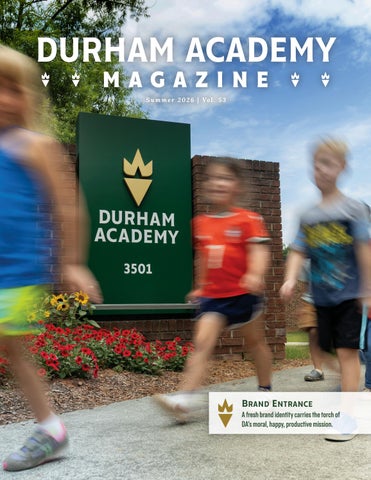
DURHAM ACADEMY MAGAZINE S u m m e r 2 0 2 6 | Vo l . 5 3
Brand Entrance A fresh brand identity carries the torch of DA's moral, happy, productive mission.
EDITORIAL
Melody Guyton Butts // Editor Victoria Price // Art Director
MARKETING & COMMUNICATIONS
communications@da.org Leslie Traba // Director of Marketing & Communications Kate Auger // Digital Content Specialist & Photographer Melody Guyton Butts // Associate Director of Marketing & Communications Dylan Howlett // Writer & Content Strategist Jesse Paddock // Videographer Victoria Price // Assistant Director of Marketing & Communications
CONTRIBUTING WRITERS
Brooks Dareff; Kathy McPherson ’66, Former Associate Director of Communications; Melissa Mack, Director of Digital Learning and Innovation; Sarah Graham Motsinger ’00, Director of Philanthropy Operations and Stewardship; Andy Pogach, Director of Athletics; Constanza de Radcliffe, Upper School Spanish and French Teacher; Kelly Teagarden ’04, Program Director for Applied Civic Engagement and Public Purpose; Beth Throop ’06, Third Grade Teacher; Cana Yao ’26
CONTRIBUTING PHOTOGRAPHERS
Black Mountain Expeditions; Mehmet Demirci; Samantha Everette ’03; Anne Gregory-Bepler, Upper School Visual Arts Teacher; HighSchoolOT; Tim McKenna, Director of Alumni Philanthropy & Engagement; Evan Pike Photography; Constanza de Radcliffe, Upper School Spanish and French Teacher; Sarah Shulz; Upper School Faculty
CONTRIBUTING ARTISTS
Stella Brown ’28; Lylah Camire ’26; Kate Holladay ’28; Cayden Kim ’29; Morgan Yohn ’26
PRODUCTION
Performance Print Services // Printer
LEADERSHIP
Michael Ulku-Steiner // Head of School Kristen Klein // Associate Head of School Melissa Pfeil // Chair, Board of Trustees David Peters ’13 // President, Alumni Board
PHILANTHROPY AND ALUMNI AFFAIRS
philanthropy@da.org Chris Farr // Director of Philanthropy Tim McKenna // Director of Alumni Philanthropy & Engagement
PICTURED HERE: Jon Lantzy had, by May 16, nearly done it all in the world
of lacrosse. He played collegiately and professionally. He coached at every conceivable level. He directed the King of the Spring Face-Off Classic, the nation’s largest regular-season, intersectional high school lacrosse event. He had nearly done it all, too, in the world of DA, teaching Middle School PE for 18 years and leading the DA boys lacrosse team to more than 180 wins and four state final appearances. All that remained — to dispatch that stubborn “nearly” — was an NCISAA state championship. But his program was always something more than wins and losses. “As a lacrosse coach, Jon Lantzy cares more about who you are as a person than who you are as a player,” said Camden Hughes ’26, a two-time All-State honoree under Lantzy. “He feels his role is to develop people’s character under his mentorship. He walks the talk and lives a simple, fulfilling life.” Rarely had Lantzy’s lacrosse life felt more fulfilled than on May 16, when the Cavaliers — in Lantzy’s final game on the DA sideline — won their coach’s first state title over Charlotte Country Day School in overtime. It was a storybook ending for Lantzy, who left DA this summer for the athletic director’s position at Christ School. That was, of course, the furthest thing from his mind as he spoke with his team one last time after their state championship. “Let’s be clear: Nothing is mine,” he said. “That is our moment.” We are grateful that Coach Lantzy will always be a state champion, and even more grateful that he will always be a Cavalier.
FRONT & BACK COVER PHOTOS BY K ATE AUGER, DIGITAL CONTENT SPECIALIST & PHOTOGR APHER
i
Durham Academy Magazine Summer 2026
da.org
ii
HIGHSCHOOLOT
CONTENT 1
The Galvanizing Wisdom from DA Senior Exit Interviews From the Head of School
2
Heard in the Halls
3
Moral, Happy, Productive
7
The Art of Building Resilience
9
Another Jump, Another Kick, Another Try
Healing the Deal Four years ago, Dr. Nora Wilson Dennis ‘97 pivoted from a traditional career in psychiatry to establish her own farmbased practice.
Resilience in Physical Education
24
12 What’s in My Backpack 13 Beyond the Classroom
Five Years of Cavalier Capstones
22 Teatime
Upper School Ceramics Gallery
27 The Legacy of a More Sustainable Future 40 Press Play on the Future: Class of 2026 46 From the Alumni Board 47 Homecoming 2026 48 Lexie Chen ’25 Leaves a Path of Green in Durham 50 A Mission-Driven Gift Opens Doors for Durham Academy Students 51 Legacy Gift Planning 52 What My Sabbatical Taught Me About Creativity Reflections from Constanza de Radcliffe
54 Off The Page
Student Book Recommendations
59 From Sea Turtles to Storybooks 63 Family Ties 65 Weddings & Babies 66 Brendan Bradley ’01 and Robert Wilson are Honored with Alumni Awards 72 Lori Hanks
F. Robertson Hershey Distinguished Faculty Award
74 Faculty & Staff Farewells 75 Remembering Coach John Manison 76 Alumni Board & New Trustees
iii
Durham Academy Magazine Summer 2026
A Beautiful Day for a Neighbor The Preschool’s partnership with a nearby senior living facility continues to flourish as it enters its 13th year.
18
ALUMNI
Looking for updates on DA alumni? This banner highlights stories and tidbits about how Durham Academy alumni are living moral, happy, productive lives.
Brand Entrance With the school’s first brand refresh in 27 years, Durham Academy’s visual identity and reimagined Cavalier mirror the vibrant, inclusive community that DA is today.
Cavaliers Athletics With four team state championships — three of them clinched within a 90-minute span — 2025–2026 is DA Athletics’ most successful year in nearly three decades.
28
68 Brotherly Love Mark and Marty Walkowe, brothers on DA’s security team, treat everyone they meet with the kind of compassion and care you’d expect from family.
60
da.org
iv
v
The Galvanizing Wisdom from DA Senior Exit Interviews FROM THE HEA D O F SCHO O L Every spring, I sit for 15 minutes with each DA senior to ask them about their proudest moments, what they’d do differently, where DA has best served them and where the school has fallen short. I take close notes. After commencement, I look for patterns and themes in the data. I share these themes, without names attached, with the relevant colleagues on campus. We make changes every year based on what we learn from our seniors. Teenagers (especially with the exit door in sight and emancipation on the horizon) do not hold back. Anonymity increases their freedom to share the good, the bad and the ugly. As I tell each of them, their critiques often prove most useful; we need to know where we’ve missed the mark. This year (in addition to more parking spots and shorter food truck lines), our seniors’ most common requests from the school: push us to mix our social groups more often, clarify the rules for appropriate AI use, and grow community support for fine arts and girls’ sports. This year, I did 114 senior exit interviews and never heard the same thing twice. Each student has a unique path and perspective. Still, common themes emerge. Among the most salient: • My teachers changed my life: Across 14 years and nearly 1,400 exit interviews, the strength of our faculty is by far the most common theme. Seniors gush about their advisors, coaches and mentors. One of the hundreds of tributes I heard this spring: “Dr. [Christi] Augustine is my home away from home. Her ADV Biology class is really hard, but we found a way for me to learn best. Twice a week in tutorial, we sit down, white-board an overview of the chapter and then dig into each topic. I never thought I’d love biology, but now I do. She’s the reason why.” • I feel prepared for college and beyond: Seniors point to their challenging coursework, outdoor campus, flexible schedule and “easy opportunities to be exposed to a lot of cultures, opinions and ways of life.” They recognize that their struggles and the high expectations of their DA teachers have left them with stronger study and time management habits, heightened interpersonal skills and an ability “to make eye contact and have a conversation with just about
anybody.” Said another senior: “My research, writing and public speaking skills have expanded so much. When I look at my old self, or my friends who go to other schools, I can see the difference. Whatever I choose to do in college and life, I have the foundation and the work ethic to do it well.” • My relationships mattered most: One might expect 12th graders, when asked for their sources of pride, to point to their college destinations, athletic triumphs or performances on the Kenan Auditorium stage. Most, however, don’t hesitate to declare they are proudest of their relationships with peers and teachers. “We are a pretty random group of people. We’re all great friends now. We call ourselves the Hooligans. We feel like a family, and Mrs. Harris is the reason why,” one senior said of Upper School librarian, teacher and advisor Shannon Harris. Said another: “My friend group is like the United Nations. I can have a disagreement with someone and it’s going to be OK. It has made me more clear and confident about my beliefs.” That common theme of productive conflict is relatively new in the data. DARC SIDE, our Upper School robotics team, might call it “Coopertition,” which they define as “unqualified kindness and respect in the face of intense competition.” I suspect it’s also growing from DA’s work on civil discourse and our move beyond AP courses. These days, DA students are solving more real-world problems, chasing authentic areas of passion and building knowledge as deep and durable as their relationships. As one senior put it: “There have been some classes with a lot of smart people in which it’s like iron sharpening iron. We are all striving to write great papers and share our thoughts. I think that about DA more generally — it’s amazing to be surrounded by people who are all trying to do really cool things.”
Michael Ulku-Steiner Head of School @michael_ulku_steiner
da.org
1
HAULING GRAVEL, GROWING COMMUNITY Students, faculty and parents have been hard at work to extend Sandy Creek Trail — a goal that could pave the way for a Pickett Road crosswalk. Students participating in Senior Challenge: Local moved 24 tons of gravel to extend the trail by 100 feet last August, and Celsey O’Hare ’29 secured a Contribution Project grant to further advance the project. The trail expansion is particularly significant in light of the late-May announcement that DA has acquired the 16-acre property directly across Pickett Road from the track and Alumni Field (and adjacent to the previously established trail). The land is being evaluated for potential uses as part of DA’s long-term campus master planning process, with environmental considerations top of mind.
KUDOS FOR TWO DA STAFF LEGENDS Forrest Beck and Cedric Richardson are the recipients of the inaugural Durham Academy Staff Excellence Award, as shared in a surprise announcement at the closing faculty and staff meeting in June. While Beck teaches and coaches robotics in the Upper School, his primary role is senior network and systems engineer. He is known across school departments as a collaborative problem-solver whose skill knows no limits. Richardson, who serves on the Ridge Road campus grounds crew, is known for his attention to detail and unwaveringly sunny disposition — no matter the weather. He is often one of the first employees whom school visitors encounter, providing friendly guidance that leaves them with a smile and a positive first impression of DA. Learn more about Beck, Richardson and the award at url.da.org/staffexcellence26.
HEARD IN 2
Durham Academy Magazine Summer 2026
SPOTLIGHT ON SUSTAINABILITY What began with plans to document the installation of solar panels at DA soon turned into much more, as Nachi Kumara ’26 and Eli Werness ’26 realized that a comprehensive look at the school’s sustainability goals was warranted. In the end, their documentary also featured a tribute to retiring sustainability coordinator Tina Bessias ’78, whose passion and determination guided DA’s strategy around sustainability for nearly a decade. Watch the short film at url.da.org/ sustainability26, and see page 27 for more on sustainability.
LEARNING SUPPORT ADDITION Over the course of the school year, an addition to the Preschool/Lower School campus steadily took shape, culminating with the opening of the ARC — Academic Resource Center — in April. The ARC, which is situated beneath the library, serves as a hub for learning support faculty and a space for teachers and outside professionals, such as speech therapists, to work one-on-one with children.
RESEARCH SYMPOSIUM With 20 Upper Schoolers presenting their culminating research projects, the Spring Research Symposium was a much-anticipated event — attended by scores of community partners, teachers, family members and peers. This year marked the second year of DA’s Pathway Scholars and Thesis Scholars programs, through which students pursue community engagement and academic research projects. Among those presented at the symposium: an investigation of teens’ willingness to implement “Blue Zone” longevity practices by Alexandria Parker-Horton ’27, a Thesis Scholar.
THE HALLS 5 Things That Have DA Talking da.org
3
ALUMNI
MORAL, HAPPY, PRODUCTIVE DA'S MISSION IN ACTION Torsie Judkins ’91 Earns Leadership Honor
Cavalier Helps Score a Junior Canes National Ice Hockey Championship
Torsie Judkins ’91 was named one of the most influential Black leaders of 2025 in Madison, Wisconsin — joining a cohort of 32 elected officials, business and community leaders. Judkins is the Head of School at Wingra School in Madison, where his leadership centers on fostering community and belonging.
Wesley Swain ’27 captained his 18U Carolina Junior Hurricanes Black team to a national championship in April. The Junior Hurricanes clinched the Tier II 1A title with a 4–2 win in the final of the 2026 Chipotle-USA Hockey National Championship, in West Chester, Pennsylvania.
Lower School Teachers Earn Advanced Degrees When DA teachers encourage their students to develop habits of lifelong learning, they model what it means to be a lifelong learner every day, and many further their own education after the regular school day ends. Among those who recently earned advanced degrees are first grade teacher Terri Burrus and first grade teaching assistant Taylor Beyle, both of whom now hold Master of Arts in Teaching (M.A.T.) in Elementary Education degrees from N.C. State University. In addition, third grade teacher Erika Kim earned a Master of Education (M.Ed.) in Elementary Education, with a concentration in Anti-Racism in Urban Education, from the University of North Carolina at Charlotte. And fourth grade teacher Ann Laros earned a master’s degree in school counseling from Southeastern Oklahoma State University.
Hall of Fame Induction Adds to Susan Ellis’ Coaching Accolades Susan Ellis, head coach of Durham Academy’s varsity girls soccer team and a Middle School PE teacher, was inducted into the inaugural Ursuline Academy of Dallas Athletic Hall of Fame in May. Ellis, who coached at Ursuline from 1984–2000, led the program to 15 state championships and is credited with building it into one of the most dominant programs in the nation. She has more than 550 career victories as a high school coach and was inducted into the DA Athletic Hall of Fame in 2024 and the North Carolina Soccer Hall of Fame in 2019. Prior to coaching, Ellis was a standout player who won four national championships at UNC Chapel Hill. Between her coaching and playing careers, Ellis has been a part of more than 55 national championship teams.
4
Durham Academy Magazine Summer 2026
Student Research Leads to Hands-On Exploration of Robot-Assisted Surgery Taylor Fox ’26 turned her ADV Thesis project into real-world impact, researching patient perceptions of robotic surgery. Her work earned an invite to Intuitive — the global leader in robot-assisted surgery — where she presented her findings and even tested Intuitive’s da Vinci system. Fox became intrigued by robotic surgery after her grandmother experienced a remarkably fast recovery from hip replacement using the technology, and she spent her junior year researching robotic technologies in the medical field.
Alumni Share With Students About Careers in Entertainment, Health Care & Tech Rielle Quiambao ’16, Betsy Wiener ’13 and David Hey ’09 joined Upper School students for a virtual tech panel in January, sharing about the twists, turns and passions that led them into the industry. They connected with students about DA, college and life beyond, reminding them that following your interests matters. In February, Rob Bressler ’03 visited the Upper School’s ADV Community-Based Research class to share about his experience in the health care, finance and tech sectors, along with his insights on building connections. In April, multidisciplinary actor and creative pioneer Brendan Bradley ’01 visited Upper School Video Production II classes to offer students a taste of his work in the entertainment industry. He had each class create a script of original work before swapping the stories to try their hand at directing. Bradley also shared what his day looks like on a set for TV, indie film and video game productions before holding a Q&A with students. Bradley, who lives in Los Angeles, was in Durham to accept the 2026 DA Distinguished Alumni Award (see more on page 66).
First Grade Teacher Publishes Debut Book Alumni Runners Find Camaraderie and Competition at Marathons DA alumni Anna Catherine Wilson ’21 and Lucy Steiner ’21 took on the Maine Marathon in October — and crushed it. Wilson finished in 3:17:18, placing second in her division with a blazing 7:32 min/mile average pace. Steiner showed incredible endurance with a 4:02:52 finish, placing 22nd in her division. At the Marine Corps Marathon in Arlington, Virginia, Ethan Goldman ’18, Jack Anderson ’19, Neil Mosca ’19, Nick Epstein ’19 and Yaakov Huba ’19 ran the race within the top 11% of competitors. The event marked the 50th running of “The People’s Marathon.”
First grade teacher Shayna Dorvilier is now a published author. I Can’t Help That... invites young readers into a compassionate classroom where children share things about themselves like medical conditions, cultural backgrounds or learning differences. Through gentle storytelling and expressive illustrations, the book explores themes of anxiety and struggles both visible and invisible. As the characters move from isolation to acceptance, readers witness the power of empathy and inclusion.
Senior Shares Research on Social Media Risks for Young People Over the course of her final two years at DA, Lilly Jones ’26 researched the risks and impacts of social media on adolescents, particularly those of middle school age. She conducted her research through the Upper School’s ADV Thesis course and Pathway Scholars program, which empowers students to design and implement community-based projects in collaboration with local partners. Jones shared her findings with DA Middle School faculty and presented to eighth graders this winter. In April, she hosted a parent education session titled “How to Help Adolescents Navigate the Risks of Social Media” in partnership with Dr. Mitch Prinstein. One of the nation’s preeminent researchers on technology and the developing brain, Prinstein had shared his expertise in talks for parents, faculty and students the previous school year.
da.org
5
DA Hosts New Events for Latinx Students & Families Two new events this school year were all about honoring roots and fostering connections within the Hispanic and Latinx communities at Durham Academy and beyond. In November, families, students and faculty from all divisions of DA gathered for Noche de Juegos, or Game Night — featuring games, lively dancing and shared culinary delights. Helping to run the event were members of ¡DALE! — the Upper School student group Durham Academy Latinos-Hispanos Estudiantes. And in March, the Upper School hosted the first-ever Hispanic–Latinx Symposium of Independent Schools of the Triangle. The event drew about 50 high schoolers from area independent schools for a morning of networking, collaborating and celebrating identity. “Although the numbers of Latino students and Latino teachers has grown enormously since I started working at Durham Academy in 2003 — it has increased from 1% to 4% [of the student population] — we still continue to be a small group,” said Upper School Spanish teacher Liliana Simón. “It occurred to me that if we combine the few small groups from the independent schools in the Triangle, we would make a nice group. We have many things in common in terms of experiences in schools that are similar to ours.”
Winter Musical Mean Girls Earns Accolades Durham Academy Upper School’s 2026 winter musical, Mean Girls: High School Edition, was nominated for multiple DPAC Rising Star Awards, and Emma Bernstein ’26 won for Outstanding Performance in an Ensemble. Conor Hernandez ’26 was a finalist for Best Actor for his role as Damian, and the full Mean Girls production was nominated for Best Ensemble. The event featured a student ensemble comprising performers from each participating high school, with winners — including Bernstein — selected in recognition of their “dedication, preparedness, attitude and overall performances.”
New Program Shows Middle Schoolers the Real-World Impact of Public Service Durham Academy’s Innovation Journey Fund supported a yearlong civic engagement initiative called Voices in Action, bringing together 15 passionate sixth and seventh grade students who were selected for their interest in leadership and community involvement. Assistant Director of Speech & Debate Rachel Mauchline met with the group twice a month after school to explore what it means to be an active citizen and changemaker. The program featured a variety of field trips — including to the Durham County Board of Elections and the State Capitol — as well as observations of governmental meetings and guest speakers. Participants hosted a spring event to share the civic engagement projects they worked on, including those focused on sustainable energy, the hunger gap, teen vape use, education funding and anxiety. Voices in Action is offered free of charge to participants — who are selected by application — and the program will continue with a new cohort of Middle Schoolers in 2026– 2027.
6
Durham Academy Magazine Summer 2026
The Art of
BUILDING RESILIENCE By Melody Guyton Butts, Associate Director of Marketing & Communications
If rooms could personify the people who occupy them, Horton Hall let out a breezy exhale and dropped its shoulders as parenting expert Dr. Becky Kennedy prefaced her late February talk at Durham Academy Middle School with a reassuring admission.
avoiding setbacks,” Muradi explained. “They come from learning how to respond to them over and over again. … When our children learn to persist, they are believing in their own capacity, and they’re building these skills that will help them throughout their lives.”
“Being open to learning about parenting is seriously one of the bravest things we can do,” she said. “You love the heck out of your kids, and hearing a new idea makes us think, Oh, I messed that up. I just want you to know that everything we talk about, I do 50, 20, 80% of the time myself at best. That’s the best it gets: taking an idea, trying to do it some of the time, repairing when we don’t and then moving on to the next day.”
So — served up with the reassurance that even the most influential parenting experts of our time don’t follow their own advice 100% of the time — here are five takeaways from Kennedy’s and Klein’s visits to DA.
That behavior — parents trying their best, and even when they might come up short, trying yet again — is exactly the sort of resilience that Kennedy and fellow psychologist Dr. Tovah Klein spoke about during their visits to DA this year. At the heart of both talks was a focus on raising adaptable, independent children who are deeply secure in the knowledge that they are loved. In introducing Klein at her presentation to parents in January, DA Director of Strategic Initiatives Victoria Muradi explained that this year’s parent education focus on resilience is aligned with the school’s mission to prepare students to live moral, happy and productive lives. “Those qualities don’t come from
The following excerpts from Kennedy’s and Klein’s remarks have been lightly edited for clarity and brevity.
1. Resilience is a learned skill. Resilience isn’t about powering through or being tough; rather, it’s the skill of being able to face uncertainty, adapt under pressure and refuel after setbacks. Klein and Kennedy say all children are capable of developing resilience through exposure to challenges — so long as they are supported by adults who help them feel safe in struggling, failing and trying again. “It’s not about tough love on the parents’ part. It’s not about armor. It’s not a trait. It’s not inborn, like you’re born resilient or you’re not. The good news is, everybody’s born with the capacity for it, and it’s not static. It’s going to
da.org
7
develop through their relationship with their primary caregivers.” — Dr. Tovah Klein “Building resilience feels anything except for resilient. It is ugly, it is messy, it is whining, it is protest. … Resilience isn’t limiting the range of feelings we can have. Resilience is actually defined by our ability to tolerate the widest range of feelings and still feel capable as a person.” — Dr. Becky Kennedy
2. Feelings are real and valid. But they don’t run the show. Both Kennedy and Klein stress that parents can validate kids’ feelings and hold the line simultaneously. And learning to regulate emotions when things don’t go your way is key to developing resilience. When kids feel seen and understood, Klein says, they’re more willing to take on hard things. “A precondition for having a skill to manage a feeling is giving yourself permission to have the feeling. You can’t develop skills for feelings you believe you’re not supposed to have. … But feelings being real doesn’t mean that feelings should change an entire family system. You are the authority. Your kid’s not going to make a good decision about how much screen time they should have. They’re not going to make a good decision about bedtime or dessert. You are the person to make that decision, and your kid is allowed to be upset about it.” — Kennedy
3. You don’t need to manufacture hardship. It doesn’t take a major crisis to build resilience. In fact, it’s most effectively cultivated through repetitions of “good stress,” or eustress, Klein says — such as the start of a new school year, not making the cast of the school play or frustration over a school assignment. After children navigate those more minor stressors and process them with the support of reliable adults, they’re better prepared for the truly life-altering stressors they will eventually encounter. “In order for the brain to handle stress, the brain needs to handle stress. You can’t wake up one day and have something bad happen, and your whole brain and body system go, I’ve never dealt with that before. … Positive self-talk comes from us saying, ‘You had a hard time, that was a big tantrum, and I’m still here for 8
Durham Academy Magazine Summer 2026
you.’ It tells your children, I’m not alone in the world, and these adults believe in me. They’ve helped me through this. It becomes their inner self-talk that says, I can figure this out.” — Klein
4. Fixing everything robs kids of opportunities to grow. In the short term, when the stakes are seemingly low, it’s all too easy to remove obstacles from your child’s path when possible. Dash home and retrieve his forgotten violin. Cave when she begs for the water bottle du jour. And that’s OK every now and then. But in the long term, Klein and Kennedy say, it’s critical for adults to find opportunities to support their children through feelings of discomfort, rather than removing the discomfort entirely. “The reason I think that our kids are having such a hard time building resilience in this generation is we aren’t willing to tolerate their distress. We have so many more distractions in our lives and conveniences in our lives that we’re like, I just don’t want to deal with this. ‘I’ll order the water bottle for you on Amazon. There you go.’ We have less patience for distress than our parents did for us. So if we want to help our kids be more resilient, I’m just gonna be honest, the answer has 0% to do with our kids. It has 100% to do with us.”
Developmental psychologist and professor Dr. Tovah Klein is author of “Raising Resilience: How to Help Our Children Thrive in Times of Uncertainty.”
— Kennedy
5. It all starts with a trusted adult. To be resilient, a child needs to know not only that they can pick themselves up when they fall, but also that an adult will be there with a comforting hug, ready to cheer them on when they try again. It’s through the primary relationship that resilience develops, Klein says, pointing to decades of psychology and neuroscience research. “As they go through life, they know that they’re safe — that’s going to always be paramount — but also that they are not alone in the world. Why is that so important? Because when they mess up or don’t want to feel like all is lost, they need that place where they’re not going to be judged, they’re not going to be shamed. That’s the relationship they internalize. Am I a good person? Is it OK when I mess up? … I don’t think as adults, we can even fathom how much our children need us.” — Klein
Psychologist Dr. Becky Kennedy is a popular source of parenting advice on social media and author of “Good Inside: A Guide to Becoming the Parent You Want to Be.”
Another Jump, Another Kick, Another Try Resilience in Physical Education By Kate Auger, Digital Content Specialist & Photographer
D
urham Academy’s physical education programs are designed to build more than physical strength. At every level, students develop different skill sets through a variety of activities — from nature walks and jumping rope to team sports and weightlifting. But no matter the age of their students, DA’s PE faculty share a larger goal: creating an environment where students learn how to be resilient. In these classrooms and gyms, success isn’t defined by winning a race or mastering a movement on the first try. Participation in PE is about learning to face challenges, discomfort and failure, and to keep showing up anyway. Students practice skills that extend far beyond fitness: self-awareness, empathy, perseverance and confidence in the face of difficulty. These are the tools that equip them not just for sport, but also for life. For our exploration of Durham Academy's physical education, we talked with faculty across grade levels. Their insights reveal how resilience is intentionally taught, modeled and practiced — one jump, one kick and one curl at a time.
PRESCHOOL & LOWER SCHOOL Each of DA’s Preschool/Lower School PE teachers has a unique goal for their students. Costen Irons ’98 wants them to learn to be bold, kind and engaged participants. Eric Block strives for students to lean into what’s
uncomfortable physically, emotionally and socially. Courtney Hexter hopes her students leave the gym with an understanding that it’s OK to not know something yet, and that effort leads to growth. The obstacle course and jump rope units check all of these boxes. The obstacle course physically challenges students by comparing their personal times from the start of the unit to the end, but more important to their teachers are the opportunities for students to support each other as they seek to improve. That’s also why everyone plays a part in the jump rope unit, no matter their skill. On a September morning, the obstacle course awaits a group of first graders, who must complete a short run, balance a ball on a cone, scale a “mountain” of a pommel horse, dribble a soccer ball and launch their bodies over hurdles. The most giggling comes from the scooter station, where the grand finish line has students flying across the last 30 feet of the course. Helping to run the course are their classmates; at each station is at least one student who acts as facilitator, referee and cheerleader. Block explains: “In games, we’re really encouraging [them to] referee themselves… especially as they get older, the more they can be honest and show integrity.” Foremost among these responsibilities of running the course is lifting one another up.
Not every student brings the same physical abilities to PE class, but the Preschool/ Lower School PE team has created space for students to take risks with the support of their peers. Yes, there will be failure, but it’s much easier to sit with it and bounce back when a student’s entire class is chanting their name and propelling them to the finish line. Hexter’s perspective on this: “It is interesting to see the ones who are really super confident out on the playground, and then come in and you can just see their uncertainty. We help them through that, and that builds resilience. It’s OK to be 8 years old and not know how to do stuff. No one was born knowing how to do any of this stuff, so we can try and grow.” Students also work through social or emotional challenges in PE class. One student might be frustrated that a classmate can’t keep up with their soccer team experience, while the other might be frustrated by trying something new. Such scenarios present opportunities to build both resilience and empathy. “Kids have power, even at a young age, to shape the environment,” Irons says. “The way they interact can help others grow.” And Hexter’s anecdote illustrates exactly how the team approaches building emotional resilience: “When a student comes to one of us and says, ‘I got tagged on the back really hard, and I didn’t like it,’ I’ll say, ‘That makes sense. Did you tell them you didn’t like it?’ We try to empower them to feel what they’re feeling and understand how to work through it.” da.org
9
MIDDLE SCHOOL The four Middle School years are marked by leaps and bounds in students’ physical, social and emotional development. Longtime Middle School PE teacher Susan Ellis — part of a teaching team including Jon Lantzy, Andy Pronto and Kristin Stroupe — recognizes this in her students. “Fifth graders often borrow resilience from adults — they need help finding their reset,” Ellis explains. “At this age, resilience often needs support: reminders to reset, encouragement to rejoin, guidance on how to handle frustration. It’s emotional, sometimes messy, but very real. They’re just beginning to understand that they can push through hard moments. Eighth graders are learning to own their resilience — they’re developing the ability to regulate, respond and push themselves forward. … It’s the student who is disappointed but manages their response, who keeps working even when confidence is shaken, who balances social pressures, academics and athletics without shutting down. They’re more aware of others’ opinions, more self-critical and sometimes harder on themselves. Resilience here is choosing to stay steady, to not withdraw, to keep showing up — even when things feel heavier.” 10
Durham Academy Magazine Summer 2026
The Middle School PE team values opportunities for students to grow, not just physically, but socially and emotionally. Consider the student who learned to throw a slower pitch to help a teammate succeed. Or the student who felt out of place because her drive and skill were more advanced than that of her peers. Teachers worked with the student to not downplay her skill, but rather celebrate and own it — demonstrating teamwork while honoring and valuing her own abilities.
slowly, the student had to finally admit that she actually liked PE. The team finds creative ways to meet the students where they are, whether that’s in level of skill or in interest.
“We create an environment where students work with different people outside their friend groups, face varied challenges and see that everyone contributes differently,” Stroupe explains. “We assess students on how they show up in a group, not just on their physical skills. By normalizing struggle and celebrating effort over perfection, students learn that resilience isn't about never failing — it's about how you respond and contribute when things get difficult.”
On a bright, sunny day, just outside the Middle School gym, the environment is the opposite of the gym class misery so often depicted in movies. It’s joyful, with energetic pop songs blaring from a speaker, and students smiling as they race across the field. Resilience is being built right here in the middle of the fun. Stroupe and Ellis reiterate that social and emotional learning is a top priority for the Middle School PE team, and from an outsider’s view, they’ve created the perfect environment — students learning through play.
With regard to their own resilience, the team sometimes encounters students who claim to dislike PE. That’s rough to hear when you’re so passionate about the subject, but it doesn’t deter the teachers. Ellis recalls a student who, at the start of the class, anticipated that she wouldn’t enjoy any of the PE units to come. What that student didn’t expect? Ellis to lead a nature walking unit. Then a soccer unit. And
Pronto says engagement is one of the department’s goals. “If a student does not engage with the content or concepts, it will be difficult for them to perform,” he said. “Some of the best moments in PE happen when students dive in and surprise themselves with their abilities or how much fun they had.”
UPPER SCHOOL Students in their sophomore, junior and senior years have the option to fulfill their physical education credits in a variety of ways, including with after-school sports, but there’s
still an abundance of students improving their athletic abilities in the strength and conditioning courses taught by Upper School fitness director Jordan Babwah and PE teacher Dr. Krishinda Lee. On a cold morning in the dead of winter, the weight room blooms with a bit of warmth, a little sweat and a lot of visible confidence from the students. Immediately apparent in their movements is the confidence each student carries — they know how much weight they can handle and how far they can safely push themselves. A crowd gathers around a student trying to break a record for most reps in a minute — of an exercise that, for the average person, could be described as a Herculean feat, or as Babwah describes it, a Nordic hamstring curl. Their support, words of encouragement and presence are enough to help Nick Friga ’26 nearly beat the Guinness World Record — currently held by Gregory Pignataro, with 24 Nordic hamstring curls per minute. Friga comes close, but doesn’t quite break the record on this day. Babwah notes an important distinction: “I teach a VERY strict form of [the Nordic hamstring curl] in class, and the world record criteria is less stringent.” In the weeks that follow, Friga continues in his pursuit of Pignataro’s record — and, ultimately, he succeeds with a personal best of 29 curls. But an even more valuable measure
of success than a Guinness World Record? His persistence in the face of failure. And that aligns perfectly with how Babwah views resilience in his classroom. “Resilience often looks like a student staying engaged when something is difficult, uncomfortable or does not go the way they hoped. In a gym, it may be continuing to work through a lift or movement pattern that does not come easily at first. In PE, resilience is not just toughness. It is the ability to keep going, adapt and learn through challenge.” He also reflects on what it all looks like as a collaborative effort — not once has the PE program at any level focused only on personal achievement. A principle that brings every division together is the power of a team, a class, a grade or a division’s collective involvement in the individual’s success. “We also intentionally build a sense of collective achievement. In some cases, we track total class improvement on certain metrics, which shifts the mindset from individual performance to shared success,” Babwah explains. “One semester, for instance, our class improved their cumulative vertical jump by 34 inches. Not only is that a significant gain, but it also creates a clear, tangible example of what collective progress can look like.”
As Lee sees it, PE classes offer students an opportunity to step away from academic stressors, as well as an environment where the cost of a mistake isn’t a permanent fixture on their transcript. “It is a space where students can challenge themselves without a ‘fear of failing,’” she says. “I think it is one of the only spaces where we encourage students to occasionally take their bodies mentally and physically to a point of failure.” And that failure happens “in a fairly inconsequential sandbox,” Babwah says. “In other parts of school life, students may feel that one grade can snowball into anxiety about college or their future. In PE, students are freer to try, adjust, get creative and let failure be a teacher. That makes it a powerful place to learn that setbacks are part of growth, not the end of the story.”
da.org
11
What’s In Noah Kim’s
BACKPACK PENCIL POUCH AND PENCILS ALGEBRA TEXTBOOK
Stuck on an equation? Need to track down the value of x? Noah turns to his textbook outside of class to practice the challenging material.
The tools that make it all happen. Noah keeps a wide assortment of pencils and pens on hand for jotting down ideas, solving tough problems and preparing for competition.
IPAD
A staple for every Durham Academy Middle Schooler, the school-issued iPad is how Noah connects with teachers on Toddle, prepares for debate and, of course, shares his inspirational stickers.
LEGAL PAD AND GAVEL
As a member of DA’s Middle School Speech & Debate team, Noah’s legal pad is always within reach to take notes and prepare for tournaments (like his semi-finalist finish at the Harvard Invitational this spring), as is the commemorative gavel he won at the Cavalier Invitational this January.
NOTEBOOKS
One is plain white — an unassuming keeper of scientific truths. The other, a patterned cover Noah describes as “fireworks,” is used for Civics.
Middle School comes with freedom — the opportunity to move, explore and grow into one’s individuality. In the busy halls of the Gateway Center, eighth grader Noah Kim ’30 carries a small portion of his world on his shoulder: a black backpack with bright blue accents, packed to the brim with homework, resources and the tools he uses to pursue his passions — including speech and debate. Noah wasn’t shy about sharing what’s inside or how each item helps him succeed academically. Story and Photography by Kate Auger, Digital Content Specialist & Photographer
12
Durham Academy Magazine Summer 2026
BEYOND the Classroom
Five Years of Cavalier Capstones at Durham Academy By Kelly Teagarden ’04, Program Director for Applied Civic Engagement and Public Purpose
A
t the end of each school year, something shifts at Durham Academy. Classrooms empty, but learning does not stop — it expands. Students board buses and planes, lace up hiking boots, step into community partnerships and immerse themselves in experiences that cannot be contained within a traditional schedule. This is the Cavalier Capstone Program: a week of immersive, hands-on, joy-filled learning designed to close out the year with discovery, connection and celebration. And this year marks a meaningful moment — five years into the program (with a pause during COVID-19), offering a chance to reflect on where the program came from, how it has evolved and why it has become such a defining part of the DA experience.
da.org
13
e 2023 ur Capston To ts h ig R Civil
026 apstone 2 Poland C
“Visiting the Legacy Museum in Montgomery was a very immersive and emotional experience, and I learned a lot about the experiences of African Americans all throughout their history. I honestly think that this Capstone gave me a new perspective.” Civil Rights Tour Capstone Student Reflection
Humanity Habitat for
How Capstones Came to Be: Honoring the Past, Evolving for the Future For decades, Durham Academy’s gradelevel trips were a signature part of the Upper School experience. The school was a pioneer in outdoor education, offering transformative and ambitious programming long before such experiences were common. Generations of students hiked, camped, climbed and learned to lead in the outdoors. In 2008, the 11th grade Civil Rights Tour was woven into the program, creating a consistent rhythm of shared class experiences. These trips were beloved, meaningful and foundational. And yet, as DA entered a period of thoughtful reflection, the school recognized that the world, and our students, were changing. Our school had grown. The Civil Rights Tour to Atlanta, Selma, Montgomery, and Birmingham — once totaling two busloads of students and faculty — no longer fit within the constraints of a large-group travel model. Meanwhile, many students were now participating in outdoor education through summer camps, travel programs and other extracurricular experiences; school was no longer the only place they encountered this type of challenge and growth. At the same time, DA itself had become a more diverse community, with a broader array of interests, lived experiences and aspirations. These changes didn’t diminish the past; instead, they illuminated the opportunity for the future. And so, beginning in 2019, DA shifted from grade-level trips to a new model: the Cavalier Capstone Program. 14
Durham Academy Magazine Summer 2026
23 Capstone 20
Students could now choose from a menu of experiences designed by faculty around six core dimensions of learning: • • • • • •
Global Citizenship Career Exploration Community Engagement Academic Immersion Craft or Skill Development Personal Challenge
This shift allowed DA to preserve the pillars of its past — most importantly the Civil Rights Tour and the culminating Senior Challenge — while expanding opportunities for students whose interests, curiosities and identities that a single annual trip couldn’t always meet. As an alumna who cherished my own DA outdoor education experiences, I understood firsthand how powerful those trips were. I also saw the potential for an even richer, more diverse landscape of learning. Capstones gave us both: a way to honor beloved traditions and keep our deep partnership with Black Mountain Expeditions alive, while embracing student and faculty passions, new directions in experiential learning and the evolving needs of our community. The program also solved a longstanding challenge in the school calendar. For years, the Upper School ended with exams — a necessary academic milestone, but not a particularly joyful conclusion. By moving exams earlier and situating Capstones during May’s final week, DA created a culminating experience filled with connection, curiosity and community. Today’s Capstone Program is both a continuation of what DA has always valued and a bold
Taiwan Ca pstone 20 25
step forward. It reflects a belief that meaningful learning can take many forms, and that students benefit from experiences that challenge, stretch, inspire and surprise them. And just as importantly, it reflects a belief that education should end each year with joy.
Capstones: A Vision Rooted in Mission
ne 2024 itchen Capsto K t n ra ig m Im The
Cozumel Sc uba
The Cavalier Capstone Program was created with a clear purpose: to extend Durham Academy’s mission beyond the classroom and into lived experience. At its core, the program reflects a belief that students learn best not only by studying the world, but also by engaging directly with it. Capstones are designed to cultivate the qualities DA values most in its graduates: empathy, curiosity, courage, resilience and a sense of responsibility through experiences that are immersive, challenging and meaningful. From the beginning, the program has been driven by two essential forces: student choice and faculty passion.
Capstone 20 26
Each year, faculty members design Capstones shaped by their expertise and passions, while students choose experiences that align with their interests, whether that means exploring something entirely new or diving more deeply into an area they already love. The result is a program that is both structured and dynamic, grounded in shared goals yet constantly evolving — and a program beautifully aligned with the mission of helping each student live a moral, happy and productive life.
Where Learning Takes Many Forms What makes Capstones distinctive is not just their intent, but also their range — and the way that range translates into experiences that stay with students long after the week ends.
“It is hard to pick one experience from the Capstone that was the most memorable, so I will share a few. The morning of the last day, we went to a waterfall and most of the people got in the water even though it was 50-degree water. It showed how we all wanted to experience the challenge and just do it anyway. Another amazing experience was getting so close to a group of people I had just met. We all had so much fun and had such an amazing group connection. The last most memorable experience from my Capstone was rappelling down a 200-foot rock!” Rock Climbing Capstone Student Reflection
The Capstone Catalog reflects a remarkable breadth: global travel programs that immerse students in different cultures and perspectives; community engagement experiences with local partners and service initiatives; career exploration opportunities that bring students into real professional spaces; academic immersion courses that dive deeply into a single topic or discipline; and creative or skill-based Capstones where students build, design, perform or create. No two students experience Capstones in exactly the same way — and that is by design. Some students travel across the South on the Civil Rights Tour, moving through Birmingham, Selma, Montgomery and Atlanta while standing in places such as the Edmund Pettus Bridge and the 16th Street Baptist Church, and visiting the Legacy Museum and National Memorial for Peace and Justice. These experiences bring students face to face with the history of the Civil Rights Movement and its ongoing impact, often challenging them to reflect deeply on history, identity and responsibility. Others step into outdoor expeditions that push physical and mental boundaries. Removed from daily routines and digital distractions, students develop resilience, independence and a deeper connection to both nature and one another. For others, Capstones open the door to academic and professional exploration that extends far beyond the classroom. In Documenting Durham, students tell local stories through documentary film. In D.C. Art and Architecture, they trace the evolution of the nation’s capital through its buildings and public spaces. Foreign Affairs examines global policy and diplomacy in realworld context, while Page to Stage brings Shakespeare to life through rehearsal and performance at the Blackfriars Playhouse.
the ields of Battlef 2025 e Capston
ar Civil W
da.org
15
Capstones built on community partnerships deepen that same sense of connection with the larger community. In Elevating Others and Lattes, a collaboration with 321 Coffee, students explore accessibility, entrepreneurship and social impact through the coffee industry while working alongside employees and learning about inclusive employment practices. In Immigrant Kitchen, students cook alongside families in the Triangle, learning about migration stories and the ways food carries identity and tradition; the week culminates in a shared meal that blends family and student stories. Participants in the Outdoor Service Expedition contributed to recovery efforts following Hurricane Helene in Western North Carolina. In partnership with Black Mountain Expeditions, students took on the challenge of clearing damaged trails and assisted with ongoing trail maintenance. And through a partnership with Hope Creek Academy, students design and lead an inclusive field day for neurodivergent children — blending service, event planning and education in a shared experience of learning and joy. “Hope Creek could not be more grateful for the partnership that has developed with Durham Academy over the past two years,” reflected a representative of the school. “Hope Creek students benefit from rich and engaging opportunities through the time and energy invested by DA Capstone students, while DA students also gain valuable experience learning how to design an end-of-year field day that is as fun, inclusive and accessible as possible.” In every setting, whether on a mountain trail, in a museum, in a kitchen, on a service site or in a professional workplace, students
stone ketball Cap as B f o ry to His
are engaging directly with the world beyond school. They are learning by doing, observing, participating and reflecting. Other Capstones focus on developing crafts and skills through hands-on making. In Sustainable Sewing and Hands-on Woodworking, students learn design and problem-solving through creation. In the woodworking Capstone, students build a table while learning to use tools such as miter saws, drills and sanders, along with finishes like stains and varnishes. The experience emphasizes craftsmanship, creativity and the satisfaction of producing a functional piece to take home.
ne Peru Capsto
2025
Several Capstones extend learning globally. In Peru, students took on physical challenges alongside cultural exploration by hiking the Inca Trail. In Korea and Poland, they studied history and memory through place-based learning. In Iceland, students embarked on a STEM-focused adventure, studying volcanic landscapes and geysers while experiencing a dynamic blend of science, outdoor exploration and Icelandic history. And while the settings vary widely, the outcomes often echo one another. Students return with stories not only about what they did, but about how they were changed. They describe moments that pushed them outside their comfort zones, conversations that shifted their thinking and relationships that formed in unexpected ways. They also talk about new friendships, often across grade levels, and the people they met along the way who shaped the experience just as much as the places they visited. Capstones are intentionally designed to support that reflection, asking students to consider what they learned about the world, about themselves and about what might come next.
2026
Exploring N.C. Colleges Capstone 2024
“My most memorable experience from the Capstone was visiting UNC and engaging with speakers working in athletics, whose enthusiasm and insight helped me better understand the many ways I could stay connected to sports after my playing career ends. Learning from professionals in different roles broadened my perspective on possible future pathways.” Careers in Athletics Capstone Student Reflection
Canoe Packing Capstone
16
Durham Academy Magazine Summer 2026
2026
Sustainable Sewin g Ca
pstone 2024
Buzz About Bees Capstone 2023 e 2024 and Capston
Icel
“The most memorable experience of going to Iceland was the connections I made with my peers. Experiencing the sights and nature of Iceland was beautiful and life-changing, but what I will remember most are the people I got the opportunity to share this unforgettable experience with.” Iceland Capstone Student Reflection
More Than a Week: A Defining Experience
National Parks Ca pstone 2025
Over time, Capstones have become more than a single week at the end of the year. For many students, they form a thread that stretches through their Upper School experience — a series of moments that build on one another, expanding perspectives and deepening understanding. For seniors, this often becomes clearest in retrospect. What begins as a single choice in ninth or 10th grade evolves into a collection of experiences that shape how they see themselves and their place in the world.
Connections to Future Studies “I’ve always been interested in technology, so the Breaking the Code Capstone my freshman year really stood out to me,” reflected a student. “Visiting the NSA and the National Cryptologic Museum and seeing a replica of the Bombe used to break the Enigma machine was an incredible way to connect history with coding. The experience reinforced my interest in technology and inspired me to continue that path through DARC SIDE and the Pathway Scholars Program.”
One Pathway Scholar traveled to Muhuru Bay as part of the Kenya Capstone to visit WISER (The Women’s Institute for Secondary Education and Research), meet students and continue her community-based research in person. This student was inspired after meeting Dr. Sherryl Broverman, co-founder of WISER, during her ADV Community-Based Research class. Learning about the barriers WISER girls face in managing their menstrual cycles — such as limited access to dependable products, heightened health risks and missed school days — moved her to focus her CommunityBased Research project on menstrual health equity. Her project partners with WISER and AFRIpads to help secure a more sustainable supply of menstrual products. As the Cavalier Capstone Program grows, its core purpose is unchanged: to create space for meaningful, student-driven learning that extends beyond the classroom. In doing so, it not only enriches the Upper School curriculum, but it also helps define what it means to be a Durham Academy student. Because sometimes, the most important learning doesn’t happen at a desk. It happens when students step beyond what is familiar, engage with the world around them and discover what they are capable of becoming. da.org
17
MELODY GUY TON BUT TS
A Beautiful Day for a Neighbor How Preschoolers and Elders Have Built a Tradition of Mutual Joy By Melody Guyton Butts, Associate Director of Marketing & Communications
A
mid-morning quiet has set over the lobby of the Solista Durham retirement community when the first few kindergartners file in, cautiously peering over their cargo: extra-large popcorn buckets piled high with snacks, word search books, and tubes of hand lotion and lip balm. It’s an impromptu visit by these pint-sized neighbors from just across Pickett Road, and the 18 kindergarten Bumblebees are dialed in on their mission to bring in 100 surprise packages for Solista residents in celebration of Valentine’s Day. “Get that bucket!” one calls 18
Durham Academy Magazine Summer 2026
out to a classmate before they turn back to collect another load. His enthusiasm makes an impression on Shanna Huffman, a Solista resident watching from nearby. “Reminds me of my grandson,” she later says with a smile. She’d noticed the kindergartner on a previous visit but didn’t catch his name. For now, “Little Bucket Boy” will have to suffice. “He’s the best. A very authoritative figure on buckets,” Huffman jokes. “He was bossing everybody, doing it in a cute way.”
Such connections are precisely the goal of DA Preschool’s association with Solista, previously known as Emerald Pond. Now entering its 13th year, the intergenerational partnership has inspired countless core memories for all involved; provided early lessons in empathy for students; and weathered challenges that could have easily toppled it, if not for the persistence of dedicated individuals on both sides of the street. As Miller, a kindergartner, so aptly puts it, “They care about us, and we care about them.”
“It’s a beautiful day in this neighborhood, A beautiful day for a neighbor. Would you be mine? Could you be mine? … Won’t you be my neighbor?” - FRED ROGERS
The words of Fred Rogers ring out from a screen in the Durham Academy Preschool Great Room, all six pre-k and kindergarten classes watching as the children’s TV icon welcomes viewers into his home-like set. Most of the students are unfamiliar with Mister Rogers’ Neighborhood, which reached peak viewership in the 1980s. But their teachers know there’s perhaps no better way to set the tone for an introduction of some of Durham Academy’s neighbors — seniors living “just across the pond” at Solista, many of whom likely heard that familiar theme song more than a time or two when raising their own children. This is one of the first Preschool assemblies of each school year, scheduled early in the calendar so students can begin planning for their first visit to the senior living center. Within a few weeks, they’ll have all learned class cheers and created posters to introduce each class’s mascot to their neighbors at Solista. This first walk over — yes, all 109 Sunshines, Frogs, Owls, Pandas, Koalas and Bumblebees will make the 0.6-mile journey on foot — has been a highlight of the Preschool experience since the beginning of the partnership in 2014. But for now, kindergarten teacher Jessica Whilden ’01 and Preschool learning support coach Michelle Park — who work with Solista’s resident life director, Krystal Jockisch, to
coordinate the partnership — focus on how much the students and the residents have in common. Just like the Preschoolers, their neighbors enjoy meals and exercise together. They look forward to celebrating birthdays and holidays. Many have pets. They love a good game of bingo or a joyful sing-along. And, no different from the 4- and 5-year-olds, several of the seniors have found that there’s nothing quite like coming out of a party with a sleeve of temporary tattoos. “We relate it to a big clubhouse for grownups,” Whilden says. “And what’s special about it is that there are helpers nearby. If someone needs something, the helpers are part of their community, just like if we need something here, we have helpers who are part of our community.”
Park and Whilden also talk honestly about some of the differences that students might notice during their visits to Solista — whether those are residents’ hearing challenges, use of wheelchairs or limb differences — and how they can show their respect and care for their elders. By the end of the assembly, with a clearer picture of Solista in their minds, several of the students say they can now imagine themselves living in such a community when they’re older. And so the stage is set for another year of hearts touched and memories made.
The idea for an intergenerational neighborhood partnership came to Sheri-lyn Carrow in 2014. Then a DA pre-kindergarten teacher,
da.org
19
MELODY GUY TON BUT TS
she was also serving as interim Preschool director at the time, and she had been doing a lot of thinking about ways to make service more authentic. As an institution, Durham Academy was moving toward more meaningful service-learning initiatives — rather than isolated acts of community service — to help students forge lasting connections, better understand others’ challenges, and develop skills and character in the process. “Seniors and young kids relate so well together,” says Carrow, who, prior to coming to DA, had worked at another school with an ongoing relationship with a senior center. “It’s just a nice pairing, if you can make it work. And it became clear that across the street there was an opportunity here at DA.” For the next 10 years — until she retired in 2024 — Carrow worked hand-in-hand with the center’s staff to ensure that the programming was equally enriching for the students and the residents of what was then called Emerald Pond. Many of those activities and projects have sustained over the years, from all six Preschool classes trick-or-treating on Halloween and small groups coming over to decorate for holidays, to the annual farewell sing-along featuring old favorites like “Take Me Out to the Ballgame” and “B-I-N-G-O.” Essential to establishing the relationship was Bonnie Gay, then the center’s resident life director. “She was the perfect person to start this with,” Carrow says. “She was very energetic, had great ideas, was up for anything and totally understood how to make it worthwhile.” Gay came to the Preschool’s very first Emerald Pond assembly in 2014 and read Oma’s Quilt, a picture book about a grandmother struggling with her transition to a retirement community and how her granddaughter helped her feel at home in her new environment. It’s a fitting story to help introduce the DA-Solista collaboration, and a dozen years later, Oma’s Quilt is still read at the assembly each year. New traditions have also been born over the years. For one, families donate comfort items for residents each year to be collected in Valentine’s Day baskets — or “You Make Our Hearts Pop!” popcorn buckets, in the case of the creatively themed packages that the Bumblebees delivered this year. It’s just one example of how the Preschool’s work with Solista enables students to witness the impact of their kindness on others, to experience the joy of giving, and to receive kindness in return. “Watching them and their eagerness to get the buckets off the bus and take them in and do their delivery, they were just delighted,” Park says. “A lot of them knew items that they had either shopped for or brought in,” Whilden adds, “and bringing them in, it just completed the circle.”
20
Durham Academy Magazine Summer 2026
The day following the bucket delivery, the Bumblebees gather on the classroom rug to reflect on their visits to Solista. “I like seeing the people there and waving to them,” Caroline volunteers. “I like when we give stuff to them, like the Valentine’s buckets,” Emeline adds. “How do you think that made them feel?” Whilden asks. Emeline responds with a smile: “Joyful.”
“I heard one of the residents make a comment yesterday that it keeps them young,” says Jockisch, the resident life director. “I think it brings a lot of reminiscing. A lot of these residents have their own children, and they’ve got grandchildren who might be young adults. And so seeing the small kids brings up memories of when their children or grandkids were growing up.” Jockisch sits at Solista’s front desk, fielding questions from residents while chatting about the Preschool’s visits with Pam Whilden, who moved to the senior living center last summer. Whilden has longstanding ties to Durham Academy — she’s Jessica Whilden’s motherin-law, her son Guy ’00 is also an alumnus, and her two grandchildren are DA students — so she had heard about the Preschool’s relationship with Solista long before she moved in.
especially when they specifically named the residents — like, ‘Hey, is Valerie here?’ ‘Hey, is Pam here?’ ‘You said that you liked this song,’ — it builds that connection. [Residents] are like, ‘Wow, they remember me.’”
The relationship also survived what could have been fractures when key players from both organizations moved on from their roles, or when the retirement center came under new corporate ownership and changed its name.
And for a language arts project, eighth graders fan out to area retirement communities, including Solista, each winter to interview residents about their lives — not for the sake of learning about historical moments, but purely to converse with their elders and to elevate their stories.
“I just feel really happy for both parties, both [Solista] and DA, that it has sustained,” Carrow says. “Learning to show that you care and reach out to share some joy with people who don’t get to see kids a lot and don’t get to experience that kind of joy as much anymore — it’s rewarding for both entities.”
“This kind of intergenerational dialogue is meaningful,” says Ben Michelman, Middle School community engagement coordinator and language arts teacher. “It helps students understand how listening deeply can bridge generations and honor lived experience.”
Looking to the future, Jockisch, Park and Whilden continue to work toward enriching the relationship and facilitating more connections. Several Solista residents visited DA to watch Preschoolers rehearse their Grandfriends Day program this spring, and there is interest in once again welcoming residents to read in Preschool classrooms. And Jockisch is exploring how students could be included in some of the residents’ favorite games, like hallway hockey and chair volleyball.
Like any longstanding friendship, the DA-Solista partnership has weathered its fair share of storms. For two and a half years, pandemic restrictions meant there could be no in-person interactions between students and elders. So, instead, pen-pal relationships flourished, and students kept a steady stream of birthday cards and crafts heading to Solista until they could be together once again.
Huffman, the resident who watched kindergartners bring in the Valentine-themed packages, has borne witness to the joy that young visitors stir in her neighbors. “Everybody’s like, ‘Oh my gosh, how cute,’” she says before breaking into a sly grin. “Now, myself? I’m going for the bucket kid.”
But experiencing the joy of the collaboration as a Solista resident is particularly special. As the Preschoolers’ first visit of the school year drew near, fellow residents were abuzz with anticipation, Pam Whilden recalls. “They’re going, ‘Oh, you wait. They’re so cute.’ Everyone gets really excited about the kids coming.” The Preschool typically visits as a full student body three times a year: for their introductory visit on Unity Day in September, to trick-or-treat around the Solista atrium area each Halloween and for a farewell singalong in May. In addition, smaller groups visit regularly to put up handmade seasonal decorations or play games, and students keep a steady stream of “Happy Mail” — drawings, cards and crafts — flowing to Solista residents throughout the year. Over the years, the Durham AcademySolista relationship has grown to include other school divisions, especially the Middle School. In October, seventh and eighth grade Vocal Ensemble students interviewed residents about their favorite holiday songs, learning about the childhood memories that the carols conjure. The students then curated their winter concert lineup to include songs with special meaning for the residents, and they returned to sing the pieces at Solista in December. The students’ thoughtfulness was moving, Jockisch says: “When they came back to sing, da.org
21
Teatime By Melody Guyton Butts, Associate Director of Marketing & Communications
T
eapots are having a moment. Wildly popular Instagram reels show lumps of clay transformed into stunning vessels within (seemingly) mere seconds. Throughout the summer, teapot enthusiasts are converging on Creedmoor, just 20 minutes north of Durham, for the triennial National Teapot Show. And in Durham Academy visual arts teacher Anne Gregory-Bepler’s classroom studio, Upper Schoolers have been infusing their unique perspectives into their own handcrafted teapots — resulting in pieces that are fanciful, rustic, whimsical and everything in between.
Gregory-Bepler assigned the teapot project to students in her Explorations in Ceramics and Sculpture course, and Morgan Yohn ’26, enrolled in Studio Praxis for Experienced Art Students, was also inspired to take on the challenge. While the teapots could be more conceptual than functional, there were a few requirements: a handle, a body, a lid and a spout. “One of the big focuses is design,” GregoryBepler explained. “How do you create balance so that when you look at the teapot, it looks like the lid, the handle, the spout are proportional? ... We’re not throwing these, like a lot of teapots
would be thrown on the potter’s wheel. They’re all hand-built, which is much more challenging.” Student interest in ceramics has exploded in recent years, prompting Gregory-Bepler to offer a second section of Ceramics and Sculpture each year. “Unlike, say, drawing or painting, I don’t think they really have preconceived notions about what it should look like as much. So they feel freer,” she said. “And the way I teach, it’s very accepting, so I think they feel a lot more relaxed. And it’s just really different from what they do in their academic classes.”
“When we got this assignment, it was starting to get warm outside, and the flowers were starting to bloom. So, I decided on making some kind of flower teapot with very delicate petals, and the spout and the handle were the leaves of the flower. I loved how this project let me turn something I found joy in into something functional.” Lylah Camire ’26 “It’s always terrifying when it first comes out of the kiln because it’s hard to tell exactly how the glazes will turn out. But finishing this project was really fun, and it was interesting to see how different each one of our designs were. I really enjoyed how open the project was; I got to try new patterns and shapes, and make something with very few guidelines.” Stella Brown ’28
22
“I like symmetry, and I really wanted to make a teapot that was symmetrical. Instead of choosing a really complicated [design], I wanted to focus on making the best simple teapot I could, with some detail. I’d seen a similar teapot online, so I made it out of clay and put my own spin on it. I really love how the glazes turned out — how the teal looks with the pink — and how the glazes worked with the pattern.” Kate Holladay ’28
“The design of this set was inspired by the process of making the tray. I struggled with cracking clay and unfamiliar techniques, each mistake leading me to something new. When I finished the tray, it led me to consider creating a tea set around it, which became my project. Ultimately, this set showcases the process of working as an artist and experimentation.” Morgan Yohn ’26
“My teapot was inspired by a coconut, as I wanted to represent a coconut that someone would drink on the beach. To make this idea come to life, I made a basic teapot and added lots of texture to the surface of the teapot to get a hairy coconut look. After glaze firing, the texture was very pronounced, and the color looked accurate, which is something I am proud of.” Cayden Kim ’29
da.org
23
ALUMNI
24
Durham Academy Magazine Summer 2026
HEALING
the DEAL
It’s been two years since Dr. Nora Wilson Dennis ’97 fulfilled the vision that she literally dreamt up: starting her own farm-based mental health practice. Story by Brooks Dareff | Photography by Kate Auger, Digital Content Specialist & Photographer
W
est of Durham, in rural Orange County, walk in mid-March through Jubilee Healing Farm with Dr. Nora Wilson Dennis ’97, and you visualize what’s coming. “Right now, it’s definitely in winter mode,” says the founder and CEO of the farm, which opened to clients in June 2024. “But it’s going to be beautiful.” Over here, the herb and flower area. And nearby, by the dirt road leading into the 10-acre farm — mostly ragweed when Dennis, a Duke-trained psychiatrist and DA alumna, bought it in 2023 — the “food forest.” There, fig, pear, elderberry and apple trees will be ringed by plant guilds, or micro-ecosystems of plants that collectively support the fruiting trees. The guilds will comprise pollinator favorites like milkweed, salvia and red clover; nitrogen‑providing dynamic accumulators such as comfrey and nasturtium; pest deterrents like marigold, chives and garlic; and moisture-holding ground covers including strawberries and creeping raspberries.
combination of idealism and pragmatism and envisions and accomplishes audacious goals.” Today, Dennis and her staff treat clients with conditions including PTSD, anxiety, mood, schizoaffective, bipolar and substance abuse disorders, schizophrenia, depression, alcoholism, grief and loss, suicidal ideation, behavioral addictions and chemical dependencies. Clients in the intensive outpatient program typically attend for 12 weeks, four half-days per week. Communal farm practices — among them cooking, yoga (which Dennis used to teach), herbalism, art and music therapy — pair with insurance-supported medication management and outpatient psychotherapy. The farm program is sustained by grants, volunteers, a sliding scale of out-of-pocket payments, and collaborators. While clients’ progress is iteratively tracked and documented, insurance companies and Medicaid do not cover therapies whose efficacy isn’t backed by expensive third-party clinical studies.
A farm focus is on making connections to the self, to the earth and to the community. “This program changed the way I view mental health,” reads a client testimonial on the Jubilee website. “If you are trying to heal, healing among others is the best way to do so. I am stronger and more balanced than I’ve ever been.” Clients’ self-connection includes, for example, self-knowledge, self-trust and self-compassion; honoring grief, pain and one’s journey; appreciating and caring for the body; understanding and seeking to regulate emotions; realizing meaning and purpose; knowing one’s values; and holding a vision for the future. Jubilee understands its connection to the earth as one of stewardship, as did Jubilee’s forebears who preceded colonization, the Indigenous peoples who are acknowledged and whose names are spoken with reverence at the farm: the Eno, Shakori, Occaneechi, Sissipahaw, Saponi, Lumbee and Tuscarora. And the care that stewardship requires becomes a source of healing for clients.
On Sept. 19, 2022, Dennis awoke from a dream with a vivid sense of her future that she shared with her husband: farm-based therapy that would serve patients needing an intensive outpatient program. Dennis had seen in her more than 10 years in the field that traditional clinical settings were falling short. “I don’t think hospitals really make people better. I think they stabilize them,” she says. “And I think it’s hard, if you’re really unwell, to get better going to therapy [ just] once a week.” That Dennis realized her vision sets her apart, says fellow psychiatrist Dr. Jane Gagliardi of Duke Medicine: “She has the rare
da.org
25
Clients glean lessons from nature, like composting, which teaches that nothing is wasted — that emotional pain, for example, can feed personal growth. The farm’s blueberries teach planning, patience and building a foundation; they’ll bear fruit for the first time after three years of cultivation that encouraged root systems to grow by trimming the bushes’ flowers. Connection to nature is a daily lesson in observation that feeds one of the farm practices: the wonder walk. Dennis defined it in her UNC talk: “It’s almost like you put on these wonder glasses and you notice things you’ve never noticed before.”
Individual clients discover which farm practices are most therapeutic. One young man found calm from his anxiety and intrusive thoughts by holding one of the farm’s two rabbits. “And I was like, ‘This is a person who actually needs an emotional support animal,’” Dennis says. “‘I’m seeing the power of this animal for him to stay settled and calm.’” Weeks focus on themes, like visioning, nothing is wasted and the challenge of letting go — which Dennis models and knows personally. That Dennis awoke ready to let go on the morning of that 2022 dream was because of what she first experienced as crushing failure. Denied a promotion to a vice presidency at Blue Cross and Blue Shield of North Carolina, where she was then lead medical director for behavioral health and health equity, she says: “I was heartbroken. I was really heartbroken.” Upon reflection, that initially unnerving devastation tracked, as her academic and professional career projected internally as an unending stepladder of ascending accomplishments. Strong academics and some beloved teachers illuminated her years at Durham Academy, from third to 10th grades. Yet, socially, it was a “really hard” and “painful” time for Dennis. An intellectual leader and well-liked by many — she was voted president of her sophomore class — Dennis was also sometimes ostracized and excluded from parties. She was one of few Black students in the school at a time when cliques were commonplace: “It’s unfathomable, I think to people now, what it was like at DA.” With DA as the foundation, Dennis “had no academic problems” at the N.C. School of Science and Mathematics in 11th and 12th grades; at UNC-Chapel Hill, where she earned her bachelor’s degree in anthropology and environmental science, and master’s degree in public health; or at Duke for medical school.
26
Durham Academy Magazine Summer 2026
Dennis’ Blue Cross heartbreak spurred soul searching about what she really wanted to do and what she could offer the world. She realized, as her CEO knew, that she lacked not just the experience but also, tellingly, the philosophical inclination for the job: ensuring the organization makes money. “And so that led me to be open to receive information,” Dennis says. “Because I think if it had been six months earlier and I had had a dream about starting Jubilee, I wouldn’t have done it. And I wouldn’t have had the bravery to follow it.” Fortifying that bravery was an obligation Dennis felt to her ancestors — Black women denied the semblance of her opportunity — which she described in a 2025 presentation at UNC’s School of Social Work: “One of the things that came to my mind was, ‘I am the first woman in I don’t know how many generations who can do what she wants with her time. ... I can leave one job and start a business and, like, how dare I not? ... All these grandmothers would be like, What is wrong with you, right? I think you’re free, you know?’” Dennis also has her eye on future generations. Says the School of Social Work’s Karon Johnson: “Nora supports the professional growth of emerging practitioners, offering internships and practicum training that allow students to learn about interventions that move beyond traditional talk therapy.” That training includes a free support specialist program for college students. POEM (Peer Outdoor Education for Mental Health), as the website states, aims to train and support a generation of Black community healers to address the disparity in mental health that is causing BIPOC students to leave their education at a higher rate than other groups. As this spring neared, clients gleaned last year’s “giving garden,” which now lies fallow, adjacent to an emerging bed where, with the help of local farmer Howard Allen, this year’s crops will soon be planted and, Dennis hopes, yield double the local donations.
Dennis models this as she interrupts the mid-March tour to carefully remove a tiny spider as it moves from the visitor’s hair to his cheek — before he is even aware of it — then sets it back down to the earth, demonstrating in one gesture her gentleness, her ever-present attentiveness and her intimate connection to the myriad minutiae of the natural world. “And so, a little tiny spider,” Dennis says. “There he is. He was so tiny you almost couldn’t feel him.”
The Legacy of a More Sustainable Future It’s never been a more exciting time for DA Sustainability. In January, hundreds of solar panels were installed atop the Upper School STEM & Humanities Center and Middle School Gateway Center, and the DA community was introduced to the Elder Oak Commons — the Upper School’s newest “pocket prairie” — with a dedication on May 3. Both projects serve as crowning achievements for DA’s first-ever sustainability coordinator, Tina Anderson Bessias ’78. She retired at the end of the 2025–2026 school year, leaving behind an indelible legacy. “I think we are where we are because of Tina Bessias,” said Head of School Michael Ulku-Steiner. “And there’s no turning back at this point.”
1 acre
of native plantings at the Upper School since 2000, plus 0.7 acres of invasive species removal
366,308 kwh of electricity to be produced by solar panels in first year
8%
reduction in greenhouse gas emissions from 2023 levels toward goal of 25% reduction by 2028
Meet DA’s New Sustainability Director: Alex Creech Eager to continue Durham Academy’s momentum on sustainability initiatives is Alex Creech, who begins her tenure as the school’s sustainability director this summer. Her selection followed a three-month national search. Creech — who is working to complete her Master of Liberal Arts in Extension Studies with a focus on sustainability from Harvard Extension School — most recently served as English department chair at Bradford Preparatory School in Charlotte. At Bradford Prep, she coordinated curriculum development, implementation and adaptation; led cross-functional teams; and launched school-wide initiatives. In her master’s program in sustainability, Creech’s focus is local climate policy, development and leadership, with a concentration in sustainability best practices. Her ability to engage with enthusiasm and excitement around sustainability-related work positions her well to lead DA into the future, with important milestones in 2027 and beyond. Creech holds a B.F.A. in theatre education from East Carolina University, and she anticipates completing her master’s program in 2027. As the summer approached, she said she and her family were looking forward to relocating to Durham. “I’m thrilled to join the DA community as your new sustainability director and can’t wait to dive into the great work already happening on campus,” Creech said. “I love tackling big, messy problems with curiosity, collaboration and lots of coffee (in a reusable mug, of course).” da.org
27
28
BRAND ENTRANCE
After Durham Academy’s first brand refresh in 27 years, one thing is certain: Never has its visual identity so closely matched its visible mission. By Dylan Howlett, Writer & Content Strategist
29
H
alloween was weeks away. It would be Josh’s last as a student in the Lower School, and he hatched a plan to make it memorable. He wanted an inflatable costume. His parents, Jacob and Celeste, set a budget of $15, which prompted a cost-conscious Josh to browse his options on Amazon. There he found it: a 5-foot polyester likeness of a Dachshund with its tongue extended and a pair of human legs dangling from its upper spine, all the better to create the illusion of a fourth grader riding atop its back. It was on sale for $20. Josh used the earnings from his regular allowance for household chores to cover the $5 shortfall. But he felt something was missing. He cut a piece of cardboard into the shape of a dog bone, covered it with a piece of white paper and draped it around the inflatable dog’s collar. The makeshift tag needed only a name. Josh found a green marker and wrote in neat block letters the moniker that would fulfill his unmistakable vision: BLADE. The morning of Halloween came. Josh clambered out of his family’s car after a 20-minute ride from Hillsborough and stuck his legs through the allotted holes of the Dachshund’s front legs. He and his sister, Carly, walked to their respective fourth grade classrooms on the second floor of the Lower School. Soon, 120 third graders and fourth graders would line the hall in a costumed tunnel, wizards and witches and princesses and superheroes among them, and make a commotion so deafening that this annual Halloween procession could have rivaled a sold-out stadium concert in its fervor and volume. They waited for Josh’s muse to pad up the 23 concrete steps as they crammed the greentiled landing, only 18 feet at its widest and 11 feet at its tallest, ideal for a rapturous cacophony. They didn’t wait to chant: Blade! Blade! BLADE! BLADE! Their calls became more desperate, then raucous, until Blade — an upright, 6-feet-tall Cavalier King Charles Spaniel, and the most playful expression of Durham Academy’s first institutional brand refresh in 27 years — crested the final step. Blade was festooned in a chef’s outfit that featured a towering white hat and a matching apron that read LET BLADE COOK. The din reached a crescendo. The third graders and fourth graders yelled and stretched their arms toward Blade as they caught sight of the dog’s glow-green eyes and fuzzy brown ears, and the pronounced biceps that masked two Cavalierstyle swords affixed to a shield on Blade’s back. Josh poked his way through the throng of shouting revelers. That’s when Blade saw him. The mascot pointed to Josh with an unmistakable sense of ebullient gratitude, and the real Blade and Josh’s Blade — the first known Halloween tribute to DA’s first mascot — exchanged high-fives.
30
K ATE AUGER
“I think,” Josh said, his lips curling into an involuntary smile, “Blade is a really fun mascot.”
DA found itself at a visual crossroads. Its logo was familiar and, in some corners of the community, beloved. But several decades had passed, the school and its priorities had evolved, and the logo no longer felt like a current, modern reflection of DA’s values. It was 1998. Some 65 years before, when DA was founded as Calvert Method School, the school borrowed its first logo from the Baltimore-based Calvert School, on which the Durham school had based its teaching philosophy. That first logo — the silhouette of a young boy’s face with the tagline “Foundation for a Lifetime” — endured for 30 years. In 1963, Marian Fitz-Simmons, a Calvert Method School educator and early DA teacher, designed the “Four Flames” emblem. The symbolic icon contained an Anglo-Saxon “D” and “A” from which four flames of learning emanated: knowledge, perception, creativity and responsibility. Its messaging soon outpaced its visual clarity. Don North, then DA’s head of school, and Greg Gephart, the school’s admissions director, began broaching the idea of a change in 1988 after describing the logo as “baffling.” Community members likened its shape to an apple, an owl, a scarecrow, even a pumpkin. They found it mysterious and exclusionary, with an implicit and inhospitable message to the broader community: You have to be a member of the club to know what this means. By 1998, the school’s External Relations Committee formally affirmed DA’s need for a new logo. It turned to an alumnus for a solution. Alex Isley ’80 had, by then, founded his own design firm and compiled an eclectic list of clients that included Giorgio Armani, Nickelodeon and Reebok. When he heard his alma mater wanted to adopt a more mission-aligned logo, Isley said he initially tried to talk DA out of it: He had a fondness for the Four Flames. “People don’t like what they like,” Isley said in a Zoom interview this April. “They like what they know.” He did have some certainty about the design process after years in the industry: A logo project, he explained to DA’s five-member logo committee, should address a problem with specific goals to reach. It must work well in a variety of applications, including merchandising. “I wanted to create something that would look good on a baseball cap,” he said. And it must answer a most elemental question: What should people think of Durham Academy when they see the logo? So was born the interlocking DA, a striking symbol of academic prestige and achievement.
Where We’ve Been 1933 – 1963
1963 – 1998
1998 – 2025
Isley sees a brand as a promise of an experience. For nearly three decades, the interlocking DA communicated a peerless academic institution staffed by extraordinary teachers who readied legions of moral, happy and productive graduates for enrollment at the nation’s best colleges and universities. The symbolism hadn’t changed by the time the COVID-19 pandemic hit. But DA had.
31
In 2020 and 2021, the school launched and refined its Strategic Vision, committing to bold goals that would prepare students for life, meet the needs of all learners and embrace innovation, all anchored by an unshakable foundation of diversity, equity and engagement. The school’s logo started to feel more and more like an anachronism. It didn’t represent every pocket of the Durham Academy student experience. It also felt more inflexible. “There’s only so much you can do,” Director of Athletics Andy Pogach said, “with the ‘D’ and the ‘A.’” That particular limitation inspired a pair of Athleticsspecific add-ons: a crossed-swords logo in 2015 (also designed by Isley) and a script Cavaliers wordmark in 2018 (designed by Sarah Tart, then DA’s brand and design manager). The marketing and communications team began fielding a mounting number of requests from across the school community to modify, or even reinvent, the interlocking DA to fit the specific needs of classes, clubs or extracurriculars. There was also the thorny issue of shoehorning
32
a logo from the late ’90s into the smaller, digital iconography of the social media age. Then there was the matter of the Cavalier mascot. Its etymology remains unknown. The Office of Marketing and Communications asked several members from the school’s original graduating classes and Anne McNamara, DA’s archivist and a former Upper School history teacher, about the Cav’s origin story. None could recall one. Isley said he remembers a strand of conversation from 1998 in which the logo committee floated the idea of replacing the human representation of a sword-wielding, swashbuckling cavalier with a cavalier spaniel. The committee decided against it, and the human Cavalier endured, with a logo largely borrowed and inconsistent in design, with a rotation of Lower and Middle School students eventually playing the role of the DA Cavalier at pep rallies and basketball games beginning in the 2010s. But the personification of the DA mascot was not necessarily owned or driven by the institution itself, an issue that made its
way to Leslie Traba, DA’s director of marketing and communications since 2014. “It was more about addressing apathy about it,” she said, “which, in a way, is almost just as dangerous for a school that’s almost 100 years old.” So as DA emerged from the pandemic in a position of unquestioned strength, and armed with its clearest articulation yet of the school’s values and mission, it began to confront the same realization Isley made in 1998: There was no better time to revisit the school’s visual identity. “I was waiting,” Traba said in April, “for all of the stars to align.”
Before she was a DA trustee, or the chair of the DA Marketing and Communications Committee, or the brand strategist who would help steer DA through its first brand reinvention in 27 years, Ashley Yetman was a
33
EVAN PIKE PHOTOGR APHY
prospective Durham Academy parent. Yetman and her husband, Lyle, moved to Durham from the Bay Area in 2016, and they needed to find a preschool for their son, Finn. Yetman took a tour with Victoria Muradi, then DA’s director of admissions and now the school’s director of strategic initiatives. She was struck by the quality of conversations between teachers and students, a dynamic that felt “elevated,” she said. She adored the intentional design of classrooms and meeting spaces. She felt moved by DA’s “Moral, Happy, Productive” mission, so much so that she would spend the coming days watching testimonials from students and families on the school website. It shattered her notion of the traditional independent school. “From an experiential standpoint,” Yetman said, “it’s vastly different than I thought.” By the fall of 2023, both of Yetman’s children, Finn and Bixby, had enrolled at DA, and she had been elevated to co-CEO and director of brand strategy at Baldwin&, a design firm
34
in Raleigh. In her capacity as a Marketing and Communications Committee member, she had become actively involved in the 2023 redesign of DA’s website. “Once you see it,” Yetman said, “it’s hard to unsee the rest of the branding ecosystem. I philosophically believe it’s all connected. It’s of a piece. It’s part of the experience.” Yetman conducted a competitive analysis and sat in on several listening sessions. Soon it became clear that DA had a chance to stand out — with its Strategic Vision, its variety of offerings within the student experience, its devotion to nurturing lifelong learners — in a way that didn’t show up in its brand identity. “Durham Academy has always been great at articulating mission and vision,” said DA parent and fellow committee member Vickie Segar, co-founder of Article 41, a talent management and social training agency for student-athletes, and founder of Village Marketing, an influencer agency. “But design is the other side of the brain that I think is often lost with academic institutions.”
The same theme would resurface the following year, when Yetman and Traba facilitated the first of 14 unique listening sessions related to the DA brand across the full spectrum of school constituencies: enrollment management, philanthropy, athletics, alumni, current students, faculty, leadership, trustees. “Intuitively, people felt like their lived experience inside of DA was mismatched to the external picture that DA was presenting,” Yetman said. And so she sought a match. With the help of Jen Matthews, the director of design at Baldwin&, and with regular input from Victoria Price, DA’s creative services manager, as well as the rest of the DA marketing and communications team, Yetman and Traba oversaw a nearly yearlong process to imagine a brand that mirrored the ethos of DA. “Why wouldn’t we be intentional,” Yetman said, “about making sure that our visual, and tonal, and even mascot experience feels a part of the strategic vision?” Baldwin&, meanwhile, felt like the ideal partner
Durham Academy’s New Brand Family The Torch A NEW FLAME FUELING THE SAME FIRE From the Statue of Liberty to the Olympic cauldron, the steady flame has long been a symbol of academia, enlightenment, learning, growth and truth. A rigorous, best-in-class education remains the priority at DA — and we want it to show. The torch boldly represents our equally bold commitment to forging lifelong learners. Each flame of the DA torch represents the transformative power of a DA education – a symbol of our enduring principles, our innovative spirit and competitive drive, our shared passion and purpose. Together they symbolize DA’s commitment to preparing students to live moral, happy, productive lives.
Blade EMBODYING THE CAVALIER SPIRIT Meet Blade, the new Cavalier. A modern and inclusive twist on DA’s historical mascot and the embodiment of the most admirable qualities of a Cavalier: bravery, honor and loyalty. As the DA Cavalier, Blade reminds us that our best friends are also our fiercest protectors. A unifying symbol of school spirit for every student, this Cavalier reminds us that in all of our endeavors — we fight with character. Blade’s design — including the swords and shield — was forged by the fire of the torch in the same way our studentathletes and fans are sharpened and shaped through DA’s academic excellence and opportunity.
The Swords
Puppy Blade
The Monogram
DOUBLE-EDGED COMPETITION AND TRADITION
REPRESENTING OUR YOUNGER CAVALIERS
REFLECTING INSTITUTIONAL TRADITION
Our refreshed swords celebrate the competitive DA spirit that helps our community bond and grow. The swords echo the fierceness, the drive and the fight of the Cavalier community and serve as an emblem for all of our athletic and academic competitive teams to rally behind.
Puppy Blade unites the young and young at heart with a version of the Cavalier that’s as fun and playful as they are. Puppy Blade is the perfect rallying point for our youngest students as they grow into their fullest and truest selves at their own pace.
The unmistakable, iconic “DA” is here to stay — in name and logo — with a clean, modern shift. As the visual representation of Durham Academy’s formal nickname, the monogram icon brings the tradition of the institution into a legible and unmistakable emblem.
Learn more about DA’s new brand elements at da.org/brand.
35
for DA, and not just because of Yetman’s intimate familiarity with the community: The firm almost exclusively represents mission-driven companies, and DA became its first schoolbased client. “I really admire them because they like to represent organizations that have strong beliefs and say them out loud,” Traba said. The feedback that emerged from the dozenplus listening sessions was near-universal. Green and white felt sacred as primary colors. The “Cavalier” name felt non-negotiable in its preservation, though the visual manifestation of the mascot did not. A sense of shared identity — across divisions, across the school — felt elusive. Middle Schoolers and Upper Schoolers who provided their thoughts had a tough time thinking of any experience or tradition that served as a throughline in their potential 14-year arc as a DA student. They also couldn’t point to any physical markers that demonstrated their school pride. Middle Schoolers, in particular, decried
36
the largely vacant walls of the Gateway Center. Yetman didn’t hear any conviction around what it meant to be a Cavalier, or what the Cavalier signified. “Sometimes,” Yetman said, “the absence of something is just as much of a finding as being able to identify something specific.” That included the question of a mascot, and how it fit into a DA that is as accessible and diverse and playful as it has ever been. Traba and her team considered splitting the two rebrands — the institution and the mascot — across two different school years. They decided they were better off reinventing both at the same time. “The stories are interwoven,” Traba said, “and the decisions we’re going to make are from the same value-infused perspective.” It was, in many ways, the only perspective to adopt when trying to find a new mascot that would serve 1,267 current students and more than 4,200 alumni. “The biggest challenge,” Segar said, “was the amount of objectives DA
had to meet: having a mascot that spanned from pre-k all the way to 12th grade, having to try to stay true to something old while refreshing into something new.” The rebrand ultimately landed in that very vicinity: a stable of familiar elements made more nimble, and a system that conveyed a unified school while making way for individual pride. There’s the Torch, an academic-specific mark with three flames that represent DA’s commitment to preparing students for Moral, Happy, Productive lives. There’s a modernized DA monogram that preserves the school’s most inimitable shorthand. There’s a refreshed crossed-swords logo for athletics. There are individualized emblems for the Speech & Debate program, the DARC SIDE robotics team and Durham Academy Summer. And then there’s Blade, the new embodiment of the Cavalier in the form of a determined-looking Cavalier King Charles Spaniel. It
DA’s TOP DOG A YEAR IN THE LIFE OF BLADE What was it like, you might ask, to be DA’s new mascot in its inaugural school year? It was busy: Blade attended more than a dozen on-campus and off-campus events, exchanged an untold number of high-fives and experienced storied DA traditions for the first time. But don’t take our word for it: Hear what it was like to be the big dog on campus — straight from Blade’s muzzle.
FIRST TOUR THROUGH CAMPUS “Meeting DA students for the first time was magical. It was almost as if we had been lifelong friends. I had a chance to walk through each campus, and watching that flicker of recognition — and a few impulsive smiles — from older and younger students was just incredible. I had several students come over and request selfies with me, and a few used the swords from my shield as part of their pose. I even noticed a few students who were in classes at the time huddled around the glass windows in their classrooms as they tried to get a look at this massive dog roaming around campus. It’s hard to beat the joy of seeing this mascot who represents the very best of your school and your community.” can also adopt a fiercer stare, as it does in the DARC SIDE logo, with glowgreen eyes. Puppy Blade, meanwhile, represents Blade at a younger age, depicted with softer eyes and a mischievously protruding tongue. Funding for the entire process — strategy, design work, rollout — has come from existing marketing budgets. Changes have been, and will continue to be, gradual, from campus signage to new athletics uniforms. The broader DA community, including families and alumni, got its first glimpse Aug. 12, 2025, in an email detailing the new brand ecosystem, along with a launch video directed by DA videographer Jesse Paddock. In an August faculty meeting and a series of division-wide assemblies at the start of the 2025–2026 school year, faculty members and students would see these icons for the first time and go home with them, too, in the form of goodie bags filled with stickers, magnets and bookmarks. Months before, a small group of Middle School students gathered with Traba and Yetman for a preview of the new brand. A trio of girls sat together at the back of the Middle School Vista Room, and they contemplated the first half of the discussion in respectful silence. But when Yetman and Traba advanced their presentation to a slide featuring Blade, the girls unleashed a coordinated, and voluble, gasp. “YES!” they cried in unison. “We’ve been waiting for this!”
FIRST HALLOWEEN PARADE “A lot of high-fives, a lot of hugs — and a lot of making sure that, as a 6-foot-tall, ginormous creature, you’re not literally stepping on anyone. When I went upstairs, there was a solid 30 seconds of kids rushing in going for hugs, for high-fives. It was like that scene from World War Z where the zombies are climbing on top of each other to go over the wall. That’s how I felt. It was a moment of understanding the impact I have, of the meaning behind having a mascot figure for the younger kids. They really, really like it. I don’t know how else to explain it other than there’s something they can rally around.”
37
On a Friday in October, Blade trotted into public life at DA. The first students to see Blade were kindergartners, who had gathered on the DA softball field to celebrate Green and White Day. They summoned Blade by chanting the mascot’s name. Some students huddled behind adults when Blade approached — it was, after all, their first time seeing a rather muscular, two-legged dog — but most swarmed and clung to Blade’s legs, arms, even tail. An emotional connection to their mascot was born. “You develop your love for something as a child,” said Segar, referring to the creation of Blade. “I think that if you were to make a choice, you had to start with the youngest kid.”
FIRST NIGHT AT THE CAVDOME “I remember how excited the little kids were to take a picture with Blade or get an autographed photo from Blade. They made it fun. In my normal life, I am very introverted in a way that I need to recharge, and I get my energy internally. But as Blade, you are just feeding off of everyone else’s energy, and it makes it so easy to be energetic, to be over the top, to be the character that people expect. I think Blade is strength, but Blade is also gentle. And you get to see how special DA is, and how well-spirited this place is for everything DA.”
And those youngest kids had questions — dozens of them — for Blade. In January, Dr. Michelle Rosen, the Preschool and Lower School librarian, set up a mailbox at the back of the library to allow students to write to Blade. Within two months, more than 130 letters had appeared. Blade replies to every single one. Blade the Cavalier doesn’t make any house visits, although parents have already inquired about availability for children’s birthday parties. Kelly Jernigan, manager of the DA school store, has had to reorder items featuring Puppy Blade — plushies, hoodies, T-shirts — at least twice, proof of its appeal far beyond Preschoolers and Lower Schoolers. Sales of new merchandise during Open House events in August nearly doubled the store’s daily average revenue, and its sales at the annual Turkey Trot 5K and Fun Run saw a 55% jump from 2024. Yetman was at a JV baseball game this spring when she looked over and saw a student dressed head to toe in new gear. “It creates a certain amount of cohesion that didn’t exist before,” said Jake Baldridge, a DA parent, Marketing and Communications Committee member and founder and strategist at Nacho Industries, a Durham-based market research and brand strategy firm. “Its long-term impacts will be subtle but real.” The newest suite has given athletics teams a distinctive identity from the school’s academic mark — and added flexibility and freedom, both in iconography and colors. “There’s something for everybody,” Pogach said, “and there’s something for every team.” There is, too, for every type of Cav. “This is more visible to remind them that we can be all of these things,” said Middle School Director Jason Mundy. “We can be great athletes. We can be fun-loving folks. But we’re also an academic powerhouse.”
FIRST GIVING DAY PROMO VIDEO “You’re bringing the energy of the school. You’re channeling that energy. As part of the video, I did a safety briefing at the robotics lab. It was a great briefing. And having worked with some of the students before, it was cool to see them in a very empowering setting where they really knew what they were doing and building really cool stuff. I am, obviously, a big fan of dogs. Speaking in the abstract, everybody loves the dog. In a family, the dog really brings the family together. Even if there’s strife between community members, everyone can agree that the dog is great. I think it’ll take some time before it really becomes something to rally around — like any change with a huge group of kids. But I think when you see Blade with Lower Schoolers, you can see everybody’s on board, and it gives us somewhere to direct our attention and affection in a way that everyone can relate to equally. I think the last mascot — a human Cavalier, which was a man on a horse with a sword — was something that some people could see themselves in and relate to in some way, but some people couldn’t relate to him in the same way. Having Blade allows everyone to engage on the same footing, which is how we bring a community together.”
38
It has already served as a reminder, too, of connection and togetherness. Mundy is, as Middle School director, all too aware of his division’s isolation from DA’s Ridge Road campus. He feels a little less alone when he sees the Torch logo emblazoned on glass doors, or the gargantuan Blade decal in the Gateway lobby. “Those are reminders for our students that we’re part of a whole,” he said. Lower School Director Carolyn Ronco has a dog-themed planter on the windowsill of her office. It was a gift from a first grader, Aubrey, who told Ronco the clay canine face on the front of the planter reminded her of Blade. Ronco has seen a steady stream of Lower Schoolers sporting Puppy Blade shirts at morning drop-off. None of this, she says, is inseparable from DA’s mission. She points to research that has found a strong correlation between a student’s sense of belonging and their success — academic, social, emotional — at school. Blade is merely one more thing they have in common. “It gives them a point of connection,” she said. Preschool Director Carolyn Howes feels much the same. The younger sibling of one current DA student will join the student body in the fall, she says, and the child already has their very own Blade plushie. During an April appearance at DA Day at the Durham Bulls, a newly admitted Preschool family approached Blade in the concourse to make introductions. “This is your new mascot, buddy! This is Blade!” the father exclaimed, and then quickly leaned in for a high five.
“It’s unifying,” Howes said of the new brand. “It’s helping us all be DA. We can all get excited for Blade. We’re all Cavs.”
On Halloween morning, Josh and Blade met once more in front of the Lower School. They posed for a photo, with Blade wrapping an arm around Josh’s shoulder and giving a thumbs up. They bade farewell, and Josh bounded down the sidewalk to join the traditional Lower School Halloween parade that snakes through the grounds of the Upper School. It didn’t take long for a particular costume to stand out. “Oh, look!” several Upper Schoolers shouted as they pointed at Josh. “It’s Blade!” One student tossed Josh a bag of Peanut M&Ms out of admiration. Josh later received an official Blade fabric patch from the marketing and communications team to commemorate his costume. He keeps it on display in his bedroom. “If you see Blade,” Josh says on a Monday morning in April as he sits on a bench by the playground, “you want to basically just try your hardest.” He considers,
for a moment, whether Blade represents something more. He catches himself as he’s about to say “Moral, Happy, Productive.” “But that’s the Torch,” Josh says, pantomiming the tips of the three flames across his fingers. He pauses. “I would say Blade is definitely a part of representing that.” But there’s more. “I think [Blade] also represents activity,” Josh says. In a few minutes, he’ll return to Jean Coene’s fourth grade Comets class — a math lesson and word study await. He glances now toward the playground as students run to and fro during recess on this crisp spring day. “You should at least try to move,” Josh says of Blade’s inspiration. “You shouldn’t complain, because the more you do it, the better you will get.” He looks out once more at his peers, the very embodiment of their new mascot’s tireless spirit and their school’s fearless dedication as DA leaps into its 93rd year with a visual identity equal to its academic and social-emotional might. “I think,” Josh says, “you should just keep trying to grow.”
“You’ll face moments when external guidance — your school, your teachers — is not around. The clear path isn’t visible anymore. That’s when the torch matters. That’s when you need the light you carry with you. That light is yours. It’s the moral compass we’ve worked to build in you. It’s the resilience and judgment and integrity that will let you navigate when you can’t see anything but the immediate ground in front of you.” LANIS WILSON, UPPER SCHOOL DIRECTOR | 2026 COMMENCEMENT REMARKS
39
Press Play on the Future: CLASS O F 2 026 By Melody Guyton Butts, Associate Director of Marketing & Communications Two weeks before graduation, Cana Yao ’26 awoke with an ambitious idea. It would be so cool, she thought, to create a time capsule video capturing her classmates’ predictions for where they’ll be in 10 years. She’d need to spend her remaining hours as a Durham Academy student convincing as many of her classmates as possible to lay bare their hopes, dreams and fears — and then edit the footage in time for a pre-commencement release.
“My time at DA has been brief yet unforgettable. Through ups and downs, the community provided for me in ways that have fundamentally shaped my character and belief in my own potential. Having the opportunity to explore my interests academically and push back against previous conceptions of mine has been both invigorating and thrilling.” – MINALI JENSEN
Yao was undaunted. And her persistence paid off, as fellow members of DA’s Class of 2026 addressed her prompt with earnestness and humor. In the end, she distilled the aspirations — and, in some cases, tongue-in-cheek predictions — of 58 classmates into a fiveand-a-half-minute short film. Some seniors spoke of career goals: Broadway, delivering babies, flying fighter jets. Others focused on the personal: adopting a dog, traveling, prioritizing friendships.
“Today is emotional because something beautiful is ending. But instead of only being sad that it’s ending, we can be grateful that it happened at all. We got to be here, together. And that is something worth celebrating.”
A fortnight after her fateful 3 a.m. wake-up, Yao took the stage of Duke’s Page Auditorium to deliver the Class of 2026 commencement address. The video project, she said, began with her own attempt to imagine what the future might hold.
– ANNA WALSH (Senior Awards speech)
“Over 50 conversations later, I still can’t answer it. I don’t know where we’re gonna be in 10 years, and I think that’s a good thing. But what I do know is that through all of our attempts to get to the answer of a rather unanswerable question … a picture begins to form of the Class of 2026, as we are right now. Silly, serious, and sometimes, dare I say, wise.” Visit url.da.org/classof2026 for the time capsule video, profiles for each member of the Class of 2026 and a video of the full commencement ceremony.
“Mrs. Marr, thank you for pushing me to explore political science! Your class and your passion for what you teach are what made me realize how much I want to learn about the interactions between international organizations and nations and how I can mobilize to help people across the world live better lives.” – CLEO GORDON PARISI
40
Durham Academy Magazine Summer 2026
“As we move into spaces that can so often feel bogged down by division, we are left with a choice. We can cling to the independence I did when I was 3, or we can choose something that transcends beyond ourselves as individuals. We can choose humility and humanity. We can choose to listen rather than dismiss. We can choose to support when it’s easier to tear down. And we can choose collaboration over competition. If DA has taught us something, it’s that while we should be lucky for the community we have, we have a responsibility to cultivate it wherever we go.” – MAYA PATEL (Commencement welcome)
“DA has taught me how to interact with others with different backgrounds, opinions and beliefs. I’m able to disagree but still have real meaningful relationships with others.” – SUTTON HOGAN
“I will forever cherish my time at Durham Academy, the friends that I have met over the years, and the connections that I have made while being a Cavalier.”
“While tonight is one of our last official nights as high school students, we will always be members of this newly rebranded Cavalier family. We are the first class to graduate under the watchful and somewhat unsettlingly bright green eyes of Blade, with dual swords named Moral and Productive strapped to his back.” – SASHA BILSBORROW (Senior Celebration speech)
– JACOB BULLOCK
41
“Dr. Cindy Moore is an evening star during the dusk turning to dark. She was so supportive, helpful and comforting. Even her office had a nice home-feel to it. I give Dr. Moore the most credit for the respect I have for teachers and my own will to be one.” – KANE WOODWARD
“I cannot overstate how much DA has done for me. I truly believe that DA is the cause of my love for learning and my desire to make the world a better place. It means so much to me to have this family and this home. I have loved my 14 years here, and it feels so weird to be leaving. I love this place so much and am so grateful for my time here!” – NICK SHAIKH
“I am most proud of my ADV Thesis project from junior year. As the culmination of my year-long research and experiment process, I had a 33-page research paper, a newfound interest in astronomical data sonification, and a proposal for DA’s science curriculum. Recently, I implemented this proposal for the ninth grade physics classes, and it felt so fulfilling to see the results of my research being used in real life to influence and hopefully encourage future scientists.” – JOANNA YOON
“Even though I had never picked up a stick a day in my life before our first day out on the field, my lacrosse coach, Bria Irizarry, treated me like I was her star player. … Everyone deserves to have a coach like Bria at least once in their lives; I know she’ll always be cheering for me regardless of if I’m one of her players or not.” – FIONA LAWTON
42
Durham Academy Magazine Summer 2026
“Being authentic is something that is so hard to do, but will help you infinitely throughout your time in high school and beyond. It leads to you finding your closest friends, the activities that mean the most to you, and experiences that will change your life for the better.” – GABY GOODMAN
“Take a weightlifting class! Coach Babwah and Coach Lee helped reshape my relationship with exercise and taught me the fundamentals of weightlifting that I can use for the rest of my life. Don’t be afraid of Coach Babwah’s morning class. Trust me, it’s worth it!” – SHRIYA DHARMAPURIKAR
“Mr. Cluff is the kind of person you are glad has children so that there may be more people like him. He is among the finest individuals humanity has to offer, and I trust him with my life.” – TONY VARELA
“It has been really amazing getting to have the direct support of teachers and classmates in small environments, which has allowed me to develop discussion, leadership, and reasoning skills. I’ve also become so much more of an interesting person because of the multitude of classes and the many people I’ve met.” – NATHANIEL WILBER da.org
43
ALUMNI
CONGRATULATIONS CLASS OF 2026
44
Durham Academy Magazine Summer 2026
American University Appalachian State University Arizona State University (Tempe) Boston University Brown University Carnegie Mellon University Claremont McKenna College Colby College Colgate University College of Charleston Davidson College Dean College Denison University Duke University East Carolina University Emory University Gap Year Gardner-Webb University Georgetown University Harvard University Hofstra University Indiana University (Bloomington) Johns Hopkins University Kenyon College Lafayette College Lehigh University Marquette University Middlebury College Montana State University New York University Northeastern University Northwestern University Oberlin College Princeton University Purdue University Queens University of Charlotte Rhode Island School of Design Sewanee: The University of the South Southern Methodist University Spelman College Stanford University The College of Wooster The University of Tennessee (Knoxville) Tufts University Tulane University of Louisiana United States Air Force Academy University of California (Berkeley) University of California (Los Angeles) University of Chicago University of Miami University of Michigan University of North Carolina at Asheville University of North Carolina at Chapel Hill University of North Carolina at Charlotte University of North Carolina at Greensboro University of North Carolina Wilmington University of Notre Dame University of Pennsylvania University of Richmond University of Southern California University of St Andrews University of Virginia University of Wisconsin (Madison) Vanderbilt University Wake Forest University Washington and Lee University Washington University in St. Louis William Peace University Williams College *Seniors’ choices as of June 10 Yale University
We wish you continued success in your future endeavors.*
K ATE AUGER
45
ALUMNI
FROM THE
Alumni Board Serving as president of the Durham Academy Alumni Board has given me a renewed appreciation for the strength and generosity of our community. It has been an honor to serve in this role, and I am deeply grateful for the opportunity to work alongside such a dedicated group of board members as we strengthen connections across our alumni network. This past year, we were proud to continue our virtual master class series, featuring Dr. Ronnie Chatterji — OpenAI chief economist, Duke professor, DA trustee and parent — along with Head of School Michael Ulku-Steiner. Their conversation about artificial intelligence and its impact on work, education and daily life sparked meaningful interest and dialogue among the greater DA community. We also celebrated another successful Giving Day. Alumni participation was especially strong, led by the classes of 2005, 2002 and 1997. This collective generosity ensures that the DA experience remains transformative for current and future students. Thank you to everyone who contributed and helped make this effort such a success. This spring brought the launch of the DA Alumni Portal (url. da.org/alumniportal). This platform offers a networking directory and a space for alumni to share updates — making it easier than ever to connect with fellow Cavs and to engage with the school. Over the course of the year, Michael and Tim McKenna, director of alumni philanthropy and engagement, have connected with alumni across the country, including visits to the Bay Area, Boston, Charlotte, Chicago, New York and Washington, D.C. These popular gatherings continue to highlight the strength and reach of the DA alumni network. Looking ahead to the fall, we can’t wait to see many of you at Homecoming on Sept. 25 and 26. Kicking off the weekend’s festivities on Friday afternoon will be a full slate of varsity games and family-friendly activities that promise to be more festive than ever — alumni from all classes are encouraged to join in the fun. And graduates of classes ending in 1s and 6s, we hope you’ll make special plans to attend Saturday evening’s reunion party. As I pass the baton to incoming Alumni Board President Chip McCorkle ’05, I am confident the board will continue to build on this momentum. I encourage alumni to stay involved and find meaningful ways to give back to the DA community. We are always looking for alumni who would like to serve on the Alumni Board or to volunteer as college and career mentors to current students. It has been a privilege to serve as your Alumni Board president over the past two years. I look forward to seeing many of you on campus or at alumni events in the years ahead. With gratitude,
David Peters ’13 Alumni Board President, 2024–2026 Pictured: Alumni gather at regional events in Chicago, San Francisco, Washington D.C., Chapel Hill and Charlotte.
46
SEPT. 25–26, 2026 THERE’S SOMETHING FOR THE WHOLE FAMILY AT HOMECOMING 2026!
Get your green and white gear ready, and join with fellow DA families, friends, teachers and alumni as we celebrate. New this year, we will offer both current families and alumni a casual catered meal option. Look out for registration details in the fall.
FRIDAY, SEPT. 25
Homecoming Tailgate and BBQ for DA and alumni families, alumni social, kids activities, varsity home games
SATURDAY, SEPT. 26
Alumni Events: athletics scrimmages, campus tours, reunion parties for classes ending in 1s and 6s
ALUMNI: Visit da.org/homecoming for details and to register for alumni-specific events. da.org
47
ALUMNI
Lexie Chen ’25 Leaves a Path of Green in Durham By Brooks Dareff
I
t’s a typically cold winter day in Ithaca, New York, when Lexie Chen ’25 joins a video chat from Cornell University’s Mann Library. The first-year student sits just a few buildings east of the Johnson Museum of Art, one of her favorite spots on campus. Among the museum’s attractions is the breathtaking view from its top floor. “It overlooks some of the Finger Lakes,” she says, “and the entirety of North Campus.” Whatever the season — Chen first visited during spring break of her senior year at Durham Academy — Cornell’s dedicated incorporation of nature into its environment is part of what drew her to the university. “Nature and the landscape at Cornell, it’s not just ornamental. Each day when we walk to class, we interact directly with nature,” she says. “Even in the winter, the view is honestly just phenomenal, even when it’s frozen over.” Biophilia, this desire to commune with nature, yields pages of hits on the Cornell website; respect for the natural environment is one of the university’s core values. The concept is also gaining traction back home in Durham, thanks in part to determined advocacy from Chen. As she was taking in Ithaca’s brilliant fall foliage last October, the Durham City Council approved a resolution she had co-created and championed during her final year at DA — moving the city toward membership in the Biophilic Cities Network, a global community dedicated to designing cities rich in nature. It was a meaningful milestone for Chen, who was a Middle Schooler when she began to recognize how “everything from city structure and urban planning and parks and gathering spaces, just how impactful those can really be to quality of life and the way that someone moves about the world and life.”
48
Durham Academy Magazine Summer 2026
K ATE AUGER
The resolution’s unanimous passage marked the first formal step in the city’s application to join the network, but it followed countless steps that Chen took behind the scenes. Over the course of a year, she communicated, collaborated and co-created with a range of stakeholders — the most intensive stretch unfolding over several months through Durham Academy’s Pathway Scholars program. Chen was in the first cohort of the program, which empowers Upper Schoolers to design and implement community-based research projects.
“I just really couldn’t believe that I was given this sort of avenue to do this at such a young age, especially, and be given the resources and the support and the time, most of all,” she says of the Pathway program.
“Just hearing their encouragement was another reinforcement, before I took the Pathway Scholars class,” she says, “about what I was capable of and what I could try to achieve if I l just started trying in the first place.”
Chen’s biophilia has roots in St. Louis, where her family lived for much of her childhood. There, they frequented the 1,326-acre Forest Park’s cultural institutions and restored wildlife habitats — natural spaces that served as a vast reservoir of wonder and education for Chen. Often, the purveyors of enrichment were strangers who helped her identify a mandarin duck or spell her name in hieroglyphics. She now calls these “lessons shared by strangers in this space. I guess for me that was sort of a catalyst as to recognizing how green space and parks especially are powerful agents for community health and connection.”
Chen took that self-confidence to the Biophilic Leadership Summit in Georgia and then to a related event in Raleigh — along the way, meeting with network leaders and officials representing biophilic cities around the globe.
When her family moved to North Carolina in 2018, Chen joined DA as a sixth grader. Her biophilia continued to grow in the confines of the COVID-19 pandemic, as home isolation made her acutely aware of her environment. It was also during this time that she discovered Biophilic Solutions, a podcast about the universal impact of nature. And, while taking Andrea Caruso’s Biodiversity class at the Upper School years later, Chen’s connection to nature was further strengthened. It was also at the Upper School that she came to see her own power to effect change. She recalls how nervous she felt after being asked to present a speech at the 2024 This I Believe assembly in observance of Martin Luther King Jr. Day. But, with the support of caring faculty, Chen worked through her fear of public speaking and delivered her speech with conviction.
Daring now to imagine a Biocities Durham, Chen’s Pathway Scholars journey officially began in August 2024. She networked with local environmentalists, including Barbara Driscoll, former president of New Hope Bird Alliance, and learned about existing biophilia initiatives. She identified biophilic goals in the city’s comprehensive plan — such as equitable access to green space, and biodiverse and resilient communities — as well as gaps and outmoded components that network inclusion might help close and update. All of it suggested the city might be receptive and share her vision. Chen began meeting with Driscoll bi-weekly to craft a proposal and pored over resolutions that had been passed by some of the 30-plus existing biophilic cities. She also gleaned valuable insights about organizational benefits, burden on staff and other logistics from Brian Smith, who coordinates Raleigh’s biophilia efforts. With a resolution, time commitment document and FAQ in hand, Chen and Driscoll presented to Durham’s Environmental Affairs Board in March. The following month, they presented to City Council Member Carl Rist, who agreed to introduce the resolution to the
full council. “Lexie led the briefing for Carl Rist,” Driscoll says, “and it was so professional he thought she was a college student.” As the project advanced, Pathway Scholars program coordinator Kelly Teagarden ’04 observed Chen’s growth: “Watching her move from nervous outreach to authoritative, well-researched advocacy was one of the most inspiring evolutions I’ve witnessed as a teacher.” Chen’s project also speaks to her lasting legacy, Teagarden says. “As one of the first Pathway Scholars, Lexie helped set the tone and standard for what this program can be. She demonstrated that high school students are fully capable of engaging in meaningful, policy-level work that has real impact on the community.” Moving forward, Chen’s biophilic hopes for Durham are numerous, among them green space and renewal for historically marginalized areas of the city. She points to the ethos of Singapore, which has changed its motto from “Garden City” to “City in a Garden.” Meanwhile, in Ithaca, where the Dyson School of Applied Economics and Management’s motto and mission is “business for a better world,” Chen is considering a concentration in Sustainable Business and Economic Policy. “I think as of right now, career seems very far away, but I know that ultimately whatever I do decide to pursue, I want it to align with how I think about impact and whether that’s something that can support my long-term environmental and social values and morals.”
da.org
49
A Mission-Driven Gift
Opens Doors for Durham Academy Students By Sarah Graham Motsinger ’00, Director of Philanthropy Operations and Stewardship Durham Academy is proud to announce a landmark $500,000 gift from the William R. Kenan, Jr. Charitable Trust to support the school’s commitment to access, opportunity and the full student experience. This generous grant, segmented to support students over the next four years, is designated for immediate-use financial aid, directly benefiting students and families while expanding access to the academic and experiential programs that define a Durham Academy education. The average award for a William R. Kenan, Jr. Scholar provides critical assistance that makes a DA education possible and ensures that these students can fully participate in every aspect of school life — from academic enrichment and the arts, to athletics and experiential learning opportunities including travel programs. “Supporting DA’s financial aid program ensures access for all students, regardless of their family’s financial circumstances,” says DA Director of Enrollment Management Kemi Nonez. “This funding allows us to support students like William R. Kenan, Jr. Scholars, who ultimately strengthen our school community.” In alignment with the Kenan Trust’s vision, the grant was contingent on Durham Academy raising a $500,000 matching component, which was fulfilled through the extraordinary generosity of a DA family who has established a new endowment 50
Durham Academy Magazine Summer 2026
fund to support financial aid in perpetuity. Together, these commitments represent a powerful partnership — one that not only meets immediate needs but also strengthens the longterm sustainability of financial aid at the school. Durham Academy’s financial aid program ensures that exceptional students from a wide range of backgrounds can access the DA experience. Financial aid broadens opportunity, strengthens socioeconomic diversity, and ensures that talented, mission-driven students can thrive. Over the past five years, DA has increased its financial aid investment by more than 25%, reflecting the school’s deep commitment to broaden opportunity, strengthen socioeconomic diversity, and ensure that talented, mission-driven students can thrive at Durham Academy. We are profoundly grateful for the Kenan Trust’s belief in DA’s mission and for the generosity of the family whose matching endowment will sustain this work for years to come. The Kenan family’s decades of generosity have helped the school grow in both scope and impact, providing critical support at key moments of expansion and innovation. Together, these investments are shaping a stronger Durham Academy that continues to thrive while remaining true to its mission of access, excellence and opportunity for all students.
Durham Academy Legacy Gift Planning We invite you to review Durham Academy’s new legacy gift planning resources. You’ll find stories of generosity; expert advice about estate and financial planning; options for thoughtful charitable gift arrangements; and creative giving strategies that can benefit both your family and DA.
LEGACY GIFT PLANNING RESOURCES
WEBSITE
NEWSLETTER
GIVING GUIDE
da.giftplans.org
Planning Matters
Leave Your Legacy
We all want to find ways to minimize our taxes, get the most out of our investments, plan effectively for retirement and identify the best ways to support our families as well as the communities and causes that matter most to us. Our website, newsletter and giving guide are dedicated to providing you with insights and information about meaningful ways to achieve your financial and philanthropic goals. We look forward to sharing this journey with you and would welcome the opportunity to work together to further explore your hopes and goals for the future. If you have chosen to include Durham Academy in your estate plans, we’d love to hear from you to ensure our records reflect your intentions.
Visit da.giftplans.org for more information. da.org
51
WHAT MY SABBATICAL TAUGHT ME ABOUT
Creativity By Constanza de Radcliffe, Upper School Spanish and French Teacher
F
ebruary of 2025 brought me some wonderful news: I was the lucky recipient of the 2025 Brenda B. Brodie Faculty Sabbatical. This meant I would spend the Fall 2025 semester embarking on a project of my choice, with time off from my teaching duties. I used this precious time with three objectives in mind: to write a novel; to research the field of creativity in education; and to take a course about Miguel de Cervantes in his birth city, Alcalá de Henares, Spain.
Creativity and Writing: No Start is a False Start On the first day of my sabbatical, a sunny morning in mid-August, I felt like I was sneaking out of faculty meetings. I saw what seemed like a vast expanse of time in front of me and a blank slate. What I wanted, more than anything, was to finish my second novel. I had the perfect conditions: time, space, silence, no work obligations. How to begin? I had been plotting and trying out scenes for my novel for two years — a weekend here and there, and many mornings before school, when I’d steal half an hour from my day by waking up at 5 a.m. On that first morning of my sabbatical, I was glad to have those pages. Even if they didn’t make it into the novel, they gave me the feeling that 52
Durham Academy Magazine Summer 2026
the world of this story already existed, and the momentum to begin again. They taught me that no attempt at creativity, no matter how small, can ever be lost. Little did I know that a much trickier blank slate proved absolutely necessary to my creative process. I needed to empty my own mind of fear and inner distractions. I relied on the wisdom of generous creators like Elizabeth Gilbert and Anne Lamott. In Gilbert’s book Big Magic: Creative Living Beyond Fear, she describes her creative work as a disciplined, daily practice, done with stubborn gladness, regardless of obstacles or obsessing about results, regardless of fear. Lamott, with her characteristic warmth and colorful language, always celebrates those clumsy first attempts or drafts as necessary steps, and believes that impostor syndrome is the main enemy a writer must face. I came to rely on a steady daily routine of journaling and meditation before the hours of writing. Most days, the writing felt like sheer effort and produced text that was far from final or polished. On very few of those days, I felt like the writing flowed. Although I already knew it to be true that sweat will beat inspiration any day, I discovered that the state of deep focus that writing offered me was what kept me coming back every day.
Creativity and the Brain: Learning with Joy Every afternoon of my sabbatical, I researched creativity in education. Among the experts I turned to was world-renowned Spanish neuroscientist Dr. Mara Dierssen. In addition to producing cutting-edge brain research in her Barcelona lab, Dierssen has dedicated much of her writing and conferences to teachers — or “brain builders,” as she calls us. She emphasizes that “learning necessitates emotion, surprise and creativity, and without them, the brain does not learn well.” Dierssen, the daughter of a physician and a painter, writes that when we engage in a creative pursuit, our reward system comes into play with our higher cognitive functions, such as memory, attention, imagination and executive function. She celebrates diverse learning environments as best suited for development, and she reminds us of the utter wonder of the human mind and its ability to shape itself. In a world that feels more chaotic and automated every day, students should realize that they still hold the treasure of their infinite potential because they are the builders of their own minds.
Creativity in Teaching: Lessons from Cervantes It turns out that all of these lessons about creativity and the mind were well understood half a millennium ago by none other than Miguel de Cervantes, the author of Don Quijote de la Mancha. In October, I traveled to Madrid and Alcalá de Henares, Cervantes’ birth city, to take a course about Don Quijote at the Cervantes Institute. I observed closely how expert teachers share this masterwork with students, many of whom are not native speakers of Spanish. The town was celebrating its Semana Cervantina, an annual festival that honors Cervantes’ birthday. Every afternoon after class, students enjoyed a 17th-century open market, featuring music, theater and even a jousting tournament. Around the time that Shakespeare’s Hamlet said, “To be or not to be, that is the question,” Don Quijote said, “I know who I am and that I can be …” Then he brags he can be better than any chivalrous hero who ever existed in the heroic novels that became his obsession. I believe Cervantes wanted to show his readers what extreme creativity is — brilliance that is bordering on madness. Maybe that is why the world will never forget him. As luck would have it, I returned to Madrid when the Serrería Belga, a small museum, had the 1605 first edition of Don Quijote on
display from a private collector. Imagine a room full of Don Quijote editions that spanned five centuries, full of visitors of all ages and from all walks of life. Every single one of us wanted to see that magical text firsthand: the letters and words that hold an everlasting key to creativity.
My Dream for Students I believe every student and every mind is creative, in the sense that the making of a particular something will ignite that fire in them — the combination of effort and reward — that will shake the “proverbial neuronal forests,” as Santiago Ramón y Cajal, the father of modern neuroscience, called brain activity. I know Durham Academy has robust programs in the arts and excellent academics. I am also convinced that we can offer a path for creativity: one in which we build long-term mentoring and guidance for young creators and we recognize their journeys. My dream is to see a first- or second-year student decide they want to explore something — whether it is a film, a novel, a fashion line, a collection of songs or a product — as long as it is exactly what they want to make. I’d like for this student to graduate with a diploma and their creation in hand, having taken those first steps toward deciding who they can be, the quixotic impetus every creator needs.
Epilogue The six months of my sabbatical came and went quickly. Yet when I returned to my beloved World Languages department office on a frigid January 2026 morning, excited and nervous to meet my new students, I felt that this sabbatical was a permanent and life-changing gift. What I get to keep forever are some profound lessons about creativity — its relationship to writing, the brain and education. These are lessons that will forever shape my teaching. The following month, a Chicago-based Spanish publishing house reached out with the news that it intends to publish my novel, titled Del abismo, una hija, to coincide with Hispanic Heritage Month this fall. It was fitting that the news came nearly one year to the day after receiving the happy news that my sabbatical application had been granted — a “path for creativity” come full circle.
Editor’s Note: The Brenda B. Brodie Faculty Sabbatical Endowment Fund was established in 1986 with a gift from former Durham Academy trustees Brenda and Keith Brodie. Each year, the fund enables one deserving faculty member to pursue endeavors such as independent research, advanced degrees or art portfolios. Sabbaticals may consist of time off from teaching responsibilities, salary continuation during the faculty member’s absence, and/or financial assistance for tuition and related costs or expenses. Since its inception, 45 faculty members have been awarded this extraordinary opportunity, supported by the income that the fund generates each year.
Above: Mercado Cervantino at Alcalá de Henares, Spain. Top Right: A 1605 print of Don Quijote de la Mancha at the Serrería Belga in Madrid. Bottom Right: Sancho Panza y Don Quijote: Alcalá de Henares, Spain.
da.org
53
Story and Visuals by Kate Auger, Digital Content Specialist and Photographer
B
eneath your feet is the soft feeling of carpet. Its fibers muffle your steps and create a cozy feeling in the space around you. It holds a smell, too — the pleasant combination of parchment, glue and ink. You like it: this scent, the bounce of the carpet. But you’re not here for that — you’re on a quest for knowledge and looking for your next read. Through the stacks of tall wooden library shelves, you search for something to pique your interest. Your eyes land on colors, graphics and titles, each representing a new world, new people, new information and new stories. All the while, your gaze speeds by numbered and lettered labels on the spines of bound artifacts. Maybe you’re timidly looking for something (really anything) to write your book report on. Or you might be searching for the sequel to a beloved favorite. You could accidentally stumble upon a genre you’d never thought you’d try. Your sci-fi fixation could diverge into historical fiction. A graphic novel could lead you to a history of the thumbtack. A memoir might call your name. But if you’re still unsure of your next read, Meera ’38, Claire ’34, James ’31 and Nolan ’29 know just what to suggest. These Durham Academy students each have a book they love, and they want you to read it, too. For them, DA libraries are places to explore, read and dive deeply into worlds both similar and dissimilar to our own lived experiences. Sometimes they find solidarity in the characters they read; other times they appreciate a different perspective. Either way, the libraries host a wealth of insight worth taking advantage of. Ready for a pause in your search? Let’s hear their thoughts and recommendations.
54
Durham Academy Magazine Summer 2026
Meera ’38 recommends
Frog and Toad Together by Arnold Lobel
Meera dashes to the library to find the first of her favorite series, Frog and Toad Are Friends, but the 1970 classic is, unsurprisingly, checked out. Instead, she searches for her second favorite title of the series, Frog and Toad Together. She recounts the plot of its 64 pages before making her recommendation. Yes, it’s funny, and yes, Frog and Toad might eat too many cookies in this book. But Meera points something else out, something she says she already knows how to practice: This tale teaches patience.
da.org
55
James ’31 recommends
The Bletchley Riddle
by Ruta Sepetys and Steve Sheinkin
What if your books were interactive? James’ recommended read is more than historical fiction; it’s part puzzle and code. The Bletchley Riddle is full of surprises — James says there are reasons to read it twice (no spoilers here!) and to examine each chapter closely. Also appealing, he says, are the book’s characters. James most closely relates to protagonist Lizzie, as they both are firm in their beliefs and ideas, thinking critically and moving against the flow when necessary.
56
Durham Academy Magazine Summer 2026
Claire ’34 recommends
The Miscalculations of Lightning Girl
by Stacy McAnulty
Claire’s book of choice, The Miscalculations of Lightning Girl, follows a 12-year-old girl named Lucy who was struck by lightning four years earlier, causing both genius-level math skills and obsessive-compulsive disorder. Her story follows her journey navigating campus social dynamics, neurodivergence and even a pull-on-your-heartstrings story about a dog named Cutie Pi. “It’s about friends and family,” she says. “It’s heartwarming because the dog is just wanting a home. … It was really actually surprising to me that I cried, because I never cry during a book.”
da.org
57
Nolan ’29 recommends
The Martian
by Andy Weir
Would Nolan consider living in the story of The Martian? “Probably not,” he says. “It seems very stressful … as the astronaut who’s trapped or the people who are trying to rescue him.” The sci-fi novel explores dark, unsettling elements, the fight for survival and hard science, while tempering the story with humor and a lighthearted tone — a balance that Nolan appreciates. He completed his read during January’s snow days. It was the perfect time to read about a cold red planet, while hunkering down on a cold blue one.
58
Durham Academy Magazine Summer 2026
From
Sea Turtles to Storybooks The Evolution of a Third Grade Tradition By Beth Throop ’06, Third Grade Teacher
When I joined the Durham Academy staff 10 years ago, I was delighted to learn that the Sea Turtle Gift Shop was still going strong. As a DA alum, I have vivid memories of my own gift shop from fall of 1996. We third graders stood behind folding tables in the breezeway of the Lower School campus — then on Academy Road — hawking our wares and taking pride in selling our crafts. Rejoining DA as an adult, I thought it wonderful to see such a lasting tradition. However, after stepping into a lead teacher role, I realized that continuing this long-standing tradition was a bit more complicated. Our students enjoyed crafting items for sale, yet they lacked the larger context for why turtles mattered. The gift shop ran in the fall, but we only briefly studied turtles in the spring. While the topic was engaging, given the distance we are from the ocean, it did not cultivate especially practical knowledge. At some point, a passionate teacher had started the project, imparting their curiosity and love for these sea creatures to the students. But this passion was no longer there. Three years ago, the third grade teaching team switched the gift shop to raise funds for local pollinators, which allowed hands-on learning for the students. At first, we felt we had found success with this new model! Studying and supporting pollinators also aligned with DA’s sustainability goals. We started experimenting with a field trip and class activities around pollinators’ roles in our ecosystem. What responsive teachers we are, we thought, adjusting our lessons to reflect our current values. Before we finished patting ourselves on the back, though, a massive twist rocked our plans: a new literacy curriculum in the Lower School. This posed a challenge for two reasons. First, the new curriculum, EL Education, required more classroom time than our previous one — time we took from
the social studies allotment. This meant we could devote less time to learning about pollinators. Second, in the new literacy curriculum, second graders study pollinators. This diluted the study of pollinators serving as a signature third grade experience. We felt discouraged, wondering if there was any way to evolve the gift shop experience again. But the new curriculum also gave us the seeds for our new iteration of the gift shop. In third grade, the first literacy unit focuses on learning access around the world. Students read about the biblioburro, the library donkeys who bring books to remote villages in Colombia. They write about book boats in Finland, the rebuilt train car library in Thailand and the camel library service in Kenya. The discussions we have around these topics raised students’ awareness of their own privilege to have such ready access to books and education. The third grade team felt, however, that we needed to teach students that a lack of books is not just a problem in remote towns internationally; it is also an issue right here in Durham. DA has partnered with Book Harvest to collect donated books on several occasions. What if we also raised funds for the nonprofit via the gift shop? Once this idea came to us, we started thinking about other ways to evolve the gift shop by making crafts people might find in a bookstore — bookmarks, cards and
keychains. Still with an eye toward sustainability, we also considered adding in activities that didn’t involve creating trinkets that might soon be lost. We’d previously tried having a game or two for people to play. What if we had many games, temporary tattoos and a cake walk? From here, the Fall Festival was born! Spreading out across the third grade pod and into the commons, each grade level from kindergarten to fourth had a time slot to attend the festival. Students could play mini golf, participate in a Rubik’s Cube challenge, eat a cupcake or buy a raffle ticket (prizes: book character stuffed animals). Joy filled the pod! This new literacy festival gave third grade students and teachers a renewed purpose and motivation. The new theme ties directly into our daily curriculum, and the students clearly understood why we were raising money. Several weeks before the festival, representatives from Book Harvest presented to third graders on the importance of book access and how the funds we raise would make a difference. Since Book Harvest’s headquarters is so close to DA, they also returned to accept our check following the festival. My students have mentioned seeing signs for Book Harvest or spotting its location on University Drive. This connection from school to real-life experiences is the magic we teachers seek.
da.org
59
K ATE AUGER
60
Durham Academy Magazine Summer 2026
Brotherly Love Sibling Security Officers Marty & Mark Walkowe are Driven by Compassion and Community By Kathy McPherson ’66, Former Associate Director of Marketing & Communications
O
ne was a police officer who spent years doing criminal investigation, much of it working with sexual assault cases. The other, also a retired police officer, was a school resource officer who worked with kids so disadvantaged that at least one of them lived in a home with no electricity. That sort of police-work background may seem surprising for Durham Academy’s 12-member security team, but DA security director Jim Cleary knew the two would be a good fit. He hired brothers Mark Walkowe and Marty Walkowe just four months apart in 2022, when each of them retired from the Durham Police Department. Marty, now DA’s assistant director of security, and Mark quickly grew to love the school community. Marty laughs, recalling his wife’s observation that he seemed depressed when DA was closed for icy weather. “I was like, it’s been more than two days. I’ve got to get back to my community.” The Walkowe brothers are no strangers to cold weather. They grew up in a small farm town, population 3,000, in South Central Michigan. “Growing up, we didn’t have a whole lot, but we never knew that,” Marty says. “We always felt like we were wealthy. Our parents took really good care of us.” They were always looking for ways to support Mark, Marty and their four sisters. Their dad’s industriousness was an inspiration. “When times were slow in the wintertime, when everything was solid ice and snow, he would load us up, spend time out in the woods cutting firewood,” Marty remembers. “We would sell that, go to campgrounds and sit on the back of the truck, yelling ‘firewood!’’’ Their father worked for a builder, learning skills that enabled him to build his own house, adding on to it as the family grew and enlisting Mark and Marty to lift beams. He later started his own construction business. “Dad was not afraid to do anything and use whatever resources he needed to,” Mark says. It was a lesson the brothers were quick to learn. Mark, who has been a licensed general contractor for more than 20 years, has built several houses. Marty, while not a licensed builder, subcontracted the home he lives in today. da.org
61
Working as a rape investigator, he was inspired by victims’ courage. “You see how a criminal act of anger and violence can affect somebody for the rest of their life. Having the ability to communicate with somebody who has been through such a traumatic situation was so rewarding for me,” Marty says. “You really get to see what people go through, how they feel and really consider the fact that this isn’t going to be something that you’re going to be able to fix. It gave me a different lens when it came to looking at people and understanding that people have pasts, people have been abused as children, and they just don’t get over it.”
William Walkowe, Mark and Marty’s father, instilled in his sons dedication and compassion.
“Even as a little kid you would be faced with a challenge of something that you haven’t done, and Dad’s response was ‘always do something, even if it’s wrong. Don’t be afraid to try,’” Marty said. A Christian faith had always been important to the Walkowe family, but it became even more so after Mark was gravely ill with ulcerative colitis in his late teens. His weight had dropped from 200 to 160 pounds, he had been hospitalized for nearly six weeks and he was facing surgery to remove his lower bowel and colon. When a nurse asked Mark if he would like for her prayer group to come in and pray, he said yes.
Mark came to police work a number of years later. His work as a school resource officer made a tremendous impact on him and on the elementary schools he served. He grew up with a processing disorder and felt a kinship with students facing their own struggles. “When I was in school, it used to drive me nuts that teachers would call on me and I just didn’t have time to process it,” he says. “I would act out. And I was one of those kids that was a ‘problem’ in school. So coming into the schools, I just really felt a niche with the kids who were having problems. “I remember this kid, it was a life changer, Mark recalls, his voice cracking. “This kid was ‘wrong’ all the time, every day in the classroom, and I was always judging that.” He was asked to go to the boy’s house because the school had been unable to contact his mother. “It was a 20-degree day when we went to that house. There were
electric lines coming from the neighbor’s house to that kid’s house. There were space heaters inside. That was a real change in my position. I was like, ‘God, I will never judge somebody just because of their behavior.’ It was one of the best things that could have ever happened, because it really gave me an idea of what these kids are going through.” Mark says being a school resource officer “really felt like you’re doing something that’s going to make a difference in these kids’ lives.” He subsequently began a mentor program to work with students on the weekend. “It was the most rewarding thing that I’ve ever done, because a lot of those kids were just kids that had no parents, or no active dad in the family, or a mom that’s just struggling. Some of those kids were having processing issues like I had in school. I remember one kid who, when I started working with him in fourth grade, he didn’t know how to read one word — he couldn’t.” Marty says every time he calls his brother, “he’s always doing something either for himself, a family member, a neighbor, or somebody that just couldn’t afford to have somebody do it. That’s his gift, you know.” And as for Marty, Mark said his brother (who is 18 months younger) “is the smart one. Any questions I have, I always run it by Marty. … He’s got a really incredible gift for telling people how to navigate things. Marty, since we were little, has had an incredible sense of right and wrong, always a sense of reason in our many life experiences.”
“And two days from that, the doctor said, ‘I don’t know what just happened here, but you don’t have any ulcers in your colon, in your lower bowel anymore.’ They would check the lower bowel every day because of how bad I was. And then a week later, he said, ‘Whatever you’re doing, keep it up.’ ... From that time on, I got better and better, and then no more problems.” “For our entire family, it’s straight up Jesus,” Marty says. “We’re all Christians. … We grew up in a Christian church, but until you have that relationship, you really don’t realize, you don’t value life the way I think you could.” Marty came to the Durham Police Department in 1994, after graduating from East Carolina University, working in the family business and taking classes at Durham Technical Community College, where an instructor recommended he try police work. “God has directed me all through my life, and one of the hard parts is allowing yourself to go somewhere uncomfortable,” Marty says.
62
Durham Academy Magazine Summer 2026
The Walkowes aren’t alone in having actual family members within the broader family of DA faculty and staff. Read on to learn about the experiences of a few parent/child faculty duos.
ALUMNI
Family Ties By Leslie Traba, Director of Marketing & Communications
On any given day, you might pass them in the hallway — two adults heading to a class, a meeting or an assembly. But if you look a little closer, you might see something special that connects them: a shared surname, familiar smiles, an easy shorthand that signals that they know each other well beyond the workplace. At Durham Academy, there are a handful of parent-child pairs who are not just part of the DA community — they’re literally part of the same DA family. We asked a few of these unique pairings what it’s like when your professional and personal lives overlap in this way. There are small, joyful moments that come with crossing paths during the school day; occasional challenges of navigating dual roles; and unexpected discoveries made about one another along the way — in a workplace that feels, quite literally, like home.
Dr. Krishinda Lee ’04, Upper School Physical Education Teacher La Sharon Lee, Lower School Extended Day Teacher When Krishinda came to DA as a PE teacher and track and field coach in 2022, she and her mom were already familiar with the school from Krishinda’s time as a student. So it wasn’t a hard sell when Krishinda suggested that La Sharon — then retired but interested in part-time work — apply for a position with the Lower School Extended Day team. Now, with Krishinda’s son Kamden a student, three generations of the family are represented on campus at any given time. La Sharon: “It is very gratifying to get to see my grandson frequently and occasionally run into my daughter on campus.” Krishinda: “I love working at DA with my mom! It is fun to hear stories from colleagues or parents who have interactions with her; it makes me appreciate her even more. We always come home with a good story to tell one another about what occurred that day. … I coach track and field, and the students call me Coach Lee. When she started subbing more in Lower School PE, I began calling her Coach Lee 2.0, but I am still the O.G.”
da.org
63
Edie Evans ’16, Upper School Learning Support Coach Lori Evans, Lower School Science Teaching Assistant The Evans family first came to DA when Edie enrolled as a kindergartner, and mom Lori joined the third grade faculty eight years later. Lori eventually moved down the hall to Lower School science, leaving behind a third grade teaching assistant position that would be occupied by Edie a few years later. Now that Edie is at the Upper School, the two see each other less often than in those first years of being colleagues, but they still find moments to observe one another at work — an experience that’s been both revelatory and affirming. Edie: “I see the amount of labor outside of teaching. I can walk by and she is cutting tons of cardboard or organizing sustainable supplies.” Lori: “I see her ability to address and meet the needs of students across grade levels at a moment’s notice, having to jump right in when she might not even know a student (developing return to learn plans); her continuous communication with colleagues.” Edie: “We always think it’s funny when we see each other on our respective campuses, like the Lower School Halloween parade at the Upper School, or when mom comes for sustainability meetings. It’s always like, ‘Oh hey, hi random moment!’ but also puts a smile on our faces.”
Jon Beyle, Sr., Fourth Grade Teaching Assistant Taylor Beyle, First Grade Teaching Assistant Many branches of the Beyle family tree have made their way to DA, starting with Jon’s daughter-in-law, Melissa, who coached track and field. Soon after, his son, Jon Beyle, Jr., joined the track and field coaching staff, the DA Summer team, and the Lower School faculty. He departed in 2021, but DA wasn’t without a Beyle for long: A couple of months later, Jon Beyle, Sr. — freshly retired from a public school teaching — followed his family’s well-worn path to Durham Academy. Before long, he’d convinced Taylor to join him. Jon: “We both have taken the opportunity to get to know the students in each other’s classes, so it is a blast getting to know them, create more relationships around the school and joke with them. … Having won ‘Teacher Assistant of the Year’ twice in public school, I knew Taylor was a great teacher, but I had never witnessed it firsthand. I just love the way she interacts with her students. She is a love-first teacher, for sure.” Taylor: “I get to see everything I love about my dad in action at work every day. He is so caring, hilarious and personable. He has a special gift of making everyone feel seen and appreciated. He builds great bonds and rapport with both staff and students. I can’t count how many times I have had people tell me they love my dad and what an incredible person he is. I love getting to share with everyone here the experience of knowing Jon Beyle. It’s an honor to work with him and to be his daughter.”
64
Durham Academy Magazine Summer 2026
ALUMNI
WEDDINGS 1. Alexi Kontos ’15 & Katy Grant ’15
Sept. 27, 2025 | New Hill, North Carolina
2. Elizabeth (Parry) Steck ’13 & Ryan Steck Kindergarten Teacher Pictured with Chloe ’34 and Braden Steck ’32 May 23, 2025 | Kiawah Island, S.C.
3. Jake Engebretsen ’06 & Julia (Cerasi) Engebretsen
Pictured with former Director of Athletics Steve Engebretsen and former Middle School French teacher Teresa Engebretsen; Grant Engebretsen ’11 and wife Hailey Amico; and Jake’s daughter Kennedy Engebretsen Dec. 31, 2025 | Fearrington, North Carolina
1
2
BABIES 4.
Dr. Krishinda Lee ’04
Upper School PE Teacher Son: Cairo Pictured with dad, Christopher Morgan, and big brother, Kamden Photo by Samantha Everette ’03
5.
Dr. Fred Ward ’11
6.
Amanda (Schroeder) Bergey ’14
7.
Lauren Carroll Patton ’13
8.
Alex Eren
9.
Dylan Howlett
3
Daughter: Penelope (Poppy) Pictured with mom, Cate Ward
Daughter: Abigail Pictured with dad, Colin Bergey, and big sister, Grace
Son: Logan Pictured with dad, Sean Patton
4
5
Middle School Science Teacher Son: Leo Pictured with dad, Stephen Eren, and big sister, Emine
Writer / Content Specialist Son: Owen
10. Susan Meyer
Middle School Latin Teacher Daughter: Peregrine Gray
11. Abby Allred
6
7
8
9
10
11
Fourth Grade Teaching Assistant Daughter: Magnolia
Share your wedding or baby news with us at da.org/shareyournews, and we'll include it in a future issue of DA Magazine!
da.org
65
ALUMNI
Brendan Bradley ’01 and Robert Wilson Are Honored with Alumni Awards At the 2026 Spring Alumni Reception in April, the Durham Academy Alumni Board honored two individuals who have helped shape future generations of artists, activists, anglers and (hopefully) algebra enthusiasts. Brendan Bradley ’01 — the multi-hyphenate actor-storyteller-filmmaker-digital content pioneer — was recognized as DA’s Distinguished Alumni Award recipient, and Robert Wilson — former Middle School dean of students and beloved math teacher — received the Faculty and Staff Legacy Award.
Distinguished Alumni Award: Brendan Bradley ’01 Brendan Andolsek Bradley ’01 is a multidisciplinary actor and creative pioneer whose work spans live stage performance, film and television, video games, digital media and immersive experiences. His career bridges institutional and independent work, rooted in his belief that entertainment should invite audience engagement.
“
66
The uncomfortable truth is that I cannot tell you a single factoid or lesson that I learned at Durham Academy. But what I remember is learning the ability to find patience in process. Determination inside discomfort is the education that has distinguished the entirety of my career. I have made a career being uncomfortable and sometimes making audiences uncomfortable to explore themes of loss, love and lust on many different types of stages and screens. And so the greatest value I can offer is reminding you that it’s OK to be uncomfortable. Especially right now. From Hollywood to Wall Street, our classrooms, our politics, our families: We are so afraid of not knowing, not having the perfect answer. We need to relearn how to be uncomfortable. And I think that’s why I’m here tonight. This room didn’t choose to award someone who’s got it all figured out … I have built a career being a self-employed creator often on the internet. Not because I’m distinguished. Or the most talented. Or the smartest. And certainly not the wealthiest … but because I was willing to be uncomfortable.”
Durham Academy Magazine Summer 2026
Outside the entertainment industry, Bradley is best known as an actor, with roles ranging from a threeyear stint as “The Staples Guy” in over 50 commercials to acting alongside Dolly Parton in her 2022 holiday special, Mountain Magic Christmas. He has been recognized by South by Southwest, the Producers Guild of America and the VR Awards for blending compelling character work with technological innovation. At New York University’s Tisch School of the Arts, Bradley founded the Innovation Lab to integrate interactive technology into the performing arts curriculum. He has also created supportive storytelling tools for the acting community. During the COVID-19 pandemic, Bradley shared free tools and tutorials for creators trapped at home and fostered community within the theatretechnology industry via his podcast. He has earned recognition as a pioneer in live virtual reality (VR) events and performance, and he has performed both virtually and in person at festivals and venues around the world. Bradley has been a longtime advocate for artists and creative labor, serving as a lead strike captain during the 2023 SAG-AFTRA labor movement. His work also includes long-term mentorship and education initiatives, as well as international speaking engagements focused on equity, authorship and the evolving future of storytelling. Bradley earned a B.F.A. from Tisch and trained at the Royal Academy of Arts in London and the Groundlings Theatre & School in Los Angeles. During his acceptance speech, he credited DA for developing the roots of his resilience in a creative career.
Faculty and Staff Legacy Award: Robert Wilson Robert Wilson is another multi-hyphenate, having served in a variety of roles over the course of his 35 years at DA Middle School. During his tenure — from 1990 to 2025 — he brought an empathetic, encouraging approach to roles including math teacher, class advisor, club sponsor, task force chair, team leader and the Middle School’s firstever Dean of Students. Wilson was honored with the F. Robertson Hershey Distinguished Faculty Award in 2000.
“
As a student, my favorite teachers encouraged me to think, provided opportunities for me to do so and paid attention to whatever I thought. Their evaluation systems were understandable and fair. I felt respected by them and truly appreciated that. In the words of Socrates: ‘I cannot teach anybody anything. I can only make them think. To find yourself, think for yourself.’ I tried to create a curriculum that required my students to think and provided opportunities, the time and a safe, respectful setting to do so ... . Both in and out of the class, I listened carefully and attentively to any students who wanted to share an idea or story with me or just chat while fooling around with some puzzle. I was genuinely interested and intently focused on whatever the conversation or circumstances happened to be. I truly enjoyed the interactions that I was privileged to be a part of.”
Wilson’s extensive teaching, mentoring and administrative career was all spent with Middle School-aged students. “Understanding,” “extremely encouraging” and “patient” are words some of his former students used to describe him in their sixth grade hero book projects — keepsakes that he counts among his proudest professional honors. Wilson introduced generations of DA Middle School students to algebra. An avid angler, he supported student passions while serving as the Middle School’s club coordinator — launching clubs to inspire future outdoor enthusiasts, sports fans and more. Wilson also modeled lifelong learning for his students. In 2007, he earned a Master of School Administration from UNC-Chapel Hill as a Brenda B. Brodie Sabbatical recipient. In the 1998 Evergreen yearbook dedication, students recognized Wilson for making them feel seen and heard both inside and outside of the classroom, where he spent “hours listening to us, let us hang out in his classroom when we didn’t have anywhere else to go, took us on fishing trips, and made us think about people and places far from our own lives.” Wilson reminisced about the importance of being present in his acceptance speech.
Durham Academy Athletic Hall of Fame to Welcome Eight New Members The Durham Academy Athletic Hall of Fame will induct its seventh class of honorees — representing alumni studentathletes, coaches and administrators — on Dec. 11, 2026. A celebration at halftime of the varsity boys basketball game in Kirby Gym at 6 p.m. will be followed by a ceremony and reception in Smith Hall. Established in 2013, the Durham Academy Athletic Hall of Fame comprises alumni athletes, coaches, administrators and supporters who were particularly outstanding in a specific sport or who helped to advance athletics at DA. With the induction of the 2026 class, the Hall of Fame will stand at 53 members. A new class is inducted every other year.
2026 Inductees Madi Dunk ’17 Girls Lacrosse, Girls Golf, Girls Swimming
Isaac Uhlenberg ’08 Baseball, Boys Basketball, Boys Soccer
Chloe Lewis ’15 Field Hockey, Girls Lacrosse, Girls Swimming
Evan Fjeld ’07 Boys Basketball
Jason Lapidus ’15 Boys Tennis, Boys Basketball, Boys Soccer Trey Harris ’14 Boys Swimming
Ryan Hardaker LaForce ’94 Girls Basketball, Field Hockey Betsy Wilkins ’82 Girls Track & Field
Learn more about these legends of DA athletics and nominate future members at da.org/hof. da.org
67
CAVALIERS ATHLETICS BY THE NUMBERS
509
STUDENT-ATHLETES
Participating in Grades 7–12
78
ALL-CONFERENCE Student-Athletes
TISAC PRESTIGE CUP SWEEP 2025–2026 BOYS | 5 TH STRAIGHT GIRLS Recognizing Conference Success Across All Sports
87
MULTI-SPORT Varsity Athletes
9
21
ALL-STATE
Student-Athletes
INDIVIDUAL NCISAA STATE CHAMPIONSHIPS
Boys Track & Field 800m: Tate Duensing ’26 Boys Track & Field Pole Vault: John David Spatola ’28 Girls Golf: Jenna Kim ’27 Girls Swimming 200 Freestyle: Yari Brock ’28 Girls Swimming 500 Freestyle: Yari Brock ’28 Girls Track & Field 4x800m relay: Helen Barritt ’28, Sybil Ludington ’30, Harper Maxwell ’28, Elliot Register ’28 Girls Track & Field 800m: Audrey Crowder ’26 Girls Track & Field 1600m: Audrey Crowder ’26 Girls Track & Field 3200m: Audrey Crowder ’26
68
Durham Academy Magazine Summer 2026
5
TOP-FOUR
NCISAA Finishes
10
TISAC PLAYER OF THE YEAR HONORS
Yari Brock ‘28 Girls Swimming Hall Chapman ’26 Boys Golf
Audrey Crowder ’26 Girls Cross Country Audrey Crowder ’26 Girls Track
Camden Hughes ’26 Boys Lacrosse Curry Jennings ’26 Boys Soccer
Jenna Kim ’27 Girls Golf Mailyn Moore ’26 Volleyball
Anna Morris ’26 Girls Soccer Stella Teis ’27 Softball
4 NCISAA TEAM STATE CHAMPIONSHIPS Girls Cross Country, Girls Track & Field, Boys Tennis, Boys Lacrosse
16 SENIOR ATHLETES COMMITTED TO COMPETE IN COLLEGE
FOURTH PLACE 4A WELLS FARGO CUP Recognizing Statewide Success Across All Sports
Ben Brock: Lehigh University, Swimming Hall Chapman: Washington and Lee University, Golf Audrey Crowder: Brown University, Cross Country and Track & Field Josh Dorsette: Dean College, Basketball Tate Duensing: Johns Hopkins University, Cross Country and Track & Field Owen Ellis: Davidson College, Soccer Nick Friga: Claremont McKenna College, Cross Country and Track & Field Camden Hughes: Colgate University, Lacrosse Curry Jennings: Washington and Lee University, Lacrosse Caroline Kantz: American University, Field Hockey Jack Kelley: Tufts University, Soccer Kenzie Kim: Williams College, Swimming Lucy Lundblad: Sewanee: The University of the South, Soccer Malcolm McNeill: William Peace University, Basketball Brady Pollard: Gardner-Webb University, Baseball Quinlan Vorenkamp: The College of Wooster, Soccer
10 TISAC TEAM CHAMPIONSHIPS Boys Golf, Boys Lacrosse, Boys Soccer, Boys Tennis, Girls Cross Country, Girls Golf, Girls Lacrosse, Girls Soccer, Girls Tennis, Girls Track & Field
da.org
69
STA By Andy Pogach, Director of Athletics
May 16, 2026, reminded us why high school sports still matter. When young people compete for something larger than themselves — and when they wear their school’s name across their chest and play for their teammates, their community and each other — extraordinary things can happen. That Saturday, in a span of about 90 unforgettable minutes, they did. 70
Durham Academy Magazine Summer 2026
ATE It was the day that Audrey Crowder ’26 cemented her status as a DA legend by winning three individual state titles and leading the girls track team to the program’s first state title since 2000. It was the day that Eli Werness ’26 won the 99th and 100th matches of his high school athletics career as the boys tennis team captured its first state title in program history. And it was the day that Curry Jennings ’26 took the ball in overtime, went left, went right, went back left, somehow kept the ball in his long
stick and shot it on the ground past the Charlotte Country Day goalkeeper in overtime to send DA head coach Jon Lantzy out in style with the program’s first state title in 23 years. Those three team championships bookended a decorated year for our athletics program. In the fall, our girls cross country team — paced by the same core of runners who helped deliver the state track title — won its first state championship since 2019, giving DA its first full school year with at least four state championships since 1997–98. In girls golf, Jenna Kim '27 won her fourth straight
individual state title, becoming DA's second student-athlete ever to win four individual state titles, all of them consecutive. And in girls swimming, Yari Brock '28 took home a pair of state titles in the girls 200 and 500 freestyle. Huge congratulations go to our studentathletes, coaches, staff and family members for their season-long support and their devotion to DA Athletics. It's always a great day to be a Cavalier — and it was triply so on May 16.
GO CAVS! da.org
71
MELODY GUY TON BUT TS
F. ROBERTSON HERSHEY DISTINGUISHED FACULTY AWARD In 1988, the Durham Academy Board of Trustees established the F. Robertson Hershey Distinguished Faculty Award in recognition of former Headmaster Rob Hershey’s decade of dedication to faculty excellence. Since that time, 37 teachers have been recognized for their extraordinary talents and contributions. These teachers represent the best in teaching at Durham Academy by: • Inspiring enthusiasm in the classroom and encouraging academic aspiration • Demonstrating sensitivity to the academic and personal needs of the individual student • Encouraging and supporting the efforts of colleagues • Promoting the cooperation of a broad spectrum of the Durham Academy community • Contributing to school life outside the classroom View a list of all Hershey Award recipients at da.org/hersheyaward. 72
Durham Academy Magazine Summer 2026
Lori Hanks Kindergarten Teacher
F. ROBERTSON HERSHEY DISTINGUISHED FACULTY AWARD By Melissa Mack, Director of Digital Learning and Innovation Since joining the Durham Academy faculty in 2018, kindergarten teacher Lori Hanks has made her classroom a place of learning where joy and wonder are the center of all she does, but her true magic isn’t confined to academics. Lori’s superpower is her ability to see each human for who they are, to make them feel valued and to build relationships that last for years. As one colleague shares, “Lori’s radiant love of children extends to parents, to fellow teachers, to our facilities crew and to anyone who crosses her path. She has a sunny disposition, a gentle spirit, an authentic interest in people of all ages and a contagious respect for others — their victories, their challenges and their realest selves.” Raised in a rural Virginia town of a few hundred people, Lori developed a love of school early in life. It was in this community at Brunswick Academy — the school she attended from kindergarten through 12th grade — that her teachers helped Hanks see that school could be a blend of learning and joy, inspiring her to know that her future path would include education. That path would enrich the lives of hundreds of students and parents for years to come. To her colleagues, she is a trusted and respected foundational member of the community — someone who is relatable, empathetic and honest. By being herself, she has shown time and time again that she is someone her colleagues can rely on. “Lori does not ever have to be asked to do something,” a colleague shares. “She reads the room, the school, the students, the other teachers, and she just MAKES. IT. HAPPEN.” This includes grabbing the mic to lead an assembly, collaborating on a new idea with a positive attitude or listening with compassion on a day that doesn’t go as planned. Lori is someone who shows up in the ways that matter, without asking anything in return. As an educator, Lori makes foundational skills come alive through hands-on, meaningful experiences and celebrates each child’s progress in ways that build their confidence. But just as important to her is instilling in her students the values of kindness, responsibility and authenticity. As one colleague shares, “What stands out most about Lori is how deeply she knows and cares for each of her students. Lori meets EVERY child where they are — academically, socially and emotionally — and supports them with patience, insight and genuine compassion. Lori doesn’t just teach kindergarten — she shapes how children see themselves as learners and as people.” Her uncanny ability to see her students for who they are doesn’t stop in the classroom. She is often found cheering on and catching up with her current and former students at DA events — from sporting events and performances, to the Turkey Trot and the All-School Family Festival. Lori is someone whom students are drawn to like a magnet, and she greets each one with a smile and a hug as they catch up on the big and small moments of their lives. Lori goes above and beyond to partner with parents and caregivers for the good of her students. This may mean checking on her students multiple times a day when they are out sick or extending a late-afternoon parent conference. In the words of one of her Owl parents: “I constantly marvel at how much love Mrs. Hanks pours into my child. And having witnessed her shower that love on the other 18 students in her class, I’ve often wondered: How does one person have so much love to share? How does she manage, year after year, to fully know each child, to uncover and celebrate the unique strengths of every single one, to empathize and adjust when they face challenges? “Just this morning, my child made a silent wish upon a stray eyelash. Not long after, as we talked about her soon moving on from the Preschool, she said with a sly smile, “Well, if wishes come true, maybe I won’t.” And who could blame her? It’s hard to imagine a happier place than in the warm light of Lori Hanks.” With gratitude for her willingness to share her light with us all, it is a pleasure to celebrate Lori Hanks as the 2026 F. Robertson Hershey Distinguished Faculty Award winner..
Editor’s note: Melissa Mack was the 2025 recipient of the F. Robertson Hershey Distinguished Faculty Award for Excellence in Teaching. The Hershey Award was presented to Lori Hanks in May 2026 at Preschool Closing Exercises.
da.org
73
FACULTY & STAFF FAREWELLS Those saying goodbye have devoted a cumulative 188 years of service to DA.
VERLE REGNERUS 39 Years
Data Systems Manager and Assistant Upper School Registrar / Former Assistant Upper School Director, Upper School Math and Technology Teacher and Varsity Baseball Coach
TINA ANDERSON BESSIAS ’78 31 Years
Sustainability Coordinator and Upper School Life Skills Teacher / Former Upper School Independent Learning Coordinator and English and Sustainability Teacher
MARY NORKUS 30 Years
Middle School Creative Movement Teacher
JEFF BIERSACH 23 Years Upper School English Teacher
KIM ALLISON 19 Years
Preschool/Lower School Infirmary Manager
JON LANTZY 18 Years
Middle School Physical Education Teacher / Varsity Boys Lacrosse Head Coach / Former Assistant Director of Athletics
KATHY PIERCE 13 Years
Middle School Operations Coordinator
MARCELA SIQUEIRA 4 Years
Kindergarten Teaching Assistant / Preschool DEE Coordinator
SAM HARRISON 2 Years
Upper School Math and Psychology Teacher / Former Middle School Math Teacher and Ultimate Frisbee Coach
ALIVIA KLIESEN 2 Years Philanthropy Services Manager
MARISA SCANDOLE 2 Years Athletic Trainer
DR. ADRIENNE VILLAGOMEZ 2 Years Preschool Counselor
RENI WORLEY 2 Years
Pre-Kindergarten Teaching Assistant and Extended Day Teacher
CALEB MCMURTRY 1 Year
Upper School Technical Theatre Director and Teacher
Our five longest-serving departing faculty are pictured from top: Verle Regnerus, Tina Anderson Bessias ’78, Mary Norkus, Jeff Biersach and Kim Allison 74
Remembering Coach John Manison By Cana Yao ’26 When Durham Academy’s head swim coach, John Manison, died in a car accident this past September, I found myself at a loss for words to describe his transformational legacy. On one hand, the numbers speak for themselves. In his four short years as head coach, John Manison revolutionized a swim program that Athletic Director Andy Pogach previously described as merely “surviving” post-pandemic, helping the boys and girls teams improve from 12th and eighth in the state to remarkable fourth- and fifth-place finishes, respectively, in just a four-year span. But having had the privilege of being one of Coach Manison’s athletes — and of hearing from his swimmers, colleagues and family while writing an article about him this fall in DA’s student newspaper, The Green & White — I can’t help but feel that the numbers hardly do him justice. Manison’s 32 years were full of life: getting up out of his wheelchair to walk across his high school’s graduation stage after being paralyzed by a rare neurological disorder just a couple of years before, fighting fires with a bulldozer in California, being cast in the third season of Glee, becoming a “manny” to two boys who had recently lost their father, and a mentor to hundreds more by founding a nonprofit, STRIDE Aquatics, to make swim education accessible for all. And at DA, he did more than just go above and beyond to meet the unique challenges of our only co-ed, 7th-12th grade varsity sport that trains off campus. Atakan Sevik ’27 fondly recalled how Manison created a swim family with jokes, stories and team spaghetti dinners. Mia Selig ’28 described how Manison’s personal story and attentive coaching inspired her to rediscover her love of swimming. And Manison wouldn’t have wanted the team to look back on any “could’ve would’ve [and] should’ves…in swimming and in grieving” according to Elly Sanger ’27, “but to STRIDE towards the next best thing.” Read Yao’s full reflection online at url.da.org/CoachManison.
Editor’s note:
At the time of Manison’s death, he was unaware of some very happy news: His fiancée, Kayla Ward, was pregnant and would go on to deliver a happy, healthy baby girl nearly eight months after his passing. Manison’s can-do spirit and selflessness will live on in Juliet Kathleen Manison Ward.
da.org
75
76
Durham Academy Magazine Summer 2026
2026–2027 DURHAM ACADEMY
Alumni Board Chip McCorkle ’05
Anna Bland Costello ’07
President
Elise Hartley ’10
Irene Pappas ’05 Vice President
Marco Reyes ’10
Maria Marinos Barton ’96
Grant Sutton ’11
Matt Crawford ’99
Chris Brasier ’13
Lauren Cavallito Lippman ’00
Ashley Jowell ’13
Maggie McPherson Weir ’01
Mark Alkins ’20
Rob Bressler ’03
Raguell Couch ’21
Izzy Mill Anlyan ’04
2026–2027 DURHAM ACADEMY
Trustees Executive Committee Jamie Spatola ’00, Chair
Anna Wu, Secretary
Kate Knutsen, Vice Chair
Christian Lundblad, Treasurer
New Members
Amy Knight, ex officio • Parent of Upper School student and alumnus • President, 2026–2027 DA Family Association • President, Environmental Resource Center Chip McCorkle ’05, ex officio • Preschool and Lower School parent • President, 2026–2028 DA Alumni Board • Vice president, general counsel and corporate secretary, Spur Therapeutics Bryson Powell • Lower and Middle School parent • President, Powell Development Company Cathy Jefferson • Middle School parent • Board of Visitors member, Fuqua School of Business • Board member, National Leadership Council for the Duke Children’s Hospital Tim Lovelace • Lower School parent • Professor, Duke University School of Law • Former professor, Maurer School of Law at Indiana University Learn about each member of the Board of Trustees at da.org/leadership.
da.org
77
3601 Ridge Road Durham, NC 27705-5599
Nonprofit Organization U.S. Postage Paid Durham, NC 27701 Permit #1083
The very first Durham Academy students to meet Blade the Cavalier were kindergartners, who squealed with delight when the mascot made a surprise appearance during their Green and White Day picnic in October. The students were already fans — having quickly cleared out the school store’s supply of Puppy Blade T-shirts and plastered their water bottles with Blade stickers — and getting to gaze into their new canine friend’s vibrant green eyes was a memory they won’t soon forget.