










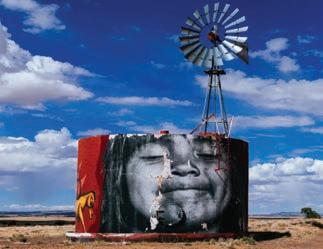
As states fail to reach deal, deadpool appears imminent by Jonathan Thompson / The Land Desk

by Dave Donley

CAST: Doug Gonzalez, Stephen Sellers, Dave Donley, Jonathan Thompson, Lainie Maxson, Rob Brezsny & Clint Reid
“I never was a poet, but the world scares me enough right now to force me into it.”
– We’ve just been hitting the wine bottle, but this sounds way more productive
Attention artists and creators: the City of Durango is soliciting ideas for a new public art installation at the top of Chapman Hill to celebrate local ski history. Ideas include but are not limited to: sculpture; interactive installations; functional art; and artistic signage. Bonus points if you incorporate salvaged materials from Chapman’s recently retired “Big Tow” (if so, we’ve got some shredded Kincos to donate, too.)
In case you’re not up on your Durango ski history, the City of Durango opened a rope tow, consisting of an old elevator apparatus, in the 1950s at what was then known as the Third Avenue Ski Hill. It was later renamed Calico Hill, due to its multicolored terrain, and in 1978, gained its current moniker in honor of Colton Chapman, a highway engineer who dedicated his life to maintaining the hill and teaching kids to ski. He and his son, Bob, built the Chapman House in 1953, which still stands today.
STAFF REPORTER: SCOOPS MCGEE telegraph@durangotelegraph.com
The Durango Telegraph publishes every Thursday, come hell, high water, tacky singletrack or mon-
ster powder days. We are wholly independently owned and operated by the Durango
On the cover Horse, rider and skier make for some action-packed spectating at last weekend’s skijoring event in Silverton./ Photo by Andy High
The Big Tow did not arrive until 1966, when the Lion’s Club raised enough money to buy the it from Camp Hale in Leadville. The tow had been used by the famed 10th Mountain Division for training during World War II. In a 2012 story with the Telegraph, ski legend Dolph Kuss recalled driving the tow back to Durango in an old dump-truck and rigging the lift with a team of volunteers.
The total budget for the new installation will be capped at $50,000, covering design, engineering, materials and installation. Selected artists will be responsible for all aspects of fabrication and installation, with completion required by Aug. 15. Applications are due March 13. Artists can apply online at cityofdurango. submittable.com.
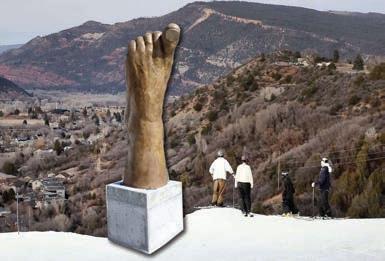
To get creative juices flowing, may we suggest a giant sculpture of a big toe (get it?) maybe as an homage to Bill Murray? We know, it’s almost as good as our prog rock Yes “roundabout” at 32nd Street, which stranglely enough we have yet to hear back on.
When I was young, bath time was one of my favorite moments of the day. After filling the tub with hot water, I would slowly step in and yip in “Oh!”s and “Ah!”s while reenacting Bugs Bunny getting into a pot of boiling stew. Being in the tub meant I had a new outlet for creativity while I waited for my fingers to get pruny. I could create tsunamis, becoming a ruler of the ocean. I could create new and interesting scents from my L’Oreal Kids shampoo and the various bottles that sat on the bathtub’s edge.
When I grew older, being in the shower provided a place where I could ponder the day’s problems. The steam would keep me warm or soften my vocal cords while I rehearsed for shows. However, these acts often led to long showers. Feeling like Durango had easy access to water via the local rivers, I didn’t think much of it. I wasn’t putting toxic products down the drain except for the spritzes of bleach I used to clean, so what was the harm?
In 2015, the United States Geological Survey estimated that the average person uses 82 gallons of water per day, with showers, toilets and faucets acting as the main source of water usage. I no doubt went above that average, but I brushed it off, because I felt like the environmental impact was negligible. I realize now that I was taking this resource for granted, and it would take purchasing a new home to finally reorient my perception.
plastic 50-gallon barrels. The Urban Institute estimates that households without running water on the Navajo reservation use an average of 8-10 gallons per day. My aunt’s household was no exception.
I recall several trips to the nearby well, the main source of water. My cousins and I would sit in the bed of the truck, where we would talk, tease and laugh until we arrived. The well, dug by my great grandfather, could be recognized by the water trough that laid open to the sky. Bringing a tube to her mouth, my aunt would begin siphoning water into the plastic drums that we brought with us. This water was not moderated or tested, a danger with a nearby uranium mine. But what other did anyone who lived in this area have? The livestock relied on it. The people relied on it. Ceremony relied on it. The effects, if any, felt distant. The thirst was now, and this water could quench it.
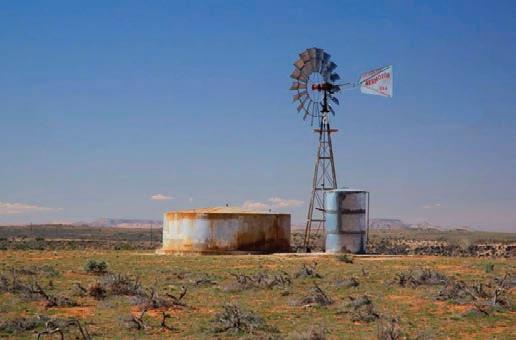
The home that my family and I just purchased is also the first home I’ve lived in without municipal plumbing. An underground, 1,700-gallon cistern feeds water into the house, which then feeds into a septic system. Before 2023, the closest water refill station was in Durango, 25 minutes east. A new refill station built by La Plata West Water is now just a few minutes south of us.
On our Sunday refills, we drive the truck that came with the house, along with a 200-gallon cistern strapped to its bed. The truck drives a bit off kilter, is missing a back seat and has more dents than all my previous vehicles combined. But what it does for my family is more important than my vanity. I am grateful that the truck, feeling like an old but experienced horse, is willing to bring this precious resource to my family. On the drive home, I often slip into memories of visiting the Navajo reservation, Diné Bikéyah.
My grandfather’s land was in Seba Dalkai, 13 miles north of Dilkon, Ariz. On weekend trips, my mother would take my sisters and I back to Seba, her childhood home. We would visit my aunt, who lived a hundred feet away from my grandfather’s hand-built stone home. There was no electricity, and the house was warmed by a wood burning stove and lit by lanterns. Water was stored in

No more jumping through hoops to cancel those online subscriptions. Starting last Monday, sellers of goods and services in Colorado are required by law to implement simple ways to cancel those pesky automatic renewals and trial periods.

Things have ended on a good note for U.S. Olympic skiers, with Mikaela Shiffrin bringing home the gold in women’s slalom and Durango’s Charlie Mickel making it to the quarter-finals in the men’s dual moguls.
I used to wonder why they didn’t just move. Why live in an area where water, electricity and other utilities are hard to come by? I hadn’t considered that being challenged by the land you live on could generate a sense of respect. I hadn’t considered that land is identity. I also hadn’t realized that off-reservation towns where I resided didn’t always have the infrastructure that made them easy to live in. When a community is valued, the infrastructure is sure to follow. Farmland and cities in the Southwest rely on water being allocated to them.
In 2023, a newly built IHS medical center in Dilkon, near my grandfather’s land, could not open due to a lack of water. This much-needed $128 million hospital was forced to sit empty.
How long has water been an issue for the Navajo Nation? After being forced to move from their homelands, the Navajo people signed a treaty in 1868 with the United States that guaranteed them a permanent home. However, this treaty did not explicitly mention water rights. In hopes that the treaty’s intentions could help open this empty hospital, the issue was brought to the Supreme Court. However, the conservative court determined in a 5-4 vote that the United States had no obligation to provide water to the Navajo Nation. This past weekend, the Upper and Lower Basin states did not come to an agreement regarding how to split Colorado River water. If the states cannot come to an agreement, it will be determined on a federal level. If we use the thinking that determined the Supreme Court’s decision with the Navajo Nation, this does not bode well for the Upper Basin. And yet, I feel hopeful – and determined. I feel determined to live the best way I know how, despite any limitations, because what other choice is there?
This week’s storm has wreaked havoc across the West, with the leading edge causing a “brown-out” and deadly pileup on Colorado’s Eastern Plains and eight backcountry skiers dying in an avalanche in the Sierras, the deadliest in modern California history. (Which reminds us, be safe out there, people.)
We’ve seen it coming for years, but the states have failed to reach an agreement on the shrinking Colorado River. We’re not sure what’s next – but safe to say we’re all gonna be up the creek.

– Doug Gonzalez Disc Gusting
Everybody knows that the first frisbee was modeled after a pie pan, just like everybody knows that most people who disc golf also shop for their wardrobes at Big 5. But for some reason, the discs used in this “sport” keep getting more and more expensive. For example, Prada sells one for $650, Chanel sells a carbon-fiber version for $2,000, and a full set of PGDA-certified Sky God discs from Discmania once sold for close to three grand at auction, which is a sentence I can’t believe I just typed. However, I can believe that if you show up to the disc golf course with a frisbee worth $2,000, you’re guaranteed to shoot a hole in fun.
by Stephen Trimble
Rep. Celeste Maloy, R-Utah, is irritated. Her most recent attack on Grand Staircase-Escalante National Monument spurred wide and deep opposition. She pushed back in a video with direct, if misleading, language.
Maloy has long criticized this southern Utah national monument that was halved by President Trump during his first term, then restored under President Biden. One million awestruck visitors come here every year and spend money in the two Utah counties surrounding the monument, whose towns total less than 14,000 residents. Yet Maloy discounts data showing the economic value of preserved public lands. She neglects the world-class scientific value of these 1.9 million acres, detailed in Biden’s proclamation.
Rep. Maloy’s attack is wily. She and the rest of the congressional delegation know there’s too much public support in favor of the monument to ask President Trump to again chop down the monument’s size. Nearly three out of four Utah voters are on record as wanting to keep Grand StaircaseEscalante protected as a national monument.
So Utah politicians are betting the public won’t pay as much attention to management retrenchment as they would to downsizing. They’re using a controversial tactic to force the Bureau of Land Management to abandon the current Resource Management Plan – a blueprint for how the BLM puts the presidential proclamation into effect on the ground.
But monument supporters are paying attention because management plans matter.
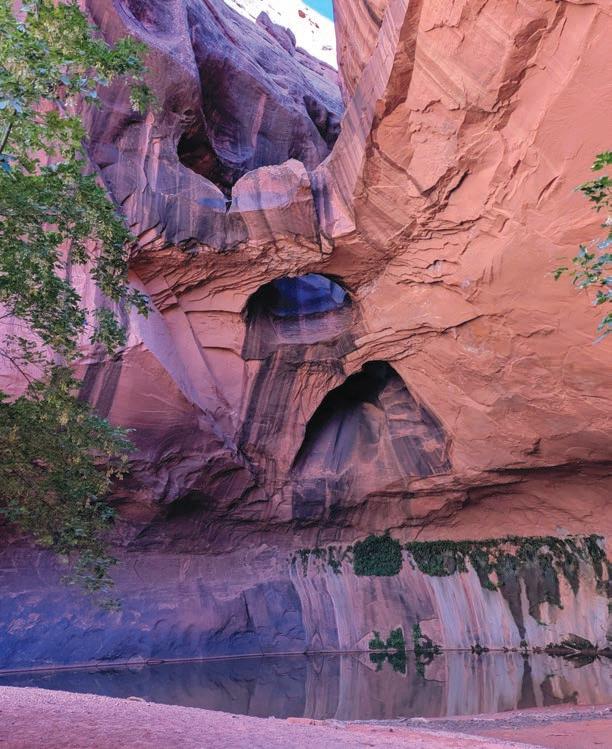
After President Biden restored the boundaries of Grand Staircase in 2021, the BLM worked with the public for two years to create the 2025 Resource Management Plan, listening to every conceivable collaborative partner. Such plans guide decision-making for years, and this true compromise keeps ranchers’ grazing permits in place while also factoring in a warming planet, persistent drought, the need for biodiversity and a sustainable future.
Now, Rep. Maloy has obtained an opinion from the Government Accountability Office to treat the 2025 plan merely as a “rule” that Congress can overturn. This unprecedented allowance can’t be challenged in court and
permits the Utah delegation to use the Congressional Review Act to kill the conservation-based plan and bar the agency from issuing any “substantially same” plan in the future. The Trump-era plan that would take its place leaves much of the monument unprotected from extractive industry and off-road vehicles.
Maloy says that emphasizing conservation “undercuts rural economic development.” From 2001-22, however, real per capita income grew by 41% in the monument’s counties.
She says local residents and “trail users” oppose the

Biden plan. This is cherry-picking. Motorized trail users always want greater access, even though the Biden-era plan left more than 800 miles of dirt roads and trails open for motorized vehicles.
When Maloy talks about “deep cultural traditions” being disrupted by the current management plan, she isn’t listening to Indigenous people who have made this place their home since time immemorial. The six Native Nations of the Grand-Staircase Escalante Inter-Tribal Coalition oppose her move, noting that without the “clear roadmap for protection and conservation” provided by the current management plan, “our ancestral lands and … cultural sites within the monument would be at greater risk of looting, vandalism, graffiti and degradation.”
To support their attacks, Utah’s politicians use their timeworn template to argue exclusively for “the needs and voices of the people who live and work on this land.” These politicians, however, listen only to county commissioners and legacy ranchers, not to a much broader constituency. This is Grand Staircase-Escalante National Monument, not Grand Staircase County Park. The environmental, scientific, interpretive and Indigenous values and potential of these public lands have national and international importance.
This new attack on Grand Staircase-Escalante from Congress – along with a parallel attack on Minnesota’s Boundary Waters – would set a national precedent with no public input that could upend public lands protection for years. Even the deeply conservative Mountain States Legal Foundation said it fears a “Wild West” for land-use planning if Congress acts on Maloy’s radical approach. The exhausting years-long battle to protect the resources and magic of Grand Staircase-Escalante can wear out supporters. But this place gives us no choice but to speak up once again. Staying silent puts federal agencies in an impossible position and places all of our public lands at risk. Let your members of Congress know that preservation of the monument requires leaving the current resource management plan in place. Stephen Trimble is a contributor to Writers on the Range, writersontherange.org, an independent nonprofit dedicated to spurring lively conversation about the West. He’s been hiking in Grand Staircase and writing about Colorado Plateau conservation for 50 years. ■


The League of Women Voters’ (LWV) mission is essential and urgent: Empowering voters, defending democracy. At a time when our election system is being questioned, distorted and misrepresented from many directions, that mission has never mattered more. Defending democracy is not an abstract slogan; it’s about protecting real people and communities whose voices can be weakened when those in power seek to change the rules of participation.
That’s why the National LWV issued the following statement on Feb. 4 in response to recent calls to “nationalize” elections: “President Trump’s continued rhetoric is a calculated effort to dismantle the integrity of the electoral system as we know it. This is not political theater; it’s a direct threat to the very fiber of democracy itself.”
The call to “nationalize” elections is not a minor administrative change – it represents a calculated challenge to the constitutional balance that has guided American self-government for more than two centuries. Framed in the lan-
guage of “fraud” and “integrity,” such proposals would shift control of voting away from state and local officials and toward those who could gain from altering the rules when outcomes are unfavorable to them.
For years, claims have been made that U.S. elections are riddled with corruption, even as courts, nonpartisan election officials and the Department of Justice have repeatedly found no evidence of widespread fraud that would change outcomes. After the 2020 election, dozens of lawsuits failed, independent audits confirmed results and officials from both major parties affirmed that the vote was secure and accurate. Yet the same narrative continues to circulate and be applied to new jurisdictions, not to address demonstrated problems but in ways that undermine confidence in the process itself.
Under the Constitution, states run elections, and local officials – your county clerk, poll workers, canvass boards – handle voter registration, ballot distribution and counting. That decentralized structure is a guardrail, making it harder for any one person or party to seize control of the process nationwide.

by Rob Pudim







When federal leaders call to “nationalize” elections or “take over voting in at least 15 places,” they are effectively urging a shift toward partisan control over where and how Americans cast their ballots. Changing who runs elections because one dislikes the voters’ choices is the opposite of election integrity; it’s a deliberate strategy to suppress turnout and undermine confidence. Democracy rarely disappears overnight. It’s chipped away – by normalizing lies, sowing chaos and intimidating anyone who stands in the way. Sweeping federal control of state and local elections based on broad, unsubstantiated claims of “corruption” risks confusing voters, discrediting honest local officials and opening the door to partisan influence over who can vote and which ballots count. As the 2026 midterms approach, casting doubt on elections in advance and discussing “takeovers” of voting in selected areas can contribute to lower turnout and weaker public trust before a single ballot is cast.
Silence in the face of such proposals is not neutrality; it’s complicity. Members of Congress swore an oath to uphold the Constitution, which places primary responsibility for election administration with the states and does not grant any president an open-ended mandate to centralize control of elections. Sens. Bennet and Hickenlooper and Rep. Hurd – and all elected officials – should hear clearly from the people they serve. We expect them to reject calls to “nationalize” elections and oppose any effort to intimidate voters or local officials. Constituents should call, write and meet with their legislators and urge them to defend the Constitution, protect state and local control of elections, and stand up – right now – against any attempt
to hijack our democracy for partisan advantage.
– League of Women Voters La Plata Board of Directors: Liz Mora, Adrea Bogle, Mady Miraglia, Jan Phillips and Wendy Pollak
On behalf of the family of Michael Goldman, I wish to thank all of the folks who have been so supportive during this very difficult time. Thank you to our friends who: brought meals; sent flowers; sent cards; shared memories, funny stories, accolades, well wishes and visions of Michael’s great smile (there can’t be many sympathy cards left in this town); chopped kindling and split firewood; or stopped by with huge hugs, snacks, treats, wine, etc.
We have very much appreciated it all! In my shock, disbelief and denial, I didn’t keep track or make note of who did these very thoughtful deeds. But, I assure you I remember who you are, and you all know who you are. We will have a Celebration of Life at 2 p.m., Tues., May 12, on the Carver Family Plaza at the Powerhouse Science Center.
– Dee Dee Carlson, Durango
I care about local government working well, openly, accurately and with collaboration between jurisdictions. Lately, that hasn’t been my experience. For three significant projects recently heard by the Town of Bayfield, I submitted written public comments weeks in advance. Yet the packet said “no public com-


ments received,” and my emails were not visible to the public. I addressed this during public comment and was told the Town would correct it. Public participation only works if the record is complete.
I also requested basic records from La Plata County to understand what issues may already exist on a property proposed for annexation. My request was dispersed across departments, and the estimated research time was quoted at 9-16 hours at $41.37/hour. At a minimum, that would be $372.33. That price tag blocks concerned citizens from accessing information that should inform major decisions.
Annexation can increase taxes and shift regulatory oversight. At minimum, Bayfield should document “good faith” coordination with the County, request County comments as a referral entity and make sure public comments are included in packets before votes are taken.
We can do better and we should. Transparency shouldn’t be a luxury item.
– Kristin Dallison, former Town of Bayfield Trustee/Mayor Pro Tem and Deputy Town Clerk, Bayfield
The Telegraph welcomes healthy civil discourse in 750 words or less. Writers must include their (real) name and city/town/state of residence. Personal attacks, hate speech or any other kind of b.s. deemed libelous are not welcome. Please email your profundities to: telegraph@durango telegraph.com

by Jonathan Thompson
Valentine’s Day wasn’t so loveydovey on the Colorado River. First, the Bureau of Reclamation released a grimmer-than-ever spring runoff forecast for the Colorado River and its two big reservoirs. Then the seven Colorado River Basin states announced they once again had failed to reach an agreement on a plan to bring demand into line with diminishing supplies by the Feb. 14 deadline. While the states have blown by other deadlines since negotiations began in 2022, this time was different in that it triggered the federal government to move forward to impose a post-2026 management plan of its own.
On paper, the states still have until the end of the water year, or Oct. 1, to come up with a deal or to implement an alternate plan. But that may be too little too late to keep Lake Powell’s level from dropping below minimum power pool –otherwise known as dead pool – later this year. While the negotiations are over the Colorado River, or rather the water in the river, in many ways they pivot around the need to keep Lake Powell’s surface level above 3,500 feet. That can only be done by releasing less water out of Glen Canyon Dam, increasing flows into the reservoir or a bit of both.
The sticking point in negotiations hinges upon whether Upper Basin states will take mandatory and verifiable cuts in water use. Lower Basin states have already taken cuts and have agreed to take more but only if the Upper Basin does the same.
The Upper Basin (aka Headwaters states) points out that while the Lower Basin has maxed out and even exceeded its Colorado River Compact allocation of 7.5 million acre-feet per year, the
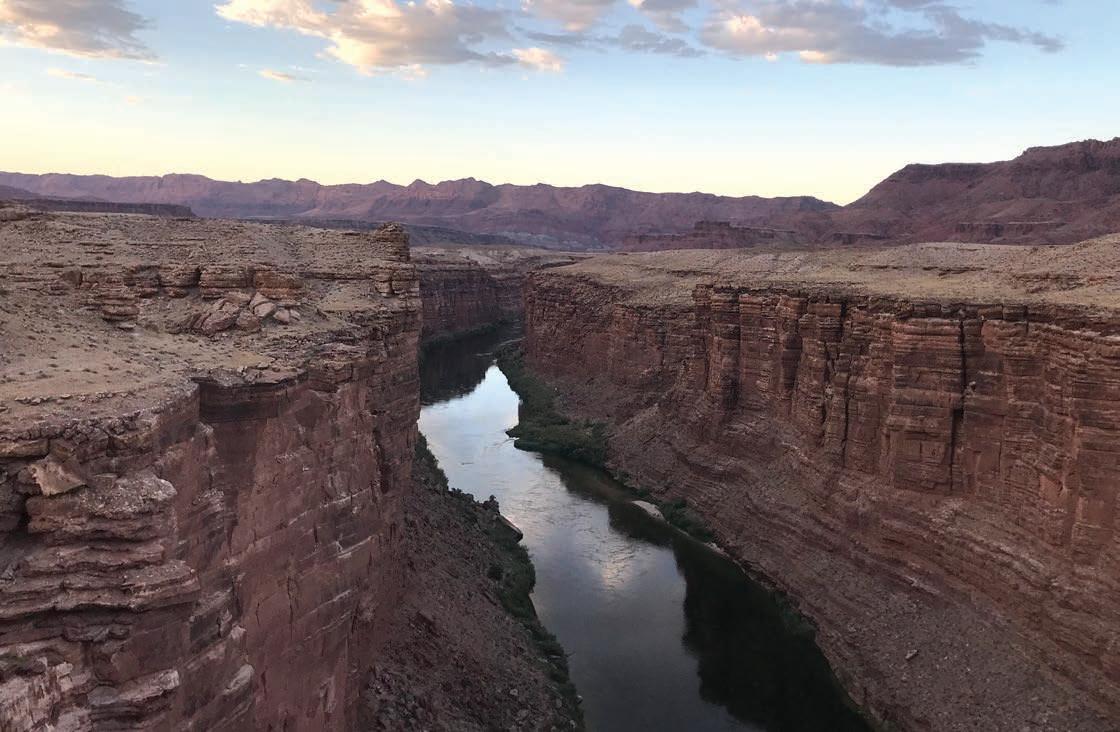
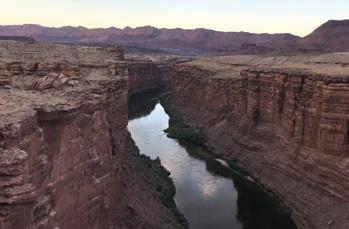
The Colorado River snakes its way down from Glen Canyon Dam through Marble Canyon. Upper and Lower Basin states have yet to agree on how to disperse the river’s dwindling supply. Meanwhile, Lake Powell is flirting with dead pool, which could be devastating to downstream power supplies as well as the dam itself./ Telegraph file photo
Upper Basin hasn’t even come close to using all of the water it’s entitled to. Furthermore, Upper Basin water users, especially those with more junior water rights, have grappled with drastic reductions during dry years because the Upper Basin lacks large reservoirs for storage, meaning their water use is dictated, in large part, by the rivers’ flows. In 2021, for example, many Southwest Colorado farms had their ditches cut off

as early as June, forcing them to sit the season out.
It’s also far simpler logistically to reduce consumption in the Lower Basin, where huge water users are served by a handful of very large diversions, such as the Central Arizona Project (which carries water to Phoenix and Tucson), the All-American Canal (serving the Imperial Irrigation District – the largest water user on the entire river), and the
California Aqueduct (serving Los Angeles and other cities). Dialing back those three diversions alone could achieve the necessary reduction. The Upper Basin, on the other hand, pulls water from the river and its tributaries via hundreds of much smaller diversions. Achieving meaningful cuts would require shutting off thousands of irrigation ditches to thousands of water users under dubious authority.

Also, proposals to divert and consume more of the Colorado River’s water – such as the Lake Powell pipeline – remain on the table. If that project were to be realized, which is a big “if” these days, it would further drain Lake Powell and result in even less water flowing to the Lower Basin.
Environmental groups tend to side with the Lower Basin on this issue. If the Upper Basin is forced to pull less water from the river, it would leave more water riparian ecosystems and aquatic critters. The Upper Basin’s proposal to release a percentage of the river’s “natural flow” from Glen Canyon Dam would leave less water in the Colorado River through the Grand Canyon, possibly imperiling endangered fish and rafting.
Meanwhile, the states’ lack of consensus pushes Powell closer to the brink of deadpool.
The BuRec’s “Post-2026 Operational Guidelines and Strategies for Lake Powell and Lake Mead” offers five alternative scenarios for how to run the river. While it doesn’t give a “preferred” alternative, federal officials have indicated that without all of the states’ approval or congressional action, they are only authorized to go with the “Basic Coordination Alternative.” This would include a minimum annual release of 7 million acre-feet from Glen Canyon Dam, with the largest mandatory cuts being borne by Arizona. But, according to BuRec’s latest 24-month projection, that release would lead to Lake Powell’s surface level dropping below minimum power pool by the end of this year, which is a really big problem
Back in 2022, as climate change continued to diminish the Colorado River’s flows and Lake Powell shrunk to alarmingly low levels, the dam’s operators were faced with the prospect of having to shut down the penstocks, or water intakes for the hydroelectric turbines, and only release water from the river
outlets lower on the dam. Not only would this zero out electricity production from the dam, along with nixing up to $200 million in revenue from selling that power, it might also compromise the dam itself.
“Glen Canyon Dam was not envisioned to operate solely through the outworks for an extended period of time,” Tanya Trujillo, then-Interior Department assistant secretary for water and science, said in 2022. “Operating at this low lake level increases risks to water delivery and potential adverse impacts to downstream resources and infrastructure … Glen Canyon Dam facilities face unprecedented operational reliability challenges.”
In March 2024, a BuRec memorandum verified those risks and recommended that dam operators “not rely on the river outlet works as the sole means for releasing water from Glen Canyon Dam.”
The only way to do that is to keep

the water level above 3,490 feet in elevation, which could mean shifting Glen Canyon Dam to a run-of-the-river operation – where releases equal Lake Powell inflows minus evaporation and seepage – as soon as this fall. That, most likely, will lead to annual releases far below 7 million acre-feet, will then lead to Lake Mead being drawn down considerably thereby threatening Lower Basin supplies. Such a scenario is clearly not sustainable, would put the Upper Basin states in violation of the Colorado River Compact and most certainly lead to litigation.
An irony here is that Glen Canyon Dam’s primary purpose is to allow the Upper Basin to store water during wet years and release it during dry years, enabling it to meet its Compact obligations. Hydropower, silt control and recreation were secondary purposes. Now, the need to preserve the dam could cause the Upper Basin to run afoul of the Compact. Aridification is
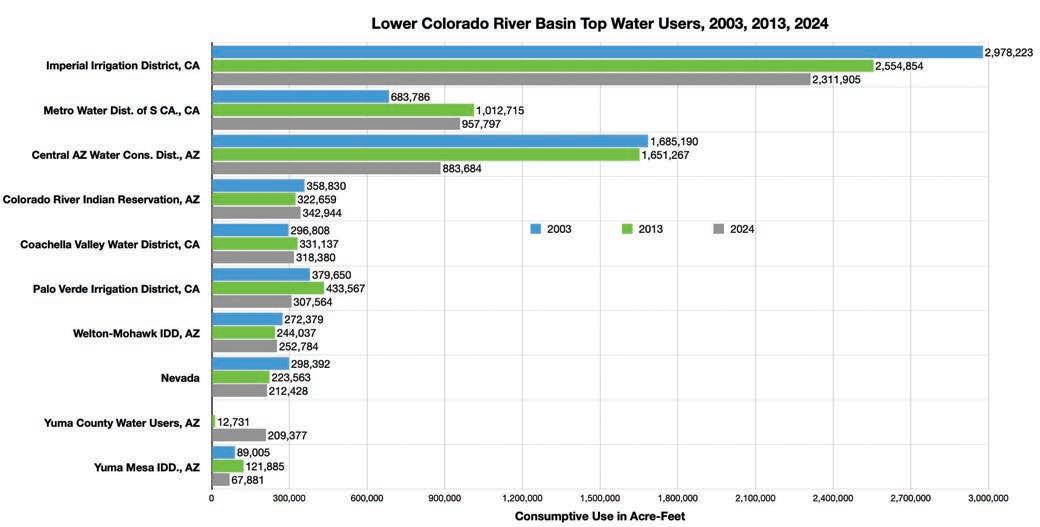
The Imperial Irrigation District is the largest single water user on the Colorado River by far. Most of that water goes to irrigating agriculture, including a fair amount of alfalfa and forage crops. Las Vegas uses about one-tenth the amount of water as the IID.
Source: Bureau of Reclamation
rendering the dam obsolete, at least as a water storage savings account. Meanwhile, low levels are diminishing hydropower and recreation. It seems that soon, the dam’s main purpose will be to prevent Lake Mead from filling up with silt.
Mother Nature, or Mother Megadrought, if you prefer, has left few options for moving forward. The states still could come to an agreement, but it’s difficult to see how, given the long-running stalemate so far. The feds could reengineer Glen Canyon Dam to allow for sustained, low-water releases. That would only be a temporary fix, however, unless climatic trends reverse themselves, and the West suddenly becomes much wetter and cooler. Somehow, that doesn’t seem too likely.
The Land Desk is a newsletter from Jonathan P. Thompson, author of “River of Lost Souls,” “Behind the Slickrock Curtain” and “Sagebrush Empire.” To subscribe, go to: www.landdesk.org. ■

by Stephen Sellers
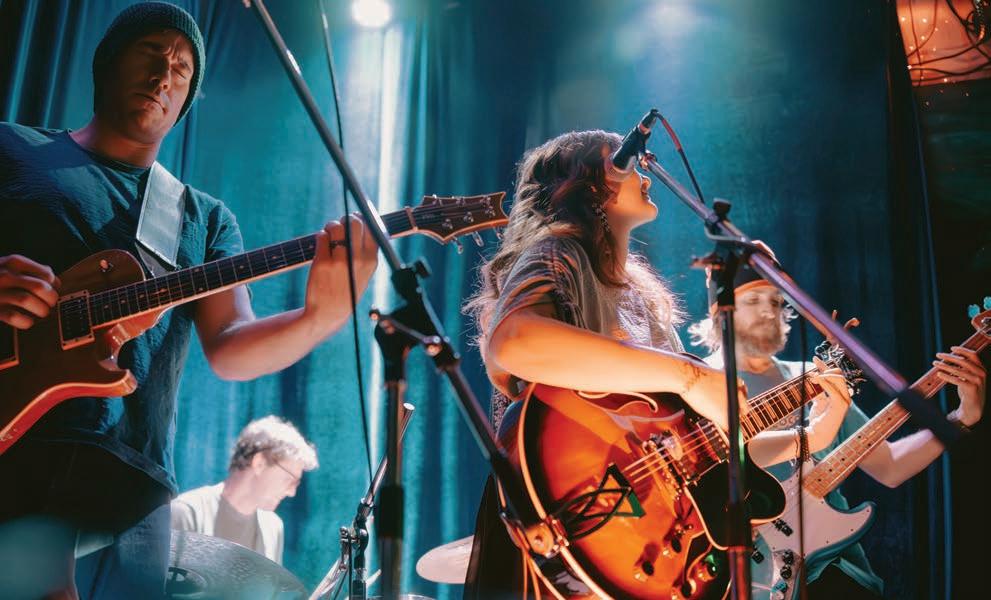
Greetings, dear readers! This week, I talked with local singer-songwriter Dana Ariel. I met Dana years ago when I was her adviser and teacher at a local high school. Even then, she was usually in tow with a ukulele, singing softly to herself whenever a quiet moment appeared. It wasn’t uncommon to find her during lunch writing and swapping songs with her high school BFF, Jules Marqua – another bright star in the Durango music scene. Since graduating, Dana has chased her passion for music through Berklee-affiliated programs in Canada and Australia.
Having been back in the area since COVID, Dana and her band, Coming Up Roses, have left a distinct Americana mark on our local scene. She’s also become an indispensable part of the iAM music education team, now teaching at the very school where we first met – a full-circle moment. Dana is humble, wise, thoughtful and writes absolutely killer music. Consider me a proud former teacher! I recently get the scoop from Dana on what life has been like on the other side. Hope you enjoy, and see you on the dance floor!


SS: You grew up in Durango but have been bopping around the world. Tell us where you’ve been.
DA: I’ve always loved to travel. I knew I needed to get out of Durango when I graduated high school, so I immediately did a year in Canada at a school in the Berklee international network. Then I moved to Australia to another school in that network and stayed there until COVID. Since coming back, I’ve still traveled a lot, because my family has free flights, and music grounds me wherever I am. Recently I was in the Middle East and had the chance to meet musicians in a culture very different from my own.
SS: What helped you make the jump from high school to moving abroad alone?
DA: I’ve always had a part of me that believes “I

can do it,” and I grew up in a family supportive of travel and music. At Animas High, I had an internship in Mexico working with an Indigenous community whose valley was being flooded. I ended up documenting their musical culture, which opened my eyes to how music exists everywhere.
SS: What was day-to-day life like in Australia?
DA: I lived in Melbourne in the beach neighborhood of St. Kilda. I went to school downtown, took songwriting classes, then gigged at night for money. Melbourne has laws about paying musicians fairly, which was amazing. I didn’t have a car, so I would strap my amp, mic stand and guitar onto a rental scooter and ride to gigs. I was a broke college kid gigging for money, working in restaurants, trying to put myself through school and pay rent. I lived with backpackers. It wasn’t like college in the U.S. with dorms.
SS: If you could go back, what advice would you give yourself?
DA: Don’t take drunk people too seriously! [laughs] You’re playing for people traveling and having fun, and sometimes you have to play covers instead of your own music. Those gigs can feel soul-sucking, because you’re creating a party that isn’t representative of who you are as an artist. I’d tell myself to see those gigs as work, not my artistry, and be grateful I have the skills to make money anywhere.
SS: Who has influenced you most as a young musician here in Durango?
DA: (iAM Music founder) Jesse Ogle, for sure. He was my first contemporary music teacher after classical violin training. I remember him making me watch an Esperanza Spalding video when I was about 12. I wasn’t quite sure how to feel about it. Ashley Edwards was also a huge influence not only as a musician, but as a woman.
SS: Tell us about your band. Why join a band instead of going solo?
DA: I do both, but playing with others is special. My five-piece band brings my music to life, and they’ve been critical to making me who I am as a human. Some of them showed up for me during major health challenges this summer. You have to choose wisely who you play music with, because it’s how you connect and express your feelings.
SS: What’s coming up next?
DA: We’re super excited to be sharing a bill with Eli Emmett’s band at the American Legion. It’s a bigger venue than we usually play, with a huge stage and disco ball, so it feels like a good next step on our way to hopefully headlining the ACT one day. Tickets are only available at the door. My band is also doing a one-night “Mamma Mia” tribute show at the Indigo Room in late June. It’s a full ABBA night with “Dana and the Dynamos!”
SS: Do you see yourself traveling more?
DA: Yes, always. Durango will always be home, but there are many musical cultures and communities I want to learn from and contribute to. ■
I’m a master at breaking the ice. I’m naturally shy, so I have a handful of questions I prepare before going to a party or event where there may be people I’m meeting for the first time. Mind you, my questions go far beyond the usual. For guys, sports or hunting are safe topics to start with. I like digging a little deeper by asking, “In farming, what’s the difference between an accessory, an implement and an attachment?”
You need to be bit more sensitive with women. I always compliment them on what they’re wearing. I sometimes ask for a good Rocky Mountain oyster recipe. Or I’ll say, “I know it’s not polite to ask a woman her age. So how much do you weigh?”
I’m always on the lookout to refresh my icebreaking routine with new material. Recently, a goldmine dropped in my lap, one that will stimulate endless conversations using just three simple words: “Had yak lately?”
It’s funny you should mention that, because I did have a fine meal consisting of a Yak steak at the local rib and yakhouse. The yak filet was a special dinner item. Nothing gets my attention more than a menu of unusual food. Between the time we heard about the special and the time it came to order dinner, a number of questions filled my mind.
How do you prepare yak? What is it, and where did it come from? What wine pairing would you recommend?
These are not the questions you would ask if rattlesnake was on the menu. You know what a snake is, and it probably got run over on the highway. I’d guess it’s prepared either grilled or fried. I wouldn’t select a wine with my rattlesnake because I draw the line at eating rattlesnake meat.
As I pondered the yak conundrum, I started jotting down on the paper tablecloth anything yak-related with the crayons typically reserved for much younger customers.
A movie title came to mind, “Love Yakually.” One of the stars, I think it was Yak Efron, plays a yakulele I quickly devolved from a brainiyak and became a maniyak. I envisioned sports heroes, like Yakquille O’Neal and Carl Yakstremski. My tablemates thought I was going nuts, to which I replied, “Exyaktly.”
Thankfully, the server came by to

take our order. She explained, likely for the 100th time, that yaks are bovines, so they are prepared in much the same manner as beef. I learned the breed originated in the Himalayans, not Yakistan as I proposed. Like beef, any red wine pairs well with the meat.
Yak is not your most elegant-looking mammal. The shaggy body makes it look like a grass hut on stilts, with horns spiraling out from its head. They are also useful for their wool, and their milk makes great cheese.
We learned after dinner that the yak in question didn’t come from Tibet. It came from a local producer, one of a number of suppliers nationwide. I predict it won’t take long until an enterpris-

ing taxidermist (um ... yakzidermist) starts selling yakalope mounts. Not real sure what that would look like, though.
The International Union for Conservation of Nature lists the yak population as “vulnerable.” While raising domestic yak here in the states will ensure the species survives, it’s still considered mildly endangered. Which, coincidently, is how I like my yak prepared – medium rare. Does this arrival of yak on the menu in cattle country portend a seismic shift away from more traditional sources of meat? Probably not. But it’s nice to know that as an American, you have choices. That, and a new icebreaker topic. ■ – Dave Donley

Petition Drive: No-Mask, Visible ID for law enforcement, 1-3 p.m.; Durango Public Library, 1900 E. 3rd Ave.
Southwest Colorado Rocks Awards Ceremony, 5-8 p.m., Community Concert Hall at FLC
“Trout Tales,” 5RTU gathering and fishing stories, 5:30 p.m., Animas Brewing Co., 1560 E. 2nd Ave.
Dart Tournament, 5:30-9 p.m., Union Social House, 3062 Main Ave.
Cult Movie Night: “Office Space,” 6 p.m., Mancos Opera House, 136 Grand Ave.
Gary Watkins plays, 6-9 p.m., Diamond Belle Saloon, 699 Main Ave.
Bluegrass Jam, 6-9 p.m., Durango Beer and Ice Co., 3000 Main Ave.
Andrew Schuhmann plays, 6-9 p.m., Office Spiritorium, 699 Main Ave.
Open Mic Night, 6-9 p.m., American Legion, 878 E. 2nd Ave.
Stand Up Comedy: Fresh & Seasoned Local Showcase, 6:30 p.m., Black Heron Lounge, 726 Main Ave.
Trivia Night, 6:30-8:30 p.m., The Powerhouse, 1333 Camino Del Rio
“Silent Sky,” the story of pioneering American astronomer Henrietta Leavitt, 7-9 p.m., Merely Underground, 789 Tech Center Dr.
FLC Alumni Ski Day and Apres-Ski Party, 9 a.m., Purgatory Resort
Ski Bike Festival & Race, 9 a.m.-4 p.m., Purgatory Resort
Winter Market, 10 a.m.-1 p.m., Four Seasons Green House, 26650 Road P, Cortez
Mac & Cheese Throwdown and Bingo, 12 noon-3 p.m., Durango Harley-Davidson, 750 S. Camino Del Rio
Petition Drive: No-Mask, Visible ID for law enforcement, 1-3 p.m.; Durango Public Library, 1900 E. 3rd Ave.
Folk Jam, 1-2 p.m., Durango Public Library, 1900 E. 3rd Ave.
Silent Book Club, bring your own book, silent reading with option to socialize after, 1-3 p.m., Durango Public Library, 1900 E. 3rd Ave.
Indivisible Durango General Meeting with U.S. Senate candidates Karen Breslin and Julie Gonzales, 3-5 p.m., Durango Public Library, 1900 E. 3rd Ave.
Cabin Fever Party: Farmington Hill plays, 58:30 p.m., Ska Brewing HQ, 255 Girard St.
Adam Swanson plays, 5:30 p.m., Diamond Belle Saloon, 699 Main Ave.
Euchre, 5:30-8:30 p.m., Union Social House, 3062 Main Ave.
Matt Rupnow plays, 6-9 p.m., Office Spiritorium, 699 Main Ave.
Karaoke with Kimmy, 6-9 p.m., Durango Beer and Ice Co., 3000 Main Ave.
Irish Jam, 12 noon-3 p.m., Durango Beer and Ice Co., 3000 Main Ave.
“Silent Sky” the story of pioneering American astronomer Henrietta Leavitt, 2 p.m., Merely Underground, 789 Tech Center Dr.
Blue Moon Ramblers play, 6-9 p.m., Diamond Belle Saloon, 699 Main Ave.
Ben Gibson plays, 6-9 p.m., Office Spiritorium, 699 Main Ave.
Sign Waving peaceful gathering, 4 p.m., corners of Camino del Rio and College Dr.
Death Café, 4-5:30 p.m., Durango Public Library, 1900 E. 3rd Ave.
Happy Hour Yoga, 5:30 p.m., Ska Brewing, 225 Girard St.
“Raising Young Adults in an AI World,” 5:30 p.m., Animas High School, 22 Osprey Way
De-Flock Durango Virtual Town Hall, 6-7:30 p.m., register: tinyurl.com/deflockdro
Terry Rickard plays, 6-9 p.m., Office Spiritorium, 699 Main Ave.
Joel Racheff plays, 6-9 p.m., Diamond Belle Saloon, 699 Main Ave.
Friday20
Seeds of Success: Durango Farmers Market Summit, 9 a.m.-4 p.m., La Plata County Fairgrounds
AARP Driver Safety Course, 12 noon-4 p.m., Pine River Library, 395 Bayfield Center Dr., Bayfield
“Asymmetrical,” opening reception community art exhibit, 5-9 p.m., Studio & Gallery, 1027 Main Ave.
Larry Carver and Ben Gibson play, 5:30 p.m., Diamond Belle Saloon, 669 Main Ave.
Dustin Burley plays, 6-9 p.m., Office Spiritorium, 699 Main Ave.
Association w/ Bean Minor Quintet, free concert, 7 p.m., The Light Box at Stillwater Music, 1316 Main Ave., Ste. C
“Silent Sky,” the story of pioneering American astronomer Henrietta Leavitt, 7-9 p.m., Merely Underground, 789 Tech Center Dr.
“Silent Sky” the story of pioneering American astronomer Henrietta Leavitt, 7-9 p.m., Merely Underground, 789 Tech Center Dr.
DJ Williams Band with Nu Bass Theory, 7-10 p.m., Animas City Theatre, 128 E. College Dr.
“Mozart and the Romantics,” 7:30 p.m., Community Concert Hall at FLC
Durango Contra Dance, 7:30 p.m., La Plata Senior Center, 2424 Main Ave.
Sunday22
Ski Bike Festival & Race, 9 a.m.-4 p.m., Purgatory Resort
Community Potluck and Celebration of Local Farmers, 12 noon, Twilight Room, Durango Rec Center
Great Decisions Durango Discussion Group “America and the World: Trump 2.0 Foreign Policy” with facilitator Paul DeBell, 11:45 a.m.-1:45 p.m., Durango Public Library, 1900 E. 3rd Ave.
Community Open Table Dinner, a chance for single diners or pairs to meet and share dinner with others, 4 p.m., Primi, 1201 Main Ave.
Engage Durango Forum, discussing new police department and city hall project, 5-6:30 p.m., Durango Rec Center
Community Workshop & Seed Swap, 5-6:30 p.m., Durango Community Recreation Center, 2700 Main Ave.
Rotary Club of Durango meeting with retired Rear Admiral and astronaut Steve Oswald, 6-7 p.m., Strater Hotel, 699 Main Ave.
“Getting Creative with Canva,” 6-7:30 p.m., Durango Public Library, 1900 E. 3rd Ave.
Tuesday Trivia, 6-8:30 p.m., 11th St. Station, 1101 Main Ave.
Interesting fact: On average, homebuyers spend 30-40 minutes inside a house for their first visit. If the real estate agent puts out snacks, you should definitely help yourself.
Dear Rachel,
I made the mistake when I was about 12 years old of liking owls. That wasn’t the real mistake, though. The real mistake was telling my mom and aunt that I liked owls. Now it’s a quarter century later and still, they give me trinkets or baubles with owls on them. I tried to tell them to stop about 10 years ago, but they got heartbroken, and I caved. Am I doomed to a lifetime of being followed by owls?
– Hoo Dunnit
Dear Owl-Whipped,
How many gifts does it take to get to the tootsie roll center of a human about to snap? At least 75 or 100, by the sound of it. You’ve got to make a statement. Maybe like a Dante’s Inferno sign above your front door, only yours says “Abandon All Owls, Ye Who Enter Here.” Or mention at the next family get together how you’re now really into hawks. Which isn’t much better, but at least it would switch up your gift selection.
– The silent hunter, Rachel
Jason Thies plays, 6-9 p.m., Diamond Belle Saloon, 699 Main Ave.
Sean O’Brien plays, 6-9 p.m., Office Spiritorium, 699 Main Ave.
Barbershop Tryouts, every Tues., 6:30 p.m., Christ the King Church, 495 Florida Rd.
Durango Daybreak Rotary Club with Laine Johnson of Guided Walking Tours of Durango, 7-8 a.m., La Plata County Fairgrounds
“Power of Place,” authors’ presentations and Q&A, 5-7:30 p.m., Center of Southwest Studies at Fort Lewis College, Lyceum room 120
Donny Johnson plays, 6-9 p.m., Diamond Belle Saloon, 699 Main Ave.
Chuck Hank plays, 6-9 p.m., Office Spiritorium, 699 Main Ave.
Leonard Davies “The Joys of Painting as a
Dear Rachel,
I think it is so weird that the biggest purchases most of us will ever make are houses, and we spend basically minutes inside them before forking over for a 30-year mortgage. We test drive cars for longer than that. We date partners for longer than that (well, most of us) before getting hitched. But houses get like one walk through and bam! You’re making an offer. Why are we so rash on our biggest decisions?
– House Hunter
Dear Rehomed,
I agree! We should get to spend at least one night in a house before committing to it. At least to check out the weird night noises, not to mention looking for ghoulies. I still can’t get over that we just move into a space that, like, two days before was someone else’s. We’re really just hermit crabs with taxes, aren’t we?
– Movin’ in, Rachel
Dear Rachel, Spousal argument time! When we go to a friend’s house and they offer us food and drinks, I think the polite thing is to accept. But my wife thinks the polite thing is to decline. We end up with the worst combination when I say yes and she says no. We both look like chumps. So which is it? Say yes to the
Pastime,” thru Feb. 28, 5-7 p.m., Durango Arts Center, 802 E. 2nd Ave.
Tia Jean’s “Worlds I Carry” exhibit, thru Feb., Studio &’s Recess Gallery, 1027 Main Ave.
Dementia/Alzheimer’s Caregivers Support Group, 1st, 3rd & 5th Wed. of each month, 10:30 a.m.-12 noon, La Plata Senior Center, 2424 Main Ave.
“Thinking Like Water,” five-part docuseries, Thurs., Feb. 26, 5 p.m., Sunflower Theater, 8 E. Main St., Cortez
Poetry Open Mic, Thurs., Feb. 26, 5:30-8 p.m., The Subterrain, 900 Main Ave., Ste. F
“Hey Girl, Let’s Talk Investing,” Thurs., Feb. 26, 5:30-7 p.m., Kelly Miranda Studio, 194 Bodo Dr., Ste. G
Tony Furtado and Luke Price in concert, Thurs., Feb. 26, 7-10:30 p.m., Durango Arts Center, 802 E. 2nd Ave.
Larry Carver and High Altitude Blues play, Fri., Feb. 27, 5:30 p.m., Diamond Belle Saloon, 699 Main Ave.
“An American Overture,” with Southwest Civic Winds celebrating the 150/250 anniversaries, Fri., Feb.

Email Rachel at telegraph@durango telegraph.com
queso and chips, or say no and go hungry until we get home?
– Rude Dude?
Dear Hungry Hungry Houseguest, Depends, for me, on one big question: Are your friends serving good stuff? It’s not just a matter of saying yes only to high-quality snackin’. If your friends offer you their quality stash, they really want to share it with you. If, however, they’re offering you like a 7-Eleven brand of knock-off bubbly water, they want you to leave. If your wife still doesn’t like you accepting libations, you can always offer your hosts an owl trinket in return.
– Pass the guac, Rachel
27, 7 p.m., Ignacio High School Performing Arts Center, 315 Ignacio St.
Bayfield Pie Auction with music from Richard Espinoza, fundraiser for Pine River Heritage Society, Sat., Feb. 28, 5 p.m., Church of Christ, 2011 E. Bayfield Parkway, Bayfield
Veterans Benefit Breakfast, Sun., March 1, 9-11 a.m., VFW, 1550 Main Ave.
“An American Overture” with Southwest Civic Winds celebrating the 150/250 anniversaries, Sun., March. 1, 3 p.m., Community Concert Hall at FLC
“The Ballad of Madelyne & Therese,” by singersongwriter Rachel Garlin, proceeds benefit the Armida Huerta Adventure Fund, March 1, 6:30 p.m., Durango Arts Center, 802 E. 2nd Ave.
Community Open Table Dinner, a chance for single diners or pairs to meet and share dinner with others, Tues., March 3, starting at 5:30 p.m., Carvers, 1022 Main Ave.
Word Honey free poetry workshop, Wed., March 4, 6-7:30 p.m., The Hive, 1175 Camino Del Rio
McDonald’s Cardboard Derby, Fri., March 7, 10 a.m.-1 p.m., Purgatory Resort Feb. 19, 2026 n 13
by Rob Brezsny

ARIES (March 21-April 19): Saturn has entered Aries. I see this landmark shift as being potentially very good for you. Between now and April 2028, you will have enhanced powers to channel your restless heart in constructive directions. I predict you will narrow down your interests and devote yourself to a few resonant paths rather than scattering your energy. More than ever, you can summon the determination to follow through on what you initiate. My Saturn-in-Aries prayer: May you be bold, even brazen, in identifying where you belong and never settle for a half-certain fit.

TAURUS (April 20-May 20): I am issuing a Wow Advisory. Consider this your highvoltage wonder alert. Your future may offer you thrilling quests and epic exploits that could be unnerving to people who want you to remain the same as you have been. You will have a knack for stirring up liberating encounters with lavish pleasures and rich feelings that transform your brain chemistry. The rousing mysteries you attract into your sphere may send provocative ripples through your own imagination as well as your web of allies. Expect juicy plot twists. Be alert for portals opening in the middle of nowhere.

GEMINI (May 21-June 20): In Leonardo da Vinci’s notebooks, you find anatomical drawings next to flying machine designs, mathematical calculations alongside water flow observations and philosophical musings interrupted by grocery lists. He moved from painting to engineering to scientific observation as curiosity led him. Let’s make him your inspirational role model. Disobey categories! Mix and match categories! Let’s assume that your eager mind will create expanded networks that prove valuable in unexpected ways. Let’s hypothesize that your cheerful rebellion against conventional ways of organizing reality will spawn energizing innovations in your beautiful, mysterious life.

CANCER (June 21-July 22): In falconry, there’s a practice called “weathering.” It involves regularly exposing trained birds to the wild elements so they don’t become too domesticated and lose their wildness. The falconer needs a partner, not a pet. Does that theme resonate, Cancerian? Is it possible that you have been too sheltered lately? Either by your own caution or by well-meaning people who think they’re protecting you? Let’s make sure you stay in touch with the fervent, untamed sides of your nature. How? You could expose yourself to an experience that scares you a lit-
tle. Take a fun risk you’ve been rationalizing away. Invite touches of rowdiness into your life.

LEO (July 23-Aug. 22): The loudest noise in history? It was the 1883 volcanic eruption of Krakatoa in Indonesia, heard thousands of miles away. The pressure wave circled the Earth multiple times. I am predicting a benevolent version of a Krakatoa event for you in coming months. Not literal loudness, but a shiny bright expression that redefines your world and what people thought was possible from you. Can you be prepared for it? A little. You’ll be wise to cultivate visionary equanimity: a calm willingness to stay focused on the big picture. I predict your big boom will be challenging but ultimately magnificent and empowering.

VIRGO (Aug. 23-Sept. 22): Buddhism teaches about “near enemies:” qualities that may appear to be virtues but aren’t. For example, pity masquerades as compassion. Clingy attachment pretends to be love. Apathy and indifference pose as equanimity. In the coming weeks, Virgo, I hope you won’t get distracted by near enemies. Your assignment: Investigate whether any of your supposed virtues are actually near enemies. After you’ve done that, find out if any of your so-called negative emotions might harbor interesting powers you could tap into.

LIBRA (Sept. 23-Oct. 22): Many intelligent people think astrology is dangerous nonsense. For any horoscope writer with an ego, this affront tends to be deflating. On the other hand, I have found that practicing an art that gets so much disdain has been mostly liberating. It’s impossible for me to get bloated with excess pride. I practice astrology for the joy it affords me, not to garner recognition. So in a backhanded way, a seemingly disheartening drawback serves as an energizing boon. My prediction is that you will soon harvest an analogous turnabout. You will draw strength, even inspiration, from what may appear to be a liability.

SCORPIO (Oct. 23-Nov. 21): Mycologist Paul Stamets claims mushrooms taught him to think in networks rather than hierarchies. He sees how everything feeds everything else through vast webs of underground filaments. This is Scorpio wisdom at its most scintillating: homing in on the hidden circuitry below the surface; gauging the way nourishment is distributed incrementally. I hope you will accentuate this mode of understanding in coming weeks. The key to your soulful success and happiness will be in how well you map the mycelial-like networks, both in the world

around you and in your inner depths. PS: For extra credit, study the invisible threads that link your obsessions to each other, your wounds to your gifts, and your rage to your tenderness.

SAGITTARIUS (Nov. 22-Dec. 21): The peregrine falcon dives at speeds exceeding 240 miles per hour, making it the fastest animal on Earth. But before the dive, there’s often a period of circling, scanning and waiting. The spectacular descent is set up by the patient reconnaissance that precedes it. I believe you’re now in a phase similar to the falcon’s preparatory reconnaissance. The quality of your eventual plunge will depend on how well you’re tracking your target now. Use this time to gather intelligence, not to second-guess your readiness. You’ll know when your aim is true.

CAPRICORN (Dec. 22-Jan. 19): There’s a certain miracle you could really use right now, Capricorn. But to attract it into your life would require a subtle and simple shift. In a related development, the revelation you need most is concealed in plain sight. To get these two goodies into your life, you shouldn’t make the error of seeking them in exotic locales. Ordinary events in the daily routine will bring you what you need: the miracle and the revelation that will change everything for the better.

AQUARIUS (Jan. 20-Feb. 18): Over the last 4,000 years, a host of things have been used as money. Among them have been cows, seashells, cheese, tobacco, velvet, tulips, elephant tusks and stone wheels. I hope this poetic fact will inspire your imagination about financial matters. In coming weeks, I expect you’ll be extra creative in drumming up new approaches to getting cash. Here are questions to guide you. Which of your underused talents might be ready to boost your income? What undervalued gifts could you be more aggressive about giving? What neglected treasures or assets could you use to generate money?

PISCES (Feb. 19-March 20): Big bright transitions are at hand: from thrashing around in the educational mire to celebrating your sweet escape; from wrangling with shadows and ghosts to greeting new allies; from messing around with interesting but confounding chaos to seizing fresh opportunities to shine and thrive. Hallelujah! What explains this exhilarating shift? The Season of Dazzling Self-Adoration is dawning for you Pisceans. In the weeks ahead, you will be inspired to embark on bold experiments in loving yourself with extra fervor and ingenuity.

Deadline for Telegraph classified ads is Tuesday at noon.
Ads are a bargain at 10 cents a character with a $10 minimum.
Prepayment is required via cash, credit card or check. (Sorry, no refunds or substitutions.)
Ads can be submitted by emailing: classifieds@ durangotelegraph.com
Ready to make a difference close to home? The University of Denver GSSW Four Corners Program is now accepting applications for the 2026–2028 MSW cohort! Classes meet Fridays in Durango, so you can keep working while earning your MSW. Learn more at du.edu/socialwork/fourcorners. Change your community. Change your future. Start with DU!
Beer Bottles – Free 8 cases, various sizes and types. Some flip tops. Clean and in very good condition. Ready to be refilled with good home brew. Call Peter 970-769-1244
Urgently Needed
Affordable, electromagnetically-quiet living space (or RV space) to rent close to town for electrosensitive senior and two (quiet, well-behaved, indoor) dogs. Fenced yard for dog use a couple of times a day (or fenced dog park/area nearby) *needed*. Price and terms negotiable, but hoping for <$800-$1000/mo with longerterm (6-12 months?) lease preferred, and starting around April 1st. Can also help with yardwork, housework, minor repairs, pet and/or elder care, etc. Can provide references. Call if you'd like to discuss. 970-508-0326 and leave a voice message.
Books Wanted at White Rabbit
Donate/Trade/Sell 970 259-2213
ForSale
Reruns Home Furnishings
Time to refresh your indoor space. Rol-

ling wooden bar, nightstands, mirrors, lamps, cool artwork and lots more! Also looking to consign smaller pieces. 572 E. 6th Ave. Open Mon.-Sat. 385-7336.
Massage by Meg Bush
LMT, 30, 60 & 90 min., 970-759-0199.
Aikido Crash Course
Slow learner? Two left feet? Kind heart? Aikido may be your jam! Try the fast, fun $8 weekly crash course Mondays 5:30-615pm. Must register online: duran goaikido.com
Yard Work, Ranch Work
General labor, snow removal, basic handyman. Dependable and trustworthy. $30/hour. Contact 970-799-5155

Electric Repair
Roof, gutter cleaning, fence, floors, walls, flood damage, mold, heating service.

Boiler Service - Water Heater
Serving Durango over 30 years. Brad, 970-759-2869. Master Plbg Lic #179917
Applications Now Open for the 2026 Durango Farmers Market.
Vendors can apply for the full regular season – including 2nd Saturdays on Main –or choose to apply for 2nd Saturdays only. Details and applications are available at: durangofarmers market.com.
Free Tax Preparation Services
VITA (Volunteer Income Tax Assistance) will again be preparing tax returns for individuals and families with income less than $68,000. The service is free, held at the La Plata County Fairgrounds Extension Building on Mondays and Saturdays, Feb. 2 - April 13. Volunteer tax preparers are certified by the IRS. Appointments are required. For more information and to schedule an appointment, go to www.durangovita.org.
'Die My Love'
Jen Lawrence bares all in this brutal postpartum psychosis nightmare – Lainie Maxson
SW Community Justice Coalition
Support restorative justice in Southwest Colorado. In 2025, SCJC expanded community-based trainings and launched new pathways to promote healing-centered responses to harm. Learn more at southwestjustice.org or southwestjustice.org.