POPS 2: Indiana Jones: Raiders of the Lost Ark In Concert
MASTERWORKS 6: Rhine Journey
40–45 Program Notes
SUPPORTING THE DSSO
48 Become a Chair Sponsor
50 How to Support the Orchestra
51 Donor Spotlight
54–58 DSSO Contributors
60–61 In Memory
62 In Honor
63 Sponsors
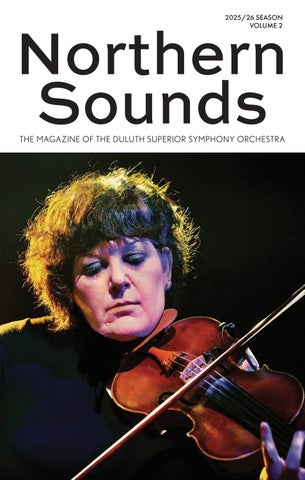
Cover Photo: Brandon Michael
Morning Classics
Host Stephanie Elkins
WELCOME FELLOW MUSIC LOVER
I am thrilled to welcome you to the DSSO’s 2025/2026 season! This year we celebrate Erin Aldridge’s 20th season as Concertmaster of the DSSO. What a remarkable achievement by an incredible musician! Erin will be featured on two of our Masterworks concerts. First, she will represent the voice of Scheherazade in Rimsky-Korsakov’s spellbinding masterpiece of the same name. Then, later in the season, she will be our featured soloist in one of her favorite concertos, Max Bruch’s Violin Concerto No.1.
Talking about amazing soloists, Adam Golka joins us for two seldom performed works for piano and orchestra: Camille Saint-Saëns Africa and Fazil Say’s Silk Road Concerto, a work that incorporates all sorts of fascinating techniques and sound effects for the piano. We will feature wonderful vocal soloists alongside the DSSO
Chorus for Haydn’s grand Lord Nelson Mass and Poulenc’s Gloria. Finally, up-and-coming piano superstar Evren Ozel will join guest conductor William Eddins for Beethoven’s beloved Piano Concerto No.4.
In between we present many a musical jewel. Be it from less familiar composers such as Anna Clyne, Lili Boulanger or Michael Abels, or from blockbuster names such as Sibelius, Liszt, Bizet or Schumann, our season truly offers something for everyone.
Alongside our Masterworks Series, the DSSO will present two pops concerts: In December we bring back our popular Holiday Spectacular. Featuring the DSSO Chorus singing the most beloved melodies of the season, this is truly an event for the entire family. Then, in April, the DSSO takes you to the silver screen once more with John Williams’ legendary score to Indiana Jones and the Raiders of the Lost Ark. With the full movie on the big screen and all music performed live by the orchestra, you will experience Steven Spielberg’s classic in a completely new way.
So, help us spread the word and let more members of our community experience the joy of orchestral music. Bring a friend, invite a neighbor, include the DSSO on your date night. However you like to enjoy the music, we are thrilled you are here, and we are honored to share our music with you.
Dirk Meyer, Music Director
2025-26 SEASON SCHEDULE
MW1 September 20, 2025
MW2 November 8, 2025
POPS 1 December 6, 2025
MW3 January 31, 2026
MW4 February 28, 2026
MW5 March 21, 2026
POPS 2 April 11&12, 2026
MW6 May 16, 2026
Music Director Dirk Meyer
As I write this, we have just reached the midpoint of our season, and I am pleased to report that the Duluth Superior Symphony Orchestra continues forward with momentum and purpose. The first half of the season offered several truly memorable moments, beginning with Scheherazade in September and culminating in an especially stirring performance of Les Préludes in January. Speaking as a member of the orchestra, it is always a gratifying experience to feel the audience rise so quickly in appreciation at the close of a concert.
Artistically, the orchestra is performing at a high level, particularly notable given the extended intervals between performances. Our roster of Masterworks soloists for the spring is exceptional, and Raiders of the Lost Ark promises to be a highlight of the season. As we conclude the year celebrating Erin’s 20th anniversary, the season
will culminate with her performance of the Bruch Concerto in G Minor—a concert I personally hope will see every seat in Symphony Hall filled. From a financial perspective, the organization remains stable. Chair sponsorships are strong, grant support has been solid this season, and ticket sales are tracking well. Individual giving, while steady, remains an area where additional community engagement would make a meaningful difference in sustaining the artistic excellence you experience from the stage.
From a planning standpoint, we are well ahead of where we were at this time last year. With optimism, and a bit of ambition, I share that our goal is to place next season’s brochure in your hands at Raiders of the Lost Ark. Dates and programming for the upcoming season are already set, and the ticketing improvements introduced this year will continue unchanged, allowing for a smooth season ticket launch this spring.
One significant organizational update is that at the conclusion of this season, our offices in the Depot will relocate from train track level to the fourth floor. While our footprint will be smaller, we look forward to the change—and to having a window, along with a rather distinctive set of neighbors.
Thank you for your continued support of symphonic music in Duluth and Superior—for your attendance, your generosity, and for the standing ovations that remind us why this work matters.
J. David Arnott, Executive Director
LAND ACKNOWLEDGMENT
Duluth Superior Symphony Orchestra’s Commitment to Building Bridges for Future Generations
The Duluth Superior Symphony Orchestra acknowledges its responsibility to the Anishinaabe, or the Ojibwe people, who were some of the original inhabitants and continue to be the longstanding stewards of the lands on which we are gathered today, and so many of us now call home.
The DSSO is deeply committed to uplifting a myriad of cultures, voices, and stories through the power of music. We recognize that music has roots tied
to countless Indigenous peoples across the globe and honor Indigenous people’s contributions past, present, and future. We encourage our patrons and partners to recognize, understand, and support the contributions of Indigenous individuals, communities, and organizations across the region and beyond. As we look toward celebrating our 100th year, we will continue to fulfill our mission to bring our communities together to embrace and celebrate music and musicians from across the world, and all walks of life, for many generations to come.
Executive Director J. David Arnott
ADMINISTRATION
J. David Arnott, Executive Director
Kristin Sande, Arts Administration Specialist
ARTISTIC STAFF
Dirk Meyer, The Charles A. & Carolyn M. Russell Music Director
J. David Arnott, Director of Orchestra Operations
Kristin Sande, Librarian
Wyatt Millaway-Roodell, Production Coordinator
Kathleen Laasko, Stage Manager
CHORUS
Richard Carrick, Chorus Director generously sponsored by members of the DSSO Chorus & anonymous donors
Aine Miller, Chorus Administrator
Beth Sobczak, Rehearsal Accompanist
CONCERT BOX OFFICE
Jean Larson, Front of House Manager
Hannah Wohlers, Front of House Assistant
Cas Bordner, Front of House Assistant
2025/26
CREATIVE SERVICES
Marketing, Graphic Design & Digital Communications provided by Andrea Halligan
YOUTH ORCHESTRAS
Melanie Sever, Administrative Director and Concert Orchestra Conductor
Kristin Sande, Youth Orchestras
Administrative Assistant
Ronald Kari, Youth Orchestras Coordinator
Byron Klimek, Youth Symphony Conductor
Kevin Hoeschen, Sinfonia Conductor
Teresa Aho, Sinfonia Conductor
Kristina Bock, Sinfonia Coach
Amy Eichers, Sinfonia Coach
Jeremy Craycraft, Percussion Ensemble Director
NORTHERN SOUNDS
Vincent Osborn, Program Notes Author
Ronald Kari, Performance Historian, now in his 64th Season with DSSO
Kristin Sande, Research Assistant
Thanks to Pro Print for the printing of this edition of Northern Sounds.
BOARD OF DIRECTORS
Branden Robinson, President, Treasurer
Mark Danielson, Secretary
BOARD OF DIRECTORS
Linda Boben
Jeff Cadwell
Mark Danielson
Rhonda Degelau
Beth Gilbert
Amber Gurske
Olivia Huston
Maggie Johnson
Tegan Johnson
Jill Kaiser
Steve Mattson
James McLeod
Emily Nygren
William “Buzz” Palmer
Deborah Rausch
Branden Robinson
James Sebastian
Nairi Stack
Rajiv Vaidyanathan
Roberta Vose
Kat Werchouski
J. David Arnott (ex officio)
Dirk Meyer (ex officio)
HONORARY LIFE DIRECTORS
Christabel Grant
Elaine Killen
Nancy Melander
James Zastrow
MEET THE ORCHESTRA
Dirk Meyer, The Charles A. & Carolyn M. Russell Music Director
FIRST VIOLIN
Erin Aldridge, Concertmaster
Sponsored by Arend J. & Verna Sandbulte in support of the concertmaster chair through the Sandbulte Orchestra Leadership Fund
Angela Waterman Hanson, Associate Concertmaster
Sponsored by Walter & Mariana Beier
Lian Ojakangas, Interim Assistant Concertmaster
Sponsored by Rose & Lester Drewes
Nicole Craycraft (On leave 25-26)
Kathleen Sanders
Sponsored by Dr. Vicki & Terry Anderson
Nairi Stack
Sponsored by Stack Brothers Mechanical Contractors & William Stack
Joan Halquist
Sponsored by Terese Tomanek & Steven Davis
Amanda Wirta
Sponsored by Rhonda & John Degelau; Emily L. Wigg
Daniel Radosevich
Steve Highland
Sponsored by Thomas & Barbara Elliott
Jenna Mattson
Sponsored by Tom & Jill Kaiser; Steve Mattson, Zenith City Photography
Kristin Sande
Sponsored by Karen Hanson Sande, Joshua & Nathan Sande
SECOND VIOLIN
Laurie Bastian, Principal
Sponsored by Jacquie & Jim Sebastian
Jean Leibfried, Assistant Principal
Sponsored by Sandra Barkley
Amy Eichers
Sponsored by Alice McCabe
Olga Chernyshev
Sponsored by Walter & Kay Gower
Marc Harroo
Sponsored by Friends at Marshall School
Michael Zellgert
Sponsored by Vern & May Nordling
Sarah Warner
Sponsored by Kathleen & James Sanders
Kristen Anderson
Sponsored by Diane Kolquist & James Seitz
Lara Hicks
VIOLA
Kevin Hoeschen, Principal
Sponsored by Kay Biga & Patrick Spott
Ronald Kari, Assistant Principal
Sponsored by Stephen & Lauri Cushing; Ruth Ann Eaton
Clare Chopp
Jonathan Kresha
Sponsored by Nancy Odden & Doug W. Britton
Kevin Peterson
Sponsored by Robert T. & Barbara K. Bennett; Linda & Mark Boben
Elizabeth Cregan
J. David Arnott
Sponsored by Sylvia Jamar
Judy MacGibbon
Kelli Barker
Sponsored by Brad Schmugge
John Middleton
Sponsored by LaVonne Middleton
CELLO
Betsy Husby, Principal Sponsored by Christabel Grant
Lucia Magney, Assistant Principal Sponsored by Tegan Johnson
Eric Graf
Rebecca M. Peterson
Sponsored by Robert T. & Barbara K. Bennett
Darin Anderson
Byron Klimek
Sponsored by Anonymous
Lindsay Schlemmer
Sponsored by Duluth Dodge, Chrysler, Jeep, & Ram
Scott Lykins
Daniel Keeler
Sponsored by Dr. Thomas & Julie Seidelmann
DOUBLE BASS
Cassidy Morgan, Principal
Sponsored by Ronald Kari
Vincent Osborn, Assistant Principal
Sponsored by Lane Fryberger Smith
Anthony Lischalk
Sponsored by Nancy Melander
James McLeod
Sponsored by Branden Robinson
Irving G. Steinberg
Sponsored by Lurene Buhrmann
Blake Bonde
Sponsored by Carolyn Sundquist
Gordon Lewis
FLUTE
James DeVoll, Principal
Sponsored by Barbara Melde Olson
Melanie Sever, Flute 2
Sponsored by Geiger & David Yount
OBOE
Michael Dayton, Principal
Darci Griffith Gamerl, Oboe 2
Sarah Boyle Carmack, Oboe 3/
English Horn
Sponsored by Duluth Dodge, Chrysler, Jeep, & Ram
CLARINET
Jennifer Gerth, Principal
Sponsored by William “Buzz” & Saundra Palmer
Kristine Peterson, Clarinet 2
Theodore Schoen, Clarinet 3/Utility
Sponsored by Karl Diekman
BASSOON
Michael Roemhildt, Principal
Sponsored by Gudrun & Geoffrey Witrak
Jefferson Campbell, Bassoon 2
Sponsored by Timothy Sandor in memory of Adeline & Joseph Sandor
Karl Kubiak, Bassoon 3/Contrabassoon
SAXOPHONE
Gregory Kehl Moore, Principal
Sponsored by Mary & Jeff Charnes
HORN
James Pospisil, Principal
Sponsored by James & Mary Zastrow
Gwendolyn Hoberg, Horn 3
Sponsored by Roger & Elaine Engle
Nicholas Brown, Horn 4
Deborah Rausch, Assistant/Utility
Sponsored by Janice Biga
TRUMPET
Earl Salemink, Principal
Sponsored by Mary Evans; R. Craft & Eleanore Dryer
Charles Leibfried, Trumpet 2
Sponsored by Jeff & Vickie Cadwell; Patricia & David Mast
Thomas Pfotenhauer, Trumpet 3
Sponsored by Mark & Grace Monson; The Ulrick Family (Shawn, Maeve & Liam)
TROMBONE
Larry Zimmerman, Principal Sponsored by Gale & Jeri Kerns; Roberta Vose
Christian Howard, Trombone 2
James Erickson, Bass Trombone
Sponsored by Mark Danielson & Theresa Smith
TUBA
Steve Grove, Principal
Sponsored by Helena Jackson & Doug Dunham; Julia & Daniel Jacobson in honor of Rainer Jacobson, Youth Symphony Tubist
TIMPANI
Fred Morgan, Principal
PERCUSSION
Colin O’Day, Principal Sponsored by Dr. Susan Relf
HARP
Janell Kokkonen Lemire, Principal Sponsored by Elaine B. Killen
KEYBOARD
Alexander Sandor, Principal
Sponsored by Mary Hunner Robinson
DULUTH SUPERIOR SYMPHONY YOUTH ORCHESTRAS
For 85 years, thousands of young musicians throughout the Northland have found inspiration in the Duluth Superior Symphony Youth Orchestras program (DSSYO).
The DSSYO allows these young musicians to sharpen their music skills through a variety of experiences with DSSO conductors and musicians in rehearsals, sectionals, and side-by-side performances.
JOIN US FOR OUR 2025/26 SEASON!
Auditions are held annually to find new members for the intermediate and advanced orchestras. The Sinfonia program is for string players only and is non-auditioned. DSSYO membership is open to students ages 10 through high school.
In addition to advanced performance opportunities and weekly rehearsals, your DSSYO membership includes free tickets to DSSO concerts and professional coaching, as well as an annual retreat.
EVENTS
Spring Concert May 3, 2026 • College of St. Scholastica
2026/27 AUDITIONS
Auditions coming summer 2026. Visit dsso.com/youth for more information coming later this spring.
DSSO PRESENTS
MASTERWORKS 4
FRENCH VOYAGE
SATURDAY, FEBRUARY 28, 2026, 7 PM
DECC SYMPHONY HALL – ALLETE STAGE
DIRK MEYER, CONDUCTOR
KATHERINE HENLY, SOPRANO
DSSO CHORUS
RICHARD CARRICK, DSSO CHORUS DIRECTOR
BOULANGER
D’un matin de printemps
POULENC
Gloria
Gloria
Laudamus Te
Domine Deus
Domine Fili unigenite
Domine Deus, Agnus Dei
Qui sedes ad dexteram Patris
INTERMISSION
FRANCK
Symphony in D minor
Lento - Allegro non troppo
Allegretto
Allegro non troppo
Thank you to our generous concert sponsor
Katherine Henly, Soprano
Praised worldwide for her captivating and affecting portrayals in genres ranging from opera to musical theater, jazz, and pop, American soprano Katherine Henly has performed with Los Angeles Opera, Washington National Opera, the Royal Opera House Muscat, Hawaii Opera Theatre, Charlottesville Opera, Virginia Opera, the New York Musical Theatre Festival, the New York International Fringe Festival, and the O’Neill National Music Theater Conference. For her eleventh-hour début with Oper Köln in Street Scene, Resmusica raved “Finally, in Sam Kaplan and Rose Maurrant, we discover two of the most promising American singers... Radiant physically and vocally, also very moving in the farewell scene... a performance even more impressive under the circumstances. The young American soprano, passing through Cologne, had replaced at the last minute a sick colleague during several rehearsals - without having yet sung the role on stage before. The Cologne Opera thanked her with a performance that marked both her European début and role début. Definitely a career worth following.”
Last season, Katherine performed the role of Clorinda in Opera Maine’s production of La Cenerentola and was seen in concert with Grand Junction Symphony Orchestra and the Creede Musical Arts Collective. This season, she joins the South Florida Symphony for Handel’s Messiah and Minnesota Opera to cover Adina in L’elisir d’amore.
Recent seasons saw her début the role of Musetta in Peter Rothstein’s critically acclaimed
production of La bohème with Theater Latté Da in Minneapolis, her return to Charlottesville Opera as Valencienne in The Merry Widow, her début as Clorinda in Rossini’s La Cenerentola conducted by Gavriel Heine for the Northern Lights Music Festival, and her performance as a soloist in Preludes: Lyrics & Lyricists, a five-part online series filmed on the historic stage of the 92nd Street Y. Additional recent performances include the world premiere of Maria Thompson Corley’s The Sky Where You Are commissioned by An Opera Theatre and streaming online as a part of Decameron Opera Coalition’s Tales From A Safe Distance; and a soloist for Glad Jul, a holiday concert produced by Motarbeider, the Støttet av Kulturrådet Norsk kulturfond, and the Nord-Odal kommune, filmed in the historic Sand kirke in Nord-Odal, Norway. She made her off-Broadway début as Elsa in Sheldon Harnick’s musical Dragons at The York Theatre Company and can be heard on the studio recording with Tony Award-winner Michael Cerveris. Ms. Henly has had solo performances with Utah Lyric Opera, Utah Valley Symphony Orchestra, Grand Junction Symphony Orchestra, the Ramsey Wind Symphony, Palisades Virtuosi, Worcester Symphony Orchestra, Camerata New York, and in concert at Mechanics Hall and Carnegie Hall. Ms. Henly has completed Young Artist residencies with Utah Festival Opera, Charlottesville Opera, and the Glimmerglass Festival. She is a graduate of Ithaca College (B.M.) and Brigham Young University (M.M.).
D’un matin de printemps (Of a Spring Morning)
LILI BOULANGER
BORN: August 21, 1893, in Paris, France
DIED: March 15, 1918, in Mézy-sur-Seine
WORK COMPOSED: Originally for violin and piano in1917, orchestrated by the composer in 1918.
WORLD PREMIERE: March 13, 1921, at the Paris Conservatoire, Concerts Pasdeloup Orchestra, Rhené-Baton conducting
PERFORMANCE HISTORY: The DSSO has not previously performed any music by Lili Boulanger
INSTRUMENTATION: Two flutes and piccolo, two oboes and English horn, two clarinets and bass clarinet, two bassoons and sarrusophone or contrabassoon, four horns, three trumpets, three trombones, tuba, triangle, snare drum, cymbal, harp, celeste, and strings.
DURATION: 5 minutes
(Marie-Juliette Olga) Lili Boulanger grew up in a musical household where both her parents and her sister Nadia (1887-1979) were active composers and performers. Her father, Ernest Boulanger (18151900) won the Grand Prix de Rome in 1835 with his cantata Achille. Her mother, Raïssa Mischetzky (1854?-1935) was an amateur singer who performed at musical soirées in their house regularly attended by Dubois, Fauré, Gounod, Massenet, Widor and occasionally Saint-Saëns. The author of Nadia Boulanger’s biography, Jérôme Spycket, claims that Ernest was most likely not the father of Nadia or Lili! Spycket claims that the father was Richard Bouwens, the son of Ernest’s friend, William Bouwens van der Boijen, a Dutch architect who had settled in Paris. What good is a program note without a little controversy? Nevertheless, Nadia
and Lili always considered Ernest their father. Lili showed a prodigious talent at the very young age of two! She was already singing melodies by ear and learned to read sheet music before she even knew the alphabet. In 1895 Lili became ill with bronchial pneumonia that severely weakened her immune system. She was almost constantly ill with either passing infections or outbreaks of chronic intestinal tuberculosis which led to her death in 1918. Because of her frail condition she needed constant care and had to rely on private musical tutors instead of receiving a full education at the Conservatoire. Through these extraordinary hardships she eventually became the first woman to win the Grand Prix de Rome in 1913 with her cantata Faust et Hélène. She was able to partake in the award of the Prix de Rome and journey to the Villa Medici in Rome to study and compose. However, World War I cut short that time and she returned to Paris where she founded the Comité Franco-Américain du Conservatoire National, an organization which offered material and moral support to musicians fighting in the war. In 1916 she returned to Rome for several months and worked on her five-act opera La princesse Maleine and other works. Rapid deterioration of her health soon forced a return to Paris. She spent the last two years of her short life trying to finish compositions she had begun earlier.
The last two pieces Boulanger finished in her own hand (she dictated her final composition Pie Jesu to her sister) are complementary works: D’un matin de printemps (Of a Spring Morning) and D’un soir triste (Of a Sad Evening). Both of these works began as small chamber pieces before ultimately being fully orchestrated. They share a common idea for their thematic material with drastically contrasting moods implied by their titles; D’un soir triste is mournful with somber tones, D’un matin de printemps is bright and festive. D’un matin de printemps depicts a bright, energetic morning that includes dreamlike moments before returning to full brilliance. Think of waking up in that early morning after a good night’s sleep filled with wonderful dreams that you try to recall.
Boulanger was raised in a time of musical transition and her music fits easily in what we consider the post-Romantic style. Although she explored Impressionism, her style is more Symbolistic featuring a sense of obscurity and indirection. Considering the struggles and isolation caused by her poor health one might expect that her music is more introspective, which is not the mood of D’un matin de printemps. One can only imagine the fantastic music she might have given the world had she lived a longer life.
FRANCIS POULENC
BORN: January 7, 1899, in Paris, France
DIED: January 30, 1963, in Paris
WORK COMPOSED: 1959-60
WORLD PREMIERE: January 20, 1961, in Boston with Adele Addison, soprano; Boston Symphony Orchestra, Charles Munch conducting.
PERFORMANCE HISTORY: There have been four previous performances of this work by the Orchestra and Chorus. Carol Moody was the soprano soloist on April 21, 1967, in a concert that closed the DSSO’s inaugural season in residence at the DECC and marked Hermann Herz’s final performance after 17 seasons as Music Director. In 1980 Nancy Virkhaus was the soprano; 1992 with Dana Summers; 2011with Regina Zona.
INSTRUMENTATION: Two flutes and piccolo, two oboes and English horn, two clarinets and bass clarinet, two bassoons and contrabassoon, four horns, three trumpets, three trombones, tuba, timpani, harp, strings, mixed chorus and solo soprano.
DURATION: 28 minutes
The music composed by Poulenc during the first half of his career was in a lighter vein and its main purpose was to give pleasure. In the 1920s Poulenc was a member of ‘Les Six’, along with Georges Auric, Louis Durey, Arthur Honegger, Darius Milhaud, Germaine Tailleferre and their artistic leader Jean Cocteau. As a group they opposed the heavy German Romanticism and Impressionism that dominated French music at the time. They found inspiration from Erik Satie’s clarity and from folk music, jazz and other popular
forms that celebrated modernity and urban life. For Poulenc this all changed in 1935 following the death of a close friend in an automobile accident. This tragic event caused Poulenc to experience some introspection that brought about a new maturity and a recovery of his lost Catholic faith. His compositions, both secular and sacred, became more serious even though he never lost sight of his lighter style.
Poulenc’s Gloria has an interesting history. The Koussevitzky Foundation approached Poulenc in the spring of 1959 to commission a symphony, to which Poulenc replied ‘that’s not my thing.’ The Foundation then suggested a concerto for the organ, which he brushed off saying he had already composed one. Finally the Foundation relented and on July 7 approved a $2000 commission (approximately $20,000 in 2026) for a work of the composer’s choosing. Poulenc replied on August 3 that he had already begun work on his Gloria, which he completed in July 1960. Indeed, he had written to organist and musicologist Bernard Gavoty (1908-1981) on April 18, 1959, that he had “just begun a Gloria for chorus, soloist and orchestra in the Vivaldi style.” He also claimed his inspiration for the Laudamus te came from watching Benedictine monks playing soccer.
Poulenc’s Gloria is divided into six movements:
I. Gloria in excelsis Deo (G major)
II. Laudamus te (C major)
III. Domine Deus, Rex caelestis (B minor)
IV. Domine Fili unigenite (G major)
V. Domine Deus, Agnus Dei (B-flat minor)
VI. Qui sedes ad dexteram Patris (G major)
The text of the Gloria is regarded as one of the great prose hymns of Christian literature. Normally sung in the Latin Mass immediately after the Kyrie on festive occasions, the Gloria has also been used separately as a hymn of praise. The text as it is now employed developed over an extended period until it reached its present form in the 9th century. Poulenc repeated a number of phrases in such a way that make it liturgically inappropriate and gives evidence that he most likely considered his Gloria a piece for the concert hall and not for a church service. It is interesting to experience how Poulenc interspersed such an intensely serious text with his colorful and secular musical personality. The mystical quality of Poulenc’s Gloria may not make it a profoundly deep work, but it is one of his most brilliant and is still relevant in today’s world.
Symphony in D minor CÉSAR FRANCK
BORN: December 10, 1822, in Liège, Belgium
DIED: November 8, 1890, in Paris, France
WORK COMPOSED: 1887-88
WORLD PREMIERE: February 17, 1889, by the Société des concerts of the Paris Conservatoire, Jules Garcin conducting
PERFORMANCE HISTORY: Tonight marks the Orchestra’s eleventh performance of this piece. Early in the Orchestra’s history this Symphony was quite frequently played—eight times beginning in 1934 and continuing until 1962. After that there have been only two performances previous to this evening: in 1982 and on April 20, 2002.
INSTRUMENTATION: Two flutes, two oboes and English horn, two clarinets and bass clarinet, two bassoons, four horns, two trumpets and two cornets, three trombones, tuba, timpani, harp, and strings.
DURATION: 37 minutes
César Auguste Jean Guillaume Hubert Franck was a French composer with an interesting cultural origin. At the time of his birth Liège, in the Belgian region of Wallonia, was part of the United Kingdom of the Netherlands until 1830, when the Belgian Revolution established an independent and neutral Belgium which incorporated Liège. His mother, Marie-Catherine-Barbe Franck (née Frings) (1788-1860), was from Aachen, Germany. His father, Nicolas-Joseph Franck
(1794-1871), came from Gemmenich, located on The Netherlands-German border. The young César displayed a talent for music at a very young age and his father, believing his son a prodigy, enrolled him in the Liège Conservatoire in October 1830. César was a successful student and in the spring of 1835 his father organized a series of concerts in Liège, Brussels and Aachen. The next obvious path led to the family’s move to Paris in May 1835 with a course of piano lessons with Pierre Zimmerman (1785-1853) and theory and harmony lessons with Anton Reicha (17701836). Because of his nationality, César was not allowed to enter the Paris Conservatoire until October 1837 after his parents became French citizens in that year.
Franck gained a reputation as a formidable musician on the organ and he travelled extensively in France to demonstrate the new organs built by Aristide Cavaillé-Coll (18111899). In 1858 Franck was employed as organist in the newly-consecrated church Sainte-Clotilde, a position he kept the rest of his life. In 1872 he became a professor at the Paris Conservatoire where his pupils included Ernest Chausson and Vincent d’Indy. Most of Franck’s compositions come from this time when his full creative powers were finally realized. He is best known for his Violin Sonata, a setting of Panis angelicus, and his Symphony in D minor.
The Symphony in D minor, completed on August 22, 1888, is Franck’s only mature symphony and it employs a cyclic form, with the important themes recurring in all three movements. Franck’s music after 1870 reflects an interest and awareness of German music, notably that of Richard Wagner. Henri Duparc (1848-1933), Franck’s student, encouraged his professor’s interest and Franck “made an effort to study one of the Wagner scores every summer during the last period of his life.” His Symphony in D minor reflects a Wagnerian influence and Franck dedicated it “to my friend Henri Duparc.”
The premiere received mixed reviews. The review in Le Figaro stated: “The new work of M. César Franck is a very important composition and developed with the resources of the powerful art of the learned musician; but it is so dense and tight that we cannot grasp all its aspects
and feel its effect at a first hearing, despite the analytical and thematic note that had been distributed to the audience.” Charles Gounod (1818-1893) was reported as calling the work “the affirmation of impotence taken to the point of dogma.” A member of the Conservatoire faculty asked the question, “Who ever heard of a cor anglais [English horn] in a symphony?” Franck’s use of the brass section was criticized as being too blatant, especially the addition of cornets to the usual orchestral trumpets. Those were the nicer reviews; they got worse! However, outside of the environment of French music criticism, Franck’s symphony quickly became popular. Until the 1970s Franck’s Symphony in D minor was frequently heard in the major symphonic halls throughout the United States. It is now rarely performed, mostly attributed to changing musical tastes. Nevertheless, there is value in dusting off an old gem and revisiting it with a new perspective.
Chorus is an integral part of the Duluth Superior Symphony Orchestra, regularly joining the orchestra for choral masterworks, operas, and pops concerts.
The DSSO Chorus has performed an impressive range of choral masterpieces, from monumental works like Beethoven’s Symphony No. 9 (“Ode to Joy”) and Mahler’s “Resurrection Symphony” to vibrant and dramatic favorites such as Orff’s Carmina Burana and Bizet’s Carmen. Their repertoire also includes Michael Tippett’s A Child of Our Time, Brahms’ and Fauré’s Requiems, and, of course, no choral repertoire would be complete without Handel’s Messiah, a timeless and beloved oratorio that continues to inspire and uplift listeners.
MEET DSSO’S CHORUS DIRECTOR
Richard Carrick is a conductor, clinician, singer, and educator. He is the Director of Choral Activities at The College of St. Scholastica in Duluth, MN, Director of Music at the Cathedral of Our Lady of the Rosary, and a founding member and conductor of Borealis Chamber Artists. He holds a D.M.A. in Choral Conducting from the University of Washington and has performed with the Oregon Bach Festival Chorus, the St. Paul Chamber Orchestra, and the Minnesota Orchestra. When not teaching or conducting, Richard can be found on a trail somewhere in the woods, or baking with his wife and children. Chorus Master generously sponsored by members of the DSSO Chorus and an anonymous donor.
MEET THE CHORUS
CHORUS DIRECTOR Dr. Richard Carrick
REHEARSAL ACCOMPANIST Beth Sobczak
CHORUS ADMINISTRATOR Aine Miller
SOPRANOS
Jenna Altonen*
Cathy Ameel
Hannah Boadwine
Emilie Bowman
Karen Finseth
Maureen Gamradt
Anita Gille
Rose Heldt
Sara Henriksen
Susan Hough
Kaylie Jesperson
Jan Johnson
Tasha Kapp
Lynne King
Cathy Larson
Lita Lind
Steph Love
Kelli Marlow
Phyllis Messenger
Aine Miller
Chantal Norrgard
Barbara Olson
Deb Schroeder
Sara Stefancik
Beth Storaasli
Shannon Swegle
Maeve Ulrick
ALTOS
Andrea Asleson
Naomi Atkins
Alison Aune
Mariana Beier
Lea Carr
Erin Durkee
Diane Fernholz
Jill Geyer
Ann Gumpper
Carol Hoeschen
Lindsey Korthals
Lisa Larson
Audrey May
Carolyn Mikel
Grace Monson
Neve Moore*
Jillian Odell
Sharon Sandvik
Ann Sanford
Linda Senta
Sandy Skrien
Kathy Stinnett
Charlotte Taylor
Shelby Trost
Colleen Tuura
Gudrun Witrak
TENORS
David Arnott
Robert Asleson
Anne Bier
Richard Carrick
Kate Dean
Bonnie Lou Dunphy
Corbin Eddy
Jim Johnson
Tegan Johnson
Benjamin Jorgenson*
Glen Krenelka
Madonna LeBlanc
Patrick Russell
Jim Schulzetenberg
Tom Sjoberg
Peter Wodrich
BASSES
Samuel Black
Jeff Cadwell
Mark Danielson
Timothy Delnay
Tom Diener
Hilary Godard
Cade Hatlestad*
David Helf
Mark Knutson
Larry LeBlanc
Mark Monson
Andrew Nast
Luther Qson
David Steinberg
Kirby Wood
Christopher Wright
*Denotes Section Leader
For 33 years Keyport Liquor has been your trusted local store for top quality spirits at everyday low prices. without the gimmicks - just honest value and selection. Visit us today and experience why we're the twin ports favorite family owned liquor store.
INVEST WITH INTEGRITY IT’S YOUR FUTURE
MASTERWORKS 5
BEETHOVEN & BIZET
SATURDAY, MARCH 21, 2026, 7 PM
WILLIAM EDDINS, GUEST CONDUCTOR
EVREN OZEL, PIANO
BEETHOVEN
Piano Concerto No. 4 in G major, op. 58
Allegro moderato
Andante con moto
Rondo: Vivace
Evren Ozel, piano
More Seasons
Symphony No. 1 in C major
Allegro vivo
Adagio
Allegro vivace
Allegro vivace
DECC SYMPHONY HALL – ALLETE STAGE
Thank you to our generous concert sponsor
More Seasons by Michael Abels is presented under license from Subito Music Corporation.
William Eddins, Guest Conductor
William Eddins is the Music Director Emeritus of the Edmonton Symphony Orchestra and a frequent guest conductor of major orchestras throughout the world. Recent engagements include conducting the Philadelphia Orchestra with Yo-Yo Ma, and collaborations with Wynton Marsalis’ Jazz at Lincoln Center Orchestra with both the Detroit Symphony and Minnesota Orchestra.
Evren Ozel, Piano
American pianist Evren Ozel has established himself as a musician of “refined restraint” (Third Coast Review), combining fluent virtuosity with probing, thoughtful interpretations. Having performed extensively in the United States and abroad, Evren is the recipient of a 2023 Avery Fisher Career Grant, 2022 Salon de Virtuosi Career Grant, and is currently represented by Concert Artists Guild as an Ambassador Prize Winner of their 2021 Victor Elmaleh Competition.
Since his debut with the Minnesota Orchestra at age 11, Ozel has been a featured soloist with the Cleveland Orchestra, Jacksonville Symphony, and The Orchestra
Eddins has conducted the New York Philharmonic, St. Louis Symphony, the symphony orchestras of Boston, Cincinnati, Atlanta, Detroit, Dallas, Baltimore, Indianapolis, Milwaukee, Houston, and the Los Angeles Philharmonic. Internationally, Eddins was Principal Guest Conductor of the RTÉ National Symphony Orchestra (Ireland). He has also has conducted the Berlin Staatskapelle, Berlin Radio Orchestra, Welsh National Opera, and the Royal Scottish National Orchestra. Career highlights include taking the Edmonton Symphony Orchestra to Carnegie Hall in May of 2012, and leading the KwaZulu-Natal Philharmonic on tour in South Africa with soprano Rene Fleming.
An accomplished pianist and chamber musician, he regularly conducts from the piano in works by Mozart, Beethoven, Gershwin and Ravel. Recently, Eddins has been performing Enrique Granados’ seminal solo piano work Goyescas (1911), having performed recitals in Minneapolis, Milwaukee and Houston in 2023.
Mr. Eddins has performed at the Ravinia Festival, the Aspen Music Festival, the Hollywood Bowl, Chautauqua Festival, the Boston University Tanglewood Institute and the Civic Orchestra of Chicago.
Now at Bard College, with conductors Jahja Ling, Courtney Lewis, and Leon Botstein. In March of 2025, his first album of Mozart Concertos with the ORF Radio Symphony of Vienna and conductor Howard Griffiths was released on Alpha Classics.
Ozel’s 2024-25 season highlights included solo recitals for La Jolla Music Society, Capital Region Classical, and Cal Performances. Previously, he has performed recitals for Harvard Musical Association, Schubert Club, Chopin Society of Minnesota, and The Gilmore. Carrying a vast and varied recital repertoire, his 2023-24 season included a program ranging from Bach and Rameau to Ligeti, as well as a program of Beethoven’s last three Piano Sonatas.
An esteemed chamber musician, Ozel performs alongside artists like David Finckel and Wu Han, Stella Chen, Zlatomir Fung, Paul Huang, and Peter Wiley. He spent four summers at the Marlboro Festival, and is currently a 2024-27 Bowers Program Artist for the Chamber Music Society of Lincoln Center. His 2024-25 season included a tour with Musicians from Marlboro, as well as CMS concerts at Alice Tully Hall.
Ozel resides in Boston, where he is currently a candidate in New England Conservatory’s prestigious and highlyexclusive Artist Diploma program, under the tutelage of Wha Kyung Byun. Other important mentors include Jonathan Biss, Imogen Cooper, Richard Goode, Andras Schiff, and Mitsuko Uchida.
Piano Concerto No. 4 in G major, Op. 58 LUDWIG VAN BEETHOVEN
BAPTIZED: December 17, 1770, in Bonn, Germany
DIED: March 26, 1827, in Vienna, Austria
WORK COMPOSED: 1805-06
WORLD PREMIERE: March 1807 at a private concert in the home of Prince Franz Joseph von Lobkowitz; December 22, 1808, in Vienna, Beethoven soloist and conducting PERFORMANCE HISTORY: The DSSO has presented this concerto seven times previously: in 1960 with solo pianist Leonard Pennario; in 1969 with Claude Frank; 1971 Andre Watts; 1978 Diane Walsh; 1988 Grant Johannesen; 1995 Hélène Grimaud with guest conductor George Hanson; and on January 22, 2005 with Orli Shaham.
INSTRUMENTATION: Flute, two oboes, two clarinets, two bassoons, two horns, two trumpets, timpani and strings.
DURATION: 34 minutes
Beethoven was part of the first generation to grow up playing the piano. The harpsichord was quickly being replaced by the more expressive fortepiano, invented around 1700 by Bartolomeo Cristofori (1655-1731). The piano rapidly evolved to meet the demands of the musicians; at its invention the piano range was only four octaves. Mozart wrote his music for a piano with five octaves and the last
piano compositions by Beethoven spanned six and a half octaves. The modern piano is normally seven and one-third octaves.
Beethoven played an incredible part in the instrument’s evolution. By the time he had reached maturity as a composer, Beethoven was one of the world’s greatest pianists. He demanded more from the instruments and advised piano makers to build their instruments bigger and stronger. Beethoven was celebrated for the power of his playing and the imagination of his improvisations. Piano virtuosos wrote concertos for themselves as vehicles to display their talents. Mozart broke away from that tradition and his later concertos show that the piano is more than a tool to show off one’s technical prowess. Beethoven followed in Mozart’s footsteps in his earlier piano concertos until his Fourth Piano Concerto, where his maturity and identity shine through.
The first movement breaks with the traditional format: there is no orchestral introduction, the piano begins alone in the key of G major and ends on a D major chord (dominant of G major)then the orchestra enters, but in the key of B major! Within a few measures of the orchestra response Beethoven moves through the Circle of Fifths until arriving back at G major. Music theory alert: the Circle of Fifths is arranging all twelve tones of a chromatic scale in a circle where C is at the top and going clockwise each note is a perfect fifth above the preceding note. C-G-D-A-E-BGb/F#-Db/C#-Ab/G#-Eb/D#-Bb/A#-F-C When the orchestra enters in B major, Beethoven uses the circle in a counter-clockwise motion and moves from B-E-A-D-G. You might not think this is anything special, but back in Beethoven’s day this was most likely earth-shattering!
The second movement begins with a dark introduction by the strings in unison, using a motif from the Dies Irae (Day of Wrath) chant, that is quietly answered by the piano. Beethoven’s biographer Adolf Bernhard Marx (1795-1866) has associated it with the imagery of Orpheus (represented by the piano) taming the Furies (unison strings) at the gates to Hades. The movement ends quietly and leads immediately
into the final movement.
Beethoven premiered the Fourth Piano Concerto in March 1807 in a private concert at the home of his patron Prince Franz Joseph von Lobkowitz (1772-1816). Included in that performance was the Coriolan Overture and the Fourth Symphony. At the public premiere the Concerto was a bit overshadowed by other works on the program. By this time Beethoven was becoming increasingly deaf and this was the last of his concertos he was able to perform. He organized a benefit concert for himself to alleviate some of his financial difficulties. Those who attended witnessed the premieres of not only the Fourth Piano Concerto, but also the Choral Fantasy, the Fifth and Sixth Symphonies, two excerpts from his in-progress Mass in C major, an aria and a solo piano improvisation! Now if you are starting to think you might be jealous of those fortunate audience members… it was December in 1808, there was a problem with the heating system making it a very cold venue, the concert lasted from 6:30 to 10:30, and nearly all of the music was sight-read at the concert and being under rehearsed, the orchestra was in a foul and surly mood. Ferdinand Ries, a piano pupil of Beethoven, wrote: “We experienced the fact that one could easily have too much of a good – and even more, a powerful – thing. I… would not have thought of leaving the box before the end of the concert, although several faulty performances tried our patience to the utmost.”
Early critics thought the concerto was strange and unusual, particularly the quiet piano entrance at the opening. It was performed rarely, compared with his other concertos, until November 3, 1836, when Felix Mendelssohn gave a significant performance in Leipzig that renewed interest in it. Since then the Fourth Piano Concerto has been ranked among Beethoven’s greatest works. It stands out for its fresh approach of combining the orchestra and soloist, requiring from the soloist virtuosity and sensitivity. Many great pianists have written cadenzas for the Fourth including Brahms, Clara Schumann, Saint-Saëns, Anton Rubinstein, Busoni, and many others, although most use Beethoven’s own cadenzas. The genius of Beethoven shines through in the Fourth Piano Concerto and it continues to sound fresh and new with each performance.
More Seasons
MICHAEL ABELS
BORN: October 8, 1962, in Phoenix, Arizona
WORK COMPOSED: 1999
WORLD PREMIERE: 1999
PERFORMANCE HISTORY: Tonight marks the first time the Orchestra will play music by Michael Abels.
INSTRUMENTATION: Two flutes (2nd flute doubling piccolo), two oboes, two bassoons, two horns, two trumpets, timpani, harpsichord and strings.
DURATION: 12 minutes
Michael Abels spent his early years on a small farm in South Dakota where he lived with his grandparents. He began to show musical curiosity with the family piano at the age of four. His grandparents were music lovers and they convinced the local piano teacher to take him on as a student. By the age of eight he began composing music and his first completed orchestral work was performed when he was thirteen. After graduating from high school Abels attended the University of Southern California Thornton School of Music in Los Angeles. He later studied West African drumming techniques at California Institute of the Arts, and sang in a predominantly black church choir to further explore his AfricanAmerican roots. Abels has been a very prolific composer for film, television, and concert halls over the last fifteen years. In 2023 the opera
Omar, co-written by Abels and Rhiannon Giddens, won the Pulitzer Prize for Music. One of his earlier compositions is More Seasons, which he considers his “own spin” on early Baroque music, subjecting the themes of Vivaldi’s Spring and Summer “to maniacal, minimalist abuses,” and calling it “Vivaldi in a Mixmaster.” More Seasons takes the audience on an unexpected and delightful journey with themes that are instantly recognizable. In contrast with Astor Piazzolla’s Estaciones Porteñas (Four Seasons of Buenos Aires) which includes all four movements in a completely fresh style, Abels’ More Seasons is a single-movement piece that deliberately shifts away from that structure. Abels explores the minimalist quality of the original Four Seasons and creates a unique approach to an old classic.
Symphony No. 1 in C major GEORGES BIZET
BORN: October 25, 1838, in Paris, France
DIED: June 3, 1875, in Bougival, a suburb of Paris
WORK COMPOSED: 1855
WORLD PREMIERE: February 26, 1935, in Basel, Switzerland, Felix Weingartner conducting.
PERFORMANCE HISTORY: The two previous DSSO performances of this work were in 1966 (Hermann Herz conducting) and in 1978 (with Taavo Virkhaus).
INSTRUMENTATION: Two flutes, two oboes, two clarinets, two bassoons, four horns, two trumpets, timpani and strings.
DURATION: 27 minutes
Georges Bizet is, of course, an extremely wellknown composer in the operatic world with his wildly popular Carmen. However, other than Carmen and his incidental music to Alphonse Daudet’s play L’Arlésienne, very little of Bizet’s music is performed regularly.
Showing a proclivity for music at an extremely young age, Bizet’s parents enrolled him in the Paris Conservatoire at the age of nine. The minimum age for entrance was ten but his interview with Joseph Meifred (1791-1867), the horn virtuoso and professor who was also on the Conservatoire’s Committee of Studies, was so impressive that Meifred waived the age
requirement. Bizet was an exceptional student and won many prizes, including the Grand Prix de Rome in 1857. He was recognized as an outstanding pianist but he rarely performed in public, choosing instead to arrange the music of others and compose his own music.
Bizet composed a considerable number of works, but unfortunately a significant number of his manuscripts were lost after his untimely death at the age of 36. One of his earliest works is his Symphony in C, which he began composing four days after his seventeenth birthday and finished a month later. Because Bizet showed no interest in having the work performed or published it is presumed to have been an assignment for his composition studies with Charles Gounod (1818-1893). It has also been argued that Bizet’s Symphony closely resembles Gounod’s Symphony in D which was written in 1854 (Bizet had been hired to write a transcription of it for two pianos). His widow, Geneviève Halévy (18491926), gave the manuscript of Bizet’s Symphony to Reynaldo Hahn (1874-1947), who then passed it along to the archives of the Conservatoire’s library where in 1933 it was found by Jean Chantavoine (1877-1952), musicologist and secretary-general of the Conservatoire. Bizet’s first biographer Douglas Charles Parker (18851970) then showed the manuscript to the conductor Felix Weingartner (1863-1942) who had it prepared for a premiere.
Unfortunately Bizet never composed another symphony and he died only months after the premiere of Carmen. The youthful energy and beautiful melodies that are displayed in the Symphony in C are evidence of his brilliance and we can only imagine what might have been had Bizet written more symphonies.
Signature Wealth Management is a marketing name for securities and investment advisory services offered through Osaic Wealth, Inc. Member FINRA/SIPC. Osaic Wealth is separately owned and other entities and/or marketing names, products or services referenced here are independent of Osaic Wealth. Osaic Wealth does not provide tax or legal advice.
The Best of the Best award issued by Duluth News Tribune on 9/10/2025 for the 2025 year was awarded to Best Financial / Wealth Advisor. The financial professional was nominated for the recognition. All financial professionals within an 80 miles radius of Duluth, MN could be nominated by the public with the top 5 nominees being named finalist. Finalists were voted upon by the public with the highest vote receiver winning the award. No fee was paid for the nomination, receipt, or promotion of the award. Third-party ratings are no guarantee of future investment success and do not ensure that a
or
or
nor are
DECC SYMPHONY HALL APRIL 11 & 12, 2026
original score by JOHN WILLIAMS full orchestra conducted by DIRK MEYER
Rachael Kresha, organ Cathedral of Christ the King
March 26 | 7:30 p.m.
Orchestra Concerto Competition Concert
Thorpe Langley Auditorium
April 14 | 7:30 p.m.
University Recital Series
Dough Walter & Brett Jones, percussion
Webb Recital Hall
MASTERWORKS 6
RHINE JOURNEY
SATURDAY, MAY 16, 2026, 7 PM
DECC SYMPHONY HALL – ALLETE STAGE
DIRK MEYER, CONDUCTOR
ERIN ALDRIDGE, VIOLIN
TE-CHIANG “BACCO” LIU, GUEST CONCERTMASTER
KODÁLY
Dances of Galánta
Lento
Allegretto moderato
Allegro con moto, grazioso
Allegro
Allegro vivace
BRUCH
Violin Concerto No. 1 in G minor, op. 26
Prelude: Allegro moderato
Adagio
Finale: Allegro energico
Erin Aldridge, violin
INTERMISSION
SCHUMANN
Symphony No. 3 in E-flat major, op. 97 (Rhenish)
Lebhaft
Scherzo: Sehr mässig
Nicht schnell
Feierlich
Lebhaft
Thank you to our generous concert sponsor
musician, and has been featured throughout Europe, South America, and the United States. Aldridge maintains an active performance schedule as a soloist and chamber musician, as well as in non-classical genres with her bands Danny Frank & the Smoky Gold and Superior Siren.
She has been a soloist with the Duluth Superior Symphony Orchestra, the Lake Superior Chamber Orchestra, the Long Prairie Chamber Orchestra, the Mesabi Symphony Orchestra, and the Itasca Symphony Orchestra. She has been a guest artist at the Indiana University Summer Music Festival, Arizona State University, DePaul University Contemporary Concert Series, Madeline Island Music Camp, Ashland Chamber Music Series, National String Workshop, “Live at the Chazen” Concert Series, and The Third Coast Chamber Collective. She has been broadcast on National Public Radio, the BBC, Minnesota Public Radio, and Wisconsin Public Radio, and featured on television in the Midwest region.
Outside of classical music, Aldridge performs a wide variety of genres including bluegrass, Americana, folk, funk, blues, electronic, and rock. Her principal band, bluegrass and Americana group Danny Frank & the Smoky Gold, has garnered local and regional acclaim for their virtuosic instrumentalism and genre-blending original compositions. They have been featured at Blue Ox Festival in Eau Claire, Boats and Bluegrass Festival in Winona, River Falls Bluegrass Festival, The Great Northern Squashfest, and GLAMA Festival, and appear regularly at venues throughout the Midwest.
With Superior Siren, Aldridge made her debut at First Avenue in Minneapolis opening for DeVotchKa, and also performed at Blue Ox Festival. The first single she recorded with the group, “Rattlesnake,” received critical acclaim and was highlighted as a best new Minnesota song for August by Mpls. St. Paul Magazine. Aldridge is also the artistic advisor to the Duluth Superior Symphony Orchestra’s Bridge Sessions, a summer concert series dedicated to bringing together musicians of diverse genres.
Aldridge has several recordings, including her recording of Eugene Ysaÿe’s Six Sonatas for Solo Violin, Op. 27, Justin Rubin’s Constellations on the MSR Classics label, and Ian Deterling’s Duet in F Minor, Op. 4 for Violin and Trombone. She has also recorded with singer-songwriter Sara Thomsen, Three Altos, Superior Siren, and Andy Hanson. Danny Frank & the Smoky Gold released their live album Live from the Heart: Danny Frank & the Smoky Gold at Sacred Heart Music Center and recorded their first studio album in January 2025.
In the Twin Ports area, Aldridge has received significant recognition. She was named concertmaster of the Duluth Superior Symphony Orchestra in 2005, selected for the Duluth News Tribune’s “20 Under 40” award in 2007, and received the Community Enrichment Award from the Duluth Depot Foundation in 2012. She was later honored by the American Association of University Women as one of four “Created Here” artists. Most recently, she received the 2023 Teaching Excellence Award from the Universities of Wisconsin Board of Regents.
As a conductor, Aldridge has directed ensembles throughout the state and served as guest clinician for the UW–Milwaukee High School Honors Orchestra. Under her direction, the University of Wisconsin–Superior Chamber Orchestra has developed a reputation for innovative programming. UW–Superior Chamber Strings has been featured at the Wisconsin State Music Educators Conference and has toured internationally.
Aldridge earned her bachelor’s degree in Violin Performance from Indiana University, her master’s degree and Performer’s Certificate from the University of Wisconsin–Milwaukee, and her Doctor of Musical Arts degree from the University of Wisconsin–Madison. She is currently Professor of Violin and Viola and Director of Orchestra at the University of Wisconsin–Superior, and Concertmaster of the Duluth Superior Symphony Orchestra and Lyric Opera of the North Opera Orchestra.
Dances of Galánta
ZOLTÁN KODÁLY
BORN: December 16, 1882, in Kecskemét, Hungary
DIED: March 6, 1967, in Budapest
WORK COMPOSED: 1933
WORLD PREMIERE: October 23, 1933, in Budapest; Philharmonic Society Orchestra, Ernst von Dohnányi conducting.
PERFORMANCE HISTORY: The two Masterworks performances of these dances were in 1960 and 2009. In the summer of 2004 Markand Thakar led outdoor performances at Lucius Woods (Solon Springs, WI) Performing Arts Center and on the lawn of Glensheen Mansion in Duluth.
INSTRUMENTATION: Two flutes (2nd flute doubling piccolo), two oboes, two clarinets, two bassoons, four horns, two trumpets, timpani, percussion (glockenspiel, snare drum, triangle) and strings.
DURATION: 16 minutes
Zoltán Kodály played an integral part in the development of ethnomusicology and music education. Because his father worked for the Hungarian State Railways as station master, the young Zoltán spent his first eighteen years in the Hungarian countryside. His mother played the piano and sang and his father played violin. While at the elementary school in Galánta he heard folktunes sung by his classmates. Nagyszombat, where Kodály attended grammar school, is a
historic town of rich cultural traditions. He was an excellent student with a proficiency in literature and languages. With very little tutorage he learned the piano, violin, viola and cello to such a level that he could take part in chamber music at home and perform with the school orchestra.
Kodály visited remote villages in 1905 to collect songs, which he recorded on phonograph cylinders. In 1906 he authored a thesis on Hungarian folk songs, Strophic Construction in Hungarian Folksong. Around this same time he met Béla Bartók, whom he took under his wing and shared his methods for collecting folk songs. They became lifelong friends and champions of each other’s music.
Throughout Kodály’s adult life he was very interested in improving music education. In 1935, along with his colleague Jenő Ádám, he embarked on a long-term project to reform music teaching in Hungary’s lower and middle schools. Several highly influential books resulted from this work. It’s interesting to read the goals of the Kodály method:
• Music is for everyone.
• Music teaching should be sequential and begin with the child in mind.
• Children should be taught music from an early age.
•The sequence should be logical and follow the same process by which children learn language.
•Music classes should be enjoyable and engaging.
• Singing is the first and most valuable tool for learning musical concepts.
• Teachers should pull from quality folk song materials in the “mother tongue” of the students.
Kodály adapted a hand signal system for solfège (Do - Re - Mi) created by Sarah Ann Glover (1785-1867) and improved on by John Spencer Curwen (1816-1880). In the motion picture Close Encounters of the Third Kind, a visual learning aid distributed to members of a conference of ufologists used Kodály’s method that referenced musical notes as hand signals.
Dances of Galánta was composed on commission for the 80th anniversary of the Budapest Philharmonic Society. It is based on the folk music of Galánta (now part of Slovakia), where Kodály lived for several years. By way of explanation, Kodály inserted this statement in the score:
Galánta is a small Hungarian markettown known to the travelers from Vienna to Budapest, where the composer passed seven years of his childhood. There existed at that time a famous Gypsy band which has since disappeared. Their music was the first “orchestral sonority” which came to the ear of the child. The forebears of these Gypsies were already known more than a hundred years ago. Around the year 1800 some books of Hungarian dances were published in Vienna, one of which contained music “after several Gypsies from Galánta.” They have preserved the old Hungarian traditions. In order to continue it the composer has taken his principal subjects from these old editions.
The old 18th century dances that Kodály chose are known as verbunkos music, ‘recruiting dances’. The method of enlisting recruits during the Imperial wars of that century was for the dances to be performed by a group of hussars led by their sergeant and consisted of slow figures alternating with lively ones. This impressive display was designed to arouse enthusiasm among the spectators, sending the message that the soldier’s life is endless fun. The music that accompanied these events was played by Gypsy bands, who often performed breathtakingly elaborate improvisations over the basically simple tunes.
Dances of Galánta is in five sections: Lento, Allegretto moderato, Allegro con moto - grazioso, Allegro, Allegro vivace. The link between ethnic musical sources and formal classical composition is exemplified in this work. The music of the Romani (Gypsies) embodies a distinct cultural heritage that has been influenced from the Middle East to Western Europe. The brilliant orchestration of the old Gypsy bands and the breathtaking liveliness makes Dances of Galánta one of Kodály’s most popular works.
PASSION
Violin Concerto No. 1 in G minor, Op. 26 MAX BRUCH
BORN: January 6, 1838, in Köln (Cologne), Germany
DIED: October 2, 1920, in Friedenau (near Berlin)
WORK COMPOSED: 1866
WORLD PREMIERE: April 24, 1866, probably in Koblenz; Otto von Königslow as soloist, Bruch conducting. Revised version on January 5, 1868, in Bremen; Joseph Joachim, soloist and Karl Martin Rheinthaler conducting.
PERFORMANCE HISTORY: Tonight marks the fifth DSSO performance of this concerto: in 1947 with violinist Isaac Stern; in 1953 with Ruggiero Ricci; 1974 Norman Carol; and on November 18, 1988 with Anne Akiko Meyers.
INSTRUMENTATION: Two flutes, two oboes, two clarinets, two bassoons, four horns, two trumpets, timpani and strings.
DURATION: 24 minutes
Bruch composed his First Violin Concerto in 1866 during his tenure as music director from 1865-1867 at the court in Koblenz. Along with his Scottish Fantasy, which he completed in 1880, it is his most famous work. After its initial premiere Bruch worked with celebrated violinist Joseph Joachim to make revisions and completed it in its present form in 1867.
The immense popularity of his Violin Concerto No. 1 became a source of great frustration for Bruch. He wrote to his publisher: “Nothing compares to the laziness, stupidity and dullness of many German violinists. Every fortnight another one comes to me wanting to play the first concerto. I have now become rude; and have told them: ‘I cannot listen to this concerto any more – did I perhaps write just this one? Go away and once and for all play the other concertos, which are just as good, if not better.’” In 1903 he visited Naples and local violinists gathered to pay him tribute, “On the corner of the Via Toledo they stand there waiting to break out with my first violin concerto as soon as I allow myself to be seen. As if I had not written other equally good concertos!” Indeed, Bruch composed a significant number of other works but the Violin Concerto overshadowed the majority of them to the extent that only a handful of his works are regularly performed to this day.
The first movement is titled Vorspiel (Prelude) and opens quietly with the timpani and woodwinds followed by a mini cadenza. The second iteration has a similar structure, only a little louder. The music is impassioned and serves as an introduction, featuring dramatic cadenzas for the soloist. Seamlessly the second movement emerges from the end of the Vorspiel. The soul of the concerto is in the second movement and is probably the reason it is so beloved. Bruch’s heartbreakingly beautiful melody is infectious and memorable. The final movement is a spirited Gypsy-influenced dancelike movement that combines soaring melodies and brilliant double stops bringing Bruch’s Violin Concerto to a fiery conclusion. There is little wonder why it is considered one of the best works of the Romantic period.
Symphony No. 3 in E-flat major, Op. 97 Rhenish
ROBERT SCHUMANN
BORN: June 8, 1810, in Zwickau, Saxony
DIED: July 29, 1856, in Endenich, near Bonn
WORK COMPOSED: 1850
WORLD PREMIERE: February 6, 1851 in Düsseldorf, Schumann conducting PERFORMANCE HISTORY: There have only been four previous DSSO performances of this symphony: in 1944 (Tauno Hannikainen conducting); in 1960 (with Hermann Herz); 1979 (Taavo Virkhaus); and on May 19, 2012 (Markand Thakar)–also the last piece of that season.
INSTRUMENTATION: Two flutes, two oboes, two clarinets, two bassoons, four horns, two trumpets, three trombones, timpani and strings.
DURATION: 32 minutes
The Symphony No. 3 in E-flat major, Op. 97, also known as the Rhenish, is the last symphony composed by Robert Schumann, although not the last published. This was due to Schumann withdrawing the score to his Fourth Symphony after a poor reception at its premiere in Leipzig in 1841. Schumann revised it ten years later and that version was published after the Rhenish Symphony. The Rhenish Symphony captures the composer’s response to the Rhineland at its most euphoric. Schumann used Beethoven’s symphonies as a model for his own symphonic writing. It has been suggested that Beethoven’s Third and Sixth Symphonies are the most influential in the Rhenish Symphony. The second movement of the Rhenish is most closely aligned with Beethoven’s Sixth; not
only does the Rhenish also have five movements, the second movements have a very similar quality. Beethoven titled his second movement Szene am Bach (Scene at the brook) and Schumann originally titled his second movement Morning on the Rhine, but removed it before publication. His reason for removing the title was his belief that it might force a certain opinion of the music upon the listener. This is supported by a quote from him, “If the eye is once directed to a certain point, the ear can no longer judge independently.” Schumann also said that “we must not show our heart to the world: a general impression of a work of art is better; at least, no preposterous comparisons can then be made.”
The fourth movement may be one of the most awe-inspiring things Schumann ever wrote. It was composed after he visited the Cologne cathedral. It has a solemn tone giving it the quality of an important ceremony. Indeed, the Archbishop of Cologne was elevated to Cardinal and may have been the inspiration for this movement. This is followed by a complete change of mood as the fifth movement is light and exhilarating.
The atmosphere around concerts in Düsseldorf was significantly more relaxed and convivial than the seriousness and formality of concerts in Dresden and Leipzig. The premiere was such a success that it was repeated a month later on March 13. This was one of the few successes Schumann had in Düsseldorf. He actually preferred a more formal atmosphere and after coming under fire for his conducting along with the pressure and stress of the treatment both he and his wife Clara were receiving, his mental and physical condition deteriorated. In January 1854 he tried to kill himself by jumping into the Rhine. Two and a half years later he died in an asylum.
The Rhenish Symphony stands apart from Schumann’s other symphonies for its openness, clarity, and sense of place. Rather than a literal tone poem, it offers an emotional portrait of the Rhineland - its landscapes, traditions, and spiritual life - filtered through Schumann’s poetic imagination. Composed at a moment of confidence and creative abundance, the symphony remains one of his most beloved orchestral works, radiating warmth, strength, and human connection.
Krajewski, Stephen Cleobury, Robert Franz, and Dirk Meyer
BECOME A FIRST-TIME CHAIR SPONSOR
Chair Sponsors support the DSSO by connecting with individual musicians who bring our concerts to life.
Each annual sponsorship pairs a donor with a member of the orchestra, creating a unique relationship that goes beyond the stage. Whether you’re sponsoring in honor of a loved one, supporting a specific instrument, or simply giving back to your community, Chair Sponsorship is a meaningful way to become part of the DSSO family.
Choose Your Level of Support
*Entry Level Chair valid for one season
Visit us online at DSSO.com/give or call 218.623.3776 to learn more.
Build a personal connection to the music you love
SUPPORT THE ORCHESTRA
The DSSO’s vision is to create a stronger community through the power of music. Have you had a transformative experience with music in your life? Maybe a memory of making music or listening to music that stands out in your mind? You could be a part of creating that experience for new generations of music lovers!
INDIVIDUAL GIVING
Your gift of any amount supports the music and musicians of the Duluth Superior Symphony Orchestra.
CORPORATE & FOUNDATION GIVING
Partner with the DSSO to strengthen arts and culture in our community through sponsorships and philanthropic support.
CHAIR SPONSORSHIPS
Connect with a member of the orchestra through a sponsorship that goes beyond the stage
PLANNED GIVING
Create a lasting legacy for symphonic music by including the DSSO in your estate plans.
QUALIFIED CHARITABLE DISTRIBUTIONS
Are you 70½ or older? You can support the music you love with a Qualified Charitable Distribution from your IRA. Please consult your tax or financial advisor for more information.
GIFTS OF STOCKS, BONDS, AND MUTUAL FUNDS
Investment markets have done very well over the last several years. Share that success by making a tax-smart contribution of appreciated securities directly to the DSSO.
VOLUNTEER OPPORTUNITIES
Donate your time and talents behind the scenes to help make concerts possible.
HOW TO GIVE
In Person: Come say hello to us at the tables in the lobby. We want to hear your stories about concerts you have enjoyed over the years.
Call the Office: We are happy to process your donation over the phone and love it when you call! 218-623-3776
Donate Online: Give securely by visiting www.DSSO.com/give
Debit Transfer: Join other DSSO patrons and simply authorize your banker to initiate a recurring debit transfer from your account directly to the DSSO.
Security Transfers: Contact us for instructions.
Mail Us a Check: We know it can be oldfashioned, but our office loves getting mail. 506 West Michigan Street Duluth, MN 55802
DSSO DONOR SPOTLIGHT
We are proud to highlight some of those who love and have donated to the DSSO.
AREND “SANDY” AND VERNA SANDBULTE
Arend and Verna both grew up in northwest Iowa and were childhood sweethearts. Arend was a farm kid and everyone knows him as Sandy. He played competitive softball into his 70s.
Sandy was CEO of Minnesota Power, in the 1980s and 90s and was greatly loved by the rank and file and the company did well under his leadership.
Sandy and Verna were dedicated DSSO attendees for many years—always sitting halfway back on main floor for DSSO
BREAKFAST WITH DIRK
concerts. Sandy was very involved with the DSSO in developing the Leadership Fund which sponsors Erin Aldridge’s Concertmaster chair.
In addition to the DSSO, they have donated generously to organizations including the Duluth Superior Area Community Foundation (now Boreal Waters), The College of St. Scholastica, Glen Avon Church, and Iowa State University.
Arend and Verna have identified the DSSO in their estate planning.
Donor Breakfast with Dirk at Restaurant 301 at the Sheraton. Left to right: Executive Director David Arnott, Music Director Dirk Meyer, Jim Krook, Mary Krook, Elaine Killen, Board Member Jill Kaiser, Kay Gower, & Ellie Dryer
Building the Future
DSSO CONTRIBUTORS
Thank you to the following corporate and individual contributors who have given in support of the DSSO between July 1, 2024 and January 16, 2026.
LEGACY
($25,000 & up)
Estate of Adelaide M. Cline
Arnold “Larry” Luukkonen Irrevocable Trust
The Depot Foundation
Jeremy & Carol Fryberger
McKnight Foundation
Cheryl Meese
Minnesota State Arts Board
North Shore Bank of Commerce
Pachel Foundation
Moses G. & Julie M. Smith Foundation
Muriel Whiteside Charitable Trust
MAESTRO
($10,000 to $24,999)
Aspirus St. Luke’s
Dr. & Mrs. Bernhard Boecker
Foundation Charitable Trust
Mark Danielson &
Theresa Smith
Duluth Grill Family of Restaurants
Thomas & Barbara Elliott
Helena E. Jackson &
Douglas Dunham
Pamella & Richard Jacobson
Tegan Johnson
Tom & Jill Kaiser
Richard D. Kivela
Wildey H. Mitchell
Family Foundation
Dr. Mark & Grace Monson
Nancy Odden & Doug Britton
William “Buzz” & Saundra Palmer
Branden H. Robinson
Charles A. & Carolyn M.
Russell Family Foundation
Arend J. & Verna Sandbulte
Kathleen & James Sanders
Signature Wealth
Management: Endersbe, Herron & Associates
The Teberg Fund
Gudrun & Geoffrey Witrak
VIRTUOSO
($5,000 to $9,999)
Dr. Vicki & Terry Anderson
Dr. J. David Arnott &
Tamara Bottge
Leonardo Alberto
Contardo Trust
Rhonda & John Degelau
Karl Diekman
Rondi Erickson
Dr. Beth Gilbert
Gale & Jeri Kerns
Keyport Liquor
LaVonne Middleton
Minnesota Power -
An ALLETE Company
Karen Hanson Sande
Brad Schmugge
Jacquie & Jim Sebastian
Harlan & Anita Stech
Carolyn Sundquist
Shirley Tratechaud
Amanda Wirta
ENCORE
($1,000 to $4,999)
Anonymous (1)
Leonore & Robert Baeumler
Sandra Barkley
Eileen Barratt
Benedictine Sisters of the St. Scholastica Monastery
John & Kathleen Berchild
Janice Biga
Kay Biga & Patrick Spott
Mark & Linda Boben
Boreal Waters
Community Foundation
The Honorable David & Gloria Bouschor
Lurene Buhrmann
Jeffrey & Vickie Cadwell
Janeen Carey
Cecilian Society
Alison Clarke
John & JoAnn Congdon
Stephen & Lauri Cushing
Judy Mueller Dahl
Father Daniel J. Dahlberg
Malcolm Davy & Cindy Spillers
Katharine DeVinck
Rose & Lester Drewes
R. Craft & Eleanore Dryer
Ruth Ann Eaton
Roger & Elaine Engle
Mary Evans
Gail Gilliland
Kay & Walter Gower
Christabel Grant
Debra Grimsrud
Thomas & Joan Hedin
Paul Holm
Otto Johnson &
September Mihaly
Elaine B. Killen
Robert Knighton
Mary & Jim Krook
Dennis Lamkin & Jon Niemi
Kristin Kinsela Larsen
David & Patricia Wall Mast
Alice McCabe
Dean & Kate McCall
Nancy Melander
Moms Run This Town
May Nordling
The Nys Family
Vincent & Sharon
Rigby Osborn
Tammy Ostrander & Anthony Barrett
Ann Pellman
Rebecca & Doug Pruitt
Deborah Rausch &
Dean Peterson
Dr. Susan Relf
Mary Hunner Robinson
Timothy Sandor
Janet R. Sklaris
Lane Fryberger Smith
Tobin Sobaski & Kari Koehler
Nairi & William Stack
Stack Bros.
Mechanical Contractors
Dr. Andrew Thompson & Patricia Bugliosi
Rajiv & Emily Vaidyanathan
Roberta Vose
Karen Wahmanholm
Rolf & Elizabeth Bent Weberg
Kirby & Cathleen Wood
Geiger & David Yount
James & Mary Zastrow
CRESCENDO
($250 to $999)
Anonymous (6)
Advantage Emblem & Screen Printing
John & Virginia Alexander
Allen Anway & Judy Sage
Beth Arnson
Charles & Judyth Babst
Glenn & Linda Backman
Susanne & Johan Bakken
Dr. Niles & Patricia Batdorf
Susan Bathory & Donald Lane
Kathi & Bill Beasley
Walter & Mariana Beier
Laura & Timothy Berdahl
Daniel & Marjorie Bergeland
Dee A. Boulger
Day Breitag & George Youngs
Maryjane Burdge
Thomas G. & Debra M. Buresh
Ronald Caple
Mary & Jeffrey Charnes
John & Martha Church
Henry F. Coyle
Jerry & Judy Curnow
Mary & Don Davidson
Linville Doan & Bernardo Perez
Jeanne & Daniel Doty
Michele Dressel
Bonnie Lou Dunphy
Paul Enenbach
Jason & Rose Fife
Fife Music Studio
Karen Finseth
Michael & Jennifer Fuchs
Douglas & Helen Gettle
Tracey Gibbens &
Kerry van Dusen
John D. Gibbs
Drs. Karen & Richard Gran
Great Lakes Aquarium
Carlton & Judith Gustafson
Kay & Ronald Gustafson
Beth Hall
Edwin & Sherry Hall
Dan Hartel
Ellen Hedin
Dan & Rose Heldt
Hemslöjd Studios
Robert & Lois Heller
Barbara Hjort
Jill-Ann Hoag
Ann & Robert Hockman
Kevin & Carol Hoeschen
Holden Insurance Agency
Mary Holm-Lund
Sally Hunner
Olivia Huston
Julia & Daniel Jacobson
James Jarocki & Kristin Blakeslee
Dennis & Susan Johnson
Matthew Johnson
Ronald Kari
Karen & John Keenan
John & Beth Kelly
Paul & Carol Knuti
Mark Knutson &
Elizabeth Storaasli
Glen Krenelka
Katherine & Robert Kuettel
James Lampi, Software
Diversified Services
Sharon Layon
Joshua Lehigh
Charles & Jean Leibfried
Gary & Nancy Loberg
Paul & Nancy Lokken
Dr. Michael & Marta Maddy
John & Michelle Magdsick
Matinee Musicale
Steve Mattson, Zenith City Photography
Heather Muster
Judith A. Newman
Mark & Karen Niedermier
Kathryn Noble
Phil & Lorraine Norrgard
Emily Nygren
Barbara Melde Olson
Dr. Peter & Carol Person
Kevin & Rebecca Peterson
Roger & Nancy Ralston
Kenneth & Sandra Rausch
Mary Pat Renaud
Kathleen Risku
David & Jo-Ann Rossetter
Gerald & Karen Ruona
Patricia A. Downs
Nichole & Jeffrey Schaefer
Theodore Schoen &
Laurie Van Brunt
Dr. John Schrock &
Mary Berube
Dr. Penny Schwarze
Judi Scott
Dr. Thomas & Julie Seidelmann
Janis & Gautam Sengupta
Kay Slack
Dale & Elizabeth George Sola
South Pier Inn
Gerard & Melissa Spoelhof
Sandra & Craig Sterle
Dr. Tim Stratton and Rev. Suzanne Wasilczuk
Jolane & John Sundstrom
Richard Swenson
Linnea & Jon Swenson
Tellekson
Ruth & Dale Thorpe
Terese Tomanek & Steve Davis
Sharon L. Torrison
The Ulrick Family (Shawn, Maeve, & Liam)
Emily & David Wigg
Sandra Reitz Wilson &
Brian Lowell Steen
John Wolf
Mary W. Zbaracki
OVERTURE
($1 to $249)
Anonymous (17)
Candy & Dick Adams
Fiona Adams
Janet Akervik
William Alexander
John & Catherine Ameel
Arthur & Kay Amundson
Logan & Samantha Amys
John & Mary Anderson
Jody Anderson
Richard & Yvonne Anderson
Tim Anderson
Kathleen & James Antilla
Allan Apter & Brenda Ion
Judith Arnold
Stacey Bailey
Carla Bayerl
Beth Behme
Vivian & Barry Bergquist
James & Darcy Bester
Anne Bier
David & Karen Bjorkman
Timothy Blackburn
Angie Bomier
Richard & Jane Bradford
Kathleen & John Bray
Sue & Kim Bretheim
Carolyn Brooks
Deborah Callies & Tom Bergin
Jean & Sharon Captain
Rev. Craig & Bobbie Lou Carlson
Lea Carr
Andrew Chalberg
Archie & Gretchen Chelseth
Julia Cheng & Robin
Washington
Maggie & Ethan Coady
Patrick Colvin
Ripley Cook & Natalie Constance
Margaret J. Cooper
Charles Corcoran
Tim & Joanne Itami Craig
Karen Ruedi Crowell
Gwyn Curran
Maria Cuzzo
Ann & John Dahl
Thomas & Kathy Dahlberg
Matthew Dane
Debbie Davis
Emma Deaner
Carol Diethelm
Connie & Bill Dinan
Charlene Domingo, Tat Chase, & Dodi Platt
Michael & Carol Donahue
Laura & Jim Donovan
Patricia Dorn & Harley Hanson
Gary & Marcia Doty
Peggy & Steve Downing
Kate & Paul Drevnick
Wendy Durrwachter
Jeffrey Eastman
Julie Eckman
Amy & Chad Eichers
Courtney Ann Eickman
Kari & John Embree
Sophia Farell
Peter I. Fifield
Martha & Conrad Firling
Danny & Angie Frank
Ruth Fransen
Kristin Garey & Michael Carey
Geoffrey Gates &
Deborah Rasmussen
Anita Gille &
James Schulzetenberg
Diana Giombetti
Deborah Voelk Good
Grandma’s Marathon
Ann Gumpper & Mark Harvey
Amber Gurske & Roger Reinert
Mary K. Hagen
Gail & Kevin Hamre
Greg & Rebecca Hansen
Charles Hanson
Ann Harrington
Lynne Harrington Hall
Clay Helberg & Andrine Lemieux
David & Mary Helf
Richard Hellman
Sara Henriksen
Kay Hill
Lisa Hoch
Karen Hoeschen
Dr. Glen E. Holt
Roderick Hood
George & Connie Host
Laura & Doug Houston
Robert Howe
Bryan Howell
Daniel & Lois Jaeckel
Alan & Dorothy Johns
Marian & Donald Johnson
Robert & Barbara Johnson
Ruth R. Johnson
Zachary Johnson
Young & Barbara Johnson Kim
Marlene D. Johnston
Peter Jongewaard
Marcus Juusola
Crystal & Stefan Kaiser
Jonathan Kane
Barbara Ellwanger Kase
Celeste Kawulok &
Perry Middlemist
John & Sharon Kemp
Jane Killough
Lynne King
Melissa King & Brian Ruggle
Byron Klimek
Ann Kraker
Arthur Kropp
Karl Kubiak
Cathy Kurtz
Anne Laible
Scott & Pamela Larson
Thomas & Cynthia Ledin
Paul & Marsha Lee
George & Lynn Lehman
John & Janell Kokkonen Lemire
Janet & Dale Lietha
Michael Lillo
Jean Loushin
Michael Lyons
Judy MacGibbon
Debora Magee
Lucia Magney & Richard Wildberger
Allen & Liz Makynen
Lisa & Gary Mandelin
Rachel & Gregory Mason
Julianne & Michael McCoshen
Jennifer McEwen
James & Cindy McLeod
Karen McManus
Mesabi Symphony Orchestra
Dirk & Paula Meyer
Donald & Marilyn Mitchem
Jane Moe
James R. Taylor & Therese Mooney
Tom & Julie Morgan
Pastor Dennis Morreim
Wende & James Morrell
Fran Morris
Penelope & Ron Morton
Janet & John Murphy
Susan & Charles Nelson
Jamie Ness & Maria Isley
Jeannette Nesseth
Ann M. Novack
David & Carolynn Olsen
Jacob Olson & Ryan Reid
Margaret “Peg” Oman
David J. Ouse
Julie Padilla
Parker Artists Managers & Consultants
Dennis Paulson
Benjamin & Kailyn Pelerin
Mary Lu Perham
Mary Kay Plank
Charles & Della Pleski
Betty Preus
Marjorie Provo
Kristin Randall
Mayur Rao
Brian & Suzanne Rauvola
Scott Risdal & Zandra Zweibel
Terry Roberts
Mark & Nancy Rubin
Holly Sampson
Kristin Sande
Barbara Schlichting
Harley Schreck
Jessica Schroeder & Richard Carrick
Marisa Schultz-Erickson
Terrence & Diane Scott
Edwyna Scouton
Jack & Cindy Seiler
Judy Seliga-Punyko & William Punyko
Linda Senta
Melanie Sever
Laurie & Mark Severson
Sheila & Fred Shusterich
Jill Siegfried
Lara Signorelli
Mark & Sandra Signorelli
Eleanor Simon
Steven & Jane Skalisky
Richard & Barb Skogg
Edward Smith
Phyllis & Vic Smith
Yelena Sokolova & Khagan Mammadov
Alice & Lawrence Sommer
Dennis & Donna Soukup
Lawrence Spears
Dr. Joseph & Judith Spencer
Dr. David & Brenda Sproat
Paul Stack
Richard & Eileen
Stack-Sandahl
Roxanne Stahl
Connie Olson Stanley
Marilyn Steele
Ann-Marie Stojevich
Thomas & Cynthia Storm
Emily & Luther Strayer
Luke Sydow
Christina Tarasczuk & David Alexander
Mary Tennis & Stacy Lavres
Adrienne Thureen
Steve & Kerry Tomhave
Lucas Trea
Ruth Ann & William Trembath
Karen Tribby
Mandy Turpin
Mary Ann Ulishney & Bill Schneider
Tiss Underdahl
Paul & Marlene Van Puymbrouck
Shelly Vanneste
Brandon VanWaeyenberghe
Jennifer & Steve Wabrowetz
Sally Wahman & Tim Carter
Jori & Chuck Walt
Sarah & Jason Warner
Peggy White
Trevor & Kathy White
Judy Whitely
Heidi Wick
Steve Wick & Margie Nelson
Kay & David Winek
Shirley Wuchter
Elizabeth Young
Eric & Celeste Zuniga Brandt
DSSYO SUPPORTERS
We are grateful for the individuals and organizations who support the Duluth Superior Symphony Youth Orchestras.
Anonymous (5)
Cecilian Society
Stephen & Lauri Cushing
The Depot Foundation
Linville Doan & Bernardo Perez
Kate & Paul Drevnick
Matinee Musicale
Moms Run This Town
Roger & Nancy Ralston
Moses G. & Julie M.
Smith Foundation
DSSO VOLUNTEERS
Thank you to our volunteers, who generously donate their time and energy to make each concert possible.
Jayne Baumgardner
Ashley Beecroft
Audrey Beyer
Charles Corcoran
Erik Davies
Bonnie Lou Dunphy
Elaine Haglund
Patty Kaiser
John Leach
Susan Leach
Lisa Mandelin
Jenny Peterson
Deborah Rausch
Heather Rickerl
Lela Rikkola
Judith Rogers
Kat Werchouski
CHAIR SPONSORS
We are grateful to the following individuals, families, & organizations whose generosity directly supports the musicians of the DSSO.
FULL CHAIR
($5,000 & above)
Mark Danielson & Theresa Smith
Karl Diekman
Duluth Dodge, Chrysler, Jeep, & Ram
Thomas & Barbara Elliott
Helena Jackson & Doug Dunham
Tegan Johnson
Tom & Jill Kaiser
Nancy Odden & Douglas W. Britton
William “Buzz” & Saundra Palmer
Arend J. & Verna Sandbulte
THREE-QUARTER CHAIR
($3,750)
LaVonne Middleton
HALF CHAIR
($2,500)
Dr. Vicki & Terry Anderson
Linda & Mark Boben
Rhonda & John Degelau
Christabel Grant
Sylvia Jamar
Gale & Jeri Kerns
Elaine B. Killen
Alice McCabe
Dr. Mark & Grace Monson
May Nordling
Branden Robinson
Karen Hanson Sande
Kathleen & James Sanders
Timothy Sandor
Brad Schmugge
Jacquie & Jim Sebastian
Stack Bros. Mechanical Contractors
Carolyn Sundquist
Gudrun & Geoffrey Witrak
QUARTER CHAIR
($1,250)
Sandra Barkley
Robert T. & Barbara K. Bennett
Janice Biga
Kay Biga & Patrick Spott
Lurene Buhrmann
Jeffrey & Vicki Cadwell
Steve & Lauri Cushing
Rose & Lester Drewes
Ruth Ann Eaton
Roger & Elaine Engle
Mary Evans
Walter & Kay Gower
Diane Kolquist & James Seitz
David & Patricia Wall Mast
Nancy Melander
Dr. Susan Relf
Mary Hunner Robinson
Lane Fryberger Smith
Roberta Vose
Geiger & David Yount
James & Mary Zastrow
ENTRY LEVEL
($500)
Anonymous (1)
Walter & Mariana Beier
Mary & Jeff Charnes
Friends at Marshall School
Julia & Daniel Jacobson in honor of Rainer Jacobson, Youth Symphony Tubist
Ronald Kari
Steve Mattson, Zenith City Photography
Barbara Melde Olson
Dr. Thomas & Julie Seidelmann
Terese Tomanek & Steven Davis
The Ulrick Family (Shawn, Maeve, & Liam)
Emily L. Wigg
IN MEMORY
Our hearts go out to the families and friends of musicians or patrons who have passed. *This list represents those we have been made aware of through Memorial Gifts.
MARTHA AAS
Linda Senta
ERIN ABRAMSON & JACOB NEPHEW
Bettina Keppers
Moms Run This Town
WILLIAM “BILL” ALEXANDER
Branden Robinson
Kristin Sande
DR. EUGENE THOMAS ALTIERE
Karen Finseth
DOROTHY ANWAY
Allen Anway
DR. & MRS. BERNHARD BOECKER
Dr. & Mrs. Bernhard Boecker
Foundation Charitable Trust
ELIZABETH MURPHY BURNS
Roberta Vose
MARY DONAHUE
Thomas Donahue
Ronald Kari
Charles & Jean Leibfried
MARY BETH DUNDER BROWN
Janice Biga
Kay Biga & Patrick Spott
ROBERT H. EVANS
Anonymous
AUDREY FISHER
Jean & Sharon Captain
CAROL FRYBERGER
Kay Biga & Patrick Spott
JAMES GRANT
Fiona Adams
John & Kathleen Berchild
Kay Biga & Patrick Spott
Steve & Lauri Cushing
Mark Danielson & Theresa Smith
Mary & Don Davidson
Connie & Bill Dinan
Gary & Marcia Doty
Mary Evans
Walter & Kay Gower
Greg & Rebecca Hansen
Thomas & Joan Hedin
Helena Jackson & Doug Dunham
Peter Jongewaard
George & Lynn Lehman
Tom & Julie Morgan
Penelope & Ron Morton
Mayur Rao
Deborah Rausch &
Dean Peterson
Scott Risdal & Zandra Zweibel
Laurie & Mark Severson
Ann-Marie Stojevich
Emily & Luther Strayer
Roberta Vose
PHILOMENA GREGORIAN
Cathy Kurtz
Anne Laible
Scott & Pamela Larson
Julianne & Michael McCoshen
Richard Sandahl & Eileen Stack-Sandahl
Paul Stack
LINDA HAAGENSEN
Kathleen & James Sanders
NEIL HENSRUD
Kathleen Collins & Richard Stewart
MILT HILL
Kay Hill
Pastor Dennis Morreim
ALICE HOLM
Paul Holm
ROBERT G. HOWELL
Bryan Howell
JOHN HUSSEY
Tracey Gibbens & Kerry van Dusen
JACK JARNIS
Ripley Cook & Natalie Constance
Mark Danielson & Theresa Smith
Jane Jarnis
PATRICIA DIANE
JOHNSON
Stacey Bailey
Tom Bergin & Deborah Callies
James & Darcy Bester
Debbie Davis
Charlene Domingo, Tat Chase, & Dodi Platt
Patricia Dorn & Harley Hanson
Kari & John Embree
Charles Hanson
Robert & Barbara Johnson
Marlene D. Johnston
Mesabi Symphony Orchestra
Edwyna Scouton
Roxanne Stahl
Ruth Ann & William Trembath
Paul & Marlene
Van Puymbrouck
Sarah & Jason Warner
Peggy White
Judy Whitely
Heidi Wick
Amanda Wirta
MARGE KEUHN
Kathleen & James Antilla
KALERVO & ARLYNE
KOKKONEN
Judith & Carlton Gustafson
ALICE KUBISTA
Candy & Dick Adams
Kay Biga & Patrick Spott
Dee Boulger
Jeffrey Eastman
Richard Hellman
Christina Tarasczuk & David Alexander
Roberta Vose
DEXTER LARSEN
Kay Biga & Patrick Spott
Kristin Kinsela Larsen
James & Mary Zastrow
THOMAS MCCABE
Julie Eckman
CAROL MILLER
Beth Arnson
WALTER & ALTA MOE
Shirley Tratechaud
GARY MEIER
Darla Meier
DON NIEMI
Sharon L. Torrison
VERN NORDLING
Mark Danielson & Theresa Smith
DR. JAY PARKER
Kay Biga & Patrick Spott
BERYL L. PETTIGREW
Arthur & Kay Amundson
Gwyn Curran
Stephen & Lauri Cushing
Matthew Dane
Barbara Ellwanger Kase
Peter I. Fifield
Laura & Doug Houston
Jonathan Kane
Ronald Kari
Barbara Ellwanger Kase
John & Sharon Kemp
Jane Killough
Ann Kraker
Kristin Randall
Jill Siegfried
Richard Skogg
Roberta Vose
Sally Wahman
Karen Wahmanholm
Elizabeth Young
JAMES PETTIGREW
Ann Kraker
Karen Wahmanholm
ANNETTE RADTKE
Gwyn Curran
ADELINE & JOSEPH SANDOR
Timothy Sandor
DAVID A. STECH
Harlan & Anita Stech
FRANK J. SKLARIS
Janet R. Sklaris
DR. CLARENCE
MALCOLM SCOTT
Janice Biga
Kay Biga & Patrick Spott
Sally J. Brown
Dennis O. Cochrane
Katherine DeVinck
Walter & Kay Gower
Barbara Hjort
Sylvia Jamar
Murray & Diana Johnson
Diane Kruger
Jan & Bill Lippitt
Sharon & Toby Marcovich
Janet & John Murphy
Richard & Ruth Nystrom
Ronald Scott
Marilyn Steele
SAMUEL TRATECHAUD
Shirley Tratechaud
DAVID VOSE
Sharon L. Torrison
Roberta Vose
DR. ROBERT WAHMAN
John & Mary Anderson
Beth Behme
Kay Biga & Patrick Spott
Mark Danielson & Theresa Smith
Peggy & Steve Downing
Julie Eckman
Mary Evans
Ruth Fransen
Grandma’s Marathon
Robert & Lois Heller
Dr. Glen E. Holt
Roderick Hood
Helena Jackson & Douglas Dunham
Daniel & Lois Jaeckel
Alan & Dorothy Johns
Dennis & Susan Johnson
Ruth R. Johnson
Mary & Jim Krook
Dr. Michael Maddy
Therese Mooney & James R. Taylor
William “Buzz” & Saundra Palmer
Eleanor Simon
Kay Slack
Dr. Joseph & Judith Spencer
Gerard & Melissa Spoelhof
Linnea & Jon Swenson
Tellekson
Roberta Vose
Sandra Reitz Wilson & Brian Lowell Steen
John Wolf
James & Mary Zastrow
SHARON WAHMAN
Kay Slack
Lane Fryberger Smith
Roberta Vose
ALBERTE & TREVOR
WHITE
Trevor & Kathy White
IN HONOR
This list represents gifts being made in tribute to an individual, organization, or occasion.
20TH ANNIVERSARY OF ERIN ALDRIDGE, DSSO CONCERTMASTER
Samantha & Logan Amys
Anonymous (1)
Allen Anway & Judy Sage
Judith Arnold
J. David Arnott & Tamara Bottge
Kathi & Bill Beasley
Janice Biga
Timothy Blackburn
Linda & Mark Boben
Day Breitag & George Youngs
Carolyn Brooks
Jeffrey & Vickie Cadwell
Archie & Gretchen Chelseth
Julia Cheng & Robin Washington
Maggie & Ethan Coady
Patrick Colvin
Maria Cuzzo
Emma Deaner
Patricia A. Downs
R. Craft & Eleanore Dryer
Wendy Durrwachter
Amy & Chad Eichers
Rondi Erickson
Mary Evans
Sophia Farell
Jason & Rose Fife
Fife Music Studio
Karen Finseth
Danny & Angie Frank
Michael & Jennifer Fuchs
Dr. Beth Gilbert
Kay & Walt Gower
Gail & Kevin Hamre
Hemslöjd Studios
Kevin & Carol Hoeschen
Mary Hunner Robinson
Olivia Huston
Daniel & Lois Jaeckel
Marcus Juusola
Jill & Tom Kaiser
Karen & John Keenan
Elaine B. Killen
Byron Klimek
Dennis Lamkin & Jon Niemi
Charles & Jean Leibfried
John & Janell Kokkonen Lemire
Lucia Magney & Richard Wildberger
Alice McCabe
Dean & Kate McCall
Jennifer McEwen
Dirk & Paula Meyer
Fran Morris
Jamie Ness & Maria Isley
Mark & Karen Niedermier
Emily Nygren
Benjamin & Kailyn Pelerin
Kevin & Rebecca Peterson
Terry Roberts
Branden Robinson
Earl & Judith Rogers
Mark & Nancy Rubin
Holly Sampson
Kristin Sande
Kathleen & James Sanders
Jessica Schroeder & Richard Carrick
Dr. Penny Schwarze
Judi Scott
Jacquie & Jim Sebastian
Jack & Cindy Seiler
Melanie Sever
Lara Signorelli
Mark & Sandra Signorelli
Dr. Dennis & Donna Soukup
Nairi & William Stack
Carolyn Sundquist
Linnea & Jon
Swenson Tellekson
Luke Sydow
Mandy Turpin
Mary Ann Ulishney & Bill Schneider
Laurie Van Brunt & Theodore Schoen
Sarah & Jason Warner
Rolf & Elizabeth Bent Weberg
Steve Wick & Margie Nelson
Amanda Wirta
Gudrun & Geoffrey Witrak
Kirby & Cathleen Wood
Geiger & David Yount
Mary W. Zbaracki
J. DAVID ARNOTT
Branden Robinson
LAURIE BASTIAN
Thomas & Cynthia Storm
LINDA BOBEN
Mark Boben
ANGIE BOMIER
Paul Holm
RICHARD CARRICK, DSSO CHORUS MASTER
Anonymous (2)
Karen Finseth
KATHLEEN DALY
Deborah Good
MARK DANIELSON & THERESA SMITH
Sue & Kim Bretheim
THOMAS DONAHUE
Charles & Jean Leibfried
DSSO CHORUS
Karen Finseth
Linda Senta
DSSO VIOLIN SECTION
Beth Arnson
KEVIN HOESCHEN
Karen Hoeschen
MARY HUNNER
ROBINSON
Sally Hunner
ANDRE & MARILYN LAMOUREA
Janis & Gautam Sengupta
MUSICIANS OF THE DSSO
Brandon VanWaeyenberghe
VINCENT OSBORN
Ruth & Dale Thorpe
BRANDEN ROBINSON
Sally Hunner
MELANIE SEVER
Malcolm Davy & Cindy Spillers
TAKE A BOW, SPONSORS
We are pleased to offer a big thank you to our sponsors for the 2025-2026 Season. Their generous support makes it possible for the DSSO to bring world-class concerts, educational programs, and community outreach to the Northland. BRAVO!
DSSYO SPONSORS
This activity is made possible by the voters of Minnesota through a Minnesota State Arts Board Operating Support grant, thanks to a legislative appropriation from the arts and cultural heritage fund.
CHOOSE EXCELLENCE CHOOSE HANFT
DINE-IN,
M-F: 11am-1am
Sat-Sun: 10am-1am WEEKEND BRUNCH
Sat-Sun: 10am-2pm
Duluth located on the corner of Superior and Lake.