Senior Vice Principal | Operations pgp@hchnet.co.uk
9 Curriculum Overview
Year 9
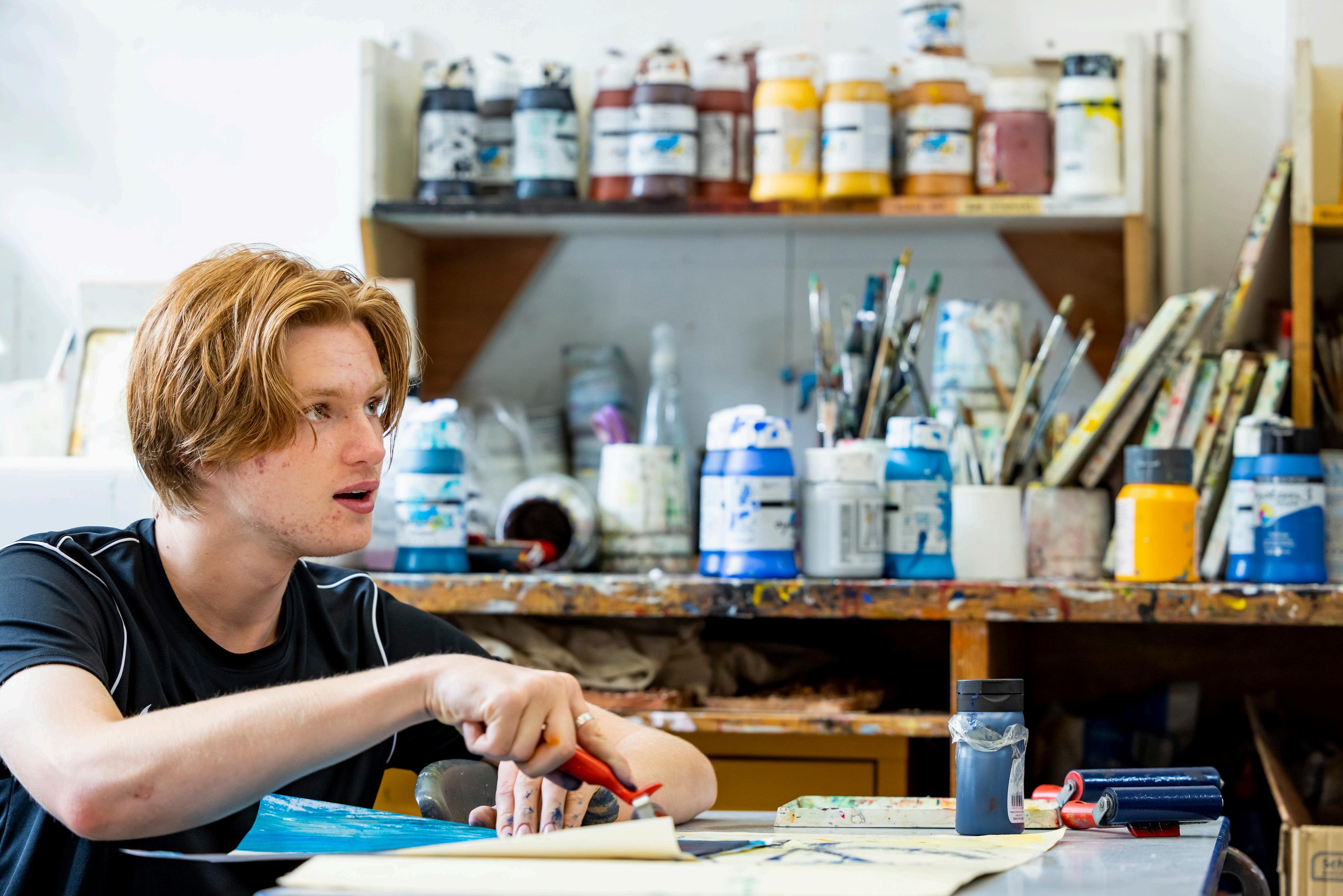
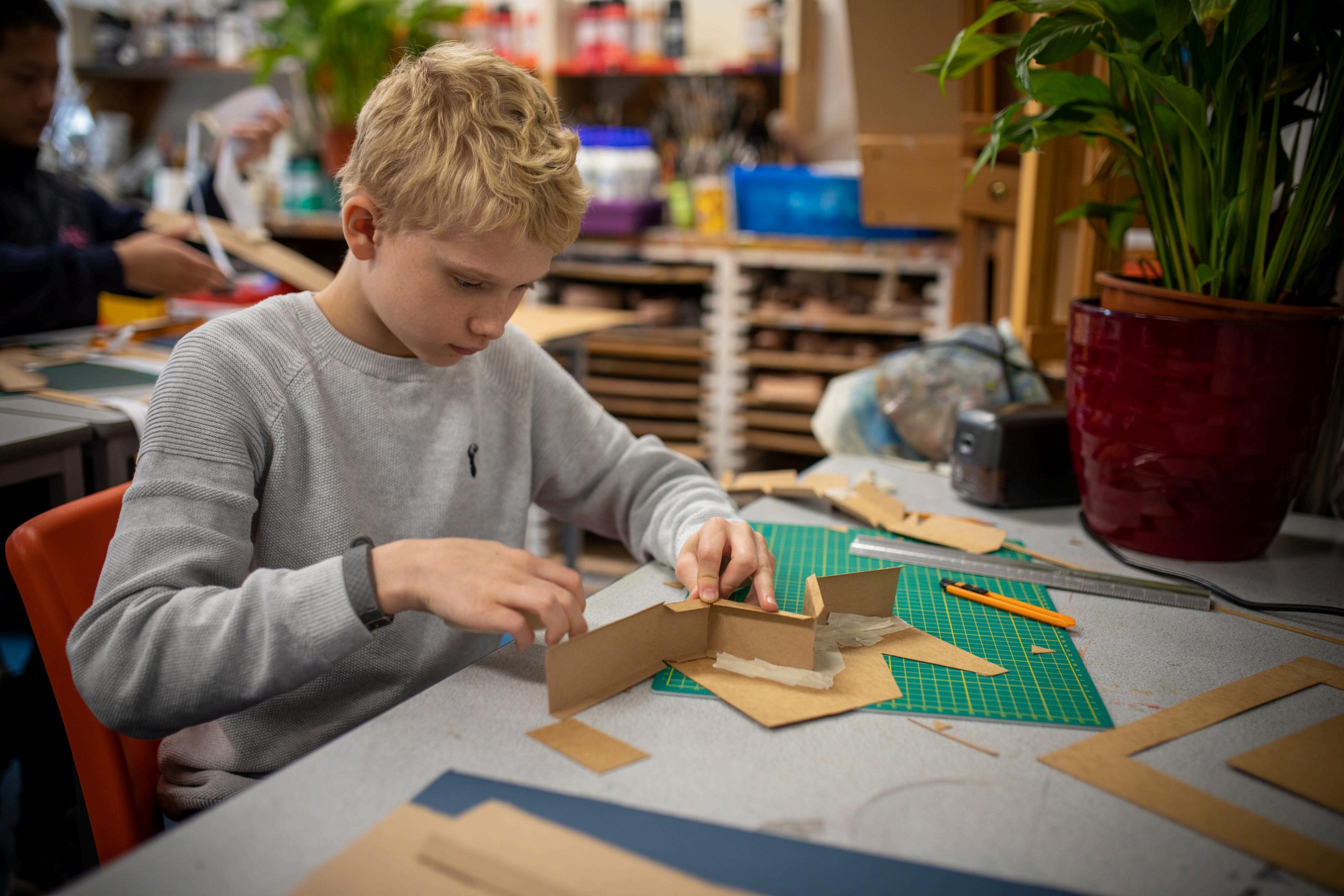
Printing project. This unit teaches techniques to create methods of repeat printing. Inspired by natural plant forms, the artists and designers of the 19th Century Arts and Crafts Movement and modern printmakers Mark Hearld and Angie Lewin, students will create collagraphs, lino cuts and textured surfaces with which to produce a collaborative set structure for the drama production.
How it is assessed
Student work is assessed during the lessons with practical help offered when necessary. Understanding is assessed gradually because students need to build on their previous knowledge, and quick challenges are introduced to check this. Students are also encouraged to self-assess through refining their own work and reflecting on each other's. Their memory and understanding of processes are assessed through write ups which they are asked to document in their sketchbooks at the end of each project.
Term
Autumn 1
What are we studying?
Drawing project. This unit introduces students to key aspects of drawing and covers a range of approaches and styles, exemplified by a broad selection of artists. Each two-week block covers a particular material, style or approach, inspired by a selected artist. Students study line, tone, texture, shape and composition, and consider how the artist’s purpose shapes the style of a drawing. They learn to critique their own and others’ work using subject specific terms.
Autumn 2 Drawing
Architecture and sense of place
Inspired by artists John Piper, Frank Bowling, Sara Flores and Grayson Perry
Spring 1
Looking at how different artists have approached the portrayal of architecture and how the environment reflects atmosphere, narrative or personality. Students explore using paint and are introduced to sculpture.
Spring 2 Continuation of Spring 1
Summer 1
Printing project. This unit teaches techniques to create methods of repeat printing. Inspired by natural plant forms, the artists and designers of the 19th Century Arts and Crafts Movement and modern printmakers Mark Hearld and Angie Lewin, students will create collagraphs, lino cuts and textured surfaces with which to produce a collaborative set structure for the drama production.
Summer 2 Continuation of Summer 1
Computer Science
The syllabus in Year 9 includes materials and concepts recommended by the National Centre for Computing Education (NCCE) for Key Stage 3, as well as GCSE-level topics and resources. The topics are a mixture of theory and practical activities – mainly programming in Python. This ensures the students are prepared for potentially taking the subject at GCSE, as well as building an understanding of the wide scope and complexity of the subject. In the theory periods, gamified learning will also be used to illustrate and embellish the topics to maintain student engagement, and in the more practical sessions, students will be required to maintain a log of their activities, which will form part of their assessment.
How it is assessed
Each half term there will be a mini test on the topics covered that half term. These will take place online during normal lessons. At the end of the year there will be an end of year exam covering all the topics from the whole year. This will be during the school’s assessment week. Throughout the year, each student’s written work - completed entirely in Teams/Class Notebook – will be considered in the assessment of their progress.
Design & Technology
Autumn 1
Spring 1
Core technical principles
New and emerging technologies
Energy generation and storage
Developments in new materials.
Specialist technical principles
Forces and stresses
Ecological and social footprint
Selection of materials and components.
Designing and making principles
Investigation, primary and secondary data
Summer 1
Environmental, social and economic challenges
The work of others
Design strategies
Communication of design ideas.
Autumn 2
Spring 2
Core technical principles
Systems approach when designing Mechanical devices
Materials and their working properties.
Specialist technical principles
Using and working with materials
Surface treatments and finishes
Specialist techniques and processes.
Designing and making principles
Prototype development
Material management
Summer 2
Specialist tools and equipment
Specialist techniques and processes.
This term, students perform an adaptation of Noughts and Crosses on Wednesday 10th June, engaging with a powerful and thought‑provoking story that explores themes of identity, inequality and social change. This challenging piece allows them to develop emotional depth in performance, refine their characterisation skills and work with more serious dramatic material, encouraging maturity, empathy and strong ensemble work.
Following this, students move on to The Curious Incident of the Dog in the Nighttime, where they begin exploring the play’s unique storytelling style, physical theatre elements and innovative use of movement and space. This shift helps students broaden their performance toolkit, experiment with new theatrical techniques and deepen their understanding of character perspective.
How it will be assessed
Creative ideas and contributions throughout the term
A performance of Noughts and Crosses, demonstrating their use of drama skills to convey meaning.
A written evaluation using PEEL paragraphs, analysing the use of performance skills and design elements of ‘The Curious Incident of the Dog in the Nighttime’ to prepare for GCSE Drama.
Autumn 1
Spring 1
‘What’s on the box?’
Acting for television
Audience awareness skills
Understanding use of voice and vocal care
Noughts & Crosses’ Understanding the plot of the play
Exploring themes
Autumn 2
‘What’s on the box?’ Acting for film
Audience awareness skills
Understanding different styles of acting for different genres
‘Noughts & Crosses’ Developing characters
Spring 2
Summer 1
‘Noughts & Crosses’ Learning lines and blocking
Performing to a live audience
Creating characters
Summer 2
Ensemble work
Evaluating their performance
‘Curious Incident of the Dog in the Night-time’
Understanding how theatre is used to present political and societal ideas
Understanding the effectiveness of set, lighting and costume to help an audience’s appreciation of a performance
English
Term
Spring 2
Summer 1
Summer 2
What are we studying?
Romeo and Juliet by William Shakespeare:
In Spring 2, students will complete and cover the second half of the play
The focus of studying this play will be analytical, but we will intersperse some creative writing opportunities for students
The study of this play will provide a strong foundation for the GCSE English Literature study of Macbeth that takes place in Year 10
We will be analysing Shakespeare’s language, structure and form, whilst linking his ideas to the wider Elizabethan context
The key themes we will be looking at are : Love | Fate | Conflict
Poetry
In Summer 1, Year 9 students will study the “Journeys” poetry anthology, exploring how writers present physical, emotional and spiritual journeys across a range of texts and time periods. They will develop their skills in analysing language, understanding context and making clear comparisons between poems, while building a secure knowledge of key themes and quotations.
Narrative, Descriptive and Transactional writing
In this unit, students will develop their descriptive, narrative and transactional writing, learning how to craft engaging and purposeful pieces for a range of audiences. They will build confidence in using precise language, structuring ideas effectively and writing with increasing accuracy and control.
c o n t e n t
S u m m e r
FLAM
Geography
Term
Autumn 1 and 2
What are we studying?
Focus: ‘Is Nigeria a developed country?’
Spring 1 Focus: ‘How important is the Middle East?’
Spring 2 Focus: ‘How dangerous are tectonics?’
Understanding steps in earthquake formation and main types of seismic waves
Comparing Chile and Nepal earthquake impacts and their responses. Evaluating significance of development in the impact of earthquakes. Understanding how tropical storms form, including conditions needed (warm ocean temperatures, low pressure, Coriolis effect).
The structure of a tropical storm (eye, eyewall, spiral rain bands).
Case study of a tropical storm (e.g. Typhoon Haiyan) including causes, impacts and responses.
Summer
Primary and secondary impacts of tropical storms. Immediate and long-term responses to tropical storms. How monitoring, prediction and planning can reduce the impacts of storms. This section looks at how weather hazards affect the UK and how their impacts are managed.
Types of extreme weather in the UK (storms, flooding, heatwaves, snow).
Case study of a UK extreme weather event (e.g. flooding or storms).
Causes and impacts of extreme weather events.
Social, economic and environmental impacts. How the UK prepares for and responds to extreme weather.
The natural greenhouse effect and how it keeps Earth warm.
The enhanced greenhouse effect caused by human activity.
Causes of climate change (burning fossil fuels, deforestation, agriculture).
The spring term will be devoted to a depth study of the First World War.
This summer term explores how political extremism grew after the First World War, with a focus on the ideologies that shaped new regimes Students will study communism in the Soviet Union under Joseph Stalin, fascism in Italy and Spain led by Benito Mussolini and General Franco, and imperial militarism in Japan The course examines key ideas such as dictatorship, propaganda, nationalism, and control, and how leaders used these to gain and maintain power Students will then investigate how these ideologies contributed to rising tensions, leading to the outbreak of the Second World War in 1939 and its global consequences
How it will be assessed
As part of their preparation for Y10, pupils will sit an exam at the end of term that will feature a variety of GCSE-style questions Pupils will have opportunities during the term to become familiarised with these sorts of questions and the marking scheme In addition, pupils will be assessed in variety of different ways throughout the term, including graded group presentations, debates and multiple-choice quizzes
Term
Autumn 1
Autumn 2
Spring 1
Spring 2
Summer 1
Summer 2
What are we studying?
The American Revolution
Start of the French Revolution
Conclusion of the French Revolution
The Russian Revolution
The long and short-term causes of the First World War
Propaganda and recruitment
A study of trench warfare, including conditions, combat and the psychological impacts on soldiers
The reasons for Germany’s surrender in 1918
The Treaty of Versailles and establishment of the League of Nations
The collapse of Tsarism in Russia and establishment of a communist dictatorship
The rise of fascism in Italy and Spain
The development of militant nationalism in Japan
The build up to WWII
The key turning points of WWII
The end of the war and establishment of the United Nations
IIn the Summer term Year 9 will continue Chapter 9 and 10 revising and consolidating the uses of the subjunctive in subordinate clauses, the 4th and 5th declensions, using dum with subjunctive and indicative and using gerundives to express purpose We will also begin reading and studying Aulus Gellius’ Attic Nights as an introduction to Latin GCSE literature
How it will be assessed
Students will be assessed on vocabulary knowledge 25 words per week There will be half termly comprehension and translation tasks to assess their vocabulary and syntactical knowledge
c o n t e n t
S u m m e r
Maths
How it will be assessed
Students will sit a 45-minute written assessment at the end of the term. They will also have continuous assessment through low-stakes mini-tests, so that they can track their progress and what areas of development they might need to work on.
Term
Autumn 1
Autumn 2
Spring 1
Spring 2
Summer 1
Summer 2
What are we studying?
Trigonometry and Pythagoras
Volume and Surface Areas of Cylinders, Cones and Spheres
Proportion including Direct and Inverse Averages and Range
Coordinate Geometry Equations of Lines Inequalities
Probability Trees Revision and Review
S u m m e r c o n t e n t
Philosophy
Autumn 1
Autumn 2
What are we studying?
The aim here is to further their understanding of the construction of an argument, and how to reason and find any truth.
Ideally this unit should help students understand why evidence is needed, why we need to give reasons, why we ask questions and so on in academic writing. We will look at how to build valid and sound arguments, the principles and problems of empiricists and rationalist approaches to knowledge as well as the limits of knowledge.
Justice and Fair Society
The main goal for this unit is to consider what a perfect or just society looks like. What would need to change? Where do they fit in it? What responsibilities do they have toward other people?
The challenge here is to get students to think in a selfless way. There are many groups of people they would need to consider in their theories in order for it to be a good theory. We will look at Social Contract theory, Marxism, Plato’s Republic and ideas of restorative justice for ideas for how to build a fair and just society
Philosophy
Term
War and Philosophy
Spring 1
Spring 2
Summer 1
Summer 2
What are we studying?
In this module we be looking at John Stuart Mill’s theories of Just war (jus ad bellum and jus in bello) then also Thomas Nagel principle of moral luck (lucky to be empathetic vs wanting to hurt others). We will then move to explore the idea’s Hannah Arendt with the banality of evil and Viktor Frankl’s experience of the holocaust of looking - meaning in suffering. We will then finish the module looking at Simone Weil’s principles of non-violence. This is complementary to thier studies from the history curriculum.
Medical Ethics
This module an exploration into medical ethics from a human rights perspective to answer some of the most challenging questions being debated in the 21st century. Looking and philosophical discussions on the ethics of abortion, euthanasia and organ donation. We will end the module exploring Yuval Noah Harari’s Homo Deus looking at the ethics of biomedical and biomechanical enhancement as a possible future path for humanity.
Free will and determinism
Choice vs free will Scientific evidence (for + against)
Soft vs hard determinism?
Are we morally responsible?
Identity: Who am I?
Psychological Continuity Theory (Locke): Identity is based on consciousness and memory; you are the same person as long as your consciousness (memory, thoughts, personality) extends back to past actions/experiences.
Skepticism (Hume): Argues there's no permanent, unified self; we are just bundles of fleeting perceptions, so true persistence is an illusion
Social Identity Theory (Sociology/Social Psychology): How group membership influences self-concept and behaviour.
Creators: Henri Tajfel & John Turner (1970s-80s).
Key Idea: We categorize ourselves and others into groups (in-groups/outgroups) to boost self-esteem.
Identity Theory of Truth (Philosophy of Language/Metaphysics): True statements (propositions) are identical to facts in the world.
Significance: Bridges language and reality
Physical Education
In the summer term, Year 9 students will participate in off-site lessons at the Elmbridge Xcel Leisure Complex and Weir Archer Athletics Centre. The program aims to prepare them for the house competition of sports day at the end of June. The lessons will cover various athletic events, including sprints, relays, shot put, discus, javelin, long jump, triple jump, and high jump. An emphasis will be placed on personal growth, team support, resilience, and sportsmanship in line with the values of Hampton Court House.
How it will be assessed
Speed and Sprinting: Analysis of acceleration, peak speed, and pace maintenance in short sprints.
Endurance and Stamina: Evaluation of sustained pacing over longer distances and overall cardiovascular health.
Strength and Power: Assessment of muscular strength and explosive power in events such as shot put, discus, and jumping.
Technique and Form: Evaluation of posture, stride, and efficiency in running, jumping, or throwing to enhance performance and prevent injuries.
PSHE
Science
Chemistry
Biology
As we approach the final term of the academic year, Year 9 students will be studying Units 3 and 5 from Viva 3, focusing on healthy lifestyles and travel experiences, as well and reinforcement the important grammar points learnt over the year, getting prepared to the GCSE content.
Unit 4: Young people in actions
In this unit, students will explore how to express ideas about the wider world. Topics include children’s rights, fair trade, the environment, and the importance of fundraising events. In terms of grammar, students will consolidate their use of the three main tenses (present, past, and future), while also being introduced to more advanced structures such as sedebería (one should…). By the end of the unit, students will be able to express and justify their own opinions on issues that go beyond their immediate personal experience. This represents a greater challenge, as it requires them to use language in a broader and more abstract context.
Unit 5: A trip to Madrid and Genera revision
This unit will equip students with essential language skills for travel, allowing them to describe past and future holidays using the preterit and future tenses. They will practice real-life interactions such as ordering food, shopping for souvenirs, and asking for directions, engaging in role-plays to simulate tourist scenarios. By the end of the unit, they will be able to navigate common situations abroad with greater fluency and confidence.
How it will be assessed
In addition to having a regular vocabulary test, and end of unit exams, students will have an End of Year exam that will include listening, reading, translation, and writing exercises related to all the topics and grammar aspects covered over the academic year.
Term
Autumn 1
Autumn 2
What are we studying?
“Somos así” (That’s who we are)
Talking about things they like
Talking about hobbies and pastimes activities
Using three tenses together
Talking about movies genres
Talking about celebrities
Things you did recently ( Past – perfect)
Things you are planning to do soon ( both future tenses).
“Los trabajos” (Jobs)
Talking about different jobs and different duties
Talking about their future aspirations
Thinking what they would like and wouldn’t like to do according to their personality and personal interest
Talk about a typical day on their life and someone else’s A film you watched, a concert you attended (Past).
Spanish
Term
Spring 1
Spring 2
“En forma” (in shape)
Summer 1
Summer 2
What are we studying?
Talk about different types of food and their benefits or drawbacks on a healthy diet
Talk about healthy or unhealthy habits, including expressions like, de debe (one must)
Talking about what it hurts and if they feel ill or good
Talk about daily routines with the use of reflexive verbs
Revising how to say the time in Spanish
“Jóvenes en acción” (Young people in action)
Learn vocabulary related to global issues such as children’s rights, fair trade, and the environment
Talk about ways young people can help others, including fundraising and volunteering
Practise using present, past, and future tenses to discuss different topics
Give and justify opinions about wider world issues using more advanced structures
“Una aventura en Madrid” (An adventure in Madrid)
Learn key vocabulary for travel, including holidays, food, shopping, and directions
Practise talking about past and future trips using the preterit and future tenses
Take part in role-plays to handle real-life situations such as ordering food and asking for directions
Build confidence in communicating in common travel scenarios abroad
Revision of the material for the end of year exam
Movie analysis: Ferdinand To discuss about the one of the most famous traditions and the controversy of it, to discuss until what point tradition should be maintained