

Louis Scott, Digital Marketing and e-commerce Manager, Dukes Plus, explores the history and significance of braille
It was the late summer of 1771 when the 25-yearold interpreter, Valentin Haüy, stopped for lunch in the Place de la Concorde in central Paris. The annual Saint-Ovide Fair was in full swing in the square and among the attractions, Haüy would have witnessed traders selling food and trinkets, a billiards hall, and even an exhibition of circus animals. But his attention was drawn by one raucous entertainment in particular. Approaching, he saw that a crowd was gathered around a stage on which were arranged a peculiar-looking orchestra. Dressed in dunce caps and oversized cardboard glasses, the players were sawing, striking, and blowing apparently at random at their instruments, out of tune and out of time, and the result was a cacophony that provoked
the laughter and jeers of their audience. It was not until he pushed to the front of the crowd that Haüy got the joke: everyone in the orchestra was blind. All residents of the nearby Quinze-Vingts hospice for the blind, the ensemble had been publicly humiliated for the amusement of the fairgoers.
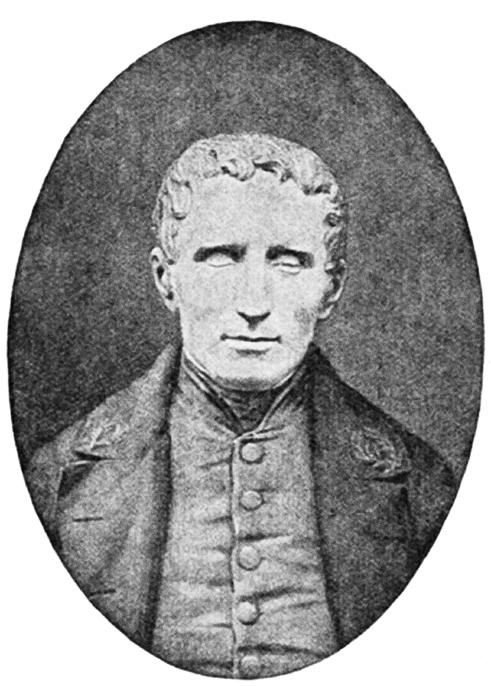
More than forty years later, in a village some 20 miles outside Paris, the three-yearold son of Simon-René Braille, a leather worker, was playing in his father’s workshop. The toddler, Louis, was piercing holes in a piece of leather with an awl when the tool slipped and he stabbed himself in the eye. Despite being rushed to a surgeon in the capital, the wound could not be healed, and by the age of five, Louis Braille was blind in both eyes.
Louis’ evident intelligence, coupled with his parents’ desire to afford their son the best life chances possible, meant that they made considerable efforts, unusual for the time, to educate him. In 1819, at the age of 10, he was enrolled in the National Institute for Blind Youth in Paris — the world’s first such school, founded in 1785 by Valentin Haüy. So appalled had Haüy been by the spectacle he had seen at the Saint-Ovide Fair that he had dedicated his life to educating blind children.
Haüy had realised that blind people could learn to read embossed text by tracing the shapes of the raised letters with their fingers; as such, Braille and the Institute’s other pupils had access to textbooks which provided them with unprecedented educational opportunities. Nonetheless, Haüy’s embossed print was flawed: some letters, like capital Cs and Gs, were hard to distinguish, while the books themselves required specialist equipment to print and were very expensive. Haüy could supply a small selection of books inside the Institute, but they were unavailable outside of it, meaning that his pupils’ ability to read would become useless when they graduated. Furthermore, it was impossible for blind people to write in embossed lettering themselves, so they remained excluded from any profession that required literacy. The school’s aim was therefore to provide a basic education and fit its pupils for work in manual trades, like shoemaking.
‘Embossed print was reinstated by the Institute’s new director, Pierre-Armand Dufau, who, believing that blind people should use the same reading systems as sighted people, banned the use of braille in 1840’
In 1821, a former artilleryman in Napoleon’s army called Charles Barbier came to demonstrate a striking new invention at the school. Barbier had formulated a code, known as ‘night writing’, which he believed would improve on embossed text. It consisted of a two-by-six cell of raised dots, with different combinations of dots representing individual sounds and letters. Although it was easier to print and read than embossed text, and even possible to write with a pocket-sized board and stamp, the young Braille quickly perceived that night writing had its own imperfections. Barbier had not tested his invention on blind readers, and his large 12-dot cell could not be read at one touch of a fingertip.
While still at school, the 12-year-old Braille began refining Barbier’s system. As he later wrote, ‘If we have pointed out the advantages of our method over his, we must say in his honour that his method gave us the first idea of our own.’ Working through the night after classes and in the school holidays, he completed an early version of what we know today as braille by the time he was 15. His code used cells of just six dots, making it far quicker to read, especially for children’s fingers, and also added capital letters, punctuation, mathematical notation, and — eventually — musical notation. Anyone literate in braille could learn to read and write music, saving them from the public humiliation suffered by the Quinze-Vingts orchestra
more than fifty years earlier.
Braille continued finetuning his system throughout the 1820s and 1830s, but he did not live to see its international adoption. In his lifetime, he faced internal opposition from the Institute where he studied as a pupil and later worked as a teacher. Embossed print was reinstated by the Institute’s new director, Pierre-Armand Dufau, who, believing that blind people should use the same reading systems as sighted people, banned the use of braille in 1840. Some students continued to learn it in secret, and those who were caught were punished and their braille books burned. It was only reintroduced in 1844 after Joseph Gaudet, the deputy director, staged a demonstration in which two blind pupils successfully took dictation and read a passage aloud using braille.
Wider recognition remained scarce, however. When Braille died of tuberculosis in 1852, not a single newspaper carried a death notice. The major turning point came in 1878, when a global congress for deaf and blind people hosted in Paris, proposed an international braille standard. Braille was officially adopted by English speakers in 1932, and efforts by UNESCO after the Second World War led to its growth in India, Africa, and the Middle East.
Now, however, braille is imperilled once more. In the US, braille literacy rates for school-age blind children have fallen from more than 50% 40 years ago to under 20%
today. In the UK, meanwhile, only 7% of blind people are literate in braille. This decline is attributable to a variety of causes: a shortage of braille teachers, the rise of screen readers and audio books, and, in the US at least, a policy of mainstreaming blind children into public schools where little, if any, time and resources are available for teaching braille.
Given the widespread availability of audio alternatives, one may wonder whether this is a problem. But as one teacher of the visually impaired has asked, ‘If the literacy rate among sighted people’ were this low, ‘would that be acceptable?’
Studies show that there are neurological benefits to reading and writing in braille, while there appear to be economic advantages, too. In the United States, only 30% of blind adults are employed, but for braille-readers, that figure is 85%. The same combination of factors that led Braille to depart from embossed print still speak for his system today: a broader range of economic opportunities for the literate, the freedom of self-expression which comes with the ability to write as well as to read, and the academic and cognitive benefits of genuine literacy. More than two hundred years after this remarkable teenager’s invention, the value of reading for all should not be forgotten. ■

‘In the UK, meanwhile, only 7% of blind people are literate in braille. If the literacy rate among sighted people were this low, would that be acceptable?’