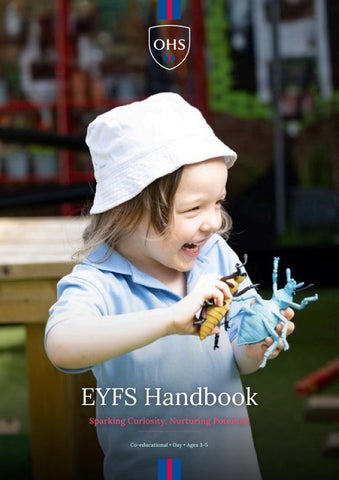
EYFS Handbook Sparking Curiosity, Nurturing Potential Co-educational • Day • Ages 3-5
2
The EYFS Framework There are seven areas of learning and development that shape our educational programme. All areas of learning and development are important and inter-connected. Three areas are particularly important for building a foundation for igniting children’s curiosity and enthusiasm for learning, forming relationships and thriving.
These are the prime specific areas: Communication and language
Physical development
Personal, social and emotional development
We also support children in the four specific areas of learning, through which the three prime areas are strengthened and applied.
The specific areas are:
Literacy
Mathematics
Understanding
Expressive arts
the world
and design
At Orchard House School the children in the Early Years benefit from a continuous provision in the outdoor environment. Children’s learning is extended daily in our outdoor area and children enjoy daily outdoor activities throughout the academic year. Exploratory play is encouraged in the outdoor area throughout the day. Children in the Early Years also benefit from many aspects of the Montessori curriculum and philosophy at Orchard House School. For more information about the Early Years curriculum please follow this link www.gov.uk/government/publications/early-years-foundation
The ethos of Orchard House underpins the aims of our school and runs through every aspect of school life. In the course of their daily work, all members of the school community contribute to the development of this ethos by: • Providing a child-centred, forward-looking educational philosophy • Treating each child as an individual and nurturing their own individuality • Valuing all members of the school and wider community equally, showing mutual respect and concern for others • The provision of a friendly and welcoming environment, in which courtesy, kindness, respect and teamwork are fostered • Valuing and celebrating success and achievement, in all spheres • Cultivating a culture to help instil resilience and perseverance
EARLY YEARS FOUNDATION STAGE HANDBOOK
3
4
Introduction Our Early Years curriculum ensures that your child’s academic potential is fulfilled but we go well beyond this; we inspire, motivate, nurture and care so that you know your child will have the opportunity to grow and prosper in an engaging, vibrant and supportive learning environment. We ensure that each child receives the quality time and attention required each day to build confidence and self esteem; which in turn will allow your child to develop his or her own curiosity and interest in learning and discovery. Our spacious and innovative centre for early years, provides a safe and dynamic home to our Nursery and Reception classes. The bright and colourful centres are perfectly equipped to offer stimulation for both physical and academic development with spacious classrooms, Priory House library and outdoor play areas on site. The play areas are enjoyed by the children on a daily basis providing space to learn and play together. They are introduced to the world of music and Eurhythmics by our specialist teachers in the Performing Arts Centre at the Church and will have the opportunity to be involved in a music and drama performance every year to their parents. Our new Science & Technology centre will enable the children to be introduced to scientific concepts in our purposebuilt science laboratory. The children are introduced to the world of coding and tech using the most up-to-date resources.
EARLY YEARS FOUNDATION STAGE HANDBOOK
5
Values and Ethos in EYFS At Orchard House we strive to ensure all children within our settings feel safe, happy and valued. We know that young children develop rapidly during these early years physically, intellectually, emotionally and socially. The school operates an open door policy, valuing close relationships between school and home. In our EYFS setting we aim for all pupils to be happy and fulfilled. For each child to reach his or her potential across all areas of the curriculum, thereby becoming confident, creative and independent learners. We ensure teaching is supportive yet challenging, always taking into account the individual needs of each child. We aim for the children to develop self respect along with a strong sense of moral values, so they can grow into responsible and involved members of society. Orchard House school harnesses an ethos that shows mutual respect and concern for all members of the school community and one which fosters close relationships between its pupils and staff alike.
Orchard House Values: Honesty
Excellence
Kindness
With unrivalled staff, excellent facilities and top-quality extra curricular provision, we offer endless opportunities for children to discover where they excel. Our pupils have ambitious goals and high hopes for their futures. Our culture of excellence offers the best
Honesty is our guiding principle. With it, we build respectful and genuine relationships. We learn to trust and be trusted by others. Honesty creates a culture where children are encouraged to be themselves. It also means taking responsibility for mistakes and learning from
We believe kindness bears fruit; that a less self-centred mindset leads to greater and wider success. At Orchard House School, kindness is our pupils’ strength. It is active, purposeful and robust. Kindness means courage; standing up when others shy away. And by showing
possible preparation extraordinary life.
them. It builds resilience and character, making sure our pupils are ready for the opportunities and challenges that lie ahead.
kindness we prepare children to become the considerate and courageous leaders of tomorrow.
for
an
6
The EYFS Framework At Orchard House School we follow the statutory Early Years Foundation Stage framework, which, aims to provide: quality and consistency in all early years settings, so that every child makes good progress and no child gets left behind a secure foundation through planning for the learning and development of each individual child, and assessing and reviewing what they have learned regularly partnership working between practitioners and with parents and/or carers equality of opportunity and anti-discriminatory practice, ensuring that every child is included and supported
The EYFS specifies requirements for learning and development and for safeguarding children and promoting their welfare. The learning and development requirements cover: the areas of learning and development which must shape activities and experiences (educational programmes) for children in all early years settings the Early Years planning supports children to work towards (the knowledge, skills and understanding they should have at the end of the academic year in which they turn five) assessment arrangements for measuring progress (and requirements for reporting to parents and/or carers)
Personal, Social and Emotional
Communication and Language
Development
The development of children’s spoken language
Children’s
personal,
social
and
emotional
development (PSED) is crucial for children to lead healthy and happy lives, and is fundamental to their cognitive
development.
Underpinning
personal
development
are
the
their
important
underpins
all
seven
development.
areas
of
Children’s
learning
and
back-and-forth
interactions from an early age form the foundations for
language
and
cognitive
development.
The
number and quality of the conversations they have
attachments that shape their social world.
with adults and peers throughout the day in a
Strong, warm and supportive relationships with
commenting on what children are interested in or
adults enable children to learn how to understand their own feelings and those of others, as well as to self-regulate. Children should be supported to manage emotions, develop a positive sense of self, set themselves simple goals, have confidence in their own abilities, to persist and wait for what they want and direct attention as necessary. Through adult modelling and guidance, they will learn how to look after their bodies, including healthy eating,
language-rich
environment
is
crucial.
By
doing, and echoing back what they say with new vocabulary added, practitioners will build children’s language effectively. Reading frequently to children, and engaging them actively in stories, non-fiction, rhymes and poems, and
then
providing
them
with
extensive
opportunities to use and embed new words in a range of contexts, will give children the opportunity
and manage personal needs independently.
to thrive. Through conversation, story-telling and
Through supported interaction with other children,
support and modelling from their teacher, and
they learn how to make good friendships, cooperate and resolve conflicts peaceably. These attributes will provide a secure platform from which children can achieve at school and in later life.
role play, where children share their ideas with sensitive questioning that invites them to elaborate, children become comfortable using a rich range of vocabulary and language structures.
EARLY YEARS FOUNDATION STAGE HANDBOOK
7
8
Physical Development
Mathematics
Physical activity is vital in children’s all-round
Developing a strong grounding in number is
development, enabling them to pursue happy,
essential so that all children develop the necessary
healthy and active lives. Gross and fine motor
building blocks to excel mathematically. Children
experiences
throughout
should be able to count confidently, develop a
early childhood, starting with sensory explorations
develop
deep understanding of the numbers to 10, the
and the development of a child’s strength, co-
relationships between them and the patterns
ordination
through
within those numbers. By providing frequent and
tummy time, crawling and play movement with both
varied opportunities to build and apply this
objects and adults. By creating games and providing
understanding - such as using manipulatives,
opportunities for play both indoors and outdoors,
including small pebbles and tens frames for
adults can support children to develop their core
organising counting - children will develop a
strength, stability, balance, spatial awareness, co-
secure base of knowledge and vocabulary from
ordination and agility. Gross motor skills provide
which mastery of mathematics is built. In addition,
the foundation for developing healthy bodies and
it is important that the curriculum includes rich
social and emotional well-being. Fine motor control
opportunities for children to develop their spatial
and precision helps with hand-eye co-ordination,
reasoning skills across all areas of mathematics
which is later linked to early literacy. Repeated and
including
varied opportunities to explore and play with small
important that children develop positive attitudes
world activities, puzzles, arts and crafts and the
and interests in mathematics, look for patterns
practice of using small tools, with feedback and
and relationships, spot connections, ‘have a go’,
support from adults, allow children to develop
talk to adults and peers about what they notice
proficiency, control and confidence.
and not be afraid to make mistakes.
and
incrementally
positional
awareness
Literacy of reading. Reading consists of two dimensions: language
comprehension
and
Language
comprehension
(necessary
word
reading. for
both
reading and writing) starts from birth. It only develops when adults talk with children about the world around them and the books (stories and nonfiction) they read with them, and enjoy rhymes, poems and songs together. Skilled word reading, taught later, involves both the speedy working out of the pronunciation of unfamiliar printed words (decoding) and the speedy recognition of familiar words.
Writing
(spelling
and
handwriting)
involves and
transcription composition
(articulating ideas and structuring them in speech, before writing.
space
and
measures.
It
is
Expressive Arts and Design
It is crucial for children to develop a life-long love
printed
shape,
The
development
of
children’s
artistic
and
cultural awareness supports their imagination and creativity. It is important that children have regular opportunities to engage with the arts, enabling them to explore and play with a wide range of media and materials. The quality and variety of what children see, hear and participate in is crucial for developing their understanding, self-expression,
vocabulary
and
ability
to
communicate through the arts. The frequency, repetition and depth of their experiences are fundamental to their progress in interpreting and appreciating what they hear, respond to and observe.
Understanding the World Understanding the world involves guiding children to make sense of their physical world and their community. The frequency and range of children’s personal experiences increases their knowledge and sense of the world around them – from visiting parks, libraries
and
museums
to
meeting
important
members of society such as police officers, nurses and firefighters. In addition, listening to a broad selection of stories, non-fiction, rhymes and poems will foster their understanding of our culturally, socially, technologically and ecologically diverse world. As well as building important knowledge, this extends their familiarity with words that support understanding
across
domains.
Enriching
and
widening children’s vocabulary will support later reading comprehension.
EARLY YEARS FOUNDATION STAGE HANDBOOK
9
10
School day Nursery and Reception (EYFS)
At the start of each day, children in the Nursery and Reception work with a combination of Montessori apparatus and other specialist Early Years resources to develop their basic skills. Whether classroom based or in the tailored outdoor environment, pupils consistently spend time in the morning and afternoon aquiring and developing new skills such as language, communication, physical, creativity, literacy and mathematics. During the week they will also have topic-based lessons and activities including PE, music, computing, Eurhythmics and French. On several occasions each week the children in Nursery and Reception have phonics lessons to develop early reading and writing skills. Each day of the week differs as we have many specialist teachers who come in to take lessons throughout the day. During morning break time, each Reception class is taken into the playground under the supervision of our teaching staff. In the afternoons, the timetable for Reception is less structured, and the children enjoy outdoor learning, science activities and physical and creative activities. Nursery children benefit from free flow between the indoor environment and outdoor provision, with the Nursery timetable becoming gradually more structured every term in preparation for Reception class.
Outdoor Learning We place a lot of value on outdoor learning and feel strongly that it is a crucial element to our young children’s learning and development. This belief is why we ensure, whenever possible, that our pupils have access to outdoor areas every day both in the morning and afternoon.
Assessment/Early Years Foundation Stage Profiles At Orchard House, we observe the progress your child is making, assessing each pupil’s development in relation to the EYFS developmental learning intentions and goals that form part of the statutory guidance for the foundation stage. These assessments, (called profiles), are made based on our accumulated observations, ongoing informal assessment and in-depth knowledge of your child. To gather a full picture of your child we invite parents to contribute to our assessment via the online learning profiles. Contributions could include writing their name, being kind or helping at home; however small we want to know about it. This gives us an opportunity to have discussions with your child, celebrating various achievements or moments which are special to them both at school and home.
11
12
Welfare Requirements The staff
Contacts
Head of EYFS: Miss Rosamund Brown
School email: info@orchardhs.org.uk School phone number: 020 8742 8544
Head of Nursery: Mrs Mercedes Remuinan Reception: Miss Argyro Fornaridou Reception: Mrs Anna Tajeddin Designated Safeguarding Lead: Mr Ciarán McAuley Deputy Designated Safeguarding Leads: Miss Rosamund Brown and Mrs Mercedes Remuinan SENDCO: Mrs Mercedes Remuinan (Nursery) & Mrs Sarah Chung (Reception)
All staff attend regular training days and INSET sessions to keep updated. The Head of EYFS and Head of Nursery attend regular cluster meetings, conferences and training sessions with Little Dukes colleagues. All staff are trained in Paediatric First Aid.
EARLY YEARS FOUNDATION STAGE HANDBOOK
13
14
Promoting Positive Behaviour in EYFS At Orchard House we have high expectations of children’s behaviour and we follow our Orchard House values throughout the day. Kindness and respect towards each other is expected at all times. In the Early Years we understand children are going through many developmental and neurological changes including sensitive periods and developing their individual interpersonal skills. We pride ourselves on helping children to become confident and kind members of the class with strong communication skills. We believe that positive reinforcement works best at this young age and clear communication and expectations help children to work through any low level issues that may arise.
Housekeeping We use the Montessori ‘Peace Rose Table’’ to help children overcome low level conflict in a peaceful and purposeful manner. Children can also talk about their feelings at the ‘Peace Rose Table’. Form teachers may wish to use specific charts or resources to support the whole class or individuals with behaviour choices and celebrate their successes. We have a wide range of resources in the classroom environment to help children develop strong social communication skills. EYFS children take part in regular PSED sessions to explore a range of topics such as sharing, taking turns, kindness and emotions.
Reporting to Parents Parents will be invited to attend a meeting with the key teacher in the Nursery and class teacher in Reception classes in the autumn and spring terms. A full school report will be sent home at the end of the summer term.
Keeping In Touch It is the school’s intention that parents should enjoy at all times completely satisfactory communication with the school. If you wish to contact the school or send a message to any of the staff by email please use the school email address: info@orchardhs.org.uk This will ensure your message is seen and dealt with quickly. Please do not use the individual address of any staff, as if they are away from school for any reason your message will not be seen.
Staying Healthy Snack and lunchtime Snack time in the morning will be provided by the school. Children will enjoy choosing their morning snack from a fresh fruit platter. The children will require a water bottle from home which will be kept in school and sent home every day to be cleaned. A nutritious and healthy lunch will be served daily (please note that only Nursery pupils who are in for the full day will have lunch at the school). Please do inform us if your child has any special dietary needs. Children will learn about healthy eating, oral hygiene and staying fit in school.
Medicines, Infectious Diseases, Injuries The school must be informed if your child is suffering from an infectious disease such as COVID-19, chicken pox, conjunctivitis, measles, mumps, scarlet fever. Children should not be sent to school if they are infectious and advice should be sought from your GP about when it is safe for your child to return. If the headteacher has any concerns about a child being fit to return they may ask for a letter from the child’s doctor. Should your child require medication to be administered throughout the day, a medical must be completed and handed to your child’s teacher. These forms are also available for parents to download on the schools portal.
EARLY YEARS FOUNDATION STAGE HANDBOOK
15
16
When a child becomes ill at school, the school secretary will contact his or her parents and request that their Should be collected from school as soon as possible. Children who have been absent due to illness, particularly sickness or an upset stomach, should not return to school until the child has been clear of any symptoms for 48 hours. If this is not the case, the office should be informed. If your child has an injury such as a broken bone please contact the school office, who will prepare a risk assessment to be agreed before your child returns to school If any changes occur to your personal or emergency contact details please let us know immediately. It may be necessary for the school to contact you urgently if your child is ill or has had an accident. For this purpose, it is essential that parents advise the school at the beginning of the academic year with the emergency contact details. However, we rely on parents to notify us if their details change e.g moving house or changing employer. Please remember to let us know if your details change during the course of the year. Parents will also be asked to nominate at least one e-mail address, which should be checked on a daily basis, to which e-circulars may be sent. Communications are also sent in this way from the Parents’ Association’s class representatives to their classes.
Settling In New Children All new EYFS children (Nursery and Reception) will be invited into school for a Tea Party to meet their new teacher and peers in the summer term. The Head of EYFS and Head of Nursery will contact children’s previous Nurseries to visit children and discuss the transition into Orchard House School. Children joining Reception are also invited into school for a moving up day at the end of the summer term in preparation for September.
Morning and Afternoon/Pick up and drop off Children are expected to arrive at and depart from school on time.
Form
Arrival
Registration
Departure
Nursery
8:30am via side gate on Rupert Road
9am
12 noon or 3.30pm via Rupert Road playground
Reception
8:30am via front door on Bath Road
9am
3.30pm via Rupert Road playground
All children based in the Nursery or Reception should arrive at the side gate on Rupert Road between the times shown above. Parents who come to the Rupert Road building by car should park in Rupert Road or in a nearby residential road – not on Bath Road. A member of staff will be in attendance at the gate at arrival and departure times. There are CCTV cameras at both entrances at Rupert Road to aid security.
EARLY YEARS FOUNDATION STAGE HANDBOOK
17
18
Inclusion and Equality All children, parents and carers are valued whatever their race, gender, creed or area of residence. We enjoy taking paart in multi-cultural festivals and have toys and books readily available to promote positive values and behaviour, and to discourage sexist and racist attitudes. A full copy of the Equal Opportunities Policy is available on request.
Message Book Please use the message book provided for any changes in home time arrangements and other informal communications. We are unable to allow your child to go home with anyone else unless we have written confirmation or, in emergencies, a telephone call or email to the school office. If you would like your child to stay for an afternoon, please let us know via the message book. Teachers are available only for a very quick word in the mornings. Parents wishing to speak with staff should telephone or email the office to arrange a time that is mutually convenient. Circulars are posted on our website and an email with the circular attached will be sent to parents at whatever addresses they may have nominated for the purpose.
Uniform/ labelling Children are expected to wear the correct school uniform at all times. All items of uniform must be clearly named. Children in the Nursery should wear their navy blue nursery jumper or nursery polo shirt (available from School Blazer) and navy bottoms or skirt. No belts or accessories at school please and we recommend children wear sensible footwear everyday ideally without shoelaces. Parents should ensure that there are strong loops inside the collar on rain jackets and coats so that they can be hung securely from the child’s peg. Depending onhildren in Reception class should wear their coat to school every day. They should return home in the same outerwear that they went to school in. A lightweight navy rain jacket should be kept in school. Navy blue gloves, scarves and the optional woollen ‘beanie’ may be worn in cold weather.
For every PE and Games lesson, or after school sports club, every child must wear the correct PE kit and water bottle. Warm clothing should be worn in cold weather. Second-hand uniform sales are held, usually in the autumn, spring and summer terms. Parents are notified well in advance of these sales, which are organised by the Parents’ Association. Please ensure that all items of clothing, including shoes, are labelled clearly.
Uniform The school uniform supplier is: Schoolblazer All orders should be placed online via the schoolblazer website: www.schoolblazer.com
Nursery Nursery students are to wear the same uniform year round. Navy bottoms or shorts either from home or OHS branded. These are to be paired with the pale blue OHS polo shirt and navy and red OHS Jumper.
OHS navy rain coat
OHS navy sweatshirt with red trim
OHS sky blue pique polo shirt
Navy joggers
Navy shorts
A full uniform list can be found on the school website. Please refer to the OHS Parent Handbook and Essential Information document emailed to all parents for further information.
EARLY YEARS FOUNDATION STAGE HANDBOOK
19
Sparking Curiosity, Nurturing Potential Orchard House School Priory House, Priory Avenue, London, W4 1TX
Part of the Dukes Education family. Together we’re extraordinary.