VOICES
SPRING 2018 · VOL 7, ISSUE 2
SPECIAL ISSUE
a literary journal SITES.DUKE.EDU/VOICES
Diversity in Race and Gender
VOICES letter from the editors
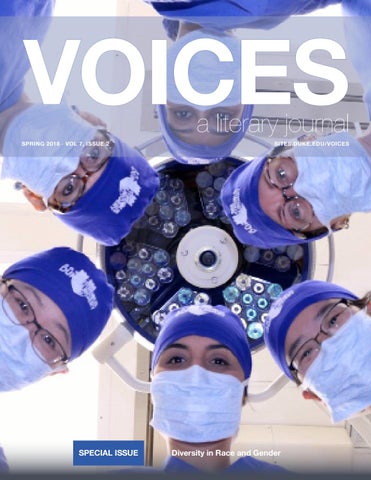
Over the past few years, Voices has grown tremendously from a newsletter to the literary magazine that it is today. As we continue to grow, we are constantly looking for new ways to improve and achieve more. This issue illustrates part of that development as we launch our biggest issue to-date with the first themed publication focusing in on the conversation surrounding diversity in gender and race. The progress towards true equality and diversity is long and arduous, filled with national movements and personal realizations. The outpour that followed the #metoo and #ilooklikeasurgeon trends garnered worldwide attention to moments like our cover photograph, and shined a brighter spotlight on the smaller, seemingly insignificant moments that fill the lives of ordinary people. It examines and brings into focus moments of immense clarity and questionable microaggressions, like what Maureen Cullins, the co-director of the Duke multicultural center, describes in her piece about unwittingly insensitive napkins and holiday cards. What may be small and insignificant to one, may be the very foundation of an antagonistic culture. After all, as Viriginia Woolf once observed, “It’s not catastrophes, murders, deaths, diseases, that age and kill us; it’s the way people look and laugh, and run up the steps of omnibuses.” It is sometimes the small things that matter the most. Jasmine Chigbu recounts her effort to change the cultural schisms between patients and providers, and Dr. Ray Barfield describes efforts by physicians at Duke to appreciate the keepers of the hospital who contribute to the amorphous aspects of healing. As we continually try to shift the culture around us, the director of Duke Admissions Office, Andrea Liu, reminds us to most importantly to be our genuine selves, to follow our passions. After all, we are always reminded of our responsibilities in the healthcare system, as Vinayak Venkataraman and Charmaine Mutucumarana describe their experiences as a first year intern and fourth year medical student, respectively, and the commitment we hold to our patients. From the patients’ perspective, Linda Matern recounts her journey from diagnosis to treatment for melanoma. And Sachi Oshima describes her patient’s experience with the potential supernatural, then reexamines her own reaction to her patients’ story. We also have to find a balance between our professional and personal lives, as Amy Petty notes in her essay on the various concerns that one must calculate into a fulfilling career as a female physician-scientist. We grow throughout our careers in medicine starting as the “ugly duckling” that Dillon Stull describes in his poem. Rachel Ballantyne Draelos reminds us to look towards both the deepest and highest points of Earth, and follow our truest intuitions. As we read through this issue of Voices, we are continually awed by the diversity of Voices in our community. All publications are published online at sites.duke. edu/voices. We are always looking to expand for editors and writers; if you would like to join the Voices team, please email us at dukemedvoices@gmail.com. With lots of thought and warm wishes, Rui Dai, S. Tammy Hsu, and Ashley Adams
table of contents Letter From the Editors 2
Rui Dai, S. Tammy Hsu, and Ashley Adams
Balance Amy Petty 4 Minorities to Majorities
Jasmine N Chigbu
4-5
Journey Through Cancer Linda Matern 6 When You Label Me Anonymous 7 First Night On Vinayak Venkataraman 8-9 Keeping House and Other Small Gifts Ray Barfield, MD 10-11 Flags at Half-Staff Charmaine Mutucumarana 12-13 The Ugly Duckling Dillon Stull 14 What is Your Passion Andrea Liu 14-15 How can I take in Mariana to Everest Rachel Ballantyne Draelos 18 Visits Sachi Oshima 17-18 Holiday Cards Maureen Cullins 19-20 Thao Nguyen Zachary Smothers Samuel Hofacker Shan McBurney-Lin Karishma Sriram
MS1 MS1 MS2 MS2 MS2
associate editors
Gireesh Reddy MS3 Madelyn Stevens MS4 Bilal Ashraf MS4 Teresa Meng UNDERGRAD
faculty editors
Raymond Barfield MD, PhD Karen Jooste MD
BACKGROUND PHOTOGRAPHY CREDITS: COVER: Clockwise from center: Avni Finn, MD, Cynthia Toth, MD, Xi Chen, MD, PhD, Lejla Vajzovic, MD, Wenlan Zhang, MD, Sharon Fekrat, MD. CREDITS/CONTENTS: Qiang Miao, PhD student
Balance
“How do you think you will be able to balance life and a career as a FEMALE physician-scientist in the future?” This was one of the questions that seemed to always pop up prior to my eventual matriculation into the Medical Scientist Training Program. At the time, I was confused, and perhaps a little angry at the implications that female physician scientists will have to handle their careers differently than their male counterparts. These questions, often asked by female physician scientists themselves, just seemed a little unfair to me at the time. However, as I immersed myself deeper into the field of medicine and medical research while simultaneously trying to build a family and living a productive life outside of medicine, I now found myself often wondering the same thing. In recent years, about 50% of the matriculants into MD programs nationwide are women. However, women only made up 38% of MD/PhD students nationwide in 2014, a figure that has plateaued in the 10 years prior. The number of women applying into MD/PhD program in the past 3 years also showed a steady decline. A JAMA research report in 2008 also suggested that female MD/PhDs are more likely to drop out of the program and less likely to continue in academic medicine. Looking at these numbers, it is hard to not feel discouraged about the future of female physician-scientists in the medical workforce. But it also begs the question – despite constant ef5 · SITES.DUKE.EDU/VOICES
forts from major medical universities to promote the career of female physician-scientists, why is it so hard to recruit and retain them in academic medicine? As I wondered, I cannot help but reflect on my personal life in search of answers. When I entered the dual program, I was 24 – young, naïve and eager to conquer the world. I made the decision to attend medical school in high school but truly fell in love with basic science research in undergraduate. I realized that attending a MD/PhD program is a major life commitment – a commitment that will dictate many decisions of my life in the next 10-20 years. Now, 6 years into my training program, I’m almost 30 years old. While my commitment to this career path remains unshaken, life happens outside of medicine. When should I have a family? When I have a family, what specialty should I choose for the flexibility I need? Will my residency program support me while I joggle many different roles? With so many variables, it is no wonder why so many female physician-scientists feel that they need to choose between a successful personal or professional life. While it is desirable for both male and female physicians to maintain a satisfying personal life outside of a demanding career, the definition of “a satisfying personal life” often has profound differences for male vs. female physicians. Amy Petty is a MD/PhD student at Duke University.
Minorities
They did not get it. I did not understand how they were getting it so wrong. As a simple research assistant in a room full of accomplished physicians, nurses and statisticians I felt as if my voice carried less authority. So, I remained silent. As my research team sat around a table and the lead physicians openly discussed the correlation between cardiology, ethnicity and healthcare I could not help but disagree with everything they said. Not only did I disagree, I believed they were wrong. After analyzing our study data, our team noticed that ethnic minorities tended to have significantly less contact with primary care facilities and hospitals in the year before their death. As we discussed this point, one of the physicians stated, “Yes, I do not understand why African Americans do not like to go to the doctor. They seem to be less proactive when it comes to preventative healthcare.” Another physician agreed with this statement and said, “Yes, I have noticed that as well. It may be something cultural.” Others in the room also agreed and offered their two cents on the “cultural” reasons why African Americans tended to have less contact with the health care system. All of the people offering these opinions looked the same. They were white, they were male and they were above age 50. As I sat there, I was screaming on the inside and wanted to yell, “You all are so wrong!” As an African American woman I did not know of any people of color who SPRING 2018 · VOL 7, ISSUE 2
to Majorities knew they were sick and willingly did not go to the hospital even they have the opportunity to and could afford it. I also did not know any person of color saying, “Yes, I like feeling sick.” I wanted to shout these words, but I did not. Once again, I remained silent. I was one of two women—and the only person with deep melanin—on my entire research team. All of the physicians were white men–the statistician was an Asian man and my co-research assistant was also a white man. In that moment, I realized that despite all of their accolades and medical knowledge, the physicians in that room lacked something I felt was necessary in healthcare: they all lacked certain diverse lived experiences. They lacked a diversity of experiences which I believe could have enhanced their perspectives and led to a more accurate explanation of the complicated relationship between minorities, healthcare and systemic oppression. If I had used my voice I would have asked, “Have you all even considered the structural inequalities that make it impossible for some minorities to seek care even when they know they need it? Have you all considered that in order to seek healthcare, an individual may have to take off work, but they may need that money to care for their families? Have you all considered the fact there may not be any hospital near these communities of color and that could be a reason why they are not seeking medical 5 · SITES.DUKE.EDU/VOICES
care as often?” Because I know from my own experiences living in post- Hurricane Katrina New Orleans, where there was no hospital within 30 minutes of my predominately black and Vietnamese neighborhood until 10 years after the storm, access to care is an issue. I wanted to say all of these things, but I once again I felt silenced by my lack of medical training. But I knew that in order for more diverse perspective and voices to be heard in medicine and other professions we [ethnic minorities] have to claim our seat at the table. We have to pursue medicine, engineering, architecture and other fields in which we have been historically underrepresented in order for our stories and experiences to be told accurately. Consequently, I decided I had to take action to help underrepresented students, like myself, move from minorities to majorities in not only medicine but in all professions. However, I knew that in order to increase representation of diverse groups, I had to increase underrepresented students’ access and exposure to various educational and professional opportunities, which led to the creation of the Minorities to MajoritiesTM mobile app. Minorities to MajoritiesTM is a mobile app-based platform designed to connect female, ethnic minority, LGBTQIA+ and international students with various scholarship, internship and fellowship opportunities so they can begin to claim their voices in spaces where they have been
historically silenced. I hoped the Minorities to MajoritiesTM platform would inspire students and help them understand that diversity is vital for creating professional and academic spaces which thrive on differences and accurately depict the diversity of our communities. I used to be ashamed that I did not speak up in that room filled with white male physicians who attempted to tell my story and the stories of other people of color. However today, I know that I will never let my voice be silenced again. I hope that the Minorities to MajoritiesTM platform and I will continue to inspire diverse students seek opportunities, pursue the careers of their dreams and share their stories because the world needs to hear them. Jasmine N Chigbu is a “Double Dukie.” She is a member of the Duke University Class of 2015 and the Duke School of Medicine’s Masters of Biomedical Sciences Class of 2017. After noticing a distinct lack of diversity in her undergraduate pre-med and postgraduate experiences, Jasmine decided to create a mobile app designed to connect underrepresented students with various educational and professional opportunities.
SPRING 2018 · VOL 7, ISSUE 2
Journey Through Cancer Anyone who has been diagnosed with cancer recalls that sentinel moment when they heard those three simple words: you have cancer. Hearing the diagnosis is the easy part. It’s just listening….. the doctor has the harder task of delivering those three simple words: you have cancer. Then more listening as the doctor presents treatment options and impacts and expectations and timelines, and answers questions almost every cancer patient certainly asks. Once agreed to, treatment shifts the day-day hard work to the patient, who endures a regular regimen of procedures, side effects, efforts to mitigate those side effects, labs, scans, doctor appointments, and getting through each day not knowing for certain whether the time, money and effort will actually lead to the words all cancer patients want to hear: you are cancer-free. I have watched this dynamic shift between doctor and patient for almost 40 years as a healthcare executive. In 2016 it was my turn to hear: you have cancer. Despite an entire career helping others I couldn’t help myself. I could supply the hope and endure the treatment journey but not much more. I needed what every patient needs—a specialty cancer care environment and a committed physician partner (I have had three superb Duke physician partners, two surgeons and an oncologist!) to provide the medical guidance and direction, expertise, advice,
6 · SITES.DUKE.EDU/VOICES
honesty, and attention needed to successfully navigate and finish the journey. I wanted the newest, most effective treatment options. And, I didn’t ever want to be just another appointment on the doctor’s calendar. I wanted each of the three physicians and their teams who sequentially managed my treatment plan to understand they were, and are, my lifeline. I chose to come to Duke because they offered my specific cancer (stage 4 metastatic melanoma) all these attributes, in particular physician expertise in cancer care. So the quality of the time each of my physicians spent with me, and continue to spend with me, matters greatly. I have been committed to healthcare for four decades. It’s perhaps the only industry in which we buy a product (in my case cancer treatment), at a significant cost of which the largest portion is paid by a 3rd party (insurance) and which has no warranty or guarantee the product will work. What else do we buy or would we buy like we buy healthcare? It’s complicated, confusing, regulated, fragmented, expensive, bureaucratic, political, and challenging to all who work within it and for people who need to access care. It’s against this background, however, that the doctor-patient partnership remains sacrosanct and fundamental to the human element of health and healing, which is the uplifting and rewarding part of healthcare. And, as science and technology provide advancements in and more
options for cancer treatment, the doctor-patient partnership becomes even more dynamic and important to making successful outcomes the norm. My year-long cancer treatment journey at Duke has, at least for now, been successful. At 68 years old and still quite active as a healthcare executive, success was the only plan I had upon hearing my diagnosis. There wasn’t a plan B. Not certain my physicians appreciated that, especially my oncologist who served as quarterback (would surely like to hear all three of my doctors’ perspective of our journey together)--but I truly relied on their expertise and experience as doctors, and their guidance as standard bearers of new cancer treatment protocols. In turn, I believe they relied on me to put in the work and effort as needed for our treatment plan to succeed. Add some faith, hope, family support, and determination (luck, too…..never hurts!) to the doctor-patient partnership and, despite the historical prognosis data for my diagnosis, together we’re tracking to plan A! This article is a companion piece to a more in-depth podcast at sites.duke.edu/voices. The podcast focuses on my cancer journey at Duke from my physicians’ perspective and from mine. One patient, one diagnosis viewed from 2 very perspectives. Ms. Linda Matern is a veteran healthcare executive who today serves in an advisory capacity to hospital boards, venture capital and consulting firms. She resides in the Outer Banks, NC.
SPRING 2018 · VOL 7, ISSUE 2
When You Label Me
When you label me as anxious, as if I shouldn’t be, when the swelling has become so tight that it begins to ache, I wonder: What ailment must I have to justify the rise in heart rate that accompanies the loss of control. What part of me led you to mock concern for my body as if to call it an overestimation of my worth: My skin? My sex? My strength to speak up? What part of you? It stings – quicker than the shock down my arm when the needle struck a nerve. And sears— redder than the scar that remains as a reminder of what it’s like to hear your words, my own feet the ones dangling off the edge of the table. Anonymous 7 · SITES.DUKE.EDU/VOICES
SPRING PHOTO2018 CREDIT: · VOL QIANG 7, ISSUE MIAO 2
First Night On Three days into intern year, I had my first night on call. Despite being a few days removed from medical school, I was on a daunting adventure in active learning while serving as the primary provider on the floor. The first few hours were fortunately mundane, my energy focused on correcting orders, prescribing stool softeners, dosing Robitussin, and trying to scarf down some semblance of dinner. It didn’t last long. In my periphery, a nurse rushed into view. She was out of breath. “You need to come now!” A paralyzing fear overcame me, rendering me frozen in my chair. My unconscious instincts eventually won as I bolted down the long corridor, rushing to the bedside of a “cross-cover” patient I had never met. He was frail and emaciated, chest heaving with each breath, unresponsive. I stood back, likely with a bewildered visage, as experienced nurses worked in synchrony to stabilize him. His primary nurse was deep suctioning his dinner that went down the wrong pipe. During orientation, we had gone through this exact case with human-like mannequins. But nothing could have prepared me for being hurled into that moment. I fortunately had enough insight to call for a rapid response team. The rapid response team arrived soon after, as well as several senior medicine residents. “What happened?” one asked. “Tell me about this patient,” 8 · SITES.DUKE.EDU/VOICES
asked another. The primary nurse chimed in and recited his descriptive “one-liner” with much greater fluidity than I could have. He had terminal cancer, here with metastatic complications, to be discharged to home hospice. The senior residents went to work to manage his sudden difficulty breathing. One of them turned to me, “What’s his code status?” “DNAR,” I spoke up. I did not know his full story, but I at least remembered the manner in which he wanted it to end. The combination of suctioning and oxygen facemask had successfully brought him back to consciousness. He was still breathing heavily, but could now speak. “How are you, sir?” one resident asked. “Fine,” he whispered, in a raspy, breathless voice. He had cycling periods of lucidity and lassitude, but when lucid, he was extraordinarily clear — he did not want suctioning, nor to wear a facemask. When we spoke to him, we acknowledged how uncomfortable the interventions were, but stressed how critical they were to keeping him alive. We asked if he understood. He nodded, slowly whispering, “Yes.” He was fortunately moderately stable after one round of support. He was also competent. If his condition headed south, he told us, “let me die.” *** When I dialed his wife’s number, I nervously awaited a conversation in untraversed territory.
“Hello?” answered a lady with thick Boston accent. “I’m sorry to bother you so late. My name is Dr. V, and I am taking care of your husband —” “Oh god, what happened?” I hesitated for a moment, but then replied, “I’m sorry to inform you that your husband had an aspiration event — I mean, his dinner went down the wrong pipe, and he had trouble breathing…” “Oh god.” I stumbled along, “We were able to suck out much of it, and put him on a facemask to get him more oxygen.” “My god! He was supposed to come home. What would I have done?” I paused, knowing I had to deliver news about his wishes. “Your husband found the suctioning and facemask very uncomfortable. He is currently refusing use of both. We believe he is competent to decide this.” Her end fell silent. “We have stabilized him…but it’s hard to predict how the next few hours will go.” “What does that mean?” She asked, sharply. “Do you think he might die?” In truth, I had no idea how the next few hours would unfold. I had never actively managed respiratory distress, but I did know his situation was made more tenuous without life-preserving intervention. “Right now, he is interacting with us. But if things change, he has made his wishes clear.” I was consciously avoiding the word “death.” SPRING 2018 · VOL 7, ISSUE 2
“Should I come in?” I paused. She then closed off any avenue for hedging. “If you were me, what would you do?” The question was strangely freeing. Though I had only met her husband a couple hours ago, I was his doctor now and felt oddly, intrinsically linked to him and his family. She forced me to imagine myself in her shoes, sleepless and glued next to the phone, only to have her husband’s doctor provide euphemisms and vague qualifications, when all she wanted was someone to be “real.” To tell her if she should drive across town, in the middle of the night, because she may lose her husband by morning. “I think you should come in. I don’t know how the night will go, but I know he’ll be helped by having you by his side.” “We’re on our way.” *** Soon after, I was called to his bedside. He was now in florid respiratory failure. He was breathing extremely fast, lunging violently with each breath, his neck accessory muscles tiring. His eyes were bulging out as if trying to leave their casing. He was no longer responsive. We tried to blunt his discomfort, but he continued to heave and stare. Consciousness never returned, but his relentless brain stem refused to let his heart and lungs stop. His family arrived soon after. We were not prepared for the violence of his impending de-
9 · SITES.DUKE.EDU/VOICES
mise. I gave them space, but also gave his wife gentle hugs whenever passing by. At 6 AM, his primary team took over managing his slow passing. *** I imagine helping a family through the process of dying for the first time is a moment few forget. It generated a flurry of complicated emotions that evolved as the night progressed, while watching someone pass away in real-time. My greatest fear was making a mistake during a pivotal moment in a family’s collective life — especially a family I had never met and performing a role I had never played. Fortunately, I was working with an thoughtful team overnight who guided me through it. The next morning, I walked through the full experience with my attending. It was comforting to share my experience with my co-interns and have their first question be: “How are you feeling?” — confirming it is not weird to feel “weird” after such an experience. I learned the value of humility in caring for patients who decide they are ready to face their fate without hesitation. Though suctioning and facemask seem “small” in comparison to more aggressive interventions, he did not want any of them. The same principle applies to families. There is a notion that dying at home is most “natural,” but in this case, the wife was clearly overwhelmed by the ferocity that can accompany final moments and thankful her husband was in
the hospital during that time. I also learned the incredible bond that can form during brief, unexpected moments. When I think back to meaningful patient experiences, they often arise from longitudinal relationships forged over days or years. But the intensity of final hours can discombobulate those expectations. Though his wife and I may never cross paths again, I will never forget our conversation. She challenged me to do something — to be something — that ought to come naturally – namely, to be human. She was not asking me to predict the future, rather asking for honesty and guidance during her most devastating moment. Her challenges were not unique. They were ones that all families eventually face — including my own. Being a physician will not shield me from that reality, and I ought to contemplate how I would want to be treated when I help others through their moment. In the end, though we can never dictate the “ends,” we can control our approach to the “means.” We can derive satisfaction and pride from providing compassionate care and advocacy, while maintaining humility and understanding that we play a single role in a larger human drama, without script in hand. Both he and his wife, in different ways, taught me timely lessons during brief, early morning conversations — lessons I hope to never forget. Vinayak Venkataraman is a Med/Peds intern at Massachusetts General Hospital
PHOTO CREDIT: YUANFAN YANG, MD
Keeping House and Other Small Gifts When I was a kid, I always kept my room neat. Whether I was swimming in summer or building snow-forts in winter, the order of my room was something I loved returning to when I was exhausted by play. And when I was sick, the order of that room—along with my mom’s carefully prepared food, and the quiet my parents created in the house while I recovered—was so comforting to me that even now, decades later, I remember those times vividly. Somehow, the order, the secure presence of my parents, the nourishing food, and the overall sense of being cared for softened my experience of illness. Despite medicine’s outward signs of authority—white coats, corridors with “Do Not Enter” signs, promises of various miracles—both patients and those who care for them can sometimes feel lost. Who can meander day after day on the threshold of mystery, fragility, and death without being at least a bit bewildered? Who can leave home, dress in a standard-issue open-backed gown, relinquish history and body to strangers, and submit to scalpels and to chemicals in bags with labels that read “Hazardous,” without feeling some sense of disorientation? I’m an oncologist. Though my patients are often cured, they also lose their hair, vomit, and sometimes have limbs cut off or become sterile. But no matter what happens, every patient’s life is a whole life, with a beginning, a middle, and 10 · SITES.DUKE.EDU/VOICES
an end, and I have witnessed astonishing beauty in the middle of suffering. Because the hospital is a place where sufferers go for care, it must not lose the sense of “hospitality” that gives the institution its name. A friend of mine, Sam Wells, wrote, “If you can’t make it happy, at least make it beautiful.” That’s good advice for doctors and for patients. But how do we do that in a busy, high-tech, academic hospital? How do we bring a measure of beauty and peace into the lives of suffering patients and families? One of the best answers to this question comes from the members of Environmental Services, who ensure that sheets are washed, trash cans are not overflowing, bathrooms are clean, and floors are mopped. They bring an order into the patient’s room and into the workspaces where clinicians spend so much of their day. They bring dignity to ill human beings who are facing unexpected disarray in their lives. They are present throughout the hospital every day of the week. One evening when I was moonlighting for pediatric bone marrow transplant, I was in the room where we put on our booties and wash our hands before going into the unit. The Environmental Service worker assigned to the unit was emptying the garbage. We greeted each other. And then something happened that had not happened before. He started a conversation with me while he worked.
“My name is Michael.” “I’m Ray.” “I’ve seen you around the unit. How long have you been in pediatrics here?” “Almost nine years. And you? How long have you been with housekeeping?” “Ten years. More than that, actually. But before I came to Duke I did all kinds of work. I even taught ball-room dancing in Paris.” Ball-room dancing in Paris? He said, “My favorite part of the job is getting to know the patients and families day after day, week after week. Sometimes month after month.” And then he added, “I love this work. It matters. But I don’t consider myself a housekeeper. I consider myself the keeper of the house.” The keeper of the house. Indeed. The one who brings the profound gift of cleanliness, order, and dignity to the sick, the suffering, and the dying. For the remainder of my shift I thought about that conversation. For many years I scarcely noticed my colleagues in Environmental Services. Of course, I noticed when they came into a patient’s room, usually apologizing for interrupting whatever work I was doing in the room. And when they rolled trash bins down the hall where my team was rounding, or needed to mop in the area where I was sitting, I politely moved enough for them to finish their work. But for years, I missed something important that should have been obvious. SPRING 2018 · VOL 7, ISSUE 2
How many other stories had I missed? Why had I never thought about the gift the keepers of the house give to patients, families, and staff? Why had I never thought of the relationships that develop over days, weeks, months? I had organized many “debriefing” sessions with staff when they experienced sadness or distress at the death of a patient. But never once had I invited the keepers of the house who had gone into the patient’s room every day, developing a relationship that was important. Why not? There is a lot of suffering in a hospital. Medical teams often talk about illness in biological language. Patients and families often talk in terms of what they have lost because of about illness, suffering, or the threat of death. As the severity of the suffering increases, meaningful words can be hard to find. There are forms of great suffering that seem to lie beyond the last beacon of language available to us. Whole languages have been rendered incoherent in the face of this kind of suffering. But there are still things we can do for the sick, the suffering, and the dying, even when we do not have words to say. There are things we can do, even when we have nothing left in our toolbox to cure an illness or stop the approach of death. Every day, Michael and his colleagues show us the kinds of things we can do. We can be present, we can bring the comfort of cleanliness, and we can provide clean sheets. Sometimes sick bodies leave messes on the floor or in the bathroom, and this can make a person ashamed. We can clean up these messes, which may also bring a measure of order to the larger chaos 11 · SITES.DUKE.EDU/VOICES
caused by illness, and return some dignity to the person. My eyes are more open now, but I still have much to learn. I want to pay more attention to giving small gifts to patients when such a thing can make their burden a little bit lighter. When I don’t know what to say to someone who is sick or suffering, I want to remember what it was like to be sick as a kid, and to remember how grateful I was for simple things like clean sheets and an orderly room. I also want to understand why it took me so many years to open my eyes to the value of the work done by my colleagues, the keepers of the house. Why did I miss this? Why did I miss them? I suspect that understanding this last point will not be comfortable. It may very well require a difficult kind of diagnosis and healing. In any case, I know that not every healer has an M.D., and I am quite sure that Michael is one of the healers in this hospital. Now that I am paying attention, I wonder how many more healers I will discover. I also wonder how many unexpected places in our hospital still need to be healed. A team led by Neil Prose, Rhonda Klevansky, Candace Brown, Deborah Gold, and Ray Barfield is currently working on a documentary film project called “Keepers of the House.” The film will explore the perspectives and experiences of staff from Environmental Services, and will be used in several educational events with clinicians in training, among others. Collaborators include Duke Environmental Services, Franklin Humanities Institute, and Trent Center for Bioethics, Humanities, and History of Medicine.
SPRING PHOTO CREDIT: 2018 · VOL YUANFAN 7, ISSUE YANG, 2 MD
Flags at Half-Staff During the last week of my MICU rotation, I experienced for the first time the passing of a patient whom I had the privilege of getting to know over the past few months. Patient X was definitely a character to remember. I first met him during my Internal Medicine sub-internship at the VA a few months ago. He was admitted to our team for observation after a liver biopsy for metastatic cancer. Even though he stayed with us for only one night, he was more memorable than the amount of time would suggest. I went to interview and examine him in the observation unit with my junior resident. He told us, “Trust me. I have been through a LOT.” He said he previously had an “aneurysm within an aneurysm”, acknowledging that I had probably never heard of that before. Despite giving me a hard time as a medical student, I could tell he was a gentleman who liked to converse with people. He and my junior resident talked for a long time about wildlife places they had visited. My patient elaborated on all the places he had been around the world and my junior resident shared pictures from his recent trips. We spent more than 30 min with him until we told him that we had to leave him for now to see other patients, but we would be back in the morning to check on him. The next morning, he was standing up confidently and dressed very sharply in a button-up long-sleeved blue shirt and pants. He was ready to 12 · SITES.DUKE.EDU/VOICES
go to IHOP for brunch with his favorite nephew and then proceeded to give me a hug after knowing me for less than one day. There was him, a gentleman with stage IV cancer, marching on his merry way with strong willpower to meet his nephew. Little did I know that 2 months later, he would be sent via a Rapid Response from the General Medicine floor to the MICU for shock. After I had last seen him, he was readmitted to Gen Med for failure to thrive and weight loss. He was refusing blood pressure medications and sub-cutaneous heparin for Deep Vein Thrombosis prophylaxis, making his medical team nervous. However, one morning, his team noticed that his blood pressure was lower than usual. He actually agreed to medical interventions, which was unusual for him and ironically a sign that he was becoming sicker. He was eventually brought to the MICU later that afternoon with a markedly distended and tense abdomen. We promptly started him on medications to slow his heart rate. He was stable until early that afternoon, when suddenly his blood pressure plummeted. The next few minutes were a fast flurry of commotion. The pulmonology fellow was shouting the names of vasopressive medications. He was desatting to the low 80s, and in the setting of hemodynamic instability, was intubated. Next thing we knew, the independent elderly gentleman was now connected to a ventilator, a breathing tube in his
mouth, completely unable to talk. His nephew, his healthcare power of attorney, soon came to the bedside, calm but clearly worried. The next few days were days of diagnosis, management, and also back and forth discussions with his family about his goals of care. He was alive but still very sick, particularly with a grossly enlarged abdomen. A CT of his abdomen showed evidence of peritonitis and a diagnostic paracentesis confirmed the diagnosis of spontaneous bacterial peritonitis. His distended abdomen was in the setting of a recent history of severe diarrhea, and soon enough his Clostridia difficile toxin PCR came back positive. His admission blood cultures also grew Candida and gram-positive cocci bacteria. We started him on broad-spectrum antibiotics for his infection, with improvement the next few days in his abdomen size and importantly his abdominal pain. It was so refreshing to see him give me a thumbs-up a few days in a row when I rounded on him in the morning and with minimal pain. With his decreased abdominal size and his infection’s response to antibiotics, from a respiratory standpoint he was ready to be extubated. However, in the setting of all his improvement, one organ lagged behind and never turned around to recover: his kidneys. He continued to be acidotic on daily electrolyte panels with continually worsening acute SPRING 2018 · VOL 7, ISSUE 2
kidney injury, thought to be in the setting of his shock and poor perfusion to his kidneys. During rounds every day we discussed how his kidneys could go either way: improve or continue to decline. It came to the weekend, when we were at a tough spot. We had gone beyond anyone’s prediction for him by pursuing more interventions than planned, in order to give him a fighting chance to stay alive. However, it was not safe to extubate him given his continued metabolic acidosis, as his compensating respiratory rate would not be sustainable once extubated. We continued to monitor him over the weekend, and by Monday, He was doing worse. His kidneys had never turned around, and what was more concerning was that his abdomen was getting bigger again and he expressed more pain. Instead of the “thumbs up” that he was giving me the previous days, on Monday he gave me a “so-so” hand wave when asked how he was doing. Things had taken a turn for the worse. In rounds, we discussed with his family how his kidneys had failed, and that one-way extubation would be the only option for him within his goals of care but that he would not be able to sustain his work of breathing very long before passing away. They understood, and we discussed this plan with Patient X. He could not voice his opinion while having the breathing tube in, but he seemed to understand his prognosis after extubation and how we would make him comfortable with his increased work of breathing. So on an afternoon at the VA 13 · SITES.DUKE.EDU/VOICES
with the flags at half-staff, Patient X was extubated, with family soon afterwards by his bedside. I had never seen what “air hunger” meant, but seeing his work of breathing was a prime example. He had his mouth open gasping for air, initially in distress but then becoming more comfortable with the addition of fentanyl for pain and versed for sedation. Unfortunately he was not able to talk even after extubation, most likely because of sedation and recent removal of the breathing tube from his trachea. His family was by his bedside the whole time, slowly watching the change in his vital signs on the continuous vital monitor. He remained comfortable for several hours in the afternoon, with slowly down trending blood pressures that I could see. Around 8:30-9 pm or so, his vitals changed more drastically. His heart rapid rapidly came down to the 60s from >100s where they had been for the past few days, his blood pressure continued to drop, and his respirations became more infrequent. Nurses notified the senior resident that he had passed away. Both the senior resident and I gowned up in the protective C. difficile gown, and the senior resident examined him and pronounced him dead. His eyes were shut. The family was emotional but held strong. What took me aback and made me the most emotional was when his sister-in-law immediately gave me a big hug, and stated “Thank you for everything you’ve done for him.” That statement was among the most humbling I have heard through-
out medical school. I let the family grieve and eventually they exited with a chaplain, with Patient X’s body left in the dark in his room, his eyes closed and mouth opened. My senior resident asked me to call Carolina Donor Services with a “new referral” for him. The process of calling Donor Services to see if he was an eligible organ donor and asking the family if they wanted an autopsy took me aback as very “protocolized.” I did not want to detach myself from the emotions of his recent passing, but at the same time the experience opened my eyes to the medical experience of a patient’s passing, including documentation and logistics. I waited for a while to see if his family would come back to talk to them again, but it appeared that they had left for the day. I then left the hospital to go to sleep and prayed for his family, arriving back the next morning to find his body gone and an empty room left behind. The previous night’s events seemed like a dream but at the same time so incredibly real. Later that afternoon as I was driving to an orthodontist appointment nearby, I found myself behind a funeral procession. I wondered if the funeral procession was for Patient X. I will never forget your spunk and your loved ones, Patient X. May you rest in peace. Charmaine Mutucumarana is a 4th year medical student at Duke University.
SPRING 2018 · VOL 7, ISSUE 2
The Ugly What is Your Passion? Duckling
It’s 3:00 am and I am wide awake. I am thinking about the applicant I met recently and our conversation. Did I ask her Flanked by residents, the attending the correct questions? Could Bowls down fluorescent hallway, our conversation have gone Brows chiseled, eyes locked on in a different direction? What The unseen, probing the guise of happens if she decides not to Disease to expose its fraudulent pursue medicine or science? Masquerading. As the Director of Admissions Barking fills the air, which shakes for the School of Medicine and With the turbulence of hurry, Assistant Director of the MediAs one giant and two protégés cal Scientist Training Program, Barrel across the ward, I have the good fortune to meet Tripartite, rushing wall with so many amazing, diIntent on cure, verse people and discuss how Caesars on a heroic march to make their application to Into battle: medical school or the MD/PhD Beware the stomping of the program competitive. hooves. It is uncommon that I am kept awake by such a converClose behind sation, but this student was That mighty triumvirate, different. The potential appliThe student strains the ear. cant and I spoke for almost an A draft of wind whistles hour about all the things she Around the superiors, muffling had done to make her applicaThe consultations and verdicts tion competitive. Despite gradOf the monarch and advisors. uating in the spring and already Sight is more reliable, having the credentials to apply So the student learns to mimic for either MD or MD/PhD, she Their high gait, breakneck pace, wanted to take a couple years Speedy gestures. before applying. Interestingly, what she should do in the next After a month, the three year or two was a mystery to Have become four. her. Barreling in unison down Since her application seemed Fluorescent hospital hallways, fairly complete; I inquired her One still straggles at the tail, about her passions. My quesBut more like a duckling tion produced no answer. We Than an outcast. sat in silence for what seemed like an unusually long time. I Dillon Stull is an amateur poet, was quite surprised, believfirst-year medical student at Stan- ing I had asked a reasonable ford, and Duke Divinity School question. I began to question alumnus. myself; perhaps passion could have been the wrong word. Not able to take the silence 14 · SITES.DUKE.EDU/VOICES
any longer, I rephrased and asked her if she could think of anything that excited her. She shook her head no. “So, of all the experiences you’ve had to date, none of them motivated you to do more?” She looked at me with a blank stare. “When was the last time you were enthusiastic about something?” I asked. Again, silence. Now I was perplexed. How could someone who had a number of different, interesting experiences not have passion, excitement, or enthusiasm about any of them? Needing to learn more, I asked her more questions; attempting to help her remember something that made her happy or made her want to get up in the morning. We finally discovered the “thing.” The thing that made her eyes light up. To my surprise, it was writing. During this time she began to cry. It was then I finally understood that she was going through the motions of “checking all the boxes” to become a competitive applicant. For an undergraduate wishing to become a physician, there are many criteria that are required or recommended to even be eligible for MD or MD/PhD programs across the country. This is what “checking the boxes” means. It can comprise many things from good grades, strong tests scores, to research and volunteering. For this applicant mentioned above, she had lost sight of her true inner self while trying to check these boxes. In the remainder of our conversation we talked about her love for writing SPRING 2018 · VOL 7, ISSUE 2
and if medical school or MD/ PhD was her true calling. Why had she lost sight of her herself in the process? This particular conversation is a bit out of the norm in that someone is crying in my office, although I do find most of the conversations I have with applicants include aspects of how someone can “check the boxes” to make their application competitive. Some of the discussions include questions such as; do I have enough shadowing, is my research significant enough, what should I do after graduation, and what else can I do to make my application competitive? For many students applying to medical school or MD/ PhD, the process of “checking the boxes” is often necessary. Nevertheless, it is also important for potential applicants to realize that everyone has different passions and different values. This is what I have learned through meeting all these remarkable people; that everyone has a story. Their story includes where they come from, their experiences, the way they describe themselves, who were their roles models, and what they have learned along this journey. Each applicant is truly diverse in a remarkable way. Listening to each individual and their story helps me in understanding who they are and where their dreams and aspirations lie. Understanding the individual person allows me to be ask guided questions with the aim of aiding each of them to find their own answers and following their trajectory towards 15 · SITES.DUKE.EDU/VOICES
their dreams and aspirations to become a doctors or physician-scientist. Duke School of Medicine Admissions Committee is looking applicants who have a passion for helping others, a passion for making a difference in the world, a passion for looking outside themselves to guide medicine and science forward. We are looking for applicants with diverse experiences that allowed them to get to where they are today. The diverse experiences of shadowing, research, attending conferences, writing papers, scribing, EMT certification, volunteering at hospitals are all examples of ways applicants can learn and grow and find the experiences that excites them. This excitement shows up in the application when essays are written. This excitement exemplifies the applicant’s passion about their experiences. Each applicant I interact with impacts on my life in some positive way, helping me to understand there are numerous ways to live your passion and follow your dreams. I met with this particular applicant again a few days later, and she was in much better spirits. She had done a great deal of introspection after our first conversation and was eager to share her ideas about how to incorporate her passion of writing into her career path. This particular applicant made me question myself. Am I passionate about what I do each day? Am I excited about
my work with applicants; potential students; current students; past students; staff and faculty? Am I being honest about the message I am given to others? My answer to these questions is most definitely YES! I get excited visiting with applicants interested in becoming a doctors and talking with them about their applications. I love speaking with current students about how their courses are going, what clinical rotation they like the best, what residency programs they think they might want to choose. It excites me when students chat with me about their lab rotations and discuss pros and cons of which lab would be the best choice for them. When faculty want to learn more about the medical school interview process, conversing with them is important so they know exactly what is required to evaluate applicants and I am energized by these conversations. I believe we are all working for the same goal; to become the truest expressions of ourselves. My passion is asking the important questions. My passion is guiding others to realize that their diverse experiences are what Duke School of Medicine is looking for in the doctors and physician-scientists of the future. My question to you is what is your passion? Are you living your dream? If not, why not? Andrea Liu is the Director of the Admissions Office and the Assistant Director of the Medical Scientist Training Program at Duke University School of Medicine. SPRING 2018 · VOL 7, ISSUE 2
How can I take in Mariana to Everest
How can I take in Mariana to Everest And battle Time, when she thinks she’s the cleverest? Here’s a curled-up baby, damp and crying Blinking with its black eyes at the room Every eyelash, fingernail complying With the human blueprint from the womb. Here’s a wrinkled shell, her soul still beating Even after AIDS has gnawed her flesh How to live when all of life is fleeting? How to age, when birth appears so fresh? How to love, when lovers die tomorrow? How to rage, when justice walks away? How to grieve when tears don’t lessen sorrow? How to see the weave within the fray? We must follow creature intuition What humans did before we managed fire We must understand another being’s condition And do our best to give what they require. We serve our human sisters and our brothers We cannot always choose their paths through mortal night Touched by the ancient calling: healing others It’s enough to lend our steady beams of light. The Challenger Deep in the Mariana Trench is the deepest point in the world’s oceans, over 36,000 feet below sea level. Mount Everest rises over 29,000 feet above sea level. Rachel Ballantyne Draelos is a fourth year MD/computer science PhD student interested in creative writing, creative coding, and rewriting genomes.
16 · SITES.DUKE.EDU/VOICES
Visits
David and I walked into the nursing home’s sparsely furnished dining room to find Ms. Kerry and her mother sitting in the corner, matching, as they always are, in their brightly colored knit hats. We had arrived at the end of lunch, and Ms. Kerry greeted us with a smile and a nod before returning to feeding her mother spoonfuls of the day’s lunch. While we pushed chairs across the room to join them at their table, David and I went through our list: diet, cigarettes, medications, new bus lanyard. Since we began working with Ms. Kerry a month ago through a program aimed at providing wraparound support to patients who frequent Duke’s emergency department, Ms. Kerry had made progress on all of her health goals. Today was no exception, as we applauded her switch from white to multigrain bread (just one in a long list of habits she was trying to change). After around thirty minutes of discussion, David and I were packing up to leave and asked her if there was anything else we could work with her on in the upcoming week. “No, that’s it. And I’ll be fine if my brother doesn’t come around anymore,” she said. I paused, processing this comment, a little bewildered. I thought Ms. Kerry had told us just last week that her brother had passed away the year before. Doubting myself, I probed further. “Your brother?” “Mhmm. When I came out of my room he was just sitting
SPRING 2018 · VOL 7, ISSUE 2
there in my armchair. And then he stomped all around, making a huge racket. It frightened me so bad, so I said to him ‘You leave me alone! You let me be!’” “Ms. Kerry, is this the brother who passed away last year?” “Mhmm. He was just there in my living room! He hasn’t been back, but sometimes I can feel his presence.” It was clear that David and I didn’t exactly know the best way to proceed. A ghost? Was there a correct way to continue an interview on paranormal encounters? Despite our skepticism, we peppered her with more questions, and learned that Ms. Kerry had seen her brother’s ghost before, here at her mother’s nursing home, where he had also been a resident until his death. More often than actual sightings, Ms. Kerry said she simply felt him somewhere nearby, lingering in the air. When we were out of questions, and without any clear idea of how to help the situation, David and I thanked Ms. Kerry for sharing her story and got up to leave. In our moment of departure, I felt guilty at the thought that Ms. Kerry could sense my doubt. Did I think she was making it up? Had my mind too quickly jumped to the possibility of an underlying psychological condition? When I got home, I went about making sense of her experience the way any self-respecting medical student would: Google (and peer-reviewed literature). Sifting through the results, I felt the familiar relief of statistics, transforming my 17 · SITES.DUKE.EDU/VOICES
uncomfortable encounter with Ms. Kerry into something I could explain. It turns out a lot of people believe in ghosts—45% of Americans, according to a 2013 Huffington Post survey. A 2017 Chapman University “Survey of American Fears” showed that 52% of Americans believe that “places can be haunted by spirits,” a much larger group than the mere 16% of Americans who believe in Bigfoot. The academic literature was rich with theories and assertions of correlations between paranormal beliefs and demographic categories like religion, age, race, and education. , While I do not know much about Ms. Kerry’s upbringing, I do know that I come from a cultural milieu where few people would admit to believing in ghosts. Perhaps something in the experiential and cultural expanses between Ms. Kerry’s life and my own explained both her belief and my skepticism. I closed my laptop, momentarily appeased. But as I was chopping broccoli later that night, I still wondered: what happened in Ms. Kerry’s living room? She was the only one there when her brother came to visit. Could statistics and outside research ever capture that experience or enlighten my understanding of it? And had I even paused to examine the methodology of the surveys and studies I had chosen to believe? (Spoiler: no.) Letting “cultural differences” serve as the lesson of my conversation with Ms. Kerry was neither an acceptable nor a thorough response. It was a gloss that robbed Ms. Kerry of
the personal details of her encounter—the shock of his form taking up her only armchair, the jarring rhythm of his stomps, the solitude that followed his departure. Despite the many differences between myself and Ms. Kerry, she chose to trust me beyond the simple pleasantries of clinical visits, or the sanitized version of her health found in lab results and blood pressure readings. I cannot know what I would have seen had I stood next to Ms. Kerry when her brother appeared. But if I wished to learn from her in the intangible and unexpected ways that deep listening and authentic conversation allow, perhaps I needed to give myself permission, at least for a time, to believe her. Her story is not something to be ignored, explained away, or neatly categorized. It is a window into her life, and her health, that requires, if not untempered credulity, at least an openness to a lived experience beyond my own. Sachi Oshima is a first-year medical student who is settling into life in Durham through walks in the woods and frequent trips to The Parlour.
SPRING 2018 · VOL 7, ISSUE 2
Holiday Cards A few weeks ago, I ran into a colleague who was shopping for paper-ware for a holiday party. She showed me the cocktails napkins she had chosen. There was a sepia toned picture of a white family smiling and holding wrapped presents. The caption read, “Wishing You a Happy Whatever Doesn’t Offend You.” She laughed, I smiled. I continued to admire the cups, plates, dinner napkins, and flatware, trying to suppress a growing sense of despair. We departed each other’s company and I headed off thinking, “Really!” Yet another reminder that after five decades of integration and multiculturalism, diversity and inclusion are not yet the norm and are little more than a nuisance for very many. I am not humorless, and this may well have felt like a different expression a year ago, but I continue to think about it. The Duke University School of Medicine Multicultural Resource Center was founded in 2000 with a grant from the Duke Endowment. Duke was one of the last schools to establish such an office, believing that it did no good to isolate resources for minority and low wealth students. In 2000, medical schools were beginning to take a look at what role they could play in the reduction of health disparities. Medical education (writ large) embraced the need to provide a culturally competent education, acknowledging that providers should not contribute to the disparities in health outcomes. Diversifying the learner population,
18 · SITES.DUKE.EDU/VOICES
the faculty, and thus the provider population became strategies to address the health of the least of our nation. The work of the Multicultural Resource Center is multifaceted. We endeavor, first, to support medical students on their journey to becoming providers who understand the need to communicate and address the factors that permit the patient to trust and comply with a treatment plan. This has meant advocating for experiential opportunities for students to engage with people from different communities, to be formally educated about health disparities, and to have experiences in the local community as a precursor to working with our patients. Part of that entails bringing emphasis to the needs of those underrepresented in medicine, addressing climate issues such as harassment prevention, contributing to an inclusive environment, and fostering a space where a multiplicity of opinions and views can be explored and debated. We are hopeful that students will take the risk of sharing their experiences and learning about each other without judgment. The Multicultural Resource Center provides educational opportunities for the larger medical school community to learn some of the intricacies of the impacts of race, gender, sexuality, religion, and wealth on health and health care. We invite scholars who have studied these issues and we engage in a variety of partnerships. We collaborate with student organizations to bring
speakers and plan educational conferences and symposia. We also provide funding to attend these events at other venues. The MRC works with university offices and the four other medical schools in North Carolina on local and statewide initiatives that address improving reducing health disparities. And, we engage in the national effort to ensure that disadvantaged and underrepresented minority youth are not deterred from the study of science, mathematics and medicine through sponsoring pipeline programs such as BOOST (Building Opportunities and Overtures in Science and Technology) and SBSI (Summer Biomedical Sciences Institute). Many Duke medical students have served as coaches, resident assistants, and teaching assistants in both these programs. We thank you and look forward to your continued engagements with these worthwhile programs. As I continue to ponder the cocktail napkin, I am reminded that the Multicultural Resource Center has helped the medical school community wrestle with the dissonance caused by Holocaust deniers, Ku Klux Klan marches, unjustified police violence, DACA and anti-immigrant sentiment, the hate-inspired murders in Charleston, the free speech/PC debate, a contentious election, and too many other events that bring our nation’s struggle for identity to our doorstep. Most recently, the tragic events in Charlottesville brought students together for an
SPRING 2018 · VOL 7, ISSUE 2
open discussion and the birth of Duke Med for Social Justice. La luta continua. My colleagues and I are proud of the way Duke medical students confront the intractable issues of this day and time; we hope we play a part in creating a space that supports their work. Dr. Delbert Wigfall, Ms. Sharon Coward, and I are inspired and appreciate the hope and renewed energy we get to continue our work with those who represent the future of medicine and who are the best hope for justice in health care and the larger society. As the holiday season grows nearer, I am looking for a cocktail napkin that embraces our collective desire for a home, family, health, happiness, and peace. Happy Holidays and Happy New Year! Maureen Cullins is the co-director of the multicultural center at the Duke University School of Medicine
19 ¡ SITES.DUKE.EDU/VOICES
PHOTO CREDIT: NEECHI MOSHA, MD SPRING 2018 ¡ VOL 7, ISSUE 2
JOIN VOICES AND SUBMISSIONS: sites.duke.edu/voices dukemedvoices@gmail.com
SITES.DUKE.EDU/VOICES
SPRING 2018 · VOL 7, ISSUE 2