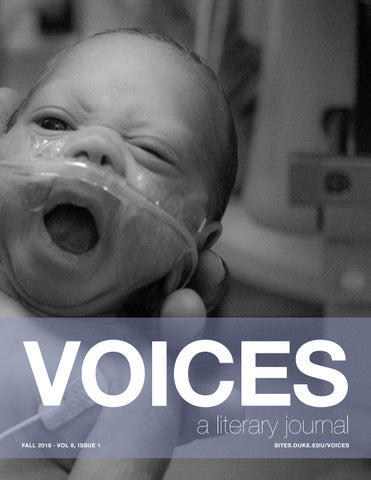
VOICES
FALL 2018 · VOL 8, ISSUE 1
a literary journal SITES.DUKE.EDU/VOICES
VOICES letter from the editors
Diseases drive the healthcare profession. By treating disorders, healthcare workers hope to eliminate or ameliorate diseases’ effects on patients. However the process of treating disorders is also an experience that is different for each patient that undergoes the process. Patients and healthcare workers understand health disorders from different perspectives. One of our goals in this issue is to bring different perspectives of disease from medical students to professional healthcare workers, to patients who live with their diagnoses every day. By bringing everyone down to the same common denominator, disorders bring out human nature in ways that we would not otherwise experience in daily lives. The question then is how do we maintain our own identities? Rayan Kaakati examines Pemphigus Vulgaris, a rare disorder of the skin, as she learns about it through a colleague and her reasons for deciding to come to medical school. Pemphigus Vulgaris is a relatively rare disorder, but its impact on patients cannot be deemed less significant compared to that of other more common diagnoses. Another medical student reflects on her experience in medical school, while rotating through different specialties. They note the different approaches each specialty has with different diagnoses. The same disorders may be treated completely differently by different doctors. Along the same veins, Leland Ben notes how conventional wisdom of dieting has changed the way that people eat, potentially for the worse. The same disorder, obesity, is seen and treated differently as research develops and new evidence emerges. Jacob Goeders notes his personal experience with Leukemia. He provides a view of disease that providers yearn to further understand. The disorder is only one facet of the treatment. The human underneath the patient label is the true goal of health. However not even doctors are completely immune to multifaceted aspect of treating disorders. Multiethnicity is a proud founding principle of America, however striving towards that point of perfection remains a struggle in our society. Dr. Amy Lee writes about her experience as a minority provider in the United States and the challenges that it brings. Providers struggle not only with the treatment of disorders, but also with ourselves.Providers, like patients, also have mental disorders as Teresa Meng notes. Disease brings everyone down to the same common denominator. But how do we maintain our individuality in the face of medicine and disease remains question that both patients and providers seek to answer. We would love to hear your thoughts and ideas at dukemedvoices@gmail. com. And as always, if you would like to join the Voices team, please let us know. Rui Dai and Thao Nguygen co-Editors-in-Chief
table of contents Letter From the Editors 2 Rui Dai, Thao Nguyen
How Conventional Dieting Wisdom 4-5 Super-Sizes Society Leland Ben Reflection Essay
Anonymous
6-7
Mental Health in Medicine Teresa Meng 8-9 Taking Another Look at Rare Diseases: A Story about 10-11 Pemphigus Vulgaris Rayan Kaakati Learning to Live with Leukemia Jacob Goeders 12-13 Omnia Vincit Amor Yu-Lin Amy Lee, MD 14-15
Zachary Smothers Samuel Hofacker Shan McBurney-Lin Karishma Sriram
MS2 MS3 MS3 MS3
associate editors
Ashley Adams MS4 S. Tammy Hsu MS4 Gireesh Reddy MS4 Teresa Meng UNDERGRAD
faculty editors
Raymond Barfield MD, PhD Karen Jooste MD Sneha Mantri MD BACKGROUND PHOTOGRAPHY CREDITS: COVER: Blaire Rikard, Undergraduate CREDITS/CONTENTS: Miao Qiang, PhD student
How Conventional Dieting Wisdom “A slice of bacon a day keeps the doctor away.” “Fruit makes you fat! Fruit is nature’s candy.” Posters with this type of dietary advice adorn the patient examination rooms of Dr. Eric Westman’s office, where he serves as the director of DUMC’s Lifestyle Medicine Clinic. His unconventional diet advice—which instructs patients to consume most of their calories from fat and protein and almost none from carbohydrates—is dismissed by many of his peer health professionals. Some have even called him a charlatan. Yet, despite the criticism, the diet has proven effective for weight loss and type 2 diabetes reversal. “Don’t let your holiday eating festivities turn into a holi-month,” Westman counseled his patients over the Thanksgiving holiday. But forget about holidays and holi-months. How about a holi-year? Or, a holi-half century? It is not just the holidays that mark lots of added sugars, carbohydrates, and binge eating. The average American’s diet has taken a turn for the worst since the 1960s: well over 50 percent of the macronutrients consumed by the average person are carbohydrates consisting mostly of processed grains and sweet, pure sugar. Portion sizes have increased dramatically and, consequently, so has calorie consumption. The concept of three meals per day has slipped into antiquity; snacking on power bars, cookies, pastries, and the 4 · SITES.DUKE.EDU/VOICES
likes of Venti Frappuccinos up to seven times per day is commonplace. Commonplace as well are obese Americans. Nearly 40% of the U.S. adult population is obese, up from around 10% in the 1960s. Even more, the prevalence of obesity-related diseases is skyrocketing: type 2 diabetes, congestive heart failure, and stroke are among the top five leading causes of death in the United States. American healthcare costs are also skyrocketing. Healthcare expenses relating to obesity in 2008 alone was $150 billion. Medical costs for the typical overweight American are $1500 more than someone of a healthy body mass index. The prospect for a healthier, slimmer and fitter future generation is likewise looking grim. More American children are obese than ever: almost 20% of U.S. youth under the age of 19 are obese. That’s almost five times higher than in the 1960s. What happened? Simply put, President Eisenhower nearly dropped dead from a heart attack in September of 1955. Obviously, the reasons for the present public health crisis are far more nuanced than Eisenhower’s misfortune. Yet this single incident brought discussion about heart disease to the forefront of the American scientific and health community, a previously seldom ailment that had begun to appear in more adults towards the mid-20th century. Eisenhower’s personal phy-
sician delivered a speech at a national press conference the following day, urging Americans to kick their smoking habits and eat less fat. He cited Wisconsin researcher Ancel Keys, a pioneer of the low-fat movement. Keys, known for his charismatic and charming personality, earned celebrity status, making appearances on the cover of Time Magazine and publically ridiculing critics of his (shoddy) low-fat promoting research. Since that point, saturated fats have become a dietary archvillain. Americans treated the prescription of Ancel Keys just as if it were the word of God Himself. Butter was replaced by margarine; beef and pork, staples of evening meals, were substituted with starch-based products; drinking whole milk was a health sin, as orange juice was more “nutritious” with its no-fat content. Eggs and bacon were vilified; “if bacon grease clogs your drain, it must clog your arteries!” In the 1980s, the U.S. government issued its first set of dietary guidelines. Crafted by nearly 100 nutritionists, with Ancel Keys’s advice and research serving as the bedrock, the guidelines are the basis for the food pyramid that is engraved in the minds of many Americans. A healthy diet should consist of a strong base of grains, breads, fruits, rice, and pasta (all of which are sugars) and sparingly feature butter, mayonnaise, and cheese (the supposed heart-failure-inducing fats). Since the release of these guidelines, previously flat-lined FALL 2018 · VOL 8, ISSUE 1
Super-Sizes Society obesity, diabetes, and heart disease rates took off towards the stratosphere. Today, it is becoming increasingly clear to health professionals and members of the scientific community that saturated fats are no longer the culprit for certain chronic illnesses. Yet, this belief is not a new one. Researchers who were critics of Keys had pointed to sugar consumption as the cause of poor health. Keys dismissed such researchers’ work as being a “mountain of nonsense” and paid for by industry. However, recently unearthed evidence shows otherwise. An analysis published in the JAMA Internal Medicine last year found that the grain and sugar industry paid scientists to conduct misleading research. Most notably, the Sugar Association paid $50,000 to three Harvard researchers in 1967 to conduct what became a “landmark” study on the link between sugar, saturated fat, and heart disease. The analysis, which was published in the renowned New England Journal of Medicine, helped solidify the scientific community’s consensus that saturated fat intake was the leading cause of heart disease. The lead researcher of that analysis, Dr. Mark Hegsted, went on to direct the U.S. Department of Agriculture’s department of nutrition, within which he led the team of nutritionists to create the first dietary guidelines in the 1980s. Those guidelines gave credence to a low-fat diet. “It seems to me that the con5 · SITES.DUKE.EDU/VOICES
sensus now is that the initial USDA guidelines were not based on science. When looking back to when the guideline was created, there was really no evidence to make that it. It came from a political sub-committee that was bought and paid for by industry,” said Dr. Westman. The impact of sugar-centric trade associations and their members on the scientific community and government is just as powerful today as it was towards the end of last century. An investigation by the New York Times last year revealed that Coca-Cola, the world’s largest producer of sugary beverages, is actively funding scientists to downplay the link between their products, obesity, and type 2 diabetes. They are pushing the narrative that it is exercise and moderation, not what people consume, that matters most in combatting obesity. Dr. Westman believes that this narrative is fundamentally flawed. “For most people who eat sugar, it is an addictive substance. It would be like saying, ‘don’t use much heroin’ to a junkie. Fortunately, sugar isn’t laced with things that kill you. But it’s a slow death of diabetes and heart disease. It’s too little too late to say ‘hey, moderate an addictive substance.’” The American Beverage Association and Coca-Cola’s impact on popularizing this misleading narrative has been wildly successful. Months before the launch of Michelle Obama’s “Let’s Move!” campaign, industry leaders met with the First
Lady to trumpet the research they funded. They showed that it was calorie intake and lack of exercise—not sugar—that was causing childhood obesity. “You would have to run three miles to offset the effects one can of Coke has on metabolic functions that contribute to gaining weight,” Dr. Westman said. “You can’t outrun obesity.” Although Michelle Obama might consider her persuasion of these companies to prominently display calories on cans of soda a victory, the victory was sweeter for industry. They successfully obfuscated the connection between sugar and obesity, and instead shifted discussion to exercise. Coca-Cola has spent millions on building community fitness centers and launching the Global Balance Energy Network, which promotes physical activity in America’s youth. Continued at sites.duke.edu/ voices/publications/ Leland Ben is a member of the class of 2021 in Duke University’s Trinity College of Arts and Sciences. He plans on majoring in Public Policy with a concentration in Policy Journalism and Media Studies. Leland completed a low-carb diet losing over eighty pounds and has since taken a keen interest in the politics of food and dieting.
FALL 2018 · VOL 8, ISSUE 1
Reflection Essay The attending strides into the room and everyone falls silent. She inches her way in-between the scrub nurse and the physician assistant. The surgery begins. 15 minutes into the surgery, the attending acknowledges the medical student. She does not ask who I am, where I am from, my interests, my story. To her, I am just a human encyclopedia, expected to know every statistic, every risk factor. The pimping starts and I manage to get almost every one of her questions wrong. She follows up every response with “well of course that’s not the answer” or “that’s only one risk factor I need two” or “you’re going to tell me that’s a risk factor just because this patient has it?”, really driving home that my hours of preparation the night before were not enough to answer her questions. I leave the OR with tears streaming down my face, feeling shameful about my performance. I feel like someone has squeezed out every drop of my self confidence, leaving a shell of my former self behind. I cannot lead the operation, I cannot assist her, I cannot hand her the proper tools, I cannot administer the anesthesia, I can’t even provide support and empathy to the patient, the qualities I pride myself most on, because the patient is asleep on the table. On surgery rotation, my only value seems to be my knowledge. So when I don’t know anything, I feel worthless. Fast forward three weeks later, the pediatric genetics attending
6 · SITES.DUKE.EDU/VOICES
glides into the workroom and greets me with a smile and a hug. She introduces me to the team members, the genetic counselor, the nursing staff. She tells them she is excited to have me on board. Dr. Kishnani and I head over to see our first patient, a bubbly, bright-eyed 3 year-old girl with beautiful long curly hair and a pink polka dotted dress who was born with infantile Pompe disease. Dr. Kishnani’s clinical and research efforts have provided the patient with an enzyme replacement therapy (ERT) that will save her life. She received her first dose a few months ago. Dr. Kishnani marvels as the girl shows off her new ability to walk and jump. I watch as Dr. Kishnani secretly monitors her gait for stability while simultaneously asking the patient’s mother “how’s the new house?”, “did you end up switching schools?”. She beckons me over to help examine her patient. “You need to learn this well. See the dimpling of her iliotibial band? See the hypertrophy in her calf muscles?” Dr. Kishnani’s attention to detail in her physical exam is uncanny, and I smile as I notice her desire to pass on her immense knowledge content to me. As the visit comes to an end, the patient runs over to Dr. Kishnani for their annual photo together. She hands Dr. Kishnani a mousepad adorned with the last picture of the two of them before running out the door. I fight to hold back the tears of joy welling up behind my eyes as I start to re-
member my desire to become a physician. By the end of the week, Dr. Kishnani is offering me to join her research lab for my PhD, offering me opportunities to collaborate with her postdocs on textbook chapters and journal articles. I entered my pediatric genetics selective with the weight of two months of surgery on my shoulders, feeling like I was worthless, that I did not have what it takes to become a successful physician. In only two minutes in pediatric genetics clinic, I had felt that weight start to lighten and my confidence return. I left the clinic feeling cared for, feeling loved. Now fast forward to the last hour of the last day of our practice course class. Dr. Lee starts handing us envelopes. I joke in my head that they’re checks for all of the hard unpaid work we’ve put into this, but remember that they are the letters we wrote ourselves almost twelve months ago. “You’re almost done with second year. Congratulations! You can see the light at the end of the tunnel. You may have a few more wrinkles, permanent raccoon eyes, and your white coat may have a few more stains, but hopefully it has all been worth it and you have finished second year a better person. I hope that you have held on to your inherent characteristics – enthusiasm, optimism, a desire to learn; and I hope you’ve picked up some new traits along the way – resilience (you have learned not to let your superiors and your FALL 2018 · VOL 8, ISSUE 1
peers define your ability and your self worth…” I pause right there. “Beginning of the year” was very insightful. If I have learned nothing else this year, it’s that I cannot let others define my self worth. I can choose to surround myself with people who build me up, like how I’ve chosen to do my PhD in the Kishnani lab exploring the pathophysiology behind glycogen storage disease type 9, under the guidance of a strong female role model who will acknowledge my potential and encourage my success. Inevitably, I will be tasked in my life to work with people who do not inherently bring out the best me. And when that happens, I cannot let them define my value. I need to remember that I can acknowledge the best in myself. I am a strong, hard working, kind, compassionate young woman. And one day, I will make an incredible pediatrician, impacting the lives of thousands of kids across the country with compassionate clinical care and innovative research. I define my self worth. Anonymous
7 · SITES.DUKE.EDU/VOICES
SPRING PHOTO PHOTO2018 CREDIT: CREDIT: · VOL LEAH QIANG 7, ISSUE ROSEN MIAO 2
Mental Health in Medicine There is currently a mental health crisis going on in America, especially on college campuses. As a current undergraduate student, I can’t escape this reality, especially when I witness peers battling depression and other mental health illness. Among my close friends, half of us have experienced at least one episode of depression and are seeking treatment and medication. I recently had a conversation with one of those friends about why mental health issues are so prevalent among our friends and she told me, “it’s because we are all try-hards”. It’s true, half of my friends are premed and there seems to be a direct correlation between premed and depression, though the sample size is very limited. Half of my friends are also Asian Americans. There also seems to be a direct correlation there. As premeds and Asian Americans, we faced the pressure to be prefect for our entire lives. We are model minorities and one day we will be doctors who people trust with their lives. So there is a reason to expect perfection. But I wonder what does perfection cost us, especially to our health. Are possible solutions? I learned from conversations with friends that they were well aware that they were depressed because they viscerally felt the early signs: guilt, irritability, and lasting feeling of sadness. The question then becomes, why aren’t students speaking out? Among Asian Americans, there seems to be various socio-cultural factors at play. One 8 · SITES.DUKE.EDU/VOICES
study found that “social stigma, shame, and saving face often prevent Asian from seeking behavioral care” (Kramer, 2002). Parents push their children very hard, expecting perfection which worsens mental health. The researchers concluded there needs to be culturally component care in the Asian American community. An Asian American therapist I interviewed said when she first started therapy twenty years ago, her goal was to help the Asian American community with mental health. However, she was disappointed that almost no Asian Americans went to therapy. Although the numbers have improved, stigma is still very present within the Asian American community. My friends hesitated to tell their parents and friends because they didn’t want their loved ones to worry about them. This reluctance seems to intensify among premed students because of the intense pressure to do achieve. There is a checklist of things to accomplish: leadership, community service (both clinical and non-clinical), and research. On top of all, one needs to maintain almost perfect grades. This pressure to be effortlessly perfect: to be high achieving without trying, is terrible for mental health. Students do not want to accept that they need help because doing so will admit they can’t withstand the pressure. Instead, students want to perform equally or better than those around them. We need to change this culture by learning it’s better to be happy and
healthy than it is to be perfect. We need to adopt a growth mindset: there is no losing, we either win or learn. There is not much research on depression among premedical students; however, one paper found that premed students were more likely to be depressed (Fang, 2010). The study noted that female students exhibited more severe depressive episodes. One premedical student, Shilpa Prasad, described the pain of depression is “deeply connected with fear. There’s a fear that loved ones will resent you or think you’re a hassle. Fear that you won’t feel better. Fear that no one understands your pain.” She described being depressed by her performance in a high stress environment coupled by familial pressure to continue on the premedical path. She wrote, “ the more they pressured me, the more I felt like I was drowning in doubts of whether I could actually succeed. I was working so hard, and yet, I wasn’t doing well. What was wrong with me?” The study and the anecdotes made me question whether depression intensifies when students enter medical school. A study conducted in India, found that overall prevalence of depression was 64% (Sharma, 2014). Some exacerbating factors include the belief that peers would not want to want to work with a depressed student and the belief that themselves would be unable to complete medical college responsibilities. As the students progressed FALL 2018 · VOL 8, ISSUE 1
through medical school the stigma about disclosing depression and working with a depressed person increases. While in Portugal, the overall prevalence of depression ranged from 12.7 to 21.5% (Morgado, 2017). Students who chose medicine for the wealth and prestige reported more severe symptoms of depression such as relationship issues, cynicism and decreased satisfaction with daily activities. Students who chose medicine as a career, for the right reasons, per se, tended to experience the opposite. In the U.K., specifically Cambridge, the prevalence of depression among medical students was 10.6% to 18.3% (Benson, 2012). In the U.S., 50% of medical students experience burnout and 10% had suicidal ideation (Shanafelt, 2008). The JAMA Meta-Analysis of medical students from 43 different countries found that the overall prevalence of depression was 27.2%, and the overall prevalence of suicidal ideation was 11.1% (Torre, 2016). Despite being future health professionals, meaning they should recognize the signs better than the average citizen (according to the NIH, the U.S. national average is 4%), only 16% of medical students in the study saw a therapist. This problem continues during residency; another JAMA Meta-Analysis found that 29% of residents are depressed (Bansal, 2015). It’s important to keep in mind that these numbers are only from students who answered the surveys truthfully and accurately. It is highly likely that depression among medical trainees is underreported because of the stigma.
9 · SITES.DUKE.EDU/VOICES
In an NPR article, medical school student referred to as Giselle, was brave enough to admit to the admissions committee and her classmates of her mental health issues. She had her first suicide attempt at 16 years old and struggled with mental health throughout her life. She was able to manage her grades and get into medical school. However when she struggled with the course load, she was asked by the medical school committee “if she could handle her issues and if she was cut out for the stressful life of a doctor.” Her mentor, another more experienced doctor, said Giselle never used her mental health as an excuse for her performance. A particular quote that resonated with me was: “We need Giselle in medicine. We need people who are unafraid to have the insight to talk about not only their own struggles in life, but how that relates to others.” The article also points out that the lifestyle of medical training includes many risk factors for mental illness, including lack of sleep and support systems. Physician depression and suicide has been a well-studied topic. A Meta-Analysis found that the aggregate suicide rate ratio for male physicians, when compared to the general population, was 1.41, for female physicians the ratio was 2.27 (Colditz and Schernhammer, 2004). A more recent study found that burnout is more common among physicians than any other profession. Furthermore, physicians in family medicine, general internal medicine, and emergency medicine are at
greatest risk (Tan, 2012). 300 to 400 physicians die by suicide each year, approximately 1 physician per day (American Foundation for Suicide Prevention). There have been improvements within medical education. Many schools are now helping students deal with mental health issues with therapists and tutors. Hospitals and residency programs cap work hours at 80 hours a week and provide counseling services to help cope with stress. However, a Yale-New Haven resident wrote that “despite these efforts, people still fall through the crack… We masquerade as strong and untroubled professionals even in our darkest and most self-doubting moments. How, then, are we supposed to identify colleagues in trouble — or admit that we may need help ourselves?.” We need to educate the academic community to support students further by changing attitudes about what to expect from students. We need teachers who push us but not too far while inspiring us to be better. The pass-fail curriculum is great because it lessens the focus on grades, and more on student mental health. Continued at sites.duke.edu/ voices/publications/ Teresa Meng is a Duke Undergraduate student. She is a senior and plan on applying to medical school.
FALL 2018 · VOL 8, ISSUE 1
Taking Another Look at Rare Identifying rare diseases is like tracking an exotic new species out in the middle of the forest in the middle of the night, where scientists can only infer its existence through cross-referencing many random data points and thus deducing the existence of a “new species.” Once that step is accomplished, further research will be compiled to locate the specimen to study. In the words of Peter R. Grant, “We observe closely related species in sympatry and infer how they evolved from a common ancestor.” Researching rare diseases could be the precursor for treating the source of many ailments. I lived a few years in Qatar and Lebanon before moving back to the US. Through my interaction with different healthcare systems overseas, I’ve come to the realization that I do not want to be a doctor who is “just” a certified medicine dispenser doctor; many pharmacists in third world countries already assume that role, where majority of people tend to explain their symptoms to the pharmacist, who in turn prescribes medication, and sometimes even asks the inquirer to do some lab work before finalizing the prescription. The pharmacist eliminates the role of a PCP, by referring patients with “peculiar” symptoms directly to a specialist. Therefore, operating as a fully independent insurance company, without charging the monthly premiums. In the US, we might frown upon this; however, it’s advantageous to many patients, and they explain it this 10 · SITES.DUKE.EDU/VOICES
way: “Doctors prescribe the same medication, after charging us a hefty checkup fee— it’s not like we’re going to the pharmacist with a rare disease.” Doctors in countries that don’t encourage medical research and even require a researcher to get security clearance with the interior ministry to organize disease-specific conferences will tend to produce certified medicine dispenser doctors. The medical establishment— medical students, nurses, physical therapists, doctors, pharmaceutical companies, etc—must be in a continuous pursuit to identify and document rare diseases followed by research to prevent or treat. Case in point was Dr. John Snow, who worked around the clock in London in the mid-1800s to track down information from hospitals and public records on when the cholera outbreak began in London and whether the victims drank water from the Broad Street pump. His pioneering medical research paid off by simply using a geographical grid to chart deaths from the outbreak and by investigating each case to determine access to the pump’s water. Many other doctors had probably just resorted to easing the pain of patients, while Dr. Snow opted to perform research. That’s when I met Jon, a fellow Californian, who was diagnosed with Pemphigus Vulgaris (PV) in the fall of 2002. Jon shared his story, from noticing his symptoms to current day medication,
while reflecting on his journey. Pemphigus Vulgaris is a rare autoimmune disease that causes painful blistering on the skin and the mucous membranes. An autoimmune disease is a disease in which the immune system attacks its own cells and in the case of Pemphigus Vulgaris, it goes about it by producing antibodies against desmosomes (connecter molecules) in your skin, causing painful blistering scabs to form on your body. Jon initially ignored the large scabs on his nose, forehead, and scalp and just figured they would eventually go away; however, they continued to grow and to spread to other areas—becoming extremely painful with time. Jon was at his dentist, when his dentist noticed scab formations around his gums. In the words of Jon, “I saw a fearful look on my dentist’s face as he told me to go to a dermatologist right away and that I couldn’t wait another day.” Jon’s first hurdle was to get an appointment with a dermatologist. It was then he realized that dermatologists are scarce in the US and making an appointment is exceedingly difficult, as it can take months to be seen. Soon after his first appointment, he was diagnosed with Pemphigus Vulgaris, but was warned to stay off Google in fear he would be discouraged by “daunting images.” Jon was started out on 120 milligrams of prednisone with some additional prescriptions: Zolpidem to help him sleep and Omeprazole to help with digesFALL 2018 · VOL 8, ISSUE 1
Diseases
tion and to prevent ulcers. That was the beginning of his 10-year journey on steroids. Jon was extremely fortunate to have the right diagnosis made, as it normally takes patients’ months and even years to figure out what is ailing them when the disease is categorized as “rare.” Jon introduced me to another PV patient named Dana2, who said she went to four different “Beverly Hills” dermatologists before she was given the correct diagnosis. Skin disorders (or any obvious exterior abnormality) can have a severe impact on people’s psyche that other illness may or may not have. Some disorders, such as hair loss or vitiligo, may not cause any physical pain, but the anxiety it causes has a huge toll, as it affects and targets our mental well-being. People tend to “show case” their skin to others, as if physically wearing an expensive coat. People envy those with “nice skin” and frown upon “acne.” In Jon’s case, he said the lesions were “nasty looking,” but he grew to not care much about it. However, his fiancé at the time had a hard time accepting his diagnosis of blisters on his body and the stress of it all caused them to break up soon after. Jon was really bothered by the side effects of the medications he was put on and how his body might react to it with age. Jon got the typical Cushing’s syndrome on Prednisone, as he had gained weight, had severe muscle weakness, the onset of 11 · SITES.DUKE.EDU/VOICES
diabetes, and his skin bruised easily. Jon explained to me the psychological effects of the disease and told me he never felt right and that no one (not even his own family) could understand what was going on with him. He said that in retrospect, he now recognizes that he was also dealing with depression induced by a barrage of issues that arose with his diagnosis; from receiving constant calls from well wishers and having to explain the disease to maintaining health insurance, Jon was under a constant amount of stress. The biggest stressor was not knowing how bad the disease could get. Jon wishes he were automatically referred to a therapist to help him through the sudden shift in his life. It’s hard to come to terms with reality and to accept that you have a rare disease. Jon discussed with me the need to establish a system where every patient diagnosed with a rare disease receives mandatory psychological screening, support, and placement with a mentor. In 2010, Jon found the IPPF and was paired with a PV mentor and advocate who would later become one of his closest friends. Jon felt so motivated by his mentor that he himself became a Certified Peer Health Coach with the IPPF and helps others diagnosed with PV get through it. My other contact, Dana, who also received support from the IPPF says, “Without the IPPF, I would have gone batty and been depressed. Since 2012, I’ve been a Peer Health
Coach with the IPPF.” In medical school, we are taught the “famous mainstream” diseases such as diabetes, COPD, obesity and hypertension that affects most of the population. We touch on rare diseases, but barely, since statistics dictate that we focus on the 90% of prominent diseases. Therefore, we are merely hoping we will either not run into the 10% of patients with rare diseases or that we will have access to a specialist. The 10% of patients with rare diseases tend to linger within the 90% pool due to symptoms mimicking other common diseases. They get misdiagnosed and they don’t get channeled to the right specialist who could potentially diagnose the disease. The bulk of research funds tend to be allocated to more common diseases. It makes sense statistically, but there could be enormous benefits in investing in rare diseases, as research for these diseases could give us insights to other “main stream” diseases. A rare disease could be the portal for understanding and better treating many common diseases. Continued at sites.duke.edu/ voices/publications/ Rayan Kaakati is a medical student who enjoys writing, spending time with family, and drinking lots of Turkish coffee
FALL 2018 · VOL 8, ISSUE 1
Learning to Live with Leukemia My name is Jacob Goeders, aka “The Leukemia Slayer.” I was diagnosed with high-risk Acute Lymphoblastic Leukemia on December 2, 2010. I was nine years old, in the fourth grade, and my family and I were living in Mountain View, California. The day before I was diagnosed I had never heard of Leukemia, and I never imagined that kids could get cancer. December 2nd was the day my life careened off course. I was feeling ill for a few weeks before I was diagnosed, but my doctor could not quite figure out what was going on with me. First he thought I had a sinus infection, so I was given antibiotics. This did not help me at all, and I seemed to be getting sicker with every passing day. I was having severe headaches, was extremely tired all the time, and my joints hurt as if an elephant had slowly trampled me. On December 2nd my Mom took me back to my doctor because I was very pale and could hardly stay awake. My doctor found my spleen was enlarged and decided to check my blood. Later that day, my parents woke me up to tell me that we had to go to the hospital for some more tests to find out why I was feeling so sick. I immediately asked if I was going to have to get another blood draw since I was not a fan of the needle from earlier that day. My parents were very noncommittal, but did tell me I could order dinner at the hospital and would have a cool mechanical bed, which appeased me for the moment. Looking back, I think 12 · SITES.DUKE.EDU/VOICES
I was just too sick to argue. I assumed it would just be a one night trip, but little did I know what was in store for me. We entered Lucile Packard Children’s Hospital, located in Palo Alto, California, and were sent to the admitting office. The staff signed me in and sent us to “One North”, which was the oncology floor. At the time I had no idea what oncology meant, although I would consider myself an expert now. As we walked through the heavy doors, I noticed the nurses seemed nice and friendly. They came right up to us to begin all the things they needed to do when you get admitted into the hospital: taking your blood pressure, weight, height, and to my dismay, getting an IV. Doctors and nurses filed in and out of my tiny room asking my Mom and Dad the same questions over and over as they examined me. I thought all the attention was a little strange, but I had never been in a hospital before so I was still not too worried. After many exams, my nurse wheeled me down to get X-rays and an ultrasound. When I came back to my room I was pretty happy to be able to order dinner! I ordered a cheeseburger, and as I started to eat, four doctors came into my room and asked my parents to come with them to talk. At this point I figured it couldn’t be good news if they didn’t want to talk in front of me. My parents were gone for a long time; they finally came back to my room looking somber. My Mom and Dad didn’t say
much that evening, and my little brother Jordan, who was only 4 at the time, was staying with a family friend. My room was anything but quiet though, As I settled in for the first of what was to be many nights in the hospital. My IV machine seemed to beep every ten minutes, and we heard a lot of crying from the other rooms as we tried to get some sleep. The next morning Jake from Child Life came into my room and he, along with my parents, told me that I had something called Leukemia, which was a cancer in my blood. Jake explained what Leukemia was doing to my body and what the doctors had to do to me to make me better. Later that day I had to go in for surgery to get something called a PICC line put in my arm so I could start my chemotherapy, and while I was put to sleep I also got a bone marrow biopsy and chemo injected in my spine. I remember I really hurt when I woke up and they had to give me medicine for the pain. I had to start my chemotherapy right away, but first I had to get an ultrasound of my heart. I got my first IV chemo late on the second night in the hospital. I also had to start taking a bunch of other medicines like steroids and something called Renegel, which to this day I believe was the nastiest thing I have ever had to put in my mouth! I ended up staying at the hospital for over two weeks getting more chemotherapy, FALL 2018 · VOL 8, ISSUE 1
blood, platelets, and more tests. Nurses had to train my Mom and Dad how to flush my PICC lines every day and what to do if I got a fever while I was home. I was scared that I was going to have to be stuck in the hospital for Christmas, but the doctors let my parents take me home just in time to celebrate with my little brother and my Grandmother, who had come from Florida to stay with my brother. During the course of my treatment I went back weekly for chemo and labs, spent many more weeks in the hospital, and had more trips to the emergency room than I can remember. Treatment lasts a long time for kids that have Leukemia, my treatment lasted for three years and three months. I am happy to say that my treatment officially ended on March 23, 2014 and I remain in long-term remission today. Looking back on that day, I still find it hard to believe I was actually diagnosed with cancer. At the time I still did not understand just how serious the situation was, and I did not know it was an illness I could die from. I think my parents did know however, and it must have been hard for them to hear a doctor tell them I had Leukemia that day. I will always remember December 2, 2010 as the day I was diagnosed with Leukemia, and I have been learning to live with it ever since. Jacob Goeders is a 16 years old video game master, junior philanthropist, and Leukemia Slayer.
13 ¡ SITES.DUKE.EDU/VOICES
PHOTO SPRING CREDIT: 2018AARTI ¡ VOLTHAKKAR 7, ISSUE 2
Omnia Vincit Amor Recently, there has been a burning within me, one that I hope to give voice to today. Over lunch with my parents not long ago, a white man began to shout expletives at us. For being foreign. For not speaking English. This culminated with a threat to “kill those F-ing people.” It was humiliating and, frankly, quite frightening. I have grown accustomed to things like this and have largely learned to brush it off, but when it involves my family, I find it hard to remain quiet. Unfortunately, this is nothing new. I have had people roll down their car windows and hurl derogatory words in my face; their creativity is usually limited to “go back to ___ (insert Asian country of choice)”. As an intern at Duke, a patient kicked the bedside nurse and me out of the room because we were both “foreigners” and requested an “American doctor.” People frequently ask “why don’t you have an accent” or “why is your English so good?” Am I supposed to have an accent simply because I look outwardly different? The “where are you from?” question inevitably draws disappointment when I answer “Buffalo” instead of “Taiwan” or some other exotic country. Another frequent question that I encounter is the classic “what kind of oriental are you?” I have contemplated answering with “I feel like a vase, or perhaps a rug,” but over time the humor fades away. “Do you eat pizza with chopsticks?” “Are you related to Bruce Lee? I bet you 14 · SITES.DUKE.EDU/VOICES
know karate or kung-fu.” “Can I so I asked my parents to stop touch your hair, it’s so black and packing tasty home-cooked silky.” “I have this Korean/Japa- Taiwanese food made with such nese/Vietnamese friend, maybe love and opted for the bland, and much less tasty, alternative you know them since you are Asian?” While mildly frustrating, of peanut butter jelly sandwichmost of these questions, provid- es to avoid sticking out. I never ed they are in the right setting, cried. I tried everything in my are opportunities for meaningful power to assimilate, to be more “American,” to be less Asian and dialogue. less “other.” Throughout my life, I have always been aware of my “oth- Like so many others in the United States, my parents are erness.” I was once forced to first-generation immigrants and check the box “other” rather nothing short of amazing. They than “Asian/Pacific Islander” because someone in the office came here with barely more decided that I was not qualified than the clothes on their backs to be an “Asian/Pacific Island- and a bit of pocket money. They worked tirelessly day in and er.” When I was younger, this sense of “otherness” bothered day out, learned English, and jumped over countless hurdles me immensely. People often so that my brother and I could laughed at my name. In an have and experience the things attempt to avoid the snickering, jeering and being poked at that they could not. People with pencils, I made my parents know little about living on the switch out my Taiwanese name hyphen and the Asian-American story except for the rhetoric of so that it wouldn’t be called the “model minority” stereotype, out during attendance. On my first ever ride on the big, yellow a trope that does no one any good and serves only to perpetcheese of a school bus, kids uate racial burdens. The uncomyelled “ching chong chang” fortable truth is that the story at me, shoved me around the bears more scars than can be narrow aisle, and then forced my face into the back of a seat, outwardly seen and that it has endured more than just sprinkles swiftly knocking a tooth out. I of racism. Racism knows no vowed never to take the bus again and from that day on until boundaries, knows no colors. I can’t exactly pinpoint when my high school graduation, my parents drove me or I walked to the light bulb went off, but somewhere along the journey, I school myself. My classmates laughed at the shape of my eyes stopped caring about fitting in as they sang “my mom is Chi- and started embracing myself. I nese, my dad is Japanese and am deeply grateful for the peolook what happened to me,” so I ple around me who embrace evlearned to look down and avoid ery quirky and awkward ember eye-contact. They laughed at my of my being and for a God who “weird” bento boxes for lunch, loves unconditionally. My close FALL 2018 · VOL 8, ISSUE 1
friends know that I am fiercely proud of being Taiwanese-American. I have come to realize that many people are unfamiliar with Taiwan, a tiny but mighty island in East Asia and a proudly independent and democratic country with a strong, brilliant female president. I am proud that I can speak three languages and can pick up anything with just a pair of chopsticks. I bring my delicious rice-filled bento boxes to work and drink my bubble tea unashamedly. I wear my full Taiwanese name on my white coat and care for people of all ages and all walks of life without question. From inside the restaurant, I watched the man walk back to his SUV and kindly open the door for his female friend before getting into the driver’s seat. Deep down, I believe that he is likely a decent man. Maybe he was having a bad day or perhaps something about my family stirred discomfort or fear in him, but I am hopeful that one day, he might open the door to others and be pleasantly surprised. Ultimately, my hope is simply to meet people wherever they are on their journey with the kindness, compassion, and love that my parents taught me rather than reciprocating with fear and hatred. We are a nation of immense diversity on a multitude of levels and a nation of cultural pluralism – let us embrace each other, advocate for each other, and care for each other. Racism may know no colors, but love also knows no colors. And love always triumphs. Yu-Lin Amy Lee, MD is a Medical instructor at Duke in Internal Medicine and Pediatrics with specialty in Hospice and Palliative Medicine. 15 · SITES.DUKE.EDU/VOICES
SPRING PHOTO 2018 CREDIT: · VOL ALLIE 7, ISSUE HARJO 2
JOIN VOICES AND SUBMISSIONS: sites.duke.edu/voices dukemedvoices@gmail.com
SITES.DUKE.EDU/VOICES
FALL 2018 · VOL 8, ISSUE 1