Duke School of Medicine
VOICES
FALL 2015 • VOL 4 • ISSUE 2
Best and Worst
6
SITES.DUKE.EDU/VOICES
Games 10
Odd Encounters 13
VOICES Editors in Chief Rui Dai, MS2 Anna Brown, MS3
Associate Editors
Bilal Ashraf, MS1 Madelyn Stevens, MS1 Kelly Ryan Murphy, MS2 Kun-Wei Song, MS2 Vinayak Venkataraman, MS2 Sean Fischer, MS3 Jacqueline Zillioux, MS4 Neechi Mosha, MD
Special Thanks to
Maureen Cullins and the Multicultural Resource Center Duke University School of Medicine Davison Council For information on joining or writing for Voices, please email DUKEMEDVOICES@GMAIL.COM
Table of Contents 4 Letter from the Editors 5 Scar’s Song 5 Mt. Rainier
Rui Dai and Anna Brown
Chinmay Paranjape
Wendy Wang
6 The Best and Worst Four Months of My Life Vinayak Venkataraman
6 Sunset Daisies 8 My Sister
Rui Dai
Umar Qadri
8 Car Show Visitor Neechi Mosha 9 Congenital Insensitivity to Pain
Carlisdania Mendoza
9 Hurricane Ridge Wendy Wang 9 The Giant Moth of the Heart 9 Wasteland Butterfly V 10 Games
Kristian Becker
Billy Baumgartner
Sherveen Parivash
13 Odd Encounters and the Spontaneity of Medicine Hussain Lalani
14 Iron Gong
Chinmay Paranjape
14 Aubade for the Unwanted 14 Guatemala Sunrise 16 Mountains
Kristian Becker
Anna Brown
Stephanie Ngo
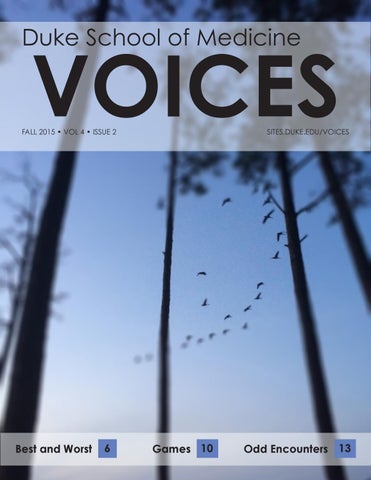
Background Photography Credits Cover: Rui Dai, MS2 Credits/Contents: Jerry Lee, MS1
Letter from the Editors Everyone has a voice that deserves to be heard. Throughout the hospital, the voices of patients, doctors, students, and staff members all have stories to tell. And it is the mission of Duke Med Voices to broadcast those voices to the community. Duke Med Voices was founded on the belief that medicine is more than just facts and numbers, and patients are more than just their medical records. Behind each patient’s chart, there are many more thoughts and experiences that transpire than the words of an official document. They are real people with stories of love, loss, and near misses with the inevitable. Human nature is often most raw when we are standing at the fork between life and death. Despair, humiliation, and sacrifice juxtaposed with hope, laughter, and delight in the face of shock, wonder, and awe at how thin the line is between the living and the dead. Healthcare providers have the privilege of listening to
and participating in patients’ stories, and we have featured the creative expressions of providers and trainees in this publication. Medicine is a full-time commitment, both physically and emotionally. Vinayak Venkataraman narrates the oscillation between loss and hope in “The Best and Worst Four Months of My Life,” as he details his experience as a second year medical student on the pediatric hematology-oncology service. Umar Qadri, in his poem entitled, “My Sister,” explores the all-consuming nature of a medical career that can tear us away from the life around us. The omnipresent forces of love and loss are poignantly explored in Chinmay Paranjape’s poem “Iron Gong” and Kristian Becker’s “Aubade for the Unwanted.” The unpredictable nature of medicine is noted in Hussain Lalani’s prose about his experience in the emergency department, and Sherveen Parivash imagines a similar event from a patient’s perspective
PHOTO CREDIT: Wendy Wang, MS4
in his short story entitled “Games.” At the same time, we are reminded of our own vulnerabilities and humanness in Kristian Becker’s poem, “The Giant Moth of the Heart,” and Chinmay Paranjape’s “Scar’s Song.” Because otherwise, “Congenital Insensitivity to Pain” becomes the only way we can deal with our own emotions, as Carlisdania Mendoza writes beautifully in her poem. As always, our hope in editing and managing Duke Med Voices is to uplift the voices of the Duke medical community, and encourage creative ways of expression. If you are interested in writing or editing for Duke Med Voices, please do not hesitate to contact dukemedvoices@ gmail.com. Rui Dai, MS2 Anna Brown, MS3 Co-Editors in Chief, Duke Med Voices
PHOTO CREDIT: Rui Dai, MS2
Scar’s Song
Chinmay Paranjape, MS3
Funny how scars work, How they begin so red, Indurated and gnarled.
It’s funny how your scars, Can stop hurting, can fade, Can contract, can diminish.
It’s funny how even when birds chirp, And no further blood is being shed, They serve to remind us of our wars.
Because ultimately, they never disappear, Can simultaneously not hurt but remind you of your fear, Because while the war is over, the battles do not finish.
Interesting, is it not, How a war might be over, But its battles can still be fought. For I stood up to the beast, I stood for what was right, And though I suffered no defeat, I feel defeated of all my might.
For in the minds of the lionhearted, Though our brethren may be departed, From our lion-hearts they are never gone: And this, my friends, is the scar’s song.
Chinmay Paranjape is an MS3 who got hurt and now likes bones (is interested in orthopedics). In addition to bones, he likes biking, hiking, and generally poking fun at himself and others. FALL 2015 • VOL 4 • ISSUE 2
SITES.DUKE.EDU/VOICES • 5
The Best and Worst Four Vinayak Venkataraman, MS2 I had just joined the pediatric hematology-oncology service, and I was assigned a new patient to follow. I was greeted by a wide-eyed, slightly undersized 8-year-old boy, with scattered freckles and a broad smile. I introduced myself and started with a few icebreaker questions. His mom, watching TV, sheepishly interjected, “Son, tell him about that girl you like.” “Eww girls are gross!” A yelled, quickly turning his head towards her then burying his head into his pillow. “Come on, A, you can tell me her name,” I prodded. He turned to me and smiled. He put one hand to his mouth, blocking off his mom’s view of his lips, and motioned for me to lean in. He whispered her name and smiled. “You ask her out?” I asked. “Not yet,” he said. “But I will.” “I’m going to hold you to that, bud.” He nodded. “Don’t tell my mom.” “What are you boys talking about over there?” His mom yelled out. “Nothing!” he yelled back, giving me a wink. “It’s a boy secret!” “Keeping secrets from your mom?” She shot back. “Looks like someone’s getting Barbie’s for Christmas.” A whipped his head towards her. “Ahhh dude! You’re killing me!” He buried his head in his pillow. Both his mom and I started laughing, and eventually a smile emerged from the corner of his pillow.
for him to clear the infection, then get some longer-term therapy. I immediately bonded with him because even though he was gravely ill, he acted like a typical eight-year-old kid and shared with me his eightyear old life. He revealed to me his budding love life. He told me about the ups and downs of his backyard soccer career and love of Italy (“I wish I were bigger so I could be on the Italian soccer team – those guys are sick!”), as well as the people on his blacklist (“That kid is so gross, he like picks his butt!”). He LOVED playing videogames. One day, when I came in, he was busy playing a Scooby Doo game on his Nintendo. I tried to finish my physical exam without bothering him, but as I was listening to his heart, he asked, “Do you want to play with me?” He was having trouble beating this level. “I just don’t get it!” He said. “Don’t worry, bud,” I said. “We’ll figure this out.” The next half an hour, we worked together and eventually got it. “Dude, we did it!” He said as he leaned in for a hug. It was the most important accomplishment of the day for him. “I bet the next level is impossible!” He said. “You say that about every level, man,” I replied. “You always figure it out.” “I guess — ” “I think you can do it. By the time A suffered from a sudden severe we come back for rounds, I wanna bone marrow condition which pre- see some progress.” vented him from forming new blood He smiled: Challenge accepted. cells. He had no white blood cells to speak of and presented with an Over the week, things were looking acute, local infection. The hope was up. The infection seemed localized, 6 • SITES.DUKE.EDU/VOICES
and he was going to be transferred to the bone marrow transplant unit for longer-term therapy. Meanwhile, I was reflecting with my resident how A was the first patient with whom I had really connected. However, by Friday afternoon we received word that the infection was much more lethal than expected. Since A didn’t have the white blood cells cells needed to fight the infection, it had a near 100% mortality rate. His prognosis was extremely grim. Though he was not my family, I was devastated when I heard the news. I tried to maintain my composure emotionally that afternoon, but I found it almost impossible to do so. It was so hard to fathom someone so young and with so much life to live suddenly passing. Luckily, I escaped the hospital floor to clear my head and eyes and meet with a couple advisors. They said they most regret the times they’ve allowed bad news to make them retreat. I realized how tempting that was since that was my initial reaction. I headed back to the floor and stayed with the family for the evening. His dad and big brother had just arrived when I returned. His dad was talkative and shared with me the stresses they faced with limited financial means, one car, and their entire family in another state. When the attending and fellow needed to speak with the parents alone that night, I took the older preteen brother for a walk. After a little videogame-based icebreaking, he shared how hard it was for him to see his little brother going through this. I’m so happy I went back to the hospital that night. Those few hours FALL 2015 • VOL 4 • ISSUE 2
Months of My Life were among the most powerful of note written by A and his brother, my life, as I resolved to genuinely telling me I was part of their family care for a family I had only met days forever and to never forget them. before. I didn’t realize it was possible to be both incredibly happy and sad at the The week after the initial shock of same time. Gestures I thought small the diagnosis had its emotional ups were meaningful to a lonely famiand downs, but I tried to figure out ly in a big hospital with no nearby the best role I could play. My resirelatives and few financial means. dent, fellow, and attending were all But the willingness to become close extremely supportive and willing did come with emotional challenges. to share advice and allowed me to I cried more in those 10 days than spend a majority of my time with A. in the past 10 years. With each day, I also talked to and was blown away I became closer, and it was hard not by the support from my friends, to bring work home, even when no family, and mentors from all staglonger on service. I felt an emotional es of my life. As one palliative care catch-22. I felt part of the family but doctor suggested, “it’s the patient’s knew I was not. moment - just be present and they’ll When I left service, I knew A tell you what they need.” would most likely pass away in the I continued to become close with coming months, but I continually A’s family. A just wanted to be a kid, reminded myself of the resiliency so we played Mario Kart and talked of kids. He still had fight in him, about his “unique” views on life. His but in the end, that’s not what it is parents were always warm and wel- about. It is about making the most coming, but over the week became of whatever time he had left, be it very honest about their struggle, 3 days, 3 months, or cure and 30+ both emotionally and financially. years. At that moment, he was an By the end of the week, his dad eight-year-old, doing and thinking would greet me with a hug and about eight-year-old things – he say “you’re family now!” His mom wasn’t getting down about how he was especially inspirational - incred- might not drive a car or go to colibly loving but also fiercely indepen- lege. Those are emotions I imagine dent and pragmatic. She’d often say, since I’m older. He was a young kid “I’m not one of those people who and just really wanted to beat me at goes, ‘how could this happen to us?’ Mario Kart. It was tough to see him It happened. I can’t change it. I just get sicker each day, but he still had take it one day at a time.” that childhood spirit in him. And On my last day on service, when I for his parents, who did think about entered the room, his dad excitedly all the things he might be missing, I handed me an envelope. It was a tried to remain present during their photograph of the family on vacatime of need. tion in Florida - A was appropriately wearing a “Man of Steel” shirt. On Over the coming three months, I the back was a gift I’ll cherish for continued to visit A and his family. I the rest of my life. It was a thank you had switched from Pediatrics to SurFALL 2015 • VOL 4 • ISSUE 2
gery, but I tried to visit at least once a week. The transition from “medical student” to “friend of family” was nice in some ways, but challenging in others. During the month after I left service, A was doing well. He had transferred to the Bone Marrow Transplant unit and was receiving specialized care. Things were looking up as they gave him white blood cells from his mom and waited for bone marrow transplant. When I finished early from Surgery, I would stop to play. A continued to be incredibly adorable and affectionate. He would never make it easy to leave. When I tried to leave once, he said he’d pay me $20 if I came every day (and pulled out a thick wad of 20s). We thankfully reached a non-cash compromise. When he found out I was single, he blurted out, “Dude! Just go online and find a girlfriend! What are you waiting for?” One time, he asked me how old I was. When I said 25, his mom commented on how young I was, and A blurted out, “Mom, can we adopt him?” When I left for the weekend once, he gave me a button with a picture of him and said to wear it so my friends would like him. For those few weeks, it was fun to stop by, especially after a day spent in the OR. Things were moving forward with a transplant date in a month’s time. Unfortunately, the next couple weeks did not treat A and his mom well. He developed a recurrence of the same initial infection, which caused significant pain and swelling. Most days, he was too tired or pained to talk or play. Continued on page 15 SITES.DUKE.EDU/VOICES • 7
My Sister Umar Qadri, MS2 We were due to talk to again acquaint Updates, concerns—I had my life to share But I soon forgot my first-world complaints When she gave me a glimpse of life back there Gone was her school, her fun, her innocence The days kept her up – the nights held no sleep Her eyes of nine had seen every offence And still they saw…while mine could only weep But her heart was strong, and it gave her life, And she then dried my tears with some verses But when I thought to those who’d caused her strife No words could I bring forth—save some curses Yet I forget things worse in this violence Like how dare I point…and blame another My sin…is my tongue…and my own silence And that I could call…myself…her… brother…
Umar Qadri is an MS2 who states, “I wrote this poem during the end of first-year and start of second, because I felt so consumed—almost selfishly—in my own studying and future. All around the world, even in Durham, there are so many innocents whose daily struggles are far more real, who suffer without even the basic dignities of life. This is a reflection to them, who are my motivation for pursuing medicine and whose lives, God-Willing, I hope to one day better.” 8 • SITES.DUKE.EDU/VOICES
PHOTO CREDIT: Neechi Mosha, MD
Congenital Insensitivity to Pain Carlisdania Mendoza, MS3 People who don’t feel pain are covered in scars they pull out their hair scratch away their skin
People who do not write suffer in silence on an island far away.
People who don’t feel pain bite their tongues they do not cry, and choke from inside out
numb skin covered in old scars that replace the absence
People who do not love have nothing to lose they scratch and scratch at the same spot
Carlisdania Mendoza is an MS3 who loves the beach, squirrels, and fairness, in that order. She has a flare for the melodramatic caused at least partially by her early exposure to telenovelas.
PHOTO CREDIT: Wendy Wang, MS4
The Giant Moth of the Heart Kristian Becker, MS2 For Craig Arnold If you ask me how I know when the heart is sick, I’ll tell you to imagine My heart as a giant moth at night where the dark spots on its wings are Spots where the tissue has died and doubled in size Growing dark and as stiff as leather. That its vessels have hardened And how when it beats it strains to move. That my moth-heart Is as fragile as tin shivering in the auscultation of wind. If I tell you I am sacred of the night drawn out As pale as milk, of the dead-drum heart with its edges pulled taught. If I say the heart is not what you think but a muscle only. Or the mind is well-organized water — would you Hate me for taking poetry and cutting it for stone. Would you hate me if I told you that this poem Isn’t a poem at all, but the only way I know how to say I miss you, And that I wish you had not died falling from that volcano.
Kristian Becker is an MS2 who previously studied poetry at Boston University and Columbia School of the Arts. FALL 2015 • VOL 4 • ISSUE 2
Billy Baumgartner, MS1
Games
Sherveen Parivash, MS1 “What the hell?” Hugo felt his pupils dilate and constrict with uncertainty as they adjusted to the calm green lights overhead. Before him sat an old man in a red velvet lounge chair, complete with ornate gold buttons, glowing unnaturally in the cold twilight around them. In front of the old man was a rather ostentatious gold and white table with a spartan, unimpressive chessboard atop it, clashing awkwardly with the posh furniture. Across from the old man, sat another chair adorned in velvet that looked to Hugo to be every color at once. The whole ensemble floated curiously on top of deep snow at the peak of an infinitely high, flat-topped mountain. The old man glanced up at Hugo expectedly, his eyes betraying worry. “Dad?” Hugo said. “Hi son,” Samuel said tiredly, “please sit. We haven’t got much time.” Hugo moved mechanically to his chair and sank into its deep cushions, eying his deceased father with incredulity and faint suspicion. “Am I dreaming?” Hugo said, feeling his head begin to swirl. “I’m afraid not,” Samuel shook his head solemnly, “you are dead my boy.” Hugo watched the old man shift uncomfortably in his chair at those last words. He looked much older than Hugo had remembered. His weathered face was now covered with a thick, white beard, matching his now wispy eyebrows. Samuel was wearing a long crimson robe that appeared to blend seamlessly with his velvet throne. 10 • SITES.DUKE.EDU/VOICES
“Dead?” Hugo gasped. “Well…” Samuel’s head bobbed from side to side as Hugo remembered he would do when explaining a particularly difficult concept, “not quite anyway, but it’s pretty much a done deal.” “But…. How?” Hugo thought he heard thunder in the distance, as the aurora overhead danced a bit more quickly. He sensed he might be asking questions someone or something did not want him to know the answers to. Hugo looked down at the chessboard before him and shot a glance at his father’s worn countenance. “Am I to play for my life then?” “That’s the idea boy,” Samuel smiled vacantly. “Isn’t Death supposed to be doing this,” Hugo’s eyes widened, “you aren’t….” Samuel boomed a hearty laugh, contrasting starkly with his frail speaking voice. “No, no,” he waved his hand and looked down, embarrassed, “think of me as a proxy. Death is a busy fellow and can’t be everywhere at once, you know?” Hugo shook the cobwebs out of his head, startled at how ordinary he found his predicament to be. Looking around, Hugo found it odd that he wasn’t hypothermic. He felt the frigid air brush against his bare arms and face, but it didn’t bother him. Samuel broke Hugo out of his reverie. “Shall we start?” Samuel said. “You’re white.” Hugo nodded. He suddenly felt like he was in his teens again. Chess had been a contentious ritual between
him and his father for several years before Samuel’s death. Hugo had almost never won. “What if I don’t…?” Hugo hesitated. “Then you lose.” “You mean die?” “The two are one and the same now,” Samuel said matter-of-factly, fidgeting with his rook. Hugo drew a deep breath, making his first move. “I don’t suppose I can get you to throw this one?” Hugo said hopefully. “It’s…” Samuel coughed nervously, “against the rules.” “You are already dead,” Hugo said flippantly, “what more can be done.” “Don’t speak of what you don’t know boy,” Samuel said, making his move. “Do we have a time limit?” “You do,” Samuel looked slightly annoyed at the question, “from what I understand you are losing quite a lot of blood.” Hugo suddenly felt a sharp pain in his side and was startled to find viscous, black blood moving like molasses down his flank. He looked up at his father, panicked. “It’s okay. You have a little more time here than down there,” Samuel gestured vaguely down the mountain, “try to forget about it.” “Glad to see you haven’t changed,” Hugo felt a twinge of irritation rising in his voice. Samuel ignored his son, and urged him to continue. His father had always been an emotionally difficult man, and Hugo was dismayed to find that he appeared to be the same in the afterlife. He remembered lying FALL 2015 • VOL 4 • ISSUE 2
PHOTO CREDIT: Wendy Wang, MS4
awake at night for several hours at a time as a child, praying for a sibling to share the burden of his relationship with Samuel. “It will only get more difficult the more time you let pass,” Samuel offered. It was as close to an apology as Hugo would get. He watched the board carefully and made his next move, nervously fingering his deep, oozing wound, trying in vain to forget about it. Several minutes passed in silence before Hugo gathered his thoughts again. “So what is it like then?” Hugo watched the dazzling green lights above, waiting for another thunderclap to shut him up, but none came. “What do you mean?” Samuel’s face was serious. “Being dead,” Hugo felt a thousand questions flood his mind, “what do you do? Have you seen, you know…. God?” Samuel let out an exasperated grunt, as if the question was phenomenally stupid. “God?” He began, “I don’t know anything about that. If he exists, I’ve never met him.” Hugo sighed disappointedly, taking one of his father’s bishops. He felt a rush of excitement, gaining the advantage. Hugo swore he felt his wound close slightly. “So, what’s the point then?” Hugo tried to break Samuel’s concentration. “What do you do?” Samuel positioned his rook strategically, endangering one of Hugo’s knights, and grinned as he put his son on the defensive. How can he be playing to win? Hugo thought indignantly. Although they had only been reunited for a short time, Samuel had already begun to annoy his son tremendously. “The point boy is that there is no FALL 2015 • VOL 4 • ISSUE 2
point,” Samuel leaned back into his chair as if he was a king overlooking his dominion. “I can’t tell you what happens because I don’t know. Time doesn’t pass like you expect here. It’s… relative.” Hugo watched his father draw a few deep breaths, the same way he did the night he died. He got up to move over to his father, but Samuel waved him off. Hugo sat down again, shifting weight away from his gash, which had opened again. Samuel worked to catch his breath. “I have to say, after all these years, I expected for you to have improved,” Samuel said acidly. “You still play like you did as a child. All emotion, no tact.” A volley of curses rose in Hugo’s throat, but he stopped himself. Just as when he was young, his father played the game heavily with intimidation. He remembered several of their sparring matches ending with him crying in his mother’s arms. This would inevitably be followed by hours of his parents angrily fighting, the chess incidents providing the kindling for their wildfire altercations. Hugo always wondered if Samuel blamed him for their divorce. Swallowing his pride, Hugo remained silent and carefully considered his next move. Samuel had not dropped his concentration, showing no signs of panic or pleasure. Hugo castled kingside and leaned back to survey the landscape, trying in vain to control his shaking legs, a nervous tick from when he was a boy. Samuel raised his bushy eyebrows in mock surprise. While Samuel considered his next move, Hugo shifted awkwardly and spoke, not able to predict his father’s reaction to his next question. “Have you seen mom at all?” Hugo watched as his father’s eyes
darted up, momentarily breaking his deep concentration. “Your mother,” Samuel started, “has not made herself known to me.” “But you know she died right?” Hugo pushed a step further. “How?” “You don’t stay married for twenty years without having some sort of connection,” Samuel was coy, “I felt her entrance to this… whatever this is.” Samuel waved his hands noncommittally to the heavens. Bright white stars had begun to show themselves amongst the vast green and black canvas above. Hugo imagined his mother to be one of the thousands of blinking lights overhead, looking down disapprovingly at their little game. “Why do you ask?” Samuel said. “I think I have a right to know her… situation.” Samuel shrugged. “That was always your problem,” he said gruffly, “you always thought you were the center of the universe. You don’t have the right to know anything.” “What’s that supposed to mean? I’m asking you a simple question and you are making this about you,” Hugo licked his lips impatiently, “for god’s sake she was my mother!” “And she was my wife,” Samuel regained his composure, “and you took her from me.” There was his answer. Hugo sat silently in awe as Samuel made his next move. “Check.” The word rang fiercely through Hugo’s skull and down to his open wound. He doubled over in pain as if a searing hot knife had been thrust into his side and twisted clumsily. Hugo felt as if he was going to vomit and tried to rise from his chair and fall into the snow, but another jarring bright light and thunderclap SITES.DUKE.EDU/VOICES • 11
echoed from the distance, forcing Hugo back into his seat. He reached to his side and felt the warm, syrupy blood between his fingers. “How,” he gritted his teeth in pain, “can you say that?” Samuel said nothing and looked down his nose at his pathetic son, which only enraged Hugo further. He stood up and raised a fist through the pain, preparing to strike his father. Before he could swing, a jolt of electric discharge struck the mountain, shaking the peak and causing Hugo to fall listlessly back into his chair. He hunched over, panting more out of anger than discomfort, trying to regain his composure. He was in check after all. Hugo fought hard through the painful fog that clouded his mind and emerged with more clarity than he’d had in a while. The chessboard was suddenly ablaze with counter-offensive options. All he had to do was get out of check. Hugo’s hand trembled slightly as he used his knight to clear his king from danger. “Mistake old man,” Hugo said, leaning in with a crooked smile, “and, just so you know, she left you because she hated you.” Hugo’s last words seethed from his clenched teeth. He had always thought himself a better, more even-tempered man than his father, but it felt good to see Samuel squirm. They both knew the truth. Now it was all in the open. Samuel reseated himself awkwardly, posturing like an agitated, coiled viper. Hugo watched his father’s eyes as they dropped crestfallen to the board. A small pang of regret seated itself deeply in Hugo’s core, temporarily washed away in his moment of triumph. His father did not speak, instead making a clumsy move and cursing himself after surveying the damage. 12 • SITES.DUKE.EDU/VOICES
Hugo almost opened his mouth, but then remembered all the times Samuel had belittled him as a child, and renewed his vigor to win the match. It took almost all of his strength to remember that this game was for more than proving dominance over Samuel. What followed were a series of moves, each turn bringing Hugo closer and closer to victory. He took Samuel’s other bishop and both rooks, culminating in a blitz play for his father’s queen, while sacrificing only one of his own knights. Samuel attempted to rally a few times but could only muster a few time-dilating tactics to stave off the eventual killing blow. Hugo felt a sick satisfaction at every exasperated grunt he would elicit from his father, rubbing in every powerful move with unbroken, intense eye contact. To his credit, Samuel did not look away, but continued to radiate his own casual disappointment in his son, stoking the flames of Hugo’s offensive prowess. After a short time more, the final move was upon them. Hugo grinned maniacally at his father, reaching to move his trusty knight to deliver a coup de grace. Before he could make the move, Samuel reached up and gripped Hugo’s hand so tightly that it began to grow pale, and then purple. Hugo’s eyes shot up to meet Samuel’s. What do you think you’re doing? Hugo spat at Samuel implicitly. “If you make that move, you’ll win and you’ll never see me again.” Hugo eyed his father contemptuously. And? He gestured without speaking. “I can’t let you do this without making a few things clear.” Samuel let go of his son’s hand. Hugo clicked his tongue and rubbed his mouth in frustration with his now free hand.
“Okay…” “You’re a pain in the ass,” Samuel offered unapologetically. Hugo rolled his eyes hard and lifted his hand to make his final move. “Wait!” Samuel roared, stopping Hugo before he could touch his piece. “Just wait. This isn’t easy for me.” Hugo was now more confused than ever. He stayed silent, waiting for his father to fill the void. Samuel croaked and cleared his throat. “You are a pain in the ass,” He started again, “But so am I.” Hugo’s eyebrows rose. “I know what kind of father I was, and I know it wasn’t easy.” “Dad I don’t have time for this…” Hugo stopped as his father cut him off. “I can’t justify everything I’ve done to you, and I don’t intend to. That business with your mother…” Samuel inhaled deeply, swallowing a lump in his throat, “wasn’t your fault. I’m not so blind, but you can’t tell me it didn’t light a fire under your ass.” Hugo suddenly realized what had happened and cursed himself for not seeing it sooner, blindly assuming his father had been tormenting him without purpose, as always. A spike of remorse lifted itself through the rapidly dissipating animosity he felt for his father. “Regardless of how you feel about me, I know you. I know you better than you know yourself, and I’ve had thirteen years to study you and learn about you from here,” Samuel closed his eyes, “everything I’ve done has made you into the man you are now… and you’re doing well enough.” Continued on page 15
FALL 2015 • VOL 4 • ISSUE 2
Odd Encounters and the Spontaneity of Medicine Hussain Lalani, MS2
It was 8:57am on a Thursday morning in the ED. “Sir, are you awake?” yelled a nurse in the room closest to the physician workstation. Silence. She repeated the question, much louder this time. Silence. My resident and I jumped up and ran into room 64. We saw a yellow-colored man taking deep sporadic breaths, his eyes closed as if he were sleeping. Two baseball-sized hernias protruded out of his abdomen as he inspired. His GCS was 6. There was no doubt this patient was sick. He was immediately transported to the resuscitation bay, intubated, and put on a ventilator as labs were drawn, fluids started, and his head was scanned. The most bizarre thing was that no one knew how Mr. A had arrived in room 64 in the first place. There was no hand-off note, no paramedic, and no record that he had checked into the ED. “This isn’t the first time a dying patient has shown up in this ED without notice”, the resident remarked later that day. Although this is one example of a
strange moment in medicine, it is not just an isolated incident. Think about it – whether it’s dealing with a patient who chose to smoke a pack of Marlboro Lights in his hospital room, a psychotic individual who attacks the attending on rounds, or a post-surgical patient whose wound gushes arterial blood upon inspection of the site – medicine is full of peculiar encounters. And for health care professionals, it is just another day in the hospital. We take the situation for what it is, deal with the challenges, and move on aiming to do what is best for our patients. After all, we signed up for this exhilarating experience. Nevertheless, even the most creative person would be hard-pressed to predict the complex scenarios that arise on a daily basis. And to me, this complexity and uncertainty is what makes medicine fascinating. If every surgical case had the same outcome or every patient responded similarly to a therapeutic drug, then life would become mundane. There would be fewer reasons to pay attention to detail and more feelings of déjà vu. Sure, at some point, once you have
experienced a variety of outlandish encounters over years of training, you may become less fazed by the chaos around you. These days, it seems like we are taught to reduce complexity and to treat patients using a standard algorithm of options. This streamlines the process of delivering health care, allowing us to see more patients in a fixed amount of time. However, I challenge you to avoid this temptation. Instead, approach each patient with a curious mind because each encounter has the potential to become an intriguing case with underlying concerns that can only be addressed with an open, unbiased mind. This is much easier said than done. If we become unfazed by the nuances in medicine, then we will be less effective as health care providers. And that is unacceptable. We have engineered machines to process and accurately diagnose patients based on their history, but only a human can detect subtle cues and variations in behavior. This is why doctors have not become obsolete. Regardless, it is impossible for us to heal if we are closed off to the possibility to begin with.
Hussain Lalani is an MS2 interested in population-based health outcomes and mortality, global health, and innovation.
SPRING 2015 • VOL 4 • ISSUE 2
PHOTO CREDIT: Robyn Mical, ABSN
SITES.DUKE.EDU/VOICES • 13
Iron Gong
Chinmay Paranjape, MS3 I was supposed to be strong, Wasn’t ever supposed to break, So why does it feel so wrong? Why do I feel I’ve had all I can take?
Aubade for the Unwanted Kristian Becker, MS2 This sound of brick on bone Was the sound of his disappearing.
A chime of resilience was my song, Forged by fire - it was me I’d make But the vibrations in this Iron gong, Have begun to dissipate.
Like a branch snapping beneath his foot,
And it’s funny the way that some folk, In order to breathe, must make others choke. While others still pass their flame, Like one candle to another, Never diminishing their own, Never becoming lame.
This man not make good or well The meat of his dreams And found it impossible to turn the wind with tender care to how it’s meant to be or ought. My Love: What do you think of When you think of me?
And in this life all that matters, Is not the former but the latter. So when you hear that faint, But audible….still…pitter patter
The pique of thunder,
As it reverberates in your chest, Know that you must only do, Strive, and achieve your very best.
on a tile floor bathed in shadows?
For, my friend, I love you. And that is all I have left.
Or how oyster shells when empty, even if held Together and loved, still cannot come to pearl.
The taste of grass and rainwater, or The chill that comes when feet rest
Tell me of the mercy of wild beasts.
Chinmay Paranjape is an MS3 who got hurt and now likes bones (is interested in orthopedics). In addition to bones, he likes biking, hiking, and generally poking fun at himself and others.
Kristian Becker is an MS2 who previously studied poetry at Boston University and Columbia School of the Arts.
PHOTO CREDIT: Anna Brown, MS3
grew stiff and uncomfortable, but he could not gather enough strength to move away from it. “What’d you do that for you crazy I would still stop by, but I could bastard!?” Hugo yelled over the deafsense his deteriorating state was takening drone around them. ing a toll on both his family and on “It was time!” Samuel pointed at his me. I started to dread visiting and son’s side. seeing him get sicker. Hugo looked down and saw blood I realized I was becoming too running down his leg with force. He emotionally invested to the point looked back up at Samuel, fear in his where my mood was determined by eyes. his clinical state. I had to force my“Am I going to die!?” Hugo couldn’t self to step back; being emotionally hear his own voice over the thunder drained was helpful to no one. With and quaking earth. Surgery ramping up, for the next Samuel shook his head, “I’m gonna couple weeks, I called each week need you to stay with me!” but did not physically visit. I did so “What?” knowing he had a great team and Hugo could no longer dissect his support system in the pediatric bone senses. Pain, fear, anger, sorrow, marrow transplant unit. After some vibrations, nausea, and deafening time and self-reflection, I started to visit again. He was still very sick, but Vinayak Venkataraman is noise descended upon him. Only his father’s voice cut through. I sometimes managed to get a smile an MS2 who enjoys writ“I’m gonna need you to stay with out of him. ing, cooking Indian food, me!” Samuel yelled again. playing tennis, drinking Before Hugo could speak again, the Thankfully, A’s story has an incoffee, and cheering for lightning, which had been drawing terval positive ending. He finally the Buffalo Bills. ever closer, finally struck the peak. got a bone marrow transplant and The rumbling stopped all at once after a few really crummy weeks, he and Hugo fell off the side of the started to make his own white blood Games mountain, riding a warm wind down cells without much rejection. More Continued from page 12 to the ground below. As he was importantly, his eight-year-old spirit about to hit, the earth beneath him started to re-emerge after months Hugo tried to speak through his gave way, cascading into an unfathof fever and misery. He was stable surprise. omably bright, retina-searing light. enough to be discharged (and tell “Dad…” When he emerged on the other side, me all about the Saw movie fran“Good luck, my son.” several men and women towered chise). I was on OB-GYN and down Before Hugo could speak again, over him, chattering unintelligibly the hall, so I was able to be part of Samuel grabbed his son’s knight and save for one frenzied utterance: his confetti parade out of the unit. moved it into position. All at once “Clear!” One insanely difficult chapter of the mountain began to shake and their lives was finally ending, and the swirling green lights overhead another journey outside, with both now became blooms of intense red, Sherveen Parivash is an challenges and excitement, had MS1 who is interested in each exploding in rhythm with begun. He and his mom are among the thunderclaps, which were now pursuing a career in acathe strongest, most resilient, most closer than ever. The furniture that demic neuroradiology. patient, and kindest people I’ve ever adorned the peak glowed white hot, known. I hope he continues to live and the chessboard and table disinlife with few complications going tegrated before Hugo and his father’s forward and see his childhood play eyes. Hugo’s now colorless chair out as normally as possible. Best and Worst Continued from page 7
FALL 2015 • VOL 4 • ISSUE 2
It was one of the most emotionally charged four months of my life, one that made me more compassionate, more emotionally balanced (eventually), more spiritual, and more appreciative of Duke and the people who make this community special. In particular, I owe so much to the months of support from Dr. Wigfall and my close friends. Whatever happens, getting to know A and his family has been among the greatest gifts of my life. It allowed me to connect so deeply with and provide support to a loving family, one that invited me into their lives in a way I never thought possible. I know that I will never forget them, and I’m going to be a better doctor and person for having known them.
SITES.DUKE.EDU/VOICES • 15
PHOTO CREDIT: Stephanie Ngo, MS3
FALL 2015 • VOL 4 • ISSUE 2
SITES.DUKE.EDU/VOICES