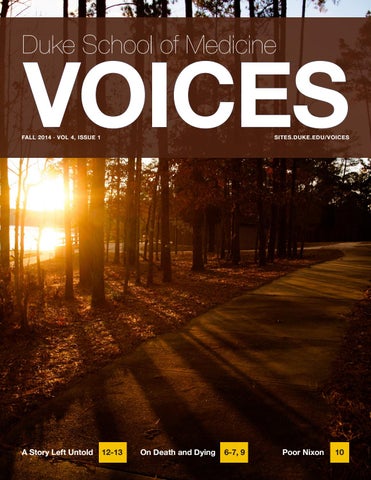
VOICES
Duke School of Medicine
FALL 2014 · VOL 4, ISSUE 1
A Story Left Untold
SITES.DUKE.EDU/VOICES
12-13
On Death and Dying
6-7, 9
Poor Nixon
10
Voices Editors in Chief Rui Dai, MS2 Anna Brown, MS3
Design Editor Neechi Mosha, MD
Treasurer Sean Fischer, MS3
Associate Editors Bilal Ashraf, MS1 Madelyn Stevens, MS1 Kelly Ryan Murphy, MS2 Kun-Wei Song, MS2 Vinayak Venkataraman, MS2 Sean Fischer, MS3 Jacqueline Zillioux, MS4
Special Thanks To
Duke University School of Medicine Davison Council Duke Chapter of the American Medical Association FOR INFORMATION ON JOINING OR WRITING FOR VOICES, PLEASE EMAIL RD74@DUKE.EDU
Table of Contents 4 Autopsy Day 1: A Life And Alive Matt Rosenstein, MS1 5 What is a Stump? Bradley Potts, MS3 4-5 Birdy Photograph Billy Baumgartner, MS1 6-7 Death and Dying Robyn Mical, ABSN Student 7 Bad News Alexandra Rosenberg, MS3 7 Boats Painting Alexandra Rosenberg, MS3 8 On Death And Dying Kelly Ryan Murphy, MS2 8 This New Normal Anna Brown, MS3 9 Sweat Drop Carlisdania Mendoza, MS3 8-9 Duke Chapel Photograph Wendy Wang, MS4 10 Clay Stephanie Ngo, MS3 10 Poor Nixon Leslie Jo Mitchell, RN BSN COS-C 10 Seagull Photograph Liwei Jiang, Johns Hopkins SOM, MS3 11 Dehumanizing the Human Amol Sura, LSU SOM, MS3 11 Lighter Photograph Billy Baumgartner, MS1 12-13 A Story Left Untold Vinayak Venkataraman, MS2 12-13 Maple Leaf Photograph Billy Baumgartner, MS1 14-15 A Breast Cancer-Stained Glass Window
Allison Webb, MS4
14-15 Photograph Elizabeth Deerhake, MS1 Background Photography Credits Cover: Liwei, Johns Hopkins School of Medicine, MS3 Credits/Contents: Billy Baumgartner, MS1
Anatomy Day 1
MATT ROSENSTEIN, MS1
A Life And Alive
The now legendary physicians Dr. Christine Montross (Body of Work, Brown), and Dr. Louise Aronson (History of the Present Illness, UCSF), and acclaimed social historian Professor Teofilo Ruiz (The Terror of History, UCLA) prepared me for medical education by teaching me that I have a duty to learn more about my patients, in life and in death, through experiential narrative. This is my minuscule attempt to learn by walking a toe in their footsteps. Anatomy lab was the part of medical school that really scared me most. Actually the thought of it quintessentially terrified me. The smell and fluid exposure was the tiniest part of that fear. Death scares me. And yes, as a clinician, I’m scared to see someone else die. Yes, people like me can go to medical school. I thought I would faint, throw up, be in the hallway in the first three minutes. In part, it was the idea that I would be there while someone’s mom, daughter, grandmother would be taken apart muscle by muscle. Yet, it was more than this. It was the fact I would be there with what was left. Standing next to an incomplete set of organs, tissues, bones. Parts of a structure that once collectively felt the ultimate stressor. That I would be left wondering at what point a person became the bone in my bone box. I arrived expecting to come home and have nightmares. I’m home now, it’s nighttime and I’m fine. I was reminded that I’m alive. Our arrival felt like the first day of P.E. class in high school. Rushing to find a spot for our backpacks in the locker room, you could smell the industrial cleaning solution on the same sets of scrubs, t minus10 seconds to game time with a long line to use the sink. We knew what to expect, we wanted to know how we would feel. We grabbed gloves, tied each others’ aprons, and checked in. We stood with our dissection teams near the blue tarp-bag with our group number. Our instructor reminded us how special this opportunity was. And then we unzipped, and as I opened my eyes again, I saw her. Oh wow, she’s… she’s real, she has presence, she exists. She seemed at peace. Is she sleeping? We uncovered a leg. And I think I took a step back while shaking. Oh my God. Her legs were pale. Is she ok, I thought to myself. There was some instinct to try to help her. Subconsciously, I denied that she was dead. Then came the face. And she looked just like the people I love. And at that point I
knew I wasn’t going to be able to cut. Hopefully I’d be able to stand and watch this. We turned her over. She had mass. She felt real, she felt like she could give someone a hug. At first I watched from afar. Actually not really watching at all. Then slowly I peaked. I saw the fat above the muscles grease my classmates gloves. I saw the nerves separate naturally, the muscle uncovered. It was real. This was the world beneath a life. And it was personal, I knew everything I saw was in me too. As she became more and more exposed, her finality became more and more conclusive. She was not going to wake up. Not tomorrow, not next week, not ever. She was a synonymous human structure, that couldn’t live. A genetic carrier that could no longer differentiate. A person without a willingness, an eagerness, a commitment, a sense of self. She was gone. And as I could taste a few of those saltier tears, I was reminded. I’m alive. Her feet looked just like mine. Her feet were still shaped the same as mine. And yet I can move mine. I can walk, I can jump, I can go play basketball, I can love. I can go home and eat ice cream. Wake up at 8:30 a.m., lecture by 9:10 a.m. Test, notes, test, more notes. Important. So is being alive. Going to honor her life by appreciating mine is alive. Going to call my Grandma in the morning, and my Mom and my Dad. And play basketball and really do the things that I love. I’ll make time for Grey’s. But first I need to enjoy my life. And be grateful for that moment, the next one, not take anything for granted. We’re here and we’re alive. We are alive. And it is so amazingly awesome.
Matt Rosenstein is an MS1 at Duke University School of Medicine
4 · SITES.DUKE.EDU/VOICES
FALL 2014 · VOL 4, ISSUE 1 PHOTO CREDIT: Billy Baumgartner
BRADLEY POTTS, MS3
What is a Stump But the Abscence of Limb?
What is a stump, but the absence of limb? Let sick life be done and new one begin! Faults of flesh repaired with technology, We’re here to save you, we have the degree.
Had I not the foresight of this vision? Had I been seduced by the incision? Was I too young or ignorant to be trusted by him to hold the healing key?
‘Twas all I thought as I entered the room, A gay call to save this poor man from doom From ciggies and diet - things read in the book, Now sick appendage, I came and I took.
What is a stump, but the absence of limb? At what point does stump end, and man begin? For man without limb is a stump you see, Loss affects all that a body can be.
Rewind just a bit to understand me, With twinkling eyes, a surgeon to be. Oh the OR, as it called like a verse, And whispered, “come here, time to assist first.”
But still this does not explain all I saw Crucibles differ, to any and all. What we can’t do is push our perspective, No pity, no scorn, just be receptive.
Eight weeks did I wait and finally beep, Intern’s off-duty, how high I did leap, And exclaimed to all, “time to chop a leg!” Ditched the banquet to scrub, no fear, no dread.
Though his mass lessened, his weight on me grew, And revealed to me, another thing true. Than anything we think, a man is more, Than stature, than status, than his limbs four.
What is a stump, but the absence of limb? It happens to many, this time to him. Few med students have so lucky a chance, Now would be my turn to wield surgeon’s lance.
And when with this Man, we’re trusted to act With blade, potion, or word, we have a pact: Acknowledge our aims while inclined to feel, Maintain above all, the honor to heal.
But what if he knew my luck was his loss, How quickly aside kind words would he toss. Words that I meant could now meaningless be, If at that moment, he happened on me.
Bradley Potts is an MS3 who is interested in Urology and enjoys fishing and watching Ohio State Football in his free time.
Excited was I, so much that I shook, Sprinting through halls, every short-cut I took. No thoughts of he, on whom I had rounded Proper technique, and Recall I pounded. And when the time came, I focused, no smile Undertaking the act, strange all the while. “Good job” was earned, as I made myself look There, warm in my hand, lay unattached foot. What is a stump, but the absence of limb? Bone and muscle covered with flap of skin. When limbs are septic, a cure it can be, Then back to the floor toward recovery. He was drugged, alone, and absent one leg, I’d gone home, showered, then shuffled to bed. Before the daylight could bring morning gloom, I’d studied his chart, then into his room. He lay as he did every morn before, Subtle smile shown as I opened the door. As my gaze moved down I became quite ill, This Being has changed, product of my thrill. 5 · SITES.DUKE.EDU/VOICES
FALL 2014 · VOL 4, ISSUE 1
Death and Dying
ROBYN MICAL, ABSN STUDENT
that bonded us forever. I committed my whole self to him right then. No matter October 10, 2013 · 20:30 how daunting or grim things got, I would McCormick Hospital be by his side for any physical or emotional Chiang Mai, Thailand support he may need. Two nurses and I placed him on a bed relatively slow evening in the and drew the curtains around us to better emergency room, eight hours of assess his condition. At a closer glance, I my shift done and five more to noticed his eyelashes, eyebrows and hair go, I was hoping for some incomparable were all singed off. The smell of burning and exhilarating traumas. It was day flesh was now concentrated, thick and six of my medical placement in the ED, pungent, stinging my eyes and coating but nothing up to that point could have my mouth. I collected his vitals – BP: prepared me for what was about to 182/114, PR:82, RR: 8, SPO2: 81. The happen. head nurse handed me towels and bottles The ED at McCormick Hospital was a of sterile water and told me to put the small, narrow room that barely had space towels on every inch of his body and pour for six beds. The double sliding doors to the water without reservation. A chaotic the ED were wide open to let a cool draft dialogue took place between the nurse in, as it was a humid evening. At 20:30, all and the patient as the story of what had of those beds were empty as the staff and I happened began to unfold: entertained ourselves with old x-ray films. This young man and his wife were That moment of tranquility changed in an cooking dinner together in their shack 30 instant as a deep walling cry bellowed out minutes out of town. Their gas can, which from the parking lot. Everyone in the room was hooked up to their burner, exploded stopped what they were doing and locked with the young man standing directly next eyes on the doors in anticipation for the to it. Because their kitchen was a very small trauma that was about to come in. room, the explosion ricocheted off all the The next hour of my life was the walls, charring his entire body. His wife, scariest yet most satisfying experience I who had been on the outskirts of the room, have ever had. was able to drive them to the hospital. The moaning grew louder as a young The nurse did a rapid triage assessment woman, age 19, limped into the room. and declared that this man had 85% She was covered in blood and black char. TBSA burns with both 2nd degree deep Looking confused and horrified, she full thickness burns as well as 3rd degree dropped to her knees, gasped for air, and burns. I had limited knowledge on how threw her head back, attempting to scream burns affected the body at this point, but it but nothing came out. The ED nurses was clear to me that he was in shock and raced to her side and quickly escorted her edema was setting in very quickly. Only to one of the beds. Just a moment later several minutes had passed and his skin a young man, age 21, tranquilly shuffled became swollen, tight, and shiny. I stood in with nothing on but a pair of charred next to him as his nurses were yelling shorts. His entire body was seared black, as if he had just fallen through a chimney. orders across the room. He turned his head and looked at me with a tear rolling down A smell wafted through the air that was his cheek. I returned his gaze with my sickly sweet and deeply unpleasant. It hit undivided attention and a calming smile. the back of my throat, eliciting a visceral response in me to move faster, smarter and He gazed back at the ceiling, closed his eyes and began coughing feebly. His nurses reach deep for a sense of compassion I ran back over and shouted for an NG tube. had not yet discovered within myself. I stepped back from him as he started to This man emoted no sounds and no code and the entire team swarmed around words but his eyes were filled with terror him. As they intubated him, a stretcher and anguish. I locked eyes with him and was brought into the room and I was told in that moment we shared a similar fear that they were transferring him to Maharaj
A
6 · SITES.DUKE.EDU/VOICES
Hospital, a nearby public hospital with a specialized burn unit. I was instructed to bring sterile water bottles and his chart into the ambulance and wait for them in there. I moved with haste and precision without contemplation. I was unsure of the plan but I was honored and relieved to be asked to stay with this patient. The 10-minute ambulance ride to Maharaj Hospital was completely silent except for the pumping of oxygen. It was the calm before the storm. My eyes were unwavering from this patient as I watched teardrops stream down the side of his cheek and drip onto the side railing of the stretcher. Each teardrop was like a knife to my heart. Every fiber of my being was screaming to hold him and let him know he’s not alone. It was clear his condition was rapidly deteriorating as the nurse told me his trachea was severely burned, his organs were beginning to fail and systemic edema was setting in. As we pulled up to the ED of Maharaj, a team of at least 20, including doctors, nurses, burn specialists, plastic surgeon, cardiologists, and medical students, were all eagerly anticipating our arrival. We unloaded and went into a large area of the department dedicated to triage cases. It felt like I was walking into a slow motion circus from a nightmare. There was an audience that ‘oohed and awed’ at the severity of his condition, staff swarming around him poking and prodding him with every device available. His blankets were thrown off of him and he shivered uncontrollably for what seemed like an eternity. Someone drew blood while another took more vitals and set up for x-rays. Teaching doctors addressed their students, pointing out findings and quizzing them on their medical knowledge. And all the while, a living, breathing, thinking human had been lying there alone. No one said a word to him. No one asked him a question, updated or consoled him. Not a single person stopped to address any of his needs as a patient who was clearly dying. Surrounded by people but completely alone. People started to clear out as they realized that they couldn’t do much to save him. The adrenaline was gone and the FALL 2014 · VOL 4, ISSUE 1
PAINTING CREDIT: Alexandra Rosenberg
masses disappeared with it; it was as if he was no longer interesting or important. I was lost in translation and didn’t have a clear understanding of what had transpired but I knew from looking at him that he was not going to survive the night. I asked my team what had happened and they confirmed that he was not going to live much longer. I asked permission to stand with him and address some of his basic needs. After getting their consent, I picked up the blanket at his feet and draped it back over his body. His once tiny, fragile, charred body had transformed into a rubicund swollen sac of fluid. I couldn’t distinguish basic anatomical markers on any part of his body. His burns were raw, oozing and the smell was almost unbearable. I continued to move up his body slowly, gazing at every inch of him and finally got to his face. Although his eyes were swollen shut, tears were still slowly streaming down his cheek. In that moment, a commanding and life altering sensation took over. Regardless of what this young man was capable of feeling or comprehending, I was not going to let him die scared or alone. I bent down, placed one hand on his chest and whispered a quieting sentiment to him. I wiped the tear from his cheek and stood there holding him until he took his last breath. My head fell and my heart sank as I silently said goodbye. I couldn’t articulate or grasp any logical emotion for the next hour. During the drive home, I couldn’t process what had happened but I knew I was proud of myself for the role I played in advocating for my patient while he was dying. It wasn’t until I was in bed when a tidal wave of emotions washed over me and I cried until the sun came up. I stood strong in the midst of chaos and focused on my patient’s needs in his final moments of life. I didn’t speak the language nor did I fully understand what had happened, however I recognized his basic needs for companionship and security and gave him every ounce that I had to give. I provided a freedom from suffering by simply being present.
Robyn Mical is a Duke ABSN student who covets global experiences and cookie dough ice cream. 7 · SITES.DUKE.EDU/VOICES
Bad News ALEXANDRA ROSENBERG, MS3 If you looked at this quiet street The cookie cutter houses and the tidy lawns And I said — guess which house Tragedy hit — you’d probably guess mine: Mine, with the overgrown lawn, cause Ed Won’t come when I call; mine — the waste-high weeds, The loveless look of a part time home. But you’d be wrong, you know, Because he came home last week In a dirty uniform and tired face And he said, “Remember our neighbor Sam?” I know Sam. I saw him not long ago in front of his pretty home Maybe playing with his two big dogs, or working on his car, Or maybe I waved at his wife, or son, Or sighed over their lawn. Sam, of the kind face and super hero looks, Who fed our cat when we were at the beach. Sam, who was with my husband On a nameless Afghan mountain One August day was shot“Straight through the neck - nothing the medics could do - just a fluke they hit him -” News like that - a punch in the gut - Injustice - a good man - for what? A crack in the façade of kind divinity. Maybe I could have prayed a little more. Maybe a grander gesture could be made. What’s left to say? One man came home and one did not. And I’m the lucky one again. We rock our rocking chairs and drink a beer. We listen to the fading summer night.
Alexandra Rosenberg is an MS3 at Duke. She grew up in NYC and has since lived- with more or less enthusiasmin Texas, Georgia, Hawaii, the UK and most recently, North Carolina. She is currently surviving the frigid North Carolinian winters with the help of her husband, Trey, and her cat, Kitty
This New Normal
On Death and Dying
In this crowded world We clamor for comfort Compete for cush jobs
The Inopportune Ride
ANNA BROWN, MS3
Rummage our minds for A glimpse of that memory So sweet and forgotten Pillage our hearts for Emotion, so raw and Unbroken, not dulled by Long hours we spend Walking the hospital wards Or rather run to catch up Quick step and quicker thoughts Fast pace keeps on moving Whether done or still living That life you had always Envisioned, now may be A little out of reach. This new normal is what It’s all about these days Reframing reality Your goals once so bold, Now steeped in obstacles Whether time or IV lines. I wonder what it all means Most days
KELLY RYAN MURPHY, MS2 I want two things Said the old man To die alone and To die in pain. “And why is that? Do people not Want the opposite?” Why yes, indeed, they do. “But why alone?” Implored the bystander. So they remember me alive. “But certainly not in pain?” Alas yes, to feel alive. “I hope for your success” Good day to you, too. And so the train emptied, Filling again; new faces To pass the time. And still the old man sat, Surrounded by strangers Free of pain, knowing, Today was not his day.
Obligations I’m going to beat this She said again. And with pursed lips, Upturned corners, We obliged her echo.
When the black and white contrast Fades
Though our ears, Our ears resisted. For had they not, For had they heard, We’d have been obliged.
And our distinctions all Change
And we were just not ready To correct her.
Only time will tell How it will all play out. Until the last tick, We protect what we’ve built
Kelly Ryan Murphy is an MS2 and former Duke undergraduate.
I wonder what we’ll dream of Later on
And compete to complete Our life goals, still bold And unbroken by time.
Anna Brown is an MS3 who enjoys creative writing, and pondering the meaning of life.
Sweat Drop
CARLISDANIA MENDOZA, MS3
When she was a little girl scared and very very little she learned Punishment will fix Fear is good, necessary Crying makes it worse
When she was a little girl scared and very very little she sided with eve Thinking everything would be simpler If it had been her fault I am eve temptress, monster, war hidden in strong and clean and sweet Born to be water that fills pots She yearns to be fire To be free to hate the things she loves I am eve temptress, monster, war. She was born of fire to be water and deserves no aloe for her wounds
Carlisdania Mendoza is an MS3 who loves the beach, squirrels, and fairness in that order. She has a flare for the melodramatic caused at least partially by her early exposure to telenovelas.
PHOTO CREDIT: Wendy Wang
Clay
Poor Nixon
LESLIE JO MITCHELL
STEPHANIE NGO Soft, squishy, sometimes I run through your fingers and splatter Onto the floor Other edges Firmer and harder to move I twist and reach, some Tips hard And rigid Fall And Shatter
What strange unconnected things this man said, “O ill done Dick” and “O well done Harry!” They dubbed him foolish, insane, crazed, and mad. But oh, just then, Richard fell to Henry. What great prophecy he owned, and vision. To test the prophet of his skill, the King Lost a diamond purposely. Quoth Nixon, “Those who hide can find,” all astonishing. What fear had he of being clemmed. “Never,” Pledged Henry and rode off to hunt. Servants Snubbed the pampered loon. The King’s officer Locked him up to keep from torment. This good Man sped up to meet a summons. After Three days returned, and found poor, starved Nixon.
Give rise to softer roots that are malleable Fingers reach from the inside Creating Mazes in My interior
(Inspired by the legend of Robert Nixon c. 1467, the troubled prophet of Cheshire. The Shakespearean-style sonnet, composed in iambic pentameter, was written in an attempt to mix the mathematical peculiarites of the poetry style
Hands Exteriorly Touch me and I bend
with a human story of Robert Nixon.)
But I am mounted on the same pedestal always Stephanie Ngo is an MS3. She enjoys coffee and frisbee catching dogs.
Leslie Jo Mitchell, RN BSN COS-C, is a MSN Nursing Education Student from Wilmington, NC
10 · SITES.DUKE.EDU/VOICES
FALL 2014 · VOL 4, ISSUE 1 PHOTO CREDIT: Liwei Jiang
PHOTO CREDIT: Billy Baumgartner
Dehumanizing the Human
AMOL SURA, LOUISIANA STATE UNIVERSITY SCHOOL OF MEDICINE Death terrifies me. So when our professors first herded us to the human dissection lab, through the foul-smelling corridors of the Medical Education Building, I grew apprehensive that I would be the fool who fainted at the sight of a cadaver. After a few introductory remarks from our professor, we opened our dissection tanks. As I drew the formaldehyde-soaked sheet from my cadaver, I stared down death for the first time in my life. Only a few seconds after the initial shock, a wholly unexpected feeling came over me—indifference. Human dissection has evolved into a medical school rite of passage, the first test to evaluate whether someone is fit to enter the fraternity of physicians. To painstakingly clean and identify the thousands of structures within the body forces its participants into surgical patience, an appreciation for the human body’s intricacy, and an unwavering commitment to education. But an unintended, and maybe counterintuitive, consequence arises from spending hundreds of hours in front of a dead body: desensitization. This numbness comes not only from the passing of hours in lab, but also from the utilization of a person as a scientific frontier. Each passing day in the cadaver facility brings a new anatomical discovery. Findings such as a massive aortic dissection, pervasive hematomas, extensive muscular atrophy within the limbs and face, and a complete hysterectomy contributed to the metamor11 · SITES.DUKE.EDU/VOICES
phosis of my first patient from a rosy grandmother into a three-dimensional textbook figure. Even the most humanizing characteristics of my cadaver—her hot pink nail polish and tattoos etched with a Biblical verse—faded into the background during our tedious scientific examinations. What remained was an educational tool, not a human. Perhaps that’s a good thing. Physicians shouldn’t cringe at the sight of blood or an open wound. Early exposure to death and suffering is necessary in a profession where our entire lives will be spent dealing with it, in some form or another. But it’s also an extraordinarily unhealthy thing to forget the humanness of our cadavers. Ancient physicians realized this. Although the fathers of Western medicine, Hippocrates and Galen, dissected and vivisected thousands of mammals to uncover the anatomical basis of disease, they steered clear of human dissection. In Homer’s Iliad, one of the only things that pauses the nonstop battle is the collection of and prayer over fallen soldiers. And by sacred Greek laws, homes that contained a newly-dead corpse were considered so desecrated that other villagers were prohibited from entering the home. In sum, remarkably powerful legal, religious, and social taboos surrounded the scientific investigation of corpses for over two thousand years, stretching into the Renaissance. This attitude persisted despite society’s self-conscious realization that it hindered
medical breakthroughs for generations. Why were the ancients, even the most scientifically-minded ones, terrified of human dissection and dehumanizing their dead? And why has modernity since decided that it’s OK to interact with cadavers? The tension between the usefulness of dissection and its dehumanizing nature is omnipresent. As future physicians—bearers of the torch of humanism—we must come to terms with this tension in our own ways. This takes time, effort, and discomfort. But just as the Greek and Trojan soldiers in the Iliad once realized, sometimes we too must pause our battles, understand the gravity of our cadaver’s sacrifice, and offer a prayer over a fallen soldier. Amol Sura is an MS3 at Louisiana State University School of Medicine, and a Duke undergraduate alumnus. FALL 2014 · VOL 4, ISSUE 1
Looking Through a Breast Cancer-Stained Glass Window This piece is about one family’s perspective on their mother getting and battling breast cancer. I wrote it after interviewing my parents for an Illness Narratives class to better understand our family’s narrative of my mother’s cancer. Of course, it is “stained” by my own perspective. Just like a stained glass window, each member offers a unique viewpoint that sheds light on a certain part of the illness experience. Each part of any story is a small fragment of a larger collage that helps onlookers understand a cohesive, beautiful whole. This piece aims to represent that fragmented work of beauty that was, and still is, my family’s illness narrative. Revelation Few Things Worse I knew I had cancer from the moment I felt that parasitic little lump that took residence in my breast and sucked its lifeblood from my breast tissue. I touched it, gently, and then stopped touching it at all. What if I pushed the cancer out into my bloodstream? What if massaging it encouraged the little bugger to grow, made it think I was affirming its presence with my tender touch? I just knew it couldn’t be anything else. It was a primordial fear. Breast cancer was the one illness that I always dreaded and spoke of in tremulous, apprehensive, “what if ” questions. I had been religious, too, even devout about my health. Damn near obsessed with having my husband check me for lumps. I never missed a yearly checkup. Never smoked, rarely drank. I suppose I could have exercised more, but I ate well. I decided that stress was the cause… and God. Was I being punished? Dare I say that I blamed God for this? So common a thought, I know, but He was so perfect a scapegoat. Blaming a tame scapegoat offers such relief, but God was not behaving. It was as if this naughty scapegoat had turned around and bit me in the ass, maybe the breast, really, and then took pleasure in it with a wicked laugh. I knew it was cancer. It had to be. It couldn’t be anything else. As I sat in front of the doctor, only one thought was going through my mind. I rehearsed so I’d be ready. The phrase looped on a continuous circuit. It was like a song, a melody with its own distinct rhythm: “You have cancer, you have cancer, you have cancer.” “You have cancer.” “I have cancer.” The doctor’s words and my thoughts
synchronized into the apex of my opus, the harmony that the entire piece hinges upon, the chord on which you hold your breath, waiting for resolution. His Prayer Heavenly Father, Lord, please help me. Help my wife, help my children. I don’t know if I can do this. Please give me strength. Please don’t let my wife die. The Daughters My parents were both home when my two sisters and I got home from school on a Friday. They were never both home when we got home from school. Something was wrong. Alli: What’s wrong? Dad: Sit down. We sat. Together. Dad: Your mother had her doctor’s appointment today to go over the biopsy results. She has breast cancer. (Pause). I know this is going to be really hard for you girls, but it’s going to be OK. We have a lot of questions that can’t be answered yet. She has to get her breast removed. That is going to be OK, too. We are leaving on Monday to fly to the States, and she has an appointment with some really great surgeons on Tuesday. Jenni: (In a panicky voice) Is Mommy going to die? Alli: No, Jenni, she’s not going to die. Mom: (Crying, just a little, with silent rolling tears). I could die. Dad: Desi, you are not going to die. Girls, she is not going to die. Mom: (Quietly, more to herself this time). I could die. Dad: Here is the plan of attack. (Note: Dad is a man with a perpetual plan of attack. An Army officer, he divides challenges into goals and objectives, especially in relation to his family. At times like this, his training makes things easier. It is a reversion to what he knows, to what he’s comfortable with). Jenni will be coming with us because she isn’t old enough to stay in the boarding house and we don’t want to separate her from Mom. Alli and Kaiti, you’ll go into the boarding house while we are gone. I know it will be hard, but Mommy and I want you to stay in school and we have faith that you can do it. Can you do it? Kaiti: (Crying) I don’t want to do it.
12 · SITES.DUKE.EDU/VOICES
Alli: Yes, Dad, we can do it. Kaiti, it will be OK. I’ll look after you. Kaiti: I’ll want Mommy. Mom: I’ll want you. Tribulation Row of Lights If I’m going to die from breast cancer, please, Lord, let it be now. Let me go to sleep in my operation and not wake up. If I’m going to die, don’t let it be after I’ve given a long fight with lots of pain. The Operation I had seen pictures from the operation. I supposed the surgeon would naturally want to document the process, the moment when he shot the first bullet in the war against my wife’s cancer. The surgeon, like a master butcher, had flayed open my wife’s breast. Proudly, he took a picture of the extracted flesh, sunny side up, so that the fat, muscle, and cancer tissue were displayed. “We got all of it”, he proudly proclaimed. Should I feel triumphant? Anguish The sound of beating water against the fiberglass walls of the shower was not loud enough to stifle my wife’s sobs. This was not a cry that wrinkles the sufferer’s face at the eyes and forehead. It was a cry that twists and contorts the sufferer’s entire body into the mangled posture of pain, loss, and despair. The anguish that was pouring from my wife’s soul wrapped its unwanted arms around my own heart, and began a suffocating squeeze. In this moment, she looked far different from the woman I married. In a soft voice I chanted, “Desi, Desi, Desi,” both to calm my wife and remind me that she still was, at least at her core, the woman I married. Naked together, I focused. With one arm I held my wife under her good arm to support her, my other hand cupping handfuls of water, pouring them over her head. Careful, careful, can’t get the incision wet yet. It, the scar, stared at me, but I was stoic. “Desi, Desi, Desi.” Hair I could not get away from my cancer. My cancer had become my identity. During the day, the cancer was still with FALL 2014 · VOL 4, ISSUE 1
PHOTO CREDIT: Elizabeth Deerhake
ALLISON WEBB, MS4 me. Every interaction would remind me of my cancerous state. I hated it when people said, “Desi, you look good!” I knew that I didn’t look good, definitely not great. I looked like I was sick. I looked cancerous. For me, the attempt at kindness was instead an ugly and public recognition that, yes, this is a woman who is fighting cancer. We must affirm her. Support her. You don’t go around telling normal people that they look good. Honestly, worst of all was losing my hair. I could hide my lack of breast with a fake implant that fit into my bra. The wig I used to cover my bald head sufficed only if the onlooker was about five feet away. Any closer, and my cancerous status was revealed. The wig was shaped well, but unmoving. The color was about right, but its texture was coarse and somewhat straw-like. It had a funny, plastic shine to it. Not even the night offered respite from the cancer. Wasn’t it enough that I thought about it constantly during the day? No. Cancer stayed with me like the annoying song that gets stuck in your head and won’t leave, or the hiccups without a remedy. Waking up in the middle of the night, I could feel my silk nightgown brush against my intact breast. What a glorious, feminine feeling. Yet the right side of my chest was empty. When your breast is taken because of breast cancer, the doctors relentlessly scrape every last cell of tissue off your chest wall. You become flatter than a pre-pubescent girl. The thin skin that was stretched tightly over my right rib cage was void of feeling, numb, and scaly from rounds of radiation. I stumbled to the bathroom. As my sleepy eyes adjusted to the light in the bathroom, my reflected image came into focus. In the mirror, I saw a woman I did not want to be. The same silk nightgown that once looked beautiful lying against my pale skin hung awkwardly on my deformed frame. Filled with a breast on the left side, it hung limp across my bare right rib cage. My head was bald in patches, some hair still hung on with a death grip to my scalp. The same way I was holding on with a death grip to my life. I silently cheered on each remaining lock. Hold on, hold on. Self-Righteousness In many ways I made my mother’s breast cancer about me. I was proud of the way I put on a stiff upper lip. I thought my mother, and certainly others, would admire such immense strength in a sixteenyear-old girl. I would exceed everyone’s, and my own, expectations. I did not like boarding school. I felt like I could not relate to the other girls who 13 · SITES.DUKE.EDU/VOICES
lived there. We had more in common than I wanted to admit: we were motherless. Our abandonment should have united us. But I felt like my family’s separation was distinctly different. It was not a choice: it was forced upon us. I considered myself a refugee, exiled to a place I had to call my home. I was lonely. I did not vocalize these discomforts often. One night, the picture of my family that I taped to my wall fell down into the crevice between my bed and the wall. In the morning, I noticed the empty space and a panic surged within me. My family! What evil plot was this that destroyed any tenuous attempts I had made to keep my family close? The injustice! I fixed my makeup before heading out the door to class so no one would know I had been crying. Deliverance Expectations Recovery is an interesting concept. I expected my wife to recover from her illness much faster than she did. She handled most of the physical challenges with valor and courage. The chemo did not entirely wreck her physically. She still worked quite a bit throughout the chemo. I was proud. But my wife’s spirit had been crushed. She thought about death and cancer all the time. Her wounds healed, the rounds of chemo subsided, she began to gain her hair back, and I expected her to come out of the emotional despair that breast cancer had put her in. I needed her to come out of this. We all needed it. We were tired, in many ways, of repeating the lines, “No, you are not going to die”. This chant had become our anthem. It was the family’s new mantra. I was getting angry, and Desi knew it. It was the aftermath that hurt our marriage. Collateral damage… Non-Speakables In my family, there is one thing that you don’t say. You do not say, “I hate you.” I’ve said it probably eight times. Three times to my mother, and five times to my sisters. Every time I have said it, it hangs in the air for a split second before it delivers its nasty uppercut. In that split second, I always wish that I could take it back. I’ve found another thing that you don’t say. You do not say that you are angry at your mother for how she dealt with her breast cancer. You do not say she disappointed you. You do not say she is not your hero. You do not say you are bitter, or angry. You do not say she made you scared. You do not say that when you think about yourself getting breast cancer, you pray
you’ll handle it differently than your mom. These are non-speakables. Mom’s Words, Nov 4th, 2008 “I don’t feel like I changed as a result of having breast cancer, and that worries me. Did I miss something? I still get stressed out, and feel like maybe I missed learning something. I hear about people who totally change their lives as a result of cancer (like they eat organic foods, or don’t eat sugar anymore, or exercise religiously) or they say that cancer was the best thing that ever happened to them! I know for certain, without a doubt, that cancer was NOT the best thing that ever happened to me.” Thoughts on Writing this Narrative
I was surprised at how difficult writing this narrative was for me. The process of asking my parents about their experiences and feelings towards my mother’s breast cancer was eye opening. Many of their answers were surprising, and it was difficult for me to integrate their views with assumptions that I had already made. As I tried to convey my own emotions honestly, I continually thought about how much of this I’d want to reveal to my mother. On one phone call home, my sister asked me what my narrative project was about. My mother overheard, and interjected, “It’s about me being Alli’s hero.” My mom isn’t my hero, but that does not diminish what she went through or how much I love her. I won’t tell her she is not my hero. I’ll tell her that I’m proud of her for getting through cancer, because she has. She came through it in the end. I’ll tell her I’m thankful that her breast cancer is behind us. I’ll tell her I’m proud to be her daughter and that I respect her. Most of all, I’ll tell her I love her.
Alli is a fourth year medical student at Duke University. She hopes to pursue training in Medicine-Psychiatry in the United States Army.
FALL 2014 · VOL 4, ISSUE 1
The Story Left Untold Family Medicine I arrived at Pickens Family Medicine clinic, alongside a crisp autumn breeze. I had arrived a few minutes early to prepare for another day. Days were always busy at Pickens, where patients had more comorbidities than minutes to discuss them. For every patient, in order to get ahead, I would commence on a journey through the corridors of EPIC with my mouse serving as my noble steed. Visits for chronic disease management had fairly predictable stops. For diabetics, I would look up their HgbA1c and medication history to get a sense of their overall management. Then, I’d check their blood pressure and lipid panel to make sure they were being treated with the latest hypertension and cholesterol guidelines, which lead to everyone and their mother being put on atorvastatin. Lastly, I’d check if they had seen an eye doctor within the last year and if they had received their flu shot yet. The journey became slightly more spontaneous as I tried to piece together what had happened since their last visit. Some patients had gone to the ED with acute flare-ups. Others were seeing cardiologists or nephrologists now that their chronic conditions had started taking its toll on their organs. By making mental connections, I could piece together a simple, concise history before even meeting the patient. I tried my best to make this journey an objective means of previewing my conversation with the patient. However, I would sometimes find myself entering a room with an HPI already formulated in my head. The patient just needed to help me fill a few gaps in the story. EPIC made it all the easier with various templates one could follow those templates could sometimes help guide the creation of the story and determine the probative questions needed to make it real. It was less a habit of creativity, more a habit of convenience. While the best stories are those with nuance and complexity, the nature of the beast (i.e. 15 minute visits) made mundane, straightforward stories more appealing. Too bad these stories were rarely accurate. “Ms. M?” I said after knocking, “My name is Vinayak, and I’m a medical student working with the doctor today. Can I talk to you for a bit?” “Sure, that’d be fine,” She replied, softly.
She was a heavyset, African American woman in her 70s with horn-rimmed glasses of my parent’s era and deep wrinkles beneath her eyes. She had a steady affect, as if age had touched her a few times too forcefully and left her tired and jaded. She had made eye contact for a couple seconds while answering, but was now staring at the floor. “What brings you in today?” “To talk about my diabetes.” EPIC had told me that she was in for a onemonth checkup on her diabetes. So before coming in, I had scrambled through her EMR to get all her numbers. I also knew she had a full spectrum of active problems: diabetes, hypertension, high cholesterol, obesity, COPD, coronary artery disease, and end-stage renal disease. In a 15-minute visit, however, diabetes necessarily had to be the focus. “How have things been going?” “Well, I think it’s been going fine,” she said. “I haven’t really paid much attention to be honest.” Her diabetes was not fine. Her numbers were headed in the wrong direction. Her HgbA1c had been holding steady for a few months but had risen quite a bit. Her blood and urine tests showed signs of worsening kidney disease. Thankfully, her eye doctor had noted stable diabetic retinopathy in his visit last month, but who knew how long that would last? “Have you been able to measure your glucose at home?” I asked. “Sometimes in the morning,” she said. “Do you remember what they read when you check them?” “I really can’t remember, but I think they looked OK.” I tried to get more information, following a standard script — has she had any episodes of high or low blood sugar? Has she had chest pains or shortness of breath? How about numbness/tingling or changes in her foot sensations? Changes to her vision? These questions led to a parade of “No… no…no…no.” “Do you get three full meals a day?” “Not really,” she replied. “I’ve had a smaller appetite in the last month.” “How’s your exercise regimen been going?” I asked. “I haven’t been working out much,” she replied. “I used to go to the Senior Center, but I’ve just felt too tired to go.” She shifted her gaze from the floor to my eyes before going back to the floor. A tear meandered down her left eye, getting trapped in a pool around her frames. Then another one. And another. She pulled out a tissue to wipe her eyes, moving her glasses up so I could see her bloodshot red eyes unhindered by refraction. She continued to look down at the floor, never looking up. “What’s wrong, Ms. M?” I asked, gently leaning
14 · SITES.DUKE.EDU/VOICES
in. “I lost my daughter two months ago,” she said, softly. “It’s been tough trying to get through that.” The story that I had constructed in my head before the visit had been reduced to ashes. All those lab values and previous clinic notes did not hold meaning today. All those scripted questions meant to guide the story’s formation — are you having trouble monitoring your glucose regularly? Taking your insulin and metformin? Having side effects to them? Eating healthy and being active? — weren’t going to be helpful. Despite the chief complaint recorded in EPIC, this was no longer a visit about diabetes management. It was about so much more, and there was no EPIC template to guide that conversation. Nor should there be. The conversation that followed was unscripted, unhindered, unbiased by previous data. She told me about her daughter, how her passing had affected her, and how the grieving process had been since. Her daughter had issues in the past, but she had been working towards improving her life. But her life had ended in a freak car accident, leaving behind broken memories and a deluge of emotions for her mother. Though Ms. M had become reclusive and detached over the month, she also had a strong spirit who was motivated to get better, both physically and emotionally. She was starting to feel better, reconnect with her friends, and spend more time with her living children. But in acknowledging the progress she had made, she was mindful of the things — such as her late daughter’s birthday — that could set her back. The emotional rollercoaster of grief was consuming so much energy that she had not been able to keep up with her medications and blood sugar management. Fortunately, she had volunteered this information during the visit — other patients might not have done so. Without it, any history on the patient would have been incomplete, and any recommendations made would not have been helpful. Through several experiences like this one, I quickly learned how tempting it is to reduce people to numbers and former progress notes — to try to construct my own narrative for them before even meeting them. As much as I dislike myself for doing so, the inevitable time crunch of a busy clinic, and the wellintentioned effort to reduce wait times, has made it harder to avoid. It takes a lot of time to discover a patient is grieving and help them develop the next steps — it’s so much faster to FALL 2014 · VOL 4, ISSUE 1
PHOTO CREDIT: Billy Baumgartner
VINAYAK VENKATARAMAN, MS2
pull up the PHQ-9 Depression Screen, calculate a number, and ask scripted questions. But by doing so, you often miss the real reason for the visit, the real reason they aren’t doing as well as they could. You miss learning about their story, the real one — the story that often goes untold.
on my second pass — or at least convince myself I did. One episode in particular impacted me. I was rotating through Vascular and Interventional Radiology and watching my first procedure — a hepatic angiogram and arterial embolism. The patient had just gotten onto the operating table The clinical clerkship journey has been filled and been covered in surgical drapes. She was with several experiences that force me to reflect a middle age woman with a cheerful smile and on many things. One of them has been the role of lively personality. electronic medical records in the care of patients. “I’ve seen fire and I’ve seen rain,” she was While I have had several experiences where the singing. “I’ve seen sunny days that I thought information contained in them are vital, I have would never end.” also seen instances, such as this, where it allows me “James Taylor?” asked the anesthesia nurse. to construct convenient stories that are devoid of “Yes sir!” she replied, “I’m a music teacher color, nuance, or accuracy. and my students are learning that song.” The sheer amount of data and information “That’s a nice one,” he said. “Alright I think housed in EPIC is astonishing, but the connections we’re going to get started.” between disparate streams are prone to bias Her voice faded as the sedative agent started and inaccuracy if not guided by the patient’s to kick in. The radiologist moved into position. own words. As a student just starting out on the They used fluoroscopy to image the liver’s medical career journey, I don’t know the answer, vasculature and then insert material into the but I hope to find that balance with experience hepatic artery to block its flow from the aorta to to discover the story for each patient that is often the liver. Since most of its blood comes from an left untold. alternate source (the portal vein), the liver is still able to survive. The procedure I watched was a success and Radiology took less than an hour to complete. I figured the patient would be happy since I had an I’ve found that sometimes medical experiences impression that most VIR procedures were are less about the patient, and more about curative. But I was still left puzzled — why the procedure itself or information obtained would anyone want to block off the hepatic through the procedure. This was especially true artery? in radiology where most patient “encounters” I stepped outside and quickly glanced through were through a set of images and most in-person her progress notes. My answer came quickly as encounters featured sedated patients. I noted most notes were coming from “Duke Overall, I found radiologists an impressive Oncology.” The cheerful woman who I just bunch, not just for their breadth of knowledge, saw, full of life and singing James Taylor, had but also for their incredible efficiency. In mere terminal cancer of the bile ducts in her liver. seconds, a radiologist could scan through a patient’s entire body, looking for abnormalities as This procedure was successful in that it cut off the cancer’s main blood supply, but for the they quickly scroll through a morbid flipbook of patient, it was a palliative, not curative, measure. one’s innards. She didn’t have much time. On top of that, as They knew so much about someone’s internal a single mother, every note contained a social anatomy without laying a single finger on a work addendum, discussing what would happen patient. However, to fully understand what to her kids once she passed. was going on with the patient, a clinical story Beyond asking if I could watch her procedure, often needed to be constructed. Much to the consternation of radiologists, the referring doctor I had never met or gotten to know her. I typically did not provide this story. It fell on them had never met her kids or family. The only impression I got when I left the procedure was to construct one through the series of progress she was a vivacious person who had a successful notes housed in EPIC. procedure. But all I could think about for the Radiology being my first rotation, I was forced rest of the day were the notes I read. But I to do this quite a lot for my own benefit because didn’t know the full story, nor would I ever. I I barely knew what was going on. In some cases, would only know the fragmented clinical story it wasn’t too hard. If I couldn’t find a fracture on that could be pieced together through progress plain film, I’d go back to the primary care note notes in EPIC. And the fact that she would soon and see where the patient had localized the pain. With more pinpoint focus, I could find the fracture pass. 15 · SITES.DUKE.EDU/VOICES
The clinical clerkship journey has been filled with several experiences that have forced me to reflect on many things. One of them is the role of learning about techniques and procedures. Knowing how a hepatic angiogram is done and how to interpret the information obtained is incredibly important, and often, it does not require knowing the patient at all. While knowing a patient’s history can be important when reading their images, it isn’t necessary to know more than what the reason for the procedure. And I’ve learned that this is OK — for sake of efficiency and impact, it’s OK to not know the full story. But when I don’t, my natural curiosity often gets the better of me. The only way to learn more is through the fragmented notes contained in EPIC. And by piecing them together, one can discover the story left untold.
Vinayak Venkataraman is an MS 2 who enjoys writing, cooking Indian food, playing tennis, drinking coffee, and cheering for the Buffalo Bills.
FALL 2014 · VOL 4, ISSUE 1
PHOTO CREDIT: Billy Baumgartner (MS1)
SITES.DUKE.EDU/VOICES
FALL 2014 · VOL 4, ISSUE 1