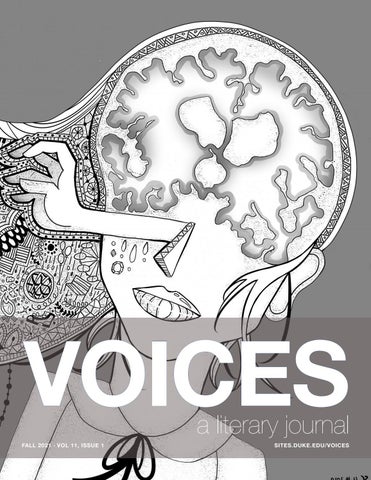
VOICES
FALL 2021 · VOL 11, ISSUE 1
a literary journal SITES.DUKE.EDU/VOICES
VOICES about us
Voices is a literary magazine of the Duke University School of Medicine. We publish varied forms of creative expression from the medical community, and welcome submissions from patients, students, healthcare providers, employees, families, and friends. Our goal is to publish a range of unique voices in the healthcare system. We hope that as you read through the pieces published in this issue, you will be inspired to submit something as well. All submissions can be sent to dukemedvoices@gmail.com or online at sites.duke.edu/voices.
letter from the editors Looking back, normal is certainly no longer the same normal that we were accustomed to a few years ago. We have had to not only adjust to a once-in-alifetime pandemic but have had to come to face with all aspects of our identity as a community—all our differences and disparities. Masking and vaccinations remain contentious political topics, opposed to facts proven to save lives. Patients languishing in the intensive care unit would rather endure invasive procedures again and again, instead of a single shot to the arm. Has societal trust corroded so extensively that it is past the point of no return, or is this just another one of those periods in history full of sound and fury, signifying nothing—that future generations will read in textbooks and marvel? For all our sakes, we hope that it is the latter. A politician recently noted, with surprising astuteness, that while the title of “the greatest generation” is already taken, we can still strive to be “the kindest generation.” By individual sacrifice and unity, we might be able to restore a living heartbeat to society. In this issue of Voices, we attempt to return to normal, knowing full well that we may never achieve it again henceforth, but also to capture the best versions of ourselves. As always, we welcome any comments and interest in joining our team via email at dukemedvoices@gmail.com or online at sites.duke.edu/voices. Your Editors-in-Chief, Rui Dai Lindsey Chew PHOTOGRAPHY CREDITS: Qiang Miao
table of contents
Letter From the Editors Rui Dai, Lindsey Chew 2
Strawberries in the Sun Jess Harris, RN 4-5 Dear Parents Anonymous 6-7 Want to Play
Sam Curtis, MD
8-9
Lessons from “Spring and All” Govind Krishnan, MD 10-11 My Silent Teacher Linda Li 12-13 Poems John Sihn 13 Words Matter Simone Nabors 14
associate editors
Kate Daniel Danielle Levinson Nathan Luzum Linda Li David Ryu Austin Ayer Seth Flynn
MS1 MS1 MS1 MS2 MS2 MS3 MS3
Karen Jooste MD, MPH Brian Quaranta MD Jeffrey Baker
MD, PhD
Emily Hatheway MS3 Kira Panzer MS3 Megha Gupta MS4 Rosa Yang MS4 Devon DiPalma GS2 S. Tammy Hsu, MD PGY2 Natalie Chou Undergraduate
faculty & staff editors Sneha Mantri MD
trent center advisors Marjorie Miller MA Nikki Vangsnes
Strawberries in the Sun
April 2020. I needed a longer commute. I plodded down the flights of stairs and stepped out into fresh air and fading light. My steps on the eight-minute walk home would fail to carry me an adequate distance from this place. I needed to be further. I did not want to see the light reflecting off the glass exterior of the ICU tower when I looked out the window. I did not want to have my dinner interrupted by the dull roar of the helicopters dropping off patients, giant mechanical perverse storks come to drop off the dying. I needed more than eight minutes to decompress. To wash away the sounds of shrill alarms and the cries of the suffering, dying, and mourning. To aerate the odor of bodily fluids and cleaning products that settled in the threads of my scrubs. To acknowledge and set aside the emotions, burdens, and tales of woe that accompanied each person I cared for, whose burdens I took in part for those twelve hours. I adjusted the strap of my bag across my chest and began the walk home, tucking in headphones playing music entirely too loudly. I could not begin… No. I did not want to begin to process the shift. I would go home, wash the shift away with a scalding shower, and watch a John Mulaney Netflix special so I would not have to think about the preceding thirteen hours. The shift had begun much as any critical care nurse’s day started during the pandemic; business as usual was masks and caps and green checks 4 · SITES.DUKE.EDU/VOICES
and closed break rooms. I was assigned two “up-training” nurses—med-surg, outpatient, OR, and PACU staff I was responsible for orienting and training in the ICU to be fully capable of being a competent part of a “team nursing” model (one ICU nurse paired with three non-ICU nurses responsible for overseeing nine critically ill patients). For every single shift the past month, I had either been with COVID+ patients or attempting to train non-ICU staff competency in skills that take years to master. I was already exhausted, and the dreaded First Wave had yet to peak in our community. The day started with a dying patient. Not so unusual—when one works with the critically ill it is a common outcome. An iPad stood on a stand, allowing a family unable to travel due to COVID restrictions the opportunity to say goodbye. He mercifully passed quickly. I grabbed a body bag from the supply room, quickly returning to the room to teach post-mortem care. The day continued. A second occupant came and left the room in much the same manner—iPad and alone save some unknown nurse. The previously full slot labelled “shroud” in our supply room had one remaining item. I grabbed the last body bag from the shelf, calling our unit secretary to ask her to order more as I walked back. “They’re out.” “Yeah, that’s why I’m calling. Can you have supply chain restock?” “No.” She paused. “Supply
chain is out. We can’t get any more until tomorrow morning— system wide.” My stomach dropped. I thanked her and hung up. By the end of the twelvehour shift, our 22 bed ICU had wheeled seven patients down to the morgue. Two covered in only a sheet. April 2021. I had never been one for old films. When our Plague Literature instructor told us we would be watching The Seventh Seal together, I was unsure what to expect. I expected a somewhat grotesque portrayal of plague with terrible special effects. An examination of faith, existentialism, and the human condition were not quite what I had anticipated. After years away fighting in the crusades, the character of Knight Antonius Block returned to Sweden to find his homeland burdened with the Black Death. Block ventured out sure and devout. He returned riddled with doubt, questioning the very existence of the God he sought to serve and make known. The film opens with an excerpt from the book of Revelation, citing “silence in heaven about the space of half an hour.” This hints towards a theme woven throughout the film: silence from God. I began my tenure as a nurse driven by noble but naïve ideals. Prior to the start of COVID, working in critical care had choked out much of the passion I felt towards my work and stirred up a crisis of faith. As a critical care nurse, you are afforded a unique glimpse into the depravity of FALL 2021 · VOL 11, ISSUE 1
humanity. You see the effects of what people are capable of doing to one another—the evils and atrocities that occur when one raises his hand against his fellow man. You see the horrible things people do to themselves. You see the cruel results of chance. It is easy to become overwhelmed by the senselessness of the pain and suffering you witness. Where is the goodness of God in all of this? Where within the halls of the critical care unit does His mercy reside? Why does He not intervene? Why does God stay silent in the face of so much human suffering? Like Antonius Block, I too have sought answers; asking questions to a seemingly distant deity, receiving silence as the only response. The personification of Death begins to stalk Block early in the film. A game of chess, for life and soul, ensues. One scene in particular struck me. As Block plays chess with Death near a cliff’s edge, they witness a beautiful young mother, Mia, playing in the grass with her infant son Mikael. Mia and Mikael distract Block, leaving his match with Death to enjoy their company. They sit, marveling in Mikael’s youth and vitality; lounging in the sunshine, snacking on strawberries and milk with this young and pure family, Block ceases to be tormented by Death and questions of purpose and meaning. His worries and doubts melt away in the face of the fruits of love and simple joys. Our tortured knight is serene, maybe even hopeful. April 2020. My commute ending all too quickly, I arrived home. After the aforementioned scald5 · SITES.DUKE.EDU/VOICES
ing shower, I settled down with a bowl of leftovers and flicked on the television screen, seeking a mental anesthetic from the troubles and sorrows of the day. As I scrolled through Netflix, the familiar tones of a FaceTime call came from the cushion beside me. A moment passed as I considered leaving the phone unanswered. Sighing, I slid the bar to the right, revealing my sister and her 18-month-old daughter on screen. A few minutes into the call, I began to weep. I was overcome by her vitality and youth. Her vigor and joy for life. Fresh-faced, she was only at the beginning of this life—everything ahead. Her giggles and rosy cheeks stood in such dramatic contrast with my day that the dissonance was dizzying. I had witnessed the ending of seven stories that day. Seven people leaving this life surrounded by machines and the unfamiliar. Seven families unable to say goodbye to their loved ones in person. The world sterile and cold and bleak. But this toddler with wild hair and dirty hands babbled on about her day to me, trying to communicate the joys and wonders and excitements of her day on their farm. Her story was in its first chapters. She was in that moment my Mikael—an allegory of the infant Jesus. As I wandered through a land overwrought with death, seeking an accounting for all the pain I witnessed, she was a beacon of light and purity and innocence to show me that not all the world is in extremis or suffering. That hope for tomorrow and tomorrow’s tomorrow exists in the person she may become. She provided me a
much-needed moment of reprieve; though I was not engaged in a match for my life, I wrestled with questions of purpose, mortality, and the character of the God I sought to serve. Listening to the unintelligible prattlings of a child, I sat eating strawberries in the sunshine. The Seventh Seal does not portray Death as some grotesque caricature, but instead depicts mortality as a lingering, dispassionate presence. Block, as many do, struggles to accept the company of Death. I have seen many wrestle and bargain with Death in the vein of Antonius Block; it is never to any avail. My line of work allowed for frequent reminders of the ending of all lives in a very tangible way. Everyone dies; young and old, rich and poor, weak and strong. People run and battle and bargain against him, spending their last hours in turmoil instead of peace; still Death comes. We do not often have a say in when Death will come to us, but we can control our reaction to his arrival. At the close of the film, Death comes for our knight and his companions. One character stands before the others, face painted by peace. She has witnessed suffering and death. Despite, or maybe because of, her intimate acquaintance with hardship and sorrow, the mute girl stands at the arrival of Death, devoid of fear. She speaks for the first time in the film, echoing the words of Jesus on the cross. Expectant for the hope that lies ahead, she accepts Death. May we all enter our last in such a fashion. Jess Harris is a critical care nurse turned PA student with a love for the outdoors, coffee, and books. FALL 2021 · VOL 11, ISSUE 1
Dear Parents
Hi mom and dad, It’s me, your disappointing child. It’s difficult to admit how deeply my desire to please you and make you proud has defined the last near-decade of my young adult life, and even more challenging to know what to say after so many years of just…not saying. Med school is hard, mom and dad, but not as hard as navigating my desperate need for your approval. I’ve tried to free myself from that need. I’ve tried to focus on the love and support of my friends and siblings, to find peace in living out my faith, and to embrace the truth that my own pride in my accomplishments is more important than yours. But knowing something in my mind and feeling it in my heart are often galaxies apart from each other. I’m sorry I don’t seem as stressed or worn-out as you think a medical student should be if they were working hard enough. I thought you’d appreciate my attempts to lead a healthy, balanced life, but I’ll do my best to look more sleep-deprived the next time I see you. I wish you’d ask about my friends and hobbies more often than my latest exam grades or Step study plan. I’m really struggling to make friends. I feel alone in my beliefs and values, and loneliness is the new pandemic. No, it’s ok, I don’t want more advice on networking and putting myself out there. I know, I know, “magic happens outside of your comfort zone” … I’m tired of being uncomfortable. 6 · SITES.DUKE.EDU/VOICES
Yes, I understand the importance of connections with colleagues for my future career, but I want real friends! I want people I can invite to my wedding one day… Humans are designed for companionship. We’re made for community. It’s not enough to be in the physical presence of others, small-talking and networking until our minds are numb. I want to be seen. Heard. I want friends who know who I am. But who am I? Do you even know? Do I? “Modern loneliness. We’re never alone but always depressed.” You said it Lauv. Should I even answer the phone when you call? I don’t know. When I don’t answer, I must be too busy and important to keep in touch with my parents. When I do answer, I must have too much time on my hands and can’t be working hard enough. And if I only let it ring twice, then geez, I must have my phone on me all the time and am far too distracted during my studies. Oh, I went out to dinner for a friend’s birthday last weekend? That doesn’t sound like the life of a med student… they’re obviously taking it too easy on us. More proof that this generation is soft and incapable of accomplishing anything meaningful or withstanding difficulties. Yes, I still go to church and exercise. I’m pretty sure I’m still losing weight as you suggested, and yes, I still play my instrument but of course not as much as I used to. I know you put thousands of dollars into my musical training… no, it wasn’t all for nothing, I’ll do my best to
keep practicing. Rotations are just keeping me busy. Yes, I promise I’m asking questions and making a good impression. I don’t know if I’m going to do surgery, the lifestyle doesn’t seem compatible with my hopes for a family. I want a life outside of the hospital... Yes, I know you think I should prioritize my career right now, but I’m trying to set myself up for happiness as well as success. Choosing a non-surgical specialty is not the lazy way out! Forget it… let’s talk about something else. Step 1? I thought it went well. I know my score was only in the 75th percentile... I’m sorry I couldn’t be better than the other 25% of med students in the country, but I really did work hard. I’m sure I’ll be fine for residency applications… no, not because I’m settling for second-rate programs, but because it’s truly not a bad score. I know a 75% is a C… that’s not how it works. This isn’t helping, can I go now? No, I’m not coming home for my research year. I know I could save a lot of money, but my life is in limbo when I’m at home. I don’t go anywhere, I don’t meet anybody, I just get swallowed up in the family’s affairs as though I never left. What do you mean, why do I have to meet people? I want a life! No, my family is a part of my life, not all of it. You can’t be all of it. Besides, I want to spend my research year closer to my boyfriend. I think we might even get engaged soon! Yes, I know you didn’t want us to start dating
FALL 2021 · VOL 11, ISSUE 1
and you’re still upset about that. Can’t you still be happy for me now? He’s in med school too and we have so much in common, I thought you’d like him. Yes, I know he has a chronic health condition, it’s one of the many things I love about him. I’m not “throwing my life away”, I’m choosing to spend it loving someone who loves me… Yes, I know it’s not what you wanted for me, but it’s what I want for me. I’m sorry I’m such a disappointment. Maybe one day I’ll believe the truth that I don’t have to make you proud to be proud of myself. Until next time, mom and dad. I love you. Author is a rising MS4 at Duke School of Medicine and loves sharing, writing and talking about their big family and 9 siblings. They are shy and private, and rarely opt to publish their writings publicly. They hope to match into Anesthesiology residency next spring.
PHOTOGRAPHY: Qiang Miao
FALL 2021· VOL 11, ISSUE 1
Want to play?
8 · SITES.DUKE.EDU/VOICES
I start almost every day the same way. My alarm goes off; I brush my teeth, make coffee, and try to fit in a quick workout before I go to the hospital. My toughest decision walking out the door is whether I will pack my lunch or eat the free lunch at work. When I make the 10foot trek to my car, little thought goes into how I will be treated that day based on the way I look or the color of my skin. I am white. I am from the suburbs of Charlotte. I am from a middle-class family. I have little to contribute to the diversity in the workplace based on my appearance. Very rarely have I been put in situations where I was the “odd wo-man out,” and I have never truly thought about implicit bias until the last few years. It was not because I was blinded to it, but because I believe everyone should be treated equally and respected for their desires and beliefs, and I just assumed everyone thought the same. I have been social media sober for the last six years: no Facebook, no Twitter, no Instagram. I did, however, recently make a Pinterest account to expand my recipe repertoire from the 5 crockpot recipes I know how to cook for my husband’s sake. I do not stay in contact with people other than those in my phone, and no one knows what is going on in my life besides the people I stay in touch with. I am sure half of my high school classmates think I fell off the face of the earth or died because I have no presence on social media. To be honest, I do
not read the news and my latest pop culture knowledge is based on what I hear from workout instructors during their classes. Most days, I am naïve to what is going on in the world around me until I get to work and reality hits. People are sick, people are dying, people have been separated from their families, and COVID has made this worse. The medical system is already a tough place to navigate. I feel like a pawn on the big chessboard of a large hospital system. I work with my team to try to make strategic moves to provide the best care in the midst of fighting against sickness, culture and social structure. Check. We face the struggle of providing medical care while knowing that a patient may not have insurance and may be buried beneath medical bills while trying to save them or meet their medical wishes. Checkmate? I talk with families on the phone instead of in person to tell them difficult news, attempting to telepathically transmit empathy and understanding due to visitor restrictions. Stalemate. These are struggles enough without having to think about how the color of my skin impacts the way others view me and my medical abilities. I am not saying that all my patient encounters start (or even end) perfectly. There have been a handful of times when I have walked in the room, introduced myself, and immediately heard, “You cannot possibly understand where I come from.” To
PHOTOGRAPHY: Qiang Miao
that I reply, “You are right, I do not.” Normally I get a blank stare or a jaw drop (which I could previously see before the dawning of masks). It’s true, I cannot possibly understand all the hardships people have faced or all the experiences they have had prior to meeting me. There is no one who can understand where everyone comes from. Those comments usually come from a place of vulnerability, personal experience, previous distrust of the medical system or of people that may have looked like me. Medical practitioners cannot have a one-size-fits-all mindset or the idea that everyone with the same problem can be fixed the same way. If that were the case, everyone would be healthy and there would be no need for doctors. Just as my patients may experience fear, my fear as a resident comes in the form of imposter syndrome. It is the syndrome that most residents, fellows, and attendings alike face on a daily basis. Now, people are looking to you to make important decisions. No longer can you bow out or call in the second team (Blue Steel for UNC basketball fans). You are the one standing at the end of the bed, considering the risks and benefits in what may be a life-or-death decision. Every day I face that. I am the one getting paged to go to the bedside to make a decision (and yes, most of the time I run my idea by someone else before clicking the “order” button). But I definitely do not feel certified nor capable to make those 9 · SITES.DUKE.EDU/VOICES
decisions. This personal experience with imposter syndrome helps me conceptualize racism in the world, although in reverse. Some people may see others as incapable or incompetent based on their outward appearance or preconceived bias, without considering their abilities or potentials. But, just like some of my patients will say, “You do not understand,” I will again say, “I truly do not understand the depths of racism.” Medicine has shifted. It respects differing opinions, different backgrounds, and more importantly, different genders and ethnicities. When medical students get their first white coat and again when graduating from medical school, they state the Hippocratic Oath. In short, it says we will treat all people with all our power to provide the best medical care we can. We promise to allow our patients to have autonomy and our respect, while practicing with beneficence. If we start doing this not only in medicine but in life, then we may just be on to something. I’ll say it again, “No, I just do not understand what it is like to experience racism.” When I go to work, the only comments I tend to get are, “You look too young to be a doctor,” “How old are you?”, and “Is the doctor coming in soon?” - comments stated by patients who are from the era of predominantly male doctors and medical paternalism. In life, we are all constantly playing a big game of chess. We make decisions that may or may not impact the people around
us. On a classic chessboard the two teams are white and black. If we are playing a good game, the pieces mix together. We need to think of life as those games, except we are not fighting against each other but rather in a constant draw. The pieces are mixed, no one wins or loses, but together we play an interesting game. The motto of chess is Gens una sumus, Latin for “we are one people.” We must learn from one another to continue to progress to a welcoming and accepting world. Want to play? Sam Curtis, M.D. is a second year Internal Medicine-Pediatric resident at Duke.
FALL 2021 · VOL 11, ISSUE 1
Lessons from “Spring and All” by Spring and All By William Carlos Williams By the road to the contagious hospital under the surge of the blue mottled clouds driven from the northeast—a cold wind. Beyond, the waste of broad, muddy fields brown with dried weeds, standing and fallen patches of standing water the scattering of tall trees All along the road the reddish purplish, forked, upstanding, twiggy stuff of bushes and small trees with dead, brown leaves under them leafless vines— Lifeless in appearance, sluggish dazed spring approaches— They enter the new world naked, cold, uncertain of all save that they enter. All about them the cold, familiar wind— Now the grass, tomorrow the stiff curl of wild carrot leaf One by one objects are defined— It quickens: clarity, outline of leaf But now the stark dignity of entrance—Still, the profound change has come upon them: rooted they grip down and begin to awaken
10 · SITES.DUKE.EDU/VOICES
Uncertainty is unsettling because it is unfamiliar. The natural remedy for this is to seek something familiar. I, like many other physicians and healthcare workers facing the COVID-19 pandemic, turned to poetry to seek some solace and familiarity. But most poets just did not seem to “get it.” They waxed lyrical about the fate of the world and the human experience, toying with complex meter and rhyme, leaving the lay reader behind as they explored new layers of erudition. But here was William Carlos Williams, a poet who wrote plainly. A poet who was importantly, a physician, someone who I believe “got it.” He was a physician-poet who understood what it was like to be at the bedside of a patient snatching their last breath before it was stolen too early from them. Most pertinently, here was a physician-poet who had lived through his own pandemic (the Influenza pandemic of 1918) and had penned his thoughts in verse so that more than a hundred years later, I along with other physicians, may glean some meaning from them. “Spring and all” was written in 1923, about five years after the peak of the influenza pandemic. Williams begins this poem with an almost throwaway phrase “By the road to the contagious hospital…” Five years after a terrible war and pandemic, events that surely shaped his entire generation, these events have simply been woven into
his daily life. The hospital he works at continues to be contagious but he continues to go to work, understanding that he assumes a daily risk but persisting in his dedication to his cause. The parallels we can draw as healthcare workers to our current COVID-19 pandemic are evident. We continue to go to work knowing that we work in an environment that is more “contagious” than it was several months ago. We understand that our daily work now is more dangerous than it was, yet we continue to walk the same “road to the contagious hospital.” As we read more in the poem, we understand that Williams understood intimately the difficulties that healthcare workers face during such times. He uses the simple metaphor of winter and the cold it spreads to represent the despair that a pandemic creates. He evokes images of a cold wind and “broad muddy fields / brown with dried weeds…,” all images of desolation that ring true in the current climate as well. For COVID-19, the image of freezer trucks in New York City being used to house the dead overflowing from the morgue is probably my equivalent image of despair. Williams goes on to describe the solitary trees and bushes as “forked, upstanding, twiggy” with “leafless vines.” In our current wintry landscape of COVID-19, these “leafless vines” call up images of doctors, nurses, respiratory therapists, and hospital staff across the country. FALL 2021 · VOL 11, ISSUE 1
William Carlos Williams The ubiquitous “masked selfies” taken by healthcare workers and the photos of doctors and nurses with gouge-like marks on their faces where their n95 respirators dug into their skin throughout their shift, all representing pictures of people called to be at the frontlines of serving humanity. All who now having spent everything, look “lifeless in appearance.” Perhaps most unsettling both in Williams’ time as well as now is how little we know. We are all entering this “new [COVID-19] world naked…uncertain of all.” This uncertainty is perhaps the thing that has been most unsettling to us. When we treat patients who have COVID-19, we are not sure if the treatments will work. We are not even sure what treatments we should be trying. On top of this, there is pervasive uncertainty about the risk we are exposing ourselves and our loved ones to. Is a simple cloth mask enough? Should we be wearing n95s all the time? Should we try hydroxycholoroquine? Maybe remdesivir is showing some promise? These flames are only fanned further by bickering in the media and squabbles in the streets. Despite all of this, Williams ends the poem with hope. “One by one objects are defined…” Maybe this means we find a vaccine, maybe this means we find an effective cure. In our current situation, we don’t know what shape this recovery will take. All the poem promises is that some recovery will hap11 · SITES.DUKE.EDU/VOICES
pen. The poem ends with a very telling last two phrases. Williams describes that “…Still, the profound change has come upon them…” In the framework of the poem, he is painting a poignant image of the changing landscape, from winter to spring. Extending the metaphor from before, if we see the “twiggy” trees and bushes as healthcare workers we understand that this pandemic will indeed have a “profound change” on us. Because of this pandemic, we are going to approach research collaboration differently, we are going to conduct vaccine trials more efficaciously, and we are going to have larger reserves of personal protective equipment. Our travel will change, our education will change, and even our shopping will change. What is undeniable is the “profound change.” And finally, the poem ends with the image of the healthcare worker-tress whose roots “grip down and begin to awaken.” This crisis has called upon anyone in healthcare to “grip down” and show tenacity in a way that has never been done before. Our roots have had to dig deeper and deeper through all our wells of despair in search of water. But here, the poet promises that we will awaken. I take the greatest comfort in this last line, knowing that despite having suffered the worst winter in our memory, despite being reduced to “twiggy” branches, our roots have the capacity to dig deep and weather “profound change.”
And eventually, we will all awaken. We will recover and overcome and we will be equipped with new perspectives, new discoveries, and comfort in the knowledge of our strength as a community. I look forward to this time when we will awaken and recover. Govind Krishnan, MD is a Pulmonary Critical Care Fellow, Med-Peds Residency Program alumnus, and former Internal Medicine Chief Resident at Duke University Medical Center.
FALL 2021 · VOL 11, ISSUE 1
My Silent Teacher On the first day of anatomy lab, this was what I knew: my first “patient” was an 87-yearold female with past medical history of diabetes, coronary artery disease, hypertension, and chronic kidney disease, presenting for an arterial vascular event and heart disease. In our clinical skills course, we were taught how to write notes for each patient encounter. Each begins with a one-liner, just like this one, that neatly sums up patient demographics, relevant medical history, and current symptoms into one sentence. Of course, we all know that people can’t be condensed into so few words, but the clinical nature of this documentation is precisely why the patient encounter itself is crucial. That short meeting is how you find out that she’s a single mom with three kids. A college student working parttime to pay tuition. A widow whose husband just passed after a five-year battle with cancer. It is how you know your patient is human. Those moments of humanity are the crux of healthcare, and the reason I pursued medicine. “Tell me a little bit about yourself,” I say to my patients. “I want to get to know you.” You can’t ask those questions to a cadaver though—or you could, but you wouldn’t get an answer. Each day of anatomy lab, I met my donor—a shriveled husk, with head and hands and feet bagged in rough burlap, a sheet pulled over the chest. It si12 · SITES.DUKE.EDU/VOICES
multaneously reminded me both of a child tucked lovingly into bed and of a raisin left out in the sun too long, but neither image brought me much comfort. Each day I wrestled with my emotions, as I wondered what I should feel. With each slice of the sharp scalpel blade through skin as thin as paper, I too was cut down, but with sorrow for the loss of the life before me. As forceps pulled back spiderwebs of connective tissue and plucked out sticky yellow globules of fat, my eyes often alit with curiosity, to marvel at the intricacy of the human body. Scissors snipped through tough tendons attached to stringy muscles—and sudden bouts of apathy hit me, as I repeatedly detached my body from my conscience, allowing my hands to perform almost unspeakable acts. I was awash in a tsunami of uncertainty, with my haywire moral compass spinning revolution after revolution. Who was the person this body belonged to? I wondered each time I donned my gown and gloves, while trying to ignore the faint stench of formaldehyde through my face mask and shield. Her frailty reminded me of my own 95-year-old grandmother. I would distract myself with my imagination: she had seven kids and a cat, or maybe seven cats and a kid. She was a professional ballerina, retired after touring the world. She loved spicy food best, but her penchant for lemon tarts was insatiable. Some may find the image I
concocted disrespectful to the actual donor, and truth be told, I agree. (I doubt my donor loved lemon tarts to that extent.) But my wild imagination was my method of coping with the very real trauma of dissecting another person. Perhaps by bestowing some semblance of humanity onto my cadaver, I could reconcile the disturbing acts of cutting through her windpipe, of removing her eyeball, and of cracking into her spine. Don’t forget she’s human, I thought, or you’ll lose your own humanity. When my team discovered, months into our dissection, that our donor had a hysterectomy, I was disillusioned. How did this fact fit into the life of the strong mother of seven I had envisioned? The mirage I had built faded as quickly as it had manifested, but the image left behind of my donor was surprisingly not simply a bag of blood and bones. Rather, she had become something in between human and body to me. We had an intimate relationship of a different sort, the kind that no one other than my teammates and I would ever experience with our donor. I would never know the sound of her voice or the mirth of her smile, but no one else knew the pitted texture of her kidneys or the weight of her heart cupped in two hands. And only she would have the privilege of first teaching me the rock hardness of a liver, the crunch of calcified arteries, the soft fragility of a brain. She was my teacher, and I was her pupil. Isn’t that beauFALL 2021 · VOL 11, ISSUE 1
tiful, once-in-a-lifetime connection something to celebrate in and of itself? A semester of anatomy lab later, I still didn’t know much about my first patient: she was an 87-year-old female with past medical history of diabetes, coronary artery disease, hypertension, and chronic kidney disease. Her eyes were a stunning blue. She painted her nails red. She might have had seven children, or she might have had none. She might not have been a ballerina, but she might have traveled the world. One thing is for certain though: what she had taught me about the human body and its value means that her kindness in donating was not only a gift to me, but also a gift to every single patient I treat. And that deserves more gratitude than I could ever express— or maybe I could, if she accepts lemon tarts in the afterlife.
Stella God damn the stars, all of them. They’re not even in the sky. They’re not even way up high, just far away. And they can stay out there, in the cold, for all I care. I’m tired of their twinkling, sparkling whatever. They’re full of shit, for not one of millions of them, shooting or falling, ever granted a thing. Still, how I wish on cold, cloud-filled nights, I had the courage to join you, up there. John Sihn is a senior high school student at the Loomis Chaffee School in Windsor, Connecticut
Linda Li is a second-year medical student at Duke University School of Medicine, with interests in psychiatry, pediatrics, and narrative medicine.
13 · SITES.DUKE.EDU/VOICES
FALL 2021 · VOL 11, ISSUE 1
Words Matter: The Impact of COVID19 on Gender-Affirming Surgeries “Due to the COVID-19 pandemic, we have been advised to cancel all elective procedures. Your surgery will be rescheduled when conditions allow.” This is the kind of message that millions around the world have received over the past year as the pandemic has ravaged our health systems. After reading through a list of steps to take if they find themselves experiencing life-threatening symptoms of the virus, patients are once again reminded that their care is elective and has been deemed nonessential. Expansive resources have been dedicated to determining the effects of these cancellations, but one continuously overlooked group is the transgender and gender nonconforming (TGNC) community who have had their gender-affirming procedures indefinitely postponed or even cancelled. Gender-affirming surgeries include a wide range of procedures that are designed to align an individual’s body with their gender identity. The American Medical Association (AMA) has classified gender-affirming services as medically necessary in an effort to reduce barriers to care for TGNC patients. (That said, it is important to note that not all members of the community choose to undergo medical procedures.) Despite being deemed a necessity, these procedures are still classified as 14 · SITES.DUKE.EDU/VOICES
elective, which has left them vulnerable to blanketed cancellations throughout the pandemic. An AMA panel comprised of LGBTQ health experts weighed in on the impacts that the COVID-19 pandemic has had on TGNC individuals. The cancellation of surgeries has led to major disruptions in people’s lives and has compounded upon the effects of social isolation, leaving this population especially vulnerable to adverse outcomes in both their physical and mental health. To be clear, these issues weren’t brought on by the pandemic. They were simply exacerbated and illuminated by it. While this panel highlighted several systemic issues related to gaps in insurance coverage, it also forced me to consider a larger issue in our classification system as a whole: our language. From a societal standpoint, the term “elective” is often equated with “cosmetic” and perceived as frivolous and unnecessary. In reality, most hospitals classify elective surgeries as those “that can be scheduled in advance” and can include anything from the removal of a benign mole to the treatment of a cancerous tumor. This gap in understanding between the medical community and the general population is especially damaging to members of the TGNC community who may interpret the classification of their life-saving care as “elec-
tive” to mean that it is unimportant. The classification system, as well as general cost and insurance coverage, are all long-standing barriers to gender-affirming care that we ought to work towards dismantling, but they are reinforced by policies and loopholes that will take time to overcome. That being said, our language and its perception in the general population are sizable ethical concerns and ones that can be easily addressed. Even if we can’t immediately change the surgical classifications themselves or ensure that access to these life-affirming surgeries won’t be interrupted in the future, we at the very least have the responsibility to make sure that our language is clear and isn’t causing harm to those we are trying to help. In these times of uncertainty when so much feels out of our control, one thing that can be certain is that our words matter. Simone Nabors is an undergraduate Robertson Scholar at Duke University
FALL 2021 · VOL 11, ISSUE 1
Dementia is a devastating disease that brings incredible hardship to afflicted persons and their loved ones. Black adults in the U.S. have poorer dementia outcomes and delayed diagnosis compared to their White counterparts. This inequity is due in part to distrust of the healthcare system and a lack of access to dementia education. Churches are a trusted pillar of support in the African-American community. By increasing dementia education interventions in Black churches, the burden of dementia among African-Americans may be reduced. ART CREDIT: Lenique K. Huggins
JOIN VOICES AND SUBMISSIONS: sites.duke.edu/voices dukemedvoices@gmail.com
This piece was painted in 2020 for the ar tist’s grandmother who passed away due to the disease, and illustrates the fading memories of a person with Alzheimer ’s. The words in the bottom right corner (back cover) are from the poem “Do Not Ask Me to Remember ” by Owen Darnell. ART CREDIT: Sua Cho SITES.DUKE.EDU/VOICES
FALL 2021 · VOL 11, ISSUE 1