The Chronicle T H E I N D E P E N D E N T D A I LY AT D U K E U N I V E R S I T Y
Staying unbeaten
Men’s soccer faces its toughest test, No. 8 Page 4
FRIDAY, SEPTEMBER 15, 2017 DUKECHRONICLE.COM
Junior Bobby Menges is remembered for positivity By Samantha Neal Contributing Reporter
Junior Bobby Menges was known for being full of infectious positive energy. Menges passed away last week at his home in Garden City, New York, after a battle with relapsed brain cancer. He was 19. He is survived by his parents Peter and Liz, brothers Andrew and Jake, sister Emily and many loving family and friends. Menges was first diagnosed with cancer when he was five, again at 10 and then was re-diagnosed in early 2016 during his first year at Duke. He had recently joined Pi Kappa Alpha fraternity, and as a show of support, the fraternity began fundraising to assist the creation of a new adolescent and young adult oncology program at the Duke University Health System. The fundraising efforts culminated in a headshaving event called Shave for Schreiber, Buzz for Bobby—named for Menges and senior Mark Schreiber. Petros Palandjian, Trinity ‘17, was president of Pi Kappa Alpha at the time of Menges’ re-diagnosis and helped plan the first event. Palandjian recalled how Menges was always a positive force for his friends. “He lit up the community around him,” he said. “In many ways he was a mentor to me and those around him. I’m hoping we can keep him alive in our thoughts, stories and actions.” Shave for Schreiber, Buzz for Bobby will become one tradition for doing so. Last spring, Menges expressed a desire to continue the fundraising event far into the future. Senior Dylan Bronson, president of Pi Kappa Alpha, confirmed that the event would continue and that the fraternity is considering other events to celebrate Menges’ life. “It was crazy how much he cared for everything,” Bronson said. “He would put himself all in to his work and studies. He was a funny kid who enjoyed life anytime he could. He saw humor in everything and was always smiling, laughing.” Junior Delaney Dalldorf, who dated Menges for a year and a half, called Menges “the best person [she’d] ever met.” She reflected on spontaneous fun moments— including running through the sprinklers on East Campus late at night—and his thoughtful shows of support, such as making signs to cheer her on during club soccer games. “We broke up two weeks before Valentine’s Day—and I think this just shows the kind of person he is—he sent me flowers that said, ‘Everyone deserves flowers on Valentine’s Day,’” Dalldorf said. “He was
ONE HUNDRED AND THIRTEENTH YEAR, ISSUE 12
EDITOR’S NOTE THE CHRONICLE SURVEY
ADMISSIONS OFFICE DATA
INTRODUCING
DUKE’S
CLASS
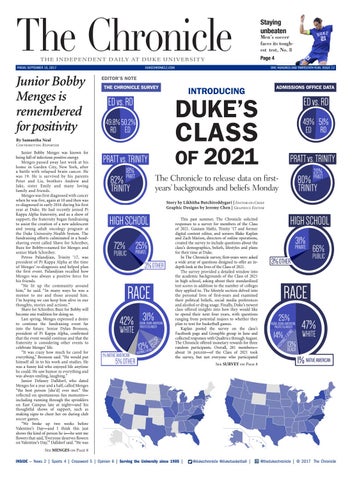
OF 2021 The Chronicle to release data on firstyears’ backgrounds and beliefs Monday Story by Likhitha Butchireddygari | Editor-in-Chief Graphic Designs by Jeremy Chen | Graphics Editor This past summer, The Chronicle solicited responses to a survey for members of the Class of 2021. Gautam Hathi, Trinity ‘17 and former digital content editor, and seniors Blake Kaplan and Zach Marion, directors of online operations, created the survey to include questions about the class’s demographics, beliefs, lifestyles and plans for their time at Duke. In The Chronicle survey, first-years were asked a wide array of questions designed to offer an indepth look at the lives of the Class of 2021. The survey provided a detailed window into the academic backgrounds of the Class of 2021 in high school, asking about their standardized test scores in addition to the number of colleges they applied to. The lifestyle section delved into the personal lives of first-years and examined their political beliefs, social media preferences and alcohol or drug usage. Finally, Duke’s newest class offered insights into how they would like to spend their next four years, with questions ranging from potential majors to whether they plan to tent for basketball games. Kaplan posted the survey on the class’s Facebook page and GroupMe group in June and collected responses with Qualtrics through August. The Chronicle offered monetary rewards for three random participants. Overall, 281 members— about 16 percent—of the Class of 2021 took the survey, but not everyone who participated See SURVEY on Page 8
See MENGES on Page 8 INSIDE — News 2 | Sports 4 | Crossword 5 | Opinion 6 | Serving the University since 1905 |
@dukechronicle @dukebasketball |
@thedukechronicle | © 2017 The Chronicle
The Chronicle
dukechronicle.com
2 | FRIDAY, SEPTEMBER 15, 2017
Arts and Sciences Council slows Marine Lab researchers use pace on curriculum reform drones to study at-risk island By Joyce Er University News Editor
At its first meeting of the year, the Arts and Sciences Council pledged to continue reviewing curriculum reforms, but without a clearly-defined deadline. Anita Layton, chair of the Council and Robert R. and Katherine B. Penn professor of mathematics, thanked Paul Manos, outgoing chair for the courses committee and Jack H. Neely professor of biology, as well as David Malone, outgoing chair for the curriculum committee and professor of the practice of education, for their hours of service. She
Bre Bradham | Staff Photographer Dean Valerie Ashby reviewed a list of accomplishments made by faculty during the past academic year at Thursday’s meeting.
welcomed Susan Wynn, associate professor of the practice of education, and Jeff Forbes, associate professor of the practice of computer science, as the new chairs of each respective committee. Valerie Ashby, dean of the Trinity College of Arts and Sciences, welcomed back Council members and opened by reiterating the three pillars of the Council’s mission—to advance excellence in research, teaching and service, to elevate leadership and mentoring among all faculty ranks and to foster diversity as the basis for creativity and excellence. “Leadership and mentoring equals excellence, diversity equals excellence and you can’t do one of these without the other,” Ashby said. She pointed to some of the University’s successes from the past year on this front, including an undergraduate Class of 2021 that is more diverse than ever before. There are 29 percent more Latino students this year compared to last year, as well as more African American and Native American students than ever before, she said. Switching to changes in faculty, Ashby said that Duke added 30 new positions this academic year—up from 18 new hires in the 2016-17 academic year. She also celebrated the accomplishments of Duke faculty in the 2017 calendar year, who collectively won 15 science research prizes, staged three international art exhibitions, published 71 scholarly books and earned 15 nationally competitive fellowships. Of particular significance, Michael Tomasello, James F. Bonk professor of psychology and See COUNCIL on Page 8
By Daniel Egitto Contributing Reporter
Although the brunt of Hurricane Irma passed by North Carolina, future storms may put the state’s coast in danger. That’s what Everette Newton, a Ph.D. student and a researcher at Duke Marine Lab, says. Newton has spent the past two years studying developments on barrier island Bird Shoal, outside the lab’s main research facilities in Beaufort, North Carolina. His team examines drone images of the skinny, two-mile-long spit of land— the only thing standing between about 4,200 Beaufort residents and the full force of the Atlantic Ocean. Although much is still unknown about this shoal, some of its features leave researchers worried that if a storm like Irma ever does pass through, there might not be a Marine Lab left to study it. Newton said the most serious threat is the possibility of a break forming somewhere along the shoal. “We are concerned there may be a breach in the island,” he said. “If water just flows through it, is it going to be a natural phenomenon where it’s going to fill on the back side, or is it just going to disappear?” Strips like Bird Shoal help dampen the most devastating effects of storms, acting as protective cushions against the ocean’s full strength. However, if anything were to happen to Bird Shoal, Newton said he fears “the town would just get pounded by the waves and the energy of the Atlantic Ocean.” Newton noted that Beaufort is not prepared for that kind of force. Issues
Courtesy of Duke Photography Duke Marine Lab is located in Beaufort, North Carolina near the barrier island Bird Schoal, which is at risk of disappearing.
including water quality, marine debris and wildlife habitat loss would almost certainly plague the town, given its current state of preparation. That makes figuring out what is going on with Bird Shoal imperative for the future success of Beaufort, he explained. As his team has been monitoring developments on Bird Shoal, they have noticed that the island is moving. Although this alone is not a surprise—scientists know that shoals are almost constantly on the move—what makes Bird Shoal a puzzle for the researchers is how far the strip has shifted since they began their study. “We’re talking about major movements of See DRONES on Page 8
Get TheDirt DISCOVER A GENEROUS SCHOLARSHIP PROGRAM.
The U.S. Army’s Health Professions Scholarship Program (HPSP) offers qualified medical, dental and veterinary students full tuition for a graduatelevel degree at the school of your choice. You’ll receive a monthly stipend and payment for books, equipment and academic fees, as well as the potential to grow as a leader.
To learn more, visit healthcare.goarmy.com/ix39, or visit your local U.S. Army Recruiting Office
©2014. Paid for by the United States Army. All rights reserved.
The Chronicle brings you a weekly summary of events, ideas and news items that are trending at Duke and in the Triangle. Read all you need to know with The Dirt!
thebluedirt.com
The Chronicle
dukechronicle.com
FRIDAY, SEPTEMBER 15, 2017 | 3
Mayoral candidates discuss engaging students at forum By Sarah Kerman Senior News Reporter
Four Durham mayoral candidates offered ideas on how to boost civic engagement amongst local college students at a candidate forum Thursday. The mayoral hopefuls included Farad Ali, a business consultant and former city council member, Shea Ramirez, a tax preparer and entrepreneur, Steve Schewel, a Durham county commissioner and Sanford School of Public Policy professor, and Reverend Sylvester Williams. Entitled “Visions for an Equitable and Vibrant City,” the forum was held at city hall and co-sponsored by the InterNeighborhood Council of Durham, the Sanford School of Public Policy, the International City/County Management Association, North Carolina Central University and Duke Student Government. The candidates shared their perspectives on a number of economic and social issues in the Durham community, in addition to answering a question submitted by Duke Student Government on how they would better engage students in the city’s civic dialogues. “I do think there’s many things that the mayor can do to in general to increase public engagement and especially among students. Go to campus when you’re asked to. Meet with students and try to get them involved,” Schewel said. “The mayor can do some things, but it’s not only the mayor that can do some things—you guys gotta do some things.” Schewel explained that it is important for students to “go out [beyond] the walls”—whether it be finding nonprofits they want to work in or tutoring at schools in Durham in order to be more present as community members. He said the main message he wants to send to students at Duke and other area universities is that Durham
wants and needs them to be involved. Other candidates for mayor shared similar sentiments. “One thing I pride myself on is making myself available and open for anyone to talk to from Duke’s campus to [NC] Central’s campus to any campus,” Williams said. “I am there because I realize we are not the ones who should be setting policies for you, you should be setting policies for you.” Ramirez also noted that the relationships built between Durham’s colleges and local government officials are key to generating new ideas for the city. “I’m really big on relationship building. I believe that it’s very important to have all the local colleges, the community colleges involved—Central, Durham Tech, Duke,” Ramirez said. Ali highlighted North Carolina Central as a university with a commitment to service embodied in its graduation requirements, noting that at NCCU students are required to complete 100 hours of community service prior to graduation. “[NCCU’s] motto is truth and service and to really go back and give to the community in a way that can build,” Ali said. “I think for Duke students there’s also an opportunity to give back, we have lots of students here that are in our school system.” Ali noted that Durham has over 50 schools under its jurisdiction and that the city can help students in engaging with them. An adjunct professor from the University of North Carolina at Chapel Hill, he said that he has worked with undergraduates to “adopt” a school and perform service projects, stating that these programs are important to kids because they build their lives around social networks. Pierce Freelon—an African American Studies
Sarah Kerman | Contributing Photographer Last Wednesday, Duke Student Government allocated funds to provide transportation for students to attend the mayoral forum.
professor at UNC—was one of two candidates not present at the event. The moderator told the audience that Freelon informed the event’s organizers Thursday afternoon that he could not attend. Freelon’s campaign could not be reached for comment in time for publication. Candidate Tracy Drinker was also absent and did not responding to the forum invitation. In addition to conversations on student engagement with local government, the candidates discussed how some policies disproportionately benefit some parts of Durham’s population in favor of others—a theme the candidates also highlighted in a prior MayorUp! Forum on policing. This forum drew attention from students after Duke Student Government voted
unanimously last week to allocate funding for Uber round trip passes to attend. Several groups of Duke students were in the audience—many from Duke Student Government and What’s Up Durham, an undergraduate class taught by Bob Korstad, professor in the Sanford School of Public Policy. Sophomore Lee Rodio, who is a Durham native, said he felt the candidates represented the broad spectrum of cultures and beliefs in Durham. “I think Farad Ali and Steve Schewel were the clear-cut frontrunners for good reason,” he said. “I think Farad and Steve both did a great job of expressing their connections to the respective universities and actually giving concrete ways that students can get involved.”
find housing at The Chronicle’s online guide to living near Duke.
Sports 4 | FRIDAY, SEPTEMBER 15, 2017
dukechronicle.com
The Chronicle
THE BLUE ZONE
DUKE’S X-FACTOR AGAINST BAYLOR sports.chronicleblogs.com
dukechronicle.com
FRIDAY, SEPTEMBER 15, 2017
FOOTBALL
The Chronicle
BEARING DOWN
Despite being double-digit favorites, Blue Devils not looking past winless Baylor By Ben Feder Staff writer
Two teams heading in opposite directions will face off this weekend in Durham, with Duke hoping its winning trend continues for at least another week. The Blue Devils will have the chance to prove that they are on the rise in a quest for their first 3-0 start since 2014 Saturday against Baylor at 12:30 p.m. at Wallace Baylor Wade Stadium. Behind vs. an explosive offense Duke and a rigid secondary, Duke has breezed SATURDAY, 12:30 p.m. by N.C. Central Wallace Wade Stadium and Northwestern, amassing 101 points— its best output in back-to-back contests since joining the ACC in 1953. On the other hand, the Bears have dropped consecutive games to lowly opponents, and its starting quarterback is currently in the concussion protocol. Sophomore Zach Smith will be leading the team into Durham to try to stop a slide, punctuated by last week’s 1710 loss to Conference USA opponent TexasSan Antonio. Regardless, the Blue Devils believe Baylor’s results are not indicative of the team’s abilities. “We just have to play relentlessly,” sophomore defensive end Tre Hornbuckle
Bre Bradham | Staff photographer
Mark Gilbert had two interceptions last week and will have to help contain dynamic wideouts Chris Platt and Denzel Mims Saturday. said. “We know Baylor is hungry. They’re 0-2, so we’ve got to be just as hungry as they are—even hungrier because it’s going to be a tough game.... They’re still a talented football team. I’ve seen them on film, and they’ve got some weapons.” Although he has not started a game this season, Smith has plenty of experience playing big games. When 2016 starter Seth Russell went
down with a gruesome ankle injury, Smith stepped in and started the team’s last four games of the season, throwing for 1,526 yards and 13 touchdowns. At 6-foot-3 and 225 pounds, Smith utilizes his pocket presence to stand in amid pass rushers, a stark difference from original starting quarterback Anu Solomon, who ranks second on the team in rushing yards and is a consistent dual
threat with his arm and legs. Smith should have no trouble finding targets, and with Chris Platt and Denzel Mims—one an All-American and the other a high school state champion in track and field—Smith should have plenty of opportunities to show off his big arm in what will be a big test for the Blue Devil defensive backfield. “They’re not going to run different sets of plays [without Solomon], so you just have to basically prepare for their offense,” Duke head coach David Cutcliffe said. “Regardless of who’s playing quarterback, we’ve got to play well.” Although it was a question mark heading into the season, Duke’s secondary will be a tough matchup for Smith and the Bears’ wideouts. Through two games, the Blue Devils (2-0) have surrendered just 263 total yards through the air, with sophomore cornerback Mark Gilbert leading the way with two interceptions—both against Wildcats’ signal-caller Clayton Thorson. The safety tandem of Jeremy McDuffie, Alonzo Saxton II and Jordan Hayes has jelled quickly, despite McDuffie’s transition from cornerback in the offseason. The Blue Devils should have no issue keeping up on the other side of the ball, either. Redshirt sophomore Daniel Jones has improved on an impressive rookie season to start off 2017, as he accounted for four touchdowns in last week’s victory. Some of Jones’ struggles last season were because he could not command the pocket See FOOTBALL on Page 5
MEN’S SOCCER
Unbeaten Duke faces toughest test yet in Tar Heels By Kevin Zhang Contributing reporter
After rising into the rankings for the first time since September 2015, No. 23 Duke will likely need its best game of the season to stay there. The unbeaten Blue Devils will seek to continue their upward trajectory against their toughest foe yet in eighth-ranked North No. 23 Carolina, which will Duke try to win its fourth vs. straight. The classic No. 8 rivalry game will take UNC place at 7 p.m. Saturday SATURDAY, 7 p.m. at Bryan Park in Bryan Park Greensboro, N.C. Greensboro, N.C. Although the Tar Heels have won their last two regular-season matchups against Duke, 17 of the last 18 meetings have been tied or decided by one goal. “You can’t avoid the rivalry…. It’s exciting for us, because you look forward to that game every single year, and the players are pumped up on both sides.” Blue Devil head coach John Kerr said. “I’m sure it’s a cliché, what the records are of each team, you know it’s going to be a war and either team is going to have a chance to win it. We know it’s going to be like
that on Saturday night.” Duke (4-0-1) will try to maintain its undefeated record as it comes off an offensive clinic against Virginia Tech in its ACC opener last Saturday. The Blue Devil offense tore apart the Hokie defense, led by senior striker Brian White’s two goals and one assist—a dominating performance which earned him a placement on the Top Drawer Soccer Team of the Week. Equally impressively, Duke’s stifling defense limited Virginia Tech to just seven shots the whole game. The Blue Devils will need to perform just as well in order to slow down North Carolina. The Tar Heels (5-1-0) are on a three-game winning streak after a tough 3-2 victory against William & Mary Wednesday night. Senior forward Alan Winn scored twice and leads the team with 15 career goals. “We’re going through details to understand our roles, both defensively and offensively, just because we know [the game] could turn on a free kick, corner, or counter-attack,” Kerr said. “We’re very well aware of the tightness of the game and what the difference could be.” Although Duke senior Markus Fjortoft was able to silence Virginia Tech star forward Marcelo Acuna last Saturday, Fjortoft and the
back line will be put to the test against the potent North Carolina offensive trio of Winn, forward Jelani Pieters and midfielder Cam Lindley. Pieters leads the Tar Heels with four goals, and Lindley—the 2016 ACC Freshman of the Year—has five assists. The Blue Devils will also focus on fighting
fire with fire offensively, a strategy that almost succeeded for William & Mary until Winn’s game-winning goal in the 73rd minute. “We have options from every angle of the field: wide, underneath, straight ahead, See M. SOCCER on Page 4
Ian Jaffe | Photography Editor
Senior Markus Fjortoft is the anchor for a Blue Devil defense that has fueled the team’s undefeated start.
The Chronicle
dukechronicle.com dukechronicle.com
MEN’S BASKETBALL
Duke adds walk-on Buckmire Staff Reports The chronicle
If Blue Devil fans were disappointed that they will no longer see Nick Pagliuca on the bench after his graduation, they now have another walk-on guard to support. Mike Buckmire, a 6-foot-2 guard from Blue Bell, Pa., was added to Duke’s roster last week. Buckmire will join junior Brennan Besser as the only walk-ons on the roster after redshirt sophomore Justin Robinson was given a full scholarship in August. Buckmire also becomes the Blue Devils’ eighth freshman, the most the team has had since 1986-87. At Germantown Friends School in Philadelphia, Buckmire averaged 22.1 points per game as a senior and scored 1,144 career points. The Chestnut Hill Local reported at the start of his senior year that he was receiving interest from Division III schools near Philadelphia. “He is a hard-worker, an enthusiastic supporter of his teammates, a great example of leadership, and passionate about improving himself every day,” Germantown Friends School Director of Athletics Katie Bergstrom-Mark said in a school release. “It was these qualities, plus his impressive talent and intellect, that led to his opportunity to try out and become part of the Duke basketball program.” The freshman has a family Duke connection, as his father, Michael, played on the Blue Devils’ 1986 national champion men’s soccer team.
FOOTBALL
FRIDAY, FRIDAY, SEPTEMBER SEPTEMBER 15, 15, 2017 2017 || 55
but he deserved [ACC Offensive Lineman of the Week] all by himself.” The right tackle could have another strong game this week against a reeling Bears defense that has managed just four sacks this season and failed to generate enough pressure on FCS opponent Liberty, which racked up 585 yards and 31 first downs in a thrilling 48-45 victory. Sophomore linebacker Clay Johnston leads the team with 16 tackles and 3.5 tackles for loss, but Baylor (0-2) has surrendered nearly 1,000 yards in its first two contests. Still, do not expect Duke to take the Bears lightly. “We’ve been playing with a chip on our shoulder because none of us ever want to sit at home in December again and watch all these bowl games,” Davis said. “We don’t ever want to go 4-8.... We came out with a different mentality [this season].”
FROM PAGE 4 amidst a sea of opposing defenders. But this season, with more confidence and an improved offensive line, the Charlotte native has been more than comfortable behind center, often shuffling around the backfield, waiting for a gap to open up for either a receiver or himself. Last week, Jones had little to worry about from the right side of his offensive line due to the play of Ohio State graduate transfer Evan Lisle, who was named the ACC Offensive Lineman of the Week. Jones also rushed for 108 yards and two touchdowns, with Lisle opening up many running lanes on option plays. “All credit to Evan Lisle. After watching the film, he played a heck of a game,” redshirt senior starting center Austin Davis said. “It is a big credit to all of us by putting up 41 points,
Juan Bermudez | Sports Photography Editor
Senior Brian White scored two goals and had an assist to account for all of Duke’s goals against Virginia Tech.
M. SOCCER FROM PAGE 4 free kick, corner kicks. We have weapons everywhere, and it’s a nice thing as a coach to have that repertoire to play and work with, and the guys are executing well,” Kerr said. “In fact, I think we should score more goals with all the chances that we’ve created.” Duke will attempt to continue its aggressive, attacking style of play reflected by its 18.2 shots per game, good for fifth in the nation. This marks a dramatic increase from last season’s 12.2 shots per contest. North Carolina utilizes a similar style with an average of 14.6 shots per game, which places the Tar Heels at 22nd in the nation. With both teams coming off impressive The New York Times Syndication Sales Corporation wins and playing as well as they have in a Jim Liu | News Photography Editor 620 Eighth Avenue, New York, N.Y. 10018 Evan Lisle won ACC Offensive Lineman of the Week for helpingFor open up rushing lanes for while, Saturday night promises to be nothing Information Call: 1-800-972-3550 Daniel Jones against Northwestern. less a fast-paced thriller. For September 14,than 2017 ForRelease ReleaseThursday, Friday, September 15, 2017
The Chronicle classified advertising
www.dukechronicle.com/classifieds deadline 12:00 noon 1 business day prior to publication ad submission
online: www.dukechronicle.com/classifieds email: advertising@chronicle�duke�edu fax to: 919-684-8295 phone orders: (919)-684-3811 No refunds or cancellations after first insertion deadline ADVERTISERS: Please check your advertisement for errors on the first day of publication. If you find an error, please call 919-684-3811. The Chronicle only accepts responsibility for the first incorrect day for ads entered by our office staff. We cannot offer make-good runs for errors in ads placed online by the customer.
The Chronicle What we should name Hank’s family’s new dog: Talula: ������������������������������������������������������������������������������������������������� likhithabanana Cameron: ���������������������������������������������������������������������������������������������������� happyrock PaTSy: �����������������������������������������������������������������������������������������������������������jaffetaffy Darth Vader: ������������������������������������������������������������������������������������������kenricklamar Daisy:��������������������������������������������������������������������������������������������������������kermanator Student Advertising Manager: ������������������������������������������������������������Megan Bowen Student Marketing Manager: ���������������������������������������������������������������������Lizzy Pott Account Representatives: ������������������������������Brittany Amano, Griffin Carter, TJ Cole, Paul Dickinson, Jack Forlines, Matt Gendell, Francis L’Esperance, Jack Lubin, Gabriela Martinez-Moure, Jake Melnick, Lauren Pederson, Brendan Quinlan, Levi Rhoades, Rebecca Ross, Jake Schulman, Matt Zychowski Creative Services: �������������������������������������������������������������������������������� Myla Swallow Student Business Manager ���������������������������������������������������������������������� Dylan Riley
Crossword ACROSS 1 Diner staple, for Rap group whose short name comes from a martial 4 Wine, informally, arts with film “the” 11 Step up from 9 Astronaut Kelly Triple-A, with 14 [Shrug] “the” Itchingmany 15 What 16 stargazers Right to the point wonder 17 Whatever it takes 16 Onetime Mughal 20 capital Party person 21 Basis Musician whose 17 of the first name is a Doctor’s toy adventures on “Doctor 22 ___ trickWho” 18 23 Twin Home to an Ideas 19 annual Call heard at Festival Arlington 26 of 20 First Whatname a bouncer the second vice might bust up president to 21 resign With 48-Across, from office East Coast 28 Mulching vacation spot material 22 Ship, to its 29 Dynamite skipper 32 role 23 “Pagliacci” Common sort 33 One China’s ___ 24 of the Dynasty Nereids
34 ofridden 25 Symbol It may be by kids at a gentleness carnival 35 ___ Sound 29 Hoary Language in 36 which “seven” is 37 “jet” Latin American 31 sweetie Return from a tunnel? of 39 Symbol 32 Christianity East or west lead-in 40 Attachment to a appDictator” 33 job “Great of 1940 41 player Congested place, at times 36 Film character who says “E.T., 42 Attraction at stay withMuseum me” Boeing’s Flight,roll for short 38 of Dragon 43 ingredient “J’adore ___” (ad
39 slogan) Home to Double-A 44 Sound of metallic baseball’s impact SeaWolves 45 41 2016 Orbitz Disney optionsfilm 46 with its 42 Carriage Spectacular horse 46 Loads of 47 It might prevent investments? you from drifting 47 Natural healer off 48 See 21-Across 51 James I and Charles Ifodder 51 Scandal
ANSWER TO PREVIOUS PUZZLE A B M C O C E L S F T P B O P A E B EI P T
N L O E H N A D E P E O D U F E S M E N R Y G N E Y
T O H E T G H OI T N O G TI H S E D C O H G A S P
E L S W EI E A R AI U E R S A T L H S O O L T E
S G A E S A S R T O O B T HI N E M T O O L A
R A M Y R E I A L B D T O A R S K E S
AI P G A O R C A A P M H E O U B PI A B O S T E S
D P O E T R H E S B E E A S L TI Y O O N U C R A B NI
O E N R C A E P E A S N T D E O E R M A S K B OI D X
L E H N A Y R E T I E S G ET D Y N E
S P O R O E N C O L N A S C R E U R C EI C S
G C EI ET Y D A F W A N M SI L PI L A A R N A
L O A T M H E O B R A A M I N E O D G R W O A U R P
A T S H EI M O V B B S G O U D N A T E O N T D E
D T E Y L R U A X E
A B S U K S S R K E S W
55 it 52 Whatever Preparatory course? takes … as in the 54 hinted Like oldatrecords arrangements 55 Wasatch of black squares Mountains around resort the circled letters 56 Singer of the 58 Together 1965 hit “Lemon Tree” 59 Short loin cut 58 Hilarius 60 Pac-12 athlete succeeded him in A.D. 461 61 Like a workaholic 59 Look for 62 Big rolls 60 “First Take” airer 63 Seat of 61 Doesn’t throw Christianity? the book at
Edited by Will Shortz 1
2
3
4
14 15 17
6 7
7 8
8 9
18
20 19
20
22
22
26
27
32
29
23
23
33 34
38
39
42
42
48
10
50
16 18
11 12
12 13
13 14
30
31
28
24
29
27
34 37
32
38
37
41 41
40 44
45
16
21
36
43
10 11
21 25 26
9
19
31
36 35 40
39 43
49
24
28
25 30
35 33
47 51
5 6
15
46
DOWN 1 Standout Neighborhood 1 in a in TV’s “Sanford and quad Son” 2 “Girls” 2 Dunham David hadofhim slain, in the 3 “What you have Bible to realize …” 3 City immediately 4 Transmission west of Mesa element 4 Knocks over 5 “The Martha ___ 5 Clear Show” of 1950s 6 TV Make unclear, in a way 6 Recluse’s 7 Deep red problem, maybe 8 Darling 7 What a “/” may 9 With a clean mean slate 8 Carter Procterof&“Ain’t Gamble 10 cleaning brand Misbehavin’”
4 5
0810 No. 0811
45
44 46
47
51
52
48
52
53
55
56
56
58
59
59
60
60 61
61
62
63
57
54
49
50
53
54
57
PUZZLE BY JOHN E. BENNETT AND JEFF CHEN HAL MOORE
13 of a real 48 Letters that 24 Banks Consider Pharmacy 27 Hairstyles that 33 2.0 might star figure precede need lots of “America’s Got 34 Music producer 10001 combing Talent” 49 ___ remember 25 Scammer’s target Gotti 29 Everyday 49 50 Bloke Quantity in the 26 Potential 18 Spent theAir most? 35 Long of “Alfie” 30 -NH2 dairy it! aisle Medal recipient 50 Darn attachment, in 37 ___ word 19 said 51 27 Something Grp. that frowns 52 Natural Newcastle upon chemistry by a put-out depression 40 “Liberté, ___, upon illegal ___, England 31 fraternité” Toy shooter Putin? checks 52 Solo, in a way (France’s motto) 53 Add (up) 34 Seat of New 28 again?” 53 View from 24 “___ Flippered animal Mexico’s Doña 54 Distort on to the Piazzale Pacific 43 Hang Ana County 29 along It had the an episode Coast 11 56 Michelangelo Rare occurrences 9 Procedural Do a little bully 44 Pose Self-titled debut titled “Little 38 Super Bowls, pop album of cuddling Green Men” 54 at Challenges for 12 One of the 25 Don’t open it! 43 Square one briefly 1991 stylists dinosaurs upon 30 It might be 10 ___ desk 45 “Ain’t Bucksgonna which Godzilla is 26 worn Indy racer 57 Clutch with short 45 ___ Fáilhitter’s (ancient (newspaper post) based sponsor 47 Somewhat stat shorts happen” crowning stone) 11 emperor 13 Roman Breakfast brand who Online subscriptions: Today’s puzzle and more than 7,000 past sinceoverthrew 1897 puzzles, nytimes.com/crosswords ($39.95 a year). 14 Galba Result of a perfectpart pitch? Read about and comment on each puzzle: nytimes.com/wordplay. 12 Silent of 23 “mnemonic” Fogg of fiction
dukechronicle.com commentary
“
T H E I N D E P E N D E N T D A I LY AT D U K E U N I V E R S I T Y
The Chronicle
6 | FRIDAY, SEPTEMBER 15, 2017
Diversity beyond numbers T
here is no shortage of conversation on diversity and multiculturalism coming out of Duke Administration, especially when in reference to the student body demographics. Over the years, this discourse seems to have produced some results as shown by a steadily increasing percentage of minority students at Duke, an area where other elite schools are stagnating. University officials chalk it up to a diverse applicant pool, courtesy of intentional efforts by the admissions office. While the process of recruiting and contacting historically underrepresented groups to join the Duke community is a crucial step towards promoting diversity, it is far from the final effort that should be made to foster a more hospitable campus. The current issue facing the university lies in solely focusing on bringing more students of color and lower socioeconomic statuses to campus, applauding ourselves for doing so and then not providing them with continuous institutional support that can ensure success once they arrive. It is no secret that Duke’s image is one of a predominately white and rich institution. While that clearly doesn’t reflect the entire student body, it’s not without some truth. White students still outnumber any other race and the average median family income of a Duke student is well above that of the national average. Given those numbers, there are bound to be aspects of life at Duke that consciously and subconsciously cater to the white students and those
who are more wealthy. Unfortunately along with that, there are preexisting expectations for racial and socioeconomic minorities on campus to have the same resources at their disposal and the same institutional knowledge as their peers in the majority. While the Black Student Alliance Invitational and Latino Student Recruitment Week can help provide some initial guidance for black and Latinx students, they are expected afterwards to effortlessly assimilate into life at Duke; a campus that can be, at times, overwhelmingly
Editorial Board white. For low income students, making the transition into a place where so many of the students around them are unfamiliar with the stress of debt, poverty, and navigating college as a first generation scholar can be an isolating experience. For students who fall into both categories, they are faced with a combination of class-based and race-based alienation that can be detrimental. It’s crucial to recognize that these racial and financial differences that can structure a student’s day-to-day life do not disappear after BSAI and LSRW end or when scholarships are awarded. While the Reginaldo Howard Memorial and David Rubenstein programs are valuable, offering mentorship and support to a limited selection of individuals is simply
onlinecomment “Duke University dropped due to their increased admittance of lesser-qualified students for “diversity” reasons. Very sad.” —Sal Tuzzolino responding to “Duke drops one spot in U.S. News rankings, falling behind Penn” published on September 12, 2017.
LETTERS POLICY The Chronicle welcomes submissions in the form of letters to the editor or guest columns. Submissions must include the author’s name, signature, department or class, and for purposes of identification, phone number and local address. Letters should not exceed 325 words; contact the editorial department for information regarding guest columns. The Chronicle will not publish anonymous or form letters or letters that are promotional in nature. The Chronicle reserves the right to edit letters and guest columns for length, clarity and style and the right to withhold letters based on the discretion of the editorial page editor.
Est. 1905
The Chronicle
”
Direct submissions to: E-mail: chronicleletters@duke.edu Editorial Page Department The Chronicle Box 90858, Durham, NC 27708 Phone: (919) 684-2663 Fax: (919) 684-4696
The Chronicle
Inc. 1993
LIKHITHA BUTCHIREDDYGARI, Editor HANK TUCKER, Sports Editor KENRICK CAI, News Editor SAM TURKEN, Managing Editor VIR PATEL, Senior Editor ADAM BEYER, Digital Strategy Team Director IAN JAFFE, Photography Editor JACKSON PRINCE, Editorial Page Editor ALAN KO, Editorial Board Chair SYDNEY ROBERTS, Editorial Board Chair CHRISSY BECK, General Manager ISABELLE DOAN, University News Department Head JOYCE ER, University News Department Head BRE BRADHAM, Local & National News Head NATHAN LUZUM, Health & Science News Head SHAGUN VASHISTH, Health & Science News Head JIM LIU, News Photography Editor WILL ATKINSON, Recess Editor NINA WILDER, Recess Managing Editor SUJAL MANOHAR, Recess Photography Editor SANJEEV DASGUPTA, Sports Photography Editor MITCHELL GLADSTONE, Sports Managing Editor LEAH ABRAMS, Editorial Page Managing Editor CARLY STERN, Editorial Page Managing Editor NEAL VAIDYA, Audio Editor JAMIE COHEN, Social Media Editor JEREMY CHEN, Graphic Design Editor CLAIRE BALLENTINE, Towerview Editor JUAN BERMUDEZ, Online Photography Editor NEELESH MOORTHY, Towerview Editor NEELESH MOORTHY, Investigations Editor ABIGAIL XIE, Investigations Editor CAROLYN CHANG, Towerview Photography Editor CAROLINE BROCKETT, Recruitment Chair CLAIRE BALLENTINE, Recruitment Chair SHAGUN VASHISTH, Recruitment Chair SARAH KERMAN, Senior News Reporter KAT BERKO, Senior News Reporter SAMANTHA NEAL, Senior News Reporter LEXI KADIS, Senior News Reporter MEGAN HAVEN, Advertising Director JULIE MOORE, Creative Director The Chronicle is published by the Duke Student Publishing Company, Inc., a non-profit corporation independent of Duke University. The opinions expressed in this newspaper are not necessarily those of Duke University, its students, faculty, staff, administration or trustees. Unsigned editorials represent the majority view of the editorial board. Columns, letters and cartoons represent the views of the authors. To reach the Editorial Office at 301 Flowers Building, call 684-2663 or fax 684-4696. To reach the Business Office at 1517 Hull Avenue call 684-3811. To reach the Advertising Office at 2022 Campus Drive call 684-3811. One copy per person; additional copies may be purchased for .25 at The Chronicle Business office at the address above. @ 2017 Duke Student Publishing Company
E
not enough to assist students of color and those with lesser financial means. General student resources such as the Academic Resource Center and the Career Center should continue to make efforts to be purposeful in providing programming and tools specifically for those students. Facilities like the Mary Lou, Mi Gente and the CMA should not be the only ones striving to make non-white students feel welcome in their own university. More financially and racially homogenous departments should also take steps to also design programs that reach out to these students and make those areas of study more welcoming. Additionally, there is an ever-present lack of faculty diversity and this disconnect can cause daily, individualized power struggles that may be hard to see, but can make or break a student’s time here. Regardless of how much progress is being made in comparison to other schools across the country, there is still a need to focus on continuously creating new ways of supporting underrepresented students for their four years on campus. While Duke tends to think in numbers, from school rankings to minority student admissions, students of color and those from lower socioeconomic backgrounds deserve to be thought of as individuals rather than just percentages. As Duke strives to increase diversity in the admissions process, there should also be concerted efforts to continue that institutional support beyond orientation week.
Ranking response
arlier this week, U.S. World News and World Report released its comprehensive rankings for the best colleges in America. To the surprise of Duke students—who likely submitted their application to the university whose hallowed halls they now walk, only after first referencing the famed list—, their beloved school had fallen one spot. Congratulations, Duke!
Jacob Weiss
NOT JUMPING TO ANY CONCLUSIONS
Evidently, the university, headed by its newly appointed president Vincent Price, has taken steps to increase diversity of experience on campus. According to a POLITICO review, published earlier this week, the U.S. News Rankings directly correlate with—and even create incentives to increase—the percentage of wealthy students at a given university. In 2017, Duke separated from the University of Pennsylvania, and defined itself as a more inclusive institution. Also in 2017, Duke expressed its commitment to diversity in the form of written response to actions taken by President Donald J. Trump. In March—under former university president Richard H. Brodhead—Duke joined an amicus curiae brief opposing Trump’s travel ban with 30 other universities, and, in August, Price penned a letter to Trump, urging the President not to repeal the Deferred Action for Childhood Arrivals (DACA) program. Ironically, though, only the expression of said commitment to diversity has been celebrated, while the actual achievement of diversity—the drop to No. 9 in the U.S. News Rankings—has been lamented. The difference in reception can be credited to the relationship between intention and result. In both Brodhead’s and Price’s written declarations, Duke intended to convey disapproval of what it considered to be close-minded policy, and succeeded, whereas, in the U.S. News Rankings, Duke intended, most assuredly, to rise—or at the very least stay the same—, and failed. However, these intentions are only ostensibly true. According to the POLITICO review—which was shared ad nauseam in the days prior to the U.S. News Rankings’ release—, Duke’s intention, by seeking to climb in the rankings, was in effect to curb the diversity of its student body—an intention, which contradicts that expressed in the two presidents’ written statements. By subscribing to a system of rankings, which preferences performance on standardized admissions tests, having a lower acceptance rate, performing well on surveys of high school guidance counselors and alumni giving, Duke creates barriers to entry—rather, admission—for socioeconomically diverse candidates. The commitment also makes clear that presidents’ intentions were not as stated in objections to the travel ban and the repeal of DACA, especially considering that Duke does not provide need-blind admission to
international applicants, and only recently provided such accommodation to undocumented U.S. residents. The true intention behind the letters was not moral concern, but rather political, just like the decision to extend need-blind admission to undocumented students within a month of Trump’s election. Although the university has stated that the reasons for its public condemnations of the current administration’s policies are the value it places on “diversity,” its endeavors to maximize the factors in the U.S. News Rankings’ formula states otherwise. Duke’s public stances against the executive’s policy decisions are an expression of a contemporary ideology prevalent in liberal and academic communities, of which Duke is both, —opposition to Trump no matter what. Certainly, there are specific policies of Trump, which are relevant to the university, and with which the university may fundamentally disagree, but the travel ban and the repeal of DACA are not examples. The university’s actions differ from its words. Duke voices a commitment to diversity, but strategizes to effectively attain a less economically diverse student body, which runs counter to realizing the “great diversity of backgrounds,” which Price desires to protect in his letter to Trump. Duke claims to treasure diversity above mores and law when doing so presents an opportunity to criticize the President, yet systematically pursues results, which would create a more culturally homogenous campus. Duke typically grants admission only to those with qualifications, which traditionally wealthy, white and American candidates are more likely to possess, as evidenced by the New York Times study, which I referenced in my previous article, and the university’s lofty placement in the U.S. News Rankings. Although the drop in the rankings is a step in the right direction, to paraphrase Dean of Undergraduate Admissions Christoph Guttentag, Duke is simply unattainable from a socioeconomic standpoint for many. Despite Duke successfully increasing its percentage of minority students on campus, the “access to higher education,” which Price seeks to expand in his letter to Trump, is still limited in practice. The university abides by a system in which becoming more elite—as it pertains to academics—means becoming more elite—as it pertains to the background of its students. While complicity in this system is neither necessarily bad nor good—as trade-offs have been established between diversity of background and institutional prowess—, it does preclude Duke from claiming a moral high ground when pronouncing concern for diversity, and makes its political objectives apparent. If Duke is as committed to diversity as its two most recent presidents have purported it to be, it should celebrate our fall in the U.S. News Rankings. Only then could its objections to Trump’s policy initiatives be thought of as ethical, and its claimed commitment to diversity be truly genuine. Jacob Weiss is a Trinity senior. His column, “not jumping to any conclusions,” runs on alternate Fridays.
The Chronicle
dukechronicle.com commentary
FRIDAY, SEPTEMBER 15, 2017 | 7
‘Moonlight’ remains a ‘Anywhere can monumental narrative serve a kale salad’
W
hen Ang Lee’s Brokeback Mountain lost to Paul Haggis’ Crash at the 2006 Academy Awards, many sat, blank faced and stupefied by the outcome, in front of their television screens, trying to understand it all. The former’s producer, James Schamus, opened up about the loss to Variety during the 10th anniversary of the film, saying that many people felt Crash established a safer political narrative.
Jamal Michel
FEATURED COLUMNIST The Oscar debacle that unfolded several months ago initially drew similar reactions, at least until the correct winner was announced. Despite the blunders, Moonlight remains a monumental examination of Black identity and sexuality, and it should receive proper recognition, but not as “an upset.” Reactions to February’s onstage flub ranged from singing Jordan Horowitz’s praises, to blaming Jimmy Kimmel and Steve Harvey. The morning after appeared no different, with major outlets capturing Horowitz’s reaction and the ways he and the stars of La La Land were dealing with the whole ordeal. While unimaginably heartbreaking, Moonlight’s victory should not be so short-lived, in that it managed to outshine a film that still dominated with six Oscar victories. Barry Jenkins, the film’s director and a Florida State University alum, went on stage and, after recovering from shock, spoke of being raised in Liberty City and of South Florida’s supreme influence on his work. While astounding in its own right, La La Land speaks openly and honestly to anyone mercilessly chasing their dreams, but it’s not the first film to provide such a lens, as previous Oscar nominees embarked on similar stories. Films like Michel
Hazanavicius’ The Artist and Alejandro González Iñárritu’s Birdman have accomplished much the same narrative. Jenkins’ film of the tumult and imperfect love that surrounds his main character is a new perspective, as Black masculinity continues to find itself at the heart of society and politics today. Chiron, Moonlight’s protagonist, delicately tightropes the complicated techniques of life from his early childhood, asking Juan, played by Academy Award winner Mahershala Ali, about sexual identity. Ali, who is the first ever Muslim actor to win such an award, captures Miami and all its vibrancy in the gentle way his character provides for Chiron. His cool, yet massive personality complements the timidity of Chiron and adds an authenticity that brings the famed swimming scene to life. Black identity and what it means to be grounded in it is examined from all angles in the film—from Chiron’s spirited youth, to his isolating adulthood. In Greek mythology, Chiron is a centaur whose esteem is founded in the way his appearance differs from others like him. Black America has not had the luxury of experiencing a film that openly asks us to rethink identity and sexuality. It has not had the opportunity to revel in the kind of elegance provided by Moonlight about what it means to be Black and gay. Jenkins’ work provides a platform for anyone who once thought they were alone in that conversation, for anyone who felt bogged down by clouds of confusion and opposition. Despite the unruliness of the award show, one shouldn’t forget how impressive Moonlight remains. Much like the film’s main anecdote, that particular victory was for all those Black bodies turned blue under the night sky. Jamal Michel is a Duke graduate and an English teacher at Northern High School.
Will Shooters excitement ever fade?
Cartoon by Daniela Flamini, a Trinity junior. Cartoon originally published online on September 12, 2017.
W
hen Mayor Bill Bell took office, 16 years ago, the city of Durham looked nearly unrecognizable based on its appearance today. There was no American Tobacco Campus, no DPAC, no Parlour, and little to do in the downtown corridor. When Bell took office, he pledged to undertake an unparalleled revitalization effort that would sweep the city in the following decade. The investment brought billions of dollars to the city that renovated old tobacco mills into livable spaces, attracted novel start-ups and businesses, and made a Durham a destination for arts, food, and culture.
Leah Abrams CUT THE BULL Today, the city stands on the brink of a precipice in the form of a mayoral election. The candidates are all quite progressive—let’s face it, it’s Durham—but each brings a unique toolset and worldview when it comes to facing the rising challenges of the new Durham. Regardless of who wins the election, the new mayor will be forced to confront the challenges of a rapidly gentrifying city, whose residents need the assurance of affordable housing and increased programming for youth. Where Bill Bell sought reinvestment and economic development, the new candidates must seek to protect the most vulnerable populations in Durham, if they want the new “renaissance” to last. Durham provides a striking juxtaposition: while its flourishing streets are home to ramen shops and high tech incubators, 66% of the students enrolled in the Durham Public School system receive free or reducedcost lunch. This represents a significant problem for the municipal government: as the upper income bracket of the city gets wealthier and wealthier, the vast majority of the city remains vulnerable to economic exploitation. Even more worrisome, the majority of children in the city of Durham belong to families susceptible to this economic injustice, deeming the next generation nearly powerless in accessing the opportunities and resources available in downtown Durham. This discrepancy in wealth and resource is only intensified along the dividing lines of neighborhoods. Contextually, the median income across the city of Durham is $51,000. In the wealthiest, mostly white areas of Durham, that median rises to $80,000. In poor neighborhoods like East Durham, that median falls to $26,000. On an annual family income of $26,000, there is hardly money to pay for food and electricity, let alone rising rents and mortgages. It should come as no surprise that as Durham develops, property taxes and valuations steadily climb. In 2011, the average rent across the city was $715 per month. And as of August 2017, the average monthly rent in the city of Durham has nearly doubled to $1,204. Meteoric increases in property valuations like these certainly point to the success of the Bill Bell renaissance, but they also necessitate the creation of programs that keep Durham residents in affordable housing and raise wages to match the rising cost of living. The pressing disparities in access to money, healthcare, college, and housing will define the term of Durham’s next mayor. The duty of the next decade is to ensure the equitability of this city’s growth, to keep the artists and families who have given Durham its character at the steering wheel, instead of handing it off to corporations and banks. This feat, though seemingly simple, represents a difficult balancing act. Yet it is the inevitable job of our new mayor to manage this balancing act and see it through. The primary issue at hand? Affordable housing. The city must adopt not only a continued dedication to task forces on community homelessness, but also creative policy solutions to the problem of gentrification. For example, property taxes could vary based on income and length of residence. Those who have lived here longest should not be pushed out based on rising costs over which they have no control. Durham should invest heavily in subsidized rents and in renovating Public Housing facilities like Section 8, bringing them up to a modern standard of living. Finally, the city should offer tax incentives to landlords who commit to progressive rent policies and maintaining affordable prices on units. Over the next few years, Durham faces a test: can it execute on these objectives, or will it give in to the pressures of development? Commitment to affordable housing and equitable development is an imperative when considering social justice and fair community-building, but it is also a commitment that will preserve Durham’s unique, resilient spirit. So much of the culture of this city lies in its inhabitants and our creative, historical, progressive manner of life. In his appearance in a recently released documentary, “The Rise and Fall of Liberty,” Justin Laidlaw of Runaway warned of the dangers of neglecting age-old community and culture of Durham. “Anywhere can serve a kale salad,” Laidlaw proclaimed. “The more Durham begins to resemble any other hipster outpost, the more Durham crushes important historical buildings into oblivion, I think it becomes no different than anywhere else at the end of the day.” Leah Abrams is a Trinity sophomore. Her column, “cut the bull,” runs on alternate Fridays.
8 | FRIDAY, SEPTEMBER 15, 2017
SURVEY FROM PAGE 1 answered each question. Professor of Statistical Science Jeremy Reiter noted that the reason some students opted out of taking the survey could prove to be more problematic than the low response rate. Reasons like access to the survey or low enthusiasm for Duke could make the results unrepresentative of an undergraduate class, he said. However, other reasons may not necessarily have that impact. Since the survey contained over 30 questions, some students might have chosen not participate due to time constraints. Had those students participated, the survey results probably would not change dramatically. The Chronicle will release survey results in their entirety online Monday and incrementally in print on Monday, Wednesday and Friday. But before publication, we have presented some demographic areas where the survey accurately reflects the Class of 2021 profile and areas in which it does not. By comparing the survey results to the breakdown of the Class of 2021 profile released by the Office of Undergraduate Admissions, you may draw your own conclusions about where the data is skewed.
MENGES FROM PAGE 1 just ridiculously nice. I just never met anyone like that.” Menges could often be found up late at night, usually because he never wanted to miss out on fun things people were doing during the day, she added. A math and music double major, Menges would work long nights to finish up problem sets but always maintained a positive attitude. He played guitar and piano, wrote songs and was involved in Jazz Band. Friends also emphasized that Menges was extremely thoughtful and would continue to check in with them despite being away for treatment. Sophomore Patrick Bowers recalled that Menges never asked for sympathy and instead continued to act selflessly.
COUNCIL FROM PAGE 2 neuroscience, was elected to the National Academy of Sciences, Duke’s eighth awardee. She also announced the return of Harris Cooper, Hugo L. Blomquist professor of psychology and neuroscience, as dean of social sciences in that role for one year. He will helm efforts to enhance Duke’s social sciences program, she noted. “We are leading in the humanities nationally, and internationally. In the social sciences we’ve moved forward, also but we haven’t actually developed [these] sciences as fully, certainly not as much as we have in the humanities,” Ashby said. “We will not slip in our leadership in the humanities and in the social sciences.” Gennifer Weisenfeld, dean of the humanities and professor of art, art history and visual studies has assembled a humanities team that meets on a regular basis to study and add structure to students’ pathways through the humanities, Ashby explained. To address concerns of financial sustainability, Weisenfeld has also
DRONES
dukechronicle.com
The Chronicle
Academics The Chronicle’s survey over-represented the proportion of students that attended public high schools. About 73 percent of survey participants said they went to public school. However, according to the admissions office report, only about 66 percent of the Class of 2021 attended public school. One area, however, where The Chronicle’s survey was mostly representative of a typical undergraduate class was the proportion of participants who applied early decision. About 49 percent of the Class of 2021 were early decision applicants, according to the admissions office report. In The Chronicle’s survey, a little more than half said they had applied early decision. Duke’s official Class of 2021 profile indicated that just under 20 percent of enrolled students are in the Pratt School of Engineering. Likewise, 18 percent of survey respondents are in Pratt.
2021 Profile lists only 25 percent of the class as being Asian. One potential reason for these discrepancies was that The Chronicle’s survey included “other” as an option—five percent of survey respondents chose “other.” The admissions office results, however, did not list “other” as an option. In terms of other minority representation, The Chronicle survey was mostly on par with Duke’s official metrics, differing by only a few percentage points. Both black or African American and Hispanic or Latinx-identifying students were slightly underrepresented in the survey. The proportion of Native American students in a typical class was similar in the survey and the Admissions Office profile— about one percent. International students were also underrepresented in the survey. Only ten percent of survey participants indicated being international, yet 14 percent of the Class of 2021 hails from outside the United States.
“We would all visit him in the hospital and I specifically remember him asking me about my classes and asking to make sure I was doing alright all while he was laying in a hospital bed,” Bowers said. Junior Christian Leonard remembered Menges helping him learn to play a song from “Lord of The Rings” on the piano and duetting with him on the guitar at 2 a.m. “He didn’t need to take an hour out of his insanely busy schedule to sit with me and teach me how to play that song, but he knew it was something that I really wanted to learn—so he did,” Leonard wrote in an email. “That’s the type of person he was. He never failed to put a smile on my face any time I was around him.” Sue Wasiolek, associate vice president for student affairs and dean of students, said she often saw Menges socializing in the common room of Gilbert-Addoms, where she serves as the faculty-in-residence. She added that he
always seemed to be in perpetual motion like the Energizer bunny. “He was truly one-of-a-kind. I never, ever met anyone with that much energy,” she said. “Bobby was present wherever he was. He was so absorbed in the absolute moment he was in, and I think that’s what made him so unique and so special because few of us are truly present all the time.” Karen Murphy, lecturing fellow in the department of psychology and neuroscience, served as Menges’ academic dean and emphasized his perseverance. “He was one of the most resilient students I’ve worked with, and was absolutely tenacious in his commitment to his studies and the Duke community as a whole,” Murphy wrote in an email. “Over the years, I talked with a number of people whose lives Special to The Chronicle he had touched, and we were all struck by his Menges was re-diagnosed with cancer in early relentless positivity.” 2016 during his first year at Duke.
begun fundraising work with organizations such as the Mellon Foundation. A Trinity leadership development program has also been developed. As part of the new program, department chairs within Trinity will work to identify faculty within their departments who possess leadership potential. The program will take a cohort of 20 faculty per year.
She said that whatever direction the Council eventually decides to take will be faculty-driven, and consensus in multiple directions would be sought so that small programs are not neglected. “We are not gearing up for curriculum reform take two,” Layton said. “There seems to be few reasons to wave a banner to say ‘We are doing curriculum reform,’ because statements like that put pressure on us and an expectation of a timeline. We see no upside to forcing us into a rigid timeline—we’re not going to do that. Instead we are going to chill.” Layton said that there was a possibility of sending out faculty-wide surveys—which would subsequently become publicly available to all members of the Council with full transparency—to solicit recommendations. There might also be value in holding followup town hall discussions, she added, although it remained uncertain what format would be most effective and who should host these meetings.
Although the Times used different metrics to classify the data it reported, the Chronicle performed a cursory comparison between its data and those from the Times. The survey responses were largely an overrepresentation of students above the 90th percentile but mostly matched the income ratios for those below the 90th percentile as reported by the Times.
Geographic distribution The Chronicle’s survey included a similar ratio of students as the Class of 2021 profile in 24 states, including Alabama, Arkansas, Arizona, Delaware, Florida, Georgia, Hawaii, Indiana, Iowa, Kentucky, Louisiana, Maryland, Massachusetts, Minnesota, Nevada, Ohio, Oregon, Pennsylvania, South Carolina, Tennessee, Texas, Washington, West Virginia and Wisconsin. States that were overrepresented in the survey included Colorado, Illinois, Michigan, Missouri, North Carolina and Virginia. However, there were 14 states from which Race and ethnicity Socioeconomic diversity no student took the survey that boasted at least The Chronicle’s survey participants were The Chronicle’s survey asked participants to one Class of 2021 member. These states include generally representative of a typical year in terms estimate their immediate family’s total annual Alaska, Idaho, Kansas, Maine, Mississippi, of race and ethnicity with two notable exceptions. income in ranges. Though the University does Montana, Nebraska, New Hampshire, New The Class of 2021 is 47 percent white, compared not release information about annual family Mexico, Oklahoma, Rhode Island, South Dakota, to only 42 percent of our survey participants. income of students, the New York Times Utah and Vermont. Additionally, Asian students made up 31 percent released data about Duke’s socioeconomic North Dakota and Wyoming had no Class of of those who took the survey, yet Duke’s Class of diversity last spring. 2021 students or survey respondents.
Curriculum reform Members of the Council said that they would continue to review and consider newer approaches to curriculum reform. “You noted—everybody noted—that we paused last year. I actually think we stopped last year,” Ashby said. “What I seek this year—and I love a pause because it allows us to reset—is a partnership with our office but also with [the Executive Committee of the Arts and Sciences Council], with the [directors of undergraduate studies], with the [department] chairs, with the faculty more broadly,” she said. ECASC would “go wherever you want us to go”, Layton added, noting that she welcomes ideas from members of the Council.
on a fleet of various makes and models of this technology, Newton and his team have FROM PAGE 2 collected information on the island using a technique known as orthomosaics. islands,” he said. “You take a series of images, and then you Typical measuring methods for these strips stitch them together using software,” Newton involve tripod-mounted lasers scanning shifts on said. “We’re able to connect these images from the scale of millimeters or less, but Bird Shoal’s before and after the storm, and we’re actually movements have been too drastic for that to be able to see these islands move.” effective. Newton’s team has observed shifts on Drone flybys allow researchers like Newton the scale of centimeters or even meters. to observe huge areas in relatively small That’s where the drones come in. Calling amounts of time, even if they do not always
In other business Minutes from the Council’s meeting
on March 9 were approved by Council members unanimously. The Council also moved to include the dean of the Pratt School of Engineering to the membership of the global education committee. Layton noted that the Global Education Office serves all undergraduates, and although it already informally reports to both Trinity and Pratt, the council’s bylaws needed to be revised to reflect current practices. Layton tabled the issue of permitting Council members and their alternates to vote via email in the event that departments could not physically send representatives to key meetings. Several faculty members voiced objections to this proposal, however. Alex Rosenberg, R. Taylor Cole professor of philosophy, noted that this would reduce Council members’ motivation to attend meetings. He added that without hearing the group’s discussion, physically absent Council members would be casting votes relatively uninformed. Layton suggested that the issue be re-tabled in next month’s meeting.
understand what they’re seeing. Another cause for uncertainty is the fact that Bird Shoal is not a natural formation, but an almost entirely man-made island— the result of large-scale spoil dredging efforts off Beaufort’s coast to facilitate ship traffic, Newton explained. In an effort to allow larger vessels to pass the town on their way to port, Beaufort years ago dug up hundreds of tons of seabed sand and deposited it by the nearby Rachel Carson Nation Wildlife Refuge. As a result, the town
inadvertently destroyed a thick wall of marshland that had protected it from the Atlantic Ocean, replacing it with the thin wedge of sand known today as Bird Shoal. An artificial barrier island like this has never been thoroughly studied before, Newton explained. Even so, he said he still believes there is hope for Beaufort. “We’re still at the recognition stage right now,” he said. “At some point you have to recognize the issue at hand, and then start to work on a remedy.”