recess
R VOLUME 15, ISSUE 18
JANUARY 30, 2014
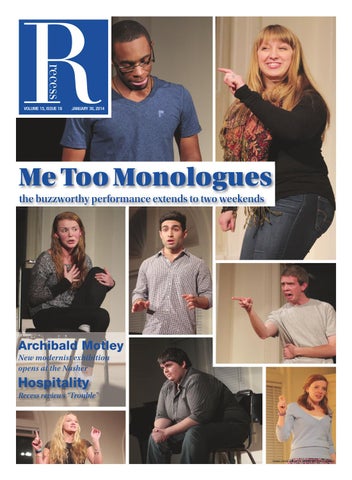
Me Too Monologues the buzzworthy performance extends to two weekends
Archibald Motley New modernist exhibition opens at the Nasher
Hospitality Recess reviews “Trouble”
EMMA LOEWE AND STEVE KUZNETSOV/THE CHRONICLE
editor’s recess note ss recess r
R recess editors SNOW DAY!
The Chronicle
recess
2 | THURSDAY, JANUARY 30, 2014
It’s been a little over a year since I started writing regularly for Recess. I’ve gotten better at having my work scrutinized. My writing has become more deliberate, critical and convincing. But one thing that’s been especially difficult, as was the case for this note, is trying to express something when nothing formative, or moving, or thought-provoking has happened. There’s a period of stagnancy, and I can only assume that anything I scrape out from the ether will be ingenuine and disappointing. Thumbing through all the things I might talk about (for a while I figured I would examine tattoos as an art form), I start to reflect on how I’ve grown. These are some of the things I’ve learned, and am still learning: There are so many stories to tell. There are so many stories, and that’s why we whip out cameras to take snapshots of a North Carolinian snow day, why we get tattoos, why we have no idea where to start when we’re interviewing someone, why we create, why we cry during a film. It gets harder to make your way though all the stories because when you ask and when you listen, it turns out that people have a wealth of things to say. They’re willing to share those things with
Lauren Feilich [editor].................................................................... first snow angel 0:-) Eliza Strong [managing]..............................................................................wait, really? MC Bousquette [music]..................................................................i’m from connecticut Megan Rise [film].................................................................................................steve Kathy Zhou [art].................................................................utah, greatest snow on earth Elysia Su [photo]..........................................................do you wanna build a snowman? Prashanth Kamalakanthan [online].......................................................nice white pow
DUKE PERFORMANCES IN DURHAM, AT DUKE, THE WORLD, JUST OUTSIDE YOUR DOOR.
THIS SATURDAY!!!
CLASSICAL PIANO GIANT
EMANUEL AX
BEETHOVEN & BRAHMS
you, even if you aren’t really worth that much of their time. You bond over how beautiful Doris Duke’s dresses were, or female authors and their thoughts on intimacy, or the thin sliver of orange paint that comes to define a painter’s lifetime of work. You bond in silence as you hurriedly jot down phrases, and when you review your pen scrawls, you wish you could craft your writings about art the way these people can speak casually about it. You end up having too many quotes to use. You start hearing about events and exhibitions all the time. You discover new galleries and an installation artist who graduated from your college. You get a little frustrated because you can’t attend everything you want to. You learn about arts policy and advocacy, because the arts should get funding too. And you realize that art is best when experienced live, so you go to those festivals, museums, spaces. You relish in quiet reflection and in universal sentiment. You want to remember this moment, or to share it with someone. Writing is hard. It’s easy enough to finish a piece of writing because it’s due, but it’s grueling to finish a piece of writing because it’s good. Writing is difficult. Especially when you’re cranking something out and don’t have enough words, or you have too many words. Your sentences get too long and out of order. You find yourself using the same words throughout articles: “prolific,” “candid,” too many em dashes and a bunch of adverb-adjective combinations. At one point, you stare at what you’ve written, sure that you can’t say anything more without being redundant or meaningless. Then there are all the times when you really just aren’t inspired enough but you have to forge ahead anyway, be-
WORLD PREMIERE!!!
URBAN BUSH WOMEN
HEP HEP SWEET SWEET DARK SWAN • WALKING WITH ‘TRANE
FRIDAY, FEBRUARY 7 & SATURDAY, FEBRUARY 8 8 PM • REYNOLDS THEATER
SOLD OUT!!!
EXCEPTIONAL STRING QUARTET + SUPERSTAR CELLIST
ARIEL STRING QUARTET FEAT. ALISA WEILERSTEIN, CELLO BEETHOVEN, BOCCHERINI, SCHUBERT SATURDAY, FEBRUARY 8 8 PM • BALDWIN AUDITORIUM
--Kathy Zhou
experience the visionary difference
$100 Off
$100 off your complete pair of glasses
$99 Exams
No insurance, no problem
Annual Frame Sale
Still time to use your Flex Spend Account
Gift of Vision
Buy a pair, and a pair will go to someone in need
SATURDAY, FEBRUARY 1 8 PM • BALDWIN AUDITORIUM
ESSENTIAL BLACK MODERN DANCE
cause something needs to be written. You come to learn that when you create—in any sense—it boils down to a struggling work ethic. You have to be able to make something sans inspiration, time, certainty. You endure. You need grit. And you have to care about what you’re writing about, because if you aren’t invested, or at least aware that it’s significant, it shows through in your writing. Sometimes you’ll listen to an album and feel unmoved, and sometimes it’ll make you dance and cry. Either way, you’re going to try to describe a song and why you felt the way you did. (My first music review took two hours to edit because no one had ever asked me why I liked something with the expectation of a legitimate and in-depth response.) And then there’s actually writing about art. You do your best to sound informed, trying to capture a hint of sophistication, a reflection of the experts you’ve spoken to. But simultaneously, you strive to remain engaging and approachable. You want your words to flow well as though the rhythm of your words, like the musicality of poetry, might reflect the sculpture you saw, the music you heard. You want others to feel what you did, to sense as you do. Claim the process and your work. Words have power. Words captivate, words strengthen, words start movements. Proclaim what you think. Declare it, because what you think matters. Cement it in writing; force yourself if you have to. Share it, maybe tentatively, but never apologetically. Even if uninspired, learn to feel proud of your work, or at least learn to own your work. Revel in the power, and relief, that comes from creating.
VISIONARY JAZZ GUITARIST
PAT METHENY UNITY GROUP
WITH CHRIS POTTER, ANTONIO SANCHEZ BEN WILLIAMS & GIULIO CARMASSI
*Promotion ends 1/31/14. Valid Rx required, outside Rx welcome. Promotion is for new frame and Rx lenses; not valid on lenses only or on previous purchases. Packages may not be combined with any other insurance discounts, government or private insurance benefits, coupons, promotions, special pricing offers or other discounts. ©2013 Eye Care Associates - Optometrists.
West Durham / South Square 3101 Shannon Road
WEDNESDAY, FEBRUARY 12 8 PM • CAROLINA THEATRE
UKE
ST
UDEN
EVERY SHOW. ALL SEASON. TAKE ADVANTAGE.
GET TICKETS: DUKEPERFORMANCES.ORG | 919-684-4444
TS
D
TIX $10
Southpoint / Renaissance at Southpoint 7001-105 Fayetteville Road
(919) 863-2020
www.eyecareassociatesnc.com
North Durham / NCEENT Building 4102 N. Roxboro Street Durham / Duke Eye Center 2351 Erwin Road
The Chronicle
recess
THURSDAY, JANUARY 30, 2014 | 3
This week in Recess, we are small on space but big on stuff. Make your way over to dukechronicle.com/section/recess after logging onto the World Wide Web to stay in the loop on all matters arts and culture. Online exclusives include: an interview with Mutual Benefit’s Jordan Lee, who will be performing at Local 506 on Feb. 4; a preview of Emanuel Ax’s sold-out Duke Performance on Feb. 1; and a feature on the Durham Arts Council’s exhibition of “Silvia Heyden and Edith London: Together Again.”
MUSIC The Dum Dum Girls Too True Sub Pop Records
by Drew Haskins THE CHRONICLE
“Why be good? Be beautiful and sad.” After two albums and four EPs, it seems as though Dum Dum Girls have finally come up with the ultimate summation of their goth-girl-meets-beach-pop aesthetic. It is a shame that this sentiment comes in the middle of “Too True,” easily their worst album to date. On paper, “Too True” looks like a continuation of Dum Dum Girls’ formulaic yet pleasant earlier work. Lead singer Dee Dee Penny returns with veteran producer Richard Gottehrer, who is best known for his work with Blondie and The Go-Go’s. The entire album—and the majority of Dum Dum Girls’ music in general--covers that familiar ‘80s ground, but the arrangements are always mindlessly catchy, and Dee Dee once again shows off her wonderfully sultry vocals. However, to the detriment of “Too True,”
the record marks a major departure from Dum Dum Girls’ earlier lo-fi sounds to a more streamlined yet less distinct production. Dee Dee and Gottehrer have largely eschewed the jangly surf rock and girl group harmonies of previous recordings. Unfortunately, much of the album is structured around nondescript ‘80s synthesizers, and Dee Dee is often stranded by vocal arrangements that simply cannot convey her sheer charisma. Songs like ‘Little Minx’ and ‘In the Wake of You’ blend together with little impact. Until now, Dum Dum Girls have created their best music by experimenting with lush waves of sound. Sonically, “Too True” often sounds thin and uninspired. Dee Dee is as good of a singer as ever, but even she cannot save the trite, fauxphilosophical lyrics of songs like ‘Rimbaud Eyes’ and ‘Under These Hands.’ There is not a song on this album that even comes close to the heartwrenching ‘Lord Knows,’ Dum Dum Girls’ best song from the 2012 EP, “End of Daze.” In comparison, most of the songs on “Too True” feel like emotional play-acting. However, that is not to say that the album is without some good songs. The album opener, ‘Cult of Love,’ is a catchy and sinister celebration of destructive love, and ‘Lost Boys and Girls Club’ is a beautifully hazy ode to Los Angeles nightlife. Overall, “Too True” marks a new sonic progression for Dum Dum Girls yet a major step back from their previous work. While many of the band’s key elements are still present from early recordings, the album seems obsessed with style when it should have focused more on substance.
Putting Of f Procrastination... until Later Sometimes, procrastination is simply a matter of self-discipline. Most of the time, it’s a lot more com-plicated than that. Would you believe it has less to do with the task you’re postponing and more to do with things like your life aspirations, your excitement about potential, and even perfectionism? Come find out how! • Learn the psychology of procrastination! • Recognize the mechanisms and types of procrastination in your own life. • Learn strategies to minimize procrastination and feel good about your work pace.
Tuesday, February 4 3:30 - 4:45pm Room 201, Flowers Building
MUSIC Hospitality Trouble Merge Records
by Andrew Karim THE CHRONICLE
Hospitality released a one-minute YouTube trailer for their sophomore record a good three months before its release date. The video featured a slideshow of arbitrary images overlapped with faint plumes of fuzzy red smoke and an archetypal electro beat, a stark contrast from the album’s distressing commitment to lethargic indie-pop. It was too much hype for the sleepy Brooklyn trio, but a shallow teaser isn’t the worst thing a band with VEVO-status could’ve hit us with. “Nightingale” opens with Papini’s bare vocals garnished with a generic blues-rock guitar that would make even the most diehard Black Keys fan cringe. The awkward shredding fades into a slow bass and cymbal sequence that just barely complements Papini’s whiney refrains. Bouncy keys hint at a much-needed divergence from the band’s dreary instrumentals
Listening to “Trouble” Reminded me of watching “Girls.”
seconds. The cut’s energy sinks when Papini’s vocals weaken into a trite, ballad-like hum. Listening to “Trouble” reminded me of watching “Girls.” If the show’s cast were to start a cutesy indie band, it’d probably sound something like this album. I hoped something stimulating would freshen up the record’s repetitive and alienating track list, but the moment never came. Instead, I trudged through 40 minutes of half-baked elevator music with a cheap garage overlay you’d hear in a Williamsburg dentist’s office. “Trouble” is a stubborn convergence of unremarkable lyrics and lackluster instrumentals. Consider the title a warning—this record is sonic flannel.
In The Company Of My Sisters
In The Company Of My Sisters ”Whether you come from a council estate or a country estate, your success will be determined by your own confidence and fortitude.” -Michelle Obama
© The Center for Contemplative Mind in Society Concept & design by Maia Duerr; illustration by Carrie Bergman
‘When I dare to be powerful-to use my strength in the service of my vision, then it becomes less and less important whether I am afraid.” - Audre Lorde’
A CAPS Workshop Counseling and Psychological Services
in “Inauguration,” a song about mourning missed phone calls while watching a presidential inauguration telecast. Yup. The keyboards quickly disappear, taking with them any potential the track had for upbeat redemption. Once again, the song is bombarded with Papini’s dusty vocals and a redundant drum set that reiterates the record’s low-spirited drone. The flat lyrics reflect Hospitality’s overarching habit of featuring painfully bland anti-narratives that are as devoid of substance as the record’s stumbling instrumentals. “I Miss Your Bones” has a pleasantly coarse riot grrrl quality to it that might have been enjoyable if it had lasted longer than a measly 20
SPECIAL TO THE CHRONICLE
“The greatest discovery of all time is that a person can change his future by merely changing his attitude” -Oprah Winfrey
SPECIAL TO THE CHRONICLE
In The Company of My Sisters will be a space for Black Women to feel empowered and confident, to be authentic and flourish, to embrace their culture and feel fabulous, to honor the space as sacred and as a gift to themselves!
In The Company of My Sisters will be a space for Black Women to feel empowered and Located In: Room 203 confident, Page Building to be authentic Counseling and Psychological and flourish, to embrace their cultureServices and feel fabulous, to Facilitator: Mazella Fuller, PhD., MSW, LCSW, CEDS honor the space February as sacred and as gift to themselves! 5th,12th,19th anda26th, March 5th,19th and 26th This Group will not meet the week of Spring Break.
(Click on “Workshops and Discussions”)
Located In: Room 203 Page Building Register now at the CAPS website! Counseling and Psychological Services http://studentaffairs.duke.edu/caps click onFuller, Workshops and Discussions” Facilitator:“and Mazella PhD., MSW, LCSW, CEDS February 5th,12th,19th and 26th, March 5th,19th and 26th This Group will not meet the week of Spring Break.
Counseling and Psychological Services
Register now at the CAPS website! http://studentaffairs.duke.edu/caps and click on Workshops and Discussions
Classes are FREE and open to ALL DUKE STUDENTS (Undergraduate, Graduate and Professional School). Because space is limited, registration is requested. Visit the CAPS website for more information and to register. http://studentaffairs.duke.edu/caps
Division of Student Affairs - Duke University
4 | THURSDAY, JANUARY 30, 2014
The Chronicle
recess
Me Too Monologues surges into t by Julian Spector THE CHRONICLE
She stands just feet away, eyes glistening as she finds the words to tell her mother what her high school boyfriend did to her when she got high for the first time with him.
“Me Too Monologues” returns for its longestever run with two weekends of highly personal monologues written by anonymous students for the performance. She is a character, insofar as she is portrayed onstage by an actor. But she is also a real Duke student who wrote and anonymously submitted a monologue to express something of herself that can’t be shared easily. The power of “Me Too Monologues,” which starts its largest-ever run this weekend, derives from the chilling and exhilarating knowledge that the men and women who wrote each monologue could be sitting next to you in the theater, laughing and crying alongside you. It humanizes the burdens, obstacles and successes of 16 different students from different backgrounds in a single evening of highly personal theater. On a campus where advocacy can be divided across numerous centers and organizations with different focuses, “Me Too” provides a single venue to spotlight issues that cut across the Duke community, said senior Cara Peterson, assistant producer. “Everyone has their issues and everyone
has their struggles, and at ‘Me Too’ we can come together and be human together and let our masks down,” she said. “You feel like your voice actually matters and you can actually do things.” When it started six years ago, “Me Too” largely focused on issues of race, but since then it has looked to other forms of identity as well. This year’s show, for instance, features the fairytale story of a farm girl’s journey to the Gothic Wonderland, which turns into a nightmare due to the pursuit of effortless perfection. Another girl has a coming out experience as a Duke student whose family’s poverty leaves her mother stranded between campus and home because she cannot afford another tank of gas. The producers also looked for more white male perspectives this time around. The diversity of perspectives may help explain how “Me Too” has established itself as not just a play but an event, as seen in the near-messianic response it routinely generates among Duke audiences. Last year’s three performances drew approximately 1,200 viewers, some of whom started lining up at 3 p.m. for a 7 p.m. show, said executive producer Tara Gavcovich, a senior. The line became a social environment of its own as people chatted with each other and ordered food in the hours before the actors took the stage. “People start talking about the show, talking about the issues involved, and when the actors come they get excited to see people lined up already,” she said. In order to deal with the crowds, the production team arranged a second weekend of performances, with a week of additional programming in between for viewers to engage with some of the themes raised by the monologues. This will include panels with actors, writers and community leaders on topics including sexuality, gender, racism and engaging in social justice from a posi-
EMMA LOEWE/THE CHRONICLE
Archibald Motley: Jazz Age Modernist opens at the Nasher by Kathy Zhou THE CHRONICLE
Archibald J. Motley Jr., Hot Rhythm, 1961. Oil on canvas. Collection of Mara Motley, MD, and Valerie Gerrard Browne. PHOTO COURTESY OF VALERIE BROWNE
Staring at the viewer from his 1933 “SelfPortrait (Myself at Work)” is Archibald J. Motley Jr., a painter who here, donning a navy beret, long triangular mustache and thick tan bohemian jacket, paints a nude woman. His room has a few relics: a small cross on the wall, an elephant statue, a small bottle of alcohol and a palette spotted with bold and blended paints. This is Archibald Motley, whose boldly colored Harlem Renaissance-era paintings chronicled the African American experience of the Jazz Age. Yet despite a 40-year span of significant artwork, Motley is one of the least visible artists of the 20th century. For the first time at the Nasher Museum, “Archibald Motley: Jazz Age Modernist” will be on display, with works dating from 1919 to 1960. The exhibition will also incorporate historical documents and audiovisual components, including a documentary commissioned by the Nasher. Motley’s paintings are modern and jazzinfluenced, navigating pieces from familiar—sometimes voyeuristic—portraits to depictions of wild Saturday nights. His 1924 “Mending Socks” captures a rustic image of his grandmother in an orange shawl, working in a rocking chair next to a table with a bowl of fruit. “Brown Girl After Bath” (1931) features a woman—with a distinctly more Modern-looking face—wearing nothing but hoop earrings, red lipstick and dance shoes. She looks into a mirror; not at herself, but at her viewers, questioning traditional representations of race, sexuality and art’s engagement with its audience. And in the
much more stylized cultural scene, “Barbecue” (1934), the canvas is filled with movement, conversation and a night sky that blends into the orange background. The work represents, in a radical and vibrant way, the communities Motley grew up in. Much of his most notable work is centered upon Chicago, particularly upon a neighborhood termed the “Black Belt” by outsiders and reclaimed as “Bronzeville” by its predominately black residents. Motley’s depictions of Chicago scrutinize both poor, overlooked workers from the South and the African American elite; yet throughout, there is a reimagining—a lauding of ambition. Here was a community in the midst of becoming, moving forth through modernity, forging black cultural and economic self-determination; and here was Motley in the middle of it all. The palette in “Bronzeville at Night” (1949) is mostly blue, with highlights in red stoplights, gauzy windows and women’s dresses. There’s a mixture of romance and nervousness, leisure and labor. Thin lines of orange paint create neon reflections and highlights on the bodies of Motley’s subjects. And there was the Stroll, a town square of sorts, home to the “Bohemia of Colored Folk” and “the black man’s Broadway and Wall Street.” These powered Motley’s cityscapes of black diversity, who himself, of multiracial and middle-class origins, lived with his white wife in a predominately white Chicago neighborhood. In “Street Scene” (1936), a woman wails in song, arms lifted and high-heeled feet spread wide apart. A dog howls, three women chorus with trumpets, one man blows
The Chronicle
recess
THURSDAY, JANUARY 30, 2014 | 5
two-weekend run, opens tonight
EMMA LOEWE/THE CHRONICLE
EMMA LOEWE/THE CHRONICLE
into his trombone. The onlookers look more uncertain, more suspicious. A white police officer glares out of the corners of his eyes, and a small child cocks her head and watches. Motley’s work captured “black expression” while it was being cultivated and expanded. There were nighttime trumpet players, a rowdy nightclub, a Negro cabaret, picnics, cocktails, cards. A social outsider who looms and watches, absorbing the vibrancy and the energy. Each painting has this sort of observer, cementing Motley as someone caught up in the very center of this frenzy, as an outsider looking in, as a reimaginer. When Motley visited Paris, where African American artists had come to thrive (think Duke Ellington and Josephine Baker), he painted the blues, the idyllic Parisian streets and the Jockey, a café frequented by artists. When he visited Mexico, he continued with his pattern of over-the-top portrayals, following the same hint of mocking dark humor as in his “Hokum” work. But his work as a modernist artist, held its foundation in America, where he maintained that “the Negro is part of America and the Negro is part of our great American art.” Motley’s modernity entailed the Jazz Age in all its rhythmic splendor, and it meant capturing a time when “these moderns,” to quote Duke Professor Richard J. Powell, “were African Americans, too…with their rainbow fashions and complexions— possessing an inherent visuality, a spectrum of socioeconomic functions and an inexhaustible will to perform.” “Archibald Motley: Jazz Age Modernist” is on view at the Nasher Museum of Art from Jan. 30 to May 11. For more information, visit the Nasher’s website.
tion of privilege, Peterson said. In preparation for the show, each actor was paired with a monologue and began developing a character to tell that story. This could include imagining a childhood for the speaker and figuring out what they studied at Duke, said senior Caroline Kiritsy, one of the actors. There is no guarantee that the monologue will come out exactly how the author expected, but the key is doing justice to their voice. “I’m very, very honored to be able to be a voice for the person who submitted it,” Kiritsy said. “It is so humbling that they’ve allowed somebody to tell their story for them. It’s all anonymously submitted, so the person could be the one that I’m making eye contact with the entire time that I’m saying it.” Actor Elizabeth Hoyler, a sophomore, noted that although she could not directly relate to the situation portrayed in her monologue, she was able to pull out emotional strains that resonated with her experience. This works for the audience members too—the show invites viewers to find moments of shared experience in unlikely places. “I believe in a lot of what this show is trying to do—showing vulnerability at Duke, showing what’s below the surface,” Hoyler said. “A lot of times Duke students project an image that ends up perpetuating our loneliness because we don’t see other people are struggling like we are. I just wanted to be part of a project that helps empower and at the same time humble students.” “Me Too Monologues” opens tonight, January 30, and will run on January 31 and February 1, 7 and 8. Shows are in the Nelson Music Room and will start at 7:30 p.m. Doors open at 7:00 p.m. Audience members are recommended to arrive early to guarantee seating. For more information, visit the Facebook event.
Me Too Programs, Feb. 3 through 6 M O N D A Y Sexuality: Keohane Atrium, 6-7:30p.m. See a screening of past monologue “Really?” and listen to an open discussion between the actor and writer. This will lead into a student panel on sexuality led by Think Before You Speak, who will end the night with food and an exhibit of their newest You Don’t Say poster campaign.
T
U
E
S
D
A
Y
Gender: Von Canon, Bryan Center 6:30p.m. Five actors performing pieces centered on gender issues will perform a sneak peek.
W
E
D
N
E
S
D
A Y
En/Countering Racism: Racial Justice Through Music: CMA, 6p.m. Join us in the Center for Multicultural Affairs to explore how racial justice has been pushed utilizing the art form of music. T H U R S D A Y Everything I Wish I Had Known as a First-Year: GA Down Under or above the Marketplace, 7-8p.m. This is an event all about creating a safe space to share vulnerability and discuss some of the most taboo issues on Duke’s campus. F R I D A Y On the Privileged Side of Social Justice Work: CMA, 6:30-8p.m. Gary Glass will lead a program offering students an opportunity to explore the experience and the role of students who enjoy privilege and want
PHOTO COURTESY OF VALERIE BROWNE
PHOTO COURTESY OF VALERIE BROWNE
Archibald J. Motley Jr., The Liar, 1936. Oil on canvas. Collection of the the Howard University Gallery of Art, Washington, DC.
Archibald J. Motley Jr., Mending Socks, 1924. Oil on canvas. Collection of the Ackland Art Museum, The University of North Carolina at Chapel Hill.
PHOTO COURTESY OF VALERIE BROWNE
Archibald J. Motley Jr., Barbecue, 1936. Oil on canvas. Collection of the the Howard University Gallery of Art, Washington, DC.
PHOTO COURTESY OF VALERIE BROWNE
Archibald J. Motley Jr., The Picnic, 1936. Oil on canvas. Collection of the the Howard University Gallery of Art, Washington, DC.
recess
HOME TOWN HERO!
6 | THURSDAY, JANUARY 30, 2014
The Chronicle
the
comsic burrito Menu Sampling
Old School Veggie Burrito Regular Chicken Burrito Cheese Quesadilla Chicken Quesadilla Veggie Nachos Chips & Salsa
$2.86 $5.65 $1.41 $3.59 $4.12 $2.06
1920 1/2 Perry St. at Ninth Street Just a block from East Campus Now served at JB’s hot dog stand.
No German? No Problem.
Go Berlin Info at: studyabroad.duke.edu OR german.duke.edu Application Deadline for Summer Session is Friday, February 7