INSIGHT O f f i c i a l
M a g a z i n e
o f
Entertaining
w i t h r e l i g i o n
On Arrogance & Humility
D a r u l
U l o o m
C A N A D A
S e p t/ O c t ‘ 2 6 vol 5 issue 6
24 06
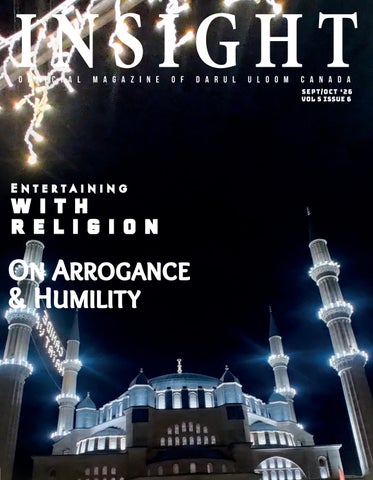
about the cover
Night photo of the Selimiyye masjid in Edirne, Turkey. The masjid was commissioned by Sultan Selim II and designed by the renowned Uthmani architect, Mimar Sinan, who considered the Selimiyye masjid his crowning masterpiece. It was built between 1568 to 1575.
CONTENTS 06
24
40
m g o n r i on f n & i e 42 i v a e i g t li c r r e n e e t a ’d c i n E n i t h R ro g b ‘jin r a s y w r 2 A t n i s 5 A l a o n i e i lif O um ing d o n a ha to p H arn e r e k g om i r s t in Le W h C h f t e e t 40 h s t h f ot la a o s et nd mm e a t U nt y s Liv l e d g e s f ir his m e P t h p e o op T h a v e el r v P le de : are a w ftw a t Fa s o On
42
56
Patron
Hazrat Dr. Ismail Memon
Fatawa
Mufti Husain Ahmad Badri
Contributors
Mufti Omar Baig
Maulana Dr. Mateen Khan Dr. Kamran Karatela
Editor
Asim Ahmad
Attribution
Photo by dlxmedia.hu on Unsplash/Photo by dlxmedia.hu on Unsplash/Photo by Allec Gomes on Unsplash Photo by Glib Albovsky on Unsplash
office@ducanada.org
Website
www.ducanada.org
Address
51 Prince St. N, Chatham, ON N7M 4J7, Canada The views expressed in the columns of Insight magazine do not necessarily represent those of Darul Uloom Canada. The articles published in this magazine may be reproduced with due acknowledgment.
4
INSIGHT MAGAZINE
The pervasive influence of the camera on our Islamic culture in and outside the masjids is something few of us are making note of even as we witness it boiling it down to a matter of fun and entertainment. The obsession with propagation of Deen, I believe, may be the reason we are oblivious to how our Deen has become an accessory to the camera. Had we thought for a moment that propagation of Deen has continued relentlessly from pre-visual media times for the past 1400+ years to become the second fastest growing religion in the world, we would realize that the hysteria about the camera as a necessary, propagative tool is a naivete that severely minimizes the prophetic mission. Entertaining with religion analyzes how the camera culture focuses on quantity and form over quality and content thereby diluting the essence of the faith.
islahi majlis UPCOMING DATES
aug 2026 SEP 2026 OCT 2026 NOV 2026 DEC 2026 JAN 2027
Darul Uloom Canada 51 Prince St N, Chatham, ON N7M 4J7, Canada
22-23 19-20 17-18 NO MAJLIS 19-20 16-17
LISTEN LIVE https://darul-uloom-canada.mixlr.com http://duc.servemp3.com
www.ducanada.org www.alqaasim.com INSIGHT MAGAZINE 5
Entertaining with Religion Death of the spirit of Islam
I went to meet a relative down south a few years back. He took me to a beautiful masjid for salat and as a way of introducing me to its history and the community that built it, he said that just last year, the board had invited an actor from the Turkish drama series Ertugrul for a talk here. He added that the masjid had never been so full as on that night. An actor? Invited to the masjid? The masjid was jam-packed? I was totally disoriented. What was the connection between an actor, a masjid and the masjid being filled to the brim? The visual-media culture has overtaken our faith; catchy flyers, celebrity speakers, heavy marketing, influencers and Islamic events featuring artists, athletes, and other ‘entertainers’ all while the very same masjids remain near-empty for the congregational salat. I talk about this doosmday phenomenon and what is at stake if we don’t wake up.
INSIGHT MAGAZINE
7
W
hen I was a kid, there was a company called Sound Vision (I believe it is still around). They are the creators of this cute, spectacled puppet named Adam who entertained Muslim kids while educating them about Islamic morals and culture. We would receive catalogs in the mail that sold Islamic videos of Adam. I would read through the catalog more out of curiosity and my love for reading (I even read the back of cereal boxes) than an interest in joining ‘Adam’s world’ as it was called. I remember my father having a conversation with me about Adam once. I am now sure that he had seen me perusing the catalog and wanted to know my thoughts on it. I don’t know what I said, but I sensed that he didn’t like something about it. He was beyond his time in his insight and wisdom and I liked to hear his take on things, which challenged me to see matters from a different angle. I digested his words carefully, trying to think every word through to its final outcome.
8
INSIGHT MAGAZINE
I don’t remember his exact words but he was clearly concerned about the idea of making faith into a fun and entertaining experience. He was adamant that a matter so sublime as faith cannot be converted into something fun and engaging. If a mother died, how do you explain her death to a child who cannot comprehend the meaning of death? Make it fun to avoid the child being traumatized by his mother’s sudden departure? Or, would the somber expressions and an elementary conversation about death be more appropriate for the occasion. This rule is equally applicable to all adult discourse. Imagine an anatomy textbook taught at Harvard medical school that looks like this: What did the bubbly fonts and colorful illustrations take away from the subject matter? It not only minimized the subject, but maybe even ruined the prestige of the institution that includes this textbook in its curriculum. Anyways, one of the other points I remember my father made at the time was that Allah sent the
Prophet s to relay the divine message, and he was the best of all creation. Alternatively, Allah could have revealed the Qur’an directly onto the people or maybe via an angel. But the point behind sending it with the Best of All Creation was to impress the importance and urgency of the message. If it is being delivered by al-Sadiq and al-Amin, the message must be a veritable reality. In that case, it is not to be taken as Abu Lahab did—lightly. When the Prophet s made his call on Mount Safa, Abu Lahab said, “Woe to you, is that all you gathered us for?”1 Note his flippant tone. When a nation establishes diplomatic ties with another, they open embassies and appoint ambasaddors to represent them. What if the ambassador of one nation wears a Sponge Bob costume every time he meets the head of state of the other country just for the fun of it? Then how can a message of immediate urgency and eternal life and death be conveyed by a puppet? And if he does, will it’s message carry any weight? Would the children who were raised up in Adam’s world develop strong feelings about the tauheed of Allah, Jannat and Jahannum, the Sunna, and accountability on the Day of Judgment? And why did the parents not take the time out to imbue the spirit of faith in their children so that they grow up to navigate their future guided by their faith? But let me be fair here. This article is not about Adam and I know that Sound Vision had the purest of intentions behind his creation. I only am using his example as a metaphor for any medium of entertainment. All mediums of entertainment will trivialize the divine message. The urgency of the message
INSIGHT MAGAZINE
9
is diminished because entertainment exists if only to reduce all matters to triviality. It is to relieve stress and kick back and relax. The problem is that Allah did not inform of the Hellfire and Jannat for us to relax and be carefree. In fact, there is nothing like Hellfire to induce stress and Jannat to incite to action. The words, “(I swear) by the passage of time, humanity is in a state of loss (103:1-2),” are a call to action and not a sedative to promote calm and relax our minds and bodies. We must be worried of accountability, fearful of our end and continuously working toward achieving the pleasure of Allah. I don’t think I was mature enough to understand my father’s point at the time, but I accepted it regardless due to my default that my father knew better than I. I will add here tangentially that taking our elders words of wisdom even if they are not certified scholars is not being unenlightened and backward. The race to be increasingly progressive especially in the variety of new ways for propagating faith seems to be abrogating the Islamic precepts (like following our elders) in our time, though propagation of Deen is neither a virtue in itself nor does it prove attachment to the Deen. In a hadith of Bukhari, the Prophet s states, “Allah supports this deen through a fajir (wicked
10
INSIGHT MAGAZINE
person).”2 If propagation of Deen was innately virtuous, it would never be associated with wickedness.
40 years later
I stuck to my father’s advice even if unconsciously so. I went around the globe to study the Islamic sciences and returned to teach hadith and other Islamic subjects in a traditional Islamic seminary for several years starting in the late 90’s. Over time, new generations of graduates entered the field at about the same time as we were welcoming the internet in the early 2000’s. Later, Youtube and other media platforms opened up shop and many saw their unique potential for the propagation of Deen. Many up-and-coming scholars and young commentators achieved fame and success with savvy marketing, Youtube videos, and broadcasting from the camera to virtual audiences around the world. None of it sat well with me, for one, because my elders didn’t like the idea. But I felt something else was amiss. Then, the shampoo bottle incident came up and I realized what my father was talking about.
Shampoo to revivify our faith
A few years ago, a charismatic, young Youtuber came out with a series of religious
videos. He would talk about contemporary issues and their solutions from an Islamic perspective. Whatever it was, people liked him and at some point he reached over a 100,000 subscribers. I didn’t have a clue who he was and what he was about since I rarely used Youtube except for tutorials (like how to fix my broken dishwasher or political commentary). Someone wanted to know my opinion about the young man and asked me to check out his channel. I started scrolling through and clicked on a video which was devoted to questions from his subscribers. The first question was: “What shampoo do you use?” That really threw me off. He seemed flattered that his hair was the first topic of discussion (and it was quite luxuriant, I admit). He laughed and said something, but I had already switched it off. Seriously? So, a channel on religion that is dedicated to the topic of Allah and His Prophet s, the sacred and sublime, eternal life, and Jannat and Jahannum boils down to a bottle of shampoo? Not only does it make no sense, it is just so mind-blowingly absurd. Can you make even a remote connection between shampoo and any aspect of faith. For me, this one video embodied everything that was wrong with using the camera and visual media for religious purposes. And it brought me back to what my father had said all those many years ago when I was a kid.
Bias of the camera
How did a religious discourse go from the topic of Allah and His Prophet s to a bottle of shampoo? How did viewers extract shampoo from a solemn discussion about Allah, or did they even? Here is the problem. The camera, you see,
INSIGHT MAGAZINE
11
learn Arabic
has a bias. It has an inherent liking for the tangible; physical subjects that can be made the center of attention. What it cannot kiss with its lens will never be a beloved of the camera. The camera despises concepts, ideas, thoughts, beliefs, and feelings even while it is in love with their physical manifestations. While the camera hates anger itself, it can certainly zoom in on an irate man throttling his victim to death. What I mean to say is that the camera is obsessed with form. It’s lens cannot capture Allah, it cannot visualize holiness, truth and falsehood, or any other abstraction for that matter. But it can show you the flowing hair of the host while he speaks of love for Allah, love for the Sunna, and other essential matters of Deen. The camera wants you to love the messenger and ignore the message. The bias of the camera forces us to recast ourselves. We become actors of ourselves but without representing our true selves. We must talk in a certain way and behave in a manner that may
12
INSIGHT MAGAZINE
not always align with who we really are. We will dress to impress and create a professional backdrop to the liking of the camera even if it doesn’t represent our everyday world. We polish our appearance, perfect the lighting, and strive to be as telegenic as possible. The anchorman sits in the makeup studio for a makeover before he pitches his daily news. The scholar sits before shelves of books, the podcaster and Youtuber before a curious array of thingamajigs that match the tone of their channel or personality, or both. In all cases, the setting is meticulously planned to make it camera-worthy. The camera is the puppeteer and we its puppets. It pulls, we dance. Sometimes I wonder what would have become of our faith, how our Islamic history would have unfolded and who our khalifa’s would have been had the rankings of the Sahaba been decided by the camera. Here is what I mean:
Dihya al-Kalbi g and, “He (Dihya Kalbi) entered the city and a young girl may come out to take a peek at him.”3 As for Jareer bin Abdullah, Umar g called him the Yusuf of this umma.4 Thabit bin Qays g was the most powerful orator of Madina and Hassan bin Thabit g Arabia’s most celebrated poet. Any time, a tribal delegation came to Madina, its poets and orators used both poetry and prose to glorify their forefathers as was the custom of the time. The Prophet s called upon Thabit bin Qays g and Hassan bin Thabit g who responded impromptu and the delegations were promptly silenced. These four Sahaba would have been darlings of the camera, not because they were Sahaba, but because of the telegenic features (think movie stars) and oratory skills that would have produced great performances. On the other hand, Abu Bakr
If cameras and videographers were at work in the time of the Salaf, the names, works and contributions of Imam Abu Hanifah and Imam Shafi may have never come to light. Our new Salaf would be the great reciters and telegenic ‘scholars’ of the time. Among the Sahaba, Dihya Kalbi g would outrank Abu Bakr Siddique g and Umar g, because of his good looks. The authentic hadith narrate that Jibril e often took the form of
INSIGHT MAGAZINE
13
and Umar k were the highest ranking of Sahaba for a sublime set of qualities that cannot be projected onto a screen. While our understanding of the hierarchical status among the Sahaba is based on standards set by the Quran and Sunna, the camera has its own golden standard by which everything is judged. It will gauge the attractiveness of appearance, the quality of the performance, the amount of form in the appearance, and the magnitude of their action. Let me present an example: The Prophet s said, “If one of you was to give equal to Mount Uhud in gold in charity, it will not equal even one mudd (less than a kilo) a sahabi spends in charity.”5 The Prophet s is comparing the ikhlas (sincerity) of the Sahaba to that of the umma by stating that their one mudd in charity is heavier on the Scale than our giving of gold equal to the size of Mount Uhud. Imagine a camera recording this hadith live in action. Before us comes a sahabi holding a small bag of barley, and then I step forward announcing before the camera that I have donated this mountain of gold for the people of Gaza. As I gesture toward the mountain, the camera zooms in on the mountain. The audience is genuinely overwhelmed by my sheer generosity. The sahabi comes across looking comparatively ridiculous with his small bag of barley. What the camera does not and cannot reveal is the condition of my heart. I performed the charitable act to improve my image while the sahabi
14
INSIGHT MAGAZINE
gave everything he had out of his love for Allah. Fortunate for him, Allah disagrees with the biased coverage of the camera.
What goes in is not what comes out
The camera breaks down everything into form much like how a crematory burns a body into ash. To do that, it guts the soul and substance and reduces it to its very skeletal form. The word performance itself says it all. Per- is a prefix which means ‘through,’ ‘completely,’ and ‘all over’ and then ‘form’ meaning the tangible skeleton of something which the meaning hugs onto. Since the camera has no appetite for sublime stuff, it converts whatever is fed through its gaping lens into a performance. Neil Postman, the media critic, says in his bestseller Amusing ourselves to death, “What I am claiming here is not that television
is entertaining but that it has made entertainment itself the natural format for the representation of all experience,” and then: The problem is not that television presents us with entertaining subject matter but that all subject matter is presented as entertaining, which is another issue altogether. The camera is essentially a converter of any and all material into some form of entertainment. The entertainment value of the converted material will vary, no doubt. A docutainment is not going to offer the same level of entertainment value as a movie, but they are sure to be more entertaining than reading a book. What makes any material entertaining has much to do with the amount of work involved in converting the material into something that entertains. Reading requires lots of mental work, which is why many find reading tedious. The mind has to create scenes out of words into bigger scenes out of sentences into even bigger scenes out of paragraphs and then chapters. And then, dots must be connected between each scene and twist. Characters and plots must be visualized. The storyline forms in the mind which is constantly at work producing, imagining, connecting, and directing. In a video, the producer, director and screenwriter and then the actors and their settings do all the work for you. The critical difference is that viewing bypasses critical thinking since the conversion is done for the viewer while reading enhances and sharpens the critical-thinking faculty because the conversion process is done by the mind. The eye captures form while the
mind processes the word. The lack of processing and filtration in watching form is always more engaging and entertaining because all human faculties besides the eye itself are in sleep mode. The camera has necessarily converted deen into visual indulgences for us to enjoy and be entertained. If there is nothing to fear or be worried about, then why even have faith? What urgency is there in the Qur’an warning us of accountability on the Day of Judgment, the enticement of Jannat and forewarnings of Jahannam, and about conviction in the oneness of Allah? Why does the Sunna even matter anymore, and why do we need to strive to please
INSIGHT MAGAZINE
15
Allah?
Celebrity scholarship
The new phenomena of celebrity scholars and imams is a by-product of the camera’s inheret bias. Imam Abu Hanifa, Imam Shafi’i and Imam Bukhari were the polymaths of our umma, but they are not celebrities because
focuses simply on the form. of form when he said, “It It is this very form that is is enough of an evil for idolized, worshipped and a person to be pointed the source of celebrity at with fingers, whether status. in matters of religion or It is the very form people worldly affairs, except point to when it passes by. for those whom Allah “Oh my God, there is soprotects.”7 and-so!” The cellphones Keep in mind that come out and fans beg for the prophets were not selfies. Or, in the least, characterized by their heads turn and people form, i.e., how they
When scandals break out and a celebrity scholar, speaker or imam is exposed, communities are shocked. But why should they be when the camera never showed the imam for who he was, but only for what he appeared to be. they were not made larger than life or greater-thanthou by appearances on visual media. The camera did not exist at the time to pry them from their profundity and knowledge. The cameras tunes out all the ‘extras’ that do not conform to the visual framework [e.g., profundity and knowledge, taqwa, and connection with Allah] and
16
INSIGHT MAGAZINE
point. The Prophet s said that the most enviable of believers is the one who is unknown and people, “Do not point toward him with fingers.”6 The camera glorifies the form until it seems larger than life. Normal becomes legendary; ordinary becomes extraordinary. The Prophet s warned against the glorification
delivered the divine message but for their sinless character, their Allah-consciousness, and their struggles and sacrifices for the divine mission assigned to them. The camera dismisses these celestial qualities since it is incapable of producing anything tangible out of them. It glorifies a talented speaker
without shedding light on how much the content of the speech is embodied in the speaker himself. In other words, the camera cannot be the criteria for judging who is or isn’t a scholar or who is or isn’t good and pious. It can only tell you who appears to be a scholar and who appears to be good and pious. When scandals break out and a celebrity scholar, speaker or imam is exposed, communities are shocked. But why should they be when the camera never showed the imam for who he was, but only for what he appeared to be. Who someone really is and what they appear to be are two very different things.
Honorariums
With the fame that follows visual appearances comes honorariums. Speakers gain the leverage to charge honorariums according to their degree of celebrity status. If this is indeed prophetic work, then let us take heed to the words of all the prophets, “O my people, I ask you no reward for it. My reward is only on the One who created me” (11:51). In another ayah, Allah warns us of an accursed nation that also made business out of their deen: Indeed, those who trade Allah’s covenant and their oaths for a fleeting gain will have no share in the Hereafter. Allah will neither speak to them, nor look at them, nor purify them on the Day of Judgment. And they will suffer a painful punishment (3:77). The Prophet s prophesized that a time will come when the deen would become big business and even alluded to the role of the camera in the making of this fateful enterprise.
Prophesy 1
The Prophet s talks about a time when a man will clothe his love for dunya (worldly life) with the guise of deen. He will deliver beautiful talks, his garb will be modest and his tongue “sweeter than honey, but his heart like the hearts of wolves,” which Mulla Ali Qari describes as more bitter than the bitterest due to excessive love for dunya and the jah” (desire for fame, rank).8 Some hadith transmissions add: and the best of them in that period will be the mudahin.9
INSIGHT MAGAZINE
17
One of the spiritual impacts of the monopoly of visual media over our sources of information has been our growing obsession with appearance, elocution, style, and superficiality. Once, I was uninvited to a masjid because they had requested Youtube videos of my talks and I had none to offer. They didn’t ask about my experience in teaching or learning because they weren’t looking for a scholar. They needed an entertainer and I refused to be one. The hadith cites the style of speech, the tongue being sweeter than honey, and the attire as two visual forms that create positive impressions before an audience while perfectly concealing the wolfish heart that desires status and money. The word carries the same point; a mudahin is essentially a people-pleaser who seeks an audience to attract a large following and/or money.
Prophesy 2
The Prophet s hinted at the rise and dominance of visual media when he said, “A time will come when the qurra (reciters) will increase while the fuqaha (jurists) will decrease.”10 Today, you can watch live coverage of the imam of Haram reciting the Quran. The melodious voice, quiet devotion of the congregation, and the voice of the imam breaking as the heart fumbles during feverish recitation. And then there are the Quran competitions and the judges as they smile, frown, and soak in the recitation of a budding reciter. The setup is on an immaculate stage. Fuqaha (legists) can do no such thing
18
INSIGHT MAGAZINE
because their work is an internal monologue on a complex issue which integrates analytical thinking to application of Islamic principles none of which has any entertainment value for the screen.
Thinking and reasoning have no form.
So, what the Prophet s could be saying in this prophesy is that the numbers of reciters will increase while the numbers of fuqaha will decrease. If visual media determines the culture, then a time will come when people will be less interested in the dryness of legal thought and more engaged with the beautiful recitations and Quran competitions. While it could be that the number of fuqaha is diminishing, another possibility is that the Prophet s was implying a new technology that would broadcast the reciters to a larger global audience thereby giving the illusion that the number of reciters was greater while the fuqaha whose thinking and ijtihad is of little visual worth live in obscurity, thus their numbers seem less. Either way you go, the prophesy is emphasizing the power of visual media.
Knowledge, on the toilet
I don’t mean to be vulgar, but it is a fact no one can deny. What makes screen-viewing all the more frivolous is the convenience of it all. Sitting in a live talk in the masjid surrounded by other congregants gathered to seek sacred knowledge requires some level of sacrifice. Extracting time from a busy schedule, traveling
to the masjid, listening from the beginning to the end and devoting time and attention to learning. As small as these efforts are, they pay huge dividends because there is nothing that Allah loves more than sacrifice. “As for those who struggle in Our cause, We will surely guide them on Our way” (29:69). There is the famous hadith of three people who came into the masjid while the Prophet s was delivering a talk. One found an empty space near the Prophet s and filled up the spot. The second sat at the edge of the gathering while the third turned around and walked out. The Prophet s cited the example of these three to show how Allah gives according to the amount of sacrifice. The first took a few more steps and he received an abundance of knowledge. The second was apprehensive, took a few less steps and sat at the edge. He received less. The third one turned around and left and was completely deprived.11 A few steps went a long way because Allah values our little efforts and sacrifices for Him. On the other hand, the convenience of watching a talk from your phone wherever you are and exercising complete control over how the event is viewed, to be able turn it off, lower the volume, and multitask undermines the quality of the knowledge that is received. Some would even go as far to say that what a person gains in such a virtual setting is information and not knowledge, the crucial difference being that the latter is transformative in nature while the former is just as good stored in a jump-drive. It is the type of knowledge to which the Prophet s prayed, “I seek refuge in a knowledge that is not beneficial.”12
proximity to the people who have the breadth of knowledge. The Sahaba devoted their time and life to the Prophet s. and learned what they learned and gained what they gained from his auspicious company firsthand. Even the most erudite predecessors who succeeded the Sahaba cannot rank with a bedouin sahabi who met the Prophet s only once in his life because true faith and knowledge cannot be achieved without suhba. The doors of knowledge that can be opened with the conviction of the bedouin Sahabi cannot be accessed by the erudite predecessor. Any type of knowledge that is gained without suhba will be compromised to some degree. One sahabi says, “We were with the Prophet s while we were young. So, he taught us iman before we learned the Quran; then, he taught us the Quran.”13 By ‘taught us iman’, the sahabi is not speaking of acquisition of academic
Islamic Epistemology
Suhba (companionship) is integral to true Islamic knowledge. The Sahaba may have not produced many literary works but the breadth of knowledge is not determined by academic achievements. It is determined by physical
INSIGHT MAGAZINE
19
knowledge, but how the prophetic company changed him from within enlightening him to the truth, opening his inner eye and grounding him in true belief. That inner knowledge which was received through suhba was the key to accessing divine knowledge from the Qur’an.
Direct learning
This principle of direct learning is applied rigorously in the primary Islamic sciences, especially in the authentication of hadith. If a hadith is narrated and the transmission misses a link between two narrators, the hadith classifies as munqati’ (broken) due to a missing link, and it is graded as a weak hadith. The equation then is as follows: absence of suhba = weak. This formula applies not only to the transmission of hadith but also to the transmission of the sacred knowledge. If it is learned directly, it is stronger; if virtually, then it is weak. The other problem beside the weakness of the transmission is that the camera creates apathy towards the Deen. Many masjids now offer Jumua prayers on their Youtube channels and when I asked why, one said, “For people who cannot attend the Jumua prayers.” I asked him that if we live in a time when more people are disinclined to pray and there is a greater indifference toward the Deen wouldn’t it make more sense to not offer such a convenience. For those who struggle with the motivation to come to the masjid, they now can sit back and watch it from home or their workplace. The camera has changed the tried and tested tradition of learning that has preserved the Quran and Sunna in word and practice for over 1400 years. ‘Learning iman’ no longer occurs because the camera has removed the essential ingredient of suhba from the recipe. What we acquire in its stead is data, an accumulation of raw information that can only be cooked and benefitted from once its placed over the fire of love for Allah; and that requires suhba. The Sahaba learned their love for Allah in the company of the Prophet s.
20
INSIGHT MAGAZINE
Aniconism and Iconoclasm
The breaking of images is called iconoclasm while avoiding the making of images is aniconism. Islam is more aniconic than iconoclastic because if images are never made there is literally nothing to destroy. Yes, the Prophet s smashed all the statues and idols and images around the Ka’ba in the conquest of Makka in 7 A.H. but they were from pre-Islamic times, thus the need to destroy them. Either way, the point in fact is that Islam has zero tolerance for embodying the divine into a format that can be seen and viewed. Of all religions in the world, none is more uncompromisingly opposed to imagery of the divine than Islam. While conflict has brewed regarding photos of animate beings within the community, no believer disagrees with the unconditional prohibition of imagery of the divine or things of the divine like prophets and angels. You will observe geometric designs, beautiful calligraphy, and decorative motifs, but never representations of divine beings in a masjid for this reason. Islam prohibits imagery because representation of the profound and nuanced is to shackle it in the prison of our mind. The bountiful cannot be bound and the infinite cannot be made finite. When we view an image of the Ka’ba, we think we have seen everything that needs to be seen: a black cubic-shaped structure draped in black banded by gold-embroidered Quranic inscriptions. For those who have visited Makka and seen Ka’ba, they understand the awe the Ka’ba
inspires when you first set eyes on it. The image certainly did not do justice. The injustice of the image toward the Ka’ba, though it is corporeal, proves how imagery, static or otherwise, belittles the value of something that is greater than its form. The typographic descriptions of the Unseen world (e.g. Jannat and Jahannum) in the Quran and Sunna are to evoke fascinating and frightening scenes in our mind that cannot be bound by physical limitations, shapes and outlines as imagery is ought to do. Scholars state that the detailed descriptions of the Prophet s in the Shama’il books is to encourage us to imagine the resplendence and beauty of the Prophet s. Otherwise an image would not only fail to do justice to him, but minimize his lofty status and erode reverence toward him.
What you see is what you get
On any debate, the argument that is less nuanced and more superficial will always win the day with the camera since form runs on the motto: what you see is what you get. The more depth
INSIGHT MAGAZINE
21
to promote their image and of thought required, the more as it revolves around and is predicated on belief in the One gain widespread fame. Allah the camera discriminates regarding whom Allah Himself won’t accept their lifetime against it. Complex topics work because even a tiny bit are thus good at exposing the says: there is none like Him of show is a form of shirk, as greatest flaw of the camera: (42:11). stated in a famous hadith.16 To recast His Deen into a its incapacity to capture the format whose scope is finite, Allah judges our deeds by the essence of a matter. physical, and superficial is to quality of ikhlas even if the Studies have shown a correlation between the unplug it from its most vital deed is small and not by its increase in flat-earthers with source—Allah. In the process, quantity. A prostitute entered the rise of Youtube videos the Deen loses spiritual glow into paradise because of her pushing the flat-earth theory.14 and nuance; it becomes kindness toward a thirsty Understanding that the earth shallow and mundane. dog. She did it out of love is round requires some level for a creation of Allah and Burning down ikhlas of science intelligence which consummate ikhlas.17 In a well-known hadith, makes it less suited for visual In our new visual culture, the Prophet s warns us of content while the flat-earth quantity supersedes quality keeping our intentions pure theory can be explained just because you can always see a in doing good deeds and gives large crowd but never know as easily through form and the example of three believers, why they are there. The quality imagery. a philanthropist, scholar, and of the gathering depends on Our deen is more nuanced a martyr15 who will go to Hell and profound than the the level of sincerity in the because they did good work most complex of subjects intention while the quantity 22
INSIGHT MAGAZINE
focuses on the volume of people in the room. We look for more creative ways to attract a larger crowd by any means necessary. Whether it pleases or displeases Allah is merely an afterthought. The obsession with spreading the word has trumped everything else including the One in whose name it is being done. The death of ikhlas creates a situational irony like the example of loving a friend so much you hurt them. We love the Deen so much that to spread it and educate others about it we love to hurt our own faith and oppose its Owner. The camera compromises ikhlas. This is not to say that anyone appearing before the camera is to be judged as insincere, but that it has the uncanny ability to deplete ikhlas through the fame and attention that it draws toward the self. Ikhlas is strongest when it is in solitude [except where the order is to execute a worship in congregation] (e.g., hajj, salat). Abu Talha g gave his most expensive real estate away in charity and said to the Prophet s, “I am giving this estate away in the path of Allah, but if I could have I would not have made this public and done it secretly.”18 His statement proves that the default for all good deeds was to do them in private. In another hadith, the Prophet s talks about the three most beloved people to Allah. One of them is a group who comes across a beggar who had no previous kinship with any of them and asked for some money. The group rebuffs him but one of the people stays behind until the group disappears from sight. Then, he takes out some money and gives it to the beggar quietly in a way that ‘no one knew about the [virtuous] act except Allah and the man who did it.’19 The Prophet s repeatedly spoke about the two greatest enemies that lie within who destroy the faith quicker than a hungry wolf upon a herd of sheep. He said, “Two hungry wolves set upon a herd of sheep is less destructive than a man’s desire for wealth and status to his deen.”20 Could the Prophet s be saying that it is better not to use the tools that can devastate our faith more than they help in propagation of the Deen?
Visual culture
As our faith has fallen victim to visual culture, especially with our cellphones, we have become INSIGHT MAGAZINE
23
accustomed to and in constant need of entertainment. Haven’t you noticed how much is invested into catchy ads and flyers for faith-based events? Comedians and nasheed artists and beautiful reciters are invited for fundraisers and special events. Only if a celebrity speaker is invited will the seats be filled to full capacity. Invitation of a low-profile scholar with 40 years of teaching Islam, and the turnout is a major dissapointment. Now there are movie nights in the masjids to entice the younger generation to the masjid. But they are not coming for Allah or salat. They are coming to seek camaraderie with friends through entertainment. The problem is that no matter how much ‘halal’ entertainment is provided, it is no competition against the unIslamic entertainment they can access at the touch of their fingertips. ‘Islamic entertainment’ can never outbeat unIslamic entertainment because even for the most liberal of Muslim minds there will be restrictions in place while unIslamic entertainment is a no-holds-barred arena and the sky is the limit. And if there is one thing we know about the self, it is that it hates to be leashed. Then, one can only guess what the Muslim child is going to be inclined to watch. We have forgotten that the strength of Islam is not in its entertainment value simply because it has none. The strength of Islam lies in it being grounded in the truth. Don’t you see how many millions accept Islam despite all the negative media
24
INSIGHT MAGAZINE
coverage, the Islamophobia, the bigotry, and propaganda? What is pulling people to Islam is not its entertainment value. It is in the truth that edifies the soul and the light that shows the way through the darkness of this worldly life. “The truth sets you free,” as they say.
Last resort
We are no longer raising our children in faith, but rather entertaining them with faith. Instead of spending time with our children and talking to them about Deen and investing in their Akhira, we outsource our God-given responsiblity to Adam and Adam-like mediums.
The movie nights, if anything, are widening the hole because no one is going to the masjid for Allah or salat. The masjid has only become a pathway for the achievement of pleasure, which the Prophet (sa) already prophesied in the following hadith, “The masjids will be made into pathways.”21 The masjids are only destinations when they are populated for the sake of Allah, but if they are visited for ulterior purposes, they essentially become pathways. In that time, the masjids will be barren, deprived of guidance as the Prophet (sa) said: ِ ُه ْْم ََعاِمِ ََرٌةٌ ََو ُ اِج ُُد َن ِ َس َ ِاٌب ِم َ ََم ٌ َي َخَ ََر َ ِه ُ اْل ُْه ََدى When we see our kids failing to show interest in the deen after they reach a certain age, we panic and try to appease them with ‘Islamic’ entertainment with the hopes that they will come back. Masjids will offer entertaining programs, sports events, and invite actors and athletes to keep them connected to the masjid. Minus all these events, the masjid would be empty of our youth because they have been raised on screens and puppets that has produced an Islamic culture built on entertainment and not faith.
Their masjids will be populated but barren of guidance.22 May Allah guide and protect us all.
Remember, no amount of lectures or talks is going to redress the wound that is caused by faithless parenting.
INSIGHT MAGAZINE
25
On Arrogance & Humility The inward workings of the heart and soul. by Mufti Husain Ahmad Transcribed & Summarized by Mawlana Zohaib Azfar
“
Pride and Humility: Diseases of the Heart
Just as the body has illnesses, the heart and soul also have illnesses. Among the most dangerous of these is pride, because a person may have it within himself without even realizing it. For this reason, it is important to understand what pride is, how it appears, and how a person can recognize it within himself.
The Nourishment and Illnesses of the Soul
A human being consists of two parts: the soul and the body. Of the two, the soul is primary, while the body has been given to a person as a temporary means of living
Outward sins can generally be recognized through a little reflection. Inward sins, however, are not visible because they pertain to the heart and soul. in this world. Just as the body requires nourishment, so does the soul. The soul can become sick and weak, and it likewise has sourc-
es of nourishment and strength. Its strength comes from righteous deeds, while sins and acts of disobedience weaken and harm it. Sins are of two types: outward and inward. Outward sins can generally be recognized through a little reflection. Inward sins, however, are not visible because they pertain to the heart and soul. A person may recognize them through careful self-examination, but it is also possible to remain entirely unaware of them. Because diseases of the heart cannot be seen, they are often difficult to identify.
The Meaning of Humility
Humility is for a person to regard themselves as lowly within their heart. This state becomes firmly established when the greatness of Allah is deeply rooted in the heart. When a person truly recognizes the greatness of Allah Almighty, what status can they claim for themselves? Consider a person who owns nothing. Someone gives him money and says, “Keep this with you during
INSIGHT MAGAZINE
27
your journey. Use whatever you need and return what remains.” Although the money is now in his pocket and he has permission to use it, he has not become its owner, nor has he joined the ranks of the wealthy. He should remain conscious that the money does not belong to him and that he has merely been permitted to benefit from it. Whatever Allah has given us is of the same nature: knowledge, ability, wealth, life, health, strength, and time. We have been permitted to use these blessings and benefit from them for as long as we live. Humility, therefore, means recognizing that every rank and blessing Allah has granted is purely His favor, not the result of one’s own excel-
28
INSIGHT MAGAZINE
lence. This does not require a person to deny an evident blessing or status. Humility is not dishonesty. If someone recognizes that a person is a ḥāfiẓ, it would be a lie, not humility, for him to reply, “No, I am not a ḥāfiẓ.”
Kibr and Takabbur
Among the many inward illnesses that affect the heart and soul, the worst is pride (kibr). There is a subtle distinction in Arabic between kibr and takabbur. Kibr is the inward state of pride: the sense of one’s own greatness that resides within the heart. Since it is internal, others cannot see or know of it directly. Takabbur is the outward manifestation of that inner pride. It refers to the actions a person performs under the influence of kibr. Any behavior through
which pride becomes apparent, for example, walking with a rigid, pompous attitude marked by an unnaturally high chin, rigid shoulders, and deliberate, heavy footsteps.
Pride: The First Sin
The first sin committed was the sin of Iblīs: he opposed the command of Allah out of pride. When commanded to prostrate before Ādam e, he declared, “Should I prostrate to him when You created me from fire and created him from clay.”(17:61) Fire rises upward and gives light, whereas clay appeared insignificant to him. He therefore considered Ādam beneath him and questioned why he should prostrate before someone of such a status. Thus, the first sin to appear was pride. Iblīs had been an exceptional worshipper. Exegetes mention that he worshiped Allah throughout the various regions
of the heavens and was regarded as foremost in worship even amongst the angels. Yet pride remained concealed within him. It did not suddenly come into existence until he was commanded to prostrate; rather, it had remained hidden because no occasion had yet arisen to expose it. Our condition can be similar. A person may worship regularly, avoid obvious wrongdoing, and assume that all is well, while pride remains concealed within the heart. It becomes apparent only when an occasion brings it to the surface. As long as others treat us with respect and dignity and do not say anything unpleasant about us, we remain content. The true test comes when someone criticizes or objects to us.
The Test of Criticism
Someone once asked Hazrat Shaykh Muhammad Zakariyya, “What is the sign that pride has left a person?” Since pride
INSIGHT MAGAZINE
29
can remain concealed, how can a person know whether it is still present? “When someone objects to you, criticizes you, or speaks ill of you, observe the effect it has upon your heart.” The issue is not whether the criticism is correct. The test begins with the fact that someone has said something about us that conflicts with our desires. What effect does this have upon the heart? When someone criticizes our conduct, yes, even our worship, we should not immediately conclude that the criticism is baseless. We should first examine ourselves and determine whether something within us requires correction. A person should develop the disposition to seek out their own mistakes. Whether the criticism comes from a friend or an enemy, from someone close or a stranger, and whether the matter is small or great, one should consider how much truth it contains. Ḥaḍrat Shaykh explained that if a person’s first thought is to consider the objection and correct the matter if it proves valid, this is a sign that pride is being removed. If anger arises immediately upon hearing criticism, before the objection has even
30
INSIGHT MAGAZINE
A person should develop the disposition to seek out their own mistakes. Whether the criticism comes from a friend or an enemy, from someone close or a stranger. been considered, this is a sign of pride. This tendency is generally present within us, but because the occasion that exposes it arises only occasionally, it
remains hidden. When such an occasion does arise, our first thoughts are often: “Why did he say this about me? Why did he bring it up at this time? Who complained about me to so-and-so?” We do not ask: “What complaint has been made? How much of it is true? If something is wrong, how can I correct it?” We must make the latter response our habitual way of thinking. If someone has a complaint against us, we should hear it in full and determine what needs correction. Sometimes a person cannot judge their own conduct accurately. In that case, they should consult someone else: “This has been said about me. Is it true? If it is wrong, I will correct it.” If the matter concerns a religious ruling, the ruling should be investigated. What commonly happens, however, is that we first take offense and then appoint ourselves as the judge of the criticism.
Following the Sharīʿah Rather Than Custom
This reaction also appears when a person’s inherited customs and practices are challenged. The argument becomes: “Our elders did it this way. This is how our family, grandfather, maternal grandfather, and grandmothers always did it.” Such assumptions must be removed from our lives. We must return to the Qurʾān, the Ḥadīth, and the Sharīʿah. Those elders through whom the Sharīʿah is correctly understood must certainly be consulted and followed appropriately. Mere appeal to family tradition, however, is not suf-
INSIGHT MAGAZINE
31
WWW.ALIFTAA.COM 32
INSIGHT MAGAZINE
WWW.ALIFTAA.COM
INSIGHT MAGAZINE
33
ing and manner of expression may differ, but the substance remains unchanged. Instead of determining what the Sharīʿah, the Qurʾān, and the Ḥadīth require, a person insists upon following what has always been practiced within the family. Human beings have weaknesses and inevitably make mistakes. Nevertheless, the principle expressed by Ḥaḍrat Shaykh of examining criticism before reacting to it is a summary of the teachings of the Qurʾān and the Ḥadīth.
The Prophetic Discussion on Pride
ficient. Many problems and disputes arise when a person becomes angry at being told not to follow an established family custom. This is the same response that the Prophets (ʿalayhi m al-salām) repeatedly encountered, and that people of knowledge continue to encounter today. The Prophets ʿ(ʿalayhi m alsalām) were told, “We found our forefathers doing the same.” The same argument remains prevalent among religious people today. The word-
34
INSIGHT MAGAZINE
A Companion asked the Messenger of Allah s, “I like to wear fine clothes and good shoes. Is this pride?” The Prophet s replied that it was not. Wearing good clothes is not itself pride, although such things can sometimes become a means of developing it. The Prophet s defined pride through two essential qualities: “Rejecting the truth and looking down upon people.”
Rejecting the Truth and Looking Down upon Others
The first quality is baṭar alḥaqq: rejecting the truth. When something true is presented to a person, he refuses to accept
it: “No, that is not correct. It did not happen that way. I do not believe it.” This may occur in personal or religious matters, or even in ordinary conversation. A person may insist, for example, that someone did not visit a particular place, even though the matter has no religious significance and he has no verified knowledge of it. The persistent need to have one’s opinion accepted and to insist upon one’s claim is a sign of pride. Human beings make mistakes. A person may understand something one way and later discover that it was otherwise. The problem lies not in the initial mistake, but in the disposition to insist upon an unverified opinion without even considering another possibility. When a matter has not been established, there is no reason to declare emphatically, “It must have happened this way.” A person should be willing to reflect and acknowledge that another explanation may be correct. The conduct of the Prophet s provides the highest example. Although he was supported by revelation and granted the greatest soundness of judgment, he still accepted the opinions of his Companions. He might offer an opinion, only for a Companion to suggest another course, and
he would accept it. Even when someone younger offered an alternative, he remained open to it. This is found numerous times, whether in the case of ʿUmar ibn al-Khaṭṭāb g regarding his muwāfaqāt, Salmān al-Fārisī and others regarding battle strategy, or even ʿAbd Allāh ibn Zayd ibn ʿAbd Rabbih g regarding the adhān. Stubbornness is therefore a major sign of pride. Even when a person hears something correct, he may reject it because accepting it conflicts with his ego. He fears that agreeing with the other person will humiliate him or cause him to lose an argument. When this disposition persists, it eventually creates a barrier in the heart to accepting the truth. A habit of stubbornness and argumentation can thus lead a person towards sin. The second quality is ghamṭ al-nās: looking down upon people and regarding them as inferior. A person may say, “So-and-so committed this sin ten years ago; he is a contemptible man of no standing.” The Prophet s stated that it is sufficient evil for a person to regard his Muslim brother with contempt. A person may perform his prayers, observe his fasts, and carry out other righteous deeds,
INSIGHT MAGAZINE
35
yet considering another Muslim beneath him is itself sufficient evil. Pride thus manifests in both stubbornness towards the truth and contempt for people: a person rejects what is correct, humiliates others, and regards them as inferior.
Knowledge and Deeds as Major Causes of Pride
Imām al-Ghazālī q discusses both inward virtues and diseases extensively in Iḥyāʾ ʿUlūm alDīn. Among the causes of pride, he identifies knowledge as the first and most important. Knowledge is highly valued. Consequently, when a person acquires it, pride can accompany it. This may be religious knowledge among those who value religious learning, or another form of knowledge among those who esteem a particular field or degree. Whatever a community considers import-
36
INSIGHT MAGAZINE
ant can become a means of pride for the one who pos- sesses it. Another major cause of pride is righteous action. Knowledge and deeds possess genuine excellence; this is precisely why people gather in mosques, engage in worship, and perform the deeds of the night. Yet their very excellence means that they can also become sources of pride. Among the six points established by Ḥaḍrat Mawlānā Ilyās q is ʿilm wa-dhikr, knowledge and remembrance. Although these are two distinct matters, they were joined as a single point. Only when knowledge is accompanied by remembrance does it become beneficial knowledge and the true knowledge of the Hereafter. Otherwise, it may become a means of pride.
The Seed Beneath the Earth
The scholars have compared humility to a seed. A seed may appear insignificant, yet Allah has placed extraordinary potential within it. If discarded, it is lost. If placed in fertile ground, however, it can produce a great tree, bearing fruit and countless additional seeds.
Pearls of wisdom Occupying your time Once, a buzurgh (elder) was going somewhere. On the way, he saw someone sitting on the curb. He passed him by without giving him salam. When he returned, he saw the man sitting in the same place sticking pine needles into the ground. His attendants asked, “Hazrat, the first time you passed him, you didn’t give him salam, but the second time you did. What is the reason for you not giving salam the first time and that you gave salam the second time?” He replied, “The first time I passed, he was doing absolutely nothing. I didn’t do salam then because Shaytan attracts the one who does nothing toward himself. On my return, though he was doing something useless, still he was occupied and that saved him from engagement by Shaytan.” After narrating this story, Hazrat Thanawi says, “This is why I say that the busier and more occupied Muslims are the better it is for them.” Respect is not from dress/attire Hazrat Thanawi says, “I was studying in a madrasa in Kanpur. He was both barefoot and bareheaded but was wrapped in a dirty shawl around his head. The students looked at him and saw his condition and started snickering and laughing at him. He then looked at the prayer mat and objected about
it being ornate and anti-Sunna and asked everyone how they could even use it. Then he started speaking in a scholarly way on the topic leaving the gathering stunned.” Hazrat says, “Respect is not in the attire. There are reasons for wearing proper attire for the people of dunya. They have to meet officials [and other such things], but the students of deen have no need for such a thing.” Hazrat Gangohi’s self-restraint over emotions Hazrat Thanawi says, “Hazrat Maulana Gangohi’s younger son was far from Deen in his early years and Hazrat kicked him out of the house. But his situation reversed near the end. Once, I remember seeing Hazrat teaching him Sharah Jami and thought to myself, ‘SubhanAllah, Shaykh of the time and he is teaching Sharah Jami to his son. What love and affection for his son.’ Then, when his son passed away, Hazrat was dejected. I wrote a letter of condolence to him and he replied, though there is no reply to a letter of condolence, and wrote, “Restraint of the sorrow and anguish has impaired the mind and heart.” Even though, Hazrat never expressed his emotions to anyone ever, but it was Hazrat’s affection for me that he opened up even that much. Hazrat Gangohi went through the same emotions when his Shaykh, Haji Imdadullah
passed away. Condescending toward scholars I had a discussion with some western-educated people and they agreed to my point. Then, we met again and they raised the same issue up again, which made me feel that they never really accept haqq from the heart. It is just another trend to stay quiet when they have no response and feel that who is going to argue with these [good-for-nothing] maulvis who respond to issues because they have nothing better to do. Finding fault Every person gets offended when you find fault in a thing that is associated with him as if you are backbiting himself. This is why Imam Ghazali has said that revealing a fault of a horse, conveyance, or home of a person is equivalent to backbiting of the owner himself. Note: the reason Hazrat said this was because some scholars had come as guests. They mentioned that when they were coming from the station, they passed a comment about the horse that was pulling their carriage that this horse is too skinny to pull of us. Then, when the horse took them to their destination, the owner of the horse said, “Maulvi sahib would say that the horse is not going to take us anywhere and look at took you to your destination. -Malfuzat of Hazrat Thanawi
INSIGHT MAGAZINE
37
A person who effaces himself resembles a seed buried beneath the earth. If the seed remains on the surface so that it can always be seen, it never becomes a tree. It must first disappear beneath the soil. Only then can it emerge, spread its branches, and benefit others. Similarly, a person who has recently acquired knowledge may fear that withdrawing for a time into the remembrance and worship of Allah will prevent others from benefiting from him. He may immediately engage in leadership and public responsibilities. Although these services are necessary, limiting oneself to them may resemble leaving the seed on the surface merely so that it remains visible. For its full benefit to emerge, the seed must first remain buried for a time. Once, the nature of pride and humility is understood, the
38
INSIGHT MAGAZINE
next step is to see how humility appears in a person’s conduct. In the next article, we will turn to the example of the Prophets, and especially the Messenger of Allah s.n
40 DUROOD, DUAA & LESSONS FROM THE LIFE OF
Prophet Muhammad By Mufti Husain Ahmad Badri
THURSDAYS AT 9:00 P.M LISTEN LIVE: darul-uloom-canada.mixlr.com
www.ducanada.org www.alqaasim.com
LISTEN - SHARE - BENEFIT INSIGHT MAGAZINE
39
JINN JINN JINN JINN JINN JINN JINN LEARN ARABIC
jinn
pitch darkness of the night; that which is concealed by the night, or the night itself; also the Jinnkind, the second creation beside human that has free will; Shaytan, Iblis is from the jinn.
Jann-a ya-junn-u means to conceal or veil from something like ajnantu al-shayin fi sadri (I concealed the thing in my heart) ; it also means to descend, fall or to become dark; the passive form junna also means to become possessed, to go insane, or to go mad.
janna
a garden of paradise; a walled garden or a garden of trees so thick that the ground is concealed by the luxurious branches of the trees, or of the canopy of trees.
janeen
anything veiled, hidden or concealed; said of a fetus since it is hidden in the womb of the mother; epithet for rancor or malice that is buried in the heart
40
INSIGHT MAGAZINE
janeena
A type of cloth like the mitraf that is worn by women. It is round like the taylasan.
N NN JIIN N NN JIIN N N JIIN N N I
N N N
janan
junna
anything used to cover or protect like a coat of mail; any protective arm or armor.
a grave because it conceals the dead; or a garment that conceals the body; the shroud because it covers and conceals the body
janaan A garment that conceals one; the hareem or interior chamber of a house because it is the most concealing of all rooms; the heart because it hides the secrets or holds things in memory.
junun
a state of possession by a female jinn; loss of reason; madness or insanity or unsoundness of mind and intellect.
INSIGHT MAGAZINE
41
Lives of the
Companions A Statement Regarding Abu Bakr’s g Caliphate and the Sermon of Umar g
A
hmad narrated on the authority of Ibn ‘Abbas k who says: I would teach Abd al-Rahman ibn Awf g the Quran. One day, while I was waiting for him—this was in Mina during the final hajj performed by Umar ibn Khattab g—he came to me and said: “A man came to Umar ibn Khattab g and said, ‘So-and-so claims: If Umar were to die, I would pledge allegiance to so-and-so. The khilafa of Abu Bakr g occurred suddenly and has now concluded, so I will likewise pledge allegiance to someone after you, and that too will be concluded.’” Umar g replied, “This evening, I will stand before the people and warn them about those who seek to make their affairs difficult.” Abd al-Rahman g said: So I said, “O Ameer-al-Mu’mineen, do not do that for the hajj season gathers
42
INSIGHT MAGAZINE
the common people and those quick to act rashly, and they are the ones who will be the majority of your assembly when you address the people. I fear they will spread something you said without understanding it or placing it in its proper context. Instead, wait until you reach Madinah, the Abode of Migration and the Sunnah, and there you will find the scholars and nobles. You can then speak with authority, and they will understand your words and give them their due place.” Umar g said, “If I reach Madinah safely, I will speak to the people there from the first place I stand.” When we reached Madinah at the
I FEAR THEY WILL SPREAD SOMETHING YOU SAID WITHOUT UNDERSTANDING IT OR PLACING IT IN ITS PROPER CONTEXT.
end of Dhul-Hijjah, on a Friday, I rushed to the Masjid right away. I found Sa’eed ibn Zaid g seated at the right corner of the pulpit, having arrived before me, and I sat next to him closely. It was not long before Umar g came out. When I saw him, I said, “He will say something today from this pulpit that no one before him has said.” But Sa’eed ibn Zaid g disagreed and said, “I do not hope that he will say something no one else has said.”
Umar g then sat on the pulpit. When the mu’adhdhin finished the adhan, he stood and said: “O people, I am going to say something that has been decreed for me to say, and I do not know—perhaps it will be near my death. So whoever understands it, let him convey it to wherever his mount takes him. And whoever does not understand it, I do not permit him to lie about me. Allah sent Muhammad s with the truth and revealed to him the Quran, and among what was revealed to him was the verse
INSIGHT MAGAZINE
43
of stoning. We recited it, understood it, and witnessed its application. The Messenger of Allah carried out stoning, and we did so after him. I fear that after a long time, someone will say—because it is a verse from the Qur’an that is abrogated in its recitation while its ruling remains in effect—‘We do not find the verse of stoning in the Book of Allah,’ and they will go astray by abandoning an obligation Allah has revealed. Stoning is a prescribed punishment in the Book of Allah upon the one who commits adultery while being married, when evidence is established or confession is made. Another example of a verse abrogated in its recitation while its ruling remains in effect is that we used to recite: “Do not turn your lineage away from your fathers, for it is disbelief on your part to turn away the lineage attribution from your fathers.” And the Messenger of Allah said: “Do not exaggerate in praising me as Isa e, the son of Maryam j was exaggerated about. I am only a servant, so say: ‘The servant of Allah and His Messenger.’”
44
INSIGHT MAGAZINE
But Allah sent down His tranquility upon His messenger and upon the believers and imposed upon them the word of righteousness (taqwa), and they were more deserving of it and worthy of it. And Allah knows everything.
It has reached me that one of you says, “If Umar were to die, I would pledge allegiance to so-and-so.” So let no one be deceived into saying, “The pledge of allegiance to Abu Bakr occurred suddenly and is now concluded.” Indeed, it was as such, but Allah protected the ummah from its harm. And there is no one among you today for whom necks would be struck in support of anyone as for Abu Bakr. Among the events that took place after the passing of the Prophet a was that Ali, Zubair k, and those who remained in the house of Fatima j stayed back from the bay’ah to Abu Bakr I fear they will spread something you said without understanding it or placing it in its proper context (due
to their grief over the Prophet a), and all of the Ansar withheld from giving the pledge of allegiance at Saqifa of Banu Sa’eedah. The Muhajireen gathered around Abu Bakr g, so I said to him, “O Abu Bakr, come with us to our brothers from the Ansar.” We set out, leading the way, until we encountered two righteous men who informed us of what the
people had done. They said, “Where are you going, O group of Muhajirun?” I replied, “We are going to our brothers from the Ansar.” They said, “There is no harm in going to them, but go ahead and conclude your matter, O Muhajireen.” I said, “By Allah, we will go to them.” So we continued on until we reached them at the Saqifa of Banu Sa’eedah. They were assembled there, and among them was a man wrapped in a cloak. I asked, “Who is this?” They replied, “Sa’d ibn Ubadah.” I asked, “What is the matter with him?” They said, “He is unwell.” When we sat down, their speaker stood up and praised Allah, then said: “We are the Ansar of Allah and the battalion of Islam. And you, O group of Muhajireen, are the group of our Prophet a, and a great number from your group has already passed away. Now you seek to deprive us of our position and to exclude us from the matter.” When he fell silent, I intended to speak—for I had prepared a statement that I wished to present before Abu Bakr g. I had hoped to temper his firmness of approach, but he was more composed and dignified than I. Abu Bakr g said, “Take it easy,” and I disliked upsetting him, for he was more knowledgeable than I. By Allah, he did not leave out a single word from what I had prepared, except that he said it himself, either matching it or improving upon it—until he
UMAR REPLIED, “THIS EVENING, I WILL STAND BEFORE THE PEOPLE AND WARN THEM ABOUT THOSE WHO SEEK TO MAKE THEIR AFFAIRS DIFFICULT.”
finished speaking. Then he said to the Ansar: “Whatever good you have mentioned, you are its people and most deserving of it. But the Arabs recognize this matter—leadership— as belonging only to this tribe of Quraysh, for they are the center of the Arabs in lineage and dwelling. I have chosen for you one of these two men, so give your pledge to whomever you wish.” And he took hold of my hand and the hand of Abu ‘Ubayda ibn Jarrah g. There was nothing in what he said that I disliked except this, by Allah. That I be put forward and my neck be struck is more beloved to me than to be a leader over a people among
INSIGHT MAGAZINE
45
whom Abu Bakr is present.
In time, he became one of the great voices of Sufism, Then one of the men from the Ansar reminding others that the stood up and said, “I am the one whose opinion is accepted among the heart must be freed from people. There shall be a leader from attachment if it is to return among us, and a leader from among you, O people of Quraysh.” (He said to its Lord in peace.
this because the hadith of the Prophet a—that leadership will remain with Quraysh—had not reached him). Umar g continues: Then the discussion intensified, and voices were raised until we feared that a division would occur. So I said, “Extend your hand, O Abu Bakr.” He extended his hand, and I gave him the pledge of allegiance. The Muhajireen followed and pledged allegiance to him, then the Ansar did the same. We then turned our attention to Sa’d ibn Ubadah and gathered around him. One of them said, “You have killed Sa’d.” I said, “May Allah pardon Sa’d.” Umar g said: By Allah, we did not find any matter among the people present that was more secure than giving the pledge of allegiance to Abu Bakr. We feared that if we were to leave without a pledge being made, the people might initiate a pledge after us—either we would be forced to follow something we were not satisfied
46
INSIGHT MAGAZINE
with, or we would oppose it, and that would lead to corruption. So whoever gives the pledge of allegiance to a ruler without consulting the Muslims, then that pledge is invalid.”
The Companions’ Preference for Abu Bakr g in the Khilafa, Their Satisfaction with His Leadership, and the Refutation of Those Who Sought Division
Ibn Asakir narrated from Muslim, who said: Abu Bakr g sent a message
to Abu ‘Ubayda g, “Come, so that I may appoint you as my successor. For I heard the Messenger of Allah a say: Every nation has a trustee, and you are the trustee of this nation.” Abu ‘Ubayda g replied, “I would never put myself ahead of a man whom the Messenger of Allah s commanded to lead us.”
Abu Bakr’s g Apology for Accepting Khilafa and Acknowledgment of His Worthiness by Ali and Zubair k
‘Abd al-Rahman ibn ‘Awf g was with ‘Umar ibn Khattab g when Muhammad ibn Maslama g broke the sword of Zubair g. Then Abu Bakr g stood and addressed the people, apologized to them and said: “By Allah, I was never eager for leadership—not by day nor by night. I never desired it, nor did I ever ask Allah for it—neither in secret nor in public. But I feared the fitna it might bring. I find no comfort in this position of authority, but I have been burdened with a matter far greater than I can bear except with the help of Allah. I only wish that the strongest of people in carrying this responsibility were in my place today. So the Muhajireen accepted his leadership,
INSIGHT MAGAZINE
47
and they added: “We were only upset because we had been left out of the initial consultation. We consider Abu Bakr to be the most deserving of it after the Messenger of Allah s. He was the Companion of the Cave, the second of the two. We are well aware of his virtue and status. And the Messenger of Allah s appointed him to lead the people in prayer during his lifetime.”
Hadith Regarding What Took
48
INSIGHT MAGAZINE
Place Between Ali and Abu Sufyan Concerning the Khilafah of Abu Bakr g
Suwayd ibn Ghafalah g narrated: Abu Sufyan entered upon Ali and ‘Abbas l and said, “O Ali, and you O ‘Abbas! How has this matter (of leadership) ended up with the most insignificant and lowest tribe of Quraysh? By Allah, I can fill the city against him with cavalry and soldiers.” Ali g replied, “No, by Allah, I do not want you to fill it with cavalry and soldiers. Had we not considered Abu Bakr deserving of this matter, we would not have allowed him to become the khalifah. O Abu Sufyan, indeed the believers are sincere and loving toward one another, even if they live far apart. And the hypocrites are deceitful, even if they live side by side. We have pledged allegiance to Abu Bakr, and he is deserving of it.”
The Incident Between Umar and Khalid ibn Sa’eed Regarding the Khilafah of Abu Bakr l
It is narrated on the authority of Sakhr g, the guard of the Prophet a, that Khalid ibn Sa’eed ibn ‘As was in Yemen during the Prophet’s lifetime, and the Prophet a passed away while Khalid g was still there. He returned about a month later, wearing a silk cloak, and encountered Umar ibn Khattab and Ali ibn Abi Talib k. Upon seeing him, Umar g called out to those around him, “Tear his cloak! Is he wearing silk while among our men in the sanctuary of peace?” So they tore his garment. Khalid then said, “O Abu al-Hasan! O Banu Abd Manaf! Have you been overpowered?”
unsettled by the news of Abu Bakr’s g khilafah. Upon his arrival, he went to Ali and Uthman k and said, “Are you content, O Banu Abd Manaf, that someone other than you has taken charge of this affair?” Umar later informed Abu Bakr g of what Khalid had said, but Abu Bakr bore no personal resentment toward him, while Umar g did. Khalid
Ali g replied, “Do you see it as an act of being overpowered, or do you see it as a khilafah?” Khalid g said, “No one is more deserving in this matter than you, O Banu Abd Manaf.” Umar g then said to him, “May Allah silence your mouth! By Allah, anyone who repeats what you have said will never speak truthfully and will harm no one but himself.”
What Occurred Between Abu Bakr and Khalid ibn Sa’eed k
Umm Khalid bint Khalid ibn Sa’eed ibn ‘As narrates that her father returned to Madinah from Yemen,
INSIGHT MAGAZINE
49
g remained for three months without pledging allegiance to Abu Bakr. One day, Abu Bakr passed by Khalid’s house and greeted him. Khalid said, “Do you want me to give you my pledge of allegiance?” Abu Bakr replied, “I would like for you to enter into the same peace that the rest of the Muslims have entered into.” Khalid said, “Then I shall come to you this evening and pledge allegiance to you.” That evening, he came while Abu Bakr g was on the pulpit and pledged allegiance to him. Abu Bakr g held a good opinion of him and treated him with respect. When Abu Bakr g dispatched the Muslim armies to Syria, he appointed Khalid as a commander and sent the army’s banner to his household. However, Umar g objected to the appointment, saying, “You have entrusted the leadership to Khalid, even though he was the one who said what he said.” He persisted until Abu Bakr g sent Abu Arwa al-Dawsi with a message, saying: “The khalifah of the Messenger of Allah orders you to return the flag.” So Khalid g handed it over and said, “By Allah, your appointment of me did not please us, and your dismissal does not grieve us. Indeed, the blameworthy one [in this matter] is not you.” His daughter continued: “I never sensed from Abu Bakr anything except that he would visit my father while offering him kind words and never once mentioned Umar’s g name in his presence. By Allah, my father continued to make du‘a for mercy upon Umar g until he passed away.” n
50
INSIGHT MAGAZINE
INSIGHT MAGAZINE
51
Prophesy
The first thing you will lose in your Deen is khushu (submissiveness), and the last thing you will lose in your Deen is salat.
al-Mustadrak: 4/516 [h.8448]
Fatawa
Q
A
: I understand that a valid hiba : In principle, a hiba (gift) is comrequires three elements: (1) the pleted by offer (ījāb), acceptance donor’s declaration, (2) the donee’s (qabūl), and possession (qabd). In the acceptance, and (3) the donee taking case of immovable property, qabd is possession (qabd). achieved when the donor relinquishes his control and the donee acquires My question concerns the third recomplete authority over the property. quirement in the case of vacant land. Therefore, if the donor executes and If the donor executes and transfers the transfers the title deed to the donee, title deed into the donee’s name with intending to transfer ownership, and the intention of transferring full ownership and authority, allowing the donee to freely use, build In the case of immovable property, qabd on, or sell the land, is this sufficient to is achieved when the donor relinquishes constitute qabd and his control and the donee acquires comcomplete the hiba? plete authority over the property. Or is it necessary for the donor to physically hand over possession (such the donee is able to freely do as they as taking the donee onto the land and formally placing him in possession) for wish with the property without restriction, the requirement of qabd is the hiba to be complete? fulfilled. In the case of a house or occupied
54
INSIGHT MAGAZINE
property, the donor should also vacate the premises and remove his belongings, thereby handing over possession to the donee. Accordingly, it is not necessary for the donor to physically take the donee onto the land and make him stand upon it. Rather, the requirement is that the donor has surrendered possession and the donee has obtained complete control over the property.
ment, team coordination, communication, and helping software development teams deliver projects. I do not develop software, approve loans, calculate interest, make financial decisions, or market financial products. Is it permissible for me to work as a Scrum Master for a conventional bank, insurance company, loan/ lending company, or other financial institution? Does the ruling differ if I : I work as a Scrum am assigned to: Master in the software - general IT projects (e.g. industry. My role is limited infrastructure, cloud, cyto Agile project managebersecurity, internal sys-
Q
It is desirable to fast either the day before or the day after the 10th of Muharram along with fasting on the 10th.
INSIGHT MAGAZINE
55
tems) projects directly related to conventional lending, interest-based products, collections, or insurance systems, even though my role remains limited to project management Also, if I am employed and paid by a staffing or consulting firm while working for such a client, does this affect the ruling, or is the ruling based solely on the nature of the work performed? : Based upon the information provided, the ruling
A
depends primarily upon the nature of the work performed, not merely the identity of the employer. If a person’s work directly assists, facilitates, develops, manages, or supports a specific interest-based (ribā) transaction or other prohibited financial activity, then such employment is impermissible because it constitutes cooperation in sin. However, if the work is genuinely independent of the prohibited transaction and relates only to general administrative, operational, or technical functions that are not specific to ribā-based dealings, then such work is not automatically unlawful solely because the employer is a conventional financial institution. Nevertheless, where lawful alternatives are reasonably available, avoiding employment with institutions whose primary business is founded upon ribā is closer to piety (taqwā) and more conducive to safeguarding one’s religion. Allah Ta’ālā says:
َ ََو ااَل ََتَعَ ا ََوُنُوا اِإْل ْْث ِِم ِ � َعَلَى ْ ََو اِن ِ اْلُع ُْْد ََو
Do not assist one another in sin and transgression.” (5:2) This verse establishes the legal principle that it is impermissible to knowingly assist another person in carrying out a pro-
hibited act. Jābir g narrates: “The Messenger of Allah s cursed the one who consumes ribā, the one who pays it, the one who records it, and the two witnesses to it, and he said: ‘They are all equal.’” (h.1598) This hadith demonstrates
that direct assistance in a ribā transaction is likewise prohibited. Accordingly, the jurists examine not merely the identity of the employer, but the nature of the employee’s own duties and whether they directly contribute to a prohibited transaction. Your responsibilities as a Scrum Master include facilitating meetings, improving team communication, removing project impediments, coordinating stakeholders, planning work, coaching Agile practices, and helping software development teams deliver projects. These duties are, in themselves, permissible. Accordingly, the income earned from performing such duties is permissible, provided they are not directly connected to facilitating or supporting prohibited financial activities. However, this profession may involve projects relating to both Sharī’ah-compliant and non-Sharī’ah-compliant services. Therefore, the ruling depends upon the specific nature of the project and your role within it. Accordingly: 1. If your work directly facilitates the development, implementation, maintenance, or management of conventional lending, interest-based financial products, loan origination or servicing systems, collections, or other ribā-related activities, then accepting such work is not permissible.
INSIGHT MAGAZINE
57
Q&A 2. If your work is confined to general technology, infrastructure, cybersecurity, cloud migration, internal systems, or other projects that are not specifically intended to facilitate ribā-based transactions, then such work is not inherently impermissible merely because the employer is a conventional bank, loan company, insurance company, or other financial institution. 3. Being employed and salaried through a staffing or consulting company rather than directly by the client does not alter the ruling, as the determining factor is the nature of the work actually being performed, not the source from which the salary is paid. Note: The following rulings concern employment with non-Muslim employers. Even where the work itself is permissible, if reasonably available, it is preferable and more precautionary to seek employment with organizations whose primary business is free from prohibited financial activities.
58
INSIGHT MAGAZINE
Q
: According to the Hanafī madhhab, if clothing containing dried, invisible impurity (such as semen from a wet dream) is washed together with other clean clothes in a modern washing machine that completes its normal wash and rinse cycle, are all the clothes considered pure, even if the machine has only one wash program? Is it necessary to prewash or wash the impure garment separately before placing it in the washing machine, or is the normal machine wash sufficient? : Essentially, all proper washing machines are designed to drain dirty water and add clean water for rinsing as part of the cycle, regardless of how many cycles the machine offers or which settings are selected. In many modern machines, this process may not be very noticeable because they use small amounts of water, drain quickly, and sometimes rely on spray rinses rather than fully refilling the drum. As a result, the transition between draining and refilling can happen quietly and quickly, making it easy to miss. Additionally, in modern one-cy-
A
If a person’s work directly assists, facilitates, develops, manages, or supports a specific interest-based (ribā) transaction or other prohibited financial activity, then such employment is impermissible because it constitutes cooperation in sin.
cle washers, there are usually one or two rinses incorporated within the process itself. In older washers, they have two or three rinses. Through this sequence, impurities are washed away and removed from the clothing in a normal and effective manner. Finally, it is generally acceptable to wash impure clothing together with other items in the same load, as the washing process separates and removes the impurities. Therefore, if the impurity is removed and does not remain on the clothing in any perceptible way, the garments are considered pure.
Q A
: Was the Messenger of Allah s born on the 12th of Rabi’ al-Awwal? : There is a major difference of opinion regarding the birthdate of the Messenger of Allah s. While the majority of ‘ulama agree that the Messenger of Allah s was born on a Monday in the month of Rabi’ al-Awwal, there are various views regarding the exact date of the birth. Below are some of the famous opinions: 1. 2nd of Rabi’ al-Awwal- this was the view of Shaykh ‘Abd al-Ghani al-Maqdisi 2. 8th of Rabi’ al-Awwal- this was the view of Ibn Hazm, Shaykh Idris Kandehlawi, and many schol-
ars of hadith. 3. 9th of Rabi’ al-Awwal- this was the view of many scholars of Sirah such as: Shaykh Shibli Nu’mani, Shaykh Safi al-Rahman Mubarakpuri, and others. 4. 12th of Rabi’ al-Awwalthis was the view of some historians such as Ibn Khaldun, Ibn Hisham, Imam Tabari, and others.
INSIGHT MAGAZINE
59