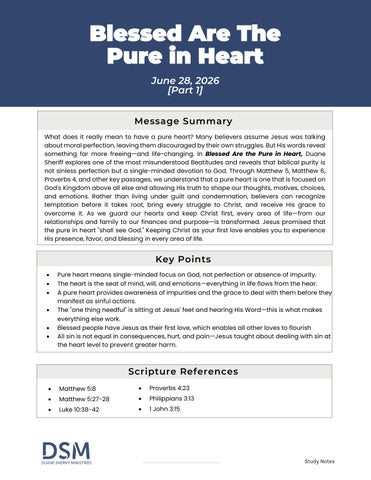
Blessed Are The Pure in Heart June 28, 2026 [Part 1] key points Message Summary What does it really mean to have a pure heart? Many believers assume Jesus was talking about moral perfection, leaving them discouraged by their own struggles. But His words reveal something far more freeing—and life-changing. In Blessed Are the Pure in Heart, Duane Sheriff explores one of the most misunderstood Beatitudes and reveals that biblical purity is not sinless perfection but a single-minded devotion to God. Through Matthew 5, Matthew 6, Proverbs 4, and other key passages, we understand that a pure heart is one that is focused on God's Kingdom above all else and allowing His truth to shape our thoughts, motives, choices, and emotions. Rather than living under guilt and condemnation, believers can recognize temptation before it takes root, bring every struggle to Christ, and receive His grace to overcome it. As we guard our hearts and keep Christ first, every area of life—from our relationships and family to our finances and purpose—is transformed. Jesus promised that the pure in heart "shall see God." Keeping Christ as your first love enables you to experience His presence, favor, and blessing in every area of life.
Key Points •
Pure heart means single-minded focus on God, not perfection or absence of impurity.
• •
The heart is the seat of mind, will, and emotions—everything in life flows from the hear. A pure heart provides awareness of impurities and the grace to deal with them before they manifest as sinful actions. The "one thing needful" is sitting at Jesus' feet and hearing His Word—this is what makes
• • •
everything else work. Blessed people have Jesus as their first love, which enables all other loves to flourish All sin is not equal in consequences, hurt, and pain—Jesus taught about dealing with sin at the heart level to prevent greater harm.
Scripture References •
Matthew 5:8
•
Proverbs 4:23
•
Matthew 5:27-28
•
Philippians 3:13
•
Luke 10:38-42
•
1 John 3:15
Study Notes
Blessed Are The Pure in Heart June 28, 2026 [Part 1]
Discussion Questions •
In what ways does making Jesus your 'first love' rather than your 'only love' actually strengthen your other relationships and responsibilities?
•
In what ways have you experienced worry and anxiety in your service to God, and how might focusing on 'the one thing' change your approach?
•
What does it mean to have a 'single-minded' or 'pure' heart toward God, and how does this differ from simply trying to be morally perfect?
•
Why is it important to distinguish between the internal sin of lust or hate and the
external act of adultery or murder, and how does this understanding help us guard our hearts? •
What practical steps can you take to maintain a pure heart when your emotions, circumstances, or past hurts threaten to pull your focus away from God?
•
What does maintaining Jesus as your 'first love' impact your ability to love your family, serve in church, and fulfill your responsibilities well?
•
How does the story of Martha and Mary illustrate the difference between busy service
and the 'one thing needful' of sitting at Jesus' feet? •
What does it mean to 'see God' as a result of having a pure heart, and where have you witnessed God's presence because of your singleness of focus?
Study Notes
Blessed Are The Peacemakers July 5, 2026 [Part 2] key points Message Summary This sermon explores the seventh Beatitude - "Blessed are the peacemakers, for they shall be called sons of God" - emphasizing that biblical peacemaking is fundamentally different from worldly concepts of peace. True peacemakers actively pursue reconciliation between God and humanity, and between warring parties, often at great personal cost. The message clarifies that peacemaking is not about appeasement, compromise, or tolerance of evil, but rather about courageously entering conflict zones to reconcile people to God's truth and to one another. Jesus is presented as the ultimate peacemaker whose reconciling work cost Him His life. The sermon challenges believers to understand that while they find peace with God through Christ, this same peace positions them for tribulation in the world. True peacemakers risk
relationships,
reputation,
and
comfort
to
pursue
godly
reconciliation
without
compromising Scripture, conscience, or God's holiness.
Key Points
Peacemakers actively pursue peace with others and between warring parties, not as diplomats managing conflict but as reconcilers bringing everyone to God's side
Being a peacemaker involves high risk and potential loss of relationships, which is why there are so few genuine peacemakers
God has reconciled Himself to us through Christ's blood, and now calls us to the ministry of reconciliation
Biblical peace is not the same as tolerance, appeasement, or compromise of truth and holiness
Peacemaking requires courage to confront sin while maintaining love and compassion
Reconciliation should be pursued in relationships before bringing offerings to God
Scripture References
Matthew 5:9
Hebrews 12:14
Romans 16:20
Matthew 5:21-24
Luke 17:3
Isaiah 40:1-2
2 Corinthians 5:17-20
Colossians 1:20
Study Notes
Blessed Are The Peacemakers July 5, 2026 [Part 2]
Discussion Questions
How does Jesus's statement that He came to bring a sword rather than peace challenge our modern understanding of what it means to be a peacemaker?
In what ways might pursuing peace with God actually position us for tribulation in the world, and how have you experienced this tension in your own life?
Why do you think there are so few peacemakers in the church today, and what specific risks make people hesitant to step into conflict situations?
How can we distinguish between godly peacemaking and worldly compromise or appeasement, especially when dealing with family members or close relationships?
What does it mean that God has reconciled Himself to us, and how should this truth change the way we approach our relationship with Him?
How can parents maintain biblical convictions and pursue peace with their children simultaneously without compromising truth or losing relationship?
Why is tolerance not listed as a fruit of the Holy Spirit, and how does biblical kindness and longsuffering differ from cultural tolerance?
What should we do when reconciliation seems impossible because one or both parties refuse to pursue peace, and how do we know when to step back?
Study Notes
Blessed Are The Persecuted July 12, 2026 [Part 3] key points Message Summary "Blessed are those who are persecuted for righteousness' sake, for theirs is the kingdom of heaven." Jesus never promised His followers an easy path—but He did promise they would be blessed. In the message Blessed are the Persecuted, the final episode of the Beatitudes, Duane Sheriff explores why persecution is a normal part of following Christ and how believers can stand firm without fear, compromise, or bitterness. Jesus prepared His disciples to expect opposition for doing what is right, reminding us that faithfulness often brings resistance in a world that rejects God's truth. Discover the difference between suffering for wrongdoing and suffering for righteousness, why soft persecution can prepare us for greater tests of faith, and how God rewards those who remain steadfast. Through passages from Matthew 5, John 15, and 1 Peter, Duane reveals how trials refine our faith, deepen our fellowship with Christ, and strengthen us to live courageously. When we understand the blessed life Jesus described, we can endure opposition with confidence, joy, and an eternal perspective.
Key Points •
Persecution comes specifically for righteousness' sake, not for wrongdoing.
•
The beatitudes are eight-character traits that the Holy Spirit works into believers' lives.
•
Many Christians are unprepared for opposition that results from doing what is right.
•
Soft persecution includes being reviled, mocked, defriended, and called names.
•
A hypocrite is an actor with no intent to become what they pretend to be.
•
A hypocrite is NOT a Christian who falls short or fails while genuinely pursuing Christ.
•
America is experiencing a spiritual awakening where evil is being opposed.
•
Believers must renew their minds to understand what the blessed life truly mean.
•
Jesus is preparing His people to stand and fight the good fight in the right way.
•
Children must be equipped early to stand firm when mocked for taking righteous stands.
Scripture References •
Matthew 5:10-12
•
John 15:18-20
•
2 Timothy 3:12
•
Matthew 23:27-28
•
Luke 16:24-26
•
Ephesians 6:13
•
1 Peter 4:12-16
•
1 Peter 1:6-9
Study Notes
Blessed Are The Persecuted July 12, 2026 [Part 3]
Discussion Questions •
How does Jesus's statement that He came to bring a sword rather than peace challenge our modern understanding of what it means to be a peacemaker?
•
In what ways have you experienced soft persecution for your faith, and how did you respond in those moments?
•
How does Jesus's command to rejoice and be exceedingly glad in persecution contradict our natural responses, and what does this reveal about the kingdom of heaven?
•
What is the difference between being a hypocrite and being a Christian who struggles and falls short, and why is this distinction important?
•
What areas of your life might indicate you are living as a closet Christian rather than openly standing for righteousness?
•
How does renewing your mind to God's definition of blessing differ from the world's understanding of a blessed life?
•
Why do you think many Christians are unprepared for the opposition that comes with
doing and saying what is right? •
What does it mean that the kingdom of heaven belongs to those who are persecuted for righteousness' sake, both now and in eternity?
Study Notes