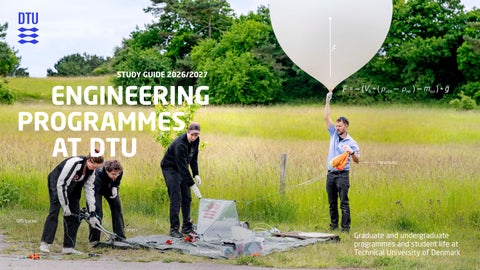
STUDY GUIDE 2026/2027
ENGINEERING PROGRAMMES AT DTU
Graduate and undergraduate programmes and student life at Technical University of Denmark
DTU Study Guide
2
Contents About DTU
3
MSc Eng programmes
22
Welcome from the President
4
MSc Eng programme structure
23
Facts and rankings
5
Industry MSc Eng
24
For the benefit of society since 1829
6
See all MSc Eng programmes
25
See all joint international MSc Eng programmes
39
Admission and tuition
44
Studying at DTU
7
Meet the students
8
Study start
8
Career and contact
45
Student life
9
DTU Career Centre
46
DTU locations
11
Pursue a PhD at DTU
46
International opportunities
17
Continuing Education at DTU
47
Living in Denmark
18
BSc Eng programme
19
BSc Eng programme structure
20
BSc Eng in General Engineering
21
Admission and tuition
21
Published: September 2026 Managing editor: Stig Roesen Editors: Andreas Ussingø and Lea Tolstrup Design and layout: Peytz - part of iO Photos and video: Arnajaraq Strøvlbæk, Aanguaq Reimer-Johansen, Albert Osbæck Adelkilde, Bax Lindhardt,, Ditte Valente, Ehrhorn & Hummerston, Lene Hundborg Koss, Line Reeh, Magnus Møller, Marie Bentzon, Mikal Schlosser, Mikkel Adsbøl, Mikkel Strange, Klaus Holsting, Svenn Hjartarson, Søren Kristensen, Thomas Hjort Jensen, Thomas Steen Sørensen, Colourbox, Shutterstock, Unsplash, DTU.
About DTU
Studying at DTU
BSc Eng programme
MSc Eng programme
DTU Study Guide
Career and contact
ABOUT DTU
3
About DTU
Studying at DTU
BSc Eng programme
MSc Eng programme
DTU Study Guide
Career and contact
Dear Student, Welcome to DTU’s engineering programmes, which rank among the best in Europe. As a DTU student, you will be taught by excellent researchers and lecturers in modern facilities, using new and experimental learning methods. You will learn to think critically and work creatively with complex challenges. Our engineering programmes are built on interdisciplinarity, collaboration, flexibility, and diversity. This provides you with the best opportunities to shape your education and contribute to developing the technological solutions of the future. At DTU, you do not only learn about sustainability—you learn to apply your knowledge of sustainability to develop concrete solutions that create change for the benefit of present and future generations.
At DTU, you will become part of communities based on mutual respect and shared interests. You will be part of an international learning environment and gain access to a wide range of international opportunities throughout your studies. With an engineering degree from DTU, you will be prepared to develop technological solutions for the benefit of society. Welcome to DTU.
Anders O. Bjarklev President
4
About DTU
Studying at DTU
BSc Eng programme
MSc Eng programme
Facts and rankings DTU is among the highest-ranked technical universities in Europe. Here, you become part of a vibrant student environment known for its high levels of student satisfaction. During your studies, you will develop a broad range of engineering competences, making you sought-after in the labour market.
Student satisfaction
Employability and career
The International Student Barometer (ISB) offers a comprehensive view of international students’ perceptions of DTU and their study programmes. Here is an overview:
DTU graduates find employment quickly
Nordic region**
Europe
77% found employment a mere three months after graduation.
94%
Rankings*
DTU Study Guide
Career and contact
World
of international students are generally satisfied with all aspects of their experience at DTU.
87% found employment six months after graduation.
96% found employment twelve months after graduation.
EngiRank: EU Ranking
1
1
-
93%
of international students are satisfied with their learning experience at DTU.
Source: Statistics Denmark for graduates from 2024. Employment rates are exclusive of emigration.
Graduates from DTU feel prepared for their future career
Leiden Ranking Citation Impact indicator (top 10% publications) All sciences Leiden Ranking Collaborative Publications with Industry Indicator
3
76
214
94%
THE World University Rankings
92% of international students feel prepared for their career goals. Source: International Student Barometer 2025
2
7
25
97% QS World University Ranking
of international students are overall happy with their life and living experience at DTU.
5
8
* As of May 2026 ** The Nordic region consists of Denmark, Sweden, Norway, Finland, and Iceland
42
47
of international students experience a friendly attitude towards them at DTU.
107
121
International students stay in Denmark 69% of international graduates from DTU are employed in Denmark two years after graduating.
93%
of international students experience a friendly attitude towards them in Denmark.
92%
of international students have never experienced discrimination.*
*Based on sexual orientation, religious beliefs, mental or physical disability, gender or gender identity, race or ethnicity, nationality Source: International Student Barometer 2025
Source: Confederation of Danish Industry, based on register data from Statistics Denmark 2026
5
About DTU
Studying at DTU
BSc Eng programme
MSc Eng programme
Career and contact
DTU Study Guide
6
For the benefit of society since 1829 Since Hans Christian Ørsted founded Technical University of Denmark in 1829, DTU has educated graduates for the benefit of society. DTU is a vibrant, international elite technical University offering world-class education, teaching, and student life. DTU’s engineering programmes rank among the best in Europe, and an education at DTU is the beginning of a lifelong learning journey—one that equips DTU graduates to match a dynamic labour market. Innovation DTU is the University of innovation. This means that innovation and entrepreneurship are integral parts of the teaching. Based on a strong foundation in natural science and engineering, DTU students learn to think critically and creatively and to apply their academic knowledge and creative skills to solve societal challenges. The Master of Science in Engineering programmes are based on interdisciplinarity, collaboration, flexibility, and diversity. This provides the best foundation for applying technology in new solutions or in the creation of new companies.
Sustainability DTU students learn to drive the green transformation so they can contribute to shaping our shared future. At DTU, students learn to apply their knowledge and create concrete solutions, enabling them to both shape their future careers and make a tangible difference. This way, they can drive sustainable change and create impact for present and future generations. These competences are in high demand across industry and globally. DTU also educates future leaders to drive sustainable transformation within organisations.
About DTU
Studying at DTU
BSc Eng programme
MSc Eng programme
Career and contact
DTU Study Guide
7
STUDYING AT DTU As a DTU student, you get hands-on access to world-class facilities and engage in project-based assignments, offering you the chance to apply your theoretical knowledge to solve real-life problems. In addition, you can be part of a vibrant student life. You can join a long list of clubs and activities, or attend Friday bars and some of the many other social events and festive occasions organized at DTU.
About DTU
Studying at DTU
BSc Eng programme
MSc Eng programme
Meet the students
8
Study start
DTU is an international elite technical University offering a vibrant student life with more than 13,000 students from all over the world.
13,813
6,533
total students enrolled
total students enrolled in DTU’s MSc Eng programmes
107
49%
countries represented by students
international students enrolled in DTU’s MSc Eng programmes
34%
1,616
women enrolled
PhD fellows
See films about our MSc Eng programmes
Social media
On DTU’s YouTube channel, you can watch a film about each of the MSc Eng programmes.
Get an insight into DTU’s study environment — follow us on social media.
See all films
DTU Study Guide
Career and contact
Introduction Week and buddies No matter where you come from, we are happy to welcome you to DTU. As a new student, there is much to learn, but don’t worry. We have many initiatives to ensure you find your way at DTU—and in Denmark. For example, your first week is Introduction Week, where we help you off to a great start. Here, you are assigned a buddy—a DTU student who will assist you through the first semester and answer any questions you might have.
Connect with fellow students After admission, you have the opportunity to connect with fellow incoming international DTU students through the online student-to-student connect programme via Goin’. In addition to making new friends prior to study start, you can ask questions to current DTU students about studies, social life, and living in Denmark.
About DTU
Studying at DTU
BSc Eng programme
MSc Eng programme
Student life All in on innovation At DTU, we believe that innovation drives us forward. That’s why innovation and entrepreneurship are integrated into our study programmes through mandatory and elective courses. Students also gain hands-on experience and industry contact through projects, events, internships, and student jobs. At our innovation hub, DTU Skylab, students who wish to establish their own start-ups receive support and guidance. In 2025, 82 student-founded start-ups were launched. For the climate, for society, and for people A world facing climate change, biodiversity loss, resource scarcity, and increasing pollution needs those who can and will make a difference. Fortunately, DTU students are surrounded by opportunities to drive the green transformation. One example is DTU Blue Dot Projects, which enables students to explore specific sustainability solutions. Another is Roskilde Festival – powered by DTU students, where students can participate in the festival by creating a project and gaining access, ECTS points, and an unforgettable experience.
Career and contact
DTU Study Guide
9
About DTU
Studying at DTU
BSc Eng programme
MSc Eng programme
Student life World-class education As a DTU student, you receive research- and developmentbased teaching in modern research and teaching facilities, using new, application-oriented, and experimental learning methods. You develop analytical skills through independent study, group work, and active participation. Our open-door policy makes it easy for you to approach your professors and lecturers with questions. The close collaboration with industry ensures that your theoretical knowledge is continually connected to real-world challenges. Become a part of the community Our study environment is vibrant and international, and most students stay after lectures to network, work on projects, or take part in one of the many extracurricular activities. It doesn’t matter if you prefer rugby or ceramics, climbing or choir, there’s something for everyone. You can join the student union, PF, visit one of our Friday bars, or become part of the Student Culture Hub—a great place to meet new people and attend unique events. At DTU, all our communities are based on mutual respect, inclusion, and shared interests.
Career and contact
DTU Study Guide
10
About DTU
Studying at DTU
BSc Eng programme
MSc Eng programme
DTU Study Guide 11
Career and contact
DTU locations DTU’s engineering programmes are closely connected to world-class research, industry collaboration, and society– whether they are based on DTU’s main campus in Lyngby or at DTU campuses throughout Denmark and in Greenland.
Kalundborg Fredericia
Femern (Rødby)
Campuses DTU is one university, but we have campuses across Denmark and in Sisimiut, Greenland. Most of our MSc Eng programmes are based on our main campus in Lyngby, just north of Copenhagen, one of Europe’s most popular and progressive capitals.
DTU Risø Campus
DTU Lyngby Campus
DTU at Kalundborg Campus
Our main campus. Home to many of our MSc Eng,
Home to our Industry MSc Eng in Biomanufacturing
BSc Eng and BEng* programmes Location: 15 km north of Copenhagen
DTU Hirtshals Campus Kalundborg
Home to our MSc Eng programme in Sustainable
Fredericia
Fisheries and Aquaculture and our BEng* programme in Fisheries Technology Location: Northern Jutland
Femern (Rødby)
DTU Sisimiut Campus Home to our Arctic study programmes Location: Sisimiut, Greenland *All BEng programmes are taught in Danish
Home to our BEng* programme in Industrial Engineering and courses for MSc Eng students Location: 40 km west of Copenhagen
Location: North-west Zealand
DTU Ballerup Campus Home to many of our BEng* programmes Location: 10 km west of Copenhagen
DTU at Frederikshavn Campus Home to our BEng* programme in Naval Architecture and Maritime Engineering Location: Northern Jutland
About DTU
Studying at DTU
BSc Eng programme
MSc Eng programme
DTU Study Guide
Career and contact
12
DTU Lyngby Campus World-class campus life At DTU’s Lyngby Campus, you will become part of a vibrant community of leading researchers and lecturers, with access to unique technological research and teaching facilities— not to mention a rich social life. DTU’s main campus is home to many of its Master of Science in Engineering, Bachelor of Engineering and Bachelor of Science in Engineering programmes as well as its continuing education programmes. The campus covers one square kilometre and is filled with research and teaching facilities, green spaces, and activities that support student life. As a student, you’ll have access to laboratories, supercomputers, experimental halls, test centres, soundproof rooms, and much more.
“It is inspiring to have access to all these facilities. It is great fun to be able to go and try out different measurements and experiments. “
You will become part of an international study environment where many students actively engage in student life and are keen to meet students from other study programmes. You can take part in all kinds of sports—from yoga and badminton to climbing, martial arts, rugby, and sailing. You can also unleash your creativity by taking part in activities such as pottery, music, revue, dance, or board games.
Teitur, MSc Eng student at DTU Lyngby Campus
Click here
and learn more
About DTU
Studying at DTU
BSc Eng programme
MSc Eng programme
Career and contact
DTU Study Guide
13
DTU Hirtshals Campus Education and research by the sea DTU Hirtshals Campus is located at the gateway to the North Atlantic. It is a centre for world-class fisheries and aquaculture research. Here, Master’s students specializing in Sustainable Fisheries and Aquaculture and Bachelor of Engineering students specializing in Fisheries Technology study alongside researchers who develop solutions to benefit fisheries, fish farming, and the marine environment, with a focus on sustainability and biodiversity. DTU’s Hirtshals campus features modern laboratories, testing facilities, a makers’ lab, and a new research hall. Lecturers and students also have access to the largest test tank in Northern Europe, where new fishing technologies can be tested under realistic sea conditions. After classes, you can use the campus for everything from experimental projects and group work to barbecues, Friday drinks, and aquarium club meetings, where students work together to look after the campus aquariums. Just outside, the harbour and the countryside await, where you can enjoy peace and quiet, or go fishing, hiking, sailing, or swimming in the sea.
“If you are into aquaculture this is the place for you. You have close proximity to and interaction with the department, researchers, and facilities—and you have the real systems and companies nearby.” Daniel, MSc Eng student at DTU Hirtshals Campus
Click here
and learn more
About DTU
Studying at DTU
BSc Eng programme
MSc Eng programme
DTU Study Guide
Career and contact
14
DTU Sisimiut Campus Engineering education and research in the Arctic “I am very drawn to the prospect of working in Greenland, and this programme opens a great many different career paths after graduation. It is truly exciting.” Line, BEng student at DTU Sisimiut Campus
At DTU Sisimiut Campus students prepare to develop engineering solutions for Arctic regions. They receive a practical, problem-solving-oriented education and enjoy a student life filled with outdoor activities and hands-on fieldwork. You will become part of a small study community, where you quickly get to know your fellow students through lectures, project work, and fieldwork. The campus comprises classrooms, communal dining and lunch areas, and a communal lounge. Once classes have finished for the day, there are plenty of things to do. Most students live in halls of residence just five minutes from campus. Here, you can meet others in the kitchen, TV lounge, or over a game of table football. Students from Civil Engineering, Architectural Engineering, Environmental Engineering, the joint international MSc Eng in Arctic Mineral Resources and the Nordics Master’s in Cold Climate Engineering can spend a semester here alongside future fisheries and civil engineers.
Click here
and learn more
About DTU
Studying at DTU
BSc Eng programme
MSc Eng programme
DTU Study Guide
Career and contact
DTU Risø Campus Education and research in the energy technologies of the future DTU Risø Campus is renowned for its world-class research and facilities in wind and energy technology. In addition to DTU’s Bachelor of Engineering programme in Industrial Engineering, the campus offers a variety of courses, individual modules, workshops, and summer school programmes for master’s and PhD students. Over the next few years, the plan is for more students to spend their days at DTU Risø Campus. The campus offers a variety of resources for individuals keen to expand their knowledge of wind and energy solutions. It features a research and testing environment in which new nanoscale materials, large-scale structures, and high-tech wind turbines are being developed. If you study at DTU Risø Campus, there are plenty of things to do after classes. For example, you can join DTU Sport to gain access to the fitness centre and enjoy spinning and yoga classes on campus. Hop on your bike, and you’ll reach Veddelev in just 10 minutes. There, you can swim, surf, and sail, or take part in events, such as kayaking courses and communal dining. Cycle for another 10 minutes, and you’ll reach Roskilde, a vibrant cultural city.
Click here
and learn more
“Everyone is very welcoming. It is interesting to talk to the researchers and understand what they are doing. Even though I am a student, it makes me feel like I am part of the research that they are carrying out.” Cecilia, MSc Eng student at DTU Risø Campus
15
About DTU
Studying at DTU
BSc Eng programme
MSc Eng programme
Career and contact
DTU Study Guide
16
DTU at Kalundborg Campus A hub for world-class biotechnology solutions
In Kalundborg, educational institutions and businesses work together to develop medicines, energy solutions, enzymes, and much more for the future. Here, you can study DTU’s Industry Master’s programme in Biomanufacturing* and gain work experience in the biotechnology industry that has put Kalundborg on the world map. Kalundborg is a hub for biotechnology, attracting people from all over the world. This means that you will be part of an international environment, both academically and socially. You will be taught in modern buildings that house everything you need as a student— from bright classrooms to group rooms and a lounge with a kitchen and a table tennis table—offering spaces for teaching, collaboration, socialising, and quiet reflection. As a student in Kalundborg, you will be surrounded by sports and leisure activities. If you enjoy adrenaline-filled activities, you can play padel tennis, basketball, volleyball, or BMX. If you prefer a slower pace, you can take a walk in the forest or go for a swim in the sea. And if you feel like visiting a larger city, Copenhagen is only an hour and a half away.
Click here
and learn more
*Industry MSc Eng specialization under Chemical and Biochemical Engineering
“I would like to gain some practical experience. Therefore, this programme is perfect, as it allows us both to work in a professional environment and to learn a great deal of theory at the same time.” Lucas, Industry MSc Eng student at Kalundborg Campus
About DTU
Studying at DTU
BSc Eng programme
MSc Eng programme
DTU Study Guide
Career and contact
17
International opportunities DTU students are part of an international learning environment, gain access to a wide range of international opportunities during their studies, and are well prepared to operate globally as graduate engineers. Exchange abroad If, as part of your DTU degree, you wish to study abroad for one or two semesters, going on an exchange is the natural choice. With more than 100 international partner universities across the globe, there are many interesting universities to choose from—some of which are among the best universities in the world. International online courses Through DTU’s EuroTeQ partnership, you can supplement your studies with online courses from seven leading European technical universities. With access to over 100 courses across various disciplines, you can tailor your curriculum, gain international perspectives, and build global connections—all while staying at DTU. Summer school abroad Going on summer school abroad may be ideal if you wish to study abroad for a shorter period of time. This way you can complete 5 to 10 ECTS points over the summer and still experience a different university culture and get a taste of international student life.
Self-arranged studies abroad If you have the time and resources, you are free to arrange your own studies abroad. This may, for example, be relevant if the university of your choice is not one of DTU’s many partner universities. Click here
and learn more about the international opportunities
Joint international MSc Eng programmes Boost your MSc Eng degree and your CV by spending some time at one of DTU’s partner universities in Scandinavia, Europe, or Asia. DTU has close partnerships with some of the best global technical universities, giving you the chance to complete a unique joint international MSc Eng programme. Students enrolled in a joint programme will spend one year at DTU and one year abroad. Click here
and learn more about the joint international MSc Eng programmes
About DTU
Studying at DTU
BSc Eng programme
MSc Eng programme
DTU Study Guide 18
Career and contact
Living in Denmark Welcome to Denmark! One of the safest countries in the world, where 86% of the population speaks English. Here at DTU, you will become part of an international elite technical University with modern research and teaching facilities. Teaching at DTU is research- and development-based, application-oriented, and founded on experimental learning methods. You will find a casual, friendly tone between students and staff; professors go by their first names, and we have an open-door policy, making it easy for you to reach out to your professors for guidance and to ask questions. Groupand project-based work will be part of your everyday life, and you are expected to be an active participant and take responsibility for your own learning. You will find the same culture if you choose to build your career here. Working in Denmark means teamwork and being part of an informal group of colleagues who pitch in with their ideas. A typical workweek is 37 hours, and our labour market is based on the values of flexibility and security.
About DTU
Studying at DTU
BSc Eng programme
MSc Eng programme
Career and contact
DTU Study Guide 19
BSC ENG PROGRAMME DTU offers one international research-based BSc Eng programme in General Engineering that is taught exclusively in English. As a student in the programme, you will learn to break down issues and find specific and practical engineering solutions to challenges ranging from wind power, AI, medicine, infrastructure, and many other areas influencing our daily lives.
About DTU
Studying at DTU
BSc Eng programme
MSc Eng programme
BSc Eng programme structure
55 ECTS
25 ECTS
Programme specific courses
Projects
All BSc Eng programmes include a number of courses that are specific to the particular programme. Programme specific courses help ensure that you acquire an accurate picture of what, for example, Human Life Science Engineering or Civil Engineering is about, and how it can be used in society. If, for example, you choose Human Life Science Engineering, this will comprise courses such as ‘biochemistry’, ‘molecular biology’, and ‘bioinformatic methods’. If, for example, you choose Civil Engineering, your programme specific courses will include ‘construction technology’, ‘thermal building physics’, and ‘concrete construction’.
During your BSc Eng programme, you will prepare two major projects. The projects help highlight and summarize everything you have learned and are also an opportunity to immerse yourself in a topic you find exciting. The first project—the subject project—falls halfway through your study programme. In addition to dealing with a subject-related topic, the project itself is an exercise in how to prepare a project and engage in teamwork. Your study programme is concluded with a BSc project, where you will have the opportunity to work in depth with a problem of relevance to the subject area of your study programme and to use a lot of what you have learned during your study programme to create results and new knowledge.
55 ECTS
45 ECTS
The polytechnical foundation
The polytechnical foundation
Elective courses
Elective courses
The polytechnical foundation is a set of compulsory courses taken by all BSc Eng students at DTU. It forms the strong academic foundation that supports your learning throughout your degree. In these foundation courses, you will develop a solid understanding of the natural sciences—including chemistry, physics, and bioengineering. You will also be introduced to mathematics and statistics, while learning to think computationally and acquire programming skills through Python.
You have ample opportunity to create your own unique academic profile as a BSc Eng student at DTU. In your block of elective courses, you can choose from several hundred different courses from DTU’s course catalogue, or you can do courses at another university—in Denmark or abroad. You can steer your BSc Eng programme in exactly the direction you want, and thus tailor your choices to the MSc programme you might want to do.
The Bachelor of Science in Engineering (BSc Eng) programme is a research-based undergraduate engineering programme that qualifies the student for an MSc Eng programme. The BSc Eng programme is composed of four basic blocks of courses. During the programme, students must pass courses within each of these four blocks, corresponding to 180 ECTS credits.
55 ECTS
DTU Study Guide 20
Career and contact
25 ECTS Programme specific courses Projects
55 ECTS
45 ECTS
About DTU
Studying at DTU
BSc Eng programme
MSc Eng programme
BSc Eng in General Engineering Engineers find answers to some of the questions surrounding us daily—from the big challenges to the small but significant details. As a student in the bachelor programme in General Engineering, you learn the skills it takes to help shape the future. Studying General Engineering, you gain a list of general competences across the engineering field and can specialise within your chosen topics. This combination allows you to gain a thorough understanding of mathematics, physics, chemistry, programming, and biotechnology while diving into your favourite subject. The four specializations are: - Living Systems - Advanced Materials - Cyber Systems - Future Energy Engineers with an international outlook Through the programme, you will collaborate with your fellow students as you work on several design-build projects, which are projects focused on finding diverse solutions to real-life challenges. Here, you learn to collaborate, communicate, and apply the learned technical skills. The General Engineering programme is international, with all courses taught in English, and approximately 40% of the students are Danish, while 60% are international.
DTU Study Guide 21
Career and contact
Admission and tuition
Application fee Please note that unless you have a residence permit in Denmark, all non-EU/EEA citizens are required to pay EUR 100 to have their application processed.
General admission criteria Degree In addition to having an upper secondary education leaving exam, you must have specific levels in English, mathematics, physics, and chemistry equivalent to the Danish exams:
Tuition fees Higher education in Denmark is free for EU/EEA citizens and for students participating in an exchange programme. All other students have to pay tuition.
The academic level of the BSc Eng programme is advanced. In each individual case, admission will be based on the following criteria:
- English B - Mathematics A - Physics B or Geoscience A - Chemistry B or Biotechnology A If your upper secondary education is not an IB, EB or from one of the Nordic countries, you have to prove your English proficiency by taking one of the following English tests: English language proficiency Minimum entry levels: CAE/CPE: 180, TOEFL iBT/TOEFL iBT Home Edition/TOEFL iBT Paper Edition: 88, IELTS: 6.5. Please note that IELTS and TOEFL tests must not be older than two years on 5 July.
Application deadline 15 March at 12 noon if you hold an international qualifying exam. Read more
About DTU
Studying at DTU
BSc Eng programme
MSc Eng programme
Career and contact
DTU Study Guide 22
MSC ENG PROGRAMMES At DTU, we offer a broad range of research-based MSc Eng programmes taught exclusively in English. The programmes follow a flexible course structure and offer honours tracks. Every programme is different, and with 32 MSc programmes, there’s much to choose from. You can choose between a lot of different subjects and types of programmes—such as an Industry MSc Eng, an MSc programme in Technology Entrepreneurship or one of our joint MSc programmes offered together with partner universities in both Denmark and abroad. No matter your chosen programme, you will get a research-based education, teaching you to turn your knowledge into solutions at the highest technological level.
About DTU
Studying at DTU
BSc Eng programme
MSc Eng programme
DTU Study Guide 23
Career and contact
MSc Eng programme structure The Master of Science in Engineering (MSc Eng) programme—a two-year programme— consists of 120 ECTS credits and picks up where the BSc Eng programme left off. The MSc Eng programme provides you with more in-depth knowledge about your subject area. You also learn about teamwork and collaboration, preparing you for your future working life. The MSc Eng programme is divided into individual study programmes, all of which include four course blocks. Specializations Specializations have been developed for most of the MSc Eng programmes. Doing a specialization will result in a more specialized educational profile. The programmes have a cross-disciplinary content and provide graduates with a unique set of engineering qualifications, only obtainable from the DTU research and innovation environment. > You can see the individual specializations under each MSc Eng programme
Programme specific courses Master’s thesis The polytechnical foundation Elective courses
Admission and tuition Find information about admission and tuition for DTU’s MSc Eng programmes Click here
and learn more
50 ECTS
30 ECTS
Programme specific courses
Master’s thesis
The programme specific courses ensure that you gain an understanding of the core elements in your subject area and that you acquire the latest technological knowledge and competences in your subject area.
The master’s thesis is the final project in your study programme. Here you will have the opportunity to work independently with a topic of your choice containing elements of the latest research in the field in question.
10 ECTS
30 ECTS
The polytechnical foundation
Elective courses
The polytechnical foundation of the MSc Eng programme ensures that you learn computational models for creating sustainable solutions. You will also acquire knowledge about innovation processes—including teamwork, entrepreneurship, and business acumen—all related to specific academic or interdisciplinary content of your study programme.
You can use the elective courses to achieve additional cutting-edge competences in your subject area and to supplement your study programme with higher education basic science subjects or with relevant subjects from other study programmes.
MSc in Technology Entrepreneurship DTU offers one MSc programme which leads to the Danish title cand.tech. Click here
and learn more about the specific programme
Honours Programmes We offer Honours Programmes as part of all our MSc Eng programmes. Click here
and learn more about honours programmes
About DTU
Studying at DTU
BSc Eng programme
MSc Eng programme
DTU Study Guide 24
Career and contact
Industry Master of Science in Engineering The Industry Master of Science in Engineering combines work and studies. It’s an ideal option if you want to learn and gain insight into the industry while pursuing a master’s degree. DTU offers the opportunity to join an Industry MSc Eng in all programmes. By studying an Industry MSc Eng, you will get:
The 1+2 model This model follows a 1+2 structure, where you complete 120 ECTS points over a threeyear period. During your first year, you will be a full-time student while your second and third year consist of a mix of studies and a 25-hour workweek at a company with a job that is relevant to your studies.
Study an Industry MSc Eng specialization in Biomanufacturing in Kalundborg Click here
- Specialized knowledge and a solid academic foundation - Experience with the labour market - Hands-on experience on how to use your knowledge in a workplace environment The Industry MSc Eng is offered in two different models.
The 4-year model With this model you complete 120 ECTS points over a four-year period. During these years, you will spend your time both as a student and a part-time, paid employee at a company with a job that is relevant to your studies, with a mix of studies and a 25-hour workweek. Prerequisites You must hold a qualifying bachelor’s degree to apply for our Industry MSc Eng programmes.
Click here
and learn more about application and conditions
About DTU
Studying at DTU
BSc Eng programme
MSc Eng programme
DTU Study Guide 25
Career and contact
MSc Eng programmes DTU offers MSc Eng programmes in all modern fields of engineering, giving students the widest possible choice. The structure and content of the various programmes reflect DTU’s status as a high-ranking elite university in engineering. Students have the opportunity to join an Industry MSc Eng in all programmes.
> Applied Chemistry
> Electrical Engineering
> Sustainable Energy Technologies
> Architectural Engineering
> Engineering Acoustics
> Sustainable Fisheries and Aquaculture
> Autonomous Systems
> Engineering Light
> Technology Entrepreneurship
> Bioinformatics
> Engineering Physics
> Wind Energy
> Biomaterial Engineering for Medicine
> Environmental Engineering
> Biomedical Engineering
> Food Technology
Industry MSc Eng specialization
> Biotechnology
> Human-Centered Artificial Intelligence
> Biomanufacturing
> Business Analytics
> Industrial Engineering and Management
> Chemical and Biochemical Engineering
> Materials and Manufacturing Engineering
Joint national MSc programmes
> Civil Engineering
> Mathematical Modelling and Computation
> Business Administration and Bioentrepreneurship (CBS and UCPH)
> Communication Technologies and System Design
> Mechanical Engineering
> Health and Informatics
> Computer Science and Engineering
> Ocean Engineering
> Quantum Information Science (UCPH)
> Design and Innovation
> Pharmaceutical Design and Engineering
> Earth and Space Physics and Engineering
> Sustainable Energy Systems
About DTU
Studying at DTU
BSc Eng programme
MSc Eng programme
DTU Study Guide 26
Career and contact
MSc Eng programmes
Applied Chemistry
Architectural Engineering
Chemistry is at the heart of everything from medicine and materials to clean energy and sustainable production. When studying Applied Chemistry, you learn how to apply chemistry to design and prepare molecules, materials, and systems. You will deepen your chemistry knowledge and learn how fundamental chemical principles are translated into impactful materials, products, and technologies. The programme focuses on understanding and controlling chemical processes in detail and develops your competences to address complex chemical challenges across many application areas.
This MSc Eng programme enables you to influence the design of future buildings. Depending on your area of specialization, you can use your extensive knowledge of architecture and other engineering disciplines to integrate the various sub-solutions of a building project into well-functioning units—e.g. components, buildings, technical facilities, or entire districts. The programme offers a wide variety of courses in areas such as energy, load-bearing structures, installations, indoor climate, fire safety, acoustics, lighting, urban planning, consumer behaviour, project management, and building information modelling.
Future opportunities Applied Chemistry provides you with a strong chemical foundation and the opportunity to specialize, making you an ideal candidate for a wide range of jobs where chemistry plays a central role. Many graduates work in research and development. As a chemist or R&D engineer, you can contribute to the development of new medicines, healthcare products, and biological solutions. Specializations – Catalysis and Sustainable Chemistry – Computational Chemistry and Atomic-Scale Analysis – Macromolecular Chemistry and Materials – Synthesis and Medicinal Chemistry Read more
Future opportunities As an MSc Eng in Architectural Engineering, you will be involved in the early project stages of construction, contributing to innovative and optimized building projects. Specializations – Acoustics – Arctic and Extreme Environments – Digital Design Systems – Energy Systems Design – Indoor Environment – Structural Design – Sustainability and LCA
Read more
Back to overview
About DTU
Studying at DTU
BSc Eng programme
MSc Eng programme
DTU Study Guide 27
Career and contact
Autonomous Systems
Bioinformatics
Biomaterial Engineering for Medicine
Biomedical Engineering
Autonomous systems are entering our working, urban, and domestic environments. Imagine fleets of smart robots that collaborate in manufacturing facilities, advanced warehouse logistics solutions such as the Amazon warehouses, crew-less cargo ships, smart grids, or interconnected smart home appliances. The MSc Eng in Autonomous Systems equips you to participate in and lead work related to the design and deployment of autonomous systems, exploiting the latest advances in artificial intelligence, big data analysis, digitization, sensing, optimization, information technologies, and systems engineering.
This MSc Eng programme focuses on the use of computer-based methods and mathematical models to analyse the vast amounts of biological data produced using high-throughput methods. Examples of biological data include DNA and protein sequences, mRNA levels, lists of post-translational modifications, protein-protein interaction data, and metabolic pathway information. Although computational analysis accounts for a large part of the programme, students also gain a deep understanding of the underlying molecular biology and the experimental methods used to generate the large volumes of data.
This programme focuses on the design and fabrication of advanced materials for applications within the healthcare sector, including engineered solutions for improved drug delivery, molecular diagnostics, and materials for healthcare products. These are highly cross-disciplinary fields where the medicinal product is a fusion between advances in chemistry, immunology, molecular biology, and material science.
Focusing on the design of future diagnostic and treatment methods at hospitals and in the field, this is an interdisciplinary programme offered by DTU in collaboration with the University of Copenhagen. The programme provides you with in-depth knowledge of the clinical problems facing the modern healthcare sector—enabling you to develop new technological solutions—and covers both engineering and human physiology courses, ranging from the functions of the organs at cell level to development of healthcare products conforming to medical device regulation.
Future opportunities With an MSc Eng in Autonomous Systems, you can pursue a career in various production and service industries in both private and public organizations. For instance, you can have a career as an AI developer, production manager, systems engineer, IT consultant—to mention but a few.
Future opportunities Future career opportunities include management positions or biomedical research at universities or in the biotech and pharmaceutical industries.
Specializations This MSc Eng programme contains no predefined specializations. Instead, you can put together your own study plan and your own tailored profile through your choice of courses.
Specializations – Biomedical Bioinformatics – Infectious Disease Health Informatics – Bioinformatics Methods in Life Science
Future opportunities Because the programme focuses on product development, candidates will be very attractive for the healthcare and medical industry, which is one of the largest and fastest-growing sectors in Denmark. Typical job functions are within research, development, quality control, and approvals.
Specializations – Drug Delivery Systems Engineering – Healthcare Materials Engineering – Diagnostics Technology Engineering – Cell Therapy Read more
Future opportunities You will have the opportunity to work with the development of measuring methods and equipment, clinical research, testing and maintenance of complex technical installations; product development, test planning, sales, marketing, and service; teaching and research. Specializations This MSc Eng programme contains no predefined specializations. Instead, you can put together your own study plan and your own tailored profile through your choice of courses.
Read more Read more
Read more
Back to overview
About DTU
Studying at DTU
BSc Eng programme
MSc Eng programme
DTU Study Guide 28
Career and contact
Biotechnology
Business Analytics
Chemical and Biochemical Engineering
Civil Engineering
Sustainable manufacturing of bioproducts as an alternative to chemical production requires engineers with cutting-edge competences within biotechnology. This programme provides you with knowledge and skills for mining of genes, exploration of organisms and biomolecules from nature, development of recombinant cell-factories, optimization and running of fermentation processes, purification and quality control of products, and most importantly: innovations within biotechnology.
The MSc Eng in Business Analytics prepares you to work with advanced methods from data science and optimization to solving critical business challenges. You will not only be able to work and manipulate data but, most importantly, you will learn how to transform data into actionable decisions that meet value creation goals. During the course of study, you will work with quantitative methods, such as descriptive statistics, forecasting, clustering, simulation, and optimization as well as qualitative methods for analysing, managing, and implementing data-driven projects in business and society.
This MSc Eng programme focuses on chemical and biochemical industrial technology and the commercial and sustainable chemical or biochemical conversion of any kind of raw materials into substances and products required by modern society. Students learn to solve technological problems using chemistry, mathematics, physics, and thermodynamics.
The mission of the civil engineering profession is to enable sustainable human flourishing; it deals with the design, construction, maintenance, reuse, recycling, and digitalization of the built environment. The profession is essentially a ‘learned profession’ with technical knowledge that keeps evolving to meet ever-changing challenges.
Future opportunities Graduates have the scientific and technological competences to translate concepts of new chemical and biochemical products and processes into safe and economically viable production. You may also play a useful role in the practical efforts to remedy environmental problems and reduce the energy consumption of current production activities.
Future opportunities Graduates work as independent experts in consulting or construction companies; they also work for material and equipment manufacturers, infrastructure owners, and educational institutions.
Future opportunities Job opportunities in the biotech industry within research, development, and production, as well as in consultancy firms and in the public sector (research, teaching, or governance). Specializations – Biosolutions – Microbiome Engineering – Cell Factory Engineering – Protein Engineering – Fermentation Based Biomanufacturing – Mammalian Cell Technologies
Future opportunities MSc Eng graduates in Business Analytics will likely find jobs in banks, large production and service companies, in the transport industry, or in research institutions. Specializations – Predictive Analytics – Prescriptive Analytics
Specializations – Chemical and Biochemical Process Technology – Chemical and Biochemical Product Engineering – Energy and Environmental Engineering – Fermentation Based Manufacturing – Biomanufacturing (Industry MSc Eng, Kalundborg)
Read more Read more
Specializations – Bridges, Pavements and Large Structures – Building Services – Cold Regions – Geotechnical Engineering – Marine and Coastal Engineering – Mechanics of Materials – Structures Read more
Read more
Back to overview
WILL POWER-TO-X HELP US CAPTURE CO2?
LET’S FIND OUT Post-combustion CO2 capture is about stopping emissions at the source, before they reach the atmosphere. That’s why DTU researchers are developing and testing new solvent molecules. With billions of possible solvent mixtures, the team uses AI to narrow the search, test the best candidates in the lab, and scale them up in pilot facilities.
Follow DTU on:
About DTU
Studying at DTU
BSc Eng programme
Communication Technologies and System Design Communication Technologies and System Design engineers contribute to the development of the technology on which modern society relies. This programme covers areas ranging from advanced component and system design through complex network structures to the development of services and ICT solutions that meet user expectations. Courses include three central, traditional disciplines that share a common technical-scientific basis: component and software design, system development and methods, and applications. Future opportunities Graduates are qualified to conduct research, development, planning, and analysis tasks in several areas related to communication technologies. Specializations – High-speed Communication – Signal Processing, Coding and Visual Communication – Mobile/Wireless Communication and Internet of Things – Cloud and Cybersecurity – Communication Hardware Design and Programming
MSc Eng programme
DTU Study Guide 30
Career and contact
Computer Science and Engineering
Design and Innovation
As a student on this programme, you will concentrate on the design and use of computing components—both software and hardware—and learn to solve technical problems efficiently and competitively. Central to the programme is the understanding and application of the right abstractions for advanced IT solutions that typically include both existing and future components. You can choose from a wide range of courses in software development, safe and secure IT systems, algorithms and logic, knowledge-based systems, and distributed and embedded systems.
This programme provides you with the proper tools and methods to combine structured problem solving, user engagement and technical disciplines in a range of innovation projects. Design and Innovation equips you with the competences required for carrying out engineering and organizational development design tasks. The programme builds on both design science as well as technical disciplines.
Future opportunities Our highly qualified graduates find rewarding careers in a wide range of Danish and international companies involved in IT, electronics, and communication.
Specializations – Artificial Intelligence and Algorithms – Cybersecurity – Digital Systems – Embedded and Distributed Systems – Safe and Secure by Design – Software Engineering
Read more
Future opportunities With an MSc Eng in Design and Innovation, you can work in engineering design, product and service development and innovation management. You can for example work as an industrial designer, system developer, systems engineer or as a product or development engineer in an industrial company. Furthermore, you might have the opportunity to continue your studies and do a PhD, for instance at DTU. Specializations – Design of Complex Technical Systems – Design for Circularity and Sustainability – Design of Smart Products and Systems
Read more
Earth and Space Physics and Engineering This programme provides you with competences within research and development of satellite, space-, aircraft-, and ground-based measuring methods as well as mathematical and physical models for monitoring, mapping, and exploring large-scale physical structures and processes on Earth and in the universe. The programme focuses on the development, design, and application of innovative and advanced technological solutions with a view to developing sustainable, advanced solutions for use in e.g. climate and environmental monitoring, the search for new resources, space exploration, or mapping and navigation on Earth. Future opportunities Graduates are eligible for positions in areas such as environmental and climate monitoring, mapping, and navigation as well as Earth and space exploration. Specializations – Earth and Planetary Physics – Earth Observation – Mapping and Navigation – Space Research – Space System Engineering – Space Tech Entrepreneurship
Read more Read more
Back to overview
About DTU
Studying at DTU
BSc Eng programme
MSc Eng programme
DTU Study Guide 31
Career and contact
Electrical Engineering
Engineering Acoustics
Engineering Light
Engineering Physics
The MSc Eng programme in Electrical Engineering allows you to engage in work at all levels—including advanced theories, methods, and components for practical systems and applications in e.g. satellites, robots, and wind turbines. You will learn to understand the theory and apply mathematical methods for designing or analysing problems within a given area.
When you study Engineering Acoustics, you learn to design sound solutions that improve health, comfort, and sustainability. You work at the intersection of physics, signal processing, and hearing to create impactful applications. The programme gives you advanced knowledge of sound and vibration and how they affect people, technology, and the built environment. Sound plays a central role in many of today’s challenges—from noise and health in urban environments to sustainable design of buildings, products, and transport systems. In this programme, you learn to create solutions that balance technical performance, human well-being, and environmental considerations.
Light engineering is essential for our high-tech society today. And it will continue to be a focus of research and development in the future. The programme encompasses all technological aspects related to light: From basic science to applications. The courses include classical optics, nano- and quantum-photonics, fabrication of nano-photonic materials and devices, instrumentations and applications of optics and photonics within many multi-disciplinary fields. The programme places great emphasis on both innovation and development of solutions to scientific and societal challenges.
This MSc Eng programme centres around physics as the basis of modern technology. The programme covers a wide range of technological, theoretical, and experimental techniques and topics such as the development of nanostructured materials with tailormade electrical, magnetic, optical, mechanical, and chemical properties; manufacturing and integration of nano- and micro-components in systems design; modelling of complex biological systems; optical data processing and transfer; and the development of technologies for sourcing, storing, and converting sustainable energy—e.g. fuel cells and hydrogen technology.
Future opportunities With an MSc Eng in Electrical Engineering, you can pursue a career in various production companies, for instance in a development department, in areas such as electric power, audiology, medical electronics, mobile communication, radar technology, or satellite communication. Specializations – Acoustics – Automation and Robot Technology – Electric Energy Systems – Electronics – Space Technology – Wireless Engineering Read more
Future opportunities Many find roles in Denmark’s strong audio and hearing technology sector, contributing to the development of hearing aids, audio equipment, and advanced sound systems in companies such as Demant, Bang & Olufsen, and Brüel & Kjær. Others work as acoustic or vibration engineers at consulting companies such as Ramboll, Cowi, and Sweco. Specializations – Audio and Transducer Technology – Hearing Science and Perception – Architectural Acoustics and Environment – Vibration, Structures and Sound – Signal Processing and Machine Learning Read more
Future opportunities The MSc Eng in Engineering Light qualifies you for employment within laser, optical communication and bio-photonic industry and academic research sectors. Specializations – Instrumentations and Applications – Materials and Components – Quantum Photonics Read more
Future opportunities Advanced physics skills are applicable in a broad spectrum of areas, but graduates work primarily in the field of research and development in private and public companies. Specializations – Energy Physics – Lifescience Physics – Materials Physics – Nanosystems Engineering – Solid-state Optics – Quantum Engineering Read more Back to overview
About DTU
Studying at DTU
BSc Eng programme
MSc Eng programme
DTU Study Guide 32
Career and contact
Environmental Engineering
Food Technology
Human-Centered Artificial Intelligence
Focusing on the technical and environmental sciences, this programme aims to provide students with the competences needed to develop sustainable solutions to complex environmental issues, while also considering legal, societal, financial, and resource aspects. You will gain in-depth knowledge of the physical, chemical, and biological processes behind local and global environmental challenges, be involved in experimental projects, and learn about the processes through mathematical models and statistical analysis of data and measurements.
The world needs engineers who can help produce healthy, safe and sustainable food for a growing population. As an MSc Eng student in Food Technology, you will build the technical and scientific skills to take on that challenge. The programme covers topics such as food safety, process engineering, product development, and innovation. You will apply your knowledge from mathematics, physics, chemistry and microbiology to improve food systems. You will collaborate with companies on real-life cases and gain hands-on experience. You can choose a specialization or design your own education.
In an area characterized by constant change, there is a need for engineers who will not be constrained by new technologies, but rather gain strong technical competences to develop new types of interaction between people and software—which is relevant in connection with game design, personalization of media content, or smartphone apps using sensors to model how we perceive the surrounding environment. This programme provides you with a deep understanding of the underlying digital media technologies and related business aspects.
Future opportunities An MSc Eng in Environmental Engineering provides you with many future career options in public administrations, companies, or organizations offering environmental and construction consultancy services. Specializations – Climate Change, Mitigation and Adaption – Environmental Chemistry and Contamination – Environmental Informatics – Environmental Sustainability Assessment – Waste Technology and Management – Waste and Circularity
Future opportunities After graduation, you will be equipped to work with innovative solutions to complex engineering challenges. You can land a job in Research & Development or Quality Control at major food companies or tech-driven start-ups. In the public sector you can work, for example, with assessment of food safety. If you are into research, you can pursue a PhD and an academic career. Specializations – Food Innovation – Food Safety
Future opportunities Career opportunities in a wide range of highly specialized areas—including user experience design, app development, data science, and computer graphics. Specializations – AI and Cognition – Computer Games – Data Science – Human-Computer Interaction – Machine Learning at Scale – Visual Computing
Industrial Engineering and Management This MSc Eng programme combines the field of engineering with planning, innovation, and management competences. The courses offered will provide you with both quantitative and qualitative management competences. You will work with mathematical optimization (operations research), simulation, and other quantitative tools together with a number of process tools that are crucial in the context of project and change management. Additional focus areas include operations management, supply chain management, innovation management, and sustainability. Future opportunities Industrial Engineering and Management graduates typically find jobs in private or public sector companies or organizations within project management, consultancy, or development positions in a wide range of areas. Specializations – Management and Analysis of Operations – Production and Project Management – Supply Chain Management and Logistics Read more
Read more
Read more
Read more Back to overview
HOW DO WE HELP ATHLETES BE BETTER, FASTER, AND STRONGER?
LET’S FIND OUT Right now, measuring your lactate levels means stopping mid-workout, pricking your finger, and taking a blood test. NDURE’s wearable sensor changes that. Worn on the arm, it streams real-time lactate data throughout your entire workout. This gives athletes and coaches live insights into when the body shifts from aerobic to anaerobic effort, when to push harder, and when to slow down.
Follow DTU on:
About DTU
Studying at DTU
BSc Eng programme
MSc Eng programme
Materials and Manufacturing Engineering
Mathematical Modelling and Computation
The focus in this MSc Eng programme is the application of materials as well as process and production technologies in high-tech products within various fields—including energy production, the automotive and aeronautical industries, medical devices, and communication. The programme enables you to predict, control, and optimize material properties, and to analyse and optimize the industrial process technologies that are relevant for advanced products at both micro and macro scale.
This MSc Eng programme will provide you with extensive knowledge of applied mathematics and mathematical modelling as well as modern computer equipment and analysis of large data volumes. Mathematics is an integrated part of our everyday lives, and its use will become even more prevalent in the future. There is an ever-increasing demand for mathematical models and methods in e.g. industrial applications, information technology, financial institutions, energy, government issues, drug development, DNA mapping, and environmental research.
Future opportunities Graduates have career opportunities in various industrial areas, including energy production and storage, transport, building and construction, (micro)electronics, food production, medical devices, automation, and robotics. Specializations – Materials Engineering – Manufacturing Engineering
Read more
DTU Study Guide 34
Career and contact
Future opportunities Graduates are qualified for jobs in industry and academia: the IT sector, consulting engineers and other consultancy firms, the pharmaceutical industry, logistics and development departments, and private and public research institutions. Specializations – Applied Mathematical Analysis – Computational Modelling and Simulation – Discrete Mathematics and Secure Computing – Machine Learning – Operations Research and Optimization – Statistical Modelling
Mechanical Engineering
Ocean Engineering
This programme is aimed at students who want to participate in the development of new and better solutions based on the laws of mechanics. The programme covers systematic engineering design methods within engineering design and product development as well as analysis, numerical simulation, and optimization with a focus on the strength of structures, fluid flows, and energy conversion.
Explore how engineering and marine science come together to understand, protect, and unlock the ocean’s potential. As an Ocean Engineering student, you will work with challenges such as climate change and dive into topics like marine ecosystems and offshore activities. The programme equips you with the skills to observe and analyse complex ocean systems and develop sustainable solutions. The Master of Science (MSc) in Ocean Engineering addresses some of the most pressing challenges facing the ocean today, including climate change, ecosystem degradation, pollution, and the growing pressure from offshore activities. The programme equips graduates to observe and analyse these challenges and develop solutions that support the sustainable use and protection of marine environments.
Future opportunities Graduates are employed in development and research departments and as consultants, and are involved in the development of new and better solutions for products, mechanical components, production equipment, and industrial installations. The focus of the solutions may range from microstructures—such as parts for hearing aids or mobile phones—to engines, turbines, wind turbines, ships, and offshore structures. Specializations – Engineering Design and Product Development – Strength and Dynamics of Structures – Industrial Fluid Mechanics – Energy Engineering – Naval Architecture & Offshore Engineering Read more
Read more
Future opportunities Graduates work in consultancy firms such as DHI and Ramboll, in public authorities, and in international organisations addressing marine and environmental challenges. Others find positions in offshore industries, including wind energy and marine infrastructure, with companies such as Ørsted. Typical job titles include environmental consultant, ocean data analyst, and marine engineer. Specializations – Applied Ocean Technology – Oceanography Read more
Back to overview
About DTU
Studying at DTU
BSc Eng programme
MSc Eng programme
DTU Study Guide 35
Career and contact
DTU Study Guide
Pharmaceutical Design and Engineering In this programme, you explore how drugs move through the entire development process—from early discovery to finished pharmaceutical products. You gain knowledge of how promising molecules are identified, developed, and tested, how formulations are designed, how production processes are scaled up, and how medicines meet regulatory requirements before reaching patients. During the programme, you will learn about central areas of pharmaceutical development—for example, drug delivery, immunology, pharmacokinetics and pharmacodynamics, and pharmaceutical process development. Future opportunities A Master of Science (MSc) in Pharmaceutical Design and Engineering prepares you for careers in the pharmaceutical and biotech industries, where multidisciplinary expertise is essential for developing new medicines. Specializations This MSc Eng programme contains no predefined specializations or recommended courses. Instead, you can put together your own study plan and your own tailored profile through your choice of courses. Read more
Sustainable Energy Systems
Sustainable Energy Technologies
Sustainable Fisheries and Aquaculture
This programme provides you with solid knowledge of optimal interactions among various energy technologies and components, as well as optimal operation and coordination of large-scale integrated energy systems, including power, heat, natural gas, hydrogen, and transport sectors. There is a strong focus on the integration of renewable energy sources as well as system and market solutions to accelerate it. For this, you will learn and exploit cutting-edge multidisciplinary solutions based on socio-economic analysis, mathematical programming, advanced modelling and statistical methods, digitalization, and machine learning. You will acquire extensive expertise in various energy system solutions with a focus on sustainability.
The MSc Eng programme in Sustainable Energy Technologies provides you with qualifications in the development of new solutions for accelerating the transition to a sustainable future. Get a chance to specialize in specific aspects of energy technologies and in the integration of multiple energy solutions as well as providing concepts for integrating these new technologies in the existing energy system. In the coming decades, global energy systems and new energy technologies will undergo major changes, and their sustainability will prove to be of the utmost importance— environmentally, economically, and socially. During the study, you will acquire extensive expertise in various energy technologies with a focus on sustainability.
This programme is taught at DTU Hirtshals Campus
Future opportunities A degree in Sustainable Energy Systems paves the way for a wide range of career opportunities in the business sector, with public authorities, and in research.
Future opportunities A degree in Sustainable Energy Technologies paves the way for a wide range of career opportunities in the business sector, with public authorities, and in research.
Specializations – Digital Energy Systems – Energy System Analysis - Energy-efficient Building Systems
Specializations – Bio-based Fuels – Chemical Energy Conversion and Storage – Nuclear Energy – Solar Energy – Thermal Energy Conversion and Storage – Wind Energy
Read more
Read more
Create engineering solutions that reduce environmental impact and improve resource efficiency in fisheries and aquaculture. You will work with advanced technologies— from production systems to digital monitoring—while addressing key sustainability challenges. The programme prepares you to shape the future of capture- and aquaculture-based food production. You will develop the competences to create engineering solutions that improve production, reduce environmental impact, and ensure efficient use of resources. The programme brings together engineering and life science, giving you a solid knowledge of technology and biology. Future opportunities With an MSc Eng in Sustainable Fisheries and Aquaculture, you have the skills to work at the forefront of developing technologies for fisheries and aquaculture. At the intersection of engineering and natural sciences, you can contribute to more efficient, innovative, and environmentally responsible fisheries and aquaculture sectors and organizations involved in aquatic resource research, consultancy, and management. Specializations – Aquaculture – Fisheries, Biodiversity, and Resource Management
Read more
Back to overview
About DTU
Studying at DTU
BSc Eng programme
MSc Eng programme
DTU Study Guide 36
Career and contact
Industry MSc Eng specialization
Technology Entrepreneurship
Wind Energy
Biomanufacturing
The programme leads to a MSc in Technology Entrepreneurship with the Danish title cand.tech
Wind energy plays a central role in the global transition towards a greener future. In the MSc Eng in Wind Energy, you learn how modern wind turbines and wind farms are designed, analysed, and integrated into energy systems. The programme prepares you to design technologies that transform wind into reliable, large-scale renewable power. Wind energy is one of the fastest-growing sources of renewable electricity and a key technology in the global energy transition. If you choose to study Wind Energy, you gain in-depth knowledge of the technologies and systems that enable large-scale wind power.
Industry MSc Eng specialization under Chemical and Biochemical Engineering
Build your own start-up while studying and develop the competences to turn technology into a business that matters. The Master of Science (MSc) in Technology Entrepreneurship is designed for you who wish to build your own businesses based on technology and create impact through innovation. The programme deliberately sits between a university and a start-up incubator. You gain a strong academic foundation along with two years of venture creation: a team, a technology, and a start-up that you build. Future opportunities Graduates from the MSc in Technology Entrepreneurship build careers where technology, business, and innovation meet. Many go on to start and lead their own companies as founders. Others apply an entrepreneurial mindset within established organisations or the wider innovation ecosystem. Specializations – Design – Management – Sustainability – Technology
Read more
Future opportunities Graduates from the Master of Science (MSc Eng) in Wind Energy work with the technologies and systems that enable large-scale wind energy. You may design turbine components, analyse aerodynamic loads, or contribute to the development and operation of wind farms. Many graduates join the global wind energy industry. Specializations – Digitalization in Wind Energy – Electrical Wind Turbine Systems – Electrical Wind Turbine Technology – Mechanics and Aerodynamics – Mechanics of Materials and Structure – Offshore Wind Energy Read more
This programme is taught at Kalundborg Campus Do you want to work in a hotspot for biotech while studying at one of the leading technical universities in Europe? Then, the specialization in Biomanufacturing might be the right fit for you. By learning to apply world-class research, you will be well-prepared for an exciting career in the rapidly growing field of biotech. As a student, you will play an essential part in the fastexpanding chemical and biochemical production industry. Here, you can work with everything from modern medicine to new ingredients for food and feed in the sustainable development of the energy and agricultural sectors. You will become an expert on process thinking and work with chemistry and biochemistry on an industrial scale. Future opportunities No matter which company you work for, the industry is hungry for talented chemical engineers with specialized skills in process technology and an eye for industrial bioproduction. Read more
Back to overview
IS YOUR GUT FEELING GIVING YOU MOTION SICKNESS?
LET’S FIND OUT Motion sickness is usually explained as a conflict between your eyes and your inner ear. But your gut might play a role too. PhD student Asher Lou Isenberg is investigating this gut-brain connection at TUH (Technical University Hospital of Greater Copenhagen), a collaboration between DTU, the Capital Region of Denmark, and Region Zealand.
Follow DTU on:
About DTU
Studying at DTU
BSc Eng programme
MSc Eng programme
DTU Study Guide 38
Career and contact
Joint national MSc programmes
Business Administration and Bioentrepreneurship Joint programme with Copenhagen Business School (CBS) and the University of Copenhagen (UCPH) The MSc in Business Administration and Bioentrepreneurship is part of the BioBusiness and Innovation Platform (BBIP), offering Denmark’s first university degree and academic courses bridging business and biotech. The mix of life science and business students gives you an opportunity to build cross-disciplinary skills and networks. Developed in close cooperation with industry, the programme gives you a unique opportunity to apply your skills to actual business challenges in real-life entrepreneurship projects, and in the business activities of leading life science companies. Future opportunities The life science industry is a key driver in the Danish economy and also globally. To maintain momentum, the sector needs innovation and entrepreneurship to build new firms and to create new business in existing firms. In life science, the steps of transforming research into business are complicated. To handle this transformation, you must both understand the science behind new developments, and also master methods and tools in finance, marketing and much more.
Health and Informatics
Quantum Information Science
Joint programme with the University of Copenhagen (UCPH)
Joint programme with the University of Copenhagen (UCPH)
This programme is taught in Danish
This joint DTU and University of Copenhagen MSc programme focuses on giving students competences in the fast-developing area of quantum information science, quantum computing, and quantum technology. The programme is interdisciplinary in the interface between Computer Science, Mathematics and Physics. In fact, students are expected to have a background within one or several of these fields. During their studies all students will be exposed to diverse aspects of the field ranging from purely theoretical to more technological and experimental. Students are then expected to specialize in one of these directions. More specifically students will gain insight into the software side, i.e. the theoretical framework for Quantum Information and the possible algorithms, and into the different hardware platforms from optical to condensed-matter technologies.
The healthcare system needs engineers with interdisciplinary knowledge of health, technology, project management, and innovation. If you choose a Master’s degree in Health and Informatics, you will acquire the competences it takes to develop and implement digital health solutions. Through the programme, you will gain knowledge about healthcare professionals’, patients’, and citizens’ needs, wishes, and requirements for new technology, and you will learn to translate these into IT solutions in collaboration with technicians and engineers. This ability to facilitate communication between users and developers is essential for the future of healthcare. Future opportunities As a graduate, you can work with the implementation of IT solutions in healthcare environments—from the patient’s homes to larger hospitals. You can work as a researcher, project manager, or consultant in the private sector or other places in the health sector, or you can create your own start-up. Read more
Read more
Future opportunities This is a new and developing field also on the job market. Current career opportunities are for instance within the areas of communication, security and cryptography, consulting, quantum start-ups, and research. Read more Back to overview
About DTU
Studying at DTU
BSc Eng programme
MSc Eng programme
DTU Study Guide 39
Career and contact
Joint international MSc Eng programmes DTU offers students the opportunity to enrol in one of DTU’s joint international MSc Eng programmes that we offer in collaboration with a number of acknowledged elite universities from around the globe. Students enrolled in a joint programme will spend one year at DTU and one year abroad. The EuroTech Universities Alliance Study at one of the leading technical universities in Europe through the EuroTech Universities Alliance and get access to the complementary strengths of each university. EuroTech consists of École Polytechnique (L’X) in France, Eindhoven University of Technology (TU/e) in the Netherlands, Technische Universität München (TUM) in Germany, and DTU. DTU offers three 1:1 programmes with TUM. These programmes allow you to spend one year at the partner university and one year at DTU to earn a degree from DTU and a certificate from the partner university. > Management (TUM) > Space and Geodesy (TUM)
Nordic Master and Nordic Five Tech (N5T) Get the full Nordic experience and access to the Nordic labour market with the Nordic MSc Eng programmes. The programmes are based on shared Nordic values and strongholds such as a student-oriented learning environment and a green environmental focus and utilize the unique strengths of each university. You will receive an MSc Eng degree from each of the two universities you attend. Choose between Aalto University (Aalto) in Finland, Norwegian University of Science and Technology (NTNU) in Norway, Chalmers University (Chalmers), and Royal Institute of Technology (KTH) in Sweden. > Cold Climate Engineering (N5T) > Extended Campus Programme – Battery Specialization (N5T) > Sustainable Aquaculture (NTNU)
Korea Advanced Institute of Science and Technology (KAIST) Get the chance to study at one of the highest-ranking technical universities in Asia and the leading technical university in Korea for a unique educational and cultural experience. You spend one year at KAIST and one year at DTU and receive a double degree. > Electrical Engineering > Engineering Acoustics > Mechanical Engineering Sino-Danish Center (SDC) DTU offers one MSc Eng programme at the Sino Danish Center for Education and Research (SDC) where you will spend two years in Beijing, China. > Life Science Engineering and Informatics Joint programmes with other universities > Arctic Mineral Ressources (Nordic Master) > CYBERSURE - Cybersecurity and Assurance (Erasmus Mundus)
About DTU
Studying at DTU
BSc Eng programme
MSc Eng programme
DTU Study Guide 40
Career and contact
Joint international MSc Eng programmes
Arctic Mineral Resources
Cold Climate Engineering
Joint Nordic Master’s programme in Civil Engineering
Joint Nordic Five Tech (N5T) programme under MSc Eng in Civil Engineering
This unique two-year MSc Eng programme, Arctic Mineral Resources, provides in-depth knowledge of designing mineral production processes and infrastructure in the Arctic environment, of economic and environmental aspects of mining in the Arctic as well as sustainable mine project development. Arctic Mineral Resources addresses the strategic importance—but also challenges— of the sensitive Arctic environment. Future opportunities The programme provides you with the skills needed to e.g. work with junior mining companies and consultancies (Mineral Entrepreneurship track covering legislative, social, financial, and other aspects of mining projects) or to work for government and authorities with the evaluation of mining projects, permitting procedures and stakeholder involvement (Mineral Resource Management track).
CYBERSURE - Cybersecurity and Assurance Erasmus Mundus programme
The Nordic double degree MSc Eng programme in Cold Climate Engineering is the first comprehensive MSc programme in cold climate engineering in Europe, and gives the students a unique possibility to do field work and projects in Greenland or Svalbard. The main focus of the joint programme is to provide you with a profound understanding of how the obtained specializations can be applied in jobs as researchers, consulting or practising engineers in the Arctic.
The programme is designed to address the growing global demand for cybersecurity professionals capable of shaping the future of digital security. Built on 19 years of collaboration among seven leading European universities, CYBERSURE offers a two-year, 120 ECTS joint degree that combines advanced technical expertise with knowledge of compliance, risk management, and handson training in cybersecurity assurance.
Future opportunities Graduates are typically employed at consulting, design, surveying and construction companies, in the mining industry, oil companies, governmental bodies, or at research institutes and universities involved in activities related to the Arctic. Your role may be that of chief executive, development manager, team manager, consultant, specialist, or researcher.
Future opportunities The programme equips students to design and implement effective cybersecurity measures, analyze and mitigate threats, and ensure that security practices align with evolving international standards and with the skills and knowledge needed to excel in diverse cybersecurity roles, from technical positions to strategic leadership. Graduates are highly sought after by organizations across Europe and beyond.
Read more Read more
Read more
Back to overview
About DTU
Studying at DTU
BSc Eng programme
MSc Eng programme
Electrical Engineering
Engineering Acoustics
Joint programme with KAIST under MSc Eng in Electrical Engineering
Joint programme with KAIST under MSc Eng in Engineering Acoustics
This double degree programme has three specializations: ‘Electrical Energy Systems’ qualifies you to analyse, design, and operate electric energy systems. ‘Space Technology’ covers several fields such as spacecraft instrumentation, electromagnetic systems, and remote sensing data from satellites and aircraft. And ‘Wireless Engineering’ focuses on advanced electromagnetic systems for wireless communication technologies.
The double degree programme in Engineering Acoustics spans many topics—such as human hearing and reaction to sound, acoustic measurement methods, electroacoustic systems, architectural acoustics, environmental acoustics, and noise and vibration control.
Future opportunities You will be qualified to work within a wide range of areas ranging from power electronics to space technology and electric energy systems. Read more
Future opportunities This double degree programme provides a good basis for employment opportunities within fields such as the hearing aid industry, measuring equipment manufacturers, and with firms of engineering consultants. Read more
DTU Study Guide 41
Career and contact
Extended Campus Programme – Battery Specialization
Life Science Engineering and Informatics
Joint Nordic Five Tech (N5T) under MSc Eng in Sustainable Energy Technologies
Joint programme with SDC under MSc Eng in Bioinformatics and Systems Biology
This MSc Eng programme focuses on developing competences related to battery technologies. Each partner is an expert in a specific aspect of batteries (Aalto: recycling; Chalmers: materials; KTH: electrochemistry; NTNU: production; DTU: modelling and characterization). You will learn to apply advanced methods to discover the batteries of the future and integrate them into the energy landscape.
The programme focuses on large-scale biochemistry, e.g. the study of proteins (proteomics), DNA (genomics), RNA (transcriptomics), and biochemical processes (metabolomics) in living organisms. A largescale and data-driven approach to these topics is becoming increasingly important for biochemistry research and production, for example in the pharmaceutical and food industries. The programme leads to an MSc Eng degree in Life Science Engineering and Informatics and a Master of Biochemistry and Molecular Biology/Bioinformatics/Genomics from the University of the Chinese Academy of Sciences.
Future opportunities Graduates can be employed for projects in companies developing and producing battery materials and devices as well as being engaged in integrating batteries with other renewable energy systems. Read more
Future opportunities Graduates are qualified for work in data-driven enterprises of any size, particularly within the pharmaceutical industry, biotech, and IT sector. Typical work tasks include analysis of largescale data, clinical chemistry analysis, large-scale DNA/ RNA sequencing, analytical biochemistry including mass spectrometry, quality control, product development, and research and development. Read more Back to overview
CAN DRONE CAMERAS REVEAL THE POTENTIAL OF SOLAR PANELS?
LET’S FIND OUT Solar panels can look perfectly fine… but still not produce electricity. At DTU Risø Campus, Senior Researcher Gisele Benatto is working to reveal what the eye can’t see. By sending an electrical current through the panels, they light up in a way only a special camera can detect.
Follow DTU on:
About DTU
Studying at DTU
BSc Eng programme
MSc Eng programme
DTU Study Guide 43
Career and contact
Management
Mechanical Engineering
Space and Geodesy
Sustainable Aquaculture
Joint EuroTech programme with TUM under MSc Eng in Industrial Engineering and Management
Joint programme with KAIST under MSc Eng in Mechanical Engineering
Joint EuroTech programme with TUM under MSc Eng in Earth and Space Physics and Engineering
Joint programme with NTNU under MSc Eng in Sustainable Fisheries and Aquaculture
This 1:1 MSc Eng programme focuses on the interplay between management and engineering by combining strategy and innovation, management science and management disciplines.
This double degree programme covers systematic engineering design methods within engineering design and product development as well as analysis, numerical simulation, and optimization with a focus on the strength of structures, fluid flows, and energy conversion. Applied mechanics is used in many contexts requiring extensive knowledge of physical principles, strength of structures, fluid flows, and energy conversion.
The 1:1 MSc Eng programme in Space and Geodesy is a two-year intensive exchange MSc Eng programme for students enrolled at either DTU or TUM. You will spend one year at TUM and one year at DTU. The study programme aims to provide students with state-of-the-art competences within Satellite Geodesy for a wide range of applications. Mapping the Earth’s gravity field and its changes from space is key to understanding the physical processes of, e.g., the hydrological cycle. Satellite-based positioning is important for accurate navigation. In Rocketry, the focus is on developing spacebased technologies.
This double degree programme covers land-based recirculating aquaculture technology and marine technology and offers a unique competence profile that is highly sought-after by the aquaculture industry. Students learn about new technologies and practices such as recirculating aquaculture systems, plant-based nutrition and bio-economy, optimization of feed and use of therapeutants, and new innovative aquaculture products, which can contribute to the development of sustainable aquaculture.
Future opportunities As a graduate from this MSc Eng programme you will be qualified to work within consulting, planning, project management, analysis, optimization, analytics, research, teaching, and management to name but a few fields. Typical sectors of employment include manufacturing management, logistics, and supply chain in a vast range of sectors.
Future opportunities Most graduates are employed in development and research departments of industrial companies manufacturing high-tech products, in firms of consulting engineers, or in research institutions.
Read more Read more
Future opportunities Studying abroad jump-starts your career as employers are always looking for graduates with an international outlook and intercultural competences. Upon graduation, you will be eligible to enter a PhD programme, but you will also be qualified for jobs in the European space industry, developing Copernicus and Galileo, or leading research institutes.
Future opportunities The MSc Eng programme provides students with a unique set of competences that are in high demand in the aquaculture industry, but also in the consultancy sector and among environmental authorities. Read more
Read more
Back to overview
About DTU
Studying at DTU
BSc Eng programme
MSc Eng programme
Admission and tuition for MSc Eng programmes Programme-specific academic prerequisites The academic level of the MSc Eng programmes is highly advanced. The academic prerequisites for admission differ for each MSc Eng programme. Read more
Tuition fees English language proficiency All applicants must document English language proficiency. Please see Language Test Requirements for accepted tests, documentation, and deadlines. Click here
Application deadlines 15 January Non-EU/EEA applicants.
pplicants interested in the MSc in Technology A Entrepreneurship should refer to the specific admission criteria.
Please note that all non-EU/EEA applicants are required to pay an application fee.
and learn more
Higher education in Denmark is provided free of charge for all EU/EEA citizens and for students participating in an exchange programme. All other students have to pay tuition.
and learn more
General admission criteria Degree Bachelor of Engineering, Bachelor of Science in Engineering or Bachelor of Natural Science, less than 10 years old and obtained at an internationally recognized university.
Click here
DTU Study Guide 44
Career and contact
1 March EU/EEA applicants and all applicants for our Nordic Five Tech programmes.
Tuition fees are subject to annual review. Read more
Tuition fee waivers You can apply for a tuition fee waiver if you are a new non-EU/EEA MSc student applying for the Autumn intake. The tuition fee waivers are allocated to students with excellent academic performance, and the number of waivers is limited. Click here
Point-based system Our master’s degree programmes have a limited number of places. Because of the limited intake, all qualified applicants will be prioritised according to a set of selection criteria and a point-based system specific to each programme. Click here
and learn more
and learn more
National Scholarships at DTU Find information about country-specific scholarships and how to apply. Click here
and learn more
About DTU
Studying at DTU
BSc Eng programme
MSc Eng programme
Career and contact
DTU Study Guide 45
CAREER AND CONTACT
About DTU
Studying at DTU
BSc Eng programme
MSc Eng programme
DTU Career Centre
Pursue a PhD at DTU
Networking events with companies At our networking events, like DTU Career Nights and DTU CareerWeek, you’ll meet engineers from different companies on campus, who will share their career experiences, open job positions, collaboration possibilities, and the like. You can ask questions, clarify job wishes, and gain insight for your future career.
Every year, DTU enrols several hundred new PhD students in our research degree programme within science and technology. Each PhD student follows an individual programme designed to provide insight and skills in conducting a scientific project according to the highest international standards. DTU has close collaborations with industry. In some industrial PhD projects the PhD student is even employed by the company.
Individual CV feedback You are welcome to come by our office during our opening hours to get some quick feedback on your CV or cover letters or tips for your job hunting. DTU Career Hub DTU Career Hub is the place to find student and engineering jobs, project collaborations with companies and professors as well as internships. Companies can also contact you. Workshops and on-demand offers You can attend various workshops and on-demand guidance on topics related to your job hunting and employability. Our workshops and guidance will introduce you to technics, useful tools, and practical advice you can use immediately. Click here
and learn more
DTU Study Guide 46
Career and contact
Click here
and learn more about the Industrial PhD programme
Career opportunities A PhD degree from DTU opens the door to a wide variety of attractive career opportunities. When doing a PhD, you will learn to understand complex research problems and to solve research challenges. These skills are not just required in your academic work, but also to a great extent in industrial R&D laboratories and start-up companies. PhDs are usually hired for research positions or positions as analysts and consultants because of their superior analytical capabilities. Admission To be admitted as a PhD student at DTU, applicants must have completed a two-year MSc Eng degree or present evidence of other comparable qualifications. All applicants are assessed by the relevant PhD school based on their qualifications in relation to the proposed project. Click here
and learn more
The PhD programme consists of: • an independent scientific project • a study programme corresponding to 30 ECTS • teaching and dissemination activities corresponding to approx. 3 months • a change of research environment • a PhD thesis • a public thesis defence
Watch videos
About DTU
Studying at DTU
BSc Eng programme
MSc Eng programme
DTU Study Guide 47
Career and contact
Continuing Education at DTU Stay ahead in a rapidly changing world through flexible, research-based continuing education. DTU Learn for Life offers Master’s programmes, single courses and professional development opportunities designed for working professionals. Whether you want to deepen your technical expertise, strengthen your leadership or specialise within a new field, you can study alongside your career and apply new knowledge directly in practice. Master in Wind Energy Develop specialist knowledge in wind energy technologies, engineering and energy systems. The programme combines cutting-edge research with practical application, preparing professionals to design, analyse and integrate renewable energy solutions. Click here
and learn more
Master in Sustainable Building Learn how to lead sustainable transformation in the built environment through flexible, research-based education designed for professionals in engineering, architecture and construction. Click here
and learn more
Master of Sustainable and Safe Food Production A flexible online Master’s programme that strengthens competences within sustainable food production, food safety and quality management while allowing professionals to study alongside their careers. Click here
and learn more
Master in Fire Safety Develop advanced competences in fire safety and prepare for leading complex fire safety projects through researchbased education combined with practical application. Click here
and learn more
DTU Biotech Lifelong Learning Cutting-edge training for workforce development in biotechnology and biomanufacturing. The programme features a comprehensive range of theoretical and practical courses such as: • Introduction to Biomanufacturing • Economic Optimization in Manufacturing • Metabolomics and Proteomics • Hands-On Introduction to Mammalian Bioprocessing • Hands-On Data Analysis and Automation: Better DecisionMaking with Bash and Python Basics Click here
and learn more
For more information BSc Eng Please direct any questions about our BSc Eng programme in General Engineering and admission to studvejl@adm.dtu.dk or phone +45 4525 1199
PhD Please direct any questions about our PhD programme to phd@dtu.dk
MSc Eng Please direct any questions about our MSc Eng programmes and admission to Questions for MSc-Admissions or phone +45 4525 1023
Postal address Office for Study Programmes and Student Affairs Technical University of Denmark Anker Engelunds Vej 101 2800 Kgs. Lyngby Denmark
Joint International MSc Eng Please direct any questions about our Joint international MSc Eng programmes to jointprogrammes@dtu.dk
Follow DTU on: