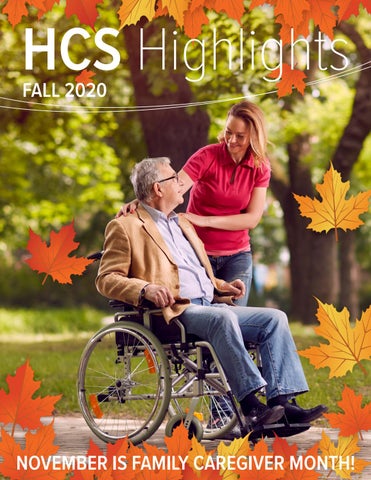
HCS Highlights FALL 2020
NOVEMBER IS FAMILY CAREGIVER MONTH!
BEA’S MESSAGE
Every year around this time, as the leaves start falling and we pull out our warm coats, Kristin Byrne and I embark on our annual fall Road Shows. Although COVID-19 has thrown off a lot of our plans, we still want to take the time to connect with all of you in the regions. This year, the fall Road Shows will look a little different. Kristin and I won’t be making our usual road trips around the state to see all of you in person. Instead, we’ll be holding sessions virtually, via Zoom.
Bea Rector Director, Home and Community Services
Although the content and format of the meetings have differed over the years, what has not changed is that they provide an important opportunity to connect with one another. It is a time for Kristin and I to hear directly from regional staff about issues impacting your work, clients and providers and to learn about your ideas for improvement. It is also an opportunity for us to share highlights of our accomplishments, strategic direction and to respond to your questions. Some of these issues raised are statewide in nature, while others may be unique to particular geographic areas. With everything that has changed this year, we want to hear from you what’s working and what is not. We plan to do some small-group break-out sessions to get feedback from you on how remote service delivery is working. We’d like to hear the good and the bad so that we can make improvements, particularly since we don’t see an immediate change to the way we are working on the horizon. Already we’ve received questions from many of you and have a list of topics we plan to address. If you have something you hope we touch on, please send it to Kim Leslie. This year’s Road Shows will start a little later than usual, in November, and will continue through the beginning of December. We’ll hold three in every region. You’ll will receive a survey from Kim asking which session you’d like to attend. Your preferences will be considered on a first-come, first-served basis, as we want to have an approximately equal distribution of employees in each session to maximize the experience. You’ll receive an invitation to a session once voting is done. In addition to our Road Shows, ALTSA headquarters’ staff typically have an all-staff meeting at least quarterly. Cathy Kinnaman is in the process of getting these meetings on calendars so we have a similar venue to connect with staff in headquarters as well. I encourage all of you to take the time to attend these meetings – they are an opportunity to share, connect and grow as a division, which is especially important now. I’m looking forward to hearing your thoughts and having the opportunity to connect with you again.
2020 Road Show Schedule REGION 1
REGION 2
REGION 3
Nov. 16
2-4 p.m.
Nov. 3
1-3 p.m.
Nov. 16
2-4 p.m.
Nov. 20
2-4 p.m.
Nov. 5
10 a.m.-12 p.m.
Nov. 17
3-5 p.m.
Nov. 24
10 a.m.-12 p.m.
Nov. 19
8-10 a.m.
Dec. 11
2-4 p.m.
CONTENTS 4
REGIONAL UPDATES
7
CHRONIC DISEASE MANAGEMENT
8
FAMILY CAREGIVER MONTH
10 EQUITY, DIVERSITY AND INCLUSION 12 LONG-TERM CARE TRUST UPDATE 14 SPOTLIGHT: HOUSING TEAM
REGION 1 UPDATES Region 1 Home and Community Services (HCS) has successfully completed our VIRTUAL All Staff Appreciation Events! In years past, we have always looked forward to these events. It was one time a year that we gathered all 242 HCS staff, in person, at Big Bend Community College. It was an opportunity to build relationships, enhance team work, and RECOGNIZE all of our amazing staff for the amazing work they do supporting clients, families, providers and each other.
Tami Rucker Region 1 Administrator
2020 has been a year like no other! Due to the pandemic and the need for social distancing, we were not able to meet in person. We still wanted to gather and celebrate our great work, so we got the creative juices flowing around the region. Our amazing, creative, and committed “Phantasic Employee Recognition Committee” (PERC) planned, organized and implemented two Zoom HCS All Staff Celebration events. We highly encouraged staff to participate by video to enhance this team connection. There were two, two-hour, events: August 18 and September 17. PERC developed welcome videos and recognition videos from Bea Rector, Teri Bichler and myself and brought in a guest speaker, Ken Saube, who talked about “The Best Self-Care Tools.” We played games and had other activities, such as the YouTube video “Dancing through the Decades.” After watching the video, staff were given 14 questions about what they saw or heard during the video. There were prizes for first, second and third. A few additional videos were Transforming Lives and Celebration of Excellence. A huge shout-out to the director of this project, Dahveed Bullis! It was great to get everyone together, virtually of course! I want to take this opportunity again to acknowledge all of the hard work staff have done and the adjustments, both personal and professional, that they have had to make over the past months. You have continued to demonstrate commitment and dedication each and every day to provide Long Term Services and Supports to our clients. THANK YOU AND WE APPRECIATE YOU!
REGION 2 UPDATES Sonya Sanders Region 2 Administrator
Despite COVID, who says you cannot have fun during a pandemic? Faced with challenges, Region 2, like the other regions, had two discharge surges going on at the same time: Western State Hospital and acute care hospitals. Staff encountered many obstacles, but they never gave up. During the surge, Region 2 discharged 726 clients from acute care hospitals, 33 clients from Western State Hospital, and 14 diversions from local psychiatric hospitals. Tina Le, FSA, and her managers celebrated with a drive-by lunch to show the staff appreciation. The staff honored were social workers from all residential case management units, the Behavioral Support unit, State Hospital Discharge and Diversion unit, and the resource development unit. It was a fun time, and the staff was hugely impressed. We also appreciate the work from the nursing home and in-home units for their support in this endeavor. It was a regional, all-hands-on-deck experience. The Region 2 Financial QA Audit was smoother than ever. We had a total of 378 “files” pulled by the headquarters quality assurance team. Each case was reviewed for accuracy in 19 questions on financial eligibility, up from 17 last year. To meet proficiency requirements on 16 of the questions, we must achieve a 95% accuracy rate. The other three questions have a 98% accuracy rate in order to meet the proficiency requirement. Not to worry, though, as usual, we met proficiency in most questions on the initial results of the audit. Eight questions were 100% percent in all cases, and three questions were 99% accurate. All of the cases that had errors identified during the audit were corrected before the first 30-day review deadline date making the usual 60-day deadline unnecessary. The proficiency improvement plan, or PIP, is expected to be pleasantly minimal. The discovered inaccuracies did not identify any large error trends in the three questions that did not meet the 95% or 98% expectation. Those three questions had 90%, 87%, and 73% proficiency results. Overall, the 2020 audit cycle results can be considered a HUGE success. As Cassandra Lynch, Financial QA Program Manager, put it, “Region 2 Rocks!!” I am incredibly happy that managers and employees of Region 2 are continuing to live up to the mission and vision of ALTSA by “transforming lives.”
REGION 3 UPDATES The Way Things Have Always Been During the recent micro-aggression training, they showed a video called “The Backwards Brain.” Destin Sandlin, an engineer, is challenged to ride a bike that was engineered to steer in the opposite direction of how a bike normally would steer. It did not go well. It took him eight months of daily practice to get the hang of it! That is how engrained the “normal” way of riding a bike was in his brain.
Debbie Willis Region 3 Administrator
The takeaway from that video was: Knowledge does not equal understanding. It is the same way with our own biases. They become just the way we are. We are not even conscious of many of our biases. Once we become aware of a bias and gain additional knowledge, the challenge is then retraining our brains. If we are not intentional and if we do not practice this “new” way of thinking with ACTION, it is easy for our brains to go right back to the familiar, to the way things have always been. This is a well-worn pathway created by years of doing things the way we have always done them. In many situations, doing things the way we have always done them is not a benefit to us. For example, Region 3 is looking at how we recruit and hire. The process has not charged in years and it needs improvement. Our Region 3 employee survey has revealed that. To begin addressing this, we sent out a two-question survey to all staff to gather their feedback and recommendations for improvement. Our newly formed EDI Advisory Board made up of field staff and supervisors will develop an action plan for improvement based on staff recommendations. Our Region is also implementing “Targeted Selection,” which is a recruiting and hiring process that focuses on a candidate’s knowledge, experience, competencies and personal attributes. It is structured in a way that does not let unconscious bias and poor interviewing techniques stand in the way of hiring the best candidate. It is a start and as we practice new ways of doing things we will forge new and better pathways.
CHRONIC
DISEASE MANAGEMENT
How ALTSA is using grant funds to help Washingtonians learn to manage their chronic illnesses For people with chronic illnesses, learning how to effectively manage their disease can significantly improve their quality of life. Fortunately, thanks to researchers, we have evidence-based strategies for teaching people how to manage their chronic illnesses. The challenge that remains is how to deploy this training to the individuals who need it. ALTSA is partway through a three-year grant aimed at establishing an infrastructure to support a series of chronic disease self-management education (CDSME) programs. The grant, provided by the Administration for Community Living, a division of the U.S. Department of Health and Human Services, follows a two-and-a-half-year grant that ALTSA received in 2016 to 2018. The current grant, which totals about $840,000, began in May 2019 and will run through April 2022. ALTSA has three main objectives under the grant: to expand CDSME programming, primarily in rural and underserved areas; to create a statewide network for delivering CDSME programming; and to create an electronic referral and reporting system so individuals can more easily access programming and ALTSA can better track outcomes. The statewide network, once established, will be administered outside ALTSA, with ALTSA maintaining partnership status. “As evidence-based programs, all of this programming has been statistically proven to increase people’s health in a number of ways,” said Derek Jenkins, ALTSA’s project manager for the grant. “What we’re really hoping to do is increase the health of older adults in Washington, decrease their social isolation, and help them deal with their chronic conditions so that they’re better able to take care of themselves.”
Program participants typically meet for a few hours once per week for about six weeks. Each program session has a small group of participants and two trained leaders, who follow a scripted, evidence-based curriculum. Several programs are being offered, including one on general chronic disease management, as well as programs on the management of chronic pain, diabetes and cancer. A Spanish-language version of the diabetes program will also be available. Although the main purpose of the grant is to establish an infrastructure to support these chronic disease self-management workshops, ALTSA also has a goal of serving 449 individuals during the three years of the grant. So far, they’ve reached 44% of that goal, having served 198 people across six programs. As with many other programs, the grant work was interrupted by COVID-19. CDSME programs were just getting started in some parts of the state when in-person events were cancelled. Although this threw a wrench into ALTSA’s plans, they decided to experiment and invest in an online CDSME program, called Better Choices, Better Health, offered by Canary Health. The program is in the process of being deployed and will soon be available throughout the state. “The vision for after this grant ends is that we have a statewide network set up so we can provide coordination and administrative services for CDSME,” Derek said. “We’re trying to set something up that will continue into the future.
NOVEMBER IS
FAMILY CAREGIVER MONTH
Every November, Washington State honors the more than 850,000 family caregivers who are the backbone of our long-term services and supports. These individuals provide an estimated 770 million hours and nearly $11 billion in unpaid essential assistance to loved ones, friends and neighbors with chronic illness, disabilities and other special needs every year. If you want more information on Washington’s supports for unpaid caregivers, visit the Washington Community Living Connections website or call 1-855-567-0252.
TIPS FOR CAREGIVERS
CAREGIVING DURING COVID-19 Caring for a loved one who is ill, aging or disabled is a challenge under any circumstances, but for the millions of Americans who provide unpaid care to friends or relatives, the COVID-19 pandemic has strained them even further. If you are caring for a loved one, or know someone who is, there are a few steps you can take to improve both your own wellness and the safety and wellbeing of your loved one.
1
First, and most importantly, take care of yourself.
2
Take precautions to keep yourself and your loved one safe.
Self-care is not selfish – it’s essential. You’re under extra stress right now, not only from the barrage of scary headlines and the changes to routine, but from other burdens. You might have kids at home with you or be adjusting to a new work environment. You might be frustrated that you can’t engage in the activities you enjoyed before the pandemic began. Whatever the stressor, taking care of yourself first will help you provide better care to your loved one.
Follow all the standard COVID-19 precautions: wear a facemask, wash your hands often and keep at least six feet apart whenever feasible. If you’re caring for your loved one in person, limit your contact with others so you’re reducing your chance for contracting the disease and passing it on to your love one.
3
Keeping your distance? Take advantage of technology.
4
Take time for to connect with your loved one.
If possible, limit your in-person visits with your loved one. Consider how you can assist your loved one from afar. Technology can be a huge help right now, and not just for keeping touch by video call. You can also use apps and websites to order home delivery of groceries, food and even medication. If your loved one has a smartphone or tablet, you can also download apps to provide medication reminders, monitor blood pressure and track other health-related data points.
You and your loved one are both struggling with the changes you’re experiencing. It’s easy to get wrapped up in the pressures of day-to-day life, but remember to take time to connect with your loved one and remember why you’re providing care in the first place – because of the special bond you share. Use the time to discuss your favorite memories or work on a project together. Now is a great opportunity to make a family photo album or learn how to make a family recipe.
EQUITY, DIVERSITY & INCLUSION
BEING NON-RACIST As ALTSA Assistant Secretary Bill Moss mentioned in his July 2020 ALTSA Update message, the Equity, Diversity and Inclusion team is working on a training on being anti-racist. What does it mean to be “antiracist”? And how is that different than being non-racist? People who are anti-racist not only do not engage in racism, but also actively take action against racial inequities in their everyday life. You may be friendly and kind to people of all different backgrounds, but do you speak out about the injustice you see and read about? You might value diversity in the workplace, but do you work to promote equity in hiring and recruiting? That is the difference between being nonracist and being anti-racist. Believing you are non-racist is safe and easy because you do not risk being socially ostracized. Being antiracist means you work to end the racism you see in the world – which requires public action. Both white people and people of color can be anti-racist. In the article “White Supremacy Culture: Changework,” Tema Okun introduces the six “Rs” to be an anti-racist. These are to: Read to educate yourself about racism in all its forms. A good starting point is this webpage on Being Antiracist. Reflect on what you’ve read and what it means for you. How can you use what you’ve learned to challenge everyday racism? Remember how what you do might uphold racism, whether intentionally or not. Work to identify and challenge these internalized attitudes. Take risks to combat racism when you see it or are participating in it. Call out friends and coworkers for racist jokes or beliefs or take action on legislative matters that will help or hurt racial inequities. Accept rejection – sometimes you’ll get it wrong. Use this as an opportunity to grow. Don’t take it personally, and don’t quit the fight. For people of color, express your rejection of racism from white people. It’s okay to be angry – use that anger to hold others accountable. Perform relationship building, both with white people and people of color, wherever they are on the journey from being nonracist to antiracist. Keep an eye out for details on the upcoming training to learn more about how to be an anti-racist. Adapted from this selection from the Racial Healing Handbook.
EDI LISTENING SESSIONS ALTSA STAFF SHARE AND LISTEN ON TOPIC OF RACISM Some people shared their personal encounters with racism, while others shared their feelings about recent news stories. Others discussed issues included trust in the workplace, hiring processes and procedures, and transparency. Many people discussed their experiences with microaggressions, those subtle, everyday words or behaviors that convey prejudice. This prompted the EDI team to develop a microaggression workshop that will be implemented in the regions.
Following the death of George Floyd, a black man who was killed during an arrest in Minneapolis at the end of May, the Equity, Diversity and Inclusion (EDI) team saw a need for staff to be able to share, vent about or simply listen to one another’s experiences with racism. The team created listening sessions for employees to hear one another’s stories and share their emotions regarding Floyd’s death and the recent Black Lives Matter protests around the country. The first listening session was held on June 4, and the team has held 17 sessions in all, some for all staff and some for specific regions. Hundreds of staff members have participated, some more than once. The feedback on the forums was overwhelmingly positive and many staff thanked the EDI team for giving them the space to share. “As I tried to find my balance and a place for all my unsettling emotions I found this forum extremely informative and supportive,” said APS investigator Lisa Porter. “Growing pains of awareness and change are hard to navigate at times but necessary… I’m thankful to work for an agency that finds this so vitally important. A variety of topics came up during the sessions.
“This is an important training to offer staff to address and bring about awareness of how systemic and institutionalized racism is imbedded in systems all around us,” said Michelle Joseph, an Equity, Diversity and Inclusion Specialist with ALTSA. “These systems are designed to advance others forward while attempting to block people of color from moving forward. This has always been an important topic, especially to those who are living this experience every day. We’ve become accustomed to avoiding the topic of racism. People somehow believe that racism will go away instead of acknowledging the existence of racism, addressing racism, educating people on what racism looks like in our society/workplace and building a no-tolerance culture for this type of behavior in our organization.”
Growing pains of awareness and change are hard to navigate at times but necessary. – Lisa Porter, APS investigator Some other projects are in the works, prompted by topics discussed in the forums. The ALTSA EDI team is working with DSHS to create a workshop on Truth, Social Justice and Dismantling Racism, which will be available to all staff. The sessions inspired other agencies, as well. Some sat in on some of the forums to get ideas for their own. If you are interested in the trainings currently in development, keep an eye on your email for more information.
LONG-TERM CARE TRUST An update on the first-in-the-nation public long-term care insurance program
Our nation will experience a huge growth in the aging population As a result of the continual growth in our nation’s aging population, it is expected that 7 out of 10 older adults will at some point need help with daily living activities such as medication management, transportation, and meal preparation. Some people will need more intensive care, such as assistance with bathing or mobility. These types of assistance, known as long-term services and supports (LTSS), are expensive and most individuals are not financially prepared to pay out of pocket for them. Over 90 percent of the nation’s population do not have private long-term care insurance. Many Americans believe that Medicare covers these services, but for the most part that is an incorrect assumption; the benefit is limited only to rehabilitative stays in nursing homes. Unpaid family caregivers often step in to support their loved ones; however, not everyone has someone who is available to take on this role. Also, being a family caregiver can have both a financial and health impact for the person providing the care as well as increase health care costs including those funded through Medicare and Medicaid. The only and final safety net for long-term care, therefore, becomes
Medicaid – forcing many Americans to deplete their life savings and fall into poverty before they can qualify for any kind of assistance in meeting their LTSS needs. In 2019, Washington State passed the first legislative solution of its kind to address this issue head on using a social insurance model.
Washington took bold step to address the longterm care crisis and established the LTSS Trust The Washington State legislature enacted the Long-Term Services and Supports (LTSS) Trust Act (RCW 50B) in 2019, becoming the first in the nation to take such a bold step toward addressing the future long-term care crisis. Under this law, individuals will have access to a total lifetime benefit of $36,500 to pay long-term services and supports providers beginning in 2025. The lifetime benefit amount will be adjusted annually in order to maintain purchasing power over time. To help finance this program, Washington workers will begin to make payroll contributions of just over one-half of a percent in January 2022. Individuals who are self-employed or independent contractors can “opt in” to making contributions so that they can later qualify for benefits.
Washingtonians who contribute to the Trust will feel secure throughout their working lives, knowing that they will be better prepared to access and pay for needed services. They will not need to deplete their life savings when accessing this benefit as they or their partner age or experience an event that leads to a functional disability. It also means that family caregivers will have access to targeted services designed to help them in their caregiving roles while also attending to their own well-being and needs. The LTSS Trust is another resource that will enable Washingtonians to age in place, allow family caregivers to remain in the workforce, and relieve the fiscal strain on the state’s Medicaid budget by preventing or delaying older adults from needing Medicaid.
Long-Term Services and Supports (LTSS) Trust Program Team and its Priorities Per RCW 50B.04.020, DSHS, the Employment Security Department, the Health Care Authority, and the Office of the State Actuary have responsibilities in the implementation and administration of the LTSS Trust Program. For DSHS, the necessary strategic planning to design the infrastructure, rules, policies, outreach strategies, information technology (IT) systems and processes for the LTSS Trust Program will happen in the 2021-23 biennium. Under the leadership of Ben Veghte, LTSS Trust Director, the Trust team is preparing for the 2021-23 biennium. The top priorities for the team in the near future are finalizing DSHS and cross-agency strategic and IT planning to pave the way for implementation of benefits in 2025, working closely with the 21-member LTSS Trust Commission to staff their recommendations to the legislature and appropriate executive agencies, and developing public communication strategies in coordination with the Employment Security Department as they prepare to assess premiums starting January 1, 2022. An LTSS Trust public website is expected to launch in late 2021, and will serve as a one-stop shop for future beneficiaries. It will include a tool for individuals to plan and budget for their LTSS needs, both for Trust benefits and any LTSS they may need beyond the amount allotted by the program. Employers, employees, applicants, beneficiaries, and providers will be able to easily access information about the LTSS Trust. To keep up with future updates about the LTSS Trust, please contact program director Ben Veghte at Benjamin. Veghte@dshs.wa.gov or bookmark our webpage http:// dshs.wa.gov/altsa/ltss-trust.
TRUST BASICS Workers pay up to $0.58 per $100. Someone who makes $750 per week will pay up to $4.35 into the Trust.
10
To get benefits, you must work at least 3 of the last 5 years or 10 years without a break of 5 or more years.
In the first year, eligible individuals can access up to $36,500 in benefits. The benefits can be used for a wide range of services and supports, such as: Professional care in own home, licensed residential facility or nursing facility Adaptive equipment and technology
P
Home safety evaluations
Training, pay and support for family members who provide care Home-delivered meals
Rides to the doctor
TEAM SPOTLIGHT: HOUSING Working together to find and maintain homes for clients Researchers have known for years that stable, secure housing has positive benefits for health. For ALTSA clients, receiving assistance in finding and maintaining affordable housing can be key to promoting their physical and mental wellbeing. The HCS housing team helps clients find and maintain that stability with the assistance of key partnerships within local communities. The team works to build strong formal and informal relationships with housing authorities and landlords. Formal relationships with housing authorities assist ALTSA in helping clients transition out of nursing facilities and other institutional settings. The ALTSA housing team assists housing authorities in securing federal vouchers, some of which may specifically be for DSHS clients, and others that are not earmarked but may nonetheless be available to ALTSA clients. This allows clients to circumvent months or even years on housing waitlists. “We want clients in their units and they want our clients receiving supports, so it’s a win-win,” said Jonnie Matson, housing program manager lead. “Wherever we can foster that partnership, we try and do that.” Even for those housing authorities with whom ALTSA does not have formal partnerships, housing specialists and the Area Agencies on Aging try to cultivate relationships so they have assistance finding housing for clients.
Although ALTSA clients have had support with their housing search for a number of years, many experienced trouble maintaining their housing. Beginning in 2017, ALTSA began offering supportive housing through the Governor’s Opportunity for Supportive Housing (GOSH) services, part of the 2016 Governor’s Behavioral Health Innovation Fund. “Our team works with a lot of people who want to live independently and just need some financial assistance. And then there are some people who want to live independently who need some extra support to do so,” said Whitney Joy Howard, lead supportive housing program manager. “We started bringing on supportive housing services to address that need and increase individual choice.” Supportive housing may include assistance with everything from securing housing and moving in to maintaining housing, whether that’s paying rent on time, managing conflicts with neighbors or connecting to legal resources. Assisting clients to navigate relationships with landlords is one of the ways the ALTSA supportive housing team partners to help clients maintain housing. The first year, the GOSH program had money to provide supportive housing to 15 people. Today, ALTSA now has 176 active GOSH clients around the state. The administration also provides supportive housing through Foundational Community Supports, part of the federally authorized five-year Medicaid Transformation project. Although ALTSA has strong partnerships already in place, the housing team hopes to build on these partnerships with the addition of a new position, the Housing Capacity Program Manager, whose role includes outreach to housing developers and housing authorities to build and expand upon partnerships, with the goal of increasing the amount of units and subsidized housing available to ALTSA clients. Assisting with housing needs is one of the many ways ALTSA supports clients’ overall wellbeing, while also providing independence. By developing these programs and partnerships, the HCS housing team helps ensure that clients can choose where and how they live.
HOUSING PROGRAM HIGHLIGHTS CLIENTS SERVED BY HOUSING VOUCHERS
527
Non-Elderly Disabled 2
108
811
160
ALTSA Bridge
CLIENTS SERVED BY GOSH SERVICES
176
GOSH Service Recipients, Currently Active
290
GOSH Service Recipients, All Time Total
71
GOSH Subsidy Recipients, Currently Active
128
GOSH Service Recipients, All Time Total
Do you have a story tip? Want to submit a photo of Washington’s scenery? SEND THEM TO MEGHAN.ERKKINEN@DSHS.WA.GOV!