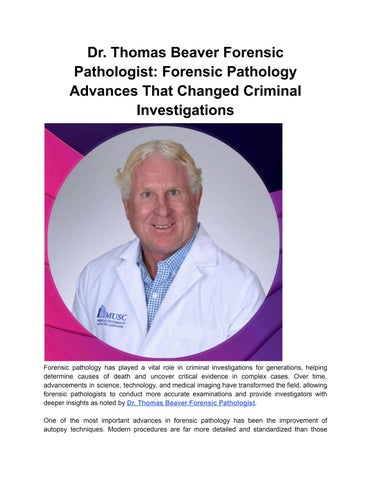
Dr. Thomas Beaver Forensic Pathologist: Forensic Pathology
Advances That Changed Criminal Investigations

Forensic pathology has played a vital role in criminal investigations for generations, helping determine causes of death and uncover critical evidence in complex cases Over time, advancements in science, technology, and medical imaging have transformed the field, allowing forensic pathologists to conduct more accurate examinations and provide investigators with deeper insights as noted by Dr Thomas Beaver Forensic Pathologist
One of the most important advances in forensic pathology has been the improvement of autopsy techniques. Modern procedures are far more detailed and standardized than those
used decades ago Enhanced examination methods allow pathologists to identify subtle injuries, disease processes, and other factors that may contribute to a person's death. Greater precision helps investigators establish more reliable timelines and determine the circumstances surrounding a case. Medical imaging technology has also revolutionized forensic investigations. CT scanning and other advanced imaging methods provide detailed internal views of the body before an autopsy is performed
These tools help identify fractures, internal injuries, bullet paths, and foreign objects with remarkable accuracy Digital imaging creates permanent records that can be reviewed repeatedly throughout an investigation and presented as evidence when necessary. DNA analysis represents another major breakthrough that changed criminal investigations While DNA testing extends beyond forensic pathology alone, pathologists frequently work alongside forensic scientists to collect and preserve biological evidence. DNA technology has helped identify victims, connect suspects to crime scenes, and solve cases that remained unsolved for years or even decades.
Toxicology advancements have also significantly enhanced forensic pathology Modern laboratory techniques can detect extremely small amounts of drugs, alcohol, poisons, and other substances within the body Improved testing capabilities help determine whether toxic substances contributed to a death and provide valuable evidence during criminal investigations Digital documentation has improved both accuracy and efficiency in forensic work. High-resolution photography, three-dimensional modeling, and computerized case management systems allow pathologists to preserve evidence in greater detail than ever before These records help investigators, attorneys, and courts better understand forensic findings.
Advances in injury analysis have strengthened the ability to reconstruct events surrounding a death Forensic pathologists can now evaluate wound patterns, trauma characteristics, and injury mechanisms with greater precision This information often helps investigators determine how injuries occurred and whether they are consistent with witness statements or physical evidence Collaboration between forensic disciplines has also expanded significantly Pathologists frequently work with crime scene investigators, forensic anthropologists, toxicologists, and digital forensic experts to develop a more complete understanding of complex cases This multidisciplinary approach improves the quality and reliability of investigative findings.