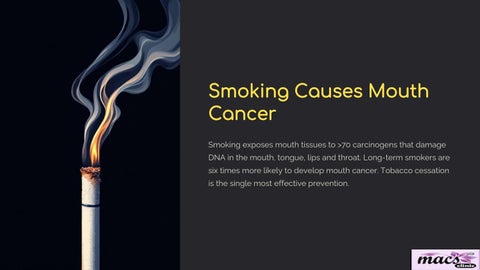

Smoking Causes Mouth Cancer
Smoking exposes mouth tissues to >70 carcinogens that damage DNA in the mouth, tongue, lips and throat. Long-term smokers are six times more likely to develop mouth cancer. Tobacco cessation is the single most effective prevention.

Expert Warning
“Smoking does not only augment the risk of mouth cancer, but it hastens the increase of tumours and also diminishes the effectiveness of treatment in those who smoke during the cancer management process.”
— Dr. Sandeep Nayak

How Smoking Causes Mouth Cancer
Exposure to Carcinogens
Tobacco smoke contains nitrosamines, benzene, formaldehyde and >70 carcinogens that directly damage DNA, triggering uncontrolled cell division.
Chronic Inflammation
Ongoing irritation of the mouth lining creates an environment where abnormal cells can grow unchecked.
Reduced Saliva
Smoking lowers saliva production, reducing the mouth’s ability to clear carcinogens and repair early cellular damage.
Alcohol Combination
Using alcohol with tobacco multiplies risk—far more dangerous than either substance alone.
Biological Link — At
a Glance
Carcinogens damage DNA → chronic inflammation impairs immune surveillance → reduced saliva limits repair → combined with alcohol, risk and progression accelerate.
Warning Signs Smokers Should Never Ignore

Non-Healing
Ulcers Any mouth sore not healed within 3 weeks needs immediate specialist evaluation.

White or Red Patches Leukoplakia or erythroplakia are precancerous changes linked to prolonged tobacco use.

Persistent Hoarseness Hoarseness lasting more than two weeks may signal throat or laryngeal involvement.

Difficulty Chewing/Swal lowing Problems with chewing or swallowing can indicate advancing tumor growth and require urgent assessment.

Screening & Early Detection
Individuals with long-term tobacco or alcohol exposure should pursue timely screening. Early detection significantly improves treatment outcomes and preserves function.

If you notice any warning signs, consult an oncology specialist rather than waiting.
Why Choose MACS Clinic
Dr. Sandeep Nayak and the MACS oncology team specialise in minimally invasive oral cancer surgery (including RIA-MIND) designed to remove tumours while preserving speech, swallowing, and facial appearance.

Book a Consultation
Call: +91 8035740000 — Book your consultation for cancer treatment at MACS Clinic, Bangalore.
MACS CLINIC

FAQs — Quick Answers
Can quitting reverse risk?
Yes. Quitting significantly reduces mouth cancer risk over time; the longer smoke-free, the closer the risk approaches a non-smoker’s.
How soon does risk fall?
Risk begins decreasing within five years of quitting and continues to drop with each additional smoke-free year. Is smokeless tobacco safer?
No. Chewing and smokeless tobacco carry equally high risks and are directly linked to cancers of the mouth, tongue, and cheek.
Takeaway
Smoking is a leading cause of mouth cancer via DNA-damaging carcinogens and chronic inflammation. Quitting and early screening save lives and preserve quality of life.
If you have symptoms or long-term tobacco/alcohol exposure, seek specialist evaluation promptly.