Exploring How Technology Sharpens Precision in Spine Surgery by Dr. Rajesh Bindal
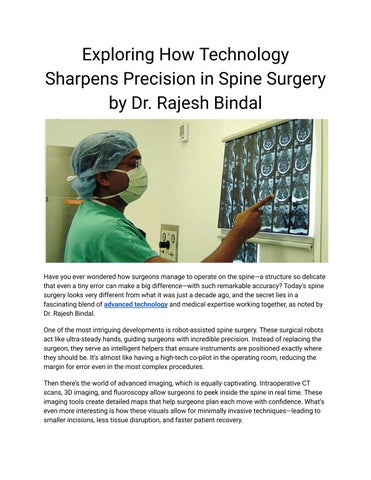
Have you ever wondered how surgeons manage to operate on the spine—a structure so delicate that even a tiny error can make a big difference—with such remarkable accuracy? Today’s spine surgery looks very different from what it was just a decade ago, and the secret lies in a fascinating blend of advanced technology and medical expertise working together, as noted by Dr. Rajesh Bindal. One of the most intriguing developments is robot-assisted spine surgery. These surgical robots act like ultra-steady hands, guiding surgeons with incredible precision. Instead of replacing the surgeon, they serve as intelligent helpers that ensure instruments are positioned exactly where they should be. It’s almost like having a high-tech co-pilot in the operating room, reducing the margin for error even in the most complex procedures. Then there’s the world of advanced imaging, which is equally captivating. Intraoperative CT scans, 3D imaging, and fluoroscopy allow surgeons to peek inside the spine in real time. These imaging tools create detailed maps that help surgeons plan each move with confidence. What’s even more interesting is how these visuals allow for minimally invasive techniques—leading to smaller incisions, less tissue disruption, and faster patient recovery.