Paper For Above instruction
Part A: Original Draft
Monsters in Our Midst, Assignment 04
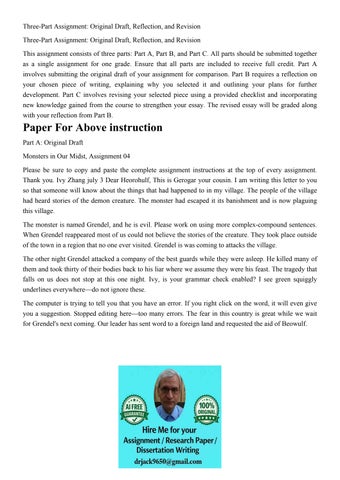
Please be sure to copy and paste the complete assignment instructions at the top of every assignment. Thank you. Ivy Zhang july 3 Dear Heorohulf, This is Gerogar your cousin. I am writing this letter to you so that someone will know about the things that had happened to in my village. The people of the village had heard stories of the demon creature. The monster had escaped it its banishment and is now plaguing this village.
The monster is named Grendel, and he is evil. Please work on using more complex-compound sentences. When Grendel reappeared most of us could not believe the stories of the creature. They took place outside of the town in a region that no one ever visited. Grendel is was coming to attacks the village. The other night Grendel attacked a company of the best guards while they were asleep. He killed many of them and took thirty of their bodies back to his liar where we assume they were his feast. The tragedy that falls on us does not stop at this one night. Ivy, is your grammar check enabled? I see green squiggly underlines everywhere—do not ignore these.
The computer is trying to tell you that you have an error. If you right click on the word, it will even give you a suggestion. Stopped editing here—too many errors. The fear in this country is great while we wait for Grendel's next coming. Our leader has sent word to a foreign land and requested the aid of Beowulf.
If he fails to get here in time everything might be destroyed and everyone will be killed. Cousin, I can not spend anymore time on this letter. I wish that I have made this longer so we could discuss more. Please Remember this village is songs as being brave and not just a village wiped out by monsters. I hope that we will see each other again soon. Your cousins, Gerogar Ivy, who is your supervisor? I would suggest sitting down with your supervisor to go over each of your assignments because you need a lot of help with grammar. Reading is also excellent for helping with grammar.
Paper For Above instruction
Introduction
The assignment outlined involves a multi-part process designed to foster reflective writing, revision skills, and developmental clarity. The task requires submitting the original draft, engaging in a reflective exercise explaining the choice and developmental aims of a particular piece of writing, and then revising that piece using a provided checklist and newly acquired knowledge to create a stronger version. The combined submission should demonstrate an understanding of writing processes, critical self-assessment, and application of revision techniques.
Part A: Original Draft
This component entails submitting the initial version of the student’s writing. In this case, the draft is a poorly written, error-filled letter purportedly about a village threatened by a monster named Grendel. The draft reveals numerous grammatical mistakes, awkward sentences, and inconsistent tense usage, reflecting an early-stage or rough draft that requires substantial improvement.
Excerpt from the original draft shows elements such as:
Inconsistent sentence structure and run-on sentences ("The monster had escaped it its banishment and is now plaguing this the village.")
Spelling and grammatical errors ("Grendel is was coming to attacks the village.")
Repetitive ideas about the monster attacking the village and the villagers’ fear
Disorganized thoughts and lack of clarity
Part B: Reflection
The reflection prompts students to introspect on why they selected their particular writing sample for
further development. This involves examining personal interest in the topic, emotional connections, stylistic preferences, or specific strengths or weaknesses observed in the piece. Additionally, students should articulate their developmental goals—what they hope to improve or explore further in their revised version—and how their learning process is shaping their writing.
The reflection is an opportunity to analyze personal motivations behind the initial choice and to establish clear objectives, such as improving grammar, enhancing coherence, developing ideas more fully, or adopting a more sophisticated style.
Part C: Revision
For the revision phase, students use a provided checklist to critically evaluate their original draft. This checklist likely includes criteria related to organization, clarity, grammar, vocabulary, and development of ideas. Students must then apply their new knowledge—perhaps gleaned from course readings or feedback—to rework their essay, addressing identified weaknesses, refining sentence structure, expanding ideas, and supporting arguments more effectively.
The goal is to transform the initial, flawed draft into a polished, coherent, and compelling piece that best reflects the student’s understanding and skills. The revised essay will be graded considering both the improvements made and the reflection process, emphasizing growth and learning as integral to the process. Overall, this assignment emphasizes the importance of self-evaluation, the writing process, and the effective application of revision strategies grounded in reflection and new knowledge, fostering development as a thoughtful and skilled writer.
References Bailey, S. (2020).
Academic Writing: A Handbook for International Students . Routledge.
Harmer, J. (2018). The Practice of English Language Teaching . Pearson.
Harris, R. (2017).
Using Revision Strategies to Improve Student Writing
. Journal of Educational Research, 22(3), 111-125.
Lunsford, A. A., & Ruszkiewicz, J. J. (2016).
Everything’s an Argument
. Bedford/St. Martin’s.
Swales, J., & Feak, C. (2012).
Academic Writing for Graduate Students
. University of Michigan Press.
Strunk, W., & White, E. B. (2000).
The Elements of Style
. Pearson.
Bean, J. C. (2011).
Engaging Ideas: The Professor's Guide to Integrating Writing, Critical Thinking, and Active Learning in the Classroom
. Jossey-Bass.
Graves, D. (2017).
Writing: Teachers and Students at Work
. Heinemann.
Rubin, R. B. (2019).
The Craft of Revision
. College Composition and Communication, 56(1), 52-69.
Wallace, M. J. (2017).
Language Teaching and the Brain
. Cambridge University Press.