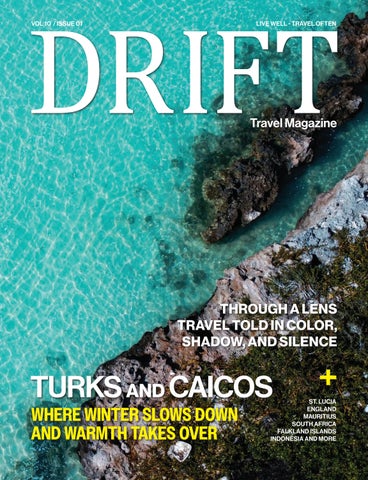
VOL 10 / ISSUE 01
LIVE WELL - TRAVEL OFTEN
Travel Magazine
THROUGH A LENS TRAVEL TOLD IN COLOR, SHADOW, AND SILENCE
TURKS AND CAICOS WHERE WINTER SLOWS DOWN AND WARMTH TAKES OVER
ST. LUCIA ENGLAND MAURITIUS SOUTH AFRICA FALKLAND ISLANDS INDONESIA AND MORE
A little
high is still too high to drive. Campaign: Name: If you feelCreative different, you driveSize: different. Media: Date Created:
/02
VOL 09 / ISSUE 04
CONTENTS TURKS AND CAICOS
12
PHOTOGRAPHIC JOURNEY
20
Steve Drake
Elaine Van der Merwe-Louwrens & Steph Louwrens
Escape winter’s chill in Turks & Caicos, where luminous beaches, calm seas, and unhurried island living redefine the season. From Grace Bay mornings to sunset sails and soulful island dining, this Caribbean refuge restores both rhythm and spirit.
A photographic journey where light, color, and stillness reveal travel’s quieter truths—capturing fleeting moments, rich textures, and human connections that invite readers to pause, look closer, and experience the world beyond words.
CRUISES
MAURITIUS
36
42
Diane Tierney
Sergi Reboredo
Step aboard Allura, Oceania Cruises’ newest floating masterpiece, where world-class cuisine, artful design, and refined indulgence redefine luxury at sea—inviting travelers to savor gourmet creativity, elegant spaces, and destination-rich voyages in unforgettable style.
From sugarcane fields to turquoise lagoons, Mauritius unfolds as a vibrant mosaic of cultures, rituals, and flavors—where sacred traditions, bustling markets, volcanic landscapes, and elegant island living combine to create a deeply immersive Indian Ocean escape.
SOUTH AFRICA
48
PILGRIMAGE
54
Allison Foat
Andrew Marshall
Perched above Walker Bay, Grootbos Luxury Eco Reserve blends hospitality with conservation, inviting travelers to slow down among fynbos landscapes, forest bathing rituals, and luxury rooted in community and nature.
Journey across continents to six sacred sites, from ancient stone circles to jungle temples, where myth, ritual, and landscape intertwine—inviting travelers to slow down, reflect, and experience the world’s power.
FALKLAND ISLANDS 62
COLUMNS
Andi Cross
TRAVEL GEAR
6
At the wild edge of the South Atlantic, the Falkland Islands challenge conventional travel—revealing raw landscapes, wildlife, conflicted history, and slowing down matters visiting one of Earth’s last unfiltered frontiers.
SPOTLIGHT
10
#WHERETONEXT
69
EXTRAORDINARY BRANDS DESERVE REMARKABLE PHOTOGRAPHS Bespoke Professional Photography for Hotels, Resorts & Luxury Brands
Clients Worldwide: TRAVEL + TOURISM Fairmont Hotels & Resorts | Four Seasons Hotels & Resorts | Ritz Carlton Hotels | Accor Hotels | Melia Hotels Ovolo Hotels | Sunwing Travel | Tourism Barbados | Tourism Grand Cayman LUXURY BRANDS Helly Hanson | Lincoln Luxury Vehicles Bugatti | Swissgear | Lole | Ford Motors | Samsung | Tiffany & Co.
Available worldwide. Request our photoshoot destination calendar: email: portfolio@glossy.media web portfolio: glossy.media
MASTHEAD PUBLISHER
CREATIVE DIRECTOR
CONTRIBUTORS
Glossy Media
Steve Drake
© All rights reserved. No part may be copied or reproduced without permission.
editor@DRIFTtravel.com
Andi Cross, Steve Drake, Allison Foat, Elaine Van Der Merwe-Louwrens, Steph Louwrens, Andrew Marshall, Adam Moore, Sergi Reboredo, Diane Tierney
Advertising Inquiries sales@DRIFTtravel.com
© COPYRIGHT DRIFT TRAVEL MAGAZINE/GLOSSY MEDIA 2015-2026
/06 COALATREE X GREATER ZION COLLECTION coalatree.com A celebration of wild landscapes and conscious exploration, the Coalatree × Greater Zion collection brings together Utah-born outdoor brand Coalatree and the spirit of Greater Zion in a line of sustainable, destination-inspired travel gear. Designed for adventurers who want performance, style, and a positive impact, this limited-edition range infuses Coalatree’s eco-minded craftsmanship with the bold hues and rugged beauty of Zion National Park and the wider Greater Zion region. Every piece in the collection is built for the trail, the town, or the airport—crafted from recycled and lowimpact materials that stand up to diverse outdoor conditions while minimizing environmental footprint. From the versatile Puffy Kachula Blanket, which transforms into a poncho or pillow for campfires, concerts, and stargazing, to the Mirage Sunshirt with breathable, UPF-protected fabric ideal for sunny desert treks, each item reflects the adventure and resilience of Southern Utah’s iconic terrain. Comfort meets function in the Java Socks, sustainably spun from recycled coffee grounds and plastic bottles, and the rugged Quest Duffel, a convertible travel bag tough enough for slot canyon escapades yet sleek enough for weekend getaways.
DRIFT TRAVEL
6
TRAVEL GEAR YETI MANUAL COFFEE MAKER yeti.ca Built for life on the move, the YETI Pour Over delivers barista-quality coffee anywhere. Durable stainless steel resists dents, packs easily, and fits YETI Ramblers. Simple filters, fast cleanup, and heat retention make it ideal for road trips, campsites, hotel rooms, and early-morning flights—with consistent results every single brew.
ICEBREAKER ZIP JACKET icebreaker.com Ideal for travelers moving between climates, the Icebreaker Merino Blend 300 RealFleece™ Descender Long Sleeve Zip Jacket offers exceptional warmth without bulk. Made with a soft merino fleece interior, it naturally regulates temperature, resists odors, and breathes during active days. The full-zip design layers easily for flights, city exploring, or mountain trails, while durable construction and comfortfocused details make it a reliable, pack-friendly essential for extended journeys.
AIRBACK ORIGINAL TRAVEL BACKPACK airback.store The ultimate companion for organized, stress-free travel. This innovative backpack combines sleek, minimalist design with game-changing functionality: an integrated vacuum packing system compresses your gear in seconds, freeing up space for more essentials or souvenirs. Made with durable, water-resistant materials and thoughtful compartmentalization, it keeps clothes, tech, and toiletries neat and accessible. Comfortable padded straps and a balanced carry make it ideal for city breaks, weekend getaways, or longhaul trips. Whether you’re hopping flights or exploring streets, the Airback Original helps you carry more with less bulk.
TIIBO STAINLESS STEEL WATER BOTTLE tiibo.com Designed for travelers who never compromise on hydration, the Tiibo Water Bottle combines sleek design with serious performance. Crafted from vacuum-insulated stainless steel, it keeps drinks cold for hours in hot climates and warm on cool journeys. Lightweight yet durable, it slips easily into backpacks, bike cages, and carry-ons. A clean-taste, BPA-free construction and spill-resistant lid make it an ideal companion for flights, city walks, road trips, and outdoor adventures alike.
DRIFT TRAVEL
8
TRAVEL GEAR ALLSWIFIT SNEAKERS BY NORTIV 8 nortiv8.com These sneakers are quickly becoming a go-to choice for travelers who log serious miles. Designed for both men and women, these ultra-light sneakers deliver all-day comfort without sacrificing support. Several styles carry the American Podiatric Medical Association (APMA) Seal of Acceptance, making them ideal for long airport walks, city sightseeing, and active itineraries. A high-rebound EVA midsole cushions every step to reduce impact and knee strain, while the breathable woven mesh upper keeps feet cool on the move. Finished with a durable, high-traction outsole and a TPU support frame, ALLSWIFIT sneakers offer stability, comfort, and confidence— wherever the journey leads.
NORTIV 8 WINTER BOOTS nortiv8.com Built for travelers who don’t stop when conditions turn challenging, TUNDRA Men’s Snow Boots and SEEKER Women’s Hiking Boots from NORTIV 8 deliver dependable performance across seasons. The TUNDRA boots are true winter workhorses, featuring waterproof construction, a cold-rated insulated lining down to –25°F, a removable cushioned insole, and a slipresistant outsole for icy streets and snowy trails. For women, the SEEKER hiking boots combine trail-ready durability with a refined silhouette, offering lightweight support, breathable mesh comfort, and advanced traction for uneven terrain. Together, they’re versatile footwear choices for cold-weather adventures, urban exploration, and off-the-map journeys alike.
SPOTLIGHT SUGAR BEACH, A VICEROY RESORT FRAMED BY THE PITONS, A CARIBBEAN ESCAPE LIKE NO OTHER Set between the iconic twin Pitons on St. Lucia’s dramatic west coast, Sugar Beach, A Viceroy Resort occupies one of the most extraordinary natural settings in the Caribbean. With rainforest-covered mountains rising sharply behind and a crescent of white sand meeting crystal-clear waters below, this former sugar plantation has been transformed into a secluded sanctuary where barefoot luxury and natural beauty exist in perfect harmony. From the moment guests arrive—often by boat along the coast—the sense of escape is immediate. The resort’s thoughtful design embraces its surroundings, allowing the landscape to take center stage while delivering refined comfort, intuitive service, and a deeply restorative atmosphere.
/10 ST. LUCIA
DRIFT TRAVEL
A Destination for Wellness and Renewal Wellness is woven into the fabric of the Sugar Beach experience. The resort’s award-winning Rainforest Spa is set within the lush jungle between the Pitons, offering open-air treatment rooms connected by wooden walkways suspended above the forest floor. Here, the sounds of birdsong and rustling leaves replace walls and ceilings, creating a deeply immersive spa journey. Signature treatments draw inspiration from nature, while yoga sessions, guided meditation, and personalized wellness programs invite guests to reconnect with both body and mind. Whether indulging in a spa ritual or simply floating in the warm Caribbean Sea, relaxation feels effortless.
11
Culinary Experiences with a Sense of Place Dining at Sugar Beach reflects St. Lucia’s rich culinary heritage and the resort’s commitment to elevated yet approachable cuisine. Beachfront restaurants showcase fresh local seafood, tropical produce, and globally inspired flavors, all served with relaxed sophistication. Guests can enjoy leisurely breakfasts overlooking the sea, long lunches with toes in the sand, and candlelit dinners beneath the stars. Private dining experiences—from romantic beach dinners to in-villa chef services—add a personal touch, making each meal feel like a celebration of place.
Adventure, Culture, and Coastal Living While Sugar Beach feels blissfully secluded, it also serves as an ideal base for exploring St. Lucia’s natural and cultural highlights. Snorkeling and diving reveal vibrant reefs just offshore, while hiking trails wind through the rainforest and up the Pitons for unforgettable panoramic views. Boat excursions, sunset cruises, and guided island tours introduce guests to St. Lucia’s rich history, volcanic landscapes, and welcoming local culture. Whether seeking adventure or stillness, the resort offers a balance that allows each guest to shape their own experience.
An Icon of Caribbean Luxury Sugar Beach, A Viceroy Resort is more than a luxury resort—it is a destination defined by its setting, calm, and ability to make time feel unhurried. Framed by one of the Caribbean’s most iconic landscapes, it offers a rare blend of privacy, authenticity, and refined indulgence. viceroyhotelsandresorts.com
TURKS AND CAICOS BY STEVE DRAKE
If winter usually finds you counting daylight hours and scraping ice from windshields, Turks and Caicos Islands offer a different rhythm entirely. Here, the days are measured not by temperature drops but by tides, sunsets, and how long you linger barefoot after breakfast. Scattered across the Atlantic southeast of the Bahamas, this low-lying archipelago is best known for beaches that seem almost unreal — powder-soft sand, water so clear it barely registers as liquid.
But Turks & Caicos is more than a postcard fantasy. It’s a place where winter travel becomes restorative, not rushed; where you can do very little very well, or quietly fill your days with saltwater adventures, island hopping, and long, memorable meals. Winter is peak season here for a reason. The weather is reliably warm without being oppressive, the trade winds keep the air fresh, and the islands feel polished but never overproduced. This is escape without chaos — refined, relaxed, and deeply soothing.
/12
DRIFT TRAVEL
WHERE WINTER SLOWS DOWN AND THE SEA TAKES OVER
13
PROVIDENCIALES: THE HEART OF THE ACTION Most travelers land on Providenciales, or “Provo,” the most developed island and the gateway to the rest of the country. Yet even at its busiest, Provo never feels frantic. Life unfolds at a graceful pace, anchored by the legendary sweep of Grace Bay Beach. Grace Bay consistently ranks among the world’s best beaches, and once you’re standing ankledeep in its shallow, luminous water, it’s easy to understand why. Winter mornings here are ideal for swimming and paddleboarding; afternoons stretch lazily beneath umbrellas or aboard catamarans cruising just offshore. Beyond the beach, Provo rewards exploration. Chalk Sound’s electricblue lagoon, framed by tiny rocky islets, offers a surreal contrast to the open ocean. Inland, quiet roads lead to hidden coves, boutique shopping at The Saltmills, and casual beach bars where shoes are optional and time dissolves quickly.
Turks & Caicos is defined by water, and winter is one of the best seasons to experience it. The sea is calm, visibility is exceptional, and marine life thrives just beyond the shoreline. Snorkeling here feels effortless. Coral gardens lie close to shore, especially around Grace Bay and Smith’s Reef, where sea turtles, rays, and schools of reef fish glide through warm shallows. For divers, the islands sit atop dramatic underwater walls that plunge thousands of feet into deep blue — a reminder that paradise often has hidden depth. Boat excursions are another winter highlight. Half-day cruises drift past uninhabited cays, pause for conch shelling on sandbars, and finish with rum punches as the sun slides toward the horizon. Whale watching also comes into play later in winter, as humpbacks migrate through nearby waters, offering rare, awe-inspiring encounters.
DRIFT TRAVEL
OUT ON THE WATER: LIFE MOVES AT SEA LEVEL
15
BEYOND PROVO: ISLANDS THAT FEEL UNTOUCHED While Provo hums gently, the outer islands whisper. Middle Caicos and North Caicos remain wonderfully low-key, connected by causeway and defined by limestone cliffs, quiet villages, and vast, empty beaches. Exploring the Reach or Mudjin Harbour in winter feels almost cinematic — wind in the palms, surf breaking against ancient rock, not another soul in sight. Grand Turk, meanwhile, carries a different energy. As the historic capital, it blends pastel-colored colonial buildings with a lively cruise-day buzz that fades back to calm by evening. It’s famous wall dive drops straight from shore, making it one of the easiest places in the Caribbean to access deep-sea drama.
Food in Turks & Caicos reflects the sea — fresh, unfussy, and full of flavor. Conch is the undisputed star, appearing cracked, stewed, or tossed raw with citrus and spice. At Da Conch Shack, picnic tables sit directly in the sand, music drifts across the water, and lunch easily stretches into the afternoon. For something more refined, Coco Bistro delivers elegant Caribbeaninfluenced cuisine beneath a canopy of palm trees, while Infinity Restaurant & Raw Bar pairs oceanfront views with seafood that barely needs embellishment. Winter evenings invite lingering dinners — warm nights, candlelight, and conversations that flow as easily as the wine. Dining here rarely feels rushed, and that’s part of its magic.
DRIFT TRAVEL
EATING WELL, ISLAND STYLE
17
WHY WINTER IS THE PERFECT TIME Winter in Turks & Caicos hits a rare sweet spot. Days hover comfortably around 80-84°F, humidity stays low, and rainfall is minimal. It’s ideal for travelers escaping colder climates without wanting the intensity of peak-summer heat. It’s also a social season. The islands feel alive but not overcrowded, polished but still personal. Resorts operate at full stride, restaurants buzz without feeling packed, and the sea remains inviting from sunrise to sunset.
What sets Turks & Caicos apart isn’t just its beauty — it’s the way it resets your internal clock. Days are naturally slow. Meals last longer. Mornings start earlier because the light is too good to sleep through, and evenings stretch late because no one is in a hurry to leave the table. Winter fades into something gentler here, something warmer. Turks & Caicos doesn’t shout for attention. Like the best winter escapes, it simply opens its arms, lets the ocean do the talking, and reminds you what it feels like to truly unwind.
DRIFT TRAVEL
THE FEELING YOU TAKE HOME
19
Sweeping views of the Blue Pearl, Chefchaouen
ELAINE VAN DER MERW & STEPH LOUWRENS
A PHOTOGRAPHIC JOURNEY
SOUTH AFRICAN BORN PHOTOGRAPHERS, ELAINE VAN DER MERWE-LOUWRENS & STEPH LOUWRENS TRULY BELIEVE THAT WHEN WE TRAVEL, WHEN WE SOAK UP DIFFERENT CULTURES, DIFFERENT LANDS, IT MAKES US ALL BETTER PEOPLE, BETTER PHOTOGRAPHERS. WITH A KEEN EYE FOR ORGANIC IMAGERY, THIS DUO’S WORK HAVE GRACED THE PAGES AND COVERS OF WORLDWIDE PUBLICATIONS. WEBSITE: DUSTANDDREAMSPHOTOGRAPHY.COM INSTAGRAM: @DUSTANDDREAMSPHOTOGRAPHY
WE-LOUWRENS /20 MOROCCO
Market day in Fes offers a feast for the senses, from fresh produce to pastries.
DRIFT TRAVEL 23
A worshiper outside the Hassan II Mosque in Casablanca.
An abundance of color. Bags filled with color pigments lining the narrow alleyways of Chefchaouen.
DRIFT TRAVEL 25
The chaos and color that is the tanneries synonymous with Fes.
Magic seeps through the cracks and crevices of the blush-colored alleyways of Marrakech.
DRIFT TRAVEL 27
A local butcher displaying his selection in his tiny shop in Marrakech.
Mesmerizing street art in the city of Fes.
DRIFT TRAVEL 29
The magnificent Yves Saint Laurent Mansion in the Jardin Majorelle Garden.
Steaming tagines,ready for the lunchtime rush in Marrakech.
DRIFT TRAVEL 31
The promise of traveling at breakneck speed though the countryside.
“Le coin des cordonniers” - the shoemaker’s corner.
DRIFT TRAVEL 33
Curled coziness. A lazy cat basking in the blue city. Chefchaouen.
We called her Rosé. A soft friendly face and an even softer muzzle.
DRIFT TRAVEL 35
Along Morocco’s spice trail, a quiet moment unfolds as aroma and tradition linger.
CRUISES /36
OCEANIA CRUISES’ NEW ALLURA CRUISE SHIP SPOILS YOU WITH CULINARY MASTERY AND LUXURY DESIGN BY DIANE TIERNEY
Prepare to be awed when you step aboard the new 1,200-guest Oceania Cruises Allura cruise ship. The atrium’s curvaceous crystal chandelier soars two decks high and sets the level of luxury you’ll enjoy on this ship from the food to the furnishings. Oceania claims to have the finest cuisine at sea and about 140 chefs are on board. Every voyage is a foodie’s delight, with gourmet cuisine savored at 12 beautiful restaurants. Adding to the cuisine commitment, the ship’s godparents are Food & Wine magazine’s six “Best New Chefs” Katie Button, Calvin Eng, Aisha Ibrahim, George Mendes, Tavel Bristol-Joseph and Lawrence Smith. Tom Bair, publisher of Food & Wine said, “This is the beginning of an inspiring partnership between Food & Wine and Oceania Cruises. We
both share a simple but powerful belief: that excellence never goes out of style. For decades, we’ve each stood for craftsmanship, creativity and a deep respect for the culinary world – past, present and future. These chefs are innovators – redefining how we experience food – and now they’ll bring that creativity to the sea.” There’s a restaurant for every cuisine craving. Specialty complimentary restaurants include Jacques (French), Polo Grill (steakhouse), Toscana (Italian) and Red Ginger (Asian). There’s also the Main Dining Room with more than 200 new recipes, the Terrace Cafe, Creperies, Aquamar Kitchen (wellness), Waves Grill, Baristas and Afternoon Tea. You can also enjoy dining experiences at the Culinary Center where cooking classes are taught and the meals created are enjoyed in the adjacent dining room. The Privee
Standout sumptuous dinner entrees include Jacques’ Veal Medallion with Morel Sauce – a tender veal cutlet bathed in velvety morel mushroom sauce. Toscana’s roasted Pancettawrapped Colorado Lamb Rack is served over potatoes infused with garlic and rosemary. Red Ginger features Miso-glazed Chilean Sea Bass and is presented on a fresh hoba leaf. Each meal is a testament to the line’s obsession with culinary perfection and crafted for those who also appreciate the art form – and Instagram-worthy photos if you’re someone who believes ‘The camera eats first’.
ALLURING DESIGN ALLURING LUXURY
DRIFT TRAVEL
experience is a fee-based private dining option for up to 10 guests. The Gerard Bertrand Wine Pairing Luncheon is a special sommeliercurated experience.
37
Bars and lounges Guests enjoy bars and lounges such as Martinis featuring specials named after Hollywood celebrities such as the Sean Connery – shaken not stirred tableside. Founders has aged bourbons, spicy ryes, and Negronies from a wooden barrel to enjoy while you relax in cozy armchairs. Horizons has floor-to-ceiling windows that frame beautiful views of the sea. The Grand Lounge feels like an exclusive private club. Waves is near the pool and ideal for chilled favorites during a hot day.
Ship features The main pool and hot tubs are surrounded by thick padded loungers. A second large warm pool and hot tubs are at the Aquamar Spa Terrance. The area is free for guests in Concierge-level staterooms and above, and other guests can purchase a day pass. An Artist Loft features workshops for those who would like to try drawing or painting. Adding to the artistic nod, the Immersive
A handsome library, designed to evoke the look of a modern equestrian estate den, offers sweeping views of the sea and serves as a quiet retreat for reflection and relaxation. The digital center has technology classes ranging from smartphone photography to video editing. Or try your luck at the casino, enjoy mini-putt golf, a sports court, running track, fitness center, high-end shops and spa/salon. Guests can refer to the daily newsletter for a variety of activities, from sunrise yoga to tournaments.
DRIFT TRAVEL
Digital Art Experience is a curated collection of about 30 artworks by 14 artists from seven countries. Artist Roberto Matta is known for his abstract expressionism. Sculptures by Eduardo Arranz-Bravo add depth and vibrant canvases by Bobbie Burgers are delightful.
39
Entertainment Shows are skillfully performed by a troupe of talented dancers and singers. “Broadway: A Documentary in Concert” takes a backstage peek at the history of Broadway in music, dance, costumes, choreography and the creative process. “Flashback” is a high-energy homage of iconic songs that have defined generations. Musicians and singers in the bars and lounges play fan favorites such as the music of Elton John, Queen, and the Eagles. Guests can also enjoy interesting lectures from special guest speakers, most aligning with Oceania’s focus on destination-rich voyages.
Oceania has 612 staterooms ranging from some of the most spacious standard cabins at sea, to the Owner’s Suite that’s 186 square meter (2,000 sq. ft.) showcasing Ralph Lauren furnishings and bedding. Guests staying in penthouses and larger staterooms receive butler service. Allura has about 800 crew on board creating a high guest-to-crew ratio and attentive service. All staterooms feature upscale boutique hotel-style furnishings, sumptuous beds and linens, and lavish marble bathrooms. If it wasn’t for the exceptional dining, leaving your luxurious cabin would be a difficult daily decision.
DRIFT TRAVEL
Staterooms merge class and comfort
41
MAURITIUS THE SWEETEST ISLAND OF THE INDIAN OCEAN BY SERGI REBOREDO
From the airplane window, paradise begins to blur. Exceptional coral reefs and turquoise blue waters surround the island. These hues, on the border between green and blue, are the ones that its discoverer, the Frenchman Pedro de Mascarenhas, must have seen before shouting the long-awaited phrase “land in sight” in 1505. They are likely also the same colors referred to by the American writer Mark Twain, who wrote in 1896 that God had shaped this island in the image and likeness of paradise. Mauritius passed from hand to hand for centuries. The Portuguese, Dutch, French, and British ruled the island until it gained independence in 1968. Despite being located in African territory, just 900 kilometers from Madagascar, the impression is that one has arrived in Asia. In 1845, when slavery was abolished in Mauritius, many African slaves returned to Madagascar, and thousands of Hindus from southern India settled here in search of a better life. They cultivated the endless sugarcane fields that now dominate the entire interior of the island.
Their presence becomes even more visible during ceremonies like the Ganga Asnan, a festival held every year in early autumn, which is equivalent to the ritual bath in the Ganges River performed by Hindus. It represents an offering and purification in the sacred waters. Early in the morning, Belle Mare beach is already filled with families and worshipers praying while placing offerings of flowers, incense, candles, and fruit on stones or banana leaves in the sand at the edge of the calm waves. Then, they fill bowls with water or milk and pour them several times into the water’s edge. Next, they light a candle surrounded by flowers and place it in the water, watching as the sea slowly engulfs it. The purification
/42
ritual lasts all day until nightfall, when the last prayers are made under the full moon. The Hindus are also responsible for cultivating the vast tea fields located in the south of the island, which are managed by the Bois Cheri Tea Factory. It’s a must-visit for tea lovers, as visitors can tour the plantations, enjoy tastings, and observe the manufacturing process through a guided tour of the facilities. Although Hindus make up the majority of the population, the island’s multicultural spectrum is much broader. The Creoles— descendants of African slaves and
European settlers—also account for a large part of the demographics, not to mention the Chinese and Franco-Mauritians, white people of European or South African origin. This heterogeneous blend of cultures is also reflected in daily life and language: the official language is English, but most businesses are signposted in French; Creole is also widely spoken—a mix of French and African languages, as well as various Chinese dialects.
you can also find delicious Indian dishes made with fresh fish and seafood, always accompanied by curry. A great place to try Creole cuisine is Escale Créole, run by Majo and Marie-Christine. It’s only open at lunchtime and is often full, so booking ahead is recommended. Homemade recipes, local ingredients, and fair prices are the keys to its success—not to mention the warmth and friendliness of its hosts.
As could only be expected, the island’s gastronomy is a faithful reflection of this melting pot of cultures. It’s not hard to have a good café au lait with croissants or fine cheeses for breakfast, but
“It’s best to start your visit in Port Louis, the island’s capital. At the Central Market, there is a constant bustle, especially early in the morning. Muscular men carry freshly unloaded fruits and
DRIFT TRAVEL 45
vegetables from the trucks back and forth; Hindu vendors try to sell their goods by shouting out their offers, while tourists and shoppers wander up and down in search of the best product or the perfect photo. On the upper floor of the building, several craft shops display the ill-fated dodo bird as the star attraction—it can be found on T-shirts, bags, keychains, and all kinds of souvenirs imported from China. Dodos were endemic to Mauritius. Large, clumsy, and unable to fly, they were doomed to extinction shortly after the Europeans arrived on the island. The road takes us to other places, to other stories. Like the Flying Dodo
craft brewery, where Oscar Olsen brews the best beers in Africa. It’s worth starting the tasting with the three classic beers: the dark, the blonde, and the triple malt. There’s also the wheat blonde, with notes of banana and orange, and the Oktoberfest beer, made using the same recipe as the Munich breweries during the famous beer festival. Following the A3 road that runs along the coast, we arrive at the Casela Nature and Leisure Park, a 14-hectare reserve that is home to more than 1,500 animal species, including birds, lions, turtles, monkeys, and more. The park can be explored by quad bike, buggy,
or Segway, but Blue Safari offers a truly unique experience: riding along the seabed on an underwater scooter. It doesn’t go very deep or move very fast. The glass domes create a pocket of air that allows you to breathe and keeps the water below shoulder level. Each scooter is independent and can carry up to two people. A little further south, still following the A3 route, we come across the Black River Gorges National Park, where the Seven Colored Earths of Chamarel are hidden. Ochres, oranges, and browns tint the soil of an otherworldly landscape shaped by volcanic dust, mineral oxidation, and rain-driven erosion. Very close
by stands an impressive waterfall, surrounded by lush vegetation and breathtaking views of the primary forest. Here, everyone lines up for a selfie. To end the day facing Belle Mare Beach, The Residence hotel is the best option. A sublime beach stretching for over a kilometer, with exquisite service and a refined atmosphere that blends the charms of the past with the comforts of the present. Its architecture is inspired by 19th-century plantation houses that once stood on the old sugar estates. Every detail is meticulously cared for—from the exotic woods of its majestic lobby to the poems left on guests’ pillows —and the room
décor—the smallest is 54 square meters—reflects both sobriety and elegance. The hotel has three restaurants—The Dining Room, The Verandah, and The Plantation—that perfectly fuse exotic dishes with cutting-edge European cuisine, while the spa, The Sanctuary, offers guests a wide range of massages, relaxation therapies, and moisturizing treatments using Carita products. The Residence is also a paradise for children, offering many activities such as cooking workshops, treasure hunts, and pony rides around the resort. In addition, it’s located in a privileged spot to watch the sunrise and, at dusk, to admire the millions of stars crowding the cosmos.
Charles Darwin described Mauritius as a land of peaceful people, gardens, and sugarcane fields growing among lava rocks, steep hills, and walnut-lined avenues. He even wrote: ‘At every moment one feels tempted to exclaim, how happily could life be spent here!’ When the sun shines over the flowering cane fields, the foam of the waves breaking against the coral reef, and the light filters through the avenues, it’s very easy to agree with him.
DRIFT TRAVEL 47
MAURITIUS IS AFRICAN BY GEOGRAPHY, ASIAN BY SPIRIT, AND EUROPEAN BY HISTORY
SOUTH AFRICA GROOTBOS LUXURY ECO RESERVE BY ALLISON FOAT
High above the sapphire coastline of Walker Bay, a scenic fourhour drive from the glossy edge of Cape Town’s CBD lies the Shangri-La of luxury nature reserves - Grootbos. Gently shaped into a beacon for travelers seeking luxury with purpose, this distinguished destination is reinforced by refinement and eco-first values, where thoughtfully curated experiences illuminate a path to travel that both indulges
/48
and inspires. “When I first saw Grootbos, it struck me with a wonder so sudden, it stole my breath away,” says owner Michael Lutzeyer. “The lush setting, blossoms glowing in brilliant colors and ancient Milkwood trees made me feel as though I had stepped into paradise; I soon realized that this would be my destiny.” That watershed moment was 1991 and it set the trajectory for a glorious tale in continuum.
The Garden and Forest Lodges, accommodating up to 40 guests depending on occupancy and room configuration, feel more like grand
LUXURY WITH PURPOSE, WHERE NATURE AND WELLNESS ALIGN
homes than hotels. Ensconced in my triple thread count tortilla, I woke each morning to birdsong and a magnificent tree framed by a floor-toceiling window- sheer, unadulterated bliss. Generous in scale, each suite unfolds as a sequence of light-filled spaces, all with riveting views across the estate and a décor aesthetic that celebrates the fynbos at every turn, be it the textiles, the body products or homegrown honey. For families and larger groups traveling together, expansive four- and six-bedroom villas, complete with private chefs, butlers and dedicated guides, offer a distinctly elevated stay. Culinary fare is superb and the wine list is on point, showcasing the region’s finest as well as vineyards from as far as away as Bordeaux in France. No matter how you choose to sojourn, Grootbos is a rare retreat where encounters with fellow guests are fleeting and the atmosphere remains a quiet constant. To compound this tranquil narrative, the Forest Lodge wellness sanctuary, tucked into the woods, now houses three new treatment pods with an inspired menu of restorative therapies, all delivered in a serene
DRIFT TRAVEL
Settled discreetly within verdant hills that tumble towards the Atlantic, every detail reflects a deep respect for the land. A committed earth advocate, Lutzeyer helms this inspiring situation and over the years he and his dedicated teams have fused passion with purpose to craft a noteworthy blueprint for responsible tourism. Today, Grootbos invites visitors to escape into the gentle rhythm of an ecoverse that invigorates and restores as much as it delights.
49
spa setting. Unsurprisingly, the property has racked up numerous accolades, most notably being named Best Hotel in Africa (2025) by Condé Nast Traveler Spain. Grootbos unfurls across 3,500 hectares of protected wilderness — an ark of biodiversity where some 950 plant species flourish, seven of them found nowhere else on Earth. Set within the smallest of the planet’s six botanical realms that surpasses even the Amazon, it reframes the idea of a safari altogether, where you can chase blooms rather than beasts. As an all-year-round destination, different floral protagonists are revealed with each passing month. From May, color begins to ignite the landscape and by spring, the veld is thick with scent and alive with pollinators. The fynbos - best explained as a belt of diversified shrubland located in the Western Cape and other provinces of South Africa - is endlessly intricate and fascinating.
DRIFT TRAVEL 51
Poised between mountain and sea, the reserve draws its energy from both. Shepherded by enthusiastic rangers, we learned about all manner of miniature marvels, from the perfect geometry of a sunbird’s beak to the hidden underground networks that sustain it all. To clinch the outdoor experience is a tour of The Hannerie Wenhold Botanical Art Gallery that houses the Grootbos Florilegium, on site. In collaboration with botanists and entomologists, several artists who have observed how plants creep, bloom, attract and deceive, have each been commissioned to produce two art pieces- one that showcases the entire plant or flower, and the other that reveals aspects in exquisite detail. The gallery honors this rare ecosystem with 120 artworks in seven themed exhibition rooms: Diversity, Ecology, Fire, Forests, Heritage and Threatened Species and to ensure you don’t miss a thing, magnifying glasses are provided for those wanting to see the intricacy and precision of each brushstroke. It’s a riveting compilation of Nature’s beautifully peculiar and critically important - a revelation of the weird and the wonderful. Beyond the estate, Grootbos partners
with a range of operators to offer experiences as varied as the landscape itself: marine safaris — whale watching a particular highlight between August and October — fat-bike tours, scenic flights, birdwatching and river cruises, while on the reserve there are options aplenty, and I can highly recommend exploring on horseback and doing the coastal cave experience. There’s something for every age, every pace and every kind of curiosity. Over the past few years there’s been a conscious shift towards nature tourism and few activities embody this better than forest bathing. It is a tender practice that happens in the ancient milkwood forest and was my most profound point of connection with nature over the three days I spent at Grootbos. A practice known by the Japanese as Shinrinyoku, it is the art of being wholly present in the company of trees, a grounding act spent in various ways, be it sitting in silence, or walking in dappled light, running a hand over a mossy log or pausing just to listen. Grant Hine, psychologist, author, and guide trainer with a profound attunement to the natural world, led
DRIFT TRAVEL 53
our meander beneath the canopy, a genuinely liminal experience. Barefoot, soles planted on the damp earth and using stethoscopes to catch the murmurs of life behind the bark, woodland mysteries unfolded. For a few phone-free hours, I was entirely absorbed; no distractions, my senses recalibrated. Science tells us that in these moments we inhale phytoncides—airborne compounds that bolster immunity and soothe the nervous system—but even without the data, the body knows. Said Grant, “If you’re guiding guests, they’re never going to remember everything you’ve told them… but they will never forget how you made them feel.”
stay into a force for good. Organic food gardens flourish alongside beekeeping projects while vocational training empowers local youth. It’s a model of travel that doesn’t just protect the land but, through the Grootbos Foundation, uplifts the people to which it is connected.
Conservation and regeneration are woven into every guest experience at Grootbos, underpinning a philosophy of travel that coaxes a gentler, more considerate way of moving through our world. Every choice, every action is intended to benefit someone else, support the community, or nurture the environment, turning each
For me, Grootbos was a call to attention, a chance to exhale, untether, and lean into unmatched hospitality delivered with depth, integrity, and grace.
“It’s been a long walk to make Grootbos what it is today, said Michael, “and our journey is far from over. Call it luck or purpose, but it all comes from that unique view and a dream to create something valuable out of apparently nothing, and in our case, dreams sometimes do become reality,” said Lutzeyer.
grootbos.com
PILGRIMAGE
/54 BY ANDREW MARSHALL
WE TRAVEL TO ENGLAND, MYANMAR, INDONESIA, GUATEMALA, SCOTLAND AND AUSTRALIA TO EXPLORE SIX OF THE MOST ATMOSPHERIC SPIRITUAL AND SACRED SITES FROM AROUND THE WORLD.
A guide translates the Mayan Hieroglyphs on an ancient stellar
A GLOBAL JOURNEY TO ANCIENT SPIRITUAL SITES
Men-An-Tol, Cornwall — a portal of stone, time, and quiet mystery.
ENGLAND – Cornwall’s Sacred Stones Mysterious stone structures are literally scattered across the Cornish countryside and embrace several thousand years of history. From solitary, star-gazing standing stones and ritual wells hidden deep in the woodlands to impressive stone circles crowning windswept moorland crests, there is so much in this area that speak eloquently of largely forgotten peoples and cultures of Britain’s prerecorded past. The Land’s End Peninsular in particular boasts a larger concentration of archaeological sites (800 sites within 128 km) than anywhere else in Britain. And, for the most part, they are all wrapped in mystery. Chun Quoit for example, is categorized as a chambered barrow. Dating from 4000 B.C to 1,500 B.C, chambered barrows are believed to have been associated with the burial of the dead and the acknowledgment of ancestors. There are numerous sacred stone sin the vicinity of Land’s End, and the sheer beauty of the countryside they punctuate justifies exploration on foot. Most are accessed through narrow lanes flanked by hedgerows and dry stone walls festooned with wildflowers and ferns. Within them, ancient treasures such as Celtic crosses and ceremonial ‘holed’ stones such as Men-An-Tol can still be found.
Of the numerous historical and archaeological sites throughout South East Asia - Bagan is the most amazing. Perhaps nowhere else has the architectural imprint of Buddhism been so well preserved over the centuries. In a frenetic burst of religious expression, a golden age of temple construction took place in a 230-year period from 1057. As a result, thousands of temples, zedis and stupas stand in all shapes, sizes and importance, spread across 40 sq kms along the banks of the Irrawaddy River. Why this city was abandoned by the end of the 12th century is a mystery. It is thought that the occupants may have fled when faced with the armies of Kublai Khan. What is known is that for centuries after it stood derelict, with its treasures plundered, it became the hideout of bandits and spirit nats. Hiring the services of a horse buggy and driver for the day is one of the more enjoyable ways of exploring Bagan. Many of the shrines have once again become places of worship, with Buddhists from all over Myanmar coming to view the nine and a half meter high gold standing Buddhas in the great Ananda Pahto, or to touch the stone that encloses a Buddha relic in Shwesandaw Paya. In the late afternoon you can climb Mingalazedi for sunset views over old Bagan; the spires of countless pagodas rising like a fleet of sailing ships in the desert.
DRIFT TRAVEL
MYANMAR - Bagan
57
INDONESIA – Borobodur As a dawn mist shrouds the plains, the growing light unveils a temple of such breathtaking beauty, that many consider Borobodur in eastern Java to be the finest example of Buddhist architecture in the world. Borobodur lies on the Kedu Plain, surrounded by an idyllic landscape of rice-terraced hills overlooked by four volcanoes. The industrious subjects of the Sailendra dynasty built it over a period of 80 years in the ninth century who transformed a volcanic plug of basalt into a pyramid of seven tiers with a base measuring 120 sq meters and a height of 35 meters. Borobodur was constructed to resemble a microcosm of the universe and this it does through a series of exquisite stone carvings that make up the stone masonry blocks of the entire monument. Its purpose was to provide a visual image of the teaching of the Buddha and show, in a practical manner, the steps through life that each person must follow to achieve enlightenment.
The dense El Peten rainforest covers more than 21,000 sq km of northern Guatemala and reaches north into Mexico’s Yucatan Peninsula and east into Belize. More than 1000 years ago the Mayans ruled this region and many relics of their ancient world remain. Vast cities and temple complexes tower above the forest canopy, while hundreds are still hidden within the jungle. The re-discovered Tikal is the most famous site. You emerge from the deep shade of the rainforest into the bright sunlight of Tikal’s Great Plaza area to be greeted by the awesome structures of Temple I and II, some of the tallest temple pyramids in the New World, rising to 38 and 44 meters respectively. This was once the great ceremonial center of the Mayan world. To function benevolently, the Mayan gods required human blood- and the Maya sacrificed accordingly, using prisoners of war and even hapless peasantry. Kings, priests and pious individuals also offered their own blood, piercing their tongues and penises with stingray spines. Climbing Temple II is hard work, especially in the blazing tropical sun but the view from the top is worth it. From this height you can really appreciate not only the complexity of the city but also the amazing effort of the archaeologists who wrested it back from the clutches of the jungle. It’s an incredible thought that at the peak of the Mayan civilization, this central area contained more than 4000 structures and the city sprawled for 50 sq km.
DRIFT TRAVEL
GUATEMALA – Tikal
59
SCOTLAND – Ring of Brodgar The wild and remote Orkney Islands are rich in archaeological treasures - and a number of key monuments make up the UNESCO Heart of Neolithic Orkney World Heritage Site helping us to understand more about the culture and beliefs of Orkney’s sophisticated Neolithic society. About a mile north-west of Stenness on Orkney’s Mainland is one of Britain’s most spectacular prehistoric sites rivaling Avebury and Stonehenge – the Ring of Brodgar. Originally consisting of 60 standing stones (36 of which survive today), and surrounded by a large rock-cut ditch, for the full effect its recommended to arrive in late evening when all the crowds have gone for the day. Strolling around the stone circle, with only the melancholic bubbling calls of curlew for company, you can ponder the scale of the effort to create it, and the strength of belief that motivated the builders of this ancient ceremonial site dating back to the 3rd millennium BC. Five miles north-east of the picturesque fishing village of Stromness on the road to Kirkwall are the imposing Standing Stones of Stenness – the four remaining stones (the largest one stands 5-metres high) from an original circle of a dozen stones dating from 3,000 BC. Another key monument is the Maeshowe chambered tomb - a masterpiece of ancient engineering, where if you visit in midwinter, and the skies are clear, you can witness the central chamber illuminated by a shaft of light from the setting sun, just as it was intended when it was build some 5,000 years ago.
For tens of thousands of years the Aboriginals have woven their Dreamtime stories through the fabric of Australia’s rockscapes acknowledging them as sacred. The Dreamtime is the Alcheringa or ‘creation time’, the central indigenous key to the landscapes of Australia. During the Dreamtime, the ancestors, in human, animal, plant and insect form of gigantic proportions, engaged in epic struggles, heroic hunting forays and battles, creating in their tracks the valleys, rivers, mountains and rock formations. In less than a days travel north of the Central Australian town of Alice Springs, is one of the most obvious of Dreamtime landscapes. Jumbled haphazardly across a shallow valley lie hundreds of 1500 million year old boulders. It is said that way back in the Dreamtime the Rainbow Serpent, the creator of caves, valleys and riverbeds, moved this way and laid her eggs. Today this sacred site is better known as the Devil’s Marbles or Karlu Karlu in the language of the traditional owners the Warumungu people. Like many of Australia’s rock formations, the best way to view the marbles is over time as the early sun rises or the afternoon rays die, gradually turning the iron red rocks to flame. This is one of those rare locations where, seated around a campfire beneath the stars, with those immense boulders silhouetted against the velvetblue night sky, the Dreamtime or Alcheringa comes eerily and momentarily to life.
DRIFT TRAVEL
AUSTRALIA Devils Marbles
61
FALKLAND ISLANDS /62 BY ANDI CROSS
After hours of flying over nothing but the open ocean, we finally spotted land. Or better put, a scatter of windbattered hills and rugged coastlines circled by this endless sea. We had arrived in the Falkland Islands, and when it comes to our expedition’s namesake, this place epitomized those “edges” we so eagerly pursue. Sitting more than 480 kilometers off the coast of South America, everything about the Falklands feels remote and, as locals like to call it, unfiltered. We’d made the long trek here to witness one of the planet’s last great strongholds for very specific wildlife found in the sub-Antarctic.
Our most immediate impression was the vast peatlands that swallowed our boots, white-sand beaches crowded with king penguins marching, and skies so wide they seemed to stretch into oblivion. On one swath of coast, sea lions hauled themselves out of the surf with surprising speed. On another, Magellanic penguins popped their heads from burrows as fighter jets roared overhead—a signal that anyone here was not allowed to forget the islands’ complicated history of conflict. At times, it felt like we had the entire archipelago to ourselves. In many ways, we did. This is not a place built for the masses, but rather for raw encounters for those willing to venture this far. The Falklands are a place where weather dictates your plans and wildlife calls the shots.
What followed was a brutal tenweek conflict fought in some of the harshest conditions on Earth. More than 900 lives were lost (649 Argentine and 255 British) many of them young conscripts or barelytrained recruits. Battles raged across the islands’ hills and peat bogs. Goose Green, Mount Tumbledown, and Wireless Ridge became names etched in blood and memory. The air war saw ships sunk by Exocet missiles and aircraft shot down over the icy seas, while soldiers on the ground endured cold, wet trench conditions that echoed World War I.
It’s not an easy destination, nor is it a polished one, but perhaps this is what makes it so unforgettable here. Falklands Conservation, a longstanding nonprofit that has worked to safeguard this rawness across the archipelago, phrased it most aptly: this place is the wild unedited. The challenge now, for visitors and for the islands themselves, is how to experience it responsibly, in a way that sustains both its fragile ecosystems and the communities who call it home. The Falklands have always carried a story of both exploitation and survival. Long before permanent human settlement, ships from Europe and North America sailed these waters, lured by the sheer abundance of life in the South Atlantic. Seals were slaughtered by the thousands for their pelts, while penguins were herded into vats and rendered down for oil. Whales were
driven to near collapse, especially the Southern right whales, once so plentiful they crowded close to shore. They were targeted because they were slow, floated when killed, and could be hunted in large numbers. Pilot whales were taken too, and later, with the introduction of harpoon guns, even the massive rorquals—Sei whales among them— were pursued across these coasts. And then came the war—an event that, for those familiar with the Falkland Islands, know the scars are still carried here. In April 1982, Argentina’s military junta launched an invasion, claiming sovereignty over the Islas Malvinas. Within days, British forces mobilized to claim the territory, sending a naval task force nearly 8,000 miles south in what became one of the last large-scale naval campaigns of the 20th century.
DRIFT TRAVEL
EVERYTHING ABOUT THE FALKLANDS FEELS REMOTE, UNFILTERED, EXPOSED, AND UNCOMPROMISING
63
Though the war was short, its imprint was notoriously deep. For Britain, victory cemented control over the islands and reshaped domestic politics. For Argentina, defeat left ripples that still drive national identity and claims to sovereignty today. And for Falkland Islanders themselves, the war was extremely personal. Families were caught in the middle with their homes occupied, and the trauma of those weeks remains within living memory. Even now, reminders are everywhere, from the bullet holes that still pockmark older buildings in the main settlement of Stanley to the rusting relics of war litter the landscape. And, until very recently, minefields laid by Argentine forces had cut off large swathes of coastline, only fully cleared by demining operations in 2020. Forty years on, memorials dot the islands, honoring both British and Argentine dead, and every April 2nd—the date of the invasion— veterans and families gather in Stanley to remember. For many beyond the South Atlantic, the Falklands are synonymous with
geopolitics and grief. But for those who live here, the war is only one chapter in a much bigger story that’s more so about an unbreakable bond with the wild land and sea they call home. Today, the Falkland Islands feel peaceful, but beneath the sweeping landscapes lie different battles that organizations like Falklands Conservation are working to manage. Centuries of grazing, the introduction of invasive species, and the pressures of modern development have left their mark here. Where once thick bands of native tussac grass blanketed the coasts, sheltering penguins and seabirds, less than 2% now survives on East and West Falkland. Without tussac, the peat that forms the islands’ soil dries and cracks, crumbling into black dust that eventually blows out to sea. What was once a living, carbon-storing wetland, transforms into barren clay and rock, borderline impossible to restore.
For an archipelago that feels untouched to a foreigner’s eye, the reality is far more complicated. Every decision here—how land is managed, what industries are allowed, how wildlife is protected— spreads outward across this harsh system. We felt it under our own boots. Walking across peatlands, our feet did not sink into soils that should have been rich and spongy. Instead, we moved with ease over the cracked and dry land where the
tussac grass once grew thick. On the other hand, as we made our way around the coasts, burrowing birds peeked out from fragile ground, and King penguins tended their chicks on exposed beaches. How could we ignore both the resilience and the fragility? And yet, for all its vulnerability, the Falklands have become a magnet for travelers—for both its rich history and its unique geography. Sitting directly on the route south to Antarctica, these islands are now one of the most popular stopovers for cruise ships crossing the Southern Ocean from South America. The city of Stanley is a convenient and enticing stopover as it’s a place to refuel and give passengers a first taste of polar wildlife before heading farther south. In recent years, this has resulted in an explosion in cruise tourism, for better or worse. In the 2023–2024 season alone, more than 73,000 cruise passengers set foot in the Falklands, marking the highest
DRIFT TRAVEL
At sea, industrial fishing has reshaped marine ecosystems, and the looming specter of offshore oil and gas exploration casts a long shadow. Locals worry that spills or leaks could devastate seabird colonies and marine mammals in waters that are among the most productive in the world. The climate crisis adds yet another layer, pushing seasonal patterns out of sync, where penguin chicks are left exposed to storms, seabirds struggle to find enough prey, and winters arrive earlier and harsher than elders can remember.
65
number on record. For a population of just over 3,400 people, the influx has its impacts. On peak days, thousands of visitors can pour into Stanley at once, overwhelming shops, cafés, and even the narrow streets of the city. For travelers, it feels like a fleeting encounter with one of the world’s most remote outposts. For locals, it can feel more like an invasion. Thousands of passengers descend on this tiny island community, staying just long enough to buy a souvenir or snap photos before being ferried back onboard. The local economy sees some benefit, albeit small in the scheme of things. According to the Falkland Islands’ Tourism Statistics Report, direct spending from all visitors—that of cruise, land-based, and domestic—totaled £16.7 million for the 2023-2024 peak season. This is a fraction compared to the environmental strain those numbers represent. Cruising, from the ecological side of things, burns heavy fuel oil, releasing black carbon into the atmosphere and sulfur into the sea. This accelerates climate change
and ocean acidification. Anchors dropped near fragile coasts scar the seafloor, while ballast water carries invasive species across oceans. Even onshore in certain areas, thousands of passengers trekking through sensitive habitats trample penguin colonies and disturb burrowing seabirds already stressed by shifting climates. What looks like a fleeting stopover for visitors could leave lasting scars on the ecosystems they came to admire. Modern cruise ships discharge over a billion gallons of sewage each year, emit more sulfur than Europe’s entire car fleet, generate underwater noise that disrupts marine life, and, if all this was not enough, produce tens of tons of solid waste every week. Even “green” alternatives, such as LNG fuel, come with their own climate costs, releasing methane far more potent than carbon dioxide. Meanwhile, the sheer scale of the industry demands massive port infrastructure, reshaping coastlines to handle vessels the size of cities. With passenger numbers now topping 30 million annually, those well versed in mass cruising warn
What’s additionally jarring is the superficiality of the encounters offered on these cruises. A few hours ashore, squeezed between a gift shop and a guided bus tour, barely scratches the surface of what these islands represent. The Falklands have become a bit of a checklist of wildlife sightings, when in reality, they are a heavy-hitting living lesson in the urgent need for conservation. But mega-cruises, by their very nature, are built for speed and scale, not depth. In our experience, there’s another way to fully appreciate the Falklands, and give back to its community. A way that goes far deeper than a fleeting shore excursion, allowing
travelers who have come so far to stay longer and step onto the islands themselves, not just the dock. For example, travel by small plane between settlements, drive the rough overland tracks with local guides, or if time and means allow, join a small sailing vessel that threads between the outer islands. Walk into the tussac grass, feel the peat beneath your boots, sit on the shores in total silence with zero connectivity, and watch the penguins in the surf. And if you plan your travels during shoulder season, meet the locals that are willing to take you over the hardcore tracks, as you’ll see a side so many miss out on. These slower journeys demand more of you. Getting to and from can be unpredictable, of course. Flights might be canceled, weather could shut everything down. Sometimes you’ll be forced to change course entirely. But what slow travel gives back far outweighs the setbacks. It rewards you as the traveler, but also the communities that were kind enough to welcome you, and the ecosystems struggling to hold the line.
DRIFT TRAVEL
the industry is moving in the wrong direction, spending billions on greenwashed promises instead of real reform. Cruise operators would need to do things such as adopt zero-emission fuels like green hydrogen, commit to full shore power, and/or ban plastic waste, to name a few. The question is whether the sector will act before it sinks the very oceans and communities it depends on.
67
This means staying longer in one place instead of rushing through five. It means spending time with locals, listening to their lived experience of climate shifts, economic pressures, or ecological loss, and letting those conversations reshape how we see the world. It means contributing something back—whether that’s through skills, resources, storytelling, or even just amplifying the voices of those who rarely get heard. Conscious travel asks us to accept the inconvenience, the delays, the uncertainty, because that’s the cost of really connecting. And in return, the depth of insight we gain, the relationships we build, and the sense of responsibility we carry forward are far greater than anything a fast trip could ever give.
The Falklands teach us, bluntly and aggressively, that abundance can vanish. That ecosystems unravel quickly, with conservation never being guaranteed. If we look at modern travel less as escape, and more as engagement, we’re going to find it much easier to connect with the natural world—abroad and at home. We might find that travel serves a new purpose and meaning, and will take us deeper into places we’d never expect.
Mediterranean
Sun‑kissed coastlines, rich history, vibrant cultures, crystal waters, incredible food, charming villages and a relaxed rhythm that makes every Mediterranean journey unforgettable and effortlessly inspiring.
DRIFT is available on PressReader