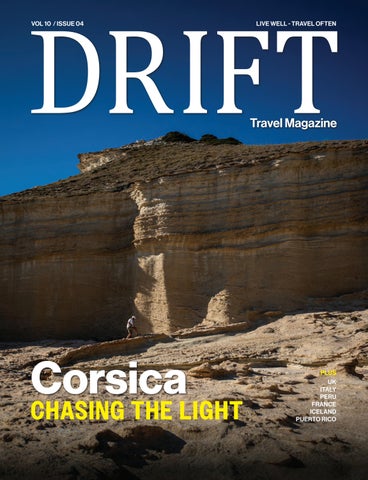
VOL 10 / ISSUE 04
LIVE WELL - TRAVEL OFTEN
Travel Magazine
Corsica
CHASING THE LIGHT
PLUS UK ITALY PERU FRANCE ICELAND PUERTO RICO
KEEP A SHOVEL AND BUCKET OF WATER NEARBY TO EXTINGUISH YOUR CAMPFIRE SMOKEYBEAR.COM
/02
VOL 10 / ISSUE 04
CONTENTS SCOTLAND
12
ENGLAND
18
Alice Read
Steve Drake
Hidden within Edinburgh Castle, St Margaret’s Chapel reveals a remarkable story of faith, royal legacy, and survival. Discover how the city’s oldest building has endured nine centuries of conflict while remaining a sanctuary of peace.
Wander through Oxford’s dreaming spires, historic colleges and lively Covered Market before venturing to magnificent Blenheim Palace. This journey reveals two captivating sides of England, shaped by scholarship, architectural grandeur and remarkable royal history.
FRANCE
PHOTOGRAPHIC JOURNEY
26
34
Sergi Reboredo
Adriana Gutierrez
Cruise the Canal du Midi at an unhurried pace, navigating historic locks and discovering medieval villages, colorful markets, local flavors and vineyard landscapes on a self-drive boating adventure through the enchanting heart of southern France.
Corsica unfolds in passages of light, weathered stone, rugged mountains and Mediterranean villages, capturing fleeting human moments, shadowed alleyways and the island’s contemplative beauty from Bonifacio to SaintFlorent and beyond.
ICELAND
52
PERU
60
Matthew Schueller
Andrew Marshall
Experience Reykjavík through midnight sunlight, rainbow-painted streets, irresistible cinnamon rolls and welcoming queer culture—a colorful capital where travelers can wander freely, laugh loudly and feel free to be themselves.
Follow a grueling 21-day expedition across Peru’s remote Vilcabamba range, where ancient Inca roads, high mountain passes and jungle-shrouded ruins lead adventurers toward the legendary lost city of Espiritu Pampa.
PUERTO RICO
COLUMNS
62
Nick Mcclelland Tee off on four of Puerto Rico’s finest courses, then discover luxurious resorts, vibrant Boricua flavors, rainforest adventures and Caribbean beaches in this irresistible guide to a tropical golf escape.
TRAVEL GEAR SPOTLIGHT
6 10
EXTRAORDINARY BRANDS DESERVE REMARKABLE PHOTOGRAPHS Bespoke Professional Photography for Hotels, Resorts & Luxury Brands
Clients Worldwide: TRAVEL + TOURISM Fairmont Hotels & Resorts | Four Seasons Hotels & Resorts | Ritz Carlton Hotels | Accor Hotels | Melia Hotels Ovolo Hotels | Sunwing Travel | Tourism Barbados | Tourism Grand Cayman LUXURY BRANDS Helly Hanson | Lincoln Luxury Vehicles Bugatti | Swissgear | Lole | Ford Motors | Samsung | Tiffany & Co.
Available worldwide. Request our photoshoot destination calendar: email: portfolio@glossy.media web portfolio: glossy.media
MASTHEAD PUBLISHER
CREATIVE DIRECTOR
CONTRIBUTORS
Glossy Media
Steve Drake
© All rights reserved. No part may be copied or reproduced without permission.
editor@DRIFTtravel.com
Steve Drake, Itamar Ginsburg, Adriana Gutierrez, Andrew Marshall, Nick Mcclelland, Alice Read, Sergi Reboredo, Matthew Schueller
Advertising Inquiries sales@DRIFTtravel.com
© COPYRIGHT DRIFT TRAVEL MAGAZINE/GLOSSY MEDIA 2015-2026
/06 COLUMBIA DIAMOND PEAK PRO SHORT SLEEVE SHIRT columbiasportswear.ca Whether you’re exploring a new city or hiking a mountain trail, the Columbia Diamond Peak Pro Short Sleeve Shirt is built to keep you cool and comfortable. Featuring advanced moisture-wicking technology, fast-drying fabric, and strategic ventilation, it’s designed for active travel in warm climates. Lightweight, breathable, and available in men’s and women’s styles, it’s a versatile essential for every adventure.
CONAIR SMOOTH SHAVE HEAD SHAVER conaircanada.ca
DRIFT TRAVEL
6
Looking sharp on the road has never been easier. The Conair Smooth Shave Head Shaver delivers a fast, comfortable shave with a flexible multi-directional shaving head that contours to your scalp for consistent results. Cordless, rechargeable, and compact enough for any carry-on, it’s ideal for business trips, weekend escapes, or extended adventures where packing light still means looking your best.
TRAVEL GEAR TERNX CARRY-ON LUGGAGE STROLLER ternx.com Family travel just became a lot less complicated. The TernX Carry On transforms from a stylish carry-on suitcase into a fully certified travel stroller in seconds, eliminating the need to juggle separate gear through busy airports. Designed to fit in most overhead bins, it offers 18 litres of luggage space, a reclining seat, UPF 50+ canopy, and smooth maneuverability. It’s an innovative all-inone solution that makes flying with young children easier, lighter, and far less stressful.
TITAN BY ARCTIC ZONE COOLERS arcticzone.com Whether you’re packing for a weekend campsite, a crosscountry road trip, or a day at the beach, the Arctic Zone cooler collection has a solution for every adventure. From lightweight backpack coolers and innovative zipperless soft coolers to rugged roto-molded models built for extended outings, the lineup is designed to keep food and drinks colder for longer. Practical features like easy-access lids, leak-resistant construction, wheeled options, and durable insulation make these coolers dependable companions wherever the journey leads. Whether you’re chasing mountain trails, lakeside sunsets, or family picnics, Arctic Zone combines thoughtful design with reliable performance for every outdoor escape.
FREET FOOTWEAR TANGA 3 freetbarefoot.com Natural movement meets everyday versatility with the Freet Tanga 3 barefoot shoe. Designed for travel, walking, and active lifestyles, it features a breathable CoffeeYarn® knit upper made from recycled coffee grounds, a wide toe box, zero-drop sole, and flexible UrbanGrip outsole for all-day comfort. Lightweight, quick-drying, and packable, it’s an ideal companion for city breaks, sightseeing, and life on the move.
NOCS PROVISIONS MONOCULAR nocsprovisions.ca
DRIFT TRAVEL
8
Tiny enough to slip into a jacket pocket yet powerful enough to bring distant details into sharp focus, the Nocs Provisions Zero Tube 8x25 Monocular is made for curious travelers. Weighing just 205 grams, it features fully multicoated optics, an IPX7 waterproof and fog-proof design, plus a rugged, no-slip housing built for life outdoors. Whether you’re spotting wildlife, scanning mountain vistas, or taking in architectural details, this ultra-compact monocular is an ideal companion for hiking, road trips, cruises, and sightseeing adventures.
TRAVEL GEAR PLANEAIRE’S TRAVEL ESSENTIALS planeaire.com Clean cabins, tray tables, and hands with one compact kit. The PlaneAire Travel Essentials Kit includes a plant-based Surface & Air Mist, individually wrapped cleaning wipes, moisturizing hand sanitizer, and a reusable travel pouch—all in TSA-friendly sizes. Made with naturally derived ingredients and lab-tested for peace of mind, it’s an easy way to stay fresh and hygienic from departure gate to destination.
TESSAN AERO 70: SMART TRAVEL ADAPTER tessan.com One compact device can replace an entire bag of charging accessories. The TESSAN AERO 70 Smart Travel Adapter combines universal plug compatibility with 70W GaN fast charging, powering up to five devices simultaneously. A built-in smart display provides real-time charging information, while its ultra-slim design slips easily into any carry-on. Designed for modern international travelers, it’s a smarter way to stay powered anywhere in the world.
SPOTLIGHT HOTEL CALIMALA MILAN CONTEMPORARY DESIGN, ROOFTOP ENERGY, AND THE SPIRIT OF PORTA VENEZIA Set within Milan’s vibrant Porta Venezia district, Hotel Calimala Milan offers a refreshing interpretation of contemporary Italian hospitality. Housed in the former Jannelli & Volpi showroom—a landmark of Italian design—the boutique hotel celebrates Milan’s creative spirit through striking architecture, curated art, and an unmistakable sense of style. Every detail reflects the vision of acclaimed architect Alex Meitlis, creating a hotel that feels as much like a design destination as it does a luxury retreat. While many visitors come to Milan for fashion, design, and culture, Hotel Calimala invites guests to experience the city like a local. Located just beyond the busiest tourist routes, the hotel is surrounded by treelined streets, independent boutiques, stylish cafés, contemporary galleries, and some of Milan’s liveliest aperitivo spots. Porta Venezia is one of the city’s most dynamic neighborhoods—creative, cosmopolitan, and effortlessly authentic—making it an ideal base for exploring Milan beyond the Duomo.
/10 ITALY
Rather than simply decorating rooms, Hotel Calimala was conceived as a complete design project. Nearly every element—from the custom furnishings and lighting to the artwork and architectural finishes—was created specifically for the property. Rich walnut wood, oversized black terrazzo floors crafted from locally sourced materials, expansive windows, and carefully selected bursts of color create interiors that feel sophisticated without sacrificing warmth.
Rooftop Views Above the City Above the bustling streets, Hotel Calimala reveals one of its most memorable features: a rooftop terrace with one of the few rooftop swimming pools in Milan. Framed by city rooftops and open skies, the terrace offers a peaceful escape from the energy below. Whether starting the morning with coffee, taking an afternoon swim after exploring the city, or settling in for cocktails as the skyline begins to glow at sunset, the rooftop delivers a distinctly Milanese blend of style and relaxation.
Dining at the Heart of the Neighborhood Hotel Calimala embraces the lively spirit of Porta Venezia through its inviting dining venues. The street-facing Espresso Bar creates a welcoming connection between the hotel and the neighborhood. On the rooftop, FIVE has quickly established itself as one of Milan’s exciting dining destinations. Contemporary Italian cuisine built around seasonal ingredients, shareable plates, handcrafted cocktails, and panoramic city views create an atmosphere that evolves naturally from relaxed lunches to golden-hour aperitivo and vibrant evening dinners. Together with The Salon, an intimate lounge for pre-dinner drinks and conversation, the rooftop has become a gathering place for both travelers and locals.
Discover Milan Beyond the Landmarks One of Hotel Calimala’s greatest strengths is its location in Porta Venezia, one of Milan’s most vibrant and character-filled neighborhoods. Elegant Libertystyle architecture, independent fashion boutiques, art galleries, cafés, cocktail bars, and leafy boulevards create an atmosphere that feels authentically local. Guests can easily visit Milan’s celebrated landmarks—including the Duomo, Teatro alla Scala, and the Quadrilatero della Moda—before returning to Porta Venezia’s relaxed pace for an evening aperitivo or rooftop dinner, experiencing a side of Milan that many visitors never discover. calimalamilano.com
DRIFT TRAVEL
A Boutique Hotel Designed Around Milan
11
SCOTLAND BY ALICE READ
ST MARGARET’S CHAPEL THE SOUL OF EDINBURGH CASTLE
/12
Hidden amid the cannons and ramparts of Edinburgh Castle lies a tiny sanctuary with a mighty story. St Margaret’s Chapel, built in the early 1100s and dedicated to a beloved Scottish queen turned saint, is the oldest surviving building in the city. Modest in size but rich in history, this Romanesque gem has weathered centuries
of sieges, reformations, and royal intrigue. Step inside its thick stone walls and you’ll find a peaceful refuge where faith, resilience, and the echoes of medieval Scotland still linger — a must-see stop on any visit to Edinburgh’s iconic fortress.
A Queen’s Legacy
DRIFT TRAVEL
Edinburgh Castle dominates the skyline of Scotland’s capital, a fortress of stone that has witnessed centuries of power struggles, royal pageantry, and national upheaval. Within its mighty walls, amid the barracks, cannons, and ceremonial halls, stands a much smaller and quieter treasure: St Margaret’s Chapel. Tucked away at the highest point of Castle Rock, it is the oldest surviving building in Edinburgh and a poignant reminder that even in places built for war, there is space for peace, prayer, and remembrance.
The chapel bears the name of Queen Margaret of Scotland, later canonized as St Margaret. Born around 1045 into the English royal family, she fled to Scotland after the Norman Conquest and married King Malcolm III in 1070. By all accounts, Margaret was a deeply pious woman who used her influence to promote religious reform, education, and charitable works. She fed the poor at her own table, founded hospices, and sought to bring the Scottish church closer in practice to the wider traditions of Western Christendom.
13
When Margaret died in 1093, grief quickly transformed into veneration. Her reputation for holiness spread, and in 1250 she was declared a saint by Pope Innocent IV. Her legacy shaped not only Scotland’s spiritual life but also the cultural identity of Edinburgh itself. Although St Margaret likely worshiped in a chapel on Castle Rock, the current building was probably constructed in her honor by her son, King David I, in the early 12th century.
The Smallest Treasure Architecturally, St Margaret’s Chapel is simple, even austere. The stone building measures only about 16 feet by 11 feet, with thick Romanesque walls, a round-arched doorway, and small chevron-decorated windows. Its size and form are in stark contrast to the grand cathedrals of medieval Europe, yet its intimacy gives it a unique power. Here, in a chamber that can hold only a handful of worshipers, one feels the immediacy of faith and the humility of devotion. The chapel was built in the Romanesque style typical of the early 12th century, with semicircular arches and small proportions. Though modest, it is remarkably well preserved, surviving even as much of the castle around it was reshaped,
rebuilt, or destroyed during sieges. Inside, the space is adorned today with beautiful stained glass windows designed in the 1920s by Douglas Strachan, Scotland’s leading stainedglass artist. These depict St Margaret, St Andrew, St Columba, and William Wallace, connecting the chapel to Scotland’s broader spiritual and national story. Survival Through the Centuries That St Margaret’s Chapel still stands is little short of miraculous. Edinburgh Castle has endured wave after wave of conflict, from medieval sieges to the Wars of Independence, from the Jacobite risings to its long service as a military garrison. During the Reformation in the 16th
century, when many Catholic shrines and chapels were demolished or desecrated, St Margaret’s Chapel escaped destruction, though it fell into disuse. For centuries it was repurposed as a gunpowder store, its sacred origins forgotten by many. It was not until the mid-19th century that its significance was rediscovered. In 1853, the chapel was restored under the guidance of the architect Hippolyte Blanc and rededicated for Christian worship. The Scottish antiquarian and public were increasingly interested in preserving national monuments at this time, and St Margaret’s Chapel became a symbol of continuity, linking Scotland’s medieval past to its modern identity.
Symbolism and Reflection
Today, the chapel remains an active place of worship within the bustling environment of Edinburgh Castle. It is maintained by the St Margaret’s Chapel Guild, an organization of women named Margaret who help care for the building and its furnishings. Baptisms and weddings are still held here, offering moments of joy and spirituality within a fortress better known for its cannons and Crown Jewels. Visitors are often struck by the contrast: outside, the parade grounds may echo with the boom of the One O’Clock Gun, but step inside the chapel and one finds an atmosphere of stillness and reverence.
St Margaret’s Chapel holds a special place not just in the castle but in Scotland’s wider story. It represents resilience—the survival of a small sacred building through centuries of turmoil. It also embodies the enduring influence of one woman’s faith and compassion. For Scots and visitors alike, it is a reminder that national identity is shaped not only by warriors and kings but also by saints and reformers. The chapel also prompts reflection on the role of spirituality in public life. While castles symbolize power, defense, and authority, the presence
of a humble chapel at the summit of Edinburgh Castle suggests that rulers once acknowledged their dependence on something greater than themselves. The juxtaposition of military might and religious devotion captures a profound truth about human societies: that even in places designed for conquest, there is a yearning for meaning, hope, and peace.
DRIFT TRAVEL
A Living Place of Worship
15
Visiting Today For the millions of people who pass through Edinburgh Castle each year, St Margaret’s Chapel is often a surprise. After the grandeur of the Great Hall, the solemnity of the Crown Room, and the spectacle of Mons Meg, this tiny sanctuary offers something very different. Its thick stone walls and narrow windows seem to cocoon visitors from the noise outside. Many linger longer than expected, moved by its simplicity. As the oldest building in Edinburgh, St Margaret’s Chapel is a jewel of Scotland’s heritage. More than nine centuries after its construction, it continues to invite reflection on faith, resilience, and the enduring power of compassion. Within the mighty fortress that has seen kings crowned, armies clash, and history unfold, this small Romanesque chapel endures as a quiet, enduring heart.
DRIFT TRAVEL 17
Historic Highlights Oldest Building in Edinburgh Built in the early 12th century by King David I, St Margaret’s Chapel is the oldest surviving structure in the city — predating much of the castle and standing for more than 900 years.
A Saint’s Influence St Margaret was canonized in 1250 for her charitable works and devotion. She fed the poor from the royal table, founded churches and hospices, and shaped the spiritual direction of medieval Scotland.
A Modern-Day Sanctuary Despite its size — it can hold only about 20 people — the chapel is still used for weddings, baptisms, and services today, offering an intimate spiritual space in the heart of a historic fortress.
OXFORD /18
A JOURNEY THROUGH ENGLAND’S LIVING HISTORY BY STEVE DRAKE
Oxford is a city that seems instantly familiar, even on a first visit. Its honeycolored buildings, narrow lanes and soaring spires have appeared in countless films, television programs and photographs. Yet walking through the city reveals something that images cannot fully capture: Oxford is not simply a collection of historic landmarks. It is a living university city, where centuries-old traditions unfold alongside busy cafés, bicycles, bookshops and students hurrying between lectures. It is also wonderfully compact. Much of central Oxford can be explored on foot, allowing the city’s character to emerge gradually. A passageway might lead into a peaceful college quadrangle, while an unassuming corner can reveal an elaborate Gothic façade or a view of another spire rising above the rooftops. Oxford rewards anyone willing to slow down, look through open gateways and occasionally wander without a firm destination.
The University of Oxford is not contained within a single campus. Its colleges, libraries and academic buildings are woven through the heart of the city, making Oxford itself feel like an extension of the university. There are dozens of constituent colleges, each with its own architecture, traditions and personality. Some sit behind grand entrances on prominent streets, while others are concealed down narrow lanes. Walking between them, I began to understand that Oxford’s appeal comes not from one defining monument but from the concentration of extraordinary buildings within such a small area. The university’s origins can be traced to teaching in Oxford as early as the 11th century, giving the city an almost unparalleled sense of academic continuity. Generations of scholars, writers, politicians and scientists have passed through these streets. That history is present everywhere, but Oxford never feels preserved in amber. Students still gather in the quadrangles, bicycles line the railings, and conversations spill out of cafés and pubs. While some colleges welcome visitors, access and opening hours can change according to university schedules, examinations and private events. That unpredictability is part of visiting a working institution rather than a conventional attraction. Even when a particular college is closed, however, there is no shortage of architectural detail to admire from the surrounding streets. I found that the best way to experience Oxford was to combine a few planned visits with plenty of unstructured walking. Broad Street, High Street and Radcliffe Square provide some of the city’s most memorable views, but the quieter lanes in between often create the strongest impression. Every turn seems to offer another carved doorway, hidden courtyard or weathered wall.
DRIFT TRAVEL
Among Oxford’s Dreaming Spires
19
Of all Oxford’s colleges, Christ Church may be the most immediately recognizable. Founded in the 16th century, it is both an Oxford college and the home of Christ Church Cathedral—an unusual combination that gives it a particularly important place in the city’s story. The approach alone is impressive. Tom Tower, designed by Sir Christopher Wren, rises above the entrance and creates one of Oxford’s defining silhouettes. Passing beneath it feels like entering a self-contained world of lawns, quadrangles, stone cloisters and grand interiors. Christ Church’s connections extend far beyond academia. Thirteen British prime ministers studied here, while mathematician and author Charles Dodgson—better known by his pen name, Lewis Carroll—taught at the college. His relationship with the family of the college dean helped inspire Alice’s Adventures in Wonderland, adding another layer to Christ Church’s literary legacy. More recently, the college became closely associated with the Harry Potter films. Parts of Christ Church were used as filming locations, while its Great Hall helped inspire the appearance of Hogwarts’ dining hall. The connection is easy to understand: the long tables, portraits, high ceiling and ceremonial atmosphere seem ready-made for a fantasy world. Yet Christ Church is far more than a film location. Walking through the college, I was struck by the way its spaces still serve their original purposes. Students dine in the Great Hall, worship continues in the cathedral, and academic life carries on within buildings visited by travelers from around the world. That sense of continuity makes the experience more meaningful than simply checking off a famous sight. The cathedral is especially atmospheric. Although relatively
intimate in scale, it is filled with remarkable architectural detail and centuries of history. After the grandeur of the quadrangles and hall, its quieter atmosphere offers an opportunity to pause before returning to the energy of central Oxford.
Oxford’s Covered Market For a different side of the city, I made my way to the Oxford Covered Market. First opened in 1774, the market remains one of the best places to experience Oxford beyond its university landmarks. Inside, historic passageways are lined with independent food vendors, cafés, specialty shops, florists and boutiques. The surroundings are full of character, but the market does not feel like a museum. Locals stop for coffee, workers pick up lunch, and visitors browse displays of baked goods, cheeses, flowers and handcrafted products. After the formality of Oxford’s colleges, the market feels relaxed and sociable. It is an easy place to linger, particularly when the English weather becomes less cooperative. It also offers a welcome reminder that Oxford has always been more than an academic center—it is a working city with its own commercial and culinary traditions.
Where to Eat in Oxford The Covered Market is a natural choice for a casual breakfast or lunch. Its independent vendors make it possible to choose from pastries, sandwiches, international dishes, coffee and sweet treats without committing to a lengthy meal. It is particularly convenient when sightseeing, as the market is only a short walk from many of Oxford’s major landmarks. For a more leisurely meal, Oxford offers everything from historic pubs to polished contemporary restaurants. Quod, on High Street, is centrally located and well suited to lunch, dinner or cocktails, while The
DRIFT TRAVEL
Inside Christ Church
21
Folly provides a more tranquil setting beside the River Thames. Traditional pubs tucked along the city’s lanes offer another distinctly Oxford experience. Wherever you choose, reservations are advisable for dinner, particularly on weekends or during university events.
A Day Trip to Blenheim Palace Oxford provides more than enough to fill several days, but one of the region’s most rewarding excursions lies just beyond the city. Blenheim Palace, located beside the town of Woodstock, is close enough for a day trip but expansive enough to feel like an entirely separate destination. The change of scale is immediately apparent. After Oxford’s compact streets and enclosed college quadrangles, Blenheim opens onto a sweeping landscape of lawns, gardens and parkland. The palace stands at the center of the estate with the confidence of a building designed to impress approaching visitors. Blenheim Palace was created for John Churchill, the first Duke of Marlborough, following his victory at the Battle of Blenheim in 1704. Presented by Queen Anne on behalf of a grateful nation, the estate became both a family residence and a monumental expression of military achievement. Today, it remains home to the Dukes of Marlborough and is recognized as a UNESCO World Heritage Site. The palace is grand even by the standards of England’s great country houses. Its monumental Baroque architecture, formal courtyards and richly decorated interiors communicate power and ceremony at every turn. Yet Blenheim’s long family history prevents it from feeling entirely impersonal. Portraits, furnishings and personal objects connect its vast rooms to the generations who have lived here.
The State Rooms form the ceremonial heart of the palace. Moving through them is like walking through an illustrated account of British aristocratic life, with each space revealing another combination of tapestries, paintings, gilded details and ornate furniture. The Great Hall establishes the tone immediately. Its height and decoration make a theatrical first impression, preparing visitors for the sequence of increasingly elaborate rooms that follows. From there, the route passes through spaces designed not merely for daily life but for receiving important guests and demonstrating the standing of the Marlborough family. Among the most impressive interiors is the Saloon, still used as the palace’s formal dining room. Its painted walls and ceiling create an enveloping setting in which nearly every surface contributes to the overall spectacle. The room captures the confidence of the palace’s Baroque design while also making it possible to imagine the formal dinners and celebrations held here. The Long Library offers a different kind of grandeur. Originally conceived as a picture gallery, it extends through an elegant, lightfilled space lined with books and family portraits. After the intensity of some of the more ornate State Rooms, the library feels comparatively serene. What stayed with me was not simply the scale or value of the collection, but the cumulative effect of the rooms. Blenheim was designed to tell a story—about victory, influence, lineage and national importance— and its interiors continue to communicate that story more than three centuries later.
DRIFT TRAVEL
Exploring the State Rooms
23
The Churchill Connection Blenheim Palace is also inseparable from the life of Sir Winston Churchill. Although he never inherited the estate, Churchill was born here on November 30, 1874, after his mother arrived unexpectedly early while visiting the palace. The Churchill exhibition explores his life through historic artifacts, photographs, and interactive displays. It adds a more personal dimension to a figure often encountered primarily through wartime speeches and political history. Here, visitors learn about his childhood, family relationships, military experiences, writing and painting, as well as the political career that would define his public legacy. Seeing the room where Churchill was born places that history within an unexpectedly intimate setting. The surrounding palace may be monumental, but his arrival there was a family event rather than a moment of national ceremony. Churchill also retained a lifelong connection with Blenheim. It was on the estate that he proposed to Clementine Hozier in 1908, beginning a marriage that would endure through political triumphs, electoral defeats and two world wars. These personal details give the exhibition warmth and help balance the enormous scale of Churchill’s public reputation.
DRIFT TRAVEL 25
Two Sides of English History Oxford and Blenheim Palace complement one another beautifully. Oxford’s history is concentrated in cloisters, libraries and busy streets shaped by centuries of scholarship. Blenheim expresses history on a grander scale, through monumental architecture, aristocratic ceremony and the legacy of one of Britain’s most influential political figures. Together, they create a journey through two distinct but interconnected sides of England. One is a city built around ideas; the other is a palace built to commemorate power and victory. Both remain living places rather than static monuments. By the time I returned from Blenheim, Oxford’s towers and narrow streets felt almost intimate. The dreaming spires had welcomed me into a city where history accompanies everyday life—and where even the grandest stories reveal themselves one doorway, courtyard and cup of tea at a time.
/26
FRANCE
CRUISING THE CANAL DU MIDI BY SERGI REBOREDO
After a brief introduction to the basics of boating, we boarded our 13-meter motorboat, the ‘Horizon 4 Plus,’ from Le Boat’s base on the outskirts of Homps. With a capacity of up to 9 people, this vessel offers plenty of space for families or groups of friends who want to enjoy a holiday on the water. Equipped with all the necessary amenities for an unforgettable experience, it features a fully equipped kitchen—including refrigerator, stovetop, sink, microwave, and oven—allowing for the preparation of delicious meals on board. The spacious salon includes a dining area and comfortable sofas to relax after a day of exploration. The four double cabins, each with its own private bathroom, ensure privacy and comfort for all passengers. The boat also has air conditioning and heating, maintaining a pleasant temperature year-
round. Bow and stern thrusters make docking and navigating locks much easier. Support bicycles are included, perfect for stopping and exploring along the way. The weekly rental price during peak season is around €7,000.
The Canal du Midi The Canal du Midi stretches 241 km from Toulouse to the coastal city of Sète. In 1666, Louis XIV approved the construction of this impressive waterway. Later, in the 19th century, the Canal de Garonne was built, running 193 km from Toulouse to Langon. Together, they form the Canal des Deux Mers, connecting the Mediterranean Sea with the Atlantic Ocean. Originally, the canal was a vital transport route for coal, stone, timber, and other industrial goods, but its commercial
The canal has been a UNESCO World Heritage Site since 1996. Many sections are lined with enormous plane trees providing shade. It is not very deep, with an average depth of only 2 meters and a width of 20 meters. It has 91 locks, 6 dams, and 126 bridges. Near Fonséranes, the famous eight consecutive locks in a staircase formation allow the
DRIFT TRAVEL
importance declined after the arrival of railways in the mid-19th century. Today, it has been transformed into a tourist destination, frequented by leisure boats, some even historic vessels carefully restored by their owners. Moving at a maximum speed of 8 km/h, travelers can enjoy life at a slower pace, with the scenic landscapes of southern France unfolding like a photographic slideshow: idyllic villages, riverside markets, lavender fields, sunflowers, and poppies. The canal is perfect for lovers of slow travel, gourmet food, and the good life.
27
canal to drop 21.5 meters in just 312 meters. At its southern end in Agde, a unique circular lock allows boats to turn and choose between three routes: one toward Toulouse, another toward Agde and the sea, and a third toward the Thau Lagoon.
Argens-Minervois. The planned route takes us to Fonséranes in Béziers to visit the impressive series of 9 staircase locks, then turn around and pass through Homps again to refill water before continuing to Carcassonne, where we turn back to return to the starting point. In total, we pass through 54 locks and cover approximately 175 kilometers during the week of navigation. The first locks serve as practice, and the staff in charge of opening and closing the gates are usually friendly and willing
to help. With care and a slow pace, there are rarely any problems. Typically, a traffic light indicates whether you can enter the lock, though sometimes the operator signals by hand. Lock operation hours vary by season: 09:00–12:30 and 13:30– 17:00 (January to March and November to December), 17:30 (October), 18:00 (April and September), 18:30 (May), and 19:00 (June to August). Many of these locks sell ice cream, soft drinks, local crafts, and even ice cubes—perfect for evening gin and tonics. As evening falls, before reaching ArgensMinervois, we encounter a closed lock, so we decide to spend the night moored along the towpath. It is possible to stop anywhere along the canal where it is not expressly prohibited and does not obstruct navigation. Mooring is often available along the banks, or you can use the stakes provided on the boat to secure it. Another option is to stop at ports and
from classic novels to regional travel guides. Book lovers will find a paradise among its shelves, filled with stories waiting to be discovered.
Le somail.
And we cannot forget the Péniche Épicerie, a floating shop located on an old barge along the canal. Here, travelers can stock up on fresh produce, local cheeses, regional wines, and other gourmet products while enjoying the unique experience of shopping in such a charming setting.
The next day, we arrive at Le Somail, a picturesque village that charms visitors with its peaceful, welcoming atmosphere. Here, time seems to stand still. The bars and cafés lining the cobblestone streets along the canal are perfect places to relax and soak in everyday French life. In the afternoon, locals and tourists gather to enjoy a coffee or a glass of wine while watching boats pass by on the canal. Le Somail’s bookstore is another hidden treasure not to be missed. Housed in a former wine cellar, this independent bookstore offers a wide selection of new and used books in various languages,
The Nine Locks of Fonséranes and Béziers Late in the afternoon, we arrived at the first of the nine Fonséranes Locks, where we stopped to spend the night and visit both the locks and the nearby town of Béziers.
DRIFT TRAVEL
use the available services such as water and electricity, though in that case a mooring fee applies.
29
These nine locks are a historic landmark that attracts visitors from all over the world. Built in the 17th century by the visionary Pierre-Paul Riquet, the locks allow boats to overcome a height difference of more than 21.5 meters over a canal stretch of about 300 meters. The lock system is a masterpiece of hydraulic engineering, composed of nine interconnected locks forming an impressive water staircase. Just a stone’s throw from the locks is Béziers, a charming city that becomes magical at sunset, especially from the banks of the Orb River. With its picturesque riverside landscape and imposing cathedral, this time of day offers an unforgettable spectacle. From the riverbank near the bridge, there is a privileged viewpoint to admire the city’s silhouette, with its historic buildings and ancient walls standing out against the warm, soft hues of the sky. The
Saint-Nazaire Cathedral, a 13th-century architectural gem, rises majestically above the city, providing a stunning backdrop for the last rays of the setting sun. Its tall towers and intricate Gothic façade gradually illuminate as the sun dips, creating a truly evocative scene.
From Béziers to Carcassonne The next day, after a hearty breakfast, we reversed course to return to Homps and continue to Carcassonne. Passing through the Malpas Tunnel near Colombiers is particularly remarkable. This engineering feat, created by Paul Riquet, stands as a symbol of his perseverance at the foot of Ensérune Hill. Riquet excavated a river tunnel through soft rock with impressive dimensions:
L’Aiguille lock in Puichéric, the most unusual lock on the Canal du Midi, where a touch of humor greets arriving sailors. Here, wooden sculptures and other small figures—often crafted from reclaimed or discarded objects—occupy the adjacent garden, the creative handiwork of Joel, the artistic lock keeper.
Poilhes is a lovely spot to moor the boat and explore the town. If it’s Thursday, Saturday, or Sunday, however, it’s better to continue to Capestang and stroll through the market. Here, you can stock up on local products such as cheese, bread, and fine wine, as well as handicrafts, and enjoy a meal at one of its charming restaurants.
Near Trèbes, a group of kayaks passes by, reminding us that there are countless ways to enjoy the canal, though most people favor boats or bicycles. A parallel unpaved path runs the length of the canal, which is mostly flat, making it ideal for family cycling excursions.
Occasionally, huge barges pass by, some even serving as venues for wedding celebrations, and everyone waves as they go by. Gradually, at a speed rarely exceeding 8 km/h, we reached the
Carcassonne, the Largest Citadel in Europe On the fourth day of navigation, Carcassonne comes into view, perched atop a hill overlooking the Aude River,
DRIFT TRAVEL
173 meters long, 8.5 meters high, and 6 meters wide, all to avoid a long detour in the canal. While the 6-meter width was considered sufficient at the time, today it presents a challenge for less experienced navigators, especially those piloting wide vessels like ours, with a beam of nearly 5 meters.
31
with breathtaking views of the Lauragais valley and the lush vineyards of Minervois. Its medieval citadel, protected by double walls stretching three kilometers and interspersed with 52 towers, is the largest fortified citadel in Europe, with every stone bearing silent witness to its romantic past. With 2,500 years of history, it has been a UNESCO World Heritage Site since 1997. It is also the bestpreserved medieval city in the world, with access restricted solely to pedestrians. In the 4th century, the first castle and walled enclosure were constructed, of which numerous vestiges still remain. Later, the Visigoths, Saracens, and Arabs were brief occupants of this fortified area, until the feudal era, when the illustrious Trencavel family shaped the current castle along with the Church of Saint-Nazaire.
The Narbonne Gate serves as the main entrance to the citadel, which still houses 50 residents. It is protected by a drawbridge, a moat, and two enormous twin towers, each 30 meters tall, and its function was to safeguard the eastern access to the city. Nearby stands the sandstone sculpture of Lady Carcas, a legendary heroine whose story is said to give Carcassonne its name. On the western side of the fortress is the iconic Aude Gate, offering an impressive view of the river and modern Carcassonne. It is particularly well preserved and retains its distinctly medieval appearance. This fairy-tale fortress has served as the backdrop for iconic films such as Robin Hood: Prince of Thieves starring Kevin Costner, The Musketeer directed by Peter Hyams, and Les Visiteurs, featuring the knight Jean Reno and his servant Christian Clavier.
We then set course back toward the port of Homps, our final destination. A couple of days remain, with some interesting stops along the way, such as the Pont le Rode, the charming Moulins de Trèbes lock, or the triple lock of Fontfile surrounded by vineyards. However, the most magical and captivating sight is the sunset through the trees near the Marseillette lock—the perfect finale to this wonderful journey.
DRIFT TRAVEL
Return to Homps.
33
ADRIANA GUTIE
A PHOTOGRAPHIC JOURNEY
TRAVEL PHOTOGRAPHER DRAWN TO QUIET, REFLECTIVE MOMENTS SHAPED BY LIGHT AND SPACE. HER IMAGES EMPHASIZE ATMOSPHERE, RESTRAINT, AND SUBTLE HUMAN PRESENCE, EXPLORING THEMES OF SOLITUDE, MEMORY, AND TRANSIENCE. WEBSITE: adrianagutierrez.work
ERREZ
/35 CORSICA
A dark, narrow alley opening onto warm light in Bastia.
DRIFT TRAVEL 37
A narrow passage in the old town of Bonifacio, where late-afternoon light extends long shadows across the stone.
A curved fence along the harbor leading toward a lighthouse in Bastia.
39
DRIFT TRAVEL
Two figures move beneath limestone formations, revealing the texture and scale of the weathered landscape.
41
DRIFT TRAVEL
Late-afternoon light slips into a narrow alley in Corte’s old town, where a black cat quietly watches.
DRIFT TRAVEL 43
Visitors photograph the sunset along a narrow passage inside a coastal fort.
A lone figure stands at the edge of the village as low clouds settle over the hills in Speloncato.
45
DRIFT TRAVEL
A figure walks toward a sunlit archway between shadowed walls.
DRIFT TRAVEL 47
A narrow alley in the old town of Bonifacio, often filled with pedestrians, falls momentarily quiet in warm late-afternoon light.
Mountain ridge above forest and drifting clouds in Aiguilles de Bavella.
49
DRIFT TRAVEL
A passerby pauses along a windswept ridge near Bonifacio.
51
DRIFT TRAVEL
ICELAND /52
REYKJAVIK IS THE PERFECT GATEWAY TO ICELAND’S UNFORGETTABLE ADVENTURES BY MATTHEW SCHUELLER
There are places you visit and places that visit you back. Reykjavik is the second kind. It gets into your jacket, your lungs, your mind, or whatever part of you that might still be holding back, and it loosens it. By the time we left the city and headed out into the wild, rugged and incomprehensible landscape of greater Iceland, I felt more like myself than I had in months. I don’t know if that’s the air or the sunlight or the people or some combination of all three, but the city does wild things to a traveler on their first visit. This past July, I brought a small LGBTQ+ group to Iceland for a SideQuests Travel adventure, and like we do before almost every trip, we built in a few pre-tour days in the city for anyone who wanted to arrive early, shake off the jet lag and meet some of the group slowly, before the real action and adventure began. Reykjavik was where we landed first and where we found our footing. It’s a city where it’s easy to eat too many cinnamon rolls and stay out way too late in sunlight that has absolutely no business being that bright at 1 am. Then we left for the rest of Iceland,
for the epic waterfalls, glaciers, hot springs and the volcanoes you’ve most definitely heard and seen so much about. But Reykjavik held us first, and it left a lasting impression. I stayed at the Leif Erikson Hotel, which could not be more perfectly named for a city this proud of where it comes from. It sits right at the base of Hallgrímskirkja, the enormous Lutheran church that rises like a concrete spaceship above the city and is visible from basically everywhere, which is helpful when you’ve had a few Icelandic beers and are trying to remember which direction is home... The hotel is cozy, the location is unbeatable, and waking up to that view every morning never gets old. The city itself is surprisingly compact. You can walk almost everywhere in the central area,
We started our morning at Brauð & Co. This was a non-negotiable. They make a cinnamon roll the size of your face with icing that I’d describe as liquid gold. My husband and I promised we’d split one, but one quickly turned to two, to three, and then many excuses that we’re on vacation and carbs never hurt anyone anyway. From there, we walked to Rainbow Street, Skólavörðustígur. This is the main street that leads up to Hallgrímskirkja, and is fully painted in rainbow stripes down the center. It functions as this beautiful, casual declaration of who this city is and what it values. Take your photos, take 10 photos, get into other people’s photos and maybe make a friend! It’s also a pedestrian street, so a great area to mingle and linger. We made our way down to Bæjarins Beztu, the famous hot dog stand near the harbor that has been feeding Reykjavik since 1937. We ordered ours “with everything”. The toppings are a bit of a mystery you sort out while chewing. It’s the cheapest meal in the city and for that, it also feels like one of the most satisfying. The group was unanimous on this. From there, we wandered over to Austurvöllur, the central square, where it felt like the entire city had pulled up a chair outside with
DRIFT TRAVEL
and you absolutely should. Exploring the city over the course of a couple of days will get your step count well over 12,000. Reykjavik is a city that rewards those who wander slowly to soak up every part of it. Steam hisses up from street grates because underneath, there’s geothermal energy bubbling. The houses are painted in colors that you’d think should clash but in Reykjavik just look gorgeous together. And the light during summer does this thing where it never really quite goes dark… it just softens into this long golden haze around midnight that makes everything feel dreamy. Thus, as beautiful as it is, bringing an eye cover for sleeping in the summer is an absolute must!
53
a coffee or a beer and decided collectively that this was the afternoon’s only obligation. We came back to this square more than once over the course of our days in the city. Each time it had the energy of a neighborhood block party we hadn’t been invited to but were warmly welcomed at anyway. On one visit, we sat with cappuccinos looking very obviously like tourists while everyone around us drank beers with the ease of people who had nowhere else to be. We aspired to that energy, like maybe we’d be more relaxed if we’d just lie back and have a beer around noon instead of rushing around the city. We decided to give it another go on day two and see how we do. As they always say, do as the locals do! Now, The Icelandic Phallological Museum was on our list. I’m not going to bury anything about this recommendation. It is exactly what it sounds like and it is completely
One of the real highlights of our time in Reykjavik was the queer city walking tour with our friends at Pink Iceland, a local LGBTQ+ tourism group that hosts tours and events. They welcomed our group with cocktails at their office on Skólavörðustígur, up a staircase above a door with a pink triangle in the window, with gorgeous views across the city from their space. Then they walked us through central Reykjavik and told us the history of queer life here, and I want to be clear: this is not a polished, rehearsed tour. It’s gossip, personal stories, and legends of the local lore. Iceland’s entire population is only around 400,000 people, which means the queer community is small, tight-knit, and everybody knows everybody. And everybody knows everybody’s business! To understand the city from a local perspective, this tour was a must. Iceland decriminalized homosexuality way back in 1940. Their first Pride was in 1983, and you can feel the accumulation of all the history just walking around the town. It’s in the way people look at you… Or more accurately, the way they simply aren’t looking at you. There’s no performance of tolerance here and nobody’s making it an extra sharp point of needing to be welcoming. Being welcoming is just the baseline. I noticed that within a few hours of arriving and it stayed with me the entire trip. I’ve thought a lot about what it means to travel somewhere that doesn’t require you to make yourself smaller. If you’ve spent any part of your life scanning a room before
DRIFT TRAVEL
worth your time. We went as a group, which I highly recommend, because the experience of watching people’s faces cycle through confusion, recognition, and full-body laughter is its own attraction. The museum is educational, absurd, and genuinely hilarious. We left with novelty keychains and a lot of questions nobody was in a rush to answer. Even if you don’t have time to make it through the whole exam, a stop at the gift shop is worth the laugh.
55
reaching for your partner’s hand, you know exactly what I’m talking about. On our way to the harbor for lunch, our hands just found each other. It may sound like a small thing, but noticing something different like this because of the change in environment doesn’t feel that small at all. For lunch, we enjoyed Fish and Chips Vagninn. We ate outside, sitting in the sun with the harbor wind doing whatever it wanted to our hair and felt completely content. The fish and chips were hearty, but the ingredients felt fresh and clean– not overly battered or greasy; it was just right. A note on food while you’re in the city: of course, the hot dog is mandatory; we’ve covered that. But please also try the pickled herring. I know, I hear you, it can be quite a strong flavor, but I will defend this position indefinitely. Scandinavians have been putting pickled herring on small rye breads with various toppings for generations and they are absolutely correct to do so. Try it before you write it off, then try it again, and maybe a third time for good measure. Trying for the first time, it goes down well with schnapps! That evening, we strolled up to Húsmálsog Menningar, which is a bookstore that is also a bar that is also a live music venue. It has an identity crisis I have never related to more deeply in my life. Attracted by the sound of music as we walked by, we peered in and then made our way through the crowd at the door to find seats and drinks for ourselves. Books downstairs, drinks upstairs and live music somewhere in the middle. It’s the kind of place that exists in Reykjavik because Reykjavik simply allows that kind of place to exist, and the city is better for it. We stayed longer than we planned and we loved every minute of it. The next morning, for brunch, we decided to make Sandholt our ritual. We noticed the line out the door the day prior while walking by and, of course, needed to stop
Continuing down the street, we stopped into Litla Jólabúðin, the little Christmas shop. We mailed Santa a letter asking for blackout masks because we forgot ours and the midnight sun, as beautiful as it its genuinely incompatible with human sleep at 2 am. Pack yours. I’m not joking. For our quintessential night out, Kiki was our answer. Iceland’s most beloved gay bar, warm and unpretentious, welcoming and vibrant. That evening, we found a few seats and enjoyed drink after drink while watching a wild drag performance that had us keeling over in laughter. As soon as the show concluded, patrons shifted the tables out from the floor and it immediately transformed into a dance party. At Kiki, you’ll find lots of locals–it really felt like a central gathering space for the town. I started traveling largely because I wanted to see how others around the world lived and understand that life isn’t like what the small town I grew up in may think it’s all about. I wanted to find places where I felt at home knowing people like me can live freely and fully as themselves, and be accepted and loved for it. Reykjavik made this case better than I ever could. My younger self would have lost his mind standing on that rainbow street in the midnight sun with a group of people who just got it. And then we were off to see the rest of Iceland, which deserves its own
DRIFT TRAVEL
back to see what the hubbub was about. We found that the hubbub is about their sourdough. Fresh baked daily, the chewy, flaky, buttery crust is something you’ll want to take home with you. But not just that, the pastries are extraordinary and the butter comes by the brick and disappears quickly. The quality of food in Reykjavik is unmatched–you can simply taste how local and fresh everything is as soon as you take your first bite.
57
article. We stood between tectonic plates and walked behind waterfalls and swam in hot springs and trekked across glaciers and watched the sun hover at the horizon at midnight like it simply couldn’t bring itself to leave. The sights were staggering. But Reykjavik was where we became a group. Where the trip actually started. Where we exhaled. Give it more than a night. Let it be your base, your soft landing, your cinnamon rolls and queer chaos before greater Iceland swallows you whole. Because it will, and it should, and you’ll be so glad it did.
59
DRIFT TRAVEL
VILCABAMBA
/60 PERU
BEYOND MACHU PICCHU LIES TRUE ADVENTURE BY ANDREW MARSHALL “But you need four mules not three,” shouted Celestino, our red faced Peruvian trekking guide as he impatiently stamped his foot. “He´s trying to rip us off for an extra 100 pesos a day,” muttered Peter in English. Both men faced each other like two raging bulls – and it seemed like the three weeks of planning and provisioning to reach the last Inca city had reached a stalemate.
the compromise being that we would use one of the horses if the journey got too tough.
As the debate raged back and forth, trek provisions were stuffed in one sack then another as imaginary mules were loaded and unloaded. “Its too much for my animals,” growled Celestino. But finally an agreement was reached; three pack mules and two horses to ride, with
Combining the rarely visited ruin of Puncoyoc would make a ten day trek. Even more ambitious, a further eight days here and two days there, and we could also visit Choquequirao and cross the entire Cordillera. Thus, our 21-day expedition to the Vilcabamba was born.
Our original expedition idea was a five-day trek to the ruins of Espirtu Pampa, the last Inca holdout- a journey taking in the 3,650 meter Colpaccasa Pass and dropping down into the steamy rainforests of the eastern Andean slopes where the ruins were still hidden deep within jungle. But while studying the topographical maps in the Cusco office of the South American Explorer´s Club, grander ambitions took root.
Vilcabamba - the very name conjures up images of lost cities and paved Inca roads leading to unexplored worlds. In the 14th century when the Spanish conquistadors had conquered much of the Inca Empire, the last rebellious Inca king, Manco and his followers retreated to this remote region to stage a guerrilla war based in the last Inca city, Vilcabamba. For nearly 40 years the Incas raided and harassed the Spanish settlements until finally in 1572, the Spaniard Hurtado de Arbieto mounted a determined expedition to capture and kill the last remaining Inca king, Tupac Amaru, son of Manco. Hunted deep into the jungle, Tupac was captured, taken to Cusco and executed. His death spelt the end of the once far reaching and mighty Inca Empire. Over the centuries the exact location of the city of Vilcabamba was forgotten, historic records lost in the archives of Madrid. By the 19th century its very existence was under question, but in 1911 when American explorer Hiram Bingham discovered Machu Picchu, he proclaimed that his find was in fact the lost and fabled city of Vilcabamba. It wasn’t´until the 1960’s, when expeditions led by the explorer Gene Savoy came across the extensive ruins of Espiritu Pampa (actually discovered by Bingham but dismissed as unimportant) that the location of Vilcabamba was known. Shrouded in such intrigue, it became our ultimate goal. Day one was perfect. In the soft light of dawn we rode from the village of Cachora down the beautiful Apurimac Valley. Gradually the markings of settlements fell behind and the excitement of finally being on the move took hold. We had a 2000 meter descent to the banks of the Apurimak, one of the primary tributaries of the Amazon River. The track was amazing as it zig-zagged down near vertical slopes. Halfway down we passed a mule train coming from the archaeological site of Choquequirao where excavation and restoration was still underway led by the COPESCO archaeologist Percy Paz. It was exciting news to hear he was on site and we would meet him.
It was dark when we arrived at the ruins of Choquequirao and set up camp. Scrambling from our tents the next morning we were aghast at the scene that unfolded before us. We had inadvertently camped on one of the lower Inca terraces that spanned a narrow valley with magnificent stone walls each two meters high. Directly above us perched majestically on the spur of the mountain were former Inca homes and outbuildings. Choquequirao was thought by some historians to be the fabled lost city of Vilcabamba and also the site where the last Inca king Tupac Amaru may have been raised by priestesses. The fine ceremonial and high-status residential architecture attested that it had indeed been a place of great importance. We spent the entire next day exploring the complex. From Choquequirao we climbed up and into the wilderness that would take us across the range to the ruins of Citcos and Rosa Pata and the town of Huancacalle eight days away. This stretch sees very little traffic except the occasional Indian peasant on foot. It was a heady feeling of smugness to be so removed from well-worn touristy routes like the famous Inca Trail to Machu Pichu.
DRIFT TRAVEL
After a solid nights´rest on the river bank and an eventful morning start when Celestino discovered the headstrong mules had escaped and headed home, we faced the 1800 meter climb to the ruins high above. Our Spanish member of the team, John, was finding the searing heat and the monotony of the zig-zagging trail tough going but refused to mount a horse which slowed proceedings. I felt at home in the saddle and free to gaze out over glorious views across the deep canyon and surrounding ranges. Peter, our Belgium leader was adamant he´d do the whole thing on foot and carry his pack while his wife Anne, like me, would ride and walk.
63
Our days on the expedition were becoming structured. Celestino and his helper Albertino would rise at 4 am to search for the mules which would stray many kilometres during the night. Anne and I would prepare a breakfast of porridge over hot coals while John and Peter would pack up camp. Then we´d all set off, with fit and confident Peter striding ahead, then myself mounted on Estrella the most temperamental of the two horses, followed by Anne on her horse and John, Celestino, Albertino and the mules taking up the rear. The need to graze the animals meant the entire procession was slow but the necessity to provision for 21 days had made mules obligatory. Our lunches of salami, cheese and crackers or boiled eggs always needed to be enjoyed in some grassy spot so the mules could graze. At altitudes never less that 3000 meters surrounded by glaciated peaks and plunging valleys, the views were always stupendous. Each night´s camp also depended on suitable nearby grazing, and weary, foot or saddle sore, we would gather around the campfire munching on dishes of pasta or rice and recount the day´s adventure. Peter had never forgiven Celestino for what he saw as a blatant attempt to extract more money from the ´wealthy gringos´, and as the days passed, the tension mounted between the two. Any long range trek will always be faced with personality conflicts and issues, and the success for any expedition depends on careful and diplomatic handling of conflict. We failed miserably. At Huancacalle we were more than happy to pay Celestino off and see the last of the mules as they headed for home. The tiny town of Huancacalle is an excellent base to explore the surrounding Inca ruins. We spent five days there, climbing up to nearby Vitcos (now called Rosa Pata) where Manco Inca had been killed, and took a three day detour to the isolated ruin of Puncoyoc. I think the one day climb to Puncoyoc was some of the toughest hiking of my life.
Anne, John and I gasped and panted our way up at the rear, collapsing at every given opportunity. The heat was intense. At one point we met a peasant along the trail and took the opportunity of asking him to point out the position of Puncoyoc. We had felt sure it was the very next peak, but with a dramatic sweep of his arm, he pointed away over what seemed the entire range to an impossible looking tor, leaving the whole group feeling demoralized. Puncoyoc is magnificent. Following an Inca stone road of stone pavements still in remarkable condition, the trail led us across bleak high plains where frigid winds chilled us to the bone. We crossed the Puncoyoc Range and finally climbed up onto a steep spur. Straddling a narrow strategic pass at 3,855 meters, Pucoyoc is one of the best preserved and untouched Inca ruins still remaining. It is little more than a stone hut and it´s lonely location in so remote and windblown that it raises the question as to why it existed. The Inca road, at times two meters wide, which reached the hut, crosses the pass and dwindles out to nothing immediately after. We gazed out into the wild expanse beyond of rugged snowcapped peaks and wondered what was out there yet undiscovered? But our immediate goal was Espiritu Pampa, and on day fifteen, we headed off from Huancacalle for the last time. With the exception of the 3650 meter Collpaccasa Pass, the remaining three days were on the descent over a dramatic series of plunging ups and downs along the banks of the Concevidayoc River.
DRIFT TRAVEL
We had hired the services of Juvenal Cobos, one of the famous Cobos brothers, local guides used by famous expeditions such as those led by explorer and author Vincent Lee. He and Peter raced ahead to ascertain the route as Juvenal could only guide us for the morning as he needed to be back in Juancacalle in time to vote at the polls for the disputed second round of the presidential elections the next day.
65
It was at this stage of the journey that group moral had deteriorated to such an extent that Peter and I had a frightful row over something as pointless as whether the remaining bacon should be thrown out. By the time we had descended the slopes of the Andes and into the steamy confines of the rainforest, tempers were frayed and the one day spent exploring Espirtu Pampa was strained. Even so, there was no denying the beauty and excitement of exploring an ancient ruin in the jungle. Entirely overgrown, we needed to climb through the buttressed roots of towering trees and hack through strangling vines in sometimes kneedeep mud to follow the rambling patterns of the crumbling stone walls. Gone was the amazing stone masonry we had seen in Cusco. Espirtu Pampa was built in a hurry as a hold out for the last rebellious stand against the Spanish colonialists. Tupac Amaru razed the city to the ground when he fled in 1572, and the Spaniards found little more than smoldering ruins.
67
DRIFT TRAVEL
PUERTO RICO LA ISLA DEL ENCANTO OFFERS UNIQUE BORICUA FLAIR AND SOME OF THE BEST GOLF IN THE CARIBBEAN BY NICK MCCLELLAND An island green is one of golf’s most tantalizing challenges. Players must choose the right shot, take dead aim and execute in order to keep their ball safe and dry. Miss it, and… kerplunk!… a lost ball and a penalty. A golf trip is much the same. Golfers need to choose the right line and shoot their shot and land it to maximize the fun and adventure. But unlike your golf buddies, airlines don’t give mulligans. Want to hit a sure shot? — Welcome to Puerto Rico! On this island full of greens you’ll find some of the finest courses in the Caribbean. Play along the sea as the ocean breeze takes the sting out of the tropical heat as you embrace the unique Boricua charm and savor worldclass hospitality.
/68
to achieve the best angles for the approach. Generally, fairways are ample, but any miss is likely to wind up in the jungle. Also, water comes into play on 15 of 18 holes (usually on the left.) So it’s crucial to choose the right line - pun intended- and not overwork a draw. The greens at Bahia are both subtle and receptive. But for those who haven’t played it before, here’s a little cheat code - many putts break toward El Yunque rainforest. So mind the geography.
So if you’re ready for a golf adventure on La Isla del Encanto, here is how we’d spend a perfect four-day weekend in the sun.
visual trickery or even much rough. Still, scoring is tough, thanks to speedy, undulating greens and the omnipresent wind.
Day 1 - Grand Reserve Golf Club
There are good birdie opportunities on the par-five second and 18th holes. Both typically play downwind. So players don’t need to murder the golf ball to get home in two.
Test your mettle right out of the gate on the The Championship Course at the Hyatt Regency Grand Reserve, where the pros tee it up at the Puerto Rico Open on the PGA Tour. Set in the northeast of Rio Grande, the course is both expansive and dramatic. Ubiquitous palm trees and mangrove frame generous fairways and stunning ocean vistas. The Tom Kite design features numerous water hazards and well defended green complexes. A near platonic ideal of a resort course, conditions are immaculate and there’s very little change in elevation. Everything is right in front of you with minimal
Get your camera ready on the parthree 16th – it’s a stunner. More than 200 yards from the back, the tee shot is played over water to a small putting surface.
Day 2 - Bahia Beach Bahia Beach is not just one of the top courses in Puerto Rico but one of the best anywhere in the Caribbean. The Robert Trent Jones Jr. design requires accuracy off the tee and the ability to position the first shot correctly
A bonus for nature lovers — both the golf course and the resort are certified by Audubon International for their enviro and sustainability best practices. About 65% of the nearly 500-acres are preserved as green areas, sanctuaries or nature trails.
DRIFT TRAVEL
WHERE CHAMPIONSHIP GOLF MEETS CARIBBEAN CHARM AND UNFORGETTABLE ADVENTURES
69
Day 3 - El Conquistador
Day 4 - Dorado Beach
Wild and quirky, El Conquistador Golf Course is a raucous romp and some of the best fun you can have in Puerto Rico. The main test of this Arthur Hills design forces players to navigate intense elevation changes - some as much as 200 feet and the rolling topography that generates almost exclusively un-even lies. But numerous elevated tee shots give players plenty of opportunities to drop bombs.
The East Course at Dorado Beach typically vies with Bahia Beach as the best course in Puerto Rico, with good reason. The spectacular Robert Trent Jones Sr. layout (later renovated by RTJ Jr.) was sculpted on a former coconut and grapefruit plantation at the behest of Laurance Rockefeller in the late 1950s.
Big hitters will relish the scoring opportunities on the course’s mostly reachable par-5s as well as the short par-four seventh and radically downhill par-4 10th. A good whack can reach the putting surface in the right conditions. But short is the preferred miss as anything that goes over these greens will test even the best’s ability to get up and down.
Jones Sr. was able to give many holes a view of the ocean and situate several greens along the shore, most notably the par-five fourth hole. The route challenges players with a reverse “Z-shaped” fairway that zigzags around two water hazards. So players need to flush two precise shots to have a postcard look at an eagle.
Traveling to and from Puerto Rico is a relatively simple affair. Numerous airlines offer direct flights into San Juan (Luis Muñoz Marín International Airport -SJU) from around 50 mainland airports. It’s also the largest and best connected hub in the Caribbean for anyone who wants to do a bit of island hopping.
Where to Stay Most of our favorite courses on the island are located to the east of San Juan, with the exception of Dorado Beach, which is west of the capital. So for convenience, we’d recommend one of the golf resorts. The family friendly Hyatt Regency Grand Reserve Puerto Rico offers spacious, comfortable rooms, many with vistas of the surrounding El Yunque rainforest, and is only a quick card ride to the Grand Reserve course. After the round you can cool off in the massive lagoon style pool or indulge in a muscle-relaxing massage at the Rainforest Spa. For players who relish a view, look no further than El Conquistador Resort. Set high on a cliff, guests of the 677 room luxury haven can gaze out on the sea from their room or the expansive collection of pools. The resort also boasts its own private island beach, Palomino. After a
DRIFT TRAVEL
Getting There
71
quick, 20 minute ferry ride, guests can enjoy sun and surf in a unique, sanctuary-like environment with a bar and restaurant, retail shop, and water sports. If only the best will do, the Four Seasons Resort and Residences Puerto Rico (at Bahia Beach) is the play. The hotel’s sumptuously appointed rooms are exquisitely complemented by the brand’s hallmark service and attention to detail.
Where to Eat Puerto Rico offers a wealth of flavors. After a round, players can dine on Cocina Criolla at the Luquillo Kiosks. Choose between classic island dishes a la Arroz con Gandule (Rice and Pigeon Peas,) Pernil (slow roasted pork,) or the iconic Mofongo (fried,
then mashed green plantains and topped with meat or seafood.) In the mood for a steak? Prime 787 at Grand Reserve expertly prepares the finest cuts of beef. Churrasco lovers would do well to check out The Hitching Post in Rio Grande for an al fresco feast. For an elevated experience, plant yourself at El Conquistador’s Ventanas’ chef’s table for a multicourse treat that subtly twists Puerto Rican flavors to tickle the tastebuds. La Estacion, in Farjado, the brainchild of Kevin Roth and Idalia Garcia, serves up some truly delectable smoked meats using American BBQ technique fused with Caribbean flavors and spices since 2006. They dubbed the unique style Nuyorican BBQ and it’s not to be missed.
Off the Course Beyond golf, Puerto Rico is a lush, verdant seaside playground. Visitors can lounge on the beach, hike El Yunque rainforest, indulge a need for speed on a jet ski, or head out on a boat for a bit of deep sea fishing. The island is one of the most biodiverse places on Earth, with three of the world’s five bio luminescent bays, a rainforest, and an array of unique flora and fauna. Anyone looking for a more cultural experience should investigate Old San Juan’s charm and the historic Castillo San Felipe del Morro. Out west is a surfer’s paradise with renowned places to shred the surf in Cabo Rojo and Isabela. In the south awaits Ponce, the second largest city in Puerto Rico, with a very different vibe and feel from San Juan. The island represents a choose your own adventure situation for sun, sand, surf, and exploration.
Your buzz could kill.
B u z z ed
driving
is
drunk
driving.
DRIFT is available on PressReader