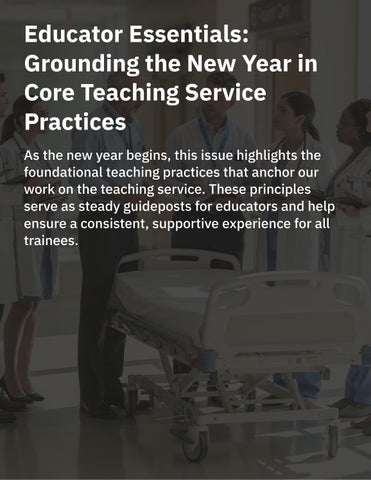
Educator Essentials: Grounding the New Year in Core Teaching Service Practices As the new year begins, this issue highlights the foundational teaching practices that anchor our work on the teaching service. These principles serve as steady guideposts for educators and help ensure a consistent, supportive experience for all trainees.
Team Strengthening and Well-Being A thriving teaching service begins with a strong, supported team. Prioritizing connection, communication, and consistency creates an environment where learners feel valued and faculty can teach at their best. Small, intentional habits early in the rotation set a steady course for the weeks ahead.
Know Your Team
Daily Check-Ins
Shared Goals
Learn who your trainees are
Monitor the team's pulse each
Outline objectives each
outside the hospital to
day and adjust expectations
morning to create clarity and
understand what motivates
when the clinical load shifts.
align effort.
them.
Celebrate Success
Regular Feedback
Recognize achievements often to reinforce a
Provide input at consistent intervals to support
positive and energizing team culture.
steady development.
The Essential Teaching Toolkit: Five Steps for Daily Practice This toolkit highlights five core habits that strengthen daily teaching on the wards.
Preparation
Role Model
Reason Out Loud
Effective teaching begins
Demonstrate skills that
Make your thinking visible to
well before rounds.
trainees can emulate.
learners.
Step Back
Bring Your "E-Game"
Create space for team ownership.
Enthusiasm inspires engagement.
Step 1: Preparation as a Standard Practice
Step 2: Role Model Intentionally
Effective teaching starts with reviewing charts
Demonstrate physical exam, communication, and
and conducting "stealth rounds" to anticipate
self-directed learning skills. Model embracing
needs, identifying key teaching cases, creating a
uncertainty by saying "I don't know" and seeking
brief lesson plan, and considering visual
answers.
supports.
Step 3: Reason Out Loud
Step 4: Step Back to allow for growth
Step 5: Bring Your "E-Game"
Make your thinking visible to
Create space for team
Your energy sets the tone in a
clarify decision-making. This
ownership and trainee
demanding clinical landscape.
strengthens clinical
leadership. This builds
Enthusiasm inspires
reasoning, reinforces core
confidence, promotes growth,
engagement and strengthens
knowledge, and creates a safe
and allows for targeted
the learning climate.
space for structured
support.
reasoning.
Bedside Teaching as a Core Practice Bedside rounding remains one of the most powerful ways to teach on the wards. It strengthens clinical skills, deepens patient connection, and allows real-time observation and feedback. When used intentionally, it becomes a central driver of team learning, patient-centered care, and high-quality teaching.
Real-Time Skill Development
Immediate Feedback Opportunity
Role Modeling Opportunities
Physical exam and
Direct observation enables
Natural moments to
communication skills develop
timely, specific feedback that
demonstrate clinical
through direct practice and
accelerates learning.
excellence and professional
observation.
behavior.
Enhance Team Cohesion
Patient-Centered Care
Shared bedside experiences
through direct engagement
strengthen team bonds and
and collaborative decision-
create shared purpose.
making.
Improved patient outcomes
Making Bedside Rounds Effective Set the expectation that bedside rounding is a routine part of the rotation Ensure each team member introduces themselves
Key Teaching Moves at the Bedside Model exam techniques and
and their role
communication strategies
Review logistics in advance including timing,
Limit interruptions during
presentation style, and high-yield exam focus
presentations to maintain flow
Pause before entering to identify sensitive topics
Highlight one or two teaching points
best discussed later
tied to the primary diagnosis
Practice regularly to build efficiency and create
Demonstrate a clear, concise summary
meaningful teaching moments
of the plan.
The Expert's Corner: Dr. Andrew Dunn, Chief of the Division of Hospital Medicine Dr. Dunn shares practical strategies that elevate both clinical efficiency and teaching impact on the wards. His approach emphasizes preparation, evidence based discussion, and intentional reinforcement of learner growth. Heavy chart check before rounds. Do a deep review of charts, ideally the night before or early in the morning. This prepares you clinically, helps you spot illness scripts worth reviewing, and lets you build a focused teaching plan. Reviewing new admissions ahead of rounds is a strength, not a shortcut. Bring the evidence to the bedside. Sharing key articles, abstracts, or results tables during rounds reinforces evidence based practice and engages learners. Having a concise, accessible reference can become a highlight of the discussion. Capture moments for meaningful feedback. Jot brief notes during rounds when learners demonstrate strong clinical reasoning or areas for improvement. Including specific behaviors and patient context allows feedback to be timely, specific, and actionable. Normalize and support incorrect answers. Responding thoughtfully to off target answers keeps learners engaged and safe. Framing why an answer would apply in a different context reinforces reasoning without discouragement. Publicly credit resident contributions. Acknowledge when resident insight leads to key diagnoses or management decisions. This reinforces teamwork, builds confidence, and highlights the collaborative nature of complex care.
A Heartfelt Thank You and a Bright New Year Thank you for everything you contribute to our academic community and beyond. Wishing everyone and their loved ones a wonderful and fulfilling New Year, filled with renewed purpose, continued success, and countless moments of professional satisfaction.