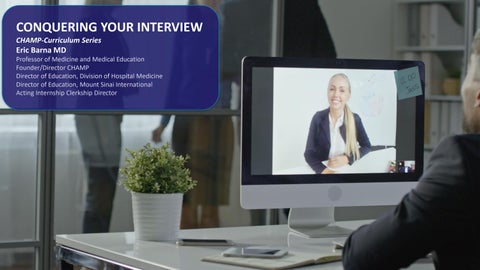
CONQUERING YOUR INTERVIEW CHAMP-Curriculum Series
Eric Barna MD Professor of Medicine and Medical Education Founder/Director CHAMP Director of Education, Division of Hospital Medicine Director of Education, Mount Sinai International Acting Internship Clerkship Director
1
Our Roadmap
1
2
Preparation
Virtual Setup
3 Interview Toolkit
4
5
AI Interview Prep
Post-Interview
Landscape
6 Letter of Intent
2
KNOW: Preparation isn't optional—it's your interview-day superpower
DO: Prepare with purpose—study the program, know who you're speaking to, and make your virtual space work for you.
FEEL: Confident, prepared, and energized to showcase your accomplishments to programs.
What is going through your mind in the lead up to Interviews? 4
From Training to First Shift Interview day is one stop on a 12-to-16 month runway
12–16 MONTHS
6–9 MONTHS
0–3 MONTHS
Career strategy. Understand compensation models and practice options.
Interviews, references, follow-up. Negotiate contract and benefits.
Relocation, insurance, onboarding, first schedule.
you are here
PLANNING
SIGNED → ON SERVICE
9–12 MONTHS
3–6 MONTHS
Identify specific opportunities. Prepare your CV and cover letter.
State license, DEA, NPI, payer credentialing, hospital privileges.
5
Preparation is Everything
EXPERT TIP: PUBLIC PRESENCE
Ask Claude to audit your LinkedIn the way a search committee would.
6
Know your audience
30-second elevator pitch
Master the art of “targeted” small talk
Let your interest be known
Be authentic!
Conquering your Job Interview: A Deeper Dive Mirroring the interviewer
Reassess body language
Anti-anxiety measures
Stay motivated
Master the final pitch
What do you do to prepare for a virtual interview?
The Virtual Interview: Zoom Room Setup ❑ Check your tech (Wi-Fi, Audio, Visual) ❑ Lighting (ring light) ❑ Background
❑ AV test run ❑ Speed test ❑ Platform familiarity (zoom/teams)
❑ Backup devices ❑ Check your surroundings (automated lights, telephones, doorbells)
Zoom Room Setup
During the Interview
EXPERT TIP ·
PRACTICE
Don’t sound rehearsed — but do rehearse. Most of us are rusty, and practice is what makes every point above land.
Making a Strong First Impression: ❑ Suits or coordinated professional outfits ❑ Facial hair (if any) should be well-groomed
❑ Do a dress rehearsal – try on your outfit beforehand ❑ Introduce yourself clearly – your name, said the way you want it said ❑ Solid colors, not patterns – fine stripes vibrate on camera ❑ The lobby counts – staff notice how you treat them ❑ Bring CV copies and a notebook, not your phone
In Person Encounter ❑ Punctuality is key ❑ Minimize cell phone use ❑ Silence smartwatches ❑ Limit drinking at social events ❑ Be yourself ❑ Remember the 360 review the coordinator, administrative and executive assistants, and hospitalists you meet outside the schedule
❑ Be consistent — the review committee compares notes ❑ Never speak negatively about your residency experience
The Behavioral Question ❑ Describe a time when you had to make a quick decision in a high-pressure situation. ❑ How do you handle difficult conversations with patients and their families? ❑ What would you do if a patient was not responding to treatment or had an unexpected complication? ❑ How do you handle situations where there is disagreement among the healthcare team about a patient’s diagnosis or treatment plan? ❑ What do you do if you disagree with a patient?
What kinds of questions are you planning on asking during your interview day?
Thoughtful Questions ❑ What would a successful first year look like? ❑ What do hospitalists who thrive here have in common? ❑ What is the biggest challenge facing the division? ❑ Schedule construct and faculty input ❑ ICU coverage and procedures ❑ APP, case management, and social work support ❑ Projected changes and new services ❑ Mentorship, promotion, faculty development ❑ Leadership and growth opportunities ❑ Team dynamic and social events
Preparing with Artificial Intelligence ❑ Mock interviews — free: ChatGPT voice mode or Gemini Live. Talk, don't type — use the prompt on the next slide ❑ Scored practice — free: Skillora asks real follow-ups and scores answers against your CV ❑ Delivery coaching: Microsoft Speaker Coach (free with institutional M365); Yoodli (5 free sessions) ❑ Record and review — free: record a Zoom mock, paste the transcript into a chatbot for feedback ❑ Refining answers — free tier: Grammarly for tone; any chatbot to tighten STAR stories ❑ Pay only if you'll do the reps: Final Round AI, Sensei AI. Check your library for Big Interview first ❑ One caution: practice tools are fair game; real-time AI “interview copilots” during a live interview are not
Your best practice partner is human — friends, family, coresidents. AI is the warm-up, not the substitute.
Sample Prompt: a 30-Minute AI Mock Interview SA M P L E P R O M P T · paste into ChatGPT
You are an experienced hospitalist division chief conducting a 30-minute screening interview for an academic hospitalist position. I am the applicant. Before we begin: Ask me to paste my CV — remind me to remove my telephone number and home address first. Don’t proceed until I paste it, then tailor your questions to my training. Questions: Ask me the 10 questions most commonly asked of hospitalist applicants, based on your knowledge of the field. Include at least one behavioral question of your choosing, and tell me if my answer is missing a STAR element. Format: Ask ONE question at a time; never list upcoming questions. After each answer, give me Strengths (2–3 specifics), Weaknesses (2–3 concrete gaps), and one sharper rewrite of my weakest sentence. Then ask the next question. Keep feedback under 150 words. Finish with: a readiness score out of 10 and the two questions I should rehearse most. Begin by asking for my CV.
Voice mode: tap the voice button and answer out loud — speaking is the rep that counts.
The Do’s
The Don'ts
“Ability to answer a behavioral question or two. Love it even more if they take a moment to think about an answer, feels very poised and mature”
“Unable to keep the conversation going.. If the interview is 30 minutes and it feels like I am pulling teeth to get there it’s a big red flag..” “Negative comments about prior experiences/workload“
“Some evidence that they have read up on our program”
“Poor body language, lack of eye contact limited engagement, checking phone or email, looking away when I am speaking”
“The sense that they really want to be at our program” “Enthusiasm.. especially for patient care” “Commitment and enthusiasm for patient care” “Knowledge of our institution that draws a candidate to our group” “Ability to express passion for Internal Medicine”
The Experts Corner
“When it is clear that the applicant has not done a full in-depth review of our program prior to the interview” “Applicants that have generic questions that are not tied to the specifics of our program”
What Residency Programs Evaluate During Your Interview Clear and targeted communication Speaking to key accomplishments on your CV Behavioral question responses Motivation for the specialty Passion for patient care Interest in the program/region Self awareness and reflection (strengths/weaknesses)
Post-Interview Checklist ❑ Reflect while it’s fresh — notes the same night, not next week ❑ Rate the program while it’s vivid — culture, mentorship, workload, before visits blur together ❑ Take your time — a thank-you sent in five minutes reads as a template
❑ Say thank you — to every person who interviewed you ❑ Personalize each message — one specific detail from that conversation ❑ Thank the coordinator — they run the show and they remember
❑ Be patient — silence is not a signal ❑ Calendar your follow-ups — so the timeline doesn’t manage you
CONTENT
EXECUTION
Remind: Why are you the best candidate?
Delivery: One message for each interviewer.
Sell: What is your value add?
Subject: Create a strong subject line that includes Thank you, job title and your name.
Fill in the Blanks: Did you forget to mention something?
Edit and Proofread: Must be 100% error free.
Indicate Enthusiasm: What excited you about the job, organization and the people you met?
Timing: Usually within 24 hours.
SAMPLE Subject: Thank you – [Job Name] – [Your Name] Dear [Interviewer Name], Thank you for meeting with me today. It was a pleasure to learn more about your team and the position of [job title]. I’m very excited about the prospect of joining [organization name] and helping [main job responsibility] with your team. As we discussed, my experience in [list your skills and/or achievements] make me a perfect fit. I also have the [skills omitted from interview] skills which would be an asset for [additional responsibilities of the job]. In researching [problem discussed in the interview], I found that [strategies] have been useful. I would enjoy speaking with you in more detail about this. I look forward to hearing from you about the next steps in the hiring process. Please do not hesitate to contact me if I can provide additional information. Best regards, [Your Name] [Your Contact Info]
Letter…
Legal Review: Usually only when letters of intent go into greater detail that you are not comfortable with.
Purpose: Ensure that all parties are on the same page.
Letter of Intent Content: There is great variability in the degree of detail.
Signing: While there is no legal barrier to signing multiple LOI’s this is a letter of good faith so would discourage this.
Closing the Deal ❑ Deliverables (LOR, References) should be ready to go
❑ Ask about salary/benefits if not already disclosed ❑ PTO/CME ❑ Flexibility for negotiation may be program dependent ❑ Attorney review of contracts is feasible depending on the program ❑ Pay special attention to “tail coverage” and “non-compete clauses” ❑ Clear and timely communication with programs is key
After the Offer Letter Cross-check and verify anything the letter does not spell out — before you sign
RANK & TRACK
PROTECTED TIME
Instructor, assistant, or associate? Tenure-eligible, clinicianeducator, or research track — each has its own salary band and promotion clock.
How much non-clinical FTE, for what, and who approves it. Startup support: RA time, statistical help, CME beyond the standard allowance.
C O M P E N S AT I O N
CONTRACT TERMS
Base versus productivity. Sign-on bonus and its clawback period. 403(b) match, CME allowance, relocation. Malpractice type and tail coverage.
Termination with and without cause. Notice you must give. Any cap on call. Non-compete scope and radius.
WORKLOAD, IN WRITING
THE RULE
Shifts or days per year. Census expectations. Night, weekend, and holiday distribution. Sick-call backup.
If it is not in the letter, ask before you sign. Verbal promises are not enforceable.
25
The Transition to Attendingship Between the signed offer and your first shift
CREDENTIALING
S TA R T D AT E
H E A LT H I N S U R A N C E
Budget up to six months at large academic centers.
Driven by credentialing, visa timing, and your own logistics. Name your constraints early, not late.
Residency coverage ends with your contract. Map the gap before it opens, not after.
BRIDGING A GAP
VISA SPONSORSHIP
YO U R I N B O X
COBRA, an ACA marketplace plan, or a spouse’s plan. Weigh cost against your start date.
Sponsorship timing can rule out a later start entirely. Confirm before you negotiate dates.
Return credentialing packets the week they arrive. Watch for scheduling and vacation requests too.
KNOW: Preparation isn't optional—it's your interview-day superpower
DO: Prepare with purpose—study the program, know who you're speaking to, and make your virtual space work for you.
FEEL: Confident, prepared, and energized to showcase your accomplishments to programs.
"It always seems impossible until it’s done." — Nelson Mandela