Scholarly Research Journal for Humanity Science & English Language, Online ISSN 2348-3083, SJ IMPACT FACTOR 2019: 6.251, www.srjis.com PEER REVIEWED & REFERRED JOURNAL, FEB-MAR, 2020, VOL- 8/38
IMPACT OF E- COMMERCE ON TRADITIONAL BUYING BEHAVIOR Dhwani Bhanushali Student MBA 2nd Year (Marketing), SSR IMR, Silvassa – Permanently Affiliated to SPPU, Pune, Email: dhwani885@gmail.com
Abstract In 2009 the Indian E-Commerce industry had achieved approx. $3.8 billion in revenue. By 2012 that number increased up to $9.5 billion. The numbers which are driven are primarily anticipated by the growth in consumer durables, electronics, apparel, accessories in addition to the firmly established products lines such as book and audio visual media. The Indian E-Commerce industry has been on an upward growth and it is expected to exceed the US to become the second largest E-Commerce market in the world by 2035. Indian E-commerce market has the potential to grow more than 4% to US$ 150 billion by 2022 supported by rising incomes and increasing the number of internet users. Each month India is adding approx. 10 million daily active internet uses to the internet community supporting the E- Commerce industry which is the highest rate in the world. India being driven by a young dynamic population with various demographic profiles with increasing the internet penetration and increasing economically performance the E-Commerce market is definitely going to increase. The rise in the digital literacy has led to increase in the investment in the E-Commerce sector/firms leveling or giving opportunities for the new player in the market while churning out the innovative or new patterns to disrupt or destroy old functioning. In India 100% FDI is allowed or permitted in B2B ECommerce. The major key players are Flipkart, Myntra, Jabong, Snap deal, EBay, Shop clues, Nykaa, Amazon.
Scholarly Research Journal's is licensed Based on a work at www.srjis.com
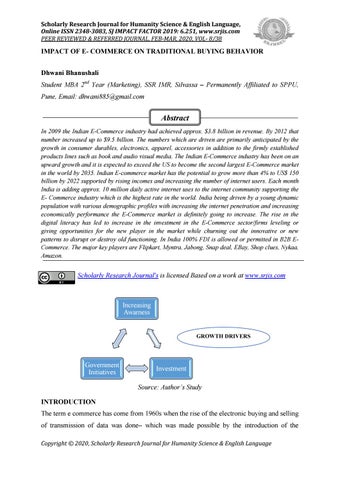
Increasing Awarness
GROWTH DRIVERS
Government Initiatives
Investment Source: Author’s Study
INTRODUCTION The term e commerce has come from 1960s when the rise of the electronic buying and selling of transmission of data was done– which was made possible by the introduction of the Copyright © 2020, Scholarly Research Journal for Humanity Science & English Language
Dhwani Bhanushali
9941
(Pg. 9940-9946)
electronic data interchange. E-commerce has become one of the most popular methods of making money online and an attractive opportunity for investors. E commerce and online shopping are used interchangeably as e-commerce refers through doing business through electronic medium were as online shopping means doing shopping of the required products or needs through electronic medium. E.g. Amazon, Flipkart etc. E-COMMERCE IN INDIA The e commerce sector in India is growing very fast. The internet subscribers in India stood at 665.31 million in June 2019. In the festive season sale i.e. from September 29 – October 4 2019, the e-retailers in India achieved US$ 3 billion. With the growing internet penetration the internet users in India are increasing. They are expected to increase by 829 million by 2021. The online shoppers are expected to reach by 220 million by 2025. The digital transactions are expected to reach US$ 100 billion by 2020. Through its “DIGITAL INDIA” campaign the government of India is aiming to create a trillion dollar online economy by 2025. By the rising Smartphone penetration the launch of 4G network and by increasing consumer wealth and by providing the more internet per day the consumer are attracted towards the e commerce site or platforms. Average online retail spending in India was US$ 224 per user in 2017. E- Commerce is increasingly attracting customers from Tier 2 and 3 cities were in people very limited access to the brands but their aspirations are high. The number of active internet users in the country is the 2nd largest / highest globally and data usage of 8GB/subscribe/month is comparable to developed countries. E- Commerce has a major impact on the retail industry in a variety of way. Retailers have had to adopt to new technologies to survive. The implication on retail industry was that it was in decline because of the ecommerce platforms. As technology is rapidly changing there is greater need for retailers to find out new ways to connect with their customers. As with the advancement in technologies the customers are doing retail shopping through the e commerce platforms as the e commerce platforms are also providing the regular /daily through electronic way. Because of this the retailers are facing many problems and are going in losses so the retailers has to change or adopt the different technology to survive in the market Nowadays every traditional retailer have a mobile offering through different applications. Traditional retailers are providing the online truncations for payment through goggle pay, paytm etc. Basically the thing which is driving towards e commerce platforms in India is the young population in India which are driven by the western influence in fashion, food, lifestyle etc. Copyright © 2020, Scholarly Research Journal for Humanity Science & English Language
Dhwani Bhanushali
9942
(Pg. 9940-9946)
the young population is driving e commerce sales up owing peer pressure, growing aspirations, rising careers and to keep updated to the latest trends in fashion as well as in digital devices. Major developments like new and improved mobile apps make it convenient for shoppers to make perches on the go. BENEFITS OF THE E- COMMERCE/CUSTOMER 1) No geographical boundaries 2) Lower cost / investment 3) Save Travel time and cost 4) Enables coupons 5) Abundance of information 6) Remains open all time i.e., 24/7 7) Convenient 8) Return policy 9) Refund 10) Discount on EMI CASE DISCUSSION: The market for online retail in India has grown in past few years. The nasscom report says that the Indian E- commerce industry will touch the 100 billion figures by 2020. With the help of digital payment solution a person can easily merge digital banking with the ecommerce as well as with the various payment methods which includes net banking, credit card, debit card etc. the e-commerce sites or platforms like amazon, Flipkart, Myntra etc. have created various options or have made available various options for the customers. It has created a wide variety of products as well as wide variety of payment services and payment options. The e-commerce platforms are giving after sales services and the return policy fir the products due to the damage or due to the defective product. This return policy had created a lot of attraction of customers to buy the product via internet or various e-commerce platforms. The e-commerce platforms have created their mobile application to make it easier for the customer to search for the product and the other options available for that same product with the different color and ranges.
Copyright Š 2020, Scholarly Research Journal for Humanity Science & English Language
Dhwani Bhanushali
9943
(Pg. 9940-9946)
BASIC COMPARISON
https://browntape.com/top-5-online-marketplaces-in-India-compared/ Although the e bay India is the oldest player in the Indian Market, Amazon and Flipkart have lead the market in the number of products and their categories.
PRICING
https://browntape.com/top-5-online-marketplaces-in-India-compared/ The Flipkart, snap deal and shop clues are giving free the subscription and listing fees. While e bay looks expensive.
Copyright © 2020, Scholarly Research Journal for Humanity Science & English Language
Dhwani Bhanushali
9944
(Pg. 9940-9946)
LOGISTICS
https://browntape.com/top-5-online-marketplaces-in-India-compared/ All the 5 online stores provide shipping assistance but only Amazon and e-bay India allows self-shipping. The packaging charges of less as compare to the other online stores.
MISCELLANEOUS
https://browntape.com/top-5-online-marketplaces-in-India-compared/ Flipkart seems to play game in the m-commerce reach as itbhas covered 70% of the mobile traffic CONCLUSION: E-Commerce usually means doing the business through the internet. Ecommerce means buying and selling through internet or transmitting funds or data. It is different from E-business but similar to it. E-Business means doing whole business via internet were as E-Commerce means commercial transactions which are done or conducted Copyright © 2020, Scholarly Research Journal for Humanity Science & English Language
Dhwani Bhanushali
9945
(Pg. 9940-9946)
through electronically on the internet E- Commerce is a large platform for all the businesses. It has taken a huge market. It is progressing very fast and it has become important for the business as technology continues to advance and the advantage should be taken and implemented by the business to grow more. Through the e- commerce the possibilities for both the business and customers have become endless. Creating more opportunities of profit for the business and making more options available for the consumers. The future of ecommerce will drastically grow as the number of internet users are increasing day by day and the taste of consumers are also changing drastically according to the changes in the technology. TEACHING NOTES FOR THE CASE: TEACHING OBJECTIVES: The following Teaching Objectives may be considered with respect to the case: 1. To understand the impact of E-Commerce platforms on Traditional buyers. 2. To deliberate upon the prospects of the E-Commerce format in the market. LEVEL OF ANALYSIS: This case shows the understanding about the E-commerce platforms and the impact of the e-commerce on the traditional buying behavior. This case is suitable for case study approach for the management student and the various small businesses. To be specific the BBA and MBA students with the specialization in Marketing & Operations, the marketing department of the various businesses to understand about the ecommerce and its opportunities can also get benefitted. CASE ASSIGNMENTS: As part of the case study delivery, participants may be assigned certain tasks pre & post delivery of the case. Pre discussion Task: Gather a fair and good understanding about the e-commerce by reading the journals, magazines of e-business and books in library and also through e sources avaiable at library. Post discussion Task: conduct a further literature review pertaining to the case and post discusiion shall include qa discusiion round on afew qiuestion pertaining to the case. BROAD DISCUSSION QUESTIONS: Q.1: “The E-Commerce platform is posing a good challenge in the market”. Discuss in the light of impact that E-Commerce has created on the physical market. Q.2: Discuss the benefits of the E-Commerce platform for the consumers.
Copyright © 2020, Scholarly Research Journal for Humanity Science & English Language
Dhwani Bhanushali
9946
(Pg. 9940-9946)
Q.3: Discuss the future of consumer market considering the huge momentum of the online players entering the market. POTENTIAL BENEFITS OF THE CASE:
Students of Higher Education: This case will be helpful for the students as they will
go to the organizations in future for the job perspective and will face the real environment at the workplace. They will come to know how the businesses are run and how to get benefited from various e-commerce platforms to earn more profits and grow further. Executives of the Companies: This case will make the executive of the organization to understand about the opportunities of the e-commerce platforms and will help to make effective strategies to grow further and earn more profits. Bibliography: https://browntape.com/top-5-online-marketplaces-in-India-compared/ https://theaims.ac.in https://www.indiastudychannel.com/resources/118653-Opportunities-of-e-commerce-inIndia.aspx https://www.indiastudychannel.com/resources/114877-About-E-commerce-ElectronicCommerce.asp
Copyright © 2020, Scholarly Research Journal for Humanity Science & English Language