Scholarly Research Journal for Interdisciplinary Studies, Online ISSN 2278-8808, SJIF 2018 = 6.371, www.srjis.com PEER REVIEWED & REFERRED JOURNAL, JULY-AUG, 2019, VOL- 7/52
INFLUENCE OF FAMILY FINANCIAL STATUS ON FEMALE STUDENTS’ RETENTION IN PUBLIC SECONDARY SCHOOLS IN MUKAA SUB-COUNTY, KENYA Jacinta w. Nzina1, Kimiti, Richard Peter2, Ph. D. & David M. Mulwa3, Ph. D. 1
Masters Candidate, Machakos University, Email: jacintanzina@gmail.com
2
Machakos University, Senior Lecturer, Department of Educational Management and
Curriculum Studies, Email: prickimiti@mksu.ac.ke 3
Machakos University, Senior Lecturer, Department of Educational Management and
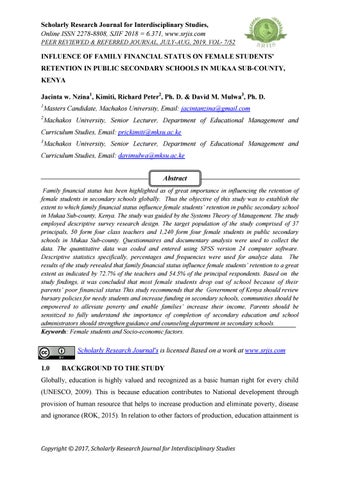
Curriculum Studies, Email: davimulwa@mksu.ac.ke Abstract Family financial status has been highlighted as of great importance in influencing the retention of female students in secondary schools globally. Thus the objective of this study was to establish the extent to which family financial status influence female students’ retention in public secondary school in Mukaa Sub-county, Kenya. The study was guided by the Systems Theory of Management. The study employed descriptive survey research design. The target population of the study comprised of 37 principals, 50 form four class teachers and 1,240 form four female students in public secondary schools in Mukaa Sub-county. Questionnaires and documentary analysis were used to collect the data. The quantitative data was coded and entered using SPSS version 24 computer software. Descriptive statistics specifically, percentages and frequencies were used for analyze data. The results of the study revealed that family financial status influence female students’ retention to a great extent as indicated by 72.7% of the teachers and 54.5% of the principal respondents. Based on the study findings, it was concluded that most female students drop out of school because of their parents’ poor financial status This study recommends that the Government of Kenya should review bursary policies for needy students and increase funding in secondary schools, communities should be empowered to alleviate poverty and enable families’ increase their income, Parents should be sensitized to fully understand the importance of completion of secondary education and school administrators should strengthen guidance and counseling department in secondary schools. Keywords: Female students and Socio-economic factors.
Scholarly Research Journal's is licensed Based on a work at www.srjis.com 1.0
BACKGROUND TO THE STUDY
Globally, education is highly valued and recognized as a basic human right for every child (UNESCO, 2009). This is because education contributes to National development through provision of human resource that helps to increase production and eliminate poverty, disease and ignorance (ROK, 2015). In relation to other factors of production, education attainment is
Copyright © 2017, Scholarly Research Journal for Interdisciplinary Studies
Jacinta w. Nzina, Dr. Kimiti, Richard Peter & Dr. David M. Mulwa (Pg. 12847-12857)
12848
economically becoming more important as it leads to the transformation of other resources to enhance civil and better livelihoods among communities (Psacharopoulos & Patrinos, 2004). According to World Bank (2012), literacy of women is an important key to improve health, nutrition and education in the family and to empower women to participate in decision making in the society. Investing in formal and non-formal education and training for female students and women, has high social and economic returns and has proved to be one of the best means in achieving sustainable development and economic returns (UNICEP, 2015). Equipping female students with education leads to more equitable development, stronger families better services, child health and effective participation in governance. In another study sponsored by World Bank, the results demonstrated that education of women leads to; improved nutritional values, proper hygiene and improved management of households (World Bank, 2014). The report puts it clearly that girls with little or no education are far more likely to be married as children, suffer from domestic violence, live in poverty and lack a say over household spending or their own health care than better educated peers. Female education leads to; improved health and education, reduced infant mortality, higher earning, reduced fertility rate and general improvement of quality of life for nations. Although there are many benefits associated with women education, most developing countries, Kenya included, are still analyzing their situation so as to develop programmes to address female education (Wang, 2003). Report from the 2018 education quality dialogues presented by the Ministry of Education shows that, Kenya has made great efforts in achieving EFA. From the report, participation in ECDE has increased from 64.2% in 2012 to 74.9% in 2016. The primary education enrolment has also risen from 88% in 2012 to 91.2% in 2016. The report also says that close to 85% of learners who complete standard eight make it to secondary schools. Secondary schools enrolment rose from 41.7% in 2012 to 49.5% in 2016. The desire of many governments to decrease dropouts in secondary schools has led to heavy public and private investment in education (UNESCO, 2003). Secondary education is a very important sector for national and individual development in any country. It plays an important role in increasing country’s human resource base at a higher level than primary education sector (Ohba, 2009). Since independence, the government of Kenya has been concerned with enhancing female student’s retention in secondary schools (Sifuna, 2013). This has been done through providing legal and fiscal framework besides advocacy through various campaigns that mitigate against dropout. Female students’ retention is a great concern Copyright © 2017, Scholarly Research Journal for Interdisciplinary Studies
Jacinta w. Nzina, Dr. Kimiti, Richard Peter & Dr. David M. Mulwa (Pg. 12847-12857)
12849
to the family, society and government. For this reason, for any educational institution to succeed, students, retention should be considered important. Students’ retention rate indicates the percentage of the students who remain at an educational institution after they begin studying there. High retention indicates that the institution is supportive to the students (Ozga, 2000). In any educational institution high students’ retention attracts high students’ academic achievement while low students retention discourages student from performing. Socio-economic factors discourage already enrolled female students from continuing with further studies. The government of Kenya calls for affirmative action to enhance women participation in education and other areas of employment (ROK, 2015). Mukaa sub-county has registered female students dropouts from 2011 as indicated below. According to the statistics from the sub-county education office, average dropout rates between 2011 and 2015 are at 11.33% for boys and 14.48% for girls. Table 1: Enrolment and completion of female students in Mukaa sub-county2011-2018 Form 1 Year 2011 2012 2013 2014 2015
Enrolment 1,015 1,137 1,197 1,333 1,362
Form 4 Year 2014 2015 2016 2017 2018
Completion 928 943 1,077 1,103 1,118
Dropout rate for female students 8.57% 17.06% 10.03% 17.25% 17.91%
(Mukaa Sub-County Director of Education, 2018) The difference between the numbers of female students who enrolled in form one and those who graduated four years later can be used to calculate the drop out rate of the students. From the above table, it is clearly shown that there is an increasing trend of dropout rate for female students in Mukaa Sub-County since 2011. This is now an area of concern in Mukaa SubCounty and therefore measures should be taken to ensure retention of female students in this area. Failing to retain female students in secondary schools leads to dropouts. Dropout can be considered as a waste of potential human resources and money spend on them in primary education and even time lost in sending them to school in the first place. Every secondary school female student dropout signifies unfulfilled objectives, goals and aim of individual as well as the society at large. Despite the Government’s efforts to offer FDSE and subsidized secondary education, the retention rate in Mukaa Sub-County is not 100%. Retention of female students in secondary schools is a major challenge which is attributed majorly by socio-economic factors. This research is aimed to determine the extent to which socioeconomic factors influence retention of female students in Mukaa Sub -County. Copyright © 2017, Scholarly Research Journal for Interdisciplinary Studies
Jacinta w. Nzina, Dr. Kimiti, Richard Peter & Dr. David M. Mulwa (Pg. 12847-12857)
12850
2.0 OVERVIEW OF THE INFLUENCE OF FAMILY FINANCIAL STATUS ON FEMALE STUDENTS, ETENTION IN PUBLIC SECONDARY SCHOOLS The family financial background is a very important factor pertaining students’ retention in secondary schools. Students from lower socio-economic background in terms of parents’ occupational status face high risks of drop out (Orodho, 2014). The 2018 Education Quality Dialogue presented by the Ministry of Education, reported that students from high socioeconomic background remain in school and perform better than those from low socioeconomic status. In addition, the financial status of a family determines how far young people are educated with most families investing more resources in the education of boys at the expense of girls. According to Amanda(2009) the financial demands for female students is higher than that of male students and therefore in families of low financial status, female students are forced to engage in some income generating activities that can lead to school dropout. Jack (2011) carried out a study on factors influencing female students drop out in secondary schools. From the study it was found out that female students face a lot of challenges while in learning institutions and some are frustrated when they experience financial difficulties and finally drop out of school. According to Oyunga (2011) most girls drop out of school due to lack of adequate finances to cater for the education and social needs. Such girls get married to men who also happen to have questionable academic credential and finally bring up children who may lead to a more miserable life in future hence poverty cycle. This concurred with the study carried out by Juma(2010) which pointed out that Inadequate funds in the family force more girls than boys to drop from school and start looking for financial engagements in towns. According to Wandiga (2008) majority of the females who are streaming to the beaches are from low financial status families and did not get substantial financial support for subsistence in schools and therefore dropped out. Children from low socio-economic family may drop out of school and engage in child labour in order to assist in earnings. This mostly affects female children. Such children spent their time working as maids and they do not have time for school. According to UNESCOUNICEP (1990) majority of financially unstable and big families prefer to educate boys for family continuity, headship of household and property inheritance since girls marry and go away from their homes. Also in poor families, the inability to pay fees and purchase books, equipment and clothing compel parents to invest in education of their sons, whom they see as a source of future family support in preference to their daughters whose economic Copyright © 2017, Scholarly Research Journal for Interdisciplinary Studies
Jacinta w. Nzina, Dr. Kimiti, Richard Peter & Dr. David M. Mulwa (Pg. 12847-12857)
12851
contribution could as well be to a different household. Therefore the family’s financial status determines who should be taken to school and also who should continue schooling and the preference are always the boys. Female students are the ones who are discontinued from school to leave room for the male students to continue with their education when the resources are inadequate to educate both of them. This is mainly because it is believed that the social benefit from boys’ education has much more impact on the family decision than that from female education (Onyango, 2003). From the World Bank (2009) it is also evident that during economic difficulties, parents opt to withdraw their daughters from school in the view that education for boys is more crucial given that boys have a role as family heads and bread winners. Drewry (2007) observed that socio-economic status of the family and retention of the students in schools are in separable. This was supported by Son (2012) who concluded that poverty and ignorance of parents leads to most children especially girls dropping out of school. 3.0 RESEARCH DESIGN This study adopted descriptive survey research design to investigate the current situation with regard to the influence of socio-economic factors on the retention of female students in public secondary school in Mukaa Sub- County. This design also gives a great deal of accurate information and therefore it is appropriate for educational fact findings. 3.1 LOCATION OF THE STUDY The study was carried out in Mukaa sub-county, Kenya. Mukaa sub-county is 1° 51’ 0” South and 37° 19’ 0” East. The sub-county has 4 divisions namely; Kilome, Malili, Kasikeu and Kiou. There are 9 locations and 19 sub-locations in Mukaa sub-county. It lies in the arid and semi-arid zones of the eastern region and receives and average rainfall ranging from 400mm600mm. The temperatures range from 24.6°c to 34.0°c. Most of the land is used for agricultural purposes since most people depend on agriculture and livestock for their livelihood. The economic activities in the area are greatly affected by rainfall unreliability and high temperatures. This has negative effect on school fees payment hence retention of female students. The study was done in this area because the retention for female students in public secondary schools has been decreasing since 2014 according to the Sub-County Director of Education.
Copyright © 2017, Scholarly Research Journal for Interdisciplinary Studies
Jacinta w. Nzina, Dr. Kimiti, Richard Peter & Dr. David M. Mulwa (Pg. 12847-12857)
12852
3.2 SAMPLING TECHNIQUES AND SAMPLE SIZE The target population was 37 principals, 50 form four class teachers and 1,240 female students in form four 2019 in the 7 pure girls and 30 mixed public secondary schools in Mukaa Sub-County. A sample size of 10% to 30% of the target population is appropriate for analysis and reporting for descriptive studies (Mugenda & Mugenda, 2003). The study used simple random sampling to select 12 principals, 15 class teachers and 124 female students in form 4. 3.3 RESEARCH INSTRUMENTS The researcher used three sets of questionnaires and documentary analysis to collect data. The questionnaires consisted of open and closed ended questions to collect primary data. The questionnaires were administered to the principals, teachers and student 4.0 RESEARCH FINDINGS AND DISCUSSIONS The findings of the study were tabulated using frequencies and percentages. A summary of the findings are summarized in table 1 below. Table 1: Girls Retention Rates Year
Class
2016 2017 2018 2019 Total
Form 1 Form 2 Form 3 Form 4
Enrollment of female students 461 415 381 358 1615
No. of students who Dropout rate dropped out 53 11.5% 25 6.0% 15 4.0% 8 2.2% 101
Findings in Table 1 show that not all female students that were admitted in the secondary school completed the secondary education. Some dropped out of school although the dropout rates have been decreasing over the years. 2016 had the highest dropout rate at 11.5% while 2019 although we are still in the middle of the year has the lowest dropout rate at 2.2%. This finding from the document analysis was also supported by the principals who indicated that not every girl that was admitted has reached up to form four, the class teachers who indicated that some of the students have dropped out since the beginning of the fourth year and the students who indicated that some of their colleagues have dropped out of school. All the respondents indicated that the number of girls who drop out every year range from one to five girls in every class.
Copyright Š 2017, Scholarly Research Journal for Interdisciplinary Studies
Jacinta w. Nzina, Dr. Kimiti, Richard Peter & Dr. David M. Mulwa (Pg. 12847-12857)
12853
The findings on whether, the financial status of families had an influence on the female students’ retention are presented on table 3 below. Table 2: Family Financial Status Variable Frequency (F) Type of family 108 Poor 16 Middle Total 124 Total amount of money earned annually 63 Less than 50,000 48 50,000-100,000 10 100,000-150,000 3 150,000-200,000 Total 124 School fees financier 113 Parents 8 Guardians 3 Well-wisher
Percentage (%)
Total
100.0
87.1 12.9 100.0
50.8 38.7 8.1 2.4 100.0 91.1 6.5 2.4
124
Findings in Table 3 show that majority of the students 87.1% described their families as poor. This was supported by 50.8% of the students who indicated that their family annual income was less than 50,000 and those 38.7% indicated that their family annual income was between 50,000-100,000. Only a few students who indicated that their family annual income was more than 100,000. Findings further show that majority of the students’ education 91.1% was financed by their parents although there were 6.5% who were funded by guardians and 2.4% that were funded by well-wishers. The finding shows that majority of the female students in the study area come from poor families who lack the ability to fully finance their children education. The finding concurs with Son(2012) who revealed that poverty of parents leads to most children especially girls dropping out of school. In order to understand how family financial status influence students retention, students were asked to tick with a yes or no answer on questions with regards to fees payment. Their opinions are presented in Table 3. Table 3: Students Responses on Influence of Lack of School Fees Questions
Yes F 109 Have you ever been sent home for fees? Are there some students in your class who 91 drop out of school due to lack of school fees?
% 87.9 73.4
No F 15 33
N=124 Copyright © 2017, Scholarly Research Journal for Interdisciplinary Studies
% 12.1 26.6
Jacinta w. Nzina, Dr. Kimiti, Richard Peter & Dr. David M. Mulwa (Pg. 12847-12857)
12854
Findings in Table 3 show that majority of the students 87.9% have at one time been sent home for school fees and 73.4% responded in affirmative that there are some students in their class who drop out of school due to lack of school fees. This finding was further supported by the students who indicated that the funds to finance their academic needs were inadequate as shown in Table 6. This implies that some parents are not able to fully finance their children academic needs and they are at times sent home to collect school fees and not all students who are sent home manage to come back to school due to financial limitations. This reduces retention rates in public secondary schools. The finding is in agreement with Owuoth (2010) and Oyunga (2011) who both agreed that most girls drop out of school due to lack of adequate finances to cater for the education and social needs. The education needs include learning materials, school uniform and school fees while social needs include personal hygiene needs. Table 4: Students Responses on Adequacy of Finances Extent
Frequency
Percentage
Adequate Inadequate Very inadequate Total
25 83 16 124
20.2 66.9 12.9 100.0
Table 4 show that 66.9% of the students indicated that the finances were inadequate, 12.9% indicated that finances were very inadequate and 20.2% of the students indicated that the finances were adequate to meet all academic needs. This finding support the previous finding that majority of the students come from poor families who are unable to pay school fees on time as well as meet all financial needs of a students’ leading to drop out in extreme cases where parents are unable to raise the funds and girls look for menial jobs to meet their needs. The financial engagement for girls who drop out school in Mukaa Sub-county are mainly working as domestic house helps and working as casual laborers in shops or hotels. The finding concurs with Juma (2010) who also found out that inadequate funds in the family force girls to drop from school and start looking for financial engagements in towns. The principals and teachers were asked to indicate the extent to which family financial status influence retention of female students. Findings are presented in Table 5. Table 5: Teachers Responses on Influence of Financial Status Extent
Frequency
Percentage
To some extent To great extent Total
6 16 22
27.3 72.7 100.0
Copyright Š 2017, Scholarly Research Journal for Interdisciplinary Studies
Jacinta w. Nzina, Dr. Kimiti, Richard Peter & Dr. David M. Mulwa (Pg. 12847-12857)
12855
Findings in Table 5 show that 72.7% of the teacher respondents indicated that family financial status influence female students’ retention to a great extent and 27.3% indicated to some extent. All the teachers who participated in the study added that the main financiers of the students’ are the parents who are low income earners and are unable to pay fees on time leading to the students being sent out of school and some don’t come back to school hence affecting retention rates. The finding concurs with Chacha (2012) which established that family income affect girls retention throughout level of learning. Girls from low income families are often sent out of school and eventually drop out of school. The students were also asked to indicate the extent to which the financial status of their family affected their education. Table 6 presents the findings. Table 6: Students Responses on Influence of Financial Status Extent
Frequency
Percentage
Little Great Very great Total
20 71 33 124
16.1 57.3 26.6 100.0
Findings in Table 6 show that 57.3% of the students felt that their family financial status affected their education to a great extent, 26.6% indicated to a very great extent and 16.1% of the students indicated to a little extent. The findings show that family financial status highly influence girls’ education. The girls might opt to drop out of school to avoid shame especially if the family is unable to meet all financial needs required to maintain girls in school. The finding is in agreement with Drewry (2007) that the socio-economic status of the family affects children retention in schools. 5.0 CONCLUSION Findings presented and discussed have proved that most students drop out of school because of their parents’ poor financial status. The parents who are low income earners are not able to pay school fees on time. This leads to the school administration sending the students home to collect school fees and not all students who are sent home manage to come back to school. When the parents lack funds to maintain their children i n school, they end up dropping out. 6.0 Recommendations Based on the findings of the study the following recommendations were made in order to increase female students’ retention in public secondary school in Mukaa Sub-county.
Copyright © 2017, Scholarly Research Journal for Interdisciplinary Studies
Jacinta w. Nzina, Dr. Kimiti, Richard Peter & Dr. David M. Mulwa (Pg. 12847-12857)
12856
i. The Ministry of Education should review bursary policies especially so that they benefit the needy students. This will ensure retention of female students who come from low socioeconomic background. ii. Communities should be empowered to start off income generating activities to alleviate poverty and enable families increase their income and have the ability to retain their female students in secondary school till completion. Still on the same, the school management board, parents association, teachers and also students need to initiate income generating and learning programmes like poultry keeping in the school to help needy students in terms of provision of basic need
s.
REFERENCES Adrian, M. (2010). Challenges to transitions; The sex preference in financing Educational opportunities among communities. AUNDP Publication report. Nairobi, Kenya. Amanda, H. (2009). The unique needs of the girls and persons with disability in Assessing life-long Education in Africa. World Vision; Kampala. Brown, and park (2010). Benefits of Girl child Education. Beijing Lau and Jin. Chacha, C. (2012). Parameters of Access, Transition and retention of Girls, Across Educational levels. Nairobi. Colclought, C., Al-samaria, s., Rose, P and Tembo, M. (2003). Achieving Schooling For all in commitment and Gender. England: Ashgate publishing Ltd. Drewry, J.A. (2007). High School Dropout Experience; A social capital perspective. USA: Blacksburg, VA. Gibson, J.L. et al (1997). Organizations behavior, structure, processes. 9th edition. United States: McGraw-Hill. Isangedighi, A.J (2011). Essentials of Learning. E – Nwabooks Association calabar Kendra, Cherry free psychology Newsletter, About psychology. Jacky, D. (2011). Focusing on enhancing Retention in learning institution: Over Coming challenges for Academic success for all. Daresalaam: Humming publication. Jamie, A.(2011). School and Early Marriages, the social conflict. Pretoria: Universities of Pretoria. Juma, C. (2010).Towards achieving Genders Quality in Education Opportunities in Developing Countries; NGO Assessments for social Development, EARCOR. Mullin, L. J.(2005). Management and Organizational behavior. 7th edition. England: Prenice Hall. Mugenda, O. and Mugenda, A. (2003). Research Methods; Qualitative and Quantitative Approaches. Nairobi: Acts press. Ohba , A(2009). Does free secondary Education Enable the poor to gain Access? A study from Rural Kenya CREATE pathways to access. Research monograph NO. 21 . Onyango, N. (2003). A study of factors that influence participation in primary schools. A case study of Ginyang and Marigat Division of Baringo District. Unpublished M.Ed Thesis; Kenyatta University Orodho, A.J. (2014). Attainment of Education for All (EFA) by 2015: From rhetoric chimera to practice in Kenya. International Journal of Current Research. Vol. 6.Issue oi, pp4666- 4674. January 2014.ww.journal.org. Owouth, A. (2010). The Girl child transitional challenges: The Educational Demands For a girl child. Nairobi ; university of Nairobi. Oyunga, A. (2011). Factors influencing transition rates among learners in Kisumu Rural District. Kampala; Kampala University. Copyright Š 2017, Scholarly Research Journal for Interdisciplinary Studies
Jacinta w. Nzina, Dr. Kimiti, Richard Peter & Dr. David M. Mulwa (Pg. 12847-12857)
12857
Oywa, J. (2012).Gains in education and corresponding gains in economic development: closing Educational gaps for social Development in local societies. HO Ozga. J. (2000). Policy research in Educational settings. Contested Terrain. Buckingharm: Open university. Psacharopoulos, G. and Patrinos, H.A. (2004). Human capital and rates of returns. Califonia : webmax publishers. Psacharopoulos, G. and Patrinos, H.A (2004).Returns to investment in education. A further update: world bank policy research working paper. Washington, D.C World Bank. Rajabu, H.H. (2007). An investigation into causes and effects of primary school pupils pregnancy on girls secondary school education. A case study of Ulanga District. Tanzania. unpublished work ROK. ( 2015). Kenya Education sector support programme 2005 – 2010. Delivering quality Education and training to all Kenyans. Nairobi : MOEST. Rothestan, R.(2004). Class and schools using social economic and educated reforms to close the white and black achievement Gap. Economic policy institute; USA. Scott, R.W. (2008). Organizations and Organizing: Rational, Natural and Open Systems Perspectives. Upper Saddle River NJ: Prentice Hall. Sifuna, D.N. (2013). Girls and Women Education in Kenya. Nairobi; UNESCO Publishers. Son, C. (2012).How did sex tourism, become an important economic source in the Coastal Region of Kenya? Wageningen university. UNESCO (2009). EFA Global monitoring Report, overcoming inequality: why Governance matter. Paris UNESCO. UNICEF (2015). Monitoring the Situation of Childrenand Women 2015. Wandiga, M. (2008). A survey on the Raising cases of Dropout Rates Among Girls in Primary Schools in Suba District. A research paper; Egerton University. Wang, Y. (2003). Call for Urgent Action to help Children and Orphans in China. Beijing; Aizhixin institute of health Education. Weihrich, H.,et al(2008). Management of global and entrepreurial perspective. 12th edition. McGraw-Hill: New Delhi. World Bank (2014).Empowering Women and Girls for shared prosperity. Washington DC: World Bank. World Bank (2012). Gender Equality and Development. Washington D.C.: World Bank. World Bank (2003). Principle and strategies for education: A World Bank review. Washington D. C: world Bank
Copyright Š 2017, Scholarly Research Journal for Interdisciplinary Studies