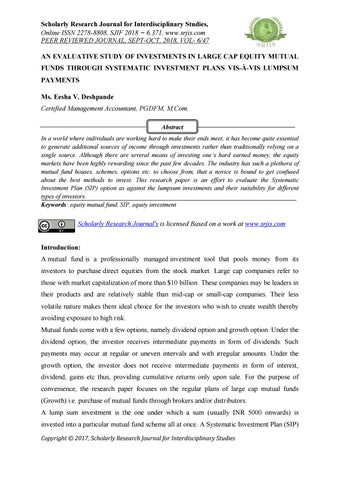
Scholarly Research Journal for Interdisciplinary Studies, Online ISSN 2278-8808, SJIF 2018 = 6.371, www.srjis.com PEER REVIEWED JOURNAL, SEPT-OCT, 2018, VOL- 6/47 AN EVALUATIVE STUDY OF INVESTMENTS IN LARGE CAP EQUITY MUTUAL FUNDS THROUGH SYSTEMATIC INVESTMENT PLANS VIS-À-VIS LUMPSUM PAYMENTS Ms. Eesha V. Deshpande Certified Management Accountant, PGDFM, M.Com. Abstract In a world where individuals are working hard to make their ends meet, it has become quite essential to generate additional sources of income through investments rather than traditionally relying on a single source. Although there are several means of investing one’s hard earned money, the equity markets have been highly rewarding since the past few decades. The industry has such a plethora of mutual fund houses, schemes, options etc. to choose from, that a novice is bound to get confused about the best methods to invest. This research paper is an effort to evaluate the Systematic Investment Plan (SIP) option as against the lumpsum investments and their suitability for different types of investors. Keywords: equity mutual fund, SIP, equity investment
Scholarly Research Journal's is licensed Based on a work at www.srjis.com
Introduction: A mutual fund is a professionally managed investment tool that pools money from its investors to purchase direct equities from the stock market. Large cap companies refer to those with market capitalization of more than $10 billion. These companies may be leaders in their products and are relatively stable than mid-cap or small-cap companies. Their less volatile nature makes them ideal choice for the investors who wish to create wealth thereby avoiding exposure to high risk. Mutual funds come with a few options, namely dividend option and growth option. Under the dividend option, the investor receives intermediate payments in form of dividends. Such payments may occur at regular or uneven intervals and with irregular amounts. Under the growth option, the investor does not receive intermediate payments in form of interest, dividend, gains etc thus, providing cumulative returns only upon sale. For the purpose of convenience, the research paper focuses on the regular plans of large cap mutual funds (Growth) i.e. purchase of mutual funds through brokers and/or distributors. A lump sum investment is the one under which a sum (usually INR 5000 onwards) is invested into a particular mutual fund scheme all at once. A Systematic Investment Plan (SIP) Copyright © 2017, Scholarly Research Journal for Interdisciplinary Studies
Ms. Eesha V. Deshpande (Pg. 11253-11257)
11254
however, invests into the scheme, small constant amounts (usually INR 500 onwards) over a period of time. At the outset, such a comparison between SIP and lump sum payment methods of investing into mutual funds would be unfair primarily due to the difference between the cash flows. Under lump sum option, the investor has money on hand that can be invested. Whereas in case of SIP, the investments are made from the surplus expected in future at regular intervals. Large cap mutual funds under consideration are: i)
Aditya Birla Sunlife Frontline Equity Fund (G)
ii) Axis Bluechip Fund (G) iii) ICICI Prudential Bluechip Fund (G) iv) SBI Bluechip Fund (G) Objectives of the study: To evaluate Systematic Investment Plan (SIP) vis-Ă -vis Lump Sum investment into large cap equity mutual fund schemes with Growth option. Methodology: The study has been conducted purely based on the secondary data available from several websites. Limitations of the study: i) The paper focuses only on the large cap equity mutual funds with growth option. ii) The paper takes into consideration, only the regular plan of the mutual funds i.e. those purchased through authorised distributor channels. iii) The period under study is one calendar year w.e.f. 5th September 2017. Hypothetically, it is considered that, Mr. X, a salaried individual had made investment in mutual funds through two ways; one through a lump sum payment of INR 100,000 on 5th September 2017 and second through a monthly SIP of INR 10,000 per month on 5th of every calendar month for 10 months respectively starting from the same date. The investments were reviewed on 5th September 2018, also referred to here, as the observation date. The temporal representation of the value of his investments can be seen through the following table:
Copyright Š 2017, Scholarly Research Journal for Interdisciplinary Studies
Ms. Eesha V. Deshpande (Pg. 11253-11257)
11255
Growth of Lump sum investments: Lumpsum Aditya Birla Sun Life Frontline Equity (G) Axis Bluechip Fund (G) ICICI Pru Bleuchip Fund (G) SBI Bluechip Fund (G)
#Units
Purchase Initial Observation Market Nav Investment Date Nav Value
472.30
211.73
Profit
Roi (%)
100000.00
226.36
106909.74 6909.74
6.91
4184.10 23.90
100000.00
28.07
117447.70 17447.70 17.45
2647.60 37.77
100000.00
42.59
112761.45 12761.45 12.76
2726.28 36.68
100000.00
39.09
106570.34 6570.34
6.57
Growth of investment through SIPs:
Sip Aditya Birla Sun Life Frontline Equity (G) Axis Bluechip Fund (G) ICICI Pru Bleuchip Fund (G) SBI Bluechip Fund (G)
Total Investment
#Units
Observation Date Nav
Market Value
100000
464.14
226.36
105062.33 5062.33
100000
4012.58 28.07
112633.21 12633.21 12.63
100000 100000
2535.84 42.59 2652.41 39.09
108001.51 8001.51 103687.73 3687.73
Profit
Roi (%) 5.06
8.00 3.69
Working for SIPs invested on 5th of each calendar month: Aditya Birla Sun Frontline Date Of Life Equity Fund Purchase NAV #UNITS 05-Sep-17 211.73 47.23 05-Oct-17 209.93 47.63 05-Nov-17 219.59 45.54 05-Dec-17 213.04 46.94 05-Jan-18 224.02 44.64 05-Feb-18 219.58 45.54 05-Mar-18 212.75 47.00 05-Apr-18 213.85 46.76 05-May-18 217.27 46.03 05-Jun-18 213.57 46.82 TOTAL 464.14
Axis Fund NAV 23.90 23.89 24.67 24.20 25.41 24.74 24.71 25.45 26.10 26.42
Bluechip Icici Pru Bluechip Fund #UNITS NAV #UNITS 418.41 37.77 264.76 418.59 37.62 265.82 405.35 40.22 248.63 413.22 39.22 254.97 393.55 41.01 243.84 404.20 40.54 246.67 404.69 39.37 254.00 392.93 39.37 254.00 383.14 39.84 251.00 378.50 39.66 252.14 4012.58 2535.84
Sbi Fund NAV 36.68 36.16 37.91 37.35 39.04 38.00 37.49 38.16 38.59 37.81
Bluechip #UNITS 272.63 276.55 263.78 267.74 256.15 263.16 266.74 262.05 259.13 264.48 2652.41
Data courtesy: https://www.amfiindia.com/ Data analysis: The figures from the above table indicate that the Lump sum investments have given a better Return on Investment (ROI) as against SIPs in case of all the mutual fund schemes under the study. A matter of fact to be considered here is that the lumpsum investment was made a year Copyright © 2017, Scholarly Research Journal for Interdisciplinary Studies
Ms. Eesha V. Deshpande (Pg. 11253-11257)
11256
before the observation date whereas most of the SIP amounts were invested only a few months ago except for the first month. For better comparison, we represent the above data diagrammatically as:
Conclusion: The above comparison clearly shows that the lump sum investments fare well during the period of study due to the rising market trend. However, in case of falling markets, SIPs would have generated better returns thereby averaging the purchases. Therefore, it is undoubtedly not fair to compare the two methods. However, one can maximize the returns by choosing from these as per the suitability of the investor. Advantages of Lumpsum investments over SIPs: 1) The lump sum investments will give better returns when made during market slump or at lower valuations. 2) These will generate better returns in the event of rising markets which is the general trend in long- term. 3) Investments start generating compounded returns as against SIPs where the investments are deferred over a period of time. 4) More suitable for individuals who have a large sum at hand, for example, retired salaried individuals or those having disposed of an asset. Advantages of SIPs over Lumpsum investments: 1) The investments are purchased at regular time intervals thereby managing the volatility. Copyright Š 2017, Scholarly Research Journal for Interdisciplinary Studies
Ms. Eesha V. Deshpande (Pg. 11253-11257)
11257
2) These are more suitable for salaried individuals who are able to create a monthly surplus for investing. 3) The investors may develop regular saving habits by investing via SIPs. 4) SIPs do not create financial burden on the investor but generate wealth in the longer term. 5) SIPs come with flexible payment frequencies such as monthly, bimonthly etc. References: https://www.motilaloswal.com/article.aspx/1365/Why-SIPs-make-a-difference-to-your-Mutual-Fundreturns. https://bluechipindia.co.in/MutualFund/MFInner.aspx?id=2 https://www.moneycontrol.com/news/business/mutual-funds/sip-or-lump-sum-investment-which-isbetter-1152005.html https://www.amfiindia.com/ https://www.valueresearchonline.com/story/h2_storyview.asp?str=23987&utm_medium=vro.in https://www.utimf.com/articles/advantages-of-lump-sum-investments-vis-a-vis-sip
Copyright Š 2017, Scholarly Research Journal for Interdisciplinary Studies