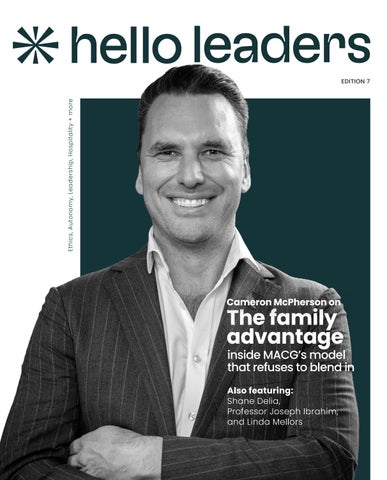
family advantage inside MACG’s model that refuses to blend in Cameron
Also featuring: Shane Delia, Professor Joseph Ibrahim, and Linda Mellors
McPherson
Lauren Todorovic Editor-in-Chief, Hello Leaders
Welcome to the Autumn Edition of Hello Leaders.
This issue leans into the tensions the sector doesn’t always say out loud — those that sit beneath reform, behind policy and inside everyday decisions.
A clear theme runs through it: the gap between what we say we value and what our systems deliver.
Professor Joseph Ibrahim captures it best: We speak the language of dignity, yet build around risk. That tension shapes how people live and how staff respond when accountability outweighs autonomy.
Dr Simon Longstaff brings the same challenge to AI. Just because something works does not mean it belongs. In aged care, ethics is what makes progress worth pursuing.
Tim Hicks points to the growing pressure between improving care and sustaining access, while Daniel Gannon reframes care as something that enables independence, not limits it.
Gregory Reeve exposes the gap between assessment and delivery, reminding us that identifying need is not the same as meeting it.
Alongside this, Shane Delia and Cameron McPherson bring focus back to experience, culture and leadership.
What connects these voices is not agreement, but clarity.
Because leadership is not about choosing the easiest path. It is about choosing the right one.
“This is our family’s business… that gave me an overwhelming sense of humility and gratitude.”
Cameron McPherson, CEO of MACG
Cameron McPherson CEO of MACG
The family advantage
and why MACG’s family-owned model refuses to blend in
Journalist, Hello Leaders
There is a tired shortcut in Australia’s aged care debate. “For-profit” has become shorthand for “lower quality care,” or “poor staffing ratios.” It makes for easy headlines, but the data tells a far more nuanced story, especially in an era when Star Ratings have turned performance into a public scorecard.
Recent analysis of the Australian Government’s Star Ratings for October 2025 shows that, among homes with a published overall rating, 82 per cent sit at four or -profit providers the figure is 77 per cent, with fewer than one per cent at one or two stars. The point is not that every for-profit operator is flawless. It is that the public narrative has become less precise than the evidence on the ground.
Once that is acknowledged, the more useful question emerges: what organisational traits actually deliver consistent quality and workforce stability? One answer keeps rising above the noise: family ownership.
Australia’s aged care system is deliberately built on -for-profits operate 57 per cent of residential services, private organisations 35 per cent (as at June 2024). That diversity is not decorative; it is functional. A sector dominated by a single model drifts towards uniform decision-making. When providers consolidate, the number of residential operators fell 18 per cent between 2017 and 2024, choice narrows, local identity fades, and accountability can stretch across distant bureaucracies. Family-owned providers do more than add beds. They bring different operating rhythms, shorter lines of sight between leaders and the floor, and a sense of belonging that frontline staff say they rarely find elsewhere.
Nowhere is this clearer than at Medical and Aged Care Group (MACG). Led by CEO Cameron McPherson, the organisation operates 11 residential homes across Melbourne and regional Victoria.
But to understand why MACG succeeds where others struggle, you need Cameron’s story and the unlikely partnership between an economist father and a strategist son who turned personal humility into a leadership philosophy that is quietly reshaping what for-profit aged care can look like.
Cameron joined the business 18 years ago. His father had launched the original iteration in 1993 as a finance company before identifying aged care as a natural extension of his medical-sector investments.
An economist, investor and former treasurer of Collingwood Football Club, the elder McPherson was “very good with moving numbers over time”, someone who could predict cash flows far beyond any standard CFO.
Cameron, fresh from London where he had built a career in branding strategy and organisational behaviour, brought the other half of the equation: the ability to run companies and shape culture.
“I came from strategy and organisational psychology,” Cameron explains.
“I wasn’t a nurse who had risen through the ranks, and I wasn’t a pure numbers person. That created a different lens from day one.”
He refused to lead from afar. Wanting to understand the business from the inside, he stepped in as acting facility manager at one of the homes for several months in 2008. At head office he simultaneously wore the hats of marketing manager, HR manager, procurement manager and IT manager, supported only by a single payroll and accounts person. The experience was grounding.
“All these staff can walk out at any time,” he reflects. “This is our family’s business. I’ve got nowhere to go.”
“That gave me an overwhelming sense of humility and gratitude.” Those two words remain the quiet philosophy that underpins every decision. Staff are not interchangeable; they are the reason the business exists. Lose them, and the family has nothing left.
That mindset is visible in how Cameron chooses to lead. He deliberately caps expansion so he can drive to every home. He wants staff to know him and him to know them, not through dashboards, but through real presence. When a home manager endured a brutal week of resident deaths and a serious fall requiring investigation, she texted him directly.
“She knows she can pick up the phone,” he says. “That level of belonging matters.”
The numbers confirm the philosophy works.
In a November 2024 BPA Analytics survey distributed to 819 MACG staff (72 per cent response rate), the organisation earned a “Culture of Soaring” rating: 72 per cent of respondents in the engagement cycle and only five per cent disengaged.
Its “Truly Great Place to Work” score reached 83 per cent, well above the aged care benchmark of 67 per cent, while the employee Net Promoter Score hit +36.5 compared with the sector benchmark of +19.1. In an industry competing against hospitals, disability services and retail for the same labour pool, that advocacy translates directly into lower recruitment costs, stronger internal referrals and more stable rosters.
Cameron’s background in organisational behaviour and emotional intelligence (he has formal qualifications in EQ 2.0 and MBTI personality assessment, informs every layer of the culture). He views lifelong learning and curiosity as non-negotiable.
“I have this insatiable thirst for knowledge,” he says. “I just want to keep learning.”
That curiosity flows through the executive team and is expected of every home manager. The result is a workplace where people feel heard, valued and genuinely part of something larger than a transaction.
Quality in aged care, Cameron argues, is ultimately a workforce outcome. Continuity of carers, timely clinical escalation, dementia capability, nutrition and meaningful daily life all hinge on staff who stay, engage and care differently because they feel they belong.
Family ownership creates conditions that are harder to replicate at scale: personal reputation risk for leaders, immediate decision loops, and leadership that is visibly present rather than remote.
That agility shows up in practical ways. He recently saw something in one of the homes’ designs that he immediately flagged as a potential safety risk.
Despite the change requiring significant investment, he approved it without delay. In a family business there is no expense review committee, no multimonth approval chain, no private equity pressure, no distant board demanding quarterly returns. Just a single decisionmaker empowered to act the moment he identifies a safety issue on site.
That speed flows straight into better resident safety and experience and it is funded by profit that is reinvested rather than extracted.
Profitability is not in tension with quality; it is the engine that funds it. MACG’s shareholders are the McPherson family.
“They’re not greedy people,” he says. “If the business makes more in a year, we put more back into capital expenditure, lifting machines, improved lighting, better technology to deliver better care and things that improve the experience for residents.”
Decisions are simple and fast because there is only one representative at the table.
Cameron is clear-eyed about scrutiny. For-profit family businesses are still for-profit, and they must meet the same regulatory standards as everyone else. But he rejects the lazy equation that private ownership equals gouging.
“The majority of businesses in Australia are family businesses,” he notes. “It’s not a dirty word.”
He contrasts the model with government-run facilities, the very sector that triggered the Royal Commission, and with large non-profits that have absorbed proud family operators.
“Be careful what you wish for,” he warns.
The biggest threat to family models, he believes, comes from deliberate government policy. He recounts a sobering conversation with a former senior bureaucrat who told him bluntly: “We’ve got too many aged care providers-I only want 400.”
The reason? Fewer providers are easier to regulate. A dedicated departmental role now exists to drive consolidation. Providers must either close or sell.
Cameron sees the endgame clearly.
“The people who win are the government and the software providers who aggregate data through algorithms.“
“The result is the homogenisation of aged care, less choice for families, weaker local identity, and care that risks becoming a transaction rather than a relationship.”
Recent examples of the absorption of family businesses illustrate the human cost. Proud operators disappear, staff cultures are dismantled, and communities lose the intimate connection that family ownership often provides.
Yet Cameron views the same pressures as an opportunity. In a sector being pushed towards uniformity, the family model stands out precisely because it is different. It offers agility, accountability and a leadership style that treats metrics as tools for improvement rather than labels for debate.
Star Ratings, care minutes and compliance data matter, but every number ultimately reflects a human story.
The organisations that understand this, and structure their governance, leadership and workforce around it, will shape the next chapter of Australian aged care. Familyowned providers like MACG are not relics of a cottage industry. They are a deliberate design choice that delivers what the sector needs most: stable teams, rapid response to real needs, and leaders close enough to the floor to hear the truth.
In an era of consolidation and measurement, that difference is no longer optional. It is becoming essential.
From CEO to consumer:
What changes when you sit on the other side of the desk
Contributor: Gregory Reeve, CEO of Heritage Care
By Jakob Neeland, Journalist, Hello Leaders
When Gregory Reeve led Heritage Care through the 2020 COVID-19 crisis, he operated from the boardroom and the clinical floor. Five years later, he finds himself on the receiving end of the very system he once ran. The contrast has given him, and every aged care leader, a rare view of what works, what fails and what must change.
The story begins at Epping Gardens in Melbourne’s north. Between March and July 2020, 89 of 119 residents developed COVID-like symptoms and 65 staff were infected. 34 residents died. A subsequent Four Corners investigation exposed the pressure: staffing levels collapsed to six rostered carers for 115 residents, test results took up to six days, surge workforce was non-existent and directives from multiple regulators frequently clashed.
WorkSafe Victoria charged Heritage Care, now Aeralife Aged Care, with three breaches of the Occupational Health and Safety Act after a 22-month investigation. The allegations centred on inadequate PPE training and failure to ensure a safe workplace. The matter proceeded to the County Court on a single consolidated charge under section 26.
When the trial opened on 26 August 2022, Crown prosecutor Garry Livermore KC told the jury that one worker failing to use PPE correctly could have catastrophic consequences. Defence barrister Daniel Gurvich KC urged the jury not to judge with hindsight. “It is not about perfection, because anyone can be perfect after the event. We all know about the dangers of hindsight.” He argued staff were expected to share knowledge and that the outbreak “had nothing whatsoever to do with PPE training.”
The jury returned a not-guilty verdict after deliberating on a Friday afternoon. Reeve responded: “We welcome the jury’s not guilty verdict. This outcome confirms what we have always maintained: that the charges should never have been brought.” He added that the case had taken too long and cost taxpayers dearly.
In court and in later reflections, Reeve described the operational reality his team faced. “During the pandemic, Heritage Care and our staff faced relentless scrutiny while navigating an unprecedented crisis.
“We found ourselves running on empty in terms of staff.”
He said every avenue was exhausted, from agencies to government escalation. Executives, including Reeve himself, a registered nurse, stepped onto the floor to fill shifts. “We were completely devoid of staff from head office because we were all in there assisting.”
The acquittal confirmed what Reeve had maintained from the outset: “The jury’s acquittal in the WorkSafe case confirms what I have always known in my heart, that Heritage Care acted responsibly under extraordinary circumstances.” He again acknowledged the human toll.
“I am exceedingly sorry. I feel for every one of them. Families, staff, the residents. If I could have done it any differently, I would have.”
For sector leaders, the trial reinforced clear operational lessons. Detailed records of regulator communication, visible executive involvement and realistic expectations of staff knowledge sharing can prove decisive when “reasonably practicable” is tested in court. Yet the most confronting insight came after the case ended.
In early 2026, Reeve received an unexpected and debilitating diagnosis. After four decades leading aged care services, he became a consumer. He entered the Commonwealth Home Support Programme with valid referral codes, expecting coordinated support. What he encountered was a gap he had not fully appreciated from the provider side.
“Despite being assessed as requiring support, my experience with the Commonwealth Home Support Programme has been one of inconsistency, unreliability and ultimately unmet need,” he says. “Services were either not delivered as scheduled or were insufficient to meet my day-today requirements.”
The result was a widening gap between assessed need and actual care. Reeve was left
managing essential aspects of his care independently.
He lodged a formal complaint and sought reassessment, requesting access to a Level 1 or Level 2 Home Care Package. In his submission to the My Aged Care Assessment Team, he argued that only a coordinated package would meet his functional needs and maintain his safety and independence.
The system responded, but only partially. Reeve has since been approved for a Home Care Package Level 3 under the new Support at Home classification. The decision recognises that his needs exceed the scope of CHSP. However, funding has not yet been allocated.
“Despite this approval, I remain in a holding pattern,” he says. “This creates a concerning situation where an individual has been formally assessed as requiring a higher level of care, yet continues to rely on a system that has already proven inadequate.”
Reeve is clear that the issue is structural. “This experience highlights a gap within the aged care system where assessment processes can accurately identify need, but service delivery and funding allocation lag behind. The result is a period of vulnerability for individuals left without appropriate support during the transition between programmes.”
His conclusion is blunt.
“Assessment without timely delivery is, in effect, a promise unfulfilled.”
For aged care executives, the power of this account lies in the juxtaposition. As CEO, Reeve defended his organisation by demonstrating good faith action under extreme pressure. As a consumer, he is now navigating the same delays and funding bottlenecks that providers are criticised for failing to overcome.
The shift from insider to consumer reveals what many leaders suspect but rarely experience. Assessment tools can be accurate. The system that converts those assessments into services is not.
The broader context only sharpens the point. Australia continues to lose around 65,000 aged care workers each year. Residential occupancy sits between 90 and 94 per cent. The full rollout of Support at Home remains more than a year away. Against that backdrop, Reeve’s experience shows that even a highly connected former CEO cannot reliably access timely support. For most consumers, the barriers are greater.
The Epping Gardens acquittal demonstrated that providers can defend decisions made in crisis when they document their actions transparently. Reeve’s experience as a consumer shows that this is only half the challenge. The other half is closing the gap between assessment and delivery.
For leaders, the lesson is no longer abstract. When you have sat at both the boardroom table and the kitchen table waiting for care to arrive, the issue stops being policy and becomes personal.
That dual perspective demands action. Faster funding activation, clearer transition pathways and genuine accountability for delivery must follow. Without them, even accurate assessments will continue to fall short.
There are still no winners in the original tragedy. Yet Reeve’s willingness to speak from both sides of the system offers something rare. Not just reflection, but clarity. A clear view of where the system fails and what must change to fix it.
Nourishing better outcomes in aged care
Supporting health through medical nutrition
A trusted partner in aged care
In aged care, where the needs of residents are complex and evolving, nutrition plays a pivotal role in supporting health, dignity, and quality of life. Nutricia is a trusted leader in medical nutrition, offering a comprehensive portfolio of scientifically backed products and services tailored to the unique needs of older adults. We offer a diverse portfolio of compact oral nutritional supplements (ONS) in Australia, with proven compliance and choice of flavours to meet diverse preferences assuring that nutritional care is both effective and acceptable to residents and clients
Our portfolio addresses the common aspects of ageing
Up to 40% of older adults living in Aged Care Homes are malnourished¹ and up to 60% of older adults living at home in the community are at risk of malnutrition.2 Malnutrition is associated with poorer overall health including increased susceptibility to infection and depression, higher wound risk and delayed wound healing, higher rates of falls and fractures, as well as poorer quality of life². Early identification and targeted nutritional support are so important — they may help prevent complications and support both residents and staff in their efforts to deliver quality care.
Manage malnutrition with Fortisip®
Fortisip® Compact Protein is an evidence-based oral nutrition supplement specifically developed to nutritionally support older adults3-4
• Help meet nutritional needs3
• Increase muscle mass4
• Improve functional outcomes4
• Improve quality of life3
: nutricia.com.au/adult
These benefits combined with Fortisip Compact Protein’s convenient low-volume format and wide variety of flavours, help drive greater acceptance and adherence in residential and aged care settings.
Supporting early Alzheimer’s disease with Souvenaid®
Souvenaid® contains a unique combination of nutrients known as Fortasyn® Connect, formulated to nutritionally support the growth of connections within the brain, known as synapses5, and is currently the only Food for Special Medical Purposes (FSMP) in Australia for the dietary management of early Alzheimer’s disease, including MCI. Backed by 20 years of evidence-based research6-9, Souvenaid® nutritionally supports memory function in early Alzheimer’s disease when taken daily for at least 6 months6-8
Beyond products: A holistic support system
At Nutricia, our commitment to aged care goes beyond providing advanced nutrition products — we’re here to support you every step of the way. Our dedicated aged care team offers:
• Education and training in malnutrition, screening, nutrition and early Alzheimer’s disease
• The National Nutricia Nurse Service supports enterally fed residents and clients
• The Nutricia Careline, staffed by accredited dietitians and nutritionists for expert advice and guidance
Support at home funding available:
Fortisip® and Souvenaid® are included and can be funded under the Support at Home program if aligned with the patient’s identified needs and preferences and when recommended by a treating healthcare professional.
References: 1. O’Shea M-C, et al. Healthcare. 2024; 12(13):1296. 2. Roberts S, et al. Nutrients. 2021; 13(7):2316. 3. Smith TR, et al. Nutrients. 2020;12(2):517. 4. Grönstedt H, et al. JAMDA. 2020;21(9):1229-1237. 5. Sijben et al. OCL 2011:18;267-270. 6. Scheltens P et al.. Alzheimers Dement 2010; 6: 1-10. 7. Scheltens P et al. J Alzheimers Dis 2012; 31: 225-236. 8. Soininen H, et al. Alzheimer’s Dement. 2021;17:29-40. 9. Shah RC et al. Alzheimers Res Ther 2013; 5: 59 Souvenaid® and Fortisip® are food for special medical
Linda Mellors, CEO of Regis Healthcare
Aged care deserves to reach big-picture gold — that means wrestling with undercurrents
By Amy Henderson, Journalist, Hello Leaders
Linda Mellors has long been recognised for her ability to think at a big-picture level. Leading Regis through a series of challenging years and navigating complex strategic pivots, she has earned respect both within the sector and beyond.
But as she approaches her final months at the helm, her reflections reveal more than strategy. They show a deep and enduring concern for the overall health of the system, not just balance sheets and investor sentiment, but the health of the sector itself, its people, its reputation and the conditions in which care is delivered.
To reach the big picture of a sustainable, growing and respected aged care sector, Mellors believes we must first acknowledge the undercurrents that have left so many fatigued – swimming hard against forces that are often unseen, misunderstood or, at times, dismissed entirely.
For the thousands of Australians ageing into care, and the thousands more who show up each day to keep the system afloat, there is no more important goal.
One brush
Working alongside teams at every level – from executives through to newly graduated nurses – Mellors speaks with a sense of pride that is both genuine and deeply felt. The word she returns to time and again is “beautiful”.
“They are just beautiful people.”
Yet that pride is not uncomplicated. It sits alongside a more persistent frustration: the tendency to judge the sector through a single lens.
“Like any sector you look at, there were some bad apples, but in aged care, I find that issues get generalised to the whole sector in a way I never saw in health.”
Mellors recalls her surprise at how differently people perceive aged care professionals.
“I couldn’t believe how poorly people were prepared to speak about aged care nurses compared to hospital nurses. They’re all registered nurses, they’re all doing fantastic work in service of others. Why do we draw a distinction that shouldn’t exist?”
This inclination to paint the sector with one brush, she suggests, has been one of the most damaging undercurrents to push against. It not only distorts public understanding, but it diminishes the work of thousands of individuals who consistently deliver care with skill, empathy and commitment.
Uncertainty
If the sector is to thrive, Mellors is unequivocal about what is required.
“The sector needs certainty and stability in policy and funding settings to make long-term, large-scale investment decisions.”
Reflecting on her early years at Regis, Mellors describes the reality of managing significant debt against declining margins – a challenge that required decisive and disciplined action.
“We had to pay that debt down as quickly as possible.”
But the operating environment has continued to shift, often unpredictably.
“The sector was blindsided by the AN-ACC changes last year. The 4.7 per cent headline increase translated to 2.6 per cent for us. We needed at least 5 per cent to cover our increasing direct care costs but instead the changes reduced our operating margin by $10m.”
What followed was not optional – it was necessary.
“We had to work really hard on cost out and cost down efficiencies and RADs to stay level at a time we expected to be growing.”
For many providers, staying profitable proved out of reach.
“We had 66 per cent of providers making operating losses not that long ago, with current estimates around 50 per cent. They’re worried about keeping the doors open.”
It is here that Mellors sees a significant disconnect between public narrative and operational reality –one that continues to frustrate.
“You hear ‘providers are just wanting to increase profitability’, but when 50% or 66% are making a loss, they’re not trying to increase profit – they’re trying to get back to one to survive.”
Correcting that narrative, she argues, is not just important – it is essential to the sector’s long-term sustainability and credibility.
Unity over uniformity
Another undercurrent Mellors identifies is the division between for-profit and notfor-profit providers – a distinction she considers unhelpful.
“I find the division that some speak of between for-profit and not-for-profit to be really unhelpful and unsophisticated.”
Her perspective is informed by experience across both models, including time working with the Sisters of Mercy.
“We would say, everyday of the week, there is no mission without margin.”
The idea that not-for-profits operate outside of financial realities, she says, is fundamentally flawed.
“All providers need to make a margin. In not-for-profit, we just call it a surplus.”
What matters is not the label, but the intent behind the resources and how they are applied.
“We are all for-purpose organisations.”
Mellors also challenges the ideological framing of profit within aged care.
Sustainable margins are not a sign of excess – they are a requirement for reinvestment, growth and long-term viability.
“You need that surplus to reinvestto maintain facilities, build new beds, upgrade equipment. It’s critical.”
With demand increasing and capacity under severe pressure, she sees collaboration – not division – as the only viable path forward.
“There’s plenty of space for everybody. We have the same issues; we’re all trying to serve the community in the face of serious demand and funding pressures.”
Character
Despite the complexity and pressure, Mellors believes aged care attracts leaders with a particular depth of character.
Many enter the sector fully aware of its challenges and choose it anyway.
When asked what sustained her through difficult periods, her response is immediate and unwavering.
“I completely believe that older Australians deserve to be cared for well. That’s what has to be at the core.”
It is this belief, she suggests, that anchors leadership in aged care – a conviction that goes beyond strategy, beyond performance, and into purpose.
Quality people
Alongside financial and operational reform, Mellors is deeply committed to shifting the broader perception of the workforce.
“The people who work in the sector deserve support and respect.”
Reflecting on the Royal Commission, she speaks candidly about its impact.
“The way the whole sector and workforce were demonised was really hard.”
The consequences of that narrative manifested in low morale and difficulty with workforce attraction and retention. The situation has improved over recent times with more respectful language and better pay rates for aged care workers.
“People want to be proud to say they care for older Australians. They deserve that pride.”
For Mellors, the reality of the workforce is clear.
“People who work in the sector are the most beautiful human beings. You don’t find better.”
Substance
Over time, Mellors has noticed a consistent pattern among those entering aged care from other industries.
“They come in, and you ask, ‘Why aged care?’”
The answer is rarely about career advancement.
“They say things like, ‘I want to do something my children will be proud of. I want to do something bigger than me.’”
It is this combination of capability and purpose that she believes defines the sector at its best.
“You get this beautiful blend of commercial brilliance and genuinely good people.”
Policies uplifting people
Mellors has placed a strong emphasis on maintaining connections across her organisation, particularly during periods of disruption.
During COVID, when physical presence was limited, she introduced fortnightly online meetings for managers across the country – a practice that continues today.
“People can ask anything. We share information openly.”
These forums serve as more than communication channels; they are mechanisms for connection, trust and transparency.
For a workforce characterised by high empathy, Mellors sees this as essential.
“We have to protect our people.”
That protection must extend beyond operational systems to include psychological safety and wellbeing, recognising the emotional demands placed on those working in care.
Pursue effectiveness
While supportive of aged care reform, Mellors acknowledges the increasing burden of compliance and reporting across the sector.
“There is ever more reporting and regulation, and it’s fatiguing the sector.”
From a system perspective, she believes there is now a need to step back and assess impact.
“There needs to be an effectiveness assessment of what’s been introduced.”
The challenge is to find balance – ensuring transparency and accountability without overwhelming the workforce responsible for delivering care.
“How can we make it an easier system to work in, while still meeting the needs of all stakeholders?”
Culture shift
There are signs, Mellors notes, of a broader cultural shift underway – particularly in how assessment and compliance are approached.
Moving away from punitive models toward those that support learning and improvement.
“We need assessment processes to be a positive experience – a learning opportunity.”
There is cautious optimism that this shift is gaining traction.
“The new Commissioner has spoken of a different approach that places more emphasis on improvement and support.”
If realised, the impact across residents, staff and the sector could be profound.
Co-design
Finally, Mellors sees a significant opportunity in deeper collaboration between government and the sector.
“The sector’s voice hasn’t been given the regard it should.”
Aged care leaders, she argues, are not simply operators. They are stewards of a complex and critical system.
“There is enormous capability and goodwill amongst sector leaders to help solve these problems.”
Engaging that capability through genuine co-design would not only strengthen policy but also improve outcomes across the board.
The need for alignment
From system-level reform to everyday leadership, Mellors’ message is both clear and grounded in experience.
The sector has the people, the intent and the capability to succeed.
What it requires now is alignment – in policy, in narrative and in trust.
If those undercurrents can be addressed, the path forward becomes not only clearer, but more achievable.
And for a sector built on care, dignity and human connection, that is a goal well worth pursuing.
Linda Mellors, CEO of Regis Healthcare
Shane Delia on dining,
Dignity and the business of experience in aged care
In residential aged care, the dining room means more than nutrition. It rekindles memories, honours individuality, and creates small daily moments of joy that remind residents they are still very much themselves.
For leaders, this is not simply a lifestyle consideration – it is a core part of the lived experience of care.
Higher Everyday Living Fees (HELF) now provide providers with a practical pathway to elevate that experience, enabling premium touches that enrich daily life without changing the fundamentals of care delivery.
By Jakob Neeland, Journalist, Hello Leaders
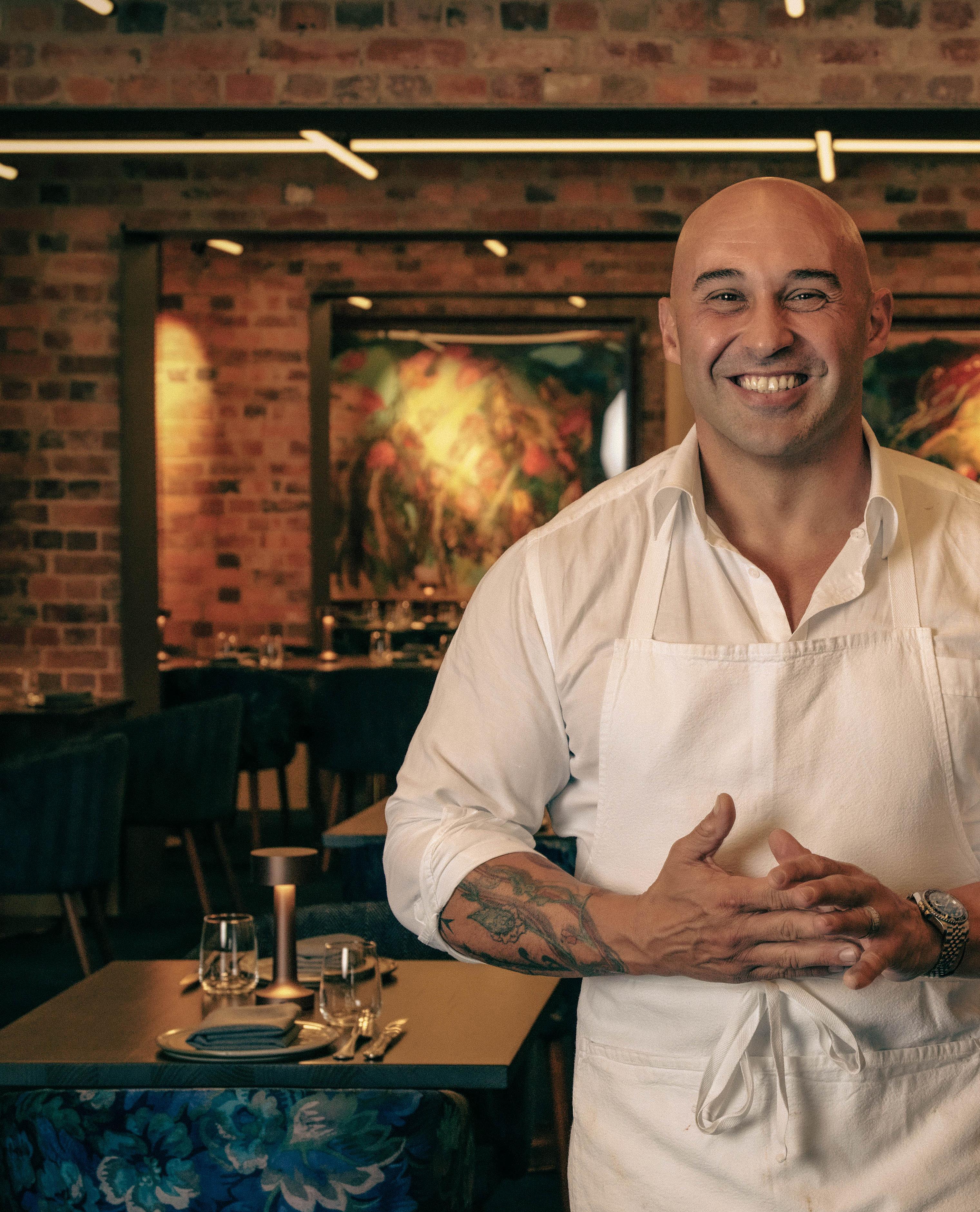
Shane Delia, celebrated Australian chef, restaurateur and television presenter, has built his entire career around experience first, meal second. When asked what mindset shift aged care leaders need, his response cuts straight to the heart.
“The people living in aged care are the foundation of the Australian culinary landscape. They helped create what we, in the food industry, have today,” Shane says.
“If anyone values great food, real produce and connection through food, it is them.
“Food was how they showed love. It was how love was shown to them.”
“It should never be reduced to just nutrition or sustenance. It is still a way to provide experience and memories.”
In a setting where residents can easily lose touch with their sense of self, food becomes a powerful bridge back to identity, their ethnicity, their childhoods and the dishes they once prepared for others. With the right intent and attention to detail, it strengthens that connection every single day.
Building genuine anticipation
Shane’s restaurants hum with energy because guests look forward to every visit. One of the reasons Shane’s restaurants resonate so deeply with guests is that they create anticipation. People look forward to the experience before they even arrive. There is energy, expectation and a sense that something thoughtful awaits them. Aged care environments, while vastly different from hospitality venues, can still learn from that principle. The opportunity lies in creating moments that feel personal, unexpected and genuinely worth looking forward to.
“Celebrate Baltic cuisine one day, Asian cuisine the next,” he suggests. “Give them a chance to relive something. Or finish the meal with a little piece of baklava or a moon cake, something special rather than a biscuit from a tin. Moments of surprise and delight go a long way. When expectations are low, exceeding them is easy, and you win.”
He also encourages providers to place residents and their families at the centre of the experience. Many arrive with rich histories, strong memories and treasured recipes that can be revived through thoughtful care.
Feature ‘Mary from Room 3’s spanner crab pasta’ or ‘Boris’s beef bourguignon’ on a beautifully printed menu, and mealtime becomes more than service – it becomes recognition, pride and storytelling.
Families often share “Mum’s tuna pie” stories. When teams incorporate these into menus, that sense of connection ripples through the entire community. These are not large-scale transformations, but they are powerful, and teams can increasingly achieve them by treating dining as an experience rather than a task.
Environment, choice and respectful presentation
Shane acknowledges that aged care operates within different constraints from fine dining, but maintains that the environment remains critical to the overall experience.
“It is the small things,” he says. “A lovely printed menu instead of something slapped on a tray. Table settings that feel premium. Engaging the community so residents see their own recipes on the board. People get excited when they see ‘Anna’s pudding’. They talk about it, and they feel proud.”
Choice, even when limited, plays a significant role in reinforcing autonomy and dignity. Small considerations, such as pre-selecting meals, choosing where to sit or offering an occasional outdoor dining experience, can shift how residents feel about their day.
“Giving choice and unexpected experiences works at any end of the dining spectrum,” he notes.
For residents on texture-modified diets, presentation becomes even more important.
“If it looks poor, you do not want to eat it, no matter your age,” Shane says. “Purée it if you must, but serve it in something nicer than a sterile dish. Mould the pumpkin so it looks like a pumpkin. Drizzle a flavoured oil on top. Make it smell and taste like it was cooked with care.”
These improvements are not necessarily high-cost. Better crockery, warmer service temperatures and thoughtful presentation signal respect and, when embedded well, can be delivered consistently.
Hospitality lessons care teams can apply immediately
Front-of-house teams in hospitality are trained to read a room instinctively. The same capability exists within care teams and can be further developed with focus and intent.
“Body language says everything,” Shane explains. “Walk the dining room, ask ‘How is everything?’ and really listen. If someone wants another piece of bread or tells you straight out what they think, act on it.
Asking for feedback and doing nothing is a slap in the face.
Everyone just wants to be heard.” At its core, this is about respect and about recognising the people in aged care for who they are and what they have contributed.
What great everyday dining really looks like
If asked to define an ideal everyday dining experience in aged care, Shane’s priorities are simple-but powerful in execution.
It starts with relevance. Food must reflect the community it serves, not a standardised approach.
It is followed by simplicity done well. As he puts it, “I would not try to razzle-dazzle anyone. I would just want it to taste bloody good, on par with what they cooked at their best.” And it must be delivered with intent through generosity, warmth and genuine care.
Food as legacy, not just service
Shane illustrates this through a formative memory from his childhood. Expecting an ordinary lunch at his grandfather’s home, he instead found himself part of a deeply meaningful experience – preparing a traditional rabbit stew alongside his family.
“It sounds graphic, but it was beautiful,” Shane recalls. “I felt I was being taught something, passed something down, from my grandfather to my father to me.
That feeling of love and skill being handed on is what drove me to become a chef. I wanted to carry that same soul and make people proud.”
This is not a story about fine dining. It is a reminder that food carries meaning-connection, identity, culture, and care.
And that is exactly what aged care dining environments have the opportunity to deliver everyday.
A leadership opportunity
For aged care and retirement leaders, dining is not a peripheral service. It is a daily, visible expression of care quality, dignity and organisational intent.
In a sector increasingly focused on experience, differentiation and consumer expectation, it also represents a tangible opportunity to lead.
In the end, as Shane Delia reminds us, the goal is straightforward: treat every resident the way we would want our own grandparents treated.
With respect. With soul. And with a dining experience that quietly says, “I am listening to what you have to say.”
Most aged care operators can see their care minutes. They suspect AN-ACC funding is being missed. They know their roster could run leaner. But data alone doesn’t tell you what to fix first – or what breaks when you fix it.
How It Works
1. We collect and contextualise your data – rostering, payroll, clinical and funding.
2. We translate into a sequenced stabilisation roadmap.
3. We connect your systems into the Care Performance Nervous System.
Chose how deeply the Care Performance Nervous System integrates into your operations:
Provider Assist Sponsor
Digital Only
Connect your systems and let the platform surface insights, flags and opportunities automatically.
Guided Strategy
Digital platform plus specialist guidance –our experts interpret the signals and sequence the right actions.
Case Study – Smart Stabilisation Strategy
Full Nervous System
The complete experience – digital infrastructure, specialist expertise and full outcome ownership.
A facility was running at a 4-star care minute rating against a 3-star target – delivering more care than required, burning agency spend, and sitting on $250K in missed AN-ACC funding.
Rather than immediately chasing the funding, we stabilised first – restructuring the workforce strategy to reduce agency costs and roster inefficiency while maintaining 3-star compliance throughout.
Result: $350K funding opportunity recovered. Zero compliance disruption.
Book Your Care Performance Control Analysis
We’ll assess your facility’s Revenue, Workforce and Compliance alignment – and show you exactly where your risk and opportunity lie. Reports tell you what happened. The Care Performance Nervous System tells you what to do next.
Proof it Works
“Behind every safe decision is a life lived a little less freely.”
Professor Joseph Ibrahim, Academic Researcher and Senior Medical Specialist in Geriatric Medicine
When safety kills living: The risk we’re not talking about
The aged care sector didn’t need a Hollywood film to tell it that protecting dignity and mitigating risk matters.
Everyday, thousands of people working in aged care show up quietly and resolutely, doing their best to provide safe, respectful and dignified care. The language of dignity and rights-based care is firmly embedded in legislation, reinforced through regulation, and echoed across organisational values.
But as many older people living in care – and the people supporting them – know, there is a gap between what we say and what actually happens.
In practice, dignity and risk do not work side by side; they often pull in opposite directions.
Professor Joseph Ibrahim has spent decades examining this tension. His view is clear: the system speaks the language of dignity but is built to manage risk, and that shapes everything.
Contributor: Professor
Joseph Ibrahim, Academic Researcher and Senior Medical Specialist in Geriatric Medicine
Life is risky
Aged care does not exist in isolation from the rest of society. It reflects our broader expectations, fears and assumptions about ageing, safety and responsibility.
“Society has created the residential aged care sector, and we’ve placed people in there to live, and many have said the problem is solved,” Ibrahim says. “It is not solved.”
At the moment someone transitions into residential care, something fundamental shifts. Their independence becomes conditional, and their preferences, while acknowledged, are no longer entirely their own.
“The new Act is anchored in providing rules around what we choose as a society to do or allow,” he explains.
Yet beneath these rules sits a truth that is far less comfortable to confront: there is no such thing as zero risk.
Risk in aged care isn’t just clinical; perception shapes how we understand and respond to it. A resident may prioritise independence, a family may prioritise safety, a staff member may prioritise compliance, and a regulator may prioritise accountability. Each is looking at the same situation, but through a different lens.
“When you talk about risk, you also have to talk about how people perceive risk, because that influences behaviour,” Ibrahim says.
It is here that complexity begins to take hold. People interpret the same decision differently, depending on who is involved, what has happened before, and what might happen next. What emerges is not clarity, but tension. In some cases, risk is over-controlled, limiting a person’s ability to live freely. In others, it is under-managed, exposing them to harm. Between these extremes sits what Ibrahim describes as the “messy middle”, the place where real, person-centred care actually exists, but where the system struggles to support it.
When systems can’t hold both dignity and risk
To manage this complexity, the sector has turned to regulation. But regulation, by its nature, seeks consistency, while dignity requires individualisation.
“You cannot conduct a risk assessment for a single hazard and apply it across the sector,” Ibrahim explains. “You have to always look at context – at the person.”
This is where a context-driven approach begins to strain the system. Something as simple as eating illustrates the challenge. At home, choosing what to eat is an everyday expression of autonomy. In residential care, the same decision can quickly become a risk, with consequences if something goes wrong.
“Any rules about risk of eating can never truly be rules; they can only be guidance,” he says. “Because they must be reassessed for each individual.”
Despite this, systems attempt to codify risk through policies, procedures and forms. These tools are designed to create clarity and consistency, but they often fail to capture the nuance of individual circumstances.
“What regulation is trying to do is codify risk and respect dignity by writing it into forms,” Ibrahim says. “But these forms don’t work, because risk depends on who you are and the situation you are in.”
In trying to standardise something inherently variable, the system creates rigidity where flexibility is required.
The rise of defensive care
This rigidity has consequences on the ground.
The system expects staff to uphold dignity while it prioritises risk avoidance. At the same time, staff are acutely aware that they will be held personally accountable if something goes wrong.
“If something goes wrong, I’m the one held accountable,” Ibrahim says.
It is within this environment that defensive care takes hold. Pressure, not indifference, drives it. Staff are navigating complex decisions in a context where the margin for error feels increasingly small.
The potential consequences are not abstract. They can affect livelihoods, reputations and, for some, the ability to remain in the country. Faced with this reality, it becomes understandable why risk minimisation often overrides other considerations.
“I can understand why people adopt a very defensive mindset,” Ibrahim says. “You can’t simply tell people to relax and expect that to disappear.”
A system shaped by pressure
The pressure shaping aged care practice extends beyond regulation. It is reinforced by the broader environment in which the sector operates. The broader environment in which the sector operates reinforces it.
“The sector is nearly always on the defensive,” Ibrahim explains. “The predominant stories that come out are generally negative.”
While scrutiny plays an important role in accountability, its cumulative effect can be profound. Over time, a narrative focused primarily on failure contributes to a culture where avoiding mistakes becomes paramount.
“You feel people are only looking for faults, and very few are acknowledging good or exceptional care.”
This perception creates a feedback loop. The more the sector feels scrutinised, the more cautious it becomes. The more cautious it becomes, the more it leans into risk avoidance, even when that comes at the expense of a person’s autonomy.
The “messy middle” we struggle to manage
Balancing dignity and risk is not a simple exercise. It requires time, expertise and resources, as well as a willingness to engage with complexity rather than avoid it.
Supporting something as seemingly straightforward as food choice, for example, can involve understanding a person’s cognitive capacity, their clinical condition, and the safest way for them to eat. It may require input from multiple professionals and ongoing reassessment as circumstances change.
“The whole point of risk mitigation is to address contributing factors and reduce risk as much as possible,” Ibrahim says.
But this level of individualised care cannot be achieved through standardised processes alone. It demands a system that is equipped to support nuance, not suppress it.
At present, that system does not fully exist. Instead, simplified approaches are often relied upon, not because they are ideal, but because they are practical within existing constraints.
A promise not yet realised
Many describe residential aged care as a person’s home. It’s a comforting notion, and one that aligns with the sector’s aspirations.
But the lived reality is more complicated.
People do not always have the same freedoms they once did. Systems, policies and responsibilities mediate their choices in ways that don’t exist in a typical home environment.
“There is a contradiction,” Ibrahim explains.
“On one hand, we say it’s their home, and they can live how they choose. On the other, we apply rules because they are considered a vulnerable population.”
This contradiction is not easily resolved. Instead, the system moves between these positions depending on the situation, without fully addressing the tension between them.
“We’re not good at dealing with the messy middle,” he says.
If dignity matters, funding must follow
The question of dignity and risk cannot be separated from the resources available to support it.
“Most people in aged care are doing their level best,” Ibrahim says. “But there are structural barriers and insufficient resources to deliver the care we want.”
If dignity is to move beyond aspiration and into practice, it must be backed by appropriate funding and support.
“If the intent of the Act were genuine, the funding model would have matched it,” he says.
Without this alignment, expectations continue to rise while the system’s capacity to meet them remains constrained.
What needs to change
Addressing these challenges requires more than incremental adjustments. It calls for a broader shift in how dignity and risk are understood and supported across the system.
Leadership must extend beyond individual providers to include regulators, professional bodies, educators and policymakers. There needs to be greater clarity about
how dignity of risk is interpreted and applied, particularly in situations where outcomes are not as intended.
“What we need is consensus about how we approach dignity and risk, especially when something goes wrong,” Ibrahim says.
Without this, uncertainty persists, and with it, the conditions that sustain defensive care.
From blame to a ‘just culture’
Other sectors have grappled with similar tensions and have moved towards what is known as a ‘just culture.’ This approach recognises that while accountability matters, so too does understanding the role of systems, complexity and human factors.
A ‘just culture’ acknowledges that people come to work with the intention of doing their best. When something goes wrong, the focus shifts from blame to learning, and from individual fault to collective improvement.
“We haven’t achieved a ‘just culture’ in aged care,” Ibrahim says.
Until that shift occurs, the instinct to avoid risk will remain deeply embedded.
The real question
At its core, the issue comes down to a question that is both simple and difficult to answer.
If a staff member supports a resident’s informed choice, and something goes wrong, will the system stand behind them?
Or will it hold them solely accountable?
Until there is clarity on this point, behaviour is unlikely to change.
Why safety keeps winning
Dignity and risk are not opposing forces. They are both essential to living a meaningful life.
But at present, the system asks staff to navigate this balance without consistent guidance, sufficient support or the reassurance that the organisation will back them when complexity inevitably arises.
And so, despite the best intentions of those within it, the system continues to prioritise safety over living.
Not because people don’t care. But because that is what it has been built to do.
Dr Simon Longstaff AO, Executive Director of The Ethics Centre
Just because we can, doesn’t mean we should:
Leading ethically in the age of AI
Why ethics-not momentum-must shape the future of aged care
By Amy Henderson, Journalist, Hello Leaders
The most dangerous decisions are not always the reckless ones. More often, they are the decisions that arrive dressed as progress – well signposted, widely accepted and enthusiastically repeated until they seem inevitable.
In aged care and retirement living, the risk of mistaking momentum for progress is especially acute. The sector is already under immense pressure to do more with less, to modernise, to innovate, to increase responsiveness, to improve sustainability and to meet a rising tide of consumer and regulatory expectations. In that kind of environment, any technology promising efficiency, predictability and savings can quickly begin to feel less like an option and more like an obligation.
Artificial intelligence has entered that landscape with extraordinary force. Its pace has been breathtaking, its capabilities startling even to many of those building it, and its commercial promise impossible to ignore. Across sectors, leaders are being told, in increasingly direct terms, that this is the road ahead, and that if they hesitate, they will fall behind.
But Dr Simon Longstaff AO, Executive Director of The Ethics Centre and co-founder of the Festival of Dangerous Ideas, argues that this is precisely the moment when leaders must slow down enough to think more carefully, not less. Because the central question is not whether AI can be used in aged care. It undoubtedly can. The deeper and more consequential question is whether leaders should embrace every application simply because it is available, efficient or becoming common practice.
For Longstaff, that is where ethics begins.
The danger of unthinking momentum
History is full of moments when individuals, institutions and entire industries have looked back on catastrophic decisions and struggled to explain how they ever came to seem acceptable. Whether in financial markets, corporate failures, wars or systemic institutional harm, the explanation often carries a haunting simplicity: people did not stop to examine what they were doing because it had become normal. The path was already there. Everyone else was taking it. The alternatives seemed slower, less certain or somehow unrealistic.
Longstaff has heard this pattern often enough to recognise it immediately.
When people are asked why they failed to anticipate the consequences of what they were doing, he says, the answer is often some version of the same refrain: “because everyone was doing it, that’s just the way things are done.”
Aged care cannot afford that kind of moral sleepwalking. It cannot afford to drift into new models of care, surveillance or automation simply because they are commercially compelling or increasingly common. In a sector entrusted with the wellbeing, dignity and humanity of older people,
“unthinking custom and practice” is not merely a leadership weakness; it is a serious ethical failure.
Longstaff’s antidote is not fear of innovation, nor reflexive opposition to change. It is the discipline of reflection. It is the willingness, at every level of an organisation, to stop and ask the most deceptively simple of questions: what should one do?
“The fact that you stop and ask the question, that is, you are doing ethics, is important,” he says. “Ethics is about asking the question, what should one do?”
That question matters because it interrupts momentum. It creates space between what is possible and what is right. It reminds leaders that practicality, popularity and profitability are not sufficient reasons on their own to adopt a course of action-particularly in a setting where decisions shape the daily lived experience of vulnerable people.
Technology is not neutral in practice
Longstaff is careful not to reduce the discussion to simplistic binaries. He does not frame AI as inherently dangerous, nor as inherently virtuous. In fact, he argues the opposite.
“No technology is either good or evil in and of itself,” he says.
That distinction is important because it moves the conversation away from fearmongering and towards responsibility. Technology is not the problem in itself; the problem lies in the assumptions, incentives and values that determine how technology is designed, deployed and justified. Electricity can light a home or electrocute a person. Medication can heal or harm. The moral question does not sit inside the tool; it sits in the human choices surrounding its use.
Yet that is also where the current AI moment becomes especially concerning. The development of these technologies is being propelled not only by curiosity or public good, but by commercial imperatives of immense scale. The companies at the forefront of AI are competing for dominance in what they understand, quite explicitly, to be a winnertakes-most race.
“There are commercial imperatives that are driving this because of very few winners in this race,” Longstaff says. “Ultimately, whoever gets there is going to dominate whole sectors.”
That commercial urgency matters because it shapes how organisations present AI to the world. The narrative rarely reflects caution or nuance. Instead, they emphasise acceleration, inevitability and advantage. Adopt now. Move quickly. Scale fast. Don’t fall behind.
But aged care is not just another sector ripe for disruption. It is not logistics, digital advertising or consumer retail. It is a profoundly human environment in which care is not only delivered, but felt. In such a setting, the standards for adoption must be higher. Leaders must ask not only what a technology can optimise, but what it might erode. Not only what burden it might lift, but what meaning it might strip away.
When efficiency begins to crowd out care
The ethical tension becomes especially visible when AI is marketed as a way to reduce costs and improve oversight in residential care settings. This scenario is not difficult to imagine; in many cases, providers already use these tools. Organisations increasingly position sensors, predictive monitoring systems, behavioural alerts and automated escalation pathways as solutions that help providers respond faster, reduce staffing pressure and create safer environments.
For boards and executive teams facing labour shortages, rising costs and unrelenting operational complexity, those promises can be deeply attractive. Any proposition that offers a more sustainable model while also claiming to improve the quality of care is likely to receive a serious hearing.
Longstaff understands why.
“People are caught between two worlds,” he says, “you’ve got people who are commercially driven and pursuing selfinterest, and you’ve got people who are part of the professions who look to others’ interest first.”
That observation lands squarely on one of the defining tensions of modern care leadership. On one side sits the logic of efficiency, scalability and sustainability. On the other hand, there is the professional and moral duty to preserve dignity, relational care and human presence. The problem is not that one side exists and the other does not. The problem is that they are increasingly being spoken about as if they naturally align, when in practice they may pull in very different directions.
Longstaff offers a confronting example. Imagine a facility where sensors connected to an AI monitoring system surround a resident. If the person becomes incontinent, the system triggers an alert and summons staff. On paper, the case for the system may appear strong: faster response times, greater visibility, reduced risk of missed care, and greater operational oversight.
But ethics begins where operational logic stops.
What does that experience feel like for the person at the centre of it? Would they want the whole floor effectively alerted to a moment of vulnerability? Does a rapid response automatically equate to dignified care? What happens to privacy when systems turn intimate bodily experiences into data points and alerts? And what happens to reassurance, comfort,
embarrassment and tenderness as technology increasingly mediates care?
“The point is it becomes a form of surveillance monitoring, which on paper could be said it’s for the benefit of the seniors, but there’s no real care in it,” Longstaff says.
“There’s nobody, or fewer people, coming to hold their hand or touch them, and say it’s all right, to deal with their distress.”
Longstaff’s insight matters deeply for leaders because it exposes the gap between service delivery and care itself. A process may be efficient, clinically defensible and operationally elegant, and still fail to honour the emotional and relational realities of the person receiving it. In aged care, that distinction is not peripheral; it is everything.
Ethics is not a brake on innovation – it is how leaders govern it
One of the most persistent mistakes leaders make when confronted with ethical reflection is to treat it as a delay mechanism – as something that slows action, introduces ambiguity or complicates decisions that might otherwise appear straightforward. But Longstaff’s argument is much more demanding than that. Ethics doesn’t just temper innovation; it ensures innovation is worthy of the setting it enters.
Leaders cannot outsource moral judgment to the market, vendors, consultants or sector momentum.
When organisations consider a system for use in aged care, they must ask not only whether it works, but also whether it fits, reflects the kind of organisation they claim to be, and protects what should never be negotiable in the care of older people.
Longstaff repeatedly returns to the importance of organisational purpose and declared values. For him, these are not branding devices or cultural wallpaper. They are the standards against which real decisions must be tested, particularly when those decisions become difficult, expensive or inconvenient.
Aged care providers, he suggests, must ask themselves in a much more serious way: what kind of organisation do we really want to be? What kind of people do we want to be in this work? What does it mean to say that dignity, autonomy and personhood matter if our systems
are slowly being built around convenience, surveillance and cost control?
“They might want to ask themselves, what kind of organisation do we really want to be, what kind of people do we want to be working in this area, it’s about who you are, either individually or as an organisation.”
That framing forces a challenge. Leaders cannot treat ethics as a late-stage review applied once implementation is underway. It must shape decisions from the beginning. It must be present when they consider contracts, trial systems, assess business cases and weigh claims of efficiency against the lived experience of residents and staff.
Convenience is seductive, but leadership requires resistance.
What makes this moment so difficult is that the easier path will often look entirely reasonable. That is part of its power.
When technology promises to ease operational strain, fill workforce gaps, standardise responsiveness and lower overheads, it does not present itself as a threat to care. It presents itself as a solution. For leaders already carrying extraordinary responsibility, the temptation to accept that promise quickly is understandable.
Longstaff does not trivialise that pressure. But he is direct about what leadership requires in response.
“And the first step is to resist the temptation to keep, as it appears on the surface, life somewhat easier.”
That resistance is not anti-progress. It is the disciplined refusal to confuse convenience with wisdom. Leaders must be willing to ask not only whether a system helps, but what kind of help it offers and what it may quietly displace. A model that reduces staff burden by reducing human contact may ease one problem while creating another. A system that improves observation while weakening intimacy may solve one operational challenge while undermining the very essence of care.
More than that, ethical leadership requires the courage to confront the implications of one’s own existing practices. As Longstaff notes, once organisations begin seriously evaluating their systems against their declared values, they may find themselves having to abandon actions that once seemed acceptable.
“How does it align with our declared values and principles, all of that requires a bit of extra effort. And it also means you’ll have to confront things which you have been doing that you won’t be able to do anymore.”
That is where ethics becomes costly –not just financially, but politically and personally. It may require a leader to reject an attractive proposition, challenge internal assumptions, disappoint enthusiastic stakeholders or accept that the easiest path is not the right one. But without that willingness, values remain rhetorical and ethics become decorative rather than operational.
The true test of leadership is not adoption, but discernment
For executive leaders, boards and owners, the pressure to appear innovative can be significant. There is often reputational value in being seen to embrace new technology early, to position the organisation as forwardlooking, efficient and digitally mature. But in aged care, discernment matters more than novelty.
Longstaff’s argument is not that leaders should reject AI wholesale. In fact, he is explicit that the technology has substantial capacity to do good. It may alleviate burdens, improve aspects of decision-making and create efficiencies that genuinely benefit both providers and those they support.
“We all need to recognise that this technology does have a great capacity to do good, that it will be able to help alleviate terrible areas of burden.”
But that is not the end of the inquiry. The existence of a benefit does not eliminate the need for judgment. In fact, it increases it, because the more promising a technology appears, the easier it becomes to overlook what it may cost.
Longstaff warns that even sincere advocates may become “almost evangelical” in their encouragement of AI, dismissing concerns as fear-driven, old-fashioned or resistant to progress. That cultural force is powerful. It can make caution appear unsophisticated and ethical hesitation seem naive.
Which is why leaders must be clear about the purpose they serve.
“Your strength in your response comes from becoming absolutely clear about what the defining purpose you serve. What are the core values and principles, and then use those consistently to evaluate.”
At the heart of CEO-level judgement is clarity of purpose, values and principles. Not reactive adoption. Not reflexive rejection. But principled evaluation. The capacity to say: this fits our purpose, that does not. This may help, but only if we bind it in these ways. This may improve efficiency, but not enough to justify the compromises it entails. This is useful as a support, but unacceptable as a substitute for human care.
That kind of discernment is more demanding than enthusiasm. It requires moral confidence, strategic patience and a much more mature understanding of innovation than the market often rewards.
Profit matters, but it cannot be the highest good
Longstaff is unsentimental about the realities of business. He does not deny that providers must be financially viable, nor does he suggest that cost or sustainability are unimportant. In fact, he explicitly recognises them as legitimate considerations.
What he refuses, however, is the elevation of those considerations above all others.
“That’s why in aged care, leaders have to give greater weight to these broad ethical considerations rather than just the simple imperative to increase profit or minimise cost or any of the other things that could be taken into account. It’s not to say those things are not important, but within a broad ethical framework, [finance] that will be one consideration but not the only.”
This is a crucial distinction for the sector. Financial sustainability is essential, but in care settings, it cannot become the sole organising principle. When it does, the person receiving care risks being reduced to a bed, a unit cost, a throughput challenge or a compliance burden. And once that shift occurs, dignity begins to erode.
Longstaff articulates the point with stark clarity.
“If an aged care facility or business cannot be run profitably without a sound ethics framework, then you should not be in business.”
It is a sentence that deserves to land heavily. Because it insists that ethics is not an optional extra once margins are secure, it is part of the enterprise’s legitimacy. In a sector built around vulnerable human lives, profitability cannot justify moral compromise. It must coexist with a serious ethical framework, not override it.
Human dignity must remain non-negotiable
Among the most important ideas in Longstaff’s argument is his insistence that treating a person merely as a means to an end violates dignity. That end may be efficiency, profitability, convenience, risk reduction or even system performance. The language used to justify it may sound reasonable. The metrics may look positive. But if the person at the centre of care is no longer being regarded as a full human being with agency, privacy and intrinsic worth, something essential has already been lost.
“Human dignity is violated whenever you are treated as a means to an end. A unit of production or a number in a bed, a price point.”
This ethical distinction matters profoundly in discussions about monitoring, tracking and
predictive technology. Consent, autonomy and context cannot be afterthoughts. There is, as Longstaff notes, a significant ethical difference between using incontinence tracking with a person’s informed consent and doing so without it. One may be part of supportive care; the other risks becoming an act of control dressed up as innovation.
“Autonomy preservation is important. There’s a big difference between applying incontinence tracking without the consent of the person concerned and with it.”
That distinction is likely to become even more important as technology becomes more sophisticated and more ambient. The less visible the systems become, the easier it is for leaders to assume they have resolved ethical questions simply by satisfying operational concerns. But invisibility does not equal innocence. It demands even greater vigilance.
There are still things only humans can do
Perhaps the most powerful element of Longstaff’s perspective is that it does not descend into panic or technophobia. It remains grounded in a calm but insistent belief that some elements of care are irreducibly human.
“AI is far better at diagnosing certain forms of cancer, but only a human can tell you you’re going to die.”
It is a line that cuts cleanly through the noise. Whatever advances technology brings, and they may be considerable, some dimensions of care cannot be replicated by efficiency, prediction or system responsiveness.
Presence. Empathy. Reassurance.
The capacity to sit with another person in discomfort, grief, confusion or shame. The subtle reading of emotion. The moral weight of touch. The dignity conferred by genuine human attention.
Longstaff’s point is not sentimental. It is strategic. If leaders fail to identify and protect those ineliminable elements, they risk building systems that are highly efficient but no longer worth calling care.
“So I’d say to people who are thinking about AI and aged care, of course, look at it and see where there can be efficiencies and what can be done, particularly with a lens to improving the experience of those you care for,” he says.
“But there are certain ineliminable elements that you will have to preserve that are nonnegotiable; otherwise, without those, you are not offering something worth offering.”
For aged care and retirement living leaders, that may be the defining challenge of the coming decade. Not whether to engage with AI, but how to do so without surrendering the qualities that make care humane, trustworthy and worthy of the people it serves.
The question leaders must keep asking
In the end, Longstaff’s argument returns us to a discipline that is both ancient and urgently contemporary: the discipline of asking what should be done before deciding what can be done.
That question may slow a room down. It may complicate an otherwise clean business case. It may expose tensions among purpose and profit, efficiency and empathy, and what is technically possible and what is morally defensible.
But that is precisely why it matters.
In a sector where older people entrust organisations not only with their safety but with their dignity, identity and daily experience of life, momentum is not enough. Popularity is not enough. Commercial logic is not enough.
Leadership demands something more searching than that.
It demands the courage to examine the road before joining the traffic.
Because in aged care, perhaps more than anywhere else, just because we can does not mean we should.
HELF
is either your next revenue stream or your biggest leak.
See better care
The only digital care delivery platform built by care, for care.
“Care isn’t the thing that replaces independence — it’s the thing that supports it.”
Daniel Gannon, Executive Director of the Retirement Living Council
Daniel Gannon, Executive Director of the Retirement Living Council
Care as infrastructure, independence as outcome:
Why retirement living is not simply becoming aged care
By Jakob Neeland, Journalist, Hello Leaders
The idea that retirement living is slowly becoming aged care has gained traction in policy circles and industry commentary alike. With Australia’s ageing population, rising acuity and persistent pressure on residential aged care, the logic appears straightforward: as care needs increase, retirement villages will inevitably shift toward a more clinical, care-led model.
But according to Daniel Gannon, Executive Director of the Retirement Living Council, that assumption is not only flawed, it risks steering the sector in the wrong direction.
“There’s a leap that feels logical, but isn’t,” he says. “That more care automatically means less independence.”
Gannon is clear: the narrative that retirement living will become a form of aged care misunderstands both the product and the people it serves.
Breaking the binary
At the heart of the issue, Gannon argues, is a deeply ingrained binary way of thinking.
“We’ve created this idea that you’re either independent or you’re ‘in care’,” he says. “That if care is present, independence must recede. That’s the wrong mental model.”
In reality, care in retirement living is not a switch that flips on at a certain point. It exists on a continuum, often from the moment a resident moves in.
“People choose retirement living because it removes friction,” Gannon explains. “Maintenance, safety, emergency response, help with the daily load. That’s care. It’s just not always labelled that way.”
This distinction matters. When care is understood only as clinical or institutional, its presence can trigger a shift in how a community is perceived, by operators, regulators and residents themselves.
Giving Victorians confidence their financial and legal affairs are in good order. Since 1940.
Life admin made simple. We handle wills, powers of attorney, trusts and estate administration, giving your clients certainty today and peace of mind for tomorrow.
state trustees
To refer your clients, or connect with a Relationship Manager Scan the QR code
“And it’s not a harmless misunderstanding,” he says. “Because once you accept that model, everything downstream changes. You design around the wrong idea. You deploy capital differently. You market reassurance instead of possibility.”
A different framing
Gannon’s counterpoint is simple, but carries significant implications.
“Care is the infrastructure. Independence is the outcome.”
It is a reframing that challenges the sector to rethink its foundations. Rather than viewing care as the opposite of independence, it becomes the mechanism that enables it.
“Care isn’t the thing that replaces independence,” he says. “It’s the thing that supports it.”
Crucially, Gannon is not talking solely about clinical care. In fact, he suggests that framing is part of the problem.
“Sometimes the word ‘care’ gets heard as ‘clinical’, and that spooks people,” he says. “But most of what older Australians need is practical support that keeps life open. Help to live life, not a hospital ward.”
That includes everyday assistance, but also connection, purpose and community.
“Think about it as care about people, not just care for them,” he adds.
When support expands life
Spend time in retirement communities, Gannon says, and a clear pattern emerges.
“When everyday living is hard work, people conserve energy. They say no more often. Life gets smaller,” he says.
“But when that day-to-day load is lifted, independence doesn’t fade. It accelerates.”
Residents travel. They learn. They reconnect. They take on new challenges.
“People don’t retreat,” he says. “They expand.”
This is not simply anecdotal. It reflects a broader behavioural dynamic that has significant implications for how retirement living is designed and delivered.
That confidence becomes particularly important during key life transitions, such as the loss of a partner or declining health.
“Those are the moments where independence is either protected or quietly eroded,” he says. “And what we see, time and again, is that when people feel supported and connected, they don’t withdraw. They grow in confidence.”
A sector already delivering care
While some narratives suggest retirement living is resisting care, Gannon says the opposite is true.
“This sector is not anti-care. In fact, we’re already delivering it at scale,” he says.
A growing proportion of villages now offer regulated care and support services, and many new developments include co-located residential aged care.
“We are investing in care, and we’ll continue to,” Gannon says. “Because the demand is real, and the system needs more capacity.”
But this is where the tension begins to emerge.
“The risk isn’t care,” he says. “The risk is what the system starts to call you once care is present.”
The identity shift
As care becomes more embedded in retirement living, there is a growing tendency to define these communities by the services they provide.
“If people live somewhere, and they need ongoing care, and the environment is equipped to support them, the logic says that place must be a residential care home,” Gannon says.
“It feels neat. It feels rational. But it’s a high-stakes assumption.”
The problem, he argues, is that this framing ignores the lived experience of residents.
“It doesn’t ask the only questions that matter,” he says. “How do people live? What do they choose? What do they still do?”
Instead, it focuses solely on services, which can trigger a cascade of consequences.
“Once services define you, identity shifts,” Gannon says. “And when identity shifts, everything shifts. Regulation, staffing, design, expectations, the way capital prices you.”
For operators, this creates a complex strategic environment. Expanding care capability can increase both risk and cost, but it also enhances the value proposition.
“When you internalise higher levels of support, the risk profile steps up,” he says. “Systems, skills, resources, cost. All of it.”
“But the customer value steps up too. And that’s what supports premium pricing and makes feasibility work.”
A deliberate choice
Gannon is clear that the sector cannot avoid this tension. Retirement villages will continue to absorb pressure from the broader care system.
“The question is not whether we deliver more care,” he says. “We will. We are.”
The real question, he argues, is how that care is integrated, and what it ultimately represents.
“Can we deliver more care without redefining residents primarily by their needs?” he asks. “Can we treat care as enabling infrastructure, rather than a signal that life has narrowed?”
For leaders, this is not a theoretical debate. It is a practical governance challenge that should be addressed explicitly.
“This is a board-level question,” Gannon says. “Not something to drift into.”
He points to three critical tests for organisations navigating this space.
“First, identity. Are you selling dependence, or extending capability?”
“Second, design. Is support something residents use, or something we label them by?”
“Third, measurement. Do you reward risk-avoidance, or independence outcomes?”
“Get those wrong,” he adds, “and it won’t just shift compliance. It will shift behaviour.”
The story the sector tells
Looking ahead, Gannon believes the sector is shaping a narrative that will define it for years to come.
“In ten or fifteen years, people will look back at this period and tell one of two stories,” he says.
“One is that retirement villages quietly surrendered their identity. That in responding to care demand, they let services and classification do the defining.”
“The other is that we made a deliberate choice. That we invested in care as
infrastructure, so independence remained the outcome.”
The distinction, he suggests, comes down to how well the sector understands its own value.
“People don’t stop wanting independence because they need support,” Gannon says. “They lose independence when systems make life harder than it needs to be.”
Redefining independence
For Gannon, independence is not about the absence of care. It is about the ability to continue living well, with choice and control, even as needs change.
“If you want a simple definition of independence, it’s living well right to the end,” he says. “Having the care you need, when you need it, in the home you love, with your people around you.”
In that context, the presence of care is not a sign of decline. It is what makes that outcome possible.
“Care didn’t end independence,” Gannon says. “It made it possible.”
For leaders, the message is direct. The line between retirement living and aged care may be shifting, but the sector still has agency.
The challenge is not to resist care, but to define it on its own terms, and to design for what it enables.
Because ultimately, as Gannon puts it, “the question isn’t how much care you provide.
It’s what that care makes possible.”
Platinum6
Care. Connection. Compliance. At every touch point.
Platinum6 continues to lead with integrated Apps and workflows across your organisation.
At Leecare, we believe quality care is only possible when every voice is heard, every professional decision is recorded, every medication is safely managed, and every ‘loved one’ can feel connected. That’s why we continue to lead with innovative Apps that embed governance and connection at every touch point.
Dr
Caroline Lee, CEO & Founder
P6My CarePlan
P6Med
Families connected
Residents, clients, loved ones and staff share documents, photos, care preferences, news, newsletters, feedback, care plans, events and the Monthly Care Statements, giving families and providers a transparent, dignified care partnership.
Governance you can prove
Australia’s first aged care eNRMC-aligned system. With our updated design, supporting easy error-free prescribing, dispensing and administration. Ask to see why facilities, Pharmacists and GPs are now selecting P6Med, benefitting from real time clinical information, automated alerts and action dashboards. Full compliance for the whole healthcare team.
Every voice heard
Real-time consumer and visitor feedback in 80 languages. Surveys, visitor management, analytics dashboards and direct integration with Platinum6 ensures issues are resolved and accountability is proven.
P6
Mobile App
at point of care, in a clients home, easy care and notes documentation, care reference, tasks sign-off and photo taking, ensuring staff can complete information sharing without the burden of computer access.
CAREFUL – Collaboration documented
A secure communication space for health professionals to share decisions and tasks per resident/client. Every update is recorded and sync’d, creating a defensible governance trail.
P6Mobile
Scan to book a no obligation demo and download our Executive Readiness Checklist
Readiness Checklist
The bigger picture.
One platform. Every detail of care.
One platform. Every detail of care.
Platinum6 remains the most advanced, fully integrated aged and community care system in the industry.
Platinum6 remains the most advanced, fully integrated aged and community care system in the industry.
From assessments and medication management to finance, operations and business intelligence, it unites every aspect of care into one central record.
From assessments and medication management to finance, operations and business intelligence, it unites every aspect of care into one central record.
Board-level dashboards and analytics for oversight P6Exec
Board-level dashboards and analytics for oversight P6Exec
supporting specialist billing for 1 Nov, residential care, support at home and billing, accounts’ management, budgeting, reporting and reconciliations.
supporting specialist billing for 1 Nov, residential care, support at home and billing, accounts’ management, budgeting, reporting and reconciliations.
We want to support our clients, so the people they support can experience the best possible quality of life.
We want to support our clients, so the people they support can experience the best possible quality of life.
Designed to work the way you do, so boards and leadership teams can work smarter, move faster, and achieve more.
The productivity pinch Why better care is leaving some Australians behind
By Jakob Neeland, Journalist, Hello Leaders
Contributor: Tim Hicks, Bolton Clarke, Executive General Manager Policy and External Relations
The Australian aged care sector is confronting a fundamental and increasingly unavoidable tension: the imperative to lift and sustain care standards for a growing number of older Australians, while the higher per-resident costs of recent years are beginning to limit the system’s ability to reach everyone who needs support.
Tim Hicks, General Manager of Bolton Clarke, one of Australia’s largest aged care providers, argues that productivity must now sit squarely at the centre of both sector strategy and policy thinking – not as a trade-off against care, but as the mechanism that will ultimately determine its sustainability.
“Fundamentally, what we have in Australia, economy-wide, is not a challenge with the ageing population,” he says. “It’s a challenge with making sure that we continue getting richer at the rate we need to support the rate at which we’re getting older.”
Hicks begins by reframing the long-standing demographic narrative that has shaped public policy for decades.
“For a very long time, we’ve been worried about the ageing population, and we’ve been worried about the participation rate in Australia falling and having fewer working-age adults to support the ageing population. That’s kind of been the bogeyman in Australian public policy circles for most of the 21st century.”
In reality, participation has not fallenit has increased, driven by migration, greater workforce participation among women, and people retiring later.
“What we should really have been worried about is productivity,” Hicks states.
“Economy-wide, we’ve seen ongoing declines in our national productivity. If productivity had held up – if we were able to achieve the sort of productivity growth that we did in the 90s – we wouldn’t have any trouble affording the sort of care that we need to support the ageing population.”
A system that has improved –but at a cost
This macroeconomic reality is mirrored within aged care itself. Australians are ageing in better health, with measurable gains in prevention and communitybased support reducing the need for residential care.
“We have fewer people in residential care than we did 20 years ago,” Hicks notes. “If we hadn’t been ageing in better health, then we’d have tens of thousands more people in residential care. It would be costing the federal government billions of dollars more per year.”
Prevention has delivered significant fiscal relief. In parallel, the sector has rightly focused on lifting care standards following the Royal Commission –a shift that has produced tangible improvements across clinical indicators and resident experience.
“Most people are happy most of the time with the care that they get,” Hicks says. “Depending on the survey tool, depending on the exact nature of the question, anywhere between 70 per cent and 85 per cent of people say that they are satisfied with their care, that they would recommend their residential care service, and that they have a good or excellent consumer experience.”
The challenge now is no longer simply demonstrating that care has improved; it is ensuring that those improvements can be sustained and extended across the entire system.
“Because we spend so much more per person receiving care, we’re now having difficulty affording to provide everyone who needs it with at least some level of care,” Hicks explains.
“The solution to that has to be finding ways to deliver the same or better quality more cost-effectively.”
Reframing the role of efficiency
To achieve this outcome, the sector needs to rethink what efficiency really means.
“The first step needs to be actually being willing to have those conversations,” Hicks says.
“A mature conversation about a good aged care system has to involve some discussion about efficiency.”
“It’s not a rude word. It’s not something that should be taboo. Providers shouldn’t treat it as a code for cutting costs. It’s about how we actually make the system workable for the level of demand that’s coming down the pipeline.”
For leaders, this is a critical distinction. In this context, efficiency doesn’t reduce care; it uses limited resources to maximise impact and extend access.
Where productivity is being lost
The most immediate and practical productivity gains, Hicks argues, lie not in large-scale reform, but in addressing the regulatory and documentation burden placed on frontline staff.
Every minute spent on non-care processes multiplies across every shift, home and resident, creating a drag on the system that’s often underestimated.
Corporate reporting requirements add their own layer of cost and complexity, but the most significant impact remains at the point of care.
“The big impact from a regulatory standpoint is for the frontline workforce,” Hicks observes. “It’s looking at the things that they have to do that don’t contribute directly to care, because that gets multiplied out over every single care interaction, every single day across every single person.”
Reducing this burden is not simply an administrative exercise; it is a direct lever for improving both productivity and the time available for care.
Smarter use of existing resources
Hicks points out that providers can unlock productivity within existing frameworks, without additional funding, by using resources more flexibly.
Residential staffing requirements, for example, are structured as home-level averages rather than rigid, residentby-resident mandates. This approach creates the potential for providers to allocate care minutes more strategically.
“What could be done, theoretically, is for a large provider like Bolton Clarke, you could take some care minutes from one home and use those to invest in delivering the higher level of care that you need to get some of those really challenging patients out of hospital,” Hicks says.
“It’s really being able to shift the care minutes around to where they deliver the biggest benefit. It doesn’t cost any extra money, it just means resources can be devoted to the places they’re most needed.”
A similar opportunity exists within home and community care.
The current classification system allocates funding based on average need, which can result in some individuals receiving more than is required, while others receive less. Unspent funds are returned at the end of each quarter.
“One of the obvious solutions is actually letting providers allow the funds that are unspent… to be used to top up the services for those who need extra support,” Hicks argues.
“Again, no extra cost to government… just letting the money go to where it’s actually needed.”
Reducing duplication and refocusing effort
Regulators can unlock further gains by rationalising requirements, particularly where duplication diverts clinical and administrative effort away from care.
Dual reporting for residents funded under both the Aged Care Act and the NDIS is one such example.
“It’s really just a waste of everyone’s time and a diversion of resources away from service,” Hicks notes.
Similarly, serious incident reporting could be recalibrated to prioritise learning and improvement over volume and detail. Similarly, regulators can recalibrate serious incident reporting to prioritise learning and improvement over volume and detail.
“The point here is not to have our workers produce huge amounts of paperwork,” Hicks explains. “It’s to understand when things go wrong, why they went wrong, and what we need to do to make sure they get better next time.”
In some cases, he suggests, simpler reporting may lead to better insights.
The workforce reality
Ultimately, productivity in aged care is inseparable from people.
Large providers may have advantages in scale, systems, and talent development, but those advantages are increasingly eroded by the ongoing demands of implementing reforms and complying with regulations.
“Staff and management in services need some level of stability so they can actually focus on service delivery,” Hicks states.
There is a limit to how much change the systemand its people-can absorb at once.
“People only have so much attention, so much energy and effort,” he says. “People in the aged care sector work really hard.”
The risk of continued pressure is not abstract.
“If you continue to place additional pressure on people and more of them just say ‘stuff it’ and exit the industry, that’s the real tragedy.”
Similarly, regulators can recalibrate serious incident reporting to prioritise learning and improvement over volume and detail.
Where it lands
For sector leaders, the implications are direct and immediate.
Championing more mature conversations about efficiency is no longer optional – it is essential. So too is advocating for smarter allocation of existing resources, whether through flexible staffing models, better use of unspent funds, or streamlined reporting frameworks.
At the same time, protecting workforce stability must remain a priority, ensuring that the talent already within the system can focus on care rather than compliance.
Productivity and quality are not opposing forces. They are, in practice, deeply interdependent.
The sector has already demonstrated its ability to lift clinical outcomes and enhance the consumer experience. The next challenge is to sustain and extend those gains to every older Australian who needs care.
That challenge will not be met through continued cost escalation alone, but through a deliberate, disciplined and sector-wide focus on productivity.
From compliance metrics to quality leadership
How providers can turn mandatory reporting into operational confidence
By Adam Holcroft, QPS Benchmarking General Manager
Mandatory reporting is now firmly embedded across aged care. Care minutes, workforce ratios, incidents and complaints are measured and scrutinised every quarter. For many providers, the reporting burden has grown alongside rising expectations around governance and assurance.
Boards review dashboards. Executives monitor trends. Reform has formalised expectations across governance, workforce accountability and safety reporting.
But metrics alone do not create confidence.
Across the sector, providers are investing significant effort into collecting, submitting and reviewing performance data. Yet the real question leaders are now facing is not simply whether reporting occurs. It is whether the data being reported can be substantiated, reconciled and interpreted consistently.
This reflects a broader shift in the regulatory environment. Reporting is no longer viewed as
a periodic administrative task. Increasingly, it forms part of an assurance framework designed to ensure that information submitted reflects operational reality.
The shift from reporting to assurance
For many organisations, this is where the pressure begins. Fragmented systems, inconsistent definitions and manual workarounds often introduce complexity into the reporting process. Teams spend significant time reconciling figures, checking calculations and validating datasets before submission deadlines. Boards may receive reports that appear stable on the surface, yet the processes used to produce those numbers can vary across teams and services.
Metrics alone do not resolve this challenge.
The organisations performing most steadily under reform are those that move beyond submission toward interpretation. They align definitions across teams, validate source data before reporting deadlines and review patterns longitudinally rather than reacting to isolated quarterly movements.
In these organisations, reporting is treated as an operational discipline rather than a compliance obligation.
“ Adam Holcroft, General Manager, QPS Benchmarking
Data should guide action, not just satisfy a deadline.”
What stable providers do differently
Care minutes are not simply checked for percentage compliance. They are analysed alongside workforce stability and agency utilisation trends. Incident data is reviewed for consistency of classification and emerging patterns, not just volume. Complaint records are linked clearly to actions, outcomes and service improvements.
This approach allows leaders to move from defending numbers to understanding them.
Quality leadership begins when data becomes shared intelligence across clinical, workforce and governance teams. When definitions are aligned and systems connected, conversations shift from explaining discrepancies to identifying insight. Trends become clearer. Variations are identified earlier. Governance discussions mature.
Stable providers are not necessarily those collecting more data. They are those embedding discipline into how data is captured, validated and reviewed.
This discipline also reduces reporting friction. When definitions are standardised and systems are integrated, much of the reconciliation effort disappears. Teams spend less time defending figures and more time focusing on quality improvement.
Leadership in the assurance era
Regulatory expectations will continue to evolve as assurance processes mature. Providers are increasingly expected to demonstrate not only that they meet required thresholds, but that their reporting reflects consistent interpretation and reliable source documentation.
Compliance, therefore, remains essential, but it is now the baseline.
In 2026, the differentiator will not be who reports. It will be those who understand what their data is signalling who can confidently reconcile performance with source records and who use insight to guide operational decisions before issues escalate.
Ultimately, leadership in the current environment requires more than accurate reporting. It requires confidence in the architecture that produces that reporting.
QPS Benchmarking supports providers with verified benchmark data, structured reporting frameworks and system integrations that strengthen assurance readiness and help organisations move from reporting obligations to informed leadership.
QPS is offering free live webinars and demonstrations to walk your team through our platform and help assess your readiness under the evolving standards.