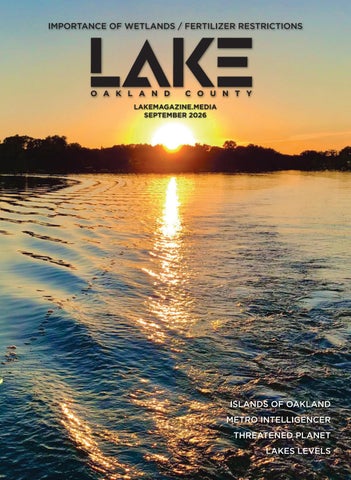
IMPORTANCE OF WETLANDS / FERTILIZER RESTRICTIONS
LAKEMAGAZINE.MEDIA SEPTEMBER 2026
ISLANDS OF OAKLAND METRO INTELLIGENCER THREATENED PLANET LAKES LEVELS
lakemagazine.media
LAKE magazine
1
09.26 9 Guidelines for fertilizing A lush, green lawn may be a point of pride for many lakefront homeowners, but the fertilizer used to achieve it can have unintended consequences which is why the state of Michigan and some local communities have become more active in restricting usage.
18 View from above An aerial view of Commerce Lake which is actually two lakes -- North Commerce Lake and South Commerce Lake – in Commerce Township.
30 20 Importance of wetlands Oakland County still has meaningful wetland resources, but they are under pressure from development, stormwater, invasive species, sediment, altered drainage and a changing legal landscape.
Islands of Oakland County Our monthly feature takes a look at Bird Island on Lake Oakland which straddles Waterford and Independence townships.
31 Threatend Planet 32 Metro Intelligencer 32 Lakes Levels Cover credit: Photo of 7:01 a.m. sunrise on Watkins Lake in Waterford by David Horne.
© Ecophoto | Dreamstime.com
FAMILY OWNED & OPERATED WITH OVER 35 YEARS OF EXPERIENCE SERVING ALL OF OAKLAND COUNTY
BESt RatES - GUaRantEED SavE hUnDREDS cOMPaRED tO DEaLERShiPS nO SPRinGtiME fEES - SPRinG PREP. iS aLWayS PaRt Of OUR OnE aLL-incLUSivE PRicE
OUR SERvicES: • BOAT/PONTOON/TRI-TOON HAULING • WINTERIZING • GENERAL MAINTENANCE & REPAIRS • PREMIUM 7-MIL SHRINK-WRAPPING (MOBILE TOO!) • TOON & BOTTOM WASHING • SECURE & VISUALLY SUPERVISED OUTDOOR WINTER STORAGE • PRE-DELIVERY FUELING SERVICE
2 HAULINGS (FALL & SPRING) ENGINE WINTERIZATION SHRINK-WRAPPING OUTDOOR WINTER STORAGE
2 HAULINGS (FALL & SPRING) ENGINE WINTERIZATION SHRINK-WRAPPING OUTDOOR WINTER STORAGE ENGINE OIL & FILTER CHANGE
$1,100
$1,200
OR LESS!*
2 HAULINGS (FALL & SPRING) ENGINE WINTERIZATION SHRINK-WRAPPING OUTDOOR WINTER STORAGE ENGINE OIL & FILTER CHANGE PRESSURE WASH BOTTOM/TOONS
$1,300
OR LESS!*
OR LESS!*
2 HAULINGS (FALL & SPRING) ENGINE WINTERIZATION SHRINK-WRAPPING OUTDOOR WINTER STORAGE ENGINE OIL & FILTER CHANGE PRESSURE WASH BOTTOM/TOONS DOCK-TO-DOCK PICK-UP & DELIVERY
$1,400
OR LESS!*
*HAULING DISTANCE AND SIZE OF BOAT ARE THE DETERMINING FACTORS OF FINAL PRICE
8560 POntiac LakE ROaD WhitE LakE, Mi 48386
248-666-1029 (caLL/tExt) LaStRESORtMaRina.nEt lakemagazine.media
LAKE magazine
3
09.26
ADVERTISERS AERIAL GRAPHICS ..............................................5, 29 ALL SURFACE RESTORATION ..................................29 BILL'S CUSTOM BOAT COVERS ...............................13 CHANGING PLACES MOVING..................................7 CITIZENS STATE BANK – MARK WEBBERLY ..............33 CLUB ROYALE ........................................BACK COVER COAST CLEAR PERMITTING ......................................7 DECKS N DOCKS MARINE .......................................1 FARM BUREAU INS. - DOUG BROWNE.....................3 FULL SERVICE MARINE .............................................5 HUB PRIVATE CLIENT INS. – JOSH STANFORD..........7 LAST RESORT MARINA..............................................3 METRO BOAT SHOW..............................................13 PROGRESSIVE COMPANIES ......................................8
REAL ESTATE KW SHOWCASE – STEVE/JANET STOCKTON ..............36-37 MAX BROOCK – JEFF/MATT BARKER ................................39 MAX BROOCK – KATHY BROOCK .............................COVER RE/MAX NEW TREND – MICHAEL HERMIZ .................COVER RE/MAX CLASSIC – SUSAN MCFARLAND .........................40
© Ken Desloover | Dreamstime.com
lakemagazine.media
LAKE magazine
5
a MeMber of dowNtowN PubliCatioNs
Publisher David Hohendorf News editor Lisa Brody News staff/CoNtributors Hillary Brody Anchill | Dana Casadei | Tracy Donohue | Stacy Gittleman | Austen Hohendorf | Grace Lovins | Jeanine Matlow Katey Meisner | Gigi Nichols | Susan Peck | Carla Schwartz | Michael Scott | Mark H. Stowers | Gretchen Van-Monette advertisiNg direCtor David Hohendorf advertisiNg sales Pat Collins graPhiCs/it MaNager Chris Grammer offiCe 970 E Maple Road / Ste. 3, Birmingham MI 48009 248.792.6464 MailiNg PO Box 1630 Birmingham MI 48012-1630 doWNtoWN PUBLIcAtIoNS GoALS/MISSIoN The personnel at Downtown Publications bring a special commitment to the publishing effort. Our mission dictates that we strive to provide a solid news and advertising product that local residents look forward to reading. Our goal is to build a community of informed citizens through the efforts of our passionate team. We are innovators producing products that go well beyond what others offer. dIStrIBUtIoN/SUBScrIPtIoNS LAKE magazine is mailed monthly at no charge to over 17,000 lakefront homes in Oakland County. For those not receiving a free mail copy, paid subscriptions are available. To secure a paid subscription, go to our website (lakemagazine.media) and click on “subscriptions” in the top index and place your order or scan the QR Code here.
INcoMING/rEAdEr FEEdBAcK We welcome feedback on both our publication and general issues of concern. Opinions can be sent via e-mail to news@downtownpublications.com or mailed to Downtown Publications, PO Box 1630 Birmingham MI 48012-1630. If you are using the mail option, you must include a phone number for verification purposes. MULtIPLE AWArd-WINNEr FroM SocIEty oF ProFESSIoNAL JoUrNALIStS LAKE MAGAZINE
thrEAtENEd PLANEt
MEtro INtELLIGENcEr
lakemagazine.media
threatenedplanet.com
metrointelligencer.com
Our ServiceS • Seawall Permit Applications • EGLE & Local Regulatory Compliance • Shoreline Protection Guidance • Permit Expediting & Documentation • Project Coordination with Contractors ContACt uS to SChEDuLE A ConSuLtAtion toDAy! sales@ccpermitting.com
810-333-9425 lakemagazine.media
LAKE magazine
7
616-447-3376
FERTILIZER USAGE AND ECOLOGICAL CONSEQUENCES THAT CAN HARM A WATERWAY ECOSYSTEM BY MIKE SCOTT
L
ush, green lawn may be a point of pride for many lakefront homeowners, but the fertilizer used to achieve it can have unintended consequences. Before homeowners decide on the use of fertilizer for their lawn, trees or plants, light research can help determine if, and what type of fertilizer might be best. While the right decisions can help a yard look as vibrant as desired, poor decisions can have even more serious ecological consequences that hurt a lake’s ecosystem.
© Ihor Lukianenko | Dreamstime.com
The state of Michigan has become more active in outlining fertilizer usage and guidelines over the last two decades. The Michigan legislature approved Public Act 299 in 2010, a measure aimed at reducing phosphorus runoff into lakes, streams and rivers across the state. The law prohibits the use of phosphorus-containing fertilizer on established residential and commercial turf, including home lawns, parks, athletic fields and more, unless specific exemptions apply. Farmers who use fertilizer for agricultural purposes and golf courses are exempt from the law. Under PA 299, phosphorus fertilizer may only be used if a soil test conducted within the previous three years shows a phosphorus deficiency or if the fertilizer is being applied to establish new grass from seed or sod during its first growing season. Some organic materials, including composted manure and biosolids, are also exempt under limited application rates. The legislation additionally prohibits fertilizer applications on frozen or watersaturated ground and requires homeowners and lawn care contractors to promptly clean
a nutrient commonly found in fertilizers that can wash off lawns, driveways and streets during rainstorms and eventually make its way into nearby waterways, according to Michigan State University Extension. While phosphorus helps plants and grass grow, even small amounts entering freshwater lakes can create significant problems beneath the surface. Phosphorus, along with other runoff items like road salt for winter’s ice roads, can get stuck at the bottom of a lake, making it difficult to find or remove, said Melissa DeSimone, executive director of the Michigan Lakes and Streams Association. Phosphorus in a lake is also food source for algae and aquatic weeds. That in turn fuels algal bloom growth. Hausler said. As algae die and decompose, the process consumes oxygen in the water, which can arm aquatic life from fish to plants. Some blue-green algae blooms can even produce toxins that may pose risks to people and pets that encounter affected water. “The amount of phosphorus can dictate algae growth,” Hausler said. “(A lake) gets most of its nutrients from sediments. Studies
Even small amounts entering freshwater lakes can create significant problems.
10
up any fertilizer that lands on sidewalks, driveways or streets where it could wash into storm drains. It has influenced the fertilizer products that are commercially available around the state, said Progressive Companies Water Resources Leader Paul Hausler. Most fertilizers for established grass products available at local retailers targeting consumers have zero phosphorus in the bags. However, it is unlikely the average homeowner will get caught. Today, many fertilizer products marketed to homeowners prominently feature a "middle number" of zero in their nitrogenphosphorus-potassium (N-P-K) ratio, reflecting the shift toward phosphorus-free lawn care across Michigan. “The caveat is that it is not strictly enforced,” Hausler said. “There’s no way to do it. So, it serves as a voluntary law.” Phosphorus is available in starter fertilizer products because of its importance in establishing root product, Hausler said. “It’s only allowed for fertilizers designed for new seed and grass.” Excess phosphorus can be harmful to a local inland lake environment. Phosphorus is
from Michigan State University and elsewhere have shown that some lakeshore sediments collected from Michigan lakes are already high in phosphorus, Hausler added. Environmental agencies, including the U.S. Environmental Protection Agency (EPA) and Michigan's Department of Environment, Great Lakes, and Energy (EGLE), have identified reducing phosphorus runoff as one of the most effective ways communities can protect water quality and limit harmful algal blooms. Such runoff can leach into lakes and create “dead zones” where it is difficult or impossible for plant or aquatic life to thrive. These dead zones are caused by algal blooms that deplete oxygen levels. “It’s hard for (life) to grow when you have harmful (runoff),” DeSimone said. Nitrogen is another element that can be damaging to a waterbody. Excess nitrogen from lawn fertilizer, agricultural runoff, septic systems and stormwater can contribute to algae growth, reduce water quality and, in some cases, promote harmful algal blooms similar to those associated with phosphorus pollution. Phosphorus is typically considered the
LAKE magazine
09.26
more significant concern because it considered as a “limiting nutrient.” In other words, it is in the shortest supply and therefore has more control over algae growth, Hausler said. Many Michigan lakes naturally contain adequate amounts of nitrogen but relatively low levels of phosphorus. Excessive nitrogen fertilizer applications can still contribute to runoff pollution, contaminating groundwater with nitrates, Hausler said. It can encourage unnecessary turf growth that requires more mowing and irrigation. Ammonia is a type of nitrogen that can be effectively used to eliminate algae, he added. Furthermore, Earth’s atmosphere is made up of about 78 percent nitrogen. Lightning increases the amount of bioavailable nitrogen in the environment because it provides enough energy to break apart one of the strongest chemical bonds in nature. Lightning superheats the air to temperatures of about 30,000 degrees, new compounds form and rain delivers nitrogen to the soil. “The fact that (nitrogen) is everywhere impacts its role in the environment,” Hausler said. “That’s why phosphorus has received
Hausler said that some contractors may suggest more sprays than is needed to effectively kill harmful weeds for lawn or trees. One way to determine the best type of fertilizer treatment is to have your soil tested by an expert like Michigan State University Extension. For Michigan homeowners, the MSU Extension home lawn and garden soil test mailer costs $26 per sample. That price includes the testing, a prepaid mailer to send a soil sample to the laboratory, and a personalized report with fertilizer and soil amendment recommendations tailored to a homeowner’s lawn or garden. Results are typically available within about 10–14 business days after the lab receives your sample. Test results can help to establish a strategy based on how the lawn is used, how much shade it gets, and more. For example, families that have young children who frequently play on a portion of their lawn may use a different approach for fertilization, especially after discovering the soil results. Learn more by visiting the MSU Soil Test webpage at homesoiltest.msu.edu.
Another fertilizing option is to irrigate directly from a body of water. more attention) from the state. You will always have access to nitrogen.” Homeowners can use a slow releasing nitrogen fertilizer as well, which can be identified by reading the bag or researching brands ahead of time, said Shannon Ervin, stormwater coordinator for the Clinton River Watershed Council. There are typically three options for homeowners to have their lawn or trees fertilized. One is to do it themselves, which can save money but can be ineffective if not managed properly. Hausler said that significant research is needed to ensure the proper fertilizers and amounts are used. The second is to contract a lawn or gardening service. In that case, homeowners will want to question what type of fertilizers are being used, and the effectiveness of each recommended spray. Ervin said that the Michigan Green Industry Association (MGIA) has a certification process that allows providers to become a landscape industry exterior technical professional through the National Association of Landscape Professionals. Those interested can learn more at the MGIA’s website at landscape.org.
“However, you have your (property) fertilized, getting your soil tested is a great step to be sure that you are educated,” Hausler said. “If you do contract to a third party, you can show them your soil results, and there may be an opportunity to adjust the treatment schedule. You may want to (test your soil) before hiring a service professional.” Another fertilizing option is to irrigate directly from a body of water if the property borders on one. That can be one of the best options because nutrients that can kill weeds are already present in the water. It still takes research and the right equipment, not to mention a plan to cover the entire area of focus. The most natural type of fertilizer is compost, Ervin said. If a soil test determines fertilizer is beneficial, compost can be particularly effective for native plants or grass with longer roots than turfgrass. It is best applied in the early fall and late spring, so that it will positively impact deep parts of the soil, she added. “It can also be a cheaper alternative than many types of fertilizer,” Ervin said. “You want to spread it around just as you would a
lakemagazine.media
LAKE magazine
11
fertilizer you buy at the store.” Many retail stores sell bagged compost, but dead leaves gathered from the ground can be just as effective. Ervin said homeowners want to use the right amount of compost, especially leaves, because if too much is spread on the soil it can choke out the grass. “Make sure that you use a lawn mower to cut the compost into pieces so that it gets into the soil and doesn’t shade out the grass,” Ervin said. “Spreading (compost) is key. It is also a good option for native insects.” Homeowners can choose not to use any fertilizer. “That may not be the best option based on your lawn, but when in doubt, you do want to lean toward using (less fertilizer or treatments) if you can,” Hausler said. “People like their green lawns.” Yet fertilizer may not even be necessary at all, DeSimone said. She said properties that border lakes likely have soil already rich in nutrients and that adding fertilizer may not help. She also suggests getting a soil sample to learn more. “The outcome for many (households living on or very close to a lake) may be acceptable without fertilizer, even if you want that nice,
the area in the 1600s, according to MSU Extension. Other so-called weeds are actually native. “Many of these ‘weeds’ are native and want to grow here,” DeSimone said. She admits that hand-sprayed weed killers, which aren’t technical fertilizers, but pesticides designed to be part of the common group the residential of lawn and garden products available to consumers, can be useful in small, concentrated areas. But they should also be used judiciously. Regardless of the type of fertilizer or compost used, homeowners should always sweep up any excess material afterward to help prevent runoff from stormwater A healthy lawn has long been synonymous with regular fertilizer applications for many homeowners. But Oakland County Water Resources says that a greener landscape requires effective lawn care practices as much or more than fertilizer. In fact, many southeast Michigan soils already contain sufficient phosphorus to support healthy turf, making routine fertilizer applications unnecessary. A healthy lawn also begins with healthy soil. Rather than relying solely on synthetic
Important to understand that what most homeowners refer to as weeds are actually native plants.
12
green lawn,” DeSimone said. “You don’t want to add fertilizer unless there’s really a need.” Another way to limit the adverse impact of fertilizer is to consider non-traditional types of grasses instead of Kentucky bluegrass or other types of turfgrasses. One example is to plant a fine fescue, which can closely resemble the look of a turfgrass with less potential for obvious weed growth, DeSimone said. Fescues require less watering, less or no fertilizer, grow well in Michigan and are excellent for partially shaded lots by a lake. An added benefit is that Canadian geese don’t seem to like eating fescue. “We’ve used fescue in our lawn (at home), and we haven’t needed fertilizer and mow less than is needed with (turfgrass),” DeSimone said. It is also important to understand that what most homeowners refer to as weeds are actually native plants that are used to growing in the area. Such plants or weeds may choke healthier-looking grass, but that is more obvious with turfgrass varieties. Common dandelions for example are considered to be “naturalized” rather than invasive today, since they were introduced to
fertilizers, Oakland County Water Resources encourages homeowners to build soil naturally by applying compost, shredded leaves or wood-chip mulch around trees and garden beds. Organic mulch helps retain moisture, reduces evaporation during the heat of summer, suppresses weeds and gradually returns nutrients to the soil as it decomposes. A diverse landscaping plan can incorporate native flowers, grasses and shrubs, according the OCWR website and flyers. Such a plan not only creates visual interest but also attracts beneficial insects that naturally help control pests, reducing the need for chemical treatments. Additionally, deep-rooted native plants improve soil structure and increase the ground's ability to absorb rainfall, helping keep both sediment and nutrients out of local waterways. Lawn care and lake care are closely connected, especially for those with direct access to the lake from their property. Decisions like testing soil before fertilizing and improving soil health with compost and planting native vegetation can reduce
LAKE magazine
09.26
Bill's custom Boat covers In BUSInESS
OvEr 30 YEArS
9124 OrTOnvILLE rd CLArKSTOn, MI 48348
OUTDOOR WINTER BOAT STORAGE PREMIUM PACKAGE PICK UP AT BOAT LAUnCH
Business: 248-922-1500 • Cell: 248-343-8571 billscustomboatcanvas@gmail.com OUTDOOR WINTER BOAT STORAGE PLATINUM PACKAGE PICK UP BOAT AT HOUSE $1300
$1100
We come to you, drive the boat to launch. Includes: Pick up and delivery, shrink wrap, storage, and winterization including fuel stabilizer.
Includes: Pick up and delivery, shrink wrap, storage, and winterization including fuel stabilizer.
OTHEr SErvICES In SPrIng: gas up boat, engine oil and gear lube changes, tune ups, quick clean up, full detail service, acid wash, power wash carpet.
Now offeriNg outside Boat storage Packages
lakemagazine.media
LAKE magazine
13
stormwater runoff while creating landscapes that are naturally more resilient. As Trisha Bruzek, communications officer for Oakland County Water Resources, confirmed, the county's educational resources at oakgov.com/government/water-resourcescommissioner are designed to show residents that maintaining an attractive yard and protecting Oakland County's lakes are not competing goals. Homeowners can utilize one or more types of green infrastructure to create a barrier between their lawn and the shoreline if they directly border a lake. The intent is forcing runoff to go away from the water and produce the least amount of infiltration. Runoff can carry any harmful substance in its path from pesticides to pet waste to oil and gas residue. Pest waste in particular can be responsible for high levels of E.coli, a type of bacteria that normally lives in the intestines of humans and animals and can cause stomach issues. Lakefront homeowners can also get more information about the impact of lake runoff by getting portions of the lake tested for various substances. “When you create a buffer zone it is all
Green infrastructure examples along the shoreline can include rain gardens, bioswales and daylighting pipes. These serve as “filter strips” which act as that barrier with the lake. A filter strip is often at least six feet wide. It can also include natural or ornamental grass. Hausler recommends just about anything with deep roots that can be part of a lakeshore filter strip. Turf grass is a poor filter strip since it has very short roots and therefore would be a poor barrier for runoff. It should be treated as a wetland area and can be a habitat for insects and organisms that thrive near the lakeshore. Hausler said these green infrastructure examples along the shoreline generally should not be fertilized. “It’s good to have it as an aesthetic habitat,” Hausler said. “You can make it look nice.” Homeowners that are having construction projects on their property may want to consider having a temporary silt fence that prevents some construction-related runoff from getting into the soil, adding unnecessary nutrients into the water. Additional information about these strategies can be found at the website for the
Create a barrier between the lawn and the shoreline if they directly border a lake.
14
about balance,” DeSimone said. “I know many homeowners may want to use their yard for other activities, including for their children to play. But fertilizer can have the greatest amount of (adverse) impact water quality of any potential runoff substance.” Ervin recommends homeowners have at least a 20-foot buffer area between the water’s edge and grass. The buffer ideally should include native plants that are taller than the grass it borders. Unlike many traditional lawn grasses, Michigan native plants develop deep, extensive root systems that help rainwater infiltrate the soil while stabilizing slopes and reducing erosion. Around shorelines and property edges, native vegetation acts as a living buffer that captures sediment and excess nutrients—including fertilizer—before they enter the water. Some of the most common types of native plants that are a part of many buffers are Black-eyed Susans and Purple coneflowers, she added. “It is also a good buffer for geese, which you ideally want to avoid,” Ervin said. “Having that much of a buffer is a good way to filter out stormwater and any fertilizer runoff.”
Michigan National Shoreline Partnership at shorelinepartnership.org. The page has information about fertilizer use, natural shoreline design and landscaping, native plant recommendations, shoreline erosion control and more. One of the biggest misconceptions among lakefront and near-lake homeowners is that protecting water quality begins at the shoreline. In reality, it often starts much farther uphill, such as on the driveway, on the lawn, or wherever rainwater leaves a property. Rain gardens can connect a roof through downspouts and hold water for 48 hours before it is distributed, further reducing fertilizer runoff. It can take some work to build and manage a rain garden, but it is often less laborious than most homeowners realize. Building one starts with removing the top three to six inches of soil, which can be done using a sod cutter. “ There is math that needs to go into a rain garden,” Ervin said. “It is an engineered process.” Ervin said that a rain garden should be placed at least 10 feet from the house and five feet from the edge of a property line. The Clinton River Watershed Council sells a
LAKE magazine
09.26
limited number of 55-gallon rain barrels each year, any of which can be designed, painted and prepared in a way that fits in with the property’s surroundings. Rain barrels collect roof runoff during rainstorms and homeowners can reuse that water later to irrigate gardens and landscape beds. That reduces both stormwater runoff and demand on municipal water supplies. Oakland County has a Rain Start Program that reimburses residents up to $2,000 in a calendar year for installation of one rain garden, a maximum of two water rain barrels and the planting of two trees during the same year. The county will send a representative to a home to help the property owners qualify for the program and strategize where the items can be placed. Oakland County Water Resources reminds residents that stormwater runoff is one of the primary ways pollutants, including excess fertilizer, make their way into lakes, streams and wetlands. As rain falls on rooftops, sidewalks, patios and driveways, it cannot soak into these hard surfaces. Instead, the water flows across the landscape, collecting grass clippings, pet waste, soil, fertilizer and more
Oakland County Water Resources encourages residents to think of their property as part of the natural filtration system rather than simply a place to shed water as quickly as possible. One of the most effective improvements is installing a rain garden—a shallow landscaped area planted with native vegetation that captures runoff from rooftops or downspouts. Instead of rushing untreated into the storm sewer, rainwater is temporarily stored, allowing it to slowly soak into the ground where soils and plant roots naturally filter pollutants before they reach lakes and streams. Even the choice of landscaping materials matters. Replacing portions of traditional concrete or asphalt with permeable pavers, gravel, mulch or other porous surfaces allows rainfall to soak into the ground instead of immediately running off the property. These simple changes become even more important when homeowners fertilize their lawns. No matter how carefully fertilizer is applied, heavy rainfall can wash unused nutrients into nearby lakes if runoff isn't managed. That's why Oakland County Water Resources emphasizes that healthy lawn care
The discussion around fertilizer use should consider the expectations that homeowners have. before carrying those pollutants into nearby waterways. The consequences can be significant. Nutrient-rich runoff fuels excessive aquatic plant growth and harmful algae blooms, reduces water clarity, contributes to shoreline erosion and degrades fish and wildlife habitat. Even neighborhoods that aren't directly on a lake are connected through storm drains and creeks that eventually discharge into Oakland County's interconnected watershed. Fortunately, homeowners have more influence than they may realize. Water runoff from impervious surfaces like sidewalks and driveways can have an outside impact on where rainwater ends up. In short, rainwater and runoff that flows from a hard surface generally flows directly into groundwater and then into a river, untreated. “ You want to be aware of that and be very careful with how your construct or (change) a hard surface around your home,” DeSimone said. “That is where rain gardens and rain (barrels) can be very effective. Rainwater or runoff on hard surfaces doesn’t have any soil to go through so it heads right to the (groundwater).”
and effective stormwater management go hand in hand. Bruzek says Oakland County's educational resources are designed to help residents understand that every property, even those miles from a lakefront, play a role in protecting Oakland County's treasured lakes. The discussion around fertilizer use should consider the expectations that homeowners have. DeSimone said it is unrealistic for homeowners to expect to have “golf-course quality lawn” if they also want to be environmentally sensitive to what’s best for the local water table and waterbodies. “There’s a perception that you can have a golf course grade lawn but the fertilizer you use will still runoff into a storm drain untreated into a local river,” DeSimone said. One way to determine where a lawn’s water, and therefore runoff goes, is to visit the River Rubber website at river-runner.samlearner.com. There, homeowners can open an interactive map created by data visualization developer Sam Learner that simulates the path a single raindrop that falls within U.S.-based neighborhoods take as it flows downhill through streams, rivers, and watersheds until it
lakemagazine.media
LAKE magazine
15
reaches a lake or the ocean. It uses elevation and U.S. Geological Survey hydrology data to trace the downstream flow path. You want to do whatever you can to promote infiltration and decrease runoff,” Hausler said. Many residential homeowners also have certain tree fertilized to prevent fungi such as oak wilt, anthracnose and tar spot. Hausler recommends that homeowners keep trees several feet, at least, away from the water, to help prevent fertilizer from getting into the water system, especially during in autumn, can also build up in a lake, creating the potential for extra muck and unwanted infiltration. “You always want to err on the side of less is more,” Hausler said. Michigan has some of the nation's stricter regulations governing lawn fertilizer use, largely because of concerns over phosphorus runoff into inland lakes, streams and the Great Lakes. In addition to the phosphorus restrictions on established lawn from PA 299, commercial fertilizer manufacturers, distributors and applicators have been regulated through licensing, registration and reporting requirements administered by the
between November 15 and April 1, or when rainfall is expected that could create runoff conditions. Importantly for lakefront property owners, annual nitrogen applications are limited to four pounds per 1,000 square feet for lakefront properties, compared with five pounds elsewhere in the township. The local ordinance was originally adopted in 2003, making it one of the earlier municipal responses to nutrient runoff in southeast Michigan. West Bloomfield Township and Bloomfield Township have ordinances targeting commercial entities. West Bloomfield requires registration and licensure for commercial and institutional fertilizer applicators operating within the township and explicitly recognizes the connection between over-fertilization and nutrient loading into lakes, wetlands and watercourses. Bloomfield Township adopted fertilizer regulations in 2010 that require registration of commercial applicators while establishing local application guidelines designed to protect lakes, streams, wetlands and drains. One provision includes a 25-foot fertilizer setback from lakes, streams, wetlands, drains and other watercourses, meaning fertilizer cannot be
Several Oakland County lake communities have adopted local fertilizer ordinances.
16
Michigan Department of Agriculture and Rural Development. Michigan law also prohibits fertilizer application on frozen or water-saturated ground and requires that any fertilizer spilled onto hard surfaces such as sidewalks, driveways or streets be immediately cleaned up to prevent stormwater transport into waterways, according to the EGLE website. The regulations “reflect Michigan's emphasis on protecting water quality while still allowing responsible nutrient management for lawns, landscapes and recreational turf,” the website states. Several Oakland County lake communities have adopted local fertilizer ordinances as well, in part because local officials were seeing algae growth and declining water quality in their inland lakes. Commerce Township, for example, ties fertilizer regulation to lake protection. The township prohibits the application of fertilizers containing phosphorus on turf and places limits on annual nitrogen applications. The ordinance applies to homeowners, renters, commercial applicators and institutional users alike. Commerce Township also prohibits fertilizer applications when the ground is frozen,
applied within that buffer area unless an exception is granted through soil testing or administrative review. Other local ordinances directly or indirectly impact fertilizer use in such communities as Orion Township, Oxford Township , Independence Township , White Lake Township, Highland Township and more. Many of these communities participate in watershed protection initiatives through the Oakland County Water Resources department. For lakefront homeowners, protecting water quality doesn't require sacrificing a beautiful landscape. Instead, it requires making informed choices that support the local ecosystem and water sources. From testing soil before applying fertilizer and planting native vegetation to creating shoreline buffers and reducing stormwater runoff, even small changes can have a lasting impact. As DeSimone said, every property in a watershed is connected, and every homeowner plays a role in keeping local lakes cleaner, healthier and more resilient for all use “What we do matters a lot,” DeSimone said. “Much of it comes down to knowing how and when to best use (fertilizer).”
LAKE magazine
09.26
Lakefront homeowners in Oakland County are a special set... and now they have their own special niche publication.
LAKE MAGAZINE Upscale, full-color, direct mailed to over 17,000 homes on the shores of Oakland County’s waterways. Produced by a seasoned group of award-winnng professionals directing their talents to the issues surrounding the concerns of living on the waterfronts. Ride on our coattails into the homes of this important, affluential segment of the buying public before the start of each month. Contact Pat Collins at 586.215.1400 or PatCollins@DowntownPublications.com to discuss how to include your message. October issue reservation deadline is Friday, September 4. Issue mailed September 22.
A MEMBER OF DOWNTOWN PUBLICATIONS 970 E. Maple Road / Ste. 3 Birmingham MI 48009
VIEW FROM ABOVE
Commerce Lake Commerce Lake is a private, 236 to 292 acre all-sports lake system in Commerce Township, Oakland County, Michigan. Fed by the Huron River and split into North and South lakes, it reaches maximum depths of 60 to 67 feet. The lake offers exclusive residential boating, water sports, and fishing for species like largemouth bass, northern pike, walleye, and rainbow trout. Restricted to private access, it was named after the 1836 Village of Commerce. © Aerial Graphics
© Bddigitalimages | Dreamstime.com
MICHIGAN’S WETLANDS NATURE’S INFRASTRUCTURE THAT BENEFITS US ALL BY MARK H. STOWERS
W
etlands are easy to overlook, especially their importance. They may look like unassuming acres of native plants, wet soil, and trees, filled with frogs and other amphibians and animals. That is, until your basement floods, your favorite lake turns green, the shoreline at your lakeside home erodes, or the spring night chorus of frogs you usually enjoy goes silent. These aren’t wastelands but an assembly line of working landscapes – part sponge, part kidney, part nursery – that slow stormwater, filter runoff, recharge groundwater, protect lakes and rivers, sequester carbon, create natural greenspace and recreational areas that stimulate economic benefits, and provide shelter for fish, birds, amphibians, insects, and mammals. According to the Global Wetland Outlook 2025, a comprehensive assessment of the state of wetlands worldwide, produced by the Scientific and Technical Review Panel (STRP) of the Convention on Wetlands, an estimated 411 million hectares of wetlands – 22 percent of the global total – have been lost since 1970.
cross Michigan, those working landscapes have been cut roughly in half since European settlement and the loss has been even more severe in many developed parts of southeast Michigan. Oakland County still has meaningful wetland resources, but they are under pressure from development, stormwater, invasive species, sediment, altered drainage and a changing legal landscape. “They need to be shouted off of the rooftops,” said Lauren Eaton, monitoring manager for Friends of the Rouge. “They’re vitally important.” But just what is a wetland? A wetland is not simply any low spot that gets soggy after a hard rain. In Michigan, wetlands are identified through three core indicators – water, wet-adapted plants and hydric soils. In more practical terms, a wetland is land that is saturated or flooded long enough, often seasonally, to shape the soil and plant community. Some wetlands hold visible standing water. Others may look dry during part of the year but still function as wetlands because the soil remains saturated during key growing-season periods. The easiest way to describe a Michigan Wetland is if it passes three tests, according to Eaton. Vegetation, Soil and Hydrology. “Vegetation involves calculating the percentage and dominance of plant species adapted to wet, saturated conditions. Soil refers to sampling soil profiles to identify anaerobic, saturated conditions caused by prolonged flooding or ponding. Hydrology refers to determining if water is present at or near the surface for a sufficient duration during the growing season,” Eaton said. Professionals use wetland delineation rather than guesswork to examine vegetation, soils and hydrology on site. Maps, aerial imagery, soils data, LiDAR (light detection and ranging) and the National Wetland Inventory can help identify likely wetlands, but the Michigan Department of Environment, Great Lakes and Energy (EGLE) cautions that only an on-site evaluation by EGLE or a qualified consultant can determine exact jurisdictional boundaries for regulatory purposes. But all wetlands are not equal. Michigan has marshes, swamps, bogs, fens, wet meadows, vernal pools, coastal marshes and inland depressional wetlands. Some are even less than an acre. Others stretch across large landscapes. Some are directly connected to lakes and streams. Others appear isolated on the surface but still connect through groundwater or seasonal flow. Randy Knapik, wetland habitat specialist with the Michigan Department of Natural Resources (DNR), explained, “Wetlands come in all shapes
A
22
and sizes and come in all different types. Some are large, some are small, and some are less than an acre, but each has a role in the larger water system.” Sciencedirect.com explains there are three types of wetlands with many subtypes in each. First, marine/coastal wetlands. These can be permanent shallow marine waters, marine sub-tidal aquatic beds, coral reefs, rocky marine shores, sand/shingle/pebble shores, Estuarine waters, Intertidal mud, sand or salt flats and several more. Second, inland wetlands. These can be permanent inland deltas or permanent rivers/streams/creeks, season/ intermittent/ irregular rivers/ streams/ creeks, permanent freshwater lakes and more. And third, human-made wetlands such as aquaculture ponds, ponds, irrigated land, seasonal flooded agriculture land, water storage areas and even wastewater treatment plants. According to the EPA, wetlands cover 5.5 percent of the land in the 48 contiguous states, and 95 percent of those are freshwater. The loss of wetlands comes from both natural and human-induced stressors such as hurricanes, human modifications, withdrawal of groundwater, pollutants and invasive species. etland loss has been critical to the state and county and has been piling up since the state was first trampled upon centuries ago by ancient discoverers. Those losses are not abstract. Eaton said Oakland County has lost about half of its wetlands, while Wayne County has lost “about ninety percent or more. Protecting our remaining southeast Michigan wetlands and restoring former wetlands is really, vitally important.” The Mitten State once had an estimated 10 million to 11 million acres of wetlands. Today, roughly 6.4 million to 6.5 million acres remain. In broad terms, the state has lost about 40 to 50 percent of its original wetlands, with the greatest losses concentrated in the southern Lower Peninsula, where the costs of making the land fit to habitat by farming, building roads, cities and subdivisions that replaced historic marshes and swamps that if understood, could have been better preserved and used to enhance and not be replaced. Oakland County’s numbers vary depending on the data source and method. Knapik cited an estimate of about 114,100 pre-settlement wetland acres in Oakland County and about 51,600 acres in 2005, a roughly 55 percent loss. Jim Nash, the Oakland County Water Resources Commissioner, cited more recent regional mapping data showing about 84,400 acres of wetlands in the county. The difference illustrates an important point that
W
LAKE magazine
09.26
wetland acreage is estimated through mapping methods that change over time, while regulatory decisions still require site-specific review. Whatever number is used, the trend is clear. Oakland County has lost a large share of its original wetland base and the wetlands that remain are especially valuable because they sit in a heavily developed landscape where stormwater, fertilizer, road runoff and flooding pressure are constant. William “Scott” Brown of the Michigan Waterfront Alliance said the remaining wetlands in Oakland County “contribute mightily to the headwaters of several rivers and your inland lakes. The county’s wetlands are not large in statewide scale, but they are outsized in importance because they protect local water quality and downstream systems.” The benefits of wetlands are numerous. According to Michigan State University Extension data, “A healthy wetland is a place of incredible biodiversity. Many species of waterfowl, songbirds, amphibians, reptiles, fish and mammals rely on wetlands. According to Michigan Sea Grant, close to 90 percent of Great Lakes fish species depend on wetlands at some point during their life cycle for food, shelter or spawning habitat. Many popular sport fish species including yellow perch, smallmouth bass and largemouth bass use wetlands as nursery habitat during their larval stage. Wetlands also support many invertebrate species that serve as a food source for Great Lakes fish. Wetlands provide critical habitat for migrating birds. According to Ducks Unlimited, every species of duck, goose and swan in North America relies on wetlands. Wetlands are particularly important to threatened and endangered species. he U.S. Environmental Protection Agency (EPA) notes that while wetlands make up only five percent of the land area in the continental U.S., more than one third of threatened and endangered species live exclusively in wetland habitat. A full 43 percent of threatened and endangered species depend on wetlands at some point during their life. Wetlands are important to lakes, rivers and people and are beneficial to each. The most common wetland analogies is that of sponges and kidneys. As sponges, they absorb and temporarily store water, slowing the rush of stormwater into lakes, rivers, streams and storm drains. As kidneys, they filter water by trapping sediment, taking up nutrients, binding pollutants in soil, and supporting microbes that transform nitrogen before it reaches downstream waters that, if left unchecked, will generate harmful algal growth affecting water supply and recreational use.
T
lakemagazine.media
When rain falls on pavement, rooftops, compacted lawns and roads, it can run off quickly, carrying fertilizer, oil, brake dust, sediment, bacteria and other pollutants with it. Wetlands and natural shorelines slow that water down, spread it out and give plants and soils time to capture what would otherwise move right into a lake or stream. Basically, working as a front line and first line of defense. Wetlands are also biological engines. They provide breeding, nesting, feeding and cover habitat for waterfowl, songbirds, frogs, toads, salamanders, turtles, fish, insects and mammals. Vernal pools or seasonal wetlands that may dry later in the year and can be essential breeding places for amphibians because they lack fish that would eat eggs and larvae. Coastal and inland wetlands also serve as fish nurseries and feeding areas, supporting recreation and local economies. ikela Dean, watershed ecologist for the Clinton River Watershed Council, described wetlands as “incredibly valuable natural features acting like sponges,” she said. “They soak up excess water, they filter out excess nutrients and pollutants, and they help mitigate flooding and erosion issues.” Dr. Silvia Newell, Director of the University of Michigan and Michigan Sea Grant (MISG) and University of Michigan Professor in the School of the Environment and Sustainability, summarized the benefits as both ecological and economic. “You get economic and ecological benefits. Economic in terms of tourism, drawing people to an area, rising home values and lowering insurance costs. And then ecological in terms of slowing down water, reducing flooding, removing nutrients and providing wildlife habitat,” she explained. In the defense with flooding, it’s not only about how much rain falls. It is also about how fast that rain moves across the landscape. Wetlands work as a braking system to effectively reduce flood risk by storing water during storms and releasing it more slowly. In a developed watershed, that delay is significant. It helps reduce peak flows in streams, limit downstream erosion, and lower pressure on culverts, drains and stormwater systems. Newell used the same image in explaining flood control. “Wetland soils hold water and slow water movement and reduce the energy of rivers. Instead of a huge pulse moving downstream, water is released more slowly,” she said. “This helps in the reduction of erosion and flooding.” Nash described the process simply. “When water moving from a lake or river reaches a wetland, the wetland absorbs much of it
M
LAKE magazine
23
and slows the current until the system is overwhelmed. That does not eliminate every flood, especially during extreme storms, but it can reduce how quickly water builds momentum downstream,” he said. he same idea applies for property owners. Rain gardens, native shoreline buffers, bioswales and restored natural areas can mimic wetland functions by holding stormwater on site instead of sending it immediately into the nearest drain, lake or creek. For lakefront property owners, Eaton connected flooding directly to land use. “Pavement and concrete are impervious surfaces,” she said, “Rain will fall and then immediately go into a storm sewer or immediately go into the river or immediately go into the lake. Natural landscapes work differently. Rain falls and filters through the ground more slowly, reducing flooding and pollution.” With the reduction of these hard working acres, wetlands are both state and federally protected. Michigan’s wetland protection system is unusual. In 1979, the state passed the Geomare-Anderson Wetlands Protection Act, now Part 303 of the Natural Resources and Environmental Protection Act. In 1984, Michigan became one of the few states authorized by the federal government to administer most of the Clean Water Act Section 404 dredge-and-fill permit program itself. The U.S. Environmental Protection Agency identifies Michigan and New Jersey as the two states that currently implement assumed Section 404 programs for assumable waters. In Michigan, EGLE is the primary state agency regulating wetlands. Under Part 303, regulated wetlands include wetlands connected to or near the Great Lakes, Lake St. Clair, inland lakes, ponds, rivers and streams; wetlands larger than five acres even if not connected on the surface; and smaller isolated wetlands that EGLE determines are essential to the preservation of the state’s natural resources after notifying the owner. EGLE’s Wetland Policy Analyst Kathryn Kirkpatrick explained that Michigan’s wetland program follows EPA’s four core elements – monitoring and assessment, regulation, voluntary restoration and protection, and wetland water quality standards. “The state’s monitoring strategy looks not only at where wetlands are, but also at their quality, trends, permitted impacts, mitigation and unauthorized impacts,” Kirkpatrick said. “Michigan Wetlands Protection Act was passed all the way back in 1979 and shortly after that, Michigan assumed administration of the Clean Water Act Section 404 program in 1984. For over 40 years,
T
24
Michigan’s regulatory wetland program has served as a national model for effective resource protection and regulatory streamlining. The Michigan Wetlands Protection Act was written specifically to support state assumption of the federal Section 404 program. The wetland program in Michigan does follow the EPA state and tribal wetland programs.” Kirkpatrick also explained the “EPA has developed a three-tiered technical approach to monitoring assessment programs for wetlands, and our wetland monitoring strategy follows this threetiered approach.” Level one assessment includes landscape level assessment using GIS and remote sensing tools to assess landscape, spatial, quantity and quality of wetlands. It includes landscape level wetland functional assessment and NWI. Level two is rapid wetland assessment. “Our assessment strategy does include rapid wetland assessment through the use of the Michigan Rapid Assessment Method or MiRAM. And then level three is the intensive site assessment. Many people are familiar with where you spend a lot of time on site actually gathering data in a wetland, and this will be the focus of today’s discussion. Our monitoring assessment strategy does include several objectives related to level three intensive site assessment as well. The Michigan Wetland Monitoring and Assessment Strategy includes eight objectives. The first four objectives are focused on that level one landscape level assessment. Objective one is to inventory Michigan’s wetland resources. Objective two is to update the National Wetland Inventory for use in status and trends reporting. Objective three is tracking permitted impacts and mitigation as well as unauthorized impacts. These are done through Mi Enviro, and objective four is application of land.” ccording to Kirkpatrick, surveys are done every five years and the next one will be in 2026 and “the National Aquatic Resource Surveys are statistical surveys done across the country to assess the status of and the changes in quality of the nation’s waters. This includes coastal, lakes and reservoirs, rivers and streams, and wetlands. These are done across the country, and they’re done at a scale that allows comparison of the results from different parts of the country and between years. The National Aquatic Resource Surveys are done and funded through EPA and headed by EPA, who works with state, tribal and federal partners to design and implement these surveys. There are four categories I mentioned: the National Coastal Condition Assessment, the National Lakes Assessment, the National Rivers and Streams Assessment, and then
A
LAKE magazine
09.26
the National Wetland Condition Assessment, which is the one that we participate in through the Wetland Monitoring Program.” The 2021 report showed that across the country, 45 percent of wetland area was in good condition for native plants. Nonnative plants were found in less than half of the wetland areas. With lots of stressors on the environment such as physical alteration from human activities affecting vegetation, hydrology and soil. The survey noted 83 percent of wetland area was in fair or poor condition from those indicators. Nitrogen levels had increased more than eight percent to 29 percent overall. ennifer Hill, Executive Director of the Clinton River Watershed Council (CRWC), explained more about wetland protection. “In Michigan, the Michigan Department of Environment, Great Lakes and Energy is charged with the regulation of wetlands. EGLE's wetland regulations flow through Part 303 of the Natural Resources and Environmental Protection Act,” Hill said. “Michigan is one of two states which have received federal authorization to administer the federal wetland program under section 404 of the Clean Water Act. Michigan has had this authority since the 1980s.” But one Supreme Court Case has muddied the protection waters for wetlands, according to Hill. “The most recent proposed definition of ‘Waters of the United States’ that emerged from the Sackett vs. EPA decision removes federal protections for streams and wetlands and ignores the overwhelming support that people in the Great Lakes region have for protecting clean drinking water here,” she said. In 2023, the U.S. Supreme Court decided Sackett v. Environmental Protection Agency, a case involving an Idaho property near Priest Lake. The court held that the Clean Water Act protects only relatively permanent waters such as streams, oceans, rivers and lakes, and adjacent wetlands that are indistinguishable from those waters because they have a continuous surface connection. The decision narrowed federal jurisdiction over wetlands, especially wetlands separated from covered waters by berms, roads, dunes or other barriers, or wetlands that are isolated on the surface. Nationally, that leaves many wetlands more dependent on state and local law. Michigan is buffered from some of that federal narrowing because it has its own wetland law and an assumed Section 404 program. Experts interviewed for this article repeatedly emphasized that Michigan’s protections are stronger than those
J
lakemagazine.media
in many states and may continue to cover wetlands that no longer qualify under the narrower federal test. But they also warned that state protections matter only as long as they remain in place and are enforced. Eaton made the Michigan distinction clear. “Michigan state laws bypass those Sackett laws and that’s a good thing.” But she added a warning. “Because those protections are state law, they could be weakened if future state leaders chose to follow the narrower federal approach Don Uzarski, CMU Professor of Biology, is a limnologist and aquatic ecologist with a focus on measures of ecosystem health of Great Lakes coastal wetlands and leads a 15-year $30 million Great Lakes coastal wetland-monitoring program for the U.S. EPA. He said the Sackett decision “really weakened the wetland regulations. My concern is that many wetlands separated from open water by roads or development may still have ecological and groundwater connections even when a continuous surface connection is no longer obvious.” ocal governments can go further with protection of their own wetlands. Eaton noted that some municipalities, including Rochester Hills, Novi, and Canton, have adopted local wetland ordinances that may be stronger than baseline protections. “Local action can matter because so many wetland decisions are shaped by zoning, planning and land-use choices close to home,” she said. Before any construction on or near a wetland, permits are required because filling, dredging, draining or building in a wetland can damage public resources even when the project occurs on private property. Wetlands store floodwater, clean water, recharge groundwater, support fish and wildlife, and protect downstream property owners. When a wetland is filled or drained, those services may be lost or shifted elsewhere. EGLE’s permit review generally asks whether the project is in the public interest, whether the activity is lawful and necessary, whether unacceptable disruption to aquatic resources would occur, and whether the applicant has avoided and minimized wetland impacts to the greatest extent possible. If impacts cannot be avoided, mitigation may be required. Kyle Rorah, Managing Director of Regional Policy for Ducks Unlimited, described Michigan’s assumed Section 404 program as a practical “one stop shop.” In many states, a developer or restoration organization may need to work separately with federal and state regulators. In Michigan, EGLE administers much of that federal
L
LAKE magazine
25
wetland permitting authority along with state law, which can streamline review while still maintaining protections. “If you’re interested in impacting a wetland, draining it, filling it, et cetera, you have to secure a permit,” Rorah said. “In Michigan, the assumed Section 404 program makes permitting more efficient because applicants generally work through EGLE rather than navigating separate state and federal processes.” Hill noted that “Other agencies and organizations play important roles in protecting wetlands. The Michigan Department of Natural Resources works on habitat, public lands and restoration. County water resources commissioners and drain offices manage drains, erosion control and stormwater concerns. Local governments may adopt wetland ordinances, and some communities have stronger local protections. Federal agencies include the U.S. Army Corps of Engineers, U.S. Environmental Protection Agency, U.S. Fish and Wildlife Service, NOAA and the Natural Resources Conservation Service. Nonprofits and research partners such as Ducks Unlimited, watershed councils, land conservancies, universities and groups such as Friends of the Rouge all help monitor, restore, educate and protect.” There are many projects around Michigan where wetlands are being renovated or restored. Knapik described restoration as either “taking an area that was wetland but is currently not wetland and restoring it back to wetland,” or “restoring function to an existing wetland that has been degraded by invasive species, partial filling, drainage tiles, ditches or altered hydrology.” etland restoration usually means one of two things. Returning wetland conditions to land that used to be wetland or improving the function of an existing but degraded wetland. Often, the first step is restoring hydrology or getting water back into a basin where historic ditches, drain tiles, berms or other alterations removed it. Restoration may also include controlling invasive plants, reconnecting floodplains, reducing sediment, removing barriers, reshaping basins, planting native vegetation and improving water-control structures. Corey VanStratt, Ducks Unlimited’s Michigan regional biologist, said the Seneca State Game Area project began as a pilot to show “the capabilities of wetlands in reducing nutrient and sediment runoff into lakes such as Lake Erie.” The project also expands public land, wildlife habitat and hunting opportunities. Alex Wieten, Water Resource Specialist for
W
26
Ducks Unlimited, said Seneca is designed around a simple idea. “Get water out of three county drains that converge on this site and restore hydrology so the wetlands can filter nutrients and sediment before they reach the Western Lake Erie Basin,” he said. Wieten noted the project grew out of a practical opportunity. “ “The marginal muck and peat soils that were increasingly difficult for farmers to work. Specialized equipment, narrow seasonal windows and saturated ground made farming harder, while the same soils made the property a strong candidate for wetland restoration. It was almost like we were able to provide a way out for some of these farmers on some of these lands that were being harder and harder to work,” he said. he Seneca effort began with land acquisition and willing landowners. Wieten said the project had reached about 450 acres, with another 80 acres expected to close. Ducks Unlimited typically buys land through Wetlands America Trust, holds it temporarily, and then transfers it to the Michigan DNR for long-term public management as part of the state game area system. Land protection is only the first step. The restoration design is phased because the project depends on hydrology, grants, land transactions and weather. Wieten explained phase one had been completed and phase two was under design, with construction expected to start during the colder months because the site is so mucky that heavy equipment could sink during summer work. VanStratt described the engineering side of that work. “Ducks Unlimited brings more than fundraising to these projects. It has engineers, engineering technicians and construction-management crews. Teams complete topographic surveys, design wetland basins and water-control structures, develop stamped engineering plans, bid the work to contractors, and monitor construction to make sure the restoration is built to specification,” VanStratt said. At Seneca, Ducks Unlimited is also working with LimnoTech on hydrologic modeling, with the Lenawee County Drain Commissioner on county drain connections, and with state partners including the Michigan DNR, EGLE and the Michigan Department of Agriculture and Rural Development. The restoration is designed to accept water during high-flow events, slow it down in basins and wetlands, allow sediment to settle, and give plants and microbes time to capture nutrients before that water moves toward Lake Erie.
T
LAKE magazine
09.26
The project is also a public access story. Once land is transferred into the Seneca State Game Area, it becomes public land. Wieten explained visitors can walk it, hunt deer, hunt ducks on the restored wetlands, and use it like other public state game areas. In that sense, Seneca is not only water-quality infrastructure, but also a conservation investment that creates habitat and gives people a place to experience wetlands firsthand. he project also illustrates a broader shift in wetland conservation. Ducks Unlimited may be best known by hunters, raffles and banquets, but VanStratt emphasized that DU is a wetland conservation organization supported by duck hunters, not simply a duck hunting club. “It’s modern work includes water quality, nutrient reduction, carbon, working lands, public access, flood resilience and ecosystem services that benefit both wildlife and people,” he said. Rorah said the state legislature has helped accelerate this work by creating a DNR budget line item for wetland restoration and land acquisition. He said the effort began with a $12.5 million allocation several years ago that included federal ARPA dollars and continued with a recent $2 million allocation. “Over the last five years, those dollars have supported close to 5,000 acres of wetland restoration work statewide,” Rorah said. Closer to home in Oakland County, the wetland restoration story is also unfolding in Pontiac, where county, state, local and nonprofit partners are trying to protect and rebuild wetland functions in a heavily developed urban landscape. VanStratt pointed to the Pontiac Oaks project near Krieger Lake as one example. “Ducks Unlimited granted Oakland County Parks and Recreation Commission $425,000 to purchase 17 acres of shoreline wetlands around Krieger Lake, expanding Pontiac Oaks, formerly known as Hawthorne Park,” VanStratt said. “The acquisition was completed in spring 2025 and should allow better long-term wetland management while increasing recreational opportunities for the surrounding community.” The Murphy Park project in Pontiac is more complicated. VanStratt described it as an urban wetland restoration effort in Pontiac with the Oakland County Water Resources Commissioner, working on behalf of the drainage district, to design and build restoration that could eventually improve up to 62 acres of wetlands. Phase one focuses on erosion problems and preventing sediment and nutrients from entering the Clinton River.
T
lakemagazine.media
“The original hope was to reclaim a much larger wetland area east of Murphy Park, but field conditions changed the plan,” Nash said. “We had to curtail some of it because we found some contamination issues that had to be avoided. Instead of disturbing contaminated ground, the project shifted toward stabilizing serious upstream erosion so that less sediment would continue washing into the wetland.” The compromised project still matters as sediment can smother wetland function, filling low areas and reducing the wetland’s capacity to hold and clean water. “This is the kind of thing you run into with projects,” Nash said. “You just never know how conditions are in the ground. By controlling erosion now, the partners can prevent the wetland from getting worse while longer-term options are considered.” Nash also described two nearby Pontiac park projects that are more green infrastructure than classic wetland restoration. “They are designed as attractive prairie-like landscapes that capture runoff, reduce erosion and filter stormwater before it reaches drains and waterways. They will be beautiful and practical, showing residents that stormwater projects do not have to look like concrete basins to work.” For a county filled with roads, roofs, parking lots and manicured lawns, these smaller urban projects matter because they reduce the burden on remaining wetlands. Every pound of sediment stopped upstream and every gallon of runoff slowed before it reaches a creek gives downstream wetlands, lakes and rivers a better chance to function. ash said Oakland County’s soil erosion and sedimentation-control work is one of the county’s most direct wetlandprotection tools. “My office handles erosion control for 48 of Oakland County’s 63 communities. Construction sites near water, wetlands or large disturbed areas may need silt fence and other controls to keep soil from washing away. That matters because sediment is not just dirt. It can carry phosphorus, nutrients and pollutants into wetlands, lakes and streams.” Nash also raised the idea of watershed trading and larger shared storage projects. In dense areas where roads cannot easily capture all runoff at the source, he said communities and road agencies may be able to invest in larger storage and wetland-style projects elsewhere in the same watershed. The goal is the same. Keep polluted runoff from rushing untreated into storm drains, creeks and lakes.
N
LAKE magazine
27
Monitoring happens at several scales. EGLE’s Wetlands Map Viewer uses data such as the National Wetland Inventory, land cover and soils to help identify likely wetlands and compare historic and current conditions. The state’s wetland monitoring framework also uses a three-level approach: landscape-level assessment, rapid assessment through the Michigan Rapid Assessment Method, and intensive site assessment. At the intensive level, field crews may survey vegetation, soil, hydrology, water chemistry, macroinvertebrates and habitat structure. Don Uzarski’s Great Lakes Coastal Wetland Monitoring Program, supported through EPA and Great Lakes Restoration Initiative funding, tracks coastal wetlands across all five Great Lakes. Local groups add another layer: Friends of the Rouge uses frog and toad listening surveys as indicators of wetland health because amphibians are sensitive to habitat and water-quality changes. Donna Kashian, Professor of Biological Sciences at Wayne State University ,has worked in Great Lakes coastal wetlands and marshes, including projects involving invasive common reed, or phragmites. She described hands-on monitoring in plain terms. “Plants are surveyed along transects with small plots, insects can be sampled with sweep nets, and fish can be sampled with seines or trap-like nets,” she said. “The best way to help wetlands is to write letters to your representatives to enforce and strengthen our wetland protection laws/policy. Be involved with your local planning commissions- or better yet- run for positions on them and work to prevent further destruction.” or lakefront and waterfront homeowners, wetland protection begins at the property line. Keep natural shoreline buffers where possible. Plant native species with deep roots. Reduce or eliminate lawn fertilizer, especially near water. Never dump oil, chemicals, yard waste or soil into storm drains, wetlands or waterways. Maintain septic systems. Control invasive plants such as phragmites, reed canary grass, purple loosestrife, buckthorn and multiflora rose. Avoid mowing to the water’s edge where a native buffer could filter runoff. Homeowners can also support broader protection. Conservation easements can protect private wetlands long term. Local planning boards and wetland ordinances matter. Reporting suspected illegal wetland filling or dumping helps regulators respond. Volunteering with a watershed council, land conservancy, Friends of the Rouge, Ducks Unlimited or the Michigan Vernal Pool Patrol
F
28
turns concern into data, restoration and stewardship. akland County residents can also look up the Water Resources Commissioner’s “Waterfront Wisdom” guide for practical stormwater and shoreline advice. Nash said residents who see dumping into a storm drain can call the county pollution hotline at 248-8580931. Brown framed the homeowner message as education. “There’s no excuse for being uneducated about the benefits and importance of maintaining wetlands,” he said. “There are plenty of public resources, local organizations and state agencies that explain why wetland buffers matter to inland lakes. Dean urged residents to “protect them” first. “If someone sees a wetland being harmed, report it to EGLE. On a personal level, reduce trash, pesticides, fertilizers, oil and other pollutants. Plant natives and volunteer with local watershed councils or statewide monitoring efforts such as the Michigan Vernal Pool Patrol. Wetlands are not leftover land waiting for a better use. They are infrastructure – natural infrastructure working every day to reduce flooding, cleaning water, supporting fisheries and wildlife, recharging groundwater, protecting property and adding beauty to communities. Knapik’s advice was both practical and civic. “Control invasive plants, use native landscaping, maintain septic systems, dispose of chemicals properly, follow fertilizer and pesticide labels, support restoration programs, and vote alongside your worldviews for leaders who reflect the wetland future residents want,” he said. For Eaton, the simplest message may be the most durable. “Homeowners, local governments and volunteers can all help wetlands by protecting what remains, restoring what has been damaged, and supporting organizations doing the work. Hopefully, people can connect their land and what they’re doing to the creatures and other impacts they have on the land and the water,” she said. Michigan has lost too much of that infrastructure already. Oakland County’s remaining wetlands are especially important because they sit among lakes, roads, homes, lawns and rivers that need every available buffer. Protecting them is not only an environmental goal. It is a practical investment in cleaner lakes, safer neighborhoods, stronger wildlife habitat and a healthier Michigan.
O
LAKE magazine
09.26
lakemagazine.media
LAKE magazine
29
ISLANDS OF OAKLAND Lake Oakland feels larger than its 311 acres might various Lake Oakland islands from the Oakland County Historical Society, said Sally Strait, president suggest from most views. Its winding shoreline, of the Waterford Historical Society. sheltered bays, and pockets of wetlands create a “The history of the land (on the Lake Oakland landscape that reveals several small islands and islands) is complicated because the families marshy peninsulas easy to overlook from shore. straddled the line between Waterford and Unlike some of Oakland County's larger lakes, Independence townships,” Strait said. “There’s where islands are known for cottages or private significant wildlife and (native) plants there.” estates, Lake Oakland's islands are understated and According to the Lake Oakland Improvement generally unpopulated. Most of the islands appear as Board, Lake low, wooded or Oakland was vegetated land that created during the blends naturally mid-1800s when a into the dam caused water surrounding levels on the shoreline. The Clinton River and islands are full of Sashabaw Creek to natural habitat rise, merging three including birds, smaller lakes into turtles, fish, and one. Although Lake other wildlife. Oakland includes While the islands several deep are lightly basins, much of the documented in lake is shallow, at local historical less than 10 feet records, they are deep, creating ideal part of a lake that conditions for has seen many aquatic vegetation changes over time. and the diverse According to a ecosystem it recent fisheries PHOTO CREDIT: AERIAL GRAPHICS supports. The survey published by shoreline stretches approximately 10.5 miles. the Michigan Department of Natural Resources, Bird Lake Oakland is one of approximately 46 stateIsland is the lake's only officially named island. The designated lake improvement boards administered DNR report also noted that "there are several small through Oakland County. The board oversees issues islands in the bays, most of which are covered by such as aquatic weed control, water quality, wetland vegetation, including cattails and various nuisance management, and other lake improvement dogwood species." projects in cooperation with the county and local Because many of the other Lake Oakland islands governments according to the Oakland County Water are marshy and sit in low water, it is difficult to get Resources Commissioner’s Office. an official count. Aerial imagery generally shows about five-seven distinct islands, including Bird Island. There’s little detailed information about the BY MIKE SCOTT 30
LAKE magazine
09.26
THREATENED PLANET Threatened Planet is a newsletter of curated information gleaned from over 30 print and online news sources where reliable information is provided on the health of the environment and the efforts to remedy problems facing the planet. We constantly monitor a diverse list of sources – the major daily newspapers in the country and in Europe, a variety of scientific journals and government websites, along with newsletters from environmental groups, as well as a wide-ranging list of other reliable print and online news outlets. For those concerned about the environment, we do the legwork by aggregating relevant information from a wide swath of sources and attempt to offer links mostly to those sources not restricted by a paywall. Those interested can sign up for the newsletter at ThreatenedPlanet.com. Research and composition of the Threatened Planet newsletter is the work of Austen Hohendorf.
Michigan lawmakers introduced provisions in the 2027 budget to block the state’s climate case against oil companies. (Lesley Clark/E&E News by Politico) ▾ How the city of Cincinnati came up with a Climate Migration Readiness Plan to absorb over 525,000 newcomers by 2050. (Alexander Nazaryan/The New York Times) ▾ Scientists say they are better prepared to protect vulnerable coral reefs in Florida three years after a devastating marine heat wave. (Brady Dennis/The Washington Post) ▾ President Trump’s clean energy rollbacks cost nearly half a million jobs and $55 billion in annual GDP growth so far, according to estimates from a new report. (Adele Peters/Fast Company) ▾ Following the ongoing conflict in Iran, research warns thousands of stranded ships in the Strait of Hormuz could result in a “massive marine invasive species event” when they eventually resume use. (Todd C. Frankel/The Washington Post) ▾ The Trump administration is ending federal support for the annual flagship Arctic climate reports that detail the state of the region and how its changing due to climate pollution. (Andrew Freeman/CNN) lakemagazine.media
How some of the largest U.S. conservation areas in the Pacific Ocean are losing conservation protections for commercial fishing, spiking a battle over some of the country’s most pristine ocean ecosystems. (Lauren Summer/NPR with support from the Pulitzer Center) ▾ The largest man-made reservoir in the country that supplies water to over 25 million people, Lake Mead just hit its lowest level in history amid an extreme drought worsened by climate change. (Jeanine Santucci, Dinah Voyles Pulver, Trevor Hughes/USA Today) ▾ The Environmental Protection Agency (EPA) is preparing to declare parts of southeast and southwest Michigan as meeting smog pollution standards set by the Clean Air Act — data shows ozone levels are still high. (Keith Matheny/The Detroit Free Press) ▾ President Trump joins with Republican officials in attacking a manual from the National Academy of Science used to educate judges on climate change issues. (Karen Zraick/The New York Times) ▾ In a first-of-its-kind lawsuit, a woman is suing oil and gas companies for the wrongful death of her mother caused by a heat dome they contributed to. (Aaron Regunberg/The National Republic) ▾ The Trump administration is moving to end 50year radiation safety principles that require companies to keep radiation exposure as low as reasonably possible even when below legal limits. (Alia Shoaib/Newsweek) ▾ Michigan businesses and individuals were granted full pardons for violating the Clean Air Act after they bypassed or deleted emissions control systems on semi-trucks. (Grant Schwab/The Detroit News) ▾ The Energy Department deleted thousands of pages of resources of money and energy saving tips from the agency’s website as energy costs soar. (Kate Yoder/Grist)
LAKE magazine
31
METRO INTELLIGENCER Metro Intelligencer is a monthly column devoted to news stories, tidbits and gossip items about what's happening on the restaurant scene in the metro Detroit area. Metro Intelligencer is reported/ created each month by Gigi Nichols who can be reached at GigiNichols@DowntownPublications.com with news items or tips, on or off the record.
e Fiori opens in Birmingham Chef Luciano DelSignore has opened e Fiori, a new Italian restaurant in downtown Birmingham that celebrates the cuisine of all 20 regions of Italy while pairing fine dining with an artisan retail concept. Located at 115 Willits Street, the 6,800-square-foot restaurant was co-founded by DelSignore and managing partner Nicole Antakli DelSignore. Guests enter through a boutique offering flowers and gifts before arriving at the gathering bar and dining room, where the focus is firmly on regional Italian cooking. DelSignore, who opened Bacco in 2002 and is a three-time James Beard Award nominee, describes e Fiori as the culmination of decades spent studying Italy’s culinary traditions. Having trained in Abruzzo, he brings authentic regional techniques and recipes to a menu featuring handmade pastas prepared daily and naturally fermented heritage sourdough breads made from a four-ingredient recipe rooted in his training. Signature dishes include Lasagna Abruzzese with prosciutto cotto, ricotta, pecorino and saffron béchamel, showcasing a classic Abruzzo preparation, and Raviolo al Uovo, a delicate egg-yolk raviolo with mascarpone, asparagus and truffle inspired by northern Italy. The beverage program complements the menu with Italian-inspired cocktails and an extensive wine list highlighting producers from nine Italian regions by the glass. Cocktails feature pantry-driven ingredients, while wines are selected to reflect the same regional diversity found throughout the menu. Designed to encourage repeat visits, e Fiori will regularly refresh its seasonal menus, wine selections and décor. The restaurant seats 199 guests, with additional private event space accommodating 250 people. 115 Willits Street, Birmingham efioribirmingham.com
Lincoln Yard and Little Yard to close Birmingham’s Lincoln Yard and its casual takeout restaurant, Little Yard, will close July 29 after a little more than two years in business. The restaurant is owned and operated by Union Joints Restaurant Group, which also operates nine Metro Detroit restaurants: Clarkston Union, Union Woodshop, Bunkhouse Burgers, Hon Cho, Union Mac Shack, Vinsetta Garage, Union Assembly, Union Rec, and Mom’s Spaghetti. Lincoln Yard built its reputation on cleaner, greener comfort food, featuring rotisserie meats paired with creative, globally inspired sauces. Little Yard served grab-and-go customers with quick bites, pastries, and coffee. According to co-owner Curt Catallo, the restaurant developed a loyal dinner following but never gained enough traction as a lunchtime destination to sustain the business. Catallo praised the Lincoln Yard staff and said management 32
is working to place affected employees at other Union Joints locations whenever possible. Located in Birmingham’s Rail District in the former Birmingham Public Schools bus depot, Lincoln Yard featured a vibrant, contemporary interior designed by Catallo’s wife and business partner, Ann Stevenson, owner of Ann Stevenson Studio.
Joe Muer Seafood Restaurant coming to Detroit Joe Vicari Restaurant Group announced that its flagship Joe Muer Seafood brand will open inside the upcoming JW Marriott Detroit Water Square, with a debut planned alongside the hotel’s January 2027 opening. Originally announced as an Andiamo location, Joe Vicari Restaurant Group later reimagined the concept as Joe Muer Seafood as part of its commitment to keeping the iconic brand rooted in the city of Detroit. The new restaurant, Joe Muer Seafood + Chops at Water Square, will combine the brand’s renowned seafood offerings with an expanded selection of prime and Wagyu steaks, along with additional elevated menu items. Joe Vicari, owner of Joe Vicari Restaurant Group, said the concept was developed to meet growing customer demand while introducing the legendary brand to a new generation of diners. Executive Chef Najwa Mansour, a more than 20year veteran of the Joe Vicari Restaurant Group, will lead the culinary program, blending Joe Muer’s established legacy with a contemporary dining experience. The restaurant’s interior, designed by Detroit native Colin Tury of Tury Design, will feature a modern, sophisticated atmosphere inspired by the luxury aesthetic of the JW Marriott brand. Located on the hotel’s first floor along the Detroit Riverwalk, the 7,700-square-foot restaurant will seat 220 guests across its dining room, bar and lounge areas, private wine room, and semi-private dining space.
Local restaurants honored by Wine Spectator Wine Spectator, a leading authority on wine, has unveiled the winners of the 2026 Restaurant Awards, which honor the world’s best restaurants for wine. “The restaurant industry is rapidly transforming as diners become more selective about when, how and what they drink,” Marvin R. Shanken, chairman and CEO of Wine Spectator, said in the announcement. “As wine drinkers grow more mindful, restaurants are adapting with creative wine programs.” Launched in 1981, the Restaurant Awards are judged on three levels— the Award of Excellence, the Best of Award of Excellence and the Grand Award. In the metro Detroit area, 16 restaurants earned honors in 2 different categories. Wine Spectator’s criterion for the Award of Excellence goes to restaurants which offer at least 90 selections and feature a well-chosen assortment of quality producers, along with a thematic match to the menu in both price and style. The Best of Award of Excellence is given to restaurants with wine lists that display excellent breadth across multiple wine growing regions and/or significant vertical depth of top producers, along with superior presentation. Typically
LAKE magazine
09.26
offering 350 or more selections, these restaurants are destinations for serious wine lovers, showing a deep commitment to wine, both in the cellar and through their service team. This year’s Best of Award of Excellence honors local restaurants which include: Prime + Proper, Detroit; San Marello, Detroit; and The Capital Grille, Troy. The Award of Excellence recognition goes to: Adelina, Detroit; Antidote, Detroit; Big Rock Italian Chophouse, Birmingham; Brentwood Grille, Novi; Cantoro Trattoria, Plymouth; Eddie Merlot’s, Bloomfield Hills; Eddie V’s Prime Seafood, Troy; Five Steakhouse, Plymouth; Morton’s-The Steakhouse, Troy; Season’s 52, Troy; Streetside Seafood, Birmingham; Sullivan’s Steakhouse, Detroit; and The Wine Grotto, Plymouth.
Spotlight on Detroit Chef The James Beard Foundation has announced its 2026–27 TasteTwenty cohort, an annual list of rising culinary stars selected to represent their cities’ independent restaurant communities during the national Taste America series, which begins in September. Through the TasteTwenty program, the Foundation recognizes chefs who exemplify its “Good Food for Good” mission. Honorees are selected not only for their culinary excellence but also for their leadership and impact beyond the kitchen, including support for sustainable agriculture, investment in employee development, advocacy for a more resilient food system, and a commitment to high-quality ingredients. Of local interest, Detroit chef Doug Hewitt, co-owner and executive chef of Freya and Chartreuse, has been named to the 2026–27 TasteTwenty lineup. Hewitt is the only Michigan chef selected this year and joins a national group of honorees.
Accolades for Griffin Claw Griffin Claw Brewing Company’s Claw Potato Vodka earned a Silver Medal at the 2026 San Francisco World Spirits Competition, one of the most prestigious and respected spirits competitions in the world. The award places Claw Potato Vodka among an elite group of internationally recognized spirits and highlights Griffin Claw’s growing reputation for producing exceptional distilled products in addition to its award-winning craft beer. The San Francisco World Spirits Competition attracts thousands of entries from distilleries around the globe each year. Products are evaluated through blind tastings conducted by panels of experienced spirits experts, making medal recognition a significant achievement within the industry. “Most people know Griffin Claw because of our beer, and we’re incredibly proud of what we’ve built over the past decade,” said Scott LePage, managing partner of Griffin Claw Brewing Company. “We’ve invested just as much passion, time and attention into our spirits program. Receiving a silver medal at the San Francisco World Spirits Competition validates what we’ve believed all along - that world-class spirits can be produced right here in metro Detroit using premium Michigan ingredients.” 575 S. Eton Street, Birmingham griffinclawbrewingcompany.com lakemagazine.media
LAKE magazine
33
LAKE LEVELS
A) Oxford Multi includes: Cedar, Clear, Long, Squaw, Michelson & Tan Lakes B) Waterford Multi includes: Cemetery(Middle), Dollar, Greens, Maceday, Lotus, Lester, Van Norman, Williams, Mohawk, Wormer, Schoolhouse, Silver, Upper Silver & Loon Lakes C) The Loon Lake control structure also controls Mohawk, Wormer, Schoolhouse Silver & Upper Silver Lakes D) The Van Norman control structure also controls Green, Maceday, Lotus & Lester Lakes E) Lake Angelus, Huron River, and Clinton River levels are not under the jurisdiction of this office F) The Dawson Mill Pond and Sylvan-Otter Lakes are controlled by the Price Dam G) Crystal Lake is controlled by the Walter Moore Dam H) Lake Louise and Huff Lake are controlled by the Ruth Johnson Dam I) Waumegah Lake reading in N.G.V.D (1983) J) Some Winter Levels are set by Court Order. Others reflects customary drawdown
Legal Level Weekly Legal Level Lake Level LevelChange Change Summer Summer WinterWinterDifference Difference (E) ( 950.00 -1.20 950.00 N/A 0.00 Angelus Bevins -0.20 910.40 909.90 0.10 (J) ( 910.50 Big 1017.00 1017.00 -0.10 -0.10 1017.30 1017.30 1016.70 1016.70-0.30 -0.30 Bunny Run 0.45 965.95 965.45 0.50 (J) ( 966.45 Bush Lake 913.40913.40 -0.05 -0.05 913.60913.60N/A N/A -0.20 -0.20 0.07 929.22 927.87 0.21 Cass (J) ( 929.43 Cedar Island 0.00 934.00 933.50 0.15 (J) ( 934.15 Cemetery & Dollar (WML) 968.56 0.06 968.50 968.00 0.06 (J)(B) ( Clinton River - M-59 2.25 0.08 2.10 N/A 0.15 (E) ( Commerce 0.00 906.80 906.30 0.40 (J) ( 907.20 Crystal 916.90 -0.08 917.50 917.00 -0.60 (J)(G) ( Dawson Mill Pond 928.78 0.04 928.60 927.25 0.18 (J)(F) ( Duck -0.11 1016.63 1016.13 -0.21 (J) ( 1016.42 Fox 0.10 930.00 929.50 0.40 (J) ( 930.40 Huron River 0.65 -0.05 1.08 N/A -0.43 (E) ( Indianwood 0.00 992.62 992.12 0.08 (J) ( 992.70 Lakeville -0.03 952.30 951.80 0.12 (J) ( 952.42 Long (Commerce Twp.) 0.00 933.00 932.50 0.05 (J) ( 933.05 Loon (WML) 949.20 -0.01 949.30 948.80 -0.10 (J)(C)(B) ( Louise - Huff 962.35 0.03 962.27 961.77 0.08 (J)(H) ( Middle & Lower Straits -0.19 930.70 930.40 -0.62 (J) ( 930.08 Mohawk (WML) 949.23 -0.02 949.30 948.80 -0.07 (J)(C)(B) ( 0.04 957.50 957.00 0.10 Oakland-Woodhull (J) ( 957.60 -0.10 930.50 930.20 -0.50 Orchard (J) ( 930.00 Oxbow -0.07 942.75 942.00 -0.12 (J) ( 942.63 Oxford Multi -0.02 1017.80 1017.48 -0.10 (J)(A) ( 1017.70 Pontiac 0.00 962.83 962.16 0.27 (J) ( 963.10 Schoolhouse (WML) 949.22 -0.15 949.30 948.80 -0.08 (J)(C)(B) ( Scott 950.75950.75 -0.52 -0.52 951.00951.00N/A N/A -0.25 -0.25 928.80 0.02 928.60 927.25 0.20 Sylvan-Otter (J)(F) ( Tipsico -0.10 1015.39 1015.25 -0.39 (J) ( 1015.00 -0.10 927.07 926.66 0.23 Union (J) ( 927.30 Upper Straits 930.40930.40 -0.25 -0.25 930.80930.80N/A N/A -0.40 -0.40 Van Norman (WML) 966.71 -0.09 966.70 966.20 0.01 (J)(B)(D) ( Walled & Shawood 932.69932.69 -0.12 -0.12 932.80932.80932.10932.10-0.11 -0.11 0.05 950.00 949.50 0.05 Watkins (J) ( 950.05 Waumegah -0.10 1049.90 1049.40 -0.45 (J)(I) ( 1049.45 -0.02 1019.10 1018.60 -0.07 White (J) ( 1019.03 Williams (WML) 965.25 -0.15 965.42 964.92 -0.17 (J)(B) (
THE RIGHT HOME THE RIGHT REALTOR THE RIGHT PUBLICATION Fish where the fish are biting, as the saying goes. If selling / searching for lake property, then look to the publication with readership on the waterways of Oakland. Reaching by direct mail over 40,000 lakefront homeowners. Quality editorial content. The right homes in the right place.
A MEMBER OF DOWNTOWN PUBLICATIONS 970 E. Maple Road Ste. 3 Birmingham MI 48009 248.792.6464
38
LAKE magazine
09.25
(248) 681-8500 (248) 553-5050 All Star
NeW TreNd EQUAL HOUSING
OPPORTUNITY
visit www.TheMichaelTeam.com
each Office Independently Owned and Operated
re/max NeW TreNd PONTIAC LAKE - $1,690,000 spectacular lakefront 3.77 acre estate sized lot on all sports pontiac lake! premium point location with 900 Ft of lake Frontage on a peninsula setting! panoramic and sunset lake views!
CALL
WEST BLOOMFIELD - $1,995,000
WOLVERINE LAKE - $775,000
ROCHESTER - $625,000
Build your dream Home! 2 prime wooded parCels witH 5 aCres & water FroNtage . situated HigH aBove NearBy upper straits lake .
gorgeous lakeFroNt raNCH Home witH FiNisHed walkout oN all-sports wolveriNe lake! Near 1 aCre lot witH 100 F t. oF lake FroNtage .
luxury CoNdo Near dowNtowN roCHester overlookiNg maiN street! spaCious , opeN Floor plaN witH premium upgrades aNd ameNities .
CALL
CALL
CALL
FRANKLIN - $1,250,000
SOUTHFIELD - $399,000
FRANKLIN - $1,250,000
New CoNstruCtioN sprawliNg raNCH Home iN New FraNkliN CommoNs developmeNt! Near CompletioN. ColoNial Home also availaBle .
sprawliNg BriCk raNCH Home Completely updated tHrougHout. oN a 3/4 aCre lot iN a private suBdivisioN. FiNisHed BasemeNt, wHole House geNerator.
New C oNstruCtioN C oloNial Home iN New F raNkliN C ommoNs ! Near C ompletioN . still time to C Hoose your owN Custom seleCtioNs .
CALL
CALL
CALL