WATERSHEDS
ADDRES SING PROBLEMS THROUGH THE UMCES REPORT CARDS
B Y MARK H. STOWERS
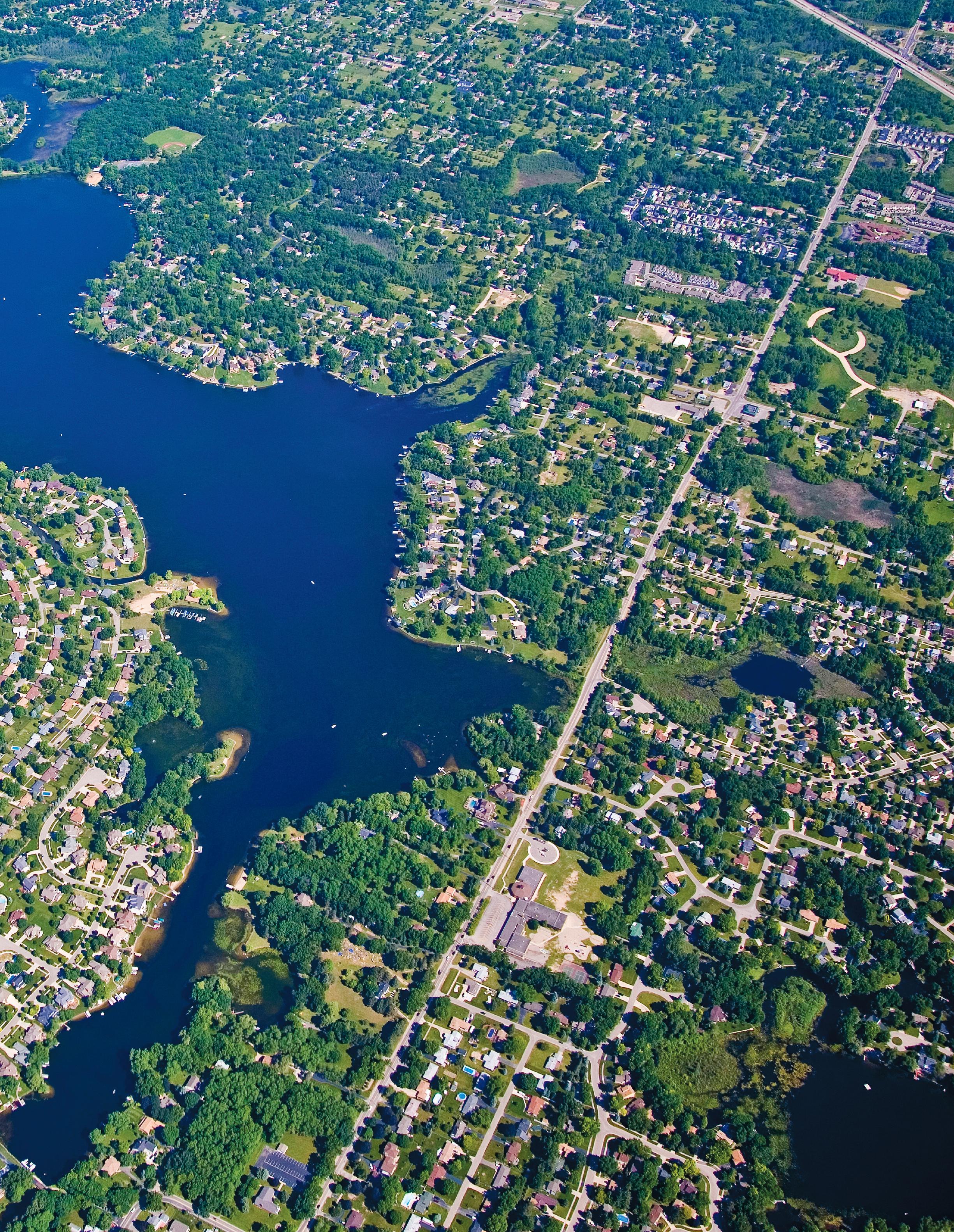
Michigan lakes, streams, and rivers get their life from the watersheds that feed them, and the health of those watersheds is cr ucial to the life of those waterbodies With 63 major watersheds in Michigan that break into another 267 sub-watersheds, these networks of lakes and streams eventually make their way to the Great Lakes. To dive deeper into effor ts to maintain the health of watersheds, five Southeast Michigan Watersheds, including the Clinton River, Rouge River, Huron River, Detroit River, and River Raisin, received a Repor t Card from the University of Mar yland’s Environmental Science Center (UMCES). The project began in 2021 and included multiple par tners and stakeholders. The nearly three-year project cost in excess of $500,000 and was funded by the Erb Family Foundation which introduced the idea of the repor t card to the watershed groups
The UMCES repor t cards were not just scorecards but were designed as a stakeholder-engagement and management framework. Across southeast Michigan, the process included creating a shared vision, selecting multiple indicators through stakeholder workshops, building par tnerships among agencies and nonprofits, and using the results to guide restoration priorities and public decision-
making. More than 100 stakeholders from 65 organizations par ticipated
Alex Fries, a trained marine biologist with a Master’s in Environmental Management, is a UMCES Program Manager and was the lead on the project. Her group has done similar projects in which they synthesized and communicated thousands of pages of data into “more understandable infor mation for people.” With the impetus from the Erb Family Foundation, UMCES star ted the process for the five watersheds
“ We put together a scope and talked about their goals, and we star ted this project with five groups,” Fries explained. “ They wanted a shared vision for what a healthy and sustainable river watershed looked like. They wanted to raise awareness about different socio -environmental conditions, not just ecosystem, water quality, and habitat, but also things that are impor tant to people, like recreation and the economy They wanted to build relationships among the different stakeholder groups, because many of them are doing similar things, so there could be more collaboration. And they wanted better decision-making processes Using the data and infor mation they have, they made infor med decisions ”
The process star ted with vir tual stakeholder workshops with all of the groups, then with individual groups.
“ We focused on the specific groups and what was impor tant to them,” she said “ We split into three sessions Since it was vir tual, it’s hard for people to do a full day online, and we had about 60 stakeholders in November of 2021 when the first workshops were held The stakeholders really drove what was going to be in the product They decided what their values were for their systems where they live and what the threats to those values are Then, when we star ted talking about potential indicators that could be used to better understand their system and goals, we came up with 33 and grouped them into categories ”
The indicator categories included economy, ecosystem, human health, infrastr ucture, recreation and water
The 33 indicators included the overall health index, household income, local ownership, cost of flooding, income equality, trade, river economy, wetlands, tree cover, forests, fish populations, bird diversity, benthic community, protected lands, fish consumption, bacteria, heat vulnerability, air quality index, environmental justice, flooding, sewer over flows, imper vious sur faces, far mland, affordable housing, walkability, parks, beach access, watercraf t access, fishing, nitrogen, phosphor us, dissolved oxygen, water temperature, and turbidity
“ Then we went through the data and looked at how it was collected and what the time period was Do we have enough data to say something about these indicators? That par t takes a ver y long time and is a ver y iterative process where we collect some data, do some scoring, and think, ‘Is this really enough data? Is it really telling us about the system?’ Then we went back and for th between us and the different groups to come up with those final indicators Af ter we finalize the indicators and scoring, with ever yone agreed and on the same page, we do the layout design, the nar rative and stor ytelling, and build the stories around the specific regions Even though they ’ re all in southeast Michigan, they ’ re ver y different systems with different issues The River Raisin compared to Clinton is ver y different We came up with stories that would be relevant to what those groups are seeing and doing in their areas and also tell the stor y of what the scores mean What are the results? How is the system doing? What are the conditions? And having that kind of A to F scoring scale, so that ever yone gets a repor t card in school and knows what it is, makes it ver y understandable, and we developed documents together with them ”
Fries had initial relationships with the Michigan Depar tment of Environmental, Great Lakes and Energy (EGLE) from previous repor t card work “ We did not collect the monitoring data, but we collated, cleaned, and organized the data and
per for med the scoring Some of it was even federallevel data One of the indicators was cost of flooding, an economic indicator we developed using FEMA data We’re looking at a treasure trove of data, but it’s ver y messy Data management within academia and outside academia is a huge challenge because people use different types of programs, record data in different ways, and store it differently ”
The co -designed repor t card process “is not someone ’ s opinion, it’s a calculated score, ” Fries explained “Developing those indicators and stories with the groups and having a product they can use as a tool for fundraising or for engaging with the public or other stakeholders they have, that’s really what the repor t card product is intended to do And also with policymakers, sometimes local elected officials, even congresspeople or gover nors, don’t have time to look at these long technical repor ts But if you can put a sixor eight-page document in their hands that looks inviting, maybe you can star t a conversation about how we really need this bill or this funding That’s another way these can be used as a tool ”
Future repor t cards now can be handled by each group, according to Fries
“ The idea when we are working on this with the groups is for us to transfer the process to them so they could do it again in three to five years, ” she said “ There is a lot of data and infor mation, and it does take a lot of work The groups need to have the capacity to take that on And it is somewhat of a burden But since we developed the indicators, as new data becomes available, that data can be updated and rescored to track progress over time and how the groups and their regions are doing Is the money in restoration having the impact they want? I think they talked about wanting to do them again and see how progress is being made But there are lots of issues in the funding landscape Are they really able to do that?”
Kevin Goodwin, EGLE Aquatic Biology Specialist, Lakes Erie, Huron, and Superior Unit, Water Resources Division, noted that his depar tment and the depar tment of natural resources were called upon only for data, and the watershed groups did the heavy lif ting on the project
“ We were invited to be at those vir tual tables, and the upshot of all these repor ts is that they were much more locally driven, not state-driven,” Goodwin said “ These were driven really by the watershed groups Each one of those watersheds has ver y active watershed groups, as well as active local municipalities and counties That’s all those folks who were at those initial stakeholder meetings, as were we The quick answer is that EGLE was mostly there as a potential data source, depending on what kinds of indicators they came up with and whether we had

infor mation that would help feed into those We, as well as the depar tment of \natural resources, I think, and some others, were there, including those watershed groups They were tr ying to cast a wide net to see what infor mation was available as they discussed the indicators they were going to use for these repor t cards That was our primar y involvement – par ticipating to see if we had data that would be helpful in the overall process ”
Overall, the southeast Michigan region received a C (49 percent) The suite of indicators and scores reflects the unique challenges faced by these five urbanized watersheds Of the six categories, recreation was the highest-scoring at 63 percent (a B -) Michigan boasts 8 5 million acres of public land, but only 250,000 of those acres are in Southeast Michigan This high score indicates that outdoor recreation remains accessible to the area ’ s residents Human health was scored at 38 percent (a D+) infrastr ucture and economy both ear ned C - grades, with 42 percent and 44 percent, respectively Ecosystem and water were slightly better, at 49 percent (C) and 58 percent (C+), respectively Bacteria scored lowest at six percent, receiving an F However, bird diversity was the highest score, an A at 91 percent
Water quality was significantly affected by agriculture and urban r unoff, with point-source pollution from industr y resulting in moderate scores for water at 58 percent, turbidity at 45 percent, and nitrogen at 47 percent Water temperature was at 53 percent, indicating rising river temperatures Phosphor us (60 percent) had a good score Dissolved oxygen was high at 89 percent, indicating that there is ample oxygen in the river for fish and other organisms
The ecosystem indicators were mostly moderate, with C grades for wetlands at 54 percent, tree cover at 40 percent, fish populations at 41 percent, and benthic community at 55 percent The amount of forests at 33 percent and protected lands at 32 percent in the region received Ds Human health conditions, fish consumption and heat vulnerability each had low scores The environmental justice score was moderate at 52 percent and the air quality score was rated high at 74 percent Infrastr ucture scores ranged from poor, with flooding at 13 percent, to good, with affordable housing at 65 percent Far mland had a poor score, while imper vious sur face and sewer over flows both had moderate scores
The cost of flooding was nine percent and income equality at 12 percent but household income was at 69 percent and local ownership was at 76 percent Trade was at 59 percent and the river economy hit 40 percent Recreation scores ranged from moderate with watercraf t access at 45 percent to ver y good for beach access at 90 percent Walkability was at 61 percent
and parks rated 66 percent, while fishing licenses had a moderate score at 54 percent The repor t over view stated, “Recreational oppor tunities are becoming more impor tant in the region, suppor ted by a healthy environment, which will improve local quality of life ”
Eric Diesing, freshwater program coordinator for Oakland County, was actually working for the Clinton River watershed when the repor t card process star ted in 2021 He uses the infor mation to help apply for grants for the county and was happy with the overall score
“ To get the C or the C plus, for this area with all of the pressure on the systems with all the urbanization around it and in it, I thought that was a good grade with all the indicators that they had put into it,” Diesing said
In April 2024, when the repor t cards were released and announced, each watershed organization emphasized somewhat different follow -up processes and priorities
The Clinton River, an 83-mile-long river in southeaster n Michigan, flows from its headwaters in nor ther n Oakland County to Lake St Clair in Har rison Township Its watershed is a 760-square-mile drainage basin across Oakland, Macomb, Lapeer, and St Clair counties At the Clinton River Watershed Council (CRWC), the plan is to use their repor t card as a public engagement and planning tool The CRWC was rated in moderate condition at 51 percent for a C Jennifer Hill, executive director of the CRWC, came into the process af ter it had begun Putting the knowledge gar nered into programs that can help nur ture and protect the watershed is key
“ When we saw the repor t card, it really reiterated something that we already knew about the watershed, which is that stor mwater is the biggest challenge we face in the Clinton River watershed,” Hill said “It impacts many of the indicators that are in this repor t card, and we really need to think about how we continue to tackle this stor mwater problem, which is such a big one And how do we do that not only in our own watershed, but how do we do that looking across southeast Michigan? Because we all know that water doesn’t stop at political boundaries or county lines While we ’ re in the Clinton River watershed here, Clinton River watershed is par t of a much larger watershed, the Lake Erie watershed for example It’s all interconnected ”
Being connected, the watershed groups “star ted to talk about creating a framework for how our watershed groups could tackle stor mwater challenges that we were all seeing in our watersheds across our watershed boundaries and empower people and communities to be par t of that solution Something we ’ ve created together It’s called the Rain Catchers
Collective And it’s an alliance of all of our groups, emphasizing the advantages of clean water for business, recreation, and in the environment But it really is looking at how do we work to implement green stor mwater infrastr ucture at a large scale, a community scale, and at a small scale? How do we empower residents to help be rain catchers on their own proper ty? Ever y little bit helps when you ’ re talking about stor mwater management Keeping that stor mwater out of the stor m drain so that it can infiltrate back through the groundwater into our river systems, instead of just flowing down the stor m drain and back into the river ”
She noted while there is an idea and plan, the next hurdle is funding to help achieve the whole purpose of the Rain Catchers Collective
“ We all already work with communities to do green stor mwater infrastr ucture projects For us, we do that through our Water Towns program, and we all work with residents to install rain gardens and similar features But the vision behind Rain Catchers Collective is to scale it up significantly across southeast Michigan This would require millions of dollars to do that We’re all still doing that work ourselves piecemeal ”
The Rain Catchers Collective would protect wetlands as they have diminished across the state and the countr y due to land development
“One of the ideas around the Rain Catchers Collective is to work with our land conser vancy par tners to make sure we ’ re protecting undeveloped land that can be critical in a wetlands case and really store stor mwater during heavy rain events before it’s going back into the system, that’s sor t of a major function that wetlands provide in the natural environment,” Wilson explained “ We should be making sure that we ’ re protecting those wetlands that still exist in our watersheds, par ticularly here in southeast Michigan where there is so much development That’s land protection is one piece of it Another piece of it is working with communities, in par ticular municipalities, to implement larger scale green stor mwater infrastr uctures Things like bioswales or large rain gardens to capture water ”
She noted a project in Centerline that designed a parking lot with four cells, each with retention basins under neath and native plants on top The parking lot can store 34,000 gallons of water during a rain event, preventing it from r unning off without being filtered or slowed down
Working with residents on their own proper ty is also a focus
“ Whether that’s planting a tree, installing a rain bar rel, or installing a rain garden If we do that across all of our watersheds in southeast Michigan, that will also have an impact There is obviously small rain gardens But if you do that at scale, that would have an
impact as well as a positive benefit,” Wilson said “And then the last piece of the Rain Catchers Collective Framework is workforce development Working in all of our watersheds and communities to make sure that there are folks in communities that know how to do the maintenance work for green infrastr ucture, par ticularly rain gardens or native plantings It can be a str uggle for folks when they ’ re installing these large scale green infrastr ucture pieces There is not always the exper tise on the maintenance side of things to understand how to actually maintain them and how to make sure that the native plants that are in there are thriving because they ’ re really a key par t of how a rain garden functions ”
One of the main problems she pointed out is the aging infrastr ucture across southeast Michigan
“Many people are doing a ton of work on putting a lot of money into improving that infrastr ucture But I think ever yone agrees that it’s not either or It has to be a solution where you are updating gray infrastr ucture and you are incorporating much more green infrastr ucture to be able to keep up with the demands you have for how much stor mwater is coming off of our watershed Over 55 percent of the watershed is covered in imper vious sur faces You’re really having to think about how you are capturing that stor mwater and making sure that it is gradually going back into the system ”
The Huron River, a 125-mile-long inland river in southeast Michigan, begins in Springfield Township in Oakland County and flows south through Washtenaw County, including Ann Arbor and Ypsilanti ,and empties into Lake Erie The Huron River watershed is a 900+ square-mile land area Rebecca Esselman, executive director of the Huron River Watershed Council (HRWC), noted there was more than three decades of data to sif t through The Huron River and its watershed was rated moderate condition and given a C+
“In the Huron River watershed, we have over 30 years of macroinver tebrate data that we ’ ve collected We have over 20 years of water quality data collected by our organization over the decades,” Esselman said “ The Huron River ranked overall as a C+, the highest grade among the five The Huron River has the benefit of ver y forested headwaters, and I think that’s a contributing factor The river benefits from a pretty extensive park system The Huron Clinton Metro Parks Authority has a lot of public land directly on the Huron River, which helps keep the river healthy And we also have a Natural Rivers District designation, a state-level designation established probably 50 years ago That requires that no buildings or development occur within 100 feet of the river ’ s edge And those three factors have contributed to the Huron River remaining a relatively healthy river, considering the urban context of southeast Michigan ”

have a lot of ver y unique pressures on the watershed and on water quality This gives us a really great tool to talk to people about why water quality is impor tant, why the work that we do is impor tant, and why the health of the watershed is impor tant in their ever yday lives,” Flintoff said “ We have a lot of ver y unique pressures on the watershed and on water quality This gives us a really great tool to talk to people about why water quality, the work we do and the health of the watershed are impor tant in their ever yday lives Also, where we ’ ve been, what we need to focus on or consider, and how we can star t moving for ward in addressing some of those things for ward in addressing some of those things ”
Flintoff gives fundraising presentations and uses the repor t card infor mation
“I’ve actually had people say, ‘Are you proud of a D plus?’ And I say, ‘Actually, I kind of am ’ Not because I think that’s the end result that we should be aiming for, but I think when you star t at what I would consider an F minus From a river on fire in 1969, to say that we are at a D plus, I think, shows incredible growth over a relatively shor t period of time, and I think it shows the value of what concer ned citizens actually stepping up and taking an active role in their environment can do I think that we have had one of the far thest ways to go, but I also think that we ’ ve made incredible progress in that shor t period of time And it gives me so much hope It sounds so optimistic, but it gives me so much hope for how much we can do, how much of an impact we can continue to have and how we can continue to steadily address that grade and address those issues and really actually make a difference because we already have We already have made such a huge gain that the only way to go is up We have so much potential to keep moving and get that to an A ”
In looking at the Rouge River repor t card she noted, “ We actually have quite a few A’s and B’s already, and a lot of C ’ s So, those kind of outweigh the D’s and F ’ s I think there is a lot of oppor tunity to build on the stuff we already have and are already strong in And then bring the rest of this up, but there is a ways to go and a lot to work on But I think this gives us a really great over view of priorities and where we can focus our effor ts to have the biggest impact ”
The River Raisin, a 150-mile-long water way originates in Lenawee County in southeaster n Michigan, flows east-southeast into Lake Erie near the city of Monroe Its watershed spans about 1,072 square miles, covering most of Lenawee County and par ts of Monroe, Washtenaw, Jackson, Hillsdale counties, and a small sliver of Fulton County, Ohio River Raisin and its watershed council received a C and is considered in moderate condition at 54 percent Their highest score came in dissolved oxygen, receiving an A with 85 percent Their lowest score was
an F with 12 percent in nitrogen Sean Dennis, the executive director of the River Raisin Watershed Council noted, “ The repor t card has helped us establish priorities, infor m our strategic plan, and set a benchmark for where we want to go as a watershed We are in the process of updating watershed management plans for the subwatersheds within the larger River Raisin Additionally, we continue stream monitoring programs throughout the watershed We have been in talks with par tners regarding potential funding for follow -up studies ”
Dennis explained more about the repor t cards and the organization based in Adrian “ The River Raisin Watershed Council par ticipated as a local watershed par tner by providing input, data, and regional exper tise throughout the development of the watershed repor t card RRWC works closely with local gover nments, conser vation par tners, far mers, landowners, educators, and community members throughout the watershed, which allowed us to contribute local knowledge and perspective to the assessment process, ” Dennis said “ The repor t card is intended to provide a snapshot of watershed conditions using available scientific data while also identif ying areas where additional monitoring, restoration, and outreach effor ts may be beneficial The repor t confir med several areas where continued effor ts are needed The lowest scores were associated with nitrogen (12 percent, F), turbidity (21 percent, D), protected lands (12 percent, F), bacteria (17 percent, F), and several economic indicators While many of the findings in the repor t were consistent with challenges and oppor tunities already identified by RRWC and our par tners, the repor t reinforced the impor tance of continuing and expanding existing effor ts throughout the watershed The results emphasized the need to remain focused on improving water quality, reducing nutrient and sediment r unoff, restoring and protecting habitat, increasing public education and engagement, and suppor ting agricultural conser vation practices ”
The RRWC is working to continue suppor ting conser vation practices that reduce nutrient r unoff, increasing habitat restoration and land conser vation effor ts, continuing water quality monitoring and stream restoration projects, expanding public education and community engagement, suppor ting far mer-led conser vation initiatives throughout the Wester n Lake Erie Basin and improving river connectivity through projects such as the Brooklyn Dam restoration effor t
“ The repor t also highlighted many strengths wor th building upon, including excellent dissolved oxygen levels, strong bird diversity, low sewer over flow occur rences, and excellent public beach access Perhaps most impor tantly, the repor t provides a sciencebased benchmark that can help track future progress and ensure that restoration and conser vation effor ts are
focused where they can have the greatest impact Based on both prior knowledge of watershed conditions and the scientific findings presented in this repor t, RRWC has continued to focus its effor ts on habitat restoration, stor mwater management, agricultural best management practices, on-site septic system education and management, and community outreach and education The repor t ser ves as a valuable tool for identif ying priorities, suppor ting future funding oppor tunities, and demonstrating the continued need for watershed improvement projects No single organization is responsible for maintaining the watershed; success depends on par tnerships and the collective effor ts of residents, landowners, far mers, businesses, and local gover nments ”
The Detroit River, a 32-mile inter national strait flowing from Lake St Clair to Lake Erie and for ms the border between southeast Michigan (USA) and southwest Ontario (Canada) Its roughly 700-squaremile watershed spans both sides of this border and is home to millions of residents and heavy urban and industrial The Detroit River Watershed had an overall grade of C (44 percent) Their challenges differed substantially from the inland watersheds that included human health concer ns, legacy contamination, fish consumption advisories, industrial impacts, habitat fragmentation and shoreline access disparities The repor t card reinforced priorities already under way by Friends of the Detroit River, including habitat restoration, public access expansion, coastal resiliency projects, Great Lakes restoration projects, tributar y restoration and community engagement
Moving for ward, each watershed group has focus areas The largest problem being stor mwater r unoff Lynn Seymour, chief engineer with Oakland County Water Resources, explained how the county is par tnering with the watershed groups to mitigate stor mwater
“Oakland County, the Clinton River Watershed Council and Friends of the Rouge are working together on the expansion of a pilot program called RainSmar t Rebates with grant funding received from the EPA Great Lakes Restoration Initiative,” Seymour explained “RainSmar t Rebates is a residential program geared towards homeowners in southeast Oakland County The program offers homeowners up to $2,000 to implement sustainable stor mwater practices, such as planting native trees, installing rain bar rels, or creating rain gardens on their proper ties The primar y goals of the program include fostering awareness about stor mwater management and promoting environmental stewardship The anticipated deliverables include implementing over 1,500 stor mwater projects on private land The outcome will capture approximately 2 5 million gallons of r unoff, significantly improving local water quality by reducing nonpoint source pollution
The intended beneficiaries are those who live, recreate, or work in the Clinton and Rouge River watersheds As par t of the program, subrecipients will conduct one- onone site assessments for each homeowner accepted into the program and provide guided suppor t on GSI design, installation, and maintenance ”
Looking at the legislative side of things for watersheds, one of the biggest concer ns is the lack of gover nance over septic systems David Lossing, director of gover nment relations for the HRWC oversees effor ts to advocate for water and climate-related issues on both the state and federal levels
“Senate bill 771, introduced by state Senator Sam Singh, has gotten us one step closer to regulating septic systems across the state,” Lossing explained “ We expect there are about 1 3 million septic systems in Michigan and about 300,000 of them are failing Those are leaching nutrients into groundwater and sur face waters which are then creating algae blooms in lakes Then ever ything, especially in our watershed, flows down to Lake Erie In Oakland County alone there are between 80-100,000 septic systems We don’t regulate them under Michigan law and most of these go back 50, 60, 70 years and most barely have any records that exist of when they were installed, when they ’ ve been inspected or when they ’ ve been updated That’s not helpful for a state that likes to pride itself on being The Great Lakes State We have 29 legislators in our watershed, 22 state reps and seven senators across both Democrat and Republican We talk to ever ybody to make them aware of what’s in their backyards ”
One of the most significant outcomes following the UMCES repor t cards was the creation of a shared socioenvironmental gover nance model across southeast Michigan Before the repor t cards, watershed organizations typically measured success through miles of stream restored, acres protected, volunteer par ticipation and individual grant outcomes
Af ter the repor t cards, all five watersheds now have a common framework built around six categories that include water, ecosystem, human health, infrastr ucture, recreation and economy
That means future planning, grant applications, restoration priorities, and public communications can increasingly be tied to measurable changes in these indicators over time The methodology itself anticipates periodic assessments ever y few years so that watersheds can evaluate whether inter ventions are improving grades and where to redirect resources (To check out each repor t card, go to, ecorepor tcard org/repor t-cards and click on southeast Michigan )
T H R E AT E N E D P L A N E T
Threatened Planet is a newsletter of curated information gleaned from over 30 print and online news sources where reliable information is provided on the health of the environment and the efforts to remedy problems facing the planet We constantly monitor a diverse list of sources – the major daily newspapers in the country and in Europe, a variety of scientific journals and government websites, along with newsletters from environmental groups, as well as a wide-ranging list of other reliable print and online news outlets. For those concerned about the environment, we do the legwork by aggregating relevant information from a wide swath of sources and attempt to offer links mostly to those sources not restricted by a paywall Those interested can sign up for the newsletter at ThreatenedPlanet com
Research and composition of the Threatened Planet newsletter is the work of Austen Hohendorf
weed killer causes potential cancer, saying claims are preempted because the EPA did not require war ning labels (Maureen Groppe/USA Today)
▾
New documents reveal oil company BP funded and shaped one of the most influential climate studies on record, arguing the “climate problem” could be solved by non-existent technologies while bur ning oil and gas (Maddie Stone, Amy Wester velt, Katie Wor th/ProPublica)
▾
New York passed the nation’s first statewide moratorium on data centers bar ring hyperscale data centers from being approved, while the state develops regulations to assess environmental effects (Grace Ashford/The New York Times)
▾
Democrats in the Michigan Senate introduced legislation to curb hyperscale data center energy usage and environmental impacts (Jordyn Her mani/Bridge Michigan)
▾
The Federal Cour t r ules against Tr ump’s effor ts to eliminate air pollution standards (Amudalat Ajasa/The Washington Post)
▾
The Environmental Protection Agency (EPA) proposal to delay enforcement of vehicle air pollution regulations was backed by major automakers, environmental groups say it will lead to an increase in preventable illness and deaths (David Shepardson/Reuters)
▾
National Oceanic and Atmospheric Administration (NOAA) for mer employees created a new climate data website (Climate us) to fill a void af ter the Tr ump administration shut down the gover nment-r un website last year (Scott Neuman/NPR)
▾
A bipar tisan measure passed the Senate blocking the Tr ump administration from dismantling the $368 million ocean monitoring system critical to understanding climate change (Maxine Joselow/The New York Times)
▾
A recent Supreme Cour t r uling blocks thousands of lawsuits against Monsanto for not war ning its
A mainstream climate science critic will oversee the gover nment’s flagship climate change repor t af ter he was appointed to lead the U S Global Change Research Program by the Tr ump administration (Maxine Joselow, Brad Plumer/The New York Times)
▾
Riding the waves – how University of Michigan researchers are testing wave-energy technology on Beaver Island to generate electricity from the Great Lakes (Vivian La/Grist)
▾
The EPA will not set nationwide environmental requirements for data centers. (Alex Guillen/Politico)
▾
For the first time on record, Americans are getting more of their electricity from solar than coal (Julia Jacobo/ABC News)
▾
President Tr ump invoked the Defense Product Act to spend $700 million in federal funding for the coal industr y, which would help build the first two new coal-bur ning power plants in the U S in a decade (Maxine Joselow, Brad Plumer/The New York Times)
▾
New research shows data centers can raise nearby air temperatures by up to four degrees Fahrenheit (Ellyn Lapointe/Gizmodo)
Dredging an inland lake is necessar y for recreational reasons but can also be destr uctive to a lake’s local ecosystem
Dredging requires a per mit from the state of Michigan from lake bottomlands owners that outlines per tinent reasons for the request The process can take anywhere from a few months to a year
The dredging process though is damaging to the local environment as it can cause the relocation, or per manent damage of many living organisms in the immediate area, such as native plants and insects Dredging can displace a local fish population which will find plentiful food sources in other areas of the lake That is why Michigan law mandates dredging projects limit adverse environmental impact
Dredging and shoreline projects are regulated under Michigan’s Natural Resources and Environmental Protection Act (NREPA), also known as Act 451 of 1994 Within that act are four par ts that relate to dredging: Par ts 301, 303, 325 and 31
Par t 301 is the main par t of the NREPA that impacts dredging and other activities around inland lakes and streams This section is the main per mit authority for dredging if the project is on inland lakes, channels connected to those lakes, rivers or streams, and some ponds Par t 301 regulates not just dredging but excavation, docks and marinas, channel constr uction and more It outlines the fact that any dredging below the ordinar y water mark generally requires a per mit
Par t 303 is designed to provide wetlands protection and would include gover nance over dredging projects Wetlands are considered environmentally sensitive because they offer many environmental benefits such as reduced flooding, water quality protection, stabilized shorelines and more Wetlands generally include marshes, swamps, and bogs so the volume of dredging projects is less given that many wetlands either don’t allow boating, and/or would be less likely to be approved for a dredging per mit
Par t 325 gover ns dredging and constr uction in the Great Lakes, Lake St Clair and related water ways Par t 31 is Michigan’s broad water pollution control law that focuses on water quality, pollution prevention, sediment discharge, contamination and more
All dredging per mits are reviewed by the Michigan Depar tment of Environmental (EGLE) Dredging requests must come to EGLE from the lake bottom landowner, or the riparian owner, said Eric Calabro, an inland lakes policy analyst for EGLE’s Wetlands, Lakes, and Streams Program Individual proper ty owners of ten apply for a per mit themselves to dredge par t of the lake bottom that they own Proper ty owners hire a dredging contractor for the work That contractor can also for the
per mit on their clients’ behalf and walk riparian owners through the process
Approval from all riparian owners whose land is impacted by a dredging request is required “ You can select an authorized agent on your behalf to make the request if you are a (riparian) owner, ” Calabro said “It’s ver y common to have those requests come from a contractor ”
Occasionally, proper ty owners may be unclear who owns exact areas of the lake bottom, especially of the proper ty is not platted, he added EGLE can work with applicants to deter mine if other owners need to be involved in the application process
The dredging application ser ves as a public notice to all interested stakeholders EGLE may hold a public hearing to address ver y large or unique dredging per mit requests, but those examples are rare A public hearing is more common when a commercial entity such as a marina applies for dredging, Calabro said
Most dredging and non-dredging per mits submitted to EGLE under NREPA are accepted, Calabro said The number of those applications that involve a dredging request can range from 750 to more than 1,000, or up to 25 percent of all NREPA-related per mit applications
Historically few dredging per mits are denied, largely because of collaborative and educational effor ts by state agencies
Riparian owners of dredged inland lake bottomlands must provide a valid reason for the request Applicants should clearly define why they are hoping to gain a dredging per mit because of the potential shor t-ter m har m to the local ecosystem, Calabro said EGLE favors applications that outline least impact on an inland lake and will make suggestions or pose fur ther questions to applicants for this purpose in many instances
Calabro created an EGLE-themed presentation about state regulations and best practices for constr uctionbased projects on Michigan’s inland lakes That presentation includes language that specifically guides EGLE’s per mit decision process as it per tains to local environmental effects and riparian rights Specifically: “ The depar tment shall issue a per mit if it finds that the str ucture or project will not adversely affect the public tr ust or riparian rights In passing upon an application, the depar tment shall consider the possible effects of the proposed action upon the inland lake or stream and upon waters from which or into which its waters flow and the uses of all such waters, including uses for recreation, fish and wildlife, aesthetics, local gover nment, agriculture, commerce, and industr y ”
Common reasons for a dredging request include the removal or control over aquatic plants, increasing water depth to suppor t boats, and to make room for new or
extended boat docks Increasing water depth can include the action of creating channels for boats to travel safely from the shore to deeper par ts of the lake
There are environmentally beneficial reasons to dredge as well, such as removing pollutants caused by dumping, leakage into the lake and more
Calabro said that dredging is most palatable when the action provides a solution to a core problem “ We always look at what is the cur rent impediment to access the waterbody,” Calabro said
Residents and proper ty owners can submit a request for dredging and create a free account through the state’s MyEnviro Por tal, available on the Michigan gov website or through an online search Once there, they can find the link to “Sign in for per mitting and compliance actions” Residents can also renew existing registrations, view and print issued per mits, and submit repor ts or management plans with a free por tal account
The por tal is a comprehensive website that offers electronic notification, per mitting, emissions repor ting and compliance application for several environmentally related requests including dredging
“ That is our statue for wetlands and inland lakes that we have to follow,” Calabro said “ We have to avoid as much impact as possible Dredging is one of the most impactful activities on a lake for all living entities ”
The impact of dredging on a lake’s ecosystem is extreme, said Jo Latimore, Ph D , an aquatic ecologist and outreach specialist in Michigan State University ’ s Depar tment of Fisheries and Wildlife and director of the MSU Extension Center for Lakes and Streams She called dredging a “major disturbance” on plants, algae and inver tebrates that live in a lake bottom The act of dredging can involve heavy equipment that removes or suctions material that houses life
“ You essentially leave behind a deser t-like situation for a period of time in that par t of the lake,” Latimore said “It takes a while to recover ”
Dredging requests tend to revolve around lake bottoms located near a shoreline, especially for requests that involve expanded boating channels, swimming areas and dock work Areas near the shoreline also happens to be where most living entities spend their time on an inland lake
Guy Savin bought an existing lake ser vices constr uction and contracting company about 25 years ago, renaming it Savin Lake Ser vices Savin provides an ar ray of lake ser vices from his headquar ters in Clare, Michan, including aquatic weed and algae maintenance, herbicide control, lake dredging and more Savin integrated dredging into his business about 15 years ago and focuses on hydraulic dredging, a process that involves pumping mud and muck at the bottom of a
lake with water and sediment to a holding cell or retention station as far away as two miles from the pumping site When the dredging work is completed, his company retur ns clean water back to the lake to replace any water that was used during the pumping in an effor t to minimize the adverse ecological impact
The process of hydraulic dredging offers several ecological benefits compared to mechanical dredging Hydraulic dredging causes less proper ty damage in the lake or near the shoreline and is less invasive than mechanical dredging, Savin said Hydraulic dredging also largely avoids creating a plume of muck and sediments that har m hyperlocal organisms and temporarily dislocate local fish populations
“ With hydraulic dredging we are cutting materials and sucking it up and then pumping it to a holding cell,” Savin said “ You aren’t getting that large plume that disturbs (local life) as much ”
He added than any type of dredging also requires the temporar y installation of turbidity cur tains, or silk cur tains, are temporar y floating bar riers used during inland lake dredging projects to contain suspended sediment and prevent it from spreading beyond the active work area
Mechanical dredging involves the use of heavy equipment that of ten involves flipping muck into a dump tr uck It is used more frequently with larger dredging projects because of the volume of work required, making it more affordable for large requests
“Mechanical (dredging) is slower and more expensive for small projects But it makes sense for most big projects,” Savin said
When an inland lake is dredged in Michigan, the sediment removed from the lake bottom does not automatically go to a landfill The material is typically evaluated to deter mine whether it is clean enough for reuse or requires special handling, according to the EGLE website Sediment is of ten pumped into temporar y containment areas or large dewatering bags near the project site, where excess water drains away and the material dries before being transpor ted or reused
Once dewatered, clean dredged material may be spread on approved upland proper ty, used for landscaping or habitat restoration projects, or beneficially reused as fill If testing reveals contamination or the material is other wise unsuitable for reuse, it may be transpor ted to a licensed landfill or other approved disposal facility
The specific disposal method depends on the characteristics of the sediment and the requirements of the state per mit issued for the dredging project, said Calabro
cost, many lake associations, municipalities, or proper ty owners must invest in an initial bathymetric sur vey to establish existing water depths and calculate the amount of sediment that needs to be removed These sur veys typically cost between $2,000 and $5,000 and provide the data needed to estimate dredging volumes in cubic yards
“ We quote each project up front,” Savin said, noting that accurate measurements are essential to developing a realistic budget and ensuring customers understand the full scope of work before dredging begins
He defined typical dredging projects as those likely to be approved by EGLE through the state’s per mitting process, such as to dig channels, remove large amounts of muck and organics, managing weed control and more
“Dredging is the quickest solution to rid your lake of muck and organic matter,” Savin said “Riparian owners have a right to be able to navigate their water ways, so that’s the biggest reason we see ”
A dredging per mit may not be denied or approved immediately, Calabro said Some initial responses from EGLE may require clarification or cor rections designed to avoid environmental impact as much as possible That is why EGLE team members will generally conduct a site visit for each dredging application so they can get a sense of the local inland lake environment, including whether adjustments to the original application can reduce the environmental impact
For example, lake bottomlands owners may ask to dredge a larger area of a lake than EGLE might deem necessar y to successfully clear a boat channel or area for a new dock, Calabro said Site visits also allow EGLE professionals to get a better sense of the impact of a proposed dredging on aquatic plants The depar tment may suggest or clarif y the water depth needed to address a proposed need
“ There may also be less impactful alter natives to dredging, or a (scaling down) of a dredging project that is possible,” Calabro said
The per mitting process through EGLE can be tenuous, according to Savin, but fir ms his can submit the application on behalf of their customers and work with them in advance to improve the chances of a successful per mit Savin confir med it can take 6 to 12 months for a small project to be completed from per mit submission to completion, fur ther emphasizing the impor tance of submitting in advance of a prefer red completion date
Savin said EGLE’s policies are designed to adhere to the ecologically “right way ” to handle dredging, so that it maintains the best possible environment for local fisheries and organisms EGLE must follow statutor y
criteria to find the least impactful alter native that allows proper ty owners to gain access to the water for boating, swimming and other lake activities, Calabro said
“ We work with EGLE and understand what their requirements are, ” Savin said
Per mit applicants can theoretically improve their chances of approval by tur ning in an application that provides detailed content outlining the reasons for a dredging request Including photos of the area in question is highly recommended In some cases, EGLE will deter mine that the photos and descriptions received from a detailed per mit application are enough to render a decision without a site visit
“ We go onsite for all major (dredging application) projects and most minor ones, ” Calabro said “But a strong application with photos and a lot of infor mation helps ”
Residents can also improve their chances of receiving a per mit by working with EGLE in advance of tur ning in an application Calabro said it is understandable that the typical applicant(s) may not understand all the factors that can be instituted to help minimize the adverse impact of dredging on a local waterbody As a result, proper ty owners can request a pre-approval meeting with EGLE through its MyEnviro webpage
“ We understand the application process can be intimidating,” Calabro said “So, we ’ re here to help with that ”
The pre-application meeting highlights the collaborative nature that EGLE uses to help riparian owners It not only breaks down bar riers and educates applicants but can help the depar tment to be more efficient in its dredging application review process, Calabro said
“Our resources program on lakes, streams and wetlands is highly collaborative,” Calabro said
While the process for securing a dredging per mit is extensive, limiting dredging is of ten the best strategy, Latimore said Dredging can also haven “hidden” drawbacks, compounding existing issues such as weed management or fish stocking, Latimore said These activities can lead to a cumulative, negative impact “I think scale and timing are impor tant,” Latimore said The more residents are aware of the options for limiting the scale of a dredging project, the better The best dredging project is not to dredge, but if you can’t do that you want to make sure to minimize the impact ”
Nearshore habitat complexity is extensive on inland lakes Most habitat and ecological interactions in a waterbody are along the nearshore, Latimore said Calabro agrees Those nearshore activities and interactions, for all living organisms from insects to plants, are impor tant to the ecological integrity of the lake
“ We don’t want to impair the ecological function of the (lake) just for the enjoyment of water for (residents),” Calabro said He refer red to dredging as an a “gouging of bottomland habitat ”
The impact of dredging on a lake can have similar comparisons to a forest fire that is maintained in a smaller area, Latimore said Vegetation and animals/birds will retur n to an area impacted by a fire, but it will take a period of time, of ten a few years “Lakes will be more bar ren for a period just like a forest will,” Latimore said
Savin Lake Ser vices has recently been contracted to handle several Great Lakes dredging projects as well because of consistently low water levels in the Great Lakes, caused in par t by lower snowfall amounts in the winter However, inland lake dredging projects are more common, Savin said
In addition to working with riparian owners, Savin Lakes Ser vices also works with lake associations, drain commissioners, local municipalities and more as dredging clients The company can also work local municipalities under Public Act 188, which gives townships the authority to fund cer tain public improvement projects through special assessment districts that charge benefiting proper ty owners for all or par t of the cost
“It of ten depends on the local gover nance who our client contacts are, ” Savin said
While EGLE is committed by statue to limit the environmental impact of dredging or other per mits, the agency also takes significant priced in helping residents enjoy lake access while also adhering to shoreline protection policies
“ We also consider the impact to public tr ust and riparian rights,” Calabro said
Dredging to depths of two to three feet typically is sufficient to address most of the issues per mits are written for, Calabro said New docks rarely require more than 10 to 12 feet of additional length Cutting some aquatic plants may be an option as well Calabro stresses that a minimal amount of dredging to solve an issue is always prefer red
“ We want to design a project as close to as possible to a minor project categor y, ” Calabro said
Lakefront proper ty owners can take a longerter m approach with dredging, Latimore said Local land use, r unoff activities, new developments, and the use of chemicals to treat grass or flowers can cause excess nutrients to enter the lake, resulting in the build-up of organic muck Reducing those activities can limit the number of times dredging is needed Latimore encourages lake associations and riparian owners to educate their neighbors on best practices
“ You want to ask yourself if you can get to a point
where dredging isn’t necessar y, ” Latimore said “It’s really more of a band-aid that can be (symptomatic) of larger issues
The Oakland County Water Resources office is not responsible for overseeing inland lake dredging projects in the county, said Oakland County Water Resources
Communications Officer Trisha Br uzek Its involvement with lake-related activities is primarily through lake improvement boards, where a representative from Oakland County Water Resources ser ves as a statutor y member as required under Michigan law
“ While we par ticipate in those boards, individual lake improvement boards deter mine and oversee their own projects, including any dredging initiatives,” Br uzek said
A significant inland lake dredging project is under way on Quar ton Lake The large project began in 2025 and is expected to be completed in 2029 The City of Bir mingham awarded the project to Mid-American Group last year for the purpose of removing accumulated sediment and to restore lake capacity and water quality, according to Bir mingham City Council meeting minutes
Hydraulic dredging is being used for this project to pump sediment water into large geotextile dewatering bags As the sediment dries and water drains, the sediment is eventually transpor ted to a pre-approved disposal location, according to a July 2025 post on the city ’ s Facebook page
Other lake dredging projects in Oakland County tend to be smaller and shor ter, such as the one Savin referenced for Pontiac Lake riparian owners last year “Once we get onsite we can have those completed in a few days,” he said
The process of setting up a dredging project with a company like Savin Lake Ser vices star ts by defining the area that needs dredging in the eyes of the applicant(s), Savin said Dredging typically can occur around 25-30 feet from the shoreline Savin and his team will work with clients to then assess why the dredging is needed
“ We tr y to use hydraulic dredging where possible but there are times when we will identif y if mechanical dredging is a better oppor tunity,” Savin said For example, Lake Shamrock near Clare was a dammed lake Dammed waterbodies of ten lead to more oppor tunities for silt settling
The consultation with each client is ver y specific to their needs, according to Savin His fir m will provide recommendations that fall within the boundaries and requirements of EGLE Of ten, they handle the entire per mit process on behalf of their clients
“Based on (more than 15 years of experience) we have insights we can share,” Savin said “ There’s a way to (have dredging) done that is responsible That’s always our goal ”
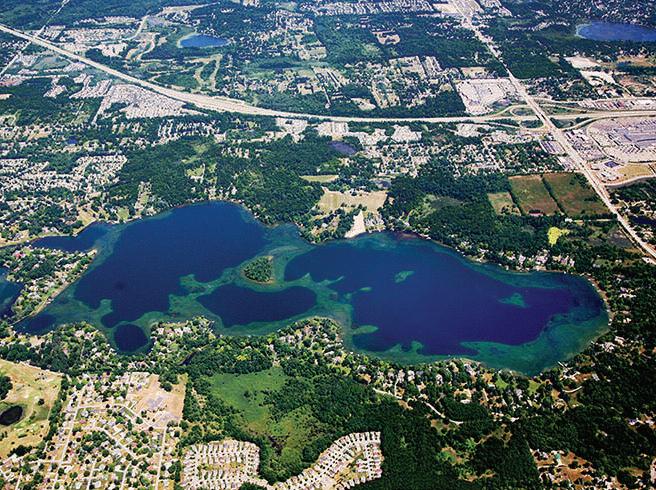
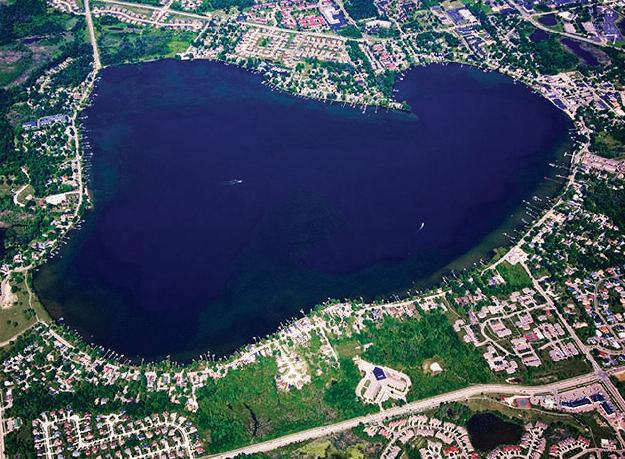
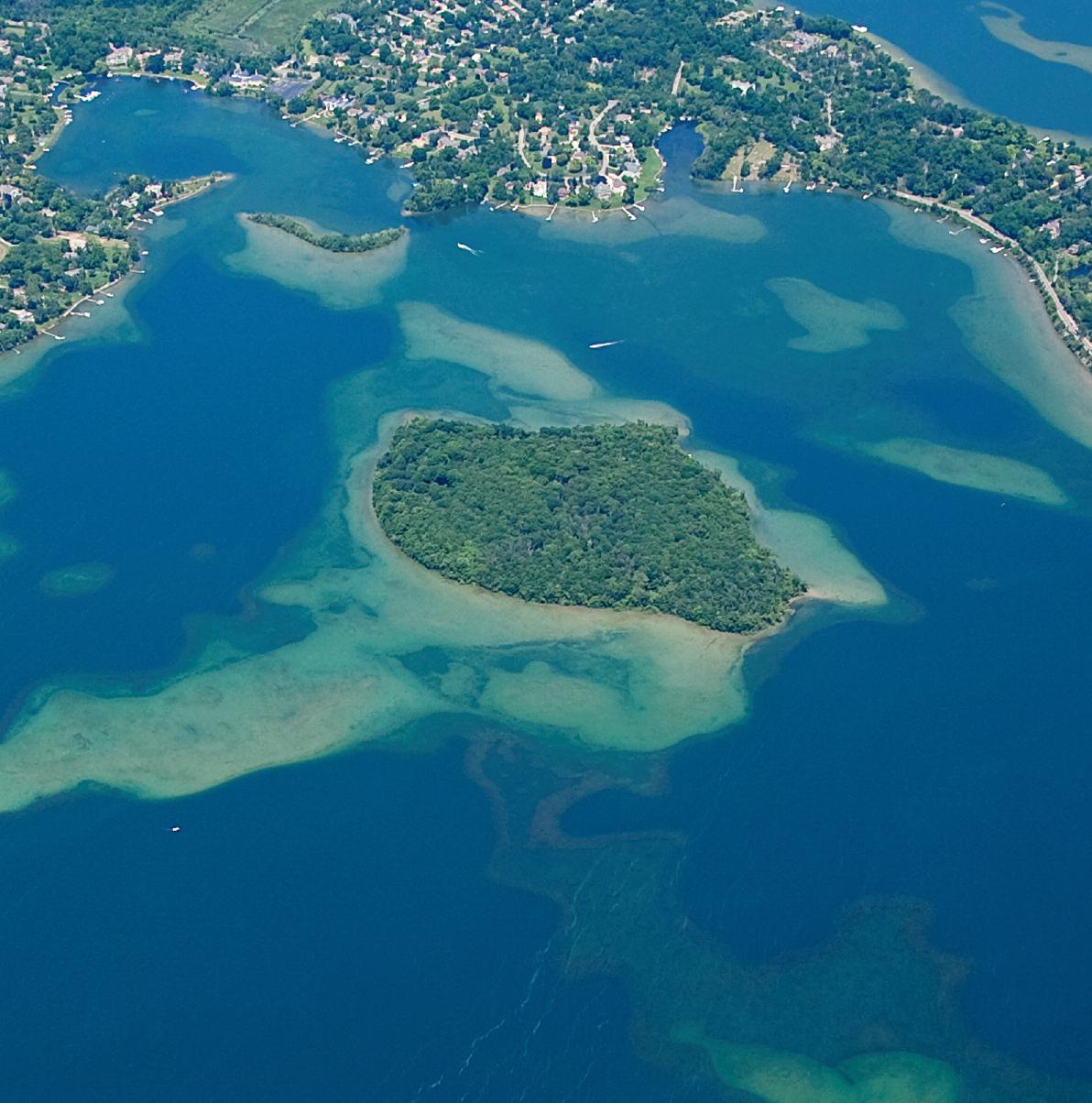
Apple Island is of ten hidden in plain sight for boaters on Orchard Lake The 35-acre island is largely off-limits to visitors yet has a notable histor y that goes back to pre- Oakland County days
The island today is owned by the West Bloomfield School District, but its histor y includes inhabitation by Native Americans, investment by Scottish immigrants, and a unique archeological stor y It is a natural sanctuar y for many types of living organisms
There are no full-time or seasonal residents, said Andrea Frank, Public Relations and Communications Super visor for West Bloomfield School District That has been the case since the island was lef t to the school district by for mer owner Marjorie Wood Strong in 1970
Apple Island sits in the center of the 800-acre Orchard Lake It was created by glacial activity, around 10,000 years ago
While Apple Island has a small physical footprint, it offers an outsized ecological stor y
Researchers have documented more than 400 plant species on the island, including numerous species considered rare in this par t of Michigan, according to the the Greater West Bloomfield Historical Society
Coats, whose family helped establish the inter nationally known J & P Coats Thread Company
A future owner tur ned the island into a private family retreat complete with orchards, gardens and additional buildings
The Ward family eventually became the island's longest and perhaps most influential stewards Willis Ward, leaving the island to the West Bloomfield School District, fulfilling Ward Strong’s wish that the island ser ve future generations as an educational preser ve rather than private development Apple Island today is officially known as the Marjorie Ward Strong Woodland Sanctuar y The district primarily uses the island as an outdoor classroom, allowing carefully controlled educational visits for students For example, American Literature classes of up to 50 high school students visited the island for class during the 2025-2026 school year, Frank said The district hosts an annual tour the second weekend in June in conjunction with the Greater West Bloomfield Historical Society, City of Orchard Lake Village, and West Bloomfield Township Parks and Recreation
One sign of early European influence on this area ’ s native population is the appearance of silver trade items, including those recovered during archaeological excavations on the island in June 2000, according to the historical society
Archaeologists have found evidence of Indigenous occupation of the island dating back centuries Native Americans ceded much of southeaster n Michigan to the U S gover nment with the 1807 Treaty of Detroit, opening the region to settlement That led to a period of many changes for Apple Island It was first owned by Scottish immigrant John
“It is used just for educational purposes with the occasional tour,” Frank said “ The island is a wonder ful resource for the school district ”
Apple Island was listed on the National Register of Historic Places in 2018 The designation acknowledged not only the island's archaeological significance but also its cultural impor tance in documenting thousands of years of human activity in the region
BY MIKE SCOT T
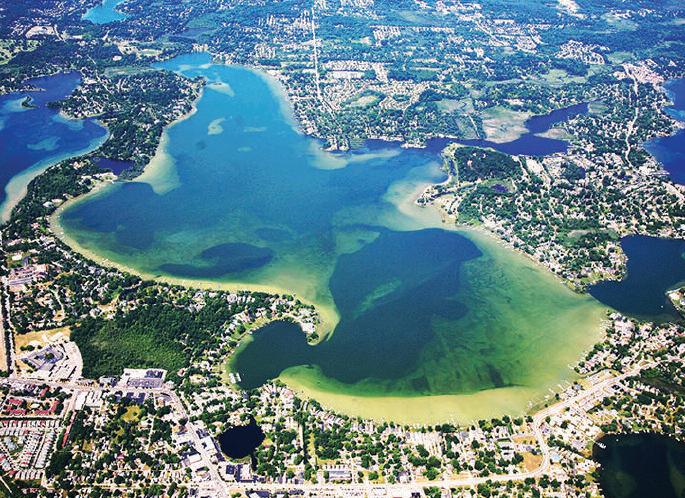
PHOTO CREDIT: AERIAL GRAPHIC S
Metro Intelligencer is a monthly column devoted to news stories, tidbits and gossip items about what's happening on the restaurant scene in the metro Detroit area Metro Intelligencer is reported/ created each month by Gigi Nichols who can be reached at GigiNichols@DowntownPublications com with news items or tips, on or off the record.
Forest has reopened
At the end of March, Samy Eid, owner of Chickpea Hospitality, announced the temporar y closure of Bir mingham’s Forest The restaurant has officially reopened and is embracing its Italian identity, unveiling a revamped menu, expanded pasta program, and redesigned dining room Although Forest has long incorporated managing par tner and Chef Nick Janutol’ s ItalianAmerican roots ser ving handmade pasta for the past decade, the restaurant was never fully perceived as Italian cuisine Eid says that ambiguity stemmed par tly from inheriting the Forest name and concept af ter purchasing the restaurant in 2015, as well as years spent balancing influences from continental American and European cooking Now, the restaurant is leaning fully into Italian fare, with a renewed emphasis on house-made pasta and chef-driven specials The updated menu features eight rotating pasta dishes, including pesto Genovese, fettuccine bolognese, raviolo, and linguine vongole, alongside seasonal additions and nightly chef specials Janutol and Executive Chef Talia Clark are also introducing a range of scratch-made components, including house tomato passata and an Italian-inspired chili crisp Additional menu highlights include chicken Milanese, veal chop, branzino, and four salad offerings designed to reflect Michigan’s seasonal ingredients through an Italian lens Beyond the kitchen, Forest has undergone an extensive interior refresh “ We’ve made the restaurant a bit more moody,” Eid said in his newsletter “All new sur faces, a brand-new back bar, new flooring, new wood, a brand-new sound system Big upgrades that drive home the beautiful, emotionally resonant Italian dining experience you ’ re going to have here ” 735 Forest Ave, Bir mingham forestbir mingham com
Grey Ghost Celebrates a decade in Detroit
Grey Ghost, the flagship restaurant of Four Man Ladder Hospitality, is marking 10 years in Detroit with a special anniversar y celebration From July 18–27, the acclaimed Midtown/Br ush Park restaurant will host 10 Days of Greatest Hits, featuring favorite dishes and cocktails from the past decade Retur ning menu items include Fried Bologna, Chicago -Style Oysters, Smoked Whitefish Dip, and Jerk Wings, alongside popular cocktails such as Grandma’s Garden, Pretty Magic, and Effeneff The celebration concludes on July 28 with a multi-course family-style Anniversar y Dinner showcasing chefs from across Four Man Ladder Hospitality Par ticipating chefs include Joe Giacomino, John Ver miglio, and Anthony Patton (Grey Ghost), Rah-ed Ghuma (Second Best), Connor Maxwell-
McCabe (Basan), and Eric Lees (Little Ghost). Since opening in 2016, Grey Ghost has ear ned a loyal following for its inventive cuisine, nationally recognized burger, award-winning cocktails, and welcoming Midwester n hospitality Named af ter a legendar y Prohibition-era r umr unning pirate, Grey Ghost was founded by chefs John Ver miglio and Joe Giacomino, who brought their shared culinar y vision from Chicago to Detroit Together with David Ver miglio and bar tender Will Lee, they opened the restaurant at 47 E Watson Street in 2016 Over the years, Grey Ghost has helped shape Detroit’s dining scene while expanding into Four Man Ladder Hospitality, which now includes Second Best, Basan, and Little Ghost “ Ten years later, we ’ re incredibly grateful to the guests, team members, and city of Detroit that have suppor ted us along the way, ” says Ver miglio “ This anniversar y is a celebration of ever yone who has been par t of our stor y ” Reser vations for both the Greatest Hits menu and the July 28th Anniversar y Dinner are now available via Res 47 Watson Steet, Detroit greyghostdetroit com
Rooftop bar opens in Brush Park
Topa, a new Mediter ranean-inspired roof top cocktail bar atop the AC Hotel Detroit at the Bonstelle in Br ush Park, has officially opened, bringing coastal cocktails, shareable small plates and skyline views to one of Detroit’s fastestgrowing neighborhoods Developed by Roxbur y Group and managed by Azul Hospitality, Topa is named af ter the Basque word meaning “to toast” or “to clink glasses,” Topa was designed to evoke the relaxed energy of the Califor nia coast while embracing Detroit’s urban atmosphere The 11th-floor venue features indoor and outdoor seating with panoramic views of the city skyline “ Topa represents the next chapter of the hospitality experience at the AC Hotel Detroit at the Bonstelle,” said James Van Dyke, president of the Roxbur y Group “Our vision was to create a space that feels transpor tive, a place where guests can slow down, connect and enjoy an atmosphere inspired by the Califor nia coast while still being sur rounded by the energy of Detroit ” Executive Chef Jorge Morales leads the kitchen with a Mediter ranean-focused menu featuring seared halloumi, bacalao croquettes, bar ramundi skewers and char red lamb chops The space itself weaves histor y into the design, featuring reclaimed wood sourced from the historic Cadillac Hotel in Lexington, Michigan, with indoor and outdoor seating overlooking the Detroit skyline Topa joins The Conser vator y and Bonstelle Playhouse as par t of the AC Hotel Detroit at the Bonstelle hospitality campus 14 Eliot Street, Detroit topadetroit com
New chef, new dining experiences at BESA
BESA, downtown Detroit’s Adriatic-inspired dining destination, has named Chef Brady Kelley as its new Executive Chef, marking a new chapter for the restaurant’s culinar y program The announcement comes alongside
several new guest experiences, including a Thursday Date Night prix-fixe dinner for couples, monthly Sunday tasting events, and an ongoing weekly happy hour A graduate of Schoolcraf t College’s Culinar y Ar ts program, Kelley brings experience from some of Michigan’s most respected kitchens At age 25, he opened his first restaurant in Ann Arbor, ear ning statewide recognition for its creativity and distinctive culinar y identity Now, he is leading BESA’s evolving menu, which features shareable Small Plates and composed Large Plates inspired by Adriatic flavors Signature dishes include Seared Halloumi with beets and kalamata compote, Mini Gyros with lamb and wagyu, and Pulled Lamb Shoulder with brown butter hummus Large Plate offerings include Crab and Saffron Risotto, Grilled Trout, Pasta Trapanese, Lamb Chops, and Ribeye 600 Woodward Avenue, Detroit besadetroit com
Wright & Co. shutters and hints at new concept
Wright & Company located at 1500 Woodward has announced that it will close as of July 3 Perched on the second floor of the historic Wright-Kay Building, the restaurant was helmed by James Beard Award semifinalist chef Marc Djozlija and became known for its contemporar y American small plates, craf t cocktails, and views of Woodward Avenue Since opening in 2014, Wright & Company has been widely regarded as one of the pioneers of Detroit’s culinar y renaissance, helping to establish downtown as a destination for innovative dining In a social media post announcing the closure, the management
thanked customers for their years of suppor t while also signaling that a new chapter may be ahead for the space “ While our dinner ser vice is coming to a close, our stor y in this space is not over We will continue hosting private events, celebrations, and special gatherings in the place we ’ ve proudly called home for the last 12 years ” For private event inquiries, email roxanne@wrightdetroit com
Palu Café opens in Southfield
A new café with deep cultural roots has ar rived in Southfield Palu Café, located on Greenfield Road, is an Ar menian coffee shop and baker y, offering a unique blend of tradition, flavor, and community Founded by Khatchig Kafafian, the café is more than a place to dine it’s a hear tfelt tribute to heritage, family, and connection The name “Palu Café” honors the late May Kafafian, a beloved and influential member of the Ar menian community who passed away in April 2015 Known for her generosity, resilience, and dedication to preser ving Ar menian traditions, May ’ s legacy lives on through the café’s mission and spirit The name itself also reflects the family ’ s ancestral roots in the historic town of Palu, once a vibrant stop along the Silk Road with a significant Ar menian population This rich histor y shapes the café’s identity and inspiration The menu showcases authentic Ar menian flavors, with a focus on freshly made flatbreads Highlights include zahtar flatbread topped with thyme, sesame seeds, sumac, olive oil, cheese, and a medley of vegetables 29255 Greenfield Road in Southfield