Grand Jury Expected in Islan Nettles Slay 06 Vodka Purveyor Leads Vodka Debate 04 voLUME Twelve, ISSUE EIGHTEEN FREE
SEPTEMBER 4 - 17, 2013
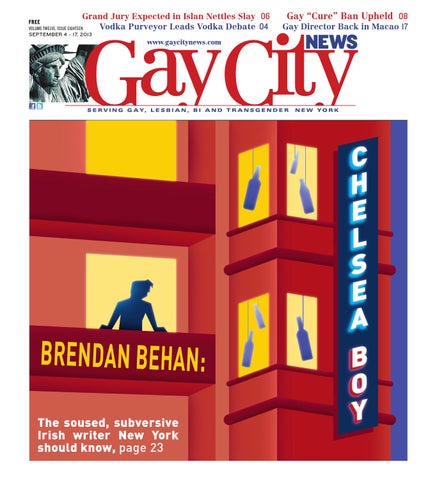
BRENDAN BEHAN: The soused, subversive Irish writer New York should know, page 23
Gay “Cure” Ban Upheld 08 Gay Director Back in Macao 17
2
September 4, 2013 | www.gaycitynews.com
Need a mortgage? POWER EXPRESS HAS IT ALL!
First time homebuyer programs, FHA Programs, Fannie Mae, Jumbo Purchases, Refi’s, Home improvement. CALL FOR A FREE CONSULTATION.
“There’s only one place to go for a mortgage – POWER EXPRESS. Tell them Mo sent you.” — Mariano Rivera CALL
800.826.2265 7 DAYS A WEEK
SPECIAL SAVINGS
MO SAVES AGAIN! Mention Mariano’s name and
FANNIE MAE .875% 15-YEAR* RATE
2
.
APR
*Monthly payments of $6.84 per $1000 borrowed. Min 5% down.
30-YEAR*
SAVE
3 227%
3 875% 4 078% .
.
RATE
APR
*Monthly payments of $4.70 per $1000 borrowed. Min 5% down.
JUMBOS UP TO $3 MILLION .500% .728% 5/1 T-BILL*
$750
2
RATE
2
APR
*12m T-Bill index 0.140% Margin is 2.50%. Mo pymts of $3.29/ $1000 borrowed. Min 25% down. Payment could go up or down after 60th mo. Annual pymt adjustment.
30-YEAR*
on closing costs!
4 125% 4 316% .
RATE
.
APR
*Monthly payments of $4.84 per $1000 borrowed. Min 25% down.
Mortgage Bankers 800.826.2265
LOCAL APPOINTMENTS 7 DAYS/WEEK
•
1111 MARCUS AVE, LAKE SUCCESS, NY
BROOKLYN, BRONX, STATEN ISLAND, NASSAU COUNTY, FLORIDA
We’re an Equal Housing Lender, Licensed Mortgage Banker—NYS Dept. of Financial Services. All rates, fees, terms and guidelines are subject to change without notice. Not responsible for errors. NMLS ID#4904, NMLS ID#1324
3
| September 4, 2013 COME CHECK US OUT AT THE NEW
COVER STORY
POLITICS
Spirited exchange, sharp contrast in Council debate
05
CIVIL RIGHTS Cover Illustration by Michael Shirey
BRENDAN BEHAN:
AT PIER 45
The soused, subversive Irish writer New York should know
23
Gay issues integrated into “Dream” anniversary
PERSPECTIVE
14
CHRISTOPHER ST. / WEST SIDE HWY
WANT TO BE A GUEST BARTENDER? EMAIL US WHY! BRING YOUR FRIENDS AND HAVE A BLAST!
FILM
FCAMP OS 1120@GMAIL.COM PDOHURLEY@AOL.COM
FREE DRINK WITH MENTION OF THIS AD (BEER & WINE ONLY)
Is the Brooklyn Bridge longer, or is my memory shorter?
The sights and sounds of France
LIVE MUSIC
24
WATCH AN AMAZING SUNSET!
OPEN MIC NIGHT
32
COME UP, JOIN OUR MUSICIANS, AND FEEL FREE TO SING ALONG
ENDORSEMENTS
WE SUPP ORT THE BOYCOTTING OF RUSSIAN VODKA
Public Advocate, Borough President, City Council picks
10
UNDER THE STAR S.
34-35
HUDSONRIVERPARK.ORG
4
September 4, 2013 | www.gaycitynews.com
HUMAN RIGHTS
Why Russia Matters Forum looks at crisis for Russian gays in an anti-gay world, but opposes boycotts BY ANDY HUMM
GAY CITY NEWS
W
ith the many nations that are governed by anti-gay laws, why has the Russian crackdown on open gay life sparked worldwide outrage? Basically because that country is so big and powerful, a forum at the LGBT Community Center on August 26 concluded — with a vote on the United Nations Security Council and the ability to set a terrible example for other countries contemplating similar scapegoating of their LGBT populations. And with Russia hosting the Winter Olympics in Sochi next February, the story has arguably become the biggest international LGBT news story ever. The forum attracted attention not just because of the line-up of human rights and Russia experts on the panel, but because it was moderated by Tony Juliano, owner of the gay XES Lounge, which has an exclusive relationship with Stoli Vodka, currently being dumped into the streets in protests around the world to draw attention to the crisis for people of “non-traditional sexualities,” whom the Russian President Vladimir Putin and his Duma have consigned to the closet. Juliano publicly opposes the boycott of Stoli, writing on Facebook that the company is “a friend and ally of the LGBT community,” describing it as a “partner” of XES Lounge. While many other gay bars across the country and globally are refusing to sell any Russian vodka, Juliano is donating a dollar for every Stoli drink sold to Amnesty International, one of the groups represented on the panel and an outspoken opponent of the new Russian law.
Boxers NYC bartenders dump Stolichnaya Vodka at a July 31 protest at Manhattan’s Russian consulate as owner Bob Fluet looks on.
While Amnesty may be taking Juliano’s donations, the Center, which hosted the event gratis, said that it doesn’t receive money from Stoli nor do the other groups represented on the panel — the International Gay and Lesbian Human Rights Commission (IGLHRC), Human Rights Watch (HRW), and the NYU Jordan Center for the Advanced Study of Russia. IGLHRC and HRW oppose boycotts of Russian products and the Olympics in the fight against the Russian law. Alan Klein of Queer Nation, which has taken the lead on protest efforts in New York, did not attend the forum but wrote on Facebook, “The ‘boycott’ has already been hugely successful. Although we are unlikely to hurt Stoli financially in the short-term, they’re certainly afraid of the long-term effect of a black eye from gay activists — so
much so that they are more or less paying Queerty and other LGBT sites to print their press releases, which are full of disinformation. That makes us extremely powerful.” Klein also wrote that “the tactic has driven discourse around Russia’s oppression of the LGBT community to another level entirely.” While Queer Nation has brought hundreds of people — including more than 60 Russians — to the Center to take action to protest the Russian laws, this informational forum was not built around planning any action. In a lengthy Q&A session, however, panelists said what they believed would make a difference. Tanya Cooper of HRW said her group is “putting pressure on the IOC [International Olympic Committee]” to make it clear that “under the Olympic charter,
discrimination is forbidden and the host country is obliged to respect that,” both in terms of “its own citizens and foreigners.” But Russia is making no such concessions and the IOC, in an August 30 letter to New York Council Speaker Christine Quinn, wrote that the “IOC is limited to the scope of the Games. For instance, the IOC cannot influence national legislation and has to respect the law of any host country.” “Russia has to be held accountable,” said Cooper, “and we’re reaching out to McDonald’s and other corporate sponsors [of the Games] to put pressure on the IOC.” Roberta Sklar, communications director at IGLHRC, said, “The Russian LGBT Network says speak up, not walk out. Raise your voices… There is a message going out [from the Russian government] that’s extremely dangerous — that it is okay to have laws against gay people. That’s something to raise hell about.” But while Sklar repeatedly cited LGBT activists in Russia opposed to boycotts, almost 40 such activists have signed on to a Queer Nation “statement on the boycott of Russian goods and services” endorsing the tactic saying, “We appreciate any and all attempts to let Russian authorities know that homophobic and inhumane laws will not go unnoticed and that Vladimir Putin’s regime will not get away with anti-gay violence.” Eliot Borenstein of the NYU Jordan Center, a professor of Russian and Slavic Studies, said, “Boycotts can play into the current regressive agenda” that has Russians saying, “The West is against us! Our values are not being respected!” He said, “Most Russians would be mystified by our concerns about LGBT
c
RUSSIA, continued on p.13
THE ANTI-SEMITIC MELTDOWN OF ONE RUSSIAN GAY ACTIVIST While LGBT groups debate whether boycotts are an appropriate tool for challenging new draconian anti-gay legislation in Russia, one of that nation’s most visible gay activists has embarked on an anti-Semitic social networking binge in recent days. Nikolai Alexeyev, who spearheaded numerous Gay Pride demonstrations in Moscow and St. Petersburg in the past half-dozen years and challenged government efforts to ban them in the European Court of Human Rights, has been speaking out against a variety of boycott proposals, arguing the 2014 Olympics in Sochi should be used as an opportunity to show LGBT defiance and illustrate the Russian state’s denial of basic rights. But that message — at least coming from Alexeyev — has now been drowned out by his recent rants on networking sites including Facebook, where on September 2 he offered to give an interview “to any credible western media about the Jewish mafia trying to overtake the world and now LGBT fight in Russia. It's incredible. They crossed all borders. And we will fiercely fight back.” Later, in the same Facebook thread, he wrote, “America is ruled by Jewish mafia” and “Do you know how many Jews fucked up my speaking engagements in America in the past and in the future? I have terrific Jewish friends but American jids [sic] will destroy the world, we all have to stop them!” The mention of the American speaking engagements likely referred to a 2011 visit, when comments
he had recently made about Israel’s help in propping up Egyptian strongman Hosni Mubarak led California sponsors of an appearance there to cancel. Writing about the Israeli-Egyptian relationship in the Mubarak years, he asked, “And who after this are the Jews? In fact, I always knew who they were.” At an appearance in New York during that flap, Alexeyev backed away from those comments, saying his use of the phrase “the Jews” referred to the Israeli government, not its people. Subsequent to his incendiary Facebook comments on September 2, Alexeyev gave an interview to Slon.ru, a Russian language website. In a translation provided by Scott Long, the former head of the LGBT desk at Human Rights Watch and a longtime critic of Alexeyev, the activist doubled down on his anti-Semitic outbursts of the previous 24 hours, saying, “I’ve been called a faggot on every corner, and I can’t call someone a Yid?” On Twitter and Facebook, Alexeyev also wrote, “It's not a secret anymore that I am Russian Jörg Haider or Pim Fortuyn. I will do what they were not able to finish.” Fortuyn, a stridently anti-Islamic gay Dutch politician, was murdered in 2002. Haider, an anti-Semitic Austrian politician who spoke admiringly of Germany’s Nazi regime and was widely thought to be a closeted homosexual, died in a car crash in 2008. Gay City News’ request for comment made to Alexeyev had gotten no response as of press time. — Paul Schindler
5
| September 4, 2013
POLITICS
Spirited Exchange, Some Sharp Contrasts in Johnson-Kurland Council Debate
LGBT LEADERS CHOOSE
JULIE MENIN
LGBT duel over real estate ties, support on the ground
for Manhattan
DONNA ACETO
Borough President.
Yetta Kurland and Corey Johnson during a contentious moment in their August 26 debate.
BY DUNCAN OSBORNE
I
n a spirited debate frequently punctuated by cheers, boos, and catcalls from the audience, the candidates who are seeking the City Council seat held by Speaker Christine Quinn for the past 14 years faced off for roughly 90 minutes. “I think 14 years is a long time to be representing a district,” said Corey Johnson during the August 26 debate that was held at the Bow Tie Cinema on West 23rd Street in Manhattan. The 31-year-old said that while Quinn had done some “good things,” there were other actions taken by the speaker that “I vehemently disagreed with.” Yetta Kurland, a 45-year-old attorney, declined to criticize Quinn and then delivered a standard Kurland shot — an oblique reference to things that remind the listener to be suspicious of the person referred to. “Her close relationship to Mayor Bloomberg gives her access and power and some might argue that’s a good thing,” Kurland said. The candidates are vying to represent the roughly 180,000 New Yorkers in a district that ranges from the Columbus Circle area to Canal Street and from Fifth Avenue to the Hudson River. With no other credible candidate in the race, the September 10 Democratic primary will determine who takes the seat. Quinn has not endorsed in the race nor has she been asked for an endorsement. Kurland challenged Quinn in
2009 and won 31 percent of the vote in a three-candidate Democratic primary. Quinn won a surprisingly weak 52 percent of the vote. Quinn and Johnson have had a difficult relationship. During the debate, Johnson and Kurland mostly used their standard campaign rhetoric. Johnson showed his detailed knowledge of the district and city policy that he learned during eight years on the community board that covers much of District 3. Kurland avoided details and specifics, favoring broad strokes and vision. Johnson talked about being raised in a working class home in Massachusetts by a mother who was a lunch lady in a public school and a father who was a Teamster and drove a truck for Pepsi. Kurland’s biography consists of a string of titles she uses to describe herself — a “small business owner,” an “educator,” a “civil rights attorney,” and many others — as well as her accomplishments. The enmity that is very much a feature of the race was also on display. Kurland made repeated references to needing “representatives who are going to be honest and open and transparent.” She also referred to electing someone who is not allied with “political insiders” and “real estate interests.” Johnson has held jobs at two real estate development firms. He only put them in his campaign biography after
c
DEBATE, continued on p.33
ENDORSED BY
· Gay City News · Stonewall Democrats · · Deborah Glick · Jim Owles Democratic Club · www.JulieMenin.com
6
September 4, 2013 | www.gaycitynews.com
CRIME
Grand Jury to Weigh Indictment in Islan Nettles Killing Suspect in brutal attack on 21-year-old
DONNA ACETO
transgender woman out on bail, due in court October 4
Among those who spoke at an August 28 vigil for Islan Nettles were her mother, Dolores Nettles (left), and actress Laverne Cox (right), who portrays a transgender inmate in the Netflix series “Orange is the New Black.”
BY PAUL SCHINDLER
The Manhattan Chamber of Commerce LGBT-2-B Committee & Gay City News present
Our LGBT BoutiQ Wedding Expo on September 23, from 6 - 8pm Join us for a brief panel discussion on the update of marriage equality – economic, Supreme Court ruling on DOMA, etc. • Hear from wedding vendors who will have tables at the event and will be available to answer all your questions. • Networking opportunities including free appetizers and special drink specials.
HB Burger
127 W 43rd St #2 New York, NY 10036
www.gaycitynews.com
www.manhattancclgbt.org
www.heartlandbrewery.com
212 473 7875 • manhattancc.org/lgbt
T
he 20-year-old Manhattan man arrested for what witnesses said was a brutal attack on a transgender woman in Harlem shortly after midnight on August 17 is due back in court on October 4, by which time he will likely have faced grand jury consideration of stiffer charges than the third-degree assault and second-degree harassment he is currently charged with. Islan Nettles, a 21-year-old resident of West 131st Street, spent her final days in a coma and died on August 22 after being taken off life support. Paris Wilson was arrested shortly after the attack, which left Nettles “unconscious on the ground with a swollen shut eye and blood on her face,” according to the criminal complaint filed against the suspect. According to police, Nettles and a friend were approached by a group of men who began hurling homophobic insults and throwing punches after realizing the women were transgender. The fatal attack occurred near 148th Street and Eighth Avenue, across the street from a public housing police service area. Several media outlets quoted Nettles’ family members saying that the victim and Wilson, a student at Buffalo State, were “friends” on Facebook. According to Detective Cheryl Crispin, an NYPD spokeswoman, subsequent to the original charges being filed, police
determined that “derogatory language” was used in the attack, so the department’s Hate Crime Task Force was brought into the case. What is unclear at this point is how an assault that left the victim unconscious initially resulted in only misdemeanor assault and harassment charges. One city official with knowledge of the investigation, who declined to be identified, suggested the severity of Nettles’ injuries were not immediately clear. But media accounts, based on police and witness sources, have uniformly described the attack as “savage” and “brutal.” On August 23, the Medical Examiner’s Office ruled the death a homicide caused by “blunt force trauma.” Neither the NYPD nor the Manhattan District Attorney’s Office would comment on what charges Wilson might eventually face. According to DA’s office, after Wilson’s arrest, “someone other than defendant came into the precinct and made incriminating statements about their involvement. We are actively investigating this new development.” The New York Post subsequently reported that police sources told that newspaper that Wilson’s mother put a friend of her son’s up to confessing and saying he had been too drunk to remember his actions. The NYPD and the DA’s office declined comment on this point as well, and the city official who spoke to Gay City News on background merely pointed to the Post story.
c
NETTLES, continued on p.13
7
| September 4, 2013
HEALTH
In Meningitis Push, Billing Disputes, Failure to Reach Medicaid Clients BY DUNCAN OSBORNE
A
s New York City’s health department struggled to respond to a meningitis outbreak among gay and bisexual men, the agency wanted to charge the CallenLorde Community Health Center for the cost of vaccine doses that it gave to the gay health clinic on behalf of the state health department. In a series of October 2012 emails obtained from the state health department under New York’s Freedom of Information Law, Jay Laudato, CallenLorde’s executive director, complained to senior staff at the state agency that he was told by the city that a contract he had with the city health department would be cut by $9,000 to pay for 125 vaccine doses. Previously, the city had given CallenLorde 100 free doses. The city and state then proposed to give another 250 free doses to the clinic, but the 250 were to come from the city’s inventory. The city said it would cut $9,000 from the contract to pay for the state’s 125 doses
and that Callen-Lorde should bill the state to recoup the $9,000. Callen-Lorde opted to reject half of the doses to avoid billing the state. At that point, Callen-Lorde had purchased 400 doses on its own and had administered 316 first doses of the two-shot vaccine. “The complicated scenario you referenced... came from a misunderstanding that Callen-Lorde needed up-front money to purchase vaccines,” Laudato wrote in an email to Gay City News. “Neither NYC nor NYS can advance funds to a provider. They can only reimburse after an expenditure is made. At that point, we had already purchased several hundred doses of vaccines. And so, we didn’t need to reduce one grant and increase the other.” The interaction with Callen-Lorde is emblematic of the city’s hapless response to the outbreak. The city health department, which declined to comment for this story, first announced the outbreak in a September 2012 alert sent to reporters that said there had been four meningitis cases among the city’s gay and bisexual men in the prior four weeks. In a
DEPARTMENT OF HEALTH AND MENTAL HYGIENE
City effort to charge Callen-Lorde for vaccine doses indicative of flat-footed response
Dr. Thomas Farley, the New York City health commissioner.
separate alert sent to medical providers at the same time, the department disclosed that there had been 12 cases altogether since August of 2010 and four of those men were dead.
The department first recommended that all sexually active HIV-positive gay and bisexual men get vaccinated, then expanded that recommendation to include all sexually active gay and bisexual men regardless of HIV status about six weeks later. While saying publicly that it wanted to vaccinate 10,000 men, the department initially pur chased 4,000 vaccine doses. The outbreak grew to 22 cases with seven deaths. A 23rd man who lived outside New York City but spent significant time here also caught the bug. Eventually, the city health department spent just over $800,000 altogether to buy nearly 12,000 doses, including the initial 4,000 doses. To date, 17,142 people have been documented as vaccinated, though that is likely an undercount since reporting the shots is voluntary. There have been no new cases since February. Callen-Lorde has administered 4,737 of the shots, or roughly 27 percent of the known doses, and eventually received more free vaccine.
c
MENINGITIS, continued on p.33
Election 2013 Village Reform Democratic Club 25 Fifth Avenue, New York, NY 10003
Village Reform Democratic Club
Vote. tuesday sept. 10th democratic primary
Comptroller Scott Stringer Manhattan District Attorney Cy Vance Public Advocate Daniel Squadron Manhattan Borough President Julie Menin City Council District 1 Jenifer Rajkumar City Council District 2 Rosie Mendez City Council District 3 Corey Johnson District Leader Arthur Schwartz
Civil Court, 2nd Judicial District:
Kathryn Freed | Marcy Friedman Adam Silvera
Countywide Civil Court Judicial Candidates: John J. Kelly | Anne O’Shea Dakota Ramseur
Judicial Delegates:
Maria Passannante-Derr Arthur Z. Schwartz Luke Henry Norma Ramirez
Alternates:
Lois Rakoff Maureen Remacle Raymond W. Cline Thomas Gass
The decisions we make in the Democratic Primary will have a direct impact on every aspect of our daily lives for years to come. The VRDC has advocated on behalf of Village residents for more than 30 years. Our efforts insure the election of candidates who support policies that are vital to our community’s needs. Please review our candidate endorsements and vote on September 10th for these outstanding leaders.
8
September 4, 2013 | www.gaycitynews.com
LEGAL
California Ban on “Conversion Therapy” for Minors Upheld Ninth Circuit draws distinction between limits on speech and restrictions on mental health practices BY ARTHUR S. LEONARD
A
federal appeals panel has ruled that a California statute outlawing so-called sexual orientation conversion therapy for patients under 18 is constitutional. The Ninth Circuit ruling, on August 29, came in response to two lawsuits, based primarily on First Amendment free speech grounds, that had delayed implementation of the law, which bans state-licensed mental health providers from conducting “sexual orientation change efforts” (SOCE) on minors. Most significantly, the court ruled that the practice of SOCE, though it mainly involves talking by the therapist and patient, is not “speech” protected by the First Amendment, but rather a medical practice that incidentally involves speech. Writing for the court, Circuit Judge Susan P. Graber first summarized mental health profession thinking about SOCE, which in decades past included aversive methods such as lobotomies, shock treatment, and induced nausea, now disavowed by nearly all practitioners. The plaintiffs’ assertion that their approach now relies almost entirely on
talk therapy formed the basis of their First Amendment claims. Beginning with the American Psychiatric Association in 1973, major professional health organizations have declared that homosexuality is not a mental illness and consequently rejected SOCE as unnecessary and ineffective. The California legislature, in debating its SOCE restrictions, considered anecdotal evidence from professional associations that the practice can, in fact, be harmful. The law does not impose criminal penalties on therapists for providing SOCE to minors, but makes it a basis for loss of a license for unprofessional conduct. Judge Graber points out licensed therapists remain free to talk about SOCE, to advocate it publicly, to recommend it to their minor clients — who would have to go out of state to receive such “treatment” or rely on non-licensed individuals such as religious-based practitioners. The law, Graber concluded, “regulates the provision of medical treatment, but leaves mental health providers free to discuss or recommend treatment and to express their views on any topic.” Examining the difficult line between regulation of speech and of conduct in the context of mental health care, Graber “distill[ed] the following relevant
principles” from prior cases: “(1) doctorpatient communications about medical treatment receive substantial First Amendment protection, but the government has more leeway to regulate the conduct necessary to administer treatment itself; (2) psychotherapists are not entitled to special First Amendment protection merely because the mechanism used to deliver mental health treatment is the spoken word; and (3) nevertheless, communication that occurs during psychotherapy does receive some constitutional protection, but it is not immune from regulation.” The California law, she concluded “regulates only treatment,” not speech in and of itself. “We conclude that any effect it may have on free speech interests is merely incidental.” The state, therefore, did not have to meet the substantial judicial burden required when limiting speech. Graber found that “protecting the well-being of minors is a legitimate state interest,” the appropriate test of the law’s constitutionality. With few exceptions, the court noted, the mainstream of professional organizations in the medical and mental health fields has arrived at “the overwhelming consensus” that “SOCE was harmful and ineffective.” Graber wrote, “On this record, we have no trouble concluding
that the legislature acted rationally by relying on that consensus.” On the question of whether the law interfered with parental rights, the court pointed out that both prohibitions of and requirements for specific medical treatments have been upheld. For example, compulsory vaccination schemes have been upheld over the protest of parents, and the courts have stepped in to mandate medical treatments rejected by parents on religious grounds. The plaintiffs will undoubtedly seek further review, but the Ninth Circuit is unlikely to allow further delay in implementing the new law. The State Attorney General’s Office defended the statute, and the National Center for Lesbian Rights was allowed to participate representing intervenors, with its legal director, Shannon Minter, arguing before the Ninth Circuit panel. The court’s decision may prove influential outside the Ninth Circuit, as a legal challenge gets underway in New Jersey to a similar statute recently signed into law by Governor Chris Christie. In New York, State Senators Brad Hoylman and Michael Gianaris and Assemblywoman Deborah Glick hailed the Ninth Circuit ruling and pressed the legislature in Albany to act on similar legislation.
Conviction of Man Who Transmitted HIV to Partner Nixed Minnesota Supreme Court approves appellate reversal for gay defendant BY ARTHUR S. LEONARD
T
he Minnesota Supreme Court unanimously ruled on August 21 that the state’s court of appeals correctly reversed the conviction of an HIV-positive gay man who had transmitted HIV to his partner, finding that neither part of the state’s law penalizing “attempted first-degree assault by communicable disease” applied to his case. According to Chief Justice Lorie Gildea’s opinion, Daniel James Rick was diagnosed HIV-positive in 2006, and three years later he met D.B. through a “social website” and they began a relationship that included unprotected anal sex. Rick maintains he disclosed his HIV-status and that the sex was consensual. D.B. subsequently tested positive for HIV, and when the relationship ended some time later D.B. complained to law enforcement about Rick, who was charged with violating
Minnesota law. Rick’s attorney argued that since his client disclosed his status before having sex, he could not be found guilty. Rick was charged with violating two sections of the law, the first part making it a crime for somebody who “knowingly harbors an infectious agent to transfer” it through “sexual penetration with another person without first having informed the other person.” The second part makes it a crime for somebody who “knowingly harbors an infectious agent to transfer blood, sperm, organs, or tissue, except as deemed necessary for medical research or if disclosed on donor screening forms.” The jury believed Rick’s testimony and acquitted him on the first charge. The state argued that regardless of whether he had disclosed his HIVstatus, Rick had illegally transferred sperm to D.B. Rick argued that provision did not apply to sexual activity, only to medical transfers of blood, sperm, organs, or tissue through sale
or donations. Accepting the state’s argument, the trial judge instructed the jury accordingly, and Rick was convicted and sentenced to 49 months in prison. His appeal kept him out of jail. The state’s court of appeals found Rick’s argument about the law’s interpretation more convincing. When a criminal statute is ambiguous and subject to alternative interpretations, courts generally apply a “rule of lenity” toward the defendant to avoid convicting somebody for conduct that was not clearly criminal. Rick, the court found, fulfilled his legal obligations by disclosing his HIV status to D.B., who could make an informed judgment about engaging in unprotected anal sex. The Supreme Court agreed with this approach. Examining various interpretations of the provision, Justice Gildea concluded that most cut in favor of holding it was not intended by the legislature to deal with sex. The court found the legislature was con-
cerned with two kinds of conduct that might transmit an infectious agent: sex and donation of blood, sperm, organs, or other body tissue. Regarding sex, the legislature was concerned with informed consent on the part of partners. On questions of donation, it intended to impose strict liability for not disclosing relevant information on screening forms. So, in Minnesota an HIV-positive person cannot donate blood, sperm, organs, or tissue except for medical purposes or unless they have disclosed their condition. And, such a person cannot engage in penetrative sex without informing their partner of their status. This interpretation of the law clearly supports the reversal of Rick’s conviction. The case drew signification attention from outside the state, including briefs from the American Civil Liberties Union’s national LGBT/ HIV Project, Lambda Legal, and various HIV-related medical organizations.
9
| September 4, 2013
POLITICS
IRS Will Recognize All Married Couples Treasury Department announces where a couple weds, not where they live key BY PAUL SCHINDLER
US DEPARTMENT OF THE TREAURY
T
he Treasury Department and the Internal Revenue Service have announced that legally married samesex couples, regardless of the state where they reside, will treated as married for federal tax purposes. The August 29 announcement is one of the most significant rulings out of the Obama administration since the Supreme Court on June 26 struck down that portion of the Defense of Marriage Act denying same-sex couples federal recognition. The new policy means that even those married gay and lesbian couples whose home states do not recognize their marriage will be able to file joint federal tax returns as a married couple. “Today’s ruling provides certainty and clear, coherent tax filing guidance for all legally married same-sex couples nationwide,” Treasury Secretary Jacob J. Lew said in a written statement. “It provides access to benefits, responsibilities, and protections under federal tax law that all Americans deserve. This ruling also assures legally married same-sex couples that they can move freely throughout the country knowing that their federal filing status will not change.” The announcement made clear that “same sex couples will be treated as married for all federal tax purposes, including income and gift and estate taxes. The ruling applies to all federal tax provisions where marriage is a factor, including filing status, claiming personal and dependency exemptions, taking the standard deduction, employee benefits, contributing to an IRA, and claiming the earned income tax credit or child tax credit.” Couples will be considered legally married as long as they wed in one of the 13 states or the District of Columbia where marriage equality now exists, in any other states at such time when it becomes legal, or in any foreign jurisdiction, such as Canada, Spain, or Britain, where gay marriage is legal. The ruling does not apply, the government warned, to couples in civil unions or registered domestic partnerships. As a result, the decision puts greater pressure on states like New Jersey, where Governor Chris Christie argues that civil unions deliver all the same rights and benefits as marriage. “The fact that this new respect applies only to married couples — not those joined by domestic partnerships or civil unions — highlights the need for an America where everyone can marry the
Treasury Secretary Jack Lew.
person they love in any state, and have that marriage respected at all levels of government,” said Evan Wolfson, president of Freedom to Marry, in a written statement. The new policy also complicates matters for tax authorities in non-marriage equality states, since state filing status is often specifically linked to the filing status claimed on a taxpayer’s federal form. Legally married same-sex couples now have the obligation to file as married, jointly or separately, going forward. Married couples who wish to amend past tax filings can typically go back three years. The Treasury announcement follows on a series of other Obama administration rulings that have relied on the “place of celebration” — where a marriage took place — rather than state where a couple resides in determining whether the union is due federal recognition for one purpose or another. Shortly after the DOMA ruling came down, Janet Napolitano, the secretary of Homeland Security, announced that a similar approach would be applied to citizens who wish to win permanent residency for their same-sex immigrant spouse. That statement was backed up just weeks later by the Board of Immigration Appeals, which is in the Justice Department’s Executive Office for Immigration Review. Actions such as that taken by Treasury and Homeland Security point up the critical role played by the Executive Branch in response to victories in the courts. The June Supreme Court ruling left many specific questions about federal recognition of same-sex marriages uncertain, and President Barack Obama pledged to deliver answers as sweeping as possible. With the new Treasury/ IRS policy, the administration is continuing down that road.
10
September 4, 2013 | www.gaycitynews.com
ENDORSEMENTS
For Public Advocate: Daniel Squadron
PUBLISHER JENNIFER GOODSTEIN
Jennifer@communitymediallc.com ASSOCIATE PUBLISHER & CO-FOUNDER TROY MASTERS
troy@gaycitynews.com EDITOR IN-CHIEF & CO-FOUNDER PAUL SCHINDLER
editor@gaycitynews.com ASSOCIATE EDITOR Duncan Osborne
CONTRIBUTING EDITORS
Christopher Byrne (Theater), Susie Day (Perspective), Doug Ireland (International), Brian McCormick (Dance)
CONTRIBUTING WRITERS Seth J. Bookey, Anthony M.Brown, Kelly Jean Cogswell, Andres Duque, Michael Ehrhardt, Steve Erickson, Andy Humm, Eli Jacobson, David Kennerley, Gary M. Kramer, Arthur S. Leonard, Michael T. Luongo, Lawrence D. Mass, Winnie McCroy, Eileen McDermott, Mick Meenan, Tim Miller, Gregory Montreuil, Christopher Murray, David Noh, Nathan Riley, David Shengold, Yoav Sivan, Gus Solomons Jr., Tim Teeman, Kathleen Warnock, B enjamin Weinthal, Dean P. Wrzeszcz
ART DIRECTOR MICHAEL SHIREY
GRAPHIC DESIGNER ARNOLD ROZON
SENIOR VP OF ADVERTISING / MARKETING FRANCESCO REGINI
francesco@gaycitynews.com
RETAIL AD MANAGER COLIN GREGORY
ACCOUNT EXECUTIVES ALLISON GREAKER ANDREW REGIER REBECCA ROSENTHAL JULIO TUMBACO Please call (212) 229-1890 for advertising rates and availability.
NATIONAL DISPLAY ADVERTISING Rivendell Media / 212.242.6863
Gay City News, The Newspaper Serving Gay, Lesbian, Bisexual, and Transgender NYC, is published by NYC Community Media, LLC. Send all inquiries to: Gay City News, 515 Canal Street, Unit 1C, NYC 10013 Phone: 212.229.1890 Written permission of the publisher must be obtained before any of the contents of this paper, in part or whole, can be reproduced or redistributed. All contents (c) 2012 Gay City News. Gay City News is a registered trademark of NYC Community Media, LLC. Jennifer Goodstein, CEO Fax: 212.229.2790; E-mail: Jennifer@communitymediallc.com
© 2013 Gay City News. All rights reserved.
FOUNDING MEMBER
FOUNDING MEMBER
T
his year’s race for city public advocate has been overshadowed by the hotly contested mayoral contest and, in recent weeks, by the suddenly competitive face-off between Scott Stringer and Eliot Spitzer for city comptroller. Which is a shame because in a group of able Democratic candidates, there are two with demonstrated records of support for the LGBT community — Brooklyn City Councilwoman Letitia James and State Senator Daniel Squadron, whose district straddles Lower Manhattan and Brownstone Brooklyn.
In roughly a decade on the Council, James has consistently backed gay rights initiatives, worked on HIV issues, and spoken out against homophobic and transphobic violence. In his five years in the Senate, Squadron voted for marriage equality — both when it lost in a rout in 2009 and when it won approval in 2011 — and is now lead sponsor of the Gender Expression Non-Discrimination Act (GENDA), the longstalled transgender civil rights measure. Though GENDA was overlooked once again this year by the Senate’s Republican leadership, Squadron and his Assembly counterpart, Dick Gottfried, significantly improved its prospects for
eventual success by skillfully enlisting the support of top law enforcement officials statewide — including Police Commissioner Ray Kelly — to beat back opponents’ scurrilous charge that the measure imperils the safety of women accessing public restrooms and locker rooms. Squadr on distinguishes himself from James by his
For Manhattan Borough President: Julie Menin
T
his year’s race fhe race to succeed Manhattan B o r o u g h President Scott Stringer is a very competitive o n e . M o s t o f the b or ough president’s powers are advisory, except for appointing half of the members of every community board. So it is a good thing that the four Democratic candidates to succeed him share one central point of agreement — that they would continue his exemplary system of screening and appointing community board members, which ended the cronyism of years past. In wielding the office’s advisory powers, skill and savvy are needed to be effective, the post’s power resting more with the person than with the office. Among four very strong contenders, one candidate, Julie Menin, the for mer chair of Community Board 1 in Lower Manhattan, stands out. In serving Lower Manhattan, Menin wracked up impressive accomplishments. Without her,
community groups downtown would never have secured $200 million of 9/11 money that the Lower Manhattan Development Corporation sat on for years. The money had been forgotten by most, and it was Menin who raised the issue, rallied support, and got the money into deserving hands. Beyond her achievements for Lower Manhattan, Menin has demonstrated leadership that speaks more broadly to the integrity she would bring to the borough presidency. Occupy Wall Street was a rallying point for progressives across the city and around the world, but in the neighborhood surrounding Zuccotti Park, it was a thorny situation in which free speech and assembly rights had to be balanced against the needs and rights of residents not to be disrupted. Menin rolled up her sleeves to forge a compromise resolution at CB1. The result satisfied both sides, but success was certainly not a foregone conclusion when she stepped up. The so-called “Ground Zero
Mosque” — actually a mosque and Islamic center blocks away from the World Trade Center — was something Menin and CB1 could easily have ducked, but they chose to stand up against calls for government interference into the religious freedom of the groups backing the project. That is commendable. Menin also demonstrates her respect for the principal of church and state separation in her posture toward the use of public schools for Sunday worship services, an issue of particular concern given the growing number of explicitly anti-gay congregations that availed themselves of the opportunity and have voiced the goal of increasing their presence. Menin understands that opening up public
support for the Department of Education policy barring the use of public schools for Sunday religious worship services. In recent years, a number of anti-gay congregations availed themselves of the opportunity to do so and have voiced the intention to expand their reach citywide. Squadron admirably stands firm on the basic principal of separation of church and state. This factor — combined with his aggressive GENDA advocacy and his role in passing sensible gun control legislation and curbing Bloomberg administration policy that charged rents to homeless families in shelters — makes Squadron the best choice for public advocate. We will miss his GENDA leadership in Albany but are confident his colleague Brad Hoylman can run with that ball. We urge a vote for Squadron in the September 10 Democratic primary.
schools for worship inevitably raises problems the Constitution wisely provided a clear solution for 225 years ago. Central to Menin’s campaign is a thoughtful proposal to craft a borough-wide master plan and to use the borough president’s budget to give community boards enhanced resources to comprehensively survey their greatest needs. Making urban planning more responsive to community needs is something she’s worked on for years. Among the other candidates, City Councilwoman Jessica Lappin has put forward good ideas on land use and community board improvements and taken the same principled stance as Menin on worship in the schools. Councilwoman Gale Brewer has real legislative accomplishments on issues like paid sick leave and protecting small shops on the Upper West Side. And Councilman Robert Jackson was a leader in the court fight to get the city a fairer shake in state education funding, though his legislative record is not as strong as that of his two Council opponents. It is Menin, however, who most clearly shows the comprehensive vision and passion to be a first-rate borough president. She deserves support on September 10.
11
| September 4, 2013
ENDORSEMENTS
Five Picks for the City Council
DONNA ACETO
T
he District 3 City Council race, for the seat held the past 14 years by Speaker Christine Quinn, pits two passionate and energetic LGBT contenders against each other for what has often been dubbed “the gay seat.” Yetta Kurland is an attorney who has won some impressive civil rights victories in her career, remains outspoken on the closing of St. Vincent’s Hospital, and has rallied community members on other issues including Superstorm Sandy relief. Corey Johnson has also been a community activist during his 13 years in New York and has served for eight years on Community Board 4, encompassing Chelsea and Hell’s Kitchen, including two terms as chair. The two broadly share common progressive views on a host of issues, including the need for more affordable housing, more classrooms, increased spending on HIV prevention, greater citizen participation in allocating funds available to the Council member, and curbs on the excessive use of stop and frisk tactics by the NYPD. A central theme of Kurland’s campaign has been her willingness to take on established powers in the city, an approach typified by her 2009 challenge to Quinn’s reelection and her tireless activism around the St. Vincent’s issue. Johnson emphasizes his skill at working with government bodies and other stakeholders to achieve the goals he values. Evidence for that includes his demonstrated mastery of policy details and the confidence his CB4 colleagues placed in him by twice electing him chair. We believe that Johnson’s skill set and his vision for his role as a Council member better suit him to represent the diverse communities within District 3. The bitterness and pettiness that have characterized this contest — including determined whisper campaigns waged by surrogates for both candidates — are disappointing, and both Johnson and Kurland bear responsibility for not having waged a more positive race. Kurland spent far too much time trying to link her opponent to the evils of the real estate industry based on two staff jobs with developers he held for relatively short amounts of time. Johnson, for his part, for too long was inexplicably opaque about his résumé, which did little but fuel the sense there was
something to be uncovered. The August 26 debate at the Chelsea Bowtie Cinema, however, nicely clarified the choice between the two candidates. Johnson offered detailed explanations for community board work he has accomplished, which gave credence to the proposals he discussed. He also set a generally positive tone for the evening that suggested he has the ability to work with community members of widely divergent opinions. Kurland offered her vision and also a profile of herself that matched that vision. She was too often, though, short on specifics, a flaw that hobbled both of her Council runs. She also has an unfortunate tendency to use upbeat language to mask serious aspersions she is suggesting about her opponent — ones she apparently is unwilling to articulate directly. Should Johnson be elected, we hope he will recognize the vital importance of transparency in public life. His community work to date suggests significant promise and we urge a vote for him.
In other Council races, Rosie Mendez, an out les-
bian who has represented District 2 on Manhattan’s Lower East Side since 2006, faces a primary challenge from Richard Del Rio, a senior pastor at Abounding Grace Church. A strong voice for affordable housing and tenants’ rights, Mendez justly deserves reelection under any scenario. She would be part of a trio of out LGBT veteran members — along with Daniel Dromm and Jimmy Van Bramer, who
will be returned to office from Queens — in next year’s Council. Mendez was among the most outspoken critics of a pattern of false NYPD arrests of gay men in Manhattan adult video stores several years ago. Though Mendez easily outmatches her opponent in visibility, endorsements, and campaign funds, Del Rio is a troubling figure on the political scene. As his website spells out, he is a leader in the fight against the Department of Education policy preventing religious congregations — many of them anti-gay — from renting Sunday space in public schools. The policy, which allows religious groups to continue accessing school space for non-wor ship activities, is currently under court challenge. Since 2011, Del Rio’s site says, he has been “one of the champions of the Right to Worship movement,” which aims to dramatically increase the presence of such congregations citywide. That position is hostile to the interests of the LGBT community and out of step with his district.
Elsewhere in the city,
three promising new LGBT candidates are seeking election to the City Council. In Brooklyn’s District 38, Carlos Menchaca, a former aide to Speaker Christine Quinn and before that to Borough President Marty Markowitz, is challenging incumbent Councilwoman Sara González. On the Upper West Side, in an open race in District 6, Mel Wymore, a transgender man who has served on his local community board for the past 17 years, is vying in a large field of candidates. And in Council District 15, in the central Bronx, Ritchie Torres, who has handled housing issues for Councilman James Vacca during the past eight years, is running for an open seat. Each of these three, profiled in recent weeks in Gay City News, is a passionate progressive and an intelligent innovator who could bring fresh and unique talents and perspectives to the Council. They deserve the community’s votes and its campaign support in the final weeks.
12
September 4, 2013 | www.gaycitynews.com
LEGAL
Wedding Photographer Cannot Deny Service to Same-Sex Ceremony New Mexico Supreme Court says First Amendment not compromised BY ARTHUR S. LEONARD
Come as you are...
Discover who you are.
Join us for The Village Temple’s Rosh Hashana and Yom Kippur services. Rabbi Chava Koster stirs us with her wit and wisdom, drawing on tradition while seeking the new. With his rich baritone, Cantorial Soloist Gerard Edery infuses our annual search for meaning with power and soul. Add your voice to our songs and prayers!
Join us for Rosh Hashanah and Yom Kippur services in the Great Hall at Cooper Union: FREE CHILDREN’S SERVICES at 2 p.m. on Sept. 5 and Sept 14. Visit our school’s Open House on Sept. 15 10 a.m. - 12 p.m. at The Village Temple, 33 E. 12th St.
Reach us at www.VillageTemple.org · 212-674-2340
L’Shana Tova for year 5774 Best wishes for a sweet and joyous New Year
Assembly Member
Dick Gottfried 242 West 27th Street New York, NY 10001
tel. 212-807-7900 fax 212-243-2035 www.assembly.state.ny.us GottfriedR@nysa.us
L’Shana Tova Good health, happiness and peace. Assemblymember
Deborah J. Glick 853 Broadway, Suite 1518, New York, NY 10003
Tel: 212-674-5153 / Fax: 212-674-5530 glickd@assembly.state.ny.us
T
he New Mexico Supreme Court unanimously ruled on August 22 that a wedding photography business violated the state’s Human Rights Act by refusing service to a lesbian couple for their commitment ceremony, finding that the owners’ religious and free speech rights were not unconstitutionally violated by this result. Vanessa Willock contacted Elane Photography LLC by email to inquire about booking the company for a commitment ceremony with her partner, Misti Collinsworth. Elaine Huguenin, who owns the business with her husband, declined, infor ming Willock they only do “traditional weddings.” When Willock pressed her, Huguenin replied specifically that they “do not photograph same-sex weddings.” Collinsworth then contacted Elane about photographing a wedding without mentioning the participants’ genders, and Huguenin sent her pricing information and an invitation to meet. Huguenin followed up with a second email when she got no response. Willock and Collinsworth filed a discrimination charge against Elane Photography, citing New Mexico’s ban on discrimination because of sexual orientation by public accommodations. Elane never claimed it is not a public accommodation, but argued it is privileged under both the First Amendment of US Constitution and the New Mexico Religious Freedom Restoration Act to decline to photograph same-sex ceremonies as a matter of freedom of expression and free exercise of religion. The New Mexico Human Rights Commission ruled against Elane, which appealed to the state courts. Both the trial court and the court of appeals rejected Elane’s arguments, and the State Supreme Court agreed in an opinion by Justice Edward L. Chavez. Elane could yet petition the US Supreme Court. Elane’s most serious arguments were the First Amendment claims, since providing photography services for same-sex ceremonies does, to some extent, involve the business’ owners in “expressive activities” that violate their religious and moral views. But the court found a substantial body of precedent for commercial businesses being required to comply with religiouslyneutral anti-discrimination laws.
Interestingly, the court analogized its findings on the free speech claims to the US Supreme Court’s decision upholding the government’s requirement that law schools receiving federal funds allow military recruiters on their campuses, despite the schools’ opposition to the Don’t Ask, Don’t Tell policy then in effect. The schools complained that allowing recruiters on campus might appear as an endorsement of the military’s policies, so a requirement they do so violated their expressive rights, but the Supreme Court held the schools were free to disclaim any approval of the military policy while allowing access for the recruiters. A similar analysis applied to the free exercise of religion claim. “Businesses that choose to be public accommodations must comply with the NMHRA, although such businesses retain their First Amendment rights to express their religious or political beliefs,” wrote Justice Chavez. “They may, for example, post a disclaimer on their website or in their studio advertising that they oppose same-sex marriage but that they comply with applicable antidiscrimination laws.” In a concurring opinion, Justice Richard C. Bosson gave an eloquent explanation of the rationale for the court’s opinion. “The Huguenins are free to think, to say, to believe, as they wish; they may pray to the God of their choice and follow those commandments in their personal lives wherever they lead,” he wrote. “The Constitution protects the Huguenins in that respect and much more. But there is a price, one that we all have to pay somewhere in our civic life. “In the smaller, more focused world of the marketplace, of commerce, of public accommodation, the Huguenins have to channel their conduct, not their beliefs, so as to leave space for other Americans who believe something different. That compromise is part of the glue that holds us together as a nation, the tolerance that lubricates the varied moving parts of us as a people.” Alliance Defending Freedom, a law firm specializing in defending religious liberty and opposing gay rights claims, provided representation to the Huguenins in this case. Julie Sakura and Sarah Steadman of Santa Fe and Tobias Barrington Wolff, a University of Pennsylvania law professor, represented Willock and Collinsworth.
13
| September 4, 2013
c
RUSSIA, from p.4
people. I don’t have a solution, but it is important to keep that in mind.” Borenstein wrote a blog post for the Jordan Center on “Sending Our Gay Students to Russia” that concluded, “We should make sure our students have as much information as possible, and let them know that visibility can bring vulnerability (especially to gay men, who are the primary target of a campaign that is so clearly connected to anxieties about ‘manliness’).” Vlachaslau Bortnik of Amnesty, a native of Belarus, painted a grim picture of what the LGBT rights movement faces there and in Russia, citing “Belarus’ first and only president [Alexander Lukashenko] who said, ‘Homosexuality was brought from the West. It is not something that can be tolerated in Belarus.’” Bortnik recalled being “very scared” when he tried to participate in Moscow Pride, which is forbidden by authorities. “Hundreds were attacked for looking like gay people,” he said. Borenstein said Russia “has a long tradition of homophobia,” citing the Soviet era when gay men were imprisoned and lesbians were treated at psychiatric facilities. The laws against sodomy were repealed in 1993 and “it was a better time,” but the return of Putin to power has seen homosexuality as something “to rally against.” He calls Putin’s crew “an authoritarian regime without an ideology that seeks power for its own
c
NETTLES, from p.6
According to the DA’s office, Wilson’s October 4 court date is scheduled “for possible grand jury action.” Represented by Legal Aid, he is out on $2,000 bail. Nettles’ LinkedIn page described a young woman who graduated from the Bread and Roses Integrated Arts School in Harlem, had taken classes at the New York College of Technology, and hoped to work in the fashion industry. Her work experience included design duties at Ay’Medici, a Harlem fashion company, and service as a photographer and fashion instructor at the Harlem Children’s Zone. Family and friends of Nettles, assisted by several LGBT organizations, held a vigil for the victim on the evening of August 28 about a block from where she was attacked. At times, the event was disrupted by shouting when several attendees challenged family members and others who referred to Nettles using the word “he.” Since late spring, the city has seen a surge in anti-LGBT violence, with assaults near Madison Square Gar den and in the East Village and Soho. On May 18, Mark Carson, a 32-yearold gay man, was shot to death point
sake and has picked an internal group that is an external threat” in their formulation. Cooper sees the new laws as an extension of all the new Putin laws “to restrict movements” and “target human rights workers and the opposition.” “It’s not okay to say you’re gay” in Russia, Cooper said. “That’s a huge violation of freedom.” Sklar cited a Russian lesbian activist who told her, “Please don’t silo LGBT people. Look at us as a larger community of human rights defenders.” After the panel, Juliano said, “I talked about the 76 countries that ban gay sex and asked why we’re focusing on Russia, which does not. They answered that question. It’s the power and influence that Russia has around the world.” Andrew Miller of Queer Nation, who attended the forum, said, “I was disappointed the panelists weren’t as informed as they might have been. There was information about what is going on in Russia from the perspective of gay and lesbian Russians who live there that didn’t get covered and that we were able to let people know about at the Queer Nation town meetings.” The debate about what is happening inside Russia for LGBT people and how to help will continue. There is no debate that the situation is dire and that action is required now. An International Day of Solidarity around the crisis is scheduled for September 8, with a rally planned in Union Square from 3 to 6 p.m.
blank in a homophobic assault in the West Village. On August 14, two gay men were attacked shortly after midnight in Chelsea by a group of up to six men shouting homophobic slurs. One of the victims required stitches under his lip and the other underwent an MRI to check for a possible concussion. Borough President Scott Stringer termed the killing of Nettles “appalling and unacceptable,” while Public Advocate Bill de Blasio, Lower Manhattan State Senator Daniel Squadron, the sponsor of the long-stalled Gender Expression Non-Discrimination Act, and his out gay colleague, Brad Hoylman of Chelsea, called on Albany to act quickly to enact the transgender civil rights law, which would broaden the language of the state hate crime statute to include protections based on gender identity and expression. In a joint statement, City Council Speaker Christine Quinn and Harlem Councilmembers Robert Jackson and Inez Dickens urged New Yorkers “to embrace our differences and to denounce hate violence,” and said anyone with information about the crime should contact the NYPD through the Crime Stoppers Hotline at 1-800-577-TIPS.
DeAr guys who like guys And GALS who like gAls, life, liberty And the pursuit of hAppiness begAn with Me.
P.S. Get your history strAight And your nightlife gAy.
10 Minutes to The Jersey Shore! On High Ground, Bike to Town, Great Community.
Love the Space You Call Home! EASTPOINTE Highlands, NJ
Apt. # 901 Let’s Talk!
Contact: Loren Manzell
1.5 Hours from Manhattan Minutes from the Ferry to NY 900 sq. ft, 1 Bdrm. Child & Pet Friendly Condominium Luxurious Amenities, Scenic Views, Valet Parking PRICE: $149,900 PHONE: 914-963-7190 EMAIL: LMSmartdogs@aol.com
14
September 4, 2013 | www.gaycitynews.com
CIVIL RIGHTS
A Winning Combination!
Gay Issues Integrated into 50th Anniversary of “I Have a Dream” LGBT equality takes the podium at August 24 March on washington
GAY CITY NEWS
PLAY. DINE. UNWIND.
LGBT activists at a DC statehood rally prior to the 50th anniversary commemoration of Dr. Martin Luther King’s “I Have a Dream” speech.
110-00 Rockaway Blvd. Jamaica, NY 11420 rwnewyork.com • 1-888-888-8801 In Queens, near JFK Airport. Take Free shuttle at Jamaica/Sutphin Blvd
or Q37. LIRR
Must be 18 years of age or older to play the New York Lottery Games. Please play responsibly.
he world was inspired by Reverend Dr. Martin Luther King, Jr.’s “I Have a Dream” speech on the steps of the Lincoln Memorial in August 1963. Hundreds of thousands were moved to travel to the Mall in Washington for the 50thanniversary commemoration rally and march on August 24, though the vast majority were African Americans stung by recent setbacks such as the Supreme Court’s gutting of the historic 1965 Voting Rights Act and a Florida jury’s acquittal of George Zimmerman in the killing of Trayvon Martin. Most major national LGBT groups endorsed the commemoration and some were provided with short speaking slots from the podium, but visible evidence of organized gay participation in the event was hard to come by moving through the massive throngs from the Washington Monument to the Lincoln Memorial. What was much in evidence was how deeply concern for LGBT rights has become integrated into the rhetoric of the civil rights, labor, and political leaders who spoke. Newark Mayor Cory Booker, the Democratic nominee in a special election for the US Senate, in one of the best received speeches of the day, said, “We must stand in my generation for equality. It doesn’t matter who you love — we don’t have second class citizenship for gay and lesbian Americans.” He had not yet been born in ’63,
GAY CITY NEWS
Scan For Gaming Info
T
BY ANDY HUMM
CBST’s Rabbi Sharon Kleinbaum.
but said, “We can never pay back [the civil rights generation] for their struggles and sacrifices. We must pay it forward.” Congressman John Lewis, a Georgia Democrat who is the only speaker from the ’63 march still alive, said in a rousing address, “It doesn’t matter if we are straight or gay. We all live in the same house.” Acknowledging that movements for equality always face backlash, he said, “I got arrested 40 times, beaten bloody and unconscious. I’m not tired! I’m ready to fight!” Randi Weingarten, president of the
c
WASHINGTON, continued on p.15
15
| September 4, 2013
Mayoral contenders Christine Quinn, Bill Thompson, and Bill de Blasio, with his daughter, Chiara, his wife, Chirlane McCray, and his son, Dante.
whether other communities can legitimately claim the mantle of the ‘60s civil rights movement in advancing their claims for equality. “We need coalitions,” he said, challenging “these bogus arguments that they aren’t welcome because they haven’t suffered like us. It’s like people in the hospital arguing over who is sickest. We need to unite and get well together. We shouldn’t be comparing pain. We need equal justice for all of us.” Later in his speech, Sharpton specifically referred to LGBT people when he talked about “an old America that has passed away that only worked for white males” who “tell you who to sleep with but don’t put food on the table.” Weingarten’s partner, Rabbi Sharon Kleinbaum of New York’s LGBT synagogue, was in the vast crowd on the Mall, having left Manhattan at 5 a.m. on a bus with 45 members of Congregation Beit Simchat Torah, “who ranged in age from 17 to 83,” including four who had been at the ’63 march. She said that fighting racism and economic inequality “are as important to us as the fight for marriage equality.” Later, among a group of three heading back to the CBST bus, Pete Webb said he had relatives who were at the ’63 march. Bryan Bridges said, “It’s nice to be part of history and support the larger issues of the civil rights movement that aren’t specifically LGBT, with people focused on class struggle.” Matthew Gore noted, “It’s 50 years later and we’re dealing with the same issues — jobs and racial justice. The gap between rich and poor is greater than then.” I ran into three mayoral candidates, including City Council Speaker Christine Quinn, there with her wife, Kim Catullo, Public Advocate Bill de Blasio, there with his wife, Chirlane McCray, and their two children, and Bill Thompson, who called it “a spectacular day.” Quinn said, “It’s great to be here 50 years after and say, ‘Thank you,’” but then noting the August 17 killing of 21-year-old Islan Nettles in Harlem, added, “A member of the LGBT community may have been murdered because she was transgender. That’s not the dream.” Still, she emphasized that there has been “massive progress.” De Blasio hailed the “50 years of committed activist achievement” since 1963 on issues including LGBT equality, even as he decried continued “economic inequality.” For those on hand in Washington, it was a day for
GAY CITY NEWS
American Federation of Teachers and an out lesbian — one of the many labor leaders behind this march — said, “Discrimination based on race or sexual orientation may not be legal, but it is still lethal” — though, in fact, anti-gay and anti-transgender bias is still legal in a majority of states. Referring to Bayard Rustin, the lead organizer of the ’63 march, she said, “Fifty years ago, another gay person had to be in the shadows.” Despite Rustin staying behind the scenes of the march, Senator Strom Thurmond, a racist and virulently homophobic South Carolina Republican, still used him as a punching bag on the floor of Congress in attacking the march. “I stand here today as a labor leader and a gay person,” Weingarten told the crowd. Veteran peace activist David McReynolds, who worked with Rustin, wrote in an email that Thurmond’s attack on Rustin — in which the senator alleged he was a member of the Communist Party, had visited the Soviet Union, dodged the World War II draft, and been found “guilty of a morals charge in Pasadena,” California, backfired. The broadside, McReynolds said, “irony of ironies, ‘freed Bayard.’” A. Philip Randolph, one of the earliest African-American labor leaders, called a press conference, McReynolds recalled, refuting the first three charges and saying, “‘of the morals charge, this occurred many years ago, Mr. Rustin has long since have shown himself of great value to the Negro people, and I have no further comment on that charge.’” According to McReynolds, “Bayard said publicly, ‘Senator Thurmond does not care if I’m a murder er. His effort is to hit at the efforts of Negro people to organize for their rights.’ What Bayard did NOT SAY was, ‘Senator Thurmond does not care that I’m homosexual.’” Gay-baiting civil rights and labor leaders is no longer an effective tool on the right, and today gay activists are open in those movements and LGBT issues are welcome at the table. Populated in good measure by members of African-American Christian congregations, this year’s march included a couple of “One Man, One Woman” anti-same-sex marriage T-shirts, but also plenty of applause when LGBT issues were addressed from the podium. Michael Eric Dyson, a Georgetown University sociologist and radio host, said, “King had a dream, we need a team” to address the range of today’s challenges, including a team to help “our gay brothers and lesbian sisters to come out of the closet.” Martin Luther King III, son of the slain civil rights leader, included “gay and straight” in his litany of diversity. He also charged the Supreme Court is “blind to the theft of the black vote” and said his father’s dream “is far from realized.” The day before the march, King endorsed a boycott of the Olympics next year in Russia to protest that nation’s new draconian anti-gay legislation. In his keynote address, the Reverend Al Sharpton of the National Action Network, which organized the commemorative events, spoke of meeting an AfricanAmerican man of some achievement who told him, “Look at my résumé. The civil rights movement didn’t write it.” Sharpton said he replied, “Civil rights didn’t write your résumé, but the civil rights movement made somebody read your résumé.” Sharpton lamented the fact that African Americans have been voting for nearly 50 years since adoption of the Voting Rights Act, and only now that Barack Obama is president are states scrambling to impose requirements that they show ID. Sharpton explicitly addressed the question of
GAY CITY NEWS
LA MAISON, from p.14
GAY CITY NEWS
c
honoring the dream with lots of talk of unfinished work. The work of integrating LGBT issues into that dream and the larger civil rights movement seems to be largely complete. As LGBT equality continues its march, the challenge for activists from our community is to show up to fight the backlash against racial justice and to advance the cause of economic justice.
R.K. Gupta · Attorney at Law · Immigration, Bankruptcy, Divorces, Real Estate, Criminal, & General Legal Matters 44 Court Street #911 Brooklyn, NY 11201 718-643-1500 // 718-237-1902 rkguptark1@yahoo.com M-F: 10-5 // Sat: 12-3
16
September 4, 2013 | www.gaycitynews.com
FILM
Sex American Style Joshua Sanchez shows us two very different gay men grappling with a connection BY GARY M. KRAMER
FOUR Directed by Joshua Sanchez 306 Releasing Director, cast appear at BAMcinématek Peter Jay Sharp Building 30 Lafayette Ave. at Ashland Pl. Sep. 10, 7:30 p.m. bam.org/#Film Opens Sep. 13 AMC Loews 19th Street East 6 890 Broadway at 19th St. amctheatres.com
In a recent Skype session, the out writer and director talked about the queer content in this amazing film. GARY M. KRAMER: What were you like as a teen — shy but adventurous, like June, or more flamboyant like his gay friend Todd (Liam Benzvi)? JOSHUA SANCHEZ: [Laughs.] I was probably much more like June. I grew up in Texas. My parents were very religious. It was not a welcoming environment for a gay kid. I was not unhappy as a teen — I struggled with my sexuality, but I had other things to keep me afloat — I was into punk rock, skateboarding, and film. I wish I was more like Todd. Gay kids are like that now — the acceptance is greater.
Not for the Timid NOW
ON TAP
IMPERIAL APRICOT ALE
Brewed with Fresh Apricots from NY’s Red Jacket Orchards
BREWED IN NEW YORK CITY Empire State 34th & 5th Midtown West 41st st at 8th Union Square at 17th st Times Square 43rd & B’way HB Burger 43rd st Between 6th and Broadway www.Heartlandbrewery.com
Employee Owned
GMK: How do you think “Four” speaks to the issues it raises about race, class, and sexuality? JS: Gosh, I think it says so much! The questions I get asked most are about Joe and the controversial elements about an older African-American man in the closet, who finds himself in that situation in his life. What that says about African-American men in general and their being about to deal with gayness. I’m not sure that it’s a film that gives a lot of easy answers.
306 RELEASING
F
our” is an outstanding character study, directed by Joshua Sanchez, who adapted the play by Christopher Shinn. The film depicts two couples who meet up for sex on the same Fourth of July. June (Emory Cohen) is a shy, gay teen who arranges a hook up over the Internet with Joe (Wendell Pierce), a gregarious African-American married man. Sanchez deftly captures the awkwardness and strained intimacy of their encounter, which is contrasted with Joe’s daughter, Abigayle (Aja Naomi King), reluctantly meeting up with the smoothtalking Dexter (E.J. Bonilla).
Wendell Pierce in Joshua Sanchez’s “Four.”
GMK: How do you think audiences in general and gay men in particular, relate to the characters of Joe and June? JS: I feel that a lot of gay men have a reaction to Joe that is nuanced and complex. You can read all kinds of unsavory aspects to his character, but to me, he was a man who was dealing with a lot of common gay male stuff. It was normal in my view of how gay men develop and the challenges they face. It makes folks uncomfortable to see the younger man-older man gay male relationship, which is common for younger guys who look to older men to show them how to be gay. One of the aspects of June’s character is that we don’t see him as a victim. I thought of Joe as someone who had so much potential, intelligence, and sophistication, but when you’re not able to be who you want to be or who you are, that’s a sad thing. That’s not to say Joe is without hope, but he’s struggling with it more than June is. There are aspects of June I related to — I was more introverted, and not outgoing, but I’ve gotten to a point in my life where I’ve recognized my own ability to stand on my own and be confident and this film was part of my journey to that. GMK: The film has themes about being big, being proud of one’s self, and believing in one’s self. JS: I guess that Joe himself — that moment where he asks June to “be big, be American,” is right after they first meet, and in a way it is the inciting aspect of the movie. It’s setting the tone of the rest of the film. It brings this confidence out of June. It’s also hypocritical because Joe has such a twisted notion of what that means for himself.
c
FOUR, continued on p.31
17
| September 4, 2013
FILM
Handsome, Unique PostColonial Noir Gay Portuguese director’s
We take pride in your health. CINEMA GUILD
return to Macao mixes fiction, doc approach
Cindy Scrash, lip-synching Jane Russell’s “You Kill Me” from the soundtrack of Josef von Sternberg’s “Macao,” in João Pedro Rodrigues and João Rui Guerra da Mata’s “The Last Time I Saw Macao.”
BY STEVE ERICKSON
T
he Last Time I Saw Macao” is like nothing I’ve seen before. It bears some resemblance to Chris Marker’s essay films, but Marker rarely integrated fiction to the degree “The Last Time I Saw Macao” does, except in his sci-fi short “La Jetée.” Portuguese directors João Pedro Rodrigues and João Rui Guerra da Mata have based the film on the latter’s life but expanded its scope to encompass wildly conspiratorial imaginings. At the same time, they’re grounded in some sense of reality. The film’s soundtrack is mostly fictional, its images mostly documentary.
THE LAST TIME I SAW MACAO Directed by João Pedro Rodrigues and João Rui Guerra da Mata In Portuguese with English subtitles The Cinema Guild Opens Sep. 13 Film Society of Lincoln Center Elinor Bunin Munroe Film Center 144 W. 65th St. filmlinc.com
Set on the island of Macao, which now belongs to China but was a Portuguese colony for 400 years, “The Last Time I Saw Macao” documents Guerra da Mata’s visit to the city, where he grew up in the ‘70s, in search of a transgender friend, Candy. The film opens with a performance by drag queen Cindy Scrash, lip-synching Jane Russell’s
“You Kill Me” (from the soundtrack of Josef von Sternberg’s “Macao”) in front of a tiger cage. Then it shows several men shooting at each other, followed by Guerra da Mata approaching Macao from a boat. He tries to get in touch with Candy, but he can’t get his bearings on the island and keeps showing up too late. Her calls and text messages grow increasingly desperate as she hints she’s being tracked down by a conspiracy tied to the animal signs of the zodiac. There’s little camera movement in “The Last Time I Saw Macao.” The film evokes “La Jetée” in that it suggests a procession of still photos, even though there’s movement within its images. The filmmakers have an uncanny eye for handsome framing and finding the perfect angle almost all the time. If they switched to photography, they could compete with Jeff Wall and Cindy Sherman in the art world. Guerra da Mata is heard but not seen. Early on, he muses that Macao is simultaneously one of the friendliest and loneliest cities in the world. “The Last Time I Saw Macao” brings out its alienating qualities as beautiful as it is. In life, Rodrigues and Guerra da Mata are partners. In the film, Guerra da Mata doesn’t acknowledge that anyone else is accompanying him on this trip or taking film alongside him. He’s on a quest for Candy, but she remains an absence at the heart of the film. “The Last Time I Saw Macao” makes overt reference to Hollywood films — besides the von Sternberg homage that
c
MACAO, continued on p.31
Comprehensive Health Care for the LGBT Communities Beth Israel Medical Group 222 West 14th St. • LGBT Family Health • Lesbian, Gay and Bisexual Primary Care • Transgender Health 309 West 23rd St., 2nd Floor • Lesbian, Gay and Bisexual Primary Care 275 Eighth Avenue at 24th St. • LGBT Senior Health www.LGBTHealthServices.org
Beth Israel LGBT Health Services Referrals, Community Education & Patient Navigation
23
| September 4, 2013
BRENDAN BEHAN: the soused, subversive
BY DAVID KENNERLEY
D
ublin-born author Brendan Behan once quipped he was “a drinker with a writing problem.” If he were alive today — he died in 1964 at age 41 from diabetes complications brought on by massive alcohol abuse — he might also admit to a serious public image problem. In the eyes of the Irish, Behan sits, albeit uneasily, alongside their greatest authors — Samuel Beckett, James Joyce, Bram Stoker, Oscar Wilde, George Bernard Shaw, and Frank McCourt, to name a few. His work, infused with raw, authentic language, broke
BRENDAN AT THE CHELSEA Acorn Theater at Theater Row 410 W. 42nd St Sep. 4-Oct. 8 Tue. at 7 p.m.; Wed.-Sat. at 8 p.m. Sat. at 2 p.m.; Sun. at 3 p.m. $55.75; BrendanChelsea.com Or 212-239-6200
new ground in articulating the plight of the working class. Two of his plays, “Quare Fellow” and “The Hostage,” were ardently received in New York. His autobiographical novel “Borstal Boy” was a worldwide bestseller, later turned into a critically praised film. Yet for some reason, the literary bad boy, once a member of the Irish Republican Army, has failed to fully register in America. It’s especially mystifying, given that Behan spent a decent chunk of time living in New York, the place where the malcontent was said to be at his happiest. And now “Brendan at the Chelsea,” a play based on the memoir “Brendan Behan’s New York,” aims to do some long overdue damage control. The five-character drama, written by his niece Janet Behan and directed by the veteran Irish actor Adrian Dunbar (who also plays the title role), was a sensation at the Lyric Theatre in Belfast and has now landed at New York’s Acorn Theatre Off Broadway. “It’s always been our ambition to bring Behan to New York,” Dunbar said of the play, which centers on the writer’s last night in the Chelsea Hotel before he returns to Dublin, only to die four months later. “It’s a very New York-centric play; however, we don’t know how audiences will respond. He is not a household name. We’re taking a huge risk. It feels like a Brendan Behan play, brutally funny and insightful.” As Dunbar sees it, Behan lacks an organized constituency, coming from the Dublin working class and with no university pedigree. “He was garrulous, alcoholic, angry, excommunicated, and bisexual if not completely gay. Yes he was married, but we’ll not go down that road. He makes a nuisance of himself and is not easy to be with. He needs people like us taking care of his memory.” According to Dunbar, the acutely intuitive Behan was a major literary figure, especially following the hit staging of “The Hostage” on Broadway, where the boozy playwright, as the story goes, once joined the
STEFFAN HILL
Irish writer New York should know
Adrian Dunbar (l.), seen in the Lyric Theatre Belfast production of Janet Behan’s “Brendan at the Chelsea.”
cast onstage mid-performance after drinking seven bottles of champagne. “He legitimized the entire Beat generation,” Dunbar explained. “He was talking to Ginsberg and Kerouac, experimenting in poetry, writing in stream-ofconscious prose. It was all fueled by whiskey and bourbon, which, from what I hear, is enjoying a comeback in New York.” Dunbar believes Behan was among the first authors to put the big issues, like political strife and capital punishment, in the mouths of ordinary people rather than the intelligentsia. “His work has a ring of sincerity and integrity about it,” Dunbar observed. “He was an excellent, groundbreaking agitprop playwright.” “Brendan at the Chelsea” evokes a vital, exciting period in New York in the early 1960s. The dissipated iconoclast caroused in such literary haunts as McSorley's, the White Horse Tavern, and P.J. Clarke’s. He even appeared on Jack Paar’s “Tonight Show.” At the time, the Chelsea Hotel was a hotbed of bohemia — creative geniuses like Arthur Miller and Dylan Thomas lived there. Gore Vidal, it should be noted, salaciously described a bout of furtive sex with Jack Kerouac, after rejecting the advances of William S. Burroughs, at the Chelsea in 1953. But that’s the stuff of another play. Appar ently Behan, who took to alcohol around age six,
would drink anything he could get his hands on. During one bender, according to Dunbar, he got naked and ran through the Algonquin Hotel and scared the old biddies, which got him banned. Behan’s plaque is among several other artistic notables at the Chelsea Hotel. If he were alive today, he’d be dismayed to see his beloved grungy hotel being turned into luxury condos, destined to be stripped of any funky charm. Dunbar admits that wearing two hats — director and lead actor — is problematic, but he’s up to the challenge: “You have to concentrate on the other actors first and worry about yourself later. I have kind of a third eye watching from above. We can’t afford to employ someone else as the director, so I’ve ended up with the job.” In preparing for the role, Dunbar was most concerned with perfecting the irregular speech cadences and accent. “It’s a huge canvas to work on,” he explained. “There are a lot of emotions to dredge up and it takes quite a lot out of me. But, you know, I said I could do it when I rode in.” To anyone familiar with “Borstal Boy,” about Behan in his late teens, then a rogue member of the IRA doing time in a prisonlike reform school for attempting to blow up the Liverpool docks, the Behan portrayed in the play may come as a shock. “He’s at the end of his life and is more reflective,” Dunbar said.
“Sure, once he gets a few drinks in him, he kids himself that things might get better. But In the cold light of day, he realizes he’s abused himself and his days are numbered.” While “Brendan at the Chelsea” is rooted in fact, Janet Behan had to invent certain conversations and confrontations, especially those with his wife, Beatrice. “He can’t write at this point because his joints are all horribly swelled up from the diabetes, so he must speak into a recorder,” explained Dunbar. “He gets these tiny flashbacks now and again of various episodes in his life.” One of the most potent yet oddly heartwarming recollections is of a trip to Fire Island with Beatrice. Did Behan really go to the gay enclave or is that a fantasy? “Yes, he went to Fire Island,” Dunbar confirmed. “He insisted he didn’t know what the place was all about, but I’m not buying that.” One scene r ecalls them arriving at the Botel in the Pines and carousing with fun-loving boys from New York. “It’s bizarre to look back at that time,” Dunbar said. “The idea that there would be a magical place where gay men can just hang out, have fun, and not be ridiculed or in danger — it’s quite startling. In those days you certainly didn’t shout [about homosexuality] from the rooftops.” The director has no interest in revising the play to suit American audiences, not even softening the acerbic language (the dialogue includes variations of the expletive “fuck” some 140 times), though he is open to toning down the accents. Somewhat gingerly, I took it upon myself to point out a minor glitch in the script, which referred to “The Pines in Cherry Grove” as if they are a single entity instead of two separate gay communities on Fire Island. Savvy New Yorkers would surely pick up on that. “Ah, so it’s the Pines near Cherry Grove,” Dunbar said. “I believe you’ve just changed the script.”
24
September 4, 2013 | www.gaycitynews.com
FILM
Our mission is to help patients realize the dream of parenthood. GENESIS Fertility & Reproductive Medicine is a nationally recognized center of excellence for the treatment of infertility, long-recognized for our comprehensive fertility services, culturally-sensitive approach to patient care and excellent success rates. The countless notes from patients that decorate our halls are testimony to the quality of the GENESIS program.
Building Families for 25 Years! Brooklyn • Staten Island • Long Island
GENESIS
®
Fertility & Reproductive Medicine
Where Life Begins
®
(718) 283-8600 www.genesisfertility.com
Mention Gay City News for a FREE 15 minute Consultation. *Limited Availability / Restrictions Apply*
The Sights of Sounds Nicholas Philibert examines the spectacle of Radio France BY STEVE ERICKSON
F
or most people, documentaries are cultural vegetables — unless they’re directed by Michael Moore or feature cute penguins. They’re more akin to reading the Sunday New York Times than to watching a sitcom. Documentary filmmakers seem to have realized this; recent films like “Dirty Wars” and “Blackfish” are juiced up with slick storytelling techniques, not always to their benefit. French director Nicolas Philibert is more successful at entertaining his audience with “La Maison de la radio.” In the past, I’ve found Philibert’s documentaries tepid and shallow, although I must admit I haven’t seen most of his filmography. “La Maison de la radio” is the first one I’ve fully enjoyed, largely because it plays like a workplace comedy and backstage musical.
LA MAISON DE LA RADIO Directed by Nicolas Philibert Kino Lorber In French with English subtitles Opens Sep. 4 Film Forum 209 W. Houston St. filmforum.org
“La Maison de la radio” centers on Radio France, a rough French equivalent to NPR. The film strings together its wildly eclectic programming, which includes the usual news reports and talk shows but also encompasses interviews with writers and a wide variety of musical programs. Shot over a sixmonth period in 2011, “La Maison de la radio” is structured to simulate a day in the life of Radio France from morning to evening. As that day progresses, news stories develop. In both its strengths and flaws, “La Maison de la radio” reveals a lot about the moder n media. I think it’s to the film’s credit that even its lapses say something. Its opening is a demonstration of media overload, as Philibert creates a video and audio montage of brief snippets from Radio France. The result is sheer chaos, signifying nothing. The rest of the film is far mellower. Throughout, Philibert maintains a fast pace. He rarely holds a scene for longer than two minutes. If his film superficially resembles Frederick Wiseman’s observational documentaries, it parts ways here, as Wiseman often
KINO LORBER
Trying to have a baby? We CAN HeLP!
Frédéric Lodéon in Nicolas Philibert’s “La Maison de a Radio.”
uses long takes and shows remarkable patience (as well as demanding that his spectator sit through lengthy running times — Philibert’s latest, “At Berkeley,” is almost four hours long.) Undeniably, the film has a soundbite sensibility. Most of the time, this doesn’t hurt it. On a few occasions, it’s infuriating. “La Maison de la radio” includes an interview with novelist Umberto Eco. Just as the Radio France DJ asks him an interesting question about his identification with the characters in his books, Philibert cuts. Philibert eventually returns to the interview, but a later portion. Formally, the most striking aspect of “La Maison de la radio” is its editing. Philibert creates the illusion that we’re watching a day unfold via the kind of elliptical cutting used during the Eco interview, by which he means to make us aware that we can’t take in everything. He edits his scenes so that two of them often seem to be going on simultaneously, as he cuts between them. “La Maison de la radio” is filled with music. Some reviews have criticized it for including one scene in which Philibert himself interviews a classical music DJ, whose CD-filled office might qualify him for an episode of “Hoarders: Buried Alive,” but it fits with the film’s general vibe. Philibert films a wide range of performers — choral song, opera, hip-hop, and pop. There were two who stood out for me — a lively percussion sextet featuring four marimba players and a piano-accompanied singer who resembles a cross between Jacques Brel and Nick Cave. Making a documentary filled with music is hardly unusual — this year’s most popular documentary, “Twenty
c
LA MAISON, continued on p.25
| September 4, 2013
THEATER
25
Friends, Let’s to the Hill Theater: Village Festival offers five Lucy Thurber plays not to be missed
S
omething rare and exhilarating is happening in the West Village through September 28. The Theater: Village Festival is underway, featuring five plays by Lucy Thurber running in repertory in four venues. Produced by Rattlestick Playwrights Theater in conjunction with Axis Theatre, Cherry Lane Theatre, and the New Ohio Theatre, the mission of the festival is to focus on the work of an individual playwright.
THEATER: VILLAGE FESTIVAL SCARCITY Cherry Lane Studio 38 Commerce St., btwn. Barrow & Bedford Sts. ASHEVILLE Cherry Lane Mainstage 38 Commerce St., btwn. Barrow & Bedford Sts. WHERE WE’RE BORN Rattlestick Playwrights Theater 224 Waverly St., btwn. Perry & W. 11th Sts. KILLERS AND OTHER FAMILY Axis Theatre One Sheridan Sq. at Seventh Ave. So. STAY New Ohio Theatre 154 Christopher St. at Washington St. Through Sep. 28 $56; $125 for five-play pass Tickets, schedules at theatervillage.com
This is the festival’s inaugural year and it features five plays from Thurber — four revivals and a world premiere — under the banner “The Hill Town Plays.” The plays, in chronological order of the storytelling are “Scarcity, “Asheville,” “Where We’re Born,” “Killers and Other Family,” and “Stay.” “This huge downtown gang is getting to do something that feels so incredible,” Thurber said of the festival, the brainchild of Rattlestick artistic director David Van Asselt. “A lot of us came to New York with the Village of the 70s ringing in our ears. It’s exciting to feel as though we’re all part of that.” The plays are set in the hill towns of western Massachusetts, where Thurber grew up after moving there with her single mother at age nine. They track
c
LA MAISON, from p.24
Feet From Stardom,” is about singers — but Philibert frames the origins of his film in a slightly different manner. He says that “La Maison de la radio” began with “the idea of filming voices.” As filmmaking progressed, Philibert admitted, “ I preferred seemingly more
the coming of age and young adulthood of a woman who is from the towns but eager to get out. While each of the plays stands alone and the characters’ names and some details vary from one to the next, the unifying themes of poverty, lack of education, striving to move beyond the situation of one’s birth, and the desire for love and, most of all, safety run throughout. Thurber has awe-inspiring versatility and skill as a playwright, and to see the plays together offers full sweep of Thurber’s vision and a profound emotional journey with her characters. She also emerges as a uniquely American voice, and while a gay theme, heartbreaking and real, runs through the five plays, it is, as well, a metaphor for — as Thurber described it — “that feeling of being an outsider that is identifiable to anything. In this cycle, it’s about a girl, class, and socioeconomics.” The girl at the center of all five plays (variously named Rachel, Lily, Celia, and Elizabeth) strives for the education she lacks. It’s a lifeline but her seeking it serves to distance her from the people around her — a contradiction that is the constant and compelling tension in the plays and apparent even at her youngest age in “Scarcity,” the first in the cycle chronologically. Across the five plays, she is often in survival mode, actively reminding herself to be present. The character turns out to be a writer and it is in creating stories that she saves herself. “Very few of us come from safe backgrounds,” Thurber said. “So the question becomes how do we as individuals create narratives that allow us to continue to exist.” In the end, survival comes from being brave enough to see the full narrative and make the changes that move us beyond merely existing from moment to moment. Narrative can be understood on an individual or a cultural level, and what makes this cycle resonant as literature is that the conflicting narratives in the world of the Hill Towns is an incisive metaphor for any place — country, family, or business — where conflicting narratives create conflict. Each play has three distinct types of characters
— those who can see another way and work to get out, those who can see that out but are trapped, and those who can see no further than the present. The play’s central girl characterizes the first type. There is real heartbreak in characters like Drew from “Where We’re Born,” who can see the cosmos but can’t see a way out of the Hill Towns, or Amanda in “Asheville,” who wants to leave her past reputation behind but has no idea how to move on. And then there are the parents, cousins, and other denizens of the Hill Towns who seek nothing more from life. There are also characters from outside, such as the teacher Ellen in “Scarcity,” who first gives the girl and her brother the idea that they can surmount their circumstances, or Claire in “Killers and Other Family,” who has made a life for herself beyond the bonds imposed by her origin. Combustion is an inevitability in Thurber’s work, and violence, both physical and emotional, is a constant in the plays. “Violence comes when you run out of words,” Thurber explained. “If you grow up without a sense of recourse, a sense of immediate justice, the only recourse you have is violence. These are people coming from a world where they lack a sense of control over their lives.”
Added to the violence are a lot of drugs and alcohol, but more than anything, entrenched narratives about what life is all about that present the obstacles the girl at each play’s center must overcome. As a playwright, Thurber is consistently bold and innovative. She imbues even the minor characters with life and richness and is willing to play with form and convention. While “Scarcity,” for instance, is fairly literal and straightforward, “Stay” explores form, abstraction, and the ways language can be harnessed as a survival tool. For Rachel in “Stay,” her words become a bulwark against her past. Her greatest challenge is in figuring out what might happen if she lays down her arms. The five plays, each featuring different casts, directors, and technical teams, nonetheless have a sense of artistic unity. Throughout, there is a constant sense of lyricism beneath the brutalities, and the sense of place evoked in each play put Thurber’s Hill Towns on a level with Faulkner’s Yoknapatawpha County or Edgar Lee Masters’ Spoon River — as both a real place and a compelling metaphor. The casts are uniformly excellent as are the directors, making this festival an event not to be missed.
trivial but cinematic criteria — faces, looks, intonations, the fluidity or pitfalls of a word, the tone and the sensuality of a voice, the body that carries it, the accent of a guest, the gestures of a programme host, the atmosphere of a studio... In short, I often relied more on the ‘presence’ of different people than on what they were saying.”
One of the film’s most ironic scenes is a brief interview with a man whose hobby is following thunderstorms. At first, the man reveals very little information about himself — declining to give his name, for example — but gradually, the Radio France presenter gets him to talk mor e and mor e, prodding him to state that he’s a
doctor. Reticent in comments on the radio, he has nonetheless consented to appear on film, a far more invasive medium. Philibert’s film isn’t a critique of Radio France or an investigation of the politics behind such paradoxical responses. Even so, it deserves credit for opening up spaces for the spectator to wonder about them.
SANDRA COUDERT
BY CHRISTOPHER BYRNE
Aubrey Dollar and Mia Vallet in Lucy Thurber’s “Ashville,” part of her five-play “Hill Town” cycle at the Theater: Village Festival through September 28.
26
September 4, 2013 | www.gaycitynews.com
BOOKS
The Neutering of Oscar Wilde New history of famed North American tour misses the essential queer subtext
O
BY DOUG IRELAND
scar Wilde was only 27 when he undertook an 1882 lecture tour of the US and Canada, and a new book from Harvard University Press’s Belknap Press — “Declaring His Genius: Oscar Wilde in North America” by Roy Morris Jr. — rates his trip “a remarkable feat of physical and emotional endurance.”
DECLARING HIS GENIUS: OSCAR WILDE IN NORTH AMERICA
By the end of this tour, Wilde “had traveled some 15,000 miles, had appeared in 140 cities and towns from Maine to California… earning, after expenses, $5,600 — in modern terms, nearly $124,000.” In his wake, as Morris relates, “many” local arts schools, crafts centers, and sculpting studios sprang up, and “untold artists, male and female, took personal inspiration from Wilde’s message and his example.” The value of Morris’ book is that it paints in great detail how Wilde’s American tour was “a complex media event, perhaps the most extensive of his time. Wilde functioned in essence as his own advance man, beating the drum for his upcoming lectures while carefully nurturing a more elevated image as the leading spokesman for the Aesthetic Movement, which he airily described as ‘the science of the beautiful.’” Wilde at this point had published only one book of poetry and some articles, but he had already “become increasingly famous, although no one could quite say why.” At Magdalen College, Oxford, where he won the school’s prestigious Newdigate Prize for poetry, his bon mots became famous and even entered the popular language of the educated classes – like his observation that “everything and every one was ‘too too utterly utter’ for words.” Thanks in part to the frequent caricatures of him by the cartoonist George Du Maurier in the humor magazine Punch, he was so famous that even the prince of Wales — the future King Edward VII — asked for an introduction, observing that “I do not know Mr. Wilde, and not to know Mr. Wilde is not to be known.” Wilde had become “the most talked about dandy since Beau Brummell,” and he “played his part perfectly, dressing in crushed-velvet coat, satin knee breeches, black silk stockings, and pale green necktie, with a giant yellow-and-brown sunflower pinned to his lapel.” The Aesthetes, who were decidedly more democratic than the art school-based pre-Raphaelites like Walter Pater (with whom Wilde had studied at Oxford), adopted the British craze for Japanese fashions — memorialized by Gilbert and Sullivan in “The Mikado” — and the lily, which imported from Japan in 1862, was adopted by Wilde as an early trademark. Wilde knew and corresponded with W.S. Gilbert, who made him the target of the successful Gilbert and Sullivan comic operetta “Patience, or Bunthorne’s Bride.” He was instantly recognizable to British
BELKNAP/ HARVARD UNIVERSITY PRESS
By Roy Morris Jr. Belknap/ Harvard University Press $26.95; 264 pages
audiences as the poet Bunthorne, the “foppish young faker who walked down Piccadilly with a poppy or a lily in his medieval hand.” Far from being embarrassed by the mockeries of “Patience,” Wilde “embraced the Bunthorne character wholeheartedly, attending a performance of the show in full costume and breezily acknowledging the cheers and gibes of fellow theatergoers with a wave and a bow. ‘The only thing worse than being talked about,’ he said, ‘was not being talked about.’” But when “Patience” opened in America in 1881, “its canny producer, Richard D’Oyly Carte, known as ‘Oily’ for his slippery business sense, saw an opportunity to gain additional publicity by bringing over [to the States] the living, breathing embodiment of Reginald Bunthorne.” Because Wilde’s extravagances left him continually strapped for money, he accepted Carte’s proposal for an American lecture tour. Even before he stepped off the steamship Arizona, while it was still held in quarantine at anchor in New York harbor, the flood of newspaper coverage of Wilde’s American adventure began. It accompanied him wherever he went. The title of Morris’ book comes from Wilde’s reported declaration on his arrival to a customs official: “I have nothing to declare but my genius.” Many of Wilde’s press clips were collected in the 2010 book “Oscar Wilde in America: The Interviews,” edited by Matthew Hofer and Gary Scharnhorst (University of Illinois Press), on which Morris’ new book relies quite heavily and where much of the detail and the Wildean quips cited by him were previously published. When Wilde spoke to a sold-out crowd in Boston’s
Music Hall, he had to delay appearing on stage when an unruly group of 60 Harvard undergraduates “marched down the center aisle in pairs, all carrying sunflowers and wearing Wildean costumes of knee breeches, black stockings, wide-spreading cravats, and shoulder-length wigs.” But Wilde’s witty speech turned the tables on the students, whom he won over when he declared that “he did not see why a prospective graduate couldn’t receive a Harvard diploma for painting a picture or sculpting a beautiful statue as much as for completing a course in ‘that dreadful record of crime known as history.’” The city’s paper of record, the Boston Evening Transcript, recounted, “Mr. Wilde achieved a real triumph, and it was by right of conquest, by force of being a gentleman, in the truest sense of the word,” producing “a thoroughgoing chastening of the super-abounding spirits of the Harvard freshmen.” A similarly costumed bunch of Yale students greeted Wilde’s lecture in New Haven, and when some hundred college boys from the Baptist-run University of Rochester disrupted Wilde’s talk in that city with “a running fire of hisses, groans, and hootings… so noisy” that the Aesthete’s voice could not be heard, the Rochester Union and Advertiser ran an editorial headlined “Rochester’s Deep Disgrace” berating the students’ actions as “the height of boorishness.” A good deal of the newspaper coverage of Wilde, however, was negative, sneering, and what we would now call “homophobic” (a word Morris does not employ). The Washington Post ran a cartoon comparing Wilde to the Wild Man of Borneo (a midget attraction of P.T. Barnum’s circus) and characterized Wilde’s supporters as “young men painting their faces… with unmistakable rouge about their cheeks.” And the Brooklyn Eagle harrumphed, “The pallid and lank young man, Mr. Wilde, will find in the great metropolis… a school of gilded youths eager to embrace his peculiar tenets.” The prestigious Harper’s Weekly ran a nasty front-page cartoon brutally sketching Wilde as an “aesthetic monkey” complete with sunflower and lily. (“Declaring His Genus” includes reproductions of a number of the more vicious cartoons Wilde endured.) “Some of the men in Wilde’s audience quite likely were gay, as newspaper reports insinuated at the time,” Morris writes. “‘Many aesthetic and pallid young men in dress suits and banged hair’ (i.e. bangs) were to be seen lounging in the rear of the theater when Wilde spoke for the first time in New York, one observer wrote. ‘Banged hair’ was a dead giveaway to readers, as was the suggestion that the men were somehow furtively loitering in the back of the room. Frequent allusions in the national press to Wilde’s ‘effeminate’ voice and mannerisms linked him to his purportedly gay audience.” Sadly, this is one of only three quite cursory references to homosexuality in “Declaring His Genius.” And while there is much here that is of interest to those of us who admire Wilde, it saddens me to have to report that this is a seriously flawed book. Morris writes — if I may be permitted a vulgarity — like a breeder; a biographical note about the author boasts of his wife and children and he is identified as the editor of a publication called Military Heritage. He
c
OSCAR WILDE, continued on p.30
27
| September 4, 2013
OPERA
Full Count in Cooperstown
KARLI CADEL/ GLIMMERGLASS FESTIVAL
Three balls, two strikes at Glimmerglass
Anthony Roth Costanzo in the Glimmerglass production of Pergolesi’s “Stabat Mater.”
BY DAVID SHENGOLD
D
er fliegende Höllander” was the Glimmeglass Festival’s first canonical Wagner (his early “Das Liebesverbot” was presented in 2008). August 16’s musical performance under John Keenan succeeded admirably — though the brass section, as in most theaters, had issues. Standard cuts were (admirably) opened in Act Three’s trio, but curiously Francesca Zambello placed the entr’acte after Senta first sees the Dutchman — an interesting effect, but it undermined the tense dramatic pauses Wagner provided. Francesca Zambello’s production, despite some missteps — too many extras, too much dancing (too much dancing, in fact, permeated the entire season) — made for an exciting evening. The sets had a striking if unbeautiful industrial look, with nautical elements brought in mainly by means of omnipresent rope and rope ladders. In the line of Jean-Pierre Ponnelle’s “Steer man’s Dream” concept, we witnessed “Senta’s dream,” with the girl starting and ending the evening in bed — moving, it seemed, from selfimposed erotic bondage to a (technically improbable) self-garroting as a sacrifice, with a Senta double joining the Dutchman in ascending a rope ladder heavenwards far upstage. In Melody Moore’s very impassioned and detailed performance, offered in fine, generous lyric sound with keen textual sense, Senta was far more knowing and capricious than usual. In fact, she was sexually aggressive with both Erik and the Dutchman, whose shirt she removed after 20 minutes’ acquaintance. Zambello likes to expose bare male chests; with handsome Ryan McKinny
on board no one objected. McKinny looks to be a fine lyrical Wagner singer in the tradition of Thomas Stewart. As the Dutchman, his volume and projection depended on his set placement; frequently when stuck upstage he sounded contained; from the main playing area, the voice resounded with its full promise. A conscientious stylist, he lacked demonic presence, which may come with experience in the role. This was a very sound start. Peter Volpe made a lively if predictably growly Daland; Jay Hunter Morris managed Erik’s ungrateful music acceptably, with some ardor.
Zambello has decreed a “classic musical” every year as
part of the mix — a sound idea economically and welcome when the shows chosen are of genuine musical interest. Despite two or three fine songs, that does not apply remotely to “Camelot,” with its tedious book and often lamentably banal score. The 1960 show is remembered for its stars (Richard Burton, Julie Andrews, Robert Goulet) and — sentimentally — for reflecting the ersatz glory of Kennedy’s presidency. It’s a dated, depressingly faux-naive show underserving of attention. It could only work as a lavish spectacle, but here, though Paul T azewell’s costumes deserve praise, the miseen-scène August 17 evoked a cheap provincial touring company. By far the best element was David Pittsinger’s beautifully sung, mellowly spoken Arthur, dashing but with gravitas. Nathan Gunn looked not much younger than Pittsinger; he handles American art song commendably but his virtues as a Broadway leading man have been oversold. There’s not much
c
COOPERSTOWN, continued on p.30
NEWFEST: THE NY LGBT FILM FESTIVAL SEPTEMBER 6-11, 2013 I FILM SOCIETY OF LINCOLN CENTER (165 W. 65TH ST) NEWFEST.ORG
Newfest_080813.indd 4
FILMLINC.COM/NEWFEST2013
8/21/13 12:22 PM
furnished. 941-363-0925
PSYCHOTHERAPY
GCN CLASSIFIEDS/NIGHTLIFE CLASSIFIEDS/NIGHTLIFE CLASSIFIEDS/NIGHTLIFE VACATION ROOMS
28
0WZZ 5WPP]\a ;3R 1/A/1 DEADLINE WEDNESDAY 5:00PM
ATLANTIC CITY Rooms for gay men. Near boadwalk, beach, casinos, restaurants. Open all year. Brochure call 609-345-8203 www.oceanhouseatlanticcity.com
September 4, 2013 | www.gaycitynews.com
MAIL 145 SIXTH AVENUE NEW YORK, NY 10013 TEL 646-452-2485 FAX 212.229.2790
>agQV]bVS`O^g 1]c\aSZW\U BODYWORK APARTMENT RENTALS @SZObW]\aVW^a /RRWQbW]\a HOT BODYWORK Swedish, Deep TisFRENCH RIVIERA. Charming /1=/ ASZT 3abSS[ :50B townRELIGIOUS COUNSELOR house, authentic village ]T Gorges du Loup, sue, sensual nude bodywork. Done by 67D /72A /TÂż`[W\U 2WdS`aWbg DNESDAY 5:00PM MAIL 145 SIXTH AVENUE NEW YORK, 10013 TEL 646-452-2485 FAX 212.229.2790 Brazilian masseur. (917) 435-4418. France,NY near Nice, Cannes, Grasse. Chaplain/Pastoral Counseling $ gSO`a W\ >`WdObS www.rentboy.com/fzaneti Breathtaking views,>`OQbWQS 2 bdrm, 2 bath Free Phone Visits. Hospital/Home AZWRW\U AQOZS 4`SSyear 1]\acZb $1250/wk. Available round, turn key pSYChOThERApY L SpANiSh BOdYwORk
DEADLINE WEDNESDAY 5:00 PM MAIL 515 CANAL STREET, NEW YORK, NY 10013 TEL 646-452-2485 FAX 212-229-2790
REAL ESTATE BODYWORK Visits possible 646-213-0077 Alison: chaplain.aba@gmail.com HOT BODYWORK Swedish, Deep TisSPANISH ANYONE? harming townming PALM SPRINGS, TOWNHOUSE sensual nudeCA. bodywork. Done by Gorges du Loup, sue, SpanishForAllnyc.com le Bar ESTATE Brazilian masseur. (917) 435-4418. nnes, Grasse. REAL Courses all levels, including for HispanicsCONDO FOR SALE OR RENT asse, www.rentboy.com/fzaneti bdrm, 2 bath Heritage/Bilingual. Location of your ce. Please visit this link: round, turn key choice including Skype Contact@ PSYCHOTHERAPY www.alwaysonvacation.com and 2 Baths, LR, 63-0925 type inspanishforallnyc.com 809752 in the "where are furnished. or 347-770-2415. you going" search bar for details m/268911.
NTALS
ACE
space. al. Ground sement 7979
kIng y
do
hts,
must. tails
oo.com
AL
Condo o pets 0 per mo -9316
CES
ERVICES
allations, uction, onsulting. ed
REAL ESTATE
MEDICAL SERVICES
furnished. 941-363-0925 1VSZaSO HOT <G BODWORK 3Oab =`O\US <8 Swedish, Deep Tissue, sensual nude bodywork. Done by Brazilian masseur. (917) 435-4418. www.rentboy.com/fzaneti
PSYCHOTHERAPY INSURANCE
EMPLOYMENT
COMMERCIAL SPACE COMPUTER SOFTWARE 0WZZ 5WPP]\a BRONX RIVERDALE ROOM IN BEAUTIFUL ' ' % " ' $ ENGINEER Condo? Co-Op? Rental? BA + 3 MOS. EXP. EXTRA LG ROOM ;3R 1/A/1 HOME TO SHARE '%! $%! #"! To you it’s simply “Home.� GLOBAL WORKS GROUP, SOHO 15 min to Man on 1,4,or Trains 220 5TH AVE, ATT: A.D GEORGE, Private house >agQV]bVS`O^g 1]c\aSZW\U MANUFACTURING SPACE Ask me about the kinds of policies Condominium NYC 10001. View of theAllstate Park offers $165forper week CLASSES
MIAMI BEACH & GREATER DOWNTOWN MIAMI
LOOKING TO BUY CLASSES 0WZZ 5WPP]\a AND/OR SELL A CONDO? wRiTiNg hELp ;3R 1/A/1 IF INTERESTED, CALL 323-493-3114.
/RRWQbW]\a in Kew Gardens@SZObW]\aVW^a or Cooperative owners and renters. Ground Floor aprox 1,550 sqft Private /1=/ ASZT 3abSS[ :50B Bath - Private entrance Own bath/bedroom $120k per Anum. 67D /72A /TÂż`[W\U ]T 2WdS`aWbg Darwin Wong Quiet Area Write Right! for $800/mo. (646) Greg Schreiber $ gSO`a W\ >`WdObS >`OQbWQS 678-5753 Call 917-862-9053 Essays, Master’s thesis, doctoral MARKETING MANAGER >agQV]bVS`O^g 1]c\aSZW\U AZWRW\U AQOZS Ave. 4`SS 1]\acZb of CVR Realty/Condo Vultures 1103 Lexington LIC PETITE 3BR DPLX LRG STUDIO RM Call 212-226-3100 Incl. cable/internet. dissertations, manuscripts of any and all @SZObW]\aVW^a /RRWQbW]\a New York BA business sorts,Ain private sessions with editor, widely Nice patio. Backyard,Walk to Subways, Victorian Village Gem /1=/ ASZT 3abSS[ :50B 1VSZaSO <G 3Oab =`O\US <8 gregschreiber.cvrrealty.com a050810@allstate.com published fiction writer, newspaper administration-marketing Shopping, Etc. 67D /72A /TÂż`[W\U ]Tis 2WdS`aWbg This secluded enchanting home nestled in Prefer respomsible, ' ' % " ' $ feature writer,786.223.3324 and college English Policy issuance is subject to qualifications. AllstateLIVING Idemnity Company: Northbrook, IL. NEED MORE SPACE? Coxsackie with amazing panoramic views of the $Avail. gSO`a W\ >`WdObS >`OQbWQS + 2 yrs exp. August 1, $2195 per mo. teacher for twenty years with Ph.D. neat person. Š 2009 Allstate Insurance Company. Hudson. This retreat consists of a large living room PROFESSIONAL '%! $%! #"! NEWBURGH AZWRW\U AQOZS 4`SS 1]\acZb 646-234-3224 NY Works Group MRa M 718-426-2800 BTW 10 AM-4PM with wood burning ďŹ replace, 3 bedrooms and 3 Global LLC, Nonsmoker/drug-free only. OFFICE SPACE baths, a 27’ dining room for all your entertainment Classes: Mon, Wed, Fri, 7 - 9:30 p.m. Janet Damon, author of Shopaholics, 220 5th Ave., NYC 10001, 1VSZaSO <G 3Oab <8 needs. Beautiful lush gardens and=`O\US a 50’ in ground Like Brooklyn, But Affordable TuTOR as seen on Oprah. Now opening a pool make this home truly unique. Just 2 hours Gowanus Arts Att: A. George. PERSONAL SERVICES SEMINAR ' ' % " ' $ practice for individuals, couples and from the city. Please call Mary Beth at 518-567CALL DAVID/BILL www.N4N12550.com Creative Minds' SHARE Tutoring APARTMENT WANTED 295 Douglass St., Brooklyn teens. 15 West 18th St. 347-575-0329 8280 BROWNSTONE for more info. Come up for a visit anytime. about the property, incl pics.
Capoeira
Pre-Kindergarten to Adults
Weichert Realtors Author, Hudson, New York Clean, AllRetired subjects/levels, educational
'%! $%! #"!
Quiet
WANTED BROOKLYN/HARLEM
nannies, developmental Non - Smoker, Healthy, No therapies, itinerant teaching, early intervention & party planning. 212-362-4296 Call Elizabeth @ 718/812-1910
718-847-9387 MASSAGE THERAPY For more info: by BRITISH BARBIE Patricia Benjamin, LCSW, LGBT Friendly. 551-574-0644 or 917-971-7980 THOUGHT ABOUT
Tired of high prices www.ďŹ canewyork.com and low service? CATSKILLS *specials for youths and parents*
Pets
Working within a context of trauma center therapy; family, couples, adolescents, and individuals. Affirming Live,and Work, Invest or culture diversity. Sliding scale, Free consult. Park Slope, Brooklyn, Retire inCall Italy Information347-623-8418 Buildable 1 bedroom
LIVING IN ITALY?
LOOKING TO BUY SOUTH BEACH CONDO
Call beautiful BritishLAKE Barbie PROPERTIES PRIVATE
307-6781 ATTORNEYS please email hOmE(212) impROvEmENT Small Cottages and or large studio “I'll do more than give you the ( & ARONOWITZto:LAW FIRM SHAPIRO,BEILLY details/photos Wall Women Beautiful Painting & Plastering )5( Lakefront Land packed Seminar 11/16/12 mykonos55@yahoo.com you've ever had,inI'll Specializing in injury, Overmassage 25 yrs experience. Located LOOKING TO RENT best mykonos55@yahoo.com ,QVWDQW $FFHVV WR 2 Hrs, from Lower also DO area. your dishes‌ 90% of myManhattan. discrimination,overtime, labor Chelsea Excellent References. OR BUY COMMERCIAL clientele are women, 225 BROADWAY, NYC 10007 1HZ <RUN DQG WKH Free estimatethat's how I WWW.LIVEINITALYNOW.COM/ like it. Call That's how good I am, TEL 212-267-9020 FAX 212-608-2072 212-675-0631 Space in TriBeca area 1DWLRQ¡V 7RS *D\ WORKSHOP Call 212-925-0044 cheers!â€? on groundfl oor or basement PAINTING Outcalls only, please! /HVELDQ 5HDOWRUV TRIBECA... for personal use.
COMMERCIAL SPACE
Space Avail. Live in the 3-bedroom unit and Considering Non Food Business at rent out the 2-bedroom unit to minimize your living expenses.present. Approx.550 sq FT w Bsmt.
Both units offer spacious rooms and off-street parking. 3-bdrm has 1 1/4 baths; 2-bedrm has 1 bath. Walking distance to town, stores and restaurants. Asking $119,900. Contact Karen Deyo at Rip Van Winkle Realty 518-943-5303.
ROOMS FOR
TaiChi-Qigong Classes
MEN
Call Owner 718-344-6468
Beautful Architectual Space in the heart of TriBeca. 2 or 3 examination rooms available most days. Call 917-213-7494
LEGAL SERVICES
TUTORING
Minimum of 1200 sq. ft. needed. QUIET CATSKILL RETREAT *D\5HDO(VWDWH FRP Basement storage with elevator SABBY PAINTING Tutoring for Gifted Email: pabakst@aol.com 7ROO )UHH SOHO MANUFACTURING and Talented Classes street access. Space can be 2 Bedroom ,1 Bath Interior-Exterior Painting 029(
SPACE Individual Sessions Have gotten children divided to accommodate Singlewide Mobile, Furnished Free Estimate Ground Floor aprox 1,550 sqft into citywide and local G & T classes. requirement. Enclosed Deck,740sqft, Well,AC GET HELP Our fits your budget. $120k per Anum. Focused tutoring session $50price – 10 Secure space beneath Gar,Septic, 3.4Wooded Acres Call 212-226-3100 WITH MORTGAGE Sessions $400. 917-837-0811 neighorhood bar. Easy Maintenance, 2.5hrs NYC Beginning 9/17 End 12/17Insured,Licensed PAYMENTS! CATSKILL Send email to schedule visit. $70K, Kelly 212-254-2522 Call 646-449-0604. VILLAGE DUPLEX West Village Commercial Info@m1-5.com &KRRVH <RXU 3HUIHFW $JHQW 2QOLQH
FOR SALE
SPECTACULAR MEDICAL OFFICE TO SHARE
6.30-7.30pm
Holy Apostles Church 9th/28th $18/24 Every Tuesday w/Karen 917-868-5181 Certified Wudang Taoist Instructor
by the Day or Week OceanHouseAC@yahoo.com
(609) 345-8203 OceanHouseAtlanticCity.com
DOMA DEFEATED Marriage Equality Immigration benefits Luna Chou, Eq. 212-226-2610 401 Broadway, #1708 NY NY 10013 LChouLaw@gmail.com
| September 4, 2013
IN THE NOH
29
De Jesus Rises Puerto Rican performing power, Hoffman’s chutzpah
ANGELO FRABONI
obin de Jesus is still in his 20s, but he is already a Broadway veteran, having literally grown up before our eyes since his big debut in the movie “Camp” in 2003. That film propelled him into an acting career and was followed by his taking over the role of Angel in “Rent”, a Tony-nominated turn in the ground-breaking “In the Heights,” and another Tony nom nod for “La Cage aux Folles.” In all of them he has evinced an instant lovability and deep humanity that make you automatically smile with his every appearance. After taking a lengthy break from the boards, he is happily returning to the stage this fall, in two special projects. “‘Domesticated’ [with Laurie Metcalf] is the political drama by Bruce Norris opening at the Mitzi Newhouse,” he told me. “I play a really interesting character which, at first, may seem like something you’ve seen me do, but then, again, not. I’m really careful in choosing gay roles — there has to be something special about them, no just ‘the friend’ or whatever. I have just one scene, but I come in and kill. When I first read the script, I thought immediately, ‘I’m booking that,’ and the next day my agent called me and, before she could say anything, I said, ‘“Domesticated,” right?’” De Jesus is also taking over in Ben Rimalower’s one-man show, “Patti Issues,” at the Duplex, a highly autobiographical account of one gay guy’s journey through life with two constants by his side — his issues with a mercurial father and diva Patti LuPone, who inspires him and lights up his darkest moments. “I took a break after ‘La Cage,’ which started off by choice but didn’t really end that way. When I left that show I was down in the dumps emotionally and mentally, and wanted a break. Plus, my dad had cancer — he’s thankfully still with us and healthy — and this had a profound effect on me and I had to prioritize. I now realize that I can have a balance with work and my family, with whom I’ve fallen madly in love with again. “Ben had invited me several times in to ‘Patti Issues’ in New York, but I couldn’t come, and then I was in LA when he was doing it there and saw it. I loved the fact that it was so specific, so geared to the culture of certain musical theater nerds and the gay community, so awesome. Ben found my number and randomly called me a couple months later, saying ‘We’re looking to bring in someone to take over the show for me, and would like you to read a couple of the monologues for us and see if it sounds good in someone else’s voice?’ “I read for him and it felt weirdly organic, with similarities to me, who knows what it’s like to have obsessions as well as Daddy issues. I told him, ‘Don’t worry, dude. If you feel that it won’t work, I won’t be offended, but he called me back next day and said, ‘We want you.’ So I’ll be able to do ‘Domesticated’ Sunday matinees and this show after that!” “In the Heights” really put de Jesus on the map professionally, and the actor remembers his mother telling him to forestall entering college if he landed the role: “I went into the audition and I just knew that character from the get-go, basing a lot of my performance on my brother.” But that show, de Jesus soon learned, would be the rarest kind of joyously
LARRY HAMILTON
R
BY DAVID NOH
Robin de Jesus in “Patti Issues,” running Sunday evenings at the Duplex through October 27.
Avi Hoffman, standing in front of a picture of Menasha Skulnik, in “Still Jewish After All These Years,” at Stage 72 through October 23.
utopian experience on Broadway for its cast and crew. In “La Cage aux Folles,” “I felt that I started with joy and then lost it, my personal unhappiness poisoned that performance, and, after a while, I was really not proud of it. “What was funny about Kelsey Grammer is that we think of him as that very proper Frasier, but he’s a fuckin’ dude! Even I was shocked at some of the jokes he told, he’s really real. As a gay man, you get so caught up in politics and there was the fact that he’s a Republican and ‘La Cage’ was during the marriage debate time, too. One assumed he goes along with the whole agenda, so what’s he doing in this show? But he would always grab on to each one of the Cagelles’ breasts before the show.” De Jesus grew up in Norwalk, Connecticut, the son of two Puerto Rican factory workers, and has been out since a junior in high school: “My grandmother was amazing, very traditional yet very forward-thinking. She had a brother who was gay and then married with kids, and they came from the mountains in Puerto Rico, where sometimes he would be seen with a friend in the forest. My grandmother said, ‘There’s one of everything in every family,’ and I’ve never been a secretive person. When I came out to my mother, her first fear was me getting sick, and although she had gay friends, it was different, me being her son and she thought she had done something wrong. “But she called up all my relatives and told them and that she was dealing with it. My family has since told me they admired me for not hiding anything, even if they had a hard time with it, and they’ve come a long way. My father said, ‘I don’t want you kissing in front of me,’ and I thought, well, for anyone to be kissing in front of you would be disrespectful. But I brought my boyfriend home for the holidays and they loved him and were really heartbroken, more for him, when we broke up! “I consider myself a pretty effeminate guy but some of them said, ‘You know, Robin, you’re cool. You’re not like all those flaming, faggoty other queens!’ And I thought, ‘A) Have you really been around them? I’m sure you made that up; B) So what does it matter if they’re true and honest and a good person, and C) Why do you make this about you?’ “I don’t have a partner right now. I may be ready
for one again in November when I have a little more time. It’s been nice this time around, being single. I’ve never felt this confident about myself as a lover, never felt I had as much to offer as I do now. Oh yeah, and heartbreak helps — I’ve had a couple. And now it’s like okay, I’m still not perfect, but definitely worthy.” De Jesus’ dream roles include Freddie in “Dirty Rotten Scoundrels,” the title role in “Sunday in the Park with George,” “Orphans,” and maybe “‘Night Mother,’ with him playing a gay son instead of a daughter. “Although with so much suicide going on, I don’t know,” de Jesus added. “But this will really tell you how crazy my mind works. What about a mash-up of ‘Nine’ and ‘Follies,’ with Gavin Creel as Carla, Ken Paige as the mother, me as Luisa, etc., set on the closing night of Splash, with go-go ghosts?!” (“Domesticated” begins previews on Oct. 10, with a Nov. 4 opening, at the Mitzi Newhouse Theater, Lincoln Center, 150 W. 65th St.; lct.org. De Jesus appears in “Patti Issues” at the Duplex, Sheridan Sq., 61 Christopher St. at Seventh Ave. So., Sun. evenings from Sep. 8-Oct. 27; theduplex.com.) If your idea of proper musical fare is seeing a rabbi gunned down by a Nazi in ¾ time, by all means, don’t miss “Soul Doctor,” but for more edifying Jewish fare, you should catch “Still Jewish After All These Years,” with veteran Avi Hoffman at Stage 72 (158 W. 72nd St., through Oct. 23; stage72.com). Hoffman recounts his life in show biz where, as he says, he didn’t quite get what Charles Grodin deemed the absolute key to certain stardom — 27 good breaks. Instead, he’s managed to forge a steady living on stage and screen specializing in Jewish, often Yiddish-speaking roles, which he describes and sings with colorful, virtuosic flavor. I loved his hilarious, spot-on impersonation of fey comic legend Menasha Skulnik, but could have done without the unnecessary, lengthy coda of him doing highlights from the many recent roles he’s done, which played more like a hopeful audition for any casting agents in the audience. Contact David Noh at Inthenoh@aol.com, follow him on Twitter @in_the_noh, and check out his blog at http://nohway.wordpress.com/.
30 c
OSCAR WILDE, from p.26
claims “it was not as a proselytizer of outlaw sexuality that Wilde presented himself to the American public, but as a spokesman for an art and beauty, in whatever exotic or commonplace forms they could be found in people’s lives. The rest was not necessarily his business.” The military buff, perhaps, continues to put too much stock in the concept of Don’t Ask, Don’t Tell. Morris’ erroneous interpretation of Wilde is only possible because he completely ignores the meticulously researched findings of Neil McKenna’s superb investigative biography “The Secret Life of Oscar Wilde,” which appeared to universal acclaim when first published in England in 2003 and hailed with equal praise when Basic Books came out with it here in the US in 2005. (See my August 25-31, 2005 review “Wilder Than We Knew” at gaycitynews.com.) McKenna’s essential work appears nowhere in the footnotes to Morris’ book. Using previously untapped diaries, letters, and other documents, McKenna demonstrated beyond dispute that by the late 1870s, Wilde was already preoccupied with the philosophy of same-sex love. He befriended and spent considerable time with the poet and writer John Addington Symonds, who helped found several Walt Whitman Societies in the north of England — the first recorded groups of gay men in that country founded specifically to discuss homosexuality — and wrote the
c
COOPERSTOWN, from p.27
imagination on display, and the stillpleasant voice has diminished in freedom. His Lancelot affected — at times — a French accent out of “Monty Python.” The audience loved Andriana Chuchman’s Guinevere; she sang well and moved gracefully but the charm seemed appliqué except in a wistful “Before I Gaze at You Again.” Wynn Harmon (Merlyn/ Pellinore) gave us a welcome dose of Broadway know-how, and Noel Bouley showed a substantial baritone as Sir Lionel, a role originated by the great Bruce Yarnell.
That evening brought Verdi’s rare early comedy “Un giorno di regno,” given as
“King for a Day” in Kelley Rourke’s English version, which combined genuine cleverness and silly doggerel, indiscriminately referencing — as did Christian Räth’s desperate-to-be-funny staging — popular culture of the last six decades. Askew frames, paparazzi, “acting funny” crowding out humor — even a thoroughly pointless Elvis mask at the end. This kind of production, wedded to yuck-filled titling, delights that not inconsiderable
September 4, 2013 | www.gaycitynews.com pro-homosexual “A Problem in Greek Ethics” (1883).Wilde began a cautious friendship with the homosexual essayist and critic Walter Pater — who had written in coded language of the love of boys — but found him “too hesitant, too secretive about his sexual tastes.” And he became familiar with the writings of gay liberationist pioneer Karl Heinrich Ulrichs, a German lawyer who from the 1860s on published dozens of books and pamphlets proclaiming that homosexuals were natural and normal, deserving of full social and legal equality, including the right to marry. Wilde embraced both Ulrichs’ philosophy and his use of the term “Uranian love” (from the Greek urianos, or “heavenly love”) in describing homosexuality. In letters, Wilde and his friends began to refer to the campaign for legalization of homosexuality as “the Cause,” and he joined a secret Uranian organization, the Order of Chaeronea, to fight for it. Morris’ failure to consult McKenna’s groundbreaking research is particularly glaring in the account of the meeting between Wilde and Whitman at Whitman’s Camden, New Jersey home. McKenna makes it quite clear that one of Wilde’s most important priorities in coming to America was a meeting with Whitman. Wilde’s friend Symonds had engaged in a long correspondence with Whitman, trying to draw out of him an explicit declaration of his sexual tastes, so ill-concealed in his beautifully homosensual poems about passionate male bonding. Whitman had remained evasive.
But after his meeting with Whitman — then in his 60s, with a flowing, white beard — Wilde wrote there was “no doubt” about the great American poet’s sexual orientation: “I have the kiss of Walt Whitman still on my lips.” Not a word of this appears in “Declaring His Genius.” Morris relies heavily on Richard Ellman’s Pulitzer Prize-winning 1988 biography “Oscar Wilde,” which is in many ways admirable. Ellman dates Wilde’s first experience of same-sex love to his 1885 seduction by Robbie Ross, a young friend who later became his literary executor. But on a number of points Ellman’s research has been surpassed and superseded by McKenna’s, who shows convincingly, in Wilde’s own words, that what Wilde himself called his “sexual awakening” took place when he was 16 at Portora Royal School. McKenna also documents how Wilde, well before his US tour, lived for several years with a male lover he’d met in 1876 — the society portrait painter Frank Miles. Wilde was introduced to Miles by the sculptor Lord Ronald Gower, “a notorious sodomite, with a penchant for ‘rough trade’,” as McKenna wrote, on whom Wilde “would base the character of Lord Henry Wotton, the corrupting prophet of strange sins” in “The Picture of Dorian Gray.” Wilde’s own sense of his sexual orientation and his political embrace of homosexual liberation, then, predated by some years his American tour. Equally glaring is Morris’ failure to cite Carolyn Williams’ 2012 book “Gilbert
& Sullivan: Gender, Genre, Parody,” which sees Wilde’s adoption of the Bunthornian caricature in “Patience” as “an extravagantly brilliant nosethumbing at bourgeois respectability.” (See my August 28, 2012 review “How Gilbert and Sullivan Begat the Oscar Wilde Persona” at gaycitynews.com.) Given the amount of space Morris gives to “Patience” and its importance to Wilde’s U.S. tour, his ignorance of Williams’ important work is as stunning as his failure to incorporate McKenna’s revisionist findings. Morris also paints Wilde as essentially non-political. Yet just a few years after his American tour, Wilde — who proclaimed himself “something of an anarchist” and wrote the libertarian socialist essay “The Soul of Man Under Socialism” — joined the agitation for clemency for the eight Haymarket Martyrs, Chicago anarchists framed and executed for a bomb that exploded in a mass protest in that city for the eight-hour day in 1886. “Declaring His Genius” makes no reference to how Wilde’s American tour might have influenced Wilde in taking sides in the Haymarket furor. Morris writes well and there is much in his book that will enlighten and entertain. But a queer historian would, it seems to me, have been more sensitive to the centrality of Wilde’s alreadydeveloped sexual consciousness. And a more attentive scholar would never have overlooked contributions as important as McKenna’s and Williams’ books. Oscar deserves better than this.
portion of the operatic audience who prefer not to listen. I found it pretty excruciating, though it was great to hear the “baby steps away from bel canto” score so fluently conducted by Joseph Colaneri. Two Young Artists fared very well. Jacqueline Echols (Giulietta, the ingénue) owns a lovely, poised soprano with a distinctive timbre; she alone kept her dignity onstage, acting like a genuine human being among the sub-sitcom antics. Patrick O'Halloran (Edoardo, her suitor) is still growing into his lyric tenor but showed impressive concern with line and phrasing. The putative stars, posturing wildly, suggested Looks Casting run amok. Alex Lawrence (Belfiore) offered a fine middle register but proved ineffective on low notes; the top often threatened minor cracks. Slim, glamorous Ginger CostaJackson (Marchesa) could barely begin to execute her music (no trills, poor runs, unblended registers) and was given unadulterated shtick — a poodle with sunglasses, a drunk scene — to attempt to cover that. When multiple wedding couples jumped through a frame, some applause broke out after two men made the leap. I would have joined in had the
two poor apprentices not been directed to flounce limp-wristedly. Did Räth think the audience would not recognize two men (or women?) as a legitimate couple otherwise? Added to Jack Noseworthy’s epicenely hateful Mordred — a professional job, but still — earlier that day, it made me marvel yet again how much minstrelsy largely gay-run and staffed opera companies continue to promote.
the Met’s Anthony Roth Costanzo. The pair sang Orfeo and Eurydice together at Palm Beach Opera in 2011; their stage rapport showed. The countertenor in particular sang with remarkable control, stylistic awareness, and compelling expressiveness. His ravishing solos furnished the summer’s highlight. The “Stabat mater” is a hard act to follow. Lang’s little minimalist oratorio goes on too long — its entire final movement being cut would make for a more profound and affecting ending — but is quite impressive. Zambello as director and David Moody as conductor got better results with the adults than with the children’s chorus — the boys consistently sang flat. The soloists, sounding repeated textual fragments and handling instruments, proved able — Lisa Williamson, soaring easily through the passaggio, and arresting-voiced Julia Mintzer, who had the most narration, quite exceptional. This thoughtful pairing of baroque and contemporary music — like the Wagner — was the kind of production people travel to Cooperstown to experience. Next summer’s best prospect: “Ariadne auf Naxos,” starring Christine Goerke.
August 18’s double bill “Passions” showed, like the
Wagner, what Glimmerglass should always be like and offers at best. It paired the Pergolesi “Stabat Mater” (1736) and David Lang’s 2007 “The Little Match Girl Passion,” a work that tells Hans Christian Andersen’s heart-rending story in Bachian terms, with only sparely accompanied chorus and four vocal soloists. The Pergolesi was exquisite, thanks, in part, to a lovely scenic concept involving the shifting bars of a cross and some sensitive choreography by director Jessica Lang but, above all, to conductor Speranza Scappucci — who skillfully imposed baroque practice on a nonspecialist orchestra — and her graceful, sonorous soloists, Nadine Sierra and
31
| September 4, 2013
c
FOUR, from p.16
GMK: And you did that, coming out? What are your experiences as a gay man? JS: When I came out I was 23 and it was in 2000. It was not the easiest thing. I came to New York [for school], and I knew I had to get out of Texas. It was about getting that distance away. I needed that space to come into my own sexually and otherwise. I had a few boyfriends before I landed into a long-term relationship with an older man for seven years. He’s still a huge part of my life, but I’m in another long-term relationship now, with a guy whose more my own age. I felt that “Four” was honest to my experience.
c
MACAO, from p.17
kicks it off, it’s essentially a film noir. Yet it delves into regions where few film noirs dared to go. In the 1940s and ‘50s, censorship prevented them from including transgender characters, but even in the post-Tarantino ‘90s neonoir cycle, LGBT characters remained invisible, with the exception of the Wachowskis’ lesbian-themed “Bound.” Rodrigues and Guerra da Mata’s sense of glamour comes from Candy, as well as their inklings of danger — she’s this film’s femme fatale. Her disappearance takes on allegorical significance, as she
GMK: What makes your film so ef fective is how you frame the characters. A scene between Joe and June in the car is amazing — you cut back and forth between them, visually isolating them even though they are sitting side by side. JS: We used a handheld camera to tell the story effectively. We shot it in scope — a long rectangular box — which could keep two characters in the frame at the same time and then pull focus since it was so much about two characters in the same scene.
GMK: How did you decide to film the sex scenes? They are passionate, but not erotic. What was your goal in depicting sex in “Four”? JS: I approached it by, “What would
typically happen in a situation like that?” Staging it was hard for all of us. We shot the Joe/ June part in a real hotel room, which adds an authenticity to the vibe. The talented actors were very unafraid — they wanted to push it even more than I was comfortable pushing it. They wanted to tell the truth of the situation. But also with [the straight couple], it was going to be raw and lustful and not the best sex they would ever have in their lives. What made the difference was giving the space and time to the actors to do what they have to do to discover the beats of the per formances to bring out the emotions.
also comes to represent the Portuguese filmmakers appear to share Marker’s fascination with cats and also seem presence in Macao. Mixing documentary and fiction isn’t pretty fond of dogs. “The Last Time I Saw Macao” could so daring these days — earlier this year, the Taviani brothers’ “Caesar Must Die” be accused of Orientalism, but its most and Sarah Polley’s “Stories We Tell” did exotic scene is Cindy’s opening number, it. What makes “The Last Time I Saw performed by a white European. Guerra Macao” so unique is the way it cooks da Mata is returning to his roots by the two into an unclassifiable stew. The going back to Macao rather than acting images and soundtrack offer totally as a tourist. The colonial dreams of divergent takes on the same material. Macao’s Portuguese settlers, like the For all the film’s beauty, its images are young Guerra da Mata, are now dead often rather plainspoken: merchants — he complains he can’t find anyone selling fish on the street, tourists who speaks Portuguese — and the city’s having their photos taken by a statue of tourists are mostly Chinese from the B:9.75” Mao Zedong, and lots of animals. The mainland (who need a special visa to
visit Macao). Rodrigues and Guerra da Mata do a better job of deconstructing Portugal’s colonial project than their compatriot Miguel Gomes did with last year’s Africa-set “Tabu.” Through films like “Two Drifters” and “To Die Like a Man,” Rodrigues has shown himself to be one of the world’s most talented LGBT directors, as well as a worthy peer of Portuguese filmmakers like Gomes and Pedro Costa. Until now, Guerra da Mata has only made shorts. The two directors’ partnership has worked wonders. At once, “The Last Time I Saw Macao” is a fine example of personal filmmaking and a fantastic city symphony.
GMK: What can you say about the spaces in the film? Viewers are
practically eavesdropping on the characters in their cars, bars, and bedrooms. JS: The locations had a very specific sense of anonymity and privacy in different ways. It’s set on the Fourth of July, a summer holiday. You’re supposed to be a patriotic soul and you’re supposed to think about what that means, but it’s ripe for transgression, and those locations are perfect for transgressing.
B:5.375”
Turn this week’s issue into next week’s. Recycle everything. Call 311 or visit nyc.gov to learn more
32
September 4, 2013 | www.gaycitynews.com
PERSPECTIVE
Is the Brooklyn Bridge Longer, or is My Memory Shorter ? sit in a small plaza to the r i g h t o f N e w Yo r k C i t y ’ s delicately facaded 18th century City Hall, gazing through newly verdant tree boughs at the old building’s elegant, almost fragile columns. Its creamcolor ed entrance has the look of a sleepy mansion on a plantation in the Old South. One half-expects liveried servants to appear on the verandah bearing silver cups of mint juleps. I settle into the hard, wooden bones of an old bench and open the book I’m reading, delighting in the breaths of cool breeze and hot afternoon sun that are the gifts of early summer. Suddenly I am consumed with hunger pangs and glance around for nearby street vendors who might satisfy my craving. None is in sight except a lone pushcart that is selling pretzels and rubbery hot dogs. I decide to wait even though I am nearly hypoglycemic. Then, deus ex-machina-like, my husband arrives bearing a bag of greasy goodies from MacDonald’s. We had agreed earlier to meet here when he invited me to join him for a walk across the Brooklyn Bridge and an exploration of Brooklyn Heights. My husband has an uncanny skill for doing the right thing at the right time, in this case showing up with edibles. We tear into the lumps of limp Chicken MacNuggets and I tell him this is the best feast I have ever had in my entire life. And it’s true! Is there anything better than really humble fare when you are famished? After we finish our snack, we head for the Brooklyn Bridge. It is partly obscured by plastic construction curtains and the footpath across it is gridlocked with pedestrians fighting with cyclists, some of whom have uncouth manners: “Get the fuck outta my bike lane!” I thought bike riders were gentle vegetar ians who spoke softly and practiced yoga. The regal lady is not at her best today. Not like the last time I saw her up close, on a warm July night well over 40 years ago. I was with a young man and I no longer remember his name. He was a ballet dancer, a redhead. We met in the Village in a ticket line for a fr ee per for -
IGNACCIO
I
BY SAM OGLESBY
How did the Brooklyn Bridge become a symbol of impermanence?
mance, one of those outdoor shows directed by Joseph Papp that made him famous. A Shakespeare play, “Much Ado About Nothing,” I think, updated with Frisbees being tossed and rock music throbbing. After the show and a coffee, the redheaded dancer invites me back to his place and we decide to walk there crossing the bridge to Brooklyn Heights where he lives. That night the br i dge is qui et and unpopulated. As midnight approaches under a full moon, mournful tugboat horns pierce the air that carries the industrial smell of factories lining the waterfront — very intense, very noir. The next morning shortly after
dawn, I walk back across the bridge, happy and exhausted, my legs weak after a night of love-making. Now decades later my husband and I ascend the ramp onto the bridge, alternately slowed by plod-
in a noisy Brooklyn Heights café we have a cof fee and several times I ask him to repeat himself when he speaks. He knits his brow and tells me, “I think it’s time for you to get a hearing aid!” Probably true, but that's not what I want to hear on this sunny afternoon when my head is full of nearly half-century-old memories of crossing the Brooklyn Bridge on a romantic night when I was 25. We leave Henry Street and walk to the Brooklyn Heights Promenade, Lower Manhattan rising before us. The Promenade is much smaller than I recall; it seems tiny. Several portable latrines lend an unwelc o me ar o ma t o t he famo us v ie w. The atmosphere is gone — the special setting that made me joyful and sad at the same time, that feeling of wanting to kill myself and live for ever that I experienced the first time I was there when I was 25. Had I changed or was the place different ? My husband gets impatient and asks why we are wasting our time here. He is from another culture and wouldn’t understand that the ghosts of Arthur Miller and Marilyn Monroe are in the air and that I can hear Marilyn whispering to Miller, their brownstone just behind us. I rise slowly from the bench where we are sitting and smile sadly at him. Like a beloved old hand-me-down childhood bicycle or a trusty, tatter ed tweed jacket whose elbows have gone threadbare, I wonder if our loving relationship of more than three decades was not showing wear and tear. I smile again, then choke b a c k a t e a r. M y husband, ever alert to my moods, asks me, “What’s wrong with you? Why are you sad?” Still smiling, I reply, ” Oh no. I’m not sad. It’s just that this place is so romantic.” Well, that was true — at least it was four or five decades ago.
The ghosts of Arthur Miller and Marilyn Monroe are in the air and that I can hear Marilyn whispering to Miller, their brownstone just behind us.
ders ahead of us and pushed by anxious power walkers to our rear. My husband, younger and stronger than I am, walks ahead and loses me. He looks back with a frown, as if to say, “Old man, hurry up!” Later
Sam Oglesby is a New York-based writer. His memoir, “Encounters: A Mem oir — R elat ionship J our neys from Around the World” won honorable mention for autobiography in the 2010 New York Book Festival.
33
| September 4, 2013
c
DEBATE, from p.5
the first job was reported by the website citycouncilwatch.net. He clearly resented the implication that he is “real estate executive,” as he put it. “If anybody wants to come see my apartment, they’ll see I’m the poorest real estate executive this side of the Mississippi,” he said, adding that his home is all of 300 square feet. Johnson has a string of endorsements from progressive officeholders, including Congressman Jerrold Nadler, who represents Manhattan’s West Side, as well as the heads of block associations, PTA leaders, and others in the district. “Not a single elected local official has endorsed you and I think that says something,” he told Kurland. “These are local folks who are endorsing me.” The crowd of roughly 300 freely shared their views on both candidates throughout the debate. They cheered their candidate and booed the other during introductions. If one candidate avoided answering a question, some partisan would yell out “Answer the question.” The accusation “Liar” was used more than once as was “Tell the truth.”
The debate was a refreshing departure from televised debates in which audiences are admonished to keep silent and the discussions are often formulaic and empty. Kurland and Johnson agree on many issues. Both say that the Lower West Side of Manhattan must have a hospital to replace the now closed St. Vincent’s Hospital and Medical Center, the city needs more affordable housing, and the district needs more parks and more schools. They disagree on who can best deliver these things. Kurland said it was an “easy decision” for voters. They can back a candidate who is tied to “real estate interests and political insiders” or they can vote for her. Johnson had a different view. “I want this race to be about the future,” he said. “This race is about who has delivered consistently for this community.” The debate was moderated by Paul Schindler, the editor of Gay City News, and Lincoln Anderson, the editor of the Villager. It was sponsored by NYC Community Media, the parent company of both papers and of Chelsea Now, the Downtown Express, and the East Villager.
“A KNOCKOUT OF A MOTION PICTURE.” – Complex
“A TAUT, CLOSELY-OBSERVED PSYCHOLOGICAL TALE.” – Los Angeles Times
/ateachermovie
@ateachermovie
EXCLUSIVE ENGAGEMENT
c
MENINGITIS, from p.7
“[A]fter what I attribute to the intervention of [City Council Speaker Christine Quinn], Callen-Lorde was given an allocation of 1,500 doses for uninsured patients,” Laudato wrote to Gay City News. Other records released by the state health department also show an early struggle to vaccinate susceptible men. In a November alert, the city health department noted that gay and bisexual men in certain Brooklyn neighborhoods were at particular risk for meningitis. The state records show that few of the known HIV-positive gay and bisexual men who were on Medicaid, the government health insurance program, in those neighborhoods were vaccinated in the seven weeks after October 1, 2012. The state health department reported that 1,590 HIV-positive gay and bisexual men were living in Bedford Stuyvesant, one of the neighborhoods mentioned in the November alert, as of the end of 2010. Just 29 male Medicaid recipients received the vaccine after October 1.
Chelsea-Clinton in Manhattan also had 29 male Medicaid recipients vaccinated after October 1. The state health department estimated that there are 4,350 HIV-positive gay and bisexual men living in that neighborhood as of the end of 2012. Of the 42 neighborhoods listed in the state documents, 24 had between zero and six male Medicaid recipients get vaccinated despite having anywhere from less than a hundred to a few hundred to thousands of HIV-positive gay and bisexual men living there. Two other North American cities that experienced meningitis outbreaks among gay and bisexual men immediately launched campaigns that gave thousands of men the meningitis vaccine. In 2001, Toronto had a six-case outbreak that killed two men. Health officials administered 3,850 vaccine doses free of charge in less than a month and reported no new cases. Chicago had six cases and three deaths in 2003. That city administered 14,267 vaccine doses in eight days and had no new cases.
STARTS FRIDAY, SEPTEMBER 6
AMC LOEWS
VILLAGE 7
3RD AVE. AT 11TH ST. 888.AMC.4FUN
FILMMAKER AND STAR Q&As AT FRI & SAT PRIMETIME SHOWS
Pursue Your Dreams! GAY CITY NEWS E scape to the Berk shires! WED 9/4
4-85x5-63 NS Open your own antique store, gallery or whatever business all.tch-4-85x5-63.0904.gcn you can dream of and live in a beautiful converted barn right at the gateway to the Berkshires!
• 2,300 sf of ADA compliant retail w/2 showrooms & high ceilings • 5,200 sf 3 BR - 3 Ba residence in 1790 timber-framed barn • High visibility location in Egremont - near the NY border
country homes, estates & land chapin fish broker-partner 413.248.3582 276 main st., great barrington, ma www.berkshiresforsale.com chapin@williambrockman.com
34
September 4, 2013 | www.gaycitynews.com
FILM Mrs. Madrigal Breaks Out “Cloudburst” is a hilarious, foul-mouthed lesbian road movie co-starring Brenda Fricker and Olympia Dukakis as a crackerjack lesbian couple on the run from a nursing home — heading to Canada to get married in a last-ditch effort to keep their family together. The film is the first autumn offering from the Hudson Valley LGBTQ Community Center’s Second Sunday Film Series. 300 Wall St. at John St., Kingston. Sep. 8, 3 p.m. Admission is free, and light refreshments are available.
MON.SEP.9
JULIAWELDON.COM
CABARET Going Down the Stoney End
SEPTEMBER 12: First of two evenings with Julia Weldon.
Bistro Award-winning singer Grace Cosgrove presents her critically acclaimed tribute to Laura Nyro, “To Laura with Love.” Nyro, a Bronx-born singer and songwriter who brought a feminist sensibility to hits she wrote including “Stoned Soul Picnic,” “Wedding Bell Blues,” “And When I Die,” and “Stoney End,” died in 1997 at age 49. Cosgrove is backed by Clifford Carter on piano, Jack Cavari on guitar, Jason Di Matteo on bass, and Margaret Dorn on vocals. Metropolitan Room, 34 W. 22nd St. Sep. 9 & 18, 7 p.m.; Sep. 29, 4 p.m.; Oct. 17, 9:30 p.m. The cover charge is $20, with a two-drink minimum, at metropolitanroom.com.
BOOKS The City is One Big Playground
THU.SEP.5
GALLERY Growing the Queer Archives
The Leslie-Lohman Museum of Gay and Lesbian Art presents an exhibition of more than 50 works from over 30 artists acquired over the past two years. Works shown include ones by Catherine Opie, Patrick Webb, George Stavrinos, David Wojnarowicz, Doug Blanchard, Duane Michaels, George Towne, Delmas Howe, Sara Swaty, Bernard Perlin, Greg Gorman, and Josef Kozak. 26 Wooster St., btwn. Grand & Canal Sts. Through Sep. 8, noon-6 p.m. More information at leslielohman.org.
FRI.SEP.6
THEATER A Southern-Sized Ghost Story
The Amoralists present “The Cheaters Club,” the newest play from resident playwright Derek Ahonen (“The Bad and the Better,” “The Pied Pipers of the Lower East Side”). It’s a Southern-sized Savannah ghost story that creeps out of the shadows and Spanish moss to bring us face to face with the skeletons that are lurking in our closet. Abrons Arts Center, 466 Grand St., at Pitt St. Sep. 6-7, 9-10, 13-14, 16-17 & 19-21, 8 p.m.; Sep. 8, 15, 21, 3 p.m. Tickets are $50 at abronsartscenter.org
SAT.SEP.7
HEALTH Outreach Uptown
The Metropolitan Community Church of New York’s MCCNY Charities holds it first LGBTQI health fair, including health screenings, opportunities to enroll in long-term healthcare programs, confidential rapid HIV testing, STD screenings, and blood pressure screenings. The afternoon includes music and performers. Fort Tryon Park, Anne Loftus Playground, Dyckman St. at Broadway. Sep. 7, noon-5. Free and open to the public. To volunteer to help, contact Frances@mccny.org or call 212-6297440.
SUN.SEP.8
CABARET Leung Power Returns
Noting that “he’s still so very young,” Gay City News’ David Noh recently wrote, “I consider Telly Leung already a Broadway veteran for all the considerable pleasure he’s given me over the years, with his soulful, honeyed tenor, and dazzling energy.” Leung, known for his work in “Glee,” “Rent,” “Godspell,” and “Allegiance,” presents his new show, an eclectic evening of songs and personal anecdotes with high-octane covers of tunes from Billy Joel to Steve Wonder. Gary Adler (“Altar Boyz”) is music director. 54 Below, 254 W. 54th St. Sep. 8, 7 p.m. The cover charge is $20-$40, with a $25 food & drink minimum at 54below.com.
In “Tales of the San Francisco Cacophony Society,” John Law and Carrie Galbraith document the secret history of an ad hoc group of Bay Area pranksters who refused to live boring lives, instead climbing bridges, hosting dinner parties in tunnels, and mobbing the streets — usually dressed up in oversized salmon costumes. The authors are joined by Charlie Todd, whose Improv Everywhere carries on the spirit of early Cacophony pranks, and Ida Benedetto, co-founder of Wanderlust Projects, who's organized games in Brooklyn's abandoned Domino Sugar factory. Moderator Jeff Stark, editor and publisher of the underground newsletter Nonsense NYC, tries to make sense of it all. Housing Works Café and Bookstore, 126 Crosby St., btwn. Prince & Houston Sts. Sep. 9, 7-8:30 p.m. Admission is free.
THU.SEP.12
MUSIC Two Evenings of Julia Weldon
Julia Weldon is a Brooklyn indie-folk-pop artist whose latest CD is “Light is a Ghost.” The CD unfurls as a ride through life, family, and relationships — complete with the inevitable loss, regret, resentment, and debauchery. On Sep. 12, 7 p.m., Weldon joins writer Lucy Corin, who reads from her new short story collection “One Hundred Apocalypses and Other Apocalypses,” at the Housing Works Café and Bookstore, 126 Crosby St., btwn. Prince & Houston Sts. The following evening, Weldon appears solo at the Living Room, 154 Ludlow St., btwn. Stanton & Rivington Sts. Sep. 13, 8 p.m. More information at juliaweldon.com.
The Femme Underground
The Violent Femmes, an acoustic punk band out of Milwaukee in the early ‘80s that was influenced by the Velvet Underground and Gene Vincent and the Blue Caps, went on to inspire artists as diverse as Pink, Keith Urban, the Smiths, Nirvana, and Mark Morris. They appear, along with the Bogmen, at Rumsey Playfield, Central Park (enter at Fifth Ave. & 69th St.). Sep. 12, 6 p.m. Tickets are $62.50 at livenation.com.
Outdoor Klezmer
Hailed as “one of the finest American klezmer bands” by Songlines Magazine (UK), Metropolitan Klezmer performs a free concert at LentSpace, an outdoor space at Varick & Canal Sts. Sep. 12, 1-2 p.m. Food trucks are nearby for those looking to make this a lunchtime concert.
GALLERY Polyglot Hawaii
“New Natives,” a solo exhibition by New Yorkbased artist Joseph Maida, includes 14 large-scale color photographs and one single-channel video exploring aspiring male models of widely mixed ethnicity, race, sexual orientation, and gender identity from Hawaii, whom Maida scouts through social media and photographs in their local landscape. Drawing from Hawaii's royal history as well as its Eastern and Western influences, “New Natives” presents multifaceted visions of masculinity, identity, and sexuality. The video offers up a private performance of a sacred, pre-Western hula by one of Hawaii's premiere male dancers. Daniel Cooney Fine Art, 508 W. 26th St., Suite 9C. Sep. 12-Nov. 2; Tue.-Sat., 11 a.m.-6 p.m. More information at danielcooneyfineart.com.
FRI.SEP.13
MUSIC Sweet Start for Aris’ New CD
The music of Brooklyn-based gay singer/ songwriter Aris, whose new CD “Twilight Revival” blends alternative rock, electronic, and pop genres, was featured in fashion campaigns for “Project Runway” winner Irina Shabayeva and gets play on dances floors at venues such as Webster Hall and Santos Party House. The Wall Street Journal has compared him to Peter Gabriel. Tonight he appears at the Bitter End, 147 Bleecker St. at LaGuardia Pl. Sep. 13, 9 p.m. Tickets are $10 at the door. More information at aris.fm.
DANCE Flamenco’s Strength, Rhythm & Eroticism
“Eclipsis Flamenco: Encounter of Two Worlds” is an original, intensely passionate dance theatrical piece documenting the historical merging of the Pre-Colombian and Spanish cultures that birthed “mestizaje” (mixed cultures), the very foundation of Mexican life. Under the artistic direction of Mexican Flamenco star Maria Elena Anaya, whose partner Norah Jacobs is producer, “Eclipsis Flamenco” exuberantly explores the plasticity, strength, rhythm, and eroticism that emerge from the interaction of pre-Hispanic dance and Mexican folklore and reverberate in the profound chords of the guitar, percussion, and “cante flamenco.” Dixon Place, 161A
c
FRI.SEP.13, continued on p.35
35
| September 4, 2013
c
SAT.SEP.14
FRI.SEP.13, from p.34
Chrystie St., btwn. Delancey & Rivington St. Sep. 13, 14, 20, 21, 27 & 28, 7:30 p.m. Tickets are $16, $12 for students & seniors at dixonplace.org; $20 at the door.
GALLERY Warhol Staged
“Pulled Pork: Unseen Images from Warhol’s Only Play” is a solo photography exhibition by Leee Black Childers, curated by Kymara Lonergan and Oliver Klaassen. “Pork” and its cast and crew from the Ridiculous Theatrical Company were influential in the evolution of glitter, glam, and punk rock music. Included in this exhibition are over 40 of Childers’ dramatic, unseen images of the performance and stage. Childers, a member of Andy Warhol's entourage of creative associates, was a vital character in the New York underground and captured the rock 'n' roll antics of the 1960s and ‘70s. The Leslie-Lohman Museum of Gay and Lesbian Art, presents exhibition in association with the Kymara Gallery. Prince St. Project Space (the Old Basement Gallery), 127-B Prince St. at Wooster St. Sep. 13-16, noon-6 p.m. Opening reception is Sep. 13, 6-9 p.m. More information at leslielohman.org.
PERFORMANCE God Save My Cousin
Paying her cousin Kate Middleton best wishes forward, burlesque star Katrina Darling headlines “God Save the Queen,” a show emceed by Mistress Formika. Darling is joined by ladies in waiting Sherry Vine, Joey Arias, Miss Guy, Dallas Dubois, Tina Burner, Bootsie LaFaris, Maddelynn Hatter, and Michael Cavadias. XL Nightclub, 512 W. 42nd St. Sep. 14, 7:30 p.m. & 9:30 p.m. Tickets are $20 at xlnightclub.com.
COMEDY
SUN.SEP.15
FASHION From Queen Anne to Alexander McQueen
“A Queer History of Fashion: From the Closet to the Catwalk” is the first museum exhibition to explore in depth the significant contributions to fashion made by LGBTQ individuals over the past 300 years. It features approximately 100 ensembles, from 18th-century menswear styles associated with an emerging gay subculture to 21st-century high fashion. From Christian Dior to Yves Saint Laurent to Alexander McQueen, the importance of gay men as fashion designers is undeniable in the 20th century. But scholars have demonstrated that, as early as the 1700s, men who loved other men were pioneers in challenging sex and gender roles. Curated by Fred Dennis, senior curator of costume, and Valerie Steele, director and chief curator of the Museum at FIT. Seventh Ave. at 27th St. Sep. 13-Jan. 4; Tue.-Fri, noon-8 p.m.; Sat., 10 a.m.-5 p.m. Admission is free. Symposiums on Nov. 8-9 feature speakers including designers John Bartlett, Liz Collins, Simon Doonan, and Ralph Rucci, writer Fran Lebowitz, editor Hal Rubinstein, and scholars Jonathan D. Katz, Monica Miller, Valerie Steele, Randolph Trumbach, and Elizabeth Wilson. Register for the symposiums and other special events at fitnyc.edu/museum.
“Communitas” is a new literary series that brings writers, authors, readers, storytellers, audiences from many worlds of New York City and beyond to showcase what is next for the city — welcoming a diverse spectrum of literary voices. Tonight, curator Frank J. Miles welcomes Federico Hewson and Christopher Artell. Dixon Place, 161A Chrystie St., btwn. Delancey & Rivington Sts. Sep. 17, 7:30 p.m. Admission is free.
THU.SEP.19
READING Out With the Old, In With the New
In her “Drunken. Careening. Writers” series, Kathleen Warnock welcomes Lisa Ferber, creator of the hit web series “The Plotz Sisters” and a satirical multidisciplinary artist whose comedies of manner and whimsical paintings celebrate human quirk and beauty; Kurt Gottschalk, a journalist, radio producer, and the author of “Little Apples” and “Sentences”; and Thaddeus Rutkowski, author of the novels “Haywire Tetched: and “Roughhouse Haywire,” both finalists for the Members’ Choice Asian American Literary Award. KGB Bar, 85 E. Fourth St., btwn. Bowery & Second Ave. Sep. 19, 7 p.m. Admission is free.
Pre-Columbian Identities
“Reflections on Identity: Endurance of Ritual,” curated by Yulia Tikhonova, presents eight emerging artists whose personal and collective identities represent a rich confluence of Spanish, Mexican, pre-Columbian, and Native American cultures. The artwork of Sol Aramendi, Sean Paul Gallegos, Omar Gámez, Thelma Garcia, Gabriela Leon, Lucia Ocegura, Sofia Garfias, and Mary Valverde engages these unique identities while opening a window into contemporary North American culture. Offering a critical view of the traps and deceptions of mainstream American culture, the exhibition poses difficult questions of politics, socio-economic status, and cultural assimilation often swept under the rug. Dixon Place, 161A Chrystie St., btwn. Delancey & Rivington St. Opening reception on Sep. 13, 5:30 p.m. Through Oct. 3.
TUE.SEP.17
READING The City that’s Coming
DANCE Raw Movement Leaves of Ass
With autumn winds beginning to blow, the Queens of Queens scatter laughter through a tiny but beloved Long Island City comedy club. Comic and actor Rick Crom, creator of "Newsical," headlines, joined by Jami Smith, Adam Chisnall, and Veronica Elizabeth. Adam Sank hosts. Laughing Devil Comedy Club, 4738 Vernon Blvd. at 48th Ave. (7 train to Vernon Jackson). Sep. 15, 8 p.m. Tickets are $10 at laughingdevil.com, and there’s a two-drink minimum.
READING Sex Worker Literati Lowdown
John J. Zullo Dance/ Raw Movement presents
Hot ’n horny hookups.
its 2013 season, featuring works from its repertory including “ALL what THIS do HAS you HAPPENED see? BEFORE,” as well as the world premieres of “this Exquisite diversion/ mysterious Skin” and project “Xiii,” which includes guest performers Barry Blumenfeld of TAPFusion and choreographer Jeff Rebudal, among others. St. Mark’s Church, 131 East 10th St. at Second Ave. Sep. 19-21, 8 p.m. Tickets are $20, $15 for students & seniors at dancespaceproject.com
FRI.SEP.20
PERFORMANCE Bathhouse Bette & Barry
Bette Midler and Barry Manilow go back to their roots in bawdy tribute comedy, “Bette & Barry: Back to the Bathhouse.” Midler tribute artist Donna Maxon revisits the glorious 1970s at the Continental Baths with her acclaimed cabaret show, joined by musical director Fonda Feingold as Barry Manilow. The show, co-written by Maxon and director Michael Schiralli, incorporates songs from throughout both Midler’s career (“Wind Beneath My Wings,” “Delta Dawn,” “Friends”) and Manilow’s (“Copacabana,” “Looks Like We Made It,” “Mandy”), and the banter between the pair touches on highlights of their career, including a touching reminiscence of friends from their bathhouse days lost to AIDS. Laurie Beechman Theatre, inside West Bank Café, 407 W. 42 St. Sep. 20, 7:30 p.m. Tickets are $20 at SpinCycleNYC.com, and there’s a $15 food/ drink minimum.
LAPTOP OR MOBILE
WE’RE VERSATILE VERSATILE
Ex-teen manchild rent boy David Henry Sterry rides herd over a cavalcade of seamy, steamy stories with an all-star lineup of the finest sex working writer/ performers money can buy. “Sex Worker Literati” is a monthly storytelling series that showcases writers from and about the sex business, this evening including Jill Morley, Mary Cyn, Hawk Kinkaid, Jodi Sh. Doff, Anne Hanavan, Dominick, Jennifer Blowdryer, Aimee deLong, and Perry Brass. KGB, 85 E. Fourth St., btwn. Bowery & Second Ave. Sep. 15, 7 p.m.
MON.SEP.16
THEATER Be There or…
Brad Bradley’s “B Squared,” a light evening of silly songs, poignant melodies with friends, and queer stories that will make you giggle and smile, gets a HOT Festival Encore tonight at Dixon Place, 161A Chrystie St., btwn. Delancey & Rivington Sts. Sep. 16, 7:30 p.m. Tickets are $12 at DixonPlace.org or $15 at the door.
Join for FREE
Get 5 Days Unlimited access
36
September 4, 2013 | www.gaycitynews.com
N U CR th & 7 ( t S h 19t
A E S L E H C CH
en) p O w o 8th - N
7th t a ( t S 23rd
!) n o o S g - Comin
Experience Gym-azing with this
3-dAy pASS
Stop by today or join online at Crunch.com Must be first time guest with valid local ID. Must be 18 years or older, or accompanied by an adult. Guest pass not valid at Crunch Essential Locations. Offer expires September 30th 2013.