Volume 12, Issue 3
Fall 2015
Security Shredding News Serving the Security Shredding & Records Storage Markets
Visit us online at www.SecurityShreddingNews.com
ATTENTION: READERS !
Are you looking for Products, Equipment or Services for your business? If so, please check out these leading companies advertised in this issue:
Collection & Storage Containers Bomac Carts – pg 7 Equipment Financing TransLease Inc – pg 2
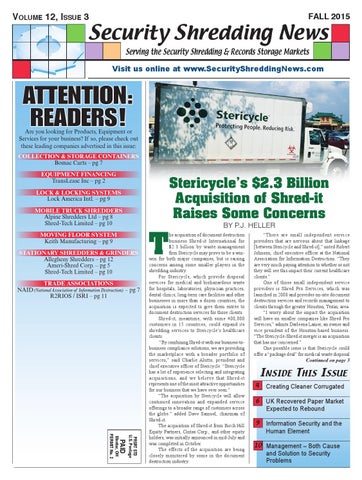
Stericycle’s $2.3 Billion Acquisition of Shred-it Raises Some Concerns
Lock & Locking Systems Lock America Intl. – pg 9 Mobile Truck Shredders Alpine Shredders Ltd – pg 8 Shred-Tech Limited – pg 10 Moving Floor System Keith Manufacturing – pg 9 Stationary Shredders & Grinders Allegheny Shredders – pg 12 Ameri-Shred Corp. – pg 5 Shred-Tech Limited – pg 10 Trade Associations NAID (National Association of Information Destruction) – pg 7 R2RIOS / ISRI – pg 11
T
By P.J. Heller
PRSRT STD U.S. Postage
PAID
Mentor, OH Permit No. 2
he acquisition of document destruction business Shred-it International for $2.3 billion by waste management firm Stericycle may prove to be a winwin for both major companies, but is raising concerns among some smaller players in the shredding industry. For Stericycle, which provide disposal services for medical and biohazardous waste for hospitals, laboratories, physician practices, dental clinics, long-term care facilities and other businesses in more than a dozen countries, the acquisition is expected to give them entrée to document destruction services for those clients. Shred-it, meantime, with some 400,000 customers in 15 countries, could expand its shredding services to Stericycle’s healthcare clients. “By combining Shred-it with our business-tobusiness compliance solutions, we are providing the marketplace with a broader portfolio of services,” said Charlie Alutto, president and chief executive officer of Stericycle. “Stericycle has a lot of experience selecting and integrating acquisitions, and we believe that Shred-it represents one of the most attractive opportunities for our business that we have ever seen.” “The acquisition by Stericycle will allow continued innovation and expanded service offerings to a broader range of customers across the globe.” added Dave Samuel, chairman of Shred-it. The acquisition of Shred-it from Birch Hill Equity Partners, Cintas Corp., and other equity holders, was initially announced in mid-July and was completed in October. The effects of the acquisition are being closely monitored by some in the document destruction industry.
“There are small independent service providers that are nervous about that linkage [between Stericycle and Shred-it],” noted Robert Johnson, chief executive officer at the National Association for Information Destruction. “They are very much paying attention to whether or not they will see this impact their current healthcare clients.” One of those small independent service providers is Shred Pro Services, which was launched in 2008 and provides on-site document destruction services and records management to clients through the greater Houston, Texas, area. “I worry about the impact the acquisition will have on smaller companies like Shred Pro Services,” admits Darleena Lanier, an owner and vice president of the Houston-based business. “The Stericycle-Shred-it merger is an acquisition that has me concerned.” One possible issue is that Stericycle could offer a “package deal” for medical waste disposal
Continued on page 3
Inside This Issue 4
Creating Cleaner Corrugated
6
UK Recovered Paper Market Expected to Rebound
9
Information Security and the Human Element
10 Management – Both Cause
and Solution to Security Problems
tlee@transleaseinc.com 2 Security Shredding News Fall 2015
www.transleaseinc.com
Security Shredding News
Stericycle’s $2.3 Billion Acquisition of Shred-it Raises Some Concerns Continued from page 1
PUBLICATION STAFF Publisher / Editor Rick Downing Contributing Editors / Writers P.J. Heller Ken McEntee Sandy Woodthorpe Production / Layout Barb Fontanelle Christine Pavelka Advertising Sales Rick Downing Subscription / Circulation Donna Downing Editorial, Circulation & Advertising Office 6075 Hopkins Road Mentor, OH 44060 Ph: 440-257-6453 Fax: 440-257-6459 Email: downassoc2@oh.rr.com www.securityshreddingnews.com
For subscription information, please call 440-257-6453 Security Shredding News (ISSN #1549-8654) is published bimonthly b y D o w n i n g & A s s o c i a t e s. Reproductions or transmission of Security Shredding News, in whole or in part, without written permission of the publisher is prohibited.
and document destruction, undercutting independent document shredding service providers. Stericycle did not respond to a request for an interview. “In exchange for the higher cost of medical destruction, they now have the ability to offer free or reduced-priced document destruction as part of their services,” Lanier said. “With current competitive pricing in our area, just to make one truck payment, a small shredding company may have to service up to 90 clients who currently have one container serviced on a monthly basis. Throw in multiple trucks, costs for fuel, payroll, utilities, truck maintenance, etc., it takes a massive amount of scheduled services to cover basic bills.” Johnson said that the Shred-it acquisition made sense for Stericycle, which was already subcontracting out document destruction services for some of its medical waste clients. The Canadian-based Shred-it will now be a wholly-owned subsidiary or Stericycle, which is headquartered in Lake Forest, Ill. “It would be no secret to anyone that Stericycle already has a large market share of the medical waste hauling industry, so they’ve got a large number of healthcare companies,” Johnson noted. “And certainly we would expect them to leverage that footprint that they have in medical waste hauling to expand their organization services into other healthcare organizations where they’re not already involved.” Document destruction services would be a key offering. “Anyone can understand that would be the logical assumption,” Johnson said. “That will be where they concentrate. That will be their initial goal. They do have a large foothold in the medical world already. They’re obviously going to concentrate on that and one of their major pushes would be to leverage those contacts and that business platform to be able to expand their shredding business.” Johnson, however, said that approach still could face some challenges. “It’s a sound strategy. But it isn’t as simple as it might sound,” he said. “Often while that sometimes seems it would be very logical and simple, it often is more difficult.” The reason: “Very often it’s not the same decision maker within the organization and they have a different set of priorities. Those different decision makers have a different set of priorities,” he explained. “As far as how effective that strategy will be, we
all just have to wait and see,” he added. Johnson noted that prior to the acquisition, shredding companies already faced stiff competition from Shred-it. “Shred-it was already a formidable competitor in every marketplace,” he said. “It isn’t like Shred-it wasn’t a good competitor before. They were already very aggressive and a very good operator. That part won’t change and I don’t think anyone is overly stressed necessarily about any change in that area. If there has been any concern, it’s really been about what‘s going to be the effect on the healthcare client. With the very logical and very evident strategy that Stericycle will have, will it actually work and will they see any erosion there.” Lanier said Shred Pro Services has won some and lost some in competing against Shred-it and other large shredding companies. “We have gained new clients who felt they were ‘lost in the shuffle’ with Shred-it being a larger company,” she said. “But we have also lost clients with larger companies who wanted one vendor company to handle offices nationwide instead of using local smaller shredding companies. We have also lost large medical accounts because Shred-it can offer lower rates that a smaller company simply cannot compete with.” Smaller companies such as Shred Pro Services have held on to their customers because they offer more quality of service and personal attention, she noted. “We like to take pride in trying to the best of our abilities to accommodate normal and ‘unusual’ circumstances for secure document destruction and records management for our clients,” Lanier said. “We take that extra step to help our clients customize their services to be exactly what they need whether it is a residential client or a large corporate company.” Even so, she expressed concern about competition from the Stericycle-Shred-it acquisition. “I am worried that corporate companies’ main offices will be focused on the bottom line and will move to Stericycle if indeed package deals are provided,” she said. “We hope that those customers who may experience a decrease in the quality of their service during the transition of the acquisition are able to switch to a smaller document shredding service who will appreciate their business and offer a better quality and personal service in the long run.” Cover photo courtesy of Wikipedia.com. (Author: Raysonho @ Open Grid Scheduler / Grid Engine)
Reach over 5,000 businesses involved in ...
Annual subscription rate U.S. is $19.95. Outside of the U.S. add $10.00 ($29.95). Contact our main office, or mail-in the subscription form with payment.
• • • • •
©Copyright 2015 by Downing & Associates.
Advertise in Security Shredding News
Printed on Post-Consumer Recycled Paper
Paper Recovery Businesses Document & Product Destruction Contractors Reverse Logistics & Electronics Recovery Operations Records & Media Storage Facility Owners Hospital Waste Service Contractors
Our Next Issue is Our Buyers’ Guide. Closing Date Dec. 4
For more information, contact Rick Downing at 440-257-6453 or rickdowning@oh.rr.com.
Security Shredding News Fall 2015
3
Security Shredding News Mills and recyclers are addressing declining fiber quality and growing contamination levels in the OCC stream. Many worry whether one-bin collections will become prevalent.
By Ken McEntee
M
y curled fingers retained their firm seems to run it now. There are some differences in the reduce their payroll to keep up with budgets, it [became] hold on each side of the box through material compared to some other sources. There may a big problem. Source separation was discontinued its oval carrying cutouts. But as I be some boxboard in there, and some other paper that in favor of more efficient single-stream collection, stood behind the open hatch of my [mills] don’t necessarily want. The challenge to the whereby the haulers saved a lot of money on the hauling minivan in the parking lot of the single-stream MRF is the quantity of smaller-sized side but transferred the additional sorting cost to their home improvement store, the package suddenly felt boxes—like the little boxes from Amazon—that processing centers. If the huge regional processing 80 pounds lighter than it did a moment earlier, and the MRFs are not well designed to mechanically pull out.” centers are not making money, they are going to try ground below me was instantaneously littered with the Because small OCC falls through the mechanical screen to find ways to become profitable. When you have shattered ceramic pieces of a Chilean-made commode. separators, it “ends up in the paper stream where labor $80 [a ton] OCC, it might be an issue as far as putting After the retailer provided a replacement, I took is required for removal,” he explains. “With increasing on [the picking line] the proper amount of people and care to carry that box by securing it from the bottom. volumes of small OCC and decreasing volumes of [old putting in the time needed to make the best OCC. As this episode demonstrated, fiber strength is newspaper], some MRFs have skipped this additional We are thankful for the MRF operators contributing critical to the containerboard that makes up corrugated effort and switched from making ONP to mixed paper, to increasing the recovery rates and keeping up with boxes. That’s why it’s important that the feedstock that where the small OCC is acceptable.” industry growth, but we sincerely encourage the MRF goes into containerboard—whether virgin or recycled Rusk says MRFs today are challenged by high operator and other recycling companies to work with fiber—is up to quality standards. production costs that the selling prices of OCC and the end user/customer/mills as well as their source of “Garbage in is garbage out,” emphasizes Marty other recyclables don’t cover. supply to ensure the product meets the mills’ needs in Rusk, vice president of Smurfit Kappa North America “In the beginning, when the market was really both volume and quality.” Recycling, a division of Smurfit Kappa Orange County strong for all recyclables, and haulers and recycling Simply put, single-stream collection makes (Mesquite, Texas), which produces 100-percentcompanies were putting their new processing systems processing OCC too expensive compared with current recycled linerboard and medium in Forney, Texas. online, quality was a lot better,” he says. “When OCC values, says Johnny Newsome, manager of the “We’re very cautious about what goes through our [selling] prices went down and [MRFs] were trying to Recycling Division of Sonoco Products (Hartsville, pulper because we compete with virgin liner, S.C.). “You need to operate at slower and we want the best corrugated fiber [that’s] speeds to make a clean bale,” he says; “the out there. That’s why we have always been equipment is expensive to purchase and pickier than the average mill in the market. maintain; the per-ton cost to operate has estRock recently implemented a companywide quality-control Our standards are very high.” gone up; [and the] selling price has gone program aimed at improving the quality monitoring and tracking That’s also why Rusk developed his down, [so] there is little to no money to be of its inbound recycled fiber. The company adapted the program own network of recycling centers more than made in the MRF business. People don’t run from one instituted by WestRock’s Solvay Paperboard mill (Syracuse, N.Y.), 10 years ago, when Corrugated Services businesses when they can’t make money.” a containerboard mill the company acquired in 2008, and the resulting savings operated the Forney mill. “By building a Is “Asian” Fiber have been “traceable and very meaningful,” according to Greg King, senior recycling plant infrastructure, we were able an Issue? vice president. to control our own destiny,” Rusk says. ost fiber buyers consider U.S.-made The Solvay mill based its quality-control process on “research from “When a MRF [materials recovery facility] corrugated the strongest available the yields of various fiber supply points,” King says, “and, in order to meet or any processor can’t conform to our quality due to its high virgin fiber content relative the specifications they needed for linerboard and corrugating medium, they requirements, we have the ability to say no. to corrugated boxes made in China and adopted a recipe and focused on sourcing the right fiber for the mill’s needs.” I can always run more material through our other overseas countries. However, OCC The process “inspects and validates the materials coming into the mills own facilities.” coming from major retailers typically by supply point,” King says. It begins with a visual inspection of the incoming Mill procurement agents and their contains a large percentage of boxes made bales, with the ISRI specifications as the foundation. “Every person at the suppliers say the most common old in China, which generally are made from receiving dock is trained in observation and grading so the paper can be corrugated container quality complaints 100-percent-recycled fiber. graded at the point of receipt,” King says. “You can’t expect one person to relate to increasing volumes from single“If you’re going to buy from a paper be responsible to inspect every load, especially when you’re doing hundreds stream MRFs, short-fibered OCC from Asia recycling plant, you’re just not going to of loads a day at the larger mills.” If the bale’s exterior appearance causes a and other regions outside of North America, get material without Asian fiber in it,” concern, the inspector may have it broken open for further examination. and moisture content. Rusk says. “Most products are being WestRock holds its own 23 recycling facilities to the same standards as High MRF Costs, manufactured in China today, so that’s it holds outside suppliers, King emphasizes. The company’s recycling plants where a large percentage of the boxes are supply recovered fiber to its own mills and other mills in the United States Low OCC Value going to come from. Fortunately, the quality and overseas. hen residential curbside programs of Chinese boxes is improving, but there is “Loads coming into the WestRock mills all go through the inbound began to take hold, the urban forest still a lot of it out there that seems like it’s quality-control process,” he says. If the inspectors believe a bale is not of the of recovered fiber consisted largely of old made from old newspapers, mixed paper, quality the supplier said it was, “then it is documented, photos are taken, and newspaper. Today, the decline of newspaper [and so on]. You can tell the difference communication goes back to the supply point.” readership, along with the growth of online because when you rip it, it tears apart very Inspectors classify OCC bales beyond the ISRI specs into sub-classes shopping, has made OCC the dominant easily and is full of short fibers. It may look based on their fiber content. “Something that would come out of a single-stream grade coming out of U.S. neighborhoods, similar, but the bottom line is, the shorter facility, for example, tends to have more mixed paper content than what you traders say. the fiber, the weaker the board.” would expect from a grocery bale. The objective is achieving the highest yield Although the OCC that comes out of Newsome also says Asian OCC has and quality of output on a consistent basis,” King says. single-stream MRFs may not be “ideal,” increased in the domestic supply over the WestRock’s quality-control program “has been well received” by the quality has improved in the past couple past five to 10 years. The boxes usually can suppliers, King says. “We educate before we enforce. We work with suppliers of years, says Waste Management Recycle be identified by their grayish color, he adds. and give them the data before we take stronger action. It helps the recycling America (Denver) Western Region Market “To us, Asian board is not No. 11 plants to be more cognizant of what is going into the supply stream. Even Director Steve Wilson. OCC,” Newsome says, referring to the ISRI large accounts that generate and bale OCC that are not recyclers have been “It used to be that some mills didn’t want specification for that grade. “We can’t take very receptive.” to buy corrugated from single stream,” Wilson Continued on next page says. “That is no longer the case. Everybody
One Mill’s Approach to Quality
W
M
W
4 Security Shredding News Fall 2015
Security Shredding News Continued from previous page a whole load of it to the pulper. When we get it, we have to segregate it in storage, and we have to treat it similar to how we would treat mixed paper. We have a specific formula that we blend in, and we will pay less for it than we do for a good Grade 11.” Asian OCC, or short-fiber OCC, is particularly problematic for mills like Smurfit Kappa Orange County, which produces 100-percent-recycled board, Rusk explains. “If you have a mill that can control long fiber content by adjusting the ratio of wood chips and OCC, the impact isn’t as great,” Rusk says. “But I can’t run it in my system because we need to have the long fibers to achieve our high quality standards. If it comes in as No. 11, depending on the circumstances, we might reject it or downgrade it to mixed paper. Or maybe we can divert it to a mill that is able to use it.” In February, ISRI’s Paper Stock Industries Chapter hosted a summit in Dallas to discuss possible changes to the organization’s paper stock specifications. One change they addressed was whether to create a specific grade definition for “Asian” or “foreign” OCC. The consensus, however, was that OCC grade definitions should consider fiber quality rather than the source of the fiber.
Mills Demand Less Moisture
M
oisture content is a decades-long issue, traders say, although some mills recently began enforcing moisture standards more rigorously. “Nobody wants to buy water,” observes Greg King, senior vice president and general manager for recycling at WestRock (Norcross, Ga.), the paper and packaging company newly formed from the merger of RockTenn and MeadWestvaco. Generally, the industry standard limits moisture to 12 percent in a bale, but that can vary
from mill to mill. “In the South, for example, we have heavy seasonal rain, and a lot of our supply is on bale routes; therefore, we monitor more aggressively for moisture content compared with mills in drier climates like the West Coast,” he says. Moisture claims are a greater concern than a couple of years ago, particularly for export orders, Newsome says. He questions the accuracy of current probe-testing methods. “You can probe the same bale in 10 different places and get 10 different readings,” he says. “Moisture is the big unknown for the industry. It is very subjective, and it can be manipulated very easily. When the market is going up, and the material is in demand, claims are down. When loads are backed up [due to less demand], claims go up.” Wilson agrees that inconsistent testing with probes is a big problem. “You can keep measuring until you get the measurement you want,” he says. “It is getting to be a bigger issue than it was. People are always trying to find a way to buy tonnage at a cheaper price, so moisture claims can sometimes depend [on] how [badly] somebody needs the fiber at the time.” Newsome advocates having a different moisture baseline for export shipments than for domestic orders. The reason, he says, is that containerized bales can pick up moisture while on the ocean en route to their destination. That point was heavily debated during the PSI specifications forum. One participant, who represented a Chinese mill group, argued that shipping containers are airtight and therefore their contents will not absorb moisture from the external environment. “Paper is like a sponge,” Newsome counters. “Common sense will tell you that if it is going to sit in a container for 45 days in a high-humidity area on a boat on the ocean … it is going to absorb moisture. Exporters I talk to say that it could be [a difference of]
3 to 5 percent.” Rusk says the Smurfit Kappa Orange County mill in Forney generally accepts up to 11 to 12 percent moisture. “Normal moisture content in the air is around 8 percent,” he says. “We leave a little buffer before we take deductions [for moisture] over 8 percent, which is similar to all the other mills in our region. I do know of one mill that starts deducting if you’re over 9 percent, but we feel that is unrealistic.” The Smurfit Kappa mill in Forney last year replaced moisture probes with digital moisture meters—an AP 500 model from Emco (Leipzig, Germany)—designed for recovered paper. “It works so much better than a probe,” Rusk says. “It covers a broader area of the bales (up to a depth of 20 inches into the bale) instead of one spot and more limited depth like a probe would.”
Enforcing Higher Standards
A
lthough traders generally acknowledge the importance of industrywide guidelines to serve as a basis for quality expectations, most agree that it is up to each mill to set its own standards, then foster a good cooperative relationship with its suppliers to be sure that they are meeting the standards. “There is always the point where somebody comes along at the mill and says they have to improve their fiber quality, so they hire somebody to do quality assurance,” says Ken Rasmussen, sales manager at CasCell Trading Group (Surrey, British Columbia). “A lot of mills are doing that. But sometimes along the way, the quality control goes out the window. Maybe the person doing it retires and isn’t replaced, or there is a reorganization and it falls through the cracks.” Random inspection of incoming loads is part of
Continued on page 6
New CROSS CUT
industrial paper shredders 10 - 40 Horsepower 1000 - 2600 Lbs. / Hour www.ameri-shred.com info@ameri-shred.com Security Shredding News Fall 2015
5
In the News
Creating Cleaner Corrugated
Continued from page 5
most quality-control efforts, Rasmussen says. “Somebody will take a representative sample bale [from] every load,” he says. “They weigh it and break it apart and try to do their due diligence. Maybe one day it will be the seventh bale off the truck. Every day it’s something different, so the supplier can’t figure out where they need to put the good stuff.” The quality-control program of Smurfit Kappa Group’s Forney mill begins with the certification of each supplier. “We frequently tour [the supplier’s facility] to see how they sort their materials,” Rusk says. “We educate everyone in the process where we can, then we monitor incoming shipments and [use] our testing procedures at the mill to ensure the required quality is met. PSI standards and practices require a certain level of quality, and we want to maintain that. We also encourage our suppliers to tour our mill so they might better understand our quality standards and why sorting out unwanted material is so critical to our ability to make high-quality containerboard. Every mill has its own unique problems with one contaminant or another: Ours is wax. So we have always [held our suppliers] above and beyond the standards for quality when it comes to wax content.” Rusk says strict quality standards by one mill or mill group—particularly a highvolume buyer—can improve the overall market supply. “A couple of years ago, Asian mill groups tightened up their programs for moisture and quality, and that’s excellent because that helps all mills,” he says. “If a supplier ships to three different locations, and one accepts the lower quality or high moisture content [material], it is bad for the rest. One major integrated mill group with a lot of purchasing influence recently cracked down on quality. They analyzed their whole system and started from scratch. They wrote procedures, trained their people, set standards, and notified all their suppliers as to what the procedure was. They did it the right way—not just by suddenly making rejections. We highly support that.” Although Rusk didn’t name the group, he was probably referring to WestRock, North America’s second-largest containerboard producer.
Educating New Suppliers
R
etailers, municipalities, and other fiber-scrap generators who are not recyclers are the ones toward whom the ISRI paper specifications should be aimed, some traders say. Several participants of the PSI Specifications Summit expressed that view as well. These “new generators” need to be educated about the specifications and about what is or is not acceptable in a corrugated bale, the summit participants said. In general, supermarkets generate clean, consistent bales of OCC, while retailstore bales are more likely to contain unwanted materials. You can see the difference in OCC a typical Walmart generates, Newsome says. “Walmart produces bales from their grocery side that are good-quality grade No. 12 double sort, and we pay more for them because they are consistent, with more fiber and minimal moisture,” he explains. “Their retail side is more likely to have a lot of Asian fiber” in its bales, he says. According to Rasmussen, however, getting clean supermarket bales also requires some education. “You do have to train them to keep certain things out,” he says. “Overall, the quality of supermarket OCC is pretty spectacular.” Rasmussen says getting quality OCC is less about tweaking the recognized grade specifications than it is about developing a good relationship with your suppliers. “When you want to supply a mill, you show them five representative loads of your product, and they either accept it or they don’t,” he says. “If they like it, then you can negotiate the price and go from there. I don’t see the point of overcomplicating the grade definitions.”
The Next Challenge
E
ven as PSI works to revise its paper stock specifications, the rise of “dirty MRFs”—which process commingled garbage and recyclables—is presenting the industry with perhaps its greatest challenge yet. “We are adamantly opposed to the ‘recycling’ role that dirty material-recovery facilities offer, largely in order to protect the quality of the recycled fiber stream,” King says. “This is already a reality because these facilities are out there. It limits the paper supplies for paper mills, and you have to be conscious of biological contaminants in the fiber stream. The United States is the breadbasket for the world; a lot of old corrugated containers go into food packaging, and we have to protect fiber quality. It is a battle that, if we are not successful in winning, could mean putting the domestic fiber supply at risk of not meeting standards.” Ken McEntee is the Strongsville, Ohio–based editor and publisher of The Paper Stock Report and other business periodicals. This article originally appeared in the July/ August 2015 issue of Scrap magazine. Reprinted with permission.
6 Security Shredding News Fall 2015
HIPAA Periodic Audits to Begin
T
he Office for Civil Rights (OCR) at the Department of Health and Human Services will begin conducting compliance audits of HIPAA-covered entities and business associates soon, reports NationalLawReview.com. The OCR had lurched forward with a pilot audit program in 2011, but pulled back when the Office of the Inspector General (OIG) criticized the methodology. OCR settled for relying primarily on self-reports of breaches from covered entities (as required by the Breach Notification Rule) as a basis for enforcement actions. Now that is changing. Section 13411 the HITECH Act directs OCR to conduct periodic audits to ensure that covered entities and business associates comply with the agency’s Security Rule, which spells out safeguards for electronic protected health information. According to news reports, HHS has chosen a vendor for the next phase of the audit program and is verifying contact information for business associates and covered entities to be included under the program. OCR noted that the first audits will mostly consist of desk audits, under which it will ask entities to send in policies and procedures for review, but there will be some in-person audits as well.
UK Recovered Paper Market Expected to Rebound
G
ernsbach, Germany – The demand for British recovered paper stabilized after a slow summer, and market analysts expect it to rebound before the year is out, reports EUWID-Recycling.com. In the UK, mixed paper was sought-after domestically and abroad up until mid-September, a trend in marked contrast to a few months earlier, when sellers’ warehouses were filled with that grade. High-quality material (dry and with a low proportion of deinking material) was selling at export prices on the domestic market as well, merchants noted. Demand for old corrugated containers was stable and quiet as well. Slight cuts were observed towards the lower end of the domestic price bracket. “It is remarkable how stable prices for paper exports have stayed given the poor economic data coming from China and dwindling prices for other commodities,” one market expert remarked. Prices for deinking grades have not fluctuated, although consumers tried to secure price reductions. Paper mills’ warehouses were mostly full, according to insiders. A slight upward trend was noted in white newsprint prices. Tissue grades showed an increase in collection volumes by mid-September, resulting in balanced supply and demand, with most prices left untouched.
Sage Acquires Hugo Neu in Non-Cash Transaction
C
olumbus, OH – Sage Sustainable Electronics LLC has acquired the Hugo Neu Recycling division, paving the way for the office equipment recycling and refurbishing company to gain a foothold in the huge New York City market, reports BizJournals.com. Columbus-based Sage was formed one year ago by Bob Houghton and Jill Vaské, the pair who founded and sold e-recycler Redemtech Inc. New York City recycling pioneer Hugo Neu Corp. provided startup capital, and became Sage’s largest single shareholder until now. Under the terms of the acquisition, no single owner has a majority. Last January, Sage began new operations in Columbus, Baltimore, Maryland, and Reno, Nevada. In August, the company launched its online Electronics Bluebook, setting values for used cables, phones, monitors and other equipment. Hugo Neu Recycling President Alan Ratner says the acquisition adds a number of Fortune 500 and mid-market customers to the Sage roster, and gives Neu customers access to the Sage Bluebook® and the Sage Central customer portal, in addition to other IT lifecycle solutions. Sage will set up operations in Hugo Neu’s 130-acre industrial park in Kearny Point, New Jersey. The company will open a fourth processing facility a 15-minute drive from Manhattan, taking advantage of Neu’s fleet of small trucks that serve the city. The company plans to open a fifth processing center by the end of 2016 in one of the southern states, and then add a new center every six months, each one employing 50 to 80 when at full capacity.
In the News Dynamic Recycling Opens E-Waste Plant in Brice Prairie
L
a Crosse,WI – Dynamic Recycling is already considering expanding the larger facility it moved into earlier this year, reports a LaCrosseTribune. com article. Wisconsin has banned e-waste from landfills since 2009. Dynamic, first formed in 2007, disassembles electronics such as computers, televisions, cell phones, medical equipment and other electronics – even arcade machines. More recently the company moved into electronics remarketing. As e-waste increases, so does the need for more capacity to deal with it. Dynamic filled up its new facility faster than expected, according to CEO Miles Harter. In an interview, he said he originally thought the business would use only about half of the 250,000 square feet of the building for production – disassembly, sorting, shredding and remarketing activities – and offices. The company has added more than 30 workers since opening the plant last January. Situated on 25 acres, the recycler has room to expand. Dynamic Recycling grew out of a long-time family cleaning services business. Refurbishing electronics began on a small scale when the owners realized much of the equipment they collected in the course of their cleaning business contained some good electronic components and units. Dynamic now has a remarketing division which tests and refurbishes used electronics. “Our remarketing division will sell 95 percent of its products within two to three months,” said Dynamic Recycling human resources manager Alicia Von Haden. “We are starting to sell more and more to individual consumers.” In addition to recycling obsolete electronics, Dynamic Recycling works with original equipment manufacturers to help them fulfill mandated recycling targets set by various state regulations. In its home state, Dynamic helps e-waste generators comply with E-Cycle Wisconsin, a statewide, manufacturer-funded program. According to Harter, Dynamic Recycling anticipates remarketing and recycling 50 million to 60 million pounds of electronics through its La Crosse facility this year and another 8 million to 10 million pounds of electronics through its facility in Nashville, Tennessee.
Collecting Sorting Recycling Phone:262.882.1227 Fax: 262.882.3389 www.bomaccarts.com
Register now and save! April 7-9, 2016
REGISTRATION NOW OPEN
Renaissance Orlando at SeaWorld
• • • •
New Profit Centers Proven Residential Strategies Mastering Nat’l Accounts Product Innovations
• • • •
Unlimited Networking Web Sales Generation Biggest Industry Trade Show Early registration discounts
www.naidconf.org Security Shredding News Fall 2015
7
In the News Gartner Reports IT Security Spending Hits $75.4 Billion in 2015
A
new report by Gartner, Inc. says that cloud and mobile computing, the Internet of Things, and rapid, targeted attacks are driving security technology demand, according to a LedgerGazette.com article. Add government projects, legislative pressures, and a sobering trend of major data breaches around the globe and the projected spending increase of 4.7 percent over 2014 numbers rockets to a total of $75.4 billion worldwide. Also contributing to rising costs is the US exchange rate, which is forcing prices upward by as much as 20% higher than last year. Gartner’s findings show that markets for data-loss prevention (DLP) technologies are hot, right up there with security testing products and services, IT outsourcing, and identity and access management. Gartner predicts spending to decline in the areas of endpoint protection and consumer security, however, where off-the-shelf products have become easily available. Other emerging trends include Cloud-based, malware detonation sandboxes being introduced as platform extensions, and smaller companies choosing UTM and firewalls while larger organizations are opting for routers and Multiprotocol Label Switching (MPLS) links to connect multiple destinations.
8 Security Shredding News Fall 2015
Too Successful: Naperville Electronics Program Shuts Down
N
aperville, IL – An electronics recycling program here was suspended because a contractor couldn’t handle the unexpectedly huge amount of hardware that was collected, according to a WashingtonTimes.com article. The contractor, New Life Electronics Recycling, was hired by the city to properly dispose of electronics brought to a municipal drop-off center. New Life reported that 629,000 pounds of electronics were brought to the facility in the first four months of its 18-month contract with Naperville. The recycler became concerned because the amount had already far surpassed the volume collected in all of 2014. In September, the site stopped collecting electronic waste. The stockpile that remains will stay until city officials can figure out what to do with it. Public Works Director Dick Dublinski called the situation “extremely unfortunate,” explaining that the city could not afford to use tax dollars to recycle the materials.
HIPAA Business Associate Case Settles for $750,000
T
he theft of a storage media device that held approximately 55,000 unencrypted health records has led to the highest fine levied by the Department of Health and Human Services’ (HHS) Office of Civil Rights (OCR) on a “business associate” of a HIPAA-covered entity. According to an article published in the National Law Review by Epstein, Becker & Green, the settlement underscores the agency’s seriousness in dealing with all businesses that come under HIPAA rules. Cancer Care Group, a large radiation oncology practice in Indianapolis, reported the theft in July of 2012 when a satchel containing a laptop and a backup media device was stolen from an employee’s car. In the terms of the settlement agreement, the group must pay a $750,000 fine and implement a supervised corrective action plan that will be overseen by OCR. The corrective action plan is effective for three years and must be preceded by a comprehensive risk assessment, which is to be provided to HHS for review. Cancer Care also must revise its procedures and policies and develop a training program for protecting patient information, all of which will be reviewed by HHS. In addition, the group must submit annual reports of any compliance breaches, known as “Reportable Events.” According to HHS rules, any breach of the corrective action plan will bring potential additional civil monetary penalties. Additionally, HHS disapproves of the risk assessment, the covered entity has 60 days to revise its risk assessment to address HHS’s concerns, and then it must resubmit the assessment. The submission/review process continues until HHS approves the risk assessment submitted. The case followed the OCR’s comprehensive HIPAA Audit program protocols, which include analyzing processes, controls, and policies of selected covered entities pursuant to the HITECH Act audit mandate. OCR established a comprehensive audit protocol that contains the requirements to be assessed through performance audits. The requirements that apply vary depending on the type of covered entity selected for review, but include: • Privacy Rule requirements for (1) notice of privacy practices for PHI, (2) rights to request privacy protection for PHI, (3) access of individuals to PHI, (4) administrative requirements, (5) uses and disclosures of PHI, (6) amendment of PHI, and (7) accounting of disclosures • Security Rule requirements for administrative, physical, and technical safeguards • Requirements for the Breach Notification Rule According to Epstein, Becker & Green, OCR has indicated that noncompliance areas surfaced in Phase 1 audits will be included in the Phase 2 audits. The alleged deficiencies for which the fine on the physicians group was imposed fall squarely within the Phase 2 priorities. To date, twenty-eight HIPAA-covered entities and business associates have paid out nearly $28.2 million to settle potential HIPAA violations and another $1.1 million where actual violations of HIPAA privacy, security and breach notification rules were found. This data comes from HHS records. The largest HIPAA settlement involved New York-Presbyterian Hospital and Columbia University Medical Center. Together, the organizations agreed to pay $4.8 million to HHS after the electronic protected health information of 6,800 patients was discovered through a Google search in 2010.
In the News Information Security and the Human Element
R
eading, England – Three quarters of employees surveyed by the data loss prevention company, Clearswift, want their organizations to improve policies that help safeguard private company data, reports Information-Age.com. The Clearswift study tabulated answers from 4,000 employees in the UK, USA, Germany and Australia. Employees indicated the following as most effective ways for human resources departments could prevent inadvertent or deliberate breaches of protected information: • Careful hiring • Clear rules and procedures • Training • Disciplinary action Three out of four employees said they would not trust their company again if private information had been leaked. Although technology can be used to detect breaches, the human element is considered just as important. A parallel survey of 500 security experts emphasized training - 68% of the respondents said
training was the most important way to minimize risk. The Clearswift research showed 71% of UK breaches come from people in the extended enterprise – 41% from employees, 9% from ex-employees, and 21% from contractors. “It will become the job of HR to make judgments about whether such activity is suspicious and take appropriate action – from sending a warning to providing suitable training, to instigating full-scale investigations,” said Heath Davies, chief executive at Clearswift. “HR therefore needs to be much more closely engaged with their company’s information. “The recent Ashley Madison breach seems to have come from someone on the inside. This shows that information security is not just an issue for the IT department, but one that needs the attention of the people tasked with hiring, incentivizing and creating a culture of trust within the workforce.”
Now Even More Options for Customers Who Want Their Own Key Codes! Lock America Adds More New Key Codes for Padlocks and Console Locks. • Give your drivers and customers a single key that fits all the locks at a site. • Ask your console or bin supplier for new available key codes, or contact Lock America directly.
One Key Can Now Operate All Your Locks!
Tel: (951) 277-5180 Fax: (951) 277-5170 www.laigroup.com
800-422-2866
9168 Stellar Court Corona, CA 92883 sales@laigroup.com
Arizona E-waste Recycler Invests $1.8 Million in Tennessee Plant
M
emphis, TN – Two young entrepreneurs are combining their business savvy with social justice ideals as they expand their Arizonabased e-waste recycling operation to Memphis, Tennessee, BizJournals.com reports. Co-owners and managing partners Rick Krug and Chris Ko launched ER2 Electronic Responsible Recyclers and Revive IT to profitably divert e-waste from landfills. The company takes in obsolete and broken office equipment from Fortune 500 companies. The pair established its first certified electronic recycling and refurbishing center in 2012, creating 65 new jobs. Next, they developed a successful sales strategy that includes retail shops and e-commerce. In compliance with National Association of Information Destruction, ER2 employees destroy proprietary data on hard drives and other storage media then refurbishes it and repurposes the equipment to be remarketed and sold through Revive IT. Memphis was selected as the site for expanding the E2R business after Ko attended a leadership conference in that city. He was impressed with the city’s Making Memphis Clean by 2019 program that was discussed at the conference. Soon the partners scouted the area and located an approximately 100,000-square-foot building in a neighborhood with a high unemployment rate. E2R purchased the building for $395,000 through the Lerner Family Trust and connected with two local organizations, the Tennessee Department of Economic and Community Development and Memphis’ Workforce Investment Network. They agreed to use the state’s FastTrack Job Training Assistance Program, which pays 50 percent of an employee’s salary during on the job training.
POWERFUL
KEITH Drive Unit
SAFE
No Tipping To Unload
FAST
Unloads In Under 5 Minutes
SEE IT WORK
Scan code or visit: www.youtube.com/user/KeithMfgCo youtube.com/user/KeithMfgCo
IT’S WHAT WE DO
™ If you want a fast RELIABLE and efficient SELF-UNLOADER, the KEITH® WALKING FLOOR® is the solution for you. With a load CAPACITY of up to 16 ton*, the system stores shredded documents and AUTOMATICALLY unloads them once the truck reaches a secure location.Your truck is your CHOICE. Make sure the unloader is KEITH. *KMD 300
www.keithwalkingfloor.com
1-800-547-6161 2015 KEITH Mfg. Co. KEITH, KEITH logo and WALKING FLOOR are registered trademarks of KEITH Mfg. Co. Manufactured under license.
Security Shredding News Fall 2015
9
In the News Management – Both Cause and Solution to Security Problems
O
rganizations may be making it hard for employees to adhere to security policies and procedures, writes Robert C. Covington in a ComputerWorld.com opinion column. Cumbersome procedures and unrealistic expectations can lead to security lapses, he concludes. Covington, founder and president of togoCIO.com, a Georgia-based IT and security consulting firm, says employee buy-in and adoption of a security culture within organizations is critical to maintaining good information security. Although many organizations have improved their employee training and communication on IT security in the past few years, another roadblock seems to have surfaced. In Context Aware Security, a study conducted by Dell involving 460 IT professionals and 301 end users, a huge majority, 91%, said they were negatively impacted by their employer’s security approach. “Based on my experience and mindset, tight security has always been king, with user convenience barely making it as part of the royal court,” Covington says. How to Get Everyone on Board with IT Security 1. Incorporate information security into every job description, regardless of position, and allow employees ample time in each work day to meet these requirements. 2. Implement identity management products that allow the user to log in to multiple systems from a single Web interface, such as Okta. 3. Provide excellent help desk support when security-related issues arise. Train help desk people to be more understanding when users are unable to log in, for example. 4. Help the users to understand risks and solutions by providing good-quality, engaging training materials that strike the right balance between information and user engagement. “We too often see our users as security adversaries rather than partners. A simple change in mindset can result in a measurable improvement to corporate security. This mindset change may be the most economical change we can make to improve security,” Covington says.
www.shred-tech.com
10 Security Shredding News Fall 2015
Cohen Electronics Invests $7 million to Upgrade Ohio Recycling Facility
M
iddleton, OH – Cohen Electronics is investing $7 million in a new electronic waste recycling facility here that will divert tons of e-waste from landfills every day starting in early 2016, according to a Journal-News.com article. The company is building a 50,000-square-foot addition to its current operation, doubling the size of the facility’s processing system and increasing production capacity by eight times, a press release states. Adam Dumes, vice president of Cohen Electronics, says the $7 million investment is the largest capital improvement in the company’s 91-year history. The outlay includes equipment and construction costs. To comply with Ohio law, a recycler must have processed 75 percent of the material present at the beginning of the year by the end of that year. Cohen’s expanded capacity will more than meet the requirement – the plant will be able to process more than 20,000 pounds of electronic waste per hour. The plant’s advanced technology will increase efficiency, allowing it to reclaim more raw materials for market consumption and to play a significant role reducing electronics waste going to landfills. The Resource Conservation and Recovery Act (RCRA), overseen by the Ohio Environmental Protection Agency, requires generators of solid wastes containing toxic constituents (such as lead and barium) to determine whether or not the waste is hazardous by using generator knowledge or by testing representative samples of that waste. The state lists discarded integrated circuits from computer systems as scrap metal. Computer CRTs are not regulated as hazardous wastes, but only if the generator drops them off to be recycled. Cohen was founded in 1924 and is one the largest privately owned scrap metal, electronics, and automobile recyclers in the region. The company operates 18 facilities across three states and employs more than 500 people. Cohen will hire 40 additional employees at the Middleton plant.
IS YOUR RECYCLER CERTIFIED? Do the right thing. Work with an R2/RIOS™- certified facility. The R2/RIOS™ difference is that reuse and recycling are the primary objectives in the lifecycle of electronics. This means fewer materials are sent to landfills. Further, R2/RIOS™ helps protect the environment by extending the life of equipment, parts and components. Tested, functional equipment is sent back into the marketplace for reuse.
As a company partnering with an R2/RIOS™-certified facility, you can have the confidence your electronics are being recycled with the highest regard for the environment and the health and safety of employees and the public. www.certifymerecycling.org/partner To find an R2/RIOS™-certified partner, visit: certifymerecycling.org/partner. www.certifymerecycling.org/partner
Each certified facility aims to protect a customer’s brand by: •
Requiring proper data destruction to wipe out confidential information
•
Holding the highest standards for data protection, such as those mandated by HIPAA regulations
•
Offering the sole program that combines quality, environmental, health and safety requirements into a single management system
Security Shredding News Fall 2015 11
www.alleghenyshredders.com
solutions@alleghenyshredders.com