VOL. XI NO. 2
www.HealthcareEnvironmentalSolutions.com
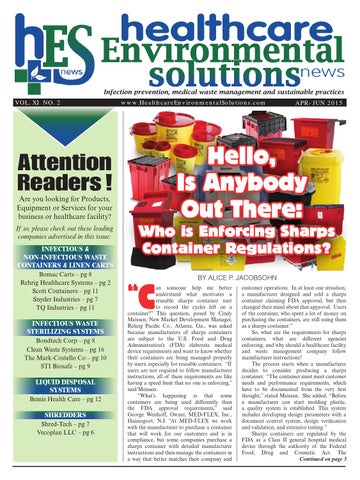
Hello, Is Anybody Out There:
Attention Readers !
Are you looking for Products, Equipment or Services for your business or healthcare facility?
Who is Enforcing Sharps Container Regulations?
If so, please check out these leading companies advertised in this issue:
Infectious & Non-Infectious Waste Containers & Linen Carts Bomac Carts – pg 8 Rehrig Healthcare Systems – pg 2 Scott Containers – pg 11 Snyder Industries – pg 7 TQ Industries – pg 11 Infectious Waste Sterilizing Systems Bondtech Corp – pg 8 Clean Waste Systems – pg 16 The Mark-Costello Co – pg 10 STI Biosafe – pg 9 Liquid Disposal Systems Bemis Health Care – pg 12 Shredders Shred-Tech – pg 7 Vecoplan LLC – pg 6
APR-JUn 2015
C
“
By Alice P. Jacobsohn
an someone help me better understand what motivates a reusable sharps container user to record the cycles left on a container?” This question, posed by Cindy Meissen, New Market Development Manager, Rehrig Pacific Co., Atlanta, Ga., was asked because manufacturers of sharps containers are subject to the U.S. Food and Drug Administration’s (FDA) elaborate medical device requirements and want to know whether their containers are being managed properly by users, especially for reusable containers. “If users are not required to follow manufacturer instructions, all of these requirements are like having a speed limit that no one is enforcing,” said Meissen. “What’s happening is that some containers are being used differently than the FDA approval requirements,” said George Weishoff, Owner, MED-FLEX, Inc., Hainesport, N.J. “At MED-FLEX we work with the manufacturer to purchase a container that will work for our customers and is in compliance, but some companies purchase a sharps container with detailed manufacturer instructions and then manage the containers in a way that better matches their company and
customer operations. In at least one situation, a manufacturer designed and sold a sharps container claiming FDA approval, but then changed their mind about that approval. Users of the container, who spent a lot of money on purchasing the containers, are still using them as a sharps container.” So, what are the requirements for sharps containers, what are different agencies enforcing, and why should a healthcare facility and waste management company follow manufacturer instructions? The process starts when a manufacturer decides to consider producing a sharps container. “The container must meet customer needs and performance requirements, which have to be documented from the very first thought,” stated Meissen. She added, “Before a manufacturer can start molding plastic, a quality system is established. This system includes developing design parameters with a document control system, design verification and validation, and extensive testing.” Sharps containers are regulated by the FDA as a Class II general hospital medical device through the authority of the Federal Food, Drug and Cosmetic Act. The Continued on page 3
SAFETYCONTAINER DOES NOT STOP
WITH THE
SIMPLE DISPOSAL
RAPID REPLACEMENT
©2015 Rehrig Pacific Company
SECURE COLLECTION
AUTOMATED HANDLING
®
IT RUNS THROUGH THE ENTIRE CYCLE Rehrig Healthcare’s reusable Patient Sharps Containers are an integral part of the Sharps Tank Container System engineered to improve safety for healthcare staff and collection and transport personnel while providing added protection for the environment. These simple to use patient room containers exceed all federal safety standards and are approved for 600 cycles. Our scientifically validated decanting and cleaning system is laboratory proven to effectively clean and disinfect
Phone: (800) 421-6244 or (323) 262-5145 Email: info@rehrigpacific.com • Web: www.rehrighealthcare.com
2
HEALTHCARE ENVIRONMENTAL SOLUTIONS news
apr-jun 2015
our reusable sharps containers. Hands-free automation improves worker safety because it mechanically opens and dumps each container. Using reusable and recyclable containers improves sustainability and eliminates significant waste from landfills. Rely on Rehrig for sustainable solutions that improve safety and the environment.
A REHRIG PACIFIC COMPANY
Healthcare Environmental Solutions news
solutions PUBLICATION STAFF Publisher / Editor Rick Downing Contributing Editors / Writers Alice P. Jacobsohn Patrick Moore Sandy Woodthorpe Production & Layout Barb Fontanelle Christine Pavelka Advertising Sales Rick Downing Subscription / Circulation Donna Downing Editorial, Circulation & Advertising Office 6075 Hopkins Road Mentor, OH 44060 Ph: 440-257-6453 Fax: 440-257-6459 Email: downassoc2@oh.rr.com For subscription information, please call 440-257-6453. Healthcare Environmental Solutions news (ISSN #1557‑6388) is published quarterly by Downing & Associates. Reproductions or transmission of Healthcare Environmental Solutions news, in whole or in part, without written permission of the publisher is prohibited. Annual subscription rate U.S. is $19.95. Outside of the U.S. add $10.00 ($29.95). Contact our main office, or mail-in the subscription form with payment. ©
Copyright 2015 by Downing & Associates
Printed on Post-Consumer Recycled Paper
Who is Enforcing Sharps Container Regulations? Continued from page 1
requirements are called the 510(k) process, in reference to the applicable section of the act. A sharps container manufacturer must receive an order, in the form of a letter from the FDA, clearing the device for commercial distribution. This includes showing that the device is substantially equivalent to another device already legally marketed in the U.S. and is at least as safe and effective as that device. A manufacturer must follow design controls during device development and provide the FDA with design control documentation. These design controls include several stages of planning. In general, planning refers to design and development activities and defines the responsibility for implementation of the plan. For example, the plan must show the relationship between different groups or activities that have input in the process such as the role of a company’s engineering and marketing teams. As the development process proceeds, the plan must be reviewed, updated, and re-approved by a designated company employee. Procedures must be established to make sure the device is designed for its intended use. The FDA’s “Current Good Manufacturing Practices” regulations are part of the design quality control process. These requirements were added in the 1990s to comply with the Safe Medical Devices Act passed by the U.S. Congress to address device failure concerns. Before the first container is produced, final specifications, inspections and testing criteria must show that the device’s design and final product are a match. “All of the participants in the container’s design look at the results to make sure that their activities and concerns have been fully considered – engineering, marketing, sales – everyone,” said Meissen. Once the design is finalized, the manufacturer validates the design by producing a low volume of the container, ensuring that the device conforms to its intended use. The container must be tested using actual or simulated use conditions and risk analysis. While not part of the regulatory requirements, the FDA has published a detailed list of questions that product evaluators (healthcare facilities or waste disposal companies) should ask when selecting a sharps container. These include questions regarding puncture resistance, safety features, opening and closing mechanisms, potential for spillage, ease of use, safe transport, autoclaving capability, handling procedures, container color and warning labels, overfill protection, container access, mounting systems, and cost effectiveness. These are also questions manufacturers should take into consideration during the design process. “At the end of the design stage, we must maintain a design history file that includes all apr-jun 2015
required documentation,” Meissen stated. This file is not a place to dump documents, but instead, includes an index that identifies the location of all applicable documents. Once the container is ready for production, the labeling, tracking, cleaning, and reporting requirements must be followed. The FDA’s labeling requirements include information provided through markings on the device (fill line, warning labels), manufacturer instructions, advertising, and other promotional material. Samples of these labels are submitted to the FDA through the approval process. For reusable sharps containers, the FDA wants to see a tracking mechanism to allow users to determine the number of cycles a container can undergo before failure. This may be as simple as numbering the containers. Some manufacturers offer bar coding or radio frequency identification systems. Note that this tracking is not the formal tracking regulations where FDA will notify certain device manufacturers (i.e. defibrillator and heart valve manufactures) that they must implement a life-cycle tracking system for their device. The regulations are tricky. The FDA insists that a manufacturer provide a means of tracking along with instructions, but the regulations do not require the manufacturer or the user to actually track the containers. Instead, approvals make note of the tracking system provided to users and may state that the user can decide on whether to purchase that manufacturer’s cleaning equipment and tracking software. “In my experience, no one from the FDA point-of-view is monitoring the cycles,” said Andrea Arredondo, President, Earth Compliance Solutions, Virginia Beach, Va. She explained that when she worked for a manufacturing company,“The FDA asked how we would track the containers, but seemed willing to accept any method. When the FDA inspector came to our facility during an annual audit, we were asked about tracking, but mostly, the auditor wanted to know how the containers were being cleaned.” The tricky part is that while the FDA does not enforce tracking by users, the agency requires that a manufacturer maintain a relationship with users for purposes of reporting container material failure, i.e. when a medical device may have caused or contributed to a serious injury or death, such as a needle stick from a sharp puncturing a container’s sidewall. Both the manufacturer and the user must file a report with the FDA. The manufacturer is required to investigate the cause of the injury. “The first question we would want to ask is how many cycles has the container undergone,” said Meissen. She added, “The manufacturer Continued on page 4
HEALTHCARE ENVIRONMENTAL SOLUTIONS news
3
Healthcare Environmental Solutions news
Who is Enforcing Sharps Container Regulations?
Continued from page 3
is held liable if someone is harmed, but if the container was used for too many cycles, the fault is not ours. Yet, we have no control over the user’s management system. If the user is operating the wrong cleaning equipment, such as using chemicals for cleaning, that the manufacturer did not test for, or the wrong temperature, we have no way of knowing.” The regulations are more complicated when reviewing the requirements of other federal agencies. According to a regulatory expert at the U.S. Occupational Safety and Health Administration (OSHA), “Our regulations require that a sharps container be leak-proof on the sides and bottom, puncture-resistant, not be overfilled, and be replaced routinely. The definition of routine is not in the regulations and we do not enforce FDA requirements. A healthcare facility subject to OSHA’s regulations must have an exposure control plan that should include sharps and sharps container management.” This means that healthcare facilities can follow manufacturer instructions such as container tracking and cleaning systems as part of an exposure control plan, but OSHA does not require that they do. However, potential liability can force a healthcare facility or disposal company to use the tracking system. For example, if a nurse gets stuck with a needle protruding from a container and sues for damages, an attorney may look at whether the container was used more times than the manufacturer specified. “We check our containers regularly to make sure that they are not cracked and that the lids fit,” said Weishoff. He added, “We really haven’t had a problem because the sharps containers we buy last for years, and I’m not going to deliver a container to a customer that isn’t right.” Other OSHA regulations that apply include a provision that reusable containers cannot be opened, emptied, or cleaned manually. The definition of manual is controversial because the definition refers to preventing “employees from exposure to the risk of percutaneous injury,” but does not specify whether a cheap screw driver or an expensive electronic opening system is required. In its guidance to regional administrators, OSHA recommends the use of a fully-automated system for opening, emptying, and cleaning reusable containers. Operating equipment designed by the container manufacturer may ensure compliance, but is not required. Rick Racksnis, Director of Field Operations, Pipeline and Hazardous Materials Safety Administration, U.S. Department of Transportation (DOT) said, “An offerer (healthcare facility) is responsible for the packaging and must follow the packaging requirements, including labeling, marking, puncture-resistance, shipping papers, and other specifications.” He added, “The DOT requires that a sharps container be FDA approved, and our investigators are going to look for that approval, but will not check the tracking system because that’s not in our regulations.” Like OSHA’s requirements, the results from the U.S. DOT’s regulations are mixed. For those healthcare facilities and waste company partners using a sharps container that is not FDA approved, a federal DOT inspection will land them in hot water. The DOT also will check for a protocol or other documentation to make sure that a container is leakproof and puncture-resistant. However, for reusable sharps containers, following a manufacturer’s tracking instructions may serve the purpose of the DOT’s container integrity regulations, but other evidence of 4
HEALTHCARE ENVIRONMENTAL SOLUTIONS news
apr-jun 2015
compliance may also be acceptable. A significant difference between the OSHA and DOT requirements are the reporting regulations. OSHA requires reporting when an injury happens. The DOT requires reporting if a sharp has punctured the container even if no personal injury occurred. While there is a gap in enforcement regarding tracking and cleaning, FDA does level the playing field for manufacturers. Publicly-available enforcement actions of sharps containers have included three FDA warning letters to manufacturers for failure to comply with the 510(k) requirements and obtain an approval letter before marketing their container. These warning letters are detailed on company failures. In a 2006 letter, the FDA informed a company that the quality system regulations were not followed. Design changes were made and control procedures were not followed, documentation was incomplete, procedures did not ensure that manufacturer instructions were placed in the customer shipments, and procedures were not followed to ensure that the design matched production. A second warning letter, in 2008, identified that a healthcare facility had contracted with a manufacturer to design a sharps insert system for their containers and did not follow Current Good Manufacturing Practices. This included: failure to designate a management representative to monitor the design process or create a complaint evaluation process; lack of procedures for conducting quality audits or for implementing corrective and preventive actions; failure to perform evaluation tests when the contract manufacturer delivered the product, and failure to document changes to the design. This warning letter was the result of an FDA finding of a number of needle stick injuries that the facility failed to investigate. The third warning letter in 2008 also showed a failure to comply with good manufacturing practices, including lack of written quality procedures, failure to obtain approval for material-failure reporting procedures, no established auditing procedures, inaccurate container labels, and failure to maintain complaint files or document the design process. In this situation, the company was a distributor with a contract arrangement with a manufacturer for a container that the distributor designed. Most of OSHA’s enforcement actions have been for failure to develop and comply with exposure control plans and failure to update these plans and test them for effectiveness. Needle stick injuries continue to plague healthcare providers. However, published enforcement actions have not included material failure investigations for sharps containers. The DOT’s actions were mostly for failure to use a sharps container and disposing of sharps directly into plastic red bags or cardboard boxes. Both the DOT and OSHA have found problems with container lids, mostly from failure to follow manufacturer procedures for closing the containers. Leaks have occurred from overfilling and from wheels not properly attached or using carts not designed for the containers. With these inconsistent enforcement actions, a manufacturer may question whether to spend the money to seek FDA approval for a reusable sharps container. Disposal companies may wonder about spending funds on tracking systems. But, there may be other reasons to invest. “We use the tracking system with a bar code provided by the manufacturer because it helps us understand our business,” said Steven Groenke, Chief Executive Officer, Curtis Bay Medical Waste Services, Baltimore, Md. He explained, “A sharps container in a patient’s room may be exchanged every 60 days, but in an operating room a container is pulled daily. We use a standard operating procedure to manage these Continued on page 6
Healthcare Environmental Solutions news
Why I Am a Climate Change Skeptic
I
By Patrick Moore, Cofounder and former leader of Greenpeace
am skeptical humans are the main cause of climate change and that it will be catastrophic in the near future. There is no scientific proof of this hypothesis, yet we are told “the debate is over” and “the science is settled.” My skepticism begins with the believers’ certainty they can predict the global climate with a computer model. The entire basis for the doomsday climate change scenario is the hypothesis increased atmospheric carbon dioxide (CO2) due to fossilfuel emissions will heat Earth to unlivable temperatures. In fact, Earth has been warming very gradually for 300 years, since the Little Ice Age ended, long before heavy use of fossil fuels. Prior to the Little Ice Age, during the Medieval Warm Period, Vikings colonized Greenland and Newfoundland when it was warmer there than it is today. During periods of the Roman Empire’s rule over Europe, it was warmer in many regions, long before fossil fuels revolutionized civilization. The idea it would be catastrophic if CO2 were to increase and average global temperature were to rise a few degrees is preposterous. Recently, the United Nations’ Intergovernmental Panel on Climate Change (IPCC) announced for the umpteenth time we are doomed unless we reduce carbon-dioxide emissions to zero. Effectively, this means either reducing the population to zero or going back 10,000 years before humans began clearing forests for agriculture. This proposed cure is far worse than adapting to a warmer world, if it actually comes about.
IPCC Conflict of Interest
T
he IPCC has a hopeless conflict of interest. Its mandate, according to its own constitution, is to consider only the human causes of global warming and not the many natural causes changing the climate for billions of years. Scientists don’t understand the natural causes of climate change, just like they cannot determine whether man-caused climate change is valid. If the IPCC discovers humans are not causing climate change, or if it finds warming would benefit Earth more than warming would harm it, there would be no need for the IPCC to exist under its present mandate. To survive, it must find on the side of the apocalypse. The IPCC should either have its mandate expanded to include all causes of climate change or it ought to be dismantled.
Political Powerhouse
C
limate change has become a powerful political force for myriad reasons. First, it is universal; we are told everything on Earth is threatened. Second, it invokes the two most powerful human motivators: fear and guilt. We fear driving our car will kill our grandchildren, and we feel guilty for doing it. Third, there is a powerful convergence of interests among key
elites that support the climate “narrative.” Environmentalists spread fear and raise donations; politicians appear to be saving Earth from doom; the media has a field day with sensation and conflict; science institutions raise billions in grants, create whole new departments, and stoke a feeding frenzy of scary scenarios; and businesses want to look “green” and receive huge public subsidies for projects that would otherwise be economic losers, such as wind farms and solar arrays. Fourth, activists engaging in class warfare see climate change as a perfect means to redistribute wealth from industrial countries to the developing world and the U.N. bureaucracy. We are told carbon dioxide is a toxic pollutant that must be curtailed, but it is actually a colorless, odorless, tasteless gas and the most important food for life on Earth. Without carbon dioxide above 150 parts per million, all plants would die.
O
Human Emissions Saved Planet
ver the past 150 million years, CO2 in the atmosphere has been drawn down steadily by plants from about 3,000 parts per million to about 280 parts per million before the Industrial Revolution. If this trend continued, the carbon dioxide level would have become too low to support life on Earth. Human fossil-fuel use and the clearing of land for crops have boosted carbon dioxide from its lowest level in Earth’s history back to 400 parts per million today. At 400 parts per million, all our food crops, forests, and natural ecosystems are still on a starvation diet for carbon dioxide. The optimum level of CO2 for plant growth, given enough water and nutrients, is about 1,500 parts per million, nearly four times higher than today. This is why many greenhouse growers inject carbon dioxide to increase yields. We have no proof increased levels of carbon dioxide are responsible for Earth’s slight warming over the past 300 years. There has been no significant warming over the past 18 years even though humans have emitted 25 percent of all the carbon dioxide ever emitted.
Celebrate Carbon Dioxide
T
he IPCC’s followers have given us a vision of a world dying because of carbon-dioxide emissions. The evidence says Earth would be a lot deader with no carbon dioxide, and increased CO2 levels will help better feed the world’s growing population. Let’s celebrate carbon dioxide, not unnecessarily demonize it. Patrick Moore (pmoore@allowgoldenricenow.org) was a cofounder and former leader of Greenpeace for 15 years. He is now chair and spokesman for Allow Golden Rice. This article is reprinted with permission from the April 2015 issue of Environment & Climate News, a publication of The Heartland Institute.
apr-jun 2015
HEALTHCARE ENVIRONMENTAL SOLUTIONS news
5
News Briefs
Who is Enforcing Sharps Container Regulations? Continued from page 4
containers and incorporate a logistical deployment process that includes the bar code. Our company owns and operates medical waste facilities from the New England states to Georgia, we need to ensure compliance with a consistent process.” Groenke emphasized the relationship of his company to his customers. He said, “From an economic standpoint, the use of a reusable container saves money because of reduced weight from fewer containers.” For a single-use container, the container becomes part of the disposal weight, but with a reusable some of this weight is saved. “In addition,” said Groenke, “customers are looking at zero waste opportunities, they want sustainability, and tracking helps them to reach that goal.” So it seems that the FDA regulates the quality of sharps containers by requiring manufacturers to produce a well-made product and advise users on how to maintain that quality through tracking, cleaning, and other management instructions. The agency fails to fully implement its regulations by not requiring users to follow the instructions or purchase compatible cleaning equipment and tracking tools. This leaves manufacturers with questions about compliance and responsibility. Other agencies have overlapping regulations for sharps containers, but do not fill in the gaps left by the FDA. Ultimately, users will follow manufacturer instructions and buy compatible cleaning equipment when they make good business sense, reduce potential liability, and support their environmental policies. Alice P. Jacobsohn is a government relations leader and attorney with a focus on assisting industry in understanding regulatory requirements, participating in the legislative and regulatory process, and positioning themselves for growth. She can be reached at alicej5251@gmail.com.
Stericycle Wants to Double Incineration at New UT Plant
S
alt Lake City, UT – Stericycle Inc. is awaiting final approval to construct a facility to burn 18,000 tons of medical waste per year at the company’s new plant in Bountiful, Utah, SLTrib.com and DavisClipper.com report. Stericycle submitted all required permits for the new facility by the end of February 2015. According to a company spokesperson, the state’s approval process takes 12-18 months. In December, Stericycle agreed to pay the state $2.3 million and to move its facility after state environmental officials found the company exceeded its emissions limits over 13 months in 2011-2012. The company had agreed to reduce emissions at the current plant before shutting it down completely. Also, half the fines may be forgiven if Stericycle moves the plant out of North Salt Lake City within three years of getting approval for the necessary permits. The company found a new site in Tooele County, about 45 miles outside of Salt Lake City, where the new facility is to be built. The site is located across from the Republic landfill in an industrial area away from homes. The Utah state Division of Air Quality and Division of Environmental quality must review Stericycle’s permit applications. A 30-day public comment period will be set before the plan goes to the EPA. If everything goes as planned, ground will be broken in 2016 or 2017 and the facility should open in 2019 or 2020. The new plant is being designed with two incinerators, enabling it to burn twice the 7,000 tons per year burned at Stericycle’s current site. Emissions would be about 27 percent lower than the Salt Lake City facility, according to Stericycle’s spokesperson. Dr. Brian Moench, an anesthesiologist and president of Utah Physicians for a Healthy Environment, has been a steadfast opponent of Continued on next page
Multi-Tasking! Vecoplan’s Universal Shredders Pull Double Duty! IT’S A MEDICAL WASTE SHREDDER... • • • • •
Vecoplan has years of med-waste experience developing systems used in hospitals world wide for red bag processing Use as the first or last step in your med-waste treatment system Shreds sharps and other tough materials Shreds to an unrecognizable consistency Turnkey medical waste sterilization systems
...AND A SECURE DESTRUCTION SHREDDER... • • • •
The same Vecoplan med-waste shredders have also been used for years for confidential data destruction. Gain control of HIPAA compliance and costs by “in house” destruction of records, disks, drives and other media Vecoplan shredders are AAA NAID compliant Vecoplan shredders are currently being used in hundreds of secure destruction operations
...ALL IN ONE!
Large Hopper Hydraulic Ram Auto-Feeds Material to the Cutting Rotor
Low Speed, High Torque Single Cutting Rotor Consistently Sized, Unrecognizeable Particles
Phone: (336) 447-3565
vecoplanllc.com www.vecoplanllc.com 6
HEALTHCARE ENVIRONMENTAL SOLUTIONS news
apr-jun 2015
Mind Reader Logic Controls Adjust Material Feed, Ram Direction and Feed Speeds
News Briefs Continued from previous page medical waste incineration. “We think it’s inappropriate to have these kinds of facilities anywhere,” Moench said. “We hope that when they move they don’t have any customers.” Many of Stericycle’s foes would like to see medical waste disposed of through an autoclave method. Of the 5.9 million tons of waste generated from today’s hospital systems each year, about 1 percent (or approximately 53 tons) can be buried or steam cleaned, according to information provided by Stericycle. Yet thirty-one states require incineration for certain medical waste. After concerns arose about emissions reporting irregularities, Utah Gov. Gary Herbert asked the state attorney general’s office to investigate any criminal wrongdoing at the Stericycle incinerator in Salt Lake City. At press time no comments on the status of the investigation had been obtained by local news agencies.
Trucking Company Eyes Medical Waste Opportunities
Segri-Med® Single Deposit Containers The Segri-Med® 10 and 17 Gallon Single Deposit Containers are versatile, “Point of Use”, reusable medical waste containers. These sharps containers offer high volume capacity for needles, lab waste, IV bags, and tubing keeping waste collection costs at a minimum. • FDA 510(k) clearance. • US DOT Marking for transportation of regulated medical waste. • OSHA Markings: Compliant with OSHA Exposure Control Plan (when supplied with decal).
B
uffalo, NY – The Lincoln Moving & Storage family of companies has added medical waste collection to its portfolio of businesses, reports Buffalo BizJournals.com. Lincoln’s newest unit, Biosan Disposal LLC, is the brainchild of Joe Palisano, great-grandson of Lincoln’s founder. Palisano decided to launch the enterprise after three years of research. Biosan will employ four and collect medical waste from doctor’s offices, veterinary clinics, hospitals, nursing homes and ambulatory surgical centers. “We felt that we could make an impact in the local market because there’s a gap in service and we could save people a little bit of money,” he explains. “It also fits well into our other businesses because it’s a logisticsbased operation and we’re already set up as a logistics company.” Palisano says approximately $200,000 has been invested in Biosan to date, which covered the cost of training, protective equipment and two new 20-foot trucks. Lake Forest, Ill.-based Stericycle is the main local competitor. In addition to collection and disposal, the new company will conduct training programs to meet OSHA, HIPAA and other various certifications for those working in facilities that dispose of medical waste.
Nest empty containers for return shipment and reuse.
Phone: 402-467-5221 • Fax: 402-465-1220 Email: info@snyderplasticsolutions.com
View our entire line of medical waste containers at:
www.medwastecontainers.com
Employees Launch Recycling Program to Make Union Hospital “Even Greener”
D
over, OH – A group of Union Hospital employees have launched a new recycling program aimed at reducing waste by 20 percent, according to a TimesReporter.com article. As part of a leadership training program, the group developed an awareness campaign to go with their recycling program. Hospital employees and visitors may now dispose of plastic and glass beverage containers, metal cans, paper and cardboard in blue recycling containers placed at ten locations around the hospital in the vending areas, cafeteria and waiting areas. The bins have colorful easy-to-understand signs that identify the types of materials to be deposited. Director of Community Relations, Carey Gardner, noted that Kimble Recycling, which handles refuse pick up for the hospital, has been helpful in not requiring separate bins for different types of recyclables. This simplified the launch and is making collection easy. Every day, the hospital’s housekeeping staff empties the blue containers into the dumpster outside provided by Kimble. Gardner says 40 percent of the hospital’s consumer waste is paper, but the kitchen operation produces a large amount of metal waste – as many as 300 large cans every day.
www.shred-tech.com apr-jun 2015
HEALTHCARE ENVIRONMENTAL SOLUTIONS news
7
News Briefs
Antibacterial Enzymes Shown to Fight Drug-Resistant Staph
L
ebanon, NH – A Dartmouth bioengineering project shows promise for developing non-chemotherapeutic approaches to conquering drug-resistant pathogens, a Cancer.Dartmouth.edu article reports. First using genome mining to locate human enzymes that play specific antibacterial roles, the scientists next developed versions of the enzymes that could kill highly infectious microbes, such as Staphylococcus aureus According to papers published in FEMS Microbiology Letters, Applied Microbiology and Biotechnology and ACS Chemical Biology, a team of microbiologists, led by Karl Griswold, PhD, ran experiments using molecular engineering to modify human lysozyme, a natural antibacterial protein that helps protect humans from microbial invaders. The research demonstrated that it is possible to modify human lysozyme to evade pathogen-derived inhibitory proteins. What they ended up with were high-performance lysozymes that can kill bacteria under conditions where natural human lysozyme is completely inactivated. Griswold’s team is forging ahead with seeking additional antibacterial enzyme candidates, fine-tuning current enzymes to increase their potency, and redesigning inhibitor-evading lysozymes to resist a broader spectrum of pathogen-derived inhibitory proteins. In the future, the research team wants to conduct clinical studies for the most promising antibacterial enzymes.
Hospital Robots Transport Medication, Linens, Medical Waste
S
an Francisco, CA – At the University of California, San Francisco Medical Center, “Tug” robots are replacing humans by delivering cargo smoothly, safely and efficiently, according to an NBCNews.com article. UCSF’s 25 robots, called Tugs, are manufactured by Pittsburghbased manufacturer Aethon. Each one is equipped with on-board laser, sonar and infrared sensors that make it possible to navigate around anything in their path. Guided through the hospital according to the layout mapped in their computer “brains,” the robots are connected to the hospital’s WIFI. Brian Herriot, director of UCSF Medical Center’s new Mission Bay wing operations planning, estimates that the hospital will at least break even on the robot investment within two years, based on current employee pay and benefits numbers. The cost of the robots, Herriot told NBC, was $3.5 million. The hospital spent another $2.5 million retrofitting the bots and programming what is essentially a “virtual railroad” so that the robots would travel freely. The Tugs carry meals from the kitchen and medicines from the pharmacy, as well as linens to and from laundry, along with other hospital supplies. The Tugs have built-in, biometric or pin-pad access drawers for sensitive medications or laboratory specimens, offering on-board chain of custody capability. Tug’s manufacturer, Aethon, designed the units to blend as well as possible into the human clinical setting. The Tugs’ audible beep tones were selected to alert humans to the robots’ movements and status without sounding irritating. The robots also “talk,” emitting announcements such as, “Waiting for a clear elevator,” “Waiting for doors to open,” and they say, “Thank You” after humans unload the deliverables. Aethon’s clients may choose soothing male, soothing female, and even friendly Australian voices. The latter selection became available after the manufacturer contracted with a client in Australia. Robots were first introduced into hospitals in the late 1980s with the first generation performing robotics-assisted laparoscopic surgery. Intelligent mobile robots, including those used in industry automation, were developed later to reduce workplace injuries, improve efficiency and staff productivity.
www.bondtech.net
www.bomaccarts.com 8
HEALTHCARE ENVIRONMENTAL SOLUTIONS news
apr-jun 2015
News Briefs
Mercy Health Youngstown to Receive OHA’s Top Environmental Award
T
he John Chapman Award recognizes one hospital or healthcare system each year for outstanding achievements in reducing the organization’s ecological footprint. Mercy Health Youngstown, formerly Humility of Mary Health Partners, will receive the Ohio Hospital Association’s top award for environmental leadership, the John Chapman Award. The John Chapman Award, which recognizes one hospital or healthcare system each year for outstanding achievements in reducing the organization’s ecological footprint, will be presented June 9 during the OHA’s annual meeting in Columbus. Over the past six years, Humility of Mary Health Partners, now Mercy Health Youngstown, has implemented a wide range of programs and practices that save water and energy, reduce waste, promote recycling, prevent hazardous materials from being landfilled, reduce emissions and increase access to healthy foods, especially in food deserts. “Being good stewards of the Earth aligns with Mercy Health’s mission to improve the health of our community and we embrace that, continually striving to improve our practices and processes to achieve environmental sustainability,” says Matthew R. Waggle, regional director of environmental services. “Over the past six years, reducing our ecological impact has become a core component of the culture here at Mercy Health Youngstown, and a key consideration in all of our decisions. “Our efforts incorporate and promote sound environmental practices throughout Mercy Health Youngstown -- all departments, all practices, all facilities,” Waggle elaborates. “With this award we’re not being recognized for a specific project, but rather our continuing efforts to reduce our impact on the Earth.”
Indiana HIV Epidemic Sparks Needle Exchange Bill
I
ndianapolis, IN – A new Indiana law allows needle exchange programs in communities with proven high rates of hepatitis C or HIV cases, reports IndyStar.com. Senate Bill 461 was prompted by an HIV outbreak in southern Indiana where 140 people tested positive for the virus that causes AIDS. Scott County, where the epidemic occurred, typically sees about five new HIV cases a year. The needle exchange is meant to be short-term as part of a public health emergency declared by the Indiana State Department of Health. SB 461 describes conditions in which a local health department, a municipality, a county, or a nonprofit organization may operate a syringe exchange program and sets July 1, 2019 as the expiration date for such authorized programs. The law temporarily lifts the State’s ban on possession and distribution of needles and syringes, provides funding for exchange programs and review of needle and syringe exchange programs and appropriate criminal penalties for certain drug offenses. The U.S. Environmental Protection Agency places responsibility on the community organizations that operate the syringe exchange programs for proper disposal of the used needles collected. According to the North American Syringe Exchange Network’s most recent statistics released in 2013, the close to 200 needle exchange programs found to be operating in the United States collected almost 34,000 needles, using “private sanitation” and “arrangement with other facilities” for disposal. The total budget for the programs across the country was nearly $20 million, with most of their funding coming from state, local and county governments, but also private foundations and donations.
rmckee@stibiosafe.com
www.stibiosafe.com apr-jun 2015
HEALTHCARE ENVIRONMENTAL SOLUTIONS news
9
News Briefs
Medieval Remedy Holds Promise as Modern Superbug Killer
N
ottingham, England – A tenth century salve that was used to treat eye infections turns out to be an effective weapon against the superbug, Methicillin-resistant Staphylococcus aureus (MRSA), reports MedicalXpress.com. In a joint project with an English professor, microbiologists at The University of Nottingham brewed the salve, based on a recipe found in an ancient text, Bald’s Leechbook, believed to be one of the earliest known medical textbooks. The scientists teamed up with Dr. Christina Lee, an Anglo-Saxon expert from the University’s School of English who translated one of the book’s ancient recipes. The initial in vitro study at Nottingham demonstrated the antibacterial properties of the salve. At a university in the United States, mice were treated with the salve, showing that it kills up to 90 percent of MRSA bacteria in ‘in vivo’ wound biopsies. The recipe calls for two species of Allium (garlic and onion or leek), wine and oxgall (bile from a cow’s stomach). The ingredients are brewed in a brass vessel, strained to purify the mixture and then stored for nine days before use. The scientists believe the bactericidal effect of the recipe is not due to a single ingredient but the combination used and brewing methods/ container material used. None of the individual ingredients alone had any measurable effect, but when combined according to the recipe, the Staphylococcus populations were almost totally obliterated. About one bacterial cell in a thousand survived. The team then went on to see what happened if they diluted the eye salve – to simulate how bacterial would be affected if the salve was applied to a real infection. They found that when the medicine is too diluted to kill Staphylococcus aureus, it interfered with bacterial cell-cell communication (quorum sensing). This is a key finding, the researchers say, because bacteria have to “talk” to each other to switch on the genes
that allow them to damage infected tissues. Many microbiologists think that blocking this behavior could be an alternative way of treating infection. According to Dr. Lee, “Medieval leech books and herbaria contain many remedies designed to treat what are clearly bacterial infections (weeping wounds/sores, eye and throat infections, skin conditions such as erysipelas, leprosy and chest infections). Given that these remedies were developed well before the modern understanding of germ theory, this poses two questions: How systematic was the development of these remedies? And how effective were these remedies against the likely causative species of bacteria? Answering these questions will greatly improve our understanding of medieval scholarship and medical empiricism, and may reveal new ways of treating serious bacterial infections that continue to cause illness and death.” Lead microbiologist, Dr. Freya Harrison, noted, “We tested it in difficult conditions too; we let our artificial ‘infections’ grow into dense, mature populations called ‘biofilms’, where the individual cells bunch together and make a sticky coating that makes it hard for antibiotics to reach them. But unlike many modern antibiotics, Bald’s eye salve has the power to breach these defenses.” Dr. Kendra Rumbaugh carried out in vivo testing of the Bald’s remedy on MRSA- infected skin wounds in a mouse study at Texas Tech University. Dr. Rumbaugh said: “We know that MRSA-infected wounds are exceptionally difficult to treat in people and in mouse models. We have not tested a single antibiotic or experimental therapeutic that is completely effective; however, this ‘ancient remedy’ performed as good if not better than the conventional antibiotics we used.” Ancient strange brews may be a source of more modern-day infection control. Harrison thinks the cross-disciplinary project establishes a precedent for testing and developing new antibiotics.
www.mark-costello.com 10 HEALTHCARE ENVIRONMENTAL SOLUTIONS news
apr-jun 2015
News Briefs
Gene-Sharing Bacteria Strains Are Poised to become Superbugs
S
t. Louis, MO – Findings from a Washington University School of Medicine study indicate that bacteria which cause respiratory and urinary tract infections in hospitals are on the verge of becoming antibiotic resistant, according to a WUSTL.edu release. The researchers studied a family of bacteria called Enterobacteriaceae, which includes E. coli, Klebsiella pneumoniae and Enterobacter. Some strains of these bacteria do not cause illness and can help keep the body healthy. But in people with weakened immune systems, infections with carbapenem-resistant versions of these bacteria can be deadly. Two genes that allow the disease-causing bacteria to resist the highly potent carbapenem family of antibiotics were identified. “Carbapenems are one of our last resorts for treating bacterial infections, what we use when nothing else works,” said senior author Gautam Dantas, PhD, associate professor of pathology and immunology. “Given what we know now, I don’t think it’s overstating the case to say that for certain types of infections, we may be looking at the start of the post-antibiotic era, a time when most of the antibiotics we rely on to treat bacterial infections are no longer effective.” “Our findings also suggest it’s going to get easier for strains of these bacteria that are not yet resistant to pick up a gene that lets them survive carbapenem treatment,” Dantas said. “Typically, that’s not going to be a problem for most of us, but as drug-resistant forms of Enterobacteriaceae become more widespread, the odds will increase that we’ll pass one of these superbugs on to a friend with a weakened immune system who can really be hurt by them.” One such gene, KPC, detected in New York in 2001, quickly spread around most of the world, with the exception of India, Pakistan and other South Asian countries. This gene was present in the bacteria that recently contaminated medical equipment in a Los Angeles hospital where two patients died. SCO002-HES Show Ad-OUT.indd 1 5/12/15 A second carbapenem-resistant gene, NDM-1, was identified in 100% CUSTOMIZABLE! 2006 in New Delhi, India. It was soon detected throughout South Asia, and most patients infected by bacteria with NDM-1 have had an epidemiological link to South Asian countries. for Medical Waste In comparing the genomes of carbapenem-resistant bacteria isolated in the United States with those of carbapenem-resistant bacteria isolated in Pakistan, researchers expected to find that bacteria from the two regions to be genetically different. Such differences could explain why the YOUR CHOICE OF FIBERGLASS, ALUMINUM OR STAINLESS two resistance genes weren’t intermingling. But the study results showed ALL MODELS ARE DURABLE & FIRE RETARDANT! otherwise. High genetic similarity between the bacteria suggests that the • SUPER Quiet Wheels & EZ to push! antibiotic-resistant genes could be shared easily between bacteria from • EVS Collection Carts for Waste, the two geographic regions. Soiled Linen, Recycling & Bio Boxes The spread of antibiotic resistance between disease-causing bacteria found in the United States and South Asia already may be happening in • Meets Joint Commission parts of China, according to study findings. • Designed and Approved for Based on the WUSTL study and others, Dantas and other experts Medical Waste Handling recommend strictly limiting the usage of carbapenems to cases in which • Variety of Models & Sizes to no other treatments can help.
www.scottcontainers.com
THE
WORKHORSE
IT’S FREE !
Receive each issue of Healthcare Environmental Solutions news (HES), call 440-257-6453.
3:13 PM
by
TQ-400 Enclosed Models • 6 Sizes 36 to 90 Cubic Feet Capacity
meet your needs 100%
www.tqind.com TQind.com
866-884-CART (2278) TQ-236 • 2 sizes
TQcarts@tqind.com apr-jun 2015
Bio-Box Models • Built to Customers Requirements
HEALTHCARE ENVIRONMENTAL SOLUTIONS news 11
News Briefs
Medical Waste Risk Often Lower Than Household Waste
A
ccording to an article published in the Journal of Emergency Medical Services at Jems.com, the public’s concern over medical waste has not been supported by scientific studies. Infection control consultant, Katherine West, refers to a number of study findings that document medical waste as far less risky than say, household waste, which was shown to be teaming with micro-organisms in studies. Further, she says, to date, no waste workers, sanitary sewer workers or even the public has ever acquired an infection from medical waste. Today’s complex bio-waste regulations and public beliefs about infectious waste were influenced largely by the reported incidents of syringes and other waste washing up on East Coast beaches in 1987.
“Fear superseded science and education,” West writes. “Today, there’s a more concerted effort to have science lead the way in healthcare. This is termed “evidence-based practice” and focuses on science to support laws before they’re passed.” State and federal regulations that were put into place to quell concerns have perpetuated the perception that all medical waste is dangerous to public health. In reality, only about 15 percent of waste generated in hospitals and other healthcare settings falls under the heading of “medical waste,” West notes. Confusion arises, too, because the terminology used in state regulations that govern the definition, collection, handling and disposal of healthcare waste differs between the various states and even between federal
DON’T STRESS OVER MESS A Means to Safe Liquid Waste Management Is your facility still pouring, using solidifiers, or putting full suction canisters into red-bag waste? Quick-Drain™ by Bemis puts liquid infectious waste where it belongs, the sanitary sewer system. Quick-Drain™ will dispose of fluid from Bemis suction canisters both quickly and safely. A single unit can service multiple ORs at a fraction of the cost of other complicated systems. It uses no electricity and minimal plumbing is needed.
www.bemishealthcare.com 1.800.558.7651 HCG@bemismfg.com
Visit our website to learn more. 12 HEALTHCARE ENVIRONMENTAL SOLUTIONS news
apr-jun 2015
agencies. “For example, in New York and Rhode Island, the term used is “regulated medical waste.” In Colorado, Nevada and Nebraska, the term used is “infectious waste.” In Connecticut, Florida, Georgia, Maine and Washington, the term used is “biomedical waste,” writes West. She continues to explain. “OSHA published a definition of medical waste in its Bloodborne Pathogen Standard, 29 CFR 1910.1030, and its Compliance Directive for this regulation, CPL 02-02.069: ‘Liquid or semi-liquid blood or OPIM (other potentially infectious material); items contaminated with blood or OPIM and which would release substances in a liquid or semi-liquid state if compressed; items that are caked with dried blood or OPIM and are capable of releasing these materials during handling; contaminated sharps; pathological and microbiological wastes containing blood or OPIM.’” Under that definition, sharps are medical waste and any item that’s “dripping, pourable or squeezable” with blood or OPIM, or is caked with dried blood, is medical waste. The EPA categorizes as medical waste “blood-soaked bandages, culture dishes and other glassware, discarded surgical gloves and surgical instruments, discarded needles used to give shots or draw blood, removed body organs, and discarded lancets.” Not everything used for patient care or that has some blood on it meets the definition of medical waste. How something is commonly defined in a regulation doesn’t mean it requires special handling and disposal in all states. In some states, the method of disposal may accommodate sharps going to landfill, whereas in others, no such limit or packaging definition exists in the law, West writes. Sharps are an occupational hazard, with exposures among healthcare personnel running at about 80 percent of reported healthcare worker exposures. The Needlestick Safety and Prevention Act, passed by Congress in 2000 resulted in sharp safe devices, which quickly reduced healthcare worker injuries by more than 50 percent. Because sharp safe devices prevent another person being stuck by the sharp after use, West wonders if they even should be considered medical waste. She also raises the issue of home healthcare, which is becoming more common. How infectious disease is transmitted is the key to a clear understanding of medical waste risks, West says. Factors necessary for disease transmission include: dose of the organism, presence of a pathogen, virulence of the pathogen, host resistance and mode of entry. She argues for a review of regulations in light of scientific and statistical evidence, and urges all healthcare providers to learn and know their states’ definitions of medical waste.
News Briefs
Doctor at Rhode Island Hospital develops Ebola Virus Diagnostic Tool May lead to more timely and effective treatment for patients suspected to have virus
A
dam C. Levine, M.D., an emergency medicine physician at Rhode Island Hospital and The Miriam Hospital who treated Ebolainfected patients in Liberia last year, used his field experience to create a tool to determine the likelihood that patients presenting with Ebola symptoms will actually carry the virus. His research was published in the Annals of Emergency Medicine today. Ebola Virus Disease (EVD) has affected 24,000 persons during the current epidemic, which is the largest recorded outbreak of EVD in history. Over 10,000 people have died in West Africa, mainly in Sierra Leone, Liberia and Guinea. Because the initial symptoms are not specific to EVD, diagnosing EVD remains a significant challenge. This is the first time that researchers scientifically derived a clinical prediction model, the Ebola Prediction Score, for patients with suspected EVD who await laboratory confirmation. “There is a lag time between a suspected case and a confirmation,” said Levine, who volunteered in Liberia through the humanitarian organization, International Medical Corps, helping set up their first Ebola Treatment Unit (ETU) in Bong County. “The Ebola Prediction Score will help clinicians risk-stratify patients already meeting one or more suspect definitions of EVD.” Typical predictors for EVD include fever, nausea/vomiting, diarrhea, fatigue, abdominal pain, loss of appetite, muscle pain, joint pain, headache, difficulty breathing, difficulty swallowing, hiccups, unexplained
bleeding, and exposure to a suspected or confirmed EVD patient within 21 days. In Levine’s Ebola Prediction Score tool, six of those symptoms create the model--sick contact, diarrhea, loss of appetite, muscle pain, difficulty swallowing and absence of abdominal pain. A scoring system based on these signs may help clinicians determine who is most likely to require isolation while laboratory tests confirm diagnosis. “Admitting a patient to an ETU in a rural setting or to a communitybased isolation center who is unlikely to have EVD puts that patient at risk for exposure,” said Levine. “Determining which patients to admit for definitive testing and treatment required balancing the epidemiologic imperative to break the train of transmission in the community against the ethical imperative to ‘do no harm’ to each individual patient, all within the context of severe resource constraints.” Patient data was collected during routine clinical care at the 52-bed Bong County ETU in Liberia during its first 16 weeks of operation. EVD testing results were available for 382 of the 395 patients admitted to the ETU during the study period. Forty-two percent, or 160 patients, tested positive for EVD. According to Levine, while the Ebola Prediction Score can help determine who is more likely to have EVD and treat them accordingly, better testing needs to be a focus. “Given the inherent limitations of clinical prediction models...a low-cost, point-of-care test that can rapidly and definitively exclude EVD in patients should be a research priority,” he said.
Attention Business owners ... target your products, equipment and services to more than 5,000 healthcare facilities and medical waste contractors ... Advertise in Healthcare Environmental Solutions news! Who Reads HES news? ➤ 2391 Hospital Facility Executives ➤ 689 Hospital Facility Engineers ➤ 1658 Infection Control Managers, Hospital Environmental Services Directors, and Sustainability Coordinators ➤ 687 Infectious and Non-Infectious Waste Transport and Disposal Companies To advertise your products or services to this market, contact Rick Downing at 440-257-6453 or rickdowning@oh.rr.com. Forme
Ma al Waste rly Medic
)
nt (MWM
nageme
Our third quarter issue closes Friday, June 26
apr-jun 2015
HEALTHCARE ENVIRONMENTAL SOLUTIONS news 13
News Briefs
Local Officials Order Shutdown of Alberta Medical Waste Incinerator
US Ebola Cases Brought Challenges - and Lessons
E
B
dmonton, Alberta, Canada – Public and local government concerns about air pollution prompted local officials to close down a medical waste incineration facility here for exceeding emissions limits, reports EdmontonJournal.com. Owner of the facility, Edmonton-based G-M Pearson, is a private contractor that handles biomedical waste from Alberta Health System. The company was fined $11,000 in 2012 by Alberta Environment for “failing to continuously monitor carbon monoxide at the incinerator baghouse stack; and the release of substances – mercury, dioxins, and furans – into the environment above the approved limit.” Pearson’s application to build a much larger incinerator to be located in Beaver County, was turned down. Pearson is appealing that decision. Meanwhile, residents who raised concerns about air pollution from the incinerator are opposed to Pearson’s proposal for a new facility because they say it’s not cost effective. Sending medical waste to the publicly owned Swan Hills facility, operated by SENA Waste Services, would cost less, they say. SENA’s facility is operating at 35-to 40-per cent capacity and the group says it could easily handle additional waste once its license is amended to include biomedical materials. The Waste to Energy Authority that owns the municipal incineration facility had planned to reduce emissions until it could shut down the plant late this year. The Authority did not find an alternative waste disposal solution. The shutdown prompted a call to Health Minister Stephen Mandel to step in and ensure the medical waste is sent to the Swan Hills hazardous waste treatment plant, which is far away from homes and farmland. About 90 per cent of the province’s medical waste — used equipment, old pills and body parts — has been burned at the Pearson facility since the 1990s.
Study Suggests Hospitals Not Doing All They Can to Prevent C.Difficile Infections
A
nn Arbor, MI – A survey by University of Michigan’s School of Medicine reveals that nearly half of American hospitals aren’t taking evidence-based preventative steps to protect patients against Clostridium difficile (C. diff) infections. C. diff is an antibiotic-resistant bug that kills nearly 30,000 people annually across the United States. In addition to being present in bodily fluids, C. diff can form spores that can persist in the hospital environment for weeks. While nearly all of the 398 hospitals in the study use a variety of measures to protect their patients from the infection, 48 percent haven’t adopted strict limits on the use of antibiotics and other drugs that can allow the dangerous bug to flourish, the researchers report. Hospital patients, particularly those who are being given antibiotics, are especially prone to developing C. diff infections, and suffering serious effects -- especially after they take antibiotics that disrupt the community of bacteria in their digestive systems. More than 60 percent of hospitalized patients receive antibiotics – and as much as 50 percent of that antibiotic use may be inappropriate, according to other research. The study findings are published online in Infection Control & Hospital Epidemiology and are the result of a national random survey of hospitals, which was conducted by University of Michigan Medical School and VA Ann Arbor Healthcare System... Virtually all the hospitals had programs in place to monitor for C. diff infections, and use protective gear, separate hospital rooms and special cleaning techniques when treating a C. diff-infected patient, so that it doesn’t spread to other patients, the survey found. Significantly, the researchers found a widespread lack of written policies to test patients for C. diff infection when they developed diarrhea while taking antibiotics or within several months of taking them. Nearly three-quarters of hospitals didn’t have such policies, although diarrhea is a key symptom of C. diff -- and can lead to dangerous complications and death in vulnerable hospitalized patients. “C. diff infection over the last decade has emerged as a threat to patients, especially the most vulnerable and the elderly, and has increased in incidence and severity,” says Sanjay Saint, M.D., MPH, lead author of the paper. The real opportunity for improvement, Saint says, lies in limiting antibiotics. Hospitalists, the doctors who prescribe most of these antibiotics, would have to buy in to stewardship programs, he explains. “Nationally, they’re the ones we must engage with to overcome this disconnect between what people think works and what they’re actually doing, and to implement stewardship programs. This is about changing physician behavior and that makes it more challenging.” 14 HEALTHCARE ENVIRONMENTAL SOLUTIONS news
apr-jun 2015
ethesda, MD – Despite preparations of facilities and employees, the hospitals providing care for Ebola cases in the United States last year encountered many surprises, according to Cidrap.umn. edu coverage of reports in Infection Control and Hospital Epidemiology (ICHE). For one thing, the Ebola cases consumed 80% of infection control staff time, a research team at the National Institutes of Health (NIH) Clinical Center in Bethesda, Md. noted. Other major challenges included: • managing patient confidentiality • managing the enormous amount of medical waste generated by Ebola patient care, • communicating effectively to control hysteria and anxiety, • handling the high volume of calls by media and other inquirers, • ensuring round-the-clock staffing, and • training caregivers, procedures observers and those who handled specimens. At NIH, the Ebola unit’s staff was not prepared to handle calls from media. A full-time staff member was recruited for the function, but in retrospect, the team decided that media responses should have been limited. A standard protocol for answering questions was used, which employed calmness and candor, the NIH team emphasized. “The keystone of our approach was transparency,” they said. “We answered questions saying, ‘We don’t know,’ when we didn’t know the answer, but we promised to try to find the answer, if it existed.” The NIH team knew from Emory University’s Ebola case to expect a huge volume of medical waste. During the NIH patient’s 10-day admission, the waste filled more than 170 bags that were autoclaved. When a landfill owner refused to accept the ashes from the incinerator contractor, the bottleneck had to be solved and this took extra time and effort. An e-mail survey sent to Society for Healthcare Epidemiology of America (SHEA) members near the end of October 2014 revealed similar challenges and concerns with training and other administrative preparations and activities, resulting in inadequate time for routine infection prevention activities. Gaps in preparedness resulted in inadequate personal protective equipment (PPE) training for frontline caregivers. The survey also found that half of the hospitals had the capacity to test patients with suspected Ebola infection. What’s more, a quarter of patients who were evaluated for Ebola faced care delays or limits in management for other medical conditions. The researchers who conducted the SHEA survey believe a general emerging pathogen preparedness program, administered at the national level, would be cost effective. This, they believe, would result in uniform evaluation methodologies and increased PPE training. An article published in Morbidity and Mortality Weekly Report (MMWR) focused on the importance of interagency collaboration for infectious disease evaluation and standard investigation protocols. Making sure that all contacts with infected patients are found and monitored, and that adequate resources can be immediately organized and devoted to those activities during quickly evolving situations is crucial, the authors wrote.
June 3-4, 2015 Las Vegas Convention Center • Las Vegas, NV USA Join the healthcare waste industry’s most powerful leaders to learn, network, and do business in a forum that’s intimate by design.
Register today and save! www.healthcarewasteconf.com
Co-located with:
HealthcareWasteConf_FP_Ad.indd 1
In collaboration with:
Marketing Sponsor:
apr-jun 2015
HEALTHCARE ENVIRONMENTAL SOLUTIONS news3:1715 1/22/15 PM
Formerly Medical Waste Management
VOL. XI NO. 2
6075 Hopkins Road • Mentor, OH 44060
PRSRT STD
Ph: 440-257-6453 • Fax: 440-257-6459 Email: downassoc2@oh.rr.com
Mentor, OH Permit No. 2
apr-jun 2015
TOP STORIES
Hello, Is Anybody Out There: Who is Enforcing Sharps Container Regulations? PAGE 1 Why I Am a Climate Change Skeptic PAGE 5 Indiana HIV Epidemic Sparks Needle Exchange Bill PAGE 9 Gene-Sharing Bacteria Strains Are Poised to become Superbugs PAGE 11 Medical Waste Risk Often Lower Than Household Waste PAGE 12 US Ebola Cases Brought Challenges and Lessons PAGE 14
www.healthcarewasteconf.com www.cleanwastesystems.com
U.S. Postage
PAID