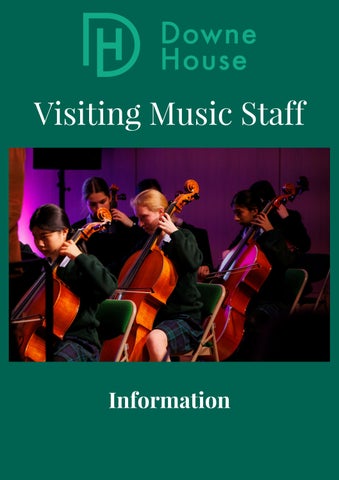
Visiting Music Staff
Information
Welcome to Downe House The aim in producing this document is to create a one-stop information point where you are able to access all the information you are likely to need in relation to working with us as a Visiting Music Teacher.
It has been kept as brief as possible!
TABLE OF CONTENTS
4. Department Staff 5. Music School Plan 6. Classroom Plan 7. School Map 8. Starting with Downe House 9. Some admin… 10. Co-curricular Music 11. Performing Opportunities 14. Music Colours and Awards 15. Exams 18. Professional Standards 19. Safeguarding 20. Absence 21. Termination notice, Annual Review, Important Dates 22. Missing Student process 23. Lower School contacts 24. Upper School contacts 25. Sixth Form contacts 26. Key Dates 27. Forms 28. Pay Deadlines
Department Staff Director of Music – Alex Leadbeater Teacher of Music and Music Outreach – Alex Tostdevine Principal Accompanist – Susan Norman Music School Manager – Chris Lambert Musician in Residence – Bob Chilcott Piano Carole Sevestre Justine Cohen Philip Dimitrovski Julia Killick Ikuko Inoguchi Rob Howarth Ben Giddens (& Organ) Strings Victoria Stapleton (Violin / Viola) Mila Ferramosca (Violin / Viola) Marisa Miller (Violin / Viola) Sean Law (Double Bass / Electric Bass) Virginia McMurtrie (Cello) Wind Sarah Ashworth (Oboe, Bassoon, Flute) Simon Parker (Clarinet & Saxophone) Karen Wills (Flute) Jonathan Howse (Clarinet & Saxophone) Drumkit & Percussion Sam Shaw Guitar Paul Owen (Acoustic & Electric) Max Hunter (Acoustic & Electric) Elias Sibley (Classical) Voice Claire Bessent Tania Pratt Anna Shackleton Davina Hastings Alexandra Rigazzi-Tarling Brass Andy Smets John Deane (Trombone) Tim Anderson (French Horn)
Plan of Music School (Marjorie Gunn Building)
Plan of Classroom Area
Whole School Map
Starting with Downe House General Guidance Timetabling and lesson delivery The Music School Manager will work with VMTs to arrive at the most workable timetable, considering the needs of the teacher and the students. Whilst every effort is made to avoid “gaps” in the timetable, this is usually unavoidable. Downe House works on a non-rotation basis. This has numerous advantages. For example, the student tends not to forget when their lesson is and, of course, they do not miss any academic classes. Lessons, overall, are contained within a forty-minute slot, however, in-line with the wider timetable, lessons are paid and charged as thirty-five minutes, to account for the period of time at the start of the session inevitably spent arriving and setting up. Practice notes and note-keeping It is expected that all students should have access to practice notes to refer to between lessons. This can be done in the most appropriate way for the individual student. It is the responsibility of the VMT to keep their own notes on each student so it is easy keep track of the progress during each lesson. This can be done electronically or as a hard copy. In some circumstances, another member of the Music Department may need to refer to these notes, so it is important that they are readily available. Reports and parental contact VMTs are required to provide written progress reports for students on a termly basis. These will not be required for every year group in every term. It is sometimes appropriate to contact parents or carers separately from termly reports, especially if the parent is overseas. If there are concerns over a student’s behaviour or attainment, the Music School Manager should be contacted in the first instance. It may be that the best course of action is for the VMT to contact the parent, but we will offer as much support as possible in the first instance which may involve establishing, for example, if there are any wider issues that may need to be taken into consideration.
Some admin... Ordering music for students This is done by submitting an online form. The music will be delivered to the relevant VMT’s pigeonhole. Other correspondence will also be delivered here, such as pay-slips. A list of all relevant forms will be included later in this document. . Photocopying music This should not be done except in certain circumstances, for example, a difficult page turn, trying out repertoire, or where the student has forgotten to bring their copy or is waiting on a music order. The photocopying of music belonging to the VMT as provision for a student, instead of them ordering their own copy is generally not acceptable. However, where an exam, performance or competition requires the use of a single piece contained within an otherwise “expensive” book, this is likely to be overlooked though an original copy should be used for the event itself. There should be no circumstance in which a photocopy is used in an exam, competition or performance. Reeds A stock of single and double reeds are overseen by the VMT “woodwind custodian”. If your student requires a spare reed, please inform the woodwind custodian or the Music School Manager, who will advise. The “woodwind custodian” will also keep an up-to-date record of school instruments being hired to students as well as advising on minor repairs. You are required to submit an online form for those students to whom have had a school reed supplied to them. A list of all relevant forms will be included later in this document. Strings Relevant spare strings for school instruments are overseen by the VMT “string custodian” and are generally kept in the appropriate instrument cases with regular audits being carried out. The “string custodian” will also keep an up-to-date record of school instruments being hired to students as well as advising on minor repairs. Brass The “brass custodian” will keep an up-to-date record of school instruments being hired to students as well as advising on minor repairs. Attendance logging It is important that every lesson is logged accurately and that the correct procedures are followed for a student who is absent from a lesson about which the VMT had no prior knowledge.
Co-Curricular Music Choirs Choral music is one of the major strengths of the Department and is proactively encouraged and promoted to all girls. There are currently four choirs in residence at Downe House School: Once Removed (Remove choir), In Harmony (L4-L5 auditioned), Polyphonix (L5-U6), and Prima Voce (U5-U6 auditioned). All girls have the opportunity to sing and perform throughout their school career as well as those vocally gifted to be stretched and challenged.
Ensembles Ensemble work, listening skills and the developing performing confidence are at the core of the group’s training as well as widening girls’ general musical experience and appreciation. The structure of the large ensembles is organised according to ability and enables every girl who learns an instrument to have the opportunity to belong to a large ensemble. Chamber Orchestra This is the flagship orchestral ensemble of the School involving the most musically advanced players in the School. The ensemble provides the opportunity to rehearse at a faster pace and perform at a higher standard. The ensemble aspires towards all players grade 7/8 and above, exploring a variety of advanced repertoire. Symphony Orchestra This ensemble embraces girls around Grade 5 and above and explores a variety of repertoire for a large orchestra from classical orchestral pieces through to film music. Sinfonia Sinfonia involves girls Grade 2 and above performing both classical and popular repertoire. The ensemble is an intensive training wind ensemble for the more advanced orchestral ensembles. Jazz Band Jazz Band involves girls around Grade 5 and above focusing upon the jazz repertoire. Girls are invited to join the ensemble, involving both instrumentalists and vocalists. Piano Ensemble Ashkenazy Piano Ensemble is an invitation-only ensemble for eight pianists, meeting weekly on Monday evenings. Band Club Band Club is open to anyone and meets on Tuesday evenings.
Performing Opportunities The Department is committed to maximising performance opportunities for all girls. There are many opportunities for solo and ensemble performances to cater for all levels of ability in a supportive environment. Internal Regular Performing Events: Murray Music Moments These informal concerts, which are 30 minutes in length, take place on Tuesdays at 12.30pm at the Murray Centre. The programmes aim to be as inclusive as possible and offer girls the opportunity to perform either a complete recital or as part of a mixed concert. Hot Chocolate Concerts These are small, informal concerts with a nurturing approach and are great for students to perform for the first time or to try out pieces. Instrumental Music in Chapel on Tuesday and Thursday mornings at 8.30am provides performing opportunities for Music Award Holders (and other girls who would like a solo opportunity) to play a piece as the girls come into Chapel before the Service. Services Choirs and instrumentalists regularly enhance the Services with music. In addition to leading the hymns on Tuesdays, Thursdays and Sundays, choirs sing an anthem, canticle or other music as needed. Music lists are prepared a term in advance. Choirs and instrumentalists provide music for further occasional services as needed, such as; Confirmation (termly), the Service of Welcome, the Remembrance Service and Leavers’ Service. Music Award Holders’ Recitals Two recitals are held each year to celebrate the music making and talent of our Music Award Holders. Each music scholar and exhibitioner is invited to perform in one of these recitals held each year. Girls write programme notes for their chosen piece and have the opportunity for a dress rehearsal as part of their preparation for this concert. Michaelmas Concert This takes place at the end of November in the Farr Centre. It is an opportunity for all the school’s main ensembles to perform as well as smaller ensembles and occasional soloists.
Lent term Concert There is usually a school concert or similar event where the school’s larger ensembles perform. Other ensembles and occasional soloists may also perform. The format and venue varies year to year. The last three years, the girls have performed a charity concert at St John’s Church in Newbury. Carol Service This is held at St Mary Abbots Church, Kensington. House Music Competition This takes place in the Lent term. The five mixed aged Houses together with attached girls from the Remove, Lower Fourth and Lower Sixth take part. A House Conductor is appointed by the Housemistress to rehearse the House choir (consisting of all girls in the House), to prepare two ensembles (vocal and instrumental), and choose a soloist. An outside adjudicator awards various prizes. Young Musician of the Year Competition The Young Musician of the Year Competition promotes music making at all levels, encouraging our musicians of the future as well as celebrating the advanced musicianship of girls at Downe. As such there are four separate classes: Music Maker (Grades 1-2), Intermezzo (Grades 2-4), Maestro (Grades 4-6) and Virtuoso (Grade 7+). Founder’s Weekend This is held on the last weekend of the Summer Term. A series of concerts and musical events over the weekend. These give the opportunity for all the school’s ensembles to perform over the weekend as well as many soloists. Founder’s Weekend often sees around 600 appearances from the girls. School Assemblies and Year Assemblies These allow for the inclusion of music as appropriate and/or requested with various soloists and ensembles performing throughout the year. Polyphonix or Prima Voce sing an anthem in assembly at the end of each term.
Master Classes These take place each year focusing on different disciplines such as wind, strings, keyboard and vocal. An external specialist is invited to take the master class with students being coached on pieces that they have prepared. Participation is encouraged in consultation with teachers. Orchestral Fun Day This is usually held every year in October and is one of the largest and most popular prep school music days in the country. Students from preparatory schools are invited to Downe House for an Orchestral Day, involving a mixture of full orchestra rehearsals and sectionals. This often involves VMTs. All participants have the opportunity of playing in a large orchestra. There is also a masterclass opportunity for more advanced children led by the Director of Music, Mr Alex Leadbeater. The day ends with a concert.
Other Events Girls are always encouraged to perform and the Department is supportive of this. Staff will always encourage, support and assist with any appropriate initiatives that the girls have.
Music Colours Music Colours recognise and celebrate girls of all musical abilities who show exceptional commitment to ensembles and contribute significantly to the musical life of the School. There are three types of Music Colours: i) Lower School Music Colours (bronze) for girls in Remove and Lower IV. ii) Upper School Music Colours (silver) for girls in Upper IV to Upper V. iii) Barbirolli Music Colours (gold) for girls in the Sixth Form. It is also possible for girls lower down the school to be awarded The Barbirolli Music Colours, but this is exceptional. The Barbirolli Music Colours are named after an inspirational performer (Evelyn Barbirolli, former pupil at Downe House) and celebrates musicianship, commitment, potential and the power of ‘having a go’.
Music Awards Every year some girls are awarded Music Scholarships and Exhibitions and go on to play a leading role in the musical life of the School. They perform as a soloist and in chamber groups and are members of instrumental and vocal ensembles, playing with enthusiasm and showing musical leadership to others in the School. If a VMT wishes to recommend a student for an award, there is a form available to do this. A complete list of relevant forms will be included in this document.
Exams ABRSM Downe House is an ABRSM Centre and host a visit at the end of every term. Entries are made via an online booking system, the link to which will be emailed and generally made available to VMTs at the appropriate time. ABRSM Performance Grades ABRSM Performance Grades are presented as a video recording of 4 pieces in one continuous take and the marking is weighted towards performance. There are no aural tests, sight-reading or scales, which means that the exams are marked differently to “face to face” exams. Each piece is marked as it would be normally, but an additional mark is given for the “Performance as a Whole” and aspects that are considered are: Communication (a sense of performance, a sense of involvement and the sequence and pacing of the programme.) Interpretation (awareness of the control of textures, suitable blending / balancing) Delivery (technical management of the voice / instrument should meet the demands of the performance situation Performance Grade recordings need to approved by the relevant VMT before the student is entered for the exam.
Other It is sometimes appropriate for students to be entered for a different board altogether. This would normally be instrument related, for example electric guitar or drum kit. Please see the Music School Manager in this case. Grade 5 theory Whilst the department as a whole will keep an eye out for potential candidates, it is the responsibility of the VMT to a) be sure that a student has achieved Grade 5 theory before entering them for a “higher” grade ABRSM exam (though the Music School Manager will be able to help with this if there is doubt) and b) to “flag up” any students that need to start thinking about Grade 5 theory. The Music Department can run the classes, timetable permitting, but need permission from parents to enable lessons to commence. A good rule of thumb for starting to look at Grade 5 theory is upon completion of ABRSM Grade 4 practical. Aural The Music Department will run tailored sessions for every girl taking an exam and these will take place in the term in which the exam is scheduled, apart from: Grade 8 – wherever possible, the aim is to start these aural sessions the term before the term in which the exam is to be scheduled. Grade 7 – if it is possible and there is a strong case, the aim is to consider starting these aural sessions the term before the term in which the exam is to be scheduled. All aural sessions should be in addition to the work done with students in their lessons, though at Grades 6, 7 and 8, the Music Department will work intensively on the complex finer details of these higher aural expectations. It is the responsibility of the VMT to be sure that the student has an aural session scheduled and that they are attending them and staff will be notified when sessions are to take place. Withdrawal from exams From time to time, it is appropriate for a student, having been entered for a music exam, to be withdrawn. A good example of this would be a student who, whilst ready to take the exam, has then suffered a long period of illness or other issue that may have meant them being able to put in the private practice required. However, VMTs should be familiar with the essential points below: Students should be ready to take the exam before they are entered. If there are any concerns about the possibility of a disappointment, these should be raised in writing to both the Director of Music and the Music School Manager. If it is not possible to raise a concern at this point, it should be done as soon as is possible, again in writing. Please remember that at this stage, when the student has been entered, the full exam fee may still be due. It is sometimes appropriate for the VMT to contact the parent regarding concerns with an exam entry however this must go through the Music School Manager in the first instance.
Having made these points, it is important to note that at some stage, every VMT has experienced the student who, at the point of entry, has just a fluency issue with a couple of scales and then, having been entered, stops practicing and starts going backwards! Again, the key is timing. These sorts of problems can usually be resolved, but not knowing about the issue until a week before the exam will present significant challenges!! External enthusiasm over exam entries VMTs are expected to use their professional judgment regarding whether to enter a student for an exam. This can sometimes be tested for various reasons. There may be worries that a student is taking too long, for example, and that “it has to be this time come what may!” The student may be “desperate” to take the exam, even though the VMT is not happy to enter them but is thinking “they could probably scrape through at a push!” The VMT may even have had a direct request from the parent to enter a student for an exam even though they know it is unreasonable but may be working to the adage “he who pays the fiddler calls the tune!” None of these are ideal situations and as above, raising any concerns as early as possible is important. Please do not enter into any correspondence with a parent promising an exam entry, even with conditions! Diplomas For many students, taking a diploma such as ARSM, DipABRSM, ATCL, LTCL etc. can be a wonderful challenge and ultimately a great sense of achievement. There may be reason why, however, in the wider context, it may not necessarily be appropriate. It is also important to gauge the basis of the need to do the diploma. Will it be an enjoyable challenge for the student? Will it add to their musical journey? Or is it a device with which to gain as many UCAS points as possible, or a badge to gain before their peer does? As soon as there is a possibility of a Diploma Entry, the Diploma Form should be submitted and this will be found along with all the other forms later in the document.
Professional Standards Dress Code The expectation is to dress professionally. It is also important to feel comfortable! Eating and drinking Pupils are encouraged to drink water during the school day and they are used to carrying water bottles. We should be doing the same, especially as there are no cups provided, though there is a water cooler in the Music School! Eating during a lesson is not considered acceptable. If there are circumstances under which staff feel they will need to eat during a lesson, please see the Music School Manager. Mobile phones Except in cases of emergency, mobile phones should not be used for making or receiving calls or sending texts etc. during teaching and should either be set to ‘silent’ or switched off. The use of musical or work-related apps, however, is acceptable. Smoking Downe House is a non-smoking establishment
Safeguarding Pastoral care By law, all staff are required to hold the relevant documentation and knowledge regarding child protection and safeguarding. The appropriate resources will be made available to staff by the HR department. All staff should carry a safeguarding card behind their security tag. The Designated Safeguarding lead at Downe House is Sofie McClymont - mcclymonts@downehouse.net . If a VMT has a safeguarding concern, no matter how insignificant it may appear, it is important to raise it. VMTs may wish to contact the Music School Manager in the first instance. Behaviour Sometimes, a student may exhibit challenging behaviour. It is important to raise this as soon as there is a concern, by speaking to the Music School Manager. Security Whenever a computer or other device is left unattended, please ensure that it is logged out (if it is a public computer) or it is locked. Security tags should be worn at all times. Under no circumstances leave them in teaching rooms at breaks and other times of absence, no matter how short. Fire The fire alarm is a constant sounding alarm in every area of the school. The evacuation point is the AGS Tennis Courts. Please ensure you sign in and out on the fire list outside Mahler Lockdown The lockdown alarm is a siren which will sound every 2 minutes during the lockdown period and will be accompanied by flashing strobes. (There is one above the instrument storage area in the Music School.) If this sounds – go into a secure building and stay away from windows. The signal that lockdown has ended will be the fire alarm. Car parking You will find that the most convenient area in which to park is along the drive entering through the South Gate and around Music, AGN, Maths and DT and behind the Concert Room.
Absence Student absence Planned absences are logged on the school database and you will have access to this. Provided the absence has been logged with no less than two weeks’ notice, you will not be able to claim for this lesson. The Music School Manager will assist in keeping track of absences by, wherever possible, emailing a list of absentees two weeks in advance of the planned absence, as well as making VMTs aware of lists of known trips and school exam dates. Examples of a planned absence are: School exams, a trip and summer study leave for U5 and U6 which usually accounts for most of the second half of the Summer Term. Unplanned absences will, under normal circumstances, be paid. Examples of an unplanned absence are forgetting to come, a medical appointment, a family event, a quickly scheduled sports event, or any other reason for which you have not received notice. There is an important process to follow to ensure that means the whereabouts of a student is known at all times.
Study Leave – U5 and U6. These year groups will go on study leave around the May Half Term. Individual music lessons are suspended by default during this period unless a request is made for them to continue – sometimes on an ad-hoc basis. Teacher absence Planned absences (Leave of Absence) may be required for a professional engagement, though it is normally a requirement to take annual leave in the school holidays only. The performing life of a Visiting Music Teacher can be hugely beneficial and inspiring for the students, but of course, should not have a negative impact on students’ learning. If you require Leave of Absence, Submit a Leave of Absence form at the earliest opportunity Unplanned absences may be due to sickness or having to attend to an ill child. If absence at short notice is needed, please phone the Music School office on 01635 204654 at the earliest opportunity, certainly before the first lesson. It will also divert to a mobile number. Leave a message if necessary. To claim sickness pay, it is sometimes a requirement to have a returnto-work interview with the Music School Manager. The number of days you work in a week will dictate how many days sick you are entitled to in any rolling 12-month period.
Notice to terminate lessons Sometimes, it is right for a student to stop taking lessons. There is a notice period attached to this. Permission must come from the parent in writing to the Music School Manager and the notice period is one full half term. The student may wish to stop lessons immediately, but they will be charged until the notice period expires. On rare occasions, the decision might be taken to offer a student a different teacher. Under these circumstances, the notice period would remain the same. Annual Review Process For the first 3 terms of your employment, there will be regular probation meetings, and these will be proportionate to how many hours teaching is carried out. Upon passing the probation period, VMTs will become part of the review process across the school. These are a great opportunity for all staff to discuss any matters relating to working as a VMT at Downe House. Important dates It is expected that VMTs attend the “VMT Staff Inset Day”, normally on the first Monday of September and the “VMT Parents Meeting”, normally on a Saturday morning in November. These are both fantastic opportunities. The first to share ideas and have lots of fun! The latter is a really important opportunity for the parents of students to put a “face to the name”. Whilst problems rarely occur, they can often not happen at all, having met a parent face to face! Meetings with parents take place online using the TEAMS platform and will be scheduled by the Music School Manager.
Important processes If a student is absent from your lesson: Check their timetable on SchoolBase. If they are legitimately absent, it will be logged here. Lower School before 18:00 – call the Reserve member of staff on 4738 Lower School after 18:00 – call the House Upper School before 18:00 – call the House. If no response or student is not there, call the Reserve member of staff on 4738 Upper School after 18:00 – call the House. If there is no response, leave a message After a student has been absent from your lesson: Log the absence on SchoolBase and make a note in the Comments box.
KEY DATES Monday 7 September Safeguarding for all staff – 09:00 PAC (if you are available) VMT Inset – 13:00 Auditorium Thursday 10 September Timetable commences at 10:40 Friday 18 September Murray Music Moment 12:30 Auditorium Friday 25 September Murray Music Moment 12:30 Auditorium Wednesday 30 September Make A Difference Day - no teaching Friday 2 October Short Exeat 12:00 (ends Sunday 4 at 20:00) Friday 9 October Murray Music Moment 12:30 Auditorium Thursday 22 October Music Award Holder Recital 19:00 Auditorium Friday 23 October Long Exeat starts – 12:00 Sunday 8 November Long Exeat ends – 12:00 Friday 13 November Murray Music Moment 12:30 Auditorium Saturday 14 November VMT Parents’ Morning (Online) Saturday 21 November Michaelmas Concert 18:00 Farr Centre Tuesday 24 November ABRSM Face to Face Friday 27 November Short Exeat 12:00 (ends Monday 30 at 20:00) Wednesday 2 December Carol Service Rehearsals Friday 4 December Carol Service Thursday 10 December Lessons will probably end early for Lower School – Santa’s Journey Friday 11 December Lessons start at 09:40 and end at 16:40 – End of Term
FORMS Claiming Chargeable Extras
Reeds
Music Ordering MICHAELMAS 2026
Request for leave of absence
Diplomas
FORMS continued
Pay Deadlines