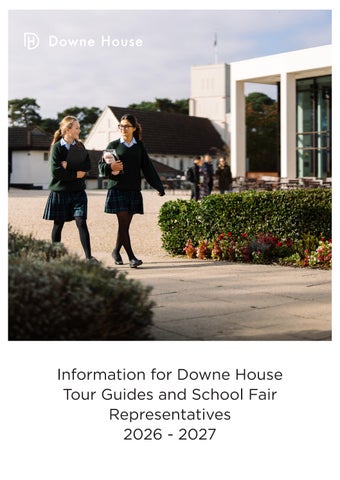
Information for Downe House Tour Guides and School Fair Representatives 2026 - 2027
Contents The tour 4-5 tour 4 Areas Key messages 6 to visit 5 Key messages 6 Family friendly boarding Family friendly boarding Weekends Weekends Day places Day route 8 Bus places Our marketing message 9-10 message 6-7 The Downe House DNA What makes Downe House unique
Admissions procedure 11 procedure 8 Scholarships 9 Scholarships 12 Bursaries 9 Bursaries 12 Facts and figures 13 figures 10 Boarding 11-13 Boarding 14-16 Lower School Upper School Sixth Form Academic life 17-18 life 14-15 Lower School Upper School (GCSE and I/GCSE) Sixth Form (A Level)
Results andextra Curriculum destinations 16 information 19-20 Curriculum Languages extra information 17-18 Languages Sport Sport Music and Drama Results Music and university and Dramadestinations 21 Higher Education 19 Futures Department 22 DH SOCIETY 22 LINKS 20 Frequently asked questions 23-24 questions 21 Mobile phones 24-26
2
Thank you and welcome to the Tour Guides and School Fairs Team for this year. As you know, it is a huge privilege to be a tour guide and to support our prospective families as they embark on their journey of choosing the right school for their daughter. You have been selected as we believe you will be a fantastic ambassador for Downe House and will show the School off in its best possible light. The aim of this guide is to give you a clear idea of the messages we are trying to deliver and of where we are pitching ourselves as a school. We aim to keep you abreast of all new developments so you talk confidently to parents and to support you with any tricky questions they may have. Please can I encourage you to frequently check our website www.downehouse.net to familiarise yourselves with the information our parents will have read before visiting us. This booklet will, I hope, with the help of the many extra links to the website, equip you with the next level of information they are looking for. As a tour guide, you will have been made a member of the Tour Guides/School Fairs team on Teams. This will be our main channel for communication and all useful information, tour guide schedules and school fair communication will be made through this team. Please remember that the tour guide schedule is extremely complex. If for any reason, you are unable to do your tour due to absence, please in the first instance consult the schedule and ask your reserve to stand in for you. It is vital that you let us know of this swap in advance as we need to ensure our visitors are given the correct information. Thank you for all your hard work and good luck with your tours this year! Tara and the Admissions team
Contacts: Tara Reeve 01635 917740 Angela Nutt, Registrar, 01635 204701 Harriet Schofield, Assistant Registrar, 01635 207829 Mireille Cook, Assistant Registrar, 01635 204671 Carole Bailey, Admissions Administrator, 01635 204615
3
The tour You will be sent an outlook invitation prior to your tour with details about the family and name and age of their prospective daughter. Please do check the slip to see whether the tour is an 11+. 12+, 13+ or 16+. You will need to adapt your tour accordingly. Please meet your family in the blue room in Wakefield House where they should have been met by a member of the SLT. Given the different timings of your tours, I urge you please to be flexible with your tour and walk your tour route through at the start of term. Below you will see the suggested tour routes for different entry points. Please do adapt this to suit you so that you feel comfortable and confident on your tour. When you have finished your tour, please bring your family back to the Blue Room at Wakefield House.
The route: 11+ and 12+ Tour •
Wakefield House – point out Murray Centre (you will return there later)
•
Lower School boarding houses (Darwin and either Hill or Hermitage)
•
Farr Centre (inc Dance Studio, gym, scholars’ boards)
•
Squash courts/swimming pool/spin bikes
•
Upper School boarding house (recommend Aisholt, AGS or AGN – common rooms, House study, dorms. Tedworth House for Day pupils) Try to give the House prior warning.
•
MDR
•
Science block
•
PAC
•
Music block (optional)
•
Food Tech/3D Design/Textiles
•
Art block
•
Concert Room
•
Cloisters – the classrooms (discuss Surface programme)
•
Chapel (optional)
•
Murray Centre
4
13+ Tour •
Wakefield House – point out Murray Centre (you will return there later)
•
Upper School boarding house 1 (recommend Aisholt – common rooms, House study, dorms) Tedworth for Day pupils
•
Swimming pool/squash courts/spin bikes
•
Farr Centre (inc Dance Studio, gym, scholars’ boards)
•
Willis or York depending on year group
•
MDR
•
Upper School boarding house 2 (recommend AGS or AGN) Second house not needed for Day pupils
•
Science block
•
PAC
•
Music block (optional)
•
Food Tech/DT/Textiles
•
Art block
•
Concert Room
•
Cloisters – the classrooms (discuss Surface programme)
•
Chapel (optional)
•
Murray Centre
16+ Bespoke Tour Find out which subjects the girl would like to study at A Level and arrange to visit the department in advance. •
Wakefield House – point out Murray Centre (you will return there later)
•
Willis or York, depending on year group (If showing York, you must show Willis too as York girls eat and socialise in Willis)
•
Elected departments if interested
•
Farr Centre
•
MDR
•
PAC (House Drama – all involved)
•
Music block (optional)
•
Cloisters – the newer classrooms (discuss Surface programme)
•
Chapel (optional)
•
Murray Centre
5
Key messages As the independent school market evolves, Downe House is taking positive steps to strengthen its future while staying true to its distinctive ethos. Our partnership with Harrow brings together the strengths of two leading schools, creating greater opportunities for pupils and ensuring long-term resilience. At the same time, we are continuing to promote more flexibility in our boarding provision to better meet the changing needs of families, while maintaining the full-boarding experience that remains central to a Downe House education. Families are increasingly looking for greater choice and flexibility to balance school, boarding and home life. This feedback has come consistently from prospective parents, feeder Prep Schools and local schools. While responding to these changing needs, we remain committed to our vibrant full-boarding model and the rich 24/7 educational experience that makes Downe House unique. Greater flexibility will enable more girls to benefit from that experience without changing the School’s core identity. Downe House & Harrow School Partnership (from September 2026)
• Downe House and Harrow School have formed a strategic partnership, bringing together two of the UK’s leading independent schools. • Both schools retain their own identities, traditions, governance, and independence while working together to create new opportunities. • The partnership is based on shared values of academic excellence, holistic education, and the benefits of single-sex boarding. • Pupils benefit from increased academic, co-curricular, cultural, and social collaboration, broadening their experiences and building friendships across both schools. • Staff benefit from sharing expertise, resources, and best practice, strengthening teaching, learning, and pastoral care. • The partnership also strengthens links between parents, alumni, and the wider school communities, with further practical collaboration planned over the coming years. • Key takeaway: The partnership enhances opportunities for our girls while preserving the distinctive character and traditions that make Downe House unique.
6
Flexible Boarding & Day Places • Downe House continues to offer three ways to experience a Downe House education, giving families greater flexibility while maintaining our strong boarding ethos: • Full Boarding – our traditional boarding experience, with girls welcome to go home at weekends once commitments are met. • Flexible Boarding – up to four nights a week, with boarding patterns that can be adjusted to suit family needs. • Day Places – girls are fully integrated into school life, with access to academic lessons, co-curricular activities, evenings, and weekends, while returning home overnight. All new day pupils are allocated Tedworth as their Upper School House where they enjoy special facilities. • The School remains firmly committed to the full boarding experience, which is at the heart of Downe House and continues to be the choice of most families. •
Greater flexibility allows more girls to benefit from a Downe House education in a way that best suits their individual circumstances.
•
We operate a local and London bus service which parents can book through our website. Further details https://www.downehouse.net/downe-house-admissions/ transport-services/
•
Key takeaway: Whether full boarder, flexible boarder, or day pupil, every girl is a full member of the Downe House community and enjoys the same outstanding education, pastoral care, and opportunities.
7
Transport We Operate a local and London bus service which parents can book through Vectare. The London bus runs on Monday morning into School, taking girls back to London on Wednesday, returning Thursday morning and home on Saturday.
eynsham
Oxford
Transportcarterton routes are subject to availability based on demand.
long crendon
haddenham thame
wheatley
princes risborough
bampton m40 a420
chinnor
london
wembley
Abingdon faringdon
greenford hayes
southall
Maidenhead *From Downe House
grove
watchfield shrivenham
Paddington Hammersmith
pangbourne
Kensington
Chiswick
twickenham
wantage
Cray’s Pond West Ilsey
Streatley
East Ilsey lambourn a34
Upper Basildon
aldbourne
Pangbourne
Reading woodleu
m4
tamsbury
Marlborough
To London *
earley
Hungerford
Thatcham
Newbury
wokingham
great bedwyn
Shalbourne burbage a33
highclere bramley
Kingsclere
hartley wintney chineham hook
oakley
ludgershall
m3
fleet
Basingstoke
overton
tidworth
andover upper cltaford
a303
alton m3
middle wallop
medstead stockbridge
chawton bordon
four marks
Kings Worthy
8
new alresford
Our marketing message Our strap line is “Inspiring Girls” with an intentional dual interpretation on the word “inspiring” (both as an adjective and a verb). We both inspire girls through a Downe House education and in turn produce “inspiring girls”, who inspire others around her. Our other messages surround leadership and our global programme. We very much believe that every girl at Downe House, no matter what her personality type, can and will lead. There is no such thing as a typical Downe House girl and the beauty of our community is that we have a diverse range of girls within it. All girls are individuals and all girls excel in their own ways. All girls will and can inspire others and lead in their own way, unique to themselves.
The Downe House DNA While we are a school full of individuals, what girls do have in common however, is a set of distinct characteristics that have long been identified as the key attributes of a Downe House girl; attributes developed on a girl’s journey through the School, and underpinned by the full range of academic, pastoral, enrichment, co-curricular and super-curricular activities, opportunities and support they receive. These attributes are: Compassion Collaboration Resilience Creativity Aspiration Communication Outward Looking
9
The Houses have boards displaying these attributes, giving examples of how we develop them in the girls. Please do try and point these out and discuss them with our prospective families and also encourage them to listen to teh Downe House podcast which explores each one of the DNA characteristics in turn. Downe House Podcast
What makes Downe House unique? There are so many things that make the difference at Downe House. For all prospective families considering Downe, our flexible boarding options, our pastoral care, our individual tutoring system and our willingness to offer bespoke programmes for the individuals in our care are of primary importance. There are also several areas where the School is leading the way, offering particular programmes, unique to Downe House: •
• •
•
• •
Exploring Europe – this programme gives our younger pupils in years 7 and 8 an insight into four diverse European countries over four terms, whilst gaining a comprehensive understanding of each place through a bespoke curriculum covering Geography, History, Politics, Art, Literature, Classics and Religion. Countries to be visited include Germany, Greece, Poland and Spain. Exploring Europe programme Global Schools Exchange Programme (mainly for the LV but opportunities also in LVI) To learn more about our 16 partner schools click here Global Internship opportunities - girls in the Lower Sixth have the opportunity to undertake a number of work placements around the world, supported by our alumnae and parents. Click here to read more. We are a leading Microsoft Showcase School and have an extensive MS Surface Programme - Downe has the greatest number of Microsoft Innovative Experts in the UK. All staff and all girls are now on the programme. Elective Programme, open to all girls LV-LVI. This is a super-curricular programme which runs alongside the curriculum, designed to stretch the more able and encourage learning for the learning’s sake. Elective Programme DH LINKS our alumnae and parents network is an innovative and progressive scheme that provides a wealth of networking and careers-based opportunities for our girls whilst at School and beyond. DH LINKS section.
For further information: Why choose Downe House For Olive Willis’ vision and her founding principles For our Christian Ethos 10
Admissions procedure We have been running early assessment for 13+ applicants for a number of years now, bringing us in line with the other major co-ed boarding schools. Now, all 11+ and 13+ applicants are invited to an Assessment Day in year 6, but we do reserve some spaces for later assessment for exceptional candidates who may have missed the standard application window. 11+/12+ ENTRY For entry into our Lower School, girls are assessed the year prior to entry. They are invited to an assessment day here at Downe House in September and will then sit the ISEB Pre-Test at their own school or at a local testing centre in October. During the Assessment Day, prospective pupils will have an interview with the Headmistress or a senior member of staff, complete a piece of creative writing, have lunch with current girls, go swimming and engage in some creative arts. We will then review the results of the ISEB, Assessment Day, interview and Head’s report and offer unconditional places by the end of the December. Link to the 11+ and 12+ Admissions Procedure 13+ ENTRY For entry at 13+, girls sit the ISEB test at their school or local testing centre in October of year 6. Top scorers in the ISEB test will then be invited to an assessment day at Downe House later in October or November. The Assessment Day echoes the one for 11+ candidates outlined above. We will then review the results of the ISEB, Assessment Day, interview and Head’s report and offer unconditional places by the end of the December. We will still ask pupils to sit the Common Entrance or equivalent at their school at the end of year 8 but this is for setting purposes only. Link to 13+ Assessment timeline 14+ Entry Please refer to the Admissions department. This is not a standard entry point.
11
Scholarships If a girl has been invited to sit Academic Scholarship papers at 11+, 12+, 13+ or 16+, these papers (DH own papers) will be sent to the girl’s school in January (or to the British Council if they are overseas). Successful candidates will then be invited for an interview day at Downe. All Scholarships are awarded on the results of exams and interviews with the Headmistress and other relevant members of staff, along with prep school reports. In addition to these major awards, Exhibitions may be awarded in each age group. Further minor awards for excellence in specific subjects may be made if candidates of sufficient merit present themselves. There is also the possibility of a Headmistress's Award for an outstanding all-round performer. A girl can also apply for Music, Drama, Art and Sports Scholarships. Exhibitions are awarded for girls who display talent but do not qualify for a full Scholarship. Being a Scholar is a position of honour and a privilege, but does not carry any remission in fees. Music Scholars receive free tuition in two instruments up to a maximum of 30 lessons per year and Exhibitioners receive free tuition in one instrument up to a maximum of 30 lessons per year.
Bursaries Every year, nearly 50 girls benefit from full and partial means-tested bursaries. We value pupils who will flourish in and contribute to life at Downe House, seizing every opportunity and enriching our community. These gifted pupils will benefit from an education and boarding environment of the highest calibre and quality, as well as the provision of academic, cultural, sporting and social experiences to help them reach their potential. Our means-tested bursaries are available at all points of entry to Downe House and vary in size based on the circumstances of the applicant’s family. We offer financial assistance as high as 100% plus an allowance towards School extras, recognising that a Downe House education encompasses more than classroom learning. Bursaries also take into account academic entry requirements and an applicant’s capacity to progress in their work through the School.
12
Fees Full boarding fees per term:
£21,076
Annual: £63,228
Flexi boarding fees per term:
£17,625
Annual: £52,875
Day boarding fees per term:
£15,682
Annual: £47,046
Day fees per term:
£11,621
Annual: £34,881
Overnight accommodation: £116.40 Registration fee (non-refundable)* Day £240 (inclusive of VAT) Boarding/Flexi
£395 (inclusive of VAT)
*(and change to Flexi or Boarding at a later date will incur an additional cost) Acceptance Deposit (refundable) Full & Flexi Boarding pupils whose parents
£3,000 (paid on acceptance of offer)
reside within the UK All other pupils
£10,000 (paid on acceptance of offer)
Day pupils whose parents reside within the UK £2,000 (paid on acceptance of offer) If a pupil requires a visa of any kind to study at Downe House, regardless of whether they have a UK address, then an overseas deposit will be payable in order to secure their place.
13
Boarding In recent years, critics have been quick to predict the demise of boarding schools. They’re out of touch and old fashioned, they argue, no longer what parents want for their children. Many parents visiting us for the first time have this view and need to be convinced about boarding. They may be first time buyers or they may have had a negative experience of boarding themselves when they were young. Boarding has changed over the last 20 years beyond recognition and it is important that they see the fabulous ‘home from home’ environment that we offer at Downe. Dorms are smaller than they were, staff are far more approachable and visible (they really care), food is delicious, and opportunities are immeasurable. The benefits of boarding: • • • • • • • •
Independence and life skills (time keeping, independent working) Mixing with people from many different cultures increases your global outlook and opportunities It develops empathy, tolerance and understanding You make friends for life A supportive atmosphere conducive to study Staff and facilities available outside lesson time An abundance of activities, trips, societies, facilities Fun!
Our Boarding Model There are huge benefits to our boarding model which set it apart from other schools. Splitting our boarding structure into three tiers (Lower, Upper and Sixth Form) means we are able to cater our care to the ages of the girls we look after. It also gives us the opportunity to mix up the girls as much as possible throughout their time with us so they can expand their friendships and benefit from living in a diverse community
Lower School boarding: Our Lower School consists of three houses, Hermitage, Hill and Darwin. All three houses have a mixture of girls from Remove and Lower Fourth. • • •
•
All three houses have approx. 35 girls in each All 3 boarding houses have residential HsMs and Assistant HsMs and have a residential Pastoral Tutor. The Lower School boarding houses are run in a very similar way to an Upper School house eg. there are desks in a large communal workroom area (so they can work in the evening). The Remove and LIV girls do their preps throughout the day in classrooms. However, it is commonly acknowledged that most of the Remove and LIV girls will probably have to do prep after 6pm, particularly those girls who are busy and have a lot of activities. Girls will change in their boarding houses for games etc and also have their break in their houses. Staff will be in these houses and around at breaks, lunch and tea (although not during other times because the Remove and LIV girls will be in lessons/ preps during every period).
14
Evening Routine: • • • • • •
7pm Return to houses or attend clubs 7.30pm House Meeting 8pm Drink and a biscuit 8.15pm Remove: FOG (Feet off Ground – quiet time in dorms) 8.45pm Silent reading 9.15pm Lights out
Lower School Handbook
Upper School boarding Our Upper School consists of five houses, Holcombe, Aisholt, Tedworth, AGS and AGN. When giving an Upper School tour, please try and show them a house in the main School (Aisholt, Tedworth for day girls or Holcombe) and then a ‘satellite’ house, either AGS or AGN. Please use Aisholt as your main school house and AGS or AGN as the satellite houses. All boarding houses have residential HsMs and Assistant HsMs and have a morning/ afternoon matron who is visible in the House all day. In the Upper School houses, girls are free to come and go back to house between lessons. Prep for the UIV is still supervised in classrooms, but as they reach the LV, as long as they are responsible enough, prep can take place in their dorms. Matrons will keep an eye on the girls and their working habits to ensure they are using their prep sessions wisely. If not, then support will be put in place to help them. Routine: • •
• •
• • • • • •
6pm – 7pm Supper (or later if choir practice). 7pm - 8.30pm Girls may visit other houses or take part in activities. The girls should sign out if they are not in House. Upon their return they must remember to sign back in. 7.30pm – 8.30pm Quiet time (Monday, Tuesday and Thursday only) 8.30pm Evening check in: at evening check in girls must report, in person, to the member of staff on duty. The girls may not then leave the building. If a girl has not checked in by 9pm the member of staff on duty should contact the Headmistress or Deputy Headmistress. UIV and LV hand mobile phones in. 8pm – 9pm Quiet study time in dorms. 9pm Bedside lights, known as ‘little lights’ go on for the UIV, room lights switched off and UIV get ready for bed. 9.15pm LV ‘little lights’ routine as above. 9.30pm UV ‘little lights’ routine as above. UIV lights out and quiet for sleep. 9.45pm LV lights out and quiet for sleep. 10pm UV lights out and quiet for sleep.
Upper School Handbook
15
Sixth Form Boarding There are two Sixth Form boarding houses, Willis and York. In the Sixth Form, we move to horizontal boarding and an entire year group will move into either York or Willis and stay there for the full two years. The Sixth Form boarding houses offer significantly more independence and operate in a similar way to a university hall of residence but with a lot more support. Girls run their own societies and take on roles of responsibility, giving them great leadership opportunities and reasons to return to their former Upper School houses and Lower School houses. In the Sixth Form, girls generally choose to work in the Murray Centre during their prep sessions but are more than welcome to work in their dorms if they wish. Willis consists of a mixture of double and single dorms (they change every term) and York is mainly single dorms. In the Lower Sixth in the first half term, all girls are required to attend two supervised sessions a week in the evening between 7.30pm and 9pm (to ensure they are on top of their work and to help them balance the huge commitment of leading House Drama). Thereafter, supervised study sessions are highly recommended and girls are booked in under recommendation from their Tutor. Even if they are not in study session, there is quiet Time in House from 7.30pm - 9pm to allow all girls to work in quiet. Activities and societies also run at this time and girls are encouraged to attend these, as they can manage, but girls must always make sure their work is up to date. Final check in for the UVI is at 9.30pm. Housestaff will come around at about 10pm to say ‘good night’ but girls put themselves to bed. Willis House Handbook York House Handbook
16
Academic life Lower School The curriculum in the Remove and Lower Fourth is designed to give as much variety as possible. Girls are encouraged to collaborate and inject creativity into their work as they explore new subjects and skills. The year groups consist of three mixed-ability teaching groups, with French and Maths being taught in divisions based initially on previous teaching. All subjects are compulsory with optional extra subjects which are taken during prep time. The following subjects are taught: • English • French • German • Latin • Mathematics • Science (Biology, Chemistry, Physics) • History • Geography • Art and Ceramics • Religious Studies • Drama • Music • Information Technology • Physical Education • Design and Technology (Food, Product Design, Textiles) • Learning for Life (PSHE & Wellbeing) • Lyceum • Exploring Europe Optional extra subjects are: • One or two instruments • Singing • Speech and Drama • Tennis Coaching • Squash Coaching Lower School curriculum
Upper School Upper Fourth Creative Subjects and Languages choices This is an opportunity for the girls to start making choices about their own educational journey, before going on to choose their I/GCSEs. Upper Fourth Choices. GCSE and I/GCSE options With the guidance of teachers, an academic tutor, Housestaff and the Future’s department, each girl crafts her own bespoke timetable. Most pupils choose nine GCSEs, with some choosing ten, and in exceptional cases, eleven. We wholeheartedly advocate for the quality, rather than quantity, of subjects taken as well as a wider pursuit of educational enrichment and personal interests beyond the curriculum. Core GCSE subjects: 17
• • • • • •
English (including English Literature) Mathematics Science (at least two of Biology, Chemistry and Physics, but usually all three) One Modern Foreign Language (of French, Italian, German, Chinese and Spanish) Physical Education (non-examined) Religious Studies (examined or non-examined)
The optional subjects in the I/GCSE years are: • Art and Design: 3D Design • Art and Design: Fine Art • Art and Design: Textile Design • Classical Greek • Computer Science • Drama • FSMQ Additional Mathematics (for top set pupils) • Geography • Health, Nutrition and Cooking • History • Latin • Music • Religious Studies Upper School curriculum
Sixth Form A Level: We advise girls to take only three A Levels. In addition to this they may take an EPQ (Extended Project Qualification) and take part in the Mini MBA or Ivy House Leadership programme Typical Sixth Form programme: LVI – 3 x A Levels + an additional subject/short course eg; Extended Project Qualification, Leiths UVI – 3 x A Levels The girls receive special support starting in the LV to help them choose the correct subjects for them at A Level. They have a programme which includes the Morrisby platform for profiling assessment and research, Unifrog for recording and research, Sixth Form taster lessons, information and assemblies on choices and work shadowing, discussions with HsMs and Tutors as well as a formal review with the Future’s department to finalise the options and action plan. There are some new subjects on offer in Sixth Form: History of Art, Economics, Religious Studies, Photography, Business Studies, Classical Civilisation, PE, Politics and Psychology. Sixth Form curriuculum
18
Curriculm – extra information Languages Modern Foreign Languages All girls study French and German from Remove and LIV – 2 x lessons/week for each language. French is set by ability/previous knowledge and organised through a short test/info from parents in an admissions form. Through the Exploring Europe programme, pupils will get a taste for languages more generally and learn about different language families and snippets of individual languages before their trips to various countries. During the course of the LIV, girls experience a taster lesson in each of the languages they may choose to study from the start of the Upper Fourth. The options that can be followed in the Upper Fourth are as follows: 1. 2. 3. 4.
Continue with either French or German. Continue with French and German. Continue with French or German and take up a new language (Spanish, Italian, Chinese) Drop French & German and take up one or two of the new languages (Spanish, Italian, Chinese)
Arabic, Russian and Japanese are not offered as part of the curriculum. However, these languages may be taken up to GCSE and beyond on an individual basis (and incurring extra fees) after consultation with Tutor, HsM and HoS. Pupils often arrive with prior knowledge of a language and we can cater for these needs on an individual basis. Wherever possible the aim is to allow pupils to join in curriculum classes at the appropriate point and to enable girls to take public exams if that is required. Native speakers are catered for on an individual basis depending on the needs of the pupil and after assessment with the relevant member of staff. Girls can be guided to the relevant public exam either with an assistant or a member of staff. This may mean only 1 or 2 lessons to guide pupils in examination strategy and skills. Individual requests for languages not offered at School: In the past girls have requested, for a variety of reasons, to take up other languages such as Polish, Greek and Portuguese. The School does not offer these languages and is not always able to source teachers for all languages, but we are very happy to facilitate setting up the lessons if a tutor can be found.
19
Sport Sport at Downe House Our USP is that all of our students, regardless of sport or ability etc are taught by a sports specialist. We are talking a lot more about movement and finding something that students intrisincally enjoy. It is not just sport or competitive games Downe House sport is not just part of the curriculum but also a vital element of a holistic education and selfimprovement. Rotation lessons are more curriculum based where we look at values such as DH DNA and cover womens health for example, other lessons are sometimes more team/ performance based but there is a good mix throughout the week for Rem-UIV. From LV the students have complete autonomoy over what they select to do. Helps foster the instrinsic enjoyment mentioned above. Mich and Lent Terms: lax, hockey, netball, cross-country, swimming, squash, gym, dance, basketball, badminton, indoor nets (cricket) and fitness (Les Mills classes) Summer Term: tennis, athletics, swimming, squash, gym, dance. Other options as you get older: fitness, pilates/yoga, dance, football, cricket, volleyball, cycling, aerobics. Dance: we offer ballet, tap and modern (Lower School and Upper School), contemporary and hip hop (Upper School only) Teams: There are a number of teams each week fielded for each sport. Girls can play sport to a very high level e.g. England – lax. We field a large number of teams and do no experience drop off, We still have 4 senior lacrosse, 4 senior netball and 2 senior hockey in winter all at same time (so different girls) and then in summer we have senior cricket and 4 senior tennis and senior athletics The general message is “Sport for All”.
Music and Drama The School’s policy is that Music and Drama is for all and both departments provide multiple opportunities to get involved for all abilities and levels of experience. For our musicians, we have classical orchestras, choirs, jazz bands, a cappella groups, and numerous orchestral ensembles. Music at Downe House. Large concerts and smaller more intimate performances are a regular occurrence and performers get to showcase their talents in a variety of venues across the UK. In addition, we have our annual Musician of the Year competition and annual House Music competition, which are always a highlight in the Downe House calendar. For our budding actors, there are several productions each year for different age groups. At a House level, House Drama provides an opportunity for girls to work in their houses and devise productions of exceptional quality, including every member of the House. There are also Lower School productions, a Founder’s production, as well as GCSE and A level performances. Drama at Downe House
20
Results and destinations GCSE Results Grading Structure As of 2020, all subjects have been graded on a scale of 1 - 9. Grades 9-7 cover the range previously covered by grades A* and A. I/GCSE 2026 Overall, 84% of grades were awarded at grades 9-7 (A*-A) I/GCSE Results
9
8
7
6
5
A*
A*
A
B
C
Combined
43%
25%
16%
9%
5%
Cumulative 43%
68%
84%
93%
98%
A Level 2026 The A Level/EPQ results are as follows A Level/EPQ
Cumulative Results
A*
22%
A
62%
B
86%
C
94%
Destinations after Downe The majority of girls apply to Oxbridge and Russell Group* universities as well as overseas universities in the USA, Australia, Canada, Hong Kong and Europe. Our Futures team runs a comprehensive programme for Oxbridge, Medicine and Veterinary applications starting in the Lower Sixth to prepare girls in every aspect of their application. There is also specialist guidance for girls wishing to pursue a more creative route such as Art Foundation, Drama, acting or Music. *Russell Group unis: Birmingham, Bristol, Cambridge, Cardiff, Durham, Edinburgh, Exeter, Glasgow, Imperial, King's College London, Leeds, Liverpool, LSE, Manchester, Newcastle, Nottingham, Oxford, Queen Mary London, Queen's University Belfast, Sheffield, Southampton, UCL, Warwick, York
21
Futures Department Making decisions about the future is a complex and daunting task for anyone but the key to success lies in making an informed decision. To enable girls to choose a course, a career or an alternative pathway, Downe House has put into place a comprehensive higher education and futures guidance programme that begins in Remove (Year 7) and builds progressively throughout the school years, with a four-year programme supporting the girls from Lower Fifth through to Upper Sixth years (Years 10 – 13). The World Ready Programme includes talks from external speakers (alumnae, parents and leading specialists) about a wide variety of careers and university or course-related topics as well as regular one-to-one guidance sessions, a Higher Education Day which focuses on making UCAS applications and writing personal statements, Academic Conferences, an interview exchange day with other local sixth forms, a Gap Year Fair, the Elective Programme which extends the scope of learning outside the curriculum, various societies and activities to develop skills, and talks on student life and finance. To make applications stand out, the girls are encouraged to take part in super-curricular activities and are introduced to the world of work through finding placements for work shadowing and internships, many of which are provided by Downe House alumnae and parents through DH LINKS.
THE DH SOCIETY The DH Society is a professional and social community for our 5000+ pupils, alumnae and parents. This network gives guidance and support to pupils and alumnae as they progress through their careers. Parents, past and present, and alumnae are encouraged to engage in career mentoring, work experience, pro-bono skills/advice (for example, interview skills), and opportunities to get involved with and support members of the School. The School’s alumnae programme has historically existed separately to our alumnae association, the Downe House Seniors Association (DHSA). As the aim of both the DHSA and school is a single one, these will be streamlined into one centralised entity, for the benefit of its members from September 2025. Our alumnae offer includes: • DH Links careers events • Mentoring and careers advice • Internships and work experience • Reunions and social events • Travel and professional development grants • Alumnae ambassador roles The DH Society Alumnae
22
Frequently asked questions What is the advantage of single-sex education over co-education? Benefits of single sex education Drugs – the School has a black and white but supportive policy on drugs. We approach it in two ways. The first is education, which will be done formally and informally. Drugs education is taught as part of the Learning for Life (PSHE) programme; outside speakers are used as appropriate and questions can be asked freely. There is also an amount of informal education in the boarding houses when girls may discuss the matter with their Housemistress or another member of the Houseteam. We also have a speaker once every two years to talk to parents as well as the girls so that parents are able to be kept informed. As far as discipline is concerned, if a girl is caught with an illegal drug at School then that is the time when the good of the whole is more important than the good of the individual and we part company. We believe this is very much a protection for her. If the stakes are so high then it is much easier to say ‘no’. In the end, it is all about equipping the girls with the information and confidence to make an informed decision when they are in a real situation. Drink – this is perhaps not such a big problem as it may be in boys’ schools although there will be girls who experiment from time to time. Again there is an education programme as well as a disciplinary one. This is always dealt with on the spot depending on the severity of the episode. Parents will be informed but not necessarily for them to do anything about it. It is normal practice that a girl will be suspended if she has overindulged. Smoking and Vaping – this is a constant nag. However disagreeable one makes smoking, it is still something that girls will try. As with drugs and drink, this is discussed as part of the Learning for Life (PSHE) programme. As far as discipline is concerned, there are a range of punishments that we use depending on the age of the pupil etc. Anorexia and eating disorders – There will always be girls about whom we are worried in a school of this size. However, I think it is important to draw a distinction between the group of girls who may have read something in a teenage magazine about certain foods and so decide to restrict their diet or diet together. This is different to the girl who develops an eating disorder on her own secretly. The former can sometimes be easier to deal with – it is likely to be necessary, in the case of the latter, to call on help from outsiders, consultants etc. Helping a girl with an eating disorder is a team effort and the girls, staff and family need to work together. There are checks in place to help to detect a girl who may have a problem. Girls are weighed and measured regularly during a year; staff all eat in the same dining hall as the girls and so are able to monitor girls either formally or informally. The girls themselves are excellent at letting you know that there is a problem. They will quite often go to a Housemistress and let her know. We also run a number of regular, expert-lead workshops for parents on drink, smoking, anorexia, sexual relationships and internet awareness; these have proved to be popular and well received by the parents.
23
Subjects that girls are streamed/put in sets – They are put in sets for English and Science (Lower Fifth upwards), Mathematics, French and Latin (Remove upwards) - the mlatter two, in particular, to take account of the differences in knowledge when girls arrive.
MOBILE PHONES How much access do girls have to mobile phones? – Mobile phones, particularly smartphones, can significantly impact pupils’ academic performance, social development, and mental health. We have seen this play out over the last few years and while technology played a vital role in getting through the pandemic, it has led to teenagers being ever more reliant on their mobile phones and other technology. We have recently restricted access to phones so we can better support pupils in developing healthy habits, ensuring a focused learning environment, and fostering meaningful social connections. Will my daughter be able to video call us? - We understand how important it is for families to stay connected and we do not want to curtail the girls’ ability to contact home and see family members and beloved pets. Whilst mobile phone use is restricted during school hours to support academic focus and in-person interactions, all girls will be able to use their Surface devices, and will have access to a House iPad, to make video calls using Microsoft Teams, Google Meet, Google Chat and WeChat. These platforms are secure, easy to use, and well-integrated into the School’s digital framework. They enable high-quality video calls and messaging, ensuring your child can reach you or other family members effectively, at appropriate times in the day. If your child needs guidance on using these tools or scheduling a video call, our IT support team and pastoral staff are on hand to assist. We have a family WhatsApp group - if my daughter is under the age of 13 and unable to access this at School; what can we do instead? - Family group chats can be a great way to stay connected. However, WhatsApp has a minimum age requirement of 13 due to its terms of service, and this aligns with our commitment to ensuring our girls use age-appropriate platforms responsibly. The policies we have in place to support a safe and structured digital environment, mean that WhatsApp is not accessible on school devices for those under the age of 13. To keep your daughter connected with family, we recommend Google Chat which is available on school devices. The platform is excellent for creating family group chats or scheduling video calls. We also encourage communications by email, scheduled phone or video calls, and of course old-fashioned letters and postcards (which girls can keep as wonderful mementos of their school days).
24
OUR APPROACH A ‘one size fits all’ approach is not appropriate given the range of ages of our pupils, and therefore the changes we are introducing involve gradated access - moving from restricted to controlled to self-regulated as the girls progress from Lower School to Upper School and then to Sixth Form. Our policy on phone access will be regularly reviewed and subject to change to ensure we get the balance right. The details below give an overview of the changes being introduced.
GENERAL POLICY Pupils (and staff) should not have their phones out in shared areas of the School during the working day. There should be no visibility of phones at all times in Chapel, in the Dining Rooms, on formal occasions, in concerts and drama productions, and at House Councils. Headphones should generally not be worn when moving around the school site during the working day. Reasonable adjustments will be made for neurodiverse pupils and those with medical needs e.g. diabetic pupils or staff. Devices should always be kept on silent. Residential and day trips should be phone free. However, there may be exceptions to this rule, where health and safety considerations make a phone advisable.
LOWER SCHOOL Girls will not be permitted access to smart phones during term time. There are several alternative ways by which girls can communicate with their families: their Surfaces give them access to Teams (video and audio calls); Google Meet; Google Chat and WeChat. In addition, each House will have an iPad available for girls to use. Pupils may have a ‘brick’ phone to call and text parents and family at specific times, and these will be kept by House staff until needed. House staff will facilitate pupils being able to video call their parents on their Surface, at agreed times. Overseas pupils using smart phone when travelling should hand these in during term time. Allowances will be made for pupils to contact families who live overseas. Smart watches are not permitted and devices with internet access are discouraged.
UPPER SCHOOL Phones will be kept by House Staff until agreed calling times. Phones may not be taken out of the House during the working day. U4 Pupils may have their phone for 30 minutes every evening (Monday to Friday), for 2½ hours on Saturday evenings, and on Sundays for 3½ hours in the morning and 30 minutes in the evening. L5 Pupils may have their phone for 45 minutes every evening (Monday to Friday), for 2¾ hours on Saturday evenings, and on Sundays for 3¾ hours in the morning and 45 minutes in the evening. U5 Pupils may have their phone for 1 hour every evening (Monday to Friday), for 3 hours on Saturday evenings, and on Sundays for 4 hours in the morning and 1 hour in the evening. Allowances will be made for pupils to contact families who live overseas. Smart watches are not permitted and devices with internet access are discouraged
SIXTH FORM LVI Pupils may have their phones from after breakfast until 9.30pm, though phones should not be visible in spaces where other pupils are present. Phones must not be taken out of the House before 6pm, and at 9.30pm they should be handed to House staff. Phones may not be taken into any dining rooms or into study sessions. UVI pupils may have their phones overnight but are encouraged to self-regulate and voluntarily hand them in. We anticipate no overnight phone access for UVI from September 2025. Although Sixth Form have much less restricted access, girls will be encouraged to regulate their own phone use and use their free time to disconnect.
Cold Ash, Thatcham, Berkshire RG18 9JJ T: 01635 200286 F: 01635 202026 www.downehouse.net