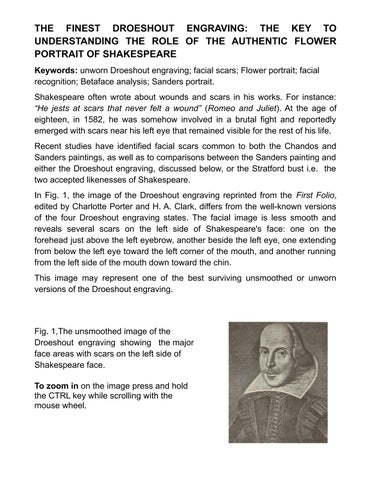
THE FINEST DROESHOUT ENGRAVING: THE KEY TO UNDERSTANDING THE ROLE OF THE AUTHENTIC FLOWER PORTRAIT OF SHAKESPEARE Keywords: unworn Droeshout engraving; facial scars; Flower portrait; facial recognition; Betaface analysis; Sanders portrait. Shakespeare often wrote about wounds and scars in his works. For instance: “He jests at scars that never felt a wound” (Romeo and Juliet). At the age of eighteen, in 1582, he was somehow involved in a brutal fight and reportedly emerged with scars near his left eye that remained visible for the rest of his life. Recent studies have identified facial scars common to both the Chandos and Sanders paintings, as well as to comparisons between the Sanders painting and either the Droeshout engraving, discussed below, or the Stratford bust i.e. the two accepted likenesses of Shakespeare. In Fig. 1, the image of the Droeshout engraving reprinted from the First Folio, edited by Charlotte Porter and H. A. Clark, differs from the well-known versions of the four Droeshout engraving states. The facial image is less smooth and reveals several scars on the left side of Shakespeare's face: one on the forehead just above the left eyebrow, another beside the left eye, one extending from below the left eye toward the left corner of the mouth, and another running from the left side of the mouth down toward the chin. This image may represent one of the best surviving unsmoothed or unworn versions of the Droeshout engraving.
Fig. 1,The unsmoothed image of the Droeshout engraving showing the major face areas with scars on the left side of Shakespeare face. To zoom in on the image press and hold the CTRL key while scrolling with the mouse wheel.