bust
(Keywords: Sanders painting, Droeshout engraving, Stratford bust, visual face recognition, facial similarities)
Introduction
The question of Shakespeare's authentic likeness has occupied scholars, collectors, and historians for more than three centuries. The true appearance of William Shakespeare is a subject of intense historical debate.
Indeed understanding how he really looked is important for several key historical, cultural, and psychological reasons. Among them knowing his true face would ground him as a real human being who lived, aged, and worked in Elizabethan London, would tell us how wealthy and influential he was, about his health, and his possible cause of premature death. Of the many portraits attributed to William Shakespeare, only two have traditionally enjoyed broad scholarly acceptance as contemporary representations: Martin Droeshout engraved portrait prefacing the 1623 First Folio and the funerary bust in Holy Trinity Church, Stratford-upon-Avon. Both works possess unusually strong historical credentials because they were accepted by individuals who had known Shakespeare personally.
The Sanders portrait occupies a distinctive position within this debate. It is among the most extensively researched paintings associated with Shakespeare, yet its authenticity remains contested. Since the Droeshout engraving and the Stratford bust function as the principal visual benchmarks for Shakespeare's appearance, systematic comparison with these accepted likenesses provides a useful framework for evaluating the Sanders portrait. The present study employs a standardized visual facialrecognition methodology to compare anatomical landmarks shared among these works. The objective is to document the degree of anatomical correspondence and to consider whether the cumulative evidence is consistent with the possibility that the three images derive from the same individual.
Materials and Methods
Comparisons were performed using the FACE-OFF visual facial-recognition (VFR) software developed by the late Robert J. Schmitt Jr. The software standardizes facial orientation by aligning the pupils on a common horizontal axis and scaling each image to an identical interpupillary distance (IPD), an anatomical measurement that remains essentially constant throughout adulthood and is widely used in forensic facial comparison. Once standardized, corresponding facial regions can be examined through interactive overlays and sliding comparisons.
The analysis compares the Sanders portrait with (1) the first-state Droeshout engraving, (2) a lesssmoothed impression reproduced from the 1906 Complete Works of William Shakespeare edited by Charlotte Porter and Helen A. Clarke, and (3) the funerary bust in Holy Trinity Church. Observations focus upon stable anatomical landmarks, including cranial proportions, eyebrows, eyelids, orbital contours, nose, lips, chin, ears, jawline, and distinctive facial markings.
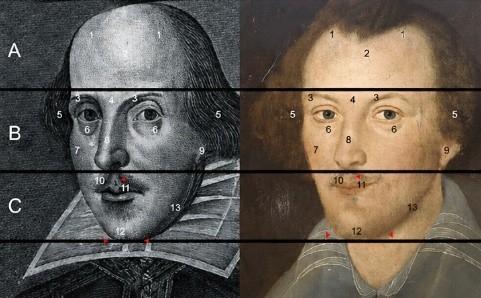
Fig. 1: First screen capture of the FACE-OFF comparison between the first state Droeshout engraving of Shakespeare and the Sanders portrait showing both images on the same horizontal plane and the same interpupillary distance. The identified similarities are discussed in the texte below.
Preliminary digital alignment revealed striking correlation across thirteen key anatomical markers (Figure 1):
1. Identical male-pattern baldness and hairline
2. An equally prominent forehead
3. Similarly delicate, arched eyebrows (superciliary arch)
4. Same glabella and nasion areas
5. Matching hair styling and volume
6. Identical eyelid structures, including symmetrical infraorbital and supraorbital dark rings
7. Corresponding right facial contour lines extending to the eyebrow
8. Symmetrical nose morphology, pronasale and nostril shapes
9. A highly specific, attached left earlobe (a rare anatomical marker)
10. An identical thin moustache aligned above the upper lip
11. A matching thin upper lip vermilion (Cupidon bow lip - another rare marker)
12. Equivalent chin prominence and 13. Identical lower jawlines ► 13 facial similarities
Furthermore, the parallel alignment lines in Figure 1 highlight broader structural congruencies. These include proportional uniformity in the forehead height (Fig. 1, Panel A) as well as equivalent sizing in the ocular and nasal regions (Fig. 1, Panel B). ► 2 other facial similarities
Differences occur primarily in the lower face (Fig. 1, Panel C). Most notably, the philtrum (the distance between nose and upper lip) is longer in the Droeshout engraving, while the lower face exhibits greater soft-tissue descent. These differences are consistent with normal age-related facial
change and would be expected if the Sanders portrait depicts a younger individual (see the red arrows in Fig. 1 philtrum and bottom part of the mentum).
COMPARISONS WITH ANOTHER UNSMOOTHED DROUSHOUT’S ENGRAVING OF WS
In Fig. 2 This Droeshout’s engraving image reprinted from the 1906 First Folio does differ from the well-known prints of the four Droeshout engravings (like the first state in Fig.1). The face image is not as smooth, likely not worn out by too many printings and does show many scars or swelling on the left side of WS face. That picture might be the real best representation of the Droeshout engraving,
Fig. 2,The unsmoothed image of Droeshout engraving showing the major face areas with scars on the left side of WS's face.
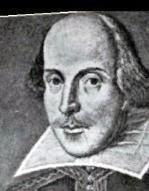
the one accepted by his wife and friends.
The less-smoothed impression reproduced from the First Folio presents additional anatomical detail not readily visible in more familiar impressions. Several subtle facial markings appear on the left side of the face, including swellings, scar-like features surrounding the left eye and scars above and under the left side of the mouth.
This unsmoothed Droeshout engraving and the Sanders painting are then compared directly with the VFR tool as shown in Fig.3.
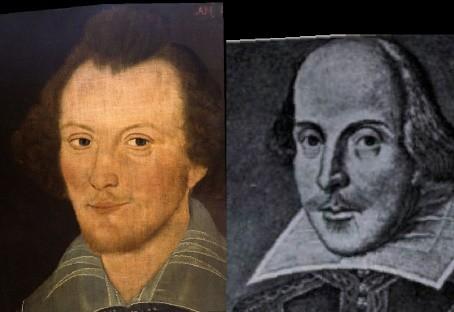
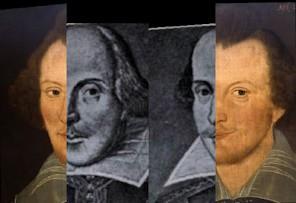
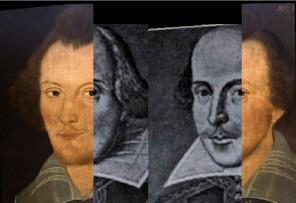
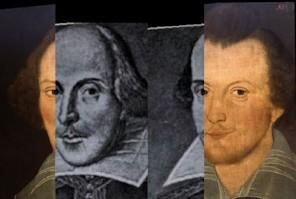
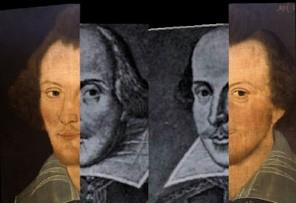
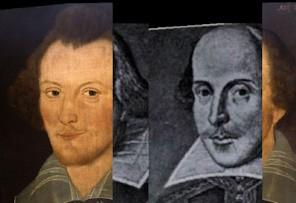
Fig. 3: Various screen captures of the FACE-OFF comparison between the unsmoothed Droeshout engraving of Shakespeare and the Sanders painting. These FACE-OFF panels are discussed in the texte below.
In Fig. 3 the top panel, the two sitters are aligned with their eyes on the same horizontal plane and with identical interpupillary distance. In the second panel, the sliding comparison pauses at the level of the right eye; in the third, at the nose; and in the fourth, at inside corner of the left eye; at the fifth, at the center of the left eye; and finally at the sixth, close to the left ear lobe.
Like in Fig. 1 comparing the first state of the Droeshout engraving with the Sanders painting, the comparison with the unsmoothed engraving reveals the same striking correspondences (Fig. 3). The sitter in the unsmoothed Droeshout engraving appears older, as indicated by more pronounced baldness, elongation of the philtrum, and a slight sagging of the lower face. These
features account for the higher positioning of the smiling mouth in the Sanders portrait relative to the engraving image as underlined in the FACE-OFF overlay of both images shown in Fig.4.
Fig.4, Overlay of both images the Sanders painting and the unsmoothed Droeshout engraving using the FACE-OFF tool. To zoom in on the image press and hold the CTRL key while scrolling with the mouse wheel.
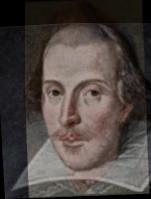
This overlay image further demonstrates compelling alignment: the left earlobe, the continuity of both eyebrows, the nose and the eye areas and the overall facial contours correspond with remarkable precision. But there is more key findings to learn from this Sanders painting - unsmoothed Droeshout engraving comparison as shown in Fig. 5.
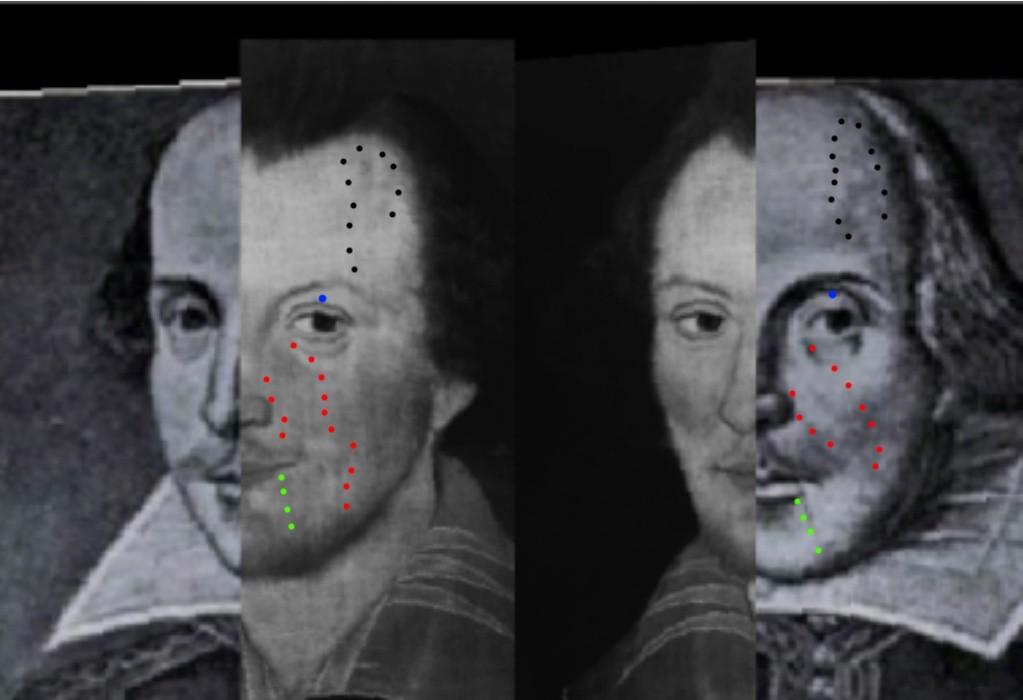
Fig. 5, Enlarged black and white screen capture of a selected FACE-OFF comparison between the unsmoothed Droeshout engraving and the Sanders painting and with color marks showing common subtle similarities discussed in the texte below.
Comparison with the Sanders portrait identifies corresponding features in similar anatomical locations, including large markings above the left eyebrow, a localized prominence of the left upper eyelid, linear
features extending toward the left corner of the mouth and toward the chin, aa well as a distinc scar under the left corner of the mouth. ► 5 other facial similarities
So that yields the total number of facial similarities observed between the Sanders painting and the Droeshout engraving to an exciting 20 facial similarities. However it is likely that looking at the Fig. 3 to 5 the actual number of similarities is greater.
THE RESULTING PROBABILITY OF IDENTICAL SITTERS
Let’s assume that we are in London having a population of about 200,000 persons at the early XVIIth century and we are looking for 2 persons sharing 20 facial similarities. What is the probability of success here? The formula to use is:
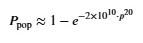
- The final likelihood depends entirely of how precise, independent or rare (p) the 20 chosen facial features are. If they are all effective and independent features, the odds of finding 2 individuals matching those 20 similarities could be immensely low.
- If the average frequency value p of chosen facial features would be >32%, the probability to find at least one match in a population of 200,000 becomes as high as 100%.
- But if the facial features are precise (real forensic biometric features) and rare, that probability drops very rapidly to 0%.
- Also one should realize that if the number of independent facial similarities was reduced to 13 with an average frequency value p of 0.30 and if we consider a much larger population, let’s say of 1 million, even then considerably fewer than one person would be expected to share that exact combination.
Since artworks are considered, this study highly suggests that the Sanders painting and the Droeshout engraving do show the exact same individual captured at different times and ages. Also it is clearly possible, based on the exceptional number of similarities between the Sanders and the engraving, that Droeshout used the Sanders portrait as the model for his engraving.
Comparison with the Holy Trinity Church Bust
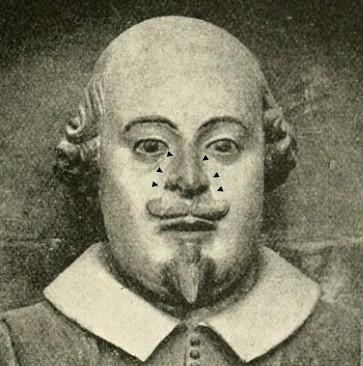
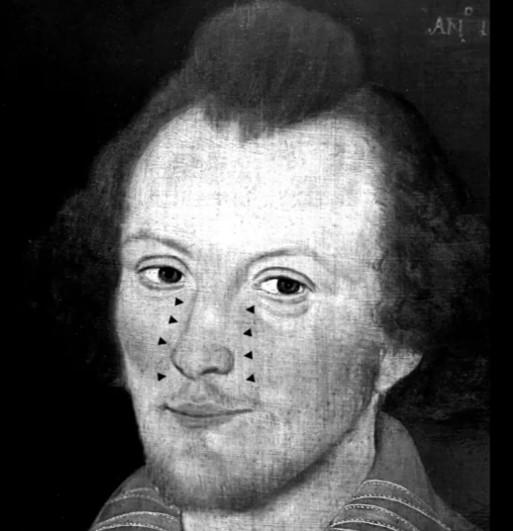
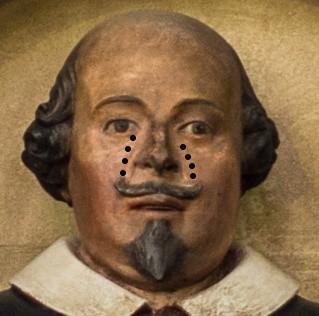
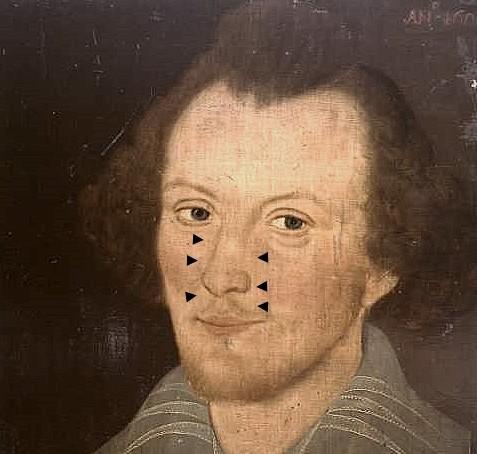
As mentioned previously the burial bust has been recognized as accepted representation of Shakespeare. But recently, Prof. Lena Cowen Orlin said: “It is highly likely that Shakespeare commissioned the monument. It was done by someone who knew him and had seen him in life. We can think of it as a kind of life portrait, a design for death that gives evidence of a life of learning and
Fig. 6, Comparative images of the Stratford bust and the Sanders painting either in black and white or in color.
literature”. This is truly important considering that this burial bust also does shared facial features with the Sanders painting as shown in Fig. 6.
The Stratford funerary bust exhibits many of the anatomical characteristics observed in the Sanders portrait, including frontal baldness, a broad forehead, thin eyebrows, narrow lips, a fine moustache, relatively small nostrils, and comparable facial proportions.
Particularly noteworthy are linear markings extending alongside the nose on both sides of the face in the Stratford bust and the Sanders painting. Comparable features are also observed in the unsmoothed Droeshout engraving and have previously been noted independently in studies of both the Chandos portrait (the Stirling’s observation) and the Stratford bust. Although the bust has undergone repeated restoration and repainting over several centuries, these facial features remain discernible.
Discussion
Human observers naturally recognize faces holistically, but forensic facial comparison relies upon stable anatomical landmarks rather than overall resemblance. Features such as interpupillary distance, ear morphology, nasion, glabella, orbital contours, and craniofacial dimensions are considerably more reliable than hairstyle, beard, or facial expression. Consequently, this study emphasizes anatomical correspondences that are relatively independent of artistic style.
The present study does not claim that facial similarities alone establish identity. Rather, it evaluates whether the observed constellation of anatomical correspondences is consistent with random coincidence. Under conservative assumptions regarding the frequencies of individual facial characteristics and allowing for statistical dependence among correlated features, the probability that an unrelated individual would exhibit the same combination of anatomical traits is expected to be exceedingly small. Consequently, the observed agreement among the Sanders portrait, the Droeshout engraving, and even the Holy Trinity bust are more consistent with a common sitter than with unrelated individuals, although the evidence should be interpreted alongside historical and artistic considerations.
Furthermore the analysis also illustrates the importance of considering age-related facial change when comparing representations that may have been produced at different stages of life. Features such as elongation of the philtrum, increasing baldness, and descent of the lower facial soft tissues are consistent with normal aging and may account for the principal differences observed between the Sanders portrait and the Droeshout engraving.
Considering that the Sanders painting has already succeeded all possible scientific tests and all the exhautive data about its provenance and genealogy, the results of this short study provide a more comprehensive assessment of the Sanders portrait's place within Shakespeare iconography.
Jean-Pierre Doucet
The author is a retired scientist living in Canada
Note added in proof
Comparison with the popularly accepted candidate the Chandos painting
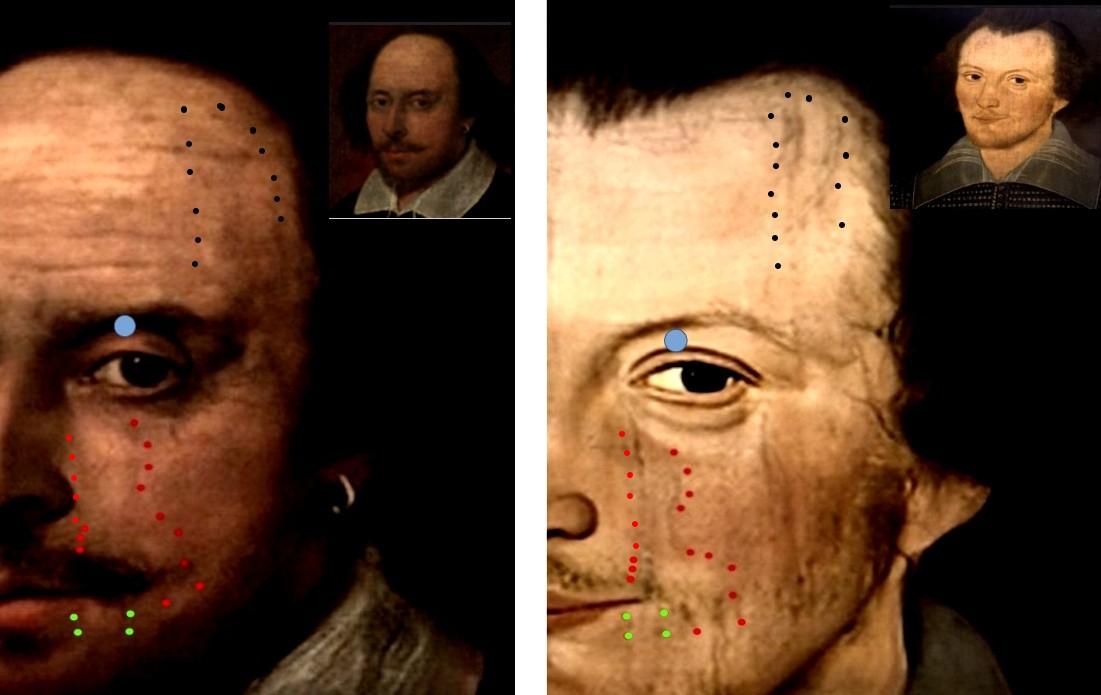
The smaller images in the upper right are the original paintings. In the larger images, the left side of the face of the Chandos painting is compared to the left side of the Sanders panting. Very similar if not identical subtle similarities as those decribed previously with the Sanders painting and the Droeshout engraving comparison (Fig. 5) are observed.
One art critic once remarked that he could never believe that the young man depicted in the Sanders portrait of 1603 could be the same individual represented in the Chandos portrait, generally dated to around 1610. Such an objection, however, may overlook the realities of early seventeenth-century life. Disease outbreaks, limited medical knowledge, and poor sanitation often accelerated the visible effects of aging. As Sharp Ogden observed, "thespan of life on the average was shorter then and the ravages of years much quicker in consequence."
MAIN REFERENCES
Doucet J.-P. et Doucet M., A Comparative Examination of the Sanders Portrait of Shakespeare and the Droeshout Engraving of Shakespeare https://news.canadianshakespeares.ca/2015/10/16/a-comparative-examination-of-the-sanders-portraitof-shakespeare-and-the-droeshout-engraving-of-shakespeare/
The Complete work of William Shakespeare Reprinted from the First Folio (1906) Edited by Charlotte Porter and H. A. Clark, Vol. 1, T. Fisher Unwin, 123 pages.
The guardian journal,'Self-satisfied pork butcher': Shakespeare grave effigy believed to be definitive likeness
https://www.theguardian.com/culture/2021/mar/19/shakespeare-grave-effigy-believed-to-be-definitivelikeness
Stirling S. A.,The Faces of Shakespeare: Revealing Shakespeare's Life and Death Through Portraits and Other Objects
https://www.gold.ac.uk/glits-e/back-issues/the-faces-of-shakespeare-revealing-shakespeares-/
Sharp Ogden W. (1912) SHAKSPERE’S PORTRAITURE: PAINTED, GRAVEN, AND MEDALLIC, The British Numismatic Journal, Vol. VII 1910.1, Bernard Quaritch editor, London, 58 pages. https://www.britnumsoc.org/publications/Digital%20BNJ/pdfs/1910_BNJ_7_6.pdf
Sanders Portrait of Shakespeare: Science and Documentation https://news.canadianshakespeares.ca/2011/05/10/sanders-portrait-of-shakespeare-the-science-s/
Sanders Portrait of Shakespeare: Provenance and Genealogy https://news.canadianshakespeares.ca/2011/02/27/sanders-portrait-of-shakespeare-provenance-an/