
by Steve Temple
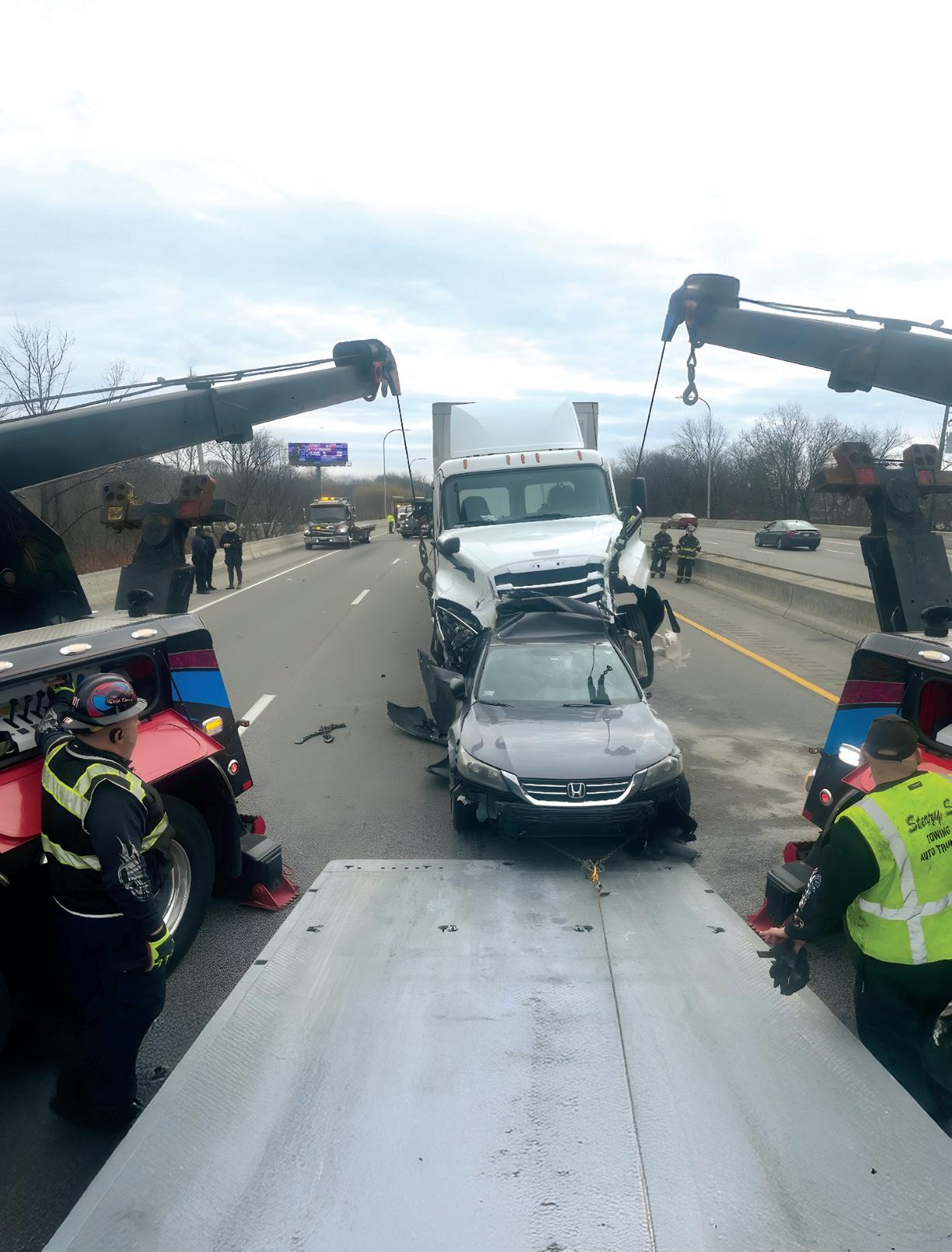
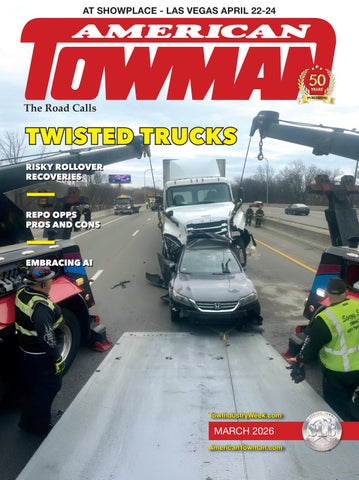
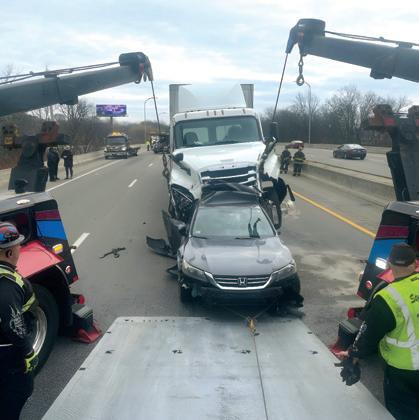
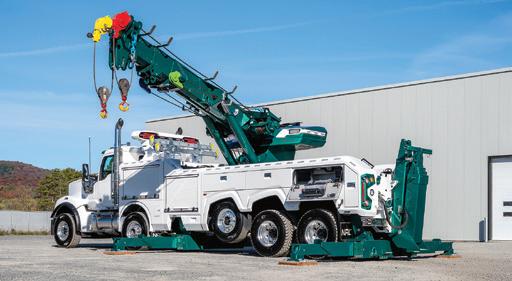
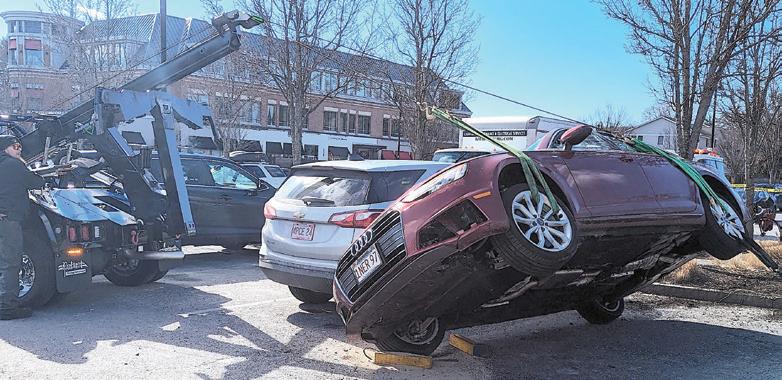
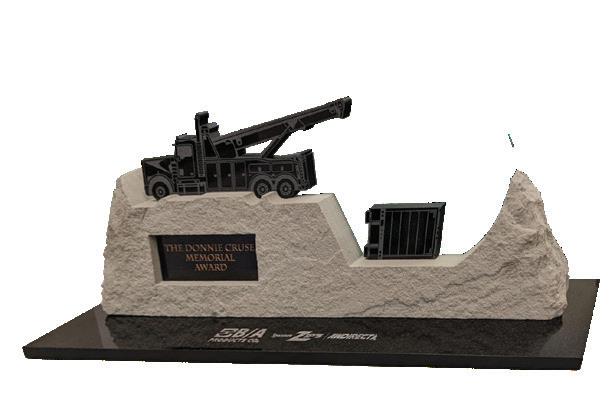
The chaotic sight that unfolded before Sterry Street Towing was totally unexpected, much bigger than the initial call indicated. Handling the massive mashup required quick thinking and additional resources for a textbook recovery that earned a WreckMaster award.
The American Towman staff continues to honor Steven L. Calitri, our Editor-In-Chief, who passed this last December. On the cover is a commemorative insignia, a tribute to a man who had a great passion for this industry and made a difference in the lives of so many towers.
Intrepidus Imperator is a Latin phrase that translates to “Fearless Commander”.
by Randall C. Resch
by Mark Lacek
By Jesse Lubar




Dennie Ortiz Publisher
Before you know it, the fresh promise of spring will be upon us, leaving this harsh winter behind.
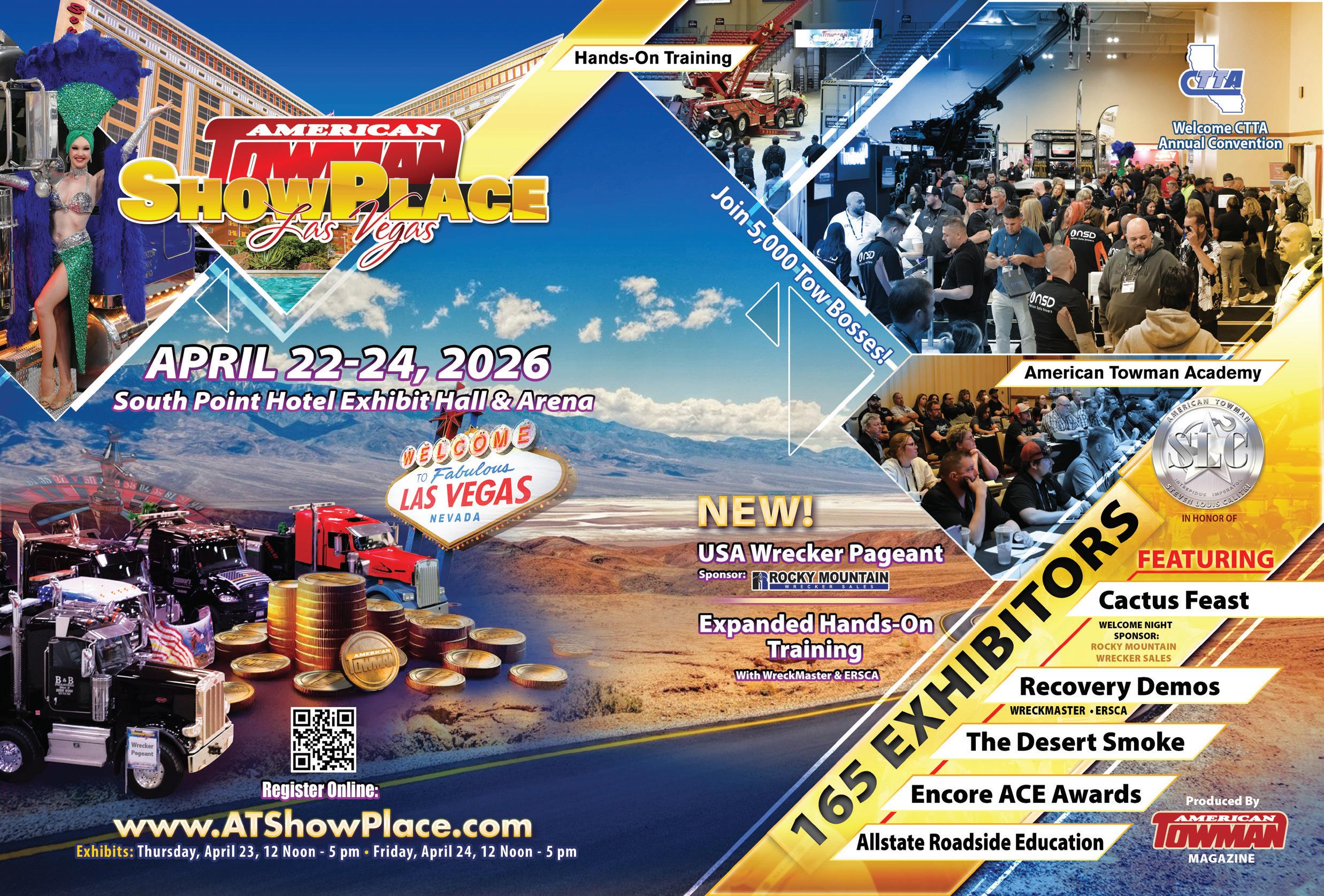
Standing as a sunny, shining light upon the horizon, an oasis in the desert, American Towman ShowPlace-Las Vegas will arrive shortly to cure those winter blues. Visit page 20 in this issue to learn what events will be taking place during the show, and which suppliers will be on hand to engage with as you make plans for your business in the coming year.
Always a strong advocate for the towing industry, Brian Riker contends in his article “A Call to Action”, that the month of March is an important time to advocate for the industry in the hallowed halls of congress. It is the period when key legislation that will affect this industry is being crafted and considered, and when your voices need to be heard. Brian covers an array of legislative items that are currently under consideration, all of which are important to monitor as they may impact your business.
As Brian reports on these matters, he passionately underscores the significance of supporting state and national towing associations. The tow industry itself will not be taken seriously by legislators if only viewed as a fractured group with no cohesion.
Looking for new revenue streams? An area that has long been associated with the towing industry, repossession, deserves a second look with the current market forces at play. In this issue, American Towman welcomes back Repo Editor and Guru, Mark Lacek. With over 35 years of experience in this field, Mark is uniquely qualified to explain what it takes to enter this book of business.
As Mark reports, the repo market has exploded, and the opportunities abound with several million assignments that have been left unattended. Lacek delves into the “Self-Help” repossession sector, detailing how to provide these services legally and safely.
Hope you enjoy reading the issue. As always, stay safe out there!

Steve Temple Editor
American Towman’s ShowPlace-Las Vegas, being held this coming April 22-24, is certainly a worthy event for towers from every sector, with practical seminars and hands-on training for tow operators and business owners alike. Consider joining the all-inclusive AT Academy, the premier training and leadership program for road-service pros. This program delivers in-depth business intelligence
on managing operations, leading teams, and growing a successful business, along with handling emergency scenarios. In addition, several hands-on courses on rigging and recovery techniques will be held at the South Point Hotel & Casino, the host hotel (for details, check out www.atshowplace.com).
In addition to attending AT ShowPlace at this resort, those who plan to visit the infamous Vegas Strip should carry a local map because sightseeing there is like traveling the world on foot. In addition, the Shelby Museum is a Mecca for high-performance car enthusiasts.
I used to work for Carroll Shelby, and have fond memories of tooling around town in the company’s Cobra test mule, and besting wannabe contenders. Once, while driving on a hot desert night down The Strip, the Cobra’s 427 bigblock V-8 overheated, and I had to refill the radiator with those pricey little bottles of Evian spring water, you know, the ones sourced from the French Alps. In hindsight, I should’ve called for a well-equipped towman!
From the Shelby legends to the highlights of the Strip, AT ShowPlace Las Vegas is one experience towers simply can’t afford to miss.
itowman.com
americantowman.com
towindustryweek.com americantowmantv.com


Juan Leon had only been running Leo’s Towing in the Twin Cities for a few months when he began noticing cars left abandoned across the city, sometimes for days, which belonged to people detained by U.S. Immigration and Customs Enforcement.
“Seeing there was a need for someone to help out, help clear the streets and get people back their vehicles, we stepped up,” Leon said.
By late December, Leon and his crew began tracking down the vehicles after tips from community members. If families contact them, the team returns the cars directly. If not, they work to identify owners and deliver the vehicles to relatives — free of charge. Donations from across the country now help fund the effort, allowing the crew to operate around the clock. But the work has come with risks.
“When they doxxed me [revealing someone’s private information], they put all my information out there,” Leon said. “We’ve been getting death threats.” So far, the team estimates it has returned about 250 vehicles.
Source: kimt.com
U.S. automakers are absorbing more than $50 billion in losses after a sharp slowdown in electric vehicle demand. After years of heavy investment, Detroit’s Big Three— General Motors, Ford, and Stellantis—have announced major accounting write-downs as they scale back EV plans.
Stellantis leads with a $26 billion writedown, followed by Ford at $19.5 billion and GM at more than $6 billion. Fourth-quarter 2025 EV sales are projected to fall 30%, hurt in part by the expiration of the $7,500 federal tax credit. Demand has weakened even for market leader Tesla, prompting Ford to halt production of its electric F-150.
Manufacturers are canceling battery projects, cutting jobs, and shifting investment back to traditional trucks. Consulting firm Atlas Public Policy estimates more than $20 billion in planned EV and battery investments have been scrapped. Meanwhile, China’s BYD has overtaken Tesla globally, expanding rapidly overseas despite slower growth at home.
A new bill in Congress seeks to make roadside recoveries safer for tow truck operators and first responders. Rep. Dave Taylor (R-Ohio) recently introduced the Towing Safety Act, legislation designed to reduce the dangers faced when large disabled vehicles break down on busy highways.
Current federal length restrictions often force tow crews to dismantle tractortrailers on the shoulder of interstates before they can be moved. Taylor’s bill would temporarily waive those length limits, allowing tow operators to haul wrecked or disabled vehicles to a safer nearby location instead.
“Roadside incidents create extremely hazardous conditions,” Taylor said, noting the risks to tow operators, law enforcement, and passing drivers. “This bill gives responders flexibility while prioritizing safety.”
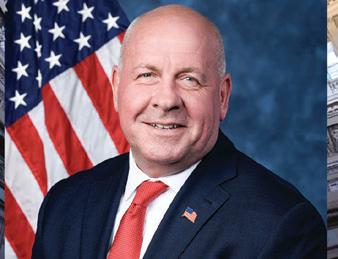
The waiver would apply only instate and on routes approved by local transportation officials. Vehicles being towed must still meet existing federal safety standards.
Source: taylor.house.gov
Tow truck operators across the U.S. faced a powerful winter storm which brought frigid temperatures, heavy snow, and ice from the Plains to the Northeast. The National Weather Service had warned that nearly everyone east of the Rockies could experience hazardous driving conditions, including snow, sleet, freezing rain, and dangerously low temperatures.
In Kansas City, crews from Adams Towing and Recovery inspected trucks, checked equipment, and adjusted staffing ahead of the storm.
“Ice was very dangerous,” said Justin Murray, manager at Adams Towing and Recovery. “Winter storms doubled or tripled call volume while making recovery work more dangerous.” In nearby Johnson County, Santa Fe Tow Service responded to more than 175
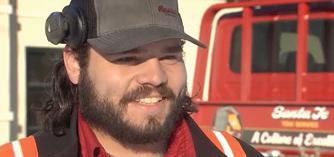
calls, with side streets coated in snow and ice causing the most trouble.
Tow operators nationwide reported similar surges. In Fargo, North Dakota, record-setting cold increased jump-start calls, while in North Carolina, crews staged trucks with shovels and salt to respond to emergencies. Icy roads, power outages, and low visibility kept towing teams busy through the weekend.
For the second time, House Bill 282—known as “Troy’s Law” — has been introduced in Frankfort, Kentucky. If passed, the bill would allow tow truck drivers to activate rearfacing blue lights while responding to roadside scenes, improving visibility for approaching drivers.
The bill continues to gain support and now has more than 15 co-sponsors. Still, it faces opposition from some law enforcement organizations, including the Fraternal Order of Police. Supporters say concerns about misuse are unfounded because the proposal would only allow rear-facing blue lights strictly for roadside safety, not to grant authority or interfere with law enforcement.
Bubba Johnson, owner of Bubba’s Towing and Recovery, says the lack of progress is frustrating. “I just really wish the state would show up for the towing industry,” Johnson said.
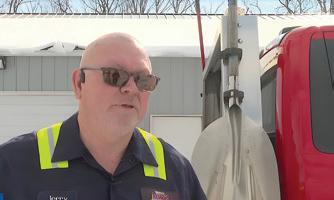
Jerry Cantrell, owner of Jerry’s Towing, continues to advocate for House Bill 282.
In September 2024, the bill’s namesake, Troy Caldwell of Jerry’s Towing, was struck and killed by a semi-truck while working on I-64.
“We worked together five years. He was like a brother,” said owner Jerry Cantrell, who now runs the company alone. “If you just save one person, it’s worth it,” Cantrell said, urging drivers to slow down and move over.
Source: wkyt.com
NASCAR has named Miller Industries Inc. the Official Towing and Recovery Equipment Provider of the sport as part of a new long-term partnership. Under the agreement, Miller Industries will supply a full fleet of towing and recovery equipment for use at NASCAR national series events across the country. The deal builds on a longstanding relationship while creating greater consistency in incident response and trackside operations.
“Having the right equipment in place is essential for maintaining a safe, efficient, and competitive racing product,” said John Probst, NASCAR Executive Vice President and Chief Racing Development Officer. He said Miller’s equipment will play a key role in supporting on-track operations and ensuring a consistent standard across events.
“We’re thrilled to join forces with NASCAR in a partnership that
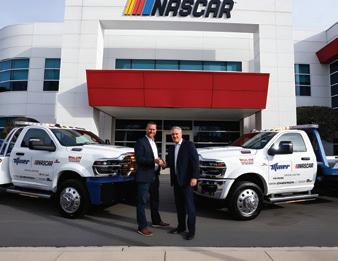
Representatives from NASCAR and
Industries mark the start of their new longterm partnership.
highlights the strength, resilience, and innovation of the towing and recovery industry,” said Kipp Felice, Vice President of Marketing at Miller Industries.
Source: Press Release Miller Industries/Facebook
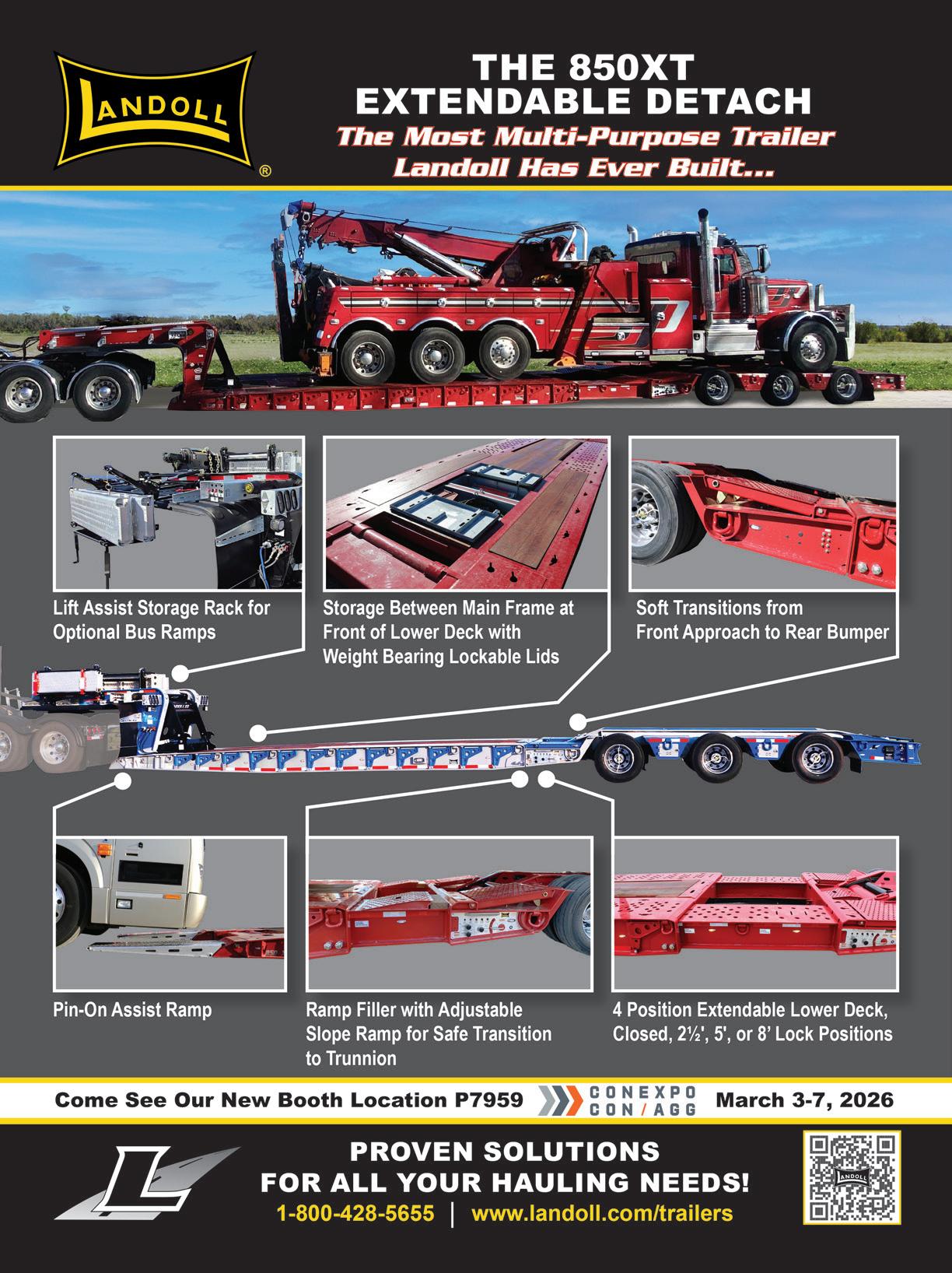
Landoll Company, LLC has announced the donation of its 40,000th lowboy trailer to the International Towing & Recovery Hall of Fame & Museum, marking a major milestone in the company’s history, and honoring the 40th anniversary of the Hall of Fame’s first induction class.
The donated unit is a 53-foot Landoll 440 Series traveling axle trailer, currently under construction at the company’s Marysville, Kansas facility. Proceeds from the donation will benefit the museum and its mission to preserve the history of the towing industry, including support for the Wall of the Fallen, which honors operators who lost their lives in the line of duty.
The custom trailer will be auctioned on October 16, 2026, with all proceeds going directly to the International Towing & Recovery Hall of Fame & Museum.
“Reaching our 40,000th trailer is a proud moment, and supporting the Hall of Fame is a meaningful way to celebrate,” said Don Landoll, founder and president of Landoll Company and a 1997 Hall of Fame inductee.
Source: einpresswire.com
Boise officials are postponing a long-awaited update to towing rates after local tow company owners said the proposed changes still don’t reflect the true cost of doing business.
The Boise City Council voted unanimously to delay adopting a new ordinance governing “nonconsent” tows. The rewrite follows Idaho’s 2025 HB 174 and would be the first rate adjustment since 2008. The proposal would set a flat $150 fee per tow and eliminate some additional charges for specialized equipment and cleanup.
Tow operators said that structure overlooks the complexity of certain calls, particularly abandoned motor homes that require extra labor, heavy equipment, and sewage disposal.
Stan Deming of Boise Valley Towing called the update, “long overdue,” but said the draft is “no better” than the current system. He warned that unclear labor rules and high disposal costs can cause companies to lose thousands of dollars on a single motor home tow.
Randy Fultz of Rocky Mountain Towing pointed to surging expenses across the industry. “I run for profit, not garbage cleanup,” he said, adding that current rates make city calls financially unsustainable.
Source: boisedev.com
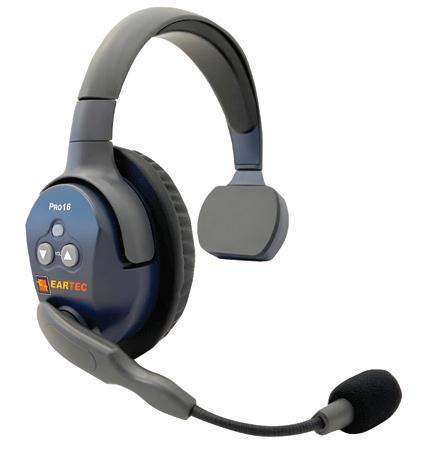
Gain a competitive edge with Eartec’s PRO16 Headset, a top choice for hardworking tow operators. These self-contained units ensure real-time communication with no delays, allowing for seamless, private conversations. Eartec’s innovative headsets serve an essential role in the tow industry, providing clarity and ease of communication to crews in tight situations, ensuring safety on the job. The PRO16 Headset system allows up to 16 users to connect in full duplex mode, all without the need for a traditional base station. This ensures seamless, real-time conversations across the tow team, enhancing coordination and efficiency in a fastpaced work environment. Equipped with Eartec’s specialty RF microprocessor, the PRO16 eliminates voice echo and digital lag for crystal-clear audio. This cuttingedge technology enhances user experience by providing instantaneous, reliable communication, essential for situations where clarity and efficiency are paramount. The PRO16 also features Eartec’s auto-mute-boom technology, letting users easily mute their microphone by placing it in the up position.
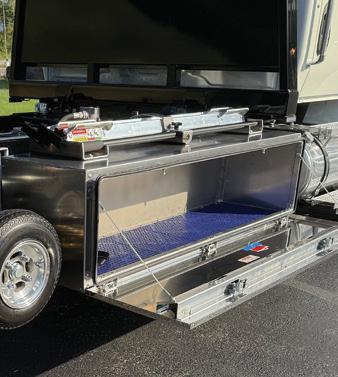
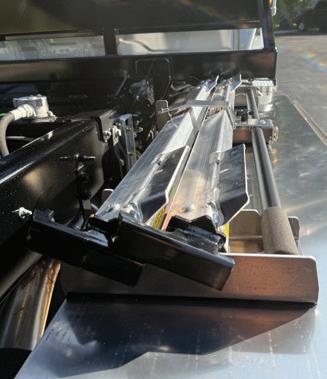
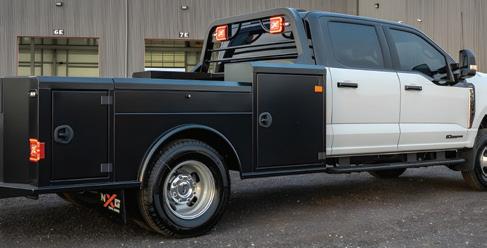
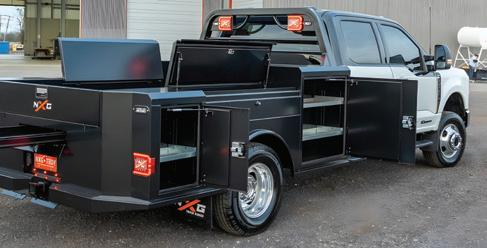
NXG Truck Bodies’ XWB Work Body redefines what a work body should be. Designed for tow fleet operators and roadside service professionals who demand reliability every day, the XWB blends rugged construction with refined engineering. From cleaner weld execution and integrated components to improved access, sealing, and safety features, every detail is intentional. The XWB is built as a complete system, resulting in a stronger, longerlasting unit that works harder, looks cleaner, and delivers the performance today’s jobs demand. NXG’s proprietary multi-stage cleaning and industrialgrade, powder-coating process delivers corrosion resistance with a durable, professional finish built for harsh work environments. Four standard highdensity LED worklights located in the XRack and rear of the truck body deliver improved visibility and safer operation in low-light conditions, along with built-in flash capability and optional strobe functionality.
Built for tough jobs and tight spaces, the Low Profile Axle Mount from In The Ditch combines heavy-duty strength with a sleek, low-clearance design. Ideal for tow trucks with limited space or custom setups, this mount is precision-crafted from high-grade aluminum and welded for long-lasting performance. Tested in tough, real-world towing conditions, this unit is suitable for either upgrading an existing rig or a new setup, and is designed to securely store axles and a breakover bar. Delivering reliable strength without unnecessary bulk, the Axle Mount features belowdeck securement for a streamlined fit, along with easy installation using standard mounting patterns.
intheditch.com
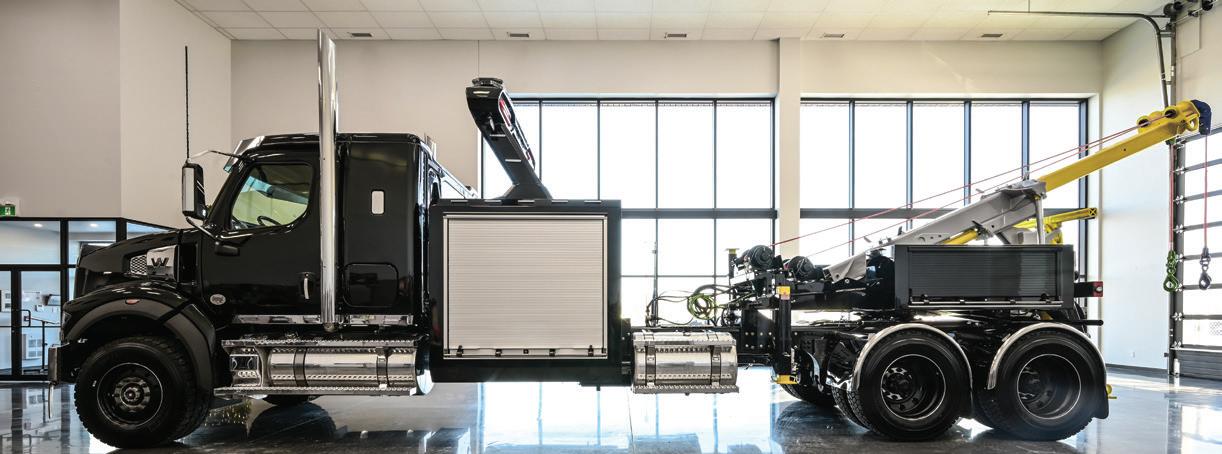
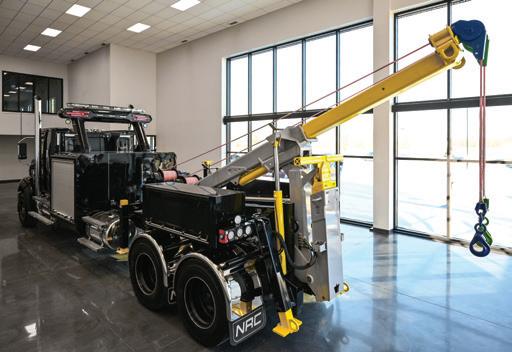
At the American Towman Exposition in Baltimore last November, NRC Industries unveiled its latest evolution of the QuickSwap. Now available with an optional integrated boom, this innovation adds versatility to the company’s rugged detachable unit.
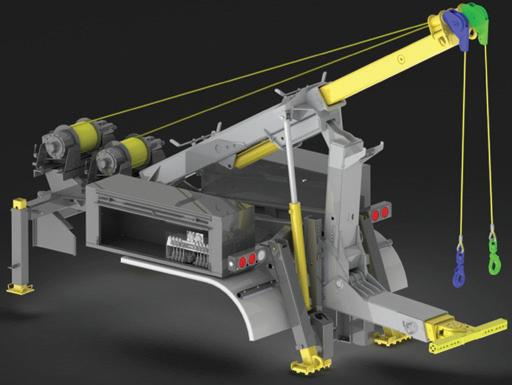
Designed for operators who required both outstanding towing performance and true recovery capabilities, the new QuickSwap configuration features a twostage telescopic boom (72″ total extension) and two 20,000 lb planetary winches. With a boom elevation range from 15° to 40°, this unit is engineered for a structural rating of 50,000 lbs at 30° when retracted, and 16,000 lbs when extended, it delivers all the power and control needed to handle most everyday recovery operations.
In addition to the optional integrated boom, the QuickSwap retains its full strength—up to 90,000 lb towing capacity and 60,000 lb lifting capacity—while adding only about 1,500 lbs to the unit. Combined with a variety of under-lift options, this new configuration pushes the limits of what a detachable unit can achieve.
“By integrating a recovery boom, we’re offering operators
a true dual-purpose solution, for more flexibility and an excellent return on investment,” said Normand Caron, Engineering Director at NRC Industries.
In related news, the company has also recently announced a mid-cycle update to its CSR65 wrecker with a redesigned boom. Extensive Finite Element Analysis (FEA) covering a wide range of lifting scenarios led to a new optimized profile that controls stress concentrations and increases overall rigidity, without compromising design or structural weight. The result is 50% more lifting capacity at full extension. Larger and stronger hydraulic cylinders also deliver up to 16% more lifting power, giving operators the confidence to handle the heaviest recoveries.
Stability under heavy loads has also been enhanced on the CSR65, now featuring wider and stronger outriggers with an additional four inches of spread. Nylatron wear pads on the legs provide smoother and more durable operations. In addition, NRC redesigned its storage solutions with a left-hand toolbox that’s 40% larger and fully customizable to each operator’s needs.
By Terry Abejuela
Since the mid 1950s, tow truck operators have been providing lockout service using a simple tool known as the Slim Jim. This device was an effective tool up until about the early 1980s, when automobile manufacturers began incorporating anti-theft designs in the locking systems. These required new techniques, tools, and training for tow truck operators to gain entry without damaging the customer’s vehicle.
Modern vehicles now have even more complicated door locking systems that require a variety of tools and techniques to successfully unlock. Not only the appropriate tools but also additional training, along with as much practice as possible.
It’s recommended to attend a formal training class (typically offered at American Towman events—see sidebar), and carry some type of lockout manual in the tow truck or have it available on a smart phone. With so many different years, makes, and models of vehicles it’s important to have technical information ready before arriving on scene. A manual may also provide a list of vehicles that might require a locksmith.
Field Editor Terry Abejuela has 40-plus years of light-duty towing and recovery experience. He is also a light-duty Level 1 instructor for the California Tow Truck Association.
Before attempting a lockout technique on a vehicle, do a quick inspection for any damages, lowered windows, or unlocked doors. Ask the customer if anyone has attempted to unlock the vehicle. If so, ask which doors and what type of tool was used. Avoid unlocking a door that was tampered with previously.
Be sure to document any damages and show them to the customer prior to attempting to unlock the vehicle. Whenever possible, attempt to unlock the passenger door first. The driver’s door is used more often and may contain more wiring, making it more susceptible to damages.
On some vehicles, a rear door may provide easier access. Open the door as soon as it is unlocked to prevent it from locking it again. After unlocking the vehicle, have the customer operate the functions in the door to ensure everything is working properly. Always use lubricant to clean up any residue on the customer’s vehicle.
The lockout tools carried by a tow operator will depend on both how often
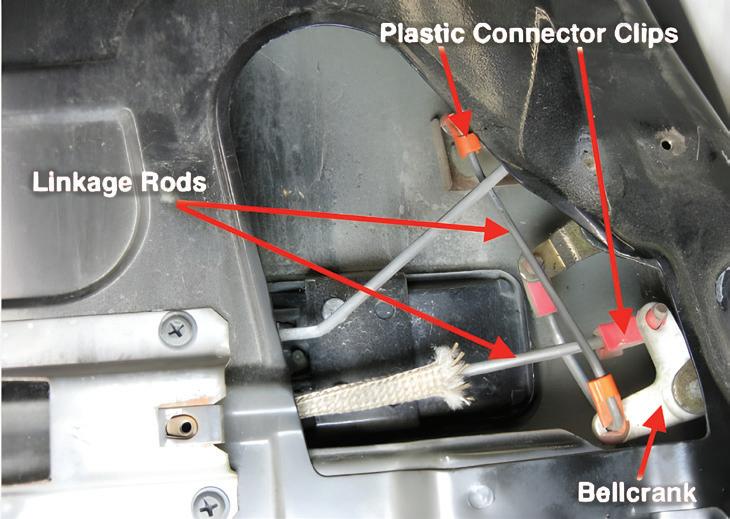
The most common way that Slim Jims work on many vehicles is by moving linkage rods. If the locking mechanism is not covered, it may be possible to make contact with the Slim Jim and then push down or lift up on the bell crank. Avoid using excessive force that may cause the plastic connecting clip of the linkage rod to break or unhook, and require repair for the lock to work with the key.
lockout service is performed, and the types of vehicles commonly serviced. The following equipment and supplies are recommended as a minimum:
• 1 – Mylar sheet
• 2 – Hard Wedges
• 1 – Air Bag Wedge
• 1 – Flashlight
• 2 – Slim Jims
• 1 – Long Reach Tool
• 1 – Packaging Strap
• 1 – Can of Silicone Lubricant
• 1 – Clean Micro Fiber Towel
• 1 – Spray bottle of Multi-Purpose Cleaner (suitable for automotive paint finishes)
• Damage-Protection Sleeves or tape
There is a large variety of automotive lockout tools and kits available, including specialty tools, linkage-rod tools, and under-window tools, but the tools listed above are effective on a significant number of vehicles, and at minimal cost.
The Long Reach Tool is most commonly used today because it works on a significant number of
vehicles. As with most tools, there are many different variations. A-light colored, one piece tool with a protective rubber cover on the tip is a preferred type, and long enough to reach the dash if necessary.
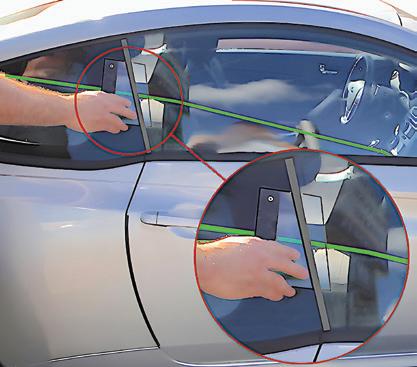
A two-piece Long Reach tool is more convenient to store but the connector may make it more difficult to slide into tight doors without damage. The long Reach tool can be used to manually move the locking lever, push the electric unlock button, or sometimes even pull keys out through an opening. Avoid excessive force when pulling or pushing with the tool. If the tool slips off of the intended target with excessive force, it can hit a window or any other components and cause damage. A hard wedge, air wedge and/or pry
tool may be needed to create the space to insert the Long Reach tool. Use some type of sleeve or barrier between the tool and any painted surface or window glass. Access Tools makes a Glassman Tool and Damage Guard Tape for this purpose. Steck Manufacturing makes a Big Easy Paint Protector Sleeve, and ProLok makes a long reach tool sleeve to prevent damages.
Wedges come in many different sizes, shapes, and materials. A common type is a hard plastic wedge with a handle. Use at least two wedges, preferably of different widths. Wedges create just enough space to allow the entry of a lockout tool.
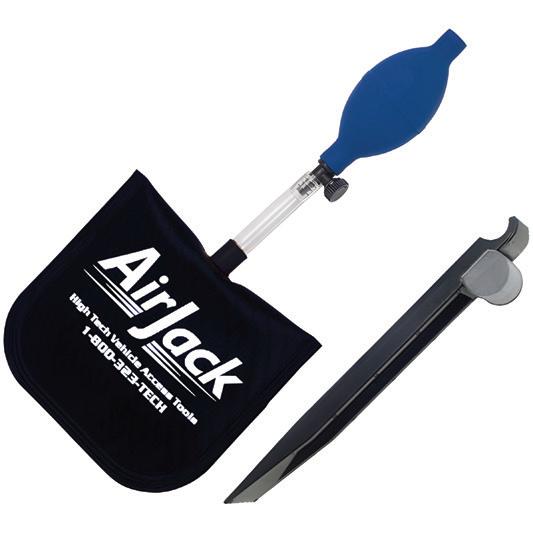
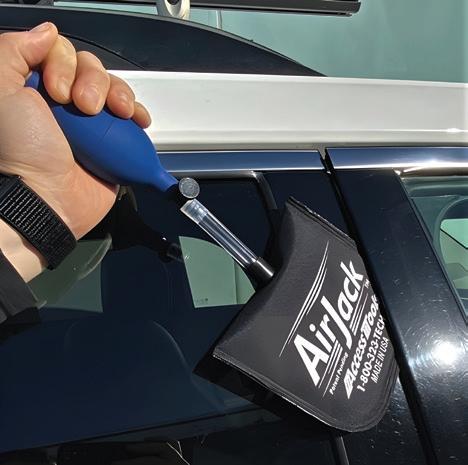
An Airbag wedge is a must nowadays for prying doors open just enough to insert a Long Reach tool. Use extreme caution, though, when using an air wedge on a frameless window. With any type of wedge, avoid excessive force and only wedge open the amount of space that is required for tool entry.
The Slim Jim still works on a significant number of vehicles currently on the road by manipulating the key lock cylinder, the door latch mechanism, or the linkage
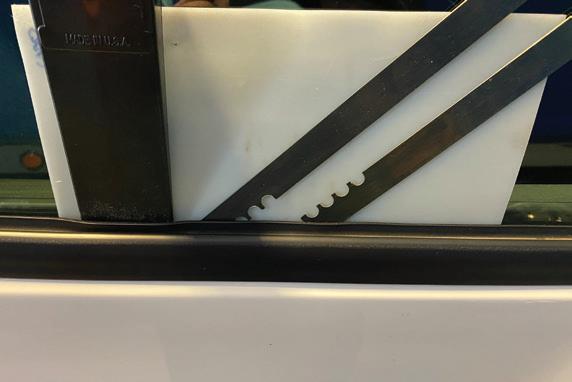

rods connecting these parts of the locking system together. Newer vehicles, however, are more likely designed to prevent access with the Slim Jim, built with covers over the lock cylinder, latch mechanism, and linkage rods. Some vehicles utilize cables instead of linkage rods.
There are several different types of Slim Jims, and operators should use the type that works best for them. The thin type is preferable, with multiple notches on one side at one end, and a hook with a rubber handle cover at the other end.
When using a Slim Jim, insert a clear mylar sheet between the window glass and the tool to prevent
Effective Lockout Techniques
Explores How To Safely Unlock Vehicles. Techniques Focus On Damage Prevention And Explain Key Tool Types. Tony DiBlasi, Automobile Club of Southern California Thursday, April 23, 8 am Visit ATShowPlace.com to Register
scratches. Use wedges to hold the mylar sheet in place, otherwise it may drop into the door cavity. Position the Slim Jim with the smooth side facing the weatherstrip to avoid damage.
On most vehicles older than 1980, the Slim Jim can be used to manipulate any of the three parts of the locking system. The easiest part to work is the locking cylinder on the inside of the door. This cylinder has a tailpiece that is attached to the locking system with a linkage rod.
Place a finger on the outside of the lock cylinder and enter the Slim Jim into the door between the window glass and weatherstrip right above the lock cylinder. If contact with the lock cylinder can’t be felt, pull out the Slim Jim and bend it slightly until there’s contact.
Watch the locking lever for movement and attempt to move the tailpiece on the lock cylinder in the direction that causes the locking lever to move in the unlocked direction. Be careful to exert only the minimum amount of force required to turn a the key in the lock cylinder. Excessive force may cause the plastic connecting clip of the linkage rod to break or unhook, and will require repair for the lock to work with the key.
Attempting to unlock a vehicle at the door latch mechanism is not effective on most newer cars. If the mechanism is not covered, it may be possible to make contact with a Slim Jim to push down or lift up on
the bell crank. Try a slight inward or outward bend on the Slim Jim, insert it farther down the inside on the rear of the door, and watch the locking lever for movement. If the locking lever moves, the Slim Jim is contacting the bell crank. If there is no movement, re-adjust the bend in the Slim Jim and try again.
The most common way that Slim Jims work is by moving linkage rods. Bend the Slim Jim inward at a 45- to 90- degree angle, and insert with the notches facing towards the linkage rod. Watch the locking lever for movement, indicating contact with the linkage rod. Apply slight pressure against the linkage rod and move the Slim Jim in the direction that moves the locking lever in the unlocked direction.
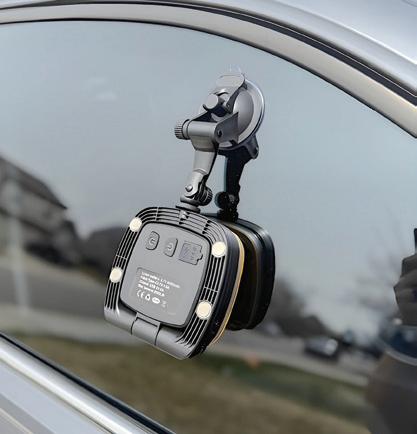
Many different lights are available that are specifically designed for lockout work. These lights commonly use suction cups to attach them to the window glass for hands-free use.
There are some vehicles that are more easily unlocked with a specialty tool specifically designed for that particular model. Tow operators who have difficulty on more than one occasion with a specific vehicle should consider acquiring a specialty tool if available. Performing lockout service effectively without causing damage requires a variety of tools, training, and practice, along with preparation, patience, and persistence.
By Brian J Riker
It is no secret that the political climate of the last ten years has been tumultuous. Towers are seemingly caught in the middle of this, some having record earnings while others are closing shop, all because of many factors beyond industry control. Compounding matters, the towing industry in general is under attack, facing increasing regulations and compliance burdens. What’s a towman to do?

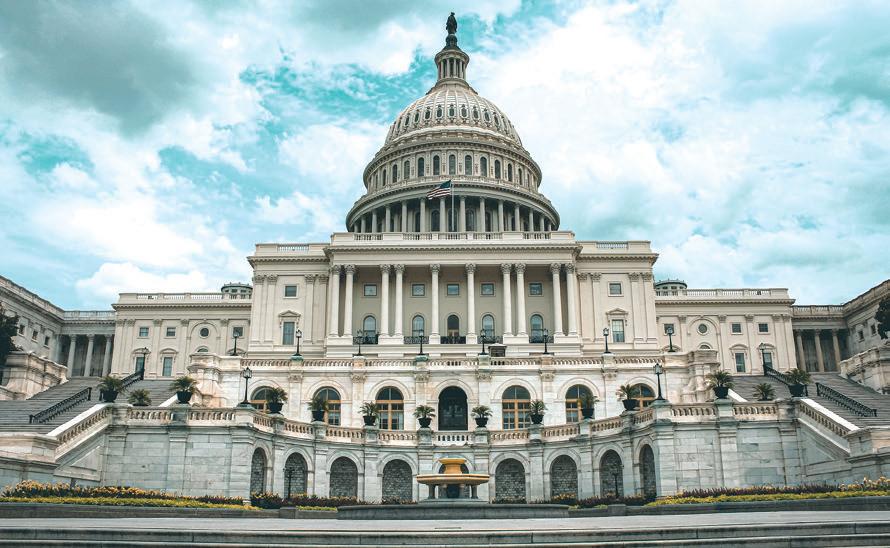
For lawmakers, March is traditionally the time things begin to kick into high gear, as the incoming new legislators have just about settled into their groove, bills have been proposed, and work has begun to decide what the season will look like. This means that March is prime time for towers to begin contacting local, state, and federal representatives, introducing who they are, share their views, and urge support to shape the tow industry’s future.
Of particular importance this March, is the fact that highway funding must be addressed. This means Congress will be looking at all sorts of transportationrelated bills, including some related to towing and roadside safety—and even insurance or rate regulation. Highway bills have a way of becoming a vehicle (no
pun intended), for all sorts of legislation to become law, often because the lawmakers have no choice but to fund the transportation system.
The last two election cycles provided at least one very important lesson—that every voice counts. Without getting political or taking sides here, it is abundantly clear that this has been the decade to stand up and make voices heard. This same energy must drive the tow industry to take charge of its destiny, rather than passively letting events unfold.
With several new members of Congress, including newly appointed Chairs of key legislative committees, as well as changes in many state governments, it is important that the towing industry is represented by a strong and unified voice. The industry must begin educating these new lawmakers, reintroducing ourselves to returning lawmakers, and begin building relationships with the newly appointed administrators of various agencies that will ultimately affect the industry.
Towing must be positioned as a formidable industry presence, not a passive group that can be overlooked. It is past time that both Congress and state
lawmakers understand that, as an industry, towers are critical to the safety and security of this nation. And, it is time to stand up and be noticed for the sacrifices towers make daily.
Without support from state and national association members in large numbers, their efforts are ineffective at best—and detrimental at worst. Legislators look at numbers when deciding to support or oppose any issue. They are elected to represent the best interests of the majority of their constituents, so the more members an association has, the more influence it has with lawmakers.
For the towing industry, this equates to some powerful opponents with well-oiled lobbyist machines, many active members, and deep connections with lawmakers on both the state and national level. When opponents mention the towing industry, they quickly point to the lack of participation among business owners and employees within the associations as a sign of a fragmented, and therefore weak, industry. Lawmakers will contend that if towers can’t agree amongst themselves about the best direction for their own industry, then why should legislators care what a small association thinks? Alone, no single tower, or towing company, can make any real change, but together towers are unstoppable.
During these challenging times, limited financial resources understandably hinder investments in association membership or lobbying, but the cost of unfavorable legislation to business could be far greater. Association dues are a small price to pay to influence the industry’s future by helping shape the regulations that all towers must
CONTINUED ON PAGE 23
There are many items on the legislative table this year, and while not all are towing specific, they can have a profound impact on many tow companies. Since towing is a subsegment of the trucking industry, towers are often lumped into onesize-fits-all, trucking-focused regulations that make no sense for tow businesses.
For example, among the CDL changes is a renewed push to change the rules regarding interstate commerce and drivers under the age of 21. Currently, the industry loses many interested and otherwise qualified candidates to the minimum age requirement, and oftentimes this includes family members. With FMCSA’s pilot program to assess the safety of drivers under the age of 21 failing due to lack of participation, Congress is taking a shot at allowing under 21-year-old CDL drivers to operate interstate. It is critical to advocate support for these programs that could lead to some relief of the shortage of operators that the industry currently faces. Another critical CDL change is the attack on non-domiciled CDL holders. While there has been some serious corruption and mistakes made regarding issuance of non-domiciled CDL’s, not all non-domiciled CDL holders are unqualified or incapable of being safe drivers. This issue will be a hot topic of debate, along with English Language Proficiency (ELP). President Trump recently signed an executive order making ELP violations an out-of-service condition. Keep in mind, however, that this will apply not only to CDL holders, but also anyone operating a FMCSA-regulated commercial motor vehicle (trucks over 10,000 lbs. gross weight rating in interstate commerce). Also, many states will adopt this into state law, meaning ELP is more important than ever.
In addition, size and weight restrictions that affect more than half of the heavy-duty towers in the US are on the table. TRAA is actively trying to get an exception to allow towing of combination vehicles to an appropriate place of safety for repairs or disassembly (splitting for a tow). While this is not a problem for some towers because state laws already permit this, it is critical that it is codified so as to mitigate the risk should a crash happen while a combination vehicle or the tow truck is in an overweight condition while towing.
Many states do not offer weight relief, or if they do, it is only applicable to state roadways, not the national network. This effort would homogenize size and weight restrictions on the national network, and encourage allowing common sense exceptions so that towers can do their jobs safely and effectively. Also, the attack on “predatory towing” (actually a misnomer), is not going away. Several associations are currently fighting back against statelevel attacks on legislation designed to restrict trade practices, and it is highly likely that federal legislation will once again rear its ugly head. While the Federal Trade Commission approach is likely dead, there is still an effort to return towing to federal rate regulation in the name of consumer protection, which would not just affect heavy-duty towers.
Any fleet vehicle, including rental cars, would likely be covered under federal protection. While the industry is not adverse to some regulations, as they can make for healthier businesses, any regulation that does come down must be workable. Last but far from least, roadside safety is also on the table. With several bills designed to protect or expand protections of roadside workers, it is essential that towers’ voices are heard loudly and clearly.

Driver Qualification in the ICE Age
Join Your DOT Guy, Brian Riker, as he digs into what a qualified driver is, and why it is more important than ever to get it right today. From lawsuit liability to immigration enforcement, there is much more to a qualified driver than just having a driver’s license. This is important for all types of drivers, not just your CDL operators.
Brian Riker, American Towman. Friday, April 24, 9 am Visit ATShowPlace.com to Register

Exhibits as of February 19: For up-to-date roster go to ATShowplace.com
*Supplier names in bold are display advertisers in this issue with their ad page number cross-referenced APRIL 22 - APRIL 24, 2025
24/7 Dispatch Booth # 1111
Access Tools Booth # 1008 - pg. 15
Agero powered by Swoop Booth # 1601
Alkeme Automotive Booth # L1
All American Jerr-Dan in Old Bridge Booth # M6 - pg. N, S, M 59
All Around the Wheel Booth # D4
Alliance Funding Group Booth # 1218
Allstate Roadside Booth # 204
Alt Enterprises Booth # 912 - pg. 34
American Key Supply Booth # 506
American Towman Magazine Booth # L7
AP Equipment Financing Booth # 214
Apache 2 Way Booth # L16
Ascentium Capital Booth # 116 - pg. 32
Aspen Custom Trailers Booth # 104
AT&T Business Booth # J1
Aurora Payments Booth # HW102
Auto Data Direct Booth # 1106
Automobile Club of Southern California Booth # 1119
Autura Booth# 904 - pg. 45
Azuga, A Bridgestone Company Booth # 1209
B/A Products Co. Booth # D7
Beacon Funding Booth # 1207
Blowtherm Booth # 910
Coast Booth # 822
Collins Booth # 701
Commercial Best Insurance Services Booth # 1120
Copart Booth # 1418
Curtis J Vernon Insurance Agency Booth # 301
Custer Products Ltd Booth # 1223
Cutco Booth # 100
DewEze Mfg. Booth # 609
Doepker Trailers Booth # 205
DRIVE Booth # 130
Dual-Tech Booth# 604 - pg. 47
ECS Booth # A8
Emergency Road Service Coalition of America / ERSCA Booth # E4
Envue Telematics Booth # HW100
EVchargeHERO Booth # 818

FCar Tech USA Booth # 1107
Federal Signal Booth # 1213
Five Star Registration Booth # 502
FleetNet America Booth # 601
Freeway Service Patrol (FSP) Booth # L2
G.L. Anderson Insurance Services Booth # K8
Gaston & Sheehan Auctioneers Booth # L12
GEICO Booth # 908
Golden West Towing Equipment. LP Booth # 227
Good Sam Roadside Assistance Booth # 1200
GovDeals Booth # L 14
Gulf Atlantic Supply Booth # 1215
Guttman Energy Booth # 1221
Heavy Duty Help Booth # HW103
HIdow Int’l Pain Free Booth # M5
HONK Technologies Booth # 1030
Horizon Motor Booth # 825
Hot Shot’s Secret Booth # 504
Huntington National Bank Booth # 700
Hydraulic Shop Booth # 1226
I-Lien Booth # 1026
IAA Holdings Booth # L17
Isuzu Commercial Truck of America Booth # 119
iTow & Licona Insurance Group Booth # 1602
James Parker Insurance Booth # L13
Kalyn Siebert Booth # 404
Khasim Insurance Agency Booth # J7 - pg. W60
Landoll Company Booth # 1517 - pg. 5
Lee Financial Services Booth # 124
Lien Enforcement Booth # 717
Lien Receivables Booth # HW 101
Lift Marketing Group Booth # 605
Lioness Business Solutions Booth # D5
Lodar Ltd. Booth # 1122
Lubnau Gonzalez Insurance Agency Booth # 823
Lynch Denver Booth # HWY 2
Matthews Garage Booth # 1225
MAXXIMA Booth # 128



MIDCO SALES Booth # 801
Mike Keith Insurance, Inc. Booth# 1615 - pg. W63
Miller Industries Towing Equipment Booth# 418 - pg. 13
MNKOTA Sales Booth # 1027
Mobile Relay Associates Booth # K7
Moose Knuckle Towing Booth # L15
Morgan Truck Body Booth # 723
Murphy Bank Booth # 607
Nation Safe Drivers Booth # 1002
National Automobile Club Booth # 611
Nevada State Tow Association Booth # 1201
Nite Beams Products Booth # 600
NRC Industries Booth # 1202
OMG Tow Marketing Booth # 1006 - pg. 25
OnCallGPS Video Booth # 820
Onspot Auto Tire Chains Booth # 122
Optimize Digital Marketing Booth # 1025
Peak Auto Auctions Booth # 1110
PeakPTT Booth # 200
Peddle Booth # J8
Penny Pockets Booth # 1114
Phoenix USA Booth # 1115
QuickBill Booth # 1203
RC Industries Booth # 1113
Relay Tow Booth # 1609
ResQTrack Booth # G7
Rivian Booth # J2
RLX Booth # 1007
Roadside Protect Booth # 400
Roadsider/Towlot.com Booth # 210
RoadSync Booth # 1011
Robertson Ryan Tow Truck Insurance Booth # 201
Robinson Oil Booth # 1109
Rocky Mountain Wrecker Sales Booth # 1208
Safety Vision Booth # C10
Santander Bank, N.A.
Booth # 510 - pg. Back Cover
Sea Crest Insurance Agency Booth # 617
Service Member Data Booth # D6 - pg. 23





Sierra Truck Equipment Booth # 520
SLUP Tow Booth # G5
Southern California Tow Equipment Booth # 623
Speedy Sweep Booth # 819
Stamp Works Booth # 821
Steck Mfg. Co. Booth # 1118
Sunrun Booth # M2
Synergy Safety Group Booth # 1023 - pg.48
TD-Vision/Transport
To Go Box and Storage Booth # C6
Tow Broker Booth # C11 Tow Industries Booth # 217, HWY3 - pg. W60 Tow World Booth # 420
Tow360 Platform Booth # 115
Towbook Booth # 1102 - pg. 3
TowIndustryWeek.com Booth # L7
Towing.com Booth # 900
Towlot.com Booth # 210
TowSmart Systems/ Parking Permits of America Booth # A4
Towsurance Booth # 1000
TowToolz Booth # 117
Trail King Industries Booth # 1604
Truck Parking Club Booth # 926
Urgent.ly Booth # D8
Utah Professional Towing Alliance Booth # 300
Verdant Commercial Capital Booth # 719
Voltexlights.com Booth # M3
Whelen Engineering Co. Booth # 1613
Whiterail Heavy Tow Marketing Booth # 1009
WreckMaster Booth # 1219 - pg. 27
Ynot Parking Booth # 101
Zacklift International Booth # 1112
Zellner Insurance Agency Booth # C12
Zip’s AW Direct Booth# 918 - pg. 17


follow. Even if the membership dues are not affordable at the moment, it doesn’t cost anything to write letters to lawmakers, or make phone calls to voice an opinion on an issue.
As an industry, towing is a mirror on the overall country, in desperate need of leadership and unification for the common good. Lawmakers need to hear the voices of all towers to determine the direction that is best for the industry as a whole. Whatever the size of the tow company, every tower is affected by the same core problems: labor shortages, truck prices, insurance costs, and changes in the sources of work. With consolidation, attrition, and pressure from elected officials to cut constituents’ costs, the towing sector is facing severe constraints on daily operations.
The only way to fight back and mitigate these changes is to have towers speak up, join together, and make their positions known. The most effective approach is to join industry associations, attend trade events, and speak directly to legislators on issues of key importance. A powerful combination of grassroots advocacy and professional representation is the best possible way to convey critical messages effectively to lawmakers and regulatory agency officials.
It is often claimed that the associations serve only big companies’ interests, and outcomes are predetermined, so involvement is pointless. This couldn’t be further from the truth. Towing associations are just like towing companies—they come in all shapes and sizes. Board members of many associations vary from some of the largest company owners to employee operators, offering a wide perspective of the issues facing the industry today.
The bottom line is that towers who don’t get involved don’t get to complain about how the new regulations and laws affect their tow businesses and their family.
Towing must be positioned as a formidable industry presence—not a passive group that can be overlooked.
By Randall C. Resch
Operations Editor Randall C. Resch is a retired California police officer and veteran tow business owner, manager, consultant and trainer. He writes for TowIndustryWeek.com and American Towman, is a member of the International Towing & Recovery Hall of Fame and recipient of the Dave Jones Leadership Award. Email Randy at rreschran@gmail.com.
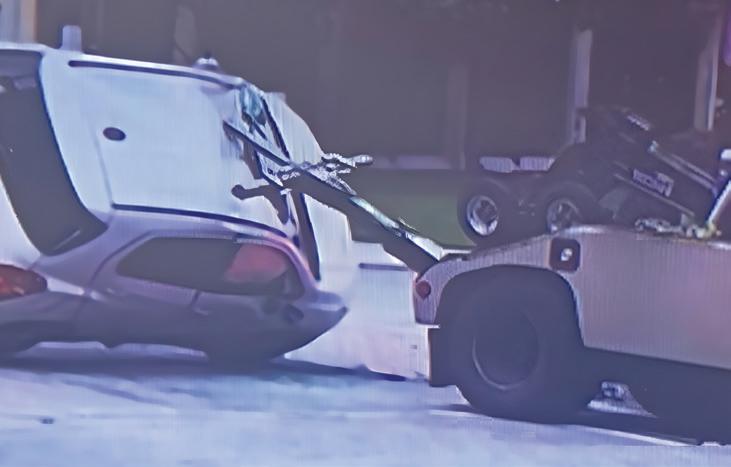
Awrecker backed up to an overturned car at an intersection crash, where the tow operator proceeded to “stab” the rolled vehicle with a lowered autoloader, and then back-flip it, with no cable attached, and no rollaway prevention in place. The tower never got out of the wrecker to conduct this hasty maneuver. As expected, the casualty vehicle just rolled away.
Not only is this scenario almost laughable (if it weren’t so dangerous), the video of this mishap went viral, demonstrating that some towers are just plain reckless in the manner in which they conduct a recovery. The video also showed the casualty vehicle rolling away, down the street. If an unsuspecting pedestrian or motorist were injured or killed by this
negligent action, the operator would very likely be facing incarceration.
There are dozens of ways to conduct rollover recoveries. Based on existing situations and the tricks stashed in a tower’s mental toolbox, recoveries end with success once the casualty drops to the pavement, making that telltale “whump” sound.
Although some rollover techniques can be questionable, others are downright dangerous, as seen in posts from various tow-truck influencers on industry websites. As an example, one tower suggested an illadvised technique of handling a rollover recovery without using winch and cable! Throughout these videos, several towers smugly claim that “Nobody around here does rollovers faster than me!” Another driver boldly proclaims, “I got three autoloaders we use to get into shopping centers, DUI’s, and do recovery work. We work rollovers without getting out of the truck.”
It’s not clear where this technique came from, but it is now becoming a makeshift version of quick clearance. But this is not a smart choice. When it comes to working rollovers, techniques applied by towers should never undermine safety for speed. A rollover can be properly worked in short order all while maintaining safety.
In a CHP (California Highway Patrol) safety course for rotation operators, one boastful participant claimed, “I can flip a car in two minutes!” The newbie tower, eager to display his abilities, hurriedly jumped into his wrecker and backed to a casualty vehicle, while fellow operators expected to be amazed. His tow truck, an F-Series Ford with a boom and autoloader combination, along with hydraulic “tire pinchers”, was suitable for quick, loadand-go operations.
The wrecker’s bed had outside controls, as well as interior cab controls, allowing him to work the wrecker inside or outside the cab. Because the wheel-lift was ◀
an integrated part of the boom’s structure, raising the boom provided height to the wheel-lift’s cross structure. This style of wrecker is popular with repos, dealerships, and inner-city tow activities.
As the overly enthusiastic operator repositioned his wrecker in a cloud of dust, what happened next showed how proven safety practices can be completely ignored. Within moments, class attendees were dumbfounded, witnessing a fool’s errand.
As the demonstration continued, the tower lowered the wheellift’s boom combination, mere inches above the pavement, and a stopwatch was activated. Peering through the wrecker’s rear window, he concentrated on the forward side of the upside-down vehicle.
Activating the wrecker’s inside controls, he accelerated rearward to “stab” the pinchers through the car’s window, causing it to shatter. While it’s not uncommon for windows to blow out during rollovers, the tower’s speed, lift, and momentum were the mechanical processes he hoped would roll the car.
Although he was working with a totaled casualty vehicle, his technique showed an intentional disregard for on-scene safety. The intentional busting out of the car’s windows created additional glass needing to be cleaned from the roadway.
The demonstrator raised the wheel-lift, pushing the assembly outward, and ultimately caused the vehicle to reverse roll in seconds. Without even so much as stepping out of the wrecker, the operator forced the vehicle into its fall space, thus completing the roll in record time.
Although participants were entertained with the demonstration of this rash technique, one tow
Industry trainers consistently teach “arrival assessment” to towers facing rollover scenarios, a debris field, safe truck positioning, obstacle recognition, general site safety, and the footprint needed for work. In all cases, working rollovers boils down to how much room, or how many lanes, police will allow for a job to be performed. In most instances, highway patrol troopers generally deny any requests for additional lanes.
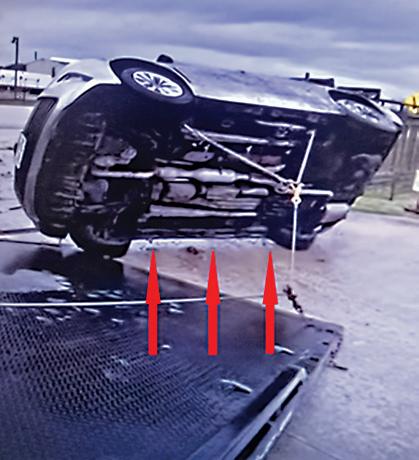
It’s commonly taught that towers position wreckers and carriers in locations requiring as little room as possible, where trucks have an easy, straightforward grasp of vehicles for a safe and controlled progression. When training newbie operators, a straightaway pull is commonly referred to as the, “T-Position.” And during rollover recoveries, this includes positioning rollaway protection. Critically important to rollover success is controlling the casualty vehicle once it’s returned onto its wheels, so as to prevent a rollaway. The potential of rolling away begins as the casualty is winched to the top of its “fall
business owner, two tow managers, and several veteran operators all looked at each other and laughed at what they’d just witnessed. As expected, an aggressive discussion ensued as to just how dangerous and unacceptable the technique would be in real-life scenarios. This “Hollywood Method” displayed as an obvious lack of control, especially considering if the vehicle were to roll away after being uprighted.
The tower justified his actions by stating, “My boss showed me this trick”, further claiming, “The cops really like it because it gets traffic moving fast.” While it’s true that officers like their accident scene handled quickly, consider three liabilities:
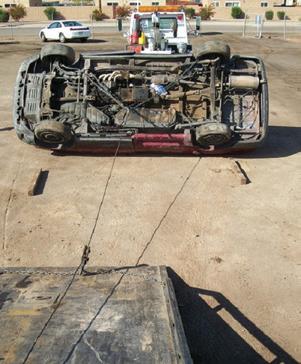
A straightaway pull is commonly referred to as the, “T-Position,” and during rollover recoveries, this includes positioning rollaway protection.
space,” visible when only a small, six inches of tire tread is touching the pavement. If the vehicle is in a “neutral state” and no blocks are in place, it’s liable to roll away. Ultimately, the measure of a tower isn’t how fast a job gets done but how carefully it’s done, and failing to use the proper equipment can turn a routine call into a fateful regret.
• Conducting a rollover from inside the cab doesn’t offer operators clear view of the total recovery.
• Not placing 4x4’s in front of and/ or behind the vehicle’s tires could allow the casualty to roll away.
• Not attaching a winch line to the casualty may allow it to roll away with no means of stopping it until impacting something—or even someone!
• This technique offers no consideration for safety—only speed.
If this technique is allowed by officers on-scene, safety concerns are at a new level of frightful incompetence. Quick clearance isn’t about some cop yelling, “Speed it up!” Rather, it’s about working ◀
within proper industry guidelines that demand reasonable and prudent recovery techniques.
If an unfortunate incident were to occur based on a haphazard technique, an investigation would certainly deem it “preventable.” In legal terms, this means a huge liability for towers and tow owners, resulting in civil or criminal penalties.
Some towers might assert that since all sorts of things can go wrong during a recovery, who can claim that working rollovers in a reckless way causes a casualty vehicle to spin, drop, then roll away into approaching or oncoming traffic? Would the company’s “Vicarious Liability” be accountable for deploying nonacceptable techniques? The answer: a resounding, “Yes.” Quick clearance isn’t an excuse for carelessness.
Even so, officers on-scene want casualty vehicles cleared as soon as possible, and likely won’t prevent towers from using this technique. Towers and officers alike may not have any idea as to the dangers it presents. But it’s not reasonable and/or prudent to work any recovery without having all safety processes in place.
If handling rollovers in this way is acceptable, why not send forklifts to work them? Why not equip freeway service patrol tow trucks with forklift attachments instead of having tow trucks? Imagine responding to a rollover recovery with a forklift just to spear the casualty’s windows, backflip it onto its roof, and drop it onto an awaiting carrier. Is that the proper way to do things? Where’s the safety and professionalism?
This article isn’t an attack on tow truck brands or equipment manufacturers who build and sell tow and recovery equipment. They’re not the problem. As safety during recovery remains a priority consideration for tow owners and professional towers, as well as tow equipment manufacturers, it only makes sense to assume that conducting rollovers in this manner is unacceptable.
Common sense must be a contributing factor as to the manner rollover recoveries are conducted. Tow industry trainers will never advise handling rollovers in this manner. Additionally, equipment manufacturers will not encourage this method in user manuals. Any tow company using autoloader-type tow trucks is obligated to address this
topic during the next safety meeting, and clearly outline using equipment in the manner intended.
Reasonable safety techniques justify charging for reasonable time spent on-scene. Even the quickest tow operator handling a rollover can’t expect to charge for anything other than portal-to-portal (or increment times), based on rates allowed by contracting agencies.
Safety and sound judgment dictate that dangerous “cowboystyle” recoveries are completely avoided before someone is injured or killed, or a secondary crash occurs that claims the life of an unsuspecting pedestrian. While it may be fitting for reality TV, judges and juries will most certainly deem these dicey “Hollywood” methods of rollover recoveries as unsafe and potentially deadly!
The potential of being prosecuted for criminal negligence while working a rollover without a winch and wire, which is justifiably outside the approval of industry standards, and injures or kills someone is a very real possibility. Tow operators that knowingly choose to conduct unsecured rollovers are clearly making an ill-fated error in judgement and should be held accountable if something goes wrong.
Randall Reilly, a leading provider of hiring solutions for skilled labor, announced the launch of a new chatbased AI feature, Stratas Assistant within the Stratas recruiting platform. With Stratas Assistant, managers for driver recruiting can type a question and get insights based on recent hiring market data within seconds. The Assistant will return key performance metrics, identify and explain
trends, or generate charts, making it easier for users to understand the hiring market and make informed decisions. Without having to navigate dashboards or hunt down data, users can check cost-per-lead and lead-to-hire rates by metro area, find where their job offerings are most competitive, or visualize top-performing markets.
Stratas Assistant joins Randall Reilly's growing suite of AI tools spe-
cifically designed to support recruiting teams searching for truck drivers and technicians. Existing features include Stratas Agent, an AI voice agent that answers driver phone calls when recruiters are unavailable and, after a natural conversation, the agent automatically routes leads to the fleet's applicant tracking system. The Call Disposition AI feature listens to recruiter-candidate calls and automatically tags outcomes, helping teams save time and improve tracking. Also, the Stratas AI Job Optimizer reviews job posts and suggests edits based on structure, clarity, and what is proven to work best for reaching qualified drivers.
These tools are built from decades of driver recruiting data and designed specifically to help private and for-hire fleets cut through dayto-day friction and keep teams focused on hiring.
Stratas Assistant is available now to all subscribers of the Stratas platform.
Source: randallreilly.com
Truck Parking Club and Shell Rotella recently announced the "Night on Us" promotion. Drivers who get a qualifying Shell Rotella T5 or T6 Synthetic Blend or Full Synthetic oil change at a participating service location can receive up to $100 in Truck Parking Club Cash. The promotion runs through June 30, 2026.
Drivers can get their Shell Rotella oil change at a participating installer, then submit their receipt at rotella.com/nightonus to redeem Truck Parking Club Cash. This can be used at any of Truck Parking Club's 4,200+ locations nationwide. Truck Parking Club is a network of instantly reservable hourly, daily, weekly, and monthly truck parking locations throughout the US. The network is made up of property owners with locations suitable for truck parking, including trucking companies, warehouses, ◀
truck repair shops, tow truck companies, storage companies, CDL schools, trailer leasing companies, industrial outdoor storage, real estate investors, truck stops, truck parking operators, and more.
Source: truckparkingclub.com
NRC Industries has launched a website offering both new and used towing and recovery equipment. Now accessible on the NRC company website, this new section brings together carrier, wrecker and QuickSwap units available for sale across North America. The new platform is now live at https://nrc-industries.com/ready-to-go-equipment/.
Designed to meet the real-world needs of tow operators, the centralized platform is available free of charge and features a modern, intuitive interface. It includes several advanced filters that allow users to customize their search based on various criteria, including equipment type, truck brand, and the user’s geographic location. Companies interested in listing equipment for sale on the platform can do so free of charge by contacting their local NRC dealer or by visiting this link to locate the nearest dealer: https:// nrc-industries.com/nrc-dealer/.



By Steve Temple
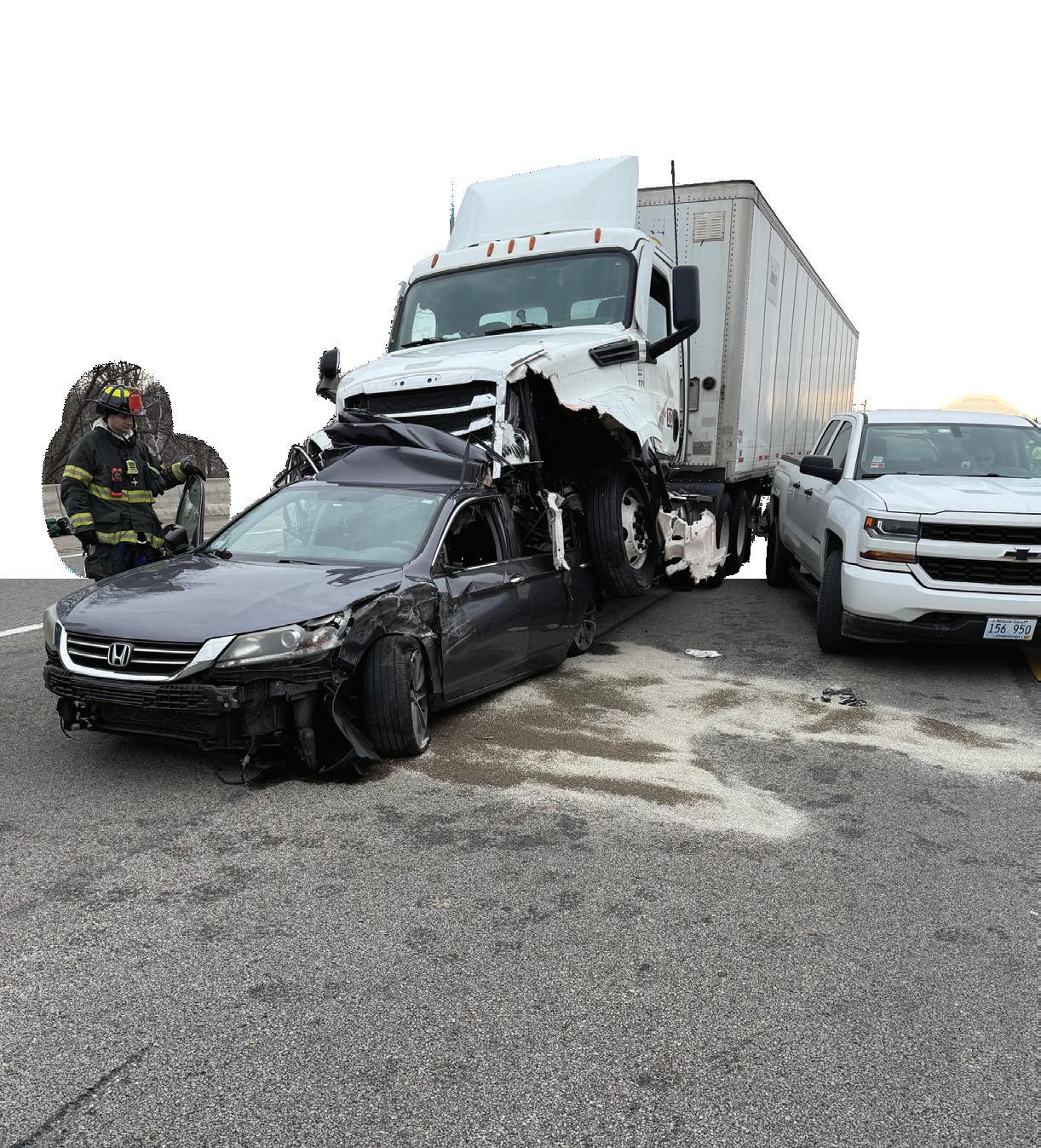
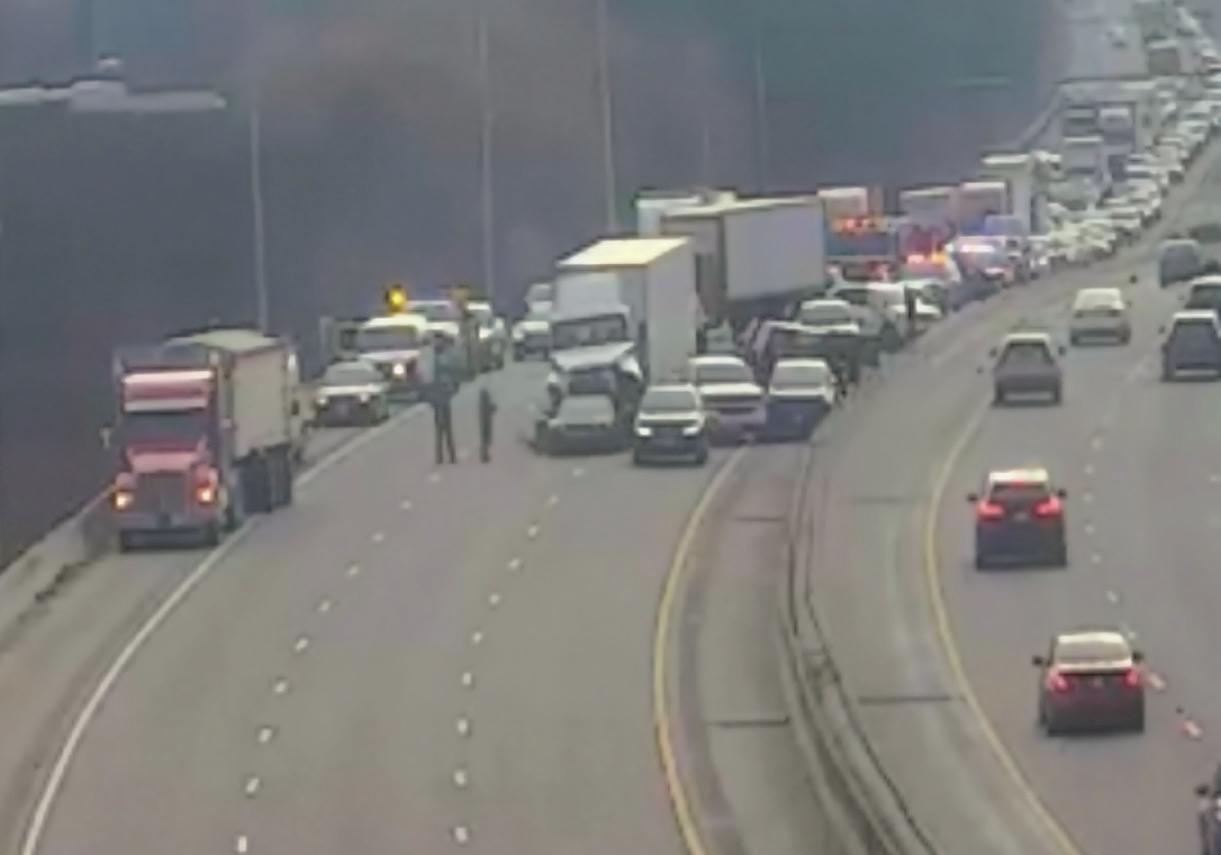
Experienced towers know that a recovery can end up being much more complicated than it sounds when first described over the phone. That was the case on March 4, 2025, 9:00 a.m., when Rhode Island State Police Commercial Enforcement Division called Sterry Street Towing in Attleboro, MA for assistance. Heavy Duty tow operator Michael Horan, a Level 8/9 WreckMaster, was dispatched to an incident that was said to be two tractor-trailers tangled up on I-95 near the Massachusetts state line.
Bridge crews had already parked Sterry Streets’ trucks nearby, so their response time was minimal. Knowing both the area and the location of the incident very well, Mike and fellow operator Andrew White were able to pick their way through the backroads and avoid most of the snarled traffic.
Parking their trucks where they would not cause any further congestion, Mike and Andrew walked the rest of the way in to make contact with the incident commander and let him know they were on scene and ready. But the chaotic sight that unfolded before them was totally unexpected, in stark contrast to the initial report.
Traffic was at a standstill, as state troopers had closed the road and were diverting traffic away from the accident area. As Mike and Andrew moved through the scene, they realized that this was much bigger than the initial call had indicated.
Multiple passenger vehicles were impacted, and it was becoming
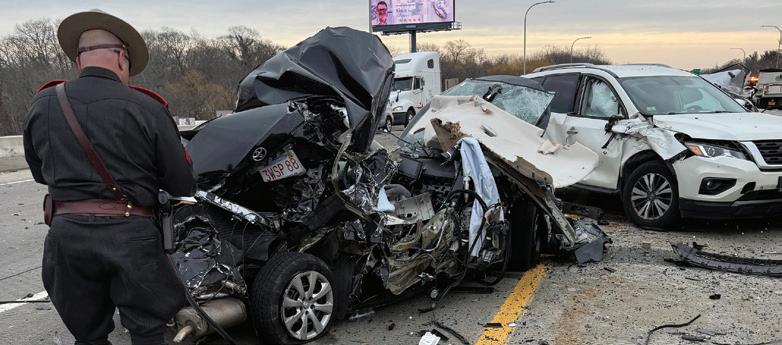
apparent that much more equipment would be needed. After making contact with the state trooper in command, Mike gave his assessment that more tow trucks should be dispatched to which the sergeant readily agreed.
While the highway patrol concluded their investigation, Andrew continued on with surveying the scene, and Mike contacted his dispatch to update them and request additional units.
At least 14 passenger vehicles and two tractor-trailers needed to be


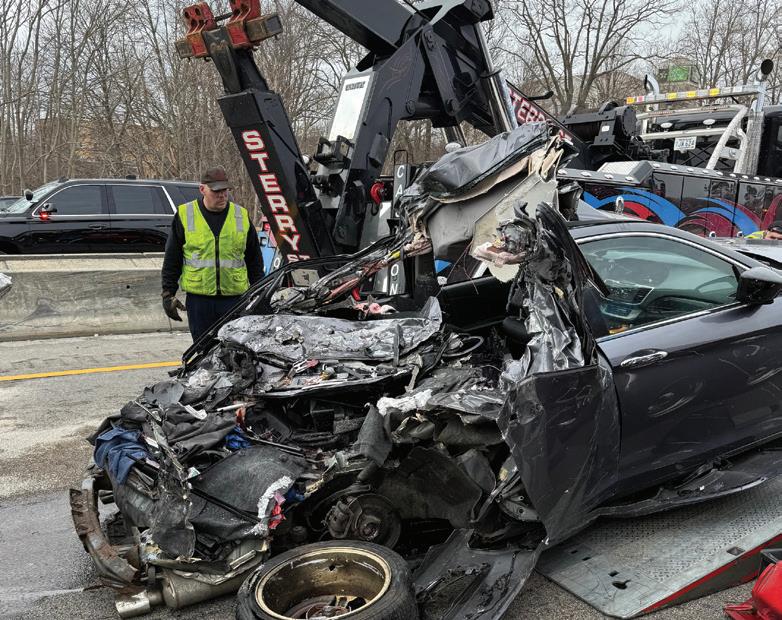
moved once the scene was turned over to them, and the Sterry Street team wanted to be ready to work as soon as they were given the green light.
At 10:30 a.m., the trooper notified Mike that the scene was ready for them
to begin clearing the massive mashup of vehicles. Four extra flatbeds, and one Miller four-car carrier joined them, and everyone worked together like a well-oiled machine.
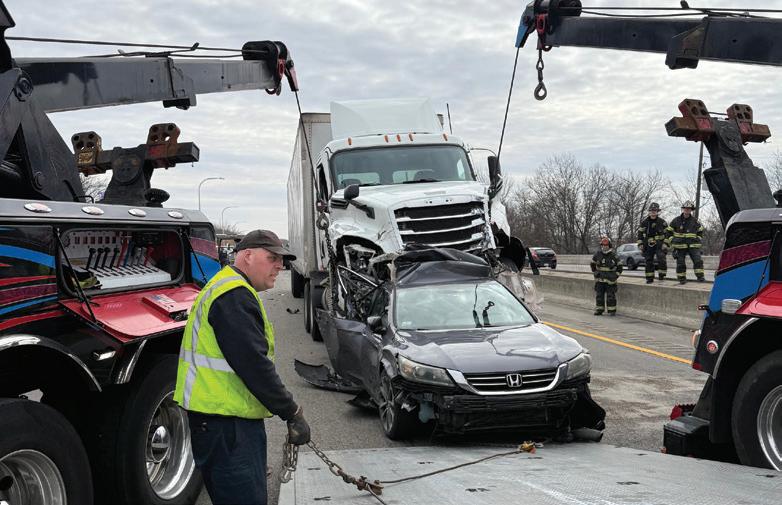
A pair of tandem Century 9055
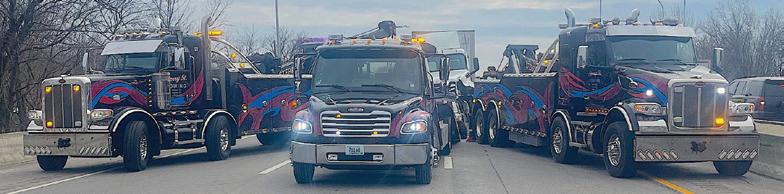
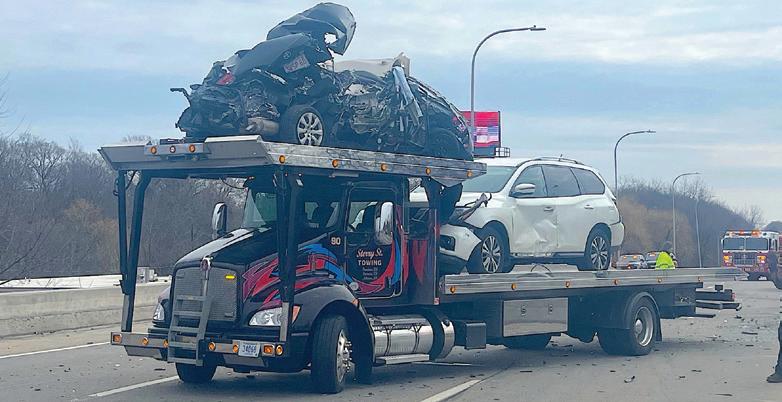
Century 9055 50-ton wreckers
Chevron four-car carrier
Miller LCG flatbeds
NRC TB20 carrier
wreckers provided all the lifting that was needed, untangling the cars from the trucks, and setting them up for the carriers to load them for removal from the highway.
About 40 minutes after getting the green light, everything was loaded and secured, ready to roll out. Two key vehicles were escorted to HQ to complete the scene reconstruction and investigation, and the rest were impounded at Sterry Street’s yard.
Sweepers were brought to the scene by DOT to facilitate cleanup of the smaller debris, insuring that gravel and glass would not interfere with traffic moving forward. No major leaks or spills occurred that would require remediation, except for slow weeping from a radiator that was quickly sopped up with absorbent booms and pads.
The weather cooperated for a change, with mild temperatures and no wind or rain to scatter the roadway scrap. The highway reopened before 11:50 a.m.. All told, the recovery required 45 minutes total from the time Sterry Street’s team had been given the go-ahead until the crew headed back to the shop.
A State DOT-led review of the incident included dash cams as well as traffic cameras. No wasted moves, no panic. The debrief was short, “Textbook,” they said. Sterry Street Towing and the team led by Mike Horan and Andrew White are to be commended for their discipline and commitment when encountering unexpected chaos.
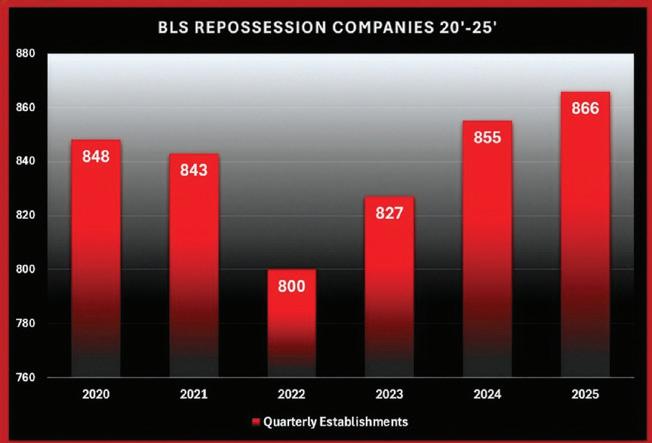
In the 2nd quarter of 2025, the US Bureau of Labor Statistics (BLS) reported 866 full time repossession companies with 7,764 employees, up from 848 in 2020. These statistics are astounding, as it is impossible for 866 repossession companies to pick up 10M cars in a year. With the training, credentialing, and certification now available, tow companies are well positioned to capture a significant share of the roughly 10M repossession assignments projected annually over the next several years.
By Mark Lacek

Repo Editor Mark Lacek has over 35 years of recovery experience. He is the former editor of “Professional Repossessor” magazine. Lacek is a sought-after repossession expert witness. He has been retained by law firms across the country more than 50 times in repossessionrelated lawsuits, including cases involving injury and death. He is the past President of the Florida Repossession Association and has authored the CCRA repossession certification program offered at www.riscus.com.
While a repo recovery agent may work as a tow truck operator, a tow truck operator can only act as a recovery agent if they possess knowledge of consumer protection laws. And the only way to acquire this knowledge is through proper credentialing and certification. This may sound like a big hurdle, but the revenue opportunity for tow companies is substantial.
Note that about 10,000,000 vehicles will be assigned for repossession in 2026—but a mere 2.6 million will actually be picked up. That’s a deficit of 7.4 million assignments, all of them missed recovery opportunities!
Lienholders and lenders will send many assignments to un-trained or non-qualified tow truck operators because there just aren’t enough trained and certified repossessors to handle the massive workload. This
dangerous policy of partnering with noncredentialed bad actors will result in drivers and consumers being killed or injured.
Training, credentialing, and certification programs are readily available, so the decision to train employees is an easy one. In actuality, this seems like a relatively simple solution to an often deadly situation. Knowledge prevents costly legal trouble and promotes employee safety. Law firms nationwide and the Department of Justice seek professional evaluations and opinions on repo from industry experts. For any company handling even one repossession this year, the following insights could prevent a tragedy involving a family member, employee, or consumer. Reviews of countless litigation documents, witness statements, and police reports, along with body and truck cam videos, stand to verify this grim possibility.
During the repo process, tow truck operators can make really bad decisions because they have not been adequately trained to perform a repossession. Tow bosses must recognize that along with basic recovery techniques, their drivers need to be knowledgeable of consumers rights, and the procedures involved in the self-help repossession process.
Some of these bad decisions have resulted in tow operators being injured, the unintentional injury to someone else, or caused someone to be killed during the repossession process. When untrained drivers handle repossessions, it’s only a matter of time before something goes seriously wrong.
The overall objective of this article is to help towing professionals understand both the legal boundaries and the ethical responsibilities involved in repossessions. Ironically, sometimes what the law allows in a given state isn’t always the right thing to do.
First, when a vehicle owner objects to a repossession, the repo agent must stop all repossession efforts, drop the car, and retreat. Yes, this means stop the repossession immediately—stop means stop.
Also, the leading cause of repossession lawsuits is the fact that the lienholder never had the authorization to repossess the car in the first place. Essentially, this means that the lender, or title loan company did not have clear title to the car they have authorized a tow operator to repossess. And, if an operator aided in improperly taking the car, even if it was done unknowingly, they can be brought into the lawsuit.
In contrast, professional repossession companies will always verify the lien on the car before attempting the repossession, which is a relatively easy process. The uncomplicated practice of verifying a lien can save a tow manager a boatload of Benjamins, as well as the hassles of a wrongful repossession lawsuit.
The definitions of “custody control” and when a repossession is complete are both complex and often debated. It’s essential to know the situations that will help define the answers. A driver or repossessor must know what to do in a confrontation, and it is simpler than many might think if they just remember that “no means no!”
This simple directive is not meant to scare tow bosses away from a great revenue producing opportunity— unless they don’t plan on providing employee training. Otherwise, tow bosses should reconsider working repossessions, because there’s no room for irresponsible behavior in this industry.
Providing repo services to the nation’s automobile lenders can be very profitable. Also, the business of repossessing collateral has additional revenue streams such as providing keys, sales, reconditioning, or detailing services, along with remarketing opportunities. In fact, some companies bring in more revenue from keys than from the repossession fees.
Consider expanding repossession services beyond cars to include other assets such as commercial trucks, heavy equipment, and recreational vehicles. For over 20 years, my repo company specialized in commercial truck and equipment. Although this firm also repossessed cars, the commercial side of the repossession business was very lucrative. Repossessing trucks and equipment allowed for opening a sales and remarketing division, from which clients would request liquidating the collateral directly from my facility.
In most states, a dealer’s license to sell a car or truck is not required of those acting as a representative of the lienholder. There are over 500 subprime truck and equipment lenders across the country, all looking for a repossession company to recover delinquent trucks. These lenders are seeking repossessors with knowledge of trucks and equipment—and not just commuter cars.
Obstacles preventing companies from offering repossession services can all be overcome through increased knowledge and training. Starting a repossession department in a tow company is not complicated, and there are clear steps to follow. Training and safety protocols are the most important. With the training, credentialing, and certification that is now available, tow companies are well positioned to capture a significant share of the roughly 10M repossession assignments projected annually over the next several years, with volumes expected to rise even further in the future.
It has been said that the repossession industry maintains a particularly close association with the towing industry, more so than any other sector. But as noted at the outset, in some circumstances, a repossessor can be a tow truck operator, but a tow truck operator cannot always be a repossessor.
Success in the repossession business depends on meeting specific industry standards and qualifications.
To begin, it is helpful to understand the two primary types of repossessions:
-The Self-help Repossession.
This lets a secured creditor take back collateral, usually a vehicle, from a debtor who has defaulted on a loan, without needing a court order. Police involvement during the self-help repossession is not allowed under any circumstances.
-The Judicial Process Repossession. This is a legal procedure through which a creditor or lienholder seeks a court order to seize property from a debtor who has defaulted on a secured loan agreement. The judicial process, also known as a court replevin, usually involves law enforcement.
This article will only focus on the Self-help Repossession process.
There is no reason that law enforcement should be involved in a self-help repossession. Authoritative legal texts and judicial precedents
establish that active law enforcement involvement typically transforms a private "self-help" action into an unlawful seizure or a "breach of the peace" that violates the debtor's constitutional rights.
Consider the following repossession industry statistics:
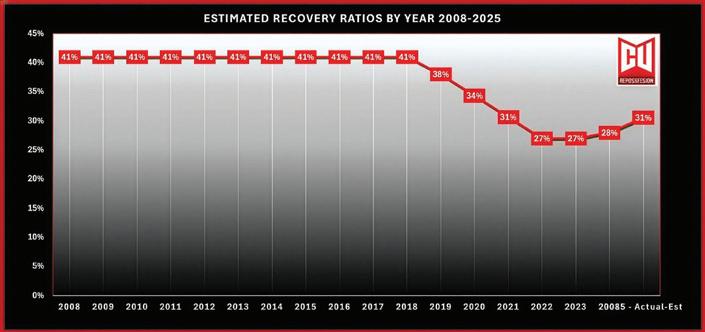
Recovery Database Network (RDN) is a leading software provider for the repossession industry. RDN reported 10.5 million repossession assignments in 2025. According to RDN, the industry carried a 31% recovery percentage in 2025. A chart published in CURepossession.com showed a decrease in recovery percentages from 41% from 2008 to 31% in 2025.
In the 2nd quarter of 2025, the US Bureau of Labor Statistics (BLS) reported 866 full time repossession companies with 7,764 employees, up from 848 in 2020. In 2025 the BLS reported 10,838 towing companies with 72,916 employees.
The numbers are astounding and the obvious point is that it is impossible for 866 repossession companies to pick up 10M cars in a year. The client base knows this, but must repossess their collateral, which causes them to take some risk. In an effort to raise the recovery percentages, some lienholders, and most title loan companies, are sending repossession assignments to tow companies across the country. This is a great opportunity for tow companies to increase yearly revenue using proven, existing processes, rather than developing a new service model from scratch. With staff, tow trucks, and storage space already in place, a tow manager must simply update the company policy on training and credentialing drivers to perform repossessions.
The following financials reveal the magnitude of the current repossession market. In 2024, the North American Industry Classification System (NAICS) reported the repossession industry generated approximately $1.2 billion in revenue. Essentially, two million repossessions in 2024 at an average ◀
repo fee of $600, this would amount to $1,200,000,000!
That is the equivalent of $1.2B in generated revenue from only 31% of 10M repo assignments recovered. If the remaining 69% of the repo assignments were picked up, it would add up to $4,140,000,000, over $4B in nongenerated revenue that the repossession industry left on
the table. Apparently there’s room at the table, and what tow boss wouldn’t like a seat there?
While the repossession industry definitely has positive aspects, there are several negative aspects that must be considered: nationwide, most tow companies lack factual knowledge of the repossession business, but accept repo assignments every day. This bad habit frequently violates consumers rights and ends up as a complaint, usually followed by a lawsuit against the tow company, the lender, and the driver who received little or no training. Defendants will most likely lose in court.
In the State of Texas, there are at least three wrongful repossession lawsuits where the tow truck driver failed to discontinue the repossession after objections from the vehicle owners. The failure of the drivers to discontinue these repos caused the owners to be run over by the tow trucks. These individuals sustained serious injuries, and in some cases, fatalities occurred. The drivers of the tow trucks testified to never hearing the term “Breach of Peace.”
In my experience, among several wrongful repossession litigation cases, few lawsuits involved reputable and professional repossession companies. Understandably, trained and certified employees make better decisions, minimizing risks and errors.
Legitimate repossession companies typically prioritize comprehensive training, certification, and the employment of certified repossessors, or have the employees receive repossession training before giving them assignments. While repossession companies train employees in consumer protection laws and repossession credentialing, most tow companies do not.
Consider a scenario in which millions of cars are illegally parked in an enormous parking lot within a few miles of a single tow company. All of the cars need to be towed. The parking lot manager requires that all towers have specific training in order to participate in the towing process of these particular cars. Would the tow boss interested in towing these cars if all that was needed was to provide some additional training to company employees?
Successfully competing in the repossession business will require that a tow company updates the following equipment:
• Rollback for delivery purposes

Provide Training on Commercial Account Repossessions with a Focus on Pre-Contact Preparation. Certified Course. Mark Lacek, Commercial Asset Solutions
Ron L. Brown, Eagle Group XX
Friday & Saturday, July 17 & 18, 8am Visit TowXpo.com to register
• Wheel-lift tow truck for speed and stealth
• Knowledge and equipment for making keys
• License Plate Recognition (LPR) for volume assignment
• Vehicle entry tools
• Wrongful repossession insurance
• Certified Commercial Recovery Agent certification (CCRA)
• Personal property removal area and storage (for items inside repossessed vehicle that are considered personal property)
• Repossession software (for communication with clients)
There are various levels of repossession service providers. Some repossession companies receive thousands of assignments per month, and others receive only a couple hundred. The amount of repossession assignments accepted per month is usually determined by the tow boss.
Tow managers interested in learning more should attend the Repossession Credentialing Seminar at the 2026 American Towman TowXpo in San Antonio, Texas, being held on July 1618. The seminar will consist of 2½ hours per day of fast-paced learning over the course of two days, and include safety and consumer protection.
Repossession industry expert Ron L. Brown from the well-respected Eagle Group XX will offer valuable insight during this seminar. Ron is a highly sought-after speaker on repossession training, policy, and procedure, and will
introduce his specifically designed credentialing training at both the TowXpo, San Antonio and AT Expo, Baltimore events. Also included in the seminar are the advantages of providing commercial vehicle repossessions to commercial lender clients, topics such as Breach of Peace, GLBA, FDCPA and UDAAP violations, and recognized standards in the repossession industry.
Tow companies have a clear path to enter the lucrative repossession market through targeted training, credentialing, and equipment upgrades. With millions of assignments available annually and rising, the opportunity to boost revenue is substantial. Attend the Repossession Credentialing Seminar in San Antonio to get started on the right foot.


By Jesse Lubar
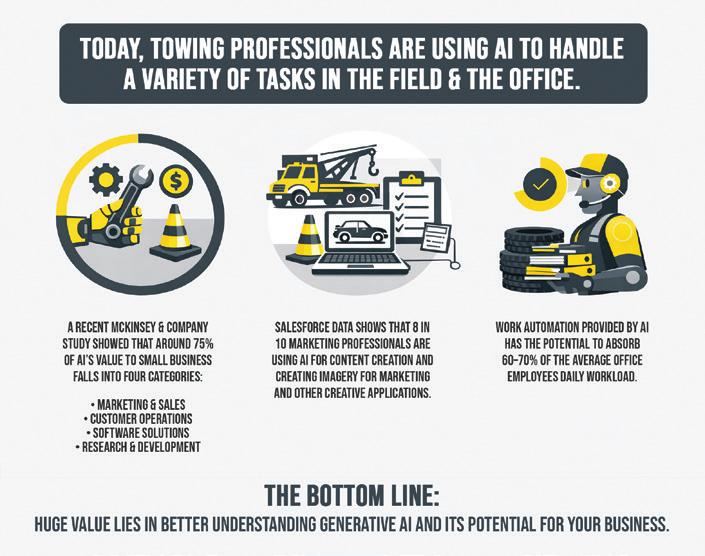
When it comes to adopting new technology, small companies usually follow large enterprises. In the towing industry, this truism no longer holds. Tow bosses of smaller firms are beginning to embrace AI (Artificial Intelligence), often moving faster than large operators and national
companies. With more competition from upstarts and private equity backed consolidation, it's more important than ever to look at every possible business advantage. Forward-thinking operators are already putting AI to work in practical ways that directly enhance dispatch efficiency, insurance renewal planning, response times, billing accuracy, and even call volume.
This surprises some tow managers, as AI is still often viewed as something futuristic, expensive, or reserved for companies with massive IT budgets and high-tech personnel. But this perception only applies if a business plans to build and train its own AI systems, which is not realistic for most towing companies—nor necessary.
For most tow bosses, AI is already embedded in the tools they use every day, or can be layered on easily. Dispatch platforms, call tracking, GPS routing, accounting systems, review management, and online marketing platforms are increasingly powered by AI. At this point, avoiding AI would be more difficult than adopting it. The real question is how towing companies are using it to solve real operational problems. Across the industry, three core areas stand out.
-Turning Paperwork Into Usable Intelligence:
Every successful business today needs to understand and use their own data to help the company improve. Tow tickets, police rotation logs, impound records, invoices, lien paperwork, insurance forms, and driver logs all contain valuable information. For many companies, this data is trapped on paper, embedded in PDFs, spreadsheets, emails—or simply stuffed in filing cabinets, making it hard to search and impossible to analyze and use.
AI-powered document processing unlocks this pile of useful information. Instead of manual digging, AI can extract, organize, and make years of towing data searchable. Tow bosses can quickly answer questions such as the number of rotation calls in the last quarter; the insurance ◀
companies that consistently delay payment, and which fleet or repeat customers generate the highestmargin work. In addition, AI can identify the best motor clubs to work with.
When this information becomes accessible and usable, it leads to faster billing, fewer errors, stronger compliance, and better decisionmaking—all critical advantages in an increasingly margin-sensitive business environment.
-Smarter Call Handling And Customer Engagement:
In towing, the phone is everything. Missed calls are missed revenue. Long hold times frustrate stranded drivers. Dispatchers can become overwhelmed during heavy weather events, larger jobs, chaotic accidents, or at peak hours. To minimize these difficulties, AI is now being used to support, not replace, dispatch teams.
Examples include AI-powered call handling that screens job requests and work leads, routing only legit calls through when tow operators are in the field. Also, call transcription and analysis indicates which calls convert into real tows, and help improve response rates and
customer service.
AI chat-based responses address questions like ETAs, pricing basics, and vehicle release procedures. By handling repetitive and predictable interactions, AI frees dispatchers or smaller operators to focus on complex situations, and ultimately stay safer when focus and attention matter most.
-Embedded In Everyday Towing Software:
AI is no longer a standalone product, as it’s being built directly into the software most tow bosses already use. Dispatch systems, routing platforms, accounting tools, payroll software, and marketing dashboards now include AIdriven features such as predictive insights, performance analytics, and automation.
Many towing companies already pay for tools that include AI capabilities but aren’t fully using them. Which means a manager doesn’t have to buy something new, but instead activate and integrate what’s already in hand to eliminate manual work and improve visibility into tow operations.
For most tow bosses, marketing isn’t about traffic or impressions. It’s about one key outcome: getting the phone to ring the moment someone needs a tow.
What has changed is how those calls are won. Search engines, map platforms, review sites, and even in-car navigation systems are now driven by AI. These platforms decide which towing company appears, and in what order, based on an AI interpretation of relevance, proximity, reputation, responsiveness, and real-world performance signals.
In practical terms, AI-driven marketing determines which towing company shows up in Google Maps and “near me” searches. It also determines how customer reviews influence rankings and call volume, and which ads generate real towing calls versus price shoppers. ◀

Another important aspect is how quickly a company gains or loses visibility in its local market. AI-powered marketing allows tow bosses to connect online activity directly to real phone calls and completed tows. Call analysis can identify which marketing sources or ads produce profitable jobs. Automation of reviews can improve response speed and tone without manual effort. Ranking tools can reveal where a company is losing ground, to which competitor, and why.
The challenge is that few towing company owners have the time to master constantly changing AIdriven marketing options.
Whether it be for tow management software, digital advertising and marketing, or phone call management, working with a future forward, tow-technology partner is key. With a host of these providers out there, finding those who specialize in towing is another key element. It makes no sense to have a tech supplier that doesn’t understand the workings of a tow business or what a tow operator’s workday is like.
With all the attention now on AI, expectations should still stay grounded. AI is not magic, and it won’t fix broken processes. The most effective towing companies start with narrow, clearly defined goals.
These should include answering basic questions such as where did the company lose time or money today, and where do mistakes reduce revenue? Also, what frustrates customers or employees most?
Test AI in focused areas: dispatch efficiency, call handling, billing accuracy, and call attribution. Measure the impact, then double down on what works.
At this point, avoiding AI would be more difficult than adopting it.
Towing companies are uniquely positioned to benefit from AI adoption. Most are owner operated and able to quickly decide whether to embrace new approaches, without getting bogged down in a long approval process. These companies can move rapidly, adapt workflows, and see results faster than large enterprises.
This agility is becoming a competitive advantage. Tow bosses who adopt AI today are not just saving time—they're improving response times, capturing more calls, tightening operations, and delivering a more professional, reliable experience to customers, fleet managers, and municipalities alike.
Tow Talk is the largest towing group on Facebook, with more than 150,000 members, representing thousands of U.S.-based companies. Spending a few minutes scrolling there will reveal that the number-one gripe from tow bosses is the price of insurance.
Here is yet another way that AI can assist a tow company in locking down the best possible rate at renewal time. Insurance companies reward predictable risk, and when AI is packaged correctly, it becomes a formal risk-management system, not a buzzword.
For a tow boss, this means using AI to actively monitor driver behavior, support safer dispatch decisions, prevent mechanical failures, and to document the corrective actions taken. The result
is fewer accidents, better trained teams, and clear proof that risk is being managed at a tow company.
The key is presentation. At renewal, the AI used should be framed as the tow manager’s Fleet Safety & Risk Intelligence Program with measurable outcomes: reduced incident frequency, documented driver coaching, defensible claims supported by video and data, and maintenance issues caught before they become problems. Insurers respond to trend lines, clear documentation, and evidence of discipline—not double talk, dashboards, or jargon.
When a tow boss walks into renewal with 12 months of improved loss data, and a structured risk program, the conversation changes. Premiums, deductibles, and exclusions become more negotiable. Of course, AI doesn’t lower insurance premiums overnight, but it can help transform insurance from a cost that only goes up, into a more controllable operating variable, which is exactly how underwriters want to see risk managed.
So, pull together all the ways that using AI can help improve a tow business. Whether from tow management software, or tools provided from a digital marketing agency (such as call analysis, positive online reviews, details from in-cab video systems, documented training, and maintenance steps taken). Package this material up, include the company’s special character, and then sit down with the insurance broker with more confidence and a sense of control.
AI can help in so many ways and its possibilities for helping a business are virtually endless. The sooner tow managers dive in and begins to understand what it does, and how to apply it, the better off they’ll be!
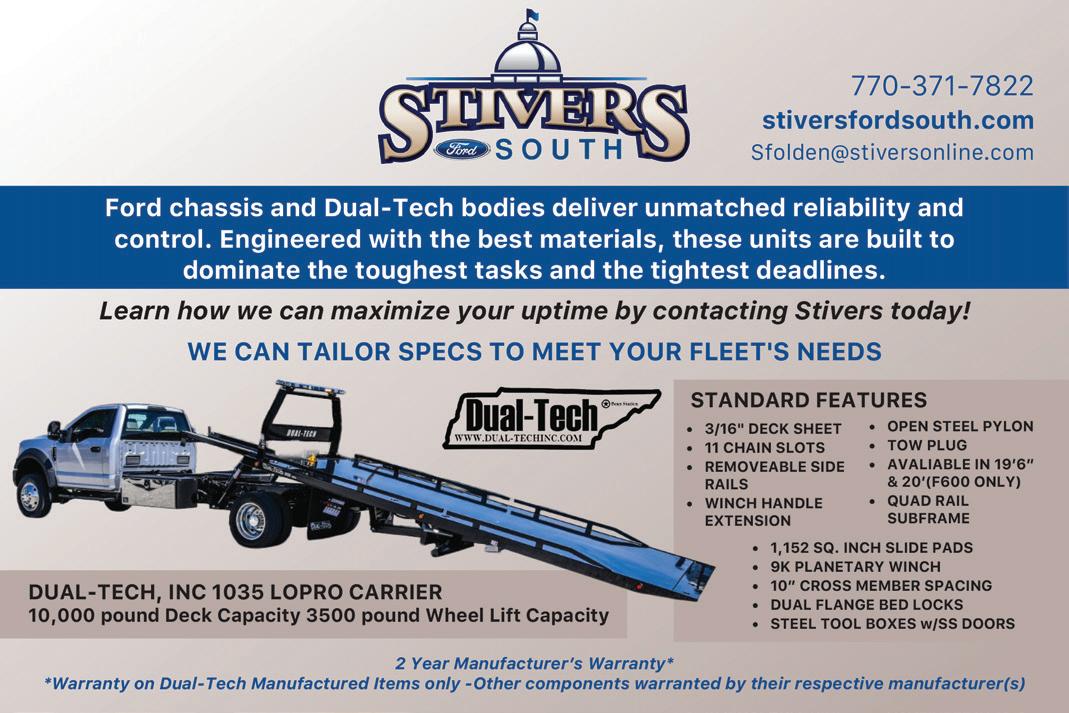
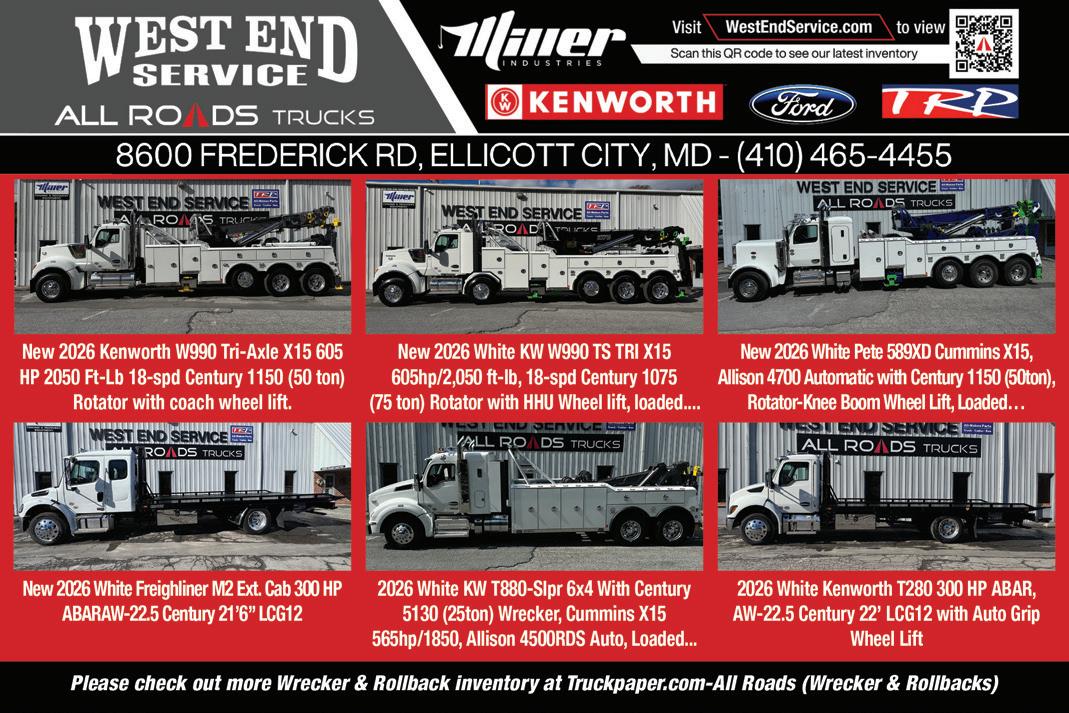

By Steve Temple
Looking to the past can define one’s future. That’s the case with Ivin Cruz’s spectacular Dodge tow
truck, meticulously painted with futuristic alien imagery. He says it’s a tribute to his grandfather Heraclio Ortega, who ran Ortega Towing for

45 years. Heraclio got into the business with a custom-built Holmes wrecker on, also a Dodge, a 1964 D300 model. He was a truly dedicated towman, who passed away
while behind the wheel of his tow truck from a heart attack in 2019. Ivan took over the family business in Camden, NJ, and renamed it Move It All In One Auto Services. In keeping with this dynamic company name, his first big move was to add motor clubs to his client list, something his grandfather hadn’t done. As revenue increased from this new venture, he was able to expand, adding a couple of wreckers and eight flatbeds. But he never forgot his grandpa’s old Dodge, and in honor of that memory, he purchased a 2011 Dodge Ram 5500. It was in need of repairs, and Ivin pulled out all the stops, both in fixing it up and adding dazzling airbrushed graphics.
“I love wreckers—grandpa did too,” Ivin relates. “I did it for him.”
The Ram was in service for some time with a Jerr-Dan MPL 40 wrecker body, a low-profile unit he prefers for recoveries, but the wornout engine and transmission ◀






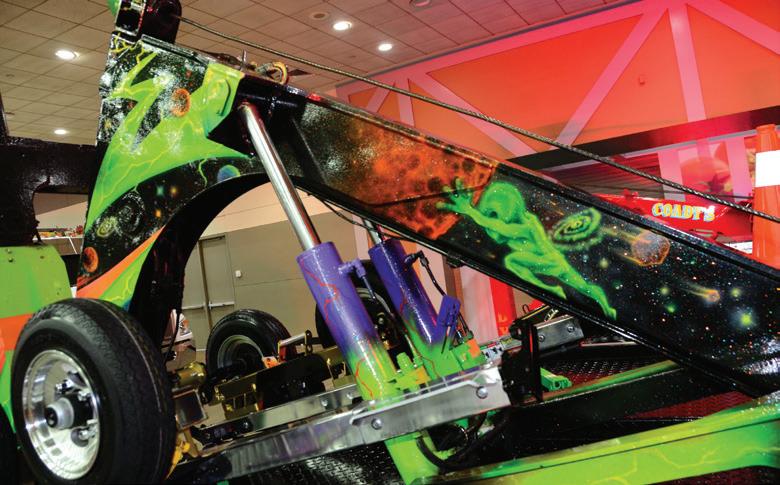
needed to be replaced. As he got into the body-off restoration project, “I just decided to go for it, went all crazy on it, everything,” he recalls.
Upgrades included adding a Federal Signal Allegiant light bar, OPT7 underbody lighting, and Cali 20-inch rims, along with an interior vinyl headliner.
What’s truly extraordinary is the intricate artwork created by Michael Colbert. He airbrushed all the alien characters by hand over a period of two years. Ivin’s wife Natalie oversaw the prep work on the body panels with a meticulous eye, and kept everything moving forward, also in keeping with the company name.
Chassis: 2011 Dodge Ram 5500 Engine: Cummins 6.7L
Transmission: Aisin Automatic
Wrecker Body: Jerr-Dan MPL 40
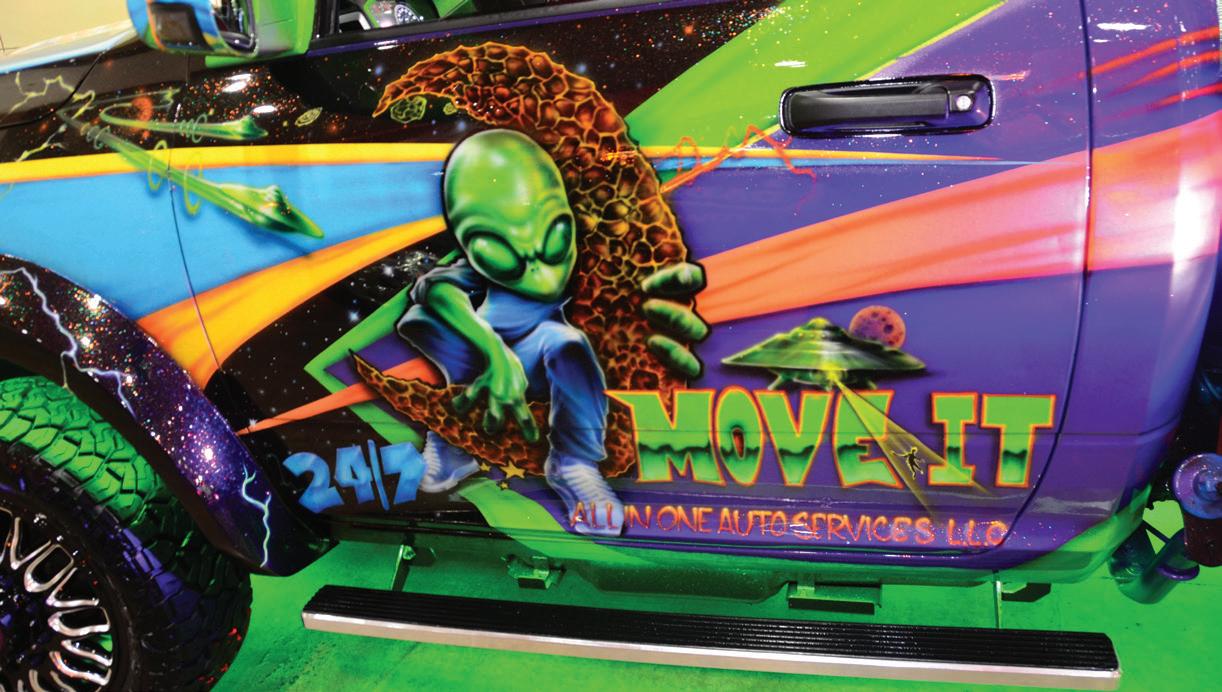
Custom Features: painting artwork by Michael Colbert; Federal Signal Allegiant light bar; OPT7 underbody lighting; Cali 20-inch rims; interior vinyl headliner; dollies; traffic cone holder.
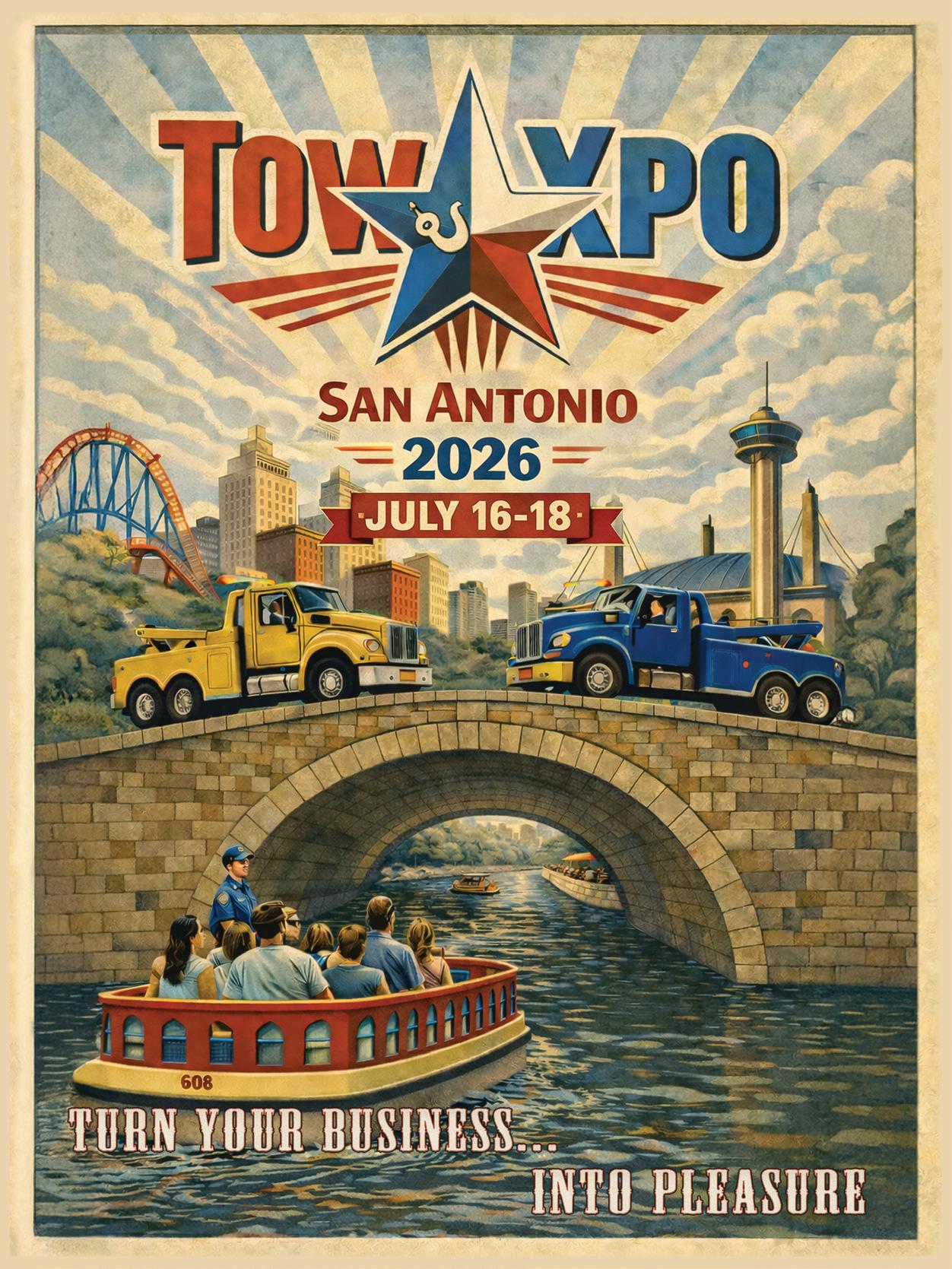
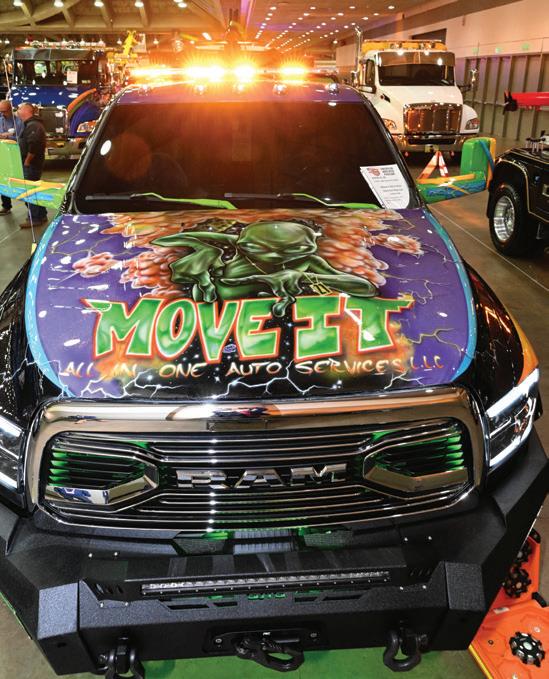
“My part in this whole project was making sure everything was done in
Wrecker Pageant at the Expo in Baltimore last November. Natalie made sure the detailers for the event didn’t use any products or buffers that might scratch the surface. And she also thoroughly inspected every crevice
and this trophy is a heartfelt link to the Ortega legacy.
Today, this “Extra-tow-estrial” truck serves as a rolling promotion for the company, appearing at events not only as an out-of-this-world statement of just how far Move It has come, but also how far they hope to go in the future.
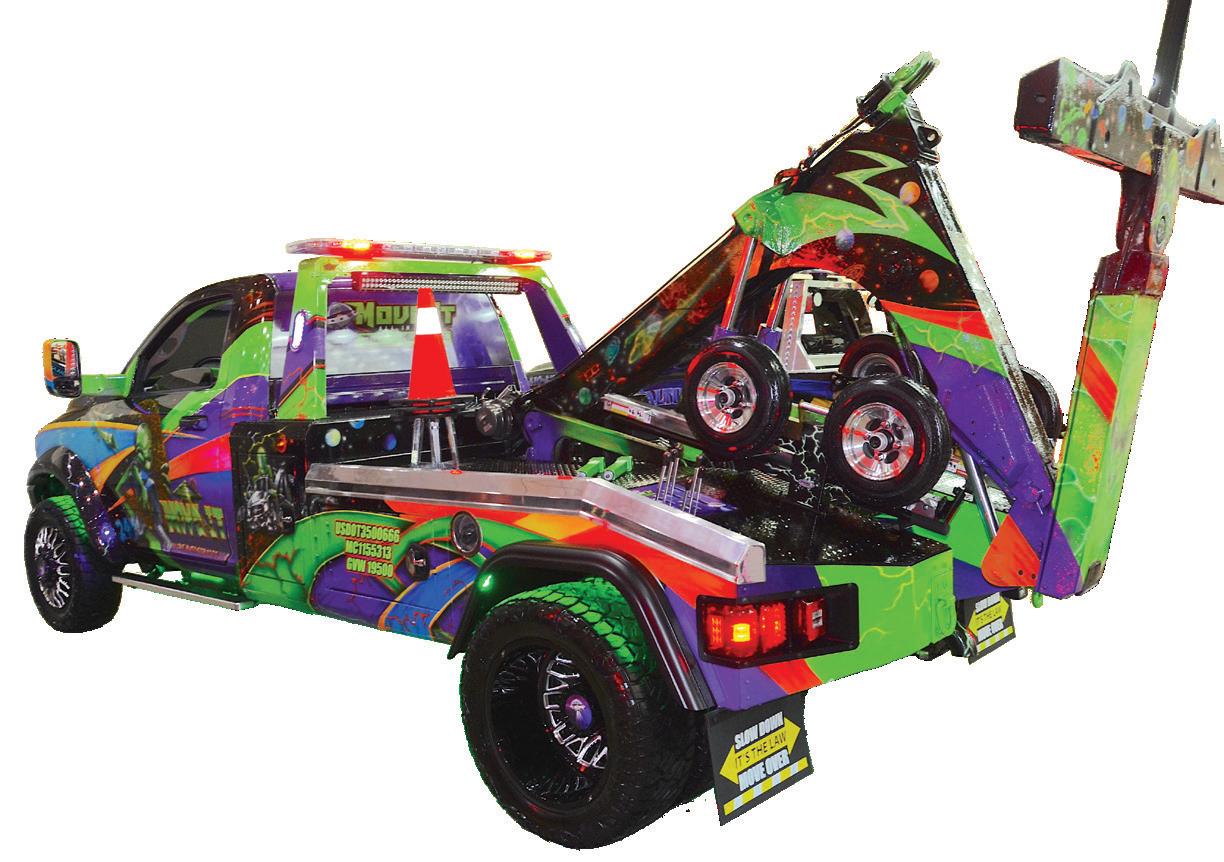
U.S. Department of Justice announced it will no longer pursue criminal charges for certain Clean Air Act violations involving OBD tampering.
The U.S. Department of Justice’s on Jan. 21 announced that it will use enforcement discretion for Clean Air Act violations involving tampering with onboard diagnostic (OBD) systems, and will no longer pursue criminal charges in those cases. However, the policy reflects only the current administration’s approach. Statutes of limitation extend beyond a single presidency, meaning future administrations could choose stricter enforcement.
SEMA President and CEO Mike Spagnola called the move “a welcome end to overly harsh penalties,” while emphasizing that federal law still clearly prohibits emissions-system tampering and profiting from products that enable it. He said SEMA remains committed to working with the EPA to help shape policies that balance compliance, safety, and innovation.
OBD tampering—often tied to defeating emissions controls or mileage fraud—remains illegal and subject to significant civil penalties. SEMA continues supporting compliance through its SEMA Garage and SEMA Certified Emissions program, which helps aftermarket companies demonstrate that parts do not increase vehicle emissions.
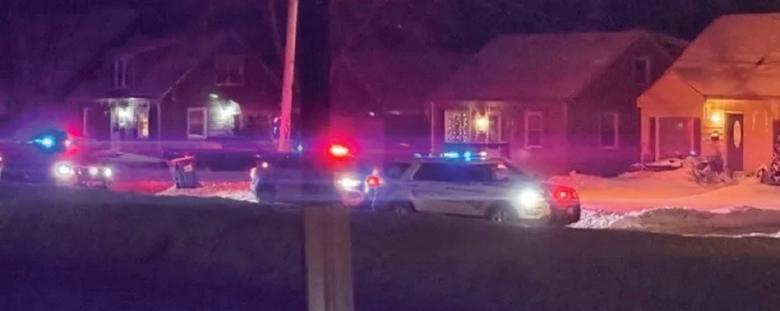
U.S. Department of Justice announced it will no longer pursue criminal charges for certain Clean Air Act violations involving OBD tampering.
Source: sema.org
A police report states a woman who hit a tow truck driver was arrested at the scene for operating a vehicle while intoxicated (OVI) and obstructing official business.
Investigators say another woman had called for a tow truck after her Kia became stuck in a snowbank. As the tow truck driver worked to free the vehicle, another car struck both the truck and the driver. The tow operator was conscious but seriously hurt, suffering a head wound and unable to answer questions. He was transported to a hospital for treatment.
A woman at the scene initially claimed the driver had fled, but officers found no footprints in the snow and witnesses reported no one else leaving the vehicle. Police said she appeared nervous and smelled of alcohol. She later admitted she had been driving and now faces multiple misdemeanor charges.
Source: wkbn.com
Employees at Absolute Towing and Recovery in St. Paul, Minnesota, discovered a dog inside an abandoned SUV that had been sitting in
their impound lot for weeks. The vehicle had been towed more than a month earlier and appeared no different from the others waiting to be processed. When workers opened it to prepare for cleaning and demolition, they noticed blankets, a cloth draped over the driver’s seat and a small box.
Then they saw a tiny dog curled up in the back. The Chihuahua-dachshund mix had somehow survived inside the vehicle the entire time, likely sustained by small amounts of water and scraps left behind.
Now named Otto, the dog was in poor condition, suffering from overgrown nails, severe dental issues and a small tumor. With veterinary care and the comfort of a foster home, he has already begun to recover.
Source: thedodo.com
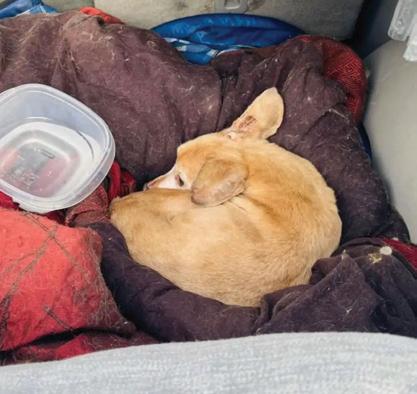
Philadelphia police are searching for Najee Williams, 27, who is wanted in connection with the fatal shootings of two tow truck drivers in separate incidents weeks apart.
Investigators say Williams is charged with murder, weapons offenses, and related crimes in the deaths of David Garcia-Morales, 20, and Aaron Whitfield, 25. A $20,000 reward is being offered for information leading to his arrest and conviction.
Garcia-Morales was found Dec. 23 inside his tow truck, suffering gunshot wounds to the neck and thigh. He died four days later at Temple University Hospital. On Jan. 8, Whitfield was discovered fatally shot in his tow truck. A 20-year-old woman with him was wounded in the leg and survived.
Police say Williams owns a separate towing company and they are investigating whether a dispute between tow operators may have played a role.
Source: fox29.com
The Federal Motor Carrier Safety Administration (FMCSA) has issued an interim final rule aimed at tightening oversight of commercial driver’s licenses issued to foreign-domiciled individuals.
The rule amends federal regulations governing State Driver’s Licensing Agencies (SDLAs), significantly limiting their authority to issue and renew non-domiciled commercial learner’s permits (CLPs) and commercial driver’s licenses (CDLs). FMCSA said the changes are intended to restore integrity to the CDL issuance process, strengthen security standards, and enhance safety in commercial motor vehicle operations nationwide. However, the rule has been temporarily blocked. On Nov. 13, 2025, the U.S. Court of Appeals for the District of Columbia Circuit issued a stay pending review, preventing the mea-

sure from taking effect until further notice. Until the court rules, states may continue issuing non-domiciled CLPs and CDLs under prior regulations. States operating under corrective action plans must continue complying with those requirements.
https://www.fmcsa.dot.gov/ newsroom/interim-final-ruling-restoring-integrity-issuance-non-domiciled-drivers-licenses-cdl
A San Francisco tow owner was sentenced to five years in federal prison for orchestrating a scheme to burn his competitors’ trucks in an effort to boost his own business. Jose Vicente Badillo, owner of Auto Towing and Specialty Towing, received the sentence after having been indicted in March 2025 on one count of conspiracy to commit arson.
According to prosecutors, Badillo conspired with others to torch six tow trucks belonging to four rival companies in San Francisco and East Palo Alto between April and October 2023. The goal, authorities said, was to drive customers to his companies. “I take full responsibility for what I did,” Badillo told the court.
The judge cited the “devastating and unfair impact” on the victims, two of whom described emotional and financial harm. She also expressed concern about Badillo’s broader criminal history, which includes fraud-related convictions and welfare fraud charges.
Source: missionlocal.org
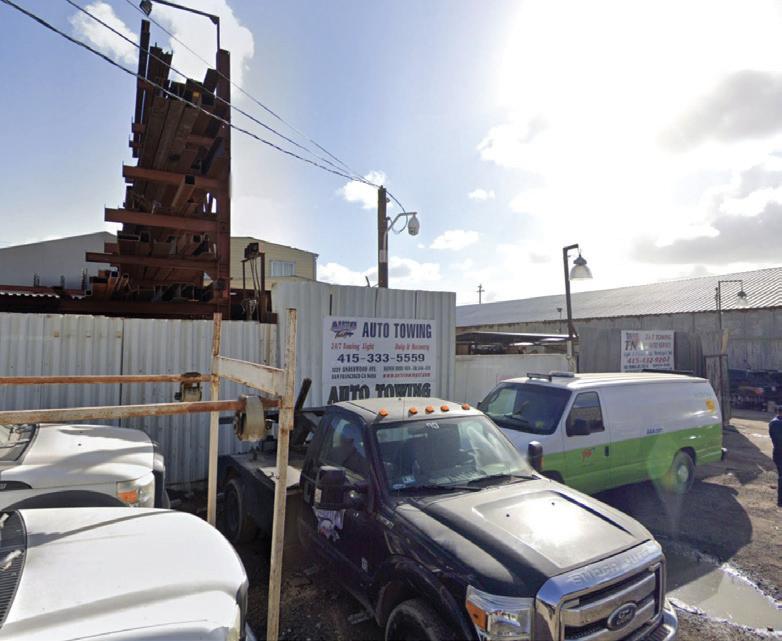
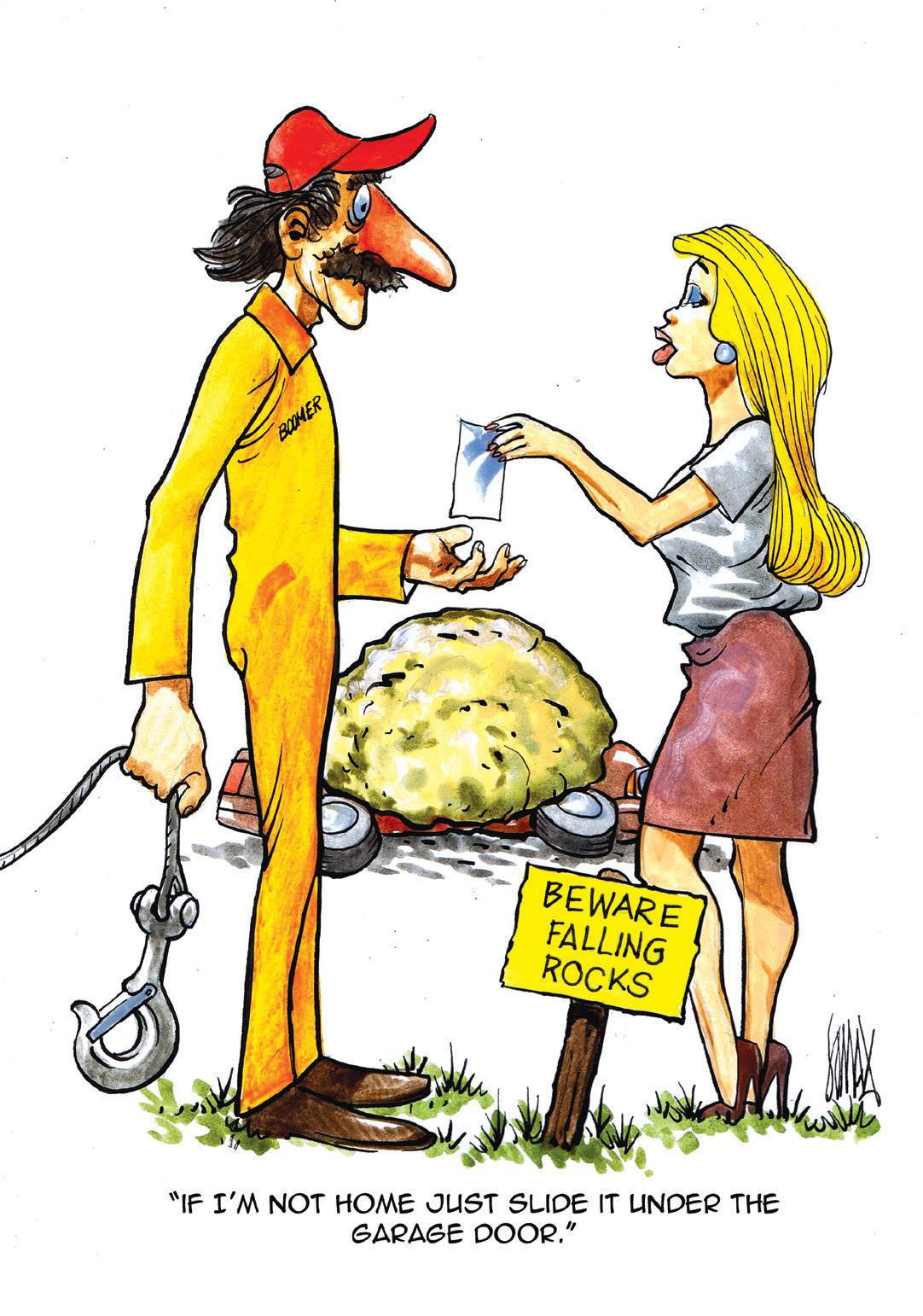
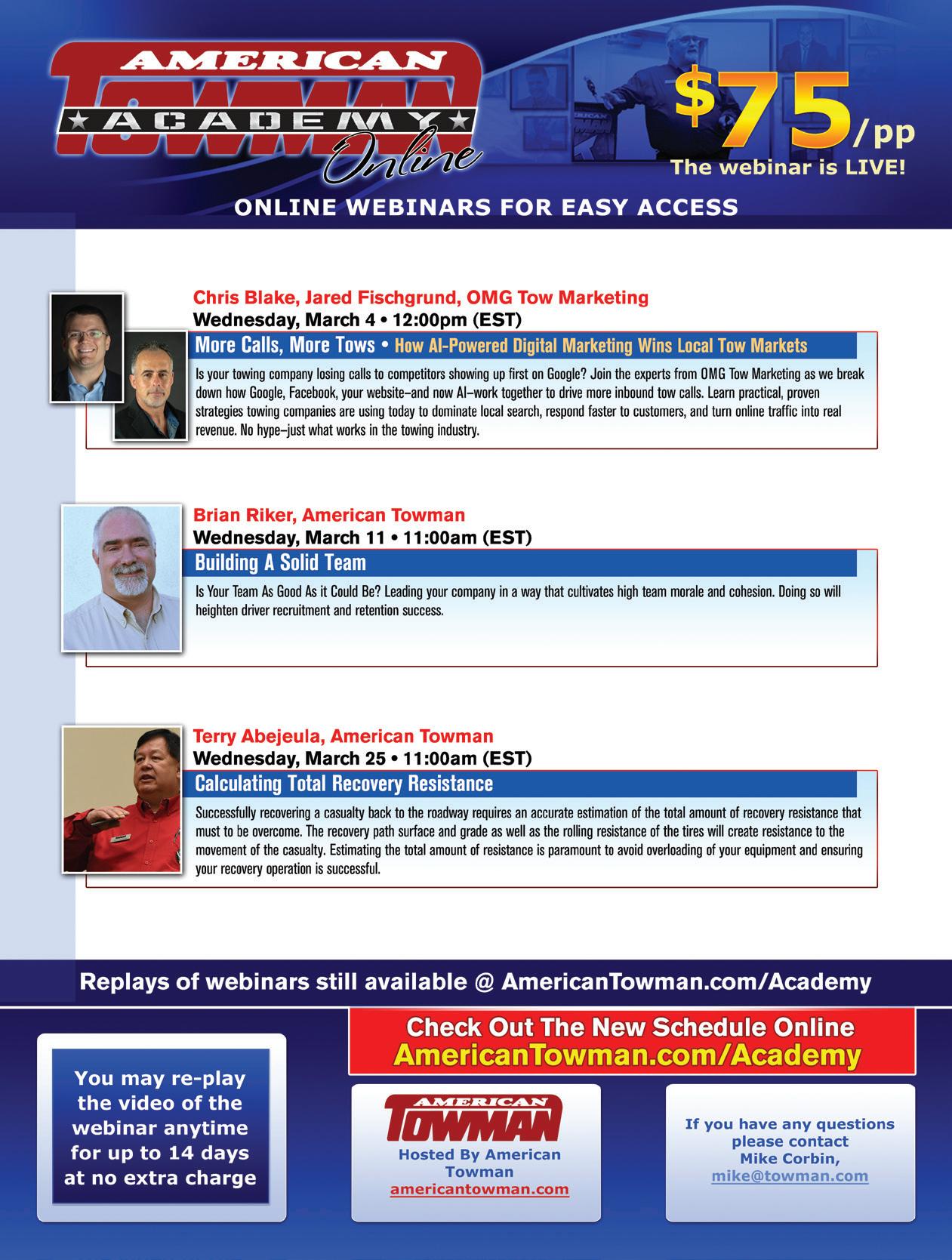
U.S. Department of Justice announced it will no longer pursue criminal charges for certain Clean Air Act violations involving OBD tampering.
The U.S. Department of Justice’s on Jan. 21 announced that it will use enforcement discretion for Clean Air Act violations involving tampering with onboard diagnostic (OBD) systems, and will no longer pursue criminal charges in those cases. However, the policy reflects only the current administration’s approach. Statutes of limitation extend beyond a single presidency, meaning future administrations could choose stricter enforcement.
SEMA President and CEO Mike Spagnola called the move “a welcome end to overly harsh penalties,” while emphasizing that federal law still clearly prohibits emissions-system tampering and profiting from products that enable it. He said SEMA remains committed to working with the EPA to help shape policies that balance compliance, safety, and innovation.
OBD tampering—often tied to defeating emissions controls or mileage fraud—remains illegal and subject to significant civil penalties. SEMA continues supporting compliance through its SEMA Garage and SEMA Certified Emissions program, which helps aftermarket companies demonstrate that parts do not increase vehicle emissions.
U.S. Department of Justice announced it will no longer pursue criminal charges for certain Clean Air Act violations involving OBD tampering.
Source: sema.org
A police report states a woman who hit a tow truck driver was arrested at the scene for operating a vehicle while intoxicated (OVI) and obstructing official business.
Investigators say another woman had called for a tow truck after her Kia became stuck in a snowbank. As the tow truck driver worked to free the vehicle, another car struck both the truck and the driver. The tow operator was conscious but seriously hurt, suffering a head wound and unable to answer questions. He was transported to a hospital for treatment.
A woman at the scene initially claimed the driver had fled, but officers found no footprints in the snow and witnesses reported no one else leaving the vehicle. Police said she appeared nervous and smelled of alcohol. She later admitted she had been driving and now faces multiple misdemeanor charges.
Source: wkbn.com
Employees at Absolute Towing and Recovery in St. Paul, Minnesota, discovered a dog inside an abandoned SUV that had been sitting in
their impound lot for weeks. The vehicle had been towed more than a month earlier and appeared no different from the others waiting to be processed. When workers opened it to prepare for cleaning and demolition, they noticed blankets, a cloth draped over the driver’s seat and a small box.
Then they saw a tiny dog curled up in the back. The Chihuahua-dachshund mix had somehow survived inside the vehicle the entire time, likely sustained by small amounts of water and scraps left behind.
Now named Otto, the dog was in poor condition, suffering from overgrown nails, severe dental issues and a small tumor. With veterinary care and the comfort of a foster home, he has already begun to recover.
Source: thedodo.com
Philadelphia police are searching for Najee Williams, 27, who is wanted in connection with the fatal shootings of two tow truck drivers in separate incidents weeks apart.
Investigators say Williams is charged with murder, weapons offenses, and related crimes in the deaths of David Garcia-Morales, 20, and Aaron Whitfield, 25. A $20,000 reward is being offered for information leading to his arrest and conviction.
Garcia-Morales was found Dec. 23 inside his tow truck, suffering gunshot wounds to the neck and thigh. He died four days later at Temple University Hospital. On Jan. 8, Whitfield was discovered fatally shot in his tow truck. A 20-year-old woman with him was wounded in the leg and survived.
Police say Williams owns a separate towing company and they are investigating whether a dispute between tow operators may have played a role.
Source: fox29.com
by Don Lomax
U.S. Department of Justice announced it will no longer pursue criminal charges for certain Clean Air Act violations involving OBD tampering.
The U.S. Department of Justice’s on Jan. 21 announced that it will use enforcement discretion for Clean Air Act violations involving tampering with onboard diagnostic (OBD) systems, and will no longer pursue criminal charges in those cases. However, the policy reflects only the current administration’s approach. Statutes of limitation extend beyond a single presidency, meaning future administrations could choose stricter enforcement.
SEMA President and CEO Mike Spagnola called the move “a welcome end to overly harsh penalties,” while emphasizing that federal law still clearly prohibits emissions-system tampering and profiting from products that enable it. He said SEMA remains committed to working with the EPA to help shape policies that balance compliance, safety, and innovation.
OBD tampering—often tied to defeating emissions controls or mileage fraud—remains illegal and subject to significant civil penalties. SEMA continues supporting compliance through its SEMA Garage and SEMA Certified Emissions program, which helps aftermarket companies demonstrate that parts do not increase vehicle emissions.
U.S. Department of Justice announced it will no longer pursue criminal charges for certain Clean Air Act violations involving OBD tampering.
Source: sema.org
A police report states a woman who hit a tow truck driver was arrested at the scene for operating a vehicle while intoxicated (OVI) and obstructing official business.
Investigators say another woman had called for a tow truck after her Kia became stuck in a snowbank. As the tow truck driver worked to free the vehicle, another car struck both the truck and the driver. The tow operator was conscious but seriously hurt, suffering a head wound and unable to answer questions. He was transported to a hospital for treatment.
A woman at the scene initially claimed the driver had fled, but officers found no footprints in the snow and witnesses reported no one else leaving the vehicle. Police said she appeared nervous and smelled of alcohol. She later admitted she had been driving and now faces multiple misdemeanor charges.
Source: wkbn.com
Employees at Absolute Towing and Recovery in St. Paul, Minnesota, discovered a dog inside an abandoned SUV that had been sitting in
their impound lot for weeks. The vehicle had been towed more than a month earlier and appeared no different from the others waiting to be processed. When workers opened it to prepare for cleaning and demolition, they noticed blankets, a cloth draped over the driver’s seat and a small box.
Then they saw a tiny dog curled up in the back. The Chihuahua-dachshund mix had somehow survived inside the vehicle the entire time, likely sustained by small amounts of water and scraps left behind.
Now named Otto, the dog was in poor condition, suffering from overgrown nails, severe dental issues and a small tumor. With veterinary care and the comfort of a foster home, he has already begun to recover.
Source: thedodo.com
Philadelphia police are searching for Najee Williams, 27, who is wanted in connection with the fatal shootings of two tow truck drivers in separate incidents weeks apart.
Investigators say Williams is charged with murder, weapons offenses, and related crimes in the deaths of David Garcia-Morales, 20, and Aaron Whitfield, 25. A $20,000 reward is being offered for information leading to his arrest and conviction.
Garcia-Morales was found Dec. 23 inside his tow truck, suffering gunshot wounds to the neck and thigh. He died four days later at Temple University Hospital. On Jan. 8, Whitfield was discovered fatally shot in his tow truck. A 20-year-old woman with him was wounded in the leg and survived.
Police say Williams owns a separate towing company and they are investigating whether a dispute between tow operators may have played a role.
Source: fox29.com
The Federal Motor Carrier Safety Administration (FMCSA) has issued an interim final rule aimed at tightening oversight of commercial driver’s licenses issued to foreign-domiciled individuals. The rule amends federal regulations governing State Driver’s Licensing
Agencies (SDLAs), significantly limiting their authority to issue and renew non-domiciled commercial learner’s permits (CLPs) and commercial driver’s licenses (CDLs). FMCSA said the changes are intended to restore integrity to the CDL issuance process, strengthen security standards, and enhance safety in commercial motor vehicle operations nationwide.
However, the rule has been temporarily blocked. On Nov. 13, 2025, the U.S. Court of Appeals for the District of Columbia Circuit issued a stay pending review, preventing the measure from taking effect until further notice. Until the court rules, states may continue issuing non-domiciled CLPs and CDLs under prior regulations. States operating under corrective action plans must continue complying with those requirements.
https://www.fmcsa.dot.gov/newsroom/interim-final-ruling-restoring-integrity-issuance-non-domiciled-drivers-licenses-cdl
A San Francisco tow owner was sentenced to five years in federal prison for orchestrating a scheme to burn his competitors’ trucks in an effort to boost his own business. Jose Vicente Badillo, owner of Auto Towing and Specialty Towing, received the sentence after having been indicted in March 2025 on one count of conspiracy to commit arson.
According to prosecutors, Badillo conspired with others to torch six tow trucks belonging to four rival companies in San Francisco and East Palo Alto between April and October 2023. The goal, authorities said, was to drive customers to his companies. “I take full responsibility for what I did,” Badillo told the court.
The judge cited the “devastating and unfair impact” on the victims, two of whom described emotional and financial harm. She also expressed concern about Badillo’s broader criminal history, which includes fraud-related convictions and welfare fraud charges.
Source: missionlocal.org
The U.S. Department of Justice’s on Jan. 21 announced that it will use enforcement discretion for Clean Air Act violations involving tampering with onboard diagnostic (OBD) systems, and will no longer pursue criminal charges in those cases. However, the policy reflects only the current administration’s approach. Statutes of limitation extend beyond a single presidency, meaning future administrations could choose stricter enforcement.
SEMA President and CEO Mike Spagnola called the move “a welcome end to overly harsh penalties,” while emphasizing that federal law still clearly prohibits emissions-system tampering and profiting from products that enable it. He said SEMA remains committed to working with the EPA to help shape policies that balance compliance, safety, and innovation.
OBD tampering—often tied to defeating emissions controls or mile-
◀
U.S. Department of Justice announced it will no longer pursue criminal charges for certain Clean Air Act violations involving OBD tampering.
age fraud—remains illegal and subject to significant civil penalties. SEMA continues supporting compliance through its SEMA Garage and SEMA Certified Emissions program, which helps aftermarket companies demonstrate that parts do not increase vehicle emissions.
Source: sema.org
A police report states a woman who hit a tow truck driver was arrested at the scene for operating a vehicle while intoxicated (OVI) and obstructing official business.
Investigators say another woman had called for a tow truck after her Kia became stuck in a snowbank. As the tow truck driver worked to free the vehicle, another car struck both the truck and the driver. The tow operator was conscious but seriously hurt, suffering a head wound and unable to answer questions. He was transported to a hospital for treatment.
A woman at the scene initially claimed the driver had fled, but officers found no footprints in the snow and witnesses reported no one else leaving the vehicle. Police said she appeared nervous and smelled of alcohol. She later admitted she had been driving and now faces multiple misdemeanor charges.
Source: wkbn.com
Employees at Absolute Towing and Recovery in St. Paul, Minneso-
ta, discovered a dog inside an abandoned SUV that had been sitting in their impound lot for weeks. The vehicle had been towed more than a month earlier and appeared no different from the others waiting to be processed. When workers opened it to prepare for cleaning and demolition, they noticed blankets, a cloth draped over the driver’s seat and a small box.
Then they saw a tiny dog curled up in the back. The Chihuahua-dachshund mix had somehow survived inside the vehicle the entire time, likely sustained by small amounts of water and scraps left behind.
Now named Otto, the dog was in poor condition, suffering from overgrown nails, severe dental issues and a small tumor. With veterinary care and the comfort of a foster home, he has already begun to recover.
Source: thedodo.com