
by George Nitti
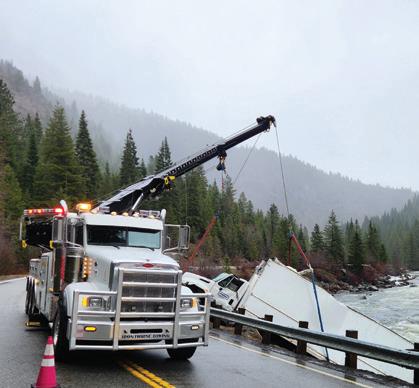
Raising a partially submerged box truck from a turbulent river not only required using unconventional methods, but also posed some vexing questions.
The American Towman staff continues to honor Steven L. Calitri, our Editor-In-Chief, who passed this last December. On the cover is a commemorative insignia, a tribute to a man who had a great passion for this industry and made a difference in the lives of so many towers.
Intrepidus Imperator is a Latin phrase that translates to “Fearless Commander”.
Riker
Randall C. Resch
Staff


Dennie Ortiz Publisher
We are extremely proud to announce that this year marks the 50th year that American Towman magazine has been published. We extend our sincere gratitude to all our readers and advertising suppliers for your continuing support. We couldn’t have reached this milestone without you.
To celebrate this historic achievement, each month our digital edition will feature a throwback article from one of our early issues. So, if you happen to be curious about the recommended methodology used to calculate the price of a tow back in the 1970s, you’ll want to visit the February 2026 edition of iTowman.com and find out for yourself.
Circling back to the here and now, George Nitti recounts in his article how a Texas tower avoided a potential catastrophe in his storage yard with an investment in a special piece of equipment that paid off in dividends. While mostly a happy ending, the story tells a cautionary tale about additional dangers of EV vehicle storage, and the necessity for greater training in this area.
The importance of keeping safety at the forefront, every minute of every day in this profession, cannot be understated. Towing Guru, Terry Abejuela, makes the case that a tower will develop muscle memory for safety procedures, while at the same time naturally increasing the speed in which they operate. Terry also discusses the various tools and equipment available to stay safe on the road all while continually reinforcing the importance of training, training, training!
Every tow, service call, or recovery poses its own risk, some more than others. Brian Riker, in his article, takes on the tall task of the fundamentals associated with towing bigger loads. Brian contends that working with buses and coaches are inherently precarious in nature, and drills down into the design of these large vehicles, along with the best practices on how to tow them.
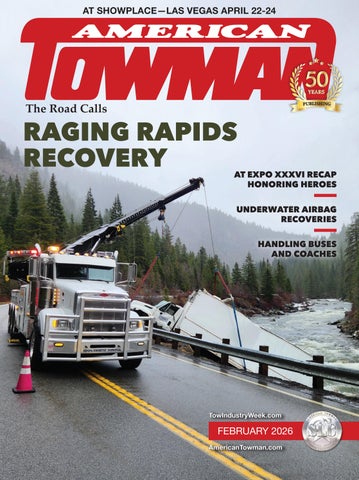
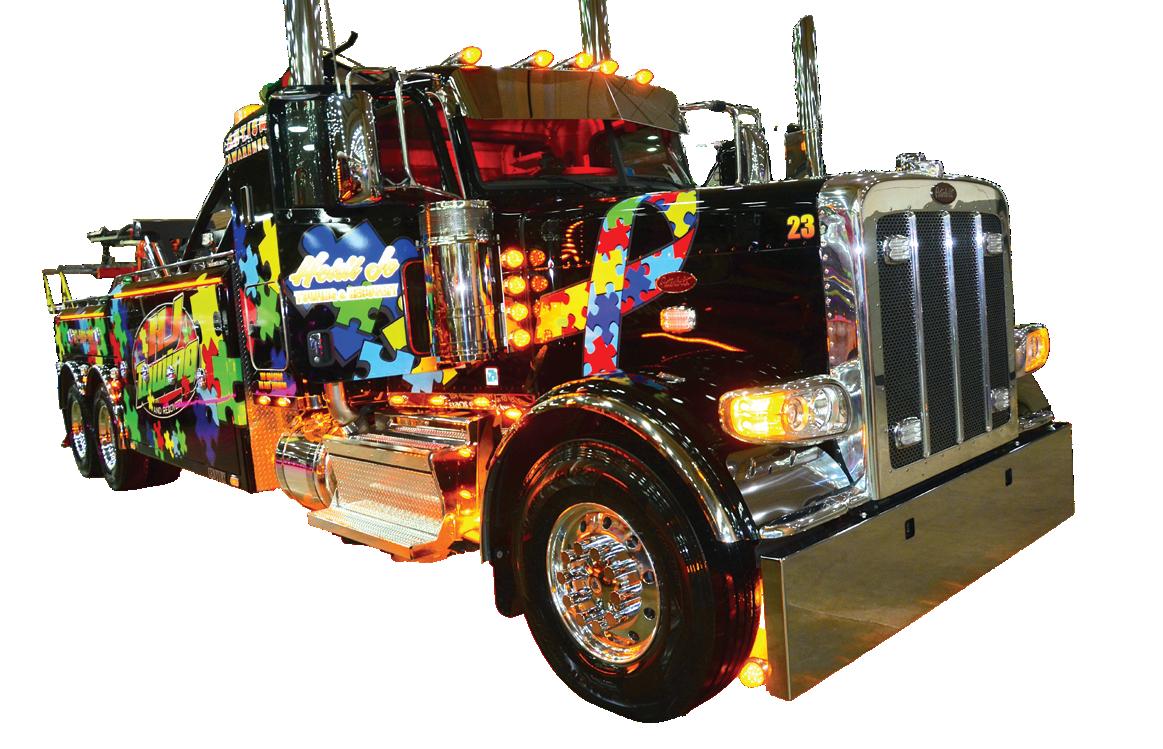
Right from the very beginning, the cover photo signals you are in for a recovery treat that’s spectacularly executed by Iron Horse Towing out of Missoula, Montana.
We hope you enjoy this issue and as always, stay safe out there!

Steve Temple Editor
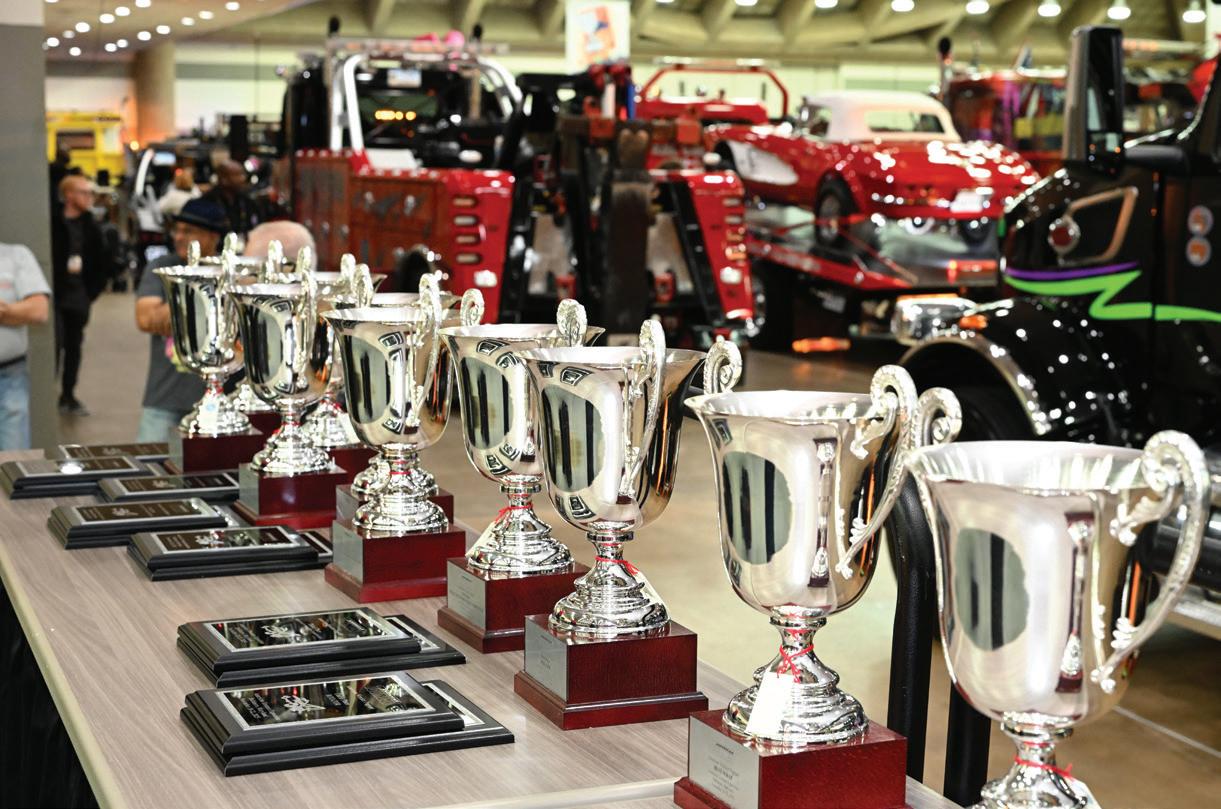
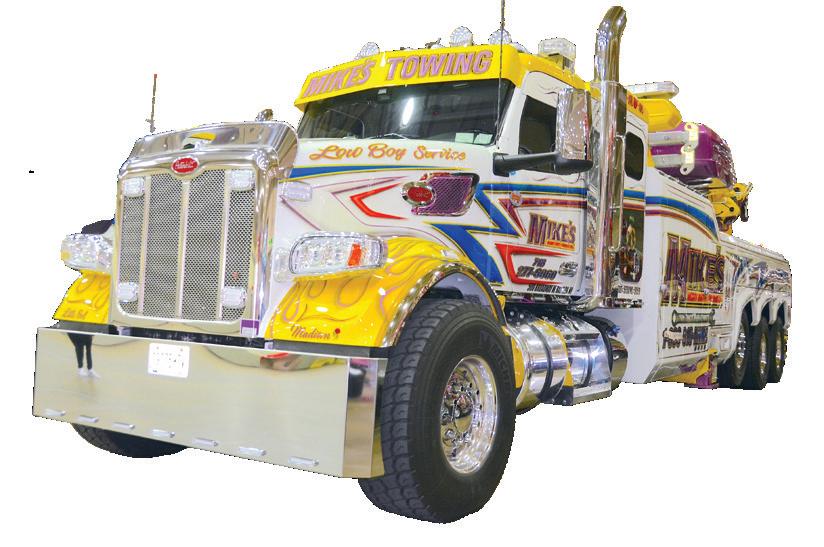
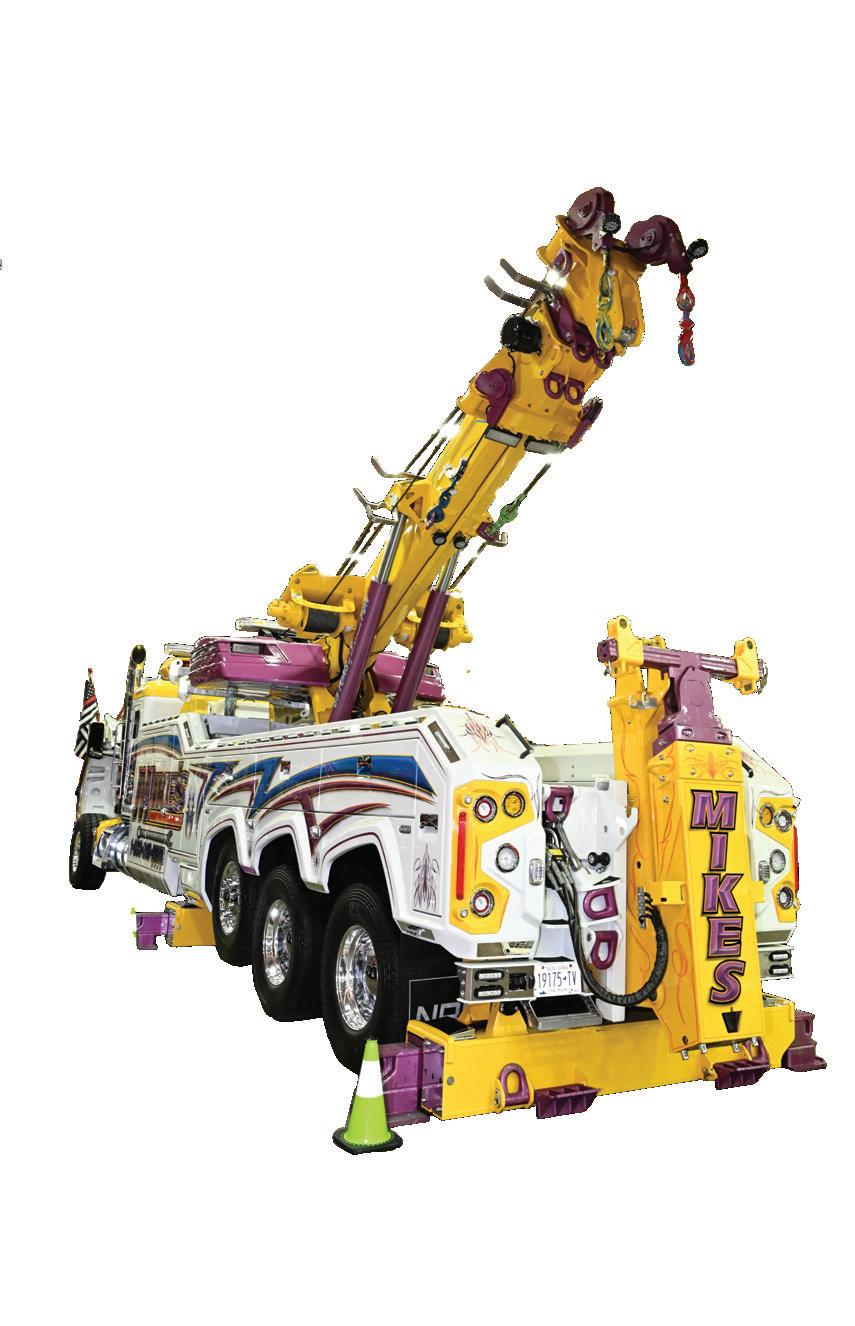
Every year, American Towman’s Wrecker Pageant is a huge highlight of the AT Expo in Baltimore, and featured in this issue. Our seasoned judges scrutinize all the entrants with a magnifying glass, looking for both bright spots and blemishes, in order to determine those that merit a trophy. Of course, not everybody can win, and deciding between a First or Second place trophy often comes down to razor-thin differences in execution, imagery, and presentation, along with having proper safety equipment and rating plates.
There are other factors as well, which our knowledgeable judges willingly share, such as with one entrant in the Vintage class who needed more periodcorrect components on his classic wrecker. (And after following the judges’ advice, the owner won a trophy the following year.)
Other less-obvious aspects are evaluated as well, such as how well prospective customers would respond to the graphic treatments. A tow truck might be slathered with dramatic imagery, but does this artistry promote the company in an effective and business-like manner? Or do the graphics overwhelm the company logo and contact info? This doesn’t mean a wrecker has to be a rolling corporate billboard, but it should help people easily remember who to call for roadside assistance.
Whatever your graphic theme, we certainly appreciate all the expense and effort that goes into prepping a truck for the American Wrecker Pageant, and look forward to seeing you there!
itowman.com
americantowman.com
towindustryweek.com americantowmantv.com

Ohio’s towing industry celebrated several legislative successes. Starting January 1, 2026, new maximum fees took effect for towing and storage of heavy-duty vehicles with a GVWR over 26,000 lbs. The Ohio Towing & Recovery Commission adopted proposed fees nearly verbatim: $410 for towing and $82 per day for storage, along with increases for existing two-tiers.
Lawmakers also passed SB 94, expanding the entities authorized to order tows, to include university campus police, park district police, and ODNR officers. The revised law clarifies that vehicle owners or lienholders remain responsible for towing and storage costs.
Notably, the tow industry successfully defeated the “Enterprise Amendment,” which would have capped fees for rental cars, allowed insurers access to impounded vehicles, and restricted title acquisition for abandoned fleet vehicles.
Source: Ohio Association of Professional Towers
A driver suspected of killing a tow truck operator in a hit-and-run crash on the 110 Freeway in Los Angeles has been arrested nearly two and half months after the deadly incident, authorities announced.
The collision occurred shortly before 3:00 a.m. on Nov. 2, 2025 in the Exposition Park area. According to the California Highway Patrol, the tow truck operator was assisting a disabled motorist at the gore point of the Exposition Boulevard offramp on the southbound side of the freeway. The tow truck’s amber warning lights were activated at the time. While the operator was outside the vehicle providing assistance, he was struck by a southbound vehicle. The operator suffered fatal injuries and was pronounced dead at the scene. The driver fled without stopping. Investigators later identified the suspect as Ander Perez of Los Angeles. On Jan. 13, an interagency task force involving the CHP and the U.S. Marshals Service arrested Perez. He was booked on suspicion of hitand-run causing great bodily injury and vehicular manslaughter.
Source: ktla.com
As vehicle thefts involving tow trucks rise in Los Angeles, Joshua Acosta of Pepe’s Towing Service is sounding the alarm about a growing trend in which thieves use self-loading tow trucks to steal vehicles, often stripping them for parts. Toyota Tacoma pickup trucks have become frequent targets, Acosta said, because they can be lifted quickly without the operator ever leaving the cab. Acosta explained that the thieves use rear cameras and power take-off (PTO) systems to control the tow equipment remotely, mimicking the methods of legitimate repossession operators. He urged motorists to watch for unmarked tow trucks, which are a major red flag. Legitimate trucks must display a company logo, motor carrier number, and U.S. Department of Transportation number.

Acosta said licensed tow operators are working closely with law enforcement to stop predatory towing and vehicle theft. He added that parking in a garage and using an alarm system remain the best ways to protect a vehicle.
Source: foxla.com
The Detroit Towing Association (DTA) is voicing strong concerns over proposed legislation currently before the Michigan House Regulatory Reform Committee, arguing the measures could harm an already highly regulated and dangerous industry.
The DTA opposes House Bills 5146, 5147, 5148, and 4149, which include provisions to cap towing rates. Association leaders say price caps unfairly punish responsible operators for the actions of a few bad actors. Towing, they note, is a hazardous profession with a fatality rate 15 times higher than the national average, and operators deserve to earn fair, market-based rates that reflect rising costs and risks.
Instead of price controls, the DTA recommends the creation of regional “Tow Rate Commissions,” modeled after Detroit’s existing system. Appointed by city councils, these commissions conduct market research and set benchmark rates, providing transparency without undermining legitimate businesses.
The association also objects to a proposal requiring drivers to obtain a contract from motorists before towing. DTA Vice President Julie Semma warned this could create dangerous roadside delays on high-speed roadways.
Representing Southeast Michigan towers with countless years of combined experience, the DTA contributes over $15 million annually to the local economy, and has invited legislators to ride along to better understand industry realities.
Source: einpresswire.com
Recent comments from Federal Motor Carrier Safety Administration (FMCSA) Administrator Derek Barrs highlights developments that affect anyone working along America’s highways. Speaking at the Transportation Research Board’s annual meeting, Barrs said research and technology are central to improving safety across freight corridors—the same roadways where tow trucks respond to breakdowns and crashes.
Barrs pointed to advances in telematics, automation, and vehicle-toeverything communication, emphasizing that innovation and safety go handin-hand. For tow operators, these technologies could improve hazard alerts, increase visibility around stopped vehicles, and enhance coordination between commercial trucks, law enforcement, and recovery personnel.
FMCSA is also strengthening oversight of electronic logging devices and expanding efforts to combat cargo theft. Those issues frequently place tow operators on busy shoulders handling recoveries, impounds, and evidencerelated tows. Technology that improves compliance and tracking may help reduce dangerous roadside encounters.
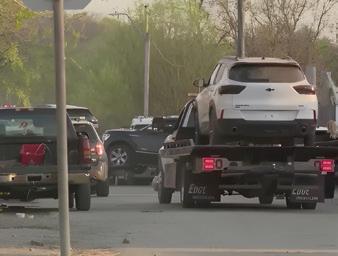
A Jackson County, Missouri judge has cleared the way for Kansas City to enforce new ordinances aimed at curbing predatory towing, rejecting a legal challenge brought by a local tow company owner. The law took effect January 1, 2026.
Judge Lauren Barrett recently ruled that the ordinances passed earlier this year do not violate Missouri state law.
The regulations include a new “Bill of Rights for Towed Vehicles,” which sets maximum towing fees, requires operators to provide vehicle owners with written notice of their rights, and allows drivers to stop a tow before it leaves private property. Mayor Quinton Lucas pushed for the changes after the city received numerous complaints from residents about towing practices.
“Kansas City will never stop protecting our community from predatory practices,” Lucas said in a statement, praising the court’s decision.
Tow operators have argued the rules expose them to new legal risks. Earlier this year, Private Party Impound and other companies sued the city, claiming the ordinance could force them to release vehicles to non-owners and conflict with state statutes. Operators have also voiced concerns about liability and lack of industry input.
Source: fox4kc.com
California drivers are being urged to pay close attention as an expanded Slow Down, Move Over law took effect January 1, 2026 strengthening protections for roadside workers and stranded motorists.
Under Assembly Bill 390, drivers must now move over or slow down not only for emergency vehicles with flashing amber lights, but also for any stationary highway maintenance vehicle or stopped vehicle displaying hazard lights. The law also applies when warning devices such as cones or road flares are present.
Previously, the rule was limited in scope. The update broadens responsibility for drivers traveling on highways and freeways, especially in construction zones or near disabled vehicles on the shoulder.
Source: newsbreak.com
Beginning January 1, 2026, motorists with multiple unpaid parking tickets can have their vehicles towed without warning if they park illegally again. The tougher rules impose a $150 towing or initial storage fee, plus $25 for each additional day the vehicle remains impounded. Drivers must also pay outstanding tickets or schedule a court date before their car is released.
The ordinance took effect November 1, 2025, but city officials delayed enforcement for two months to give drivers time to catch up on unpaid citations. During that period, Milwaukee mailed warning letters to roughly 23,000 drivers who had five or more unpaid tickets, advising them to clear their balances within 60 days.
According to TMJ4 News, tens of thousands of drivers could be affected by the crackdown. Some residents say the change has already come as a shock.
“Please park legally,” said Alderman Scott Spiker. “And if you don’t, please pay your tickets—or we’re going to be towing your vehicle.”
Source: the-sun.com
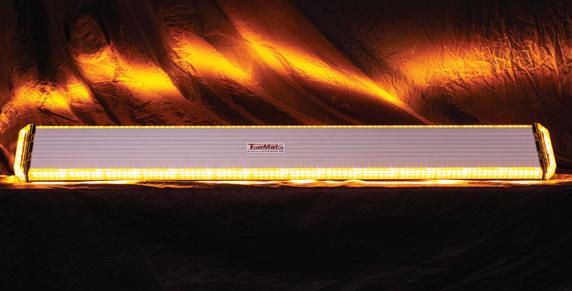
TowMate, a world leader in wireless tow light technology since 1985, announced the launch of the Infinitra Quad-Color Light Bar, a nextgeneration overhead warning light system. Powered by TowMate’s new Power-Link 2.0 two-wire technology, this 58-inch unit is engineered to deliver flexibility, visibility, and control for towing and recovery professionals. It provides total pattern control, adjustable intensity, and on-the-fly color configuration.
Designed, engineered, and manufactured in Rogers, Arkansas, Infinitra is built for demanding real-world conditions and backed by TowMate’s Lifetime Warranty. Infinitra is also part of TowMate’s next generation of Power-Link lighting, Power-Link 2.0, a simple and installer-friendly two-wire technology that transmits control signals over the power wires themselves. This eliminates the need for bulky ten-wire or greater stranded control cables, making installation faster, cleaner, and more reliable. Available in either Amber, Red, White, Blue or Amber, Red, White, Green configurations, the Infinitra can instantly be adapted to different job-site conditions and jurisdictional requirements with the ability to change color configuration on the fly, without downtime or complicated rewiring.
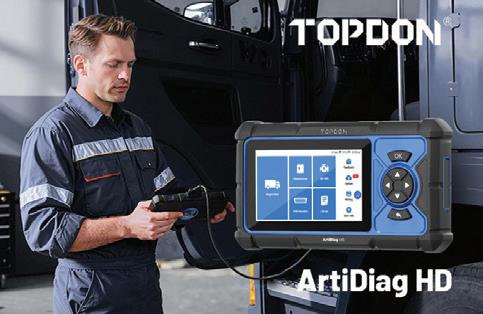

TopDon’s ArtiDiag HD is a rugged, commercial-grade scan tool built for the demands of tow fleet managers, mobile repair crews, and professional technicians. This five-inch unit delivers full-system coverage for 60 heavyduty brands, and runs essential maintenance such as DPF regeneration, urea drive resets, oil resets, and SCR resets, keeping tow vehicles running at peak performance. Powerful, reliable, and cost-effective, the ArtiDiag HD helps to fix issues faster, cut downtime, and keep a fleet moving.
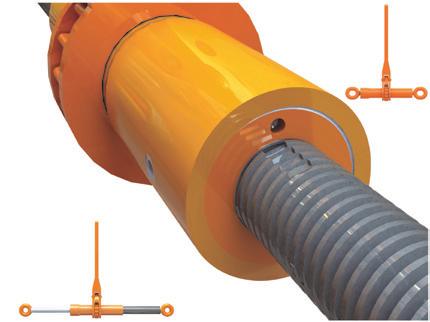
Doleco’s re-engineered DoRa Gen 2 telescopic load binder provides both speed and flexibility for flatbed operators, while preventing spindle overextension. This manufacturer of lifting sling and load-securing technologies announced that its DoRa Gen 2 Ratcheting Load Binder features significant engineering improvements, delivering 33 percent quicker tensioning and de-tensioning, as well as enhanced, patent-pending safety mechanisms. The Gen 2 model maintains the original DoRa’s patented telescopic design while adding critical operational improvements that make it a faster and more versatile manually operated load binder. The DoRa Gen 2’s re-engineered thread pitch advancement enables operators to achieve four millimeters of spindle movement per 360-degree rotation, instead of three, resulting in faster tensioning and release times. This improvement significantly reduces the physical effort and time required for both initial load securing and periodic re-tensioning during transport. In addition, the DoRa Gen 2 incorporates advanced safety features including visual marking indicators and an unscrewing protection mechanism. As operators extend the internal spindle, visual markers alert them when approaching maximum extension, while the mechanical lock prevents complete spindle separation — eliminating the time-consuming and potentially hazardous situation of bent spindles, or having to reassemble separated components in the field.
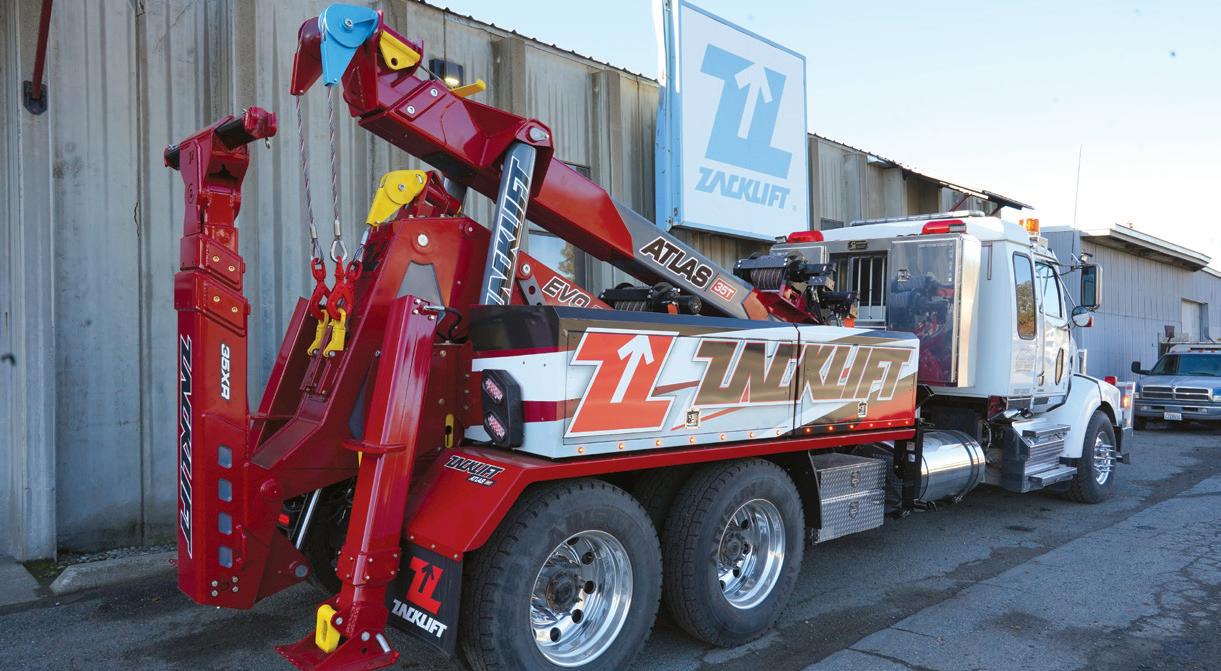
Zacklift’s ATLAS 35T represents the next evolution in detachable towing technology. It’s both a DTU (Detachable Towing Unit) and a DWU (Detachable Wrecker Unit), so it’s similar to a full conventional wrecker—but detachable. Designed for today’s professional hybrid operators, the ATLAS 35T delivers true independence between boom and underlift, giving unmatched flexibility for not only heavy-duty towing, but also complex recoveries.
This unit features a purposebuilt, independent 35-ton boom system and a patent-pending EVO 35K underlift. Engineered for maximum level height, weight distribution, and efficiency, the ATLAS 35T redefines what’s possible in a detachable towing and recovery system.
The new EVO 35K underlift features advanced geometry that moves the load forward while lifting, reducing the need for long wheelbases while also improving balance. With an impressive 48 inches of level lift height, the EVO 35K underlift provides one of the highest level-lift capabilities on the market, allowing operators to perform
precision recoveries with a smoother, faster setup and better load control.
All of this comes in the compact, durable design Zacklift is known for. The independent 35-ton boom gives operators the reach and power needed for large-scale recovery and lifting operations. Zacklift’s exclusive boom stinger design delivers more lifting strength at longer extensions than many wrecker booms, offering exceptional capability with minimal added bulk or weight.
Like all Zacklift detachable systems, the ATLAS 35T offers easy installation and quick changeover. It’s a modular, customizable system that can be permanently mounted or used as a detachable unit for maximum flexibility.
Every ATLAS 35T comes complete with five sets of forks and fork holders, safety chains, and a wireless remote. Optional accessories include modular toolboxes, winch upgrades, wheel lift, fifth-wheel ball/pintle hitch combo, and the new 35XR extended-range underlift.
The Zacklift ATLAS 35T with

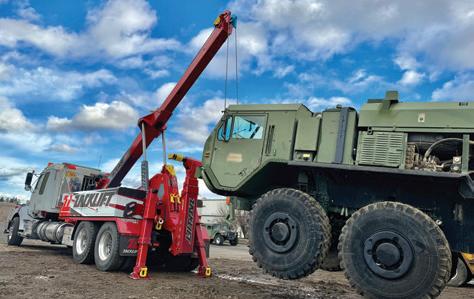
EVO 35K underlift offers the next generation of heavy-duty detachable towing technology, engineered to give operators maximum capability, flexibility, and return on investment.
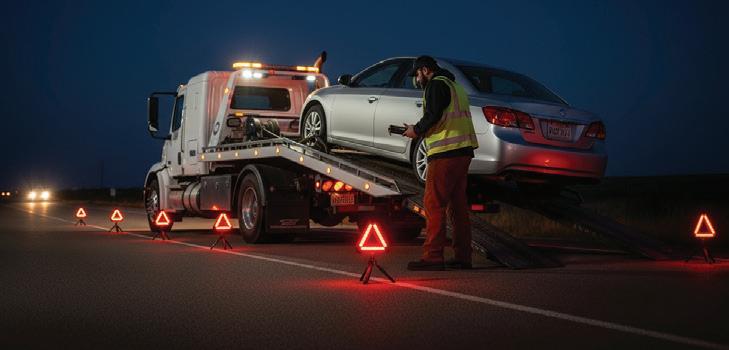
By Terry Abejuela
TUnfortunately, tow operators in training classes often admit that “I don’t have time to do all that safety stuff.”
Field Editor Terry Abejuela has 40-plus years of light-duty towing and recovery experience. He is also a light-duty Level 1 instructor for the California Tow Truck Association.
ow truck operators put their lives on the line everyday across the nation in one of the most dangerous environments of any profession. Working near high-speed traffic with unpredictable motorists in all kinds of weather conditions is a recipe for disaster. Combine that with operating heavy machinery such as hydraulic booms and winches, along with chains, hooks, and wire ropes, and the hazards grow exponentially. Avoiding danger requires skill, experience, and training, along with the right safety equipment that often makes the difference between a routine call and disaster.
Atow truck operator’s most important piece of safety equipment is their attitude. Safety equipment only works if it is used properly and consistently. Safety must be practiced on every call so that it becomes muscle memory, virtually an automatic response.
In reality, those who practice performing the job the safest way possible on every call, will develop speed with repetitiveness. Performing the job perfectly each and every time becomes the norm—not the exception. Operators, dispatchers, and managers must always prioritize safety above all else. There is an abundance of safety equipment available for tow truck operators to improve safety. Space doesn’t allow for covering them all in this article, but tow operators and company owners attending American Towman’s tow shows around the country can check out some of the latest and greatest safety equipment all under one roof.
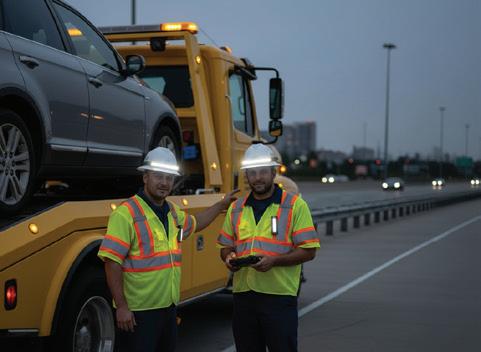
It’s abundantly obvious that PPE (Personal Protective Equipment) such as ANSI Class 3 compliant gear should always be used when appropriate. This includes high-visibility garments, gloves, safety-toe work boots, safety glasses, hard hats, and the often overlooked ear protection.
Effective lighting is another key consideration. Not only to warn approaching motorists of a hazard in the roadway, but also to illuminate the workspace and enhance visibility of the tow truck tow operator.
Familiarity with all federal, state and local laws pertaining to the use of lighting in towing and recovery operations is also an essential part of any tow

operators job. Most states regulate the color of emergency lighting that can be displayed, as well as when it’s allowed to be utilized. In California, for example, a tow truck operator is only allowed to display flashing amber warning lights when an unusual hazard exists. Using emergency flashing amber lights when no unusual hazard exists can actually create a hazard. Minimize the use of emergency lighting when possible. For instance, if a hazard is only affecting traffic in one direction, only use emergency light facing the affected traffic.
Another option gaining in popularity in the towing and recovery industry are Variable Message Sign (VMS) boards. These boards can be folded down when not in use, then raised up to display a large message for motorists in various fonts. Its value clearly was shown in a 2023 study by the AAA Traffic Safety Foundation which found that the odds of a motorist moving over were 95 percent
higher when a VMS was used.
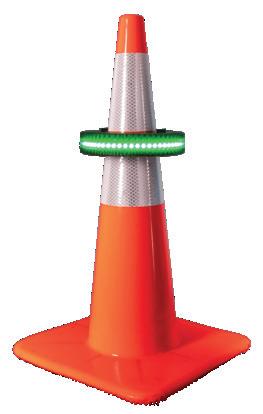
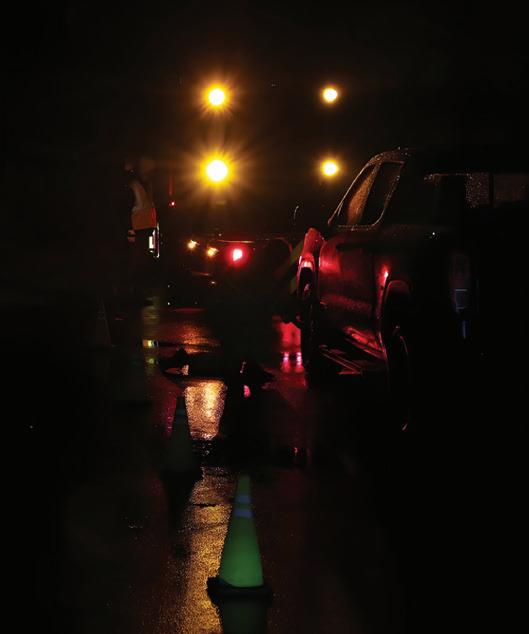
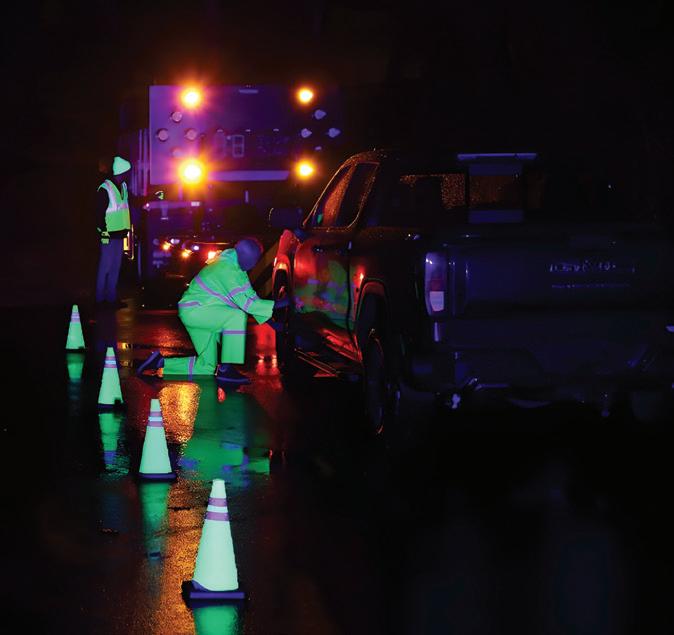
There are other ways to alert motorists as well. TowMate makes a worker safety light that utilizes High Intensity Non-Visible Intelligent Illumination (HINVII) technology. This light emits a non-visible ultraviolet light that causes the high visibility material in ANSI Class 3 garments to glow without impairing roadside workers’ vision. This light can be mounted on the tow truck or used as a cone mounted light.
TowMate also makes a Safety Alert System (SAS) to notify operators when a vehicle has entered their workspace. This system uses a rubber air hose attached to a transmitter that sends a wireless signal to a receiver attached to the tow truck’s horn when a vehicle runs over the air hose. The hose is placed on the roadway inside of the traffic cone pattern and to notify an operator when a vehicle has breached this pattern.
Vehicle breakdowns often occur in the most dangerous locations on
the roadway—in traffic lanes, on narrow shoulders, or on the blind side of a curve or hill. Work zone markers are essential to ensure the work area is clearly defined and visible. Equipment such as traffic cones, road flares, and advance warning signs can be used to enhance tow operator safety.
Tow operators need to be familiar with the federal and state MUTCD (Manual on Uniform Traffic Control Devices) before deploying these work zone markers. When used properly, these devices safely funnel traffic away from a work area, and create a more predictable driving environment for motorists.
Safety Cloud by Haas Alert is a digital system that notifies nearby or approaching vehicles of an incident or hazard ahead. The system works by installing a small transponder or activating a telematics or fleet management platform which sends out an alert when the emergency lights on the tow truck are activated. Studies show that using Safety Cloud reduces the risk of a collision by

90%, and reduces sudden stops or hard braking by 80%, according to Haas Alert.
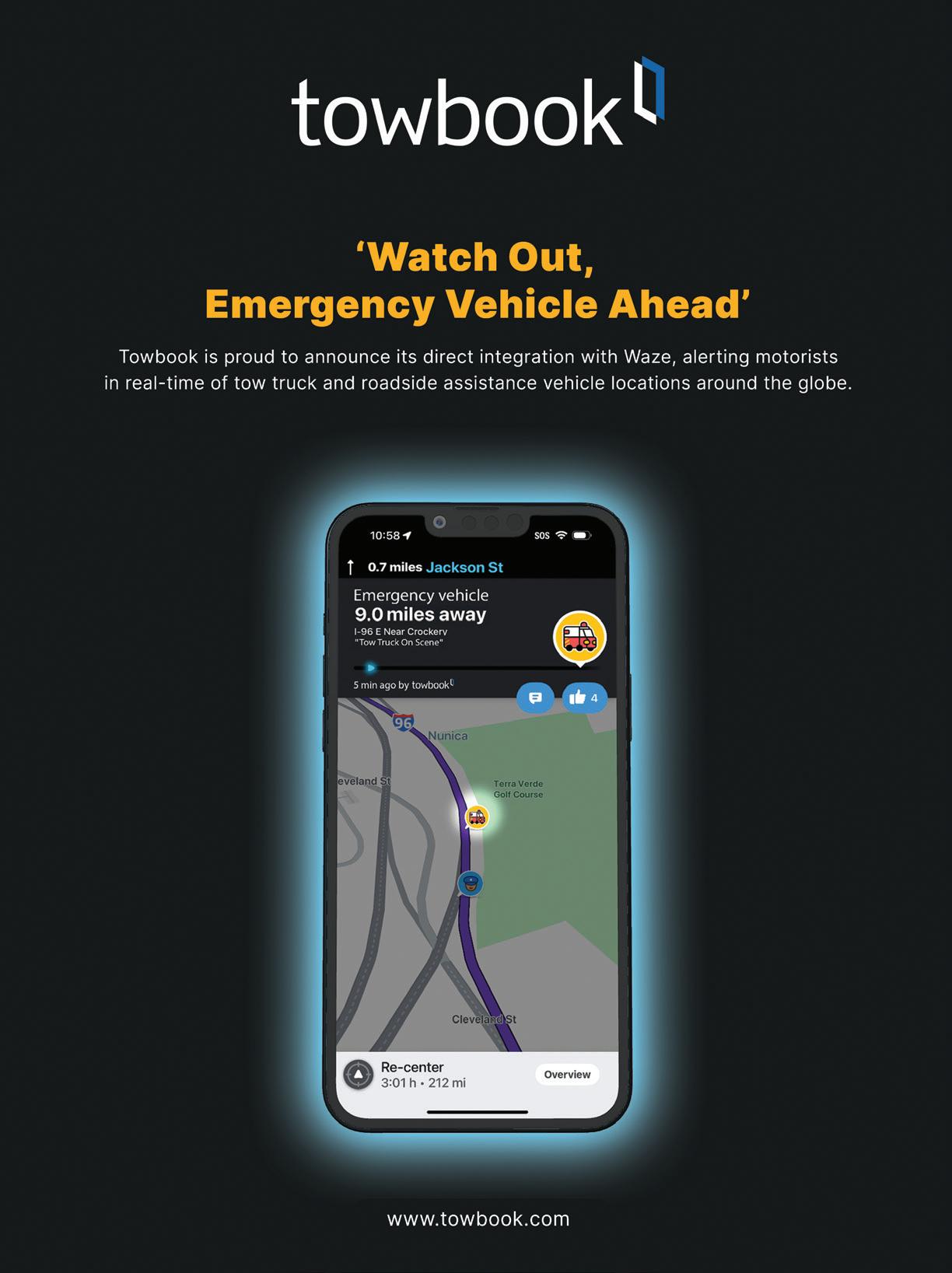
In addition, Towbook just announced its direct integration with Waze, alerting motorists in real-time of tow trucks and roadside assistance vehicle locations around the globe.
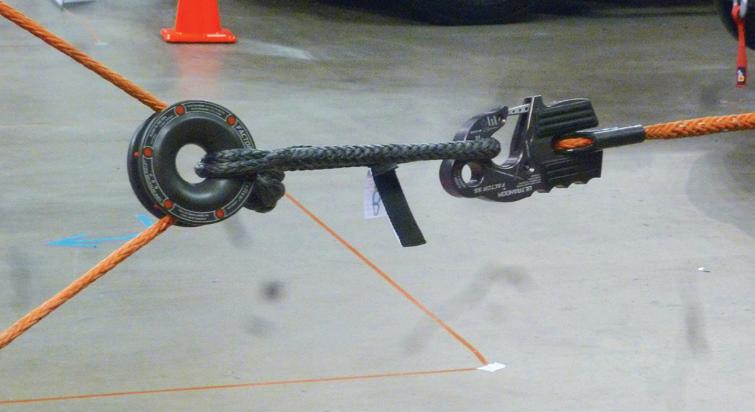
Synthetic winch ropes, synthetic chain, and soft shackles can be used in place of traditional steel winch ropes, chain and shackles. Synthetics are gradually working their way into the towing and recovery industry and can improve safety since they are lightweight, strong, and less likely to result in injuries if they fail under a load.
Even the best and most expensive safety equipment will not improve safety if it is not used correctly. Tow operators must be thoroughly trained, and provided with all the operation, inspection, and maintenance information from the equipment manufacturer. Tow managers should conduct frequent safety meetings, and after-action reviews of performance in the field. Encourage reporting of near misses, and recognize employees who demonstrate safe practices in the field.
The towing and recovery industry is inherently dangerous but with investment in the right equipment, technology, training, and safety processes, tow truck operators can dramatically reduce their exposure to the hazards. By staying current with industry best practices, adopting new technologies, and reinforcing safety through training and company culture, tow operators can protect themselves while still delivering the life-saving service their communities depend on.
By Brian J. Riker
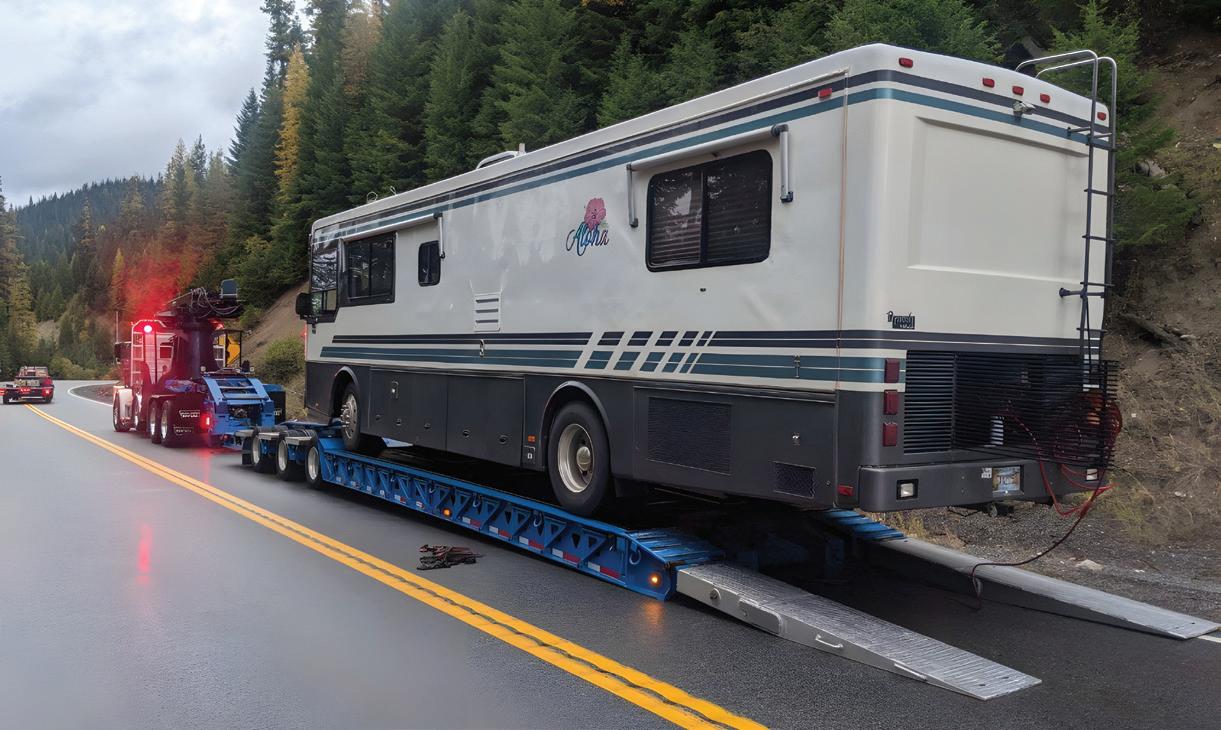
Every reward begins with risk, or at least that is how it is supposed to work. With that in mind, some of the riskiest tows completed every day involve buses and motorhomes. They simply aren’t as structurally robust, or as straightforward as the typical big-rig or box truck. Accordingly, safely managing these specialized vehicles requires a combination of extreme caution, training, education, and experience to allow a tow operator to safely handle these unique vehicles.

Brian J. Riker is a thirdgeneration towman, with 30 years of experience in the ditch as a tow operator, and president of Fleet Compliance Solutions. He specializes in helping navigate the complex world of federal and state transportation regulatory compliance. He can be reached at brian.riker@ fleetcompliancesolutions.net
Buses come in many shapes and sizes, each with their own distinctive challenges. Even the most rugged of all buses, the school bus, can cause problems for an inexperienced tower.
There are three basic designs that encompass all the buses and motorhomes on the roads in North America.
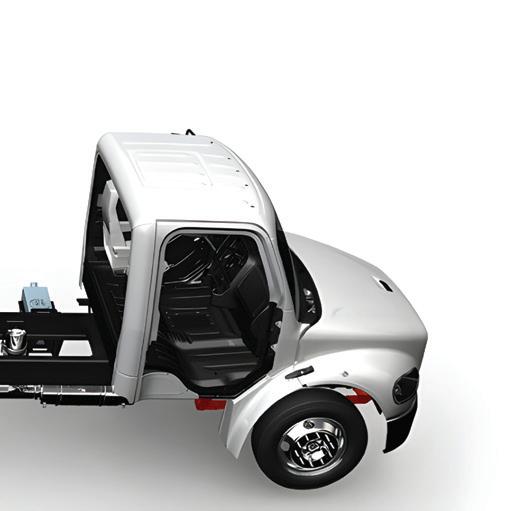
The cutaway-chassis design is a conventional class 4 -7 truck platform that has been partially stripped to accept a bus body mounted on it. This design is typically found on school buses, airport/ hotel shuttle buses, limo buses, and class B and C recreational vehicles.
The third design is the integral
The body-onframe design uses a custom-built frame, usually very similar to a class 7 or 8 truck frame, with a body mounted on it. This makes up the bulk of the class A motor home world, along with some school, commuter shuttle, and party bus designs.
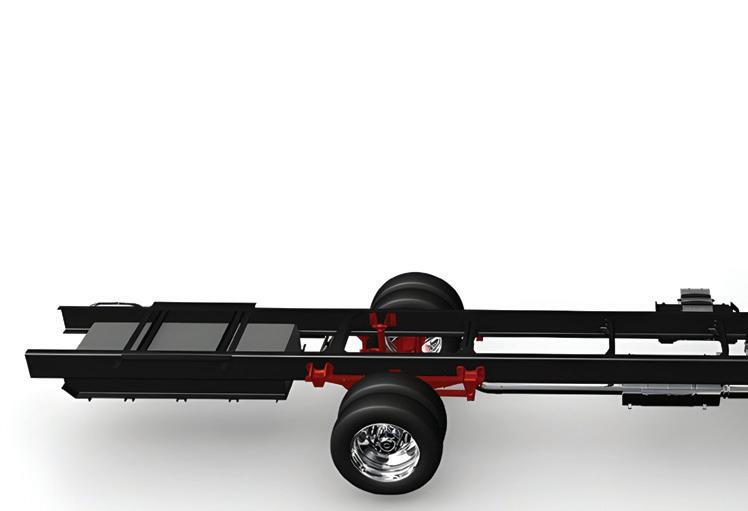
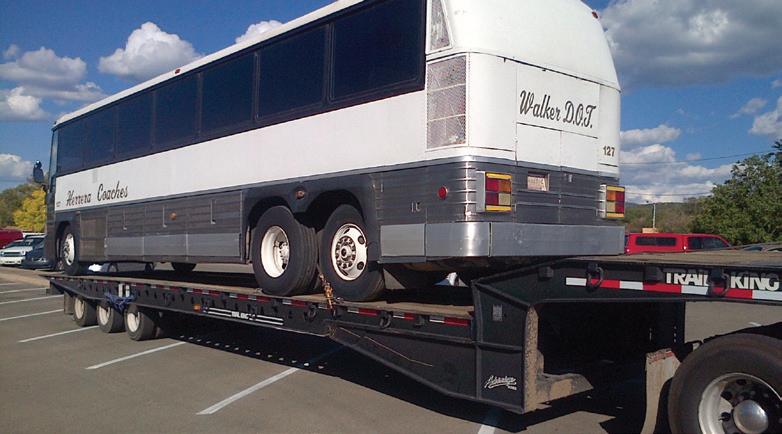
(monocoque) or unibody design. This type is popular with luxury coaches, long-haul coaches (like Greyhound), and city transit buses, and derives its structural strength from a stressed-skin design, similar to an airplane fuselage.
These configurations usually have a flat-front with large windows, giving them a similar appearance to the integral/unibody designs, although with much less structural integrity than the unibody design despite having a strong truck frame underneath.
While this design is often familiar to tow operators—because of the use of many components similar to typical truck chassis—it still presents some challenges. Most notably, these include supplying air (to the pneumatic system, due to its relocation), parking brake interlocks, and other passenger safety features that make accessing these vehicles difficult.
With long, rear overhangs, these designs are difficult to maneuver, lift too high in the front can cause dragging of the rear bumper or exhaust on the ground. Rear
Cutaway chassis designs can pose a difficulty when towing due to low ground clearance of the rear bumper and exhaust. Or if rear towing, overhead clearance can become worrisome when a tow operator is trying to keep the rear axle off the ground.
RV units often carry fresh and wastewater, which if not handled correctly can pose a health hazard to both the tow operator and the customer. Never open any drain or fill ports for the waste or freshwater system without fully understanding how the system works on that specific RV, otherwise there is the risk of cross-contaminating the systems. Further, during crash and winch-out conditions, check for low-hanging pipes and holding tanks that are easily damaged. Your author once learned this the hard way and took an unplanned bath in black water (the contents of the solids tank) when uprighting a rolled-over RV due to failing to doublecheck the tank integrity before beginning the upright procedure. Needless to say, it took several long showers over the next week to finally feel clean again.
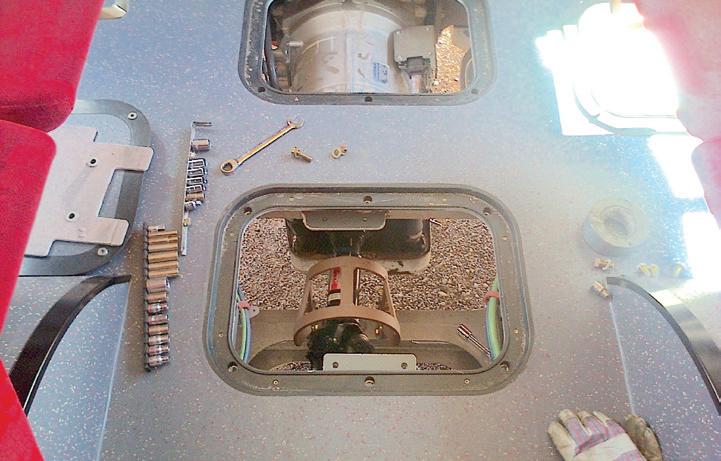
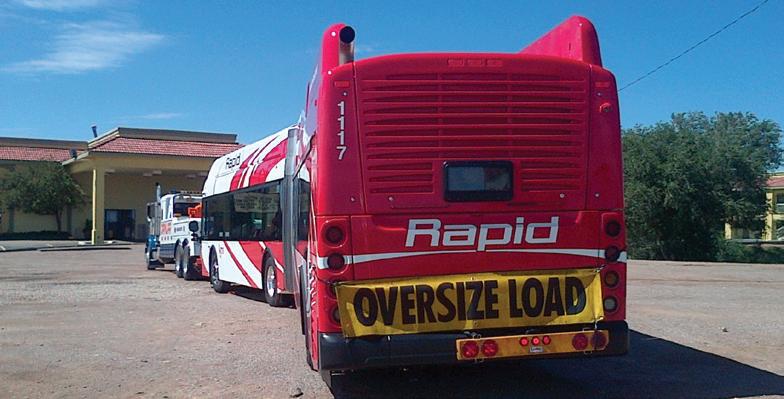
City buses, especially electric or hybrid buses, may have unique drivelines and axles that require special procedures or tools to disengage, and have an inside floor hatch for access.
towing is very difficult due to how far the axle is from the rear bumper, and not all frames are suitable for using forks.
When attaching to these units for towing, the frame rails must be carefully examined for signs of bolted-on extensions or a reduction in frame-rail size, which would indicate that the frame is
not suitable for lifting, winching, or towing. If in doubt, use a bus lift attachment (tire/wheel lift) for towing, and consider attaching recovery straps through the wheels for winching.
Winching this style of bus or RV can be challenging because, like many buses or RVs, even just a little flex can damage
windows or knock door panels out of alignment. It is important to keep all forces spread out and equal to reduce the chance of twisting.
Many of these units use plywood or other laminate material, including fiberglass, to make up the bulk of the body structure. This construction makes them very easy to damage, even just by striking a low hanging tree branch while towing or pulling the front facia through snow or sand. Prior to offering any service, including mobile repairs, always inspect the body thoroughly for signs of cracking, water intrusion (which can lead to swelling and weakening of the laminate layers), and twisting or distortion from prior service events that were completed improperly.
Cutaway designs that retain some of the appearance of a traditional truck or van, but the rear of the cab has been removed and a passenger compartment attached, can be the easiest of all buses to tow or service. Since most of the mechanical components are the same as traditional class 4 to 7 commercial trucks, towers will be very familiar with the component locations and design of these systems. That said, it is not all easy-peasy, as these units have some unique challenges to overcome, as do all buses or RVs.
Due to of the safety sensitive nature of passenger transport, these chassis often have modified parking-brake interlock systems which can be challenging to disable or bypass for towing, especially hydraulic brake units that use electric systems to activate a parking mechanism every time the vehicle is parked or the door is opened. School buses are noteworthy for this parking brake interlock.
Cutaway designs also pose some challenges for winching because of how the body is mounted to the frame. Unlike trucks, a bus body may not have any gaps around or above the frame rails to wrap chains around, making attachment for winching more difficult. ◀
Further, many of the body-onframe designs, cutaway, or purpose built, as in the first design discussed, use body mounts that are designed to shear-off in a collision (in order to absorb energy). While this design is great for passenger safety, it poses a challenge to recovery operators when cleaning up a bus wreck or trying to winch one back onto the roadway without causing additional damage.
As with a body-on-frame chassis, cutaway designs can also pose a difficulty when towing due to low ground clearance of the rear bumper and exhaust. Similarly, if rear-towing, overhead clearance becomes worrisome when a tow operator is trying to keep the rear axle off the ground.
Many of the safety measures
used for body-on-frame design are applicable with a cutaway chassis RV design. RV manufacturers prefer using laminate materials because they are lightweight and easy to install during the assembly-line process. However, as mentioned, they do not retain strength well during collisions and off-road excursions. Towers must be aware of the condition of the RV body before attempting to provide any service, especially service that involves lifting or jacking up the unit.
This design is purpose-built just to be a bus or motorhome. Almost exclusively rear engine or electricdrive units, these are frameless
flex when lifted from the rear, which is especially critical with rear-engine coaches and unibody designs.
designs, using the body structure of the passenger compartment itself to form a frame to support the engine, steering, suspension, and other components. These designs, while lightweight and overall very rugged, are susceptible to damage from winching or towing.
Without the solid-steel frame rails, as found on other bus designs, these designs rely heavily on the body-skin panels for structural integrity. This makes these designs very easy to twist and crack. The goal of the manufacturer is to make a lightweight product that has good collision survivability for the passengers, which this design excels at, but that energy absorption and lightweight nature comes at a cost— being susceptible to damage when towed or winched incorrectly.
Many older versions of these bus designs used sections of lightweight aluminum bolted or welded together with just an engine and suspension mounting cradle at each end for the driveline and steering/axle components. They typically didn’t have adequate solid attachment points for lifting, winching, or even towing. Updated designs have better tubular frame designs, although they still rely heavily on the body panels for overall integrity.
Towing these designs is best
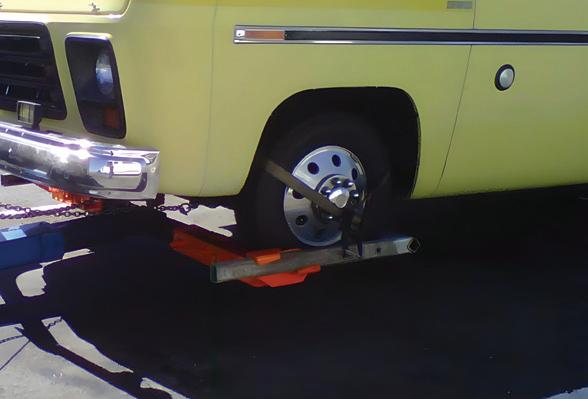
accomplished from the front, since most manufacturers prohibit, or at least strongly discourage, rear towing. The reason is that the bus is designed for force to be applied in a specific direction. A tire or wheel lift is the preferred method, and many designs include a towing fork attachment or solid bar designed for using an underlift with axle or bus forks.
Perhaps the best part of this design is most manufacturers have included air connections in the front, usually near the driver compartment, that will air up the suspension, release the parking brake, and allow for activation of the service brakes. This is important because unlike body-on-frame or cutaway designs, there is no ◀

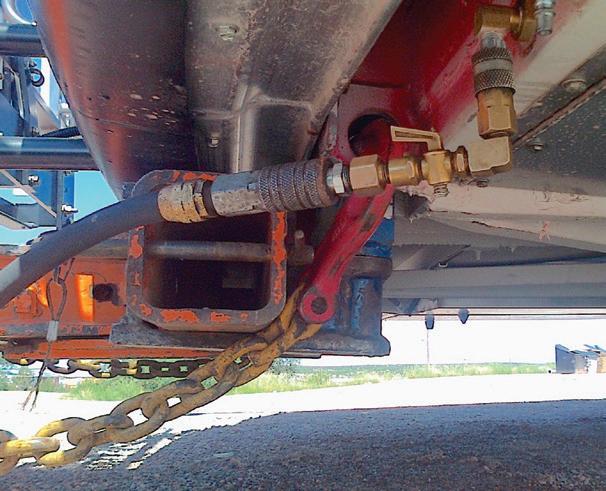
easy way to run an air-supply line all the way to the rearmounted engine.
These vehicles are not very common, outside of large metropolitan areas, due to their slow speed and extralong configuration. They will always have rear-engine or electric drivetrains, usually with planetary axles. Outside
of the extra length and the midship pivot point, these are handled much the same way as any other city transit bus.
The most important consideration is not lifting the front of the bus too high off the ground, as it could damage the pivot coupler. The most common manufacturer of this design, New Flyer, recommends not to exceed a 10-degree angle to avoid turntable damage. It is often best to flat-tow these buses to avoid any concern with the pivot point/turntable design.
As with all any towing or recovery jobs, there are inherent hazards that must be carefully considered and managed. Buses and RVs are no exception, and their unique design, often unfamiliar to towers, can pose even greater dangers.
Always block/chock the wheels prior to getting under the unit for any reason. Given the differences in the parking and service brake systems, it is imperative to eliminate the chance of a bus rolling away while hooking up, removing the driveline, or performing any service.
Always take control of the unit and remove any passengers prior to performing any service. Many buses, especially commuter, city, and long-haul units, do not have traditional keys. This allows for a bus to be started while a tow operator is working on it, which could be very dangerous.
Also, many rear engine units have a remote start in the engine compartment that could pose risk to a tower while servicing the bus or RV. Always ensure full control of the bus before beginning any work!
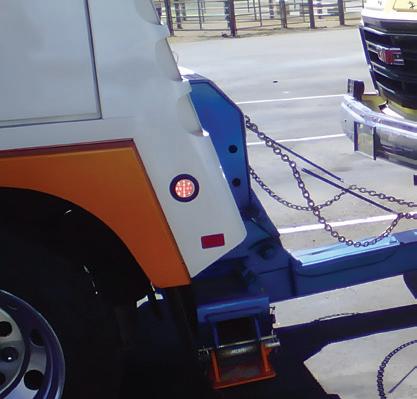
Installing tow lights can be problematic, but still must be done. Unlike trucks, buses and RVs don’t
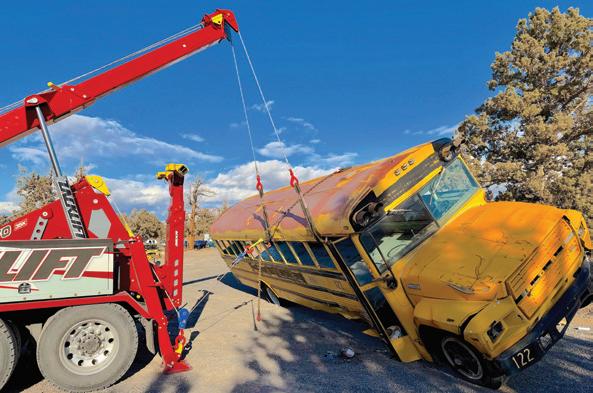
School buses typically have a cutaway-chassis that is a conventional class 4 - 7 truck design, with parts removed to allow a bus body to be mounted upon it. Even so, buses come in many shapes and sizes, each with their own distinctive challenges that can cause problems for an inexperienced tower.

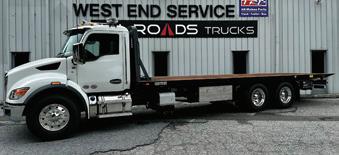
New 2026 Kenworth T480 6X4 with a Century 28’ LCG20W HS/EP Paccar PX9 370HP, Allison 3000RDS 6-Spd Auto, Century 28’ LCG20W-HS/EP

New 2025 White Pete 567 Tri-Axle with Century 28’ LCG30W 10K 3-Stage Wheel Lift, Cummins X15-565hp/1850lb-ft, Allison 4500RDS, 30K Deck

New 2026 White Freightliner M2 4x2 33K GVW with a Chevron 30’ Alum-4-Car, Cummins L9360HP, Allison 6-spd Auto, Air Brakes, Air Ride
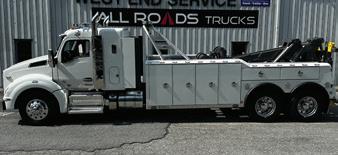
2026 White KW T880-Slpr 6x4 With Century 5130 (25ton) Wrecker, Cummins X15 565hp/1850, Allison 4500RDS Auto, Loaded...
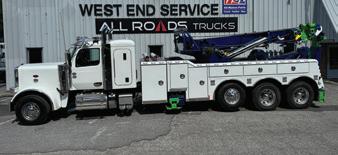
New 2026 White Pete 589XD Cummins X15, Allison 4700 Automatic with Century 1150 (50ton), Rotator-Knee Boom Wheel Lift, Loaded…
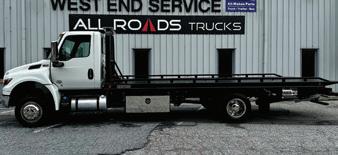
2025 Int’l
21’6”
Please check out more Wrecker & Rollback inventory at Truckpaper.com-All Roads (Wrecker & Rollbacks)

usually have readily available places to attach a strap or bungee cord for supporting a lightbar.
Fortunately, many RVs have twoinch receiver hitches, so if you handle a lot of these vehicles, consider getting a trailer hitch adapter for hanging a light bar. Rear engine coaches usually will have vent louvers that can accommodate a bungee cord, but many long-haul coaches are fairly barren in the rear, and require getting creative with ratchet straps or suction cups.
City buses, especially electric or hybrid buses, may have unique drivelines and axles that require special procedures or tools to disengage. Planetary gears are common on city buses, so it may be necessary to seek the assistance of the mechanics that work for the transit agency for disabling these drivelines. Often these units will also have an inside floor hatch that makes accessing the driveshaft easier than laying underneath the rear axle.
Towing and servicing buses and recreational vehicles can be very rewarding, when done properly. These are not every day tows, so special tools, procedures, and training are a must. Most transit agencies and bus companies are willing to share service manuals and special techniques with their tow providers. It is a best practice to reach out to these firms prior to towing their units, especially if an operator is new to towing buses.
RVs are a little more challenging because there is a definite lack of good technical publications addressing the hookup and winching points, plus an RV is often somebody’s largest investment (second to their home). As such, they should be treated with “white glove” service. Damage claims are very common with RVs, so these tows should be assigned only to the most experienced and competent operators.

Operations Editor Randall C. Resch is a retired California police officer and veteran tow business owner, manager, consultant and trainer. He writes for TowIndustryWeek.com and American Towman, is a member of the International Towing & Recovery Hall of Fame and recipient of the Dave Jones Leadership Award. Email Randy at rreschran@gmail.com.
By Randall C. Resch
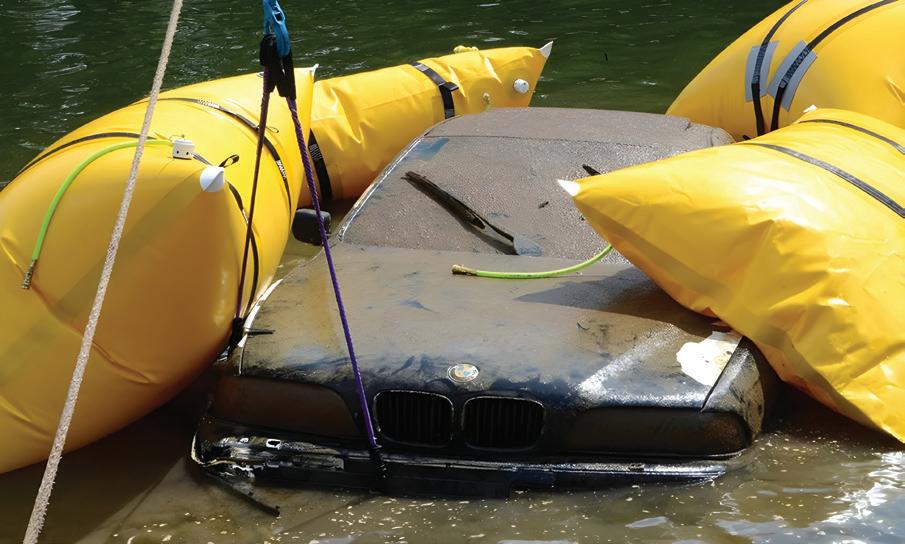
When tow operators think of utilizing an airbag recovery system, they often deploy them to upright overturned big rigs. Yet, another practical use of airbags is for raising submerged vehicles.
This particular application actually dates back quite a few years. John W. Hetrick, an industrial engineer for the U.S. Navy, worked with pneumatically filled bladders for underwater lifting. Ultimately, Hetrick patented his “Safety cushion assembly for automotive vehicles” in 1953, leading to the development of airbag systems found in today’s automobiles, and estimated to have saved tens of thousands of lives.
Air-flotation devices have a personal connection for me as well. My father, Raymond R. Resch, was a U.S. Navy, Chief Warrant Officer whose career spanned some 30 years as a rescue diver, hard-hat salvage diver, and ultimately the “Officer in Charge” of the Navy’s Hard Hat Diving Barge San Diego, CA. His specialty was rescuing sunken and crippled submarines lying on the ocean floor.
In the early 1940s, Dad’s rescue ships were outfitted with four to six, gigantic air pods, lowered to a disabled submarine’s depth, chained to the submarine’s port and starboard sides, and then filled with air to float the stricken vessel to the surface.
Following his many years of service, my folks were owners of La Jolla Towing in San Diego, CA. Raymond’s extensive background in salvage added immense value to his practical instructions on towing, recovery, and salvage. It wasn’t until 1981 that John Sweezy, Jr. of Matjack, introduced airbags to the towing industry. Since then, a number of other airbag manufacturers have emerged as well.
When it comes to the techniques of water recoveries with airbags, they demand careful planning, specialized equipment, and calculated execution where there’s little margin for error. Not typically taught by tow industry training courses, professional diving skills can be learned by motivated tow operators. The other option for towers is to hire a certified dive team with proven salvage experience in underwater hookup and rigging.
Airbags are well-regarded for having incredible lifting capabilities in supporting and/or elevating heavy recoveries, along with a controlled vehicle drop onto the pavement, eliminating a hard return from a rollover. While airbags became common for land recoveries, they later developed mainstay equipment for water recoveries, underwater construction projects, and became standard go-to equipment in boat and aircraft rescues.
Using airbags for underwater recovery has a number of operational considerations critical to recovery success. It’s important to evaluate those measures that are needed to ensure on-scene safety for tow personnel, dive teams, and boat operators, and to effectively practice techniques and safe applications.
Most tow operators will express different opinions about the various methods of water recoveries. Some seasoned operators believe attaching cable and chain enables them to use the wrecker’s brute strength to tug, drag, and lift casualty vehicles from water environments. That might be effective for vehicles submerged close to boat ramps, cliffs, bridges and beachfronts, but deepwater recoveries are problematic when vehicles are washed downstream or farther offshore.
Due to different associated factors that each recovery may encounter, it’s uncommon to have even two water recoveries that are exactly the same. Consequently, it’s imperative to prepare a total and all-inclusive recovery strategy necessary to attain a successful outcome.
Because submerged vehicles might contain remains of drowning victims, casualty vehicles may include persons named in missing person reports. In some instances, drowning
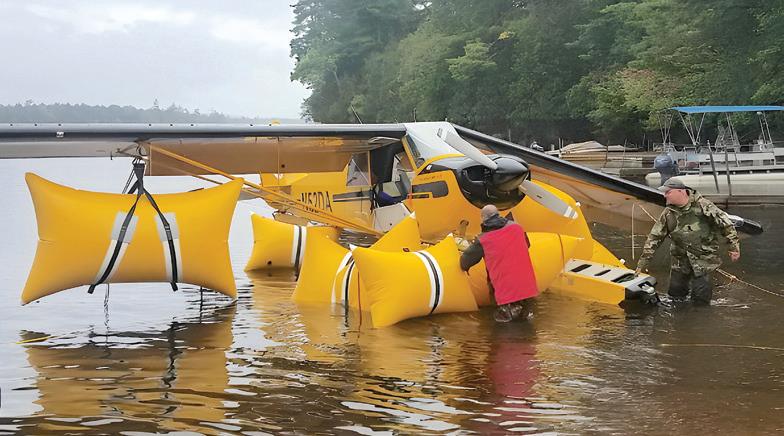
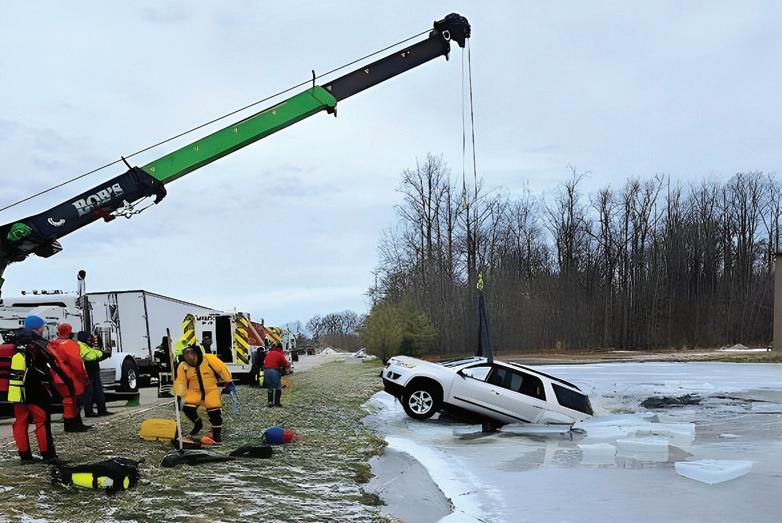
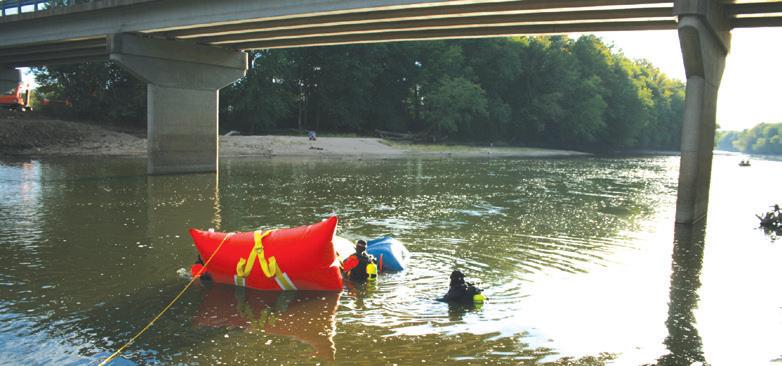
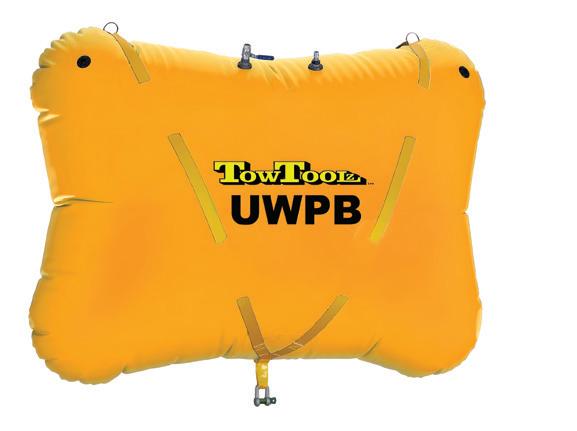
TowToolz offers Underwater Pillow Bags (UWPB) in multiple sizes for different tasks, for use in any position, either upright or flat, outside or inside of objects such as boulders, moorings, cables, pipelines, vehicle recovery, and vessel salvage.
victims might have been trapped in submerged vehicles for years.
Successful underwater recovery begins with solid planning, and answering questions such as, “What happened, was it a stolen vehicle, or a car submerged in a swimming pool or an agriculture channel, and are there any hazmat issues?”. In most submerged cases, tow operators, police, and dive rescue drivers first must conduct on-scene, roundtable discussions to ensure that a safe and effective recovery is achieved.
Some water and salvage recoveries take several days and are handled in
modules or segments. There’s nothing quick about these recoveries. For the safety of all parties involved, technical underwater recoveries should never be conducted during nighttime hours, especially when storm surge or heavy currents are running.
In all cases, someone has to go into the water to rig the casualty. Tow operators generally aren’t dive qualified, and conversely, divers generally aren’t towers. Working submerged vehicles demands that rescuers work together, and ultimately strive for the best goal of complete safety. Towers are reminded that water-soaked clothing severely impedes the ability to swim.
Here are a few other underwater considerations:
-Access: The big challenge of partially or fully submerged vehicles heading downstream is their limited “floatability”, which might last only a few minutes. As casualty vehicles fill with water, the engine’s weight generally takes a fast-sinking vehicle down by the nose.
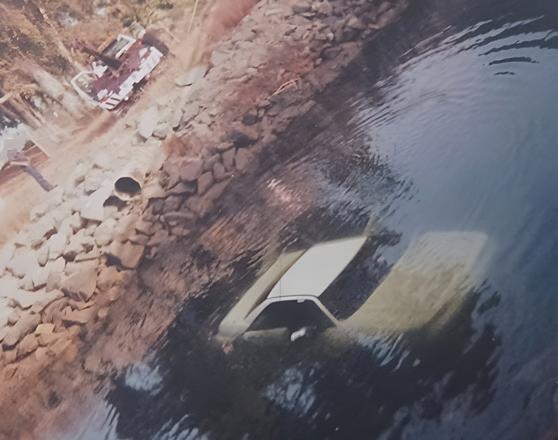
-Marking the Casualty: As a top priority, designate the casualty’s location in order to ensure that rescuers are positioned at the actual recovery site. A tethered surface marker helps dive teams and personnel find the submerged casualty quickly and easily. Adding technology to the mix, modern GPS systems and depth finders can also identify a submerged vehicle’s exact location.
-Water Filled Interiors: Determine if the recovery will be accomplished whether the casualty is dragged, lifted, or floated. Consider the additional water weight per gallon associated with submerged vehicle’s “dead lifting” versus being raised by airbags. This assessment is an important component for the ease of recovery—or possibly unsuccessful results.
-Drag Winching: At riverbanks or cliff sides, this method can be problematic. If a submerged casualty gets relocated by water flow and drops into an underwater canyon, recovery is troublesome when the sinking vehicle gets wedged between rocks or snagged on submerged trees.
It’s not uncommon for vehicles to be swept considerable distances from where they entered the water, especially during floods with fast-moving currents. This holds true for vehicles with attached trailers that get swamped at local boat ramps. When looking for submerged vehicles, remember the old phrase, “Still waters run deep!” Underwater currents can quickly reposition a vehicle’s location.
Drag winching from sea floors, streams, or pond bottoms can have good results if the vehicle is resting upside down. With the vehicle’s roof, hood, and trunk deck serving as smooth surfaces, drag winching from this position might be the better method of recovery.
For obvious reasons, rescue divers are the best judges of the bottom surfaces and recovery paths. Booms and winch lines extending beyond a cliff’s edge are prone to gouging and wedging into a cliff’s rocky or sandstone surfaces, which may lead to cable separation or a catastrophic cliff collapse.
Especially true with EV’s immersed in saltwater, best practices
Matjack .................. pg.27
TowToolz ................ pg.22
dictate draining the saltwater immediately by tilting the casualty. Otherwise, there’s the risk of a fire, explosion, or electrocution if water enters battery modules.
Tesla cars are claimed to be sealed and impervious to water leaks, but there’s plenty of evidence refuting this assertion. When driving into water environments, Tesla’s are reportedly programmed to roll windows down and open trunks to allow occupants to escape.
As recommended in Tesla’s safety procedures, “Safely tow the vehicle at least 50 feet from structures or other combustible materials such as other cars and personal property.” It’s recommended to place waterlogged Teslas on jackstands or blocks in
order to allow water drainage away from battery modules.
These industry standard methods are intended for operators looking to conduct airbag water recoveries. Because water recovery is a highly technical and dangerous practice, towers are reminded not to go into water environments until they’re thoroughly trained in this type of operation.
When divers or dive companies are subcontracted by tow services, verify that they’re certified and insured. Copies of their qualifications should be on file and updated periodically.
Tow operators are reminded that water recovery of any kind is a potentially dangerous practice. Tow operators should get training specific to airbag recoveries. Remember, safety first, recovery second!


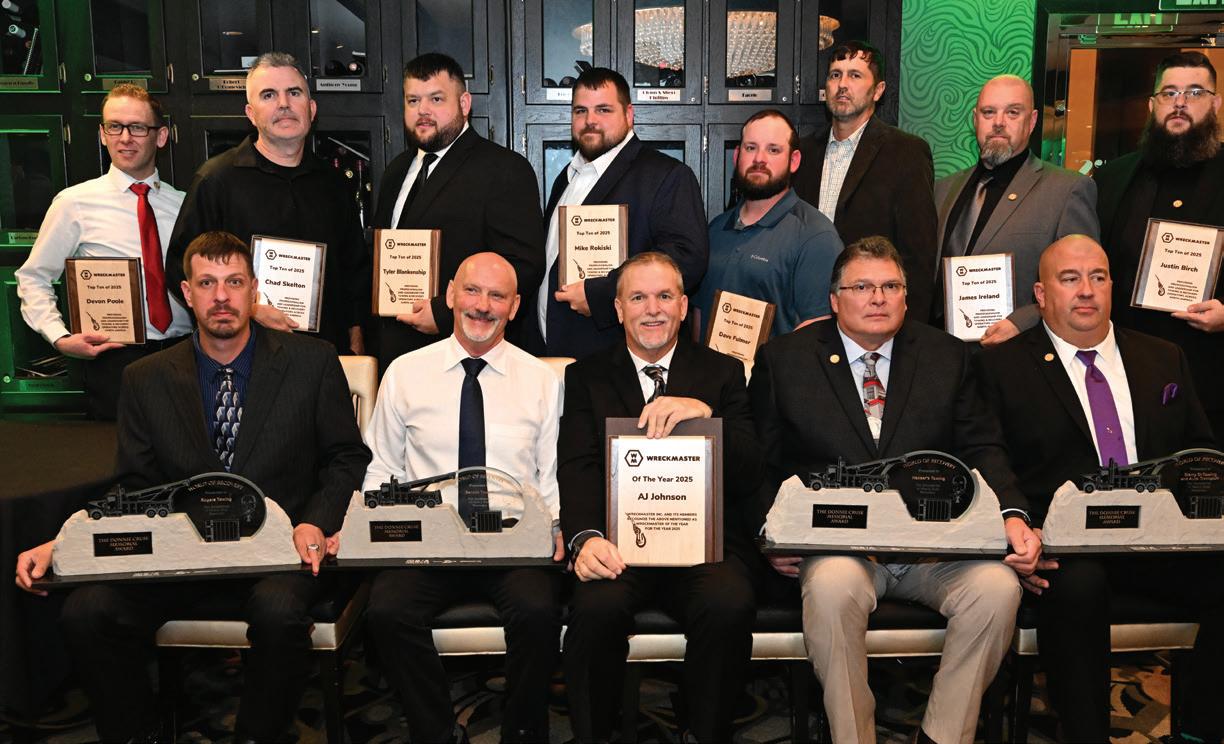
WreckMaster honors the winners of the Donnie Cruse Recovery Awards along with the Top 10 WreckMasters of 2025, and the WreckMaster of the Year.
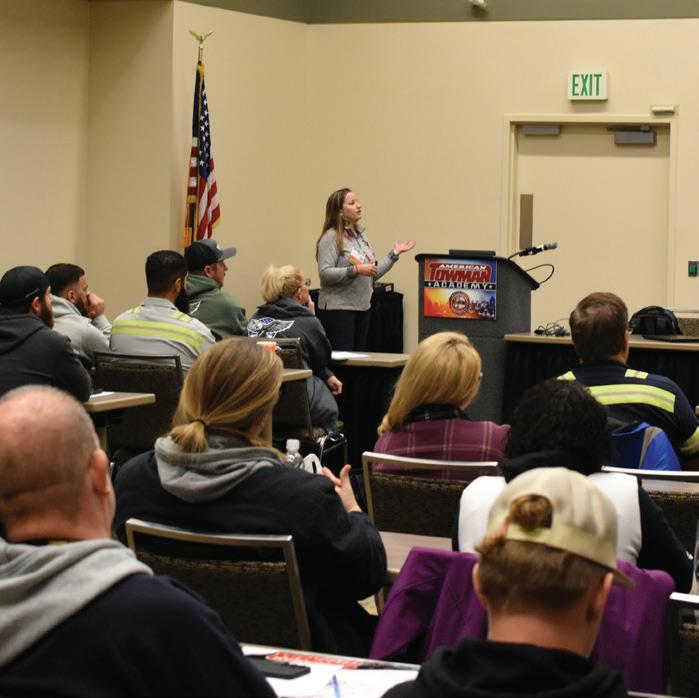
The AT Academy seminars present invaluable business advice and safety tips.
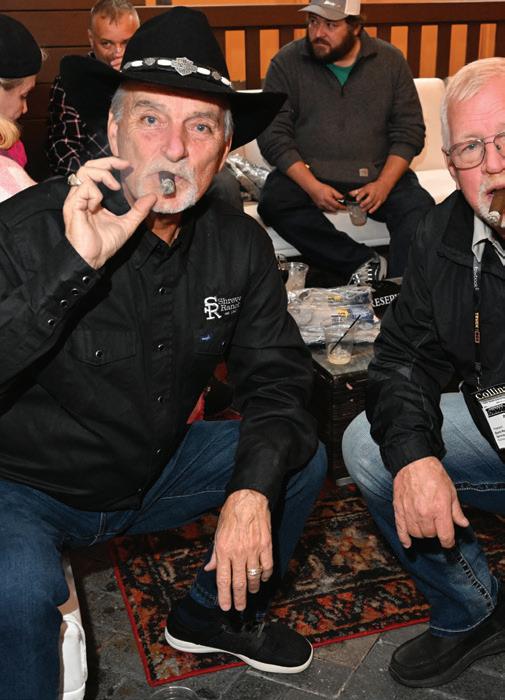
Calitri’s Cuba provides a place to share a cigar and network with fellow towers.

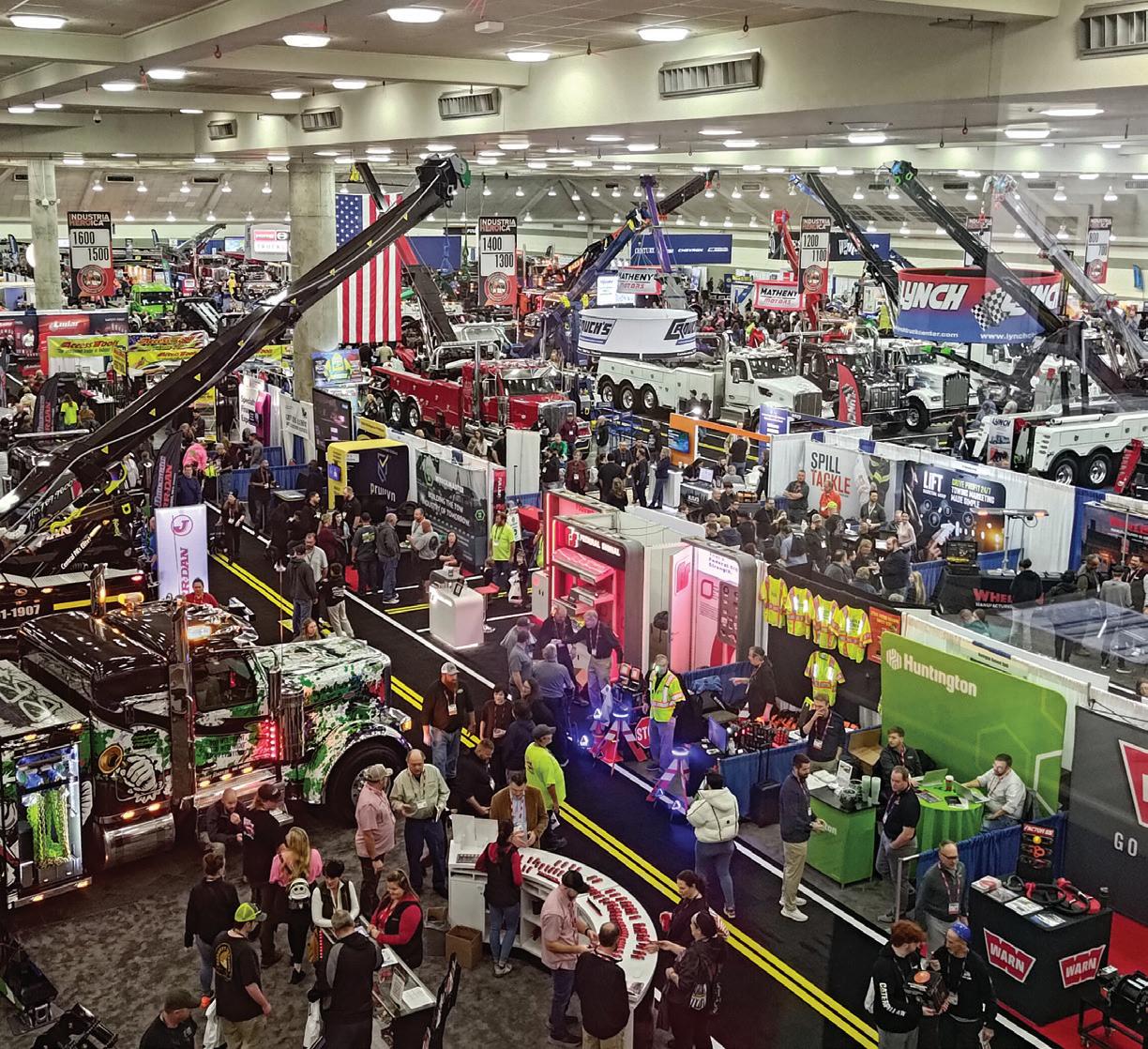
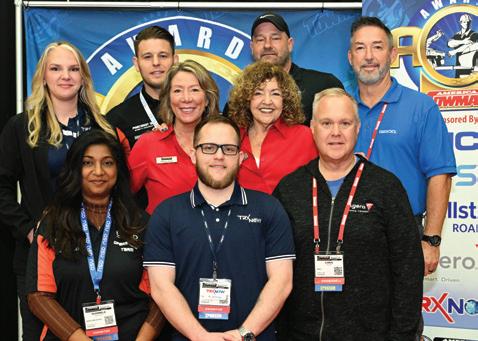
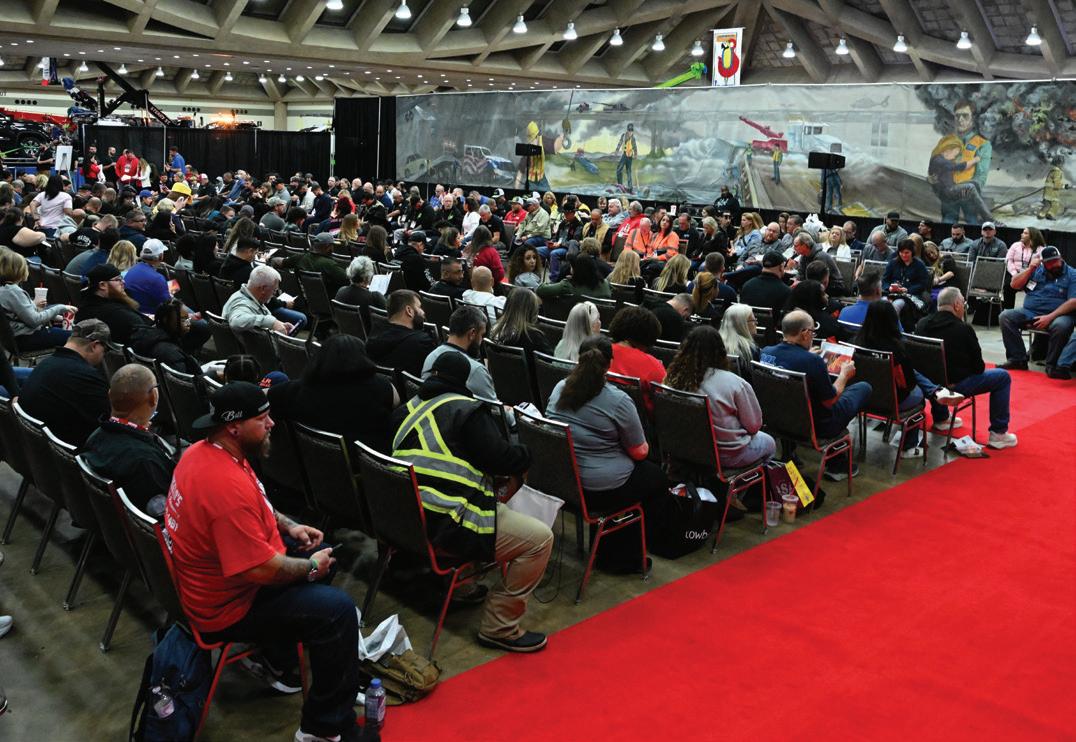
Attendees pack the AT Expo Hall for the ACE Awards presentation. ACE Awards sponsors pictured to the right.

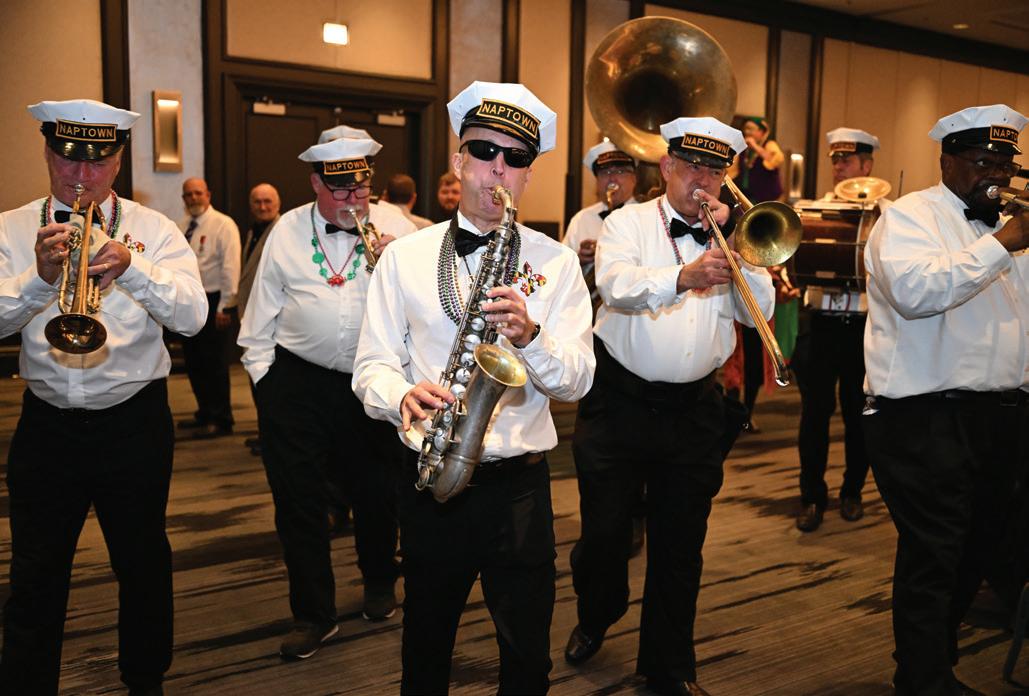
On Festival Night, the Naptown Brass Band hit all the right notes with their New Orleans energy.
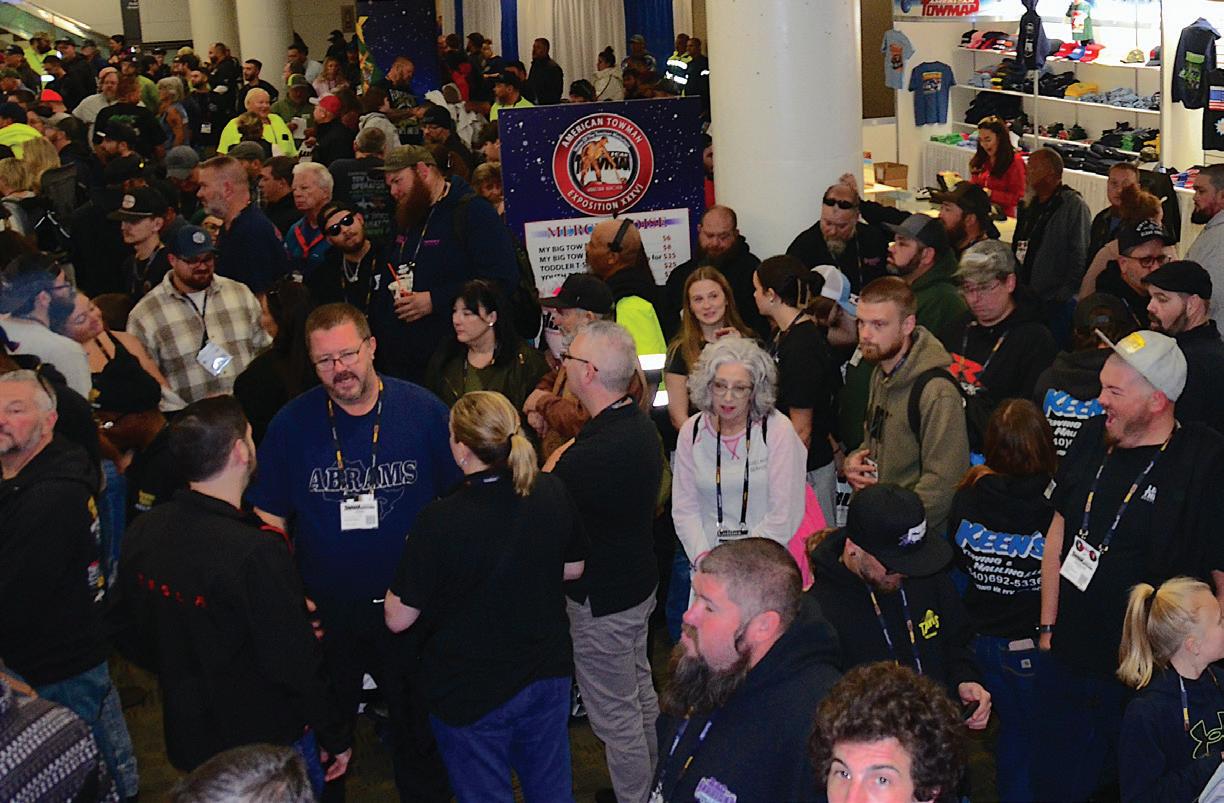
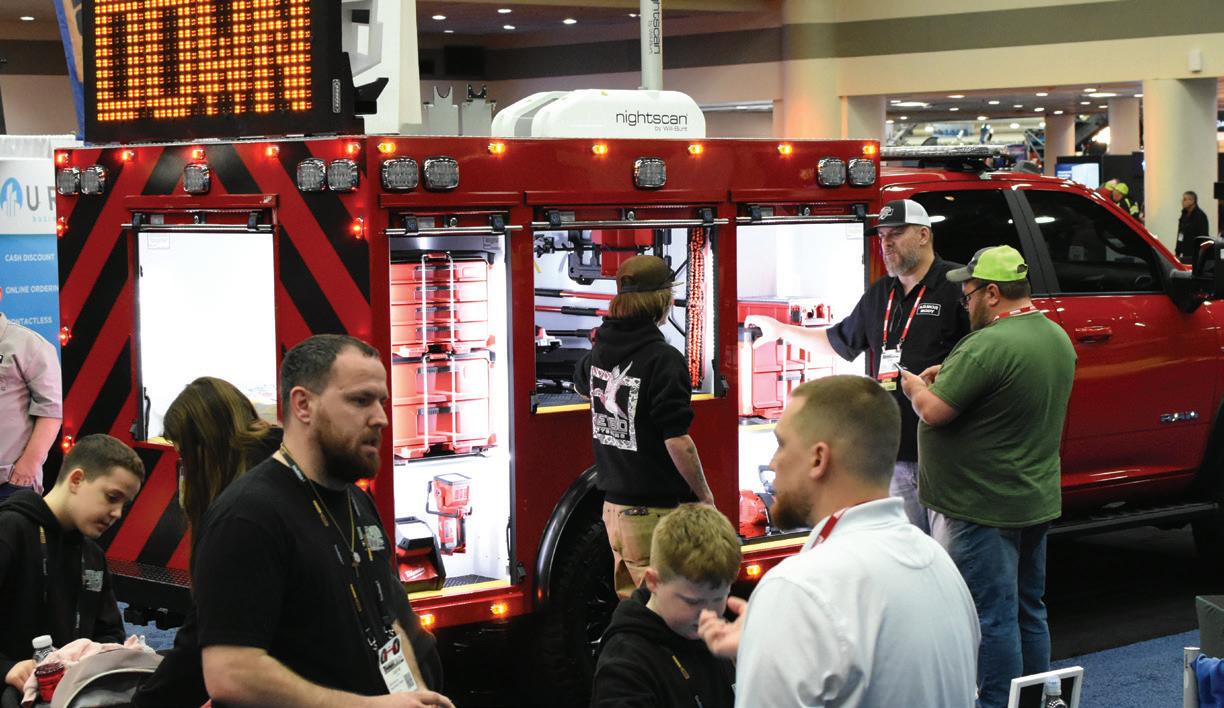
Wheeling and dealing on the show floor.

The band rocks at the Bull and Pig Roast.
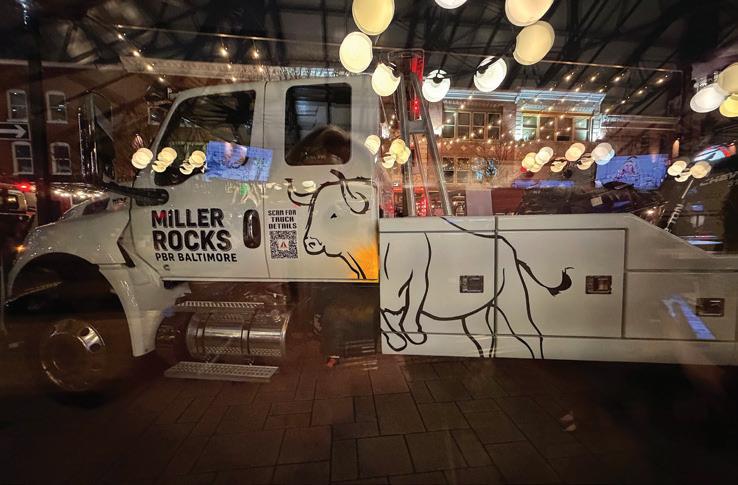
Miller Industries’ specially branded tow truck decorated the entrance to the Power Plant.
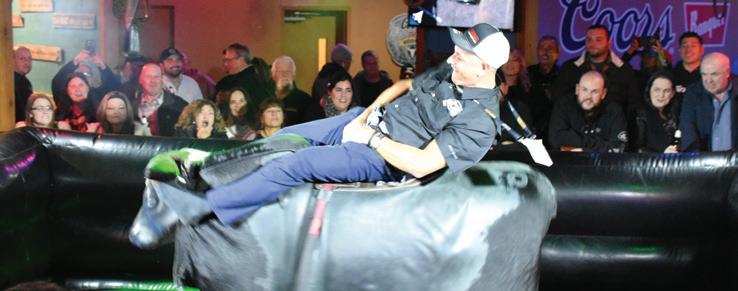
A mechanical bull gives towers wild rides at the PBR Cowboy Bar.
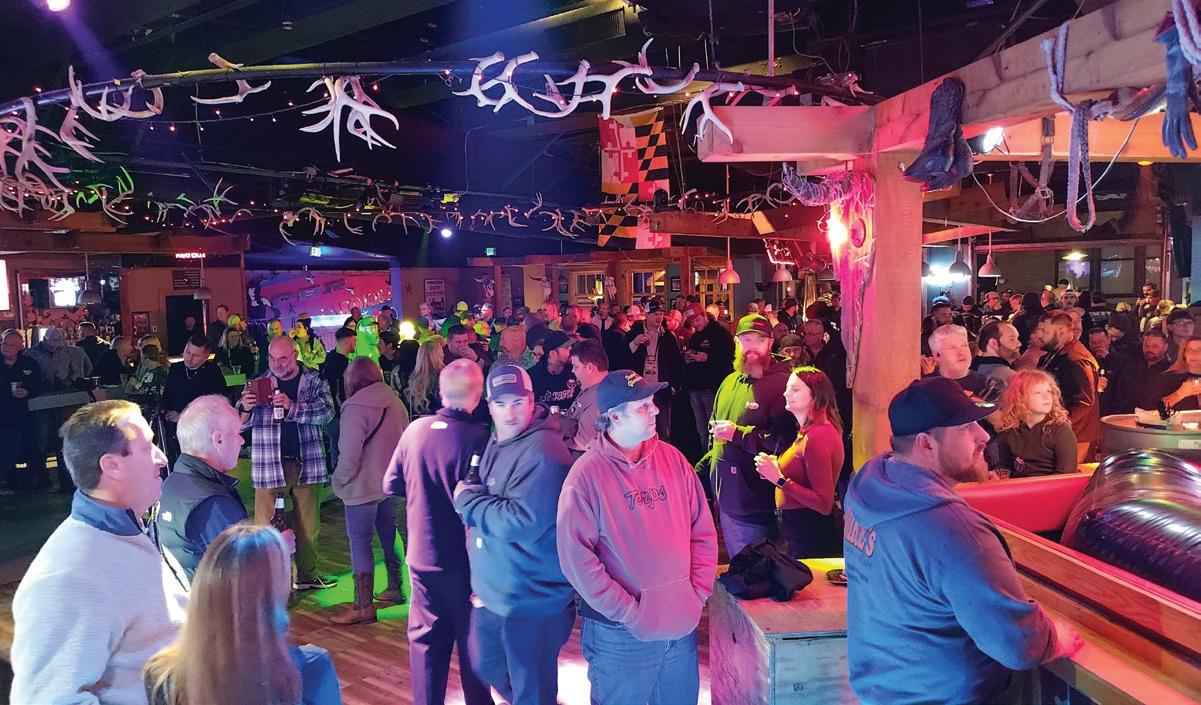
Towers packed the PBR and partied hard into the night at “Miller Rocks”!
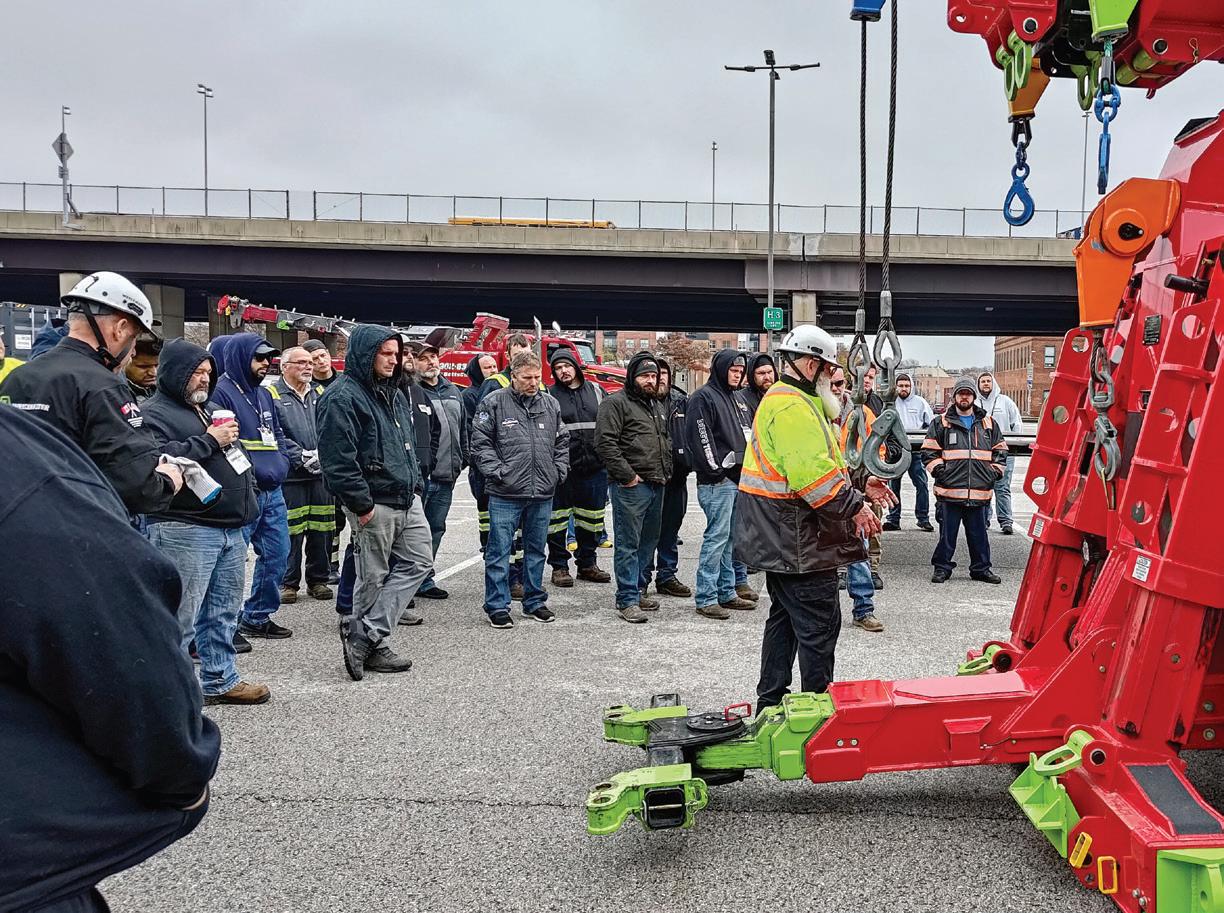
WreckMaster provides hands-on demos of safe rigging and winching methods.
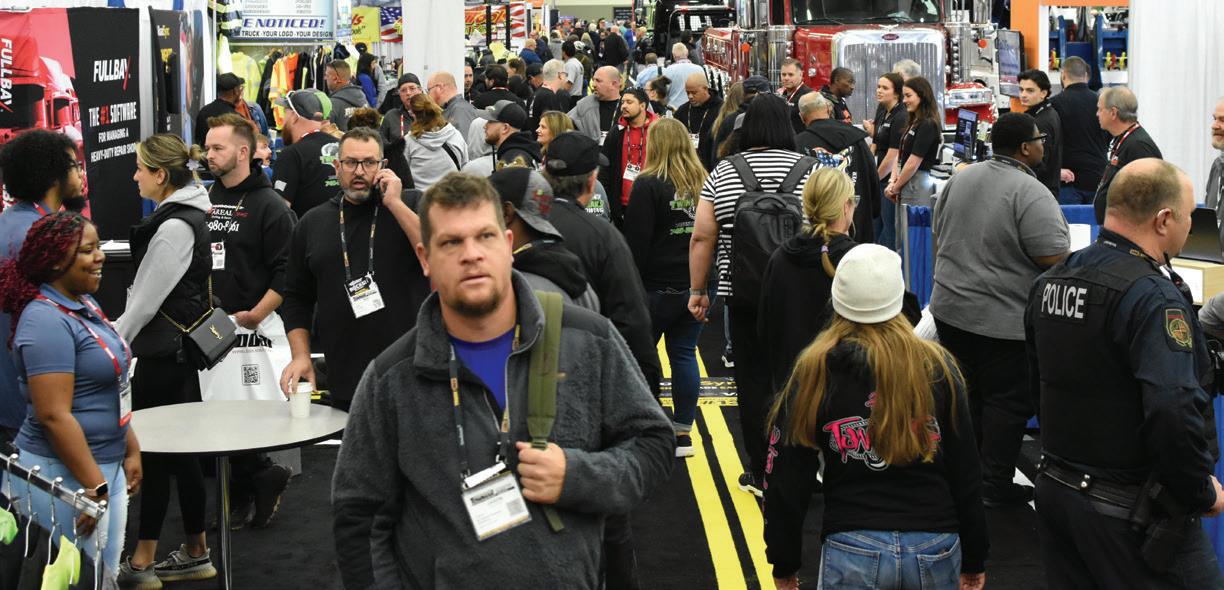
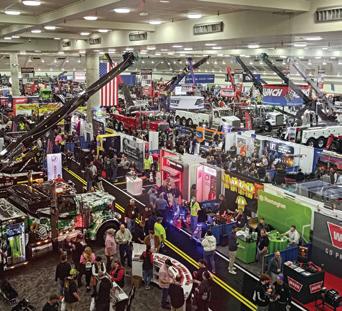
Every day is alive with excitement as waves of attendees fill the aisles in record numbers.
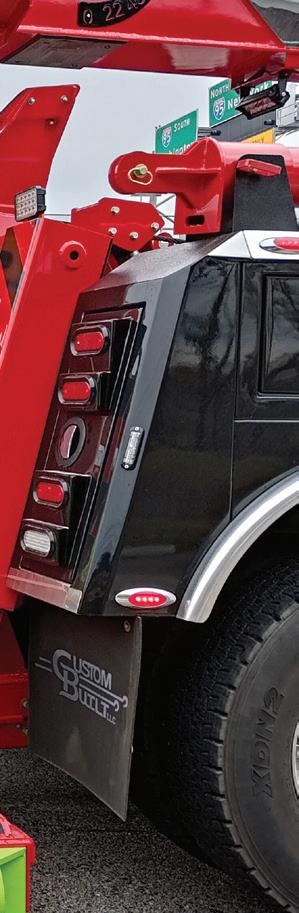
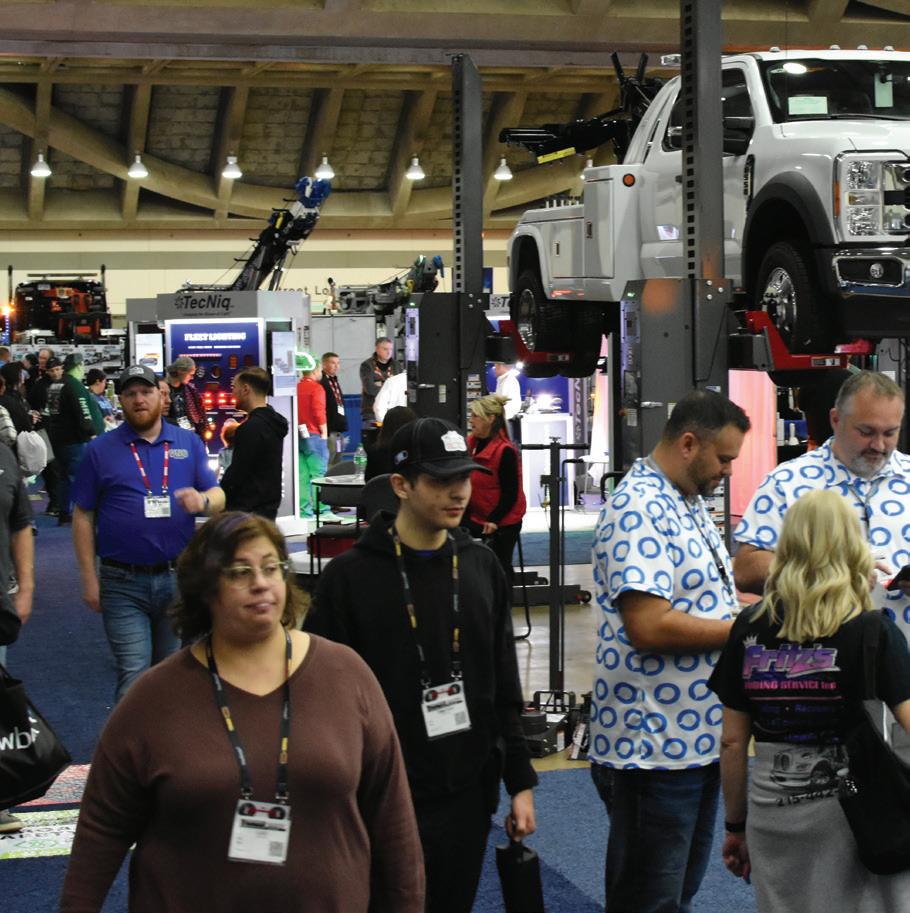
A variety of suppliers to see on the show floor.
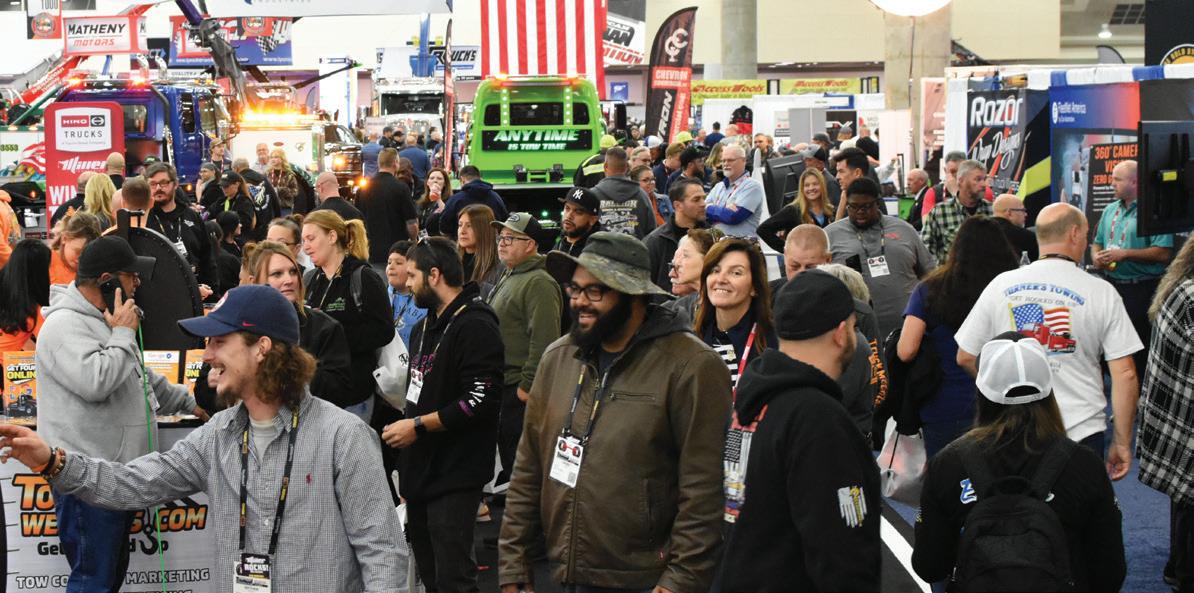
Enthusiastic towers visit with numerous suppliers.
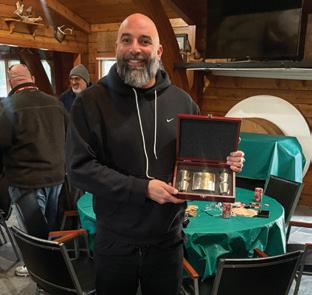
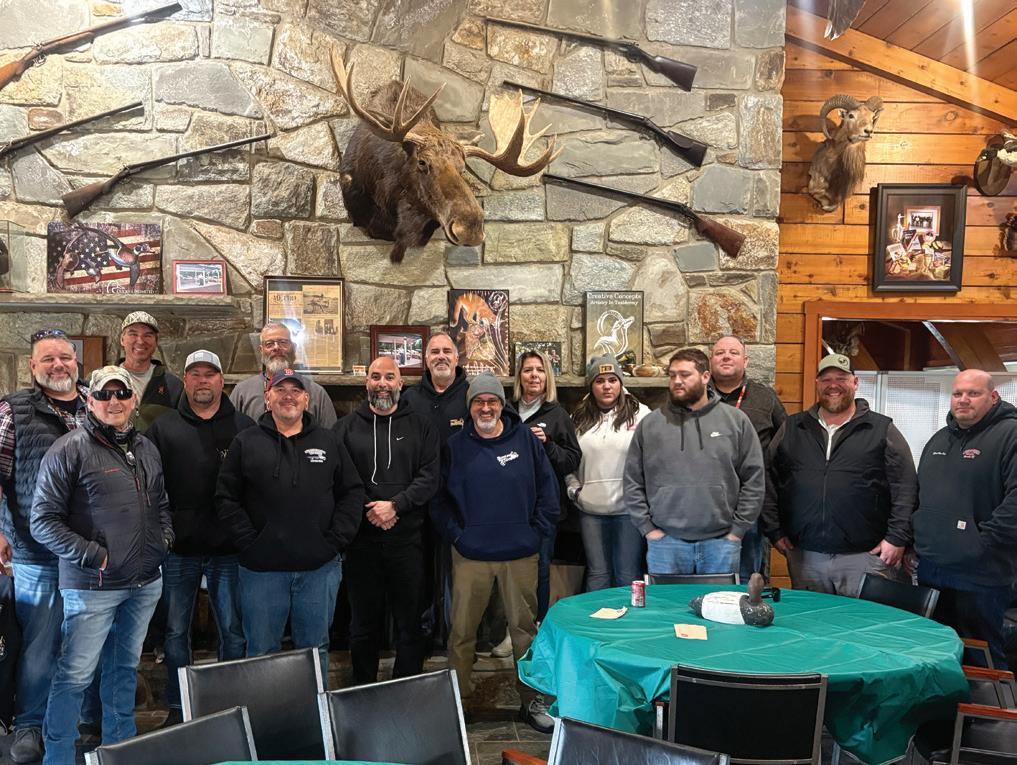
The Skeet Shoot is enjoyed every year. Winner of the last two Skeet Shoots is Jack Poladian of Eagle Towing Equipment.

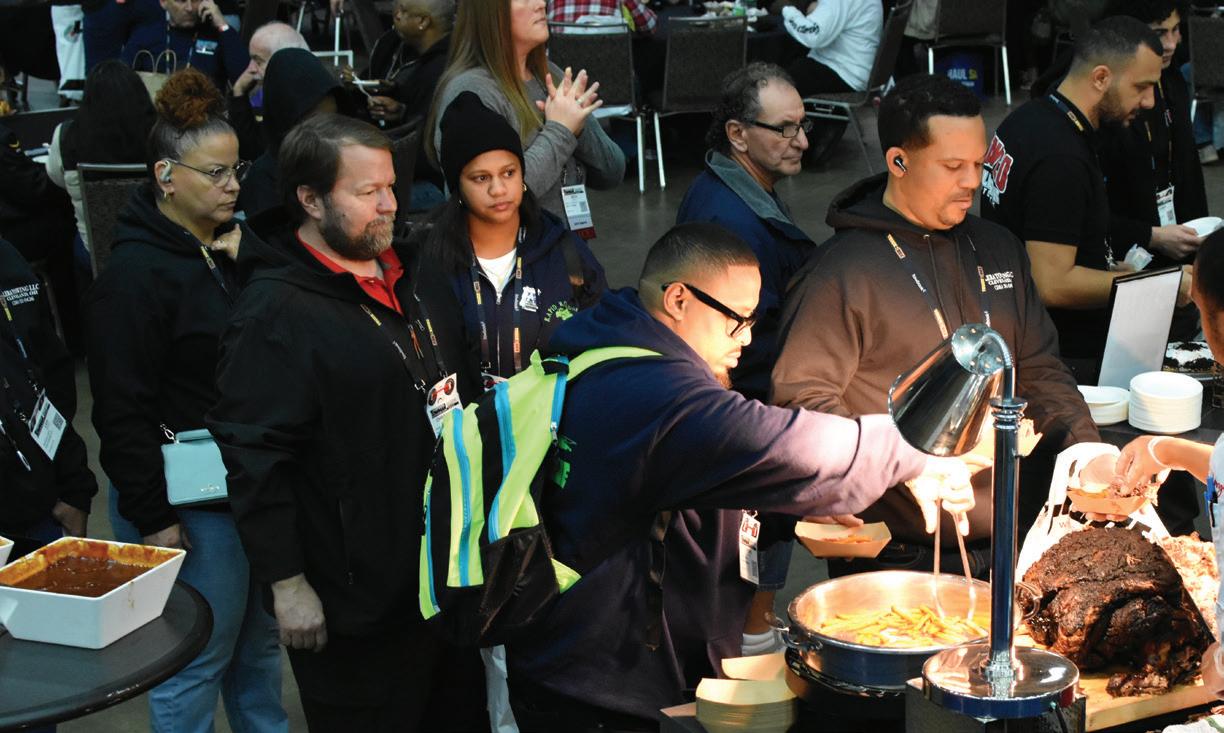
Plenty of tasty treats, compliments of American Towman, add extra flavor to the show experience.
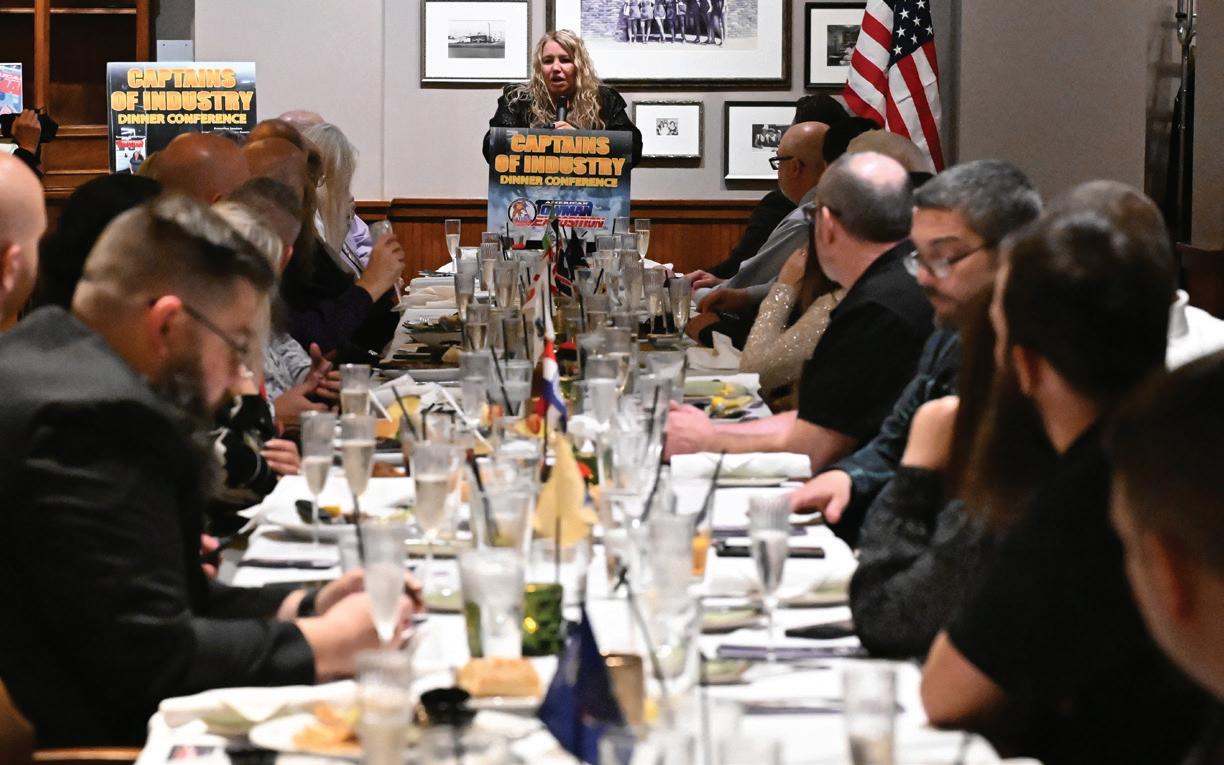
Barbara Christensen, the 2025 Towman of the Year, gives a heartwarming speech at the Captains of Industry.

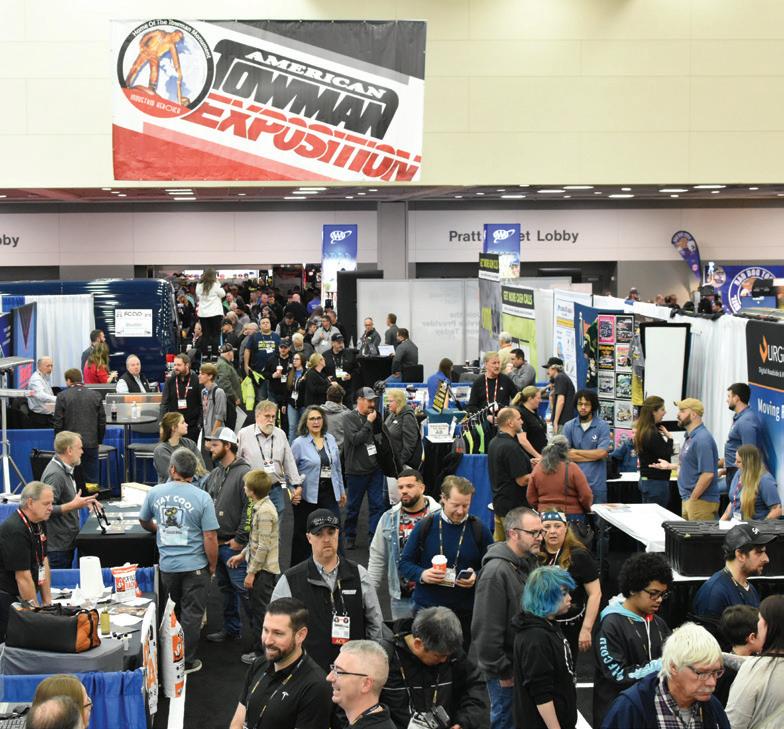
Expo attendees fill the aisles eager to see the latest equipment and services offered.
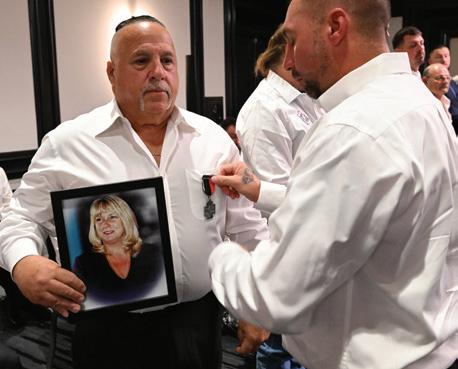
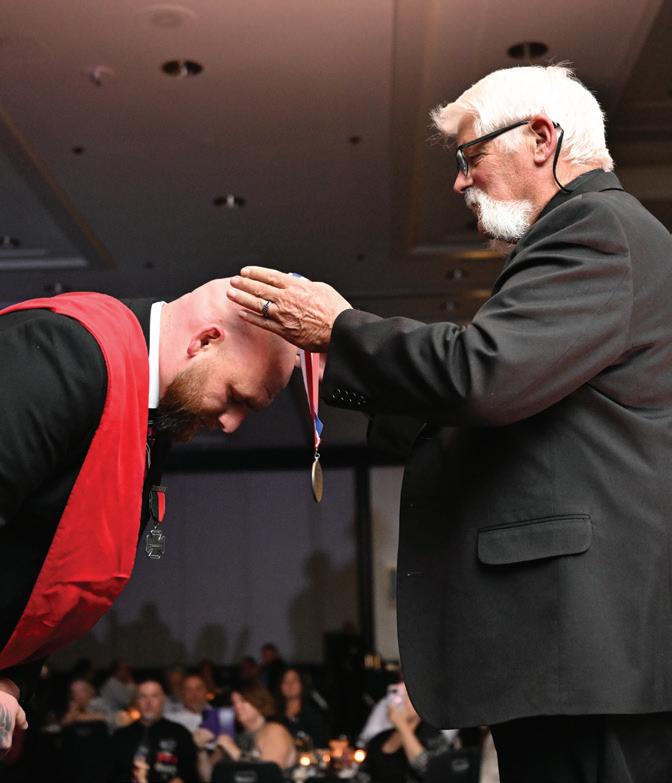
This tower pays tribute to his late wife during the pinning of The Cross.
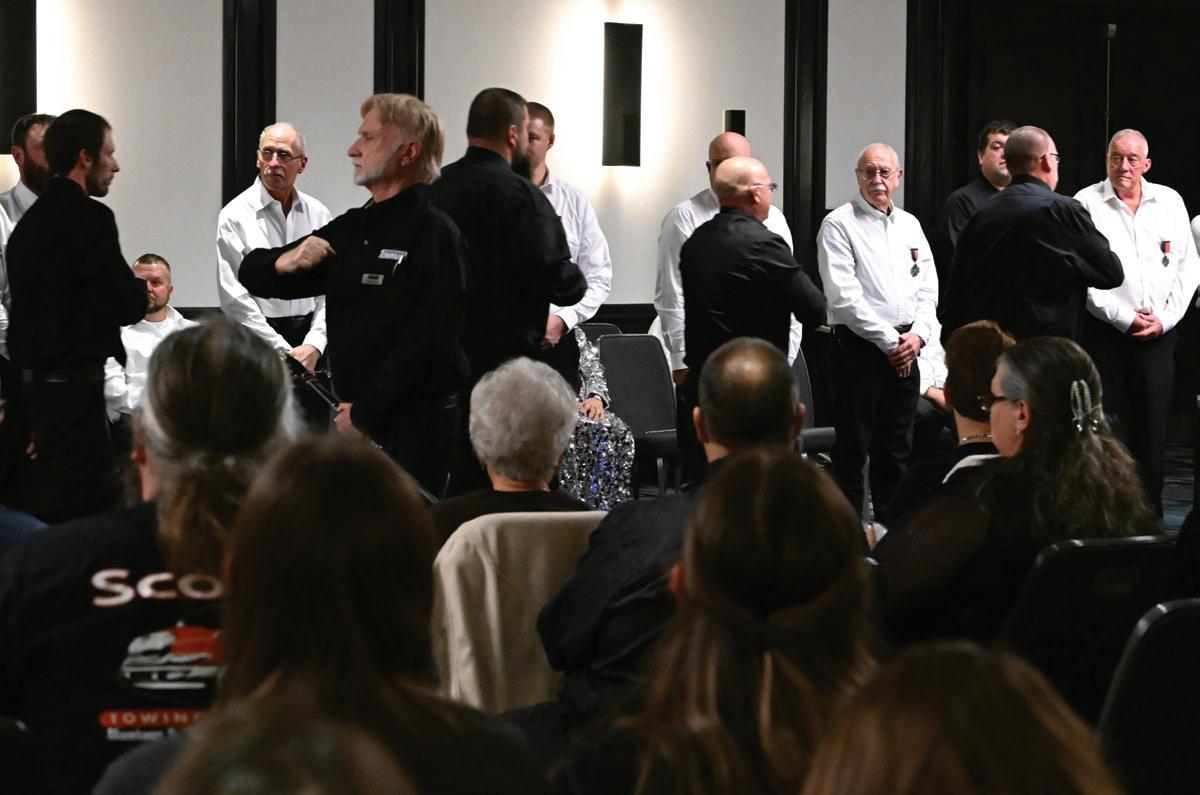

A circus-like atmosphere is always found at the Expo!
The Order of Towman are nominated by police and fire chiefs for community service.
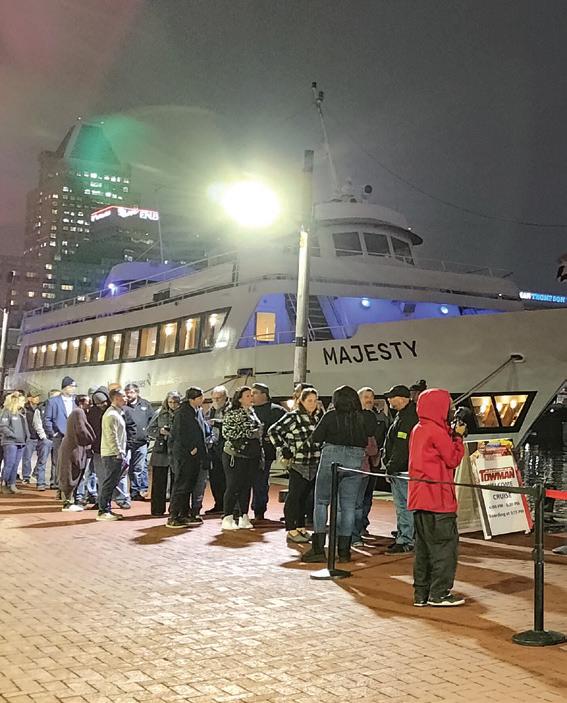
A dinner cruise at Baltimore’s scenic Inner Harbor.

Who doesn’t love a parade? AT Expo attendees and exhibitors certainly do!
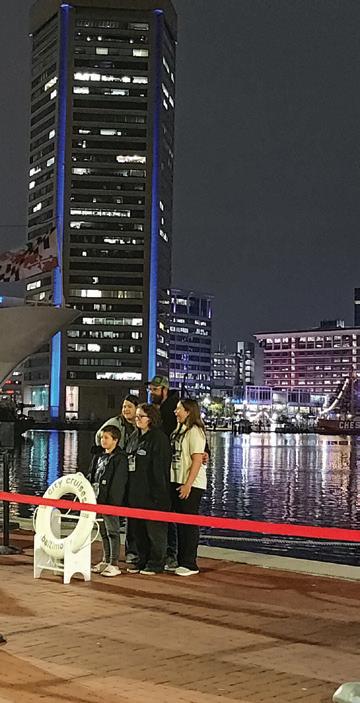

An early morning trumpet call at the Inner Harbor heralds that the time has come— “Summon the Heroes!”
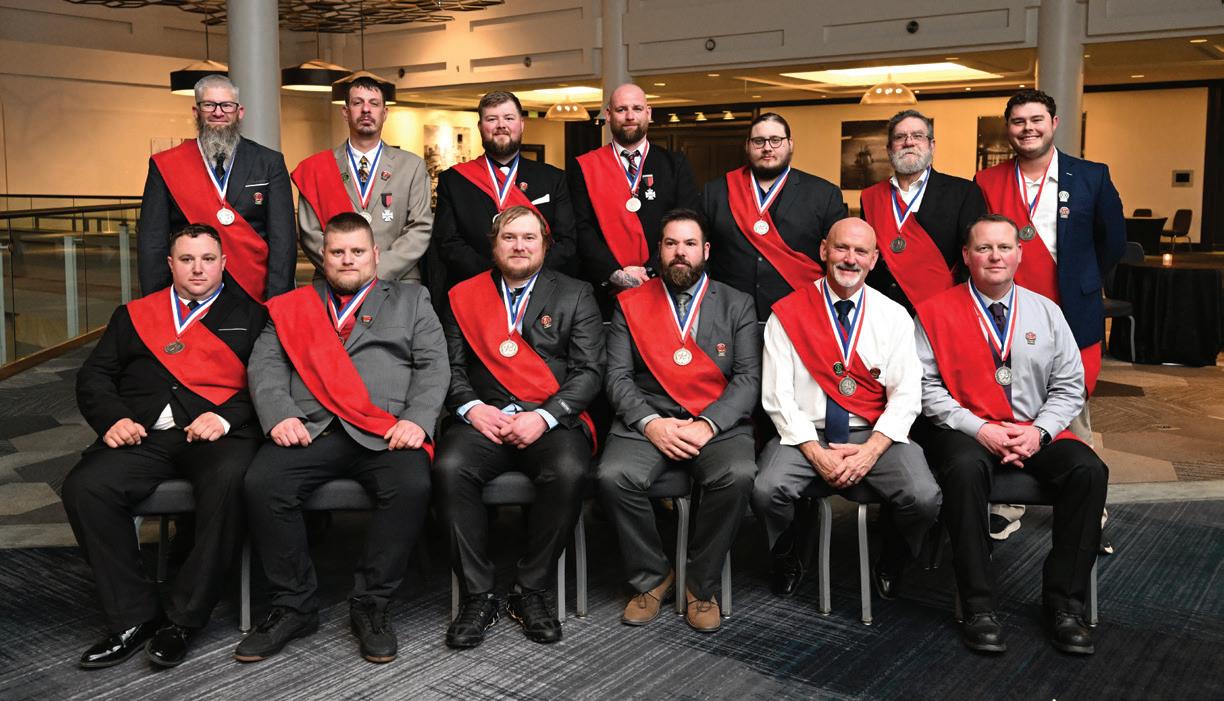
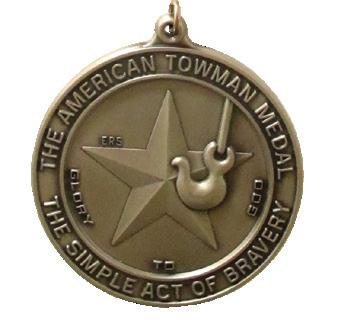
By Stephanie Marchese
In the heart of Baltimore this past November 2025, American Towman honored the spirit of heroism that defines the towing profession. Nine towers stood shoulder-to-shoulder against a poisonous pesticide to clear a toxic hazard. Others pulled victims from burning vehicles, faced live power lines and precarious gas tanks to save a driver, and braved ice and speeding highway traffic to save a trapped driver. Each act of valor is a testament to courage born from instinct and not only earned a Towman Hero medal, but reminded the industry that true courage often wears a tow uniform.
Big Wheel Towing & Recovery, E. Freetown, MA
May 25, 2023

An LNG sanitation truck, which is a natural gas powered truck with the tanks mounted on top of the packer body, crashed into large pine trees in Massachusetts in May 2023, critically injuring and trapping the driver in the wreckage. Adding to the danger, the collision occurred under power lines, and due to the extensive damage to the truck, responders were unable to shut down the LNG unit, making the recovery even more dangerous. At the beginning of the recovery, it was unclear if any parts of the tree would dislodge from underneath, or from above, which also presented a possible explosion hazard.
First responders recognized that conventional rescue methods would not suffice in this situation and
determined that the best course of action was to engage a heavy wrecker. Without hesitation, Lakeville Fire Chief, Michael O’Brien contacted Michael Cleary of Big Wheel Towing & Recovery, whom he knew from previous experiences, was a skilled professional.
Upon arrival, Michael Cleary immediately set up his equipment and worked with precision under intense pressure to free the trapped driver from the crushing force of the trees. According to Chief O’Brien, “I have rarely seen such responsibility for the outcome of a rescue placed upon a tow operator. His actions directly contributed to saving a human life that day.”
Coleman Motor Company, Fredericksburg, VA
January 9, 2025

The notoriously busy I-95, which connects major population centers from Maine to Florida, is known for high traffic volume and carries more vehicle miles traveled than any other road in the US. During an ice storm in early January of 2025, a tractor trailer ran off the road on I-95 in Virginia, on a particularly treacherous portion of the roadway, and landed in the surrounding trees.
According to Battalion Chief Jeff Foster, who serves in Spotsylvania County, VA, “the accident involved heavy entrapment…it was a pretty dangerous situation.” The cab
was severely crushed, leaving the driver deeply pinned and requiring advanced extrication methods to free him from the wreckage.
Hunter Stephens, a tow operator with Coleman Motor Company, arrived on scene and with no thought to his own safety, began using airbags for stabilization to move the tractor trailer enough to extract the driver, all while snow, ice, and incessant traffic continued all around him.
Due to Hunter’s perseverance and dedication, the driver was eventually extricated from the vehicle and survived the crash.
Puckett’s Towing, Oklahoma City, OK April 13, 2025

While en route to a call in Oklahoma City in his tow truck, operator Corey Shaw was hit by a driver in a pickup truck. The pickup driver, suspected of fleeing a previous crash, ran a stop sign and hit the gas tank of Shaw’s tow truck, causing an instantaneous explosion. Following close behind Shaw on his way to the same call, was friend and tow operator, Mason Phillips, who witnessed the entire incident. Mere seconds after the explosion, Phillips parked his own truck and ran toward Shaw’s fully engulfed wrecker, and knew he had to go
through fire to save his friend.
According to Phillips, “The only part that was not on fire was the passenger door. I was able to get my hand around that handle, but that was about it.” Phillips pulled Shaw through the flames to safety.
Shaw described it as, “…I was just covered in flames and smoke… it was like I was in a tornado. I was just spinning,”
Phillips and Shaw were back to work the next day, but Shaw said, “If it wasn’t for my coworker and God, I probably wouldn’t’ be here.”

June 21, 2021
Andy Parent, owner of Andy’s Towing in Oneida, NY, along with another man, jumped into action on June 21, 2021, to save a man’s life.
Andy just happened to be driving by in his tow truck when he saw a vehicle engulfed in flames and dashed from his tow truck to help. Apparently, the burning vehicle had driven off the road, hit a utility pole, and ignited in flames.
The downed utility pole had scattered live wires along the road, and Andy was advised by firefighters and police to stand clear. Andy saw a man hanging partway from the window, and despite the severity of
the situation and the warnings, he ran toward the flames to help the trapped victim. Andy reached through the burning hot flames and along with a Good Samaritan, worked to pull the elderly man out. According to then Sgt. Michael Burgess, of the Oneida City Police Department, said, “Andy is well known to the Oneida Police Department, in a good way.”
In recognition of his heroism, Andy was awarded a $5,500 grant from the Carnegie Hero Fund, of which he donated $5000 to Oneida’s Fourth Ward to be put toward a dog park. Just one more testament to the nature of Andy’s true heroism.
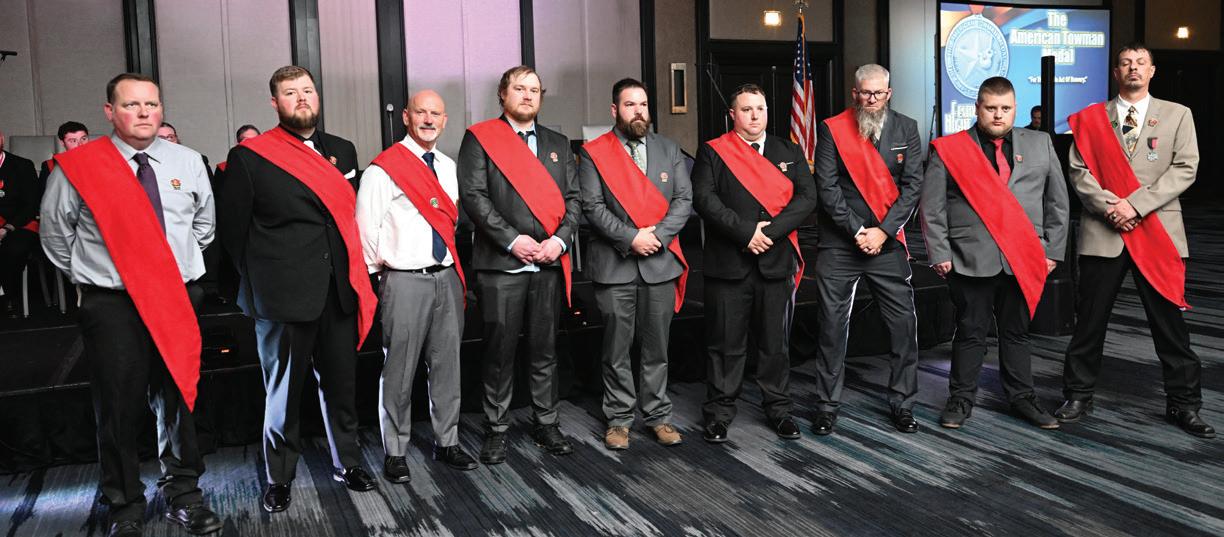
In December 2024, at least nine tow truck operators displayed extraordinary courage and professionalism when a semitruck carrying a load of extremely toxic snail poison, a common pesticide, rolled off the sharp curve of a remote logging road in the Cascade Mountains in Oregon near several populated communities. Facing hazardous chemicals that threatened to contaminate local wildlife habitats, water supplies, and the health of nearly 30,000 local residents, operators from two towing companies, Rogers Towing & Transport in Veneta, OR, and
Gerlock Towing & Heavy Haul in Portland, OR put their lives on the line to contain the spill and execute a complex and tedious recovery operation. Their swift actions, combined expertise, and ability to collaborate effectively, prevented a potential major environmental disaster that could have had lasting effects for decades. Coordinating with various environment and hazmat teams, securing the scene, and executing critical towing maneuvers under perilous conditions is further testament to their skill, dedication, and knowledge. This incident underscores the
often overlooked heroism of tow operators who not only clear wrecks, but also safeguard communities from chemical hazards. The expertise and willingness of two towing companies to willingly combine to confront danger, protect public health, and preserve delicate ecosystems, illustrates the vital role of tow professionals beyond roadside assistance. The gratitude of the neighboring towns for the preservation of surrounding natural areas remains with these nine operators who chose duty over danger to save lives and the environment.
*Supplier names in bold are display advertisers in this issue with their ad page number cross-referenced November 20-22, 2025
24/7 Dispatch
360 Payments
5Star Specialty Programs
AAA - pg. 77
Access Tools - pg. 81
Acrisure
Agero powered by Swoop
Akins Body & Carrier Sales - pg. 69
ALKEME Automotive
All American Jerr-Dan in Old Bridge
- pg. N, S, M 91
Alliance Funding Group
Allstate Roadside - pg. 33
Alpha HD Trailers
American Key Supply
American Towman Magazine
Amur Equipment Finance
AP Equipment Financing
Apache 2 Way
Armor Body
Arrowhead Winch - pg. 15
Ascentium Capital
AT&T Business
Atlanta Wrecker Sales
Aurora Payments
Austin Insurance
Auto Data Direct - pg. 17
Autura - pg. 15
Axle Covers
Azuga, A Bridgestone Company
B/A Products Co.
Bad Dog Tools
Battelini Wrecker Sales
BBK Billing & Dispatching
Beacon Funding
Benchmark Payment Networks
Big D’s Fabrication - pg. N92
Bloom Mfg.
Bobtail Technologies
Breg Environmental
Brooklyn Progressive-Auto Body & Paint Equip.
Brown & Brown Insurance Services
CameraMatics
Car-Part.com
Century
Chevron
Chevron Commercial - pg. 86
Collins
Colstan & Associates
Command Light
Contral Trailers
Copart
Crouch’s Wrecker & Equipment Sales - pg. 83
Custer Products Ltd
Custom Built MFG - pg. 88
Customers Commercial Finance
Cutco
CVVFA/Responder Safety Institute
Dakota Group
Davis Recycling
DeFalco’s Service Center
DewEze Mfg.
Direct PTT
Doepker Trailers
Dom’s Wrap-A-Wreck
DOT Tie Down
dp Winch
DRIVE
Dual-Tech - pg. 34
Dynamic
East Coast Truck & Trailer Sales
East Penn Truck Equipment
ECS
Edin”Burg” Truck, ETS Hobby Shop
EFI Tow
Emergency Road Service Coalition of America / ERSCA
Energy Security Agency
Envue Telematics
ESCO (Equipment Supply Company)
EVchargeHERO
Excel Sportswear
FCar Tech USA
Federal Signal
First Business Bank
FirstNet AT&T
FleetNet America
Fullbay
Garden State Towing Association
GEICO
Gray Manufacturing Co.
Guttman Energy
Hale Trailer Brake & Wheel
HD Trailers - pg. 16
Heavy Duty Help - pg. 26
Helix Safety Essentials
Hidden Lift & Tow
Hino Trucks - Back Cover
Holly’s Towing Dispatch
Holmes
HONK Technologies
Horizon Motor
Hunter Engineering
Huntington National Bank
IAA Holdings
Iconic MetalGear
Illusions Wraps
In the Ditch Towing Products
Int’l Towing & Recovery Hall of Fame & Museum
Integrated Vehicle Leasing & Equip.
Leasing
Intek Truck Finance - pg. 73
International Recovery Systems
Isuzu Commercial Truck of America
iTow & Licona Insurance Group
Iver Tools
J & R / DG Towing and Trucking Supplies
JB Tow
Jerr-Dan
Johnson & Towers
Journey Business Solutions
Jutland Truck Bodies - pg. 84
Kalyn Siebert
KUKJE CHAIN
Kurtz Truck Equipment
Landoll Company
Lift Marketing Group
Lighthouse Insurance Services
Lodar Ltd. - pg. 87
Lokithor
Lucky’s Trailer Sales
Lynch Chicago- pg. 67
Maritime Box
Marshall & Sterling Insurance
Maryland Carrier & Wrecker Sales
Master Tailgaters
Matheny Towing Equipment
Matjack - pg. 27
MAXXIMA
Metro Nova Creative
Metro Tow Trucks
Metrocom - pg. 33
Midtronics
Miller Industries Towing Equipment
- Inside Front Cover
Momentum Groups
Morgan Truck Body
Myers Benner Corporation
Mytee Products
Nation Safe Drivers
National Automobile Club
National Open Commerce Safer
Highways Coalition
National Recovery USA
Nite Beams Products
NRC Industries
NSM Insurance Brokers
OMG Tow Marketing - pg. 76
OmniMed
OnCallGPS Video
Optimize Digital Marketing
ParkM
Parkva
PatrolWorks
Peak Auto Auctions
Peddle
Penny Pockets
Penske Truck Leasing
Phoenix USA
Pine Hill Trailers - pg. 80
Pinnacle Trailer Sales
PipeBreak USA
Power Home Remodeling
Prime Dispatching
Priority Push-to-Talk
ProComp Payroll Services
Pruuvn
Purpose Wrecker
R.P. Recovery
R&A Insurance
Ramsey Winch
Razor Wraps & Designs
RC Industries
Recovery Solutions and Title
Relay Tow
ResQTrack
Rivian Automotive
Roadside Protect
Roadsider
RoadSync
Robert Young’s NRC Sales & Service
Robertson Ryan Insurance/Tow
Insurance Pros
Royal Truck & Equipment
Safety Vision
Santander Bank, N.A. - pg. 7
Schwartz Truck Center
Sepson USA
Service Member Data
Speedy Sweep
Spill Tackle
Square
Stamp Works
Star Blink Products
Steck Mfg. Co.
Tow4Tech
Towbook































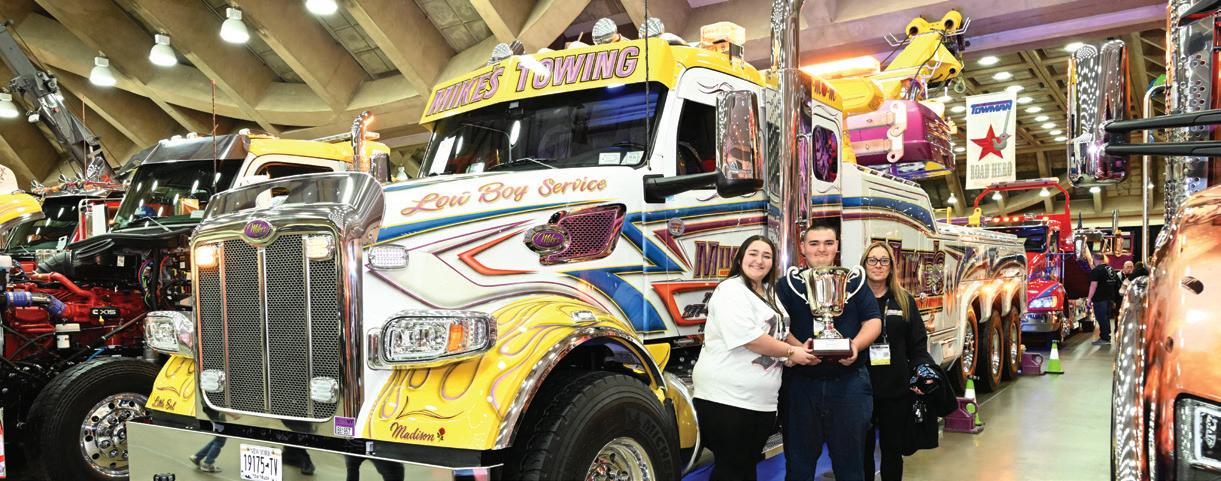
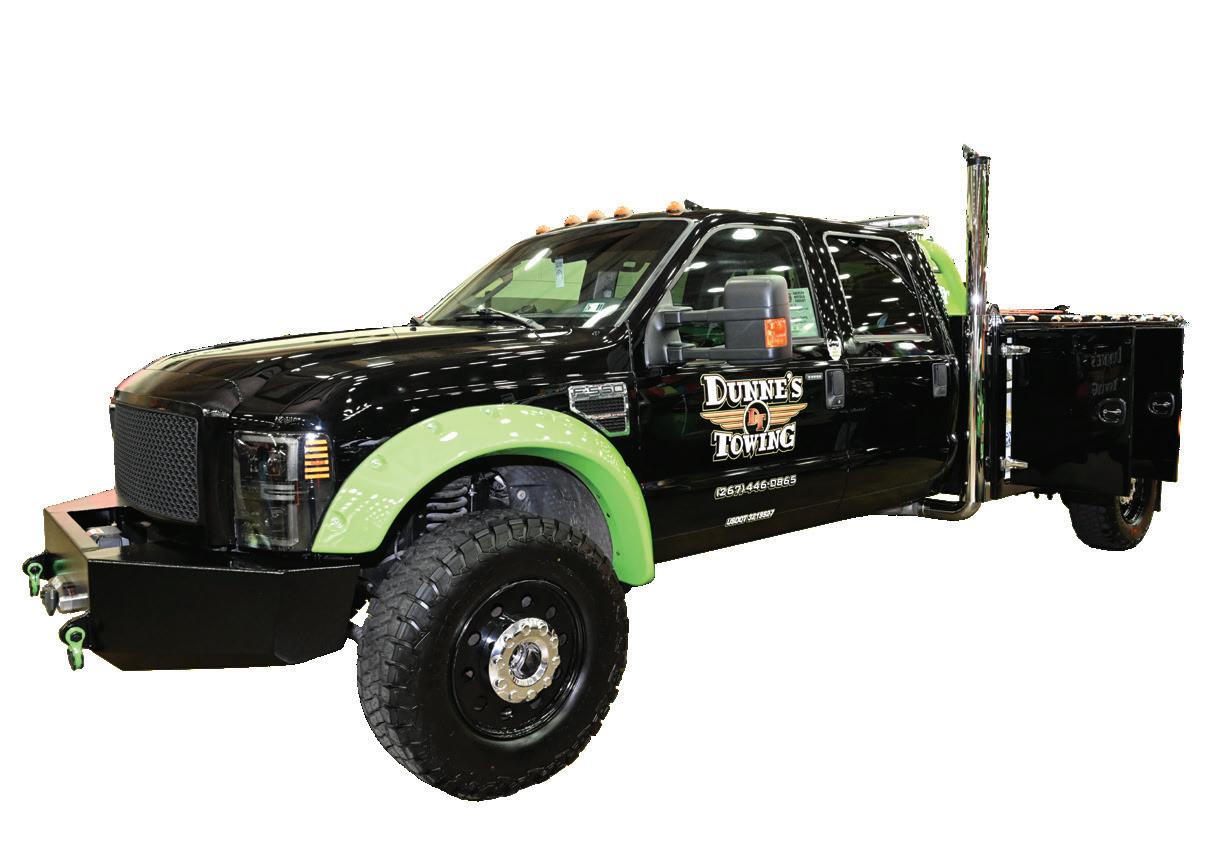
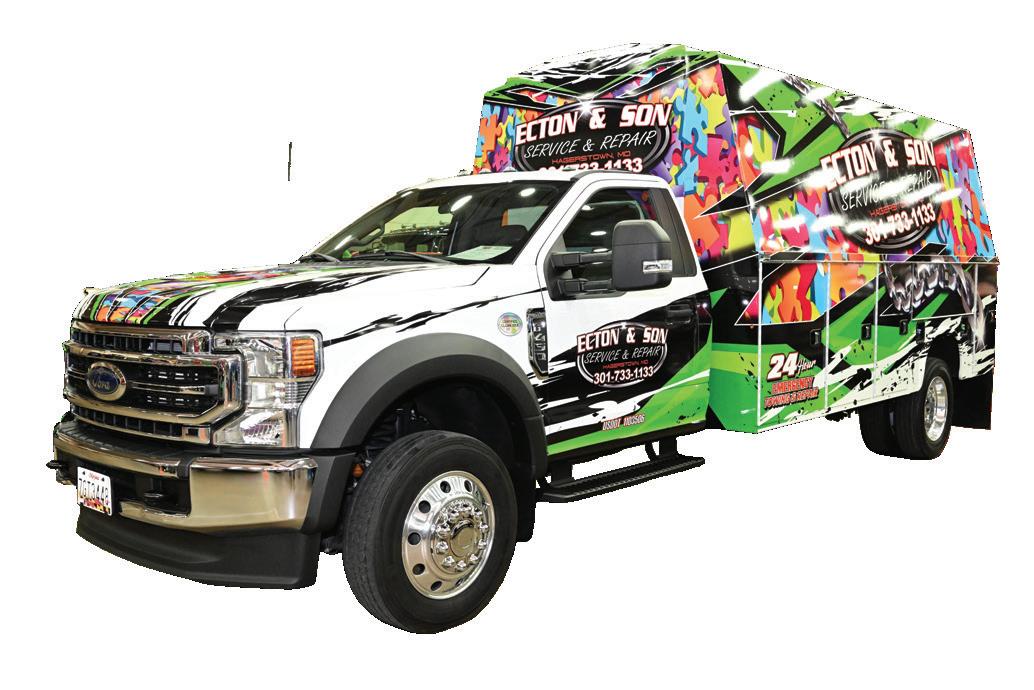
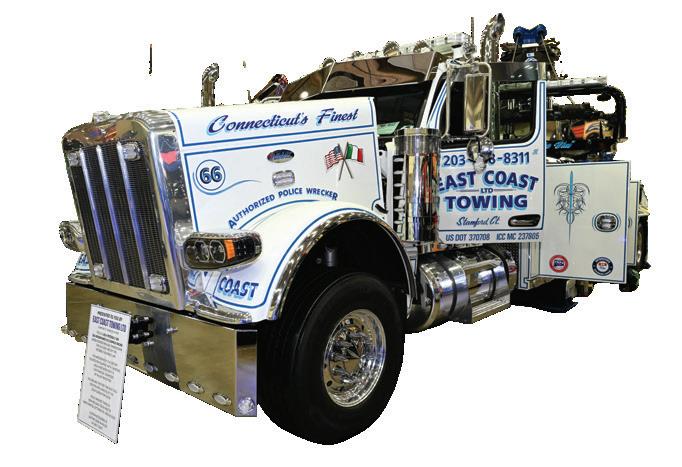
1ST
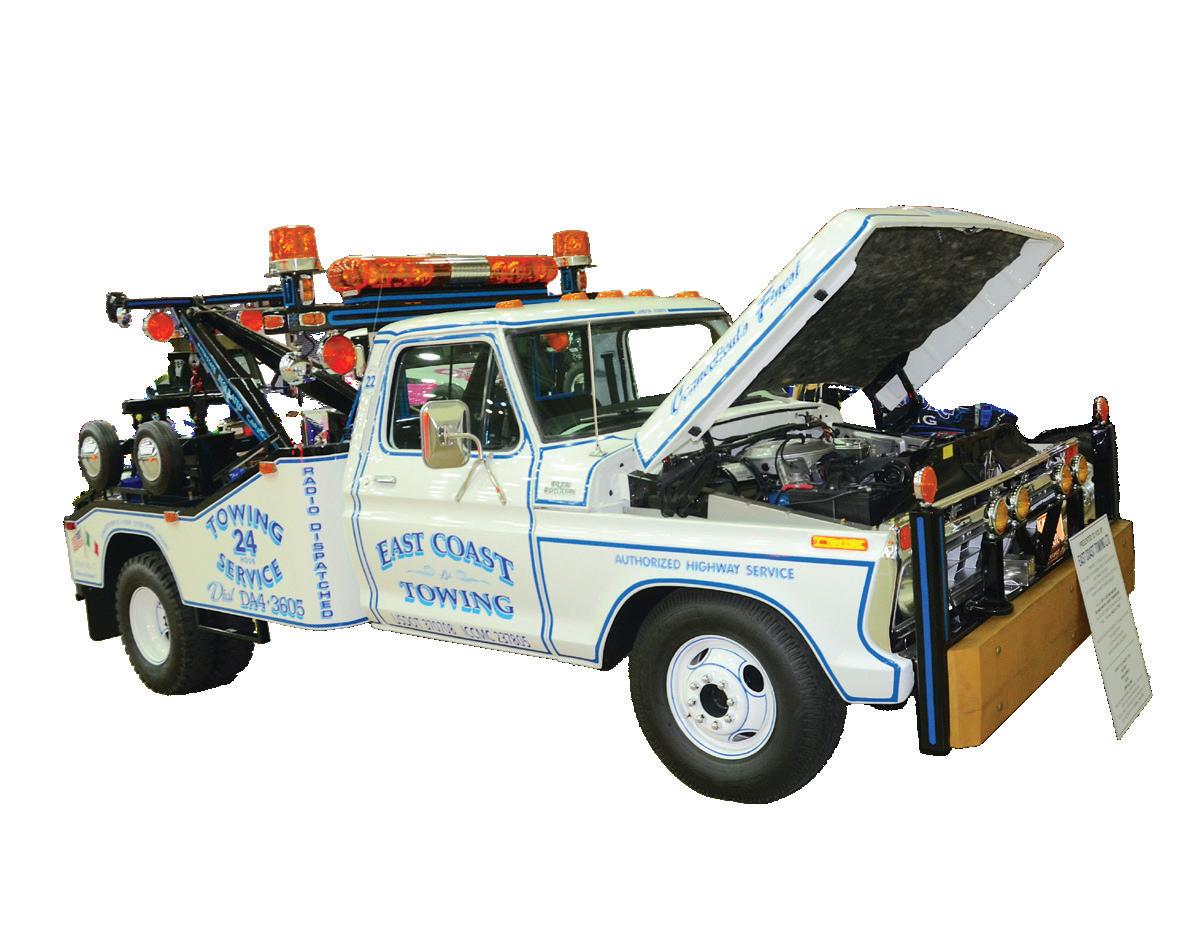
EAST COAST AUTO BODY
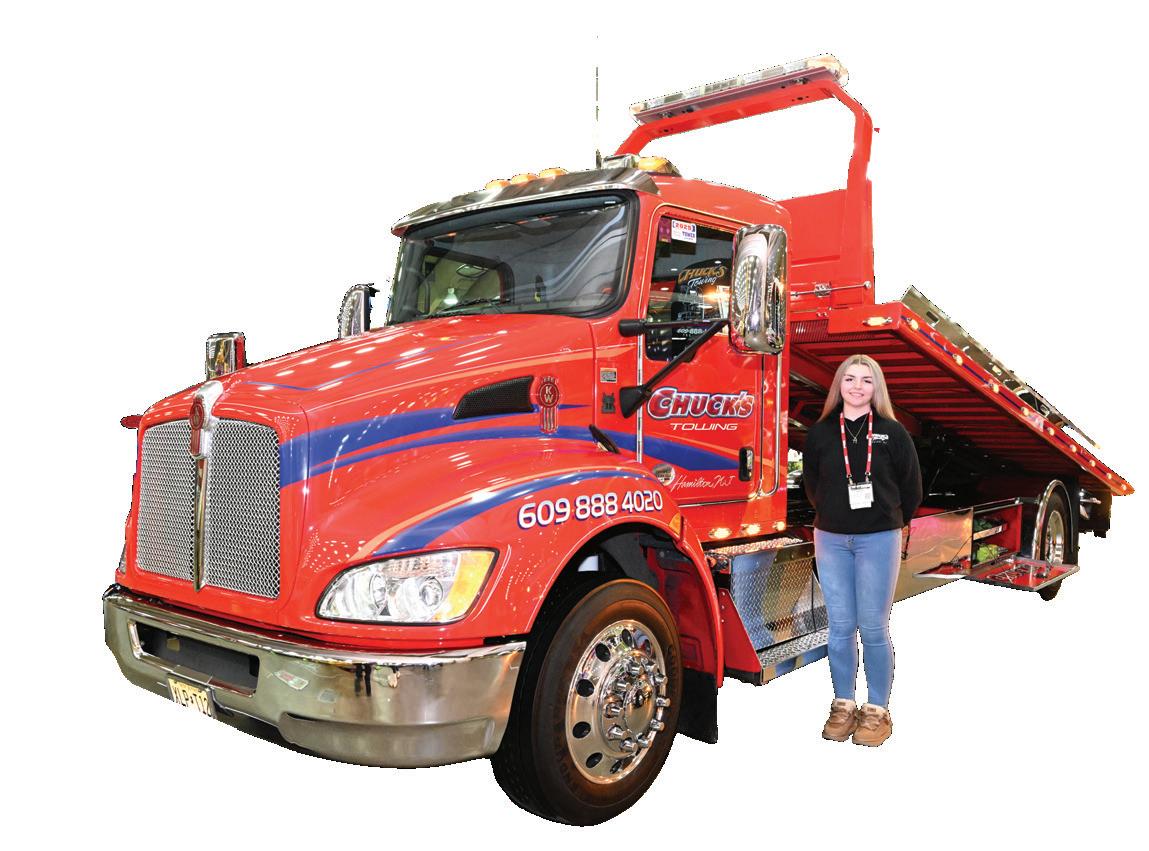
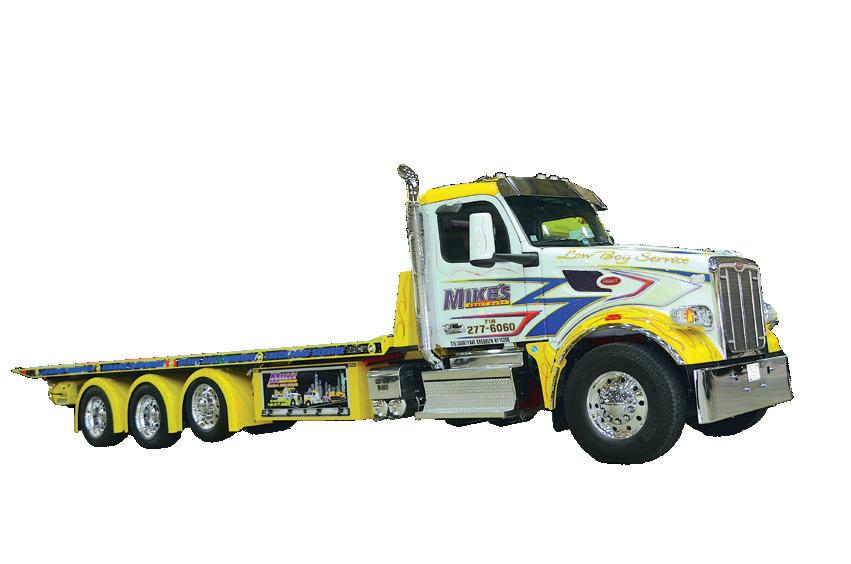
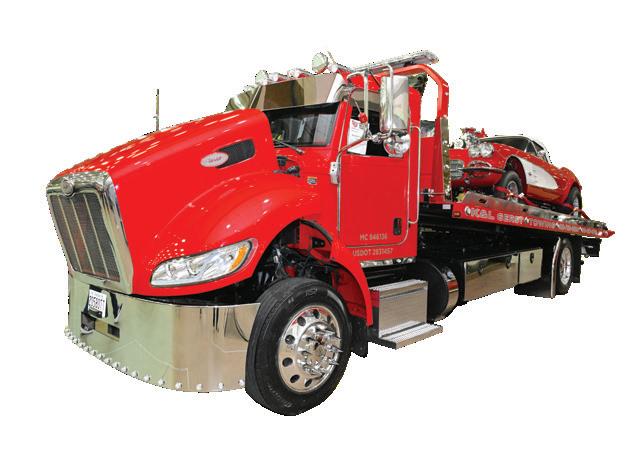
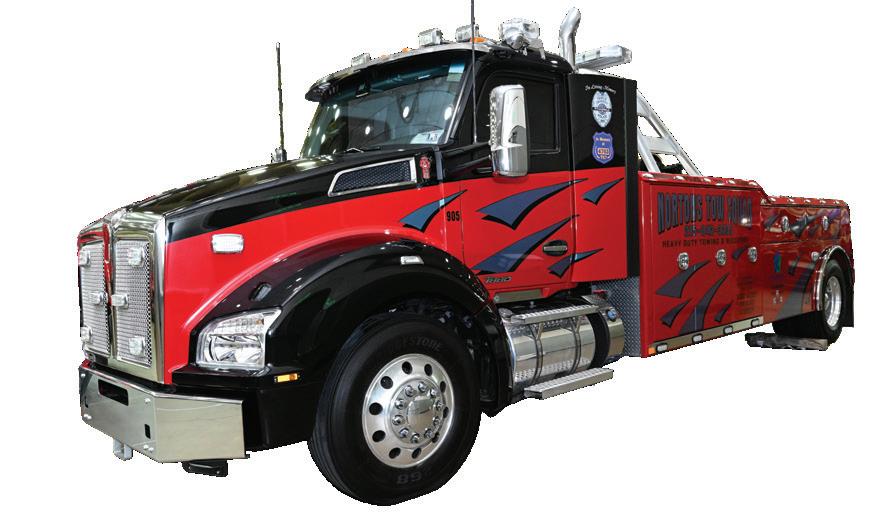
1977 Ford F-350/Ortiz Mfg. Wrecker Unit
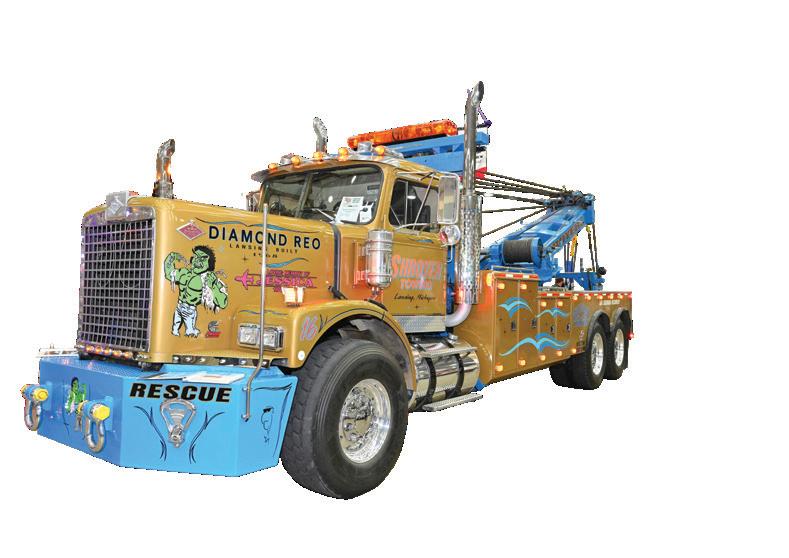
SHROYER TOWING
1968 Diamond REO C114/ Custom Shroyer Built Wrecker Lansing, MI
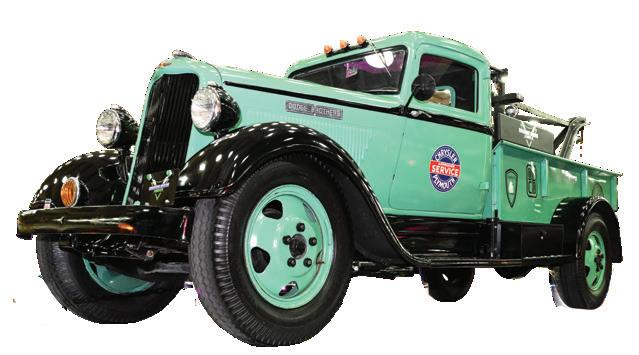
3rd
ROADSIDE
& TRANSPORT
1934 Dodge Brothers/ Weaver Crane
Needham Heights, MA
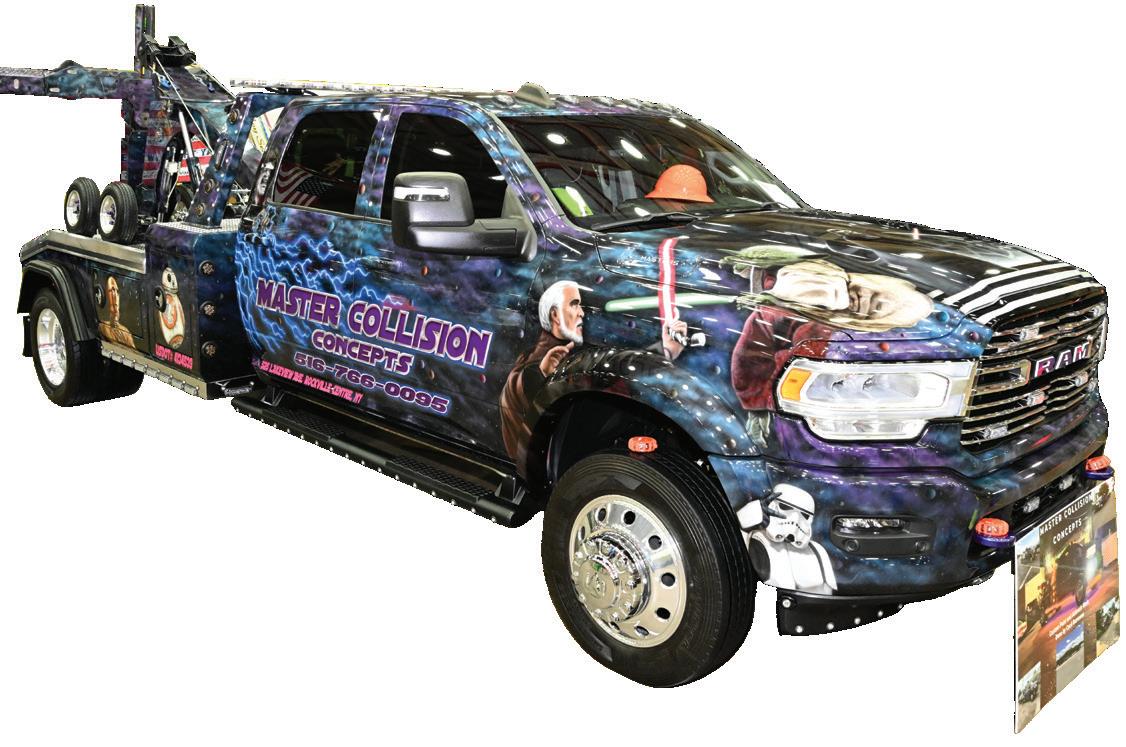
MASTER COLLISION CONCEPTS
2023 Dodge Ram 5500/ Jerr-Dan MPL 40 Rockville Centre, NY
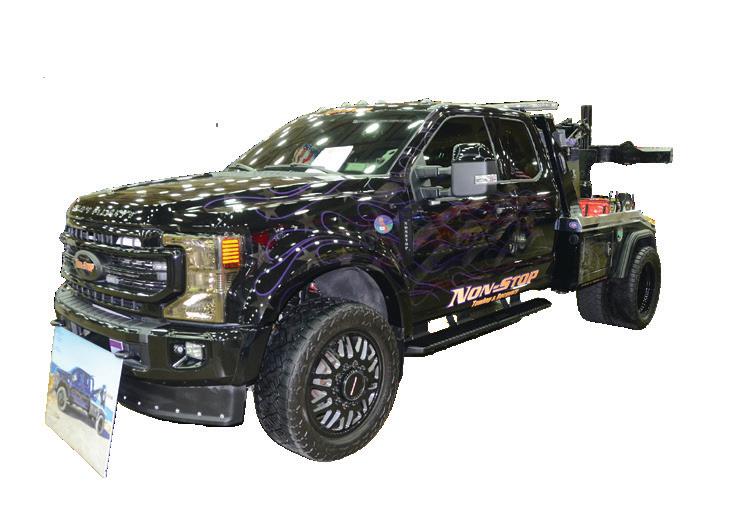
2nd
NON-STOP TOWING & RECOVERY
3
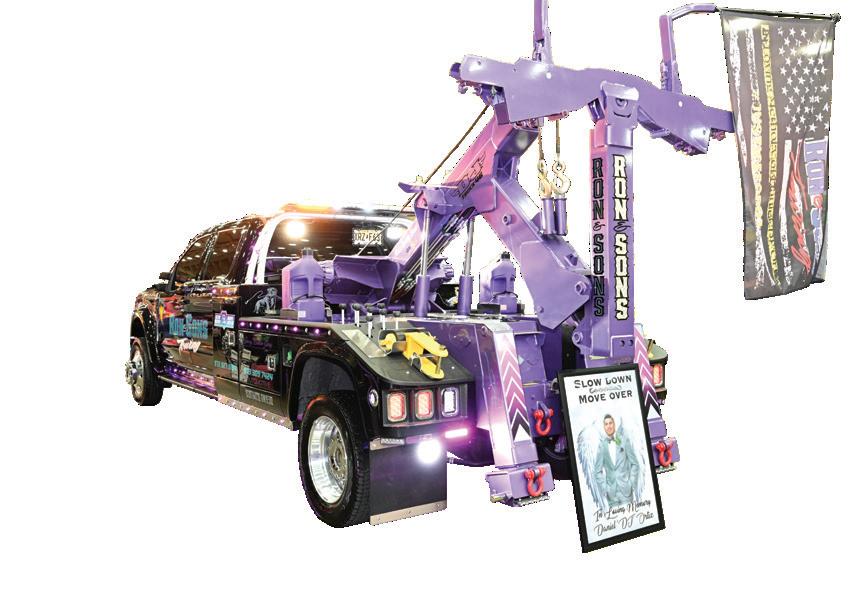
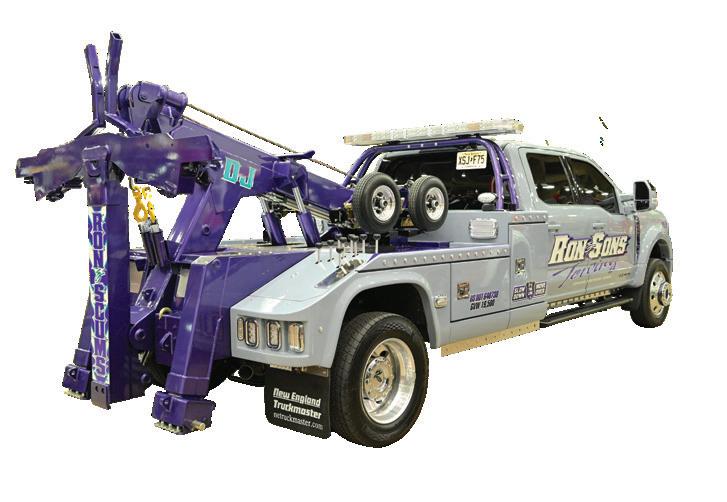
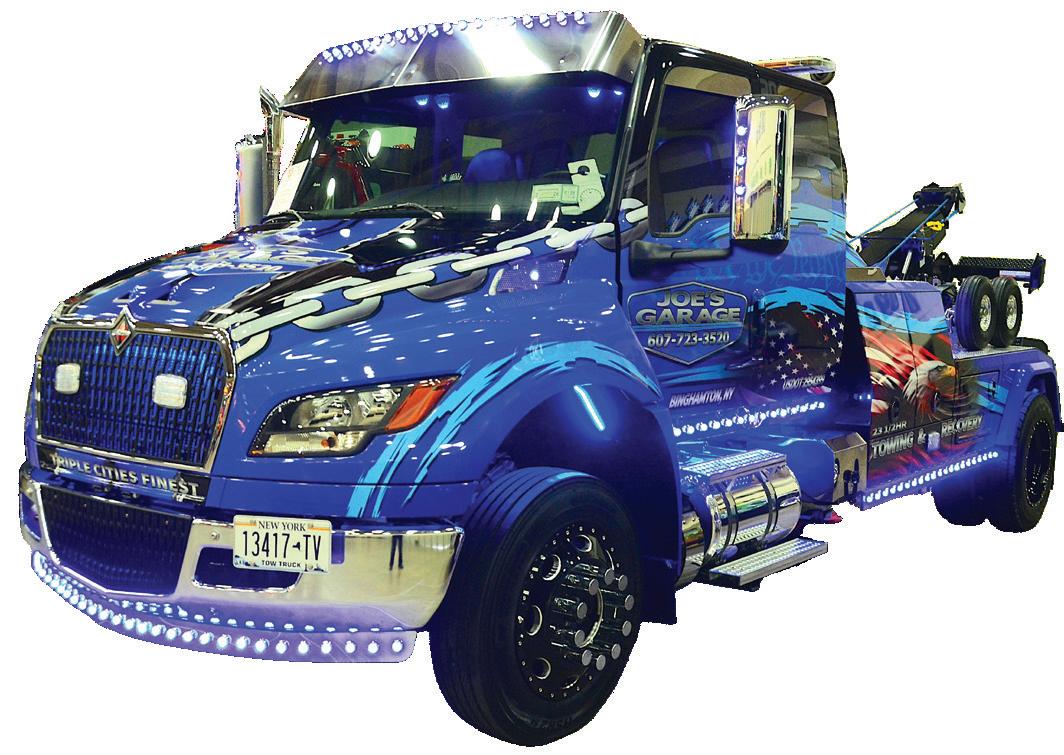
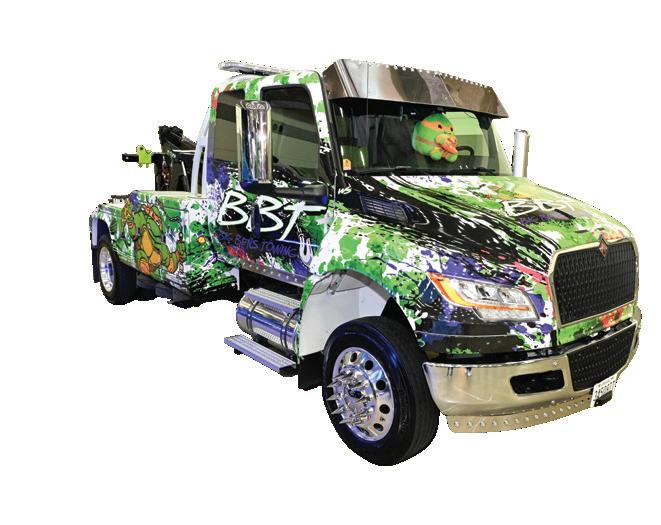
2022 Ford F-550/ Jerr-Dan MPL 40 Freeport, NY RON & SONS TOWING
2024 Ford F-550/Renegade Wrecker Kenvil, NJ





By George L. Nitti
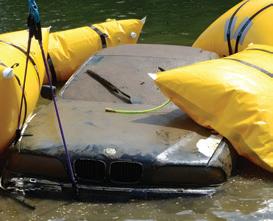
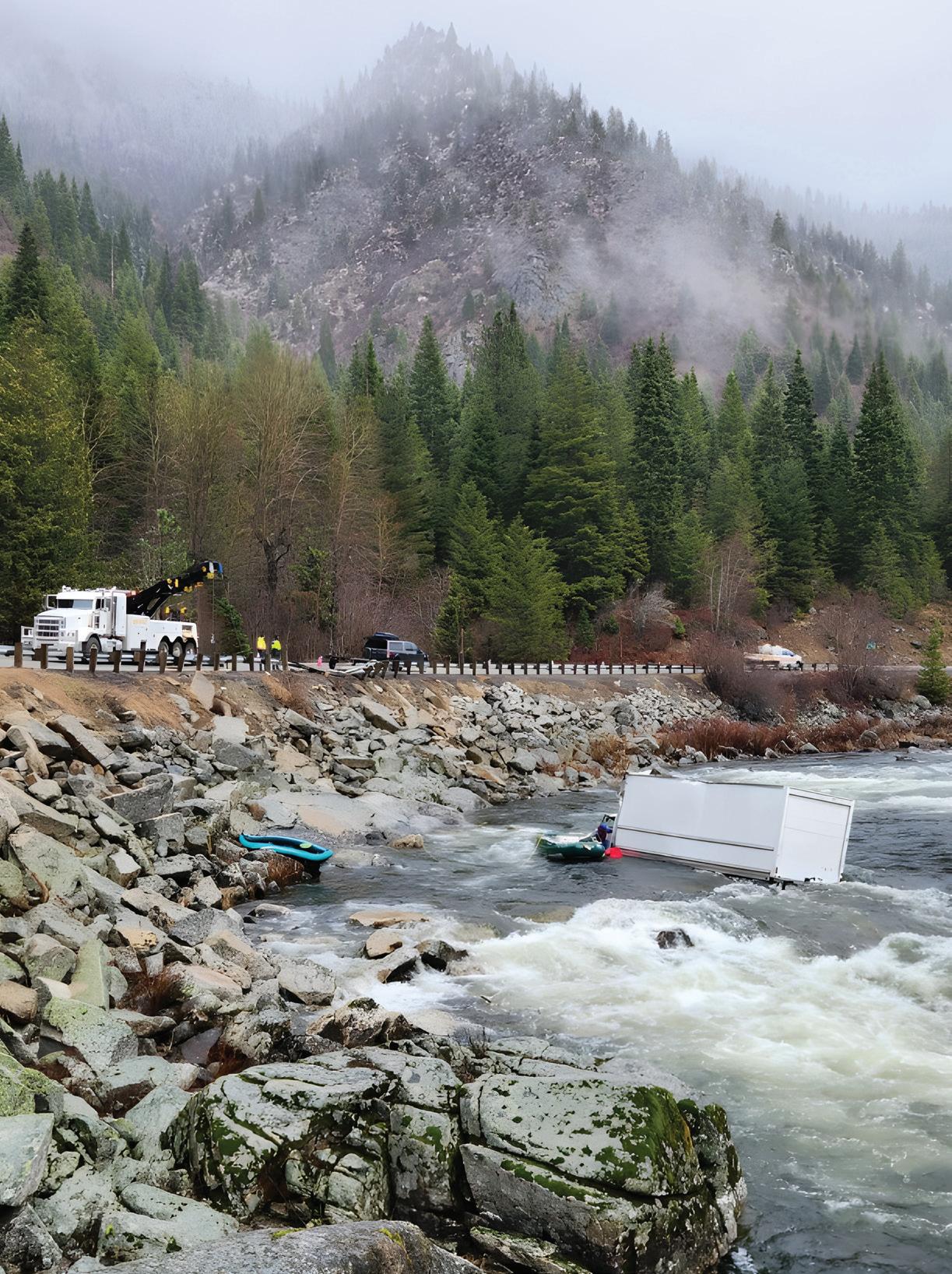
Along a narrow stretch of U.S. Highway 12 at Lolo Pass in Montana, where steep rock walls press in on one side and the icy Lochsa River races below, a box truck cartwheeled through a guardrail and plunged into the tumbling waters. Iron Horse Towing
in Missoula was called on March 26, 2024 to handle the recovery in this remote corridor, straddling the Montana/ Idaho border that’s renowned for both its beauty and unforgiving terrain. This casualty vehicle also posed some vexing questions, one of which is still unanswered.
According to Iron Horse owner Scott Wolff, the driver was hauling crates of merchandise westbound when the truck suddenly veered off the road.
“He got off the right side of the highway, and the steer tire fell off the pavement and then he overcorrected,” Wolff said. The truck skidded across the lanes, slammed into the guardrail, flipped over, and rolled down and into the river.
A mystery arose when the first responders arrived. The cab was empty, with the windows blown out, and the passenger door open, but no sign of the driver.
“They never found him,” Wolff said. “He’s still missing. He never washed up anywhere. There’s no body. There’s nothing.”By the time Wolff’s crew reached the scene, it was crowded with various agencies: the Idaho State Police, county sheriff’s office, Department of Environmental Quality, EPA, and tribal authorities overseeing a watershed that feeds the Nez Perce Tribe’s drinking water supply.
Adding to the unknowns of the incident, “Nobody knew what was in the box,” Wolff recalled. “They didn’t know if there was a hazardous materials load or if it was food or whatever. Nobody had an idea.”
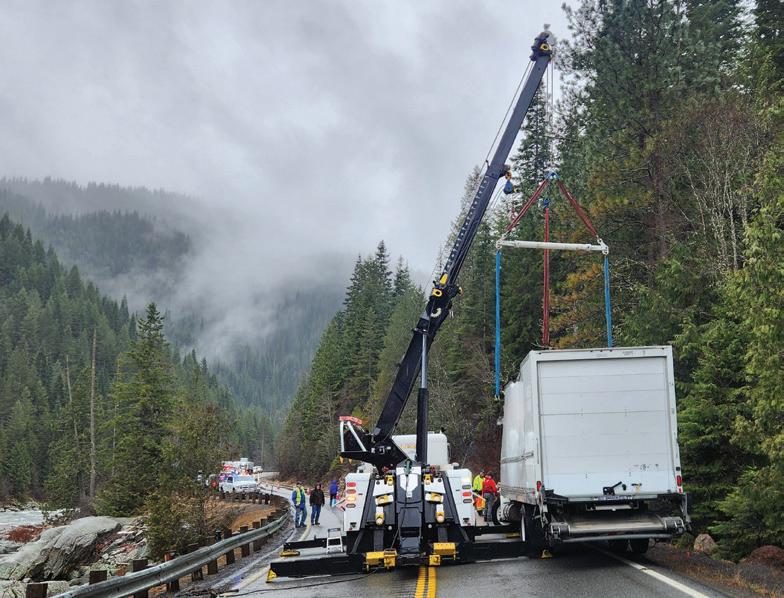
To protect the river from possible contamination, Wolff formulated a meticulous recovery plan to avoid any fuel or oil spills. His crew would have to keep changing angles and recovery points, carefully lifting over rocks instead of dragging across them.
“I couldn’t just use brute force,” Wolff noted.
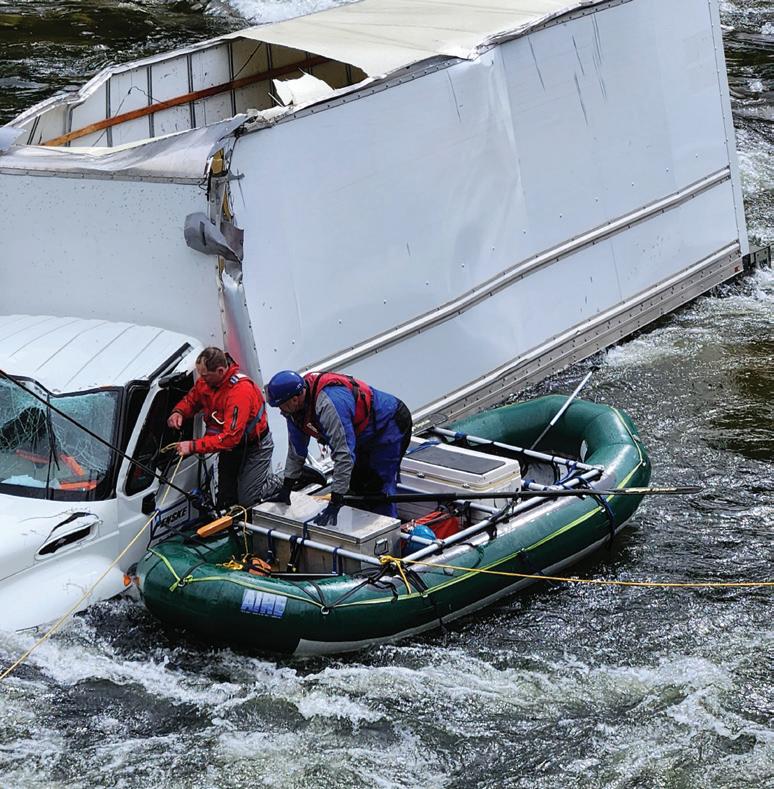
A dive team from Iron Horse launched upriver, drifting downstream in inflatable boats until they reached the wreck and tied off. Their first mission was to search the cab and river for the missing driver. Their next task—rigging
Century 1150
Peterbilt 367 and Trail King bus hauler
NRS kayak and 14-foot inflatable raft
Traffic control truck with Litesys sign board
the truck underwater—proved far more dangerous.
“They had their work cut out for them,” Wolff said. “That water was fast and cold and dangerous. If they fell off, they probably would have been in a tough spot.” The riverbed made everything worse.
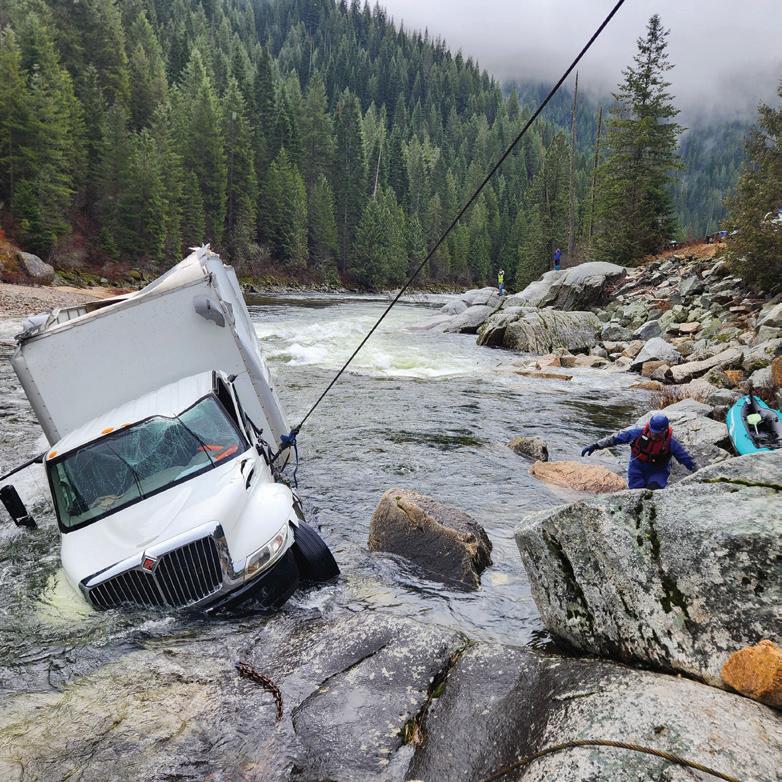
“The bottom of that river is all giant rocks, like the size of half of a car,” Wolff noted. The current had battered the truck, ripped out the rear section and wedged it between massive boulders. Divers couldn’t reach standard rigging points.
“They just physically couldn’t get to them,” Wolff added, forcing Iron Horse to abandon a conventional rigging plan. Instead, tow operators had to attach winch lines to the frame rails between the cab and the box. The most critical challenge was the precision required to remove the submerged box truck, pulling it out nose first.
“We had to be really, really careful with how we winched that thing out,” he pointed out. “We had to
create a fluid path, an angle that would keep us from scraping tanks or ripping lines.” Any mistake could have released contaminants into the river. “We were able to get it out without spilling anything, which was great,” he noted with relief. “That saved everybody a lot of issues for the environmental part of it.”
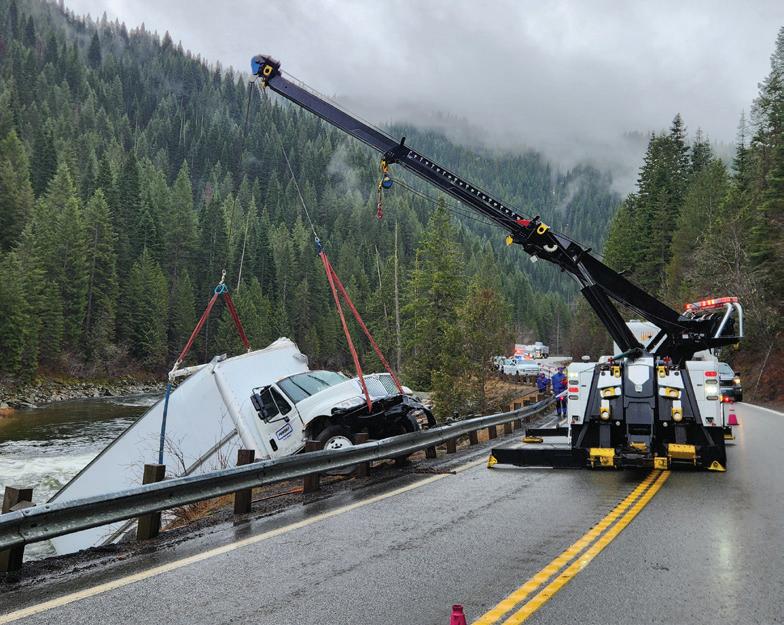
After hours of slow, technical movement, the ruined truck finally came free of the wild waters and landed safely onshore. Iron Horse’s 2018 Peterbilt with a Century 1150 wrecker reached over the guardrail, grabbed the casualty vehicle, and “just rotated the whole thing,” lifting it cleanly back onto the roadway.
Once on shore, operators were relieved to find that the cargo didn’t contain a hazardous load, just kidsized ATVs and motorcycles.
Bryan Tate
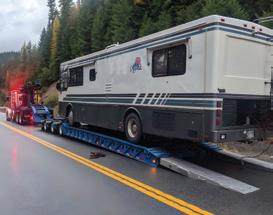
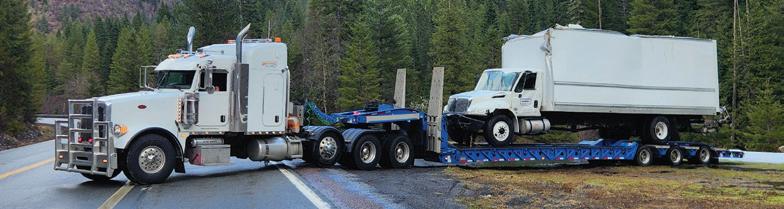
From there, the box truck was loaded onto a Trail King lowboy trailer and hauled to Missoula. Only a small amount of the cargo remained. “The roof was torn open,” Wolf explained. “I don’t know if some of it came out the roof or if it was just large and empty to begin with.”
From start to finish, including the two-and-a-half-hour drive each way into the mountain pass, the operation consumed nearly a full day. Wolff modestly summed up the job.
“It wasn’t extremely difficult,” he said. “The rotator makes the heavy lifting easy. What made it tricky was the dive team. They had a dangerous job. And the river made every decision slow and technical.”
So, even though this recovery from the rapids wasn’t all that rapid, it was successful, yet still left an unsolved mystery.

By George L. Nitti
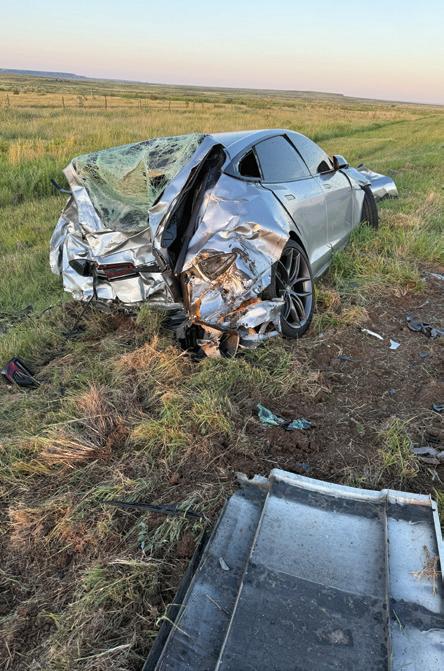
When crews from Ricky’s Towing of Amarillo, Texas, arrived at a crash site on Interstate 40 on July 15, 2025, the recovery was considered high-risk for a reason increasingly familiar to towers: a crushed electric vehicle. The tow firm, owned by Ricky Cantu, was responding to a vehicle transport that had been rear-ended by a semi, damaging several vehicles, including a nearly-new Tesla smashed at both ends.
On scene, operators checked for
heat, odors, and visible signs of battery compromise. Nothing appeared wrong. Still, the Tesla was handled as a potential hazard. This wise decision proved critical.
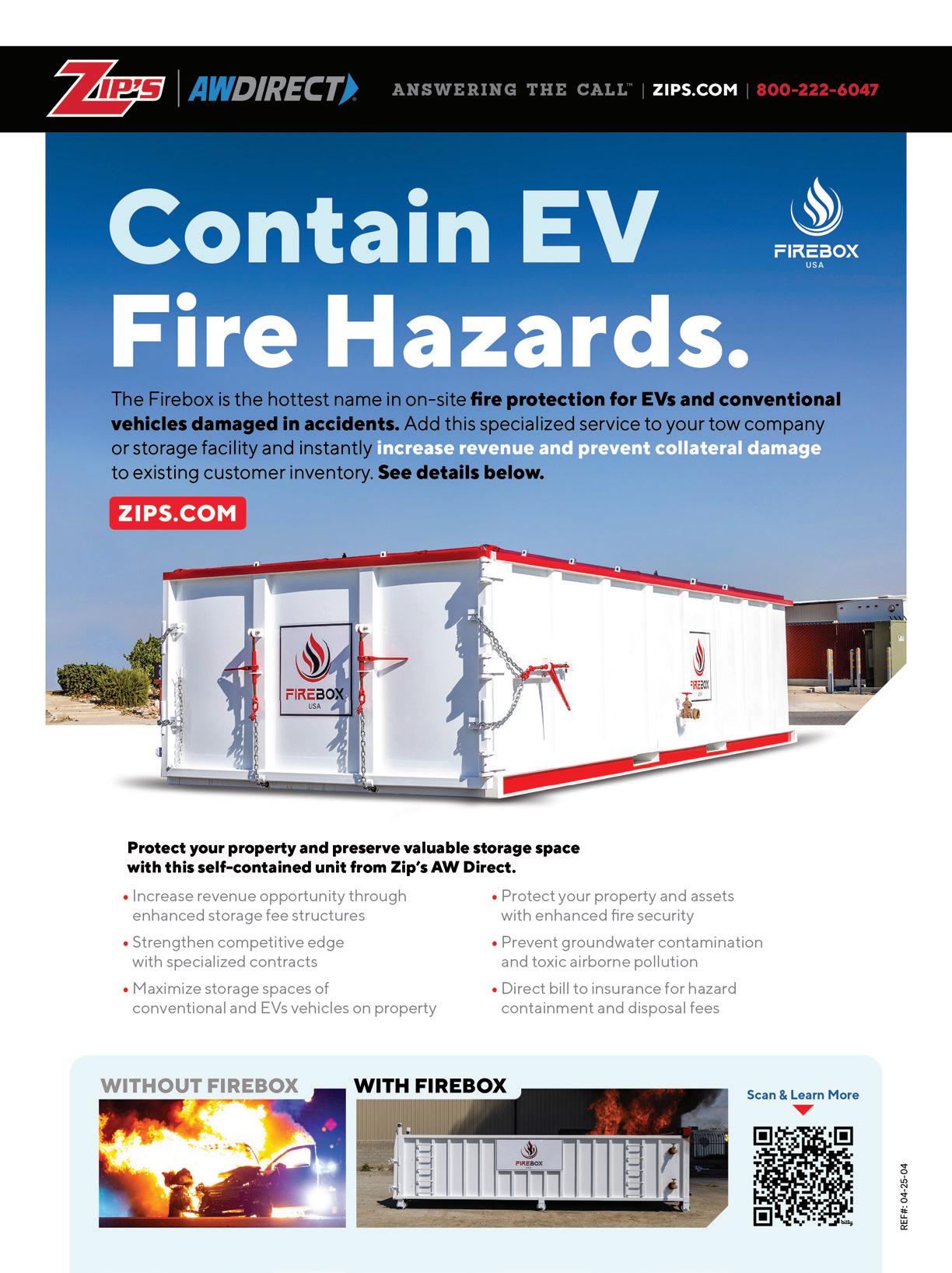
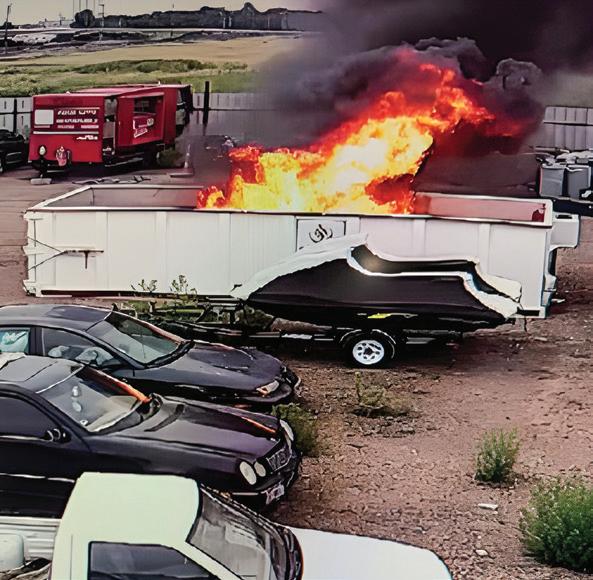
The Tesla was placed inside a newly purchased Firebox; a steel containment unit designed to isolate and immerse damaged electric vehicles. Almost three weeks later, an ominous sign developed. Employees spotted it around 9:00 a.m. and immediately contacted the fire department.
“We’re open 24/7, and luckily we had a driver and a dispatcher on site,” Cantu recalled. “They saw smoke and called it in right away.”
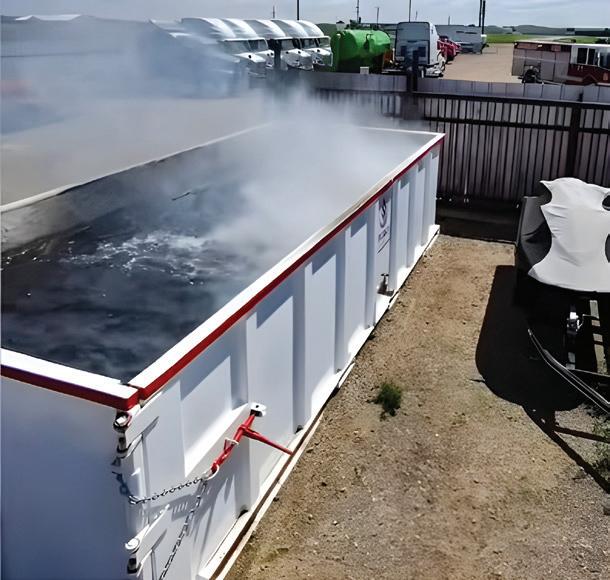
When firefighters arrived minutes later, the Tesla was fully engulfed inside the Firebox. Crews flooded the container by using its built-in water valves, submerging the vehicle beyond the roofline. The fire did not spread, but for more than 13 hours, the box bubbled as the lithium-ion battery continued burning beneath the surface.
“You could tell there was still a fire under there,” Cantu pointed out. “That battery stayed hot for hours.”

The Firebox—an investment of roughly $52,000—performed as designed, containing the blaze and protecting surrounding property. Nearby vehicles, including brandnew jet skis stored just feet away, were unharmed. Without this containment, Cantu said, the outcome could have been catastrophic.
“We don’t have room to give every EV a 50-foot radius,” he explained. “With the winds we get here—60 or 70 miles per hour—one EV fire could take out the whole yard.”
Unlike traditional vehicle fires, EV battery fires can ignite days or even weeks after a crash. Current guidance recommends isolating or containing damaged electric vehicles for 30 days, even when no warning signs are present.
In this case, the Tesla ignited. “We don’t know what caused it,” Cantu admitted. “It could’ve been internal


damage or a pinched wire. The problem is you can’t shut everything off in an EV. Some systems still have power.”
This unpredictability is what concerns towing operators most. “You may see smoke,” Cantu noted, “but you don’t see an explosion coming. That’s what can kill someone.”
Cantu speaks from experience. Two years earlier at Ricky's storage facility, a fire involving a box truck caused approximately $200,000 in losses when flames spread to two adjacent semis. “That changed how we think about storage safety,” he said.
While the Firebox successfully contained the Tesla fire, disposal proved costly and complex. The vehicle remained submerged for two weeks before crews could begin removing contaminated water. Disposal required testing, documentation, specialized hauling, and placement at a location

approved for lithium contamination.
“You can’t just dump it,” Cantu explained. “This isn’t oilfield water. Lithium contamination has its own rules.”
Testing costs alone exceeded $1,000, with hauling and landfill fees adding thousands more. Total out-ofpocket costs reached approximately $4,000, excluding storage time, labor, and equipment use. Insurance offered little relief.
“They paid for the other vehicles,” Cantu stated. “But not the Tesla. That’s going to litigation.”
To work within state limits on storage fees, Ricky’s Towing now leases the Firebox through its environmental services division— one way operators are adapting to regulations that have yet to catch up with EV realities.
Video from the incident showed firefighters climbing onto the Firebox while the vehicle burned, an action Cantu says highlights a widespread training gap.
“It could’ve ended badly,” he said. “That thing could’ve exploded.”
In response, the company has scheduled a two-day EV safety course covering battery fires, containment systems, and contamination risks, inviting local and volunteer fire departments to attend. Ricky’s Towing has also invested in hightemperature fire blankets, providing one to a local department for training and evaluation.
“They don’t even have these yet,” Cantu said. “We want them to use it, film it, and tell us what happens. We’re all learning.”
As electric vehicles—and electric semis—become more common on major freight corridors, containment challenges will only grow. “Some electric semis won’t even fit in a Firebox,” Cantu said. “That’s the next problem.”
Despite the cost, he believes incident-management towers should seriously consider containment systems. “This isn’t about equipment,” he maintains. “It’s about protecting people. I walk that yard every day. I don’t want one of my guys walking past a vehicle when it decides to blow.”
In this case, preparation made the difference. “We bought the Firebox just weeks before this happened,” Cantu said. “And it did exactly what it was supposed to do.”


By Steve Temple
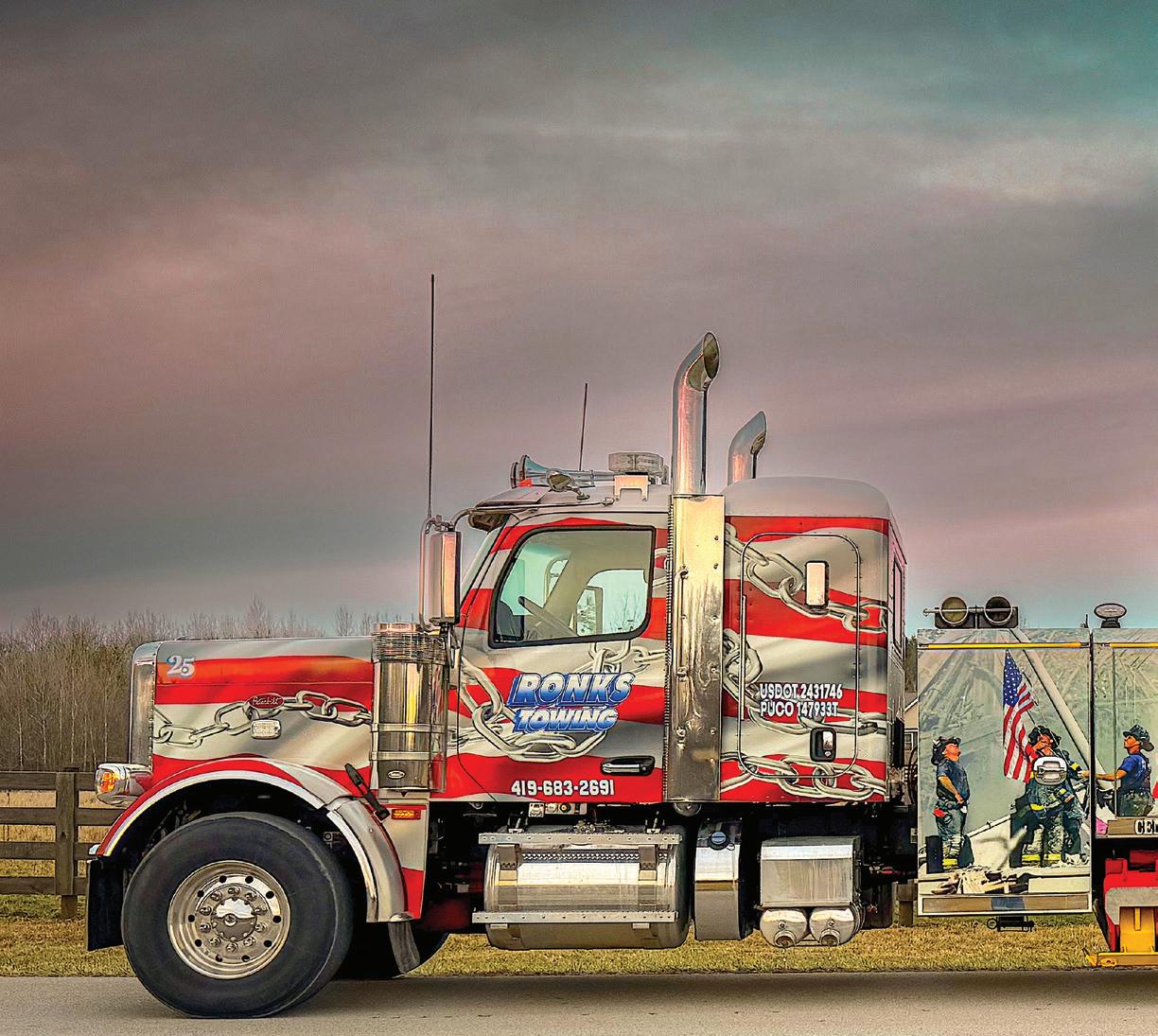
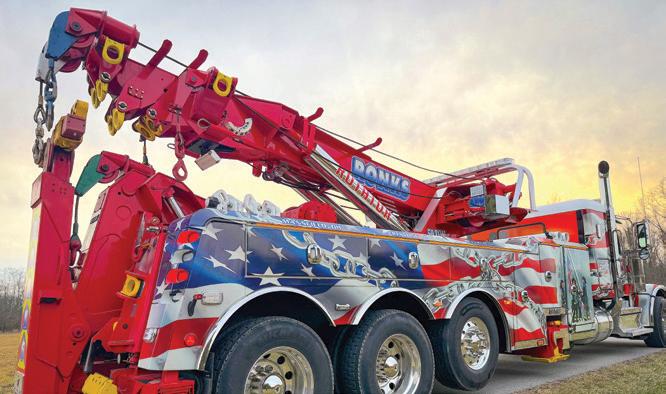
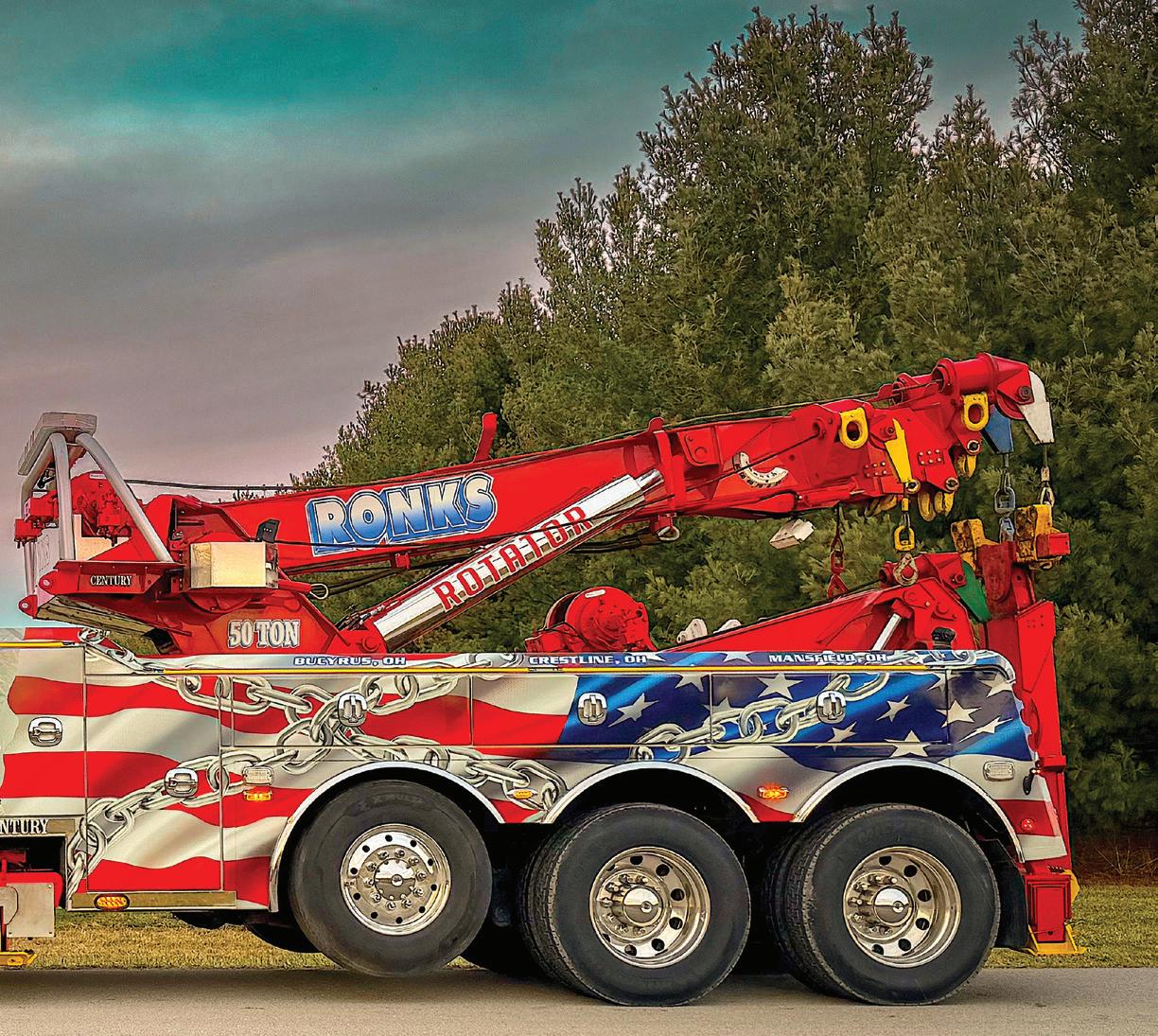
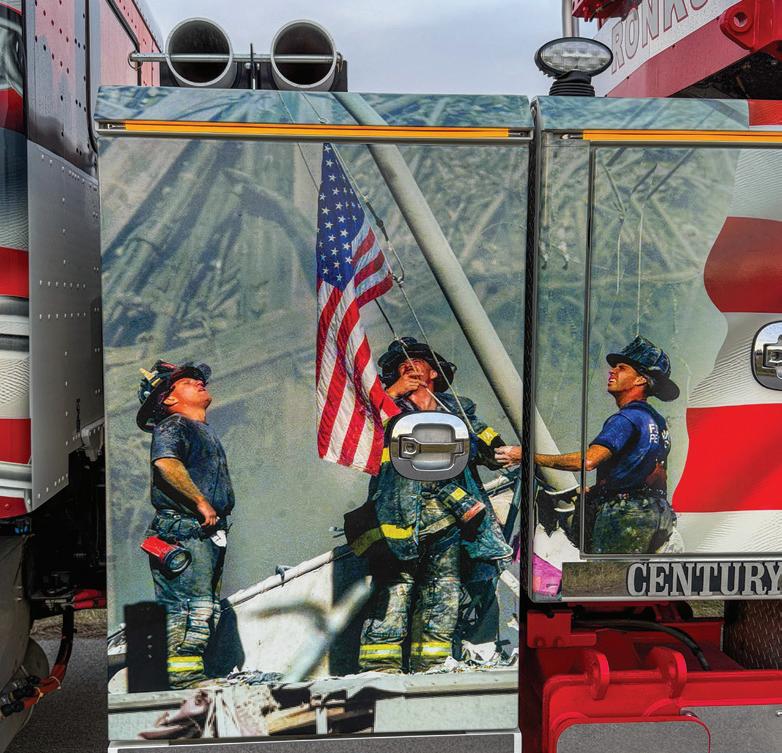
Given their regular contacts with local police and fire departments, the close-knit team at Ronk’s Auto and Truck Towing/Transport Inc. in Ohio wished to pay tribute to the heroic first responders of 9/11. Depicted here is a 2025 589 Peterbilt with a Century 1150 Rotator portraying an iconic image of firefighters raising an American flag over the ashes of the fallen the Twin Towers.
In acknowledging the company’s work with firefighters and police departments, Joey Rank pointed to the inspiration for this stirring image: “We need to keep it fresh in people’s minds, what happened —and what can happen.”
Ronk’s has a long and enduring legacy. This Ohio towing company was founded by the late George Ronk way back in 1948, and upon his death in 2001, was owned by his wife Eunice up until 2013. George’s first wrecker was a Diamond T fitted with a homemade wrecker body. ◀
Chassis: 2025 589 Peterbilt
Engine: Cummins X15 565hp
2050 lb/ft
Transmission: Eaton TX-18XB Pro 18 Speed
Wrecker Body: Miller Century 1150 Rotator
Custom Features: Vinyl wrap by Stan at Cain Graphics & Screen Printing; five winches with a knee boom; Miller Raptor proportional remote control
Ronk’s currently operates 22 trucks in the fleet, including multiple tractors, lowboy trailers as part of its core business, and DTUs for the equipment hauling side of their towing business. This division

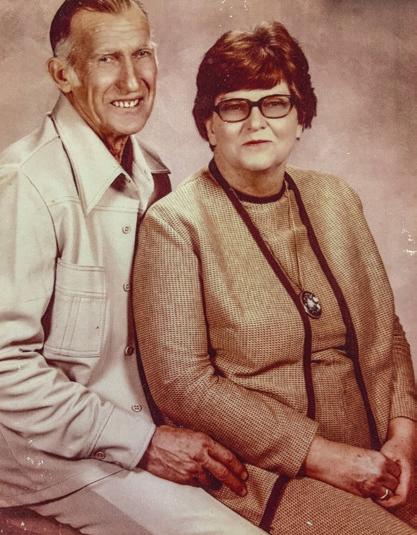
was added in 2018, along with a dealer license for the sale and export of heavy-duty truck parts.
The company is still in the family, four generations in all, with the father and son team of Jole and Joey Ronk
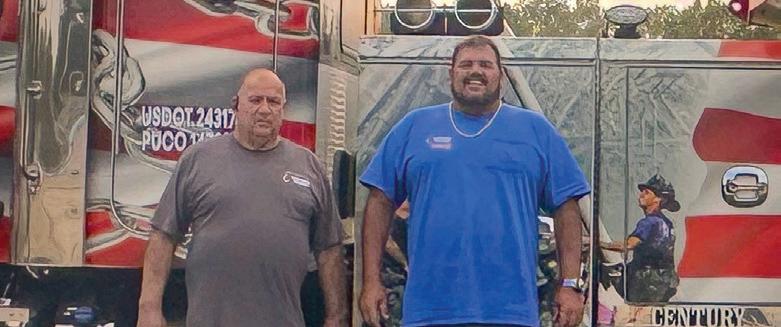
carrying on the tradition of towing. Kaden Ronk, Joey’s youngest child is the 4th generation, who joined the family business five years ago. And Jole’s younger sons Shawn and Brandon Ronk, always help out when needed. In the office, Julie Rhodes and Brianna Back keep operations running smoothly, answering calls and handling whatever needs arise from day to day.
Ronk family members collectively designed the entire wrap in-house, which includes
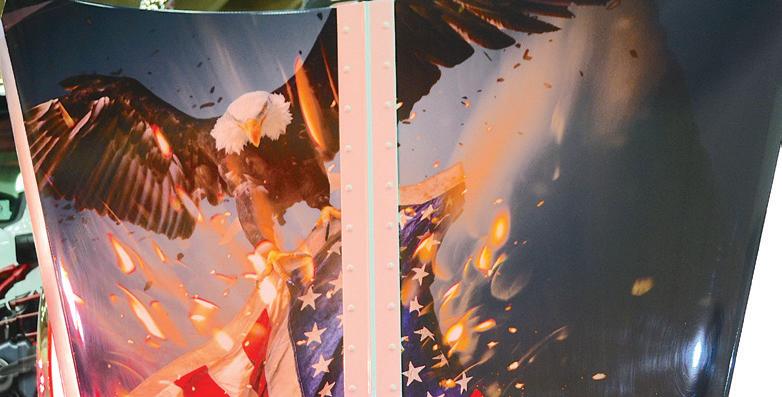
massive chain links winding through patriotic stars and stripes imagery, along with a ferocious eagle gripping an American flag in its talons. The visual impact of these elements is unforgettable, and as such, this wrecker is slated to remain in the company fleet.
“It’s supposed to be Jole’s last truck,” Joey explains. “He’s retiring, and we’ll never sell it. And it’s my history too.”
All of which makes it a true keepsake tow truck.

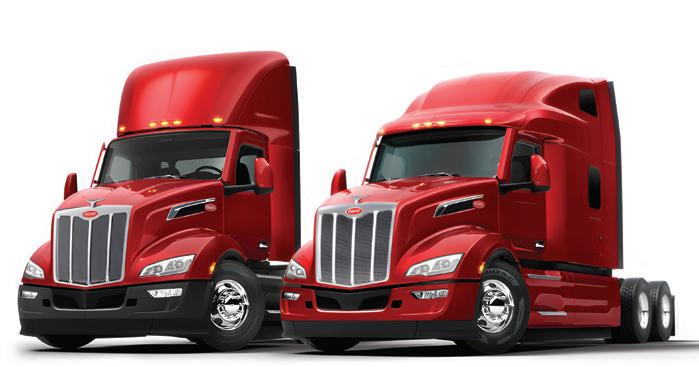
Peterbilt’s new Model 579 is the result of extensive customer input and a commitment to technological advancements. Through over 100 user tests and interviews with drivers, technicians, and safety man -
agers, the company has created a sleek, comfortable, and fuel-efficient truck that meets the diverse needs of the industry.
This model incorporates Advanced Driver Assistance Systems (ADAS) technology, providing critical truck systems information ◀
and enhancing driver safety. The Bendix Fusion system was recently updated to include pedestrian detection, lane-keeping assist, and side object detection, further improving overall safety on the road. The electronic park brake helps to potentially prevent rollaways by automatically applying the parking brakes if the driver forgets. When the Rollaway Mitigation activates, it engages the park brake and alerts the driver.
With its cutting-edge technology and customer-driven design, the Model 579 sets new standards for safety, comfort, and efficiency. It also carries a heavy payload with a lighter payout at the pump, using a PACCAR powertrain that offers an integrated solution for maximizing MPG. By combining PACCAR MX engines with DX-40k tandem drive axles, these components provide low-effort pulling, improved efficiency, enhanced fuel economy, and lower noise levels for increased driver comfort.
Other powertrain highlights include gear ratio coverage for slow-speed maneuvering, and a high-performance through-shaft pinion design that transfers full engine power straight to the road. Also, the fuel system optimizes combustion for a broad torque curve that delivers up to 1,850 lb./ft. peak torque.
The new TX-12 Pro transmission includes dual PTO functionality to power multiple hydraulic de -
vices simultaneously, along with an extreme duty clutch for better low-speed maneuvering with higher loads. Also, a Rock Free Mode helps to free the truck from mud, sand or snow. An Off-Highway Calibration enables shift points that are tuned for changing off-highway conditions with a bias toward shifting less often. A secondary configuration allows for a tailored driving experience that can toggle between two calibrations to suit the load or terrain.
Source: peterbilt.com
NRC Industries’ latest innovation, the Lift-IQ, is a cutting-edge technology that brings the towing and recovery industry into a new digital era, where every lifting calculation is performed automatically, in real time, right from the operator’s screen.
Traditionally, operators relied on printed lifting charts and manual calculations, a tedious process often involving a margin of approximation.
With the Lift-IQ, however, those days are over. Using advanced sensors and algorithms, the system instantly determines lifting capacity based on multiple factors: boom angle and extension, load and ve -
hicle weight, boom position on the truck (with NRC’s Slider System), and outrigger stance. Any time the operator moves the boom or the load, the system recalculates capacity in real time, displaying precise, live data.
“This type of technology already exists in the crane industry,” explains Sébastien Daigneault, Technical Sales Specialist at NRC
Industries. “But cranes are stationary. A wrecker, on the other hand, is mobile, and the Slider System changes the center of gravity. All these variables must be taken into account to work safely and efficiently.”
The result is an interactive and dynamic lifting chart that evolves with each movement. Operators can visualize lifting parameters from both top and side views, helping them anticipate scenarios before acting.
Beyond convenience, the LiftIQ significantly improves safety by providing accurate awareness of the vehicle’s real-time limits and capabilities. It also features a Job Planner module that allows users to simulate lifting scenarios in advance, which maximizes efficiency and reduces risk.
“We’ve been integrating electronics and programming into our vehicles for decades,” notes Norbert Pigeon, founder of NRC Industries. “We had wireless remote controls as early as 1994 and were pioneers in programmable hydraulic systems. Lift-IQ is the next logical step in that evolution.”
Now standard on the CSR85 and CSR65 wreckers, and coming soon to the CSR50, Lift-IQ represents the future of smart recovery.





Excerpt by Stephanie Marchese
Journey of Angels is just one of several novels penned by the late Steven L. Calitri using the pen name A.T. Armada. This book is a work of fiction threaded with the real heartbreak, hope, and hard pavement of the American roadway. Set against the backdrop of the towing world, it follows Mr. Bastone as he conjures up the infamous Spirit Ride, where a single empty carrier and one solemn casket come to stand for every tower lost in the line of duty. In these pages,
Bastone pushed himself up from the desk, took the cane, and moved painstakingly around and into the long room; the ‘grand salon’ as Miss Reusch called it. He sat on the wood chair in the corner.
“Come in here, Miss Reusch.”
He took the camera from Garson and with Miss Reusch looking on, instructed him in his pose.
“Garson, you just came upon this woman and her car submerged in the creek. You are standing on a flat surface—a rock slab. You are holding a grab hook in your right hand and you are reaching down to the left, stretching your left hand to her. She is reaching upward her left hand, the water line just at her shoulders.”

Garson listened and went into a pose.
“No, don’t bend down like that. Plant your legs and feet spread apart firmly upon the ground so you have the leverage to lift her out of the water with
He watched Garson with the eyes of a ballet instructor and further described
“The fender of the submerged car is visible above the water. Imagine it.
“Crouch only slightly, Garson. Reach down to her as she reaches her
Garson, all six feet of him, crouched slightly as instructed. He reached his left arm downward while bracing his hips.
Bastone could even see the grab hook in his right hand that was partially closed. He snapped several pictures,
then instructed Miss Reusch to take the camera and snap more shots from different angles. After she circled him, snapping shots, Bastone thanked Garson, who made his exit.
“What’s this all about?” she asked Bastone. Maybe there was a hero story she wasn’t aware of, and Bastone wanted artwork for the medal presentation, or for an article in the magazine he published. He might even be calling her for sketches, she thought. She had shown him several of the fashion sketches she had drawn one morning, an outshoot of her work as a seamstress and dressmaker.
“It’s about the new project.”
“Just where are we going in California?” she asked, a readiness to be whisked away on a magic carpet apparent in her eyes.
“To a foundry.”
She took that word and rolled it around her brain. A lightbulb when off.
“You’re going to create a statue!”
“A monument,” he replied.
To read the full story, visit amazon.com/Journey-Angels-T-Armada/dp/B0CMHH87QJ
Waymo (“WAY forward in MObility) temporarily suspended its self-driving, ride-hailing service in San Francisco after a widespread power outage knocked out traffic signals across the city, leaving many of its autonomous vehicles stopped at darkened intersections. The outage affected tens of thousands of residents and created traffic congestion as Waymo vehicles remained stationary while attempting to assess uncontrolled crossings.
Tow truck operators reported towing Waymo vehicles for hours overnight as the disruption continued. Videos posted on social media showed driverless cars stopped with hazard lights flashing, frustrating motorists and contributing to gridlock in several neighborhoods. Service resumed after power was restored, but the incident underscored the essential role that towing professionals play when autonomous vehicles are unable to recover on their own during large-scale infrastructure failures.
Source: nytimes.com
A South Los Angeles tow truck driver has been found not guilty of stealing a federal agent’s vehicle during an immigration arrest last summer. A federal jury acquitted Bobby Nunez, 33, of theft of government property stemming from an August 2025 incident involving immigration enforcement officers. The charge carried a potential sentence of up to 10 years in federal prison. After a four-

day trial, jurors deliberated for more than three hours before returning the not-guilty verdict.
Prosecutors alleged that Nunez interfered with federal agents as they arrested a Colombian woman accused of entering the United States illegally. According to court filings, agents parked two government vehicles, with emergency lights activated, at the exit of an apartment complex parking garage to block the woman’s car during the arrest.
Authorities said Nunez and another man approached the scene and were warned to leave. While agents dealt with the other individual, prosecutors claimed Nunez entered his Dodge tow truck and then towed away one of the government SUVs used to block the exit.
Federal officials said the SUV contained an agent’s firearm and keys. Nunez was arrested roughly two weeks later, but the jury ultimately rejected the government’s case.
Source: cbsnews.com/losangeles
A towman was killed and a woman was critically wounded after a shooting inside a tow truck in Northeast Philadelphia, police said. Towman Aaron Whitfield, 25, was pronounced dead at the scene. A 21-year-old woman was transported to a nearby hospital suffering from a gunshot wound, authorities said. According to police, a silver or gray Honda pulled alongside the tow truck, and two occupants opened fire into the vehicle. Investigators recovered between 15 and 20 shell casings at the scene, Inspector D.F. Pace said. Several bullets also struck a nearby building, with some rounds penetrating the second floor.
Source: cbsnews.com
U.S. Transportation Secretary Sean Duffy is withholding nearly $160
million from California after the state missed the Jan. 5 deadline to revoke more than 17,000 improperly issued non-domiciled commercial driver licenses (CDLs).
“It’s reckoning day for Governor Newsom and California,” Duffy said on Jan. 7, 2026, citing a Federal Motor Carrier Safety Administration (FMCSA) notice declaring “substantial noncompliance.” He accused the state of prioritizing illegal immigrants over public safety, and said the funding cut ensures federal dollars do not support “this charade.”
FMCSA Administrator Derek Barrs noted California partially implemented reforms, but failed to cancel 17,400 non-domiciled CDLs by the agreed date. The remaining 2,700 licenses are due for revocation by Feb. 13, 2026. Consequently, FMCSA will withhold 4% of the state’s National Highway Performance Program and Surface Transportation Block Grant funds starting fiscal 2027.
Source: ttnews.com
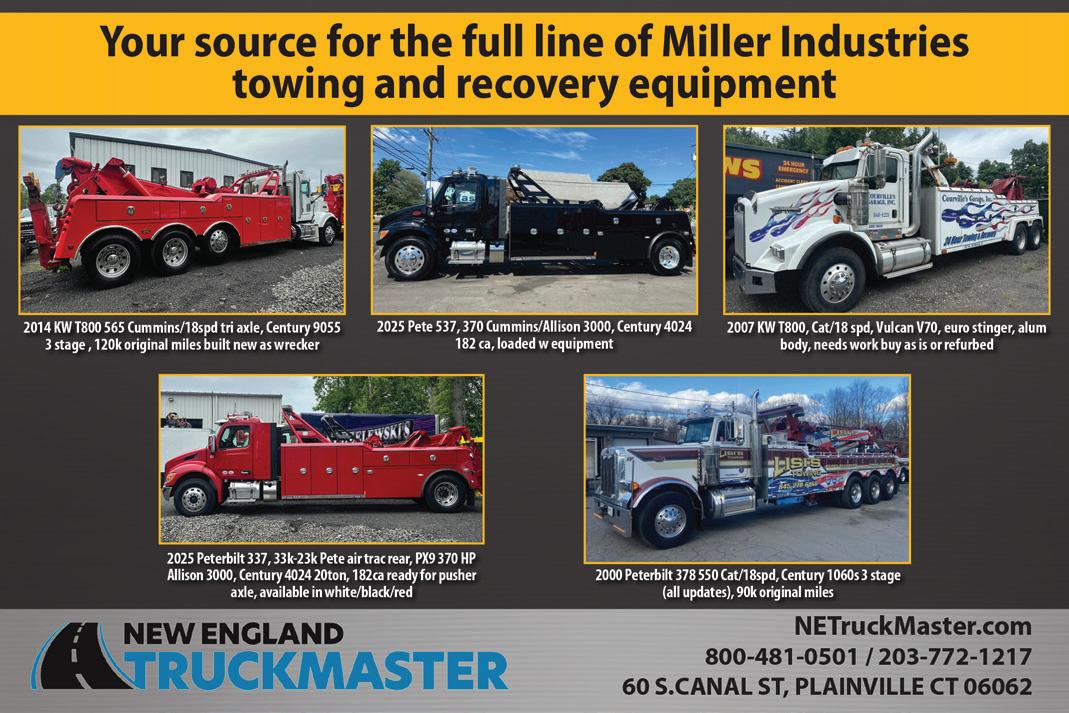
by Don Lomax
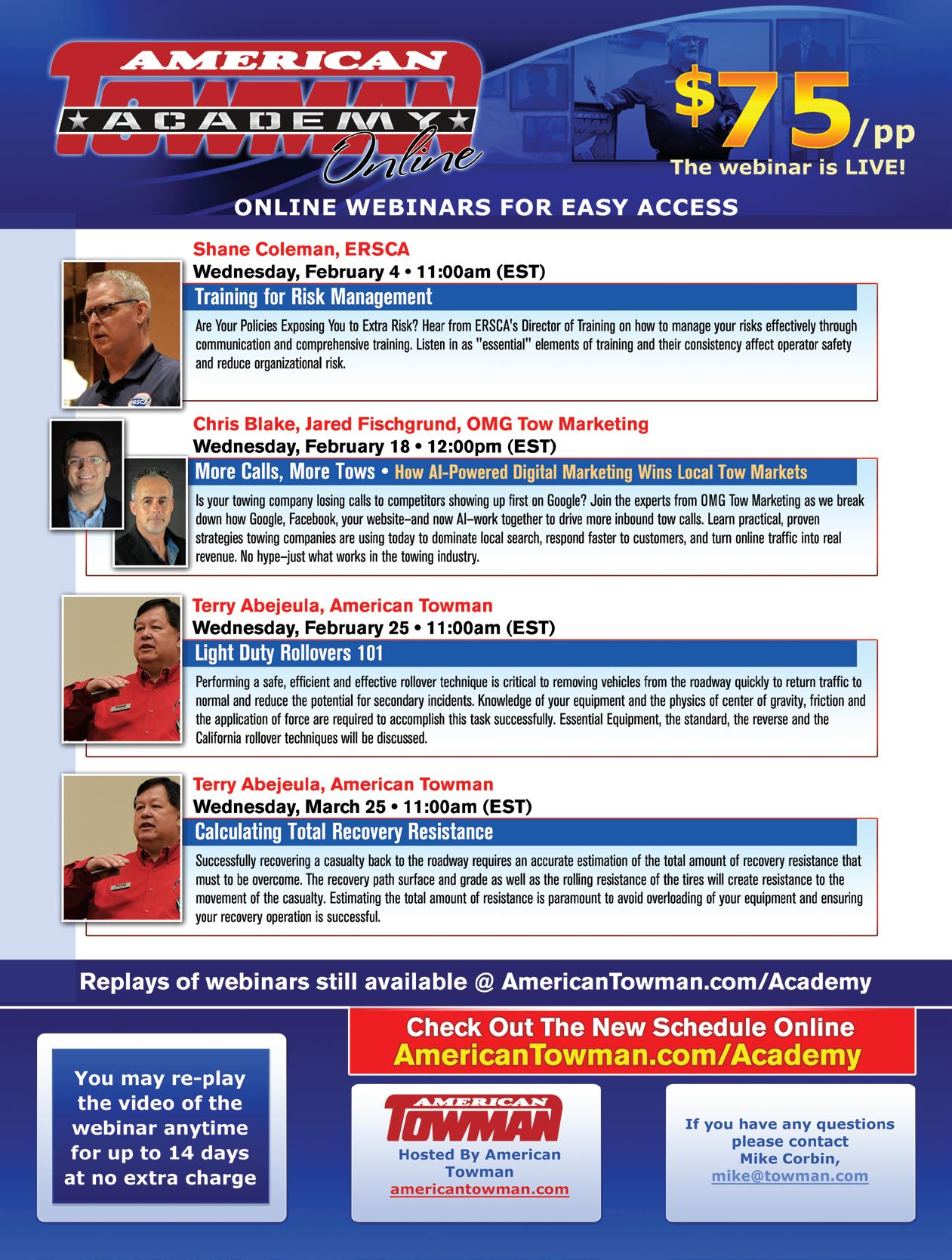
Waymo (“WAY forward in MObility) temporarily suspended its self-driving, ride-hailing service in San Francisco after a widespread power outage knocked out traffic signals across the city, leaving many of its autonomous vehicles stopped at darkened intersections. The outage affected tens of thousands of residents and created traffic congestion as Waymo vehicles remained stationary while attempting to assess uncontrolled crossings.
Tow truck operators reported towing Waymo vehicles for hours overnight as the disruption continued. Videos posted on social media showed driverless cars stopped with hazard lights flashing, frustrating motorists and contributing to gridlock in several neighborhoods.
Service resumed after power was restored, but the incident underscored the essential role that towing professionals play when autonomous vehicles are unable to recover on their own during large-scale infrastructure failures.
Source: nytimes.com
A South Los Angeles tow truck driver has been found not guilty of stealing a federal agent’s vehicle during an immigration arrest last summer. A federal jury acquitted Bobby Nunez, 33, of theft of government property stemming from an August 2025 incident involving immigration enforcement officers. The charge carried a potential sentence of up to 10 years in federal prison. After a four-day trial, jurors deliberated for more than three hours before returning the not-guilty verdict.
Prosecutors alleged that Nunez interfered with federal agents as they arrested a Colombian woman accused of entering the United States illegally. According to court filings, agents parked two government vehicles, with emergency lights activated, at the exit
U.S. Transportation Secretary Sean Duffy is withholding nearly $160 million from California after the state missed the Jan. 5 deadline to revoke more than 17,000 improperly issued non-domiciled commercial driver licenses (CDLs).
of an apartment complex parking garage to block the woman’s car during the arrest.
Authorities said Nunez and another man approached the scene and were warned to leave. While agents dealt with the other individual, prosecutors claimed Nunez entered his Dodge tow truck and then towed away one of the government SUVs used to block the exit.
Federal officials said the SUV contained an agent’s firearm and keys. Nunez was arrested roughly two weeks later, but the jury ultimately rejected the government’s case.
Source: cbsnews.com/losangeles
A towman was killed and a woman was critically wounded after a shooting inside a tow truck in Northeast Philadelphia, police said. Towman Aaron Whitfield, 25, was pronounced dead at the scene. A 21-year-old woman was transported to a nearby hospital suffering from a gunshot wound, authorities said. According to police, a silver or gray Honda pulled alongside the tow truck, and two occupants opened fire into the vehicle. Investigators recovered between 15 and 20 shell casings at the scene, Inspector D.F. Pace said. Several bullets also struck a nearby building, with some rounds penetrating the second floor.
Source: cbsnews.com
“It’s reckoning day for Governor Newsom and California,” Duffy said on Jan. 7, 2026, citing a Federal Motor Carrier Safety Administration (FMCSA) notice declaring “substantial noncompliance.” He accused the state of prioritizing illegal immigrants over public safety, and said the funding cut ensures federal dollars do not support “this charade.”
FMCSA Administrator Derek Barrs noted California partially implemented reforms, but failed to cancel 17,400 non-domiciled CDLs by the agreed date. The remaining 2,700 licenses are due for revocation by Feb. 13, 2026. Consequently, FMCSA will withhold 4% of the state’s National Highway Performance Program and Surface Transportation Block Grant funds starting fiscal 2027.
Source: ttnews.com
The Milwaukee towing community and local residents rallied in support of Alfredo Martin, a tow truck driver who was shot while repossessing a vehicle on Dec. 29, 2025.

Martin, 29, was shot around 11:40 p.m. in Milwaukee’s North Division neighborhood, according to police. He was taken to Froedtert Hospital in Wauwatosa.
On Jan. 1, 2026 a line of tow trucks formed a procession outside the hospital to show solidarity with Martin and his family. Videos and photos of the procession were shared online by Milwaukee Connections Towing & Recovery LLC, along with messages wishing Martin a speedy recovery.
A GoFundMe created to help cover Martin’s medical expenses and time away from work had raised nearly $13,000 as of Jan. 2. The fundraiser states that while Martin is expected to make a full recovery, his family faces significant medical and financial challenges ahead.
Milwaukee police say a 23-year-old man is in custody with charges pending, and investigators are searching for another known suspect.
Source: jsonline.com
An Idaho towing community is remembering the life and generosity of Brad Pickering, founder of Idaho Falls–based Sunkiss Towing, whose impact reached far beyond the roadside.
Pickering passed away peacefully on Nov. 21, 2025 at age 71, leaving behind a business built on both success and giving. Known throughout eastern Idaho for his bright orange wreckers and steady work ethic,
Pickering grew Sunkiss Enterprises from a single truck into a respected operation that continues today under the leadership of his son, Zach.
Yet, those who knew him say his greatest legacy was his generosity. He routinely checked in on hundreds of friends, customers, and acquaintances, frequently offering help before it was asked for. On one memorable occasion, a family from Germany became stranded in Idaho Falls. Pickering welcomed them into his home, repaired their car, and shared his faith before sending them on their way with a copy of The Book of Mormon. Months later, the family mailed him a German license plate and a heartfelt letter of thanks.
Raised in Idaho Falls by a hardworking single mother, Pickering carried his early drive through decades in business, always keeping generosity and compassion at the heart of his work.
Source: eastidahonews.com
Car repossessions are surging across San Diego County as more families fall behind on auto loan payments. This reflects a growing national problem fueled by high prices, housing costs, and job losses. The Federal Reserve reports 3.88% of auto loans were delinquent in the third quarter of 2025—the highest level since 2010— with subprime borrowers facing the greatest risk.
Tow truck drivers say the impact is immediate. Alex Alvarez of Active Recovery Services said repossession assignments in San Diego have jumped sharply in recent months.
“Before, we were doing two or three repos a day,” Alvarez said. “Now we’re getting calls constantly. It’s a big change, and it’s happening fast.”
Similar trends are emerging nationwide. Industry data shows that roughly 1.7 million vehicles were repossessed across the U.S. last year, the highest total since the Great Recession, as delinquency rates among subprime borrowers continue to climb.
In Utah, America First Credit Union
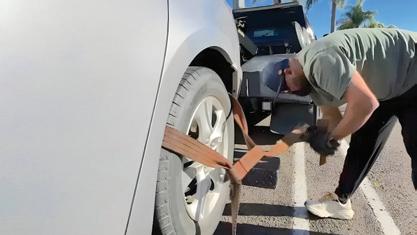
reports more members falling behind on car loans, with a growing number voluntarily surrendering vehicles. Veteran repossession operator Rich Whittaker said the reasons are strikingly consistent.
“Every person I deal with has a reason they fell behind,” Whittaker said. “Job loss, higher costs, less work—it’s the same story over and over.”
Sources: kutv.com and nbcsandiego.com
Tennessee is asking about 8,000 commercial driver license holders to provide proof of U.S. citizenship or lawful residence following an audit by the state Department of Safety and Homeland Security. State officials say the update is needed to ensure compliance with federal requirements that all CDL records include documentation of citizenship or lawful status. Many affected drivers received their licenses before those rules were in place. Tennessee announced Jan. 8, 2026 that it is updating older CDL records to meet current state and federal standards.
Out of roughly 150,000 Tennessee-issued CDLs, about 8,000 drivers will receive mailed notices requesting documentation that was not required at the time their licenses were issued. Drivers who do not receive a letter do not need to take action.
Only one acceptable document is required, and drivers must appear in person at a Driver Services Center. The deadline to comply is April 6, 2026. CDL holders who miss the deadline will have their licenses downgraded to noncommercial status until proof is provided.
Source: ttnews.com

by Don Lomax
Waymo (“WAY forward in MObility) temporarily suspended its self-driving, ride-hailing service in San Francisco after a widespread power outage knocked out traffic signals across the city, leaving many of its autonomous vehicles stopped at darkened intersections. The outage affected tens of thousands of residents and created traffic congestion as Waymo vehicles remained stationary while attempting to assess uncontrolled crossings.
Tow truck operators reported towing Waymo vehicles for hours overnight as the disruption continued. Videos posted on social media showed driverless cars stopped with hazard lights flashing, frustrating motorists and contributing to gridlock in several neighborhoods.
Service resumed after power was restored, but the incident underscored the essential role that towing profession-
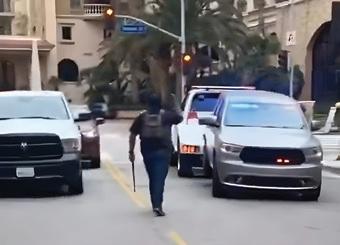
als play when autonomous vehicles are unable to recover on their own during large-scale infrastructure failures.
Source: nytimes.com
A South Los Angeles tow truck driver has been found not guilty of stealing a federal agent’s vehicle during an immigration arrest last summer. A federal jury acquitted Bobby Nunez, 33,
of theft of government property stemming from an August 2025 incident involving immigration enforcement officers. The charge carried a potential sentence of up to 10 years in federal prison. After a four-day trial, jurors deliberated for more than three hours before returning the not-guilty verdict.
Prosecutors alleged that Nunez interfered with federal agents as they arrested a Colombian woman accused of entering the United States illegally. According to court filings, agents parked two government vehicles, with emergency lights activated, at the exit of an apartment complex parking garage to block the woman’s car during the arrest.
Authorities said Nunez and another man approached the scene and were warned to leave. While agents dealt with the other individual, prosecutors claimed Nunez entered his Dodge tow truck and then towed away one of the government SUVs used to block the exit.
Federal officials said the SUV contained an agent’s firearm and keys. Nunez was arrested roughly two weeks later, but the jury ultimately rejected the government’s case.
Source: cbsnews.com/losangeles
A towman was killed and a woman was critically wounded after a shooting inside a tow truck in Northeast Philadelphia, police said. Towman Aaron Whitfield, 25, was pronounced dead at the scene. A 21-year-old woman was transported to a nearby hospital suffering from a gunshot wound, authorities said. According to police, a silver or gray Honda pulled alongside the tow truck, and two occupants opened fire into the vehicle. Investigators recovered between 15 and 20 shell casings at the scene, Inspector D.F. Pace said. Several bullets also struck a nearby building, with some rounds penetrating the second floor.
Source: cbsnews.com
U.S. Transportation Secretary Sean Duffy is withholding nearly $160 million from California after the state missed the Jan. 5 deadline to revoke more than 17,000 improperly issued non-domiciled commercial driver licenses (CDLs).
“It’s reckoning day for Governor Newsom and California,” Duffy said on Jan. 7, 2026, citing a Federal Motor Carrier Safety Administration (FMCSA) notice declaring “substantial noncompliance.” He accused the state of prioritizing illegal immigrants over public safety, and said the funding cut ensures federal dollars do not support “this charade.”
FMCSA Administrator Derek Barrs noted California partially implemented reforms, but failed to cancel 17,400 non-domiciled CDLs by the agreed date. The remaining 2,700 licenses are due for revocation by Feb. 13, 2026. Consequently, FMCSA will withhold 4% of the state’s National Highway Performance Program and Surface Transportation Block Grant funds starting fiscal 2027.
Source: ttnews.com
Waymo (“WAY forward in MObility) temporarily suspended its self-driving, ride-hailing service in San Francisco after a widespread power outage knocked out traffic signals across the city, leaving many of its autonomous vehicles stopped at darkened intersections. The outage affected tens of thousands of residents and created traffic congestion as Waymo vehicles remained stationary while attempting to assess uncontrolled crossings.
Tow truck operators reported towing Waymo vehicles for hours overnight as the disruption continued. Videos posted on social media showed driverless cars stopped with hazard lights flashing, frustrating motorists and contributing to gridlock in several neighborhoods.
Service resumed after power was restored, but the incident underscored the essential role that towing profession-
als play when autonomous vehicles are unable to recover on their own during large-scale infrastructure failures.
Source: nytimes.com
A South Los Angeles tow truck driver has been found not guilty of stealing a federal agent’s vehicle during an immigration arrest last summer. A federal jury acquitted Bobby Nunez, 33,
of theft of government property stemming from an August 2025 incident involving immigration enforcement officers. The charge carried a potential sentence of up to 10 years in federal prison. After a four-day trial, jurors deliberated for more than three hours before returning the not-guilty verdict.
Prosecutors alleged that Nunez interfered with federal agents as they arrested a Colombian woman accused of entering the United States illegally. According to court filings, agents parked two government vehicles, with emergency lights activated, at the exit of an apartment complex parking garage to block the woman’s car during the arrest.
Authorities said Nunez and another man approached the scene and were warned to leave. While agents dealt with the other individual, prosecutors claimed Nunez entered his Dodge tow truck and then towed away one of the government SUVs used to block the exit.
Federal officials said the SUV contained an agent’s firearm and keys. Nunez was arrested roughly two weeks later, but the jury ultimately rejected the government’s case.
Source: cbsnews.com/losangeles
A towman was killed and a woman was critically wounded after a shooting inside a tow truck in Northeast Philadelphia, police said. Towman Aaron Whitfield, 25, was pronounced dead at the scene. A 21-year-old woman was transported to a nearby hospital suffering from a gunshot wound, authorities said. According to police, a silver or gray Honda pulled alongside the tow truck, and two occupants opened fire into the vehicle. Investigators recovered between 15 and 20 shell casings at the scene, Inspector D.F. Pace said. Several bullets also struck a nearby building, with some rounds penetrating the second floor.
Source: cbsnews.com
U.S. Transportation Secretary Sean Duffy is withholding nearly $160 million from California after the state missed the Jan. 5 deadline to revoke more than 17,000 improperly issued non-domiciled commercial driver licenses (CDLs).
“It’s reckoning day for Governor Newsom and California,” Duffy said on Jan. 7, 2026, citing a Federal Motor Carrier Safety Administration (FMCSA) notice declaring “substantial noncompliance.” He accused the state of prioritizing illegal immigrants over public safety, and said the funding cut ensures federal dollars do not support “this charade.”
FMCSA Administrator Derek Barrs noted California partially implemented reforms, but failed to cancel 17,400 non-domiciled CDLs by the agreed date. The remaining 2,700 licenses are due for revocation by Feb. 13, 2026. Consequently, FMCSA will withhold 4% of the state’s National Highway Performance Program and Surface Transportation Block Grant funds starting fiscal 2027.
Source: ttnews.com
by Don Lomax